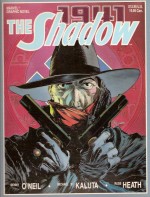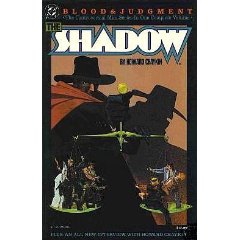
By Howard Chaykin (DC Comics)
ISBN-13: 978-0-93028-916-4
I’ve been a fan of The Shadow ever since I picked up a couple of paperbacks as a kid in my local Woolworths in the 1960s. I’ve followed the various comic interpretations with mixed feelings and general acceptance. But when Howard Chaykin had a crack at the venerable crime-crusher I nearly blew a gasket. I was appalled.
And that was the point.
Chaykin has lovingly cultivated his reputation as an iconoclast and bombast over many years and the four issue miniseries collected here certainly ruffled a few feathers – old fashioned me included.
As originally disseminated in the days before comic-books, The Shadow gave thrill-hungry readers their measured doses of extraordinary excitement via the cheaply produced periodical novels dubbed “pulps” (because of the low-grade paper they were printed on) and over the mood-drenched airwaves with his own radio show.
Pulps were published in their hundreds every month, ranging from the truly excellent to the pitifully dire, in every style and genre, but for exotic adventure lovers there were two star characters that outshone all others. The Superman of his day was Doc Savage, Man of Bronze, and the dark, relentless creature of the night dispensing his own terrifying justice was our mysterious slouch-hatted hero.
Originally the radio series Detective Story Hour, based on unconnected yarns from the Street & Smith publication Detective Story Magazine, used a spooky voiced narrator (most famously Orson Welles, although he was preceded by James LaCurto and Frank Readick Jr.) to introduce the tales. Code-named “the Shadow”, and beginning on July 31st 1930, he became more popular than the stories he introduced.
The Shadow became a proactive hero solving mysteries and on April 1st 1931 debuted in his own pulp series, written by the incredibly prolific Walter Gibson under the house pseudonym Maxwell Grant. On September 26th 1937 the radio show officially became The Shadow with the eerie line “Who knows what evil lurks in the hearts of Men? The Shadow knows!”
The Golden age comic book ran for 101 issues before cancellation in 1949 and Archie/Radio/Mighty Comics published a controversial modern-day version in 1964-5, written by Robert Bernstein with art from John Rosenberger and latterly Paul Reinman.
In 1973 DC acquired the comic rights and produced a captivating if brief series of classic tales that were unlike any other superhero title then on the stands.
Grant wrote 282 of 325 novels over the next two decades, which were published twice a month. The series spawned comic books, seven movies, a newspaper strip (by Vernon Greene) and all the merchandising paraphernalia you’d expect of a superstar brand. The pulp series ended in 1949 although many novels have been written (both by Gibson and others) since 1963 when a pulp and fantasy revival gripped America.
And 1949 is the embarkation point for this flashy, savage, witty and utterly captivating updating. The Shadow vanished in 1949, abandoning his crusade to destroy criminals and now (for which read 1986) some mastermind is eliminating every surviving member of his organization. Suddenly he is back dealing bloody justice to petty thugs as he tracks down his oldest enemy and thwarts a deadly plan to bring about nuclear annihilation. Chaykin even has the chutzpah to provide the eternal Man of Mystery with a Real Origin, something he never really had before!
I don’t know why I used to hate this book: Although I still feel the proper milieu for the character is the iconic era of mobsters, militarists and madmen (by which I mean the 1930s and 1940s) I can see what Chaykin’s getting at. Those threats were common enough in the Eighties and still are even nowadays.
Perhaps the author’s trademark trick of confronting misogyny, racism and sexuality by seemingly advocating them just wore a bit thin with such a treasured old friend as the vehicle. There’s certainly a disquieting amount of adult themes, kinky sex and graphic violence on offer, so kids, be prepared to show those fake ID’s…
With sufficient distance however I find this tale a terrific thrill-ride, stylish and compelling – if a little “in your face”. It spawned an intriguing follow-up series (by Andy Helfer and Bill Sienkiewicz if memory serves) before DC tried one final time with a series safely returned to the pre war period.
If you’ve never seen the original this would be a marvelous read, and you could always compliment the experience by tracking down DC’s first experiment with the character (mostly collected as The Private Files of the Shadow ISBN: 0-930289-37-7). After all a hero this durable has to have something to him…
© 1987 Conde Nast Publications, Inc. All Rights Reserved.