By Matt Fraction & Doug Braithwaite (Marvel)
ISBN: 978-0-7851-3426-8
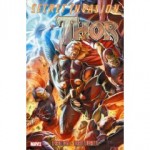
The Skrulls are shape-shifting aliens who’ve bedeviled Earth since Fantastic Four #2, and they have long been a cornerstone of the Marvel Universe. After decades of use and misuse the insidious invaders were made the stars of a colossal braided mega-crossover event beginning in April 2008 and running through all the company’s titles until Christmas.
The premise of Secret Invasion is simple: the would-be conquerors have undergone a mass religious conversion and upped their game. They are now utterly resolved and dedicated to make Earth their new homeworld. To this end they have gradually replaced a number of key Earth denizens – including superheroes. When the lid is lifted no defender of the Earth truly knows who is on their side…
Along with that the Skrulls have also unraveled the secrets of magic and superpowers, creating amped-up counterparts to Earth’s mightiest and set them loose to destroy the world’s heroic champions.
Broxton, Oklahoma, is a small simple community with some intriguing neighbours. Local doctor Don Blake is dealing with a problem pregnancy in town when a colossal fireball strikes and he discovers that an old friend has returned. Blake is the mortal host for the God of Thunder and the fiery impact signals the agonized return of his old comrade Beta Ray Bill, an alien hero who possesses power the equal of his own.
The alien is severely wounded: tortured and traumatized near to death, he was thrown to Earth as a warning. The Asgardians must leave the world immediately. If they fight for humanity or oppose the Skrulls they will be destroyed by the same power that shattered Beta Ray Bill…
And so begins another glorious classic of noble combat as the unstoppable invaders are resisted by the epitome of supernatural nobility in a tale of heroism, tragedy, sacrifice and redemption that is any fan’s wildest dream.
But…
This is an oh-so-nearly perfect superhero fun-fest that just misses because of – as is too often the case – editorial sloppiness or lazy thinking.
I was dubious when J. Michael Straczynski and Olivier Coipel revamped Thor but their thoughtful and fun reiteration which established the return of the Norse gods and the rebuilding of the hallowed city of Asgard in – or rather slightly above – the Oklahoma badlands proved an intriguing delight and a solid springboard for fresh wonderment.
Moreover the three-issue miniseries which comprises the Asgardly niche of the company-wide event is compellingly written and superbly illustrated – if only it were longer… I even adore the fact that to pad out the book the editors have included a pertinent 1967 Lee/Kirby Thor classic ‘The Scourge of the Super Skrull!’, from Thor #142, wherein the Son of Odin delivered a sound and spectacular trouncing to a shape-changing marauder with all the powers of the Fantastic Four, but Why on Earth would any editor also include that issue’s back-up strip as well?
Don’t get me wrong: ‘We who are about to Die…!’ is Kirby at his most creative and mythic. He’s revisiting the legends of the Arabian knights with a young Thor and the Warriors Three fighting Djinni, wizards, giants and a host of fantastic horrors.
But this is part 6 of a nine-chapter Tales of Asgard epic that is just plain bewildering seen in isolation. It is five pages of pictorial candy that needs to be in a whole collection of these brilliant fantasy back-ups, not sitting here uncomfortably out of place and generally unappreciated because someone couldn’t search the archives for something more appropriate and new-reader accessible. As there was still room for two text pages on Beta ray Bill why not just add similar pages on Skrulls and Super Skrull? An old Asgard adventure from Marvel Comics Presents? Even a pin-up or two?
Ranting aside: There’s too much competition for the leisure dollar – and £ – to risk alienating new readers even slightly and dedicated fans surely deserve a little regard for their years of service. With the incredible wealth of material sitting unseen and unused in those capacious comics vaults surely a little industry and creativity isn’t too much to ask?
By Alan Zelenetz & Charles Vess (Marvel)
ISBN: 0- 87135-060-2
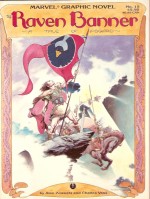
It’s been a while since Marvel published an all-original graphic novel as opposed to a collection, but not too long ago they were the market leader in the field with an entire range of “big stories” told on larger than normal pages (285 x 220mm rather than the now customary 258 x 168mm) featuring not only proprietary characters but also licensed assets like Conan and even creator-owned properties like Jim Starlin’s Dreadstar.
From the cod mythology of Marvel’s bowdlerized Aesir Alan Zelenetz and Charles Vess crafted this beautiful fairytale/fable that would not be out of place amongst the true Elder Eddas. Merry Marvelites will be enthralled by the inclusion of Balder the Brave as well as cameos by such Asgardian stalwarts as Thor and Hogun, Fandral and Volstagg – the Warriors Three – but the true story of honour lost and redeemed in the name of eternal glory belongs to the young wastrel Greyval Grimson who forsook his duty and paid the proper price.
Asgard is land of warrior gods constantly confronting monstrous evil, but Storm Giants, witches and dark elves can never triumph as long as heroes battle beneath the flowing Raven Banner. As long as the standard bearer holds it high, victory is assured, although its ancient magic demands the death of the bearer every time. But when the eternal enemies clash upon the Plain of Ida and Grim Magnus fulfills his fated task, for the first time his successor is not there to take up the perilous pennon. Where is the dying warrior’s son?
Greyval Grimson, although wed to Sygnet the Valkyrie Shield-Maiden, is still a flighty lad, full of joy and keen on merriment. As the Banner is torn from his father’s dying grasp the boy is dancing drunk with the treacherous trolls. Seduced from his duty, he is yet unaware that his negligence has not only lost him a father but also imperiled the entire kingdom of the Gods…
The penitent boy’s quest to regain the Raven Banner and his own true self is an unparalleled, magical tale of heroism, as accompanied by Balder and the fuzzy but querulous Oddbrand, the Otter God, he strives to overcome not only the assembled forces of Death and Evil, but also the overbearing ambition of a fellow Asgardian, whose head has been turned by dreams of unearned fame…
By J. Michael Straczynski, Olivier Coipel & Mark Morales (Marvel)
ISBN: 978-0-7851-1722-3
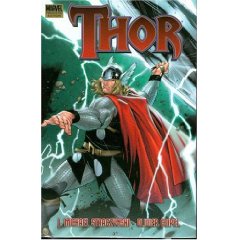
I’m always a little dubious about high-profile, big-name relaunches, coming as I do from that curmudgeonly old school which believes that “there are no bad characters”, “Iconoclasm isn’t Creativity” and especially “Famous doesn’t mean Good”.
So it’s rather refreshing to be able to say that the newest incarnation of Marvel’s God of Thunder is a delightfully good read. Collecting issues #1-6 of the monthly comicbook it finds all the entities of Asgard dead and gone (see Avengers Disassembled: Thor,ISBN: 978-0-7851-1599-1 for the startling details) until a mysterious voice summons Thor back to life – and Earth (us fans call it Midgard) – in a crack of spectacular thunder. Revived for an unspecified purpose the solitary Lord of Asgard sets about retrieving the souls of his fellow godlings, scattered and hidden inside human hosts – or perhaps incubators?
There’s a welcome reappearance and significant role for Thor’s early alter-ego Don Blake when the Thunderer rebuilds Asgard in the wilds of Oklahoma and plenty of action as the immortal hero adapts to a world that has radically changed since his demise. Even with cataclysmic battles against former ally Iron Man and the Dread Demolisher, plus a radical new look for the hero’s oldest and most implacable foe, the real joy here is the savvy script, especially the interactions between the resurrected gods and their new neighbours the ordinary folks of Broxton, Oklahoma,.
Beautiful to look at, engagingly written and with a welcome dose of political intrigue and social commentary, this “cosmic comic” has a lot of earthy resonance to balance the scope of its own mythology and, despite ending on an annoying cliffhanger, is a book to recommend to complete neophytes as well as dedicated fans. If you’ve never seen Thor before, you should now…
By Stan Lee, Jack Kirby & various (Marvel)
ISBN 0-7851-1866-7
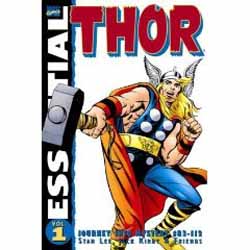
Even more than the Fantastic Four The Mighty Thor was the arena in which Jack Kirby’s restless fascination with the Cosmic was honed and refined in dazzling graphics and captivating concepts. His string of pantheons began with a modest little fantasy title called Journey into Mystery where in the summer of 1962 a tried-and-true comicbook concept (feeble mortal transformed into God-like hero) was employed by the fledgling Marvel Comics to add a Superman analogue to their growing roster of costumed adventurers. This gloriously economical tome represents those Asgardian exploits from JiM #83-112 in clean crisp black and white for your delectation.
Journey into Mystery #83 (cover-dated August 1962) featured the tale of crippled American doctor Donald Blake who takes a vacation in Norway only to encounter the vanguard of an alien invasion. Fleeing he is trapped in a cave where he finds an old, gnarled walking stick. When in his frustration he smashes the cane into a huge boulder obstructing his escape, his puny frame is transformed into the Norse God of Thunder, the Mighty Thor! Plotted by Stan Lee, scripted by Larry Lieber and illustrated by Kirby and Joe Sinnott (at this juncture a full illustrator, Sinnott would become Kirby’s primary inker for his Marvel career) ‘The Stone Men of Saturn’ is pure early Marvel, bombastic, fast-paced, gloriously illogical and captivatingly action-packed. The hugely under-appreciated Art Simek was the letterer and logo designer.
They were making it up as they went along – not in itself a bad thing – and the infectious enthusiasm shows in the next adventure ‘The Mighty Thor Vs. the Executioner’, a “commie-busting†tale of its time with a thinly disguised Fidel Castro wasting his formidable armies in battle against our hero. Dr. Blake’s nurse Jane Foster was introduced, a bland cipher adored from afar by the timid alter-ego of mighty hero. The creative team settled as Dick Ayers replacing Sinnott, and with #85’s ‘Trapped by Loki, God of Mischief!’ the last element fell into place with the introduction of a suitably awesome arch-foe; in this case a half-brother evil magician. We also saw a new world revealed with the first hints and glimpses of the celestial otherworld and more Nordic gods.
Issue #86 introduced another recurring villain. Zarrko, bristling at the sedentary ease of 23rd century life, travelled to our time to steal an experimental “C-Bomb†forcing the God of Thunder into a stirring chase through time and battle with super-technology ‘On the Trail of the Tomorrow Man!’, whilst on his return Don Blake became a target for Soviet abductors. Those sneaky spies even managed to make Thor a ‘Prisoner of the Reds!’
‘The Vengeance of Loki’ saw the god of Evil’s flamboyant, bombastic return in #88, but ‘The Thunder God and the Thug’ was an adventure with a much more human scale as a gang boss runs riot over the city and roughshod over a good woman’s heart, giving the Asgardian a chance to demonstrate a more sophisticated and sympathetic side. Issue #90 was a total surprise to fans as the grandeur of Kirby and Ayers was replaced by the charming but drama-free art of Al Hartley, who illustrated a stock invasion tale of shape-changing aliens. ‘Trapped by the Carbon-Copy Man’ was followed a month later by ‘Sandu, Master of the Supernatural!’, with Joe Sinnott handling all the art, in a thriller starring a carnival mentalist augmented by Loki’s magic who comes close to killing our hero.
Sinnott also drew #92’s ‘The Day Loki Stole Thor’s Magic Hammer’ scripted by Robert Bernstein over Lee’s plot which moved the action fully to the mythical realm of Asgard for the first time as the hero sought to recover his stolen weapon. Kirby and Ayers returned for the Cold War thriller ‘The Mysterious Radio-Active Man!’, again plotted by Bernstein, as Mao Tse Tung unleashes an atomic assassin in retaliation for Thor thwarting China’s invasion of India. Such “Red-baiting†was common in early Marvel titles, but their inherent jingoistic silliness can’t mar the eerie beauty of the artwork. With this tale the rangy raw-boned Thunder God completed his slow metamorphosis into the husky, burly blonde bruiser that dominated any panel he was drawn in.
Sinnott illustrated the next three adventures ‘Thor and Loki Attack the Human Race!’, ‘The Demon Duplicator’ and ‘The Magic of Mad Merlin!’, but these mediocre tales of amnesia, evil doppelgangers and ancient menaces were the last of a old style of comics. Stan Lee took over the scripting with the Journey into Mystery #97 and action wedded to melodrama produced a fresh style for a developing readership.
‘The Lava Man’ was again drawn by Kirby, with the subtly textured inking of Don Heck adding depth to the tale of an invader from the subterranean realms, as a long running rift with Thor’s father Odin was established when the Lord of Asgard refused to allow his son to love the mortal Jane Foster. This acrimonious triangle was a perennial sub-plot that fuelled many attempts to humanise Thor, because already he was a hero too powerful for most villains to cope with. This issue was also notable for the launch of a spectacular back-up series. ‘Tales of Asgard – Home of the mighty Norse Gods’ gave Jack Kirby a space to indulge his fascination with legends. Initially adapting classic tales but eventually with all-new material particular to the Marvel pantheon, he built his own cosmos and mythology, which underpinned the company’s entire continuity. This first saga, scripted by Lee and inked by George Bell (AKA George Roussos) outlined the origin of the world and the creation of the World Tree Yggdrasil.
‘Challenged by the Human Cobra’ introduced the serpentine villain (bitten by a radioactive Cobra, would you believe?) in a tale by Lee and Heck, whilst Kirby, with them in attendance contributed ‘Odin Battles Ymir, King of the Ice Giants!’ a short but potent fantasy romp which presaged the cosmic wonderment of years to come. The same format held for issues #99 and #100, where the main story (the first two-part adventure in the run) introduced the bestial ‘Mysterious Mister Hyde’, and concluding ‘The Master Plan of Mr. Hyde!’ dealt with a contemporary super-villain Kirby produced ‘Surtur the Fire Demon’ and latterly (with Vince Colletta inks) ‘The Storm Giants – a tale of the Boyhood of Thor’. As always Lee scripted this increasingly influential comicbook.
JIM #101 saw Kirby finally assume complete control of the pencilling on both strips. ‘The Return of Zarrko, the Tomorrow Man’ sees Odin halve Thor’s powers for disobedience just as the futuristic felon abducts the Thunder God to help him conquer the 23rd century. Anther two-parter (the first half inked by Roussos), it was balanced by another exuberant tale of the boy Thor. ‘The Invasion of Asgard’ sees the valiant lad fight a heroic rearguard action that introduced a host of future villainous mainstays. ‘Slave of Zarrko, the Tomorrow Man’ is a tour de force epic conclusion most notable for the introduction of Chic Stone as inker. To many of us oldsters, the clean full brush lines make him The King’s best embellisher ever. This triumphant epic is balanced by the brooding short ‘Death Comes to Thor!’ as the young hero faces his greatest challenge yet. Two females that would play huge roles in his life were introduced in this brief 5-pager, the young Goddess Sif and Hela, Queen of the dead.
On a creative roll, Lee Kirby and Stone next introduced ‘The Enchantress and the Executioner’ ruthless renegade Asgardians in the front of JIM #103 and in ‘Thor’s Mission to Mirmir’ revealed how the gods created humanity, which lead to a revolutionary saga ‘Giants Walk the Earth’ in the next issue. For the first time Kirby’s imagination was given full play as Loki tricked Odin into visiting Earth, only to release ancient foes Surtur and Skagg, the Storm Giant from Asgardian bondage.
This cosmic saga saw noble gods stride the Earth battling demonic evil in a new Heroic Age, and the greater role of the Norse supporting cast was reinforced by a new Tales of Asgard strand focussing on individual Gods and Heroes. Heimdall the Sentry was first, with Don Heck inking. Issue #105-106 saw the teaming of two old foes in ‘The Cobra and Mr, Hyde’ and ‘The Thunder God Strikes Back’, another continued story packed with tension and spectacular action, which showed that Thor was swiftly growing beyond the constraints of traditional single story adventures. The respective back-ups ‘When Heimdall Failed!’ (Lee, Kirby, Roussos) and ‘Balder the Brave’ (Lee, Kirby, Colletta) further fleshed out the back-story of an Asgardian pantheon deviating more and more from the classical Eddas and Sagas kids had to plough through in schools.
JIM #107 introduced another major villain in ‘When the Grey Gargoyle Strikes’, a rare tale that highlighted the fortitude of Don Blake rather than the Thunder God, who was increasingly reducing his own alter-ego to an inconsequentiality, and the Norn Queen debuted in the quirky reinterpretation of the classic tale ‘Balder Must Die!’ illustrated by Kirby and Colletta. After months of manipulation the God of Evil once again took direct action in ‘At the Mercy of Lokj, Prince of Evil!’ With Jane a helpless pawn to Asgardian magic the willing help of new Marvel star Doctor Strange made this a captivating team-up to read, whilst ‘Trapped by the Trolls’ (inked by Colletta) showed the power and promise of tales set solely on the other side of the Rainbow Bridge. Issue #109 was another superb adventure masquerading as a plug for another new series. ‘When Magneto Strikes!’ pitted Thor against the X-Men’s greatest foe in a cataclysmic clash, but you couldn’t actually call it a team-up as the heroic mutants were never seen. The teasing hints and cropped glimpses are fascinating teasers now, but the kid I was annoyed not to have seen these new heroes. Oh… maybe that was the point?
The young Thor feature ‘Banished from Asgard’ is uncharacteristically lacklustre but the concluding part ‘The Defeat of Odin!’ in JiM #110 makes up for the silly plot with breathtaking battles scenes. The lead story in that issue is ‘Every Hand Against Him’ as Loki, the Cobra and Mr. Hyde kidnap Jane as Odin once again over-reacts to Thor’s affections for the mortal girl. The concluding part ‘The Power of the Thunder God’ features a major role for Balder the Braver, further integrating the “historical†and contemporary Asgards in a spellbinding saga of triumph and near-tragedy, whilst the Tale of Asgard co-opts a Greek myth (Antaeus if you’re asking) for ‘The Secret of Sigurd’.
This wonderfully economical black-and white compendium closes with the contents of Journey into Mystery #112. ‘The Mighty Thor Battles the Incredible Hulk!’ is a glorious gift to all those fans who perpetually ask “Who’s stronger…?†Possibly Kirby and Stone’s finest artistic moment, it details a private duel between the two super-humans that occurred during a free-for-all between The Avengers, the Sub-Mariner and the eponymous Green Goliath. The raw power of that tale is followed by ‘The Coming of Loki’, a retelling of how Odin came to adopt the baby son of Laufey, the Giant King.
These early tales of the God of Thunder show the development not only of one of Marvel’s fundamental story concepts but more importantly the creative evolution of one of the greatest imaginations in comics. Set your commonsense on pause and simply wallow in the glorious imagery and power of these classic adventures for the true secret of what makes graphic narrative a unique experience.