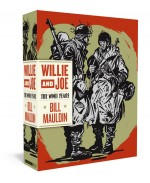
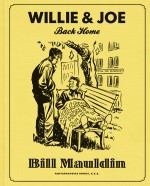
Willie and Joe: Back Home


By Bill Mauldin (Fantagraphics Books)
ISBN: 978-1-60699-351-4

Throughout World War II William Henry “Bill” Mauldin fought “Over There” with the United States Infantry whilst producing cartoons about the fighting men and for the fighting men. He told as much of the real nature of the war as his censors and common sense would allow and became an unwilling international celebrity as much because of his unshakable honesty as his incredible artistic talent.

He was in controvertibly one of the guys and American soldiers and civilians loved him for it. During his time in the service he produced cartoons for the folks back home and intimately effective, authentic and quirkily morale-boosting material for military publications 45th Division News, Yank and Stars and Stripes.

They mostly featured two slovenly “dogfaces” – a term he made his own and introduced to the world at large – giving a trenchant and acerbically enduring view of the war from the point of view of the poor sods ducking bullets in muddy foxholes and surviving shelling in the ruins of Europe.

Willie and Joe, to the dismay of much of the Army Establishment, gave an honest overview of America’s ground war. In 1945 a collection of his drawings, accompanied by a powerfully understated and heartfelt documentary essay, was published by Henry Holt and Co. Up Front was a sensation, telling the American public about the experiences of their sons, brothers, fathers and husbands in a way no historian would or did. A biography, Back Home, followed in 1947.

Willie even made the cover of Time magazine in 1945, when 23 year old Mauldin won his first Pulitzer Prize. Like so many other returning soldiers, however, Mauldin’s hard-won Better Tomorrow didn’t live up to its promise…

Mauldin’s anti-war, anti-Idiots-in-Charge, anti-bigot views never changed but found simply new targets at home. However, during the earliest days of the Cold War and despite being a bone fide War Hero, Mauldin’s politically strident cartoons fell ever more out of step with the New America: a place where political expediency allowed racists to resume repressing ethnic sections of the nation now that their blood and sweat were no longer needed to defeat the Axis; a nation where women were expected to surrender their war-time freedoms and independences and become again servants and baby machines, happy to cook suppers in return for the new labour-saving consumer goods America now needed to sell, sell, sell: a nation far too eager to forget the actual war and genuine soldiers in favour of massaged messages and conformist, inspirational paper or celluloid heroes.

The New America certainly didn’t want anybody rocking their shiny new boat…

When Sergeant Bill Mauldin mustered out in 1945 he was notionally on top of the world: celebrity hero, youngest Pulitzer Prize winner in history, with a lucrative 3-year syndicated newspaper contract and Hollywood clamouring for him.

Unfortunately, the artist was as dedicated to his ideals as to his art. As soon as he became aware of the iniquities of the post-war world he went after them, using his newspaper cartoon as a soapbox, Mauldin attacked in bitterly brilliant barrages the maltreatment and sidelining of actual soldiers (during the country’s entire involvement in WWII less than 10% of military men actually fought, or even left their home country) whilst rear-echelon brass seemed to increasingly reap the benefits and unearned glory of the peace.

The ordinary enlisted men and veterans were culture-shocked, traumatised, out of place and resented by the public who blamed them disproportionately for the shortages and “suffering” they had endured. Black and Japanese Americans were reduced to second class citizens and America’s erstwhile allies demonised, whilst everywhere politicians and demagogues were rewriting recent history for their own advantage… His fondest wish had been to kill the iconic dogfaces off on the final day of World War II, but Stars and Stripes vetoed it, and the demobbed survivors moved into a world that had changed incomprehensibly in their absence…

Always ready for a fight, Mauldin’s peacetime Willie and Joe became a noose around the syndicate’s neck as the cartoonist’s acerbic, polemical and decidedly non-anodyne observations perpetually highlighted the iniquities and stupidities inflicted on returning servicemen, attacked self-aggrandising politicians, advocated such socialist horrors as free speech, civil rights and unionisation, affordable public housing and universal medical care for everybody – no matter what their colour, gender or religion. He even declared war on the Ku Klux Klan, American Legion and red-baiting House UnAmerican Activities Commission: nobody was too big. When the Soviet Union and United Nations betrayed their own ideological principles Mauldin went after them too…

An honest broker he had tried to quit early, but the syndicate held him to his contract. Trapped in a situation that increasingly stifled his creative urges and muzzled his liberal/libertarian sensibilities, he refused to toe the line and his cartoons were incessantly altered and reworked. During six years of War service his cartoon had been censored three times; now the white paint and scissors were employed by rewrite boys almost daily…

The movie Up front – which Mauldin wanted to reflect the true experience of the war – languished unmade for six years until a sappy flimsy comedy bearing the name was released in 1951. The intended screenplay by Mauldin, John Lardner and Ring Lardner Jr., disappeared, deemed utterly unsuitable and unfilmable until much of its tone reappeared in Lardner Jr.’s 1970 screenplay M*A*S*H…

As the syndicate bled clients, mostly in segregationist states, and contemplated terminating his contract, Mauldin began simultaneously working for the New York Herald-Tribune and with a new liberal outlet changed his tactics in the Willie and Joe feature: becoming more subtle and less bombastic. He still picked up the best of enemies however, adding J. Edgar Hoover and the FBI to the roster of declaimers and decriers…

When his contract finally ended in 1948, neither side wanted to renew. Mauldin left the business to become a journalist, freelance writer and illustrator. He was a film actor for awhile (appearing in Red Badge of Courage with Audie Murphy among other movies), a war correspondent during the Korean Conflict and an unsuccessful candidate for Congress in 1956.

He only finally returned to newspaper cartooning in 1958 in a far different world and worked for the St. Louis Post-Dispatch before moving to the Chicago Sun-Times, winning another Pulitzer and a Reuben Award for his political cartoons

He retired in 1991 after a long, glittering and properly- appreciated career. He only drew Willie and Joe four times in that entire period (for an article on the “New Army” in Life magazine; for the funerals of “Soldier’s Generals” Omar Bradley and George C. Marshall and to eulogize Milton Caniff).

This magnificent hardback companion volume to Willie and Joe: the WWII Years covers the period of work from July 31st 1945 to 31st December 1948, supplemented by a brilliant biographical introduction from Todd DePastino: a superb black and white compendium collecting the bittersweet return of the forgotten heroes as they faced confusion, exclusion, contention and disillusion: but always with the edgy, stoic humour under fire that was Mauldin’s stock in trade.

Moreover it features some of the most powerful assaults on the appalling edifice of post-war America ever seen. The artist’s castigating observations on how a society treats returning soldiers are as pertinent now as they ever were; the pressures on families and children even more so; whilst his exposure of armchair strategists, politicians and businessmen seeking to exploit wars for gain and how quickly allies can become enemies are tragically more relevant than any rational person could wish.

Alternating trenchant cynicism, moral outrage, gallows humour, sanguine observation and uncomprehending betrayal, this cartoon chronicle is an astounding personal testament that shows the powers of cartoons to convey emotion if not sway opinion.

With Willie & Joe: the WWII Years, we have here a magnificent example of passion and creativity used as a weapon of social change and a work of art every citizen should be exposed to, because these are aspects of humanity that we seem unable to outgrow…

This edition © 2011 Fantagraphics Books. Cartoons © 2011 the Estate of William Mauldin. All right reserved.

Willie and Joe: the WWII Years


By Bill Mauldin, edited by Todd DePastino (Fantagraphics Books)
ISBN: 978-1-60699-439-9

During World War II a talented, ambitious young man named William Henry “Bill” Mauldin (29/10/1921 – 22/01/2003) fought “Over There” with the 45th Division of the United States Infantry as well as many other fine units of the army. He learned to hate war and love his brother soldiers – and the American fighting man loved him back. During his time in the service he produced civilian cartoons for the Oklahoma City Times and The Oklahoman, and intimately effective and authentic material for his Company periodical, 45th Division News, as well as Yank and Stars and Stripes; the US Armed Forces newspapers. Soon after, his cartoons were being reproduced in newspapers across Europe and America.

They mostly featured two slovenly “dogfaces” – a term he popularised – giving a trenchant and laconic view of the war from the muddied tip of the sharpest of Sharp Ends. Willie and Joe, much to the dismay of the brassbound, spit-and-polish military martinets and diplomatic doctrinaires, became the unshakable, everlasting image of the American soldier: continually revealed in all ways and manners the upper echelons of the army would prefer remained top secret.

Willie and Joe even became the subject of two films (Up Front -1951 and Back at the Front – 1952) whilst Willie made the cover of Time magazine in 1945, when 23 year old Mauldin won his first Pulitzer Prize.

In 1945 a collection of his drawings, accompanied by a powerfully understated and heartfelt documentary essay, was published by Henry Holt and Co. Up Front was a sensation, telling the American public about the experiences of their sons, brothers, fathers and husbands in a way no historian would or did. A biography, Back Home, followed in 1947.

Mauldin’s anti-war, anti-Idiots-in-Charge-of-War views became increasingly unpopular during the Cold War and despite being a War Hero Mauldin’s increasingly political cartoon work fell out of favour (those efforts are the subject of forthcoming companion volume Willie & Joe: Back Home).  Mauldin left the business to become a journalist and illustrator.

He was a film actor for awhile (appearing in Red Badge of Courage with Audie Murphy among other movies), a war correspondent during the Korean War and, after an unsuccessful campaign for Congress in 1956, finally returned to newspaper cartooning in 1958.

He retired in 1991 after a long, glittering and award-studded career. He only drew Willie and Joe four times in that entire period (for an article on the “New Army” in Life magazine; for the funerals of “Soldier’s Generals” Omar Bradley and George C. Marshall; and to eulogize Milton Caniff). His fondest wish had been to kill the iconic dogfaces off on the final day of World War II, but Stars and Stripes vetoed it.

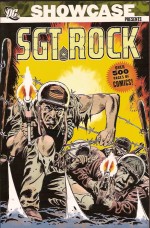
The Willie and Joe cartoons and characters are some of the most enduring and honest symbols of all military history. Every Veterans Day in Peanuts from1969 to 1999, fellow veteran Charles Schulz had Snoopy turn up at Mauldin’s house to drink Root Beers and tell war stories with an old pal. When you read Sgt. Rock you’re looking at Mauldin’s legacy, and Archie Goodwin drafted the shabby professionals for a couple of classy guest-shots in Star-Spangled War Stories (see Showcase Presents the Unknown Soldier).

This immense mostly monochrome (with some some very rare colour and sepia items) softcover compendium – 704 pages, 229 x 178mm – collects all his known wartime cartoons originally released in two hardback editions in 2008, featuring not only the iconic dog-face duo, but also the drawings, illustrations, sketches and gags that led, over 8 years of army life, to their creation.

Mauldin produced most of his work for Regimental and Company newspapers whilst under fire: perfectly capturing the life and context of fellow soldiers – also under battlefield conditions – and gave a glimpse of that unique and bizarre existence to their families and civilians at large, despite constant military censorship and even face-to-face confrontations with Generals such as George Patton, who was perennially incensed at the image the cartoonist presented to the world. Fortunately Supreme Commander Eisenhower, if not a fan, knew the strategic and morale value of Mauldin’s Star Spangled Banter and Up Front feature with the indomitable everymen Willie and Joe…

This far removed in time, many of the pieces here might need historical context for modern readers and such is comprehensively provided by the notes section to the rear of the volume. Also included are unpublished pieces and pages, early cartoon works, and rare notes, drafts and sketches.

Most strips, composites and full-page gags, however are sublimely transparent in their message and meaning: lampooning entrenched stupidity and cupidity, administrative inefficiency and sheer military bloody-mindedness whilst highlighting the miraculous perseverance and unquenchable determination of the ordinary guys to get the job done while defending their only inalienable right – to gripe and goof off whenever the brass weren’t around… Moreover Mauldin never patronises the civilians or demonises the enemy: the German and Italians are usually in the same dismal boat are “Our Boys” and only the war and its brass-bound conductors are worthy of his inky ire…

Alternating trenchant cynicism, moral outrage, gallows humour, absurdist observation, shared miseries, staggering sentimentality and the total shock and awe of still being alive every morning, this cartoon catalogue of the Last Just War is a truly breathtaking collection that no fan, art-lover, historian or humanitarian can afford to miss.

…And it will make you cry and laugh out loud too.

With a fascinating biography of Mauldin that is as compelling as his art, the mordant wit and desperate camaraderie of his work is more important than ever in an age where increasingly cold and distant brass-hats and politicians send ever-more innocent lambs to further foreign fields for slaughter. With this volume and the aforementioned Willie & Joe: Back Home, we should finally be able to restore the man and his works to the forefront of graphic consciousness, because tragically, his message is never going to be out of date…

© 2011 the Estate of William Mauldin. All right reserved.

Showcase Presents The War that Time Forgot


By Robert Kanigher, Ross Andru, Mike Esposito & various (DC Comics)
ISBN: 978-1-4012-1253-7

The War that Time Forgot debuted in Star Spangled War Stories #90 (April-May 1960) and ran until #137 (May 1968) skipping only three issues: #91, 93 and #126 (the last of which starred the United States Marine Corps simian Sergeant Gorilla – look it up: I’m neither kidding nor being metaphorical…) and this stunningly bizarre black and white compendium contains the monstrously madcap material from #90, 92, 94-125 and 127-128.

Simply too good a concept to leave alone, this seamless, shameless blend of Sir Arthur Conan Doyle’s Lost World and Edgar Rice Burroughs’ Caprona stories (known alternatively as the Caspak Trilogy or “the Land That Time Forgot”) provided everything baby-boomer boys could dream of: giant lizards, humongous insects, fantastic adventures and two-fisted heroes with lots of guns…

Robert Kanigher (1915-2002) was one of the most distinctive authorial voices in American comics, blending rugged realism with fantastic fantasy in his signature war comics, horror stories, superhero titles such as Wonder Woman, Lois Lane, Teen Titans, Hawkman, Metal Men, Batman and others genres too numerous to cover here. He scripted ‘Mystery of the Human Thunderbolt’ – the first story of the Silver Age which introduced Barry Allen AKA the Flash to the hero-hungry kids of the World in 1956.

Kanigher sold his first stories and poetry in 1932, wrote for the theatre, film and radio, and joined the Fox Features shop where he created The Bouncer, Steel Sterling and The Web, whilst providing scripts for Blue Beetle and the original Captain Marvel. In 1945 he settled at All-American Comics as both writer and editor, staying on when the company amalgamated with National Comics to become the forerunner of today’s DC. He wrote Flash and Hawkman, created Black Canary and Lady Cop, plus memorable villainesses Harlequin and Rose and Thorn. This last he reconstructed, during the relevancy era of the early 1970s, into a schizophrenic crime-busting super-heroine.

When mystery-men faded out at the end of the 1940s, Kanigher moved into westerns and war stories, becoming in 1952 writer/editor of the company’s combat titles: All-American War Stories, Star Spangled War Stories and Our Amy at War. He created Our Fighting Forces in 1954 and added G.I. Combat to his burgeoning portfolio when Quality Comics sold their line of titles to DC in 1956, all the while working on Wonder Woman, Johnny Thunder, Rex the Wonder Dog, Silent Knight, Sea Devils, Viking Prince and a host of others.

Among his many epochal war series were Sgt. Rock, Enemy Ace, the Haunted Tank and The Losers as well as the visually addictive, irresistibly astonishing “Dogfaces and Dinosaurs” dramas depicted here. Kanigher was a restlessly creative writer and I suspect that he used this uncanny but formulaic adventure arena as a personal tryout venue for his many series concepts. The Flying Boots, G.I. Robot, Suicide Squad and many other teams and characters first appeared in this lush Pacific hellhole with wall-to-wall danger. Indisputably the big beasts were the stars but occasionally ordinary G.I .Joes made enough of an impression to secure return engagements, too…

The wonderment commenced in Star Spangled War Stories #90 as paratroops and tanks of “Question Mark Patrol” were dropped on Mystery Island from whence no American soldiers have ever returned. The crack warriors discovered why when the operation was plagued by Pterosaurs, Tyrannosaurs and worse on the ‘Island of Armoured Giants!’, all superbly rendered by veteran art team Ross Andru & Mike Esposito. Larry and Charlie, the sole survivors of that first foray, returned to the lost world in #92’s ‘Last Battle of the Dinosaur Age!’ when aquatic beasts attacked their rescue submarine forcing them back to the lethal landmass…

‘The Frogman and the Dinosaur!’ took up most of SSWS #94 as a squad of second-rate Underwater Demolitions Team divers were trapped on the island encountering the usual bevy of blockbuster brutes and a colossal crab as well. What started out as Paratroopers versus Pterodactyls in #95 turned into a deadly turf-war in ‘Guinea Pig Patrol!’ whilst ‘Mission X!’ introduced the Task Force X/Suicide Squad in a terse infiltration story as the increasing eager US military strove to set up a base on the strategically crucial monster island.

The Navy took the lead in #97’s ‘The Sub-Crusher!’ with equally dire results when a giant gorilla joined the regular cast of horrors, whilst a frustrated palaeontologist was blown off course and into his wildest nightmare in ‘The Island of Thunder’. The rest of his airborne platoon weren’t nearly as happy at the discovery…

The Flying Franks were a trapeze family before the war, but as “The Flying Boots” Henny, Tommy and Steve won fame as paratroopers. In #99’s ‘The Circus of Monsters!’ they faced the greatest challenge of their lives when they washed up on Mystery Island, narrowly escaping death by dinosaur, so they weren’t too happy on being sent back next issue to track down a Japanese secret weapon in ‘The Volcano of Monsters!’

‘The Robot and the Dinosaur!’ in #101 ramped up the fantasy quotient as reluctant Ranger Mac was dispatched to the monstrous preserve to field-test the Army’s latest weapon – a fully automatic, artificial G.I. Joe, who promptly saved the day and returned to fight a ‘Punchboard War!’ in the next issue; tackling immense killer fish, assorted saurians and a giant Japanese war-robot that even dwarfed the dinosaurs, which carried over and concluded in #103’s ‘Doom at Dinosaur Island!’, after which the Flying Boots returned in Star Spangled #104’s ‘The Tree of Terror!’ as a wandering pterodactyl dragged the brothers back to the isle of no return for another explosive engagement.

‘The War on Dinosaur Island!’ found the circus boys leading a small-scale invasion, but even tanks and the latest ordnance proved little use against the pernicious and eternally hungry reptiles, after which ‘The Nightmare War!’ found a dino-phobic museum janitor trapped in his worst nightmare. At least he had his best buddies and a goodly supply of bullets and bombs with him…

The action shifted to the oceans around the island for the sub-sea shocker ‘Battle of the Dinosaur Aquarium!’ with plesiosaurs, titanic turtles, colossal crabs and crocodilians on the menu, and hit the beaches in #108 for ‘Dinosaur D-Day!’ as the monsters took up residence in the Navy’s landing craft. ‘The Last Soldiers’ pitted determined tank-men against a string of scaly perils on land, sea and air, after which a new Suicide Squad debuted in #110 to investigate a ‘Tunnel of Terror’ into the lost land of giant monsters: this time though the giant gorilla was on their side…

The huge hairy beast was the star of ‘Return of the Dinosaur Killer!’ as the Squad leader and a wily boffin (visually based on Kanigher’s office associate Julie Schwartz) struggled to survive on the tropically reptilian atoll, whilst ‘Dinosaur Sub-Catcher!’ shifted the locale to freezing ice-floes as a pack of far-roving sea dinosaurs attacked a polar submarine and a US weather station.

Star Spangled War Stories #113 returned to the blue Pacific for ‘Dinosaur Bait!’ where a pilot was tasked with hunting down the cause for so many lost subs but ‘Doom Came at Noon!’ once more returned to snowy climes as dinosaurs inexplicably rampaged through alpine territory making temporary allies out of old enemies dispatched to destroy hidden Nazi submarine pens.

Issue #115’s ‘Battle Dinner for Dinosaurs!’ found a helicopter pilot marooned on Mystery Island and drawn into a spectacular aerial dogfight, after which a duo of dedicated soldiers faced ice-bound beasts in ‘The Suicide Squad!’ – the big difference being that Morgan and Mace were more determined to kill each other than accomplish their mission…

‘Medal for a Dinosaur!’ bowed to the inevitable and introduced a (relatively) friendly baby pterodactyl to balance out Mace and Morgan’s barely suppressed animosity, whilst ‘The Plane-Eater!’ found the army odd couple adrift in the Pacific and in deep danger until the little leather-winged guy turns up once more…

The Suicide Squad were getting equal billing by the time of #119’s ‘Gun Duel on Dinosaur Hill!’ as yet another group of men-without-hope battled reptilian horrors and each other to the death, after which the un-killable Morgan and Mace returned and Dino, the flying baby dinosaur, found a new companion in handy hominid Caveboy before the whole unlikely ensemble struggled to survive against increasingly outlandish creatures in ‘The Tank Eater!’

Issue #121 presented another diving drama when a UDT frogman gained his Suicide Squad rep as a formidable fighter and ‘The Killer of Dinosaur Alley!’ Increasingly now, G.I. hardware and ordnance began to gain the upper hand over bulk, fang and claw…

Representational maestro Russ Heath added an edge of hyper-realism to ‘The Divers of Death’ in Star Spangled War Stories #122 wherein two Frogman brothers battled incredible underwater insect monsters but were still unable to gain the respect of their land-lubber older siblings, whilst Gene Colan illustrated the aquatic adventure of ‘The Dinosaur who Ate Torpedoes!’ and Andru & Esposito returned to depict ‘Terror in a Bottle!’, the second short saurian saga to grace issue #123 and another outing for that giant ape who loved to pummel pterosaurs and larrup lizards.

Undisputed master of gritty fantasy art Joe Kubert added his pencil-and-brush magic to a tense and manic thriller ‘My Buddy the Dinosaur!’ in #124 and stuck around to illumine the return of the G.I. Robot in the stunning battle bonanza ‘Titbit For a Tyrannosaurus!’ in #125, after which Andru & Esposito covered another Suicide Squad sea saga ‘The Monster Who Sank a Navy!’ from #127 and Colan returned to draw a masterfully moving human drama which was actually improved by the inclusion of ravening reptiles in ‘The Million Dollar Medal!’ (#128 and the last tale in this volume).

Throughout this eclectic collection of dark dilemmas, light-hearted romps and spectacular battle blockbusters the emphasis is always on human fallibility; with soldiers unable to put aside long-held grudges, swallow pride or forgive trespasses even amidst the strangest and most terrifying moments of their lives, and this edgy humanity informs and elevates even the daftest of these wonderfully imaginative adventure yarns.

Classy, intense, insanely addictive and Just Plain Fun, The War that Time Forgot is a deliciously guilty pleasure and I for one hope the remaining stories from Star Spangled War Stories, Weird War Tales,  G. I. Combat and especially the magnificent Tim Truman Guns of the Dragon miniseries all end up in sequel compilation sometime soon.

Now Read This book and you will too…
© 1960-1966, 2007 DC Comics. All Rights Reserved.
Showcase Presents the Unknown Soldier volume 1


By Joe Kubert, Bob Haney, Archie Goodwin & various (DC Comics)
ISBN: 978-1-4012-1090-2

After the death of EC Comics in the mid-1950’s and prior to the game-changing Blazing Combat, the only certain place to find powerful, controversial, challenging and entertaining American war comics was DC. In fact, even whilst Archie Goodwin’s stunning but tragically mis-marketed quartet of classics were waking up a generation, the home of Superman, Batman and Wonder Woman was a veritable cornucopia of gritty, intriguing and beautifully illustrated battle tales presenting war on a variety of fronts and from many differing points of view .

After the Vietnam War escalated, 1960’s America entered a homefront death-struggle pitting deeply-ingrained establishment social attitudes against a youth-oriented generation with a radical new sensibility. In response DC’s (or rather National Periodical Publishing, as it then was) war books became even more bold and innovative…

This stunning black and white compendium, collecting the lead feature from issues #151-188 (June-July 1970 to June 1975) of the truly venerable Star-Spangled War Stories anthology features one of the very best concepts ever devised for a war comic: a faceless, nameless hero perpetually in the right place at the right time, ready, willing and oh, so able to turn the tide…

The Unknown Soldier was actually a spin-off – having first appeared as a one-off in a Sgt Rock story in Our Army at War #168 (June 1966, by Robert Kanigher & Joe Kubert) – but in 1970 the artist had become editor of the company’s war division and was looking for a new (American) cover/lead character to follow the critically acclaimed “Enemy Ace” (tales of a WWI German fighter pilot) who had been summarily bounced to the back of the book after issue #150).

Written and drawn by Kubert ‘They Came Back From Shangri-La!’ introduced a faceless super-spy and master-of-disguise whose forebears had fought and died in every American conflict since the birth of the nation. Here he took on the identity of B-25 pilot Capt. Shales in 1942 as he participated in vital, morale-building retaliatory bombing raids on Japanese cities. When their plane is shot down over occupied China, “Shales” led his crew through enemy-infested territory to the safety of the Chinese resistance.

From this no-nonsense start the feature grew to be one of DC’s most popular and long-lived: Star-Spangled became The Unknown Soldier in 1977 with #205 and the comic only folded in 1982 with issue #268.

One intriguing factor in the tales is that there is very little internal chronology: the individual adventures take place anytime and anywhere between the bombing of Pearl Harbor and the surrender of Germany and later Japan. This picaresque approach adds a powerful sense of both timelessness and infallible, unflinching continuity.

The Unknown Soldier has always and will always be where he is most needed…

His second adventure ‘Instant Glory!’ found a US patrol captured by the SS as they entered a German city in 1944. An excoriating examination of brutality, heroism and philosophy, the story set the hard-bitten, bitter-edged tone for the rest of the series.

Always economy-conscious and clever with scissors and glue, DC reformatted a number of old stories at this time, particularly old westerns and mystery stories (and even the Phantom Stranger in his first appearances since the 1950s) so it should be no surprise that they would try the same thing with their newest star.

‘Everybody Dies’ was retooled into a new offering by a framing sequence by Kubert, but the body of the tale was originally seen as ‘A GI Passed Here’ (by Irv Novick in Star-Spangled War Stories #36). In its revamped form the saga recounted a grim day in the life of anonymous Eddie Gray as he survived just one more day in the deserts of Nazi-held Africa.

The Unknown Soldier got a full origin in #154’s ‘I’ll Never Die!’ recounting how two inseparable brothers joined up in the days before America was attacked and were posted to the Philippines just as the Japanese began their seemingly unstoppable Pacific Campaign. Overwhelmed by a tidal wave of enemy soldiers the brothers held their jungle posts to the last and when relief came only one had survived, his face a tattered mess of raw flesh and bone…

As the US forces retreated from the islands the indomitable survivor was evacuated to a state-side hospital. Refusing medals, honours and retirement the recuperating warrior dedicated his remaining years to his lost brother Harry and desperately retrained as a one man-army intelligence unit. His unsalvageable face swathed in bandages, the nameless fighter learned the arts of make-up, disguise and mimicry and offered himself to the State Department as an expendable resource that could go anywhere and do anything…

All DC’s titles were actively tackling the issue of race at this time and #155’s ‘Invasion Game!’ (written by Bob Haney) saw the Soldier parachuted into France in Spring 1944 to connect with the Underground’s mysterious leader “Chat Noir”. Sent to finalise the plans for D-Day he was horrified to discover the enigmatic commander was a disgraced black US Army sergeant with a grudge against his old country. Chat Noir was too good a character to waste and became a semi-regular cast member…

Haney was on top form for the next epic too. ‘Assassination’ detailed the Immortal G.I.’s boldest mission and greatest failure as he impersonated but could not destroy Hitler himself, after which that aforementioned Sgt Rock classic by Kanigher & Kubert was recycled as an untitled but deeply moving yarn for Star-Spangled War Stories #157.

Haney & Kubert reunited for ‘Totentanz!’ as the faceless warrior broke into a top security concentration camp to rescue a captured resistance leader.

General Patton was the thinly-veiled subject of ‘Man of War’ as the Unknown Soldier was dispatched to investigate a charismatic general who had pushed his own troops to the brink of mutiny, whilst ‘Blood is the Code!’ found him captured and tortured by a Japanese Colonel until he broke to reveal every secret America wanted the enemy to know…

Doug Wildey illustrated Haney’s superb ‘The Long Jump’ as the Soldier infiltrated occupied Holland only to meet more resistance from a stubborn, misguided Dutchman than all the Nazis hunting for the faceless spy, ‘Take My Coward’s Hand’ recycled the 1960 Sgt. Rock story ‘No Answer from Sarge’ (by Kanigher & Kubert from Our Army at War #91) and ‘Kill the General!’ by Haney & Dan Spiegle pitted the Man of a Thousand Faces against Nazi infiltrators determined to assassinate General Eisenhower at the height of the Battle of the Bulge.

‘Remittance Man!’ in #164 saw the anonymous hero replace a legendary spotter on an occupied Pacific island, directing Allied attacks on Japanese strongholds, after which Jack Sparling came aboard as artist in ‘Witness For a Coward’ as a US tank commander sentenced to death for desertion is saved by the testimony of a Nazi Officer – but only after he was abducted from his HQ by the immortal G.I. after which a debt of honour had to be repaid…

Bill Mauldin’s legendary wartime dogfaces “Willie and Joe” (see the superb Up Front for further details) paid an unannounced visit in #166 ‘The True Glory’ as the Unknown Soldier travelled to Italy to find out what was holding up the advance in Haney’s last offering, after which Archie Goodwin steps in to script ‘Three Targets for the Viper!’ wherein the faceless man hunted an assassin set on killing Churchill, Roosevelt and De Gaulle during a conference in 1943 Morocco before jumping to France in 1944 and a close encounter with an American officer determined to make a name for himself at any cost in ‘The Glory Hound!’

Godwin’s tenure saw a stronger concentration on espionage drama, as with issue #169 which found the Immortal G.I. infiltrating the compound where Hitler’s latest secret weapon was being built in ‘Destroy the Devil’s Broomstick!’ after which the Soldier had to stand in for an irreplaceable Marine Major and capture an impregnable island fortress in ‘Legends Don’t Die!’

‘Appointment in Prague!’ offered a rare and tragic glimpse into the Unknown Soldier’s past as he followed the aged actor who taught him the mastery of make-up and impersonation into Nazi-occupied Czechoslovakia to rescue a grandson thought long dead, after which scripter Frank Robbins took over and moved the action to the Eastern Front in ‘A Cocktail For Molotov!’ where the Nazis pulled out all the stops to destroy Russia’s charismatic foreign Minister before he could conclude a treaty with the Allies.

Star-Spangled War Stories #173 saw the G.I. infiltrating a Japanese Submarine base disguised as a Nazi wrestler invited to an exhibition match against a Sumo master. Unfortunately ‘No Holds Barred!’ proved that although allies, Japanese and Germans weren’t exactly friends…

‘Operation Snafu!’ began an extended storyline as it found him impersonating a German tank-commander and forced to sacrifice his own Resistance allies in order to complete a mission vital to the Allied advance, whilst ‘A Slow Burn… From Both Ends!’ gave him the chance to make amends and #176’s ‘Target: the Unknown Soldier!’ ramped up the tension as the Nazis discovered a way to identify the faceless warrior no matter how he was disguised…

With Von Sturm, his deadly Nazi counterpart, on his trail, the Unknown Soldier had stirred up ‘The Hornet’s Nest!’ and was hunted and hounded towards a concentration camp where inmates work as slaves to construct V1 rockets. Trapped, with the net closing around him, he replaced one of the jailers but Von Sturm was determined to deliver ‘The Sting of Death!’ in the spectacular climactic duel to the death…

In Star-Spangled War Stories #179 in the aftermath of his close escape the Immortal G.I. stumbled into ‘A Town Called Hate!’ where racial tensions between white and black American soldiers had devolved into tit-for-tat murders. Unfortunately, whilst disguised as a member of an SS infiltration squad, the Soldier could only exacerbate the situation. With the Germans about to deliver a devastating counter-attack it was a good thing the long-missing Chat Noir was also on hand…

‘The Doomsday Heroes!’ despatched the anonymous agent to the Leyte Gulf where Japanese suicide attacks had stopped the US advance. However before he could begin his mission he was shot down and forced to work with a failed Kamikaze pilot to survive the cruel Pacific seas…

After that tragedy of honour the mission continued with ‘One Guy in the Right Place…’ as the Soldier linked up with natives fighting the Japanese invaders. Disturbingly they are led by an unseen American who sounded like the brother he had lost in the first days of the war. Could Harry have survived all those years…?

Robbins and Sparling bowed out with a classy mini-classic in Star-Spangled War Stories #182, set in Tunisia where ‘A Thirst for Death!’ set the Soldier and a crew of veterans on the sandy trail of Rommel’s hidden petrol reserves, after which new kids David Michelinie & Gerry Talaoc heralded a change of direction with ‘8,000 to One’.

The horror boom in comics was at its peak in 1974 and new editor Joe Orlando capitalised on that fascination with a few startling changes – the most controversial being to regularly reveal the Unknown Soldier’s grotesque, scar-ravaged face – presumably to draw in monster-hungry fear fans…

The story itself went back to the Immortal G.I.’s earliest days as an American agent and saw him sent to Denmark to rescue a ship full of Danish Jews destined for Hitler’s death camps. Disguised as SS Captain Max Shreik, the Soldier was forced to make an unconscionable choice to safeguard his mission. The degree and manner of graphic violence was also exponentially increased to accommodate the more mature readership as the Soldier took a very personal revenge…

‘A Sense of Obligation’ found the now cold, remorseless warrior in France tasked with infiltrating a Special Kommando Training Centre and destroying it from within. However, as with all undercover work, the risk of going too deep and making friends who you might have to kill later inevitably led to another tragic life or death decision for the increasingly grim and soulless Soldier, whilst ‘The Hero’ saw the faceless man invade neutral Switzerland to kidnap a British scientist held by the Nazis. This time his lethal final judgement cost him no sleep at all…

In ‘Man of God… Man of War’ (#186) a Catholic Priest duped into working with the Nazis in Italy became the Soldier’s latest target, but the plan was forestalled and the true situation revealed and rectified after ‘A Death in the Chapel’.

This imposing, impressive and thoroughly entertaining first volume concludes with Star-Spangled War Stories #188 and ‘Encounter’ as the Unknown Soldier strove to prevent the scuttling of a hospital ship by Nazis, unaware that his only ally was in love with the enemy commander…

Dark, powerful, moving and overwhelmingly ingenious, The Unknown Soldier is a magnificent addition to the ranks of extraordinary mortal warriors in an industry far too heavy with implausible and incredible heroes. These tales will appeal to not just comics readers but all fans of action fiction.
© 1970, 1971, 1972, 1973, 1974, 1975, 2006 DC Comics. All rights reserved.

Showcase Presents Blackhawk volume 1


By anonymous, Dick Dillin & Chuck Cuidera (DC Comics)
ISBN: 978-1-4012-1983-3

The early days of the American comicbook industry were awash with both opportunity and talent and these factors also coincided with a vast population hungry for cheap entertainment. Comics had no acknowledged fans or collectors; only a large, transient market-place open to all varied aspects of yarn-spinning and tale-telling – a situation which maintained right up to the middle of the 1960s.

Thus, even though loudly isolationist and more than six months away from active inclusion in World War II, creators like Will Eisner and publishers like Everett M. (“Busy”) Arnold felt that Americans were ready for the themed anthology title Military Comics.

Nobody was ready for Blackhawk.

Military Comics #1 launched on May 30th 1941 (with an August cover-date) and included in its gritty, two-fisted line-up Death Patrol by Jack Cole, Miss America, Fred Guardineer’s Blue Tracer, X of the Underground, the Yankee Eagle, Q-Boat, Shot and Shell, Archie Atkins and Loops and Banks by “Bud Ernest” (actually aviation-nut and unsung comics genius Bob Powell), but none of the strips, not even Cole’s surreal and suicidal team of hell-bent fliers, had the instant cachet and sheer appeal of Eisner and Powell’s “Foreign Legion of the Air” led by the charismatic Dark Knight of the airways known only as Blackhawk.

Chuck Cuidera, already famed for creating the original Blue Beetle for Fox, drew ‘the Origin of Blackhawk’ for the first issue, wherein a lone pilot fighting the Nazi invasion of Poland in 1939 was shot down by Nazi Ace Von Tepp; only to rise bloody and unbowed from his plane’s wreckage to form the World’s greatest team of airborne fighting men…

This mysterious paramilitary squadron of unbeatable fliers, dedicated to crushing injustice and smashing the Axis war-machine, battled on all fronts during the war and stayed together to crush international crime, Communism and every threat to democracy from alien invaders to supernatural monsters, becoming one of the true milestones of the US industry. Eisner wrote the first four Blackhawk episodes before moving on and Cuidera stayed until issue #11 – although he triumphantly returned in later years.

There were many melodramatic touches that made the Blackhawks so memorable in the eyes of a wide-eyed populace of thrill-hungry kids. There was the cool, black leather uniforms and peaked caps. The unique, outrageous – but authentic – Grumman F5F-1 Skyrocket planes they flew from their secret island base and of course their eerie battle-cry “Hawkaaaaa!”

But perhaps the oddest idiosyncrasy to modern readers was that they had their own song (would you be more comfortable if we started calling it an international anthem?) which Blackhawk, André, Stanislaus, Olaf, Chuck, Hendrickson and Chop-Chop would sing as they plummeted into battle (to see the music and lyrics check out the Blackhawk Archives edition); just remember this number was written for seven really tough leather-clad guys to sing while dodging bullets…

Quality adapted well to peacetime demands: Plastic Man and Doll Man lasted far longer than most Golden Age superhero titles, whilst the rest of the line adapted into tough-guy crime, war, western, horror and racy comedy titles. The Blackhawks soared to even greater heights, starring in their own movie serial in 1952. However the hostility of the marketplace to mature-targeted titles after the adoption of the self-censorious Comics Code was a clear sign of the times; as 1956 ended Arnold sold most of his comics properties and titles to National Publishing Periodicals (now DC) and set up as a general magazine publisher.

Many of the purchases were a huge boost to National’s portfolio, with titles such as GI Combat, Heart Throbs and Blackhawk lasting uninterrupted well into the 1970s (GI Combat survived until in 1987), whilst the unceasing draw and potential of characters such as Uncle Sam, the assorted Freedom Fighters costumed pantheon, Kid Eternity and Plastic Man have paid dividends ever since.

This commodious monochrome collection covers the first National-emblazoned issue (#108, January 1957) through #127 (August 1958) which saw the Air Aces hit the ground running in a monthly title (at a time when Superman and Batman were only published eight times a year) and almost instantly established themselves as a valuable draw in the DC firmament.

Regrettably many of the records are lost so scripter-credits are not available (potential candidates include Ed “France” Herron, Arnold Drake, George Kashdan, Jack Miller, Bill Woolfolk, Jack Schiff and/or Dave Wood) but the art remained in the capable hands of veteran illustrators Dick Dillin and Chuck Cuidera: a team who meshed so seamlessly that they often traded roles with few any the wiser…

Moreover although broadly formulaic the gritty cachet, crime and Sci Fi underpinnings and international jurisdiction of the team always allowed great internal variety within the tales, so with three complete adventures per issue, this terrific tome is a joyous celebration and compelling reminder of simpler yet more intriguing times.

The action begins with ‘The Threat From the Abyss’ an old-school “Commie-Stomper” yarn wherein the Magnificent Seven put paid to a sinister subsea Soviet rocket base, after which ‘Killer Shark’s Secret Weapon’ stuck with the watery theme as the Blackhawks’ greatest foe returned with another outrageous mechanical masterpiece to aid his piratical schemes. Issue #108 concludes with ‘The Mutiny of the Red Sailors’ wherein a mass-defection of Russian mariners in Hong Kong proved to be a cunning scheme to destroy the British Colony.

‘The Avalanche King’ detailed the struggle against Red infiltrators in South America, ‘Blackhawk the Sorcerer!’ saw the team discover a lost outpost of Norman knights who had missed the invasion of England in 1066 and ‘The Raid on Blackhawk Island’ pitted the squad against their own trophies as an intruder invaded their secret base and turned a host of captured super-weapons against them.

Blackhawk #110 opened with ‘The Mystery of Tigress Island’ as the doughty lads battled an all-girl team of rival international aviators, ‘The Prophet of Disaster’ proved to be not a seer but simply a middle Eastern conman and ‘Duel of Giants’ pitted the team against a deranged scientist who could enlarge his body to blockbuster proportions.

‘The Menace of the Machines’ found the heroes battling the incredible gimmicks of a Hollywood special effects wizard who had turned to crime, ‘The Perils of Blackie, the Wonder Bird’ featured the team’s incredible feathered mascot who cunningly turned the tables on the spy-ring which had captured him whilst ‘Trigger Craig’s Magic Carpet’ proved once again that Crime Does Not Pay but also that even ancient sorcery was no match for bold hearts and heavy machine-guns…

‘The Doomed Dogfight’ opened #112 as a Nazi ace schemed to rerun his WWII aerial duel against Blackhawk; criminal counterpart squadron ‘The Crimson Vultures’ proved to be no match for the Dark Knights and ‘The Eighth Blackhawk’ was nothing more than a dirty traitor… or was he?

‘The Volunteers of Doom’ found the team uncovering sabotage whilst testing dangerous super-weapons for the US Government and ‘The Saboteur of Blackhawk Island’ only appeared to be one of the valiant crew before ‘The Cellblock in the Sky’ found the heroes imprisoned by a disenchanted genius in floating cages – but not for long…

‘The Gladiators of Blackhawk Island’ saw a training exercise co-opted by criminals with deadly consequences whilst costumed criminal the Mole almost enslaved ‘20,000 Leagues Beneath the Earth’ and Blackie was transformed into a ravening and uncontrollable menace in ‘The Winged Goliath’.

In ‘The Tyrant’s Return’ a group of Nazi war criminals rallied sympathisers around a new Hitler, ‘Blackie Goes Wild’ saw the gifted raptor  revert to savagery but still thwart a South American revolution whilst ‘The Creature of Blackhawk Island’ saw a extra-dimensional monster foolishly begin smashing through to our reality on the most heavily fortified military base on Earth…

As ‘The Prisoners of the Black Palace’ the old comrades crushed a criminal scheme to quartermaster the entire international underworld, Blackhawk became ‘The Human Torpedo’ to eradicate a sea-going gangster but ended up in contention with a race of mermen, and old Hendrickson became ‘The Outcast Blackhawk’ after failing his annual requalification exams…

Blackhawk #117 began with the team tackling what seemed to be a lost tribe of Vikings in ‘The Menace of the Dragon Boat’ before becoming the targets of a ruthless mastermind in ‘The Seven Little Blackhawks’ and battling a chilling criminal maniac in ‘The Fantastic Mr. Freeze’.

‘The Bandit with 1,000 Nets’ proved to be yet another audacious thief with a novel gimmick whereas the Pacific Ocean was the real enemy when an accident marooned ‘The Blackhawk Robinson Crusoes’ as they hunted the nefarious Sting Ray, before ‘The Human Clay Pigeons’ found the team helpless targets of international assassin and spymaster the Sniper.

A time-travel accident propelled the aviators back to the old West in ‘Blackhawk vs Chief Black Hawk’ and on their return Frenchman Andre inherited a fortune and became ‘The Playboy Blackhawk’ before being kicked off the team. However he was happily back for the all-out dinosaur action of ‘The Valley of the Monsters’…

‘The Challenge of the Wizard’ led in #120 as the crew tackled an ingenious stage magician whilst a well-meaning kid made plenty of trouble for them when he elected himself ‘The Junior Blackhawk!’ before the sinister Professor tricked the heroes into re-enacting ‘The Perils of Ulysses’ with deadly robotic monsters.

‘Secret Weapon of the Archer’ pitted the team against a fantastic attention-seeking costumed menace, whilst ‘The Jinxed Blackhawk’ found the team struggling against bad luck, superstition and a cunning criminal before ‘Siege in the Sahara’ saw them imitating Beau Geste whilst rescuing hijacked atomic weapons from bandit chieftain the Tiger…

‘The Movie that Backfired’ started out as a biopic but developed into a mystery when criminals began making murderous alterations to the script, ‘The Sky Kites’ found the squad battling aerial pirates The Ravens and ‘The Day the Blackhawks Died’ saw the deadly Cobra lay a lethal trap unaware that he was the prey not the predator…

Killer Shark returned to unsuccessfully assault ‘The Underseas Gold Fort’, more leftover Nazis resurfaced to solve a ‘Mystery on Top of the World’ that involved the location of the Reich’s stolen gold and Blackhawk became ‘The Human Rocket’ to thwart an alien invasion.

In issue #124, figures from history were robbing at will and even the Blackhawks were implicated but the ‘Thieves With a Thousand Faces’ proved to be far from supernatural whilst ‘The Beauty and the Blackhawks’ saw shy Chuck apparently bamboozled by a sultry siren whilst ‘The Mechanical Spies From Space’ attempted to establish an Earthly beachhead but were soundly defeated by the Magnificent Seven’s unique blend of human heroism and heavy ordnance.

‘The Secrets of the Blackhawk Time Capsule’ proved an irresistible temptation for scientific super-criminal the Schemer whilst ‘The Sunken Island!’ hid a lost Mongol civilisation in the throes of civil war and ‘The Super Blackhawk’ saw an atomic accident transform the group’s leader into a all-powerful metahuman… unfortunately it did the same for the Mole and his entire gang too…

‘The Secret of the Glass Fort’ revisited the idea as the entire team temporarily received superpowers to battle alien invaders whilst The Prisoner of Zenda provided the plot for ‘Hendrickson, King For a Day’ as the venerable Dutchman doubled for a missing monarch and ‘The Man Who Collected Blackhawks’ quickly learned to regret using his shrinking ray on the toughest crime-fighters in the World…

This stupendous selection climaxes with issue #127: starting with ‘Blackie – the Winged Sky Fighter’ wherein the formidable hawk rescued his human colleagues from an impossible death-trap, after which strongman Olaf took centre-stage as ‘The Show-Off Blackhawk’ when a showbiz career diverted his attention from the most important things in life and the manly monochrome marvels conclude when a criminal infiltrating the squad disguised as American member Chuck seemingly succeeds in killing the legendary leader in man ‘The Ghost of Blackhawk’.

These stories were produced at a pivotal moment in comics history: the last great outpouring of broadly human-scaled action-heroes in a marketplace increasingly filling up with gaudily clad wondermen and superwomen. The iconic blend of weary sophistication and glorious, juvenile bravado where a few good men with wits, firearms and a trusty animal companion could overcome all odds was fading in the light of spectacular scenarios and ubiquitous alien encounters.

For this precious moment though these rousing tales of the miracles that (extra) ordinary guys can accomplish are some of the early Silver Age’s finest moments. Terrific traditional all-ages entertainment and some of the best comics stories of their time, these tales are forgotten gems of their genre and I sincerely hope DC finds the time and money to continue the magic in further collections.

And so will you…

© 1957, 1958, 2008 DC Comics. All Rights Reserved.
Buck Danny volume 2: The Secrets of the Black Sea


By Francis Bergése & Jacques de Douhet colours by Frédéric Bergése translated by Jerome Saincantin (Cinebooks)
ISBN: 987-1-84918-018-4

Here’s another of the latest translated versions of a favourite continental classic, courtesy of the fine people at Cinebooks; a publishing outfit dedicated to bringing the fabulous wealth and variety of European comics to we infamously resistant English-speaking graphic novel readers.

Buck Danny premiered in Spirou in January 1947 and continues soaring across the Wild Blue Yonder to this day. The strip describes the improbably long and historically significant career of the eponymous Navy pilot and his wing-men Sonny Tuckson and Jerry Tumbler. It is one of the world’s last aviation strips and a series which has always closely wedded itself to current affairs such as The Korean War, Bosnia and even Afghanistan.

The Naval Aviator was created by Georges Troisfontaines whilst he was director of the Belgian publisher World Press Agency. The series was initially depicted by Victor Hubinon before being handed to the multi-talented Jean-Michel Charlier, then working as a junior artist. When Charlier, with fellow creative legends Albert Uderzo and René Goscinny, formed the Édifrance Agency to promote the specialised communication benefits of comics strips, he continued to script Buck Danny and did so until his death.

From then on, his artistic collaborator Francis Bergése (who had replaced Hubinon in 1978) took complete charge of the adventures of the All-American Air Ace, occasionally working with other creators such as in this captivating political thriller scripted by Jacques de Douhet.

Like so many artists involved in stories about flight Francis Bergése (born in 1941) started young with both drawing and flying. He qualified as a pilot whilst still a teenager, enlisted in the French Army and was a reconnaissance flyer by his twenties. At age 23 he began selling strips to L’Étoile and JT Jeunes (1963-1966) after which he produced his first aviation strip Jacques Renne for Zorro. This was soon followed by Amigo, Ajax, Cap 7, Les 3 Cascadeurs, Les 3 A , Michel dans la Course and many others.

Bergése worked as a jobbing artist on comedies, pastiches and WWII strips until 1983 when he was offered the plum job of illustrating the venerable and globally syndicated Buck Danny. Bergése even found time in the 1990s to produce some tales for the European interpretation of Great British icon Biggles. He finally retired in 2008, passing on the reins to illustrator Fabrice Lamy and scripter Fred Zumbiehl.

Like all the Danny tales this second volume is astonishingly authentic: a suspenseful and compelling politically-charged adventure yarn originally published in 1994 as Buck Danny #45: Les secrets de la mer Noire and coloured by Frédéric Bergése) which blends mind-boggling detail and technical veracity with good old fashioned blockbuster derring-do.

It’s 1991 and in the dying days of the Soviet Empire a submarine incident leads the American Chief of Naval Operations to dispatch Buck into the newly open Russia of “Glasnost and Perestroika” to ascertain the true state and character of the old Cold War Foe. All but ordered to be a spy, Buck is further perturbed by his meeting with ambitious Senator Smight, the US dignitary who is supposed to be his contact and cover-story on the trip to heart of Communism.

Moreover, Buck is an old target of the KGB and knows that no matter what the official Party Line might be, a lot of Soviet Cold Warriors have long and unforgiving memories…

No sooner does he make landfall than his greatest fears are realised. Shanghaied to a top secret Russian Naval super-vessel Buck knows he’s living on borrowed time: but his death is apparently only a pleasant diversion for the KGB renegade in charge, whose ultimate plans involve turning back the clock and undoing all the reforms of the Gorbachev administration… and the key component to the scheme is a conveniently dead American spy in the wrong place at the right time…

Of course the ever-efficient US Navy swings into action, determined to rescue their pilot, clean up the mess and deny the Reds a political victory but there’s only so much Tumbler and Tuckson can do from the wrong side of the re-drawn Iron Curtain. Luckily Buck has some unsuspected friends amongst the renegades too…

Fast-paced, brimming with tension, packed with spectacular air and sea action and delivered like a top-class James Bond thriller, The Secrets of the Black Sea effortlessly plunges the reader into a delightfully dizzying riot of intrigue, mystery and suspense. This is a superb slice of old-fashioned razzle-dazzle that enthrals from the first page to the last panel and shows just why this brilliant strip has lasted for so long.

Suitable for older kids and boys of all ages, the Adventures of Buck Danny is one long and enchanting tour of duty no comics fan or armchair adrenaline-junkie can afford to miss. Chocks Away, me hearties…

© Dupuis, 1994 by Bergése& de Douhet. English translation © 2009 Cinebook Ltd. All Rights Reserved.

Buck Danny volume 1: Night of the Serpent


By Francis Bergése, colours by Frédéric Bergése translated by Jerome Saincantin (Cinebooks)
ISBN: 987-1-905460-85-4

I’ve finally picked up some of the newest translated versions of a favourite continental classic serial, courtesy of the wonderful Cinebooks; a fine publishing outfit dedicated to bringing more of the fabulous wealth and variety of European comics to the infamously resistant English-speaking World.

All-American Naval Aviator Buck Danny was created by Georges Troisfontaines and drawn by Victor Hubinon before being handed to Jean-Michel Charlier, then working as a junior artist. Troisfontaines was director of the Belgian publisher World Press Agency whilst Charlier’s fascination with human-scale drama and rugged realism had been seen in such “true-war” strips as L’Agonie du Bismark (‘The Agony of the Bismark’– published in Spirou in 1946).

With fellow master-storytellers Albert Uderzo and René Goscinny, Charlier formed the Édifrance Agency, which promoted and specialised in communication arts and comics strips. Charlier and Goscinny were editors of Pistolin magazine (1955 to 1958) and created Pilote in 1959.

Charlier’s greatest triumph is the iconic Western Blueberry (created in 1963 with Jean Giraud/Moebius). Charlier wrote Buck Danny until his death whereupon his artistic collaborator Francis Bergése (who had replaced Hubinon in 1978) took sole charge of the adventures of the Yankee Air Ace.

Like so many artists involved in stories about flight Francis Bergése (born in 1941) started young with both drawing and flying. He qualified as a pilot whilst still a teenager, enlisted in the French Army and was a reconnaissance flyer by his early twenties. At age 23 he began selling strips to L’Étoile and JT Jeunes (1963-1966) after which he produced his first aviation strip Jacques Renne for Zorro. This was soon followed by Amigo, Ajax, Cap 7, Les 3 Cascadeurs, Les 3 A , Michel dans la Course and many others.

Bergése worked as a jobbing artist on comedies, pastiches and WWII strips until 1983 when he was offered the plum job of illustrating the venerable and globally syndicated Buck Danny. When Charlier died Bergése took over the writing too and even found time in the 1990s to produce some tales for the European interpretation of Great British icon Biggles. He retired in 2008, passing on the creative chores of Buck Danny to illustrator Fabrice Lamy and scripter Fred Zumbiehl.

Buck Danny premiered in Spirou in January 1947 and continues to this day. The strip describes the improbably long and historically significant career of the eponymous Navy pilot and his wing-men Sonny Tuckson and Jerry Tumbler. It is one of the world’s last aviation strips and a series which has always closely wedded itself to current affairs such as The Korean War, Bosnia and even Afghanistan.

Like all the Danny tales this premier edition is astonishingly authentic: a breezy and compelling action thriller – originally published as Buck Danny #49: La nuit du serpent in 2000 – with colouring by Frédéric Bergése (I’m assuming that’s his son, but I’m not certain) which blends mind-boggling detail and technical veracity with good old fashioned blockbuster adventure.

At Kunsan Airbase, South Korea a veteran American pilot goes on dawn border patrol only to be hit by an uncanny light which blinds him and seems to negate all his F-16’s guidance systems. Despite his best efforts the jet crashes in the De-Militarized Zone and the North Koreans claim a flagrant breaking of the truce and a huge publicity coup.

Strangely though, the downed Colonel Maxwell is still missing. The Communists don’t have him and the pilot’s tracking devices indicate he’s still out there somewhere: lost in the No Man’s land between North and South.

The American military swings into action, determined to rescue their pilot, clean up the mess and deny the Reds either a tangible or political victory. Danny, Tumbler and Tuckson are at a Paris air show when they get the call and are soon en route to Korea for a last-ditch face-saving mission.

However as the trio prepare to join the covert rescue mission, evidence emerges which casts doubt on the authenticity of the alleged super-weapon. Meanwhile Colonel Maxwell has stumbled into a fantastic secret under the DMZ…

Fast-paced, brimming with tension and spectacular action, this is a classically designed thriller which effortlessly plunges the reader into a delightfully dizzying riot of intrigue, mystery and suspense before its captivating conclusion.

Suitable for older kids and boys of all ages the Adventures of Buck Danny is one long and enthralling tour of duty no comics fan or armchair adrenaline-junkie can afford to miss. Bon chance, mes braves…

© Dupuis, 2000 by Bergése. English translation © 2009 Cinebook Ltd. All Rights Reserved.

Buz Sawyer: The War in the Pacific


By Roy Crane (Fantagraphics Books)
ISBN: 978-1-60699-362-0

Modern comics evolved from newspaper comic strips, and these pictorial features were until relatively recently utterly ubiquitous and hugely popular with the public – and highly valued by publishers who used them as an irresistible sales weapon to guarantee and increase circulation and profits.

It’s virtually impossible for us to today to understand the overwhelming power of the comic strip in America (and the wider world) from the Great Depression to the end of World War II. With no television, broadcast radio far from universal and movie shows at best a weekly treat for most folk, household entertainment was mostly derived from the comic sections of daily and especially Sunday Newspapers. “The Funnies” were the most common recreation for millions who were well served by a fantastic variety and incredible quality.

From the very start humour was paramount; hence the terms “Funnies” and “Comics”, and from these gag and stunt beginnings – a blend of silent movie slapstick, outrageous fantasy and the vaudeville shows – came a thoroughly entertaining mutant hybrid: Roy Crane’s Wash Tubbs.

Debuting on April 21st 1924 Washington Tubbs II was a comedic gag-a-day strip that evolved into a globe-girdling adventure serial. Crane produced pages of stunning, addictive quality yarn-spinning whilst his introduction of moody swashbuckler Captain Easy in the landmark episode for 6th May, 1929 led to a Sunday colour page that was possibly the most compelling and visually impressive of the entire Golden Age of Newspaper strips (see Roy Crane’s Captain Easy, Soldier of Fortune: The Complete Sunday Newspaper Strips volume 1)

Almost improving minute by minute Crane’s imagination and his fabulous visual masterpieces achieved a timeless immediacy that made each page a unified piece of sequential art. The influence of those pages can be seen in the works of near-contemporaries such as Hergé, giants-in-waiting like Charles Schulz and comics creators like Alex Toth and John Severin ever since.

The work was obviously as much fun to create as to read. In fact, the cited reason for Crane surrendering the Sunday strip to his assistant Les turner in 1937 was the NEA/United Features Syndicate’s abrupt and arbitrary demand that all its strips must henceforward be produced in a rigid panel-structure to facilitate their being cut up and re-pasted as local editors dictated – although the compelling text features in this book dedicated to his second masterpiece reveal a few more commercial and professional reasons for the jump from the small and provincial syndicate to the monolithic King Features outfit.

At the height of his powers Crane just walked away from the astounding Captain Easy page, concentrating on the daily feature, and when his contract expired in 1943 he left United Features to create the World War II aviation strip Buz Sawyer, lured away by the grandee of strip poachers William Randolph Hearst.

Where Wash Tubbs was a brave but comedic Lothario and Easy a surly tight-lipped he-man, John Singer “Buz” Sawyer was a happy amalgam of the two: a simple good-looking popular country-boy who went to war because his country needed him.

After the gripping and informative text feature ‘Crane’s Great Gamble’ by Jeet Heer the strip explodes into action on Christmas Eve 1942 as new Essex Class Aircraft Carrier USS Tippecanoe steams for the Pacific Theatre of Operation carrying 100 fighter-bombers and an extremely keen pair of cartoon warriors.

Buz Sawyer was a fun-loving, skirt-chasing, musically inclined pilot and his devoted gunner Rosco Sweeney a bluff, simple ordinary Joe – and one of the best comedy foils ever created. The strip is a marvel of authenticity: picturing not just the action and drama of the locale and situation but more importantly capturing the quiet, dull hours of training, routine and desperate larks between the serious business of killing whilst staying alive.

Like contemporaries Bill Mauldin and Milton Caniff, Crane was acutely aware that all his readers had someone involved in the action and therefore felt he had a duty to inform and enlighten as well as entertain. Spectacular as the adventure was the true magic is the off-duty camaraderie and personal moments that pepper the daily drama.

This beautiful archival hardback covers the entire war years of the strip from November 1st 1943 to October 5th 1945 wherein the great artist perfected his masterly skill with craftint (a mechanical monochrome patterning effect used to add greys and halftones which Crane used to add miraculous depths and moods to his superb drawing) and opens with the lovable lads shot down whilst tackling a Japanese carrier.

Marooned, their life raft washed up on a desolate desert island where they’re hunted by enemy troops and discover a German farmer and his beautiful daughter. At first hostile, the lovely fraulein, April, soon succumbs to Buz’s boyish charm. Helping Buz and Roscoe escape, the trio only make it as far as the next islet where fellow pilot and friendly rival Chili Harrison had also been stranded since his plane went down.

Eventually rescued the Navy fliers return to “the Tip” for training on new planes (Curtiss SB2C Helldivers, in case you were wondering) in preparation for the push to Japan. Amidst spectacular action sequences shipboard life goes on, but during a raid on an occupied island Buz and Sweeney are once more shot down. In the middle of a fire-fight they effect repairs and head back to the Tippecanoe, but not without cost. Rosco has been hit…

Sawyer’s exploits haven’t gone unnoticed and, whilst Sweeney is recovering from wounds, he’s selected for a secret mission deep into enemy territory; ferrying an intelligence agent to a meeting with enigmatic underground leader the Cobra.

It all goes tragically wrong and the American agent is captured. With the enemy hunting high and low for the pilot, Buz then fell back on his most infuriating ability: falling into the willing laps of beautiful women.

‘Sultry’ was a gorgeous collaborator high in the favour of the occupying Japanese, but she too finds the corn-fed aviator irresistible. Of course it might simply be that she’s also Cobra…

This extended epic is a brilliant and breathtaking adventure that blends action, suspense, love and tragedy into a compelling thriller that took Buz all the way to December 1944. As a result of his trials the hero is sent home on a thirty day leave – enabling Crane to reveal some enticing background and invoke all the passions, joys and heartbreaks of the Home Front.

Buz doesn’t want to go but orders are order, so to make things a little more bearable Buz takes the still recuperating Sweeney with him. It isn’t that the young flier despises his origins – indeed his civilian life is a purely idyllic American Dream – it’s simply that he wanted to get the job done against the enemy. Nevertheless, with a warrior’s grace under pressure, he resigned himself to peace and enjoyment whilst his comrades soldier on. If he knew the foe he would face in his little hometown, Buz would probably have gone AWOL…

Crane’s inspirational use of the War at Home was a brilliant stroke: it’s not a world of spies and insidious Bundists but just a sweet little burg filled with home-comforts and proud people – the kind of place the soldiers were fighting to preserve and a powerful tool in the morale-builder’s arsenal. It’s also a place of completely different dangers…

Buz was the son of the town’s doctor; plain, simple and good-hearted. In that egalitarian environment the kid was the sweetheart of Tot Winter, the richest girl in town, and when her upstart nouveau riche parents heard of the decorated hero’s return they hijacked the homecoming and turned it into a publicity carnival.

Moreover the ghastly, snobbish Mrs. Winter conspired with her daughter to trap the lad into a quick and newsworthy marriage. Class, prejudice, financial greed and social climbing were enemies Buz and Sweeney were ill-equipped to fight, but luckily that annoying tomboy-brat Christy Jameson has blossomed into a sensible, down-to-earth, practical and clever young woman. She’s scrubbed up real pretty too…

After a staggeringly smart and compelling soap opera sequence that would do East Enders or Coronation Street proud, Buz ended up (accidentally) engaged to Tot after all. Mercifully the leave was over and he and Sweeney had to return to the war… but even then they were disappointed to discover that they wouldn’t immediately be fighting again.

Posted to Monterey, California, they were to be retrained for new planes and a new squadron, reuniting with rowdy rival Chili Harrison: but Mrs Winter was determined to have a war hero in the clan and pursued them with Tot in tow, determined to get Buz married before he returned to the Pacific.

Insights into another aspect of the military experience (Crane had almost unfettered access, consultation privileges and the grateful willing cooperation of the US Navy) were revealed to the readers as the whiz-kid was suddenly back in school again – and usually in the dog-house because of his hot-dogging. Dramatic tension was evenly split between Buz’s apparent inability to be a team-player and the increasingly insistent ploys of Mrs. Winter.

Moreover, the squadron’s training commander had an uncanny ability to predict which pilots would die in training or combat and Buz’s name was high on that list…

At last the training was over and, miraculously alive and unmarried, Buz and Sweeney shipped back to the Pacific and the relatively easy task of ending the war. Part of a massive fleet mopping up the island fortresses en route to Tokyo they were soon flying combat missions and before long, shot down once more. This time they were taken prisoner aboard an enemy submarine…

After another incredible escape and rousing triumph the war ended, but Crane actually ratcheted up the tension by covering the period of American consolidation and occupation as Buz and Sweeney awaited demobilisation. Whilst posted to a medical facility in Melatonga the boys and Chili came across a woman from Buz’s chequered past they had all believed long dead…

When their discharge papers finally arrived (in the episode for September 9th 1945) an era of desperate struggle was over. However with such a popular and pivotal strip as Buz Sawyer that only meant that the Era of Globe-Girdling adventure was about to begin…

This superb black and white hardback also contains a selection of Sunday strips in full colour. The eternal dichotomy and difficulty of producing Sunday Pages (many client papers would only buy dailies or Sunday strips, not both) meant that many strip creators would produce different story-lines for each feature – Milt Caniff’s Steve Canyon being one of the few notable exceptions.

Crane handled the problem with typical aplomb: using the Sundays to tell completely unrelated stories. For Wash Tubbs he created a prequel series starring Captain Easy in adventures set before the mismatched pair had met; in Buz Sawyer he turned over the Sabbath slot to Rosco Sweeney for lavish gag-a-day exploits, big on laughs and situation comedy. Set among the common “swabbies” aboard ship it was a far more family-oriented feature and probably much more welcome among the weekend crowd of parents and children than the often chilling or disturbing realistically and sophisticated saga that unfolded Mondays to Saturdays.

Also included here in delicious full-page fold outs are fifteen of the best – many with appearances by Buz (spanning November 28th 1943 to 25th February 1945) – a cheerily tantalising bonus which will hopefully turn one day into a archival collection of their own. Whilst not as innovative or groundbreaking as Captain Easy, they’re still proficient works by one of the Grand masters of our art-form.

This initial collection is the perfect means of discovering or rediscovering Crane’s second magnum opus – spectacular, enthralling, exotically immediate adventures that influenced generations of modern cartoonists, illustrators, comics creators and storytellers. Buz Sawyer: War in the Pacific ranks as one the greatest strip sequences ever created: stirring, thrilling, funny and moving tale-spinning that is unforgettable, unmissable and utterly irresistible.

Strips © 2010 King Features Syndicate, Inc. This edition © 2011 Fantagraphics Books, all other material © the respective copyright holders. All rights reserved.

You’ll Never Know Book 2: Collateral Damage


By C. Tyler (Fantagraphics Books)
ISBN: 978-1-60699-418-4

In 2009 cartoonist Carol Tyler published the first of a proposed trilogy of graphic memoirs that examined the difficult relationship with her father Chuck, a veteran of World War II. ‘A Good and Decent Man’ explored three generations of the family dominated by a capable mother and a hard working, oddly cold yet volatile, taciturn patriarch. Events kicked off when after six decades of silence incipient frailty suddenly produced in her once-distant father a terrifying openness and desire to share war experiences and history long suppressed.

As if suddenly speaking for an entire generation who fought and died or survived and soldiered on as civilians in a society with no conception of Post Traumatic Stress Disorders, Chuck Tyler began to unburden his soul…

This second volume takes up the acclaimed and award-winning generational saga with Carol coping with her own husband’s desertion, leading to her resuming recording her dad’s recollections of Italy and France (including the infamous Battle of the Bulge) whilst re-examining the painful, chaotic and self-destructive existence she made for herself due to his hidden demons.

Now a single mother, Carol ponders her tempestuous past through a new lens. How much did her cold and terrifying father who was nevertheless a devoted, loving husband shape her mistakes? How can she prevent her increasingly wild daughter making the same mistakes and bad choices? Moreover, as her parents’ physical and mental states deteriorate, Chuck has become obsessed by a mystery that been forgotten since he came back from the conflict and needs Carol to solve it at all costs…

With an increasingly critical reappraisal of the family’s shared experiences, Carol discovers how her own mother coped with dark tragedies and suppressed secrets (revealed in ‘The Hannah Story’ – an updated sidebar first published in 1994), gaining an enhanced perspective but still no satisfactory answers to the conundrum of her father.

As she races to complete the self-appointed task of turning her father’s life into a comprehensible chronicle her parents are both declining visibly and her own life is becoming far too complex to ignore or withstand…

Delivered in monochrome and a selection of muted paint wash and crayon effects, the compellingly inviting blend of cartoon styles (reminiscent of our own Posy Simmonds but with a gleeful openness all her own) captures heartbreak, horror, humour, angst and tragedy in a beguiling, seductive manner which is simultaneously charming and devastatingly effective, whilst the book and narrative itself is constructed like a photo album depicting the eternal question “How and Why Do Families Work?”

Enticing, disturbing and genuinely moving, ‘Collateral Damage’ is a powerful and affecting second stage in Tyler’s triptych of discovery and one no student of the human condition will care to miss.

© 1994, 2010 C. Tyler. All rights reserved.

Comics at War


By Denis Gifford (Hawk Books)
ISBN: 978-0-96824-885-6

Often the books we write about our comics are better than the stories and pictures themselves: memorable, intensely evocative and infused with the nostalgic joy that only passing years and selective memory bestows.

That’s not in any way to denigrate or decry the superb works of the countless, generally unlauded creators who brightened the days of generations of children with fantastic adventures and side-splitting gags in those so flimsy, so easily lost and damaged cheap pamphlets, but rather because of an added factor inherent in these commemorative tomes: by their very existence they add the inestimable value and mystery of lost or forgotten treasures into the mix.

A perfect example of this is today’s wonderful item, a copious and huge chronicle released as an anniversary item in 1988 celebrating the wartime delights rationed out to beleaguered British lads and lasses, compiled by possibly the nation’s greatest devotee and celebrant of child-culture.

Denis Gifford was a cartoonist, writer, TV show deviser and historian who loved comics. As both collector and creator he gave his life to strips and movies, acquiring items and memorabilia voraciously, consequently channelling his fascinations into more than fifty books on Film, Television, Radio and Comics; imparting his overwhelming devotion to a veritable legion of fans.

If his works were occasionally short on depth or perhaps guilty of getting the odd fact wrong, he was nevertheless the consummate master of enthusiastic remembrance. He deeply loved the medium in concept and in all its execution, from slipshod and rushed to pure masterpieces with the same degree of passion and was capable of sharing – infecting almost – the casual reader with some of that wistful fire.

With hundreds of illustrative examples culled from his own collection this volume was released to commemorate the outbreak of World War II and revels in the magnificent contribution to morale generated by a battalion of artists and (usually anonymous) writers, covering the output of an industry that endured and persevered under appalling restrictions (paper was a vital war resource and stringently rationed), inciting patriotic fervour and providing crucial relief from the stresses and privation of the times.

Abandoning academic rigour in favour of inculcating a taste of the times this 160 page book reprints complete sample strips of the period beginning with the affable tramps and cover feature of Jester, Basil and Bert (by George Parlett), covering the start of the war in four strips from January to November 1939, before dividing the collection into themed sections such as ‘Be Prepared’ (with examples of Norman Ward’s Home Guard heroes Sandy and Muddy from Knock-Out and John Jukes’ Marmaduke, the Merry Militiaman from Radio Fun.

‘At War With the Army’ displays the ordinary Englishman’s perennial problem with Authority- displaying Koko the Pup and Desperate Dan (by Bob MacGillivray and Dudley Watkins from D.C. Thomsons’ Magic and The Dandy), Weary Willie and Tired Tim (from Chips and superbly rendered by Percy Cocking), as well as stunning two-tone and full colour examples from Tip-Top, The Wonder and others.

‘Tanks a Million!’ finds selections from the height of the fighting, and brings us head-on into the controversial arena of ethnic stereotyping. All I can say is what I always do: the times were different. Mercifully we’ve moved beyond the obvious institutionalised iniquities of casual racism and sexism and are much more tolerant today (unless you’re obese, gay, a smoker or childless and happy about it), but if antiquated attitudes and caricaturing might offend you, don’t read old comics – it’s your choice and your loss.

The strip that started this tirade was an example of Stymie and his Magic Wishbone from Radio Fun (a long-running strip with a black boy-tramp in the tradition of minstrel shows) from a chapter dealing with the comic strip love-affair with armoured vehicles and includes many less controversial examples from Tiger Tim’s Weekly, Knock-Out, Chips and Dandy, featuring stars such as Our Ernie, Our Gang, Stonehenge, Kit the Ancient Brit and Deed-A-Day Danny.

…And if you think we were hard on innocent coloured people just wait till you see the treatment dealt to Germans, Italians and Japanese by our patriotic cartoonists…

‘At Sea with the Navy!’ highlights nautical manoeuvres from Casey Court (Chips, by Albert Pease), Rip Van Wink (Beano, James Crichton), Lt. Daring and Jolly Roger (from Golden, by Roy Wilson, Billy Bunter (Knock-Out, by Frank Minnitt), Hairy Dan (Beano, Basil Blackaller) and Pitch and Toss (Funny Wonder, Roy Wilson again) whilst ‘Sinking the Subs’ takes us below the surface with Our Ernie, Desperate Dan, Koko, Pansy Potter, Alfie the Air Tramp and Billy Bunter.

Britain’s fledgling flying squad takes centre-stage with ‘In the Air with the R.A.F.’ featuring Freddie Crompton’s Tiny Tots, Korky the Cat from Dandy, The Gremlins (Knock-Out, by Fred Robinson) and Koko the Pup.

‘Awful Adolf and his Nasty Nazis!’ demonstrates just what we all thought about the Axis nations and even indulges in some highly personal attacks against prominent personages on the other side beginning with Sam Fair’s riotously ridiculing Addie and Hermy, (Beano‘s utterly unauthorised adventures of Hitler and Goering), whilst Our Ernie, Lord Snooty, Pitch and Toss, Big Eggo (Beano, by Reg Carter), Plum and Duff (Comic Cuts, Albert Pease) and the staggeringly offensive Musso the WopHe’s a Big-a-Da-Flop, (Beano, Artie Jackson and others) all cheered up the home-front with devastating mockery.

‘Doing Their Bit’ gathers wartime exploits of the nation’s stars and celebrities (turning Britain’s long love affair with entertainment industry stars into another bullet at the Boche. Strips featuring Tommy Handley, Arthur Askey, Charlie Chaplin, Jack Warner, Flanagan and Allen, Haver and Lee, The Western Brothers, Sandy Powell, Old Mother Riley featuring Lucan & McShane, Claude Hulbert, Duggie Wakefield, Joe E. Brown, Harold Lloyd, Lupino Lane and Laurel and Hardy re-presented here were collectively illustrated by Reg and George Parlett, Tom Radford, John Jukes, Bertie Brown, Alex Akerbladh, George Heath, Norman Ward and Billy Wakefield.

The kids themselves are the stars of ‘Evacuation Saves the Nation!’ as our collective banishment of the cities’ children produced a wealth of intriguing possibilities for comics creators. Vicky the Vacky (Magic, George Drysdale), Our Happy Vaccies (Knock-Out, by Hugh McNeill) and Annie Vakkie (Knock-Out, by Frank Lazenby) showed readers the best way to keep their displaced chins up whilst ‘Blackout Blues!’ find the famous and commonplace alike suffering from night terrors.

Examples here include Grandma Jolly and her Brolly, Will Hay, the Master of Mirth, Ben and Bert, Barney Boko, Crusoe Kids, Grandfather Clock, Constable Cuddlecock and Big Ben and Little Len whilst ‘Gas Mask Drill’ sees the funny side of potential asphyxiation with choice strips such as Stan Deezy, Hungry Horace, Deed-A-Day Danny, Big Eggo, Good King Coke and Cinderella.

‘Barrage Balloons!’ lampoons the giant sky sausages that made life tricky for the Luftwaffe with selections from Luke and Len the Odd-Job Men (from Larks by Wally Robertson), It’s the Gremlins, Alfie the Air Tramp, and In Town this Week from Radio Fun, whilst ‘Tuning Up the A.R.P.!’ deals out the same treatment to the volunteers who patrolled our bombed-out streets after dark. The Air Raid Precautions patrols get a right sending up in strips starring Deed-A-Day Danny, Big Eggo, P.C. Penny, Ben and Bert, Marmy and His Ma, Lord Snooty and his Pals, The Tickler Twins in Wonderland, Our Ernie, Tootsy McTurk, Boy Biffo the Brave and Pa Perkins and his Son Percy.

The girls get a go in the vanguard with ‘Wow! Women of War!’ starring Dandy‘s Keyhole Kate and Meddlesome Matty (by Allan Morley and Sam Fair respectively), Dolly Dimple (Magic, Morley again), Tell Tale Tilly, Peggy the Pride of the Force, Pansy Potter the Strongman’s Daughter, Big Hearted Martha Our A.R.P. Nut and Kitty Clare’s Schooldays whilst the Home Guard stumble to the fore once more in a section entitled ‘Doing Their Best’ with examples from Tootsy McTurk (Magic, John Mason), Casey Court, Lord Snooty, Deed-A-Day Danny, and Big Eggo.

Imminent invasion was in the air and the cartoonist responded with measured insolence. ‘Hop It, Hitler!’ displays our fighting spirit with examples such as Bamboo Town (Dandy, Chick Gordon), Sandy and Muddy, Pansy Potter, the astonishingly un-PC Sooty Snowball, Hair-Oil Hal Your Barber Pal and Stonehenge Kit, whilst espionage antics are exposed in ‘I Spy Mit Mein Little Eye!’ in Laurie and Trailer the Secret Service Men, more Sandy and Muddy, Herr Paul Pry, Big Eggo and Lord Snooty.

‘Wireless War!’ celebrates both radio stars and enemy broadcasts with a selection from Tommy Handley, Troddles and his Pet Tortoise Tonky-Tonk, Happy Harry and Sister Sue, Crackers the Perky Pup, Our Gang and a couple of examples of John Jukes’ spectacularly wicked Radio Fun strip Lord Haw-Haw – The Broadcasting Humbug from Hamburg.

‘To Blazes With the Firemen!’ is a rather affectionate and jolly examination of one of the toughest of home-front duties with a selection of strips including Podge (who’s dad was a fire-fighter, drawn by Eric Roberts for Dandy), Casey Court, Pansy Potter and In Town This Week.

Rationing was never far from people’s minds and an art-form where the ultimate reward was usually “a slap-up feed” perfectly lambasted the measures in many strips. Examples here include The Bruin Boys from Tiny Tim’s Weekly, Freddy the Fearless Fly (Dandy, Allan Morley), Cyril Price’s vast ensemble cast from Casey Court (Chips), Our Ernie and Dudley Watkins’ Peter Piper from Magic, all in need of ‘Luvly Grub!’

Under the miscellaneous sub-headings of ‘Salvage’, ‘Comical Camouflage!’, ‘Workers Playtime!’ and ‘Allies’, strips featuring Ronnie Roy the Indiarubber Boy, Ding Dong Dally, Desperate Dan, Tin-Can Tommy the Clockwork Boy, Big Hearted Arthur and Dicky Murdoch and other stalwarts all gather hopeful momentum as the Big Push looms and this gloriously inventive and satisfying compilation heads triumphantly towards its conclusion.

‘V for Victory!’, wherein a telling gallery of strips celebrating the war’s end and better tomorrows features final sallies from Casey Court, Weary Willie and Tired Tim, a stunning Mickey Mouse Weekly cover by Victor Ibbotson, Its That Man Again – Tommy Handley, Laurel and Hardy and from Jingles, Albert Pease has the last word with ‘Charlie Chucklechops Speaking… About New Uses for Old War materials’…

Some modern fans find a steady diet of these veteran classics a little samey and formulaic – indeed I too have trouble with some of the scripts – but the astonishing talents of the assembled artists here just cannot be understated. These are great works by brilliant comic stylists which truly stand the test of time. Moreover, in these carefully selected, measured doses the tales here from a desperate but somehow more pleasant and even enviable time are utterly enchanting. This book is long overdue for a new edition and luckily for you is still available through many internet retailers.
Text and compilation © 1988 Denis Gifford. © 1988 Hawk Books. All rights reserved.