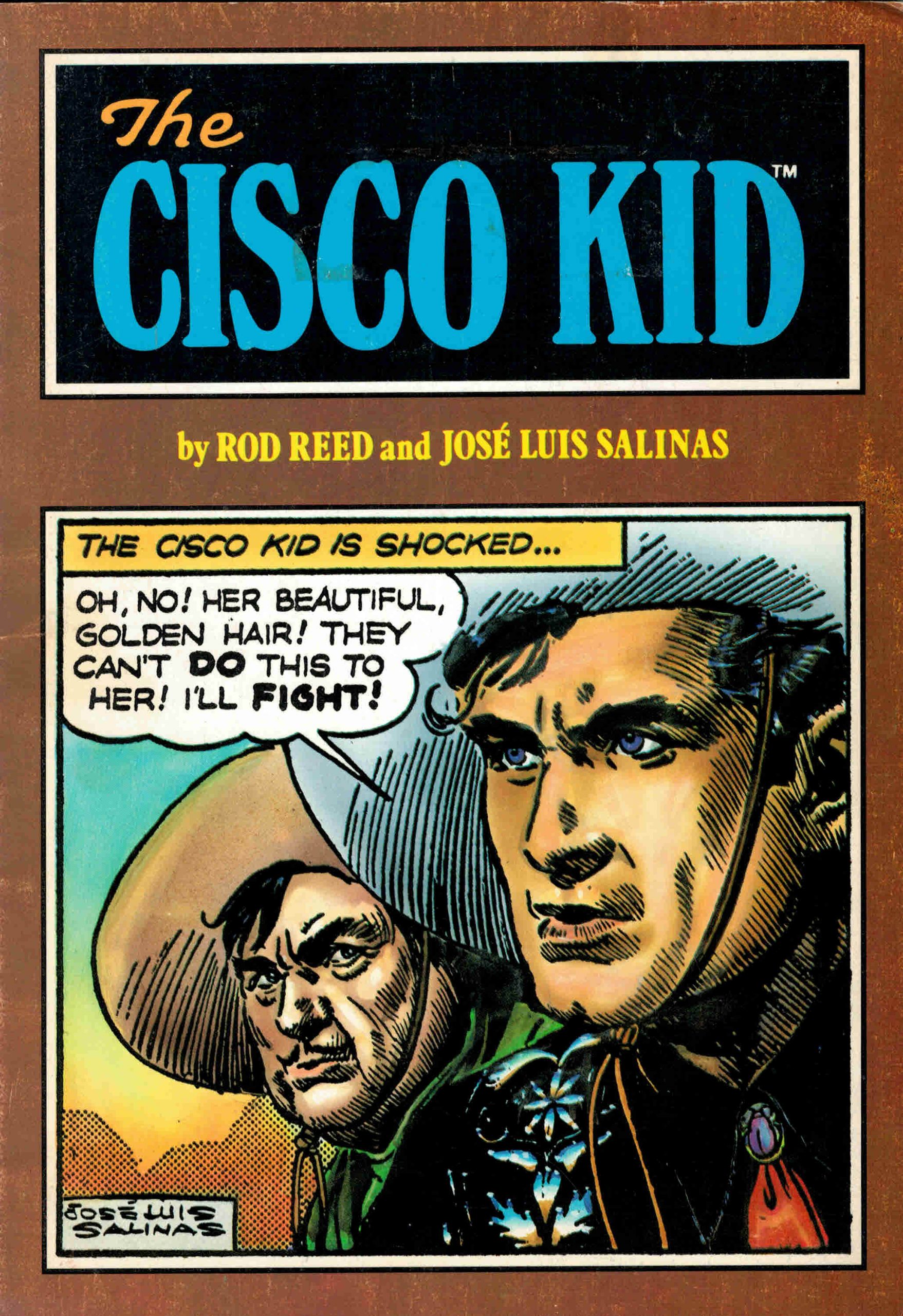
The Cisco Kid™ 


By Rod Reed & José Luis Salinas (Ken Pierce Books) 

ISBN: 0-912277-00-9 (PB) 

As with so many classic mass-media heroes, The Cisco Kid began as charismatic villain. Created by O. Henry for short prose tale “The Caballero’s Way”, he first appeared in Everybody’s Magazine in July 1907, and was included in the author’s anthological collection Heart of the West, which was published in the same year. 

Gone but not forgotten, The Kid returned and was gradually rehabilitated via a series of 27 films spanning 1914-1950; a radio serial running from 1942-1956; a one shot comic book in 1944 and – most crucially – a TV series (the first ever shot in colour) comprising 156 episodes, which spanned 1950-1956. Those latter media milestones in particular spawned a Dell Comics series (41 issues from 1950-1958) and informed a spectacular and beautiful comic strip licensed by King Features Syndicate which ran in numerous newspapers and across the world from 1951 to 1968. 

The hero is a dashing Mexican roaming the American west like the Lone Ranger, righting wrongs for no appreciable reason or reward. His comedy sidekick Pancho is fat, jolly, and eternally anxious, but also smart, deceptively brave and extremely capable: a rare example of positive depictions of Latino characters at that time or even by most modern examples… 

In the end, every effort of so many creators across the mass-communications divide couldn’t much help as increasingly polarized views about minorities pretty much cemented a certain view of Mexican characters in American public opinion in the 1960s and 1970, but at least our guys always were heroes, not low-grade villains, and lazy language stereotyping was kept to an absolute minimum.  

Cisco and Pancho spoke floridly, but never like Speedy Gonzales…  

This strip feature, like so many beautiful examples of western adventuring, has been all but forgotten today, but holds up remarkably well in terms of modern sensibilities …and as I’ve indicated, it is so very, very beautifully drawn.  

This impossible-to-find collection comes courtesy of pioneering comics archivist Ken Pierce, whose one-man campaign to preserve the best of newspaper strips throughout the 1970 and 1980s (Abbie an’ Slats; Axa; Danielle; Fred Kida’s Valkyrie) resulted this slim single volume of monochrome daily episodes, fronted by writer Rod Reed’s evocative Introduction. Reed was a veteran golden age scripter whose best work was for Fawcett and Quality Comics, and in the five stories re-presented here (covering January 17th to May 4th 1950), he ingeniously blends traditional family entertainment/action with wry wit and a devilishly wicked sense of the absurd… 

The writing is top notch but the true joy comes from the stunning draughtsmanship and graphic empathy of the illustrator. José Luis Salinas (February 11, 1908-January10, 1985) was Argentinian, beginning as an advertising artist before moving into comics El Tony and Paginas de Columba. In 1936 he created his first strip. Hernán el Corsario in Patoruzu was followed by many more classic adventure escapades. In 1949, he began working for American enterprise King Features Syndicate, who eventually partnered him with Reed. Their partnership – and the strip – lasted eighteen years, and apparently they never ever met or even corresponded even once… 

Individual storylines very much mirror TV episodes of any western of the era – like Hopalong Cassidy, Champion the Wonder Horse; Gunsmoke, Bonanza or the aforementioned Lone Ranger and all the usual tropes are in play, but thanks to Reed’s deft touches and Salinas’ skill, what might to us seem cliched, still sparkles with verve and vivacity… 

The dramas launches with ‘The First Story’ as the heroes help feisty rancher Lucy Baker uncover a swindle perpetrated by the local judge. His malfeasance is initially uncovered because he won’t allow “the wimmen-folk” vote on his new dam project, but all too soon it devolves into murder plots, frantic horse-chases and plenty of gunplay… 

‘The Deadly Stage Ride’ then sees the nomads save a failing stage coach company by replacing the driver and shotgun guard. Even if they had known sinister mastermind The Jagged Dagger was behind the campaign of sabotage and robbery, it would not have stopped them doing the right thing…  

Humour is paramount in ‘The Artist’ as French painter François Palette arrives, determined to capture the action and glamour of the Wild West and its great heroes – like Wyatt Earp, Bat Masterson, and The Cisco Kid – only to become the target of a fugitive Barbary Bill: a bullying thug who didn’t like his portrait… 

The Latin Lawgivers stumble across a dying man and carry out his deathbed wish to save an innocent man from execution in ‘The Harmonica Mistake’ before this delicious but dated delight closes down with a heartwarming mystery as Cisco and Pancho aid a poor widow and her son when outlaws kidnap the family pet. It seems there’s lost loot somewhere which old Spot can track in ‘Treasure Dog’…    

Swashbuckling thrills in the flamboyant style of Errol Flynn and Gene Kelly, combining the character dynamics of Don Quixote (& Sancho Panza ) with Holmes & Watson and Batman and Robin, these merry light-adventure yarns are so very moreish, and it’s well past time one of the specialist archival outfits like Hermes Press or IDW brought them all back to us… 

The Cisco Kid™ © 1983 Doubleday & Company. Editorial content and arrangement © 1983 Rod Reed. All rights reserved.

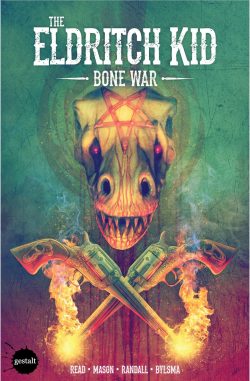
The Eldritch Kid™ volume 2: Bone War 


By Christian D. Read, Paul Mason, Justin Randall & Wolfgang Bylsma (Gestalt Publishing) 
ISBN: 978-1-922023-92-6 (TPB/Digital edition) 

Felt like a scary western today. Dug this one up… 

There was a time, not so very long ago, when all of popular fiction was bloated and engorged with tales of Cowboys and Indians. As always happens with such periodic populist phenomena – such as the Swinging Sixties’ Super-Spy Boom, the Vampire Boyfriend or recent Misunderstood Teens vs Corrupt Adult Dystopias trends – there was a goodly amount of momentary merit, lots of utter dross and a few spectacular gems. 

Most importantly, once such surges peter out, there’s also always a small cadre of frustrated devotees who mourn the passing and resolve to do something to venerate or even revive their lost and faded favourite fad… 

After World War II, the American family entertainment market – for which read comics, radio and the rapidly burgeoning television industry – were comprehensively enamoured of the clear-cut, simplistic sensibilities and easy, escapist solutions offered by Tales of the Old West: at that time already a firmly established standby of paperback publishing, movie serials cinematic blockbusters and low-budget B-feature films. 

I’ve often ruminated on how and why, simultaneously, the dark, bleakly nigh-nihilistic and left-leaning Film Noir genre quietly blossomed alongside that wholesome rip-snorting range-&-rodeo revolution, seemingly only for a cynical minority of entertainment intellectuals who somehow knew that the returned veterans still hadn’t found a Land Fit for Heroes… but perhaps that’s a thought for another time and a different review. 

Even though comics encompassed Western heroes from the get-go (there were cowboy strips in the premier issues of both New Fun and Action Comics and even Marvel Comics), the post-war boom years saw a vast outpouring of titles with gun-toting heroes ousting the rapidly-dwindling supply of costumed Mystery Men. True to formula, most of these pioneers ranged from transiently mediocre to outright appalling… 

Despite minor re-flowerings in the early 1970s and mid-1990s, Western strips have largely vanished from funny book pages: apparently unable to command enough mainstream support to survive the crushing competition of garish wonder-men and furiously seductive futures. 

Europe and Britain also embraced the Sagebrush zeitgeist, producing some extremely impressive work, before France, Belgium and Italy made the genre emphatically their own by the end of the 1960s. They still make the best straight Western strips in the world for an avid audience unashamedly nurturing an appetite for them… 

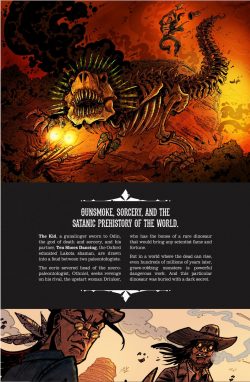
Fantasy and Horror stories, on the other hand, have never really gone away and this utterly outrageous and supremely entertaining sequel sagebrush saga from Australian raconteur Christian Read his latest visualiser Paul Mason (with colourist Justin Randall and letterer/editor Wolfgang Bylsma) superbly blends time-honoured tropes of the wild west with sinister sorcerous sensibilities to create a bewitching alternate reality where dark bloody deeds are matched by dire demonic forces and decent guys called upon to combat them have to dabble in the diabolical too… 

Once upon a time in the west, the world changed and magic – although always real and rare – became part and parcel of everyday life… 

Without preamble the adventuresome action opens with a gunfight against an extremely unpleasant and grudge-bearing witch…  

Our narrator is an urbane and erudite Oxford-educated shaman detailing his life following his return to the land of his birth. His recollections began in the previous volume and began in Spring 1877: the great Indian Wars were over. Custer was dead but so was Crazy Horse. The Whites were greedily covering the entire country and an educated man with the wrong skin tones was reduced to playing scout for a bunch of barely literate morons wagon-trekking across the plains to California. They need him but regard their supremely capable guide with suspicion, disdain and barely-disguised disgust… 

Wicasa Waken, outcast Shaman of the Oglala Lakota – AKA Ten Shoes Dancing of the mighty Sioux and lately graduated Master of Arts and Literature, Oxford, England (1875) – always knew devil magic when he smelled it, but – since his teachers taught him to treasure human life – he remained faithful to their training and always sought to do good. That got a lot harder after saving a strange white from five-headed snakes and zombies … 

Once recovered, the “victim” eagerly joined the fight: his accursed guns making short work of the ravening Heyokas and Ten Shoes Dancing realised he had made the rather prickly acquaintance of a modern Western Legend and celebrated dime novel hero – The Eldritch Kid. 

Sadly like most heroes finally-met, he’s a surly, taciturn, creepy freak. basking in hero-worship, hot vittles and wanton female attention… 

It’s not just this becoming-nation America that is awash with blood and wickedness. The entire world is swamped with boggles, spectres and far worse, but since the War Between the States, the Kid had achieved a certain notoriety for dealing harshly and permanently with all things supernatural and predatory. 

Nevertheless, he’s a mean, mercenary bastard and a tough man to like for the philosophically inclined, poetry-loving Ten Shoes, but circumstances keep them together. Faced with daily mystic mayhem, the mismatched heroes bond even after the Lakotan learned his personal patron god Lord Hnaska was deeply troubled by the cold, dark deity sponsoring the magic-guns toting Kid. Of course, the Great Spirit was far more concerned with the crawling things that hungered for human morsels, and allowed a loveless alliance to be forged. Eventually, the Kid finally opened up enough to share the history that made him the most feared gunhawk in the West. 

In 1865 Camp Elmira, New Jersey held Confederate prisoners.. The detention centre was a hellhole even by human standards, but when a demon began taking inmates, one of the terrified, beaten, sitting duck captives was offered a deal by an ancient northern god. Odin, grim King of Death, was unhappy with beasts and night things increasingly infesting Earth and offered a trade: power for service… 

After a suitably painful and gory “offering” the prisoner was given just enough of a supernatural advantage to kill the monsters – human and otherwise – and escape. Wielding a brace of Rune-Pistols, he’s been doing his Lord’s work ever since… 

That mission continues here as the Diabolist Duo inconclusively clash with bounty hunting old enemy Jacinta Gun-Gunn, and in the aftermath are recruited by former palaeontologist Mr. Othniel. He wants them to steal back his greatest discovery, the full and bejewelled skeleton of a lost prince of a civilisation that perished millions of years previously.  

The astounding artefact was swiped by his rival “Doc” Drinker, but theirs is not a regular scientific dispute. Othniel is a necromancer who survived his own decapitation and now resides a head in a jar, and Madam Drinker travels with a coterie of witches and unruly women. Both parties clearly have secret agendas but Ten Shoes Dancing and the Eldritch provisionally accept the generous commission because of the most pertinent fact: the skeleton has come back to arcane unlife and recalled revenant subjects from its long-fallen, mystically malign dinosaur empire of Tzenshaitchan to raise fresh Hell across the Badlands… 

Thanks to timely assistance from the Lakotan’s Frog-God patron, our heroes are made aware of the true situation and switch sides when  a better offer is made, but they are still bushwacked by Drinker’s presumed ally the Ani Kutani Witch Tsintah who has her own sinister scheme in play and even nastier masters to answer to… 

With dinosaur skeletons tearing the countryside up, the gunslingers are kept too busy to stop Othniel building himself a newer and more deadly body and the witch summoning the almighty horror called the Priest King and restoring an even earlier age of bloody sacrifice and life-extending butchery… 

And as the battle intensifies and all the arcane ages of terror converge to create a charnel ground of warfare, humanity’s deity Odin arrives… 

Ragnarok, anyone? 

The tantalising conclusion is supplemented by a cover/chapter break gallery by Nichola Scott, Douglas Holgate, Emily K. Smith & James Brouwer; original art pages from Mason and Read’s original script pages.  

Rowdy, rousing, purely bonkers and spectacularly action-packed, The Bone War is a sharp, satisfying and mordantly funny yarn to delight lovers of genre fiction and witty mash-ups. Black hats, white hats, lost worlds, haunts and horrors, stunning visuals and macabre twists – what more could you possibly ask for? 

Apparently, another sequel, so hopefully I’ll be getting to that too in the fullness of time… 
© 2017-2019 Christian Read, Paul Masan & Gestalt Publishing Pty Ltd. All rights reserved. 

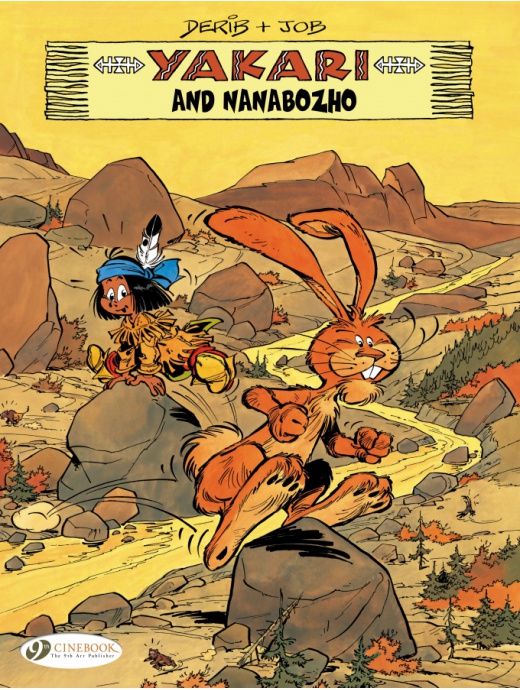
Yakari and Nanabozho


By Derib & Job, coloured by Dominque and translated by Jerome Saincantin (Cinebook)
ISBN: 978-1849181778 (Album PB/Digital edition)

Children’s magazine Le Crapaud à lunettes was founded in 1964 by Swiss journalist André Jobin who began writing stories for it under the pseudonym Job. Three years later he hired fellow French-Swiss artist Claude de Ribaupierre who had begun his own career as an assistant at Studio Peyo (home of Les Schtroumpfs), working on Smurfs strips for venerable weekly Spirou. Together they created the well-received Adventures of the Owl Pythagore and two years later struck pure gold with their next collaboration.

Debuting in 1969, Yakari delightfully detailed the life of a young Sioux boy on the Great Plains; sometime after the introduction of horses by the Conquistadores and before the coming of the modern White Man.

Overflowing with gentle whimsy, the beguiling saga celebrates a bucolic existence in tune with nature and free from strife, punctuated with the odd crisis generally resolved without fame or fanfare by a little lad who is smart, compassionate, brave… and can converse with all animals…

As “Derib”, de Ribaupierre – equally excellent in both enticing, comically dynamic “Marcinelle” cartoon style and a devastatingly compelling realistic action illustration form – became one of the Continent’s most prolific, celebrated and beloved creators through such groundbreaking strips as Celui-qui-est-né-deux-fois, Jo (the first comic on AIDS ever published), Pour toi, Sandra and La Grande Saga Indienne).

Over decades, many of his masterworks feature beloved Western themes, magnificent geographical backdrops and epic landscapes, with Yakari regarded by most fans and critics to be the feature which catapulted him to deserved mega-stardom.

First serialised in 1978, Yakari et Nanabozho was the fourth European album – released just as the strip transferred to prestigious Le Journal de Tintin – but was only translated by Cinebook in 2013, making it officially the 11th English-language album. That’s not going to be a problem for chronology or continuity addicts, since – as ever – the tale is both stunningly simple and effectively timeless…

It all begins one bright sunny day as the little wonder wanders out to the Rock of the Bear to meet his friend Rainbow. On arrival there’s no sign of her but he does meet a gigantic and extremely voluble desert hare claiming to be Trickster Spirit Nanabozho – a statement proven by making some astounding adjustments to the dubious little lad’s height.

The Great Rabbit claims to be Rainbow’s totem animal, much like Great Eagle watches over and protects Yakari, and the loopy lepine wants the boy to accompany him on a quest. Ever since a travelling tale-teller arrived in camp, sharing shocking stories of the far north, where it’s so cold the bears are snowy white, headstrong Rainbow has wanted to see the amazing creatures for herself. Eager to please his protégé, the Brobdingnagian bunny agrees to help her, even supplying magic walking moccasins to reduce the hardships of the journey. Unfortunately the impatient, excited child wouldn’t wait for the Trickster and Yakari to join her and has put them on unsupervised. Unable to resist the enchanted slippers, Rainbow has started her trek, not knowing where she’s going or how to stop…

Now with boy and bunny transforming into giants and tiny mites as circumstances demand, they hare off after their impetuous friend, following the path of a magic talisman dubbed ‘the Straight Arrow’ and assisted by such beneficial creatures as a night moose.

…And when they at last find Rainbow, the travellers decide that as they’ve come so far, they might as well complete the journey to the Land of the White Bears, aided by a fabulous flying canoe…

Always visually spectacular, seductively smart and happily heart-warming, Job’s sparse plot here affords Derib unmissable opportunities to go wild with the illustrations; creating a lush, lavish and eye-popping fantasy wonderland breathtaking to behold.

This is Really Big Sky storytelling with a delicious twist in its colossal fluffy tail…

The exploits of the valiant little voyager who speaks to animals and enjoys a unique place in an exotic world is a decades-long celebration of joyously gentle, marvellously moving and enticingly entertaining adventure, honouring and eulogising an iconic culture with grace, wit, wonder and especially humour. These gentle sagas are true landmarks of comics literature and Yakari is a strip no fan of graphic entertainment should ignore.
Original edition © 1978 Le Lombard/Dargaud by Derib & Job. English translation 2013 © Cinebook Ltd.

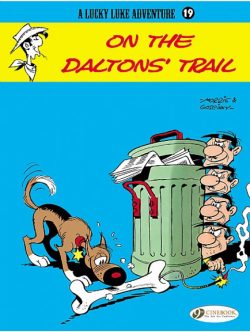
Lucky Luke volume 19: On the Daltons’ Trail


By Morris & Goscinny, translated by Luke Spear (Cinebook)
ISBN: 978-1-84918-007-8 (PB Album/Digital edition)

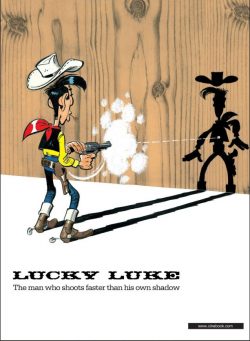
Doughty, Dashing and Dependable cowboy champion Lucky Luke is a rangy, implacably even-tempered do-gooder able to “draw faster than his own shadow”. He amiably ambles across the fabulously mythic Old West, enjoying light-hearted adventures on his rather sarcastic wonder-horse Jolly Jumper. The taciturn nomad regularly interacts with a host of historical and legendary figures as well as even odder folk in tales drawn from key themes of classic cowboy films – as well as some uniquely European ideas…

Over seven decades his unceasing exploits have made him one of the top-ranking comic characters in the world, generating upwards of 85 individual albums with sales totalling in excess of 300 million in 30 languages… thus far. That renown has led to a mountain of spin-off albums and toys, computer games, animated cartoons, a plethora of TV shows and live-action movies and even commemorative exhibitions. No theme park yet, but who knows when…?

The brainchild of Belgian animator, illustrator and cartoonist Maurice de Bévère (“Morris”) and first seen in Le Journal de Spirou‘s seasonal Annual L’Almanach Spirou 1947, Luke sprang to laconic life in 1946, before inevitably ambling into his first weekly adventure ‘Arizona 1880’ on December 7th 1946.

Working solo until 1955, Morris produced nine albums of affectionate sagebrush spoofery before teaming with old pal and fellow trans-American tourist Rene Goscinny. When Rene became regular wordsmith, Luke attained dizzying, legendary, heights starting with Des rails sur la Prairie (Rails on the Prairie) which began serialisation August 25th 1955. In 1967, the six-gun straight-shooter switched sides, joining Goscinny’s own magazine Pilote with La Diligence (The Stagecoach).

Goscinny co-created 45 albums with Morris before his untimely death, from whence Morris soldiered on both singly and with other collaborators. The artist died in 2001, having drawn fully 70 adventures, plus numerous sidebar sagebrush sagas crafted with Achdé, Laurent Gerra, Benacquista & Pennac, Xavier Fauche, Jean Léturgie, Jacques Pessis and others, all taking their own shot at the venerable vigilante…

Lucky Luke has history in Britain too, having first pseudonymously amused and enthralled young readers during the late 1950s, syndicated to weekly anthology Film Fun. He later rode back into comics-town in 1967 for comedy paper Giggle, using the nom de plume Buck Bingo.

In each of these venues – as well as many attempts to follow the English-language album successes of Tintin and Asterix – Luke laconically puffed on a trademark roll-up cigarette which hung insouciantly and almost permanently from his lip. However, in 1983 Morris – amidst pained howls and muted mutterings of “political correctness gone mad” – substituted a piece of straw for the much-travelled dog-end, thereby garnering for himself an official tip of the hat from the World Health Organisation.

Strictly for the sake of historical veracity, that tatty dog-end has been assiduously restored for this particular tale and indeed all of Cinebook’s fare – at least on interior pages. They are the most successful in bringing Lucky Luke to our shores and shelves, and it’s clearly no big deal for today’s readership as we’re at 81 translated tomes and still going strong. That’s not even considering the hefty compilations of early pre-Goscinny adventures and the inclusion of spin-offs such as Kid Lucky…

Sur la piste des Dalton was Morris & Goscinny’s 8th collaboration, originally serialised in 1962 before becoming the 17th album release in the same year: a wittily hilarious outing incorporating a little in-story continuity as the dutiful volunteer lawman is called upon to deal with some troublesome old acquaintances. It’s also the story that gave the world a key supporting character: one who ultimately shambled into his own spin-off series…

There’s a penitentiary in Texas that is the regular second home to the appalling Dalton Brothers: the worst and most-feared outlaws in numerous states and territories. Sadly, it is staffed by shiftless idiots, and when once again owlhoot miscreants Averell, Jack, William and devious, slyly psychotic, tyrannical diminutive brother Joe shuck their shackles, the hapless guards trust the facility’s dog to track them down.

Prison guard dog Rin Tin Can is a pathetic pooch with delusions of grandeur: a mutt who is vain, lazy, overly-friendly, exceedingly dim and utterly loyal to absolutely everybody, but the one thing he ain’t is: good at his job…

As Rantanplan – “dumbest dog in the West” and a wicked parody of pioneering cinema canine Rin-Tin-Tin – the pestilential pooch became an irregular co-star before eventually landing his own spin-off series.

Here, after encountering the escapees mid-tunnel and running away, the canine sentinel is dragged into a search party that constantly stops searching seconds before catching their quarry quartet. Moreover, more than a little bit fed up with continually having to recapture the bandit brothers, Lucky has told the guards he’s not helping this time…

That determination only lasts until the brothers rob his rancher pal Old Tex and before long the rangy range-rider is back on their trail, hampered by that well-intentioned but inept hound, while aided by Joe’s frustrated determination to maraud across the region and eternally-hungry Averell’s ceaseless pursuit of another meal…

The tide turns at Horse Gulch where the fugitives get guns, ammo, and transportation (of a sort) and finally resume their favourite pastime, indulging in a rampage of robbery and riot. At the height of the campaign of chaos, Lucky captures and jails Joe. While Luke is deterring a lynch-mob, the dog accidentally finds the remaining brothers and successfully distracts our hero, allowing the Daltons to capture him.

He is humiliatingly traded for Joe’s release and the robbery rollercoaster ramps up until the hero starts thinking smart. Engineering a showdown at Sinful Gulch, Lucky lays his trap and once again triumphs…

Trigger-fast pacing and sublimely stuffed with classic set-piece slapstick, crafty cinematic caricature and potent puns, On the Daltons’ Trail is a brilliant blend of daft wit and rapid action heavy on absurdity, with plenty of canny twists to keep readers guessing and giggling. Here is another wildly entertaining all-ages confection by unparalleled comics masters, affording an enticing glimpse into a unique genre for today’s readers who might well have missed the romantic allure of an all-pervasive Wild West that never was…
© Dargaud Editeur Paris 1971 by Goscinny & Morris. © Lucky Comics. English translation © 2009 Cinebook Ltd.

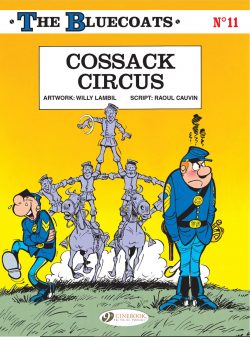
The Bluecoats volume 11: Cossack Circus


By Willy Lambil & Raoul Cauvin, translated by Jerome Saincantin (Cinebook)
ISBN: 978-1-84918-383-3 (Album PB/Digital edition)

Devised by Louis “Salvé” Salvérius & Raoul Cauvin – who scripted the first 64 best-selling volumes until his retirement in 2020 – Les Tuniques Bleues (The Bluecoats) debuted at the end of the 1960s, specifically created to replace Lucky Luke when the laconic maverick defected from weekly anthology Le Journal de Spirou to rival publication Pilote.

Ever since its first sallies, the substitute strip swiftly became one of the most popular bande dessinée series in Europe… and in case you were wondering, the stellar series is now scribed by Jose-Luis Munuera and the BeKa writing partnership…

Salvé was a cartoonist of the Gallic big-foot/big-nose humour school, and when he died suddenly in 1972, his replacement, Willy “Lambil” Lambillotte gradually adopted more realistic – but still overtly comedic – tone and manner. Lambil is Belgian, born in 1936 and, after studying Fine Art in college, joined publishing giant Dupuis in 1952 as a letterer.

Born in 1938, scripter Cauvin is also Belgian and – before entering Dupuis’ animation department in 1960 – studied Lithography. He soon discovered his true calling – comedy writing – and began a glittering and prolific career at Le Journal de Spirou. In addition to Bluecoats he scripted dozens of long-running, award winning series including Cédric, Les Femmes en Blanc and Agent 212: more than 240 separate albums. The Bluecoats alone has sold more than 15 million copies of its 65 (and counting) album sequence.

Our long-suffering protagonists are Sergeant Cornelius Chesterfield and Corporal Blutch; worthy fools in the manner of Laurel & Hardy: hapless, ill-starred US cavalrymen defending America during the War Between the States.

The original format featured single-page gags set around an Indian-plagued Wild West fort, but from the second volume – Du Nord au Sud – the sad-sack soldiers were situated back East, fighting in the American Civil War. All subsequent adventures – despite ranging far beyond the traditional environs of America and taking in a lot of genuine and thoroughly researched history – are set within the timeframe of the Secession conflict.

Blutch is your run-of-the-mill, whinging little-man-in-the street: work-shy, mouthy, devious and especially critical of the army and its inept commanders. Ducking, diving, even deserting whenever he can, he’s you or me – except sometimes he’s smart. principled or heroic if no easier option is available.

Chesterfield is a big, burly professional fighting man; a career soldier who passionately believes in the patriotism and esprit-de-corps of the Military. He is brave, never shirks his duty and hungers to be a medal-wearing hero. He also loves his cynical little troll of a pal. They quarrel like a married couple, fight like brothers and simply cannot agree on the point and purpose of the horrendous war they are trapped in… a situation that stretches their friendship to breaking point in this deceptively edgy instalment.

Cossack Circus is the 11th translated Cinebook album (and 12th sequential European release). As Les Tuniques Bleues: Les bleus tournent cosaques it debuted on the continent in 1976, serialised in Le Journal de Spirou #2000-2014 before collection as an album in 1977.

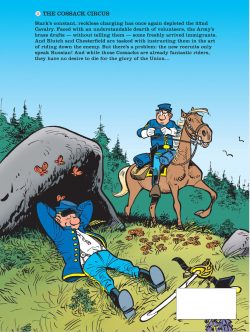
As so often it opens with another spectacular bloodbath instigated by apparently invulnerable maniac Captain Stark. The glory-addicted cavalry charger has now decimated the Union Army (and remember, that’s the side he’s fighting for) to such an extent that there’s no one left to ride into the Confederate guns…

Having depleted everyone who can be “volunteered” into the army and faced with the prospect of sending in officers or withdrawing, “The Brass” devise a brilliant solution: diverting immigrants who have been induced to America to work in the now-empty mines into nice blue uniforms…

Assigning Chesterfield and Blutch as “recruiters” and instructors, the Generals sit back in anticipation of literally fresh blood. They will soon come to regret this stratagem.

When the squabbling squaddies arrive at the holding camp, their misgivings are confirmed on discovering the future cavalrymen speak no English, and have no idea that they are now expected to officially enlist and give their lives for their new country. To the Russian- and Chinese-speaking internees, this is just a stop en route to their new life underground. If the army has its way, that’s almost the truth…

Without interpreters, our Bluecoats are helpless to convey their demands, which Blutch is increasingly convinced are illegal, immoral and stupid. His arguments with duty-blinded Chesterfield bring them to blows, and mutual murder, testing their affection for each other to the limits.

Ultimately, depriving the foreigners of food leads to their signing papers they don’t understand and donning uniforms they instinctively do, but mounting animosity vanishes when the boot camp prisoners are given horses. After Blutch demonstrates a few mounted manoeuvres he almost dies of embarrassment when the Russian clods seamlessly perform astounding synchronised riding tricks while screaming with joy… or perhaps singing?

At that moment, the camp commandant hands over their despatch orders. Next stop: the Front where Stark is itching to lead another charge into death (for everyone else ) and glory (for him)…

However, as the former best buddies carry out their orders with feelings poles apart, fate has a bizarre denouement in store, which manifests once the hereditary equestrian performers are unleashed on a battlefield they choose to see as the biggest circus ring on Earth…

Combining searing satire with stunning slapstick, this yarn is as much iron fist as velvet glove, delivering a hugely gratifying poke at the blood-&-glory boys of history. Deftly delivering an anti-war saga targeting younger, less world-weary audiences, this tale is agonisingly authentic, and always in good taste while delivering an uncompromising portrayal of state-sanctioned mass-violence. These are comedic tales whose humour makes the occasional moments of shocking verity doubly powerful and hard-hitting.

Thankfully, the divergent attitudes expressed by our put-upon pair, and their inevitable rapprochement in the midst of a magnificent plot twist, makes this battle anything but arrant folly. Funny, thrilling, beautifully realised and eminently readable, Bluecoats is the kind of war-story and Western to appeal to the best, not worst, of the human spirit.
© Dupuis 1977 by Lambil & Cauvin. All rights reserved. English translation © 2018 Cinebook Ltd.

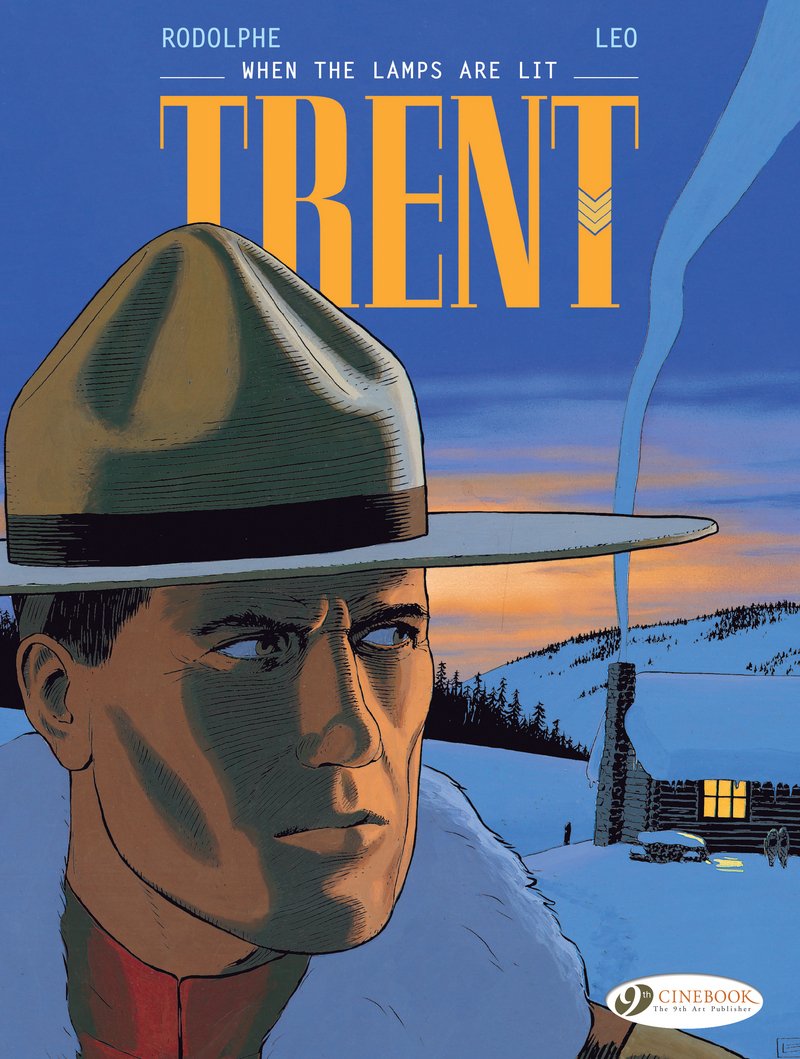
Trent volume 3: When the Lamps are Lit


By Rodolphe & Léo with colour by Marie-Paule Alluard, translated by Jerome Saincantin (Cinebook)
ISBN: 978-1-84918-836-4 (Album PB)

I’m thinking about relationships and romance at the moment, and comics have always explored pair-bonds as a fundamental aspect of any genre they exploit. It’s not always about simple attainment of a dream either. Sometimes, failure and the loss of love is more powerful, rewarding and/or entertaining than “True Love Ways”. The attendant emotion certainly has generated some astoundingly moving fiction…

European comics audiences have long been fascinated with the mythologised American experience, whether it be the Big Sky Wild West or later eras of crime-riddled, gangster-fuelled dramas. They also have a vested historical interest in the northernmost parts of the New World which has resulted in some pretty cool graphic extravaganzas.

Léo is actually Brazilian artist and storymaker Luiz Eduardo de Oliveira Filho: born in Rio de Janeiro on December 13th, 1944. Attaining a degree in mechanical engineering from Puerto Alegre in 1968, he was a government employee for three years, until forced to flee the country because of his political views. While a military dictatorship ran Brazil, he lived in Chile and Argentina before illegally returning to his homeland in 1974. To survive, he worked as a designer/graphic artist in Sao Paulo and created his first comics art for O Bicho magazine.

In 1981 he migrated to Paris, seeking to pursue a career in Bande Dessinée, and found work with Pilote and L’Echo des Savanes as well as more advertising and graphics fare. The big break came when Jean-Claude Forest invited him to draw stories for Okapi which led to regular illustration work for Bayard Presse. In 1988 Léo began his long association with scripter and scenarist Rodolphe D. Jacquette – AKA Rodolphe.

His prolific, celebrated writing partner has been a giant of comics since the 1970s: a Literature graduate who transitioned from teaching and running libraries to creating poetry and writing criticism, novels, biographies, children’s stories and music journalism. In 1975, after meeting Jacques Lob, he expanded his portfolio to write for a vast number of artists and strip illustrators in magazines ranging from Pilote and Circus to À Suivre and Métal Hurlant. Amongst his most successful endeavours are Raffini (with Ferrandez) and L’Autre Monde (Florence Magnin) but his collaborations in all genres and age ranges are too numerous to list here.

In 1991 he began working with Léo on a period adventure series of the far north. Taciturn, introspective and fiercely driven Royal Canadian Mounted Police sergeant Philip Trent premiered in L’Homme Mort, forging a lonely path through the 19th century Dominion over eight tempestuous, hard-bitten albums between then and 2000. He also prompted the collaborators’ later fantasy classics Kenya (and its spin-offs), Centaurus and Porte de Brazenac.

Cast very much in the classic adventure mould perfected by Jack London and John Buchan, Trent is a man of few words, deep thoughts and unyielding principles who gets the job done whilst stifling emotional turmoil boiling deep within him, but is the very embodiment of the phrase “still waters run deep”…

As ‘Quand S’allument Les Lampes’, this third adventure comes from 1993, with the solitary man and his faithful hound “Dog” trudging into and through another snow-wrapped town (stunning rendered as always by Leo) to eventually make camp alone in the frozen woods beyond. His thoughts dwell on the warm loving families therein, and wander back, as they always will, to Agnes.

He had saved her – but not her brother – and was given a clear invitation that he had never acted upon. Now, under the cold stars, he makes a decision. Applying for leave, he travels to Providence with marriage in mind, but on arrival finds a dilapidated, empty house and learns that his Miss St. Yves had reached the same conclusion years ago… and with another man…

Shaken and crushed, he finds a saloon and picks up a whisky glass…

Weeks later, a penniless broken staggering shambles, he plagues the barkeeps of a nameless frontier railtown, pitied and despised by residents as they go about their business and try to avoid the rummy in the gutter.

Howling constantly with desolated loss, Trent’s only human connection is bar girl Mary Lou, but he is blind to her more than Christian interest. Wendley City is all bustle and terror. The railway will bring wealth – and is already reaping dividends – but it’s also drawn out human wolves. Seemingly invisible outlaws dubbed “the Coalmen” have targeted elderly residents for months, cruelly torturing and killing to extract the savings of the weakest townsfolk…

After another night of atrocity, an outraged posse manages to wound a suspect before losing him. The fugitive hides under the stoop drunken sot Trent is slumped on, and in gratitude offers the despised reprobate a job if he has the stomach for bad business and can sober up…

The final act contains a brutal denouement and reveals a cunning and extended undercover scheme to catch the Coalmen, but one that turned on the implacable Mountie’s honest despair and deadly near all-consuming brush with loss and loneliness…

Mission accomplished, the quiet man returns to duty and the wastelands he patrols to preserve the safety of the families he cannot find a way to join…

Another beguiling and introspective voyage of internal discovery, where environment and locales are as much lead characters as hero and foe, When the Lamps are Lit offers suspense, action, drama and poignant evocation in a compelling confection that will appeal to any fan of widescreen cinematic crime fiction or epic western drama.
Original edition © Dargaud Editeur Paris 1993 by Rodolphe & Léo. All rights reserved. English translation © 2017 Cinebook Ltd.

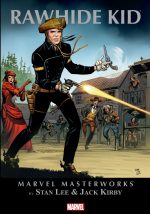
Rawhide Kid Marvel Masterworks volume 1


By Stan Lee, Jack Kirby, Don Heck, Ross Andru, Paul Reinman, Dick Ayers & various (Marvel)
ISBN: 978-0-7851-2117-6 (HB) 978-0-7851-8848-3 (TPB)

For the greater part of the 1960s nobody did superheroes better than Marvel Comics. However, even fully acknowledging the stringencies of the Comics Code Authority, the company’s style for producing their staple genre titles for War, Romance and especially Western fans left a lot to be desired. Hints at sex, the venality of authority figures or sticking a proper gun in a character’s hand and boldness and innovation gave way to overwhelming caution and a tone that wouldn’t be amiss in kids’ cartoons or pre-Watershed family TV shows.

Mercifully for revivals of such venerable stars as the Rawhide Kid, the company’s meagre art-pool consisted of such master craftsmen as Jack Kirby, Dick Ayers and others…

Technically the Kid is one of the company’s older icons, having debuted in his own title with a March 1955 cover-date. A stock and standard sagebrush centurion clad in a buckskin jacket, his first adventures were illustrated by jobbing cartoonists such as Bob Brown and Ayers but the comicbook became one of the first casualties when Atlas’ distribution woes forced the company to cut back to 16 titles a month in the autumn of 1957.

With Westerns big on TV and youthful rebellion a hot new societal concept in 1960, Stan Lee & Jack Kirby concocted a brand new six-gun stalwart – little more than a teenager – and launched him in summer of that year, economically continuing the numbering of the failed original.

Reprinting Rawhide Kid #17-25, spanning August 1960 to December1961, these western wonders are available in hardback, trade paperback and digital editions (there’s even a Marvel Essential monochrome tome out there): all offeringan eclectic mix of hoary clichés, astounding genre mash-ups and the occasional nugget of pure cowboy story-gold with some of the King’s most captivating and impressive art as well as significant contributions from a number of other laudable pencil-pushers.

Most important to remember is that these yarns are not even trying to be gritty or authentic: they’re accessing and addressing the vast miasmic morass of wholesome, homogenised Hollywood mythmaking that generations preferred to learning of the grim everyday toil and terror of the real Old West, so sit back, reset your moral compass to “Fair Enough” and relax and revel in simple Black Hats vs. White Hats, delivered with all the bombast and bravura Jack Kirby and his contemporaries could so readily muster…

Following an Introduction from honorary hombre Stan Lee, it all begins with the 17th (but still, quirkily, debut) issue as Lee, Kirby & Ayers introduce adopted teenaged Johnny Bart who teaches all and sundry in cow-town Rawhide to ‘Beware! The Rawhide Kid’

That happened after his retired Texas Ranger Uncle Ben was gunned down by fame-hungry cheat Hawk Brown. After very publicly exercising his right to vengeance, the naive kid fled Rawhide before he could explain, resigned to life as an outlaw…

Following text thriller ‘Dynamite Trail’ the comic marvels resume with ‘Stagecoach to Shotgun Gap!’ as youthful fugitive teaches passengers not to judge an outlaw by appearances, before we pause for a salutary fable in the Don Heckillustrated ‘With Gun in Hand!’ revealing the deadly downside of being the most infamous shootist, after which we return to Kirby and The Kid for a bout of rustler outwitting in ‘When the Rawhide Kid Turned… Outlaw!’

More Lee, Kirby & Ayers magic opens #18 as the lonely outsider joins a real outlaw gang only to find he cannot stomach his new allies and finds himself ‘At the Mercy of Wolf Waco!’ The continued tale concludes in ‘The Rawhide Kid Strikes Back!’ as Rawhide saves a besieged  train from the brutes before riding off into the night. Genre prose piece ‘The Brave White Man’ – illustrated by Joe Maneely – brings us to Ross Andru & Mike Esposito’s tale of an old sheriff and ‘The Midnight Raiders!’ before the Kid closes the show by taking down an ignorant bully in ‘A Legend is Born!’

Another extended tale opened Rawhide Kid #19 with ‘Gun Duel in Trigger Gap’ divided into ‘Chapter 1: The Garson Gang Strikes!’ and ‘Chapter 2: Revenge of the Rawhide Kid!’ as the fugitive tries to build a new, peaceful life until fate and marauding outlaws ruin everything…

Text vignette ‘Two-Gun Justice’ leads to Paul Reinman’s pocket précis of Kit Carson in ‘The Rip-Snorter’ before ‘Fight or Crawl, Kid!’ again finds a big man taken to task for bad behaviour by the increasingly impatient Rawhide…

Issue #20’s ‘Shoot-Out with Blackjack Bordon sees the Kid fooled by a canny brute with a fake badge and spurious pardon as ‘Chapter 1: The Treachery of Blackjack Bordon’ leads inevitably to ‘Chapter 2: The Rawhide Kid Strikes Back!’ Text tale ‘Old Mining Town’ precedes Heck’s moral homily ‘Return of the Gunfighter!’ which echoes the Kid’s sacrifice in turning a child’s hero worship into loathing and disgust in ‘The Defeat of the Rawhide Kid!’

The first instalment of #21’s extended tale ‘The Gunmen of Sundown City!’ finds Rawhide respectfully surrendering to an aging marshal, only to assist the lawman when’s ambushed in ‘The Kid Fights for his Life!’ The drama continues in ‘The Rawhide Kid… Outlaw!’ and spectacularly ends in the traditional manner in a ‘Showdown with Grizzly Younger’. Prose mystery ‘The Ghostly Prints’ then ushers us into lowkey, Heck limned revenge yarn ‘The Gunslinger!’

In the months before Fantastic Four #1 debuted, the former Atlas outfit found that for them aliens ruled. Thus, it shouldn’t have surprised anyone that Rawhide Kid #22 (June 1961) mashed up Monsters and Indians for ‘Beware!! The Terrible Totem!!’, as restless Rawhide stumbles into a silver mine staffed by slaves just in time for the criminals in charge to incur the wrath of a giant terror.

‘The Totem Strikes!’ and the Kid resists, learning that his incredible foe is an awakened alien who is extremely angry at everyone… and bulletproof. Its rampage leaves Rawhide ‘Trapped by the Totem!’, but still swift and smart enough to engineer ‘The End of the Totem’…

Prose yarn ‘No Guns in Town’ then takes us neatly to Heck’s ‘Slap Leather, Lawman!’ as another well past it lawman faces down his final foe…

A year after his debut, Stan, Jack& Dick – mostly Stan, I suspect – felt it was time for the western wonder to revisit and recap the way it began. Issue #23 delivered a remastered masterpiece with ‘The Origin of the Rawhide Kid!’ for new readers to enjoy, before text tale ‘Golden Trail’ cleared the palate for more action in extended saga ‘A Place to Hide!’ The Kid’s latest shot at peace and romance go south when the gang of Montana Joe hit town and stern steps need to be taken to save civilians in ‘No Place to Hide!’ after which Reinman recounts a tale of mistaken identity in ‘They Called Him Outlaw!’

Kirby & Ayers’ were reaching a peak of artistic excellence when Rawhide Kid #24 proclaimed a ‘Showdown in Silver City!’ with the Kid ambushed and replaced by a cunning imposter who learned too late the folly of his actions, and prose yarn ‘Tie Your Sixgun Low’ segued into an all Ayers affair of ‘The Man Without a Gun’ proving you don’t need firearmsto deal with trouble before rejoining the King for ‘Gunman’s Gamble!’ as the Kid saves a widow’s home from repossession by a small demonstration of shooting skills…

This initial compilation concludes with #25 and a classic clash seeing the Kid ride into a town already plagued by a (masked and costumed) bandit. As much whodunnit as action adventure, ‘The Bat Strikes!’ and text filler ‘Trail of Long Ago’ takes us a brutal battle with outraged Indians and turbulent skies in ‘The Twister!’ After inking Kirby’s epic vistas Ayers illustrates a tale of foolish assumptions in ‘The Man who Robbed the Express!’ before he, Kirby & Lee reveal who ‘Those who Live by the Gun…’ shouldn’t try to bushwhack the Rawhide Kid when he’s sleeping…

Also on view is a bonus cover gallery of Mighty Marvel Western #1-16 by Herb Trimpe, Frank Giacoia, John Verpoorten and John Severin, highlighting the 1968-71 reprint run of Rawhide Kid Classics.

To be frank, unless you’re an old school western buff, the stories here are mostly mediocre, occasionally insensitive, and once or twice borderline offensive. If the social climate and your own conscience trouble you, stay away from here. If however, you can see this stuff in historical context – created by genuine reformers who pioneered diversity in comics and even created the Black Panther together – take a look. Here is work that built the groundwork of the Marvel revolution and some of the very best narrative artwork ever seen.
© 2020 MARVEL.

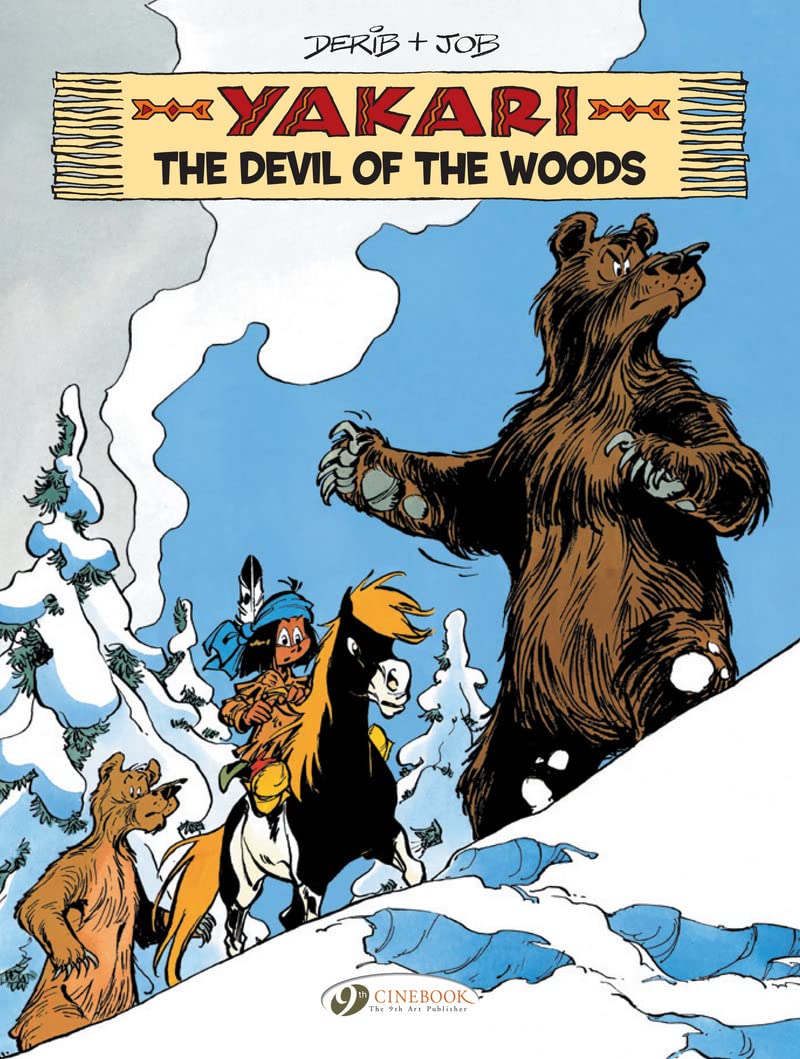
Yakari volume 19: The Devil in the Woods


By Derib & Job, coloured by Dominique and translated by Jerome Saincantin (Cinebook)
ISBN: 978-1-80044-037-1 (Album PB)

Le Crapaud à lunettes was founded in 1964 by Swiss journalist André Jobin who wrote for it under the pseudonym Job. Three years later he hired fellow French-Swiss artist Claude de Ribaupierre AKA “Derib”. The illustrator had launched his own career as an assistant at Studio Peyo, working on The Smurfs strips for venerable weekly Le Journal de Spirou.

Derib – equally au fait with enticing, comically dynamic “Marcinelle” cartoon style yarns and devastatingly compelling meta-realistic illustrated action epics – went on to become one of the Continent’s most prolific and revered creators.

Many of Derib’s stunning works feature his cherished Western themes; magnificent geographical backdrops and epic landscapes, with Yakari considered by fans and critics to be the strip which first led him to deserved mega-stardom. Debuting in 1969, it details the life of a young Oglala Lakota boy on the Great Plains: set sometime after the introduction of horses by the Conquistadores but before the coming of modern Europeans.

The content and set-up are both stunningly simple and effectively timeless, affording new readers total enjoyment with a minimum of required familiarity or foreknowledge. The series – which has generated two separate animated TV series and a movie release last year – has achieved 40 albums thus far: a testament to the strip’s evergreen vitality and the brilliance of its creators, even though originator Job has moved on and Frenchman Joris Chamblain assumed the writer’s role in 2016.

Overflowing with gentle whimsy and heady compassion, young Yakari enjoys a largely bucolic existence: at one with nature and generally free from privation or strife. For the sake of our delectation, however, the ever-changing seasons are punctuated with the odd crisis. Generally they are resolved without fuss, fame or fanfare by a little lad who is smart, brave and can – thanks to a boon of his totem guide the Great Eagle – chat with all animals. This time, however, the conclusion is far from cheery or cosy and presages dark times ahead for some…

It begins in the depths of winter, with deep snow covering the plains and provender scarce for all. As the youngsters Rainbow, Buffalo Seed and Yakari amuse themselves with his pony Little Thunder, the talkative boy’s father Bold Gazeand hunter Taut Bow urgently seek food. Luck turns their way when a large hehaka (wapiti) rushes right into their arrows. By nightfall the entire tribe has eaten well and the leftovers are preserved and dressed to provide more food in the days to come.

The adults cannot shake the impression that their welcome repast was fleeing from something worse than their arrows, and that apprehension is confirmed in the morning when the tribe discover all the remaining food has gone. The fresh snow carries no trace of the thief…

Ever-inquisitive Yakari wants an explanation and sets out to ask his animal pals, eventually finding strange tracks that might belong to some sort of bear. Incautiously following, he sees the footprints peter out just as beaver chieftain Double-Tooth pops up.

The jolly rodent is disturbed by the news and helps in searching, but as Yakari and Double-Tooth follow tracks that constantly seem to vanish into thin air, Bold Gaze and Taut Bow are trailing the thief with the camp dogs. It’s  a horrific mistake as something unseen kills and eats the valiant hounds!

Dread haunts the humans huddled in their tents that night, but in the morning Yakari and Little Thunder check out and eliminate all the local bears – even the notoriously grumpy and insomniac Grizzly who’s having difficulty hibernating – from the suspect list, unaware that something sinister and malign is tracking them…

Baffled and scared that one of their ursine pals has gone mad, Yakari and the beaver clan build a wonderful trap to catch the mysterious thief, but again the stalker outwits them all: even diverting their suspicions to the most unlikely culprit whilst retaliating by destroying the beavers’ precious dam and home…

With all creatures equally endangered by the “devil”, Yakari and his allies convince the mighty and increasingly irate Grizzly to help them hunt, and before long the arrogant quarry rises to the challenge. It confronts its pursuers but the resultant battle is swift, terrible and sadly inconclusive as their brutal clash triggers an avalanche…

In the eerie aftermath, the Great Eagle arrives and shares some disturbing thoughts that may have terrible implications in days to come…

Originally released in 1994, Le diable des bois was the 20th European album, and although its suspenseful, ominous tone feels like a dark departure from the cheery norm, there’s still plenty of humour and slapstick hijinks to balance the grim proceedings, and – in deference to the younger readers – everything is carried out with sensitivity and wit.

As ever, Derib & Job display astounding and compelling narrative virtuosity in this glorious graphic tour de force highlighting the appealing courage of our diminutive heroes, in a visually stunning, seductively smart saga to delight young and old alike.

Yakari is one of the most unfailingly absorbing all-ages strips ever conceived and should be in every home, right beside Tintin, Uncle Scrooge, Asterix and The Moomins.

Original edition © Derib + Job – Editions du Lombard (Dargaud- Lombard s. a.) 2000. All rights reserved. English translation 2021 © Cinebook Ltd.

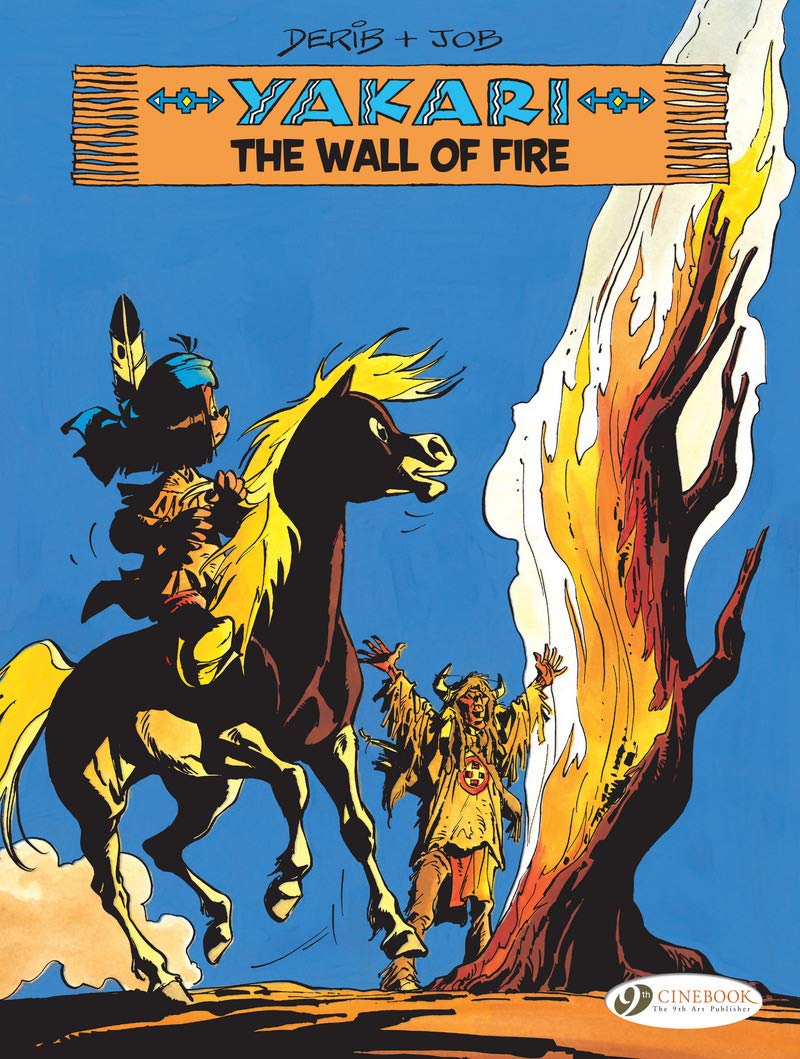
Yakari volume 18: The Wall of Fire


By Derib & Job, coloured by Dominique and translated by Jerome Saincantin (Cinebook)
ISBN: 978-1-84918-591-2 (Album PB)

Win’s Christmas Gift Recommendation: Superb All-Ages Entertainment and Adventure… 9/10

Children’s magazine Le Crapaud à lunettes was founded in 1964 by Swiss journalist André Jobin who then wrote for it under the pseudonym Job. Three years later he hired fellow French-Swiss artist Claude de Ribaupierre AKA “Derib”. The illustrator had launched his own career as an assistant at Studio Peyo (home of Les Schtroumpfs), working on The Smurfs strips for venerable weekly Le Journal de Spirou. Together, they created the splendid Adventures of the Owl Pythagore before striking pure comics gold a few years later with their next collaboration.

Derib – equally au fait with enticing, comically dynamic “Marcinelle” cartoon style yarns and devastatingly compelling meta-realistic action illustrated action epics – went on to become one of the Continent’s most prolific and revered creators. It’s a crime that groundbreaking strips such as Celui-qui-est-né-deux-fois, Jo (the first comic ever published dealing with AIDS), Pour toi, Sandra and La Grande Saga Indienne) haven’t been translated into English yet, but we still patiently wait in hope and anticipation…

Many of Derib’s stunning works over the decades feature his cherished Western themes; magnificent geographical backdrops and epic landscapes. Yakari is considered by fans and critics to be the strip which first led him to deserved mega-stardom.

Debuting in 1969, Yakari follows the life of a young Oglala Lakota boy on the Great Plains and is set sometime after the introduction of horses by the Conquistadores but before the coming of modern Europeans.

The series – which has generated two separate animated TV series and a movie release last year – has achieved 40 albums thus far: a testament to the strip’s evergreen vitality and the brilliance of its creators, even though originator Job has moved on and Frenchman Joris Chamblain assumed the writer’s role in 2016.

Overflowing with gentle whimsy and heady compassion, young Yakari enjoys a largely bucolic existence: at one with nature and generally free from privation or strife. For the sake of our delectation, however, the ever-changing seasons are punctuated with the odd crisis, generally resolved without fuss, fame or fanfare by a little lad who is smart, brave… and can – thanks to a boon of his totem guide the Great Eagle converse with all animals …

Originally released in 1993, la barrière de feu was the 19th European album, but – as always with the best books – the content and set-up are both stunningly simple and effectively timeless, affording new readers total enjoyment with a minimum of familiarity or foreknowledge required…

This time, the little wonder is embroiled in uncharacteristically dark deeds as a raiding party led by Wild Mane results in the loss of all the horses – except valiant pony Little Thunder who not only escapes but also raises the alarm and rouses the sleeping tribe.

As the adults set out on foot to recover their steeds and reclaim their honour, little Yakari tracks his equine friend and is amazed to find Little Thunder is trailing his stolen herdmates. As he follows, the loquacious lad meets a flying squirrel who kindly offers to act as an advance scout…

While the grown-ups are stymied by their cunning quarry’s tactics, the tiny tree-hugger rapidly reunites the boy with his horse and the trio set off together after the thieves. All too soon they have located the raiders, but instead of useless heroic gestures they sagely seek out Yakari’s father and lead his team to the thieves.

Dauntingly, it’s a nomadic convocation of thousands, and a retaliatory raid seems impossible. Moreover, something is shadowing the stalkers themselves, ever unseen but even getting close enough to steal supplies while they’re being carried! The adults are seriously considering swallowing their shame and retreating, but Yakari cannot let go of the notion that something is smarter than he is…

Ultimately, with help from his bestial buddies, the mystery is solved and the boy meets a new friend: a wounded lynx. The beautiful, cunning creature shows the curious kid a new trick: a sticky black liquid that oozes out of the ground and is ideal for sealing wounds.

When the shaman sees it he recognises it for all its many properties, including a tendency to burn, which gives Yakari’s father an inspired idea for countering the raiders’ superior numbers and getting back the tribe’s most treasured possessions…

Exotically enticing, deviously educational and wildly entertaining, this boldly action-packed and splendidly spectacular yarn sees Yakari’s gifts not only used to benefit his people and animal friends but also with the full acknowledgement of the adults he’s previously been unknowingly slighted by. Is our boy finally on the path to being a man?

Once again, Derib & Job display their astounding and compelling narrative virtuosity in another glorious graphic tour de force capturing the appealing courage of our diminutive heroes, and a visually stunning, seductively smart saga to delight young and old alike.

Yakari is one of the most unfailingly absorbing all-ages strips ever conceived and should be in every home, right beside Tintin, Uncle Scrooge, Asterix and The Moomins.
Original edition © Derib + Job – Editions du Lombard (Dargaud- Lombard s. a.) 1993. All rights reserved. English translation 2020 © Cinebook Ltd.

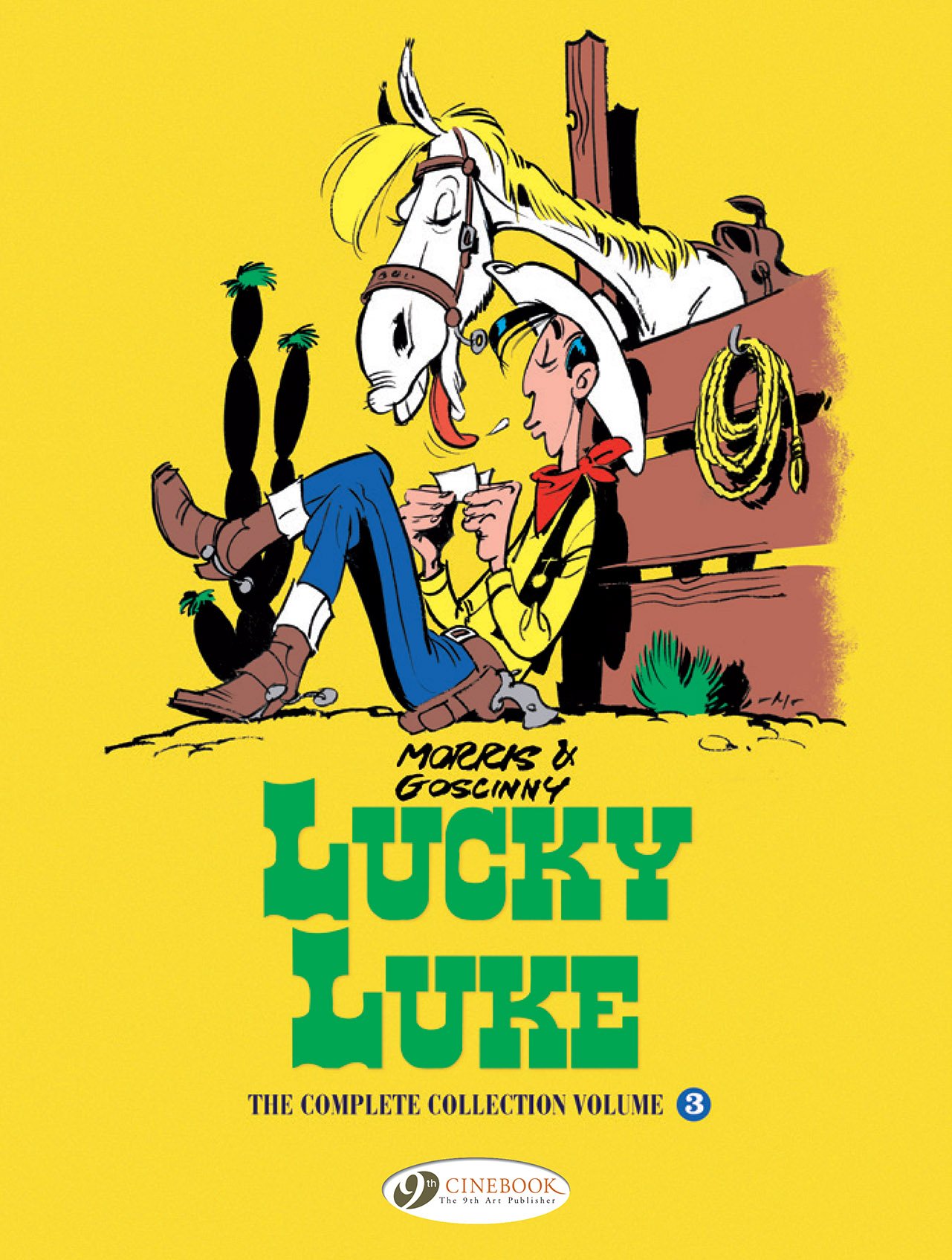
Lucky Luke: The Complete Collection volume 3


By Morris, with René Goscinny; translated by Jerome Saincantin (Cinebook)
ISBN: 978-1-84918-455-7 (Album HB)

Win’s Christmas Gift Recommendation: Blockbuster Thrills No Movie Could Match… 8/10

On the Continent, the populace has a mature relationship with comics: according them academic and scholarly standing as well as meritorious nostalgic value and the validation of acceptance as an art form. Whilst tracing the lost origins of a true global phenomenon, this hardback and digital compilation celebrates the formulative early triumphs of a fictional hero who is certainly a national treasure for both Belgium and France, and it’s also timely in that this worldwide western wonder celebrates his 75th Anniversary this year…

As we know him now, Lucky Luke is a rangy, good-natured, lightning-fast cowboy roaming the fabulously mythic Old West, having light-hearted adventures with his horse Jolly Jumper whilst interacting with a host of historical and legendary figures and icons.

His ongoing exploits have made him one of the best-selling comic characters in Europe (upwards of 80 collected books, plus spin-off series, archival collections and specials, translated into more than 300 million albums in at least 33 languages thus far). He’s also accrued all the usual merchandise spin-offs: toys, computer games, puzzles, animated cartoons, TV shows and live-action movies.

Lucky debuted in 1946, courtesy of Belgian animator, illustrator and cartoonist Maurice de Bévère (“Morris”). For many years we all believed his first appearance was in a Le Journal de Spirou Christmas Annual – L’Almanach Spirou 1947 – before being catapulted into his first weekly adventure ‘Arizona 1880’ on December 7th 1946.

However, the initial volume in this superb archival series (in hardback album and digital editions) revealed the strip actually premiered earlier that year in the multinational weekly comic, but without a title banner and only in the edition released in France…

This third curated outing exhibits – in strict chronological order – strips created between December 1952 and February 1955, with all the art and pages here restored, rejiggled and remastered to achieve maximum contemporary authenticity with the original weekly serialisation. The stories were subsequently gathered as albums L’Élixir du Docteur DOXEY (November 1955, with successive volumes launching every year in that month), Lucky Luke contre Phil Defer (1956) and Des rails sur la Prairie (1957) and this tome even offers a little something extra at the end…

Previous volumes have detailed Morris’s life, career, and achievements, paying particular attention to his alternate duties as an illustrator and caricaturist for magazine Le Moustique and at the CBA (Compagnie Belge d’Actualitiés) cartoon studio, where he met future comics superstars Franquin and Peyo.

Morris was one of “la Bande des quatre” – The Gang of Four – comprising Jijé, Will and Franquin: leading proponents of a new, loosely free-wheeling artistic style known as the “Marcinelle School” which dominated Le Journal de Spirou in aesthetic contention with the “Ligne Claire” style used by Hergé, EP Jacobs and other artists in Le Journal de Tintin.

In 1948 said Gang (all but Will) visited America, meeting US creators and sightseeing. Morris stayed for six years, meeting fellow émigré René Goscinny, scoring work at newly-formed EC sensation Mad and constantly making copious notes and sketches of the swiftly vanishing Old West.

His ongoing works are further detailed and  his “American Period” is extensively explored here in another lavishly illustrated essay from researchers Christelle & Bertrand Pissavy-Yvernault, who relate the Morris family’s jaunts and travels, paying particular attention to the movies they saw and how cinematic flourishes were transformed and recycled on the pages of Lucky Luke. Also on view are examples of work done for American consumption, such as children’s book Puffy Plays Baseball.

Crucially, there’s a detailed section on Goscinny, featuring his artwork – like so many, he was originally a cartoonist who realised his true strengths were plots and words – and side gigs in the USA: foreign correspondent, copywriter, business manager and more. At this time he created evergreen kids feature Le Petit Nicolas with Sempé in Le Moustique and his partnership with Morris formally began. What began as casual assistance eventually became a team effort that changed both their lives after they returned to Europe…

Accompanied by published cartoons and covers, contemporary ads, family photos and tons of original art, the in-depth treatise also focuses on the how and why of edited comics pages; reveals the artist’s film memorabilia (from movies that especially influenced his stories in this collection) and also includes both artwork from European and US publications by Goscinny. There’s even an in-depth analysis of how What Morris Saw became What Lucky Did, closely referencing the comics stories that follow…

Working solo (with early script assistance from his brother Louis De Bevere) until 1955, Morris produced nine albums of affectionate sagebrush parody and action before uniting with Goscinny, who became the regular wordsmith as Luke attained the dizzying heights of superstardom, commencing with Des rails sur la Prairie (Rails on the Prairie), in Le Journal de Spirou in August 1955.

Before we get there though, there’s all-Morris action to enjoy, starting with Doc Doxey’s Elixir which was originally serialised in Le Journal de Spirou #765-808, from December 11th 1952 to 8th October 1953. It relates the predatory journeys of a charlatan physician dispensing disgusting and often lethal liquid cure-alls, aided and abetted by his athletic stooge Scraggy, who gulls the public with his disguises and semi-miraculous instantaneous “recuperations” and fast exits.

Their pernicious peregrinations come to an end after poisoning the frontier town of Green Valley, which puts dogged Lucky on their trail. Packed with classic and episodic chase gags, the hunt concludes with the sneaky snake oil peddler behind bars. Of course, he doesn’t stay there long as sequel saga ‘Manhunt’ details his cunning escape, change of identity – but not modus operandi – and ultimately unsuccessful plot to murder the wandering cowboy…

Follow-up album Lucky Luke contre Phil Defer (or Lucky Luke: Phil Wire in Britain) also comprised two tales, but this time taken from the company’s general entertainment periodical. It introduced deadly gunslinger Phil Wire “The Spider” – based on legendary cinematic bad man Jack Palance – in a strip taken from Le Moustique #1464-1494 (14thFebruary-12th September 1954).

Phil Defer “LE FAUCHEUX” sells his lethal talents to sinister saloon owner O’Sullivan who’s looking to remove a rival. Fate – or perhaps the gods of comedy – unfortunately decree that another tall guy good with guns gets to Bottleneck Gulch first and is mistaken for the rather idiosyncratic notoriously superstitious killer…

Lucky and Wire have already clashed once before and – despite all the hero’s efforts to deter O’Sullivan – meet once more after all “the Spider’s” schemes to remove rival barkeep O’Hara are foiled. It comes down to a showdown on main street and only one man walks away…

The album also features a second serial from Le Moustique #1508-1516 (spanning 19th December 1954 to 13th February 1955): originally entitled Lucky Luke et Pilule.

As Lucky Luke and The Pill it here details a camp fire story told by the rangy gunman, relating how a short-sighted, diminutive hypochondriac tenderfoot with no discernible fighting ability or action acumen became a true gun-toting town-tamer…

It was back to Le Journal de Spirou for the final album reprinted here: gathering material from #906-929 and spanning 25th August 1955 to 2nd February 1956 before launching in November 1957 as ninth album Des rails sur la Prairie. Although uncredited, it was cowritten by Morris and fellow tourist Goscinny: auguring an astounding creative partnership to come…

In 1967 the six-gun star switched publishing teams, transferring to Goscinny’s own magazine Pilote with La Diligence (The Stagecoach). Goscinny produced 45 albums with Morris before his death, from whence Morris continued both singly and with fresh collaborators.

Morris died in 2001 having drawn fully 70 adventures, plus the spin-off adventures of Rantanplan (“dumbest dog in the West” and a charming spoof of cinema canine Rin-Tin-Tin), with Achdé, Laurent Gerra, Benacquista & Pennac taking over the franchise, producing another five tales to date.

Also in 1967, Lucky Luke appeared in British comic Giggle where he was renamed Buck Bingo. He had previously been seen here in weekly comic Film Fun. Before all that, though, this wild and woolly transitional delight features a far more boisterous and raw hero, offering the lighter side of another mythic western scenario…

When track-laying for the Transcontinental Railroad stalls, outraged train moguls demand action and Dead Ox Gulch, Nebraska becomes the crunch point of confrontation. The construction problems are actually caused by a traitor at home. Although a board-member in good standing Black Wilson is also secretly sabotaging the project to protect his other business: a stage coach company…

He contacts the nefarious Wilson Boys gang to keep up the bad work, just as a tall, laconic stranger rides into town. Before long, he is spearheading the march of progress and civilisation by foiling every dirty trick the gang can conceive…

Once the renewed efforts have moved beyond town and onto the prairie and inching closer to California, a train carries Lucky, passengers and the navvies ever-westward, negotiating and stymying hostile natives, greedy townships and the still-active Wilson boys’ shady tactics and stratagems.

Ultimately, Black Wilson takes personal charge and boards a stagecoach westward to destiny. Despite his every trick, though, the showdown is a foregone conclusion…

Adding extra value here is a short Luke lark that first appeared in Risque-Tout #5 (December 1955). A monochrome vignette, ‘Ruckus in Pancake Valley’ has been redrawn and coloured here and details how Lucky tracks down a miscreant who stole his horse…

Packed with contemporaneous extras, commentary, creator biographies, a special ‘Christmas in the Far West’ feature and more, this is perfect for older kids who have gained a bit of historical perspective and social understanding, although the action and slapstick situations are no more contentious than any Laurel and Hardy film – perfectly understandable as Morris was a huge fan of the duo. These early exploits are a grand old hoot in the tradition of Destry Rides Again or Support Your Local Sheriff, superbly executed by a master storyteller, and a wonderful introduction to a unique genre for modern kids who might well have missed the romantic allure of the Wild West that never was…

Bon Anniversaire, Lucky!
All pages relating to Doc Doxey’s Elixir, Phil Wire and Ruckus in Pancake Valley are © Morris/Dupuis 2018. 1949 to 1954 for the first publications in Le Journal de Spirou. All pages relating to Rails on the Prairie © Morris/Goscinny/Dupuis 2018. English translation © 2019 Cinebook Ltd.