Pogo: The Complete Syndicated Comics Strips volume 1 – Through the Wild Blue Wonder


By Walt Kelly (Fantagraphics Books)
ISBN: 978-1-56097-869-5 (HB/Digital edition)

Walter Crawford Kelly Jr. was born on August 25th 1913 and started his cartooning career whilst still in High School, as both artist and reporter for the Bridgeport Post. Moving to California in 1935, he joined the Disney Studio, working on shorts and features like Dumbo, Fantasia and Pinocchio… until the infamous animators’ strike in 1941.

Refusing to take a side, Kelly moved back East and began drawing comic books – primarily for Dell Comics, who had the Disney funnybook license. Despite his glorious work on such humanistic classics as the movie tie-in Our Gang, Kelly much preferred anthropomorphic animal and children’s fantasy (like Walt Kelly’s Santa Claus Adventures) and created Albert the Alligator and Pogo Possum for Animal Comics #1 (cover-dated December 1942). He sagaciously retained the copyrights in the ongoing tale of two Bayou critters and their young African-American pal Bumbazine. Although the black kid soon vanished, the animal stars stayed on until 1948 when Kelly became art editor and cartoonist for hard hitting, left-leaning liberal newspaper The New York Star.

On October 4th 1948, Pogo, Albert and an ever-expanding cast began their careers on the funny pages, appearing six days a week until the periodical folded in January 1949.

Although a gently humorous kids feature, by the end of its run – included in full at the rear of this magnificent tome – the first glimmers of the increasingly barbed, boldly satirical masterpiece of velvet-pawed social commentary began to be seen…

This first of 12 volumes tracks the ascent of the scintillating, vastly influential strip; don’t believe me, just listen to Gary Trudeau, Berke Breathed, Bill Watterson, Jeff McNally, Bill Holbrook, Mark O’Hare, Alan Moore, Jeff Smith and even Goscinny & Uderzo and our own Maurice Dodd & Dennis Collins, whose wonderful strip The Perishers owes more than a little to the sublime antics of the Okefenokee Swamp citizenry…

After The Star closed, Pogo was picked up for mass distribution by the Post-Hall Syndicate and launched on May 16th 1949. A colour Sunday page debuted January 29th 1950 and both were produced simultaneously by Kelly until his death on October 18th 1973 (and even beyond, courtesy of his talented wife and family…)

At its peak the strip appeared in 500 papers in 14 countries whilst book collections (which began in 1951) number nearly 50 and have collectively sold 30 million copies. This volume includes every Star strip, the Dailies from inception to December 30th 1950, plus the Sundays – in their own full colour section – from January 29th to December 31st 1950, plus supplementary features including a Foreword from columnist Jimmy Breslin, an Introduction by biographer Steve Thompson, a week-by-week highly detailed contents section, useful guide ‘About the Sundays’ by Mark Evanier and an invaluable context and historical notes feature ‘Swamp Talk’ by the amazing R.C. Harvey.

Kelly’s genius and gift was the ability to beautifully, vivaciously draw comedic, tragic, pompous, sympathetic characters of any shape or breed and make them inescapably human and he used that gift to blend hard-hitting observation of our crimes, foibles and peccadilloes with rampaging whimsy, poesy and sheer exuberant joie de vivre. The hairy, scaly, furry, feathered, slimy folk depicted here are inescapably us, elevated by burlesque, slapstick, absurdism and all the glorious joys of wordplay – from puns to malapropisms to raucous accent humour – into a multi-layered hodgepodge of all-ages accessible delight.

In later volumes Kelly set his bestial cast loose on such timid, defenceless victims as Senator Joe McCarthy, J. Edgar Hoover, the John Birch Society, Richard Nixon and the Ku Klux Clan, but he starts off small here, introducing gently bemused Pogo, boisterous, happily ignorant Albert, dolorous Porkypine, obnoxious turtle Churchy La Femme, lugubrious hound Beauregard Bugleboy, carpet-bagging Seminole Sam Fox, pompous (not) know-it-all Howland Owl and a multitude more in gags and extended epics ranging from assorted fishing trips, building an Adam Bomb, losing and finding other people’s children, electioneering, education, kidnapping, the evil influence of comic books, Baseball season, why folks shouldn’t eat each other, Western cow punchers, cows punching back, New Years Resolutions, public holidays and so much more…

The Sundays also opened with one-off gags but soon evolved into convoluted, mesmeric continued sagas such as the search for the Fountain of Youth, building a school and keeping it filled, Albert elected Queen of the Woodland by elf-like forest fauns – and why that was ultimately a very bad thing indeed…

Timeless and magical, Pogo is a true giant not simply comics, but also of world literature, and this magnificent edition should be the pride of every home’s bookshelf and digital library.
POGO Through the Wild Blue Wonder and all POGO images, including Walt Kelly’s signature © 2011 Okefenokee Glee & Perloo Inc. All other material © 2011 the respective creator and owner. All rights reserved.

Sky Masters of the Space Force: The Complete Dailies


By Jack Kirby, Dick & Dave Wood, Wally Wood & Dick Ayers (Hermes Press)
ISBN: 978-1-61345-129-8 (HB) 978-1-61345-211-0 (TPB) 1-56685-009-6 (Pure Imagination)

Sky Masters of the Space Force was – and remains – a beautiful and eminently readable newspaper strip but one with a chequered and troubled back-story. How much so you can discover for yourself when you buy this book.

Even ever-upbeat and inspirational comics god Jack Kirby spent decades trying to forget the grief caused by his foray into the newspaper strip market during the height of the Space Race before finally relenting in his twilight years and giving his blessing to collections and reprints such as this one from Hermes Press.

Be grateful that he did because the collected work is one of his greatest achievements, even with the incredible format restraints of one tier of tiny panels per day, and a solitary page every Sunday. Decades later this hard-science space adventure is still the business!

And that’s despite the acrimonious legal manoeuvrings that poisoned the process of creating the strip from start to finish. That can of worms you can read for yourself in Daniel Herman’s forthright ‘Introduction: Jack Kirby, Wally Wood, and Sky Masters’ which precedes the astronautical adventures contained herein…

Just for context though: against a backdrop of international and ideological rivalry turned white-hot when the Soviets successfully launched Sputnik in 1957, the staid George Matthew Adams newspaper syndicate decided to finally enter the 20th century with a newspaper feature about space.

After approaching a reluctant DC Comics (then National Periodicals Publications) a deal was brokered. The project was steered by editor Jack Schiff who convinced Jack Kirby, inker Wally Wood (later replaced by Dick Ayers) and scripters/brothers Dick and Dave Wood (no relation to Wally) to begin bringing the conquest of the cosmos into our lives via an all-American astronaut, his trusty team of stalwart comrades and the philanthropic largesse of the newly-minted US Space Force (who knew Donald Trump could read back then?).

The daily strip launched on September 8th 1958 and ran until February 25th 1961; scant months before Alan Shepherd became in reality the first American in Space on May 5th.

The Sunday colour page told its five extended tales (The Atom Horse, Project Darkside, Mister Lunivac, Jumbo Jones and The Yogi Spaceman) in a separate continuity running from February 8th 1959 to 14th February 1960. They are sadly not included in this monochrome archival collection, but at least that gives us fans something to look forward to…

This tense, terse and startlingly suspenseful foray into a historical future begins with ‘The First Man in Space’ (September 8th – November 21st 1958) as Major Schuyler “Sky” Masters becomes the second man in space. Romantically involved with Holly Martin, he is hurled into orbit to rescue her astronaut father after the bold pioneer encounters, in the pitiless reaches above Earth, something too horrible to contemplate…

Human tragedy and ever-impinging fear of the unknown of that moody tale informs all the tales that follow, and as Holly Martin’s feisty brother Danny and burly Sgt. Riot join the cast (who do they remind me of?) for ‘Sabotage’ (22nd November – 7th March 1959), the quintessential components of all great comics teams are in place.

In this second encounter the stage expands enormously and a member of the vast Space Force contingent sinks into derangement: convinced colonization of the void and abandonment of Mother Earth is an unholy abomination.

That’s bad enough, but when he’s despatched as one of the six pathfinders constructing America’s first permanent orbiting space station, disaster is assured unless Sky can expose him and stop his deadly machinations…

Even as grim yet heady realism slowly grew into exuberant action and fantastic spectacle, the strip moves into high dramatic gear as woman pilot (or “aviatrix”) ‘Mayday Shannon’ (9th March – 9th May) joins the squad. The Brass have high hopes that she will prove “females” can thrive in space too. They didn’t reckon on her publicity-hungry greed and innate selfishness. Happily, the magnetic allure of the stars ultimately overcomes her bad side and Sky is on hand to deal with her ruthlessly unscrupulous manager…

A medical emergency tests the ingenuity of our dedicated spacers when project instigator and patriarch Doctor Royer is taken ill and Sky must ferry a surgeon to him in ‘To Save a Life’ (11th May – 10th June) after which the tireless Major and an unsuspected rival for Holly’s affections are stranded together on a New Guinea island of cannibals after losing control of ‘The Lost Capsule’ (11th June – 23rd September)…

During that heady meeting of ancient and modern cultures, inker/finisher Wally Wood was replaced by Dick Ayers (although the signatures remained “Kirby & Wood” for years more. Maybe the credit was for the writers?).

The incalculable terrors of space manifested with the next saga as ‘Alfie’ (24th September 1959 to 13th January 1960) carried the heroes of the New Frontier into the next decade. When young astronaut crewman Marek joins the orbiting space wheel, he begins periodically suffering bizarre fits. Every four hours for seven and a half minutes, the young American seems to channel the personality of aging East End cockney thief Alfie Higgins. With the fear that it might be some kind of infectious space madness, Sky and Riot head for London to link up with Scotland Yard in a gripping mystery drama blending jewel robbery and murder with the eerie overtones of Dumas’ Corsican Cousins

The constant tensions of the Cold War and Space Race come to the fore in ‘Refugee’ (14th January – 19th February) as Sky and the US Space Force aid a most unlikely and improbable Soviet defector’s escape to the West…

Now a fully-trusted and dedicated member of the squad, Mayday Shannon returns to solve an astronaut’s romantic dilemma by arranging a ‘Wedding in Space’ (20th February – 20th April), before the true threat of the outer depths is tackled when Sky meets astronautical guru and maverick Martin Strickland. A tempestuous but invaluable asset of the Space program, the intellectual renegade has proof of alien life but won’t share the ‘Message from Space’ (21st April – 22nd June) unless military and civil authorities give him carte blanche to act on humanity’s behalf…

Counterbalancing such speculative sci fi aspects, the penultimate adventure is very much Earthbound and grounded in contemporary science and economics. ‘Weather Watchers’ (23rd June – 27th December) finds greedy capitalist entrepreneur Octavius Alexia realise he can make huge profits by scamming insurers if he has access to advance weather predictions afforded by the growing web of satellites orbiting the world.

To monopolise on that valuable information, he targets Mayday with the latest in espionage technologies and male honey trap J. Mansfield Sparks III. It might have all gone his way too if the woman hadn’t been so smart, and his mercenary gigolo had remained unencumbered by conscience…

The series ended in a rather rushed and rapid manner with ‘The Young Astronaut’ (28th December 1960 – 25th February 1961) wherein a new recruit proved to be too good to be true. Excelling at every aspect of the harsh training, Frederick T. “Fission” Tate had ulterior motives for getting into space. Luckily, suspicious Major Masters was right beside him on that first flight into the Wide Black Yonder…

As well as these stellar tales of stellar wonder, this volume also contains an abundance of visual extras such as a numerous covers and samples of Kirby’s contemporary comic book work, plus original art panels in a ‘Focus’ section, which almost compensates for the absence of the Sunday colour pages. Almost…

This compilation comprises a meteoric canon of wonderment that no red-blooded armchair adventurer could possibly resist, but quite honestly, I simply cannot be completely objective about Sky Masters.

I grew up during this time period and the “Conquest of Space” is as much a part of my sturdy yet creaky old bones as the lead in the paint, pipes and exhaust fumes my generation readily absorbed. That it is also thrilling, challenging and spectacularly drawn is almost irrelevant to me, but if any inducement is needed for you to seek this work out let it be that this is indisputably one of Kirby’s greatest accomplishments: engaging, beguiling, challenging and truly lovely to look upon. Now go enjoy it.

Back in 2000, Pure Imagination Publishing released The Complete Sky Masters of the Space Force, which also contains an abundance of essays; commentary and extras such as sketches and unpublished art, as well as those omitted Sunday pages, albeit printed in black and white. If you have the resources and that completist bug it’s worth hunting down, until such time as modern publishers finally catch on and print everything.

© 2017 Herman and Geer Communications, Inc. d/b/a Hermes Press. Introduction and Focus © 2017 Daniel Herman.

Superman Sunday Classics Strips 1-183 (1939-1943)


By Jerry Siegel & Joe Shuster & the Superman Studio (DC/Kitchen Sink Press: Sterling Publishing Co. Inc.)
ISBN: 978-1-40273-786-2 (Sterling) 978-1-56389-472-5(DC/KS)

It’s indisputable that the American comic book industry – if it existed at all – would have been an utterly unrecognisable thing without Superman. Jerry Siegel & Joe Shuster’s unprecedented invention was rapturously adopted by a desperate and joy-starved generation, quite literally giving birth to a genre if not an actual art form.

Within three years of his 1938 debut, the intoxicating blend of breakneck, breathtaking action and wish-fulfilment that epitomised the early Man of Tomorrow spawned an impossible army of imitators. The original’s antics and variations grew to encompass cops-and-robbers crime-busting, socially reforming dramas, science fiction fantasies, and whimsical comedy. Once the war in Europe and the East ensnared America, patriotic relevance for a host of gods, heroes and monsters exploded: all dedicated to exuberant, eye-popping excess and vigorous dashing derring-do.

In comicbook terms Superman was master of the world. Moreover, whilst transforming the shape of the fledgling funnybook industry, the Metropolis Marvel relentlessly expanded into all areas of the entertainment media. Although we all think of the Cleveland boys’ iconic invention as the epitome and acme of comicbook creation, the truth is that very soon after his debut in Action Comics #1, the Man of Steel became a fictional multimedia monolith in the same league as Popeye, Tarzan, Sherlock Holmes and Mickey Mouse.

We parochial and possessive comics fans too often regard our purest, most powerful icons in purely graphic narrative terms, but the likes of Batman, Spider-Man, The Avengers and their hyperkinetic kind long ago outgrew four-colour origins and are now fully mythologized media creatures instantly familiar in mass markets, across all platforms and age ranges…

Far more people have seen or heard an actor as Superman than have ever read his comicbooks. The globally syndicated newspaper strips alone reached untold millions, and by the time his 20th anniversary rolled around at the very start of what we know as the Silver Age of Comics, Superman was a thrice-weekly radio serial regular and starred in an astounding animated cartoon series, two films, on TV and a prose novel by George Lowther.

He was a perennial sure-fire success for toy, game, puzzle and apparel manufacturers and had just ended that first smash live-action television presence. In his future were three more shows (Superboy, Lois & Clark and Smallville), a stage musical, a string of blockbuster movie franchises and an almost seamless succession of games, bubble gum cards and TV cartoons beginning with The New Adventures of Superman in 1966 and continuing ever since. Even his superdog Krypto got in on the small-screen act…

Although pretty much a spent force these days, for the majority of the last century the newspaper comic strip was the Holy Grail that all American cartoonists and graphic narrative storytellers hungered for. Syndicated across the country – and often the planet – it was seen by millions, if not billions, of readers and generally accepted as a more mature and sophisticated form of literature than comic-books. It also paid better.

And rightly so: some of the most enduring and entertaining characters and concepts of all time were created to lure readers from one particular paper to another and many of them grew to be part of a global culture.

Mutt and Jeff, Flash Gordon, Dick Tracy, Buck Rogers, Charlie Brown and so many more escaped their humble tawdry newsprint origins to become meta-real: existing in the minds of earthlings from Albuquerque to Zanzibar. Most of them still do…

However it was considered something of a risky double-edged sword when a comicbook character became so popular that it swam against the tide (after all, weren’t the funny-books invented just to reprint the strips in cheap accessible form?) to become a genuinely mass-entertainment syndicated serial strip.

Superman was the first comic book star to make that leap – six months after exploding out of Action Comics – with only a few ever successfully following. Wonder Woman, Batman (eventually) and teen icon Archie Andrews made the jump in the 1940s with only a handful like Spider-Man, Howard the Duck and Conan the Barbarian doing so since.

The Superman daily newspaper comic strip launched on 16th January 1939, supplemented by a full-colour Sunday page from November 5th of that year. Originally crafted by Siegel & Shuster – whose primary focus switched immediately from comic books to the more prestigious and lucrative tabloid iteration – and their hand-picked studio (Paul Cassidy, Leo Nowak, Dennis Neville, John Sikela, Ed Dobrotka, Paul J. Lauretta & Wayne Boring), the mammoth daily grind soon required the additional talents of Jack Burnley and supplementary writers including Whitney Ellsworth, Jack Schiff & Alvin Schwartz.

This superb collection – doubly out-of-print and still not available digitally, despite its superb quality and sublime content – opens with an Introduction by contemporary Super-Scribe Roger Stern. He effusively recaps the sensation and spotlights his creators, before we see the first 19 complete tales of the primal powerhouse in stunning full colour stupendously unfold.

Whether in pamphlet or local periodical, these tales of the modern Hercules exploded into the consciousness of the world. No one had ever seen a fictionalised hero throw all the rules of physics away and burst into unstoppable, improbable action on every page. In fact, editors and publishers’ greatest concern was that the implausible antics would turn off audiences. Clearly, they could not have been more wrong…

Thus early episodes simply establish the set-up of an Alien Wonder among us, masquerading as an extremely puny human at a “great metropolitan newspaper”… when not crushing evil as his flamboyant alter-ego. These stories are all about constant action and escalating spectacle, displaying the incredible power of a bombastic, heroic man of the people…

On the first Sunday in November 1939 the parade of marvels commenced with a single introductory page describing Superman’s origins in ‘The Man of Tomorrow’ followed seven days later by initial adventure ‘Twenty-Four Hours to Ruin’ which found the Action Ace in a non-stop rush of blood and thunder, saving a logging concern from sabotage and hostile takeover by gangsters.

Crime segued into scientific fantasy when Superman saved ‘The Mindless Slaves of Dr. Grout’ from forced labour as the villain fomented a coup against America…

Inklings of true comic book themes and more complex storylines arrived as Clark Kent and Lois Lane were despatched to investigate the ‘Giants of Doom Valley’: discovering a race of hostile subterranean invaders for Superman to discourage, before ‘Assassins and Spies’ took them into the most pressing concern of the era after agents of a foreign power spread sedition and terror on America’s shores to bolster a European war.

A mysterious mastermind then employed super-science, coercion, abduction and giant insects to ensure ‘The Chosen’ carried out his plans of global financial dominance before a more bucolic tale saw Superman helping Lois escape fatal consequences as ‘The Dangerous Inheritance’ left her with 5,000 acres of seemingly worthless scrubland. Not everyone agreed with the assessment and the Man of Steel was never busier…

Woe in the wilderness gave way to big city bombast as ‘The Bandit Robots of Metropolis’ caused carnage in search of cash, pushing the Man of Steel to his physical and intellectual limits and priming him for a landmark clash against ‘Luthor, Master of Evil’ who turns the weather into a weapon in his escalating war against mankind.

A cunning murderer sought to frame a professional automobile driver in ‘Death Race’ whilst a high-tech propaganda campaign almost destabilised the city when ‘The Committee for a New Order’ pirated the airwaves. Crushing their campaign of terror, Superman was embroiled in a blistering battle against vile enemy agents who knew Lois was his Achilles’ Heel…

Another corporate assault on trade is exposed when freight drivers are poisoned by crooks trying to ‘Destroy All Trucks’ of a businessman’s rivals, after which a mirage-making super-villain pillages Metropolis until her galvanic guardian saw through ‘The Image’

When Clark’s ‘Arson Evidence’ convicts an innocent man, his other self moves Heaven and Earth to exonerate the jailbird and ferret out the true fire-fiend, after which – it being almost three years since his debut – Superman spent two weeks reminding old readers and informing new ones why and how he was ‘The Champion of Democracy’.

To a large extent mention of World War II was kept to a minimum on the Action Ace’s funny pages, but now ‘The Superman Truck’ – detailing how a prototype military transport was relentlessly targeted by saboteurs – plunged right in to conflict with a subplot about a reluctant taxi driver enlisting in the Army Transport Corps. Tracing his induction and training, this yarn was a cunningly-conceived weekly ad and plea for appropriately patriotic readers to enlist…

Military motifs continued as a ship full of diplomats and war correspondents was set afire by an incendiary madman allied to in-over-their-heads Fifth Columnists. It’s not long before ‘The Blaze’ is in critical timberland, acting on his own deranged impulses and leaving the Metropolis Marvel with the huge job of saving America’s war effort…

Showbiz raised its glamorous head when Clark and Lois were sent to cover the morale-boosting ‘Hollywood Victory Caravan’ tour, only to stumble into backbiting, sabotage, intrigue and murder at the hands of Nazi infiltrators.

Wrapping up the vintage spills and thrills is another fervent comics call to arms as Superman – and Clark – take a well-intentioned but lazy and perpetually backsliding wastrel in hand. How he is shepherded through aviator ‘Cadet Training’ to a useful existence as a warrior of Democracy is a rousing wonder to behold.

Supplementing the gloriously rip-roaring, pell-mell adventure are spellbinding extra features including ‘How Superman Would End World War II’ (first seen in the February 27th 1940 issue of mainstream icon Look magazine), promo ads and a 1942 ‘Superman Pinup’.

This specific Sterling Publishing volume is a reissue of the 1999 DC/Kitchen Sink co-production, but either edition offers timeless wonders and mesmerising excitement for lovers of action and fantasy. If you love the era or just crave simpler stories from less angst-wracked times, these yarns are perfect comics reading, and this a book you simply must have.
Superman and all related names, characters and elements are ™ & © DC Comics © 2006. All rights reserved.

Superman: The Dailies 1939-1940


By Jerry Siegel & Joe Shuster with Paul Cassidy (DC/Kitchen Sink Press)
ISBN: 978-1-56389-460-2 (TPB)

It’s indisputable that the American comic book industry – if it existed at all – would have been an utterly unrecognisable thing without Superman. Jerry Siegel & Joe Shuster’s unprecedented invention was rapturously adopted by a desperate and joy-starved generation, quite literally giving birth to a genre if not an actual art form.

Within three years of his 1938 debut, the intoxicating blend of breakneck, breathtaking action and wish-fulfilment that epitomised the early Man of Tomorrow spawned an impossible army of imitators. The original’s antics and variations grew to encompass cops-and-robbers crime-busting, socially reforming dramas, science fiction fantasies, and whimsical comedy. Once the war in Europe and the East ensnared America, patriotic relevance for a host of gods, heroes and monsters exploded: all dedicated to exuberant, eye-popping excess and vigorous dashing derring-do.

In comic book terms Superman was master of the world. Moreover, whilst transforming the shape of the fledgling funnybook industry, the Metropolis Marvel relentlessly expanded into all areas of the entertainment media. Although we all think of the Cleveland boys’ iconic invention as the epitome and acme of comicbook creation, the truth is that very soon after his debut in Action Comics #1, the Man of Steel became a fictional multimedia monolith in the same league as Popeye, Tarzan, Sherlock Holmes and Mickey Mouse.

We parochial and possessive comics fans too often regard our purest, most powerful icons in purely graphic narrative terms, but the likes of Batman, Spider-Man, The Avengers and their hyperkinetic kind long ago outgrew four-colour origins and are now fully mythologized media creatures instantly recognisable globally across all platforms and age ranges…

Far more people have seen or heard an actor as Superman than have ever read his comic books. The globally syndicated newspaper strips alone reached untold millions, and by the time his 20th anniversary rolled around, Superman was a thrice-weekly radio serial regular and starred in an astounding animated cartoon series, two films, on TV and a prose novel by George Lowther.

He was a perennial sure-fire success for toy, game, puzzle and apparel manufacturers and had just ended that first smash live-action television presence. In his future were three more shows (Superboy, Lois & Clark and Smallville), a stage musical, a string of blockbuster movie franchises and an almost seamless succession of games, bubble gum cards and TV cartoons beginning with The New Adventures of Superman in 1966 and continuing ever since. Even his super-dog Krypto got in on the small-screen act…

Although pretty much a spent force these days, for the majority of the last century the newspaper comic strip was the Holy Grail that all American cartoonists and graphic narrative storytellers hungered for. Syndicated across the country – and often the planet – it was seen by millions, if not billions, of readers and generally accepted as a more mature and sophisticated form of literature than comic books. It also paid better.

And rightly so: some of the most enduring and entertaining characters and concepts of all time were created to lure readers from one particular paper to another and many of them grew to be part of a global culture.

Mutt and Jeff, Flash Gordon, Dick Tracy, Buck Rogers, Charlie Brown and so many more escaped their humble tawdry newsprint origins to become meta-real: existing in the minds of earthlings from Albuquerque to Zanzibar. Most of them still do…

However it was considered something of a risky double-edged sword when a comicbook character became so popular that it swam against the tide (after all, weren’t the funny-books invented just to reprint the strips in cheap accessible form?) to become a genuinely mass-entertainment syndicated serial strip.

Superman was the first comic book star to make that leap – six months after exploding out of Action Comics – with only a few ever successfully following. Wonder Woman, Batman (eventually) and teen icon Archie Andrews made the jump in the 1940s with only a handful like Spider-Man, Howard the Duck and Conan the Barbarian doing so since.

The Superman daily newspaper strip launched on 16th January 1939, and was eventually supplemented by a full-colour Sunday page from November 5th of that so momentous year. Originally crafted by Siegel & Shuster – whose primary focus switched immediately from comic books to the more prestigious and lucrative tabloid iteration – and their hand-picked studio (including Paul Cassidy, Leo Nowak, Dennis Neville, John Sikela, Ed Dobrotka, Paul J. Lauretta & Wayne Boring), the mammoth grind soon required the additional talents of Jack Burnley and even co-writers like Whitney Ellsworth, Jack Schiff & Alvin Schwartz.

This superb collection from 1999 – long overdue for re-release, especially in this anniversary year! – opens with an Introduction by James Vance, declaring ‘A Job for Superman’ before effusively recapping the overnight sensation conception, reviewing his antecedents and regaling us with the acts of his creators (and assistants like Cassidy).

Then we see the first 10 tales (nine and a half actually) of the primal powerhouse in all-action monochrome. Wisely and boldly, the first serial – ‘Superman Comes to Earth’ (16th – 28th January 1939) only depicts the Man of Tomorrow on the last of the 12 daily episodes. Instead, Siegel & Shuster took readers to doomed planet Krypton for the first time and revealed how desperate scientist Jor-L and wife Lora were thwarted in their attempts to save the population from their own indifference and ignorance and compelled in desperation to save their newborn son by sending him away in a prototype test rocket aimed at planet Earth. Almost as an afterthought, the last strip reveals how the infant was found, adopted, raised and now operates in secret as vigilante do-gooder Superman…

Whether in pamphlet or local periodical, these tales of the modern Hercules exploded into the consciousness of the world. No one had ever seen a fictionalised hero throw all the rules of physics away and burst into unstoppable, improbable action on every page and panel. In fact, editors and publishers’ greatest concern was that the implausible antics would turn off audiences. Clearly, they could not have been more wrong…

That’s only one reason why the indomitable champion confronted problems and issues every reader was familiar with. Second adventure ‘War on Crime’ (30th January – 18th February) combined social activism and civic corruption as the mighty Man of Tomorrow begins his crusading career by rescuing ten men trapped in a vault. In fact he only saves eight and realises that he needs to be in a place where information can reach him instantly. Thus Clark Kent applies for a job at The Daily Star and stumbles into a deadly case of graft, gangsterism and high-level corruption ferreted out by dynamic reporter Lois Lane. After Superman cleans up the racketeers, the shy unassuming new guy confirms his position by scooping Lois to the first interview with the mysterious costumed vigilante…

A boxing drama follows as the Man of Steel saves a derelict from suicide and uncovers a tragic case of match-fixing and shattered dreams. ‘The Comeback of Larry Trent’ (20th February – 18th March) begins with Superman masquerading as the supposedly finished former heavyweight champion in a whirlwind tour of spectacular bouts, whilst training and rehabilitating the stumblebum to reclaim his title personally in the big championship match. Of course, the Action Ace is on hand when Trent’s crooked manager tries to dope him a second time…

Lois begins her own rise to stardom when she’s relegated to the lonely hearts and lovelorn section, turning up a sinister case of a blackmailed husband entrapped by ‘Jewel Smugglers’ (20th March – April 1st) victimising refugees fleeing war in Europe. Naturally, Superman is lurking in the shadows, ready to handle any necessary roughness required…

A string of fatalities on a construction site takes the hero into the sordid depths of capitalism in ‘Skyscraper of Death’ (3rd – 29th April) as he tackles a saboteur and exposes a ruthless businessman happy to kill innocent workers to destroy a rival, after which ‘The Most Deadly Weapon’ (1st May – 10th June) reflects the tone of the times in a chilling tale of espionage and realpolitik. When Kent interviews Professor Runyan about his deadly new poison gas, the chemist is kidnapped and murdered by spies from a foreign nation. In hot pursuit, Kent discovers the plot was instigated by an arms dealer profiteering from an ongoing civil war and calls in his other – true – self to recover (and ultimately destroy) the formula, punish the perpetrators and even spectacularly force both sides to make peace…

Early episodes never stinted on action and increasingly ingenious ways of displaying Superman’s miraculous abilities. The plan was to simply establish the set-up of an Alien Wonder among us, masquerading as an extremely puny human at a “great metropolitan newspaper” when not crushing evil as his flamboyant alter-ego. These stories are all about constant action and escalating spectacle, displaying the incredible power of a bombastic, heroic man of the people…

Heralding longer stories and more evocative plots, Siegel returned to social crusading for ‘Superman and the Runaway’ (12th June – 22nd July), as the Man of Steel recues orphan Frankie Dennis from imminent destruction and discovers a tale of shocking corruption and abuse at the State Orphanage the boy would rather die than return to. Realising this is no job for Superman, Kent enlists Lois and Frankie to expose monstrous, murderous Superintendent Lyman, but severely underestimates the grafter’s ruthlessness…

Romance taints the air next as ‘Royal Deathplot’ (24th July – 11th November) finds Superman foiling a plan to literally torpedo the diplomatic mission of visiting dignitaries King Boru and Princess Tania of Rangoria. His epic and breathtaking sea battle against a submarine is only the tip of an iceberg of trouble as Superman – and even briefly Kent – find favour in the eyes of the princess, even as elements in the royals’ own embassage continually seek their destruction. Far from impressed, but hot on a scoop, Lois sticks close and plays fifth wheel and rival to super-smitten Tania until the Man of Steel can foil the plot, crush the sinister mad scientist behind it and stabilise the political situation at home and abroad…

Historians might be interested to know that during this yarn, the use of art assistant Cassidy became markedly more noticeable. Other than handling character faces himself, Shuster was happy for the other artists to express themselves in how Siegel’s scripts were interpreted…

Major events were in store both for the hero and the whole of humanity and ‘Underworld Politics’ (13th November – 16th December) signalled the closing of a chapter. Simple cathartic super-deeds would soon take a back seat to grander designs, but only after the tale of how Superman – and especially Lois – destroyed the seemingly impregnable party machine of crooked political boss Mike Hennessey. That well-connected unworthy thought he could terrorise and even murder a crusading new District Attorney, but he was so very wrong…

After his fall Lois thought she had the front page sewed up, but didn’t figure on World War being declared in Europe…

This initial volume of pioneering paper perils begins a saga of sabotage and ‘Unnatural Disasters’ (18th December 1939 – January 6th 1940) as a mysterious gang blow up a dam and then poison the reservoir. Moments too late in each instance, all Superman can do is save what lives he can and determine to avenge the dead…

To Be Continued…

Offering timeless wonders and mesmerising excitement for lovers of action and fantasy, the early Superman is beyond compare. If you love the era or just crave simpler stories from less angst-wracked times, these yarns are perfect comics reading, and this a book you simply must see.
Superman: The Dailies volume 1 copublished by DC Comics and Kitchen Sink Press. Covers, introduction and all related names, characters and elements are ™ & © DC Comics 1998, 1999. All Rights Reserved.

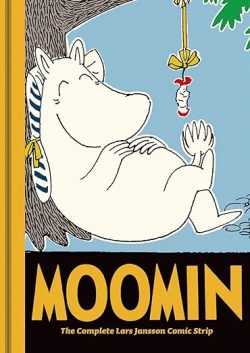
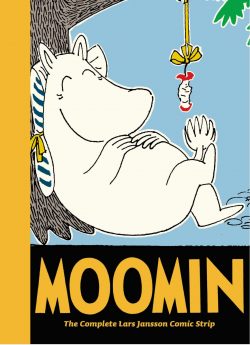
Moomin volume 7 – The Complete Lars Jansson Comic Strip


By Lars Jansson (Drawn & Quarterly)
ISBN: 978-1-77046-062-1 (HB) eISBN: 978-1-77046-554-1

Tove Jansson was one of the greatest literary innovators and narrative pioneers of the 20th century: equally adept at shaping words and images to create worlds of wonder. She was especially expressive with basic components like pen and ink, manipulating slim economical lines and patterns to realise sublime realms of fascination, whilst her dexterity made simple forms into incredibly expressive and potent symbols and, as this collection shows, so was her brother…

Tove Marika Jansson was born into an artistic, intellectual, basically bohemian Swedish family in Helsinki, Finland on August 9th 1914. Father Viktor was a sculptor and mother Signe Hammarsten-Jansson a successful illustrator, graphic designer and commercial artist. Tove’s brothers Lars – AKA “Lasse” – and Per Olov became respectively an author/cartoonist and art photographer. The family and its close intellectual, eccentric circle of friends seems to have been cast rather than born, with a witty play or challenging sitcom as the piece they were all destined to inhabit.

After extensive and intensive study (from 1930-1938 at the University College of Arts, Crafts and Design, Stockholm, the Graphic School of the Finnish Academy of Fine Arts and L’Ecole d’Adrien Holy and L’Ecole des Beaux-Arts, Paris), Tove became a successful exhibiting artist through the troubled period of the Second World War.

Brilliantly creative across many fields, she published the first fantastic Moomins adventure in 1945. Småtrollen och den stora översvämningen (The Little Trolls and the Great Flood or latterly and more euphoniously The Moomins and the Great Flood) was a whimsical epic of gentle, inclusive, accepting, understanding, bohemian misfit trolls and their strange friends…

A youthful over-achiever, from 1930 to 1953 Tove worked as an illustrator and cartoonist for Swedish satirical magazine Garm: achieving some measure of notoriety with an infamous political sketch lampooning the Appeasement policies of European leaders by depicting Hitler in nappies. She was also highly in-demand for many magazines and children’s books, and had started selling comic strips as early as 1929.

Moomintroll was her signature character. Literally.

The lumpy, big-eyed, gently adventurous romantic goof began life as a spindly sigil next to her name in her political works. She called him “Snork” and claimed she had designed him in a fit of pique as a child – the ugliest thing a precocious little girl could imagine – as a response to losing an argument with her brother about Immanuel Kant.

The term “Moomin” came from her maternal uncle Einar Hammarsten who attempted to stop her pilfering food when she visited, warning her that a Moomintroll guarded the kitchen, creeping up on trespassers and breathing cold air down their necks. Snork/Moomin filled out, became timidly nicer – if a little clingy and insecure – acting as a placid therapy-tool to counteract the grimness of the post-war world.

Initially The Moomins and the Great Flood made little impact, but Jansson persisted – as much for her own edification as any other reason – and in 1946 Kometjakten (Comet in Moominland) was published. Many commentators regard the terrifying tale a skilfully compelling allegory of Nuclear Armageddon. You should read it now… while you still can…

When it and third illustrated novel Trollkarlens hatt (1948, Finn Family Moomintroll or occasionally The Happy Moomins) were translated into English in 1952, their instant success prompted British publishing giant Associated Press to commission a newspaper strip about her seductively sweet and sensibly surreal creations.

Jansson had no misgivings or prejudices regarding strip cartoons and had already adapted Comet in Moominland for Swedish/Finnish paper Ny Tid. Mumintrollet och jordens undergäng Moomintrolls and the End of the World – was a popular feature, so she readily accepted the chance to extend her eclectic family across the world. In 1953, The London Evening News began the first of 21 Moomin strip serials to captivate readers of all ages.

Jansson’s involvement in the cartoon feature ended in 1959, a casualty of its own success and a punishing publication schedule. So great was the strain that towards the end she recruited brother Lars to help. He then took over, continuing the strip until 1975. His tenure as sole creator continues here…

Liberated from the strip’s pressures, Tove returned to painting, writing and other creative pursuits: making plays, murals, public art, stage designs, costumes for dramas and ballets, a Moomin opera and 9 more Moomin-related picture-books and novels, as well as 13 books and short-story collections strictly for grown-ups.

Tove Jansson died on June 27th 2001. Her awards are too numerous to mention, but just consider: how many modern artists get their faces on the national currency?

Lars Fredrik Jansson (October 8th 1926 – July 31st 2000) was just as amazing as his sister. Born into that astounding clan twelve years after Tove, at 16 he started writing – and selling – novels (nine in total). He also taught himself English because there weren’t enough Swedish-language translations of books available for his voracious reading appetite.

In 1956, he began co-scripting the Moomin newspaper strip at his sister’s request: injecting his own brand of witty whimsicality to ‘Moomin Goes Wild West’. He had been Tove’s translator from the start, seamlessly converting her Swedish text into English. When her contract with The London Evening News expired in 1959, Lars Jansson officially took over the feature, having spent the interim period learning to draw and perfectly mimic his sister’s cartooning style. He had done so in secret, with the assistance and tutelage of their mother Signe. From 1961 to the strip’s end in 1974, he was sole steersman of the newspaper iteration of trollish tails.

Lasse was a man of many parts: other careers including writer, translator, aerial photographer and professional gold miner. He was the basis and model for the cast’s cool kid Snufkin

Lars’ Moomins was subtly sharper than his sister’s version and he was far more in tune with the quirky British sense of humour, but his whimsy and wry sense of wonder was every bit as compelling. In 1990, long after the original series, he began a new career, working with Dennis Livson (designer of Finland’s acclaimed theme park Moomin World) as producers of Japanese anime series The Moomins and – in 1993 with daughter Sophia – on new Moomin strips…

Moomintrolls are easy-going free spirits: natural bohemians untroubled by hidebound domestic mores and most societal pressures. Moominmama is warm, kindly tolerant and capable but perhaps overly concerned with propriety and appearances, whilst devoted spouse Moominpappa spends most of his time trying to rekindle his adventurous youth or dreaming of fantastic exploits.

Their son Moomin is a meek, dreamy boy with confusing ambitions. He adores their permanent houseguest the Snorkmaiden – although that impressionable, flighty gamin much prefers to play things slowly whilst hoping for somebody potentially better to come along…

The seventh oversized (310 x 221 mm) monochrome hardback compilation gathers serial strip sagas #26-29, and opens with Lars firmly in charge and puckishly re-exploring human frailties and foibles via a sophisticate poke at the shifting political climate…

Craftily casting cats among pigeons, 26th escapade ‘Moomin the Colonist’ finds armchair adventurer Moominpappa resenting the advent of the annual hibernation and rashly listening to his bookish boy, who has been reading about colonisation…

Soon he has packed up the family and a few close friends and set out to conquer fresh fields and pastures new. With Mymble and Little My, Mrs Fillyjonk, her daughters and a cow in tow, the eager expansionists head off across the frozen land and don’t stop until they reach a tropical desert island where they start setting up a new civilisation combining the best of the old world with lots of fresh ideas on how society should be run…

Sadly, their neighbours from back home have sneakily copied the Moomin movement and before long the new continent is embroiled in a passive-aggressive, slyly competitive struggle for control, with scurrilous reprobate Stinky and his pals playing the bad guys behind the Palm Tree Curtain…

Following the mutual collapse of colonialism, outrageous satire gives way to wicked sarcasm as ‘Moomin and the Scouts’ recounts how energetic Mr Brisk’s passion for the outdoor life, badges and bossing children envelopes the instinctively sedentary Moomins and unleashes all kinds of disruptive chaos. With scouts running wild amongst the trees it just seems easier to join them rather than seek to beat them and let nature disrupt the movement from within…especially after Moomin starts hanging around with Miss Brisk’s Girl Guides and the generally dismissive Snorkmaiden feels oddly conflicted…

The perils of property and stain of status upsets the orderly life of the clan when Moominpappa unexpectedly comes into a major inheritance in ‘Moomin and the Farm’. Grievously afflicted by a terrible case of noblesse oblige, the family uproot themselves and retire to stately Gobble Manor to perpetuate the line of landed gentry on a modern working arable and pastoral estate.

Adapting to wealth and property is one thing and even accommodating the legion of ancestral ghosts is but another strand of Duty, but the effort of taking on and even perpetuating centuries of unearned privilege proves far too weighty a burden for all concerned… before the increasingly untenable situation typically corrects itself…

Back in their beloved house and rearranging furniture, a dropped chest disgorges an ancient map and triggers another wild dreamers’ quest in ‘Moomin and the Gold-fields’…

Unable to refuse adventure when it’s dangled in front of their exuberant noses, father and son are soon trekking the wilds and digging random holes thanks to the supremely unclear chart, and before long the entire valley is afflicted with gold rush fever.

With law, common decency and even good manners abandoned to greed as the sedate dell becomes a boisterous and sordid boom town, all Moominmama can do is maintain her dignity and wait for the madness to pass…

This deceptively barbed and edgy compilation closes with ‘Lars Jansson: Roll Up Your Sleeves and Get to Work’ by family biographer Juhani Tolvanen, extolling his many worthy attributes and more besides…

These are truly magical tales for the young, laced with the devastating observation and razor-sharp mature wit which enhances and elevates only the greatest kids’ stories into classics of literature. These volumes – both Tove and Lars’ – comprise an international treasure trove no fan of the medium – or carbon-based lifeform with even a hint of heart and soul – can afford to be without.
© 2012 Solo/Bulls except “Lars Jansson: Roll Up Your Sleeves and Get to Work” © 2011, 2012 Juhani Tolvanen. All rights reserved.

Popeye Classics volume 9: The Sea Hag’s ‘Magic Flute’ and More!


By Bud Sagendorf, edited and designed by Craig Yoe (Yoe Books/IDW Publishing)
ISBN: 978-1-63140-772-7 (HB) eISBN: 978-1-68406-092-4

How many cartoon classics can you think of still going after a century? Here’s one…

There are a few fictional personages to enter communal world consciousness – and fewer still from comics – but this grizzled, bluff, uneducated, visually impaired old tar with a speech impediment is possibly the most well-known of that august bunch.

Elzie Crisler Segar was born in Chester, Illinois on 8th December 1894. His father was a general handyman, and the boy’s early life was filled with the solid, dependable blue-collar jobs that typified the formative years of his generation of cartoonists. Segar worked as a decorator, house-painter and also played drums; accompanying vaudeville acts at the local theatre.

When the town got a movie-house, Elzie played silent films, absorbing all the staging, timing and narrative tricks from keen observation of the screen. Those lessons would become his greatest assets as a cartoonist. It was while working as the film projectionist, at age 18, that he decided to become a cartoonist and tell his own stories.

Like so many others in those hard times, he studied art via mail, specifically W.L. Evans’ cartooning correspondence course out of Cleveland, Ohio, before gravitating to Chicago where he was “discovered” by Richard F. Outcault – regarded as the inventor of modern newspaper comic strips with The Yellow Kid and Buster Brown. The celebrated pioneer introduced Segar around at the prestigious Chicago Herald. Still wet behind the ears, the kid’s first strip, Charley Chaplin’s Comedy Capers, debuted on 12th March 1916.

In 1918, Segar married Myrtle Johnson and moved to William Randolph Hearst’s Chicago Evening American to create Looping the Loop, where Managing Editor William Curley foresaw a big future for Segar and promptly packed the newlyweds off to New York: HQ of the mighty King Features Syndicate. Within a year Segar was producing Thimble Theatre, (launching December 19th 1919) in the New York Journal: a smart pastiche of cinema and knock-off of movie-inspired features like Hairbreadth Harry and Midget Movies, with a repertory of stock players acting out comedies, melodramas, comedies, crime-stories, chases and especially comedies for vast daily audiences. It didn’t stay that way for long…

The core cartoon cast included parental pillars Nana & Cole Oyl; their lanky, cranky, highly-strung daughter Olive; diminutive-but-pushy son Castor and the homely ingenue’s plain and (so very) simple occasional boyfriend Horace Hamgravy (latterly, plain Ham Gravy).

Thimble Theatre had already run for a decade when, on January 17th 1929, a brusque, vulgar “sailor man” shambled into the daily ongoing saga of hapless halfwits. Nobody dreamed the giddy heights that stubbornly cantankerous walk-on would reach…

In 1924, Segar created a second daily strip. Surreal domestic comedy The 5:15 featured weedy commuter/aspiring inventor John Sappo and his formidable spouse Myrtle. It endured – in one form or another – as a topper/footer-feature accompanying the main Sunday page throughout Segar’s career, survived his untimely death, and eventually became the trainee-playground of Popeye’s second great humour stylist – Bud Sagendorf.

After Segar’s premature passing in 1938, Doc Winner, Tom Sims, Ralph Stein and Bela Zambouly all took on the strip as the Fleischer Studio’s animated features brought Popeye to the entire world, albeit a slightly variant vision of the old salt of the funny pages. Sadly, none had the eccentric flair and raw inventiveness that had put Thimble Theatre at the forefront of cartoon entertainments. And then, finally, Bud arrived…

Born in 1915, Forrest “Bud” Sagendorf was barely 17 when his sister – who worked in the Santa Monica art store where Segar bought his drawing supplies – introduced the kid to the master cartoonist who became his teacher and employer as well as a father-figure. In 1958, after years on the periphery, Sagendorf finally took over the strip and all the merchandise design, becoming Popeye’s prime originator…

With Sagendorf as main man, his loose, rangy style and breezy scripts brought the strip itself back to the forefront of popularity and made reading it cool and fun all over again. Bud wrote and drew Popeye in every graphic arena for 24 years. When he died in 1994, his successor was controversial “Underground” cartoonist Bobby London.

Bud had been Segar’s assistant and apprentice, and in 1948 became exclusive writer/artist of Popeye’s comic book exploits. That venture launched in February of that year: a regular title published by America’s unassailable king of periodical licensing, Dell Comics.

On his debut, Popeye was a rude, crude brawler: a gambling, cheating, uncivilised ne’er-do-well, but was soon revered as the ultimate working-class hero. Raw and rough-hewn, he was also practical, with an innate, unshakable sense of what’s fair and what’s not: a joker who wanted kids to be themselves – but not necessarily “good”. Above all else he was someone who took no guff from anyone…

Naturally, as his popularity grew, Popeye mellowed somewhat. He was still ready to defend the weak and had absolutely no pretensions or aspirations to rise above his fellows, but the shocking sense of dangerous unpredictability and comedic anarchy he initially provided was sorely missed… except in Sagendorf’s sagas…

Collected here are Popeye #40-44, crafted by irrepressible “Bud” and collectively spanning April-June 1957 to April-June 1958. The stunning, nigh stream-of-consciousness slapstick sagas and nautical nuttiness are preceded by a treasure-stuffed treatise on ‘The Big Guy who Hates Popeye!’, as Fred M. Grandinetti details all you need to know about archetypal “heavy” Bluto. The lecture on the thug of many names is backed up by character and model sheets from animated appearances, comic book covers, and numerous comic excepts. Also emergent are strip precursors and alternate big bullies, original strip art from Sagendorf and London, plus a kind-of guest shot from Jackson Beck – the meaty matelot’s on-screen voice…

Sadly missing the usual ‘Society of Sagendorks’ briefing by inspired aficionado, historian and publisher Craig Yoe, and the ever-tantalising teasers of ephemera and merchandise of ‘Bud Sagendorf Scrapbooks’, we instead plunge straight back into ceaseless sea-savoured voyages of laughter, surreal imagination and explosive thrills with quarterly comic book #40, opening with a monochrome inside front cover gag concerning the sailor’s ward Swee’Pea and his fondness for digging in the dirt, before ‘Thimble Theatre presents Popeye the Sailor in The Mystery of the “Magic Flute!”’ once more pits the mariner marvel against the ghastly and nefarious Sea Hag.

Here she unleashes an army of agents to locate and secure a mystic talisman safeguarded by Popeye. With it, she can rid the world of her great enemy…

With the family house overrun, impetuous elder Poopdeck Pappy unthinkingly hands over the wishing whistle and instantly Popeye is whisked into a pit with lions, thugs and Bluto all lined up to kill him. It doesn’t work out well for any of them…

‘Popeye the Sailor and Eugene the Jeep’ then reintroduces another of Segar’s uniquely wonderful cartoon cryptids. The little marvel had originally debuted on March 20th 1936: a fantastic 4th dimensional beast with incredible powers whom Olive and Wimpy use to get very rich, very quickly. Of course, they quickly lost it all betting on the wrong guy in another of Segar’s classic and hilarious set-piece boxing matches between Popeye and yet another barely-human pugilist…

This time he pops up after Olive and the old salt clash over setting an engagement date, and Wimpey suggests asking the Jeep’s advice. Instantly he materialises, and the question is nervously asked. The response is ambiguous and draws nothing but trouble…

Prose filler ‘Ol’ Blabber Mouth’ tells how a parrot accidentally causes all his friends to be captured by pet trade hunters before we arrive at the ever-changing back-up feature. Sappo – now reduced to gullible foil and hapless landlord to the world’s worst lodger – endured the ethics-free experiments of Professor O.G. Wotasnozzle “The Professor with the Atomic Brain”.

Callously and constantly inflicting the brunt of his genius on the poor schmuck, here the boffin seizes top billing with The Brain of O.G. Wotasnozzle, building a robot replica of his landlord and running rings around the sap in ‘Double Double Who’s Got Trouble’

The issue ends with an endpaper monochrome gag with Popeye and the precious “infink” disputing bedtimes and a colour back cover jape with them disastrously fishing…

Issue #41 (July-September) opens with ‘Popeye the Sailor in Spinach Soap!’ as the sailor battles Olive’s new beau. He looks just like Bluto, but has one advantage the sailor cannot match …a steady job!

In response, the money-disdaining matelot calls his secret weapon and Wimpey takes charge of Popeye’s savings – a million bucks – all so that he can set up a business to employ the sailor man…

An engaging Micawber-like coward, cad and conman, the insatiably ravenous J. Wellington Wimpy debuted in the newspaper strip on May 3rd 1931 as an unnamed, decidedly partisan referee in one of Popeye’s pugilistic bouts. Scurrilous, aggressively humble and scrupulously polite, the devious oaf struck a chord and Segar made him a fixture. Preternaturally hungry, ever-keen to solicit bribes and a cunning coiner of many immortal catchphrases – such as “I would gladly pay you Tuesday for a hamburger today” and “Let’s you and him fight” – Wimpy was the perfect foil for our straight-shooting action hero and increasingly stole the entire show… and anything else unless it was very heavy or extremely well nailed down.

Full of good intentions but unable to control himself, Wimpey naturally embezzles it all and fobs off his pal with a get-rich-scheme. However when Popeye starts selling his vegetable-based cleanser door to door he soon finds his old tactics are enough to wash that man out of Olive’s hair…

Co-starring Popeye, Swee’Pea and the Jeep!, ‘Sucker Gold!’ sees the cowboy-obsessed kid head for the desert and perilous Apache Mountain to be a prospector. Happily, with Eugene along for the ride his safety and prosperity are assured…

The story of Bradley fills the prose section this revealing how the ‘Horse Student’ was kicked out of human high school, after which O.G. Wotasnozzle! thinks himself into an invulnerable, inert state and the authorities resort to explosives to wake him up, before the back cover finds Popeye giving his kid a (kind-of) haircut…

Cover-dated October-December, Popeye #42 opens with the main event as the entire cast is caught on ‘Trap Island!’ as The Sea Hag and her hefty hench-lout target them from her mobile mechanised islet, before using doppelgangers to lure the sailor into ultimately useless death traps. Even her monster spinach-fuelled gorilla Smash is helpless before the power of spinach inside Popeye…

Popeye then discovers Swee’Pea can get into trouble anywhere, anytime when he sends him to fetch ‘Today’s Paper!’ Through no fault of his own the mighty mite ends up trapped in a weather balloon, a target of the air force, 2300 miles from home in Harbor City, a blood enemy of angry Indian Chief Rock’n’roll and locked in a missile, before dutifully bringing back that pesky periodical…

A duck with a speech impediment finds his purpose in prose yarn ‘Big Toot’ prior to Sappo giving O.G. Wotasnozzle the push. Typically, the toxic tenant terrorises every prospective replacement for his lodgings and the status quo is reluctantly re-established…

Another endpaper monochrome gag sees Popeye and Olive experiencing a little car trouble before Popeye #43 (cover-dated January-March 1958) opens in mono with another dig at Swee’Pea and his shovel whilst main event ‘Mind over Muscles!’ finds Popeye in high spirits and utterly oblivious to Sea Hag’s sinister surveillance. As the sailor eagerly anticipates his annual physical exam, she sends in her Sonny Boy – AKA Bluto disguised as a physician – to undermine his confidence and poison his mind with the notion that spinach is killing him. However, even doctor’s orders can’t make him give up his green cuisine and everyone gets what they deserve in the end…

‘Popeye and Swee’Pea in “The Voyage!”’ finds the sailor man sent on a dangerous mission to an island of “wild savages” with his boy outrageously left behind and babysat by Poopdeck Pappy. The infernal infink’s unhappy state is swiftly shifted by capricious fate though, and his soapbox boat is caught by wind, tide and a welcoming whale. When Popeye finally arrives, there’s a big little surprise awaiting him…

Prose parable ‘Diet!’ reveals what happens when Mrs. Smith declares the family is going vegetarian and pet dog Winky disagrees, after which O.G. Wotasnozzle apparently mends his ways and declares himself ‘“A Friend to Man” or “Be Kind to Sappo Week!”’ Sadly, even his best intentions and domestic inventions are severely hazardous to his landlord’s health – and the town’s wellbeing…

Concluding with an endpaper monochrome gag seeing Popeye severely tested by the kid’s bath time and a spot of gardening brings us to the last happy hurrah as Popeye #44 (April-June 1958) opens with black & white wisdom and Wimpy showing Olive the only way to Popeye’s heart…

Full-colour feature ‘Popeye meets “Orbert”’ embraces a wider-screened, more dynamic illustration style for Sagendorf as occasional amorous arch rival Bluto makes another play for Olive. Whilst he and Popeye enjoy their violent clash, Swee’Pea opens the box Bluto brought and unleashes a strangely alien flying beast. When its odd orbits kayo the blustering brute, Swee’Pea christens it Orbert. Soon they are inseparable and its ability to grant wishes have turned the kid into a bully and tyrant, and it’s time for some stern parenting …and spinach…

Sappo’s détente with O.G. Wotasnozzle is still in play but comes under extreme pressure when the Prof joins a quiet day’s fishing, and starts devising ways to make the pastime more efficient…

‘Specks’ reflects in prose upon the life of short-sighted fish George, before Popeye and Swee’Pea star in self-proclaimed “horrible story” ‘Follow the Leader!’ as spies kidnap the kid and try to make him tell where Popeye’s pirate gold is stashed. The map he eventually draws them only leads to trouble and the issue and this volume wrap up on a monochrome end gag proving Swee’Pea’s punch is a powerful as his wits…

Outrageous and side-splitting, these universally appealing yarns are evergreen examples of narrative cartooning at its most absurd and inspirational. Over the last nine decades Thimble Theatre’s most successful son and his family have delighted readers and viewers around the world. This book is simply one of many, but each is sure-fire, top-tier entertainment for all those who love lunacy, laughter, frantic fantasy and rollicking adventure. If that’s you, add this compendium of wonder to your collection.
Popeye Classics volume 9 © 2016 Gussoni-Yoe Studio, Inc. All Rights Reserved. Popeye © 2016 King Features Syndicate. ™ Heart Holdings Inc.

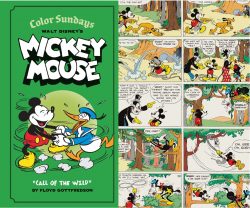
Walt Disney’s Mickey Mouse: “The Race to Death Valley” (Walt Disney’s Mickey Mouse Classic Collection volume 1)


By Floyd Gottfredson & various; Edited by David Gerstein (Fantagraphics Books)
ISBN: 978-1-60699-441-2 (HB/Digital edition)

As collaboratively co-created by Walt Disney and Ub Iwerks, Mickey Mouse was first seen – if not heard – in silent cartoon Plane Crazy. The animated short fared poorly in a May 1928 test screening and was promptly shelved. (Happy technical 95th Anniversary, kid!)

That’s why most people who care cite Steamboat Willie – the fourth Mickey feature to be completed – as the debut of the mascot mouse and co-star and paramour Minnie Mouse, since it was the first to be nationally distributed, as well as the first animated feature with synchronised sound. Its astounding success led to a subsequent and rapid release of fully completed predecessors Plane Crazy, The Gallopin’ Gaucho and The Barn Dance once they too had been given soundtracks. From those timid beginnings grew an immense fantasy empire, but film was not the only way Disney conquered hearts and minds.

With Mickey a certified solid gold sensation, the mighty mouse was considered a hot property and soon invaded America’s most powerful and pervasive entertainment medium: comic strips…

Floyd Gottfredson was a cartooning pathfinder who started out as just another warm body in the Disney Studio animation factory. Happily, he slipped sideways into graphic narrative and evolved into a ground-breaker of pictorial narratives as influential as George Herriman, Winsor McCay and Elzie Segar. Gottfredson’s Mickey Mouse entertained millions – if not billions – of eagerly enthralled readers and shaped the very way comics worked.

Via some of the earliest adventure continuities in comics history he took a wild and anarchic animated rodent from slap-stick beginnings and transformed a feisty everyman/mouse underdog into a crimebuster, detective, explorer, lover, aviator or cowboy. Mickey was the quintessential two-fisted hero whenever necessity demanded…

In later years, as tastes – and syndicate policy – changed, Gottfredson steered that self-same wandering warrior into a sedate, gently suburbanised lifestyle, employing crafty sitcom gags suited to a newly middle-class America: a 50-year career generating some of the most engrossing continuities the comics industry has ever enjoyed.

Arthur Floyd Gottfredson was born in 1905 in Kaysville, Utah, one of eight siblings born to a Mormon family of Danish extraction. Injured in a youthful hunting accident, Floyd whiled away a long recuperation drawing and studying cartoon correspondence courses. By the 1920s he had turned professional, selling cartoons and commercial art to local trade magazines and Big City newspaper the Salt Lake City Telegram.

In 1928, he (and wife Mattie) moved to California where, after a shaky start, the doodler found work in April 1929 as an in-betweener with the burgeoning Walt Disney Studios. Just as the Great Depression hit, he was personally asked by Disney to take over the newborn but already ailing Mickey Mouse newspaper strip. Gottfredson would plot, draw and frequently script the strip for the next five decades: an incredible accomplishment by of one of comics’ most gifted exponents.

Veteran animator Ub Iwerks had initiated the print feature with Disney himself contributing, before artist Win Smith was brought in. The nascent strip was plagued with problems and young Gottfredson was only supposed to pitch in until a regular creator could be found.

His first effort saw print on May 5th 1930 (his 25th birthday) and Floyd just kept going for an uninterrupted run over the next half century. On January 17th 1932, Gottfredson crafted the first colour Sunday page, which he also handled until retirement.

In the beginning he did everything, but in 1934 Gottfredson relinquished the scripting role, preferring plotting and illustrating the adventures to playing about with dialogue. Thereafter, collaborating wordsmiths included Ted Osborne, Merrill De Maris, Dick Shaw, Bill Walsh, Roy Williams and Del Connell. At the start and in the manner of a filmic studio system, Floyd briefly used inkers such as Ted Thwaites, Earl Duvall and Al Taliaferro, but by 1943 had taken on full art chores.

This superb archival compendium – part of a magnificently ambitious series collecting the creator’s entire canon – re-presents the initial daily romps, jam-packed with thrills, spills and chills, whacky races, fantastic fights and a glorious superabundance of rapid-fire sight-gags and verbal by-play. The manner by which Mickey became a syndicated star is covered in various articles at the front and back of this sturdy tome devised and edited by truly dedicated, clearly devoted fan David Gerstein.

Under the guise of Setting the Stage the unbridled fun and revelations begin with gaming guru Warren Spector’s appreciative ‘Introduction – The Master of Mickey Epics’ and a fulsome biographical account and appraisal of Gottfredson and Mickey continuities in ‘Of Mouse and Man – 1930-1931: The Early Years’ by historian and educator Thomas Andrae.

The scene-setting concludes with ‘Floyd Gottfredson, The Mickey Mouse Strip and Me – an Appreciation by Floyd Norman’, incorporating some preliminary insights from Gerstein in …An Indebted Valley… before the strip sequences begin in ‘The Adventures: Floyd Gottfredson’s Mickey Mouse Stories with Editor’s Notes’.

At the start the strip was treated like an animated feature, with diverse hands working under a “director” and each day seen as a full gag with set-up, delivery and a punchline, usually all in service to an umbrella story or theme. Such was the format Gottfredson inherited from Walt Disney for his first full yarn ‘Mickey Mouse in Death Valley’. It ran from April 1st to September 20th 1930 with the job further complicated by an urgent “request” from controlling syndicate King Features. They required that the strip immediately be made more adventure-oriented to compete with the latest trend in comics – action-packed continuities as seen in everything from Wash Tubbs to Tarzan

Roped in to provide additional art and inking for the raucous, rambunctious rambling saga were Win Smith, Jack King, Roy Nelson & Hardie Gramatky. The tale itself involved a picaresque, frequently deadly journey way out west to save Minnie’s inheritance – a lost mine – from conniving lawyer Sylvester Shyster and his vile and violent crony Peg-Leg Pete.

To foil them Mickey and his aggrieved companion chased across America by every conveyance imaginable, facing every possible peril immortalised by silent movie westerns, melodramas and comedies. In their relentless pursuit they were aided by masked mystery man The Fox

Next up – after brief preamble ‘Sheiks and Lovers’ – is another lengthy epic, featuring most of the early big screen repertory cast. ‘Mr. Slicker and the Egg Robbers’ (inked by Gottfredson, Gramatky & Earl Duvall and running from September 22nd – December 29th) opens with Mickey building his own decidedly downbeat backyard golf course before being repeatedly and disconcertingly distracted when sleazy sporty type Mr. Slicker starts paying unwelcome attention to Minnie. Well, it’s unwelcome as far as Mickey is concerned…

With cameos from Horace Horsecollar, Clarabelle Cow, goat-horned Mr. Butt and a prototype Goofy who answered – if he felt like it – to the moniker Dippy Dog, the rambunctious shenanigans continue for weeks until the gag-abundant tale resolves into a classic powerplay and landgrab as the nefarious ne’er-do-well is exposed as the fiend attempting to bankrupt Minnie’s family by swiping all the eggs produced on their farm. The swine even seeks to frame Mickey for his misdeed before our hero turns the tables on him…

A flurry of shorter escapades follow: rapid-fire doses of wonder and whimsy including ‘Mickey Mouse Music’ (December 30th 1930 – January 3rd 1931 with art by Duvall), ‘The Picnic’ (January 12th – 17th, Gottfredson inked by Duvall) and ‘Traffic Troubles’ (January 5th – 10th with pencils by Duvall & Gottfredson inks) before Gerstein introduces the next extended storyline with some fondly eloquent ‘Katnippery’

With story & art by Gottfredson & Duvall, ‘Mickey Mouse Vs. Kat Nipp’ proceeded from January 19th until February 25th 1931, detailing how a brutal feline thug bullies our hero. The sad state of affairs involves tail-abusing in various inspired forms, after which ‘Gallery Feature – …He’s Funny That Way…’ reveals a later Sunday strip appearance for Kat Nipp in a story by Merrill De Maris with Gottfredson pencils & Ted Thwaites inks. The excerpt comes from June 1938.

Gerstein’s introductory thoughts on the next epic – ‘High Society: Reality Show Edition’ – precede the serialised saga of ‘Mickey Mouse, Boxing Champion’. Running February 26th to April 29th by Gottfredson, Duvall & Al Taliaferro, the hilarious episodes relate how ever-jealous Mickey floors a big thug leering at Minnie to become infamous as the guy who knocked out the current heavy lightweight boxing champ.

Ruffhouse Rat’s subsequent attempts at revenge all go hideously awry and before long Mickey is acting as the big lug’s trainer. It’s a disaster and before long the champion suffers an inexorable physical and mental decline. Sadly, that’s when hulking brute Creamo Catnera hits town for a challenge bout. With Ruffhouse refusing to fight, it falls to Mickey to take on the savage contender…

Having accomplished one impossible task, Mickey sets his sights on reintroducing repentant convict Butch into ‘High Society’ (April 30th – May 30th – story & pencils by Gottfredson and inks from Taliaferro). The story was designed to tie-in to a Disney promotional stunt – a giveaway “photograph” of Mickey – and the history and details of the project are covered in ‘Gallery Feature – “Gobs of Good Wishes”’

‘Mick of All Trades’ introduces the next two extended serial tales, discussing Mickey’s every-mouse nature and willingness to tackle any job like the Taliaferro-inked ‘Circus Roustabout’ which originally ran from June 1st – July 17th. Here a string of animal-based gags is held together by Mickey’s hunt for a cunning thief, after which ‘Pluto the Pup’ takes centre-stage for a 10-day parade of slapstick antics and Gerstein’s ‘Middle-Euro Mouse’ supplies context to the less-savoury and non-PC historical aspects of an epic featuring wandering “gypsies”.

‘Mickey Mouse and the Ransom Plot’ (July 20th – November 7th) follows the star and chums Minnie, Horace and Clarabelle on a travelling vacation to the mountains. Here they fall under the influence of a suspicious band of Roma exhibiting all the worst aspects of thieving and spooky fortune-telling. When Minnie is abducted and payment demanded, Mickey knows just how to deal with the villains…

Essay ‘A Mouse (and a Horse and a Cow) Against the World’ segues into fresh employment horizons for our hero as Gottfredson & Taliaferro test the humorous action potential of ‘Fireman Mickey’ (November 9th – December 5th). Another scintillating cascade of japes, jests and merry melodramas – and taking us from December 7th 1931 to January 9th 1932 in fine style – it offers glimmerings of continuity sub-plotting and supporting character development. These all shade a budding romance under the eaves of ‘Clarabelle’s Boarding House’. Although the chronological cartooning officially concludes here, there’s still a wealth of glorious treats and fascinating revelations in store in The Gottfredson Archives: Essays and Archival Features section that follows.

Contributed by Thomas Andrae, ‘In the Beginning: Ub Iwerks and the Birth of Mickey Mouse’ offers beguiling background and priceless early drawings from the earliest moments, as does Gerstein’s ‘Starting the Strip’ which comes packed with timeless ephemera.

As previously stated, Gottfredson took over a strip already in progress and next – accompanied by covers from European editions of the period – come the strips preceding his accession. Frantic gag-panels (like scenes from an animation storyboard) comprise ‘Lost on a Desert Island’ (January 13th – March 31st 1930, crafted by storyteller Walt and artists Ub Iwerks & Win Smith) are augmented by Gerstein’s ‘The Cartoon Connection’ with additional Italian strips from Giorgio Scudellari in ‘Gallery Feature – “Lost on a Desert Island”’.

Even more text and recovered-art features explore ‘The Cast: Mickey and Minnie’ and ‘Sharing the Spotlight: Walt Disney and Win Smith’ (both by Gerstein) before more international examples illuminate ‘Gottfredson’s World: Mickey Mouse in Death Valley’ whereafter ‘Unlocking the Fox’ traces the filmic antecedents of the hooded stranger, with priceless original art samples in ‘Behind the Scenes: Pencil Mania’.

More contemporaneous European examples from early collections tantalise in ‘Gallery Feature – Gottfredson’s World: Mr. Slicker and the Egg Robbers’ before Alberto Beccatini & Gerstein’s ‘Sharing the Spotlight: Roy Nelson, Jack King and Hardie Gramatky’ supply information on these lost craftsmen.

Gerstein’s ‘The One-Off Gottfredson Spin-Off’ highlights a forgotten transatlantic strip collaboration with German artist Frank Behmak, whilst ‘Gallery Feature – The Comics Department at Work: Mickey Mouse in Color (- And Black and White)’ covers lost merchandise and production art whilst ‘Gottfredson’s World: Mickey Mouse Vs. Kat Nipp’ and ‘Gottfredson’s World: Mickey Mouse, Boxing Champion’ offer yet more overseas Mouse memorabilia.

‘Sharing the Spotlight: Earl Duvall’ is another fine Gerstein tribute to a forgotten artisan, supplemented by ‘The Cast: Butch’ and ‘Al Taliaferro’, after which ‘The Gottfredson Gang: In “Their Own” Words’ (Gerstein – with texts by Mortimer Franklin & R. M. Finch) reprints contemporary interviews with the 2D stars, garnished with publicity tear-sheets and clippings. This is rounded off by more foreign covers in ‘Gallery Feature – Gottfredson’s World: Strange Tales of Late 1931’, ‘The Cast: Pluto’ and a stunning Christmas message from the Mouse as per ‘I have it on good authority’, giving Gottfredson himself the last word.

Gottfredson’s influence on not just the Disney canon but sequential graphic narrative itself is inestimable: he was among the first to produce long continuities and “straight” adventures; he pioneered team-ups and invented some of the first “super-villains” in the business.

When Disney killed the continuities in 1955, dictating henceforth strips would only contain one-off gag strips, Floyd adapted seamlessly, working on until retirement in 1975. His last daily appeared on November 15th with the final Sunday published on September 19th 1976.

Like all Disney creators, Gottfredson worked in utter anonymity, but in the 1960s his identity was revealed and the voluble appreciation of his previously unsuspected horde of devotees led to interviews, overviews and public appearances, with effect that subsequent reprinting in books, comics and albums carried a credit for the quiet, reserved master. Floyd Gottfredson died in July 1986.

Thankfully we have these Archives to enjoy and inspire us and hopefully a whole new generation of inveterate tale-tellers…
© 2011 Disney Enterprises, Inc Text of “In the Beginning: Ub Iwerks and the Birth of Mickey Mouse” by Thomas Andrae is © 2011 Thomas Andrae. All contents © 2011 Disney Enterprises unless otherwise noted. All rights reserved.

Action Heroes Archive volume 1: Captain Atom & volume 2: Captain Atom, Blue Beetle & The Question


By Steve Ditko, Joe Gill, Gary Friedrich, Dave Kaler, Steve Skeates, Rocke Mastroserio, Frank McLaughlin, Al Milgrom, Roger Stern, John Byrne, Michael Uslan, Alex Toth, and various (DC Comics)
ISBN: 978-1-4012-0302-3 (HB vol. 1) 978-1-4012-1346-6 (HB vol. 2)

Clearly I’m cashing in on the pre-release hype around a new DC Cinema blockbuster here, but I take honest refuge and some comfort in the fact that these books and the stories they contain are actually germane as well as being some of the best Silver Age comics ever crafted… 

Despite being dead – and so very much missed – Steve Ditko remains comics’ most unique stylist. Love him or hate him, you can’t mistake his work for anyone else’s. His career began in the early 1950s and, depending on whether you’re a superhero fan or prefer deeper, more challenging experimental work, peaked in either the mid-1960s or 1970s.

Leaving the Avenging World, Mr. A and his other philosophically-derived creations for another time, the superhero crowd should heartily celebrate and clamour for new editions of these deluxe collections of the first costumed do-gooder that Ditko worked on. Although I’m a huge fan of his linework – which is always best served by monochrome printing – the crisp, sharp colour of these Archive editions is still much better than the appalling reproduction on bog-paper that first displayed Charlton Comics’ Atomic Ace and latterly the Bug Bombshell to the kids of Commie-obsessed America.

As discussed in the Foreword by historian and Ditko-expert Blake Bell, Action Heroes Archive volume 1: Captain Atom reveals – in all the full-on, simplistic furore of a 1950s B-Movie – how a Cold War-obsessed America copes with a modern-day miracle just as the concept of costumed superheroes was being reimagined…

With covers by Ditko and/or Mastroserio, this tome amasses pertinent tales from Space Adventures #33-40 & 42 (spanning cover-dates March 1960 to October 1961), augmented by the contents of the revived, solo-starring Captain Atom #78-82, as published for December 1965 through September 1966.

In those simpler times the short, terse adventures of Captain Atom seemed somehow more telling than the innovative yet rather anodyne DC fare, whilst Marvel was still pushing romances, westerns and monsters in underpants, explorers in pith helmets and citizen scientists with labs in their garden sheds. Their particular heroic revolution was still months away even though Steve Ditko was producing top-flight work for both companies.

Nevertheless, Ditko’s hero was different and we few who read him all knew it….

As scripted by Jo Gill and predating Fantastic Four #1 by more than 18 months, Space Adventures #33 even cover-featured the new sensation-in-waiting as ‘Introducing Captain Atom’ in a brief but vivid vignette, giving us a true American hero and man of his time before instantly killing him.

Captain Adam was an astronaut accidentally but literally atomised in a rocketry accident. Eerily – and the way it’s drawn spooked the short pants off me when I first read it all those years ago – he gradually reassembles himself on the launch pad…

Now blessed with astounding powers, he reports to the President (Eisenhower) and is swiftly kitted up in a protective outfit, allowing contact with normal, non-irradiated humans and reassigned as a masked superhero who will be the USA’s secret weapon…

Mostly written by or co-written with Joe Gill, the first wonderful, addictive run of 18 stories from Space Adventures #33-42 (and three of those were in fact drawn by uninspired, out-of-his-comfort zone Rocke Mastroserio) are a magnificent example of Ditko’s emerging mastery of mood, pacing, atmosphere and human dynamics.

In 1961, with Ditko increasingly doing more work for blossoming – and better paying – Marvel, Charlton killed the Captain Atom feature. However, when Dick Giordano jumped on the superhero bandwagon and created a costumed character line for Charlton in late 1965, the Captain was revived. Space Adventures was retitled, with Atom’s first full length issue numbered #78.

Since he was still drawing Amazing Spider-Man and Doctor Strange, Ditko could only manage pencils, so Mastroserio was recruited to ink the series, resulting in an oddly jarring finish. With #79, Ditko became lead writer too, and the stories took on an eccentric, compelling edge and tone, lifting them above much of the competition’s fare. Eventually the inker adapted to Ditko’s style and much of the ungainliness disappeared from the figurework, although so had the fine detail that had elevated the early art. This volume ends with issue #82, leaving six more published issues and a complete unpublished seventh for another time…

However, those early, Cold War-fired tales are a truly unique blend of action, tension and sheer whimsy which continued in Space Adventures #34 as ‘The 2nd Man in Space’ cheekily sees the magnanimous hero covertly undercut another Soviet space triumph by saving the USSR’s first cosmonaut from his defective capsule, whilst #35#s ‘The Little Wanderer’ finds him traversing the stars to rescue the spirit of an little boy inadvertently abducted by a well-meaning cosmic traveller…

A thermonuclear double bill graced #36, beginning with ‘The Wreck of X-44’, with a new craft detonating in space and leading Captain Atom to a deadly saboteur, after which ‘Captain Atom on Planet X’ finds him defending a US satellite from all-out attack by the dastardly ruthless Russians…

Geopolitics gives way to fantasy as #37 (December 1960) initially details a fusion-foiled invasion by ‘The Space Prowlers’ before a US probe to the second planet is scuttled by svelte space sirens who score ‘A Victory for Venus’ over the stounded atomic Earthman…

Two months later and the count climbed to three stories, beginning with ‘One Second of War’, wherein the Captain wrecks the doomsday missile attack of Dr. Claudius Jaynes, a suicidal maniac with his own atomic arsenal, before repeating the feat in ‘Backfire’ when a tin-pot dictator seeks to nuke the USA. The issue ends with ‘The Force Beyond’ as an alien entity tries to destroy the world with meteors before encountering our nuclear nemesis…

Space Adventures #39 begins with a ‘Test-Pilot’s Nightmare’ as arrogance threatens the life of a helpless jet jockey and Atom invisibly comes to the rescue after which Mastroserio limns ‘Peace Envoy’ with the energetic enigma turning back another alien invasion. Ditko is back for the final fling as Captain Adam goes undercover in Berlin (just before The Wall went up) to crush an espionage plot in ‘An Ageless Weapon’

The atomic experiment was coming to a close. After #40’s ‘The Crisis’ – wherein the hero helps a diplomat call a tyrant’s bluff and ‘The Boy and the Stars’ features another Earth tot transported into the wondrous cosmos – the costumed heroics were absent the next issue.

Just as the FF was about to go big, Space Adventures #42 (October 1961) arrived and depleted all the inventory tales at once beginning with a brace of Mastroserio drawn yarns and one last tantalising Ditko masterpiece. ‘The Saucer Scare’ is yet another mediocre space war clash whilst ‘The Man in Saturn’s Moon’ sees the atomic ace hunting a Soviet dissent squirreled away by wicked commies. Those lesser efforts are utterly eclipsed by ‘The Silver Lady from Venus’ as another sexy extraterrestrial beguiles the humans of Earth before making a fool of the fiery champion…

And that was that the end until of 1965 when a global resurgence of costumed capers led to a new line at Charlton. Leading that charge came Captain Atom #78 (cover-dated December) when Gill & Ditko – with Mastroserio inking – revived the Atomic Adventurer in ‘The Gremlins from Planet Blue’. The genre had moved on in four years and the stripped-back, pared-down B-Movie feel of those early tales had evolved into a more uniquely fulsome and flamboyant affair for this particular extraterrestrial infiltration. Here were subplots and supporting cast to spare, as the hero foiled alien sabotage and mind control at Cape Kennedy, romancing Leah Jupe whilst her scientist father fell under the control of insidious infiltrators. There was even a new gadfly for Captain Adam in the grumpy form of martinet military man General Brill before ultimately saving Earth again…

In the next issue (February/March 1966), a true but tragic supervillain arrives in the series as ‘Captain Atom Faces Doctor Spectro, Master of Moods’ when a spy hunt brings the hero into the orbit of an embittered recluse seeking to master light and colour to revolutionise medicine. Sadly, sudden success tips him over the edge and his newfound abilities drive him even more crazy…

Apparently destroyed, the miscreant is soon forgotten when a wandering planetoid nears Earth and sounds the ‘Death Knell of the World’ (#80, Ditko, Gill & Mastroserio). Happily, the High Energy Hero is up to foiling a cosmic tyrant and liberating his captive satellite people before confronting ‘The Five Faces of Doctor Spectro’ as the misunderstood miscreant reappears in five prismatic pieces with a plethora of different plans but one overriding goal: pulling himself together and finally splitting this atom…

The hero hosts a quick fact feature drawn by Frank McLaughlin in ‘Captain Atom’s Secret’ before this initial outing ends with a magnificent step up in tension and quality. Issue #82 – cover-dated September 1966 and by Ditko with Dave Kaler & Mastroserio – debuts not just the series’ ultimate archfoe and a major story arc but also the company’s first female superhero.

With an enigmatic teleporting thief casually robbing the nation and the military of its wealth and top secrets, Captain Adam is sent undercover with mystery operative Nightshade in ‘Captain Atom vs. The Ghost’

Their mission introduces sleek scoundrel Alec Rois, channels the spy craze of the era and hints at a vast conspiracy underpinning a threat to Earth and even finds time to see the heroes battle an army of thugs and save Fort Knox from bold bullion banditry…

Over half a decade pioneers Steve Ditko and Captain Atom and paved the way and lit a path to a revolution in comics storytelling and these early exploits were only the start…


Action Heroes volume 2: Captain Atom, Blue Beetle & The Question

A second – far longer – volume completes Ditko’s controversial Charlton Comics costumed hero contributions with the remainder of Captain Atom’s exploits, the introduction of a new Blue Beetle and debut of his uniquely iconic vigilante The Question.

Following an effusive and extremely informative Introduction by original Action Line inventor and editor Dick Giordano, Captain Atom #83 (November 1966) starts the ball rolling again with a huge blast of reconstructive character surgery.

Although ‘Finally Falls the Mighty!’ was inked by Mastroserio and scripted by relative newcomer Kaler, thematically it’s pure Ditko. Plotted and drawn by him, it sees an ungrateful public swiftly turn on the Atomic Ace, due to the manipulations of a former colleague turned cunning criminal.

Intended to tone down the character’s sheer omnipotence, the added approachable empathy-inducing humanity of malfunctioning powers made his struggles against treacherous Professor Koste all the more poignant.

Moreover, the sheer visual spectacle of his battle against a runaway reactor is some of Ditko’s most imaginative design and layout work. The tale ends on a cliffhanger – a real big deal when the comic came out every two months – and with the last 7 pages dedicated to debuting a new superhero with one of the oldest names in the business.

The Blue Beetle first appeared in Mystery Men Comics #1, released by Fox Comics and cover-dated August 1939. Created by Charles Nicholas (nee Wojtkowski) the character was inexplicably popular: surviving the collapse of numerous publishers before ending up as an acquired Charlton property in the mid-1950s. After releasing a few issues sporadically, Charlton shelved him until the superhero revival of the 1960s when Gill and latterly young Roy Thomas revised and revived the character for a combined 10-issue run (June 1964 – February 1966).

Here however, Ditko accepts but sets aside all that history to utterly recreate him. Ted Kord is an earnest young scientist with a secret tragedy in his past, which Ditko and scripter Gary Friedrich sagely forbear revealing in deference to intrigue and action, in a taut, captivating crime-thriller where the new hero displays his modus operandi by stopping a vicious crime-spree by the Killer Koke Gang.

This untitled short has all the classic elements of a Ditko masterpiece: outlandish intense, fight scenes, compact, claustrophobic yet dynamic layouts, innovative gimmickry and a clear-cut battle between Right and Wrong. It’s one of the very best introductory stories of a new hero anywhere in comics – and it’s 7 pages long…

The remodelling of the Atomic Ace concludes in the next issue with ‘After the Fall a New Beginning’. Once again Ditko rattled his authorial sabre about the fickleness of the public as the villainous Koste exposes the hero’s face on live TV. Escaping, Atom gets a new costume to match his curtailed powers …and consequently, a lot more drama drapes the series.

Now there is a definite feeling of no safety or status quo. The untitled Blue Beetle back-up (scripted by Friedrich with full art from Ditko) pits the new kid against a Masked Marauder, but the real kicker is the bombshell revelation that Homicide detective Fisher – investigating the disappearance of Dan Garrett – suspects a possible connection to Kord…

Whilst extending a running plot-line about the mysterious Ghost and his connection to a lost civilization of warrior women, ‘Strings of Punch and Jewelee’ introduces a couple of shady carnival hucksters who find a chest of esoteric alien weapons and use them for robbery. Although Cap and partner Nightshade are somewhat outclassed here, the vigour and vitality of the Blue Beetle is again undeniable as a mid-air hijack is foiled and a spy sub and giant killer octopus are given short shrift by the indomitable rookie crusader.

Captain Atom #86 finally brings the long-simmering plot-thread of tech thief The Ghost to a boil as the malevolent science-wizard goes on a rampage, totally trouncing Nightshade and our hero before being kidnapped by the aforementioned mystery maidens. ‘The Fury of the Faceless Foe! is by Ditko, Kaler & Mastroserio whilst in the (still) untitled Blue Beetle strip by Friedrich & Ditko, the cobalt crusader confronts a ruthless scientist/industrial spy he’s convinced he battled before…

This leads directly into the first issue of his own comic book. Blue Beetle #1 (cover-dated June 1967) is an all-Ditko masterpiece (even scripting it as “D.C. Glanzman”) with the hero in all-out action against a deadly gang of bandits. ‘Blue Beetle… Bugs the Squids’ is crammed with the eccentric vitality that made Amazing Spider-Man such a monster hit, with justice-dispensing joie de vivre balanced by the moody, claustrophobic introduction of Ditko’s most challenging mainstream superhero creation.

‘The Question’ is Vic Sage, a TV journalist with an uncompromising attitude to crime and corruption, employing an alter-ego of faceless, relentless retribution. In his premiere outing he exposes the link between his own employers’ self-righteous sponsors and gambling racketeer Lou Dicer. This theme of unflinching virtue in the teeth of both violent crime and pernicious peer and public pressure marked Ditko’s departure from straight entertainment towards philosophical – some would say polemical – examination of greater societal issues and the true nature of both Good and Evil that would culminate in his controversial Mr. A, Avenging World and other independent ventures.

In Captain Atom #87 (August 1967), ‘The Menace of the Fiery-Icer’ presaged the beginning of the end for the Atomic Ace as Kaler, Ditko & Mastroserio dialled back on plot threads to deliver a visually excellent but run-of-the-mill yarn about a spy ring with a hot line in cold-blooded leaders.

Blue Beetle #2 however – another all-Ditko affair from the same month – showed the master at his peak. Lead story ‘The End is a Beginning!’ at last reveals the origin of the character as well as the fate of Dan Garrett, and even advances Kord’s relationship with his assistant Tracey. The enigmatic Question, meanwhile, tackles flying burglar The Banshee in a vertiginous, moody thriller reminiscent of early Doctor Strange strips.

Frank McLaughlin joins as inker for a satisfying no-nonsense escapist romp ‘Ravage of Ronthor’ (Captain Atom #88, October 1967), as the hero answers a distress call from space to preserve a paradise planet from marauding giant bugs. Blue Beetle #3 was another superbly satisfying read, as the eponymous hero routes malevolent, picturesque thugs ‘The Madmen’ in a sharp parable about paranoia and misperception. Equally captivating is the intense and bizarre Question vignette wherein a murderous ghostly deep-sea diver stalks some shady captains of industry…

Cover-dated December 1967, issue #89 was the last Captain Atom published by Charlton: an early casualty of the burn-out afflicting the superhero genre and leading to a resurrected horror and mystery craze. This resurrected genre would form a new backbone for the company’s 1970’s output; one where Ditko would shine again in his role as master of short story horror.

Scripter Kaler satisfactorily ties up most of the hanging plot threads with the warrior women of Sunuria in sci-fi-meets-witchcraft thriller ‘Thirteen’, although the Ditko/McLaughlin art team was nowhere near top form.

The next episode promised a final ‘Showdown in Sunuria’, but never materialized…

Blue Beetle #4 (released the same month) is visually the best of the bunch as Kord follows a somehow-returned Dan Garrett to an Asian backwater in pursuit of lost treasure and a death cult. ‘The Men of the Mask’ is pure strip poetry and bombastic action, cunningly counterbalanced by a seedy underworld thriller as the Question seeks to discover who gave the order to ‘Kill Vic Sage!’ Scripted by Steve Skeates (as Warren Savin) it was the last action any Charlton hero saw for the better part of a year…

Then, cover-dated October 1968, The Question returned as the star of Mysterious Suspense #1, with Ditko producing a captivating cover and three-chapter thriller (with Mastroserio providing a rather jarring full-page frontispiece). ‘What Makes a Hero?’ (probably rescued from partially completed inventory material) sees crusading Vic Sage pilloried by the public, abandoned by friends and abandoned by his employers yet resolutely sticking to his higher principles in pursuit of hypocritical villains masquerading as pillars of the community. Ditko’s interest in Ayn Rand’s philosophical Objectivism had become increasingly important to him and this story is arguably the dividing line between his “old” and “new” work. It’s also the most powerful and compelling piece in this entire book.

A month later one final issue of Blue Beetle (#5) was published. ‘The Destroyer of Heroes’ is a decidedly quirky tale featuring a nominal team-up of the azure avenger and the Question as a frustrated artist defaces heroic and uplifting paintings and statues. Ditko’s committed if reactionary views of youth culture, which so worried Stan Lee, are fully on view in this charged, absorbing tale.

Other material had been created and languished incomplete in editorial limbo. In the early 1970s a burgeoning and committed fan-base created fanzine Charlton Portfolio. With the willing assistance of the company, a host of kids who would soon become household names in their own right found a way to bring the lost work to the public gaze. Their efforts are also included here, in monochrome as they originally appeared.

For Charlton Portfolio #9 and 10 (1974), the unreleased Blue Beetle #6 was serialized. ‘A Specter is Haunting Hub City!’ is another all-Ditko extravaganza, pitting the hero against an (almost) invisible thief. Follow-up magazine Charlton Bullseye (1975) finally published ‘Showdown in Sunuria’ in its first two issues.

Behind an Al Milgrom Captain Atom cover, Kaler’s plot was scripted by Roger Stern (working as Jon G. Michels) and Ditko’s pencils were inked by rising star John Byrne – a cataclysmic climax almost worth the 8-year wait. But even there, the magic doesn’t end in this magnificent Archive volume.

Charlton Bullseye #5 (1975) offers one last pre-DC tale of The Question: 8 gripping, intense and beautiful pages plotted by Stern, scripted by Michael Uslan and illustrated by the legendary Alex Toth. This alone is worth the price of admission.

These weighty snapshots from another era are packed with classic material by brilliant craftsmen. They are books no Ditko addict, serious fan of the genre or lover of graphic adventure can afford to be without. It’s impossible to describe the grace, finesse, and unique eclectic shape of Steve Ditko’s art. It must be experienced, and this is as good a place to start as any. It’s just a shame DC have let these tales languish so long, but hopefully the power of Hollywood will induce a revival…
© 1966, 1967, 1968, 1974, 1975, 1976, 2007 DC Comics. All Rights Reserved.

The Phantom: The Complete Sundays Archive Volume Three 1945-1949


By Lee Falk, Ray Moore & Wilson McCoy: introduction by Daniel Herman (Hermes Press)
ISBN: 978-1-61345-100-7 (HB/Digital edition)

Born Leon Harrison Gross, Lee Falk created the Ghost Who Walks at the request of his King Features Syndicate employers who were already making history, public headway and loads of money with his first strip sensation Mandrake the Magician. Although technically not the first ever costumed champion in comics, The Phantom became the prototype paladin to wear a skin-tight body-stocking and the first to have a mask with opaque eye-slits…

The generational champion debuted on February 17th 1936, in an extended sequence pitting him against an ancient global confederation of pirates. Falk wrote and drew the daily strip for the first two weeks before handing over illustration to artist Ray Moore. The spectacular and hugely influential Sunday feature began in May 1939.

For such a long-lived, influential series, in terms of compendia or graphic collections, The Phantom has been quite poorly served in the English language market (except for the Antipodes, where he has always been accorded the status of a pop culture god). Many companies have sought to collect strips from one of the longest continually running adventure serials in publishing history, but in no systematic or chronological order and never with any sustained success. That began to be rectified when archival specialists Hermes Press launched their curated collections…

This third edition is a lovely and large (229 x 330 mm) landscape hardback/digital tome, displaying a complete full colour Sunday per page. Released in March 2016, its 208 pages are stuffed with sumptuous visual goodies like panel and logo close-ups, comics covers and lots of original art and opens with publisher Daniel Herman’s ‘Introduction: The Sunday’s Continue…’ recapping all you need to know about the feature and disclosing how Wilson McCoy assumed the illustrator’s role from Ray Moore – and why nobody knows exactly when he did…

For those who came in late: 400 years previously, a British mariner survived an attack by pirates, and – after washing ashore on the African coast – swore on the skull of his father’s murderer to dedicate his life and that of his descendants to destroying all pirates and criminals. The Phantom fights evil and injustice from his fabulous lair deep in the jungles of Bengali. Throughout Africa and Asia he is known as the “Ghost Who Walks”…

His unchanging appearance and unswerving war against injustice led to his being considered an immortal avenger by the uneducated, credulous and wicked. Down the decades, one heroic son after another has inherited the task, fought and died in an unbroken family line, with the latest wearer of the mask indistinguishable from the first and proudly continuing the never-ending battle.

In his first published exploit the Phantom met and fell for wealthy American adventurer Diane Palmer and his passion for her was soon reciprocated and returned and she became a continuing presence in both iterations of the series as ally, partner, sounding board, a means of reader identification and naturally a plot pawn and perennial hostage to fortune.

Almost every saga featured powerful, capable and remarkably attractive women as both heroes and villains, and in opening tale ‘Queen Pera the Perfect’ (running from December 9th 1945 to March 17th 1946), Diana saw the tables turned…

The aforementioned ruler of remote but rich Karola was constrained to find a husband, and so sent her fanatical minions into the world to find a man worthy of her. They returned with a musical genius, celebrated fighter pilot, champion pugilist and cinema’s greatest lover, but wherever they went they heard legends of an incredible superman…

After The Phantom repeatedly refuses her men’s offer, and gives her stern lesson in manners, she responds by having him imprisoned in her dungeons until he sees sense, and this time it’s his true love who has to save the day…

Spanning March 24th to August 4th 1946, ‘King of Beasts’ sees the liberated champion retuned to Bengali in time for Diana to be unjustly imprisoned. A priceless pearl necklace has been stolen from a maharajah and nobody believes the story of who actually took it: not the police and certainly not American mobster Poison Ivy and his boys…

When The Phantom tries to engineer a jailbreak, he’s caught too and charged with being an accomplice, only for the true thief to free him and Diana by sending a pickpocketing monkey to unlock their cell. In the ensuing flight, Diana is snatched by the mobsters, who don’t believe a word about a hidden mastermind using trained beasts to burgle. That all changes when a trained troop of elephants bust into the bank and porcupines empty a packed casino for their masked master…

With chaos unleashed, The Phantom retrenches and calls in his own equine ally and canine corps. Mighty steed Hero and lupine assistant Devil soon track down the King of Beasts who is far from what anyone expected. However even after he’s handled, there’s still increasingly murderous Poison Ivy to deal with…

Another female fury debuts in ‘The Scarlet Sorceress’ (August 11th – December 22nd) as a royal visit to the Deep Woods of the Bandar People introduces little Princess Valerie and her grandfather the Rajah of Volara. The child will soon become a pawn in a wicked plot…

When the princess of neighbouring kingdom Wogu falls ill, a devious manipulator “prophesies ” that only golden-haired Valerie’s blood can save the ailing waif, prompting a kidnapping and a frantically fast response from the Ghost Who Walks. Not all the monstrous forces set against him can slow the Phantom, but after exposing the witch as a charlatan, the hero discovers that he’s fighting not a villain but another victim. Soon, however, his efforts save all involved and pacify two kingdoms…

December 29th 1946 to June 29th 1947 finds The Phantom once more battling to save Diana after the filthy rich and spoiled Potentate of Ptjar Prince Pepe abducts her to be his very best bride. Law and reason mean nothing to the repulsive despot and by the time the hero reaches the distant kingdom, she is beyond even the Ghost’s reach. His only recourse is to play Pepe’s game and in a dozen days complete ‘The 12 Tasks’ conceived to frustrate and humiliate the hero. However, wit and ingenuity married to his mighty physicality make short work of the impossible – such as capturing an invulnerable giant bandit, emptying a river of carnivorous fish, banishing every shark in the bay or stopping all crime for 24 hours – and despite Pepe’s cheating equivocations the final task changes the nation forever and for the better…

A return to jungle warfare and tribal feuding underpins ‘The Dragon God’ (July 26th to November 16th) as Diana’s interest in an ancient Wambesi idol presages the fire-breathing saurian coming to life and demanding its worshippers kill and plunder their neighbours the Ulangi. With “The Phantom’s Peace” broken, the Ghost Walks amongst them to re-establish order and quickly discovers white instigators and recovered wartime weaponry behind the uprising, but once begun war has its own momentum and tribal grudges run deep and burn forever…

With bloodshed ended, a change of pace and tone heralds the return of an appalling duo who had previously made life miserable for The Phantom. Spanning November 23rd 1947 to May16th 1948, ‘The Marshall Sisters’ sees over-privileged brats Lana and Greta return to Africa in a ruthless no-holds barred competition to seduce and wed the mighty jungle avenger. This is after their last attempt to land the ultimate trophy husband was foiled by Diana Palmer…

When allure, deception and blackmail all fail, the hellions even try shanghaiing and blunt force trauma to achieve their aims, but lose all control when the various thugs they hire hijack the caper…

A relatively short story running from May 23rd through September 5th follows, revealing how a long-running annual sporting contest devised by the original ancestral Phantom has served to ameliorate tribal tensions for four centuries. Although its dollar value is meaningless to the competitors who strive for pride and bragging rights alone, the gem-stuffed urn that acts as ‘The Phantom Trophy’ is an irresistible prize for cop-killing fugitives Spike and Grunt.

When they rope in more scallywags to swipe the prize from the previous holders/custodians, before it can be handed over to the new champions tribal war erupts. Although The Phantom hunts the thieves he might be too late as naked greed turns the rogues against each other…

The final sequence in this volume visits ‘The Haunted Castle’ (September 12th 1948 – February 13th 1949) as Diana goes exploring alone and is propelled into wild unexplored country. As The Phantom and Devil search for her, she wanders a lost valley whose people are enslaved by sinister wizard Great Moogoo who shrinks anyone who opposes him to the size of a plaster gnome and adds them to his terrifying garden…

As the lascivious sorcerer captures her, Diana’s man has tracked her to the stone citadel and begun a one-man siege that exposes his nefarious trickery and wrecks his powerbase…

Taken from America’s immediate post-war period, these brief encounters are bold, brash, uncomplicated fare, full of despicable rogues, lost kingdoms, savage tribes, dangerous but still redeemable dames and very bad guys, but thrillingly reassuring entertainment for all that. Just remember, different times have different values. If the kind of fare you’d encounter in a 1940s Tarzan movie or cop thriller might offend, you should consider carefully before starting this…

Finally rediscovered, these lost treasures are especially rewarding as the material is still fresh, entertaining and addictively compelling. However, even if it were only of historical value (or just printed for Australians – manic devotees of the implacable champion from the get-go) surely the Ghost Who Walks is worthy of a little of your time?
The Phantom® © 1945-1949 and 2016 King Features Syndicate, Inc. ® Hearst Holdings, Inc. Reprinted with permission. All rights reserved.

Superman – The Golden Age volume one


By Jerry Siegel & Joe Shuster & various (DC Comics)
ISBN: 978-1-4012-9109-2 (TPB/Digital edition)

Almost exactly 85 years ago, Superman started the whole modern era of fantasy heroes: outlandish, flamboyant indomitable, infallible, unconquerable. He also saved a foundering industry by birthing an entirely new genre of storytelling – the Super Hero.

Since April 18th 1938 (the generally agreed day copies of Action Comics #1 first went on sale) he has grown into a mighty presence in all aspects of art, culture and commerce, even as his natal comic book universe organically grew and expanded.

Within three years of that debut, the intoxicating blend of eye-popping action and social wish-fulfilment that had hallmarked the early exploits of the Man of Tomorrow had grown: encompassing crime-busting, reforming dramas, science fiction, fantasy and even whimsical comedy. However, once the war in Europe and the East seized America’s communal consciousness, combat themes and patriotic imagery dominated most comic book covers, if not interiors.

In comic book terms at least, Superman was soon a true master of the world, utterly changing the shape of the fledgling industry. There was a popular newspaper strip, a thrice-weekly radio serial, games, toys, foreign and overseas syndication and as the decade turned, the Fleischer studio’s astounding animated cartoons.

Moreover, the quality of the source material was increasing with every four-colour release as the energy and enthusiasm of originators Jerry Siegel & Joe Shuster went on to inform and infect the burgeoning studio which grew around them to cope with the relentless demand.

These tales have been reprinted many times, but this superb compilation series is arguably the best, offering the original stories in chronological publishing order and spanning cover-dates June 1938 to December 1939. It features the groundbreaking sagas from Action Comics #1-19 and Superman #1-3, plus his pivotal appearance in New York’s World Fair No. 1. Although most of the early tales were untitled, here, for everyone’s convenience, they have been given descriptive appellations by the editors.

Thus – after describing the foundling’s escape from exploding planet Krypton and offering a scientific rationale for his incredible abilities and astonishing powers in 9 panels – with absolutely no preamble the wonderment begins with Action #1’s primal thriller ‘Superman: Champion of the Oppressed!’ Here, an enigmatic costumed crusader – who secretly masquerades by day as mild-mannered reporter Clark Kent – begins averting numerous tragedies…

As well as saving an innocent woman from the Electric Chair and roughing up an abusive “wife beater”, the tireless crusader works over racketeer Butch Matson and consequently saves feisty colleague Lois Lane from abduction and worse before outing a lobbyist for the armaments industry bribing Senators on behalf of the greedy munitions interests fomenting the war in Europe…

One month later came Action #2 and the next breathtaking instalment as the mercurial mystery-man travels to that war-zone to spectacularly dampen down hostilities already in progress in ‘Revolution in San Monte Part 2’ before ‘The Blakely Mine Disaster’ finds the Man of Steel responding to a coal-mine cave-in and exposing corrupt corporate practises before cleaning up gamblers ruthlessly fixing games and players in #4’s ‘Superman Plays Football’.

The Action Ace’s untapped physical potential is highlighted in the next issue as ‘Superman and the Dam’ pits the human dynamo against the power of a devastating natural disaster, after which issue #6 sees canny chiseller Nick Williams attempting to monetise the hero – without asking first. ‘Superman’s Phony Manager’ even attempts to replace the real thing with a cheap knock-off, but quickly learns a most painful and memorable lesson in ethics…

Although Superman starred on the first cover, National’s cautious editors were initially dubious about the alien strongman’s lasting appeal and fell back upon more traditional genre scenes for the following issues (all by Leo E. O’Mealia and all included here).

Superman – and Joe Shuster’s – second cover graced Action Comics #7 (on sale from October 25th but cover-dated December 1938) prompting a big jump in sales, even as the riotous romp inside revealed why ‘Superman Joins the Circus’ – with the mystery man crushing racketeers taking over the Big Top.

Fred Guardineer produced genre covers for #8 and 9 whilst their interiors saw ‘Superman in the Slums’ working to save young delinquents from a future life of crime and depravity before latterly detailing how the city’s cop disastrous decision to stop the costumed vigilante’s unsanctioned interference plays out in ‘Wanted: Superman’. That manhunt ended in an uncomfortable stalemate that endured for years…

Action Comics #7 had been one of the company’s highest-selling issues ever, so #10 again sported a stunning Shuster shot, whilst Siegel’s smart story ‘Superman Goes to Prison’ struck another telling blow against institutionalised injustice, as the Man of Tomorrow infiltrated a penitentiary to expose the brutal horrors of State Chain Gangs.

Action #11 offered a maritime cover by Guardineer whilst inside heartless conmen driving investors to penury and suicide soon regret the Metropolis Marvel intercession in ‘Superman and the “Black Gold” Swindle’.

Guardineer’s cover of magician hero Zatara for issue #12 was a shared affair, incorporating another landmark as the Man of Steel was given a cameo badge declaring his presence inside each and every issue. Between those covers, ‘Superman Declares War on Reckless Drivers’ is a hard-hitting tale of casual joy-riders, cost-cutting automobile manufacturers, corrupt lawmakers and dodgy car salesmen who all feel the wrath of the hero after a friend of Clark Kent dies in a hit-&-run incident.

By now, the editors had realised that Superman had propelled National Comics to the forefront of the new industry, and in 1939 the company was licensed to create a comic book commemorative edition celebrating the opening of the New York World’s Fair. The Man of Tomorrow naturally topped the bill on the appropriately titled New York World’s Fair Comics at the forefront of such early DC four-colour stars as Zatara, Butch the Pup, Gingersnap and gas-masked vigilante The Sandman.

Following an inspirational cover by Sheldon Mayer, Siegel & Shuster’s ‘Superman at the World’s Fair’ describes how Lois and Clark are dispatched to cover the event, giving our hero an opportunity to contribute his own exhibit and bag a bunch of brutal bandits to boot…

Back in Action Comics #13 (June 1939 and another Shuster cover) the road-rage theme of the previous issue continued with ‘Superman vs. the Cab Protective League’ as the tireless foe of felons faces a murderous gang trying to take over the city’s taxi companies. The tale also introduces – in almost invisibly low key – The Man of Steel’s first recurring nemesis – The Ultra-Humanite

Next follows a truncated version of Superman #1. This is because the industry’s first solo-starring comic book simply reprinted the earliest tales from Action, albeit supplemented with new and recovered material – which is all that’s featured at this point.

Behind the truly iconic and much recycled Shuster cover, the first episode was at last printed in full as ‘Origin of Superman’, describing the alien foundling’s escape from doomed planet Krypton, his childhood with unnamed Earthling foster parents and eventual journey to the big city…

Also included in those 6 pages (cut from Action #1, and restored to the solo vehicle entitled ‘Prelude to ‘Superman, Champion of the Oppressed’”) is the Man of Steel’s routing of a lynch mob and capture of the real killer which preceded his spectacular saving of the accused murderess that started the legend. Rounding off the unseen treasures is the solo page ‘A Scientific Explanation of Superman’s Amazing Strength!’, a 2-page prose adventure of the Caped Crime-crusher, a biographical feature on Siegel & Shuster and a glorious Shuster pin-up from the premier issue’s back cover.

Sporting another Guardineer Zatara cover, Action #14 saw the return of the manic money-mad deranged scientist in ‘Superman Meets the Ultra-Humanite’, wherein the mercenary malcontent switches his incredible intellect from incessant graft, corruption and murder to an obsessive campaign to destroy the Man of Steel.

Whilst Shuster concentrated on the interior epic ‘Superman on the High Seas’ – wherein the heroic hurricane tackles sub-sea pirates and dry land gangsters – Guardineer then made some history as illustrator of an aquatic Superman cover for #15. He also produced the Foreign Legion cover on #16, wherein ‘Superman and the Numbers Racket’ sees the hero save an embezzler from suicide before wrecking another wicked gambling cabal.

Superman’s rise was meteoric and inexorable. He was the indisputable star of Action, plus his own dedicated title and a daily newspaper strip had begun on 16th January 1939, with a separate Sunday strip following from November 5th of that year. The fictive Man of Tomorrow was the actual Man of the Hour and was swiftly garnering millions of new fans.

A thrice-weekly radio serial was in the offing, and would launch on February 12th 1940. With games, toys, and a growing international media presence, Superman was swiftly becoming everybody’s favourite hero…

The second issue of Superman’s own title opened with ‘The Comeback of Larry Trent’ – a stirring human drama wherein the Action Ace clears the name of the broken heavyweight boxer, coincidentally cleaning the scum out of the fight game, and is followed by ‘Superman’s Tips for Super-Health’ before ‘Superman Champions Universal Peace!’ depicts the hero once more tackling unscrupulous munitions manufacturers by crushing a gang who had stolen the world’s deadliest poison gas.

‘Superman and the Skyscrapers’ finds newshound Kent investigating suspicious deaths in the construction industry, drawing his alter ego into conflict with mindless thugs and their fat-cat corporate boss, after which a contemporary ad and a Superman text tale bring the issue to a close.

Action Comics #17 declared ‘The Return of the Ultra-Humanite’ in a vicious and bloody caper involving extortion and the wanton sinking of US ships. and featured a classic Shuster Super-cover as the Man of Steel was awarded all the odd-numbered issues for his attention-grabbing playground.

That didn’t last long: after Guardineer’s final adventure cover – a bi-plane dog fight on #18 – and which led into ‘Superman’s Super-Campaign’ with both Kent and the Caped Kryptonian determinedly crushing a merciless blackmailer, Superman simply monopolised every cover from #19 onwards. That issue disclosed the peril of ‘Superman and the Purple Plague’ as the city reeled in the grip of a deadly epidemic created by Ultra-Humanite.

Closing this frenetic fun and thrill-filled compendium is the truncated contents of Superman #3, offering only the first and last strips originally contained therein, as the other two were reprints of Action Comics #5 and 6.

‘Superman and the Runaway’, however, is a gripping, shockingly uncompromising exposé of corrupt orphanages, after which – following a brief lesson on ‘Attaining Super-Health: a Few Hints from Superman!’ – Lois finally goes out on a date with hapless Clark – but only because she needs to get closer to a gang of murderous smugglers. Happily, Kent’s hidden alter ego is on hand to rescue her in the bombastic gang-busting style in ‘Superman and the Jewel Smugglers’

Although the gaudy burlesque of monsters and super-villains lay years ahead of our hero, these primitive and raw, captivating tales of corruption, disaster and social injustice are just as engrossing and speak powerfully of the tenor of the times then and now! The perilous parade of rip-roaring action, hoods, masterminds, plagues, disasters, lost kids and distressed damsels are all dealt with in direct, enthralling and captivatingly cathartic manner by our relentlessly entertaining champion’s summarily swift and decisive fashion.

As fresh and compelling now as they ever were, these endlessly re-readable epics perfectly display the savage intensity and sly wit of Siegel’s stories – which literally defined what being a Super Hero means – whilst Shuster created the basic iconography for all others to follow.

Golden Age tales are priceless enjoyment. What comics fan could possibly resist them?
© 1938, 1939, 2016 DC Comics. All Rights Reserved.