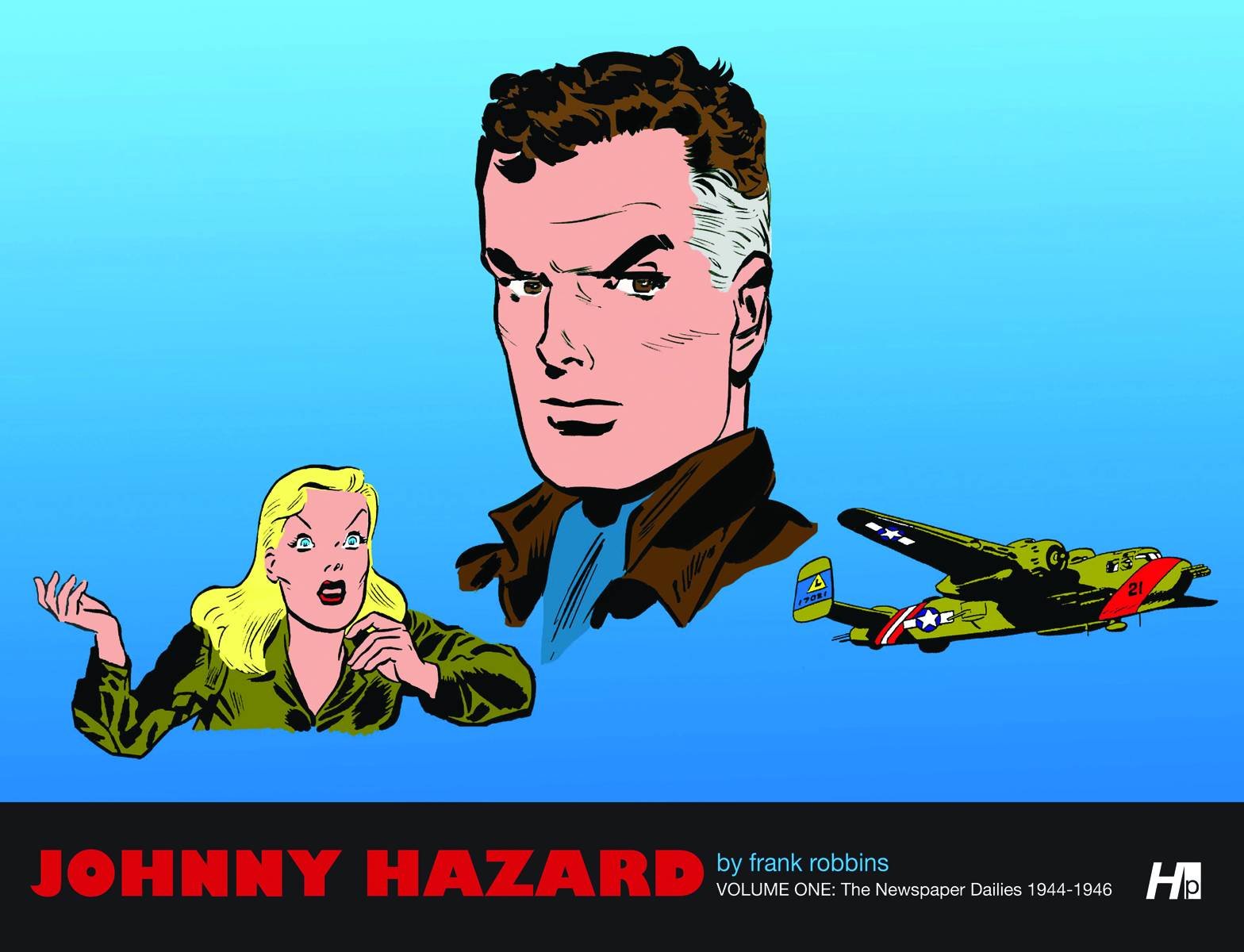
Frank Robbins’ Johnny Hazard: Volume One – the Newspaper Dailies 1944-1946


By Frank Robbins with an introduction by Daniel Herman (Hermes Press)
ISBN: 978-1-61345-004-8 (HB/Digital edition)

Johnny Hazard was a newspaper strip created in the style and manner of Terry and the Pirates, but in many ways this steely-eyed hero most resembles – and indeed predates – Milton Caniff’s second masterwork Steve Canyon. Unbelievably, until 2011 this stunningly impressive, enthralling adventure strip had never been comprehensively collected in archival volumes – at least not in English – although selected highlights had appeared in magazines like Pioneer Comics, Dragon Lady Press Presents and the Pacific Comic Club.

Boston born, Franklin Robbins (9th September 1917 – 28th November 1994) was an artistic prodigy who shone from early on. At age nine he was awarded a scholarship to the Boston Museum of Fine Arts and at 15, moved to New York City to attend the National Academy of Design on a Rockefeller grant. Skilled, inventive and prolific as both painter and graphic artist, he freelanced continually, even working with Edward Trumbull on the legendary murals for the NBC building and Radio City Music Hall.

Robbins created graphics for RKO Pictures, worked in advertising and magazine illustrations but never stopped painting, with work shown at the Whitney Museum of American Art, Metropolitan Museum of Art, The Corcoran Gallery of Art and Walker Art Gallery, although he found his perfect medium of expression when invited to take over a top comic strip…

Even whilst relentlessly creating a full seven days of newspaper strips, he exhibited work at the Whitney Museum of American Art’s Annual show and – after ending his comics career – retired to Mexico to end his days with a brush in his hand.

The truth is that comics changed Robbins’ life. He was a brilliant natural cartoonist whose unique artistic and lettering styles lent themselves equally to adventure, comedy and super-heroic tales, whilst his expansive raconteur’s gifts made him one of the best writers over three generations.

He first found popular fame in 1939 by taking over aviation strip Scorchy Smith from Bert (The Sandman) Christman, who had left America to fight with the Flying Tigers in China. Robbins thrived in the role and created a Sunday page for the feature in 1940.

The groundbreaking feature had been originated by John Terry before the astounding Noel Sickles replaced him: revolutionising it and – with Milton Caniff – inventing a new impressionistic style of narrative art to reshape the way comics were drawn and perceived .

Robbins remained until 1944 and was then offered high-profile Secret Agent X-9. Instead, he devised his own lantern-jawed, steely-eyed man of action.

A tireless and prolific worker, even whilst producing the daily and Sunday Hazard (with a separate storyline for each), Robbins continued freelancing as an illustrator for The Saturday Evening Post, Look, Life and a host of other mainstream magazines. He also tried comic books for the first time when Johnny Hazard won his own title in 1948-1949, just as superheroes began being supplanted by he-men, gangsters and monsters…

Robbins tried again in 1968: quickly becoming a key contributor as both artist and writer on Superboy, The Flash and The Atom, as well as a regular contributor to humour mag Plop! and DC’s mystery and war anthologies. He particularly excelled on Batman, Batgirl and Detective Comics where, with Neal Adams, he created Man-Bat, before following Michael Kaluta as artist on The Shadow.

Moving to Marvel in the 1970s, Robbins concentrated on drawing a variety of titles including Captain America, Daredevil, Ghost Rider, Morbius, The Man from Atlantis, Human Fly, Power Man and The Invaders – which he co-created with Roy Thomas.

When Johnny Hazard launched on Monday June 5th 1944, he was an aviator in the US Army Air Corps. When hostilities ceased, he briefly became a freelance charter pilot and spy before settling into the of a globe-girdling, troubleshooting mystery-solver: a modern day Knight Errant. The strip ended in 1977: one more victim of diminishing panel-sizes and the move towards simplified, thrill-free, family-friendly gag-a-day graphic fodder to frame small-ads. In its time it was syndicated in nine different languages in thousands of newspapers across the world, and even scored a residency in 1950s British weekly Rocket.

This fabulous hardcover/digital series – reproduced from original King Features proofs – at long last re-presents the definitive magnum opus in fitting form: a monochrome, landscape format archival collection of the first 2 years (covering June 5th 1944 to November 11th 1945), resurrecting the Amazing Aviator in followers’ hearts and hopefully finding new fans.

The action begins with a selection of those 1948 comic book covers and an informative ‘Introduction: Frank Robbins and Johnny Hazard’ by Daniel Herman before we meet the man himself in ‘The Escape’.

Here, the reader meets coolly capable flyer Lt. Johnny Hazard and his pals Loopy and Scotty as – having escaped from a German POW camp – they break into a Nazi air field to steal a bomber and fly home. Fast-paced, sharp-tongued and utterly gung-ho, the yarn introduces a cunning, charming, happy-go-lucky lout, insouciantly ruthless and prepared at every stage to risk his own freedom and life if it means killing a few more of the enemy and sabotaging the German war effort.

His saga truly begins with the 5th July episode as the liberated and again ready-for-duty airman touches base with friendly civilians only to meet feisty, headstrong and dedicated war photographer ‘Brandy’ during an air raid. All sorts of sparks fly as a series of spectacular events continually push them together and ultimately passionate fury and disgust on both sides turns to something else amidst all the deadly missions and flaming firepower.

The romantic turning point comes when Brandy impetuously parachutes into occupied territory to get a perfect shot and Hazard – hating himself every moment – goes after her…

The strip could not keep up with the fast-moving events after D-Day (the real world Allies invaded “Fortress Europa” the day after Johnny Hazard debuted) and third story arc ‘Sun Tan and General Mariwana’ – opening on September 11th 1944 – saw the hero’s squadron transferred to the Pacific Theatre of Operations to reinforce the battle against Japan. Through ingenious means Brandy inveigles herself into the picture as recently promoted Captain Hazard and his crew undertake a top-secret mission couriering a Chinese resistance leader back to her people.

Enigmatic Sun Tan is both staggeringly beautiful and lethally dangerous… and the Japanese Secret Service’s top target. Her leaked intentions spark a byzantine assassination plot wherein an experimental tracking device is hidden in Brandy’s camera gear during a refuelling stopover in Iran…

The architect of the plot is Colonel Mariwana: a pilot disfigured in a previous clash with the freedom fighter. His maniacally relentless pursuit costs him his command but does succeed in bringing down Hazard’s plane in the Himalayas. Ultimately, the grim episode of revenge leads to mass-murder and desecration of temples before honour is avenged. The mission is completed, but at a punishing cost…

A new year reinforced the darker tone as January 31st 1945 opened the saga of ‘Colonel Kiri’, as Hazard sets up shop on an embattled army air base under constant assault by Japanese forces on the front line of occupied China. It also introduces ace wingman Captain “The Admiral” Slocum: last in an unbroken line of valiant patriotic mariners, but reduced to defending his country in the skies since his debilitating sea sickness prevents him from serving afloat like a true warrior…

The Americans are hard-pressed, targeted by a secret Japanese installation decimating the region. When Brandy is shot down while helping to evacuate Chinese refugees, she is sheltered by farmers who disguise her as one of them. She meets malign war criminal Kiri when he claims her as a “comfort woman” and triggers his fate by freeing recently captured Hazard and Slocum, who spectacularly sabotage the ghost base. In the chaos, carnage and confusion, the Americans steal a Japanese tank and head for their own lines…

The closing chapter here is a deft and delicious tribute to the characters of Damon Runyon, embodied in displaced, pool-addicted, New York gunsel ‘Side-Pocket Sam’ (August 13th to November 11th 1945).

As our heroes enjoy the destructive capabilities of their new ride they almost accidentally capture a major prize. High command officer General Ishigaki and his glamorous French “assistant” Mademoiselle Touché aren’t quick or smart enough to escape the fleeing Yanks, and none of them are able to avoid the army of Chinese bandits who scoop them up and deliver them to their slick Yankee boss.

Side-Pocket Sam is debonair, charming but utterly amoral. He knows one of his “guests” carries Japan’s failsafe game plan for World War III and – once it’s his – plans to make the deal of his life…

Tragically, he’s underestimated his enemies and his friends, enabling Johnny, Brandy and the Admiral to save the day and head for safety…

Sharp, snappy and devilishly funny repartee in the style of movies like Howard Hawks’ His Girl Friday and Frank Capra’s It Happened One Night is a hallmark of these rapid fire yarns, some of the greatest comic strips in history, and that in itself can present a few problems for modern readers.

Contemporary attitudes to sexuality, gender and particularly race are far from what we find acceptable – or should even tolerate – today. That situation is further compounded by an understandably fervent patriotic tone: equal parts pure jingoism and government-sponsored morale boosting.

Every contemporary-based feature of the era participated in the war effort by shaping its content accordingly, and terms like “Jap”, “Nip”, “Kraut” and many different forms of “othering” were common parlance in both movies and comics – the two main forms of popular entertainment. These slurs became a character-defining shorthand, used without consideration and thus an indelible facet of national speech and behaviour for decades to follow.

We know better now – at least most of us do – but must accept and understand that hurtful and unjust as such terms are, they did exist and we’re doing history and our society a huge and dangerous disservice by ignoring, downplaying or worst of all self-censoring those terms and the attitudes that fed them.

In truth, Johnny Hazard was far less egregious than most: Robbins may have made Kiri and Mariwana contemptible villains, but the Japanese army (who had committed many verified real world atrocities) were given fair play and did not unnecessarily suffer from the worst propagandist nonsense used by the Allies to bolster a united war spirit.

Other ethnicities – like Chinese, Iranian, Tibetans and Italians – are treated with the full dignity of different but equal cultures and depicted as competent comrades in arms, not ignorant primitives in need of a white man’s saving graces. However, arch comedian Robbins clearly couldn’t resist playing mischievous games with accents, names and speech patterns that would do Benny Hill, Hogan’s Heroes or Charlie Chan (the opposite of) proud, so if you don’t think you’re capable of remaining historically detached, best to forgo those delights that have transcended time…

To be continued…

These exotic action-romances perfectly capture the mood and magic of a distant but incredibly familiar time; with cool heroes, hot dames and exceedingly intemperate bad-guys encountering exotic locales and stunning scenarios, all peppered with blistering tension, slyly mature humour and vivid, visceral excitement.

Johnny Hazard is a brilliant two-fisted thriller-strip too long forgotten, and this is your chance to remedy that.
© 2011 King Features Syndicate, Inc. ® Hearst Holdings Inc. All rights reserved.
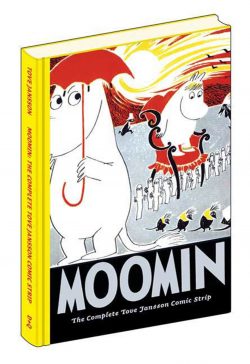
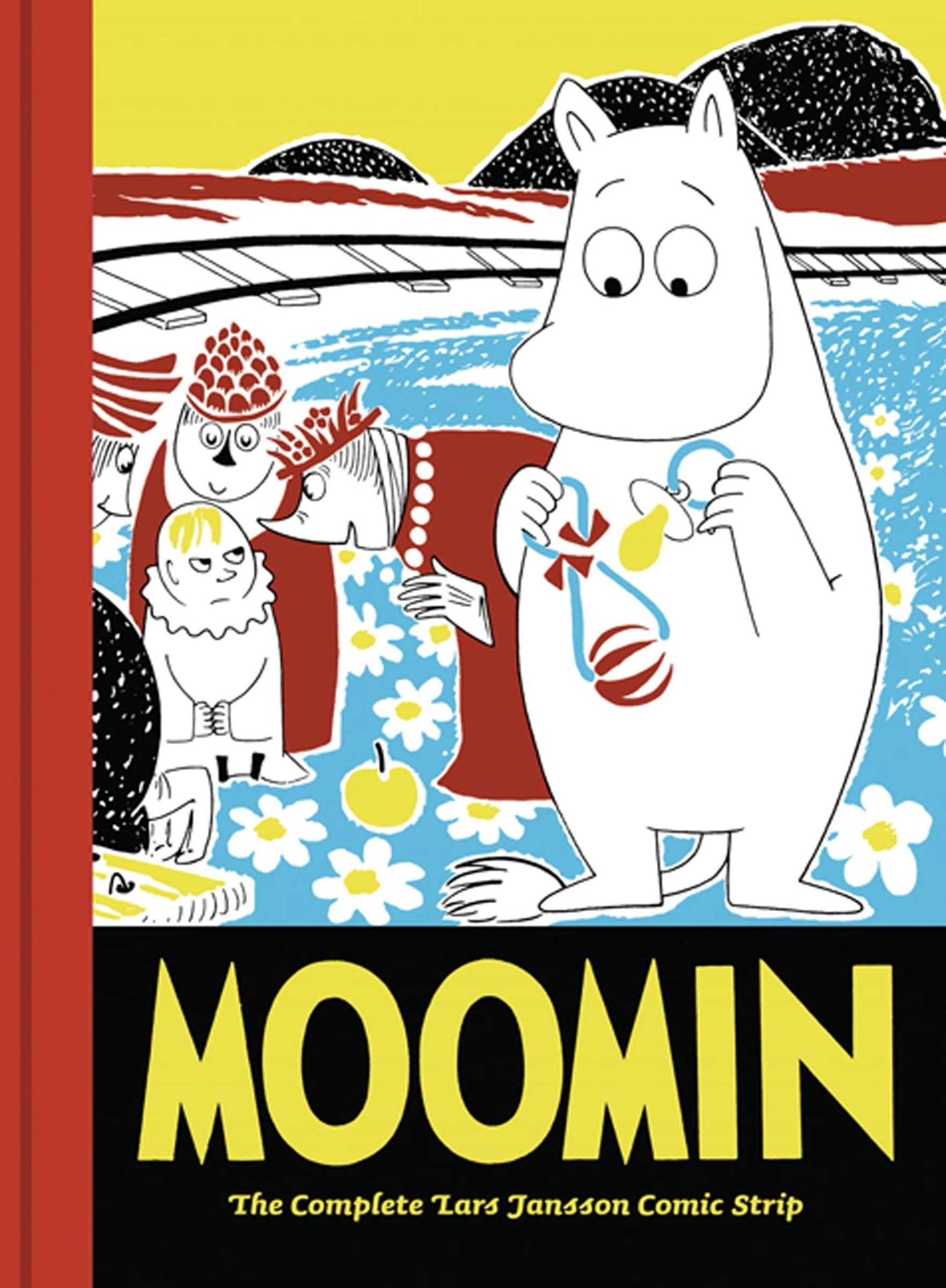
Moomin: The complete Tove Jansson Comic Strip volume 4


By Tove and Lars Jansson (Drawn & Quarterly)
ISBN: 978-1-897299-78-4 (HB) eISBN: 978-1-77046-551-0

If Tove Jansson was alive today she’d still be amazing and fascinating and also 108 years old. Sadly, she isn’t, but her immortal menagerie of bizarre and introspective characters are still going strong and all her best material is readily available for anyone wanting to politely, respectfully and belatedly join in all the dreamy fun…

Tove Jansson was one of the greatest literary innovators and narrative pioneers of the 20th century: equally adept at shaping words and images to create worlds of wonder. She was especially expressive with basic components like pen and ink, manipulating slim economical lines and patterns to realise sublime realms of fascination, whilst her dexterity made simple forms into incredibly expressive and potent symbols.

Tove Marika Jansson was born into an artistic, intellectual and practically bohemian Swedish family in Helsinki, Finland on August 9th 1914. Father Viktor was a sculptor, her mother Signe Hammarsten-Jansson a successful illustrator, graphic designer and commercial artist. Tove’s brothers Lars and Per Olov became a cartoonist/writer and photographer respectively. The family and its close intellectual, eccentric circle of friends seems to have been cast rather than born, with a witty play or challenging sitcom as the piece they were all destined to act in.

After intensive study from 1930-1938 (at the University College of Arts, Crafts and Design, Stockholm, the Graphic School of the Finnish Academy of Fine Arts and L’Ecole d’Adrien Holy and L’Ecole des Beaux-Arts, Paris), shebecame a successful exhibiting artist through the troubled period of the Second World War.

Intensely creative across many fields, she published the first fantastic Moomins adventure in 1945: Småtrollen och den stora översvämningen (The Little Trolls and the Great Flood or latterly and more euphoniously The Moomins and the Great Flood): a whimsical epic of gentle, inclusive, accepting, understanding, bohemian, misfit trolls and their strange friends…

A youthful over-achiever, from 1930-1953 Tove worked as an illustrator and cartoonist for the Swedish satirical magazine Garm, achieving some measure of notoriety with an infamous political sketch of Hitler in nappies that lampooned the Appeasement policies of Chamberlain and other European leaders in the build-up to World War II. She was also an in-demand illustrator for many magazines and children’s books, and had started selling comic strips as early as 1929.

Moomintroll was her signature character. Literally.

The lumpy, gently adventurous big-eyed romantic goof began life as a spindly sigil next to her name in her political works. She called him “Snork” and claimed she had designed him in a fit of pique as a child – the ugliest thing a precocious little girl could imagine – as a response to losing an argument about Immanuel Kant with her brother.

The term “Moomin” came from her maternal uncle Einar Hammarsten who attempted to stop her pilfering food when she visited, warning her that a Moomintroll guarded the kitchen, creeping up on trespassers and breathing cold air down their necks. Snork/Moomin filled out, became timidly nicer – if a little clingy and insecure – acting as a placid therapy-tool to counteract the grimness of the post-war world.

The Moomins and the Great Flood didn’t make much of an initial impact but Jansson persisted, probably as much for her own edification as any other reason, and in 1946 the second book Kometjakten (Comet in Moominland) was published. Many commentators have reckoned the terrifying tale a skilfully compelling allegory of Nuclear Armageddon.

When it and her third illustrated novel Trollkarlens hatt (1948, Finn Family Moomintroll or occasionally The Happy Moomins) were translated into English in 1952 to great acclaim, it prompted British publishing giant Associated Press to commission a newspaper strip about her seductively sweet and sensibly surreal creations.

Jansson had no misgivings or prejudices about strip cartoons and had already adapted Comet in Moominland for Swedish/Finnish paper Ny Tid. Mumintrollet och jordens undergängMoomintrolls and the End of the World – was a popular feature so Jansson readily accepted the chance to extend her eclectic family across the world.

In 1953, The London Evening News began the first of 21 Moomin strip sagas which promptly captivated readers of all ages. Jansson’s involvement in the cartoon feature ended in 1959, a casualty of its own success and a punishing publication schedule. So great was the strain that towards the end she recruited brother Lars to help. He took over, continuing the feature until its end in 1975. His official tenure as writer will begin in the next volume: stay tuned…

Liberated from the strip, she returned to painting, writing and other creative pursuits, generating plays, murals, public art, stage designs, costumes for dramas and ballets, a Moomin opera and 9 more Moomin-related picture-books and novels, as well as 13 books and short-story collections strictly for grown-ups.

Tove Jansson died on June 27th 2001. Her awards are too numerous to mention, but consider this: how many modern artists – let alone comics creators – get their faces on the national currency?

Her Moomin comic strips have long been available in Scandinavian volumes and the discerning folk at Drawn & Quarterly have translated her and Lars’ efforts into English for our sheer delight and delectation.

Moomintrolls are easy-going free spirits, bohemians untroubled by hidebound domestic mores and most societal pressures. Moominmama is warm and capable but overly concerned with propriety and appearances whilst Moominpappa spends most of his time trying to rekindle his adventurous youth or dreaming of fantastic journeys. Their son Moomin is a meek, dreamy boy who adores their permanent houseguest the Snorkmaiden – although that impressionable, flighty gamin prefers to play things slowly whilst waiting for somebody potentially better…

The forth oversized (312 x 222mm) monochrome hardback compilation gathers the 14-18th strip sagas and is a particular favourite, comprising a range of fanciful exploits and a rather bleak and a scary reworking of Comet in Moominland that must have had kids and their parents stocking the bomb-shelters back when it was released as a daily chapter play…

Fantasy fills the page in ‘Moomin Goes Wild West’ after Moominpapa’s annoying tinkering ruin a perfectly good clock and Moominmama’s sewing machine, whilst his attempt at repair accidentally results in a time machine. Following a distressing episode wherein Moomintroll meddles and the family meet their rather upset future selves, it is suggested that everyone go on a small holiday. The women’s rather staid suggestions are naturally overruled by the adventurous males and the machine summarily deposits them all in the land of cowboys.

It is nothing like they imagined and a very good thing that were armed with water pistols and not regulation firearms…

Sadder but no wiser after their extended tribulations in the Big Country, the assembled and not at all rested Moomins submit to suggestions of a little historical romance and travel back to 18th century France in ‘Snorkmaiden Goes Rococo’. Once again, lack of diligent research and an overdependence on popular fiction leads to misunderstanding and mischance as “the Age of Reason” proves to be anything but, and Snorkmaiden’s dreams of passionate folly are continually thwarted.

She does however score an invitation to the King’s Dinner, only to learn how badly the odds are stacked against the poor, and is promptly impelled to experiment with revolution…

Back where they all belong at last, the return of self-sufficient drop-out Snufkin heralds a visit from a representative of the League of Conscience and Duty exhorting the easy-going, but dutiful nonconformists (some unpleasant modern people say “workshy”) to dedicate their lives to personal industry and privation in service of a greater good.

‘The Conscientious Moomins’ certainly try their hardest – pursuing jobs they’re no good at, indulging in entrepreneurialism and seeking to improve character through self-help books and courses – but are just not suited to such new-fangled ideas. Ultimately, nature and good sense lead them back to their bohemian true selves just in time for one of the scariest adventures of their lives…

Comet in Moominland was first translated into English in 1951, and was a familiar text for many children and parents. Here in ‘Moomin and the Comet’ the allegory of nuclear armageddon is subtly reshaped over 86 daily instalments: modernised with the emphasis shifted from narrow escape to inescapable destruction leading to unexpected rebirth.

When a light gradually grows in the sky, the Moomins and their friends can only observe the world’s peoples’ increasing turmoil and riot. As the planet slowly alters in advance of imminent catastrophe and growing heat evaporates the oceans, spiteful Little My acts as Greek Chorus and commentator as everything makes it peace with oblivion. She’s also on hand to witness and announce the miracle that saves them all…

A parable of pride and caution closes this volume as ‘Moomin and the Golden Tail’ reveals how Moomintroll’s fear of premature baldness in this nether appendage prompts unwise exploration of remedial quackery, quasi-science and old family sorcery.

The result is a lush, luxuriant tail of gold, that makes him the world’s most fashionable person and pointless celebrity. All too soon that chic lustre fades and the sad lad is hunting ways to stop being famous and go back to his old look, negligent of how his beloved Snork maiden has reshaped herself to match his gleaming fame…

Especially excoriating are the lawyers and managers who hound him seeking to lock down the marketing rights to his golden fleece, but in the end a way is found to return him to his normal, anxious, insecure, anonymous self…

These are truly magical tales for the young laced with the devastating observation and razor-sharp mature wit which enhances and elevates only the greatest kids’ stories into classics of literature. These volumes are an international treasure and no fan of the medium – or carbon-based lifeform with even a hint of heart and soul – can afford to be without them.
© 2009, 2021 Solo/Bulls. All other material © its creators. All rights reserved.
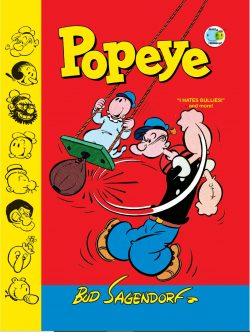
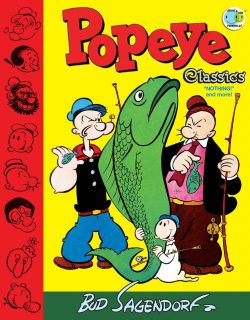
Popeye Classics volume 7: “Nothing” and More


By Bud Sagendorf, edited and designed by Craig Yoe (Yoe Books/IDW)
ISBN: 978-1-63140-447-4 (HB) eISBN: 978-1-62302-786-5

How many cartoon classics can you think of still going after a century? Here’s one…

There are a few fictional personages to enter communal world consciousness – and fewer still from comics – but a grizzled, bluff, uneducated, visually impaired old sailor with a speech impediment is possibly the most well-known of that select bunch.

Elzie Crisler Segar was born in Chester, Illinois on 8th December 1894. His father was a general handyman, and the boy’s early life was filled with the solid, dependable blue-collar jobs that typified the formative years of his generation of cartoonists. Segar worked as a decorator, house-painter and also played drums; accompanying vaudeville acts at the local theatre.

When the town got a movie-house, Elzie played silent films, absorbing all the staging, timing and narrative tricks from keen observation of the screen. Those lessons would become his greatest assets as a cartoonist. It was while working as the film projectionist, at age 18, that he decided to become a cartoonist and tell his own stories.

Like so many others in those hard times, he studied art via mail, specifically W.L. Evans’ cartooning correspondence course out of Cleveland, Ohio, before gravitating to Chicago where he was “discovered” by Richard F. Outcault – regarded by most in the know today as the inventor of modern newspaper comic strips with The Yellow Kid and Buster Brown.

The celebrated pioneer introduced Segar around at the prestigious Chicago Herald. Still wet behind the ears, the kid’s first strip, Charley Chaplin’s Comedy Capers, debuted on 12th March 1916.

In 1918, Segar married Myrtle Johnson and moved to William Randolph Hearst’s Chicago Evening American to create Looping the Loop, where Managing Editor William Curley foresaw a big future for Segar and promptly packed the newlyweds off to New York: HQ of the mighty King Features Syndicate. Within a year Segar was producing Thimble Theatre, (launching December 19th 1919) in the New York Journal: a smart pastiche of cinema and knock-off of movie-inspired features like Hairbreadth Harry and Midget Movies, with a repertory of stock players acting out comedies, melodramas, comedies, crime-stories, chases and especially comedies for vast daily audiences. It didn’t stay that way for long…

The core cartoon cast included parental pillars Nana and Cole Oyl; their lanky, highly-strung daughter Olive; diminutive-but-pushy son Castor; and the homely ingenue’s plain and (very) simple occasional boyfriend Horace Hamgravy (latterly, just Ham Gravy). Thimble Theatre had successfully run for a decade when, on January 17th 1929, a brusque, vulgar “sailor man” shambled into the daily ongoing saga of hapless halfwits. Nobody dreamed the giddy heights that stubborn cantankerous walk-on would reach…

In 1924 Segar created a second daily strip. The 5:15 was a surreal domestic comedy featuring weedy commuter and would-be inventor John Sappo and his formidable wife Myrtle. This one endured – in one form or another – as a topper/footer-feature accompanying the main Sunday page throughout the author’s career, and even survived his untimely death, eventually becoming the trainee-playground of Popeye’s second great humour stylist: Bud Sagendorf.

After Segar’s premature passing in 1938, Doc Winner, Tom Sims, Ralph Stein and Bela Zambouly all took on the strip, as the Fleischer Studio’s animated features brought Popeye to the entire world, albeit a slightly variant vision of the old salt of the funny pages. Sadly, none had the eccentric flair and raw inventiveness that had put Thimble Theatre at the forefront of cartoon entertainments. And then, finally, Bud arrived…

Born in 1915, Forrest “Bud” Sagendorf was barely 17 when his sister – who worked in the Santa Monica art store where Segar bought his drawing supplies – introduced the kid to the master cartoonist who became his teacher and employer as well as a father-figure. In 1958, after years on the periphery, Sagendorf finally took over the strip and all the merchandise design, becoming Popeye’s prime originator…

With Sagendorf as main man, his loose, rangy style and breezy scripts brought the strip itself back to the forefront of popularity and made reading it cool and fun all over again. Bud wrote and drew Popeye in every graphic arena for 24 years. When he died in 1994, his successor was controversial “Underground” cartoonist Bobby London.

Young Bud had been Segar’s assistant and apprentice, and in 1948 became exclusive writer and artist of Popeye’s comic book exploits. The series launched in February of that year in a regular title published by America’s unassailable king of periodical licensing, Dell Comics.

On debut, Popeye was a rude, crude brawler: a gambling, cheating, uncivilised ne’er-do-well. He was soon exposed as the ultimate working-class hero: raw and rough-hewn, practical, but with an innate, unshakable sense of what’s fair and what’s not; a joker who wanted kids to be themselves – but not necessarily “good” – and someone who took no guff from anyone…

Naturally, as his popularity grew, Popeye mellowed somewhat. He was still ready to defend the weak and had absolutely no pretensions or aspirations to rise above his fellows, but the shocking sense of dangerous unpredictability and comedic anarchy he initially provided was sorely missed… except not in Sagendorf’s yarns…

Collected in this superb full-colour hardback/digital edition are Popeye #30-34, crafted by irrepressible “Bud”: collectively spanning September/November 1954 to October/December 1955. Stunning, nigh stream-of-consciousness slapstick sagas are preceded by an effusively appreciative ‘Society of Sagendorks’ briefing by inspired aficionado, historian and publisher Craig Yoe, offering a mirthful mission statement.

Augmenting that is another tantalising display of ephemera and merchandise in ‘A Bud Sagendorf Scrapbook’ presenting Coca-Cola Company-funded comic strip themed postcards distributed to WWII servicemen; original art, tin toys; a Popeye Chalkboard; Get Well Soon and Birthday card art plus images on cups and mugs.

We rejoin the ceaseless parade of laughs, surreal imagination and thrills with quarterly comic book #30, opening with text tale ‘The Bigger They Are -’ detailing, across the inside front-&-back covers, the story of Throckmorton …biggest tomcat in the world!

Another wild ride in begins in ‘Desert Pirates (a story of Evil Haggery)’ as Popeye’s ruthless nemesis The Sea Hag uses witchcraft, seduction, brainwashing and principally hamburgers to turn Wimpy into her weapon against the old sea salt. Naturally, when the hero blunders into her arid ambush, the scurvy faithless traitor then betrays her to Popeye – it’s just his nature…

An engaging Micawber-like coward, cad and conman, the insatiably ravenous J. Wellington Wimpy debuted in the newspaper strip on May 3rd 1931: an unnamed, decidedly partisan referee in one of Popeye’s pugilistic bouts.

Scurrilous, aggressively humble and scrupulously polite, the devious oaf struck a chord and Segar gradually made him a fixture. Preternaturally hungry, ever-keen to solicit bribes and a cunning coiner of many immortal catchphrases – such as “I would gladly pay you Tuesday for a hamburger today” and “Let’s you and him fight” – Wimpy was the perfect foil for our simple action hero and increasingly stole the entire show… and anything else unless it was very heavy or extremely well nailed down…

Follow-up yarn ‘Popeye An’ Swee’Pea in “Danger, Lunch!”’ resorts to tireless domestic themes as a quiet meal with Olive becomes an assault course after the anarchic and precocious “infink” gets bored and amuses himself with a hammer and chemistry set…

Smartly acknowledging a contemporary trend for sci fi fun, Sagendorf had introduced ‘Axle and Cam on the Planet Meco’ in #26: a robotic father and son indulging in wild romps on other worlds. Here they observe Earth television shows and the lads decides what his world needs is beanie hats, sidewalk refreshment stands and fun with dragons…

Cover-dated January/March 1955, #31 also opens and closes with a prose yarn adorning inside front and back. ‘Apple Vote!’ exposes the shocking behaviour of a retired racehorse with a sweet tooth after which ‘Thimble Theatre Presents Popeye An’ Swee’Pea in “Mud!”’ finds unconventional family unit Popeye, Swee’Pea and villainous reprobate Poopdeck Pappy deemed dysfunctional by Olive. Her eccentric efforts to save the kid and make him a gentleman are resisted by all involved with extreme vigour…

Just as the sailor man idly daydreams of being a monarch, the wacky ruler of Spinachovia returns in ‘Popeye and King Blozo in “Exile!” or “Bein’ King is Fer de Boids!!!”’ with the maritime marvel unwisely trading cap for crown  and learning a salutary lesson about people in general and being careful of what you wish for, after which ‘Axle and Cam on the Planet Meco’ sees the mechanical moppet pay a fraught and frightening visit to Earth…

The issue concludes with a back cover strip starring ‘Popeye and Swee’Pea’ inspired by baby pictures…

Popeye #32 (April/June) opens with epic thrill-fest ‘Alone! or Hey! Where is Everybody? or Peoples is All Gone!’ as humans are abducted from all over the coast, leading the sailor man into another ferocious battle with evil machines and his most persistent enemy, after which our stars swap sea-voyages for western climes in “a tale of gold and cactus” entitled ‘Lorst!’

Set some years previously, the story reveals how Popeye made his fortune prospecting – despite and ultimately because of a little trouble with his newly adopted kid…

Sagendorf was a smart guy in tune with popular trends and fashions as well as understanding how kids’ minds worked. His tales are timeless in approach and delivery. As television exponential expanded, cowboys were king, with westerns dominating both large and small screens and plenty of comics. Thus, many episodes saw Popeye as a horse-riding sagebrush wanderer who ran a desert railroad when he wasn’t prospecting or exploring. I don’t think he ever carried a gun though…

The changing times dictated a shift in back-up features and the final ‘Axle and Cam on the Planet Meco’ exploit saw their world in chaos after Cam tried to transplant the human fashion for lawns to his own planet. Text tale ‘Catfish! detailed a meeting between fish feline and mutt and a wordless desert inspired back cover strip starring ‘Popeye and Swee’Pea’ wrapped thigs up.

The next issue (#33 July/September) offered a monochrome ‘Popeye and Swee’Pea’ house-wrecking short before main feature ‘Trouble-Shooter’ sees the tireless “hoomanitarian” set up as a helping hand for folk with troubles. Sadly, the gesture attracts some real nuts like cowardly King Hinkle of Moola who needs a patsy to fight rival ruler the King of Boola…

Returning to western deserts, Popeye and Swee’Pea swap sea-voyages for arid plains in ‘Monskers!’ and encounter a gigantic dinosaur which is not what it seems…

The replacement back-up feature was actually a return of Segar-spawned old favourites. Sappo was now hapless landlord to world’s worst lodger Professor O.G. Wotasnozzle, who callously inflicts the brunt of his genius on the poor schmuck. In ‘I’m the Smartest Man in the World!’, the lunatic fringe scientist decides to end late payment harassment by uninventing money…

A prose vignette reveals the fate of cowboy pony George who has ‘A Long Tail!’, before the fun pauses with a back-cover baseball gag starring Popeye An’ Swee’Pea.

The year and this archive close with #34, starting with more ‘Popeye An’ Swee’Pea’ baseball exploits on the monochrome inside front cover before Thimble Theatre Presents sailor man, Olive, Wimpy and the kid who endure a nautical nightmare storm that leaves our cast castaway on an island of irascible, invisible folk in eponymous saga ‘Nothing!’

Next, Popeye An’ Swee’Pea revisit western deserts to dig in the dirt and face ‘Uprising! or The Red Man Strikes Back! or Birds of a Feather!’ as the kid contends with and eventually befriends Indian infant Big Chief Thunder Eagle Jr. Sadly their play war on the white man is misunderstood by Wimpy who calls in not the cavalry but the US Army…

The manic mirth multiplies exponentially when Professor O.G. Wotasnozzle proves his insane ingenuity and dangerous lack of perspective in ‘Stop Thief!! or Please Halt! or Burglarproof House!’ before the fun concludes with one last text treat in transformative tale ‘Fish Fly!’ and a back cover gag proving why adults like Popeye should listen to kids like Swee’Pea…

Outrageous and side-splitting, these all-ages yarns are evergreen examples of narrative cartooning at its most surreal and inspirational. Over the last nine decades Thimble Theatre’s most successful son has unfailingly delighted readers and viewers around the world. This book is simply one of many, but each is sure-fire, top-tier entertainment for all those who love lunacy, laughter, frantic fantasy and rollicking adventure. If that’s you, add this compendium of wonder to your collection.
Popeye Classics volume 7 © 2015 Gussoni-Yoe Studio, Inc. All Rights Reserved. Popeye © 2015 King Features Syndicate. ™ Heart Holdings Inc.

Hal Foster’s Prince Valiant volume 14: 1963-1964


By Hal Foster (Fantagraphics Books)
ISBN: 978-1-60699-970-7 (HB)

Prince Valiant in the Days of King Arthur premiered on Sunday February 13th 1937: a fabulous rainbow-colour weekly peek into a world where history met myth to produce something greater than both. Pioneering creator Hal Foster developed the feature after a groundbreaking and astoundingly popular run on the Tarzan of the Apes comic strip.

Prince Valiant offered action, adventure, exoticism, romance and a surprisingly high quota of laughs in its engrossing depiction of noble knights and wicked barbarians played out against a glamorised, dramatized Dark Ages backdrop. The never-ending story follows a refugee lad of royal blood, driven from ancestral Scandinavian homeland Thule who grows up to roam the world, attaining a paramount position amongst the fabled heroes of Camelot.

Foster wove his complex epic romance over decades, tracing the progress of a feral wild boy who became a paragon of chivalric virtue: knight, warrior, saviour, avenger and ultimately family patriarch through a constant storm of wild, robust and joyously witty wonderment. The restless champion visited many far-flung lands, siring a dynasty of equally puissant heroes, enchanting generations of readers and thousands of creative types in all the arts.

The glorious epic spawned films, an animated series and all manner of toys, games, books and collections. Prince Valiant was – and remains – one of the few adventure strips to have run continuously from the thunderous 1930s to the present day (well north of 4000 episodes and still going strong) – and, even here at the end-times of newspaper strips as an art form, it continues in more than 300 American papers and via the internet.

Foster soloed on the feature until 1971 when John Cullen Murphy (Big Ben Bolt) succeeded him as illustrator whilst the originator remained as writer and designer. That ended in 1980, when he finally retired and Cullen Murphy’s daughter Mairead took over colouring and lettering whilst her brother John assumed the writer’s role.

In 2004 the senior Cullen Murphy also retired, since when the strip has soldiered on under the auspices of other extremely talented artists such as Gary Gianni, Scott Roberts and latterly Thomas Yeates & Mark Schultz.

This luxuriously oversized (362 x 264 mm) full-colour hardback (tragically, the series is still unavailable digitally) re-presents pages spanning January 6th 1963 to December 27th 1964, (individual Strips #1352 to 1455) and comes with all the regular bonus trimmings.

Comics scripting A-Lister Roger Stern (Superman; Avengers; Spider-Man; Doctor Strange; Incredible Hulk; Captain America) discusses and critically appraises the influential force of the newspaper strip on comic books in a picture packed Foreword ‘Swiping Mr. Foster: A Legacy in Four Colors’, offering many potent comparisons and shameless swipes, after which Brian M. Kane expands the argument about Valiant’s lasting influence in ‘Might for Right: A Code of Honor for Sentinels of Liberty’.

The erudite scholar returns at this tome’s close: spotlighting the glorious range of the master story teller in closing article ‘Land and Sea: Hal Foster’s Fine Art Paintings’ in a select gallery of land-and-seascapes, nature studies and illustrative tableau. Captivating as they are though, the real wonderment is, as ever, the unfolding epic that precedes them…

What Has Gone Before: following a failed and ruinous quest for the Holy Grail by the Round Table Knights, Valiant has compelled their return to Camelot and courtly duties. In the months that followed he visited the Great Tor at Glastonbury, met St Patrick and assisted a Papal mission from Rome building a cathedral there. Wars erupted and plots were foiled, and an extended familial rift with long-suffering wife Aleta was healed. A visit to Valiant’s homeland of Thule brought more combat and death and personal injury. With son Arn in tow, recuperation was concluded during a visit of the entire clan to Aleta’s ancestral kingdom in the Misty Isles, with Viking reiver Boltar escorting them to counter Mediterranean pirates and brigands…

At their destination, the family defeated a colonising invasion by rival ruler Thrasos during which the queen delivered twin daughters, to make Valiant a proud father of four. His peace was shattered when fleeing prisoners of war abducted Arn and his commoner pals Paul and Diane, forcing Valiant and Viking shipwright Gundar Harl, into frantic pursuit to prevent their being sold as slaves. By the time they caught up, Arn had already dealt with the problem…

Even with the crisis averted peace was impossible to find. When pilgrims bound for the Holy Land were shipwrecked on the Misty Isles, Val felt duty-bound to offer aid, and used his presence as escort to found a trade mission promoting the produce and wares of his island home. He also brought Arn, whose days of childhood indolence gave way to learning his place in the world…

Many rousing exploits marked their trail from Jaffa to the Dead Sea, Damascus to Baghdad before the pilgrimage ends in Aleppo where Boltar waits to ferry father and son back to a recovered and much wealthier Aleta. However, a brief period of glorious relaxation ends when King Arthur summons them to save Gaul from invading Goth hordes. With safe passage across Europe ended, England’s ruler needed his greatest hero carry a message to the Pope…

As Aleta’s forces secured a sea route to Albion, Valiant and Arn’s perilously mission drew much action but ultimately no satisfaction from the embattled Pontiff.  Undaunted, Valiant devised an alternative trade route between the Holy Father and still-imperilled Christian Britain: visiting what become Spain and France, encountering a lost land where monks were guarded by monsters, dodging Goths and ousting a usurper whilst reinstating the true ruler…

By the time the scattered family are reunited in England, the country endures a new kind of assault, as a charismatic priest is manipulated by scurrilous scholar attendants/business managers to foment a religious revolution…

After cleverly ending the near-insurrection, Val rejoined his family at the site of a church under construction near the fens where he grew up. The lure of his sire’s past beguiles Arn, who explored the boggy waterways and was soon hopelessly lost. Over tense weeks, he experienced the same privations his father had, before being rescued.

Carrying huge wealth destined for Arthur’s coffers, the family thankfully took ship for Camelot, unaware that greedy, ambitious eyes were watching…

The illuminating wonders here resume with those eyes fatally blinking. Opportunistic fellow voyager Ethwald abducts Arn by subterfuge and holds him to ransom for the treasure Valiant is safeguarding for the king. Ethwald fears the knight’s prowess but feels assured a father will do nothing to endanger his heir. He grievously underestimates the murderous wiles of enraged mother Aleta…

The majority part of this two-year tome deals with the anticipation and results of a mass invasion by Angles and Saxons, but the slowly-building saga is comprised of many shorter episodes – adventures both tragic and even broadly comedic – in its ever-expanding tapestry.

After returning to Camelot, the family are feted until Valiant is again called to defend the realm. Arn meanwhile steadily advances from Page to Novice and begins official combat training. Soon he is made a Batchelor-at-Arms and, when the vassal king of Wales dies, is drawn into war.

The former Prince Cidwic hungers for fame, glory and riches, and – deploying his Welshmen and a mercenary Pictish and Caledonian warband – besieges Carlisle in an attempt to annexe Scottish territories. The city is defended by a small contingent of cavalry and engineers led by Sir Kay, but as Arthur prepares a rescue fleet to aid them, Valiant forms and leads a unit of swift-riding messengers from the Novices and Batchelors to keep lines of communication open. The youngest recruit is Arn…

When Cidwic regroups and fortifies his position, the boy plays a crucial role in supporting Kay’s forces and the would-be conqueror’s eventual downfall. As diplomacy and reconciliation take over, Arthur rewards the lad with more responsibility: befriending new King Cuddock, Cidwic’s 12-year old son. As they bond and duty grows into true friendship, the king’s uncle Ruddah seeks to frame Arn for murdering the boy king, and learns to his eternal regret that youth does not equate to stupidity…

The plot foiled, Valiant and Arn make their slow way back to Court, partaking of the many local jousts and tourneys that filled the autumn season and served to keep fighting men in peak form. As they compete they encounter a pair of impoverished, less than noble knights whose response to defeat leaves much to be desired and exposes the sordid underbelly of professional jousting…

Upon reaching Camelot, a joyous family reunion almost ends in shame and bloodshed when cunning schemer Modred attempts to traduce Aleta’s honour and reputation by trapping her and Launcelot in a compromising situation. His vile scheme exposed, the villain flees and encounters a Saxon war party infiltrating the region around the Vale of the White Horse. The long dreaded war with the invaders is starting to happen…

War-wise Arthur deems them to be scouting the land and sends his best men to observe them, with Arn and other knights-in-training as messengers. Sadly, Owen is still starry-eyed and vainglorious, and his inexperience leads to Arn’s capture. Thankfully he is sharp-witted and well-disguised: convincing the Saxons he is a son of infamous pirate Boltar, while turning his situation to England’s advantage by learning the plans of the vast invasion force marshalling overseas. Of course his actions suggest to the keenly watching rescue party that the son of valiant has turned traitor before the boy orchestrates his escape and reports back to Arthur…

Although moving to a war footing, life at Court continues largely as before and leads to personal crisis when a grand tournament intended to hone the fighting spirit of the nation’s champions sparks intrigue, and murder…

Visiting his kinsman Launcelot, Count Brecey of Brittany finds Aleta most pleasing and determines to make her his. That she is a queen with four children he can profitably marry off when he marries her is a huge additional benefit. Used to taking whatever he wants, the overprivileged coward operates through his assassin Hugo, but that deadly killer proves no match for Valiant and his mighty warhorse Arvak, and as a web of sinister schemes unravels, Brecey is forced to abduct Aleta and run for the coast. Thanks to the efforts of his victim and her hotly-pursuing spouse and first son, the Count doesn’t get far and – when caught – compounds his villainy with the worst kind of cowardice…

As summer approaches, Arthur’s preparations intensify, and the entire Court awaits news of a vast fleet of Angles, Jutes, Danes and Saxons. Tensions mount as word comes of established colonies previously defeated by and sworn to Arthur, recant their oaths of allegiance and pick up the swords they had abandoned for peace and acceptance. The lure of imminent plunder is everywhere and the King is forced to remind is noble subjects of their promises to supply fighting men when the nation needs them.

Valiant and Gawain are despatched to Cornwall where three local kings are at war with each other and “unable” to honour their word, whilst Arn travels to North Wales where his friend Cuddock is genuinely embattled, plagued by raids of marauding Scotti. He will soon discover, the raiders are sponsored by the Saxon overlord as a distracting diversion…

Whilst one Cornish ruler is steadfast and readily provides promised forces for the army, weak, ambitious and greedy Kings Grundemede and Alrick-the-Fat need a sharp lesson in realpolitik and practical conjuring (learned long ago when young Valiant was attached to the wizard Merlin) before they grudgingly comply…

Their missions successful both the Cornish and Welsh embassages return with their new reinforcements to Camelot to make final preparations for the encroaching Saxon invasion. Thanks to Arn’s prior intelligence warlord’s colonising raiders head for Badon Hill, the perfect site for Arthur’s stout defence…

This astounding clash takes seven weeks to tell, but at the end England is barred to them for generations and the victorious armies return to their own lands. Switching from epic action to wry romantic comedy, Foster then plays with his stars as Aleta and the visiting queen of Alrick-the-Fat indulge in combat matchmaking; each seeking to wed heroic Sir Charles of Cornwall to their respective noblewoman protégés. However, their escalating wiles and schemes make a catastrophic impression on Aleta’s twins Karen and Valeta, who apply what they’ve seen to their own relentless pursuit of boy-king Cuddock, recuperating from nobly-earned wounds and far too naive to endure being the subject of the girls’ first crush…

Employing the clever conceit of lost historical scrolls, the narrative jumps forward some months and resumes with Valiant’s entire family en route to the ancestral kingdom of Thule with bombastic brigand Boltar. The voyage is interrupted by news of marauders assembled by Skogul Oderson, who has united many tribes into a formidable force to ravage Thule.

As the year ends, the far northern chieftain is spectacularly beaten. He never counted on Valiant and wilderness scout Garm organising the scattered selfish homesteaders into a lethally effective guerrilla force who slowly whittle away the raider’s numerical advantage through guile, lethally inventive use of terrain and psychological warfare…

The final instalment here presages even greater adventure as Boltar’s son and Arn discuss a return to the lost continent they had visited: a land latterly dubbed “the New World.”

To Be Continued…

A mind-blowing panorama of visual passion and precision, Prince Valiant is a tremendous procession of boisterous action, exotic adventure and grand romance; blending epic fantasy with dry wit and broad humour, soap opera melodrama with dark violence. Lush, lavish and captivating lovely, it is an indisputable landmark of comics fiction and something no true fan should miss.
All comics © 2015 King Features Syndicate. All other content and properties © 2016 their respective creators or holders. This edition © 2016 Fantagraphics Books. All rights reserved.
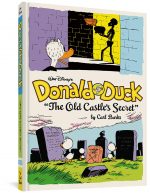
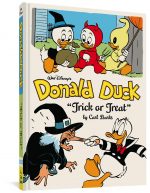
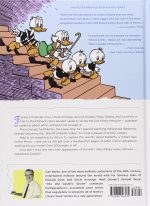
Walt Disney’s Donald Duck by Carl Barks: volume 6 – The Old Castle’s Secret


By Carl Barks & various (Fantagraphics Books)
ISBN: 978-1-60699-653-9 (HB/Digital edition)

Donald Duck ranks among a number of fictional characters who have transcended the bounds of reality to become – like Sherlock Holmes, Tarzan, Popeye and James Bond -meta-real. As such, his origins are complex and convoluted. His official birthday is June 9th 1934: a dancing, nautically-themed bit-player in the Silly Symphony cartoon short The Wise Little Hen.

However, that date is based on the feature’s release, as announced by distributors United Artists and latterly acknowledged by the Walt Disney Company. Recent research reveals the piece was initially screened at Carthay Circle Theatre in Los Angeles on May 3rd, part of a Benefit show. The Wise Little Hen officially premiered on June 7th at the Radio City Music Hall in New York City, before the general release date was settled.

The animated cartoon was adapted by Ted Osborne & Al Taliaferro for the Silly Symphonies Sunday comic strip and thus classified by historians as Donald’s official debut in Disney comics. Controversially though, he was also reported to have originated in The Adventures of Mickey Mouse strip which began 1931. Thus the Duck has more “birthdays” than the Queen of England (plus the generally disUnited Kingdom and gradually diminishing Commonwealth) which probably explains why he’s such a bad-tempered old cuss.

Visually, Donald Fauntleroy Duck was largely the result of animator Dick Lundy’s efforts, and, with partner-in-fun Mickey Mouse, is one of TV Guide‘s 50 Greatest Cartoon Characters of All Time. The Duck has his own star on the Hollywood walk of fame and has appeared in more films than any other Disney player.

During the 1930s his screen career grew from background and supporting roles to a team act with Mickey and Goofy to a series of solo cartoons that began with 1937’s Don Donald, which also introduced love interest Daisy Duck and the nephews Huey, Louie and Dewey. By 1938 Donald was officially more popular than company icon Mickey Mouse, especially after his service as a propaganda warrior in a series of animated morale boosters and information features during WWII. The merely magnificent Der Fuehrer’s Face garnered the 1942 Academy Award (that’s an Oscar to you and me) for Animated Short Film…

Crucially for our purposes, Donald is also planet Earth’s most-published non-superhero comics character and has been blessed with some of the greatest writers and illustrators ever to punch a keyboard or pick up a pen or brush.

A publishing phenomenon and mega star across Europe – particularly Italy, Germany, the Netherlands, Greece, Sweden, Denmark, Norway, Finland and Iceland – Donald & Co have spawned countless original stories and characters. Sales are stratospheric there and in the more than 45 other countries they export to. Japanese manga publishers have their own iterations too…

The aforementioned Silly Symphonies adaptation and Mickey Mouse newspaper strip guest shots were trumped in 1937 when Italian publisher Mondadori launched an 18-page story by Federico Pedrocchi in comic book format. It was quickly followed by a regular serial in Britain’s Mickey Mouse Weekly. The comic was produced under license by Willbank Publications/Odhams Press and ran from 8th February 1936 to 28th December 1957.

In #67 (May 15th 1937) it launched Donald and Donna (a prototype Daisy Duck girlfriend), drawn by William A. Ward. Running for 15 weeks it was followed by Donald and Mac before ultimately settling on Donald Duck, and a fixture until the magazine folded. The comic inspired similar Disney-themed publication across Europe with Donald regularly appearing beside company mascot Mickey…

In the USA, a daily Donald Duck newspaper strip launched on February 2nd 1938, with a colour Sunday strip added in 1939. Writer Ted Karp joined Taliaferro in expanding the duck cast, adding a signature automobile, dog Bolivar, cousin Gus Goose, grandmother Elvira Coot and expanded the roles of both Donna and Daisy…

In 1942, his licensed comic books canon began with the October cover-dated Dell Four Color Comics Series II #9 as Donald Duck Finds Pirate Gold: conceived by Homer Brightman & Harry Reeves, scripted by Karp and illustrated by Disney Studios employees Carl Barks & Jack Hannah. It was the moment everything changed…

Carl Barks was born in Merrill, Oregon in 1901, and raised in rural areas of the West during some of the leanest times in American history. He tried his hand at many jobs before settling into the profession that chose him. His early life is well-documented elsewhere if you need detail, but briefly, Barks was an animator before quitting in 1942 to work in the new-fangled field of comic books.

With studio partner Jack Hannah (another future strip illustrator) Barks adapted Karp’s rejected script for an animated cartoon short into Donald Duck Finds Pirate Gold, and although not his first published comics work, it was the story that shaped the rest of his career.

From then until his official retirement in the mid-1960s, Barks operated in self-imposed seclusion: writing, drawing and devising a vast array of adventure comedies, gags, yarns and covers that gelled into a Duck Universe of memorable and highly bankable characters. These included Gladstone Gander (1948), Gyro Gearloose (1952), Magica De Spell (1961) and the nefarious Beagle Boys (1951) to supplement Disney’s stable of cartoon actors. His greatest creation was undoubtedly the crusty, energetic, paternalistic, money-mad giga-gazillionaire Scrooge McDuck: the World’s wealthiest winged nonagenarian.

Whilst producing all that landmark material Barks was also just a working guy, generating cover art, illustrating other people’s scripts when asked, and contributing stories to the burgeoning canon of Duck Lore. After Gladstone Publishing began re-packaging Barks material amongst other Disney strips in the 1980s, he discovered the well-earned appreciation he never imagined existed…

So potent were his creations that they inevitably fed back into Disney’s animation output itself, even though his brilliant comic work was done for Dell/Gold Key and not directly for the studio. The greatest tribute was undoubtedly the animated series Duck Tales: heavily based on his classic Uncle Scrooge tales.

Barks was a fan of wholesome action, unsolved mysteries and epics of exploration, and this led to him perfecting the art and technique of the blockbuster tale: blending wit, history, plucky bravado and sheer wide-eyed wonder into rollicking rollercoaster romps that utterly captivated readers of every age and vintage. Without the Barks expeditions there would never have been an Indiana Jones…

During his working life Barks was blissfully unaware that his work (uncredited by official policy, as was all Disney’s comics output) had been recognised by a rabid and discerning public as “the Good Duck Artist.” When some of his most dedicated fans finally tracked him down, a belated celebrity began.

In 2013, Fantagraphics Books began chronologically collecting Barks’ Duck stuff in wonderful, carefully curated archival volumes, tracing his output year-by-year in hardback tomes and digital editions that finally do justice to the quiet creator. These will eventually comprise the Complete Carl Barks Disney Library. The physical copies are sturdy and luxurious albums – 193 x 261 mm – that would grace any bookshelf, with volume 6 re-presenting works from 1948 – albeit not in strict release order. I should also note that all the Four Color issues come from Series II of that mighty anthological vehicle and all cover are by Barks.

It begins eponymously with The Old Castle’s Secret’ (FC #189, June 1948) as a crisis in the McDuck financial empire triggers a mission for Donald and the nephews: accompanying Scrooge to the ancestral pile in Scotland to search for millions in hidden treasure. Apparently the craggy citadel is haunted, but what they actually encounter is both more rationalistically dangerous and fantastically unbelievable…

Two single-page gags from the same issue follow, with ‘Bird Watching’ exposing the hidden perils of the hobby whilst superstition is painfully debunked in ‘Horseshoe Luck’ before ‘Wintertime Wager’ (Walt Disney’s Comics and Stories #88, January) introduces annoying cousin Gladstone Gander. Amidst chilling winter snows, the miraculously lucky, smugly irksome oik invites himself over for Christmas and soon he and Donald are involved in an escalating set of ordeals that might cost the Duck his house. Thankfully, Daisy and the boys are there to solve the problem…

Gainful employment was a regular dilemma for Donald and February’s ‘Watching the Watchman’ (WDC&S #89) finds him taking a midnight-to-daybreak job at the docks, but pitifully unable to alter his sleep patterns. Once again, Huey, Louie and Dewey offer outrageous assistance but this time it’s the Duck’s inability to stay awake that foils a million dollar heist….

They’re actually Donald’s rivals in ‘Wired’ (WDC&S #90, March) when all seek big bucks as telegram messengers. Sadly, millionaires are not generally friendly, welcoming or prone to giving giant gratuities…

A dedicated social climber, Donald plans a garden party in WDC&S #91 (April), but his notion of fancy dress and family solidarity utterly anger the boys, who retaliate with manic mesmerism in ‘Going Ape’, after which March of Comics #20 finds butterfly-hunter Donald at war with avaricious lepidopterist Professor Argus McFiendy across two continents.

Donald’s sharp and ruthless tactics inspire onlooker Sir Gnatbugg-Mothley to fund a safari to ‘Darkest Africa’ in search of the rarest butterfly on Earth. The daunting quest for the Almostus Extinctus is frenetically fraught, astoundingly action-packed and fabulously fun-filled but please be aware that despite Barks’ careful research and diligent, sensitive storytelling some modern folk could be upset by his depictions of indigenous peoples in terms of the accepted style of those decades-distant times.

Nevertheless, the bombastic war ends with a delicious sting in the tail.

In case you were wondering: March of Comics releases were prestigious promotional giveaways tied to retail products and commercial clients like Sears, combining licensed characters from across Whitman/KK/Dell’s joint catalogue. The often enjoyed print runs topping 5 million copies per issue. Being a headliner for them was a low key editorial acknowledgement of a creator’s capabilities and franchise’s pulling power…

Back in the regular world, Donald’s eternal war of nerves with the kids boiled over in FC #189 (June) as ‘Bean Taken’ saw his obsessive side dominant in a guessing game, a single-pager, preceding another exploring the downside of sandlot baseball in ‘Sorry to Be Safe’ (FC #199, October) and standard 10-page romp ‘Spoil the Rod’ (WDC&S #92, May). Here passing do-gooder Professor Pulpheart Clabberhead seeks to stop Donald’s apparent abuse of Huey, Louie and Dewey – but only until he gets to know them…

Although the science fiction boom and flying saucer mania was barely beginning in 1948, Barks was an early advocate and ‘Rocket Race to the Moon’ (WDC&S #93, June) sees newspaper seller Donald suckered into piloting an experimental lunar exploration ship. Tragically, Professors Cosmic and Gamma seem more concerned with a large cash-prize contest than advancing science and rival rocketman Baron De Sleezy is a ruthless schemer, but no one – not even the stowaway nephews – were prepared for what lived on the moon…

Patriotism inspires our bellicose birdbrain to enlist as ‘Donald of the Coast Patrol’ (WDC&S #94, July) but it’s his innate gullibility and bad temper that helps him bag a bunch of spies before true wickedness rears its downy head as ‘Gladstone Returns’ (WDC&S #95, August).

The ghastly Gander was designed as a foil for Donald, intended to be even more obnoxious than the irascible, excitable film fowl.

This originally untitled tale reintroduces him as a big noxious noise every inch as blustery a blowhard as Donald but still lacking his seemingly supernatural super-luck talent. Here, both furiously boast and feud, trying to one-up each other in a series of scams that does neither any good… especially once the nephews and Daisy join the battle…

Arguably Barks’ first masterpiece, ‘Sheriff of Bullet Valley’ was the lead tale from Dell Four Color Comics #199, drawing much of its unflagging energy and trenchant whimsy from Barks’ own love of cowboy fiction – albeit seductively tempered with his self-deprecatory sense of absurdist humour. For example, a wanted poster on the jailhouse wall portrays the artist himself, offering the princely sum of $1000 and 50¢ for his inevitable capture.

Donald is – of course – a self-declared expert on the Wild West (he’s seen all the movies) so when he and the boys drive through scenic Bullet Valley, a wanted poster catches his eye and his imagination. Soon he’s signed up and sworn in as a doughty deputy, determined to catch rustlers plaguing the locals. Unfortunately for him, the good old days never really existed and today’s bandits use radios, trucks, tommy guns and ray machines to achieve their nefarious ends. Can Donald’s impetuous boldness and the nephews’ collective brains and ingenuity defeat the ruthless high-tech raiders?

Of course they can…

That same issue first saw a brace of short gags, beginning with ‘Best Laid Plans’ as Donald’s feigned illness earns him extra hard labour rather than a malingering day in bed and closing with ‘The Genuine Article’ wherein suspicions of an antiques provenance leads to disaster…

The lads plans to go fishing are scuppered – but not for too long – when Donald demands their caddying services in ‘Links Hijinks’ (WDC&S #96, September). It all really goes south once Gladstone horns in and Donald’s competitive spirit overwhelms everybody…

That tendency to overreact informs ‘Pearls of Wisdom’ (WDC&S #97, October) when the nephews find a small pearl in a locally-sourced oyster and big-dreaming Donald goes overboard in exploiting the” hidden millions” probably peppering the ocean floor, before we close with another mission for Uncle Scrooge.

To close a deal with British toff Lord Tweeksdale, McDuck must prove his family pedigree by excelling in the most “asinine, stupid, crazy, useless sport in the world”: fox hunting. Designating Donald his champion, the Downy Dodecadillionaire of Duckburg is thankfully unaware Huey, Louie and Dewey also consider themselves ‘Foxy Relations’ (WDC&S #98, November), injecting themselves covertly into proceedings with catastrophic repercussions…

The visual verve over, we move on to validation as ‘Story Notes’ offers commentary for each Duck tale and Donald Ault relates ‘Carl Barks: Life Among the Ducks’, before ‘Biographies’ explain why he and commentators Alberto Beccatini, R, Fiore, Craig Fischer, Jared Gardner, Leonardo Gori, Rich Kreiner, Ken Parille, Stefano Priarone, Francesco (“Frank”) Stajano and Mattias Wivel are saying all those nice and informative things.

We close with an examination of provenance as ‘Where Did These Duck Stories First Appear?’ explains the somewhat byzantine publishing schedules of Dell Comics.

Carl Barks was one of the greatest exponents of comic art the world has ever seen, and almost all his work featured Disney’s Duck characters: reaching and affecting untold millions of readers across the world and he all too belatedly won far-reaching recognition. You might be late to the party but it’s never too soon to climb aboard the Barks Express.
Walt Disney’s Donald Duck “The Old Castle’s Secret” © 2013 Disney Enterprises, Inc. All contents © 2013 Disney Enterprises, Inc. unless otherwise noted. All rights reserved.
Crisis on Infinite Earths


By Marv Wolfman & George Pérez, with Jerry Ordway, Dick Giordano, Mike DeCarlo & various (DC Comics) 
ISBN: 978-1-4012-5841-2 (HB/Digital edition) 978-1-56389-750-4 (TPB) 

Once more I’m compelled to dash out another swiftly modified reprinted review to mark the passing of one of our industry and art form’s most prolific and irreplaceable master creators. George Pérez died on May 6th from the complications of pancreatic cancer. He was 67 years old.  

His triumphs as penciller, writer and an always in-demand inker made him a force to be reckoned with and earned a vast number of awards in a career spanning almost fifty years. Pérez worked for dozens of publishers large and small; self-published his own creations, redeemed and restored many moribund characters and features (like the (New) Teen Titans), Nightwing and Wonder Woman) and co-created many breakthrough characters such as The White Tiger (first Puerto Rican superhero), The Maestro, Deathstroke the Terminator, Terra, The Monitor and Anti-Monitor.  

He will be most warmly remembered for his incredible facility in portraying big teams and cataclysmic events. Pérez probably drew every DC and Marvel superhero of his era, with major runs on The Avengers, The Fantastic Four, The Justice League of America, Legion of Super-Heroes and numerous iterations of Teen Titans as well as stints on The Inhumans, X-Men, JSA, All-Star Squadron, Thunderbolts and T.H.U.N.D.E.R. Agents. He will be immortalised for the comic book series covered below. A fuller appreciation will follow as soon as I can sort it… 

In 1985 the Editorial Powers-That-Be at DC Comics were about to celebrate fifty years of publishing, and enjoying a creative upswing that had been a long time coming. A crucial part of the festivities, and purported attempt to simplify five decades of often conflicting stories, was a truly epic year-long saga that would impact every single DC title and reconstruct the entire landscape and history of the DC Universe, with an appearance – however brief – by every character the company had ever published. Easy-peasy, Huh? 

Additionally, this new start would seek to end an apparent confusion of multiple Earths with similarly named and themed heroes. This – it had been decided – was deterring (sic) new readers. Happily, since then (primarily thanks to movie rom-coms like Sliding Doors) we’ve all become well aware of string theory and parallel universes and can revel in the most basic TV show or kids cartoon proffering the concept of multiples incidences of me and you… 

Way back then, the result of those good intentions was a groundbreaking 12-part miniseries that spearheaded a vast crossover event: eventually culminating in a hefty graphic novel collection (plus latterly three companion volumes reprinting all the crossovers). 

The experiment was a huge success, both critically and commercially, and enabled the company to reinvigorate many of their most cherished properties: many of which had been in dire need or some regeneration and renewal. Many fans would argue that DC have been trying to change it back ever since… 

Plotted long in advance of launch, threads and portents appeared for months in DC’s regular titles, mostly regarding a mysterious arms-and-information broker known as The Monitor. With his beautiful assistant Lyla Michaels/Harbinger he had been gauging each and every being on Earths beyond counting with a view to saving all of Reality. At this juncture, that consisted of uncountable variations of universes existing “side-by-side”, each exhibiting differences varying from minor to monumental.  

Building on long-established continuity collaborators Marv Wolfman and George Pérez – aided and abetted by Dick Giordano, Mike DeCarlo and Jerry Ordway – began by tweaking things fans knew before taking them on a journey nobody anticipated… It transpired that at the very beginning of time an influence from the future caused Reality to fracture. Rogue Guardian of the Universe Krona obsessively sought to unravel the secret of creation and his probing cause a perfect singular universe to shatter into innumerable self-perpetuating cracked reflections of itself… 

Now, a wave of antimatter scythes through the Cosmic All, eradicating these separate universes. Before each Armageddon, a tormented immortal named Pariah materialises on an inhabited but doomed world of each Existence. As the story opens, he arrives on an Earth, as its closest dimensional neighbours are experiencing monumental geo-physical disruptions. It’s the end of the World, but The Monitor has a plan. It involves death on a mammoth scale, sacrifice beyond measure, a gathering of the best and worst beings of the surviving Earths and the remaking of time itself to deflect cosmic catastrophe and defeat the being that caused it… 

Action is tinged with tragedy as many major heroic figures – from the nondescript and forgotten to high, mighty and grand – perish valiantly, falling in apparently futile struggle to preserve some measure of life from the doomed multiverse. 

Full of plot twists and intrigue, this cosmic comicbook spectacle set the benchmark for all future crossover events, not just DC’s, and is still a qualitative high point seldom reached and never yet surpassed. As well as being a superb blockbuster in its own right and accessible to even the greenest neophyte reader, it is the foundation of all DC’s in-continuity stories since 1985, the basis of a TV phenomenon and absolutely vital reading.  

More than any other work in a truly stellar career, Crisis on Infinite Earths is the magnum opus George Pérez will be remembered for: It might not be fair, but it’s inescapably true… 
© 1985, 1986, 2001, 2008, 2015 DC Comics. All Rights Reserved. 

Manhunter – The Deluxe Edition 


By Archie Goodwin & Walter Simonson & various John Workman (DC Comics) 
ISBN: 978-1-77950-751-8 (HB/Digital edition) 

One of the most celebrated superhero series in comics history, Manhunter catapulted young Walt Simonson to the front ranks of creators, revolutionised the way dramatic adventures were told and still remains the most lauded back-up strip ever produced. Concocted by genial genius Archie Goodwin as a supporting back-up strip in Detective Comics (#437-443, October-November 1973 to October-November 1974) the seven episodes – a mere 68 pages – garnered six Academy of Comic Book Arts Awards during its far too brief run. 

In case you’re wondering they were: Best Writer of the Year 1973 – Archie Goodwin; Best Short Story of the Year 1973 for ‘The Himalayan Incident’; Outstanding New Talent of the Year 1973 – Walter Simonson; Best Short Story of the Year 1974 for ‘Cathedral Perilous’; Best Feature Length Story of the Year 1974 for the conclusion ‘Götterdämmerung’ and Best Writer of the Year 1974 – Archie Goodwin. 

Paul Kirk was a big game hunter and part-time costumed mystery man before and during World War II. Becoming a dirty jobs specialist for the Allies, he lost all love of life and died in a hunting accident in 1946. Decades later, he seemingly resurfaced, coming to the attention of Interpol agent Christine St. Clair. Thinking him no more than an identity thief, she soon uncovered an incredible plot by a cadre of the World’s greatest scientists who had combined over decades into an organisation to assume control of the planet once they realised that man now had the means to destroy it. 

Since the end of the WWII The Council had infiltrated all corridors of power, making huge technological advances (such as stealing the hero’s individuality by cloning him into an army of superior, rapid-healing soldiers), slowly achieving their goals with no-one the wiser. The returned Paul Kirk, however, had upset their plans and was intent on thwarting their ultimate goals… 

This slim tome reprints the much-missed Mr. Goodwin’s foreword from the 1979 black-&-white album Manhunter: the Complete Saga before gathering in one sublime collection Kirk’s entire tragic quest to regain his humanity and dignity.  

Coloured by Klaus Janson and lettered by Ben Oda, Joe Letterese, Alan Kupperberg & Annette Kawecki, it tells of St. Clair and Kirk’s first meeting in ‘The Himalayan Incident’, her realisation that all is not as it seems in ‘The Manhunter File’ and their revelatory alliance beginning with ‘The Resurrection of Paul Kirk.’ 

Now fully a part of Kirk’s crusade Christine discovered just how wide and deep the Council’s influence ran in ‘Rebellion!’ before beginning the end-game in the incredible ‘Cathedral Perilous’ and gathering one last ally in ‘To Duel the Master’… 

With all the pieces in play for a cataclysmic confrontation, events take a strange misstep as Batman stumbles into the plot, inadvertently threatening to hand the Council ultimate victory. ‘Götterdämmerung’ fully lived up to its title and wrapped up the saga of Paul Kirk with consummate flair and high emotion. It was a superb triumph and perplexing conundrum for decades to come… 

In an industry notorious for putting profit before aesthetics, the pressure to revive such a well-beloved character was enormous, but Goodwin & Simonson were adamant that unless they could come up with an idea that remained true to the spirit and conclusion of the original, Manhunter would not be seen again. 

Although the creators were as good as their word DC did weaken a few times. Kirk clones featured in the Secret Society of Super-Villains and The Power Company, but they were mere shabby exploitations of the original. Eventually, however, an idea occurred and the old conspirators concocted something feasible and didn’t debase the original conclusion. Archie provided a plot, and Walter began to prepare the strip. 

After years of valiant struggle the master plotter finally succumbed to the cancer that had been killing him. Anybody who had ever met Archie Goodwin will understand the void his death created. He was irreplaceable. 

Without a script the project seemed doomed until Simonson’s wife Louise suggested that it be drawn and run without words: a silent tribute and last hurrah for a true hero. Manhunter: the Final Chapter reunites the characters and brings the masterpiece to a solid, sound resolution. Now it really is all over… 

This Deluxe Edition offers a touching afterword – with some extremely early character sketches – by Walter and a gallery of further art treats: the cover and a pin-up from Detective Comics #443; covers from reprint editions Manhunter Special #1 (May 1984), Manhunter: The Special Edition (1999), Tales of The Batman: Archie Goodwin (2013), Manhunter: the Complete Saga (1979) and the Manhunter entry from Who’s Who #14. 

This book represents a perfect moment of creative brilliance and an undisputed zenith in comics storytelling. This is a tale no comic fan can afford to be without. 
© 1973, 1974, 1999, 2013, 2020 DC Comics. All Rights Reserved. 

Barnaby volume 3 


By Crockett Johnson with Ted Ferro & Jack Morley (Fantagraphics Books) 
ISBN: 978-1-60699-823-6 (HB/Digital editions) 

This is one of those rare books worthy of two reviews. So, if you’re in a hurry… 

Buy Barnaby volume 3 – and all the rest – right now. It’s one of the five best newspaper comic strips of all time and this lavish hardcover/digital compilation has lots of fascinating extras. If you harbour any yearnings for the lost joys of childish wonder and the suspicious glee in catching out adults trying to pull a fast one, you would be crazy to miss this book… 

However, if you’re still here and need a little more time to decide… 

The once-huge range and breadth of newspaper strips – continuity drama, adventure strips or informational/sports inspired – has all but faded away as the 21st century proceeds. Cartoon strips aren’t a dying art form though: merely moved on to less valuable property in cyber-space. Check out the magnificent and resurgent return of Berke Breathed’s Bloom County – as released whenever he wants on Facebook…  

Back in the tangible world of typesetting, if a paper actually still runs any strips – as opposed to editorial cartoons – chances are they will be of the episodic variety typified by reprints of Charles Shultz’s Peanuts or the latest hot movie/media spin-off rather than series like Doonesbury or Prince Valiant which demand a little conspicuous consistency and regular attendance from the readership.  

You can describe the most popular strips such as Garfield or Hagar the Horrible as single-idea pieces with a set-up, delivery and punch-line, all rendered in a sparse, pared-down-to-basics drawing style. In that they’re nothing new and there’s nothing wrong any of that ilk on their own terms. 

Narrative impetus comes from the unchanging characters themselves, and a building of gag-upon-gag in extended themes. The advantage to the newspaper was always obvious. If you like a strip it encourages you to buy the paper. If you miss a day or two, you can return fresh at any time having, in real terms, missed nothing. 

Such was not always the case. Once upon a time the daily “funny” – comedic or otherwise – was a crucial circulation preserver and builder, with lush, lavish and magnificently rendered fantasies or romances rubbing shoulders with thrilling, moody masterpieces of crime, war, sci-fi and everyday melodrama, and the always-unmissable delights of legion of humour strips which maintained and sustained an avid, devoted following. 

And eventually came Barnaby, which in many ways bridged the gap between then and now. 

On April 20th 1942, with America at war for the second time in 25 years, liberal New York tabloid PM began running a kids’ strip which was simultaneously the most whimsically addicting, socially seditious and ferociously smart satire since Al Capp’s Li’l Abner – another utter innocent left to the mercy of scurrilous worldly influences. 

Crockett Johnson’s outlandish 4-panel daily was the product of a perfectionist who didn’t particularly care for comics, but who – according to celebrated strip historian Ron Goulart – just wanted steady employment… 

David Johnson Leisk (October 20th 1906-July 11th 1975) was an ardent socialist, passionate anti-fascist, gifted artisan and brilliant designer who had spent much of his working life as a commercial artist, Editor and Art Director. Born in New York City and raised in the outer wilds of Queens when it was still semi-rural (in Flushing Meadows near the slag heaps which would eventually house two New York World’s Fairs), “Dave” studied art at Cooper Union (for the Advancement of Science and Art) and New York University before leaving early to support his widowed mother.  

This entailed embarking upon a hand-to-mouth career drawing and constructing department-store advertising. He supplemented his income with occasional cartoons to magazines like Collier’s before becoming an Art Editor for magazine publisher McGraw-Hill. He also started a moderately successful, “silent” strip called The Little Man with the Eyes. 

Johnson divorced his first wife in 1939 and moved out of the city to Connecticut, to share an ocean-side home with student (and eventual bride) Ruth Krauss. Ceaselessly looking to create that steady something, almost by accident he devised a masterpiece of comics narrative… 

However, if friend Charles Martin hadn’t seen a prototype Barnaby half-page lying around the house, it might never have existed. Thankfully, Martin hijacked the sample, parlaying it into a regular feature in prestigious highbrow leftist PM simply by showing the scrap to the paper’s Comics Editor Hannah Baker. Among her other notable finds was a strip by Theodor (“Dr.”) Seuss Geisel which would run contiguously in the same periodical. Despite Johnson’s initial reticence, within a year Barnaby was the new darling of the intelligentsia… 

Soon came book collections, talk of a Radio show (in 1946 it was adapted as a stage play), a quarterly magazine and rave reviews in Time, Newsweek and Life. A small but rabid fan-base ranged from politicians and smart set paragons like President and First Lady Roosevelt, Vice-President Henry Wallace, Rockwell Kent, William Rose Benet and Lois Untermeyer to ultra-cool celebrities such as Duke Ellington, Dorothy Parker, W. C. Fields and legendary New York Mayor Fiorello La Guardia. Of course, the last two might only have checking the paper because the undisputed, unsavoury star of the strip was a scurrilous if fanciful amalgam of them both… 

Not since George Herriman’s Krazy Kat had popular culture so infiltrated the halls of the mighty, whilst largely passing way over the heads of the masses or without troubling the Funnies sections of mass-circulation papers. Over its 10-year run (April 1942 to February 1952), Barnaby was only syndicated to 64 papers nationally – a combined circulation of just over five and a half million – but it kept Crockett (a childhood nickname) and Ruth in relative comfort whilst America’s Great & Good constantly agitated on the kid’s behalf. 

What more do you need to know?  

One dark night, during an air raid drill, a little boy wished for a Fairy Godmother and something strange and disreputable fell in through his window… 

Barnaby Baxter is a smart, ingenuous and scrupulously honest pre-schooler and his ardent wish was to be an Air Raid Warden like his dad. Instead he was “adopted” by a short, portly, pompous, distinctly unsavoury and wholly discreditable windbag with pink pixie wings. 

Installing himself as the lad’s “Fairy Godfather”, Jackeen J. O’Malley was a card carrying-member of the Elves, Gnomes, Leprechauns and Little Men’s Chowder and Marching Society – although he hadn’t paid dues in years. A lazier, more self-aggrandizing, mooching old glutton and probable soak could not be found anywhere. To be fair, although he certainly frequented taverns, he only ever raided the Baxter’s icebox, pantry and humidor, never their drinks cabinet…  

Due more to intransigence than evidence – there’s always plenty of physical proof, debris and fallout whenever O’Malley has been around – Barnaby’s parents adamantly refuse to believe in an ungainly, insalubrious sprite, whose continued presence hopelessly complicates the sweet boy’s life. Their abiding fear is that Barnaby was cursed with Too Much Imagination… 

In earlier episodes, O’Malley became implausibly – and almost overnight – an unseen and reclusive public Man of the Hour, preposterously translating that dubious cachet into a political career by accidentally becoming a patsy for a corrupt political machine. In even more unlikely circumstances O’Malley was elected to Congress… 

This strand gave staunchly socialist cynic Johnson ample opportunity to lampoon the electoral system, pundits and public. As usual, Barnaby’s folks perpetually overruled their boy: assertively assuring him the O’Malley grown-ups had elected was not a little man with pink wings… 

Despite looking like a fraud – he’s almost never seen using his magic and always has one of Dad’s stolen panatela cigars as a substitute wand – J. J. O’Malley is the real deal: he’s just incredibly lazy, greedy, arrogant and inept. He does – sort of – grant Barnaby’s wishes… but never in ways that might be anticipated… 

Once O’Malley got his foot in the door – or through the bedroom window – a succession of bizarre characters also turned up to baffle and bewilder poor Barnaby and Jane Shultz, the sensible little girl next door who was also privileged to perceive the pompous pixie.  

Even Barnaby’s new dog Gorgon was an oddity. The pooch could talk – but never when adults were around, and only with such staggering dullness that everyone listening wished him as mute as other mutts. More mythical oddballs and irregulars included timid ghost Gus; Atlas the Giant (a 2-foot tall, pint-sized colossus unimpressive until he got out his slide-rule to demonstrate that he was, in fact, a Mental Giant); Gridley the Salamander (a “Fire Pixey” who couldn’t raise a spark even if supplied with matches and gasoline); water hating sea god Davey Jones and puny Puritan pixie Cousin Myles O’Malley.  

The greatest of these wry creations was Launcelot McSnoyd: invisible Leprechaun and O’Malley’s personal gadfly, persistently proffering harsh, ribald counterpoints and home truths to the Godfather’s self-laudatory pronouncements… 

Johnson continually expanded his bizarre cast of gremlins, ogres, ghosts, policemen, bankers, crooks, financiers and stranger personages – all of whom could see O’Malley – while the unyieldingly faithful lad’s parents were always too busy and obdurately certain the Fairy and all his ilk were unhealthy, unwanted, juvenile fabrications. 

The officious elf’s schemes grew evermore fanciful. He was a boxing impresario, attempted to have constructed two utterly unnecessary hydroelectric dams, wrote the definitive text on Pixie Anthropology and usurped running the factory managed by Barnaby’s father. After that O’Malley campaigned in the then-ongoing Presidential Election, tried crime-busting and even took a turn as a most improbable Wall Street wizard and publishing mogul.  

This third tipsy-turvy treasury opens with hearty appreciation from award-winning cartoonist Jeff Smith in the Foreword before Nathalie op de Beeck’s ‘Notes on a Haunted Childhood’ details the relationship of the author to his signature character, after which the whimsical wonderment resumes with the strips spanning January 1st 1946 to December 31st 1947. The serialised silliness opens with a delicious and delirious assault on the growing phenomenon of radio quiz shows as ‘Our Next Contestant, Mr. O’Malley’ (January 2nd -February 2nd). Seeking finance for making his prospective movie masterpiece the overconfident oaf inveigles his way onto the “Detect and Collect Show” but things don’t go quite his way… 

His overall scheme remains becoming ‘J. Darryl O’Malley, Movie Mogul’ (February 4th – March 16th) but when a suitable text for his magnum opus cannot be found he opts to pen his own bestselling book first. However, since he’s such a busy magnate, he eventually gets Gus to ghost-write for him while he secures stars. A simple phone call to Hollywood creates a storm of chaos in the glitzy land where Dreams Come True, scripts are judged by weight and page count and a confidant lie is the ultimate weapon… 

As sparks fly in Hollywood, the elf has already moved on. Taking umbrage at the senior Baxter’s perpetual rubbishing of his very existence ‘Professor O’Malley’ (March 16th – April 4th) seeks to prove his bona fides through atomic age Science and arranges a lecture on mythological folk, inviting Gridley, McSnoyd, Atlas, Gus and more. Tragically, a mix-up in scheduling venues soon scuppers the plan… 

As a result of the confusion, the Baxter and Schultz pantries and iceboxes took particularly significant hits and the astounded, anxious parents call in the police to track down ‘The Refrigerator Bandit’ (April 5th – May 11th). Filled with civic outrage, O’Malley joins the hunt, even organising a unique posse of his comrades, but somehow that only leads to greater atrocities on already abused larders… and now extends to cigar humidors…  

Midsummer madness is sparked when Mr. Baxter is cajoled into joining the office baseball team and the ever-helpful Fairy Godfather decides to offer the benefits of his vast coaching experience in ‘O’Malley at the Bat’ (May 13th – June 22nd). Although dad is unaware, the pixey and his team are in there, pitching for him… 

When Gorgon begins feeling enclosed and claustrophobic, hungry for a place of his own, the sensible suggestion of a dog house rapidly escalates into another major human headache and the absolutely unnecessary solution of ‘The J. J. O’Malley Housing Project’ (June 24th – August 24th). At a time when America faced an accommodation crisis, the Pixie’s posturing and proposal of “the Baxter Plan” soon triggers a land rush and city scandal with a totally bewildered Pa Baxter suddenly seconded to the City School Board. What a surprise then, when the always unseen winged wonder decides to open ‘The O’Malley School’ (August 26th – November 2nd) and radically reform the way teaching works… 

If you’re of an historical mien, during this strip, Johnson’s assistants Ted Ferro and Jack Morley began signing strips even as the teaching tale migrated into a canny poke at progressive methodology and bean-counting civic administrators seeking to save cash and instigate cut-rate education… 

Trend-based commerce and rampant consumerism fell under the satirical spotlight next as, in the last days of post-war shortages and rationing, Mr. Baxter applied for a new car. His chances seem slim but O’Malley has a plan – involving raffle tickets – and soon ‘The New Packomobile’ (November 4th – December 14th) arrives, albeit as the result of skulduggery, subterfuge and venal opportunism on the part of an automobile manufacturer. Of course, it doesn’t actually reach the perplexed parent the way any human intended…  

With Christmas bearing down on everyone, a discussion of seasonal demands on limited finances neatly segues – via a chemistry set gift – into an exploration of ‘The Atomic Age’ (December 16th 1946 – March 1st 1947). It’s triggered  by the Pixie noticing a marked lack of that most modern element Uranium in the toy box. His subsequent search almost creates as much carnage and catastrophe as an actual thermonuclear detonation, particularly after he finds a mallet perfect for splitting atoms…. 

Th mayhem magnifies when – despite all the Fairy Godfather’s efforts to avoid him – his disreputable reprobate “black sheep” brother ‘Orville O’Malley’ (March 3rd – May 24th) hits town and pays a visit. He seems very interested in stock market investments and the family finances… 

‘Top Dog’ (May 26th – June 28th) then focusses on Gorgon’s aspirations as the mouthy mutt refuses to enter a local kids’ pet show after which the absentee O’Malley returns just in time for the Baxter’s annual seaside excursion, and a brush with nervous teen lovers Bob and Angelica who need the assistance of an unseen coach to confirm their passion. Happily there’s ‘The Mysterious Troubadour’ (June 30th – August 23rd) and his bizarre backing band of spooks, fairies and kibitzers. Romantic melodies carry, however, and soon the Godfather is engaged himself…   

On the group’s return the chastened, still single sprite delves into domesticity, remodelling the Baxter abode and descending inevitably to the disaster via ‘Mr. O’Malley’s Book of Household Management’ (August 25th – September 13th) before being drawn back onto the world stage as humans pollute the sacred dell that is the nation home of all the assorted creatures of fancy and provoking a declaration of war against mankind… 

Lacking a sense of reason or proportion the inexorable march to conflict is exacerbated by the little Peoples’ quest for ‘Sylvania’s Secret Weapon’ (September 15th – December 23rd) as the year closes, storm clouds gather and talks cease. It’s a cliffhanging pause to ponder as ‘Sylvania Vs The United Nations’ (December 24th – 31st) barely begins before the comics time runs out. Don’t fret though: everything will continue and conclude in the next book…  

More elucidatory content follows in education scholar and Professor of English Philip Nel’s fact-filled, scene-setting, picture-packed Afterword essay ‘Escape Artist?’ which explores how and why Johnson turned the feature over to Ferro and Morley whilst deconstructing the series included is Coulton Waugh’s contemporary treatise ‘In Every Sense a Major Creation’ excerpted from The Comics (1947) before Nel returns with strip commentary, context and background in ‘The Elves, Leprechauns, Gnomes, and Little Men’s Chowder & Marching Society: a Handy Pocket Guide’… 

Intellectually raucous, riotous, sublimely surreal and adorably absurd, the razor-sharp whimsy of the strip is instantly captivating, and the laconic charm of its writing is irresistible, but the lasting legacy of this ground-breaking strip is the sparse line-work that reduces images to near-technical drawings, unwavering line-weights and solid swathes of black that define space and depth by practically eliminating it, without ever obscuring the fluid warmth and humanity of the characters. Almost every modern strip cartoon follows the principles laid down here by a man who purportedly disliked the medium… 

The major difference between then and now should also be noted, however. Johnson despised doing shoddy work, or short-changing his audience. His strips – always self-contained – built on the previous episode without needing to re-reference it, and contained three to four times as much text as its contemporaries. It’s a sign of the author’s ability that the extra wordage was never unnecessary, and uniquely readable, blending storybook clarity, the snappy pace of “Screwball” comedy films and the contemporary rhythms and idiom of authors like Damon Runyan or Dashiel Hammett. 

Johnson managed this miracle by type-setting the dialogue and pasting up the strips himself – primarily in Futura Medium Italic but with effective forays into other fonts for dramatic or comedic effect. No educational vigilante could claim Barnaby harmed children’s reading abilities by confusing the tykes with non-standard letter-forms (a charge levelled at comics as late as the turn of this century), and the device also allowed him to maintain an easy, elegant, effective balance of black and white rendering the deliciously diagrammatic art light, airy, fresh and accessible. 

During 1946-1947, Johnson surrendered the strip to pursue a career illustrating children’s book such as Constance J. Foster’s This Rich World: The Story of Money, but eventually he returned, crafting more magic before permanently retiring Barnaby in 1952 to concentrate on his books. When Ruth graduated she became a successful children’s writer and they collaborated on four tomes, The Carrot Seed (1945), How to Make an Earthquake, Is This You? and The Happy Egg.  

These days Johnson is best known for his seven Harold books which began in 1955 with Harold and the Purple Crayon. 

During a global conflagration and the ideological Cold War that followed, with heroes and villains aplenty, where no comic page could top the daily headlines for thrills, drama and heartbreak, Barnaby was an absolute panacea to the horrors without ever ignoring or escaping them. The entire glorious confection that is Barnaby is all about our relationship with imagination. This is not a strip about childhood fantasy. The theme here, beloved by both parents and children alike, is that grown-ups don’t listen to kids enough, and that they certainly don’t know everything. 

For far too long Barnaby was a lost masterpiece. It is influential, ground-breaking and a shining classic of the form. You are all the poorer for not knowing it, and should move mountains to change that situation. I’m not kidding. 

Liberally illustrated throughout with sketches, roughs, photos and advertising materials as well as Credits, Thank Yous and more, this big hardback book of joy is a welcome addition to 21st century bookshelves – most especially yours… 
Barnaby volume 3 and all Barnaby images © 2016 the Estate of Ruth Krauss. The Foreword is © 2016 Jeff Smith. “Notes on a Haunted Childhood” © 2016 Nathalie op de Beeck. The Afterword and Handy Pocket Guide are © 2016 Philip Nel

Lone Wolf & Cub volume 4: The Bell Warden


By Kazuo Koike & Goseki Kojima, translated by Dana Lewis (Dark Horse Manga) 

ISBN: 978-1-56971-505-5 (TPB/digital edition) 

Best known in the West as Lone Wolf and Cub, the epic Samurai saga created by Kazuo Koike & Goseki Kojima is without doubt a global classic of comics literature. An example of the popular “Chanbara” or “sword-fighting” genre of print and screen, Kozure Okami was serialised in Weekly Manga Action from September 1970 until April 1976. It was an immense and overwhelming “Seinen” (“Men’s manga”) hit… 

The tales prompted thematic companion series Kubikiri Asa (Samurai Executioner) which ran from 1972-1976, but the major draw – at home and, increasingly, abroad – was always the nomadic wanderings of doomed noble ÅŒgami Ittō and his solemn, silent child. 

Revered and influential, Kozure Okami was followed after years of supplication by fans and editors by sequel Shin Lone Wolf & Cub (illustrated by Hideki Mori) and even spawned – through Koike’s indirect participation – science fiction homage Lone Wolf 2100 by Mike Kennedy & Francisco Ruiz Velasco. 

The original saga has been successfully adapted to most other media, spawning movies, plays, TV series (plural), games and merchandise. The property is infamously still in Hollywood pre-production. 

The several thousand pages of enthralling, exotic, intoxicating narrative art produced by these legendary creators eventually filled 28 collected volumes, beguiling generations of readers in Japan and, inevitably, the world. More importantly, their philosophically nihilistic odyssey – with its timeless themes and iconic visuals – has influenced hordes of other creators. The many manga, comics and movies these stories have inspired around the globe are impossible to count. Frank Miller, who illustrated the cover of this edition, referenced the series in Daredevil, his dystopian opus Ronin, The Dark Knight Returns and Sin City. Max Allan Collin’s Road to Perdition is a proudly unashamed tribute to the masterpiece of vengeance-fiction. Stan Sakai has superbly spoofed, pastiched and celebrated the wanderer’s path in his own epic Usagi Yojimbo, and even children’s cartoon shows such as Samurai Jack are direct descendants of this astounding achievement of graphic narrative. The material has become part of a shared world culture. 

In the West, we first saw the translated tales in 1987, as 45 Prestige Format editions from First Comics. That innovative trailblazer foundered before getting even a third of the way through the vast canon, after which Dark Horse Comics assumed the rights, systematically reprinting and translating the entire epic into 28 tankōbon-style editions of about 300 pages each, between September 2000-December 2002. Once the entire epic was translated, it was all placed online through the Dark Horse Digital project. 

Following a cautionary ‘Note to Readers’ – on stylistic interpretation – this moodily morbid monochrome collection truly gets underway, keeping many terms and concepts western readers may find unfamiliar. Therefore this edition offers at the close a Glossary providing detailed context on the term used in the stories, plus profiles of author Koike Kazuo & illustrator Kojima Goseki and another instalment of ‘The Ronin Report’ by Tim Ervin-Gore. The occasional series of articles here offers a rundown on exotic weaponry of the era in Weapons Glossary: Part one…  

Set in the era of the Tokugawa Shogunate, the saga concerns a foredoomed wandering killer who was once the Shogun’s official executioner: capable of cleaving a man in half with one stroke. An eminent individual of esteemed imperial standing, elevated social position and impeccable honour, ÅŒgami Ittō lost it all and now roams feudal Japan as a doomed soul hellbent for the dire, demon-haunted underworld of Meifumado. 

When the noble’s wife was murdered and his clan dishonoured due to the machinations of the treacherous, politically ambitious Yagyu Clan, the Emperor ordered ÅŒgami to commit suicide. Instead, he rebelled, choosing to be a despised Ronin (masterless samurai) assassin, pledged to revenge himself until all his betrayers were dead …or Hell claimed him. His son, toddler Daigoro, also chose the path of destruction and together they roam grimly evocative landscapes of feudal Japan, one step ahead of doom, with death behind and before them. 

Unflinching formula informs early episodes: the acceptance of a commission to kill an impossible target necessitates forging a cunning plan where relentless determination leads to inevitable success. Throughout each episode plot is underscored with bleak philosophical musings alternately informed by Buddhist teachings in conjunction with or in opposition to the unflinching personal honour code of Bushido… 

That tactic is eschewed for a simple commission in opening tale ‘Tsuji Genshichi the Bell Warden’ with the assassin hired by a prestigious and honourable official. Greater Edo runs to the timetable of nine great bells, dictating the flow of civilised time and acting as emergency alarm system in times of crisis. All that power and responsibility is controlled by one man: The Bell Warden. 

As with most hereditary official posts, great glory and vast wealth inevitably accrues to the position, but now the aging incumbent is preparing his successor. He has three candidates and grave misgivings about the worth and dedication of each. His solution: hire the most infamous outlaw in Japan to chop off the right (bell-ringing) arm. If they can’t survive and overcome they are none of them the man for the job… 

Drowning in his own ocean of duty, ÅŒgami accepts the commission and isn’t surprised to discover there is a hidden agenda in play… 

As the nation modernised – or lost its ethical core – noble samurai economised by firing their retainers and hiring domestic mercenaries. As this new class – “Chugen-Gashira” – grew in power, they feathered their own nests; increasingly turning to villainy and chicanery, further debasing Japan’s moral core. They were shielded by their own base-born origins, since upholders of the old ways could not “punch down” to retaliate.  

In ‘Unfaithful Retainers’, when two noble children seek redress for their father’s assault, the Lone Wolf also falls foul of his own entrenched self-image, and must concoct a byzantine scheme to reach the guilty party and deliver honourable justice…  

Daigoro takes centre stage in ‘Parting Frost’ as his father goes missing during a mission. As his supplies run out and winter snows start to melt , the boy is compelled to strike out in search of his father, only to encounter a Samurai who discerns exactly who and what he is. Testing the child to destruction with fire and steel, obsessive Iki Jizamon is only foiled by the abrupt return of the cub’s far from happy sire… 

Set in a brutal uncompromising world of privilege and misogyny, these episodes are unflinching and explicit in their treatment of violence – especially sexual violence. In detailing another historical aspect of the culture, ‘Performer’ focusses on a particular underclass: Gōmune. The term grouped together all street folk who busked for money: female minstrels, dancers, sleight-of-hand conjurers, weapons-demonstrators, kabuki actors, drummers, travelling players puppeteers, preachers, contortionists, storytellers acrobat and countless others all entertaining for coins. Naturally, they had no protection under law and when a swordswoman martial artist was brutalised by woman-hating warrior using treachery and hypnotism, she was unavenged… 

In her shame and fury, O-Yuki had her body further desecrated by horrific, attention-diverting tattoos, giving her a momentary advantage as she butchered a succession of Samurai on her way to finding one in particular… 

Accepting a commission from a lord rapidly being depleted of soldier-servants, Ōgami plays detective but finds himself deeply conflicted when he finally corners his prey. However, his given word is inviolate, his philosophy is unflinching and a job must be done… 

These stories are deeply metaphorical and work on many levels most of us westerners just won’t grasp on first reading – even with contextual aid provided by the bonus features. That only makes them more exotic and fascinating. Also a little unsettling is the even-handed treatment of women in the tales. Within the confines of the notoriously stratified culture being depicted, females – from servants to courtesans, prostitutes to highborn ladies – are all fully rounded characters, with their own motivations and drives. The wolf’s female allies are valiant and dependable, and his foes, whether targets or mere enemy combatants in his path, are treated with professional respect. He kills them just as if they were men… 

Whichever English transliteration you prefer – Wolf and Baby Carriage is what I was first introduced to – Kazuo Koike & Goseki Kojima’s grandiose, thought-provoking, hell-bent Samurai tragedy is one of those too-rare breakthrough classics of global comics literature. A breathtaking tour de force, these are comics you must not miss. 

© 1995, 2000 Kazuo Koike & Goseki Kojima. All other material © 2000 Dark Horse Comics, Inc. Cover art © 2000 Frank Miller. All rights reserved. 
Edgar Rice Burroughs’ Tarzan: The Complete Joe Kubert Years


By Joe Kubert with Burne Hogarth, Hal Foster, Frank Thorne, Robert Kanigher, Russ Heath & various (Dark Horse)
ISBN: 978-1-61655-982-3 (TPB/digital editions)

For those that care, it’s a week until St. Valentine’s Day, and once more I’m foregoing gift recommendations in favour of comics-related pep talks. This year, you can see here how some relationships – albeit in cartoon form – have weathered the test of time. One of the longest drives a strip that – despite a shift in social sensibilities and general growth in consensus attitudes – still has lot to offer on many levels…

Soon after first publication in 1912, Tarzan of the Apes became a multi-media sensation and global brand. More novels and many, many movies followed: a comic strip arrived in 1929, followed by a radio show in 1932 with the Ape-Man inevitably carving out a solid slice of the comic book market too, once that industry was firmly established.

Rivalling and frequently surpassing DC and Marvel at the height of their powers, Western Publishing were a big publishing/print outfit based on America’s West Coast. They specialised in licensed properties and the jewels in their crown were comics starring the Walt Disney and Warner Brothers cartoon characters.

As publishers, they famously never capitulated to the wave of anti-comics hysteria that resulted in the crippling self-censorship of the 1950s. Dell Comics – and latter imprints Gold Key and Whitman – never displayed a Comics Code Authority symbol on their covers. They never needed to.

Dell also handled other properties like movie or newspaper strip franchises, and would become inextricably associated with TV adaptations once the small screen monopolised modern homes. In 1948, Dell produced the first all-new Tarzan comic book. The newspaper strip had previously provided plenty of material for expurgated reprint editions until Dell Four Color Comic #134 (February 1947).

That milestone featured a lengthy, captivating tale of the Ape-Man scripted by Robert P Thompson – who wrote both the radio show and aforementioned syndicated strip – with art by the legendary Jesse Marsh.

Marsh & Thompson’s Tarzan returned with two further tales in Dell Four Color Comic #161, cover-dated August 1947. This was a frankly remarkable feat: Four Colour was an umbrella title showcasing literally hundreds of different properties – often as many as ten separate issues per month – so such a rapid return meant pretty solid sales figures.

Within six months, the bimonthly Tarzan #1 was released (January/February 1948), beginning an unbroken run that only ended in 1977, albeit by a convoluted route…

After decades as solid Whitman staples, licensed Edgar Rice Burroughs properties transferred to DC – not just Tarzan and his extended family, but also fantasy pioneers John Carter of Mars, Carson of Venus, Pellucidar and others – with the new company continuing the original numbering.

Tarzan #207 had an April 1972 cover-date and the series carried on until #258 in February 1977. Thereafter, Marvel, Malibu and Dark Horse extended the Jungle Lord’s comic canon…

The early 1970s were the last real glory days of National/DC Comics. As they lost market share to Marvel, their response was controversial: delivered in the form of landmark superhero material eschewing fantasy and super-villains in favour of social commentary. However their greatest strength lay – as it always had – in the variety and quality of its genre divisions. War, Mystery & Supernatural, Romance, and Kids’ titles remained strong and the company’s eye for a strong brand was as keen as ever.

The Ape Man and his family were a Dell/Gold Key mainstay and global multi-media phenomenon, so when DC acquired rights they justifiably trumpeted it out, putting one of their top creators in sole charge of the legend’s monthly exploits, as well as generating a boutique bunch of ERB titles in a variety of formats.

DC’s incarnation premiered in a blaze of publicity at the height of a nostalgia boom and was generally well received by fans. For many of us, those years provided the definitive graphic Tarzan, thanks solely to the efforts of the Editor, publisher and illustrator who shepherded the Ape-man through the transition.

They were all the same guy: Joe Kubert.

Kubert was born in 1926 in rural Southeast Poland (which became Ukraine and might be Outer Russia by the time you read this). His parents took him to America when he was two. and he grew up in Brooklyn. According to his Introduction, his earliest memory of cartooning was Hal Foster’s Tarzan Sunday strips…

Joe’s folks encouraged him to draw and the precocious kid began a glittering career at the start of the Golden Age, before he was even a teenager. Working and learning at the Chesler comics packaging “Shop”, MLJ, Holyoke and assorted other outfits, he began his lifelong association with DC in 1943.

A canny survivor of the Great Depression, he also maintained outside contacts, dividing his time and energies between Fiction House, Avon, Harvey and All-American Comics, where he particularly distinguished himself on The Flash and Hawkman. In the early 1950s he and old school chum Norman Maurer were the creative force behind publishers St. Johns: creating evergreen caveman Tor and launching the 3D comics craze with Three Dimension Comics.

Joe never stopped freelancing: appearing in EC’s Two-Fisted Tales, Avon’s Strange Worlds, Lev Gleason Publications & Atlas Comics until 1955 when, with the industry imploding, he took a permanent position at DC, only slightly diluted whilst he illustrated the contentious and controversial newspaper strip Tales of the Green Berets (1965 to 1968). From then on, he split his time drawing Sgt. Rock and other features, designing covers and editing DC’s line of war comicbooks.

And then DC acquired Tarzan…

This monumental archive collects the entirety of his work with the Ape-Man: stories from Tarzan #207-235 (April/November 1972 to February/March 1975): a tour de force of passion transubstantiated into stunning comic art, with Kubert writing, illustrating and lettering.

Moreover, the vibrant colours in this epic re-presentation are based on Tatjana Wood’s original guides, offering readers a superbly authentic and immersive experience whether you’re coming fresh to the material or joyously revisiting a beloved lost time.

The only disconcerting things about this stellar compilation are the cover reproductions, which appear in all their iconic glory but manipulated to remove DC’s trademark logos. The mightiest force in the modern jungle is still Intellectual Property lawyers…

The tense suspense begins with Kubert’s Introduction to earlier collections before his adaptation of debut novel Tarzan of the Apes opens with a safari deep in the jungle. A pretty rich girl is driving her white guide and native bearers at a ferocious pace as she desperately hunts for her missing father.

When a bronzed god bursts into view battling a panther, she watches aghast as human impossibly triumphs over killer cat and then pounds his chest whilst emitting astounding screams. As the terrifying figure vanishes back into the green hell, the girl’s questions are grudgingly answered by the old hunter who relates a story he has heard…

‘Origin of Tarzan of the Apes’ reveals how, following a shipboard mutiny, John Clayton, Lord Greystoke – and his wife Lady Alice – are marooned on the African coast with all their possessions, including a vast library of books and Primers intended for their soon-to-be-born baby…

Against appalling odds, they persevered with Greystoke building a fortified cabin to shelter them from marauding beasts, particularly the curious and savage apes roaming the region. Despite the birth of a son, eventually the jungle won and the humans perished, but their son was saved by a grieving she-ape who adopted the baby to replace her own recently killed “Balu”…

The ugly, hairless boy thrived under Kala’s doting attentions, growing strong but increasingly aware of intrinsic differences. He only discovered the how and why after years of diligent effort: through sheer intellectual effort and the remnants of his father’s books and papers, Tarzan learned to read and thereby deduced that he was a M-A-N…

The tale within a tale continues in ‘A Son’s Vengeance: Origin of the Ape-Man Book 2’ as the boy rises to prominence amongst his hirsute brethren and through imagination and invention masters all the beasts of his savage environment. Eventually, brutal, nomadic natives settle in the area and Tarzan has his first contact with creatures he correctly identifies as being M-E-N like him…

The new situation leads to the greatest tragedy of his life as a hunter of M’Bonga‘s tribe kills beloved, devoted Kala and Tarzan learns the shock of loss and overpowering hunger for revenge…

Issue #209 revealed how civilisation finally caught up with Tarzan as ‘A Mate For the Ape-Man: Origin of the Ape-Man Book 3’ saw him meet and save American Jane Porter, her elderly father and his own cousin…

Just as had happened years earlier, these unlucky voyagers were marooned by mutineers. Discovering John Clayton’s cabin, the castaways find the lost peer’s diary, which is of especial interest to William Clayton, the current Lord Greystoke. As tensions rise and humans die, Tarzan takes his golden-haired mate deep into the impenetrable verdure…

It all concludes neatly and tantalisingly in ‘Civilisation: Origin of the Ape-Man Book 4’ wherein the innately noble Tarzan returns Jane to her fiancé William, just in time for the westerners to be rescued by Naval Officer Paul D’Arnot.

When the dashing French Lieutenant is captured and tortured by M’Bonga’s warriors, Tarzan rescues and nurses him back to health. In return, the grateful sailor teaches him to speak human languages that up until that moment he could only read and write in. By then, however, the navy vessel and saved souls have all sailed away, each carrying their own secrets with them…

With no other options, lovelorn Tarzan accompanies D’Arnot back to civilisation. The eternal comrades eventually settle in Paris with Tarzan practically indistinguishable from other men…

Even today ‘Origin of the Ape-Man’ is still the most faithful adaptation of ERB’s novel in any medium: potent and evocative, fiercely expressive: a loving, utterly visceral translation of the landmark saga.

Kubert’s intent was to adapt all 24 Burroughs novels and intersperse them with short, complete tales, but the workload, coupled with his other editorial duties, was crippling. To buy some time #211 combined old with new as ‘Land of the Giants’ partially adapted and incorporated Don Garden & Burne Hogarth’s newspaper classic ‘Tarzan and the Fatal Mountain’: Sunday strip pages #582-595 which had originally ran from May 3rd to August 2nd 1942.

A clash with crocodiles lands Tarzan in a lost valley where giant natives are persecuted by deformed, diminutive outworlder Martius Kalban: a sadist hungry for the secrets of their prodigious size and strength. Even after gaining his dark desire, Kalban finds himself no match for the outraged Ape-Man…

It’s followed by ‘The Captive!’: a latter-day exploit beginning a run of yarns based on the short stories comprising ERB’s book Jungle Tales of Tarzan as the relationship between Ape-Man and elephants is explored with each saving the other from the ever-present threat of the hunters of M’Bonga…

The Jungle Tales reworkings continue with ‘Balu of the Great Apes’ with childhood friends of Tarzan becoming incomprehensibly aggressive after the birth of their first baby, before ending with ‘The Nightmare’ as starving Tarzan steals and gorges on meat and drink from the native village. The resultant food poisoning takes him on a hallucinogenic journey never to be forgotten: one that almost costs his life when he can no longer tell phantasm from genuine threat…

Following Kubert’s Introduction to Tarzan #215-#224, the pictorial wonderment resumes with another vintage visual treat as ‘The Mine!’ (Tarzan #215, December 1972) incorporates material originally seen in 1930s Sunday newspaper strips (by Foster & George Carlin) embedded in an original tale by Kubert.

As before, deadline pressure again compelled Kubert to combine original with found material, detailing how Tarzan is captured by slavers and pressed into toil deep in the bowels of the earth for a sadistic mine owner. Naturally, he soon chafes at enforced servitude and leads a savage workers’ revolt to overturn and end the corporate bondage…

Issue #216 took another route to beating deadlines with old pal Frank Thorne pencilling Kubert’s script for ‘The Renegades’: leaving hard-pressed Joe to ink and complete the story of a murderous raid which wipes out a Red Cross mission.

Investigating the atrocity, Tarzan discovers the “maddened savages” responsible are actually white men in disguise; stealing supplies for a proposed expedition to plunder a lost treasure vault. When he catches the culprits, Tarzan’s vengeance is terrible indeed…

‘The Black Queen!’ was all-new, all-Kubert, as the Jungle Lord almost saves a man from crocodiles. Acceding to the ravaged victim’s last wish, Tarzan then travels to his distant country and overturns the brutal regime of tyrannical Queen Kyra – who rules her multicultural kingdom with whimsy, ingrained prejudice and casual cruelty…

The equally selfish choices of American millionaire tycoon Darryl T. Hanson blight his family as his search for ‘The Trophy’ decimates the fauna of Tarzan’s home and leads to a clash of wills and ideologies which can only end in tragedy…

With #219, Kubert began an epic 5-issue adaptation of ERB’s sequel novel The Return of Tarzan. It opens in Paris as the unacknowledged son of long-vanished Lord Greystoke tries to adapt to his new life as a civilised man of leisure.

One night, his natural gallantry draws him to the side of a woman screaming for help and he is attacked by a gang of thugs. After easily thrashing the brigands he is astounded to find her accusing him of assault and simply bounds effortlessly away from the gendarmes called to the disturbance. The entire trap had been engineered by a new enemy; Russian spy and émigré Nikolas Rokoff beside his duplicitous toady Paulvitch…

The rightful heir to the Greystoke lands and titles silently stood aside and let his apparently unaware cousin William Cecil Clayton claim both them and the American Jane Porter after the wild one rescued her from attacking apes in the jungle. Missing her terribly, Tarzan has chosen to make his own way in the human world beside French Naval Officer D’Arnot. In the course of his urbane progression, Tarzan had exposed the Russian cheating at cards to blackmail French diplomat Count De Coude and earned himself a relentless, implacable foe, forever.

When Rokoff subsequently tries to murder Tarzan, the vile miscreant agonisingly learns how powerful his jungle-bred enemy is…

With physical force clearly of no use, Rokoff’s latest plan is to put the Ape-Man through a ‘Trial by Treachery’: manufacturing “evidence” that Tarzan is having an affair with the Comte’s wife. Once again, the civilised beast underestimates his target’s forthright manner of handling problems and is savagely beaten until he admits to the plot and clears the innocent woman’s name…

With news of Jane’s impending marriage to Clayton, Tarzan seeks to ease his tortured mind with action, and the next chapter sees him in Algeria where, sponsored by the grateful, ashamed Count, he works for the French Secret Service in Sidi Bel Abbes, ferreting out a traitor in the turbulently volatile colony. His hunt leads to a likely turncoat and subsequent brutal battle with Arab agent provocateurs, but things start to turn his way after he liberates a dancing slave who is the daughter of a local sheik.

When word of Jane comes from D’Arnot, Tarzan throws himself even more deeply into his tasks and falls into another ambush organised by Rokoff. This time his ‘Fury in the Desert’ seems insufficient to his needs …until his newfound friend the Sheik rides to the rescue…

The intrigue further unfolds in ‘Return of the Primitive’ as Tarzan finally uncovers a link between Rokoff and spies at Sidi Bel Abbes. Mission accomplished, he is then posted to Capetown and aboard ship meets voyager Hazel Strong, a close friend of Jane’s who reveals the heiress had never forgotten her tryst with an Ape-Man.

Unable to watch Jane enter into a loveless marriage, Hazel took off on an ocean cruise…

The story rocks Tarzan’s mind, but not so completely that he fails to notice Rokoff is also aboard and murderously dogging his footsteps. This time, the Tsarist is properly prepared and that night the jungle man vanishes from the ship…

Rokoff’s act of assassination is a purely pyrrhic victory. Soon after reaching Capetown the villain insinuates himself into the Clayton wedding party but when their yacht’s boilers explode next morning, he, Hazel, Clayton, Jane and her father are left adrift in a lifeboat…

Tarzan, meanwhile, has survived being tumbled overboard and spent days swimming hundreds of miles. He now washes up on the same beach his parents were left upon decades ago. Staggering inland, he finds himself in the cabin his father built before being stolen and adopted by Kala the She-Ape.

John Clayton is forgotten, for fate has brought Tarzan home…

A man changed by his time amongst other men, the Jungle Lord instinctively saves a native warrior from certain death and is astonished to find himself declared chieftain of the Waziri nation.

…And off the coast, a lifeboat filled with dying travellers espies land and wearily sculls towards a welcoming beach in the heart of primeval forests…

Revelling in his newfound status, popularity and freedom, Tarzan enquires about the fabulous jewelled ornaments of his new friends and learns of an incredible lost metropolis. Soon he is curiously journeying to ‘The City of Gold’ to encounter debased, degenerate sub-men led by a gloriously beautiful Queen.

La is high priestess of lost Atlantean outpost Opar, but can barely control her subjects enough to allow the perfect specimen of manhood to escape to safety. Both she and Tarzan know they are destined to meet again…

Refusing to be cheated of their sacrifice, the bloodthirsty Oparian males search far into the jungle and soon encounter the Clayton yacht survivors. When the primitives attack the human strangers and carry off Jane, Rokoff shows his true colours, leaving William to his fate. This callous act also inadvertently clears the path for Tarzan to finally claim his inheritance and reunite with Jane. All the Jungle Lord has to do is break back into Opar, save his one true love from ‘The Pit of Doom!’ and escape the wrath of spurned Queen La…

That mission accomplished, he and Jane return to the beach in time to witness William’s dying confession and accept the succession to the estates and title of Lord Greystoke…

The adaptation is followed by an original adventure codicil, seeing Tarzan rescue a beautiful maiden from attacking apes to find she comes from La, now in peril of her life…

In Opar, another Beast Man insurrection has left the Queen imperilled by her subjects and threatened by a gigantic mutant whom she tearfully reveals is her sibling in ‘Death is My Brother!’ With no choice, Tarzan regretfully battles the nigh-mindless brute and proves to the insurgents that his wrath is greater than their malice…

A third and final Kubert text missive of fond reminiscences about Tarzan #225-235 leads into original tale ‘Moon Beast’ which sees a mother and child brutally slaughtered and Tarzan captured: framed for the hideous crime by cunning medicine man Zohar. When the vile trickster overreaches himself, the captive lord breaks free but still has to deal with the mutant brute Zohar employed to perpetrate the atrocity…

Kubert only produced the cover for #226, as deadline pressures finally caught up with him. The contents – not included here – featured a retelling of the Ape-Man’s origins by Russ Manning, taken from the Sunday newspaper strips of 15thNovember 1970-7th February 1971.

Back for #227, Joe took Tarzan out of his comfort zone as ‘Ice Jungle’ saw young warrior Tulum endure a manhood rite at the top of a mountain. Also converging on the site for much the same reason is American trust-fund brat J. Pellington Stone III: determined to impress his father by bagging a legendary snow ape. Sensing impending doom, Tarzan follows them both and is proved correct in his assessment…

After single-handedly killing an immense Sabretooth tiger in an unexplored region of the continent, Tarzan is captured by pygmies intent on offering him as sacrifice to a mighty monster that has terrorised them for years. However, a ‘Trial By Blood!’ sees the Ape-Man cleverly outwit a giant lizard and teach tribal elders a valuable lesson in leadership, after which albino queen Zorina seeks to extend her power by making him her consort.

The mighty wanderer wants nothing to do with ‘The Game!’, and, after the kingdom descends into savage civil war, sees ironic Fate deal the white queen a telling death blow…

With Tarzan #230 (April/May 1974), the title transformed into a sequence of 100-page giants, mixing new material with reprints of ERB characters and thematically-aligned stars from DC’s vast back-catalogue.

Leading off that issue was a brief all-Kubert vignette as ‘Tarzan’ saves a deer from a lioness. It neatly segues into ‘Leap into Death’ starring Korak, Son of Tarzan (written by Robert Kanigher, with Kubert pencilling and inks from Russ Heath). Here the titanic teen nomad hunts for his stolen true love Meriem and barbarian Iagho who   abducted her, before stumbling into a nest of aggressively paranoid bird-people who learn to respect his courage before flying away with his lover…

The next issue featured the start of another-Kubert-adapted Burroughs novel: possibly the most intriguing conception of the entire canon.

‘Tarzan and the Lion Man Part One’ sees a movie company on location in the deep jungle. They are making a picture about a white man raised by animals who becomes undisputed master of all he surveys. The chain of coincidences grows more improbable as actor Stanley Obroski is a dead ringer for Tarzan… which probably explains why he is taken by savages set on torturing the Jungle Legend to death…

Rescued by Tarzan, Stanley explains how the expedition was attacked, unaware exactly how much trouble his fellow actors are in. During Obroski’s absence, stand-in Rhonda Terry and starlet Naomi Madison are kidnapped by El Ghrennem‘s Arab bandits. They think the production’s prop map leads to an actual valley of diamonds…

When Tarzan finds the rest of the film crew, he is mistaken for Stanley and drawn into their search for the missing women. The plucky Americans have already made a mad dash for freedom, however, and Rhonda has been captured by creatures she simply cannot comprehend…

After a fascinating bonus section revealing Kubert’s ‘Layouts and Thumbnails’ for the opening chapter, ‘Tarzan and the Lion Man Part Two’ reveals Rhonda taken by apes who speak Elizabethan English, and made the subject of a fierce debate. Half of the articulate anthropoids want to take her to “God” whilst the other faction believes her a proper prize of their liege lord “King Henry VIII”…

After being briefly recaptured by El Ghrennem, Naomi too is taken by the talkative Great Apes. When Tarzan discovers the kidnapper’s corpses, he follows a trail up an apparently unscalable escarpment. Rescuing and returning Miss Madison to her surviving friends, “Stanley” then re-ascends the stony palisade to discover an incredible pastoral scene complete with feudal village and English castle…

Tracking Rhonda, he enters the citadel and meets a bizarre human/ape hybrid calling himself God. The garrulous savant explains that once he was simply a brilliant Victorian scientist pursuing the secrets of life. When his unsavoury methods of procuring test-subjects forced him to flee England and relocate to this isolated region of Africa, he resumed his experiments and transformed himself into a superior being, before making the apes into fitting servants.

Now they have a society of their own – based on the history books he brought with him – and his experiments near completion. Having already extended his life and vitality far beyond its normal span by experimenting upon himself, God is now ready to attain immortality and physical perfection. All he has to do is consume Tarzan…

Of course, the madman has no conception of his captive’s capabilities, and when the Ape-Man and Rhonda promptly vanish from his dungeon it sends the palace into turmoil and God into a paroxysm of insanity…

The chaos also prompts already ambitious apostate King Henry to begin a revolt to overthrow his creator. As ‘Part Three‘ opens, war between Church and State is in full swing and Tarzan battles to rescue Rhonda whilst God’s castle becomes a flaming hell. Losing her in the chaos, Tarzan is forced into a hasty alliance with God, unaware that maniacal monarch Henry has taken her back to the jungles below the escarpment, and into a region where God casts his scientific failures…

All too soon Henry is dead and Rhonda is facing beings even stranger than talking apes. Thankfully, ‘Part Four‘ (preceded by another fascinating Kubert Layout spread) sees the Ape-Man arrive in time to save and return her to the film party in a dazzling, tragic conclusion…

Kubert ended his close association with Tarzan in #235’s ‘The Magic Herb’. Here, the hero saves a couple from a crashed aeroplane and siblings Tommy and Gail urge him to help them find a legendary flower that might cure the man’s fatal ailment. However, something about them makes Tarzan deeply suspicious…

Nevertheless, he takes them to the primeval lost valley where it grows, only to be betrayed as the intruders frame him: throwing the jungle lord to the resident lizard men and fleeing with specimens that will make them millionaires in the outside world. Sadly, the treacherous pair have completely misunderstood the powers of the plant and pay the ultimate price all betrayers must…

Wrapping up the astounding thrills and captivating artistry, more revelatory treasures from ‘Joe Kubert’s Tarzan Sketchbook’ trace the art process from page-roughs to competed page.

Supplemented by Creator Biographies of Burroughs and Kubert, this tome is an unmissable masterpiece of romance fantasy, wild adventure and comics creation no lover of the medium or genre can do without.
Edgar Rice Burroughs’ The Complete Joe Kubert Years © 1972, 1973, 1974, 1975, 2005, 2016 Edgar Rice Burroughs, Inc. All rights reserved. Trademark Tarzan and Edgar Rice Burroughs Inc. All rights reserved.