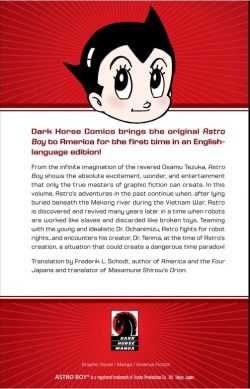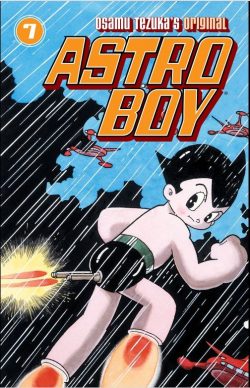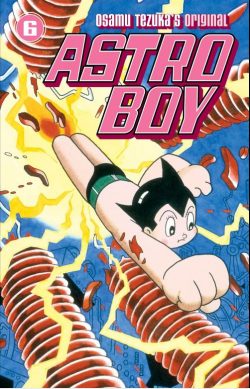

Osamu Tezuka’s Original Astro Boy volume 6 & 7


By Osamu Tezuka, translated by Frederik L. Schodt (Dark Horse Manga)
ISBN: 978-1-56971-681-6 (TPB 6) 978-1-56971-790-5 (TPB 7)

There’s nothing like the real thing. After a range of robotic rapscallions and kid-friendly constructions, here’s a double dose of the original and genuine mechanical marvel of any age…

From beginning his professional career in the late 1940s until his death in 1989, Osamu Tezuka generated an incomprehensible volume of quality work which transformed the world of manga and how it was perceived in his own country and, ultimately, across the globe. Devoted to Walt Disney’s creations, he performed similar sterling service with Japan’s fledgling animation industry.

The earliest stories were intended for children but right from the start Tezuka’s expansive fairy tale stylisations harboured more mature themes and held hidden pleasures for older readers and the legion of fans growing up with his manga masterpieces…

“God of Comics” was born in Osaka Prefecture on November 3rd 1928, and as a child suffered from a severe illness. The doctor who cured him inspired the lad to study medicine, and although Osamu began drawing professionally whilst at university in 1946, he persevered with college and qualified as a medical practitioner too. Then, as he faced a career crossroads, his mother advised him to do the thing which made him happiest.

He never practiced as a healer but the world was gifted with such masterpieces as Kimba the White Lion, Buddha, Black Jack and so many other graphic narratives.

Working ceaselessly over decades, Tezuka and his creations inevitably matured, but he was always able to speak to the hearts and minds of young and old equally. His creations ranged from the childishly charming to the distinctly disturbing such as The Book of Human Insects.

Tezuka died on February 9th 1989, having produced more than 150,000 pages of timeless comics; created the Japanese anime industry and popularised a uniquely Japanese graphic narrative style which became a fixture of global culture.

These monochrome digest volumes (173 x 113 mm in the physical world and any size you like if you get the eBook edition) continue to present – in non-linear order – early exploits of his signature character, with the emphasis firmly on fantastic fun and family entertainment…

Tetsuwan Atomu (literally “Mighty Atom” but known universally as Astro Boy due to its dissemination around the world as an animated TV cartoon and one of post-war Japan’s better exports) is a spectacular, riotous, rollicking sci fi action-adventure starring a young boy who also happens to be one of the mightiest robots on Earth.

The series began in 1952 in Shōnen Kobunsha and ran until March 12th 1968 – although Tezuka often returned to add to the canon in later years, both in comics but in also in other media such as the newspaper strips reprinted and repackaged here. Over that period, Astro Boy spawned the aforementioned global TV cartoon boom, starred in comic book specials and featured in games, toys, collectibles, movies and the undying devotion of generations of ardent fans.

Tezuka frequently drew himself into his tales as a commentator, and in his later revisions and introductions often mentioned how he found the restrictions of Shōnen comics stifling; specifically, having to periodically pause a plot to placate the demands of his audience by providing a blockbusting fight every episode. That’s his prerogative: most of us avid aficionados have no complaints…

Tezuka and his production team were never as wedded to close continuity as fans are. They constantly revised both stories and artwork in later collections, so if you’re a purist you are just plain out of luck. Such tweaking and modifying is the reason this series of collections seem to skip up and down the publishing chronology. The intent is to entertain at all times so stories aren’t treated as gospel and order is not immutable or inviolate.

It’s just comics, guys…

And in case you came in late, here’s a little background to set you up…

In a world where robots are ubiquitous and have won (limited) human rights, brilliant Dr. Tenma lost his son Tobio in a traffic accident. Grief-stricken, the tormented genius used his position as head of Japan’s Ministry of Science to build a replacement. The android his team created was one of the most groundbreaking constructs in history, and for a while Tenma was content.

However, as his mind re-stabilised, Tenma realised the unchanging humanoid was not Tobio and, with cruel clarity, summarily rejected the replacement. Ultimately, the savant removed the insult to his real boy by selling the robot to a shady dealer…

One day, independent researcher Professor Ochanomizu was in the audience at a robot circus and realised diminutive performer “Astro” was unlike the other acts – or indeed, any artificial being he had ever encountered. Convincing the circus owners to part with the little robot, the Prof closely studied the unique creation and realised just what a miracle had come into his hands…

Part of Ochanomizu’s socialization process for Astro included placing him in a family environment and having him attend school just like a real boy. As well as providing friends and admirers the familiar environment turned up another foil and occasional assistant in the bellicose form of Elementary School teacher Higeoyaji (AKA Mr. Mustachio)…

The wiry wonder’s astonishing exploits resume after the now traditional ‘A Note to Readers’ – explaining why one thing that hasn’t been altered is the depictions of various racial types in the stories.

The author was also keen on combining all aspects of his creation into one overarching continuity. This volume opens with ‘“Once Upon a Time” Astro Boy Tales Part 1′ January 24th – December 23rd 1967: reprinting modified strips from the serial that ran in the Sankei newspaper. In his cartoon persona, the God of Comics explains how the cliffhanger ending of the TV series (falling into the sun on a malfunctioning nuclear fusion blocker) never sat well with him.

Filling in gaps, Tezuka here reveals how the depowered robot boy was originally rescued and repaired by insectoid aliens and restored to Earth, but also how he has since rejected that plot twist and replaced it with a new one in ‘Beginning of the Contradiction’…

Now, while enjoying an evening flight over his beloved city, Astro is caught in the explosion of a crashing spaceship. He also saves a locust woman passenger who has taken more-or-less human form. After sharing her tale convoluted tale of romantic woe – involving two males determined to fight to the death for her – Scara Ohara realizes she is marooned on Earth, but that’s not the biggest problem she and her robot rescuer face. When Astro goes for help, he discovers the detonation has cracked the time barrier, plunging them back 50 years to March 1969…

While scouting ancient (by his lights) Tokyo and reeling in shock, Astro meets and befriends a little boy. He soon learns that there are no other true robots in existence and that little Shin-Chan is the world’s greatest beggar.

The diligent mendicant offers the stranded strangers accommodation in his plush house and is astounded when Astro reveals his artificial nature and great dilemma. The mechanoid needs constant atomic fuel top-ups or he will cease to function, but now – decades away from sustenance – is living on borrowed time…

‘Living on Earth 101’ finds Shin-Chan urgently schooling the strangers on the primitive, intolerant world they now live in: building a home, getting jobs as Astro deduces that – if he’s careful – he can live three more years. There are numerous embarrassing and simply dangerous moments where their secret is almost exposed, such as the time he digs up rare gems from inside a volcano but cannot explain how he got them to extremely curious diamond sellers…

Scara cannot understand the concept of work, but easily adapts to the joys of shopping, and lure of “fun” with a succession of attentive men, piling pressure on the sensible robot and triggering an encounter with ruthless thieves and the first of Astro’s contacts with people he will know half a century from “now”.

It’s the birth of the age of automation and Astro regularly meets prototype constructs that painfully remind him of home, where robots are sentient and have equal rights. Here, his kind are considered, silly fantasy, toys and potential job-stealers. Pioneering scientists often work in secret, such as the masked dabbler building his metal men in a secret underground lair.

The Birth of Neva #2′ sees a painfully young Ochanomizu take on the human-seeming weird kid Astro as an assistant… with startling repercussions.

As Scara continues to flounder in a strange world, ‘Baro, the Robot’ finds her at odds with her rescuer after she reveals that on her world, all mechanoids are slaves. Incensed, Astro rockets away, wasting precious energy to ostensibly investigate the rogue nation of Peakok, which has shocked the world with twin announcements: it is now a nuclear power, and its H-bombs are deployed by a robot delivery system…

As Astro enters the sinister police state, President Bundell is already taking charge of scientist Carpon‘s beloved brainchild Baro. The dictator has no idea that the sentient machine has the mind and personality of a human toddler, whilst the nuclear weapon really hates the idea of killing or dying: opinions fortified after meeting and debating with Astro. That all tragically changes when the President murders rebellious Carpon and Baro seeks revenge…

Squandering power, Astro only has six months energy remaining when the next crisis occurs. ‘Scara Disappears’, reveals how the emotionally dislocated alien – growing evermore discontented – flees to the mountains to escape humanity. When the boy bot returns, guilt drives him to investigate Mount Tanigawa, eventually finding Scara has changed shape and joined the bugs living there. With time running out, he and Shin-Chan make contingency plans: a scheme to store Astro’s power-depleted form for the decades necessary to catch up with the technology needed to sustain him, when the moment of total depletion finally comes…

In the meantime, Astro works with young Ochanomizu on developing robots. Faced with constant failure and the fact that society hates and does not want truly autonomous mechanoids, the boffin is despondent and Astro considers sharing his astonishing secret. Suddenly disaster strikes when a building collapses, and the heroic droid sacrifices most of his dwindling reserves to save people trapped in the wreckage. To keep his secret, Astro wears an old robot shell, but the act provokes a crisis as the authorities want the saviour machine that Ochanomizu knows could not have even moved, let alone independently rescued the victims. Revealing his true nature to the Professor, Astro accidentally sparks a national manhunt before falling into the hands of spies with only three days power remaining.

These monstrous thugs have their eyes on another nation’s top-secret technology.

‘The Energy Tube’ could preserve Astro’s existence so he reluctantly agrees to join them and is soon being smuggled out of Japan in a submarine…

This volume ends on a chilling cliffhanger as Astro’s conscience overrides his survival instincts. Refusing to be anybody’s secret weapon, he scuppers the sub and escapes, only to fly into a massacre: US jets bombing peasants. The war in Southeast Asia was in full swing when Osamu Tezuka crafted these stridently anti-war episodes which depicts the Mighty Atom routing American ground and air forces with his last vestiges of energy. When he collapses and is reverently interred, his “corpse” is disturbed and sinks into the Mekong river when the revenge-hungry Americans return to obliterate the village that even ‘The Angel of Viet Nam’ could not save…

To Be Continued…

Osamu Tezuka’s Original Astro Boy Volume 7 offers the same standard preliminaries and The Story Thus Far’ before resuming the Sankei newspaper adventure ‘“Once Upon a Time” with Astro Boy Tales Part 2′ (spanning December 24th1967 to September 27th 1968). Returning to prognostication, the master jumps to ‘The Summer of 1993’ and a world largely at peace and thriving on scientific progress. A dredger in the Mekong plucks a strange doll out of the mud, and – thanks to a handy note attached by Astro Boy – is returned to a certain person in Tokyo.

Little beggar Shin-Chan is now prestigious, powerful businessman Shingo Yamanaka, but he has never forgotten his childhood companion and despite his subordinates suspicious quibbling, spends a fortune on a new energy tube system to repower the inert doll. Marginally successful, the magnate introduces Astro to a world far closer to, but still not his own.

He and his flighty daughter Surume are the only ones who know his secret, and share his woe that although robots are now commonplace, they are still deliberately limited: a worker underclass who “know their place” and always end up on scrap heaps…

With only one day of full power, Astro knows this is not a situation he can fix. Dutiful and loyal, his first action is to check on Scara, who has been with the locusts on Mount Tanigawa for a quarter of a century now. Unsuccessful in this task, he allows Surume to show him the sights, especially the colossal Fun-Zone where humans go to release tensions, Dancing, playing or acting out their frustrated desires to kill in robot-staffed theme parks. Thy have to be careful though, unsupervised robots are illegal and subject to instant destruction if caught in human zones…

Professor Ochanomizu has not been idle. He still seeks to perfect sentient robot creation and his latest success is his pride and joy. However, its advanced nature makes the construct a perfect patsy when criminals frame it for a bold robbery. ‘Robot Chiruchiru in Danger’ finds the nobly stoic automaton on trial for its life. Surume and Astro strive mightily and heroically to save it, but tragedy strikes when the thieves outsmart the robot boy and justice takes a cruelly biased turn…

After turning the tables on the crooks ‘Astro’s Energy Runs Out’ and his day in the sun ends with him again shutting down, this time in the meadow where he had last seen Scara…

More time passes and the story almost comes full circle, as the origins of Astro Boy revisited in ‘Dr. Tenma’ with the tragedy of the deranged genius and his son Tobio expanded to reveal how parental neglect, overwork and compensating guilt all contributed to the construction of the dead boy’s synthetic substitute, and what the obsession to build him actually cost…

A further unknown complication is simultaneously beginning on Mount Tanigawa, where hibernating Scara awakes beside the eroded body of Astro Boy and realises a long-anticipated time-loop paradox is about to occur with two versions of the same person now occupying the same timeline. The solution is horrible, inevitable and ultimately miraculous…

‘The Tragedy of Bailey’ focuses on the robot boy’s painful failure to fit into the Tenma household: his mother’s anxiety and father’s spiralling into madness, and reappearance of aged Professor Ochanomizu, with constantly-baffled “Tobio” stumbling from crisis to crisis before being summarily handed over to a businessman whose behind the scenes dealings had enabled Tenma to complete his resurrection project…

This embroils him in a bizarre doomed plot to force America to recognize robot rights, but end horrifically for pioneering freedom fighter Bailey…

Returned to Japan, Tobio’s relationship with Tenma further deteriorates and ‘Astro Goes to the Circus’ sees time turn a full circle as the Science Minister wearies of the farce and sells his robot boy to inspirationally sadistic circus impresario Hamegg who renames his goldmine star attraction Astro Boy…

Subjected to an escalating round of gladiatorial combats and life-threatening stunts, Astro rebels and runs away, but even personal tragedy and the wiles of Ochanomizu are enough to keep the mighty mech out of Hamegg’s brutal clutches and despite showing his valiant mettle, this tome concludes on another cliffhanger with Astro Boy a battered slave of the worst that humanity can produce…

To Be Continued…

Breathtaking pace, outrageous invention, slapstick comedy, heart-wrenching sentiment and frenetic action are hallmarks of these captivating comics constructions: perfect examples of Tezuka’s uncanny storytelling gifts, which can still deliver a potent punch and instil wide-eyed wonder on a variety of intellectual levels. The melange of marvels is further enhanced here by an older, more sophisticated tone and the introduction of political and social commentary, proving Astro Boy to be a genuine delight for all ages.
Tetsuwan Atom by Osama Tezuka © 2002 by Tezuka Productions. All rights reserved. Astro Boy is a registered trademark of Tezuka Productions Co., Ltd., Tokyo Japan. Unedited translation © 2002 Frederik L. Schodt.

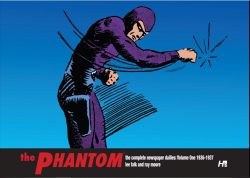
The Phantom: The Complete Newspaper Dailies volume 1 1936-1937


By Lee Falk & Ray Moore: introduction by Ron Goulart (Hermes Press)
ISBN: 978-1-932563-41-5 (HB)

There are plenty of comics-significant anniversaries this year, and this guy is probably right at the top of the birthday cake.

For such a long-lived, influential series, in terms of compendia or graphic novel collections, The Phantom has been very poorly served by the English language market (except in Australia where he has always been accorded the status of a pop culture god).

Numerous companies have sought to collect the strips – one of the longest continually running adventure serials in publishing history – but in no systematic or chronological order and never with any sustained success. At least the former issue began to be rectified with this initial curated collection from Archival specialists Hermes Press…

This particular edition is a lovely large hardback (albeit also available in digital formats), printed in landscape format, displaying two days strip per page in black and white with ancillary features and articles in dazzling colour where required.

Born Leon Harrison Gross, Lee Falk created the Jungle Avenger at the request of his King Features Syndicate employers who were already making history, public headway and loads of money with his first strip sensation Mandrake the Magician. Although technically not the first ever costumed champion in comics, The Phantom became the prototype paladin to wear a skin-tight body-stocking and the first to have a mask with opaque eye-slits…

The Ghost Who Walks debuted on February 17th 1936 in an extended sequence pitting him against an ancient global confederation of pirates. Falk wrote and drew the daily strip for the first two weeks before handing over illustration to artist Ray Moore. A spectacular and hugely influential Sunday feature began in May 1939.

In a text feature stuffed with sumptuous visual goodies like movie posters; covers for comics, Feature and Little Big Books plus merchandise, Ron Goulart’s eruditely enticing ‘Introduction: Enter the Ghost Who Walks’ tells all you need to know about the character’s creation before the vintage magic begins with ‘Chapter 1: The Singh Brotherhood’.

American adventurer Diane Palmer returns to the USA by sea, carrying a most valuable secret making her the target of mobsters, society ne’er-do-wells and exotic cultists. Thankfully, she seems to have an enigmatic guardian angel who calls himself  “the Phantom”…

As successive attacks and assaults endanger the dashing debutante, she learns that an ancient brotherhood of ruthless piratical thieves wants her secret, but that they have been opposed for centuries by one man…

Kidnapped and held hostage at the bottom of the sea, she is saved by the mystery man who falls in love and eventually shares his incredible history with her…

In the 17th century a British sailor survived an attack by pirates, and – washing ashore on the African coast – swore on the skull of his murdered father to dedicate his life and that of his descendants to destroying all pirates and criminals. The Phantom fights crime and injustice from a base deep in the jungles of Bengali, and throughout Africa is known as the “Ghost Who Walks”.

His unchanging appearance and unswerving war against injustice have led to him being considered an immortal avenger by the credulous and the wicked. Down the decades, one hero after another has fought and died in an unbroken family line, and the latest wearer of the mask, indistinguishable from the first, continues the never-ending battle. And he’s looking to propagate the line…

In the meantime, however, there’s the slight problem of Emperor of Evil Kabai Singh and his superstitious armies to deal with…

‘Chapter 2: The Sky Band’ (originally published from 9th November 1936 to April 10th 1937) finds the mystery avenger caught in love’s old game as a potential rival for Diana’s affections materialises in the rather stuffy form of career soldier Captain Meville Horton – an honourable man who sadly knows when he’s outmatched, unwanted and in the way. Mistakenly determined to do the right thing too, The Phantom concentrates on destroying a squadron of thieving aviators targeting the burgeoning sky clipper trade: airborne bandits raiding passenger planes and airships throughout the orient.

His initial efforts lead to the Phantom’s arrest: implicated in the sky pirates’ crimes, before escaping from police custody with the aid of his devoted pygmy witch doctor Guran and faithful Bandar tribe allies, he’s soon hot on the trail of the real mastermind…

On infiltrating their base, he discovers the airborne brigands are all women, and that his manly charms have driven a lethal wedge between the deadly commander and her ambitious second in command Sala…

A patient plaything of the manic Baroness, The Phantom eventually turns the tide not by force but by exerting his masculine wiles upon the hot-blooded – if psychopathic – harridan, unaware until too late that his own beloved, true-blue Diana is watching. When she sets a trap for the Sky Band, it triggers civil war in the gang, a brutal clash with the British military and the seemingly end of our hero, triggering Diana’s despondent decision to return alone to America…

‘Chapter 3: The Diamond Hunters’ opened on April 12th 1936 and revealed how the best laid plans can go awry…

In Llongo territory, white prospectors Smiley and Hill unearth rich diamond fields but cannot convince or induce local tribes to grant them mineral rights to the gems they consider worthless. Like most native Africans, they are content to live comfortably under the “Phantom’s Peace” and it takes all the miners’ guile – including kidnapping a neighbouring chief’s daughter and framing the Llongo; gunrunning and claiming the Ghost Who Walks has died – to set the natives at each other’s throats. Recovering from wounds, the Phantom is slow to act, but when he does his actions are decisive and unforgettable…

With the plot foiled and peace restored, Smiley flees, only to encounter a returned Diana who has acted on news that her man still lives. Seeing a chance for revenge and profit, Smiley kidnaps “the Phantom’s girl”; provoking his being shunned by all who live in the region, a deadly pursuit and a spectacular last-minute rescue. Smiley’s biggest and last mistake is reaching the coast and joining up with a band of seagoing pirates…

At least he is the catalyst for Diana and The Ghost finally addressing their romantic issues….

To Be Continued…

‘Afterword: For Those Who Came in Late…’ then sees editor Ed Rhoades offer his own thoughts on the strip’s achievements and accomplishments.

Stuffed with chases, assorted fights, torture, blood & thunder antics, daredevil stunts and many a misapprehension – police and government authorities clearly having a hard time believing a pistol-packing masked man with a pet wolf might not be a bad egg – this a pure gripping excitement that still packs a punch and quite a few sly laughs. …

© 2010 King Features Syndicate, Inc.: ® Hearst Holdings, Inc.; reprinted with permission. All rights reserved.


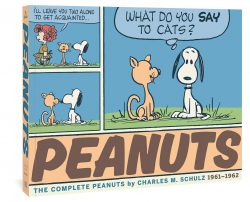
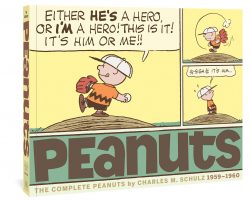
The Complete Peanuts volume 6: 1961-1962


By Charles M. Schulz (Fantagraphics Books)
ISBN: 978-1-56097-672-1 (HB) 978-1-60699-949-3 (PB)

Peanuts is unequivocally the most important comics strip in the history of graphic narrative. It is also the most deeply personal. Cartoonist Charles M Schulz crafted his moodily hilarious, hysterically introspective, shockingly philosophical surreal epic for half a century: 17,897 strips from October 2nd 1950 to February 13th 2000. He died from the complications of cancer the day before his last strip was published…

At its height, the strip ran in 2,600 newspapers in 75 countries, translated into 21 languages. Many of those venues are still running perpetual reprints, as they have ever since his departure. Attendant book collections, a merchandising mountain and television spin-offs made the publicity-shy artist a billionaire.

None of that matters. Peanuts – a title Schulz loathed, but one the syndicate forced upon him – changed the way comics strips were received and perceived: proving cartoon comedy could have edges and nuance as well as pratfalls and punchlines.

Following Diana Krall’s Foreword – discussing past times and secular humanism – the timeless times of play, peril and psychoanalysis resume as ever in marvellous monochrome, with more character introductions, plot advancements and the creation of even more traditions we all revere to this day…

As ever our focus is quintessential inspirational loser Charlie Brown who, with increasingly fanciful high-maintenance mutt Snoopy, remains at odds with a bombastic, mercurial supporting cast, all hanging out doing kid stuff.

As always, daily gags centre on playing, musical moments, pranks, and a seasonal selection of sports; teasing, making baffled observations and occasionally acting a bit too much like grown-ups. However, with this tome, the themes and tropes that define the series (especially in the wake of all those animated TV specials) become mantra-like and endlessly variable.

Mean girl Violet, prodigy Schroeder, self-taught psychoanalyst and world dictator-in-waiting Lucy, her off-kilter little brother Linus and dirt-magnet “Pig-Pen” are fixtures perfectly honed to generate joke-routines and gag-sequences around their own foibles, but now another clutch of new disruptive players join the mob.

Moreover, Charlie Brown’s existential responsibility for baby sister Sally expands crushingly as she grows and he assumes the mantle of dumber, yet protective, big brother…

Resigned – almost – to being an eternal loser singled out by fate, Charlie is helpless in the clutches of relentless Lucy who monetises her spiteful verve via a 5¢ walk-in psychoanalysis booth – ensuring that whether at play, in sports, flying his kite or just brooding, the round-headed kid truly endures the trials of the damned…

Perpetually sabotaged, and facing face-to-face abuse from all females in his life. Charlie Brown now endures a fresh hell in the form of smug attention-seeking Frieda who demands constant approval for her “naturally curly hair” and champions the cause of shallow good looks over substance. Even noble Snoopy is threatened, as the newcomer drags – literally – her boneless, functionally inert – but still essentially Feline – cat Faron into places where cats just don’t belong!

Other notable events include a sinister escalation in the Blanket war as Lucy sadistically seeks ways to decouple Linus from the fabric comforter that sustains him in the worst of times…

Moreover, when she isn’t stealing, slicing, mutilating, interring or otherwise assaulting the cloth, Snoopy is there to fight the tormented kid for it. And worst of all, Linus is afflicted with the compulsion to collect things and diagnosed with a need to wear eyeglasses. Oh, the humanity…!

The bizarre beagle increases his strange development in all ways. Other than his extended Cold War duel for possession of the cherished comfort blanket, the manic mutt must adapt to that darn cat, but still finds time to philosophise, eat, dance like a dervish, stand on his head, converse with falling leaves, play with sprinklers, befriend birds, eat more, brave the elements and coin a bucketload of new slogans like “Happiness is a piece of fudge caught on the first bounce”…

The Sunday page had debuted on January 6th 1952; a standard half-page slot offering more measured fare than 4-panel dailies. Thwarted ambition, sporting failures, explosive frustration – much of it kite-related – and Snoopy’s inner life became the strip’s signature denouements as these weekend wonders afforded Schulz room to be at his most visually imaginative, whimsical and weird…

Particular moments to relish this time involve the increasingly defined and sharply-edged romantic triangle of Lucy, Schroeder and Beethoven; Sally’s extended performance anxiety over starting kindergarten; Linus discovering the magic of a library card; the satisfaction of shoelace-tying; more “pencil-pal” communications; snow-games, rain, hiccups, stargazing ruminations; cooking gaffes; television, and grandeur and weirdness of Autumn.

There’s also slow-maturing madness through the first converts to the cult of The Great Pumpkin and the dread power of romance manifests with the return of Linus’ unattainable schoolteacher/inamorata Miss Othmar…

To wrap it all up, Gary Groth celebrates and deconstructs the man and his work in ‘Charles M. Schulz: 1922 to 2000’whilst a copious ‘Index’ offers instant access to favourite scenes you’d like to see again….

Readily available in hardcover, paperback and digital editions, this volume ensures total enjoyment: comedy gold and social glue metamorphosing into an epic of spellbinding graphic mastery that still adds joy to billions of lives, and continues to make new fans and devotees long after its maker’s passing.
The Complete Peanuts: 1961-1962 (volume Six) © 2006, 2014 Peanuts Worldwide, LLC. The Foreword is © 2006, Diana Krall. “Charles M. Schulz: 1922 to 2000” © 2006 Gary Groth. All rights reserved.

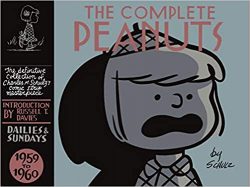
The Complete Peanuts volume 5: 1959 to 1960


By Charles M. Schulz (Canongate Books/Fantagraphics Books)
ISBN: 978-1-84767-149-3 (Canongate HB) 978-1-60699-921-9 (Fantagraphics PB)

Peanuts is unequivocally the most important comics strip in the history of graphic narrative. It is also the most deeply personal.

Cartoonist Charles M Schulz crafted his moodily hilarious, hysterically introspective, shockingly philosophical surreal epic for half a century: 17,897 strips from October 2nd 1950 to February 13th 2000. He died from the complications of cancer the day before his last strip was published…

At its height, the strip ran in 2,600 newspapers in 75 countries, translated into 21 languages. Many of those venues are still running perpetual reprints, as they have ever since his departure. Attendant book collections, a merchandising mountain and television spin-offs made the publicity-shy artist a billionaire.

None of that matters. Peanuts – a title Schulz loathed, but one the syndicate forced upon him – changed the way comics strips were received and perceived: proving cartoon comedy could have edges and nuance as well as pratfalls and punchlines.

Following a Foreword of fun and frank shared reminiscences between editor Gary Groth and mega star Whoopi Goldberg, the timeless times of play, peril and psychoanalysis resume as ever in marvellous monochrome, but this time major changes are in motion as the feature enters its true glory days …

Our focus is quintessential inspirational loser Charlie Brown who, with increasingly high-maintenance, fanciful mutt Snoopy, remains at odds with a bombastic, mercurial supporting cast, all hanging out doing kid stuff.

As always, daily gags centre on playing, pranks, and a seasonal selection of sports; musical moments, teasing, making baffled observations and occasionally acting a bit too much like grown-ups. However, with this tome, the themes and tropes that define the series (especially in the wake of all those animated TV specials) are truly bedded in.

Mean girl Violet, prodigy Schroeder, “world’s greatest fussbudget” Lucy and her off-kilter little brother Linus and dirt-magnet “Pig-Pen” are fixtures sufficiently fleshed out and personified to generate jokes and sequences around their own foibles, but a new disruptive force is introduced. The existential angst of Charlie Brown is magnified by more responsibility with the coming of his new baby sister Sally…

Resigned to his role as eternal loser and singled out by fate and the relentless, diabolical Lucy – who now intensifies and monetises her spiteful verve with a 5¢ walk-in psychoanalysis booth – the round-headed kid really endures the trials of Job from now on. His attempts to fly a kite or kick a football are perpetually sabotaged, and he faces from all the females in his life constant face-to-face reminders of how rubbish he is. Can this new one in his own house be any different?

Other notable events include the first instances of Linus’ doomed relationships: primarily with alternative mythical entity The Great Pumpkin, but also unattainable, equally unseen schoolteacher/inamorata Miss Othmar…

Wonder beagle Snoopy increases his strange development in all ways. His extended Cold War duel for possession of Linus’ cherished comfort blanket escalates but the manic mutt also finds time to philosophise, dance like a dervish and battle City Hall to save his doghouse from a proposed Freeway Bypass…

The Sunday page had debuted on January 6th 1952; a standard half-page slot offering more measured fare than 4-panel dailies. Both thwarted ambition and explosive frustration became part of the strip’s signature denouements as these weekend wonders gave the auteur room to be at his most visually imaginative, whimsical and weird…

By 1959, rapid-fire raucous slapstick gags were riding side-by-side with increasingly abstract, obscure, edgy, psychologically barbed introspections: deep ruminations in a world where kids and animals were the only actors. The relationships are now deep, complex and absorbing but there was still room and time for pure artistic expression. The “Clouds” page for Sunday August 14th was instantly revered by readers and cited by Schulz as his all-time personal favourite.

Sheer exuberance and a spontaneous tendency to barrack perceived failure or weakness at any provocation remains a trusted standby, supported by sporting crises, loneliness, the difficulties of learning to read and wearing long pants, plus a growing attention to issues of motherhood.

Particular moments to relish here involve Snoopy’s muzzle-pugilism; Charlie Brown’s “pencil-pal”; snow-games, rain, cooking gaffes; television, the dread power of romance and grandeur and weirdness of Autumn: all while offering more examples of Schroeder’s eternal love affair of Beethoven and inability to discern Lucy’s far-from-apparent attractions.

The general trends for all the kids being beguiled by stargazing, waxing philosophical at the heavens’ splendour and enduring St. Valentines’ Day traumas continues and there’s even a sighting of Lucy’s softer side. This collection features the first incidence of a minor phenomenon springing from the April 25th daily which first disclosed that “Happiness is a warm puppy…”

To wrap it all up, Gary Groth celebrates and deconstructs the man and his work in ‘Charles M. Schulz: 1922 to 2000’whilst a copious ‘Index’ offers instant access to favourite scenes you’d like to see again….

Readily available in hardcover, paperback and digital editions, this volume offers a rare example of a masterpiece in motion: comedy gold and social glue metamorphosing into an epic of spellbinding graphic mastery that remains part of the fabric of billions of lives, and which continues to make new fans and devotees long after its maker’s passing.
The Complete Peanuts: 1959-1960 (volume 5) © 2006 United Features Syndicate, Inc. The Foreword is © 2006 Whoopi Goldberg. “Charles M. Schulz: 1922 to 2000” © 2006 Gary Groth. All rights reserved.

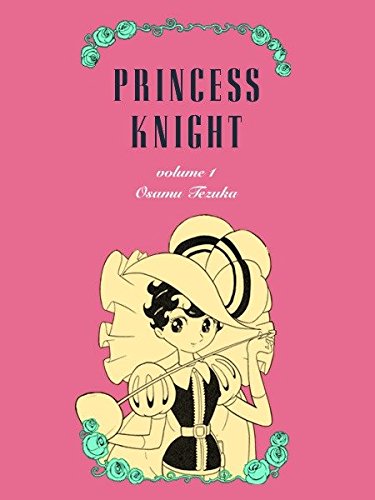
Princess Knight volume 1


By Osamu Tezuka, translated by Maya Rosewood (Vertical)
ISBN: 978-1-935654-25-4 (PB)

Osamu Tezuka revolutionised the Japanese comics industry during the 1950s and 1960s. A devoted fan of the films of Walt Disney, he performed similar sterling service in the country’s fledgling animation industry.

Many of his earliest works were aimed at children, but right from the start his expansive fairy tale stylisations – so perfectly seen in this splendid romp – harboured more mature themes and held hidden treasures for older readers…

Ribon no Kishi or “Knight of the Ribbon” is a series which Tezuka returned to repeatedly during his life and one continued in the 21st century by his disciples. The simple tale has been turned into TV anime seen all over the world (generally known as some variation of “Choppy and the Princess”) and in 2006 became a stage musical.

The serial originated in Kodansha’s Shoujo Korabu (Shōjo Club), running from January 1954 to January 1956, with a generational sequel appearing in Nakayoshi magazine from January 1958 to June 1959. The original tale was updated and revised in 1963-1966, forming the basis of the version in this magnificent tome, translated from the Tezuka Osamu Manga Zenshu Edition 1977.

In 1967-1968, to tie-in with a television adaptation, Tezuka reconfigured the tale with science fiction overtones. Limned by Kitano Hideaki, it ran for a year in Shōjo Friend.

The series is a perennial favourite and classic of the medium and this volume is part of a 2-volume softcover (or digital) English-language edition, containing the first 16 episodes in vibrant monochrome.

‘Once Upon a Time’ opens in Heaven where junior angels are busy with soon-to-be-born souls, installing either blue boy hearts or pink girl hearts to the ante-natal cherubs in their care. Unfortunately, easily distractible Tink (AKA “Choppy” in many foreign iterations) cocks up and one proto-baby gets both…

Tink is dispatched to Earth to retrieve the superfluous metaphysical organ and lands in the feudal kingdom of Silverland, where a most important child is about to be born. The King and Queen desperately desire their imminent first-born be a boy, for no female can rule the country. Should the child be a princess, then vile Duke Duralumin‘s idiot and nastily maladjusted boy Plastic will become heir-apparent.

Thus, due to a concatenation of circumstances, a baby girl with a dual nature spends her formative years pretending to be a prince…

Fifteen years pass before ‘Flowers and Parades’ resumes the saga. Tink has been lax in his mission and Prince Sapphirehas become the darling boy of the kingdom. Duralumin and crafty henchman Sir Nylon have spent the intervening years certain the gallant boy is actually a useless girl, but have been unable to prove it. In that time, Sapphire has grown into a dutiful, beautiful – if androgynous – specimen skilled in riding, sports and all arts martial, but passionately yearns to openly wear the dresses and make-up which are her family’s most intimate secret. When Tink finally reveals himself and exposes the heir’s hidden nature, Nylon overhears…

‘The Carnival’ sees gorgeous Prince Franz Charming pay a royal visit from neighbouring Goldland. Sapphire, aided by her mother and nurse, dons a blonde wig and party frock to clandestinely give vent to her true nature, turning all heads and captivating her regal guest. When she returns to her public identity, all Franz can talk about is the mysterious girl with flaxen hair, blind to the fact that she is sitting beside him…

In ‘The Tournament’, the evil Duke turns a fencing exhibition to his advantage, killing the King and framing Franz for the deed, after which the ‘Prisoner Prince’ is helped to escape by his Flaxen maid. Heir Sapphire accedes to the throne in ‘Coronation’, only to have it all snatched away as the Duke’s latest scheme succeeds beyond all his wildest dreams. Sapphire is publicly exposed as a girl, and her recently widowed mother is accused of betraying the nation by concealing the fact…

Reviled and shunned, mother and daughter are imprisoned with ghastly hunchback jailer Gammer in ‘Sapphire in Coffin Tower’, wherein the distraught girl befriends the vermin of the Keep just as Gammer gets his orders to dispose of his charges. Meanwhile, Tink has been searching high and low for Sapphire…

Narrowly escaping being murdered, the princess becomes a masculine masked avenger of wrongs in ‘Phantom Knight’s Debut’, punishing the wicked men who have ruined her nation since Plastic was enthroned by Duralumin.

In the Palace, the villains look for ways to control the increasingly off-kilter Plastic in ‘The Idiot King’s Bride’. Little do they know that Briar Rose, the fetching companion they’ve acquired, is Sapphire, on an infiltration mission…

When she is inevitably caught, Sapphire’s life takes an even more dramatic turn in ‘Devil’s Whisper’ when terrifying witch Madame Hell materialises, offering her untold wealth and power if she will sell her female heart and nature. Luckily Tink’s angelic power drives the horror off, but is unable to prevent the princess being sentenced to a life of penal servitude in ‘Two by the Quarry’.

Here she again meets Franz, who has long believed Sapphire responsible for his frame-up and imprisonment in Silverland’s dungeons. Nevertheless, the Prince helps Sapphire escape, almost dying in the effort. Soon after the girl is transported to ‘The Witch’s Lair’ and meets Hell’s daughter Hecate, who violently opposes her mother’s scheme to marry her off to Franz. That young worthy, however, has meanwhile recovered from his wounds and is still searching for the flaxen-haired girl, oblivious to her true identity and nature…

Hecate does not want Sapphire’s girlish heart and frees the Princess Knight by turning her into a ‘Grieving Swan’ who is captured by Franz and added to the Royal Flock. The Prince too is being pressured to marry and beget an heir, so when Madame Hell arrives with a huge bribe and a now compliant Hecate the boy’s uncle is keen to cement the nuptial alliance until the ensorcelled swan Sapphire exposes their true natures with Tink’s angelic assistance…

Just as Franz begins to finally notice the similarity of his flaxen dream girl to the freshly restored Sapphire in ‘Two Hearts’ she and Tink are fleeing – right into the clutches of Nylon who is keen to wipe out any loose ends. At the worst possible moment, the angel completes his long mission and reclaims the boy-heart, leaving her helpless, but cannot betray his friend and returns it, consequently losing his place in Heaven…

Together again the pair attempt to rescue Sapphire’s mother from Coffin Tower but are too late. The Queen and Gammer have been taken to Sea Snake Island where vengeful Madame Hell’s dark magic has transformed her into a petrified ‘Stone Queen’.

The drama pauses with Sapphire and Tink adrift on the ocean and encountering brilliant, dashing, gloriously charismatic ‘Captain Blood, Pirate’ who instantly penetrates the princess’ manly disguise, seeing a woman he must marry at all costs…

Princess Knight is a spectacular, riotous, rollicking adventuresome fairy tale about desire, destiny and determination which practically invented the Shoujo (“Little Female” or young girl’s manga) genre in Japan and can still deliver a powerful punch and wide-eyed wonder on a variety of intellectual levels. Still one of the best and most challenging kid’s comics tales ever, it’s a work that all fans and – especially parents – should know.

© 2011 by Tezuka Productions. Translation © 2011 by Mari Morimoto and Vertical, Inc. All rights reserved.

A Valentine for Charlie Brown


By Charles M. Schulz (Fantagraphics Books)
ISBN: 978-1-60699- (HB)

Peanuts is unequivocally the most important comics strip in the history of graphic narrative. It is also the most broadly accepted, since – after the characters made the jump to television – the little nippers become an integral part of the American mass cultural experience.

Charles M. Schulz crafted his moodily hilarious, hysterically introspective, shockingly philosophical epic for 50 years, publishing 17,897 strips from October 2nd 1950 to February 13th 2000. He died from the complications of cancer the day before his last strip was published…

At its height, the strip ran in 2,600 newspapers in 75 countries, translated into 21 languages. Many of those venues are still running perpetual reprints, as they have ever since his departure. Attendant book collections, a merchandising mountain and TV spin-offs made the publicity-shy artist a billionaire. That profitable sideline – one Schulz devoted barely any time to over the decades – is where this little gem originates from…

Peanuts – a title Schulz loathed, but one the syndicate forced upon him – changed the way comics strips were received and perceived by showing that cartoon comedy could have edges and nuance as well as pratfalls and punchlines.

The usual focus of the feature (we just can’t call him “star” or “hero”) is everyman loser Charlie Brown who, with high-maintenance, fanciful mutt Snoopy, endures a bombastic and mercurial supporting cast who hang out doing kid things in a most introspective, self-absorbed manner.

The daily gags centred on playing (pranks, sports, musical instruments), teasing each other, making ill-informed observations and occasionally acting a bit too much like grown-ups. The consistently expanding cast also includes mean girl Violet, child prodigy Schroeder, “world’s greatest fussbudget” Lucy Van Pelt, her other-worldly baby brother Linus and dirt-magnet “Pig-Pen”: each with a signature twist to the overall mirth quotient and sufficiently fleshed out and personified to generate jokes and sequences around their own foibles. As a whole, the kids tackled every aspect of human existence in a charming and witty manner, acting as cartoon therapists and graphic philosophical guides to the world that watched them.

Charlie Brown is settled into his existential angst and resigned to his role as eternal loser as if singled out by a gleeful Fate. It’s a set-up that remains timelessly funny and infinitely enduring…

Available in a child-friendly hardback and the usual digital formats, A Valentine for Charlie Brown offers a trio of extended vintage sequences revolving around further crushing the spirit of the saddest, yet most optimistic kid on Earth. All he wants is someone to love, but for many of us, it’s not that easy to find the one – or even anyone…

The tales are told in a series of monochrome panels (generally four to a page) and we open with ‘Valentine’s Vigil at the Mailbox’ as the perpetually anxious and responsibility-burdened Charlie anticipates a card or maybe more at this time of romantic intensity. Sadly, the mail is not an ally and most post goes to the hairy pal who truly does dote on him…

Of course, there’s always Linus to share thoughts with, sister Sally to show him up and Lucy to be… well Lucy…

Not that Van Pelt has much joy with her own chosen inamorata. Schroeder loves music and would do anything to be alone with his passion…

A new year brings fresh hope as Charlie discovers ‘The Little Red-Haired Girl’, but even after burdening all his pals with his aspirations and disappointments, our gallant would-be swain painfully realises the course of true love never yadda, yadda, yadda…

Wrapping up the melancholy mirth is delicious change of pace ‘My Sweet Babboo’ which sees Sally set her cap for Linus with terrifying determination: an all-points pursuit to delight jaded older souls and simultaneously chill the heart of anybody with pet bunnies..

Sally and Linus take centre stage in this outrageous and inventive sequence but there’s still plenty of time for Charlie and the others to suffer their usual hang-ups, between marvelling at the dogged determination on show…

Timeless and evergreen, Charlie Brown’s existentialist travail and amorous aspirations have been delighting readers seemingly forever and clearly will not be stopping or superseded anytime soon. If you haven’t joined this club yet, why not sign up now?
A Valentine for Charlie Brown © 2015 Peanuts Worldwide, LLC. All rights reserved.

The Mythology of S. Clay Wilson: volume 1: Pirates in the Heartland


By S. Clay Wilson, edited by Patrick Rosenkranz (Fantagraphics Books)
ISBN: 978-1-60699-747-5 (HB)

Once more, I’m altering the fixed schedules to note the passing of a giant. Everybody’s losing loved one in far greater numbers than we can really afford or cope with, but this one is even more poignant and powerful: the death of one of the most vital and vigorous cartoonists we’ve ever been privileged to enjoy. Here’s a parental warning to prove it…

This book is filled with dark, violent sexual imagery and outrageous situations intended to make adults laugh and think. If that hasn’t clued you in, please be warned that this book contains images of nudity, extreme violence, sexual intimacy and excess – both hetero- and homosexual – and language commonly used in the privacy of the bedroom, drunken street brawls and school playgrounds whenever adults aren’t present.

If the thought of all that offends you, read no further and don’t buy the book. The rest of us will just enjoy some of the most groundbreaking cartoon experiences ever created without you.

Steve Clay Wilson was a pioneering light of America’s transformative Underground Commix movement: an uncompromising, controversial, in-your-face pioneer of the counterculture, constantly challenging attitudes and sensitivities whilst telling the kind of cartoon tales he wanted – or perhaps had – to.

Something of a contradiction to those who knew him, charming, charismatic Wilson lived life to the full and took his art seriously.

And what art! Stark, complex, shocking, incredibly detailed tableaux jumping with modern Rabelaisian content: mesmerising scenes packed with intense multi-layered busyness, crammed with outrageous, iconic characters in constant surging motion – mostly combative and hilariously violent.

The manly, hedonistic exuberance of frantic fighters rejoicing in the wild freedom as exemplified by bikers, cowboys, pirates, bull dykes and devils, augmented by other violent ne’er-do-wells, grotesques, human-scaled beasts and things which could be drawn but never described…

His work seethed and abounded with excess: monsters, mutilations, booze and drug-fuelled romps populated with priapic plunderers and ravening beasts, dangerous and disturbed women and always, always unsettling scenes of society’s biggest taboos – sex and personal freedom.

All Americans already worshipped violence; Wilson just pushed the visuals for that sacrament as far as he could into surreal parody. Everybody who knew Wilson adored him, but around him they were usually a little nervous and stepped lightly…

The modern successor to Pieter Bruegel and Hieronymus Bosch moved on to other artistic arenas when the Underground movement foundered, but he never toned down his visions. In 2008 he suffered massive brain damage in mysterious circumstances and underwent full-time palliative care ever since. He died aged 79, on Sunday February 7th 2021.

This intimate and informative oversize (286 x 202mm) hardcover biography and graphic overview – also available in digital formats – is compiled from previous writings and extensive interviews with the people he grew up with and who shared his eventful life.

Moreover, each telling anecdote and reminiscence is augmented with photos, paintings, illustrated letters and private or previously-unpublished artworks, and each chapter offers a wealth of gloriously outrageous strips: comprising all of his published comics work from the heady days of America’s counterculture explosion in 1968 to its virtual demise in 1976.

It opens with a warm, picture-packed, fact-filled Introduction by college pal and flatmate John Gary Brown before the hagiography of horrors begins with ‘Wilson’s Childhood’.

Described by Robert Crumb as “the strongest, most original artist of my generation” Steven Clay Wilson grew up in down-home Lincoln, Nebraska, thriving on a diet of EC comics (especially Piracy), post-war prosperity and Great Plains sensibilities. His early life was filled with good family, cool pets, cycling, school and drawing.

Lots of drawing (much of it impressively included in the first chapter) takes us out of High School and into college, but before that unfolds there’s a gory welter of early triumphs in the black and white comics section which includes such classics as ‘Shorts in the Bowl’ (from Gothic Blimp Works #1), ‘River City Shoot-Out’ from the second issue and ‘No Loot for You, Captain Namrooth’ from Gothic Blimp Works #6, all circa 1969, followed by a ‘Goodtimes Front Cover’for May 1st 1970.

The entirety – 26 images – of the mega-successful arts project which became ‘S. Clay Wilson Portfolio Comix’ leads into the strip ‘Afterwards’ (Hydrogen Bomb Funnies, 1970) and the tableaux ‘It’s a Thrill to Kill’ from Thrilling Murder Comics, 1971 and ‘The 137th Dream of Lester Gass’ (Illuminations, 1971).

A productive strip period begins with ‘Insect Paranoia’ (Insect Fear #1),‘Insect Angst’ (#2, both 1970) and ‘Insomnia Angst’ (#3, 1972), followed by ‘Boogie Boogie Horror Yarn’ (Laugh in the Dark, 1971) and closes with ‘Whip Tip Tales’and ‘Soft Core Porn Yarn’ from San Francisco Comic Book issues #1 and #3 in 1970.

Wilson’s turbulent brush with art school and academia at the University of Nebraska is detailed in ‘Higher Education’ as is his understandably less than glorious military service and adoption of the drop-out life style, topped off by more manic strips and panels (he called them “Deep Scenes”) beginning with ‘The Hog Ridin’ Fools’ (Zap Comix #2, 1968 and featuring a very early appearance of Wilson’s signature character the Checkered Demon). That issue also supplies ‘Just as you said Madge… He’s Shitting’ and ‘Head First’, whilst from the third comes ‘Captain Pissgums and His Pervert Pirates’, ‘Gilded Moments’, ‘Captain Edwards St. Miguel Tilden Bradshaw and his crew come to Grips with bloodthirsty foe pirates’, ‘Come Fix’ and ‘Arnie, my bra ain’t on’.

Wilson drew at a phenomenal rate and Zap Comix #4 1969 unleashed ‘A Ball in the Bung Hole’, an untitled phantasmagorical double-spread, ‘Leather Tits’ and the debut of his occasional lewd lead ‘Star-Eyed Stella’. Zap #5 (1970) barely contained ‘Lester Gass the Midnight Misogynist’, ‘Ruby the Dyke Meets Weedman’ and ‘Snake Snatch Tale’.

At the end of 1966 Wilson relocated to ‘Lawrence, Kansas’: a burgeoning Midwestern oasis of countercultural thought and self-expression, and a useful place to concentrate creative energies before his inevitable move to the West Coast. This chapter is abutted by another wave of glorious filth and ferocity, comprising non-biblical epic ‘The Felching Vampires Meet the Holy Virgin Mary’ (Felch Cumics, 1975), adult fairy tale ‘Puducchio’ from Pork (1974), which also offers a quartet of single-frame gags, after which Bent (1971) provides Deep Scene ‘Dwarf Snuffing Station #103’, ‘Pendants’; a return engagement for ‘Star-Eyed Stella’ and ‘Nail Tales’.

Declaring “Art is Therapy”, Wilson always saw its creation as a collaborative process: one which demanded a response. On reaching the golden lands of ‘The Barbary Coast’ his artistic jams with the likes of Crumb – who claims the flatlander inspired him to completely release all his artistic inhibitions – and creative compadrés like Spain Rodriguez, Rick Griffin, Robert Williams and Victor Moscoso, made them royalty in the San Francisco heart of the revolution.

That star-studded, astounding period and how it began to fade makes up the last revelatory chapter in this initial volume (of three) and concludes with one last selection of colour and monochrome masterpieces including eye-popping ‘Deranged doctors perform operational experiments on mutated patients under the antiseptic incandescent gaze of the Big Daddy Devil Doctor’ from Arcade #3, 1975; illustrations for William Burroughs’ seminal short story ‘Fun City in Badan’ (Arcade #4), ‘The Corpse Gobblin’ Ogre of Columbite Mountain’(Arcade #5), ‘Monster Bride’ (Arcade #6) and ‘Vampire Lust’ (Arcade #7, 1976).

Also on show are multi-hued strip ‘Last Foe’ (Apple Pie July 1975), the cover from Zap Comix #3, front-&-back covers from S. Clay Wilson Portfolio Comix, Bent and Pork; ‘It’s a treat to blast away the flat foot’s feet’ from Tales of Sex and Death #1 (1971), 8-page, in-record minicomic insert ‘The Saga of Yukon Pete’ from the vinyl platter of the same name by Son of Pete and the Muffdivers, wrapping up in fine style with the infernally euphoric ‘Surfsup’ strip from Tales from the Tube #1, 1972.

Scholarly yet surprisingly engaging, this superb collation, contrived and shepherded by Patrick Rosenkranz, offers an amazingly and unforgettable close-up view of one of the most important cartoonists in American history. This is a book no serious lover of the art form or devotee of grown-up comics can afford to miss.
The Mythology of S. Clay Wilson volume one: Pirates in the Heartland © 2014 Fantagraphics Books. All comics and images by S. Clay Wilson © 2014 S. Clay Wilson. All biographical text © 2014 Patrick Rosenkranz. All other material © 2014 its respective creators and owners. All rights reserved.

Barnaby volume 2


By Crockett Johnson (Fantagraphics Books)
ISBN: 978-1-60699-709-3 (HB)

This is one of those rare books worthy of two reviews. So, if you’re in a hurry…

Buy Barnaby now – it’s one of the five best comic strips of all time and this superb hardcover compilation has lots of fascinating extras. If you harbour any yearnings for the lost joys of childish wonder and the suspicious glee in catching out adults trying to pull a fast one, you would be crazy to miss this book…

However, if you’re still here and need a little more time to decide…

Today’s newspapers have precious few continuity drama or adventure strips. Indeed, if a paper has any strips – as opposed to single panel editorial cartoons – chances are they will be of the episodic variety typified by Jim Davis’ Garfield or Scott Adams’ Dilbert.

You might describe these as single-idea pieces with a set-up, delivery and punch-line, all rendered in a sparse, pared-down-to-basics drawing style. In that they’re nothing new and there’s nothing wrong any of that ilk on their own terms.

Narrative impetus comes from the unchanging characters themselves, and a building of gag-upon-gag in extended themes. The advantage to newspapers is obvious. If you like a strip it encourages you to buy the paper. If you miss a day or two, you can return fresh at any time having, in real terms, missed nothing.

Such was not always the case, especially in America. Once upon a time the daily “funnies” – comedic or otherwise – were crucial circulation builders and preservers, with lush, lavish and magnificently rendered fantasies or romances rubbing shoulders with thrilling, moody masterpieces of crime, war, sci-fi and everyday melodrama. Even the legion of humour strips actively strived to maintain an avid, devoted following.

And eventually there was Barnaby, which in so many ways bridged the gap between then and now.

On April 20th 1942, with America at war for the second time in 25 years, the liberal New York tabloid PM began running a new, sweet little kids’ strip which was also the most whimsically addicting, socially seditious and ferociously smart satire since the creation of Al Capp’s Li’l Abner – another utter innocent left to the mercy of venal and scurrilous worldly influences…

The outlandish 4-panel daily, by Crockett Johnson, was the product of a perfectionist who didn’t particularly care for comics, but who – according to celebrated strip historian Ron Goulart – just wanted steady employment…

David Johnson Leisk (October 20th 1906-July 11th 1975) was an ardent socialist, passionate anti-fascist, gifted artisan and brilliant designer who spent much of his working life as a commercial artist, Editor and Art Director. Born in New York City and raised in the outer wilds of Queens when it was still semi-rural – very near the slag heaps which would eventually house two New York World’s Fairs in Flushing Meadows – “Dave” studied art at Cooper Union (for the Advancement of Science and Art) and New York University before leaving early to support his widowed mother. This entailed embarking upon a hand-to-mouth career drawing and constructing department-store advertising.

He supplemented his income with occasional cartoons to magazines such as Collier’s before becoming an Art Editor at magazine publisher McGraw-Hill. He also began producing a moderately successful, “silent” strip called The Little Man with the Eyes.

Johnson had divorced his first wife in 1939 and moved out of the city to Connecticut, sharing an ocean-side home with student (and eventual bride) Ruth Krauss, always looking to create that steady something when, almost by accident, he devised a masterpiece of comics narrative. However, if his friend Charles Martin hadn’t seen a prototype Barnaby half-page lying around the house, the series might never have existed…

Happily, Martin hijacked the sample and parlayed it into a regular feature in prestigious highbrow leftist tabloid PM simply by showing the scrap to the paper’s Comics Editor Hannah Baker. Among her other finds was a strip by a cartoonist dubbed Dr. Seuss which would run contiguously in the same publication. Despite Johnson’s initial reticence, within a year Barnaby had become the new darling of the intelligentsia…

Soon there were book collections, talk of a Radio show (in 1946 it was adapted as a stage play), a quarterly magazine and rave reviews in Time, Newsweek and Life. The small but rabid fan-base ranged from politicians and the smart set such as President and First Lady Roosevelt, Vice-President Henry Wallace, Rockwell Kent, William Rose Benet and Lois Untermeyer to cool celebrities such as Duke Ellington, Dorothy Parker, W. C. Fields and even legendary New York Mayor Fiorello La Guardia. Of course, the last two might only have been checking the paper because the undisputed, unsavoury star of the strip was a scurrilous if fanciful amalgam of them both…

Not since George Herriman’s Krazy Kat had a piece of popular culture so infiltrated the halls of the mighty, whilst largely passing way over the heads of the masses and without troubling the Funnies sections of big circulation papers. Over its 10-year run (April 1942 to February 1952), Barnaby was only syndicated to 64 papers nationally, with a combined circulation of just over five and a half million, but it kept Crockett (a childhood nickname) and Ruth in relative comfort whilst America’s Great and Good constantly agitated on the kid’s behalf.

What more do you need to know?

One dark night a little boy wishes for a Fairy Godmother and something strange and disreputable falls in through his window…

Barnaby Baxter is a smart, ingenuous, scrupulously honest and rather literal pre-schooler (4 years old to you) and his ardent wish is to be an Air Raid Warden like his dad. Instead, he is “adopted” by a short, portly, pompous, mildly unsavoury and wholly discreditable windbag with pink pixie wings.

Jackeen J. O’Malley, card carrying-member of the Elves, Gnomes, Leprechauns and Little Men’s Chowder and Marching Society – although he hasn’t paid his dues in years – unceremoniously installs himself as the lad’s Fairy Godfather. A lazier, more self-aggrandizing, mooching old glutton and probable soak (he certainly frequents taverns but only ever raids the Baxter’s icebox, pantry and humidor, never their drinks cabinet…) could not be found anywhere.

Due more to intransigence than evidence – there’s always plenty of physical proof, debris and fallout whenever O’Malley has been around – Barnaby’s mum and dad adamantly refuse to believe in the insalubrious sprite, whose continued presence hopelessly complicates the sweet boy’s life.

The poor doting parents’ abiding fear is that Barnaby is afflicted with Too Much Imagination…

At the end of the first volume O’Malley implausibly – and almost overnight – became an unseen and reclusive public Man of the Hour, preposterously translating that cachet into a political career by accidentally becoming a patsy for a vast and corrupt political machine. In even more unlikely circumstances O’Malley is then elected to Congress – which somehow doesn’t seem so fantastic any more…

This strand gave staunchly socialist cynic Johnson ample opportunity to ferociously lampoon the electoral system, the pundits and even the public. As usual Barnaby’s parents had to perpetually put down their boy: assertively assuring him that the O’Malley the grown-ups had elected was not a fat little man with pink wings…

Despite looking like a fraud – he’s almost never seen using his magic and always has one of Dad’s stolen panatela cigars as a substitute wand – J. J. O’Malley is the real deal: he’s just incredibly lazy, greedy, arrogant and inept. He does sort of grant Barnaby’s wishes though… but never in ways that might be wished for…

Once O’Malley has his foot in the door – or rather through the bedroom window – a succession of bizarre characters start sporadically turning up to baffle and bewilder Barnaby and Jane Shultz, the sensible little girl next door.

Even the boy’ new dog Gorgon is a remarkable oddity. The pooch can talk – but never when adults are around, and only then with such overwhelming dullness that everybody listening wishes him as mute as every other mutt…

The mythical oddballs and irregulars include timid ghost Gus, Atlas the Giant (a 2-foot tall, pint-sized colossus who is not that impressive until he gets out his slide-rule to demonstrate that he was, in truth, a mental Giant) and LauncelotMcSnoyd, an invisible Leprechaun and O’Malley’s personal gadfly: always offering harsh, ribald home truths and counterpoints to the Godfather’s self-laudatory pronouncements…

Johnson continually expanded his gently bizarre cast of gremlins, ogres, ghosts, policemen, Bankers, crooks, financiers and stranger personages – all of whom can see O’Malley – but the unyieldingly faithful little lad’s parents are always too busy and too certain the Fairy Godfather and all his ilk are unhealthy, unwanted, juvenile fabrications.

This second stupendous collection – available as a landscape hardback and in digital formats – opens with a hearty appreciation from Jules Feiffer in the Foreword before cartoonist, biographer and historian R. C. Harvey provides a critical appraisal in ‘Barnaby and the Power of Imagination’. The captivating yarn-spinning commences next, taking us from January 1st 1944 to December 31st 1945.

There’s even more elucidatory content at the back after all those magic-filled pictures too, as education scholar and Professor of English Philip Nel provides a fact-filled, scene-setting, picture-packed ‘Afterword: O’Malley Takes Flight’and Max Lerner’s 1943 PM promo feature ‘Barnaby’s Progress’ is reprinted in full.

Nel also supplies strip-by-strip commentary and background in ‘The Elves, Leprechauns, Gnomes, and Little Men’s Chowder & Marching Society: A Handy Pocket Guide’…

However, what we all love is comics so let’s jump right in as the obese elf gets caught up in exhibiting his miniscule expertise in ‘The Manly Art of Self-Defense’ (running from 28th December 1943 to 19th January 1944), and follows Mr. Baxter’s purchase of a few items of exercise equipment.

Always with an eye to a fast buck, O’Malley organises a prize fight between poor gentle Gus and the obstreperous Brooklyn Leprechaun, all whilst delaying his long overdue return to the Capitol. The godfather is expert in delay and obfuscation but eventually, in a concatenation of curious circumstances, the Congressman buckles under pressure from both his human and fairy-folk constituents to push through a new hydroelectric project – in actuality two vastly different ones – and wings off to begin the process of funding ‘The O’Malley Dam’ (20th January – 22nd April)…

As the political bandwagon gets rolling, further hindered by Mr. Baxter and Barnaby visiting the Congressman’s never-occupied office in Washington DC, the flighty, easily distracted O’Malley takes it upon himself to inscribe the natural history of his people in ‘Pixie Anthropology’ (24th April-18th May), even as, back home, the Big Fight gets nearer and poor Gus continues to wilt under his punishing training regimen…

‘Mr. O’Malley, Efficiency Expert’ (19th May to 8th June), sees the Fairy Fool step in when overwork and worry laid Mr. Baxter low. The factory manager is pilloried by concerns over production targets, but whilst he is remanded to his sickbed, the flying figment busily “fixes” the crisis for him…

During that riotous sequence another oddball was introduced in the diminutive form of Gridley the Salamander: a “Fire Pixey” who can’t raise a spark, even if copiously supplied with matches and gasoline…

The under-worked winged windbag is a master of manipulation and ‘O’Malley and the Buried Treasure’ (9th June – 7thSeptember) has the airborne oaf inveigling invitations for the Baxters to the beachside cottage owned by Jane’s aunt. Once there, it isn’t long before avaricious imagination and a couple of old coins spawn a rabid goldrush amongst the adults who really should know better. This extended vacation also sees the first appearance of moisture-averse sovereign of the seas Davy Jones…

Whilst the Congressman busily avoids work, his seat vanishes during boundary reorganisation, but – ever-undaunted – the pixilated political animal soldiers on, outrageously campaigning in the then-ongoing Presidential Election throughout the cruelly hilarious ‘O’Malley for Dewey’ (8th September – 8th November 1944)…

Newspaper strips always celebrated seasonal events and, after the wry satire of the race for power, whacky whimsy is highlighted with the advent of ‘Cousin Myles O’Malley’ (9th – 24th November). The puny Puritan pixie had come over on the Mayflower and is still trying to catch a turkey for his very first Thanksgiving Dinner. Naturally his take-charge, thoroughly modern relative is a huge (dis)advantage to his ongoing quest…

With Christmas fast approaching, an injudicious expression from Ma Baxter regarding a fur wrap sets Barnaby and his Fairy guardian on the trail of the fabled and fabulous, ferocious ermine beast and debuts ‘The O’Malley Fur Trading Post’(25th November 1944 to 27th January 1945).

Although legendary and mythical gnomish huntsman J. P. Orion fails to deliver, an unlucky band of fur thieves fall into the hunters’ traps and discover their latest haul missing. Before long, poor Mr. Baxter is looking at the chilling prospect of jail time for receiving stolen property…

With the global conflict clearly drawing to a close, Johnson threw himself into the debate of what the post-War world would be like. In a swingeing attack on the financial system and the greedy gullibility of professional money men, Barnaby – and most especially his conniving godfather – almost shatter the American commercial world in a cunning fable entitled ‘J.J. O’Malley, Wizard of Wall Street’ (29th January – 26th May)…

With America still reeling, the ever-unfolding hilarity offers an arcane twist as Mr. Baxter suffers more than the usual degree of personal humiliation and confusion when he takes Barnaby, Gorgon and Jane for a short walk and loses them in the littlest woods in America.

They have of course been led astray by O’Malley who accidentally dumps them on ‘Emmylou Schwartz, Licensed Witchcraft Practitioner’ (28th May – 3rd July). She has been in a very bad mood ever since the Salem Witch Trials…

As a result of this latest unhappy encounter and a shameful incident with a black cat, the dogmatic dog is hexed and becomes ‘Tongue-Tied Gorgon’ (4th – 10th July)… not that most people could ever tell…

When Barnaby’s Aunt Minerva writes a bestseller, O’Malley feels constrained to guide her budding career in ‘Belles Lettres’ (11th July – 17th August). The obnoxious elf is a little less keen when he discovers it’s only a cookbook, but perks up when it leads to Minerva being offered a newspaper column. Being an expert in this field too, O’Malley continues his behind-the-scenes support amidst ‘The Fourth Estate’ (18th August – 8th September), renewing his old acquaintance with impishly literal Printers Devil Shrdlu…

Immune to O’Malley’s best efforts, Minerva remains a success and is soon looking for her own place. In ‘Real Estate’(10th September -10th October), Barnaby is helpless to prevent poor Gus being used by the godfather as a ghostly goad to convince a spiritualism-obsessed landlady to let to his aunt rather than a brace of conmen…

A perfect indication of the wry humour that peppered the feature can be seen in ‘Party Invitations’ – which ran from 11thto 20th October – as O’Malley attempts to supersede the usual turkey-and-fixin’s feast with a fashionable venison banquet – even though he can’t catch a deer and won’t be cooking it once it’s been butchered…

Congruent with that is the introduction of erudite aborigine ‘Howard the Sigahstaw Indian‘ (22nd October – 23rdNovember) – who was just as inept in the hunting traditions of his forefathers – after which the festive preparations continue with ‘O’Malley’s Christmas List’ (24th November – 15th December) wherein the always-generous godfather discovers the miracle of store credit and goes gift shopping for everybody.

Never one to concentrate for long, he is briefly distracted by a guessing competition in ‘Bean-Counting’ (8th – 15thDecember): the prize of a home movie camera being the ideal gift for young Barnaby before this parade of monochrome cartoon marvels concludes with the dryly hilarious saga of ‘The Hangue Dogfood Telephone Quiz Program’ (17thDecember 1945-1st January 1946) wherein Gorgon’s reluctant answers to an advertising promotion again threaten to hurl the entire American business world into chaos…

Intellectually raucous, riotously, sublimely surreal and adorably absurd, the untrammelled, razor-sharp whimsy of the strip is instantly captivating, and the laconic charm of the writing is well-nigh irresistible, but the lasting legacy of this ground-breaking strip is the clean sparse line-work that reduces images to almost technical drawings, unwavering line-weights and solid swathes of black that define space and depth by practically eliminating it, without ever obscuring the fluid warmth and humanity of the characters. Almost every modern strip cartoon follows the principles laid down here by a man who purportedly disliked the medium…

The major difference between then and now should also be noted, however.

Johnson despised doing shoddy work, or short-changing his audience. On average, each of his daily encounters – always self-contained – built on the previous episode without needing to re-reference it, and contained three to four times as much text as its contemporaries. It’s a sign of the author’s ability that the extra wordage was never unnecessary, and often uniquely readable, blending storybook clarity, the snappy pace of “Screwball” comedy films and the contemporary rhythms and idiom of authors such as Damon Runyan and Dashiel Hammett.

He managed this miracle by typesetting the dialogue and pasting up the strips himself – primarily in Futura Medium Italic but with effective forays into other fonts for dramatic and comedic effect.

No sticky-beaked educational vigilante could claim Barnaby harmed children’s reading abilities by confusing the tykes with non-standard letter-forms (a charge levelled at comics as late as the turn of this century), and his efforts also allowed him to maintain an easy, elegant, effective balance of black and white, making the deliciously diagrammatic art light, airy and implausibly fresh and accessible.

During 1946-1947, Johnson surrendered the strip to friends as he pursued a career illustrating children’s books such as Constance J. Foster’s This Rich World: The Story of Money, but eventually he returned, crafting more magic until he retired Barnaby in 1952 to concentrate on books.

When Ruth graduated, she became a successful children’s writer and they collaborated on four tomes, The Carrot Seed (1945), How to Make an Earthquake, Is This You? and The Happy Egg, but these days Crockett Johnson is best known for his seven “Harold” books which began in 1955 with the captivating Harold and the Purple Crayon.

During a global war with heroes and villains aplenty, where no comic page could top the daily headlines for thrills, drama and heartbreak, this feature was an absolute panacea to the horrors without ever ignoring or escaping them. The entire glorious confection that is Barnaby is all about our relationship with imagination. This is not a strip about childhood fantasy. The theme here, beloved by both parents and children alike, is that grown-ups don’t listen to kids enough, and that they certainly don’t know everything.

For far too long Barnaby was a lost masterpiece. It is influential, ground-breaking and a shining classic of the form. You are all the poorer for not knowing it, and should move mountains to change that situation. I’m not kidding.

Liberally illustrated throughout with sketches, roughs, photos and advertising materials as well as Credits, Thank Yous and a brief biography of Johnson, this big hardback book of joy is a an indispensable addition to all bookshelves and collections – most especially yours…
Barnaby vol. 2 and all Barnaby images © 2014 the Estate of Ruth Krauss. Supplemental material © 2014 its respective creators and owners.

Popeye Classics volume 6


By Bud Sagendorf, edited and designed by Craig Yoe (Yoe Books/IDW)
ISBN: 978-1631403255 (HB) eISBN: 978-1-62302-786-5

How many cartoon classics can you think of still going after a century? Here’s one…

There are a few fictional personages to enter communal world consciousness – and fewer still from comics – but a grizzled, bluff, uneducated, visually impaired old sailor with a speech impediment is possibly the most well-known of that select bunch.

Elzie Crisler Segar was born in Chester, Illinois on 8th December 1894. His father was a general handyman, and the boy’s early life was filled with the kinds of solid, dependable blue-collar jobs that typified his generation of cartoonists. He worked as a decorator, house-painter and also played drums; accompanying vaudeville acts at the local theatre.

When the town got a movie-house, he played for the silent films, absorbing all the staging, timing and narrative tricks from keen observation of the screen. Those lessons would become his greatest assets as a cartoonist. It was while working as the film projectionist, at age 18, that he decided to become a cartoonist and tell his own stories.

Like so many others in those hard times, he studied art via mail, in this case W.L. Evans’ cartooning correspondence course out of Cleveland, Ohio, before gravitating to Chicago where he was “discovered” by Richard F. Outcault – regarded by most in the know today as the inventor of modern newspaper comic strips with The Yellow Kid and Buster Brown.

The celebrated pioneer introduced Segar around at the prestigious Chicago Herald. Still wet behind the ears, the kid’s first strip, Charley Chaplin’s Comedy Capers, debuted on 12th March 1916.

In 1918, Segar married Myrtle Johnson and moved to William Randolph Hearst’s Chicago Evening American to create Looping the Loop, but Managing Editor William Curley saw a big future for Segar and packed the newlyweds off to New York, HQ of the mighty King Features Syndicate.

Within a year Segar was producing Thimble Theatre, which launched December 19th 1919 in the New York Journal. It was a smart pastiche of cinema and knock-off of movie-inspired features like Hairbreadth Harry and Midget Movies, with a repertory of stock players to act out comedies, melodramas, comedies, crime-stories, chases and especially comedies for vast daily audiences. It didn’t stay that way for long…

The core cartoon cast included parental pillars Nana and Cole Oyl; their lanky, highly-strung daughter Olive, diminutive-but-pushy son Castor and the homely ingenue’s plain and (very) simple occasional boyfriend Horace Hamgravy (latterly, just Ham Gravy).

Segar had been successfully, steadily producing Thimble Theatre for a decade when he introduced a brusque, vulgar “sailor man” into the daily ongoing saga of hapless halfwits on January 17th 1929. Nobody suspected the giddy heights that stubborn cantankerous walk-on would reach…

Many Happy Returns, you old matelot, you…

In 1924 Segar created a second daily strip The 5:15: a surreal domestic comedy featuring weedy commuter and would-be inventor John Sappo and his formidable wife Myrtle. This one endured – in one form or another – as a topper/footer-feature accompanying the main Sunday page throughout the author’s career. The feature even survived his untimely death, eventually becoming the trainee-playground of Popeye’s second great humour stylist: Bud Sagendorf.

After Segar’s far-too-premature death in 1938, Doc Winner, Tom Sims, Ralph Stein and Bela Zambouly all worked on the strip, even as the Fleischer Studio’s animated features brought Popeye to the entire world, albeit a slightly different vision of the old salt of the funny pages. Sadly, none of them had the eccentric flair and raw inventiveness that had put Thimble Theatre at the forefront of cartoon entertainments. But then, finally, Bud arrived…

Born in 1915, Forrest “Bud” Sagendorf was barely 17 when his sister – who worked in the Santa Monica art store where Segar bought his drawing supplies – introduced the kid to the master cartoonist who became his teacher and employer as well as a father-figure. In 1958, after years on the periphery, Sagendorf finally took over the strip and all the merchandise design, becoming Popeye’s prime originator…

When Sagendorf became the main man, his loose, rangy style and breezy scripts brought the strip itself back to the forefront of popularity and made reading it cool and fun all over again. Bud wrote and drew Popeye in every graphic arena for 24 years and when he died in 1994, he was succeeded by controversial “Underground” cartoonist Bobby London.

Young Bud had been Segar’s assistant and apprentice, and from 1948 onwards was exclusive writer and illustrator of Popeye’s comicbook adventures. These launched in February of that year in a regular monthly title published by America’s unassailable king of periodical licensing, Dell Comics.

When Popeye first appeared, he was a rude, crude brawler: a gambling, cheating, uncivilised ne’er-do-well. He was soon exposed as the ultimate working-class hero: raw and rough-hewn, practical, but with an innate, unshakable sense of what’s fair and what’s not; a joker who wanted kids to be themselves – but not necessarily “good” – and someone who took no guff from anyone…

Naturally, as his popularity grew, Popeye mellowed somewhat. He was still ready to defend the weak and had absolutely no pretensions or aspirations to rise above his fellows, but the shocking sense of dangerous unpredictability and comedic anarchy he initially provided was sorely missed… but not in Sagendorf’s comicbook yarns…

Collected in their entirety in this beguiling full-colour hardback (also available in digital editions) are issues #25-29 of Popeye‘s comic book series, produced by the irrepressible Sagendorf and collectively spanning July-September 1953 to July-September 1954.

The stunning, nigh stream-of-consciousness slapstick sagas are preceded by an effusively appreciative ‘Society of Sagendorks’ mission statement by inspired aficionado, historian and publisher Craig Yoe, offering a mirthful mission statement after which the regular collation of ephemera and a merchandise dubbed the ‘Bud Sagendorf Scrapbook’ shares cover art domestic and foreign; themed key-rings, art from Segar Russell (Broom-Hilda) Myers and excerpts from Bud’s Artists Cartoon Course (1960). Also included are ghosted Thimble Theatre strips he did during the Tom Sim/Bela Zaboly era, commissioned cast sketches and assorted trivia such as packaging for the Popeye Funny Face Maker and a TV syndication ad.

We rejoin the ceaseless parade of laughs, surreal imagination and thrills with #25 which opens and closes with a prose yarn adorning both inside front and back covers. ‘Bread Time!’ reveals how a cow named Harriet deals with her unlikely passion for baked goods before the comic capers commence with ‘Shrink Weed!’ as some “wild spinach” reduces the old salt and baby Swee’Pea to the size of insects with potentially dire and outrageous consequences…

Sagendorf was a smart guy in tune with popular trends and fashions as well as understanding how kids’ minds worked. His tales are timeless in approach and delivery. In the era of rapid television expansion, cowboys were King, with westerns dominating both large and small screens as well as plenty of comics. Thus, many sagas featured Popeye as a horse-riding sagebrush wanderer who ran a desert railroad when he wasn’t prospecting…

‘Live Game’ finds infant Swee’Pea contending with a little Indian boy and his pet bear before teaming up to play a prank on the adults after which back-up feature Sherm features another bright spark youngster. Here the kid succumbs to the juvenile blandishments of the girl next door in ‘Ah Love!’

Issue #26 opens and closes with text tale ‘Cat Fish’ as an inner-city moggy imaginatively satisfies a yearning for fresh fodder, whilst ‘Popeye and the Gang’ face an invasion of ‘Spookers!’ intent of avenging themselves on senior reprobate Poopdeck Pappy after which ‘Popeye and Swee’Pea in “Kid Raising!!”’ finds Popeye and Olive using book learning to counter Swee’Pea’s pester power.

Following the trend for sci fi fun, new feature ‘Axle and Cam on the Planet Meco’ introduces a robotic father and son in a wild romp featuring a spare-parts scavenging rogue called the Black Mechanic…

Popeye #27 (January-March 1954) starts with a prose parable about a blacksmith’s cat discovering a new toy in ‘Space Ball!’ before the entire cartoon cast visit ‘The Happy Little Island’ and confront subsurface creatures doing their darndest to spoil that jolly atmosphere.

Popeye and Swee’Pea then clash as the little nipper tries boosting his strength with a spinach overdose in ‘Full Power!’, before Axle and Cam on the Planet Meco! sees the clever kid construct a junk yard dog from junk yard junk…

In #28 ‘Fowl! Fowl!’ offers a text yarn about an alley cat promising a slap-up feed for his pals before ‘Popeye and Swee’Pea! in “Moneybag! Or Buddy, Can You Spare a Nugget?”’ sees old moocher Wimpy bamboozle himself when he sees Swee’Pea playing with Popeye’s bullion bags…

An engaging Micawber-like coward, cad and conman, the insatiably ravenous J. Wellington Wimpy debuted in the newspaper strip on May 3rd 1931 as an unnamed and decidedly partisan referee in one of Popeye’s pugilistic bouts. The scurrilous yet scrupulously polite oaf struck a chord and Segar gradually made him a fixture. Always hungry, keen to solicit bribes and a cunning coiner of many immortal catchphrases – such as “I would gladly pay you Tuesday for a hamburger today” and “Let’s you and him fight” – Wimpy is the perfect foil for a simple action hero who increasingly stole the entire show… and anything else unless it was extremely well nailed down…

He’s no match for the kid, though…

Calamity strikes courtesy of the sinister Sea Hag next as ‘“Weed Shortage” or “Pass the Spinach!”’ finds the sailor man scuppered by a global spinach blight. Captured by his frightful foe, the weakened water warrior needs the motivation of Wimpy and sweety-pie Olive to save his own bacon…

Axle and Cam on the Planet Meco then clash as the junior robot starts copying human kids and their bizarre games, and dad tries to set him straight…

Closing the comic capers for now, Popeye #29 (July-September 1954) opens with prose poser ‘Nine for Nine’ wherein Garry the Cat plays fast and loose with his stockpile of spare lives. Popeye then excels in another epic confrontation with the Sea Hag, who unleashes magical menace ‘The Boo-Bird!’ in the certainty that the old salt has no defence. Yet again, the villain underestimates Olive and the restorative power of spinach…

When Popeye refuses to give his kid a dime, Swee’Pea consults Wimpy and crafts a brilliant get-rich quick scheme in ‘Pay Dirt!’ after which ‘Axle and Cam!’ sees dad swept off his feet by the boy’s latest fun invention…

Outrageous and side-splitting, these all-ages yarns are evergreen examples of surreal narrative cartooning at its most inspirational. Over the last nine decades Thimble Theatre‘s most successful son has unfailingly delighted readers and viewers around the world. This book is simply one of many, but definitely top-tier entertainment for all those who love lunacy, laughter, frantic fantasy and rollicking adventure. If that’s you, add this compendium of wonder to your collection.
Popeye Classics volume 6 © 2015 Gussoni-Yoe Studio, Inc. All Rights Reserved. Popeye © 2015 King Features Syndicate. ™ Heart Holdings Inc.

Richard Wagner’s The Ring of the Nibelung


Adapted by P. Craig Russell, translated by Patrick Mason, with Lovern Kindzierski & Galen Showman (Dark Horse)
ISBN: 978-1-61655-401-9 (HB) eISBN 978-1-63008-154-6

Win’s Christmas Gift Recommendation: Classical Comic Perfection! 10/10

P. Craig Russell began his illustrious career in comics during the early 1970s and came to fame early with a groundbreaking run on science fiction adventure series Killraven, Warrior of the Worlds. His fanciful, meticulous classicist style was derived from the great illustrators of Victorian and Edwardian heroic fantasy and was greatly at odds with the sausage-factory deadlines and sensibilities of the mainstream comicbook industry.

By the 1980s he had largely retired from the merciless daily grind, preferring to work on his own projects (mostly adapting operas and plays into sequential narratives) whilst undertaking occasional high-profile Special Projects for the majors – such as Dr. Strange Annual 1976 (totally reworked and re-released as the magnificent Dr. Strange: What Is It that Disturbs You, Stephen? in 1996) or Batman: Robin 3000.

As the industry grew up and a fantasy boom began, he returned to comics with Marvel Graphic Novel: Elric (1982), further adapting Michael Moorcock’s iconic sword-&-sorcery star in the magazine Epic Illustrated and elsewhere.

Russell’s stage-arts adaptations had begun appearing in 1978: firstly in groundbreaking independent Star*Reach specials Night Music and Parsifal and then, from 1984, at Eclipse Comics where the revived Night Music became an anthological series showcasing his earlier experimental adaptations: not just operatic dramas but also tales from Kipling’s Jungle Books and others.

As mainstream comics matured, his stylings could be seen in Vertigo titles such as The Sandman or Mike Mignola’s Hellboy titles. He never, however, abandoned his love of operatic drama. In 2003 Canadian publisher NBM began a prodigious program to collect all those music-based masterpieces into The P. Craig Russell Library of Opera Adaptations, but just before that, the artist took a couple of years (2000 and 2001) to complete a passion project. Originally released as a succession of linked miniseries – The Ring of the Nibelung: The Rhinegold #1-4, The Ring of the Nibelung: The Valkyrie#1-3, The Ring of the Nibelung: Siegfried #1-3 and The Ring of the Nibelung: Götterdämmerung #1-4, Russell and his regular collaborators Lovern Kindzierski adapted Richard Wagner’s masterpiece to comics. His wasn’t the first, but it’s most certainly the best.

Collected in a stunning hardback volume (also available digitally) the Teutonic saga is augmented by a Preface from music critic and scholar Michael Kennedy, an Introduction by comics star Matt (no relation)Wagner, and is followed by Russell’s fascinating, heavily-illustrated essay ‘What is an Adaptation?’ describing his thinking, creative process and philosophy in the crafting of this epic, offering an intimate peek into how the magic was made along with as a range of pencil, ink and/or fully-coloured sketches and art studies as well as the entire gallery of covers from the original comics.

The four operas Das Rheingold, Die Walküre, Siegfried and Götterdämmerung (or Twilight of the Gods if you’re less pompous or well-travelled than me) is a classic distillation of Germano-Norse myth and the classic poems collected as the Icelandic Eddas. Over 26 years the master of German music distilled them into a cycle of staggering power, which people either love or hate. Great tunes, too.

Doesn’t absolutely everybody love the brilliant animated tribute-come-distillation starring Bugs Bunny entitled ‘What’s Opera, Doc?’ They probably refer to it as ‘Kill the Wabbit!’, though.

Joking aside, the Ring Cycle is a true masterpiece of Western Culture and an immortal inspiration to purveyors of drama and historic fiction. In 1989 and 1990 long-time fans and comics superstars Roy Thomas (who had already integrated the plot into the canon of Marvel’s Mighty Thor) and Gil Kane produced a 4-part, prestige-format miniseries that adapted the events into comic strip form and it’s superbly impressive, but trust me Russell’s is in a league of its own.

Bold, bright, glittering and tightly adhering to the rhythms and staging of the theatre version – thanks to translator Patrick Mason’s deft contribution – it begins with the creation of the world

Alberich the Nibelung is a dwarf shunned by all, but still manages to outwit the three Rhine Maidens. Commanded to guard an accursed treasure horde t even the Gods cannot tame, the river nymphs reveal the secret to the glib intruder. Whoever casts The Rhinegold into a ring will have all the wealth and power of the world, but must forever forswear love and joy. Never having known either, greedy Alberich readily forsakes these joys and seizes the treasure even All-Father Voton feared to touch.

Meanwhile, wily Logé has convinced Voton to promise giants Fasolt and Fafnir anything they wish if they build the great castle Valhalla to house the world’s heroes. Assured that the trickster god can free him from his promise to the giants, the all-father and Preserver of Oaths accepts their price, but on completion the giants want Freia; goddess of the apples of immortality.

Bound by their Lord’s sworn oath the gods must surrender Freia, but malicious Logé suggests that Alberich’s stolen gold – now reshaped into a finger-ring – can be used by any other possessor without abandoning love. The brothers demand the world-conquering trinket as a replacement fee and no god can sway or deter them. The course is set to disaster!

Second miniseries The Valkyrie sees an earthly warrior who calls himself Woeful as the sole survivor of a blood-feud. Fleeing, he claims Right of Hospitality from a beautiful woman in a remote cottage. But when her husband Hunding returns, they discover that he belongs to the clan Woeful recently slaughtered so many of.

Secure for the night in the holy bond of Hospitality, Woeful realises he must fight for his life in the morning when the sacred truce expires. Without weapons, he thinks little of his chances until the woman reveals to him a magic sword embedded in the giant Ash tree that supports the house. Sadly, the gods have decreed there can be no happy ending to be won, only further sin and shame and the fall of Voton’s most beloved servant Brunhildé!

Sixteen years later, Siegfried is the child of an illicit union, raised by malicious, cunning Mime, a blacksmith who knows the secrets of the Nibelung. No loving parent, the smith wants the indomitable wild boy to kill the dragon Fafnir – who was once a giant – and steal the magical golden horde the monster so jealously guards.

But the young hero has his own heroic dreams and wishes to wake an otherworldly maiden who slumbers eternally behind a wall of fire!

Years of plotting and treachery and inescapable burden culminate in Götterdämmerung, as all the machinations, faithlessness and oath-breaking of the flawed divinities lead to ultimate destruction. Siegfried has won his beauteous Brunhildé from the flames but their happiness is not to be. False friends Hagen and Gunther drug him to steal his beloved, and betroth the befuddled hero to a woman he does not love. Final betrayal by a comrade whose father was Alberich leads to his death and the inevitable fall of all that is!

If you know the operas you know how much more remains to enjoy in this quartet of tales, and the scintillating passion and glowing beauty the art magnificently captures the grandeur and tragedy of it all. This primal epic is visual poetry and no fan should be without it.
© 2000, 2001, 2014 P. Craig Russell. All rights reserved.