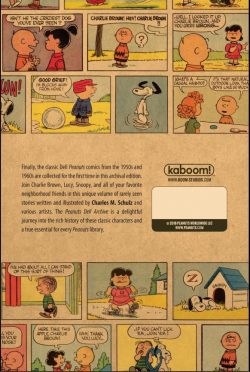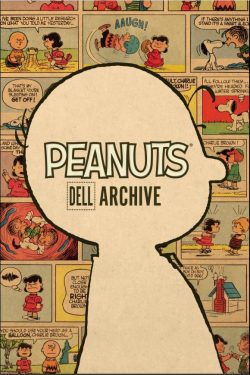
Peanuts Dell Archive


By Charles M. Schulz, Jim Sasseville, Dale Hale, Tony Pocrnick & various (KaBOOM!)
ISBN: 978-1-68415-255-1 (HB) eISBN: 978-1-64144-117-9

Peanuts is unequivocally the most important comics strip in the history of graphic narrative. It is also the most deeply personal. Cartoonist Charles Monroe “Sparky” (forever dubbed thus by an uncle who saw young Charlie reading Billy DeBeck’s strip Barney Google: that hero’s horse was called “Spark Plug”). Schulz crafted his moodily hilarious, hysterically introspective, shockingly philosophical epic for half a century, producing 17,897 strips from October 2nd 1950 to February 13th 2000. He died, from the complications of cancer, the day before his last strip was published…

At its height, the strip ran in 2,600 newspapers in 75 countries, translated into 21 languages. Many of those venues are still running perpetual reprints, and have ever since his departure. Attendant book collections, a merchandising mountain and television spin-offs made the publicity-shy artist a billionaire.

In case you came in late – and from Mars – our focus (we just can’t call him “star” or “hero”) is everyman loser Charlie Brown who, with increasingly high-maintenance, fanciful mutt Snoopy, is at odds with a bombastic and mercurial supporting cast hanging out doing kid things with disturbingly mature psychological overtones…

The gags and tales centre on play, pranks, sports, playing musical instruments, teasing each other, making baffled observations about the incomprehensible world and occasionally acting a bit too much like grown-ups. The ferocious unpredictability and wilfulness of seasonal weather often impacts on these peewee performers, too…

You won’t find many adults in the mix – which includes Mean Girl (let’s call her “forthright”) Violet, prodigy Schroeder, “world’s greatest fussbudget” Lucy, her strange baby brother Linus and dirt-magnet “Pig-Pen” all adding signature twists to the mirth – because this is essentially a kids’ world.

Charlie Brown has settled into existential angst and is resigned to his role as eternal loser: singled out by fate and the relentless diabolical wilfulness of Lucy who sharpens her spiteful verve on everyone around her. Her preferred target is always the round-headed kid though: mocking his attempts to fly a kite, kicking away his football and perpetually reminding him face-to-face how rubbish he is…

The Sunday page debuted on January 6th 1952; a standard half-page slot offering more measured fare than the daily. Both thwarted ambition and explosive frustration became part of the strip’s signature denouements and these weekend wonders gave Sparky room to be at his most visually imaginative, whimsical and weird…

By that time, rapid-fire raucous slapstick gags were riding side-by-side with surreal, edgy, psychologically barbed introspection, crushing judgements and deep ruminations in a world where kids – and certain animals – were the only actors. The relationships were increasingly deep, complex and absorbing…

None of that is really the point. Peanuts – a title Schulz loathed, and one the syndicate forced upon him – changed the way comics strips were received and perceived by showing that cartoon comedy could have edges and nuance as well as pratfalls and punchlines. It also became a multimedia merchandising bonanza for Schulz and the United Features Syndicate, generating toys, games, books, TV shows, apparel and even comic books. These days there’s even an educational institution, The Charles M. Schulz Museum and Research Center, from which a goodly portion of the archival contributions in this wonderful hardback/digital compilation originate…

Just how and why the comic book versions differ from the strip is explored with incisive and analytical vigour in Derrick Bang’s (of CMS M&RC) Introduction ‘Peanuts in Comic Books’ revealing how, in the early 1950s, reprints in St. John and, later, Dell Comics titles such as Tip Top Comics and United Comics gradually gave way to original back-up material in Fritzi Ritz, Nancy and others.

Very little of it was by Schulz – although he did contribute lots of covers – but rather were ghosted by hand-picked associates like Jim Sasseville, who ably aped “Sparky” Schulz and kept the little cast in character and on message in strips in Fritzi Ritz, Nancy, Tip Top, Nancy and Sluggo,

Sasseville wrote and drew all of the Peanuts try-out issue (Four Color #878, February 1958). Schulz contributed heavily to the second FC Peanuts (#969; February 1959) with Dale Hale and Tony Pocrnick handling subsequent back-up tales and third Four Color tester #1015 (August/October 1959).

The fourth became Peanuts #4: a title that ran for 13 issues, ending in July 1962. By then Dell staff artists and writers were generating the stories and the overall quality was nothing to brag about… although Schulz was drawing the covers, at least.

In terms of calibre and standards, the 75 comic tales here – beginning with the very first by Schulz from Nancy #146, September 1957 to the anonymous last – are all quite enjoyable and some are truly exceptional: such as ‘The Mani-Cure’(Tip Top #211, November 1957/January 1958 by Sasseville) or Dale Hale’s untitled treatise on keeping secrets from Tip Top #217 (May/July 1959).

Admittedly, true fans might have trouble with later yarns as the kids face an amok robot or dare the terrors of an old haunted house, but in the main this collection is a splendid peek at a little known cranny of the franchise and there is the joy of all those lost gems from Sparky to carry the day…

And where else are you going to see the kids in stories you haven’t read yet… you Blockhead!?
Peanuts Dell Archive all contents unless otherwise specified © 2005 Peanuts Worldwide, LLC. All rights reserved.

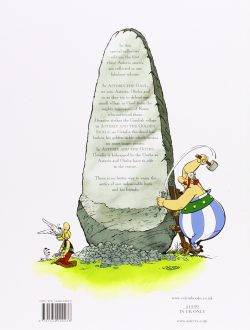
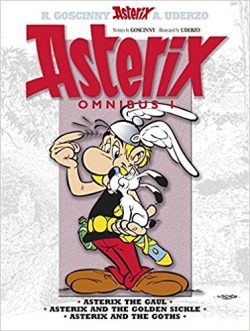
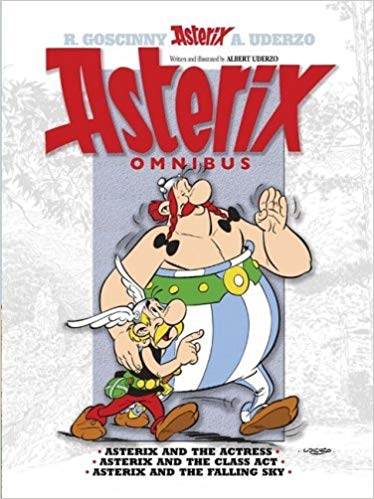
Asterix Omnibus volume 11: Asterix and the Actress, Asterix and the Class Act, Asterix and the Falling Sky


By Uderzo, translated by Anthea Bell & Derek Hockridge (Orion Childrens’ Books)
ISBNs: 978-0-75289-156-9 (HB Album) 978-1-44400-426-7 (PB Album)

A son of Italian immigrants, Alberto Aleandro Uderzo was born on April 25th 1927 in Fismes, on the Marn. Showing great artistic flair as a child reading Mickey Mouse in Le Pétit Parisien, the lad dreamed of becoming an aircraft mechanic one day.

After becoming a French citizen at age seven, Uderzo found employment at 13, apprenticed to the Paris Publishing Society where he learned design, typography, calligraphy and photo retouching. When WWII broke out, Albert spent time with farming relatives in Brittany and joined his father’s furniture-making business.

Brittany beguiled and fascinated Uderzo: when a location for Asterix’s idyllic village was being mooted, the region was the only choice.

During the post-war rebuilding of France, Uderzo returned to Paris and became a successful artist in the country’s revitalised and burgeoning comics industry. His first published work – a pastiche of Aesop’s Fables – appeared in Junior, and in 1945 he was introduced to industry giant Edmond-François Calvo (whose own comics masterpiece The Beast is Dead is still long overdue for a new edition and, if you follow current events, sorely needed as a timely warning shot in these frighteningly familiar-feeling times…).

Indefatigable Uderzo’s subsequent creations included indomitable eccentric Clopinard, Belloy, l’Invulnérable, Prince Rollin and Arys Buck. He illustrated Em-Ré-Vil’s novel Flamberge, worked in animation, and as a journalist and illustrator for France Dimanche. He created vertical comic strip Le Crime ne Paie pas for France-Soir and in 1950, even illustrated a few episodes of the franchised European version of Fawcett’s Captain Marvel Jr. for Bravo!

An inveterate traveller, the prodigy met Rene Goscinny in 1951. Soon fast friends, they decided to work together at the new Paris office of Belgian publishing giant World Press. Their first collaboration was in November of that year; a feature piece on savoir vivre (how to live right, or perhaps gracious living) for women’s weekly Bonnes Soirée, after which an avalanche of splendid strips and serials poured forth from their fevered brows.

Jehan Pistolet and Luc Junior were created for La Libre Junior before they devised a wry western with a native hero who eventually evolved into the delightfully infamous Oumpah-Pah. In 1955, with the formation of Édifrance/Édipresse, Uderzo drew Bill Blanchart for La Libre Junior, replaced Christian Godard on Benjamin et Benjamine and, in 1957, added Charlier’s Clairette to his bulging portfolio.

The following year he made his debut in Le Journal de Tintin, as Oumpah-Pah finally found a permanent home and rapturous audience. In his quieter moments, Uderzo also drew Poussin et Poussif, La Famille Moutonet and La Famille Cokalane.

When Pilote launched in 1959, Uderzo was a major creative force for the new magazine, collaborating with Charlier onTanguy et Laverdure whilst producing with Goscinny a little something called Astérix le gaulois…

Despite Asterix being a massive hit from the start, Uderzo continued working on Les Aventures de Tanguy et Laverdure, but once the first Roman romp was compiled and collected as hit album Astérix le gaulois in 1961, it became clear that the series would demand most of his time – especially as the incredible Goscinny seemed to never require rest or run out of ideas.

By 1967 the strip occupied all Uderzo’s time and attention, so in 1974 the partners formed Idéfix Studios to fully exploit their inimitable creation. When Goscinny passed away three years later, Uderzo had to be convinced to continue the adventures as writer and artist, producing a further ten volumes until 2010 when he retired.

After nearly 15 years as a weekly comic strip subsequently collected into albums, in 1974 the 21st tale (Asterix and Caesar’s Gift) was the first to be published as a complete original book before being serialised. Thereafter, each new release was a long-anticipated, eagerly-awaited treat for the strip’s millions of fans…

According to UNESCO’s Index Translationum, Uderzo is the 10th most-often translated French-language author in the world and the third most-translated French language comics author – right after his old mate René Goscinny and grand master Hergé.

Global sales will soon top 380 million copies of the 38 canonical Asterix books, making his joint creators – and their successors Jean-Yves Ferri and Didier Conrad – France’s best-selling international authors.

One of the most popular comics features on Earth, the collected chronicles of Asterix the Gaul have been translated into more than 100 languages since his debut, with a wealth of animated and live-action movies, TV series, assorted games, toys, merchandise and even a theme park outside Paris (Parc Astérix, naturellement)…

Like all the best stories the premise works on more than one level: read it as an action-packed comedic saga of sneaky and bullying baddies coming a cropper if you want or as a punfully sly and witty satire for older, wiser heads. We Brits are further blessed by the brilliantly light touch of master translators Anthea Bell & Derek Hockridge who played no small part in making the indomitable little Gaul so very palatable to English tongues.

More than half of the canon is set on Uderzo’s beloved Brittany coast, where – circa 50 B.C. – a small village of cantankerous, proudly defiant warriors and their families resist every effort of the mighty Roman Empire to complete the conquest of Gaul. The land has been divided by the conquerors into compliant provinces Celtica, Aquitania and Amorica, but the very tip of the last cited just refuses to be pacified…

The remaining epics occur in various locales throughout the Ancient World, with the Garrulous Gallic Gentlemen visiting every fantastic land and corner of the myriad civilisations that proliferated in that fabled era…

When the heroes are playing at home, the Romans, unable to defeat the last bastion of Gallic insouciance, futilely resort to a policy of absolute containment. Thus, the little seaside hamlet is permanently hemmed in by the heavily fortified garrisons of Laudanum, Compendium, Totorum and Aquarium.

The Gauls couldn’t care less: daily defying the world’s greatest military machine simply by going about their everyday affairs, protected by the magic potion of resident druid Getafix and the shrewd wits of the diminutive dynamo and his simplistic, supercharged best friend Obelix…

Firmly established as a global brand and premium French export by the mid-1960s, Asterix continued to grow in quality as Goscinny & Uderzo toiled ever onward, crafting further fabulous sagas; building a stunning legacy of graphic excellence and storytelling gold. Moreover, following the civil unrest and nigh-revolution in French society following the Paris riots of 1968, the tales took on an increasingly acerbic tang of trenchant satire and pithy socio-political commentary…

By the time of the first tale in this omnibus edition was released Goscinny had been gone for almost a quarter of a century and Uderzo had found his own authorial voice, whilst keeping the immortal characters rock steady in their natures…

Uderzo’s seventh session as sole auteur was Astèrix et Latraviata: released in 2001 as the 30th volume of the ever-unfolding saga. The English language version was released that same year as Asterix and the Actress.

The revelatory epic opens with romance in the air as Obelix and his lifelong pal return to the village, laden down with boars and more battered keepsakes of the ongoing contretemps with the woefully-outmatched Romans.

They amiably amble into a huge surprise party. The heroes coincidentally share the same birthday and their garrulous Gaulish friends have arranged the event to commemorate the occasion. Even their respective mothers have come down for a visit from fashionable regional capital Condatum…

Soon a feast is in full swing but after handing over their spectacular gifts (culled from the parents’ fashionable souvenir shop) – a fabulous jewelled sword for Asterix and an equally splendid Roman helmet for Obelix to add to his huge collection – the mothers begin a battle of their own with their sons.

Fed up with waiting for their hardworking husbands to arrive from the Big City, the impatient matrons start in on the birthday boys with lectures about settling down and providing some grandchildren…

Overruling Asterix and Obelix’s complaints, the insistent Sarsaparilla and Vanilla conduct acutely embarrassing interviews with the village’s contingent of eligible females and their potential mothers-in-law. They even organise a formal dance to show off their sons’ matrimonial potential, but the matchmaking is a succession of fiascos since the oafish louts just don’t want to play ball…

Fathers Astronomix and Obeliscoidix are now long overdue. Unknown to all, they have been arrested by Prefect Bogus Genius. The wily official has a problem which needs some clever and extremely delicate handling…

Already in custody is dipsomaniac former legionary Tremensdelirious (from Asterix and Caesar’s Gift), who sold the aforementioned sword and helmet to the Gaulish souvenir traders. Sadly, the items’ true owner is Caesar’s greatest enemy Pompey and incontrovertible proof positive that the usurping former tribune is back in Europe. The items must be quietly recovered before Rome realises…

Well aware of the ferocious reputation of the sons of his Gaulish captives, the Prefect enacts a devious scheme suggested by his spies. Mighty Obelix turns to jelly whenever he sees the beautiful Panacea (another village émigré now living in Condatum with her husband Tragicomix – as first seen in Asterix the Legionary) so the devilish plotter has hired the Empire’s greatest actress Latraviata to impersonate her and steal back the incriminating evidence…

As the despondent dads tire of waiting for rescue by their doughty boys and strike a deal with their cellmate Tremensdelirious, Decurion Fastandfurius is pretending to be a merchant escorting “Panacea” back to her home village. Apparently, the poor thing has a very selective case of amnesia…

In that certain Gaulish village on the coast of Armorica the actress is readily accepted with only Getafix in the least suspicious. Soon, her fawning attention to besotted Obelix wins her the helmet but Asterix is not so easily wooed. That changes when a spat with his now-jealous bosom buddy results in a mighty blow to the head which deprives him of his usually superior wits…

If not for overprotective mother Vanilla the plot would have succeeded then and there, but she stops the ingénue making off with the sword and calls in Getafix to cure her addled son. Unfortunately, the magic potion has a bizarre effect on the little zombie and Asterix goes wild, acting like an animal and scrapping with Obelix before hurtling out to sea like a torpedo…

He regains his senses on a rock in the middle of nowhere just as a massive storm erupts about him and only survives due to the intervention of old frenemies The Pirates and a particularly accommodating dolphin…

In the meantime, Latraviata and Fastandfurius have secretly secured the sword and started back for Condatum. Still unaware of their true nature, freshly reconciled Asterix and Obelix – who are heading in the same direction to find out what has delayed their dads – cadge a lift on the infiltrators’ cart.

Elsewhere, other agents are coming into play. A certain spy has already informed Caesar of trouble brewing and the real Panacea, having seen Astronomix and Obeliscoidix’s wrecked shop, has rushed off with Tragicomix to warn the village…

As our heroes head for the city, they are baffled to see Romans so busy fighting each other that they don’t even notice their usual nemeses, and everything comes to a startling head when Panacea apparently meets herself on the road…

After explanations, apologies and a surprising change of heart on behalf of one of the conspirators, Asterix and Obelix dash on to Condatum to rescue their fathers, only to stride straight into a major melee as Caesar and Pompey’s forces furiously clash…

Of course, it all works out in the end and cartoon dog-lovers everywhere will rejoice in the last moment arrival of the missing wonder mutt Dogmatix…and the introduction of his new “wife” and family. Apparently, some heroes cansuccessfully combine romance and duty…

Packed with outrageous action, good-natured joshing, cleverly applied raucous family humour, bombastic spectacle and a torrent of punishing puns to astound and bemuse youngsters of all ages, this rollicking affirmation of life’s eternal verities further confirmed Uderzo’s reputation as a storyteller whilst his stunning illustrative ability affords glimpses of sheer magic to lovers of cartoon art.

Diminutive, doughty daredevil Asterix is one of the Ninth Art’s greatest achievements, and by the mid-1960s had become a global brand and premium French export. He continued to grow in quality as Goscinny & Uderzo toiled ever onward, crafting further fabulous sagas; building a stunning legacy of graphic excellence and storytelling gold. As such prominent and ever-ascending stars, their presence was often requested in other places, as varied as fashion magazine Elle, global icon National Geographic and even a part of Paris’ 1992 Olympic Bid…

In 2013 new yarn Asterix and the Picts opened a fresh chapter in the annals as Jean-Yves Ferri & Didier Conrad began a much-anticipated continuation of the franchise. Before that, however, Uderzo was convinced to gather and – in many instances – artistically re-master some of the historical oddments and pictorial asides which had incrementally accrued over the glory-filled decades: features by the perfect partners which just didn’t fit into major album arcs, tales done for Specials, guest publications and commercial projects starring the indomitable Gaul. To cap off the new-old package Albert crafted an all-original vignette from that halcyon world of immortal heroes…

This intriguing compilation first appeared in France as Astérix et la rentrée gauloise in 1993 – and a decade later in English – gathering those long-forgotten side-pieces and spin-off material starring the Gallant Gauls and frequently their minor-celebrity creators too.

Following an expansive and explanatory ‘French Publisher’s Note’ – and the traditional background maps and cast list – a press conference from Chief Vitalstatistix leads directly into the eponymous ‘Asterix and the Class Act’ (originally seen in Pilote #363 October 6th, 1966) wherein the first day of school finds the little legend and his big buddy sadly miscast as truant inspectors and kid catchers for headmaster Getafix…

Each little gem is preceded by an introductory explanatory piece, and following the hard facts comes ‘The Birth of Asterix’. Taken from October 1994’s Le Journal exceptionnel d’Astérix, the tale is set ‘In the Year 35 BC (Before Caesar)’ and finds a certain village in high dudgeon as two young women go into labour. Their distraught husbands soon find a way to distract themselves – and everybody else – with a mass punch-up that quickly becomes the hamlet’s preferred means of airing issues and passing the time…

‘In 50 BC’ comes from May 1977 and re-presents newspaper-style strips produced at the request of an American publisher hoping to break the European stalwarts in the USA. The endeavour inevitably stalled but the panels – introducing and reprising the unique world of the Gallic goliaths – wound up being published in National Geographic.

Apparently Uderzo loves chickens and, especially for the original August 2003 release, he concocted the tale of ‘Chanticleerix the Gaulish Cockerel’, detailing the struggle between the village’s ruling rooster and a marauding Roman Eagle. It sounds pretty one-sided, but faithful mutt Dogmatix knows where the magic portion is kept…

Pilote #424 (7th December 1967) was full of Seasonal festive fun so ‘For Gaul Lang Syne’ saw Obelix attempting to use druidic mistletoe to snaffle a kiss from beautiful Panacea. He soon comes to regret the notion…

‘Mini, Midi, Maxi’ was produced for fashion magazine Elle (#1337 2nd August 1971) but the discussion of ancient Gaulish couture soon devolves into the kind of scraps you’d expect, after which ‘Asterix As You Have Never Seen Him Before…’ (Pilote #527, 11th December 1969) displays Uderzo’s practised visual versatility as our heroes are realised in various popular art styles from gritty superhero to Flash Gordon, a Charles Schulz pastiche and even as an underground psychedelic trip…

Approached to contribute a strip to Paris’ bid, the partners produced ‘The Lutetia Olympics’ which was later published in Jours de France #1660 (25th October 1986) and depicts how Caesar’s attempts to scotch a similar attempt to hold the great games in Gaul fails because of a certain doughty duo, whilst ‘Springtime in Gaul’ (from Pilote #334, 17th March 1966) is an early all-Albert affair wherein our heroes help the mystic herald of changing seasons give pernicious winter the boot…

‘The Mascot’ originated in first digest-sized Super Pocket Pilote (#1, 13th June 1968), revealing how the constantly-thrashed Romans decide to acquire a lucky animal totem, but chose the wrong-est dog in the world to confiscate, after which ‘Latinomania’ (crafted in March 1973 and re-mastered for the first Astérix et la rentrée gauloise in 1993) takes a sly poke at the fragile mutability of language.

‘The Authors Take the Stage’ describes how usually-invisible creators became characters in their own work and ‘The Obelix Family Tree’ collects a continuing panel strip which began in Pilote #172 (7th February 1963) and ran until #186, wherein Mssrs. Goscinny & Uderzo encounter a modern day Gaulish giant and track his ancestors back through history.

Everything ends with ‘How Do They Think It All Up?’ (Pilote #157, 25th October 1962) as two cartoonists in a café experience ‘The Birth of an Idea’…

Adding extra lustre to an already stellar canon, these quirky sidebars and secret views thankfully collect just a few more precious gags and wry capers to augment if not complete the long and glorious career of two of France’s greatest heroes – both the real ones and their fictive masterpieces. Not to be missed…

Uderzo’s controversial eighth solo outing (originally entitled Le Ciel lui tombe sur la tête) was released in 2005 as the 31st volume of the ever-unfolding saga. The English language edition was released that same year as Asterix and the Falling Sky. Apart from unlikely thematic content and quicker pacing, the critics’ main problem seemed to stem from a sleeker, slicker, less busy style of illustration – almost a classical animation look – but that’s actually the point of the tale. The entire book is a self-admitted tribute to the Walt Disney cartoons of the artist’s formative years, as well as a sneakily good-natured critique of modern comics as then typified by American superheroes and Japanese manga…

The contentious iconoclasm opens with the doughty little Gaul and affable pal Obelix in the midst of a relaxing boar hunt when they notice that their quarry has frozen into petrified solidity.

Perplexed, they head back through the eerily silent forest to the village, only to discover that all their friends have been similarly stupefied and rendered rigidly inert…

Somehow faithful canine companion Dogmatix and aged Getafix have some life in them, but only when Obelix admits to giving the pooch the occasional tipple of Magic Potion does Asterix deduce that it’s because they all have the potent brew currently flowing though their systems…

With one mystery solved they debate how to cure everybody else and all the woodland creatures – especially the wild boars – but are soon distracted by the arrival of an immense golden sphere floating above and eclipsing the village…

Out of if drifts a strange but friendly creature who introduces himself as “Toon” from the distant star Tadsilweny (it’s an anagram, but don’t expect any help from me), accompanied by a mightily powered being in a tight-fitting blue-and-red costume with a cape. Toon calls him Superclone…

The mighty minion casually insults Obelix and promptly learns that he’s not completely invulnerable, but otherwise the visitors are generally benevolent. The paralysis plague is an accidental effect of Toon’s vessel, but a quick adjustment by the strange visitor soon brings the surroundings back to frenetic life.

That’s when the trouble really starts as the villagers – and especially Chief Vitalstatistix – see the giant globe floating overhead as a portent that at long last the sky is falling…

After another good-spirited, strenuously physical debate, things calm down and Toon explains he’s come from the Galactic Council to confiscate an earthly super-weapon and prevent it falling into the hands of belligerent alien conquerors the Nagmas (that’s another anagram) and there’s nothing the baffled Earthlings can do about it…

At the Roman camp of Compendium Centurion Polyanthus is especially baffled and quite angry. His men have already had a painful encounter with Superclone but the commander refuses to believe their wild stories about floating balls and strangers even weirder than the Gauls, but he’s soon forced to change his mind when a gigantic metal totem pole lands in a blaze of flame right in his courtyard.

Out of it flies an incredible, bizarre, insectoid, oriental-seeming warrior demanding the whereabouts of a powerful wonder-weapon. Extremely cowed and slightly charred, Polyanthus tells him about the Magic Potion the Gauls always use to make his life miserable…

The Nagma immediately hurries off and encounters Obelix, but the rotund terrestrial is immune to all the invader’s armaments and martial arts attacks. He responds by demonstrating with devastating efficacy how Gauls fight…

After zapping Dogmatix, the Nagma retreats. When Obelix dashes back to the village it follows. No sooner has Toon cured the wonder mutt than the colossal Nagma robot-ship arrives, forcing the friendly alien to fly off and intercept it in his golden globe…

The Nagma tries to trade high-tech ordnance for the Gauls’ “secret weapon” but Asterix is having none of it, instead treating the invader to a dose of potion-infused punishment.

Stalemated, the Nagma then unleashes an army of automatons dubbed Cyberats and Toon responds by deploying a legion of Superclones. The battle is short and pointless and a truce finds both visitors deciding to share the weapon…

Vitalstatistix is outraged but Getafix is surprisingly sanguine, opting to let both Toon and Nagma sample the heady brew for themselves. The effects are not what the visitors could have hoped for and the enraged alien oriental unleashes more Cyberats in a sneak attack.

Responding quickly, Asterix and Obelix have two Superclones fly them up to the marauding robots, dealing with them in time-honoured Gaulish fashion.

The distraction has unfortunately allowed the Nagma to kidnap Getafix and Toon returns to his globe-ship to engage his robotic foe in a deadly game of brinksmanship whilst a Superclone liberates the incensed Druid. None too soon, furious, frustrated Nagma decides enough is enough and blasts off, determined never to come back to this crazy planet…

Down below Polyanthus has taken advantage of the chaos and confusion to rally his legions for a surprise attack, arriving just as the Gauls are enjoying a victory feast with their new alien ally. The assault goes extremely badly for the Romans, particularly after a delayed effect of the potion transforms affable Toon into something monstrous and uncanny…

Eventually all ends well and, thanks to technological wizardry, all the earthly participants are returned to their safely uncomplicated lives, once again oblivious to the dangers and wonders of a greater universe…

Fast, funny, stuffed with action and hilarious, tongue-in-cheek hi-jinks, this is a joyous rocket-paced rollercoaster for lovers of laughs and all open-minded devotees of comics. This still-controversial award-winning (Eagle 2006 winner for Best European Comic) yarn only confirmed Uderzo’s reputation as a storyteller willing to take risks and change things up, whilst his stunning ability to pace a tale was never better demonstrated. Asterix and the Falling Sky proves that the potion-powered paragons of Gallic Pride will never lose their potent punch.

If you still haven’t experienced the sublime example of graphic élan that is Asterix, it’s never too late…
© 2001, 2003, 2005 Les Éditions Albert René, Goscinny-Uderzo. English translation: © 2001, 2003, 2005 Les Éditions Albert René, Goscinny/Uderzo. All rights reserved.

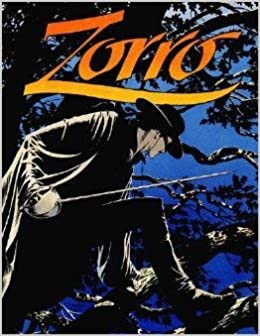
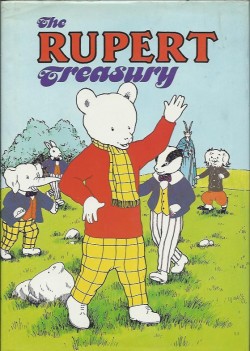
The Rupert Treasury


By Mary Tourtel & various (Purnell Books)
ISBN: 9 78-0-36106-343-2 (HB)

Win’s Christmas Gift Recommendation: Truly British Brilliance with Universal Appeal… 9/10

As we’ve all voted to head back to the fabled sunlit uplands of our own fictitious past, I’ve opted to review an actual icon of our Island Nation, and one I think we can all agree we’d be happy to find overseeing our next five years…

There’s not a lot around these days in the comics which caters specifically for little kids, as well as their nostalgic parents and guardians whilst simultaneously introducing them to the ineluctably tactile wonders and sensorium of a high-quality comics experience. Once upon a time, there was a whole subdivision of the publishing business dedicated to enthralling and enchanting our youngest and, hopefully, brightest, but now all I can think of are The Beano and The Phoenix…

At least we still have books – old and new – to fill the gap.

Moreover, comics fans and the British in general equally adore a well-seasoned tradition and in terms of pictorial narrative and sheer beguilement there’s nothing more perfect than the hirsute national treasure Rupert.

Long before television took him, the Little Bear was part of our society’s very fabric and never more so than at Christmas when gloriously painted, comfortingly sturdy rainbow-hued Annuals found their way into innumerable stockings and the sticky hands of astounded, mesmerised children.

The ursine über-star was created by English artist and illustrator Mary Tourtel (1874-1948) and debuted in the Daily Express on November 8th 1920; the beguiling vanguard and secret weapon of a pitched circulation battle with rival papers the Daily Mirror and Daily Mail. Both papers had cartoon characters for kiddies – Teddy Tail in the Mail and the soon-to-be legendary Pip, Squeak and Wilfred in the Mirror.

Tourtel’s daily serial of the Little Lost Bear initially ran for 36 instalments and triggered a phenomenon which remains in full force to this day, albeit largely due to the diligent efforts of her successor Alfred Edmeades Bestall, MBE, who wrote and illustrated Rupert Bear from 1935 to 1965 and was responsible for the Annuals which began with the 1936 edition.

The artist originally chosen to spearhead the Express’ cartoon counterattack was already an established major player on the illustration scene – and fortuitously married to the paper’s News Editor Herbert Tourtel, who had been ordered by the owners to come up with a rival feature…

The unnamed little bear was illustrated by Mary and initially captioned by Herbert, appearing as two cartoon panels per day with a passage of text underneath. He was originally cast as a brown bear until the Express sought to cut costs and inking expenses, resulting in the iconic white pallor we all know and love today.

Soon though, early developmental “bedding-in” was accomplished and the engaging scenario was fully entrenched in the hearts and minds of readers. Young Rupert lives with extremely understanding parents in idyllically rural Nutwoodvillage: an enticing microcosm and exemplar of everything wonderful and utopian about British life. The place is populated by anthropomorphic animals and humans living together but also overlaps a lot of very strange and unworldly places full of mythical creatures and legendary folk…

A huge hit, Mary’s Rupert quickly expanded into a range of short illustrated novels; 46 by my count from the early 1920s to 1936, with a further run of 18 licensed and perpetually published by Woolworth’s after that. It’s from the former that the five tales in this splendid hardback commemoration are taken…

Tourtel’s bear was very much a product of his times and social class: smart, inquisitive, adventurous, helpful yet intrinsically privileged and therefore always labouring under a veiled threat of having his cosy world and possessions taken away by the wicked and undeserving.

Heretical as it might sound, like the unexpurgated fairy tales of Hans Christian Anderson or the Brothers Grimm, the pre-Bestall Rupert yarns all have a darker edge and worrisome undercurrent with mysterious forces casually, even capriciously targeting our innocent star. Naturally, pluck, good friends and a benevolent adult or two are always on hand to help our hero win through…

This glorious tome – still readily available through many internet vendors and originated in 1984 – gathers a quintet of typical Tourtel tales from the book editions, packing a wealth of full colour painted, duo-hued and monochrome ink-line illustrations into his enchanting pages.

Here we open with the all-colour adventure of ‘Rupert and the Robber Wolf’ from 1932, with the text, as always, delivered in a succession of rhyming couplets.

When Rupert is deprived of his new pocket watch by a burly vulpine bandit – and despite seeking the assistance of best pal Bill Badger, friendly mystic The Wise Old Goat, pixies, fauns and rural troubleshooter The Pedlar – he ends up a prisoner of the wolf.

Happily, the Old Goat and a posse of police are on hand to collar the crook and his wayward son before something really nasty occurs…

Rendered in bucolic shades of green, ‘Rupert and the Old Miser’ (first released circa 1925) finds our bear playing with a new ball which flies over a forbidding wall into a large garden. When Rupert sneaks in to retrieve his toy, he encounters a range of odd and terrified creatures all suborned to the eccentric whims of the rapacious Master Raven…

Upon the bear’s capture, the ebon enchanter declares the trespasser to be his property too and sets the poor mite to work as his latest chattel. Rupert is despondent, but help is at hand. The Little Bear’s friends have concocted a cunning plan to rescue him and when their scheme succeeds the miser meets a grisly fate chasing his fleeing new slave…

Equally verdant in its art aspects is the saga of ‘Rupert and the Enchanted Princess’ (1928) which opens with the bear snatched up by a great bird and delivered to a distant kingdom whose feudal monarch pleads with him to find his missing daughter.

Despite the scorn of the assembled knights, Rupert sets out and – with the aid of woodland creatures and a talking horse – overcomes ogres, dragons and other terrors before reversing the magic curse of three witches and returning the Princess to her doting dad…

Rendered in beautiful, clear, clean monochrome line art, ‘Rupert and the Mysterious Flight’ (1930) begins when The Prince and Princess of the Wood of Mystery send the Little Bear a fully functional aeroplane. Soon, Rupert is enjoying his maiden voyage but gets lost and alights in the Land of Kinkajous, where King Toucan – after an initial fright – sets the little daredevil a series of never-ending mystic challenges. After a number of Herculean labours are accomplished, Rupert at last regains his flying machine and makes a break for freedom and home…

The fantastic voyages conclude with the full-colour ‘Rupert and the Magic Toyman’ (1933) wherein a thrilling day enjoying a Fair and Sports Day leads to the unlucky bear being spirited away by a genial craftsman whose enticing wares mask his true nature.

The toy maker is, in fact, a wicked sorcerer and his constructions are transformed animals. One of them was even a Princess…

Undaunted, Rupert organises an escape back to Princess Belinda‘s kingdom, but the Toyman has already ensorcelled the whole place into a land of marionettes. Happily, a glimmer of hope remains and the tables can be turned if only Rupert can find and recruit the valiantly heroic Moorland Will whose hunting horn can undo the magic spell…

Beautifully realised, superbly engaging fantasies such as these are never out of style and this fabulous tome should be yours, if only as means of introducing the next generation to a truly perfect world of wonder and imagination.
© 1984 Beaverbrook Newspapers Limited. Artwork & text © 1984 Purnell Publishers Limited from original Mary Tourtel material.

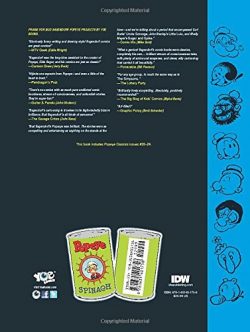
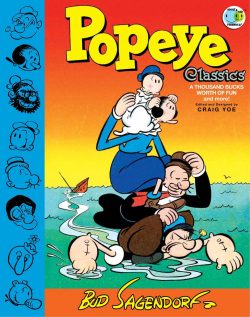
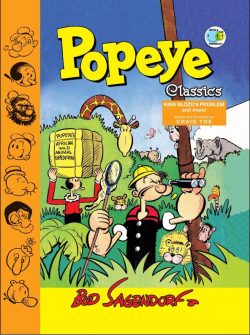
Popeye Classics volume 4: King Blozo’s Problem and more!


By Bud Sagendorf, edited and designed by Craig Yoe (Yoe Books/IDW)
ISBN: 978-1-61377-936-1(HB) eISBN: 978-1-62302-563-2

Win’s Christmas Gift Recommendation: A Gift for All Sea Sons… 10/10

How many cartoon classics can you think of still going after a century? Here’s one…

There are a few fictional personages to enter communal world consciousness – and fewer still from comics – but a grizzled, bluff, uneducated, visually impaired old sailor with a speech impediment is possibly the most well-known of that select bunch.

Elzie Crisler Segar was born in Chester, Illinois on 8th December 1894. His father was a general handyman, and the boy’s early life was filled with the kinds of solid, dependable blue-collar jobs that typified his generation of cartoonists. He worked as a decorator, house-painter and also played drums; accompanying vaudeville acts at the local theatre.

When the town got a movie-house, he played for the silent films, absorbing all the staging, timing and narrative tricks from keen observation of the screen. Those lessons would become his greatest assets as a cartoonist. It was while working as the film projectionist, at age 18, that he decided to become a cartoonist and tell his own stories.

Like so many others in those hard times, he studied art via mail, in this case W.L. Evans’ cartooning correspondence course out of Cleveland, Ohio, before gravitating to Chicago where he was “discovered” by Richard F. Outcault – regarded by most in the know today as the inventor of modern newspaper comic strips with The Yellow Kid and, later, Buster Brown.

The celebrated cartoonist introduced Segar around at the prestigious Chicago Herald. Still wet behind the ears, the kid’s first strip, Charley Chaplin’s Comedy Capers, debuted on 12th March 1916.

In 1918 Segar married Myrtle Johnson and moved to William Randolph Hearst’s Chicago Evening American to create Looping the Loop, but Managing Editor William Curley saw a big future for Segar and packed the newlyweds off to New York, HQ of the mighty King Features Syndicate.

Within a year Segar was producing Thimble Theatre, which launched December 19th 1919 in the New York Journal. It was a smart pastiche of cinema and knock-off of movie-inspired features like Hairbreadth Harry and Midget Movies, with a repertory of stock players to act out comedies, melodramas, comedies, crime-stories, chases and especially comedies for vast daily audiences. It didn’t stay that way for long…

The core cartoon cast included parental pillars Nana and Cole Oyl; their lanky, highly-strung daughter Olive, diminutive-but-pushy son Castor and the homely ingenue’s plain and (very) simple occasional boyfriend Horace Hamgravy (later known as just Ham Gravy).

Segar had been successfully, steadily producing Thimble Theatre for a decade when he introduced a brusque, vulgar “sailor man” into the everyday ongoing saga of hapless halfwits on January 29th 1929. Nobody suspected the giddy heights that stubborn cantankerous walk-on would reach…

In 1924 Segar created a second daily strip The 5:15: a surreal domestic comedy featuring weedy commuter and would-be inventor John Sappo and his formidable wife Myrtle. This one endured – in one form or another – as a topper/footer-feature accompanying the main Sunday page throughout the author’s career. The feature even survived his untimely death, eventually becoming the trainee-playground of Popeye’s second great humour stylist: Bud Sagendorf.

After Segar’s far-too-premature death in 1938, Doc Winner, Tom Sims, Ralph Stein and Bela Zambouly all worked on the strip, even as the Fleischer Studio’s animated features brought Popeye to the entire world, albeit a slightly different vision of the old salt of the funny pages. Sadly, none of them had the eccentric flair and raw inventiveness that had put Thimble Theatre at the forefront of cartoon entertainments. But then, finally, Bud arrived…

Born in 1915, Forrest “Bud” Sagendorf was barely 17 when his sister – who worked in the Santa Monica art store where Segar bought his drawing supplies – introduced the kid to the master cartoonist who became his teacher and employer as well as a father-figure. In 1958, after years on the periphery, Sagendorf finally took over the strip and all the merchandise design, becoming Popeye’s prime originator…

When Sagendorf became the main man, his loose, rangy style and breezy scripts brought the strip itself back to the forefront of popularity and made reading it cool and fun all over again. Bud wrote and drew Popeye in every graphic arena for 24 years and when he died in 1994, he was succeeded by controversial “Underground” cartoonist Bobby London.

Bud had been Segar’s assistant and apprentice, and – from 1948 onwards – exclusive writer and illustrator of Popeye’s comicbook adventures in a regular monthly title published by America’s king of licensed periodicals, Dell Comics.

When Popeye first appeared, he was a rude, crude brawler: a gambling, cheating, uncivilised ne’er-do-well. He was soon exposed as the ultimate working-class hero: raw and rough-hewn, practical, but with an innate, unshakable sense of what’s fair and what’s not; a joker who wanted kids to be themselves – but not necessarily “good” – and someone who took no guff from anyone…

Naturally, as his popularity grew, Popeye mellowed somewhat. He was still ready to defend the weak and had absolutely no pretensions or aspirations to rise above his fellows, but the shocking sense of dangerous unpredictability and comedic anarchy he initially provided was sorely missed… but not in Sagendorf’s comicbook yarns…

Collected in their entirety in this beguiling full-colour hardback (also available in digital editions) are issues #15-19 of Popeye‘s comicbook series, produced by the irrepressible Sagendorf and collectively spanning January/March 1951 to January/March 1952.

The stunning, almost stream-of-consciousness slapstick stories are preceded as ever by an effusively appreciative Foreword‘Society of Sagendorks’ – by inspired aficionado, historian and publisher Craig Yoe, offering a mirthful mission statement and fabulous collation of candid photos and assorted gems of merchandise.  Included here are newspaper strips from 1944 when Bud was ghosting the feature for Tom Sims & Bela Zaboly, and assorted Play-Storeactivity segments which Sagendorf contributed to Segar’s Sunday funny pages as his assistant in 1938 all contributing tothe wonder of the ‘Bud Sagendorf Scrapbook’.

Popeye‘s fantastic first issue launched in February 1948, and we rejoin the parade of laughs and thrills three year later with #15 and a single-page two-tone ‘Popeye’s Work Shop!’ detailing how to build a working wooden motorboat and clothespin Olive Oyl doll.

Sagendorf was a smart guy who kept abreast of trends and fashions as well as understanding how kids’ minds worked and these tales are timeless in approach and delivery. ‘Animal Talk’ rockets along from gag to gag as the Sailor Man is captured by a mad scientist who accidentally imparts the ability to communicate with all “aminals”, after which Popeye becomes a constant mouthpiece for the beasts as they seek better conditions, culminating in the old sea dog harbouring an escaped circus ape and setting up a counselling service for fauna…

In a previous episode Popeye set up his own railway and in ‘Train Time!’ faces the wrath of delayed commuters when the service suddenly stops. After his engineer explains why the locomotive must not move, the mallow-hearted mariner finds another way to get those carriages rolling again…

Sagendorf had carte blanche to use any of Segar’s characters and revived one of the oldest and daftest as he pandered to the nation’s TV-fuelled obsession with westerns. ‘Thimble Theatre Presents Ham Gravy in The Boon Brothers Last Boom!!’ sees the dumb lummox wandering the plains as legendary gunslinger Three Gun Gravy and here by the most ridiculous methods ending the criminal careers of a wicked passel of owlhoots…

All comics of the era hosted prose stories to obtain favourable postage rates (it’s far too long and irrelevant a story to deal with here) but Dell opted for a run of early-reader stand-alone yarns that here begin with ‘Bugtown Capers’ wherein a Carnival comes to the little insect township and Larry and Lena Ladybug save a baby minibeast from a riding accident, after which Segar’s other brilliant creation J. Wellington Wimpy carves out his own over-sized portion of cartoon immortality in ‘The Elder Egg!’. Here the infernal optimist’s attempt to eat a gigantic ovoid he’s found prove to be no yolk…

Supplemented by art features ‘How to Draw Wimpy’ and ‘How to Draw a Cow’s Head’, this initial offering ends with an untitled red & black gag page wherein Popeye at sea sends home a houseful of animal mates for Olive and Wimpy to babysit and a full colour back-page jape with the surly sailor teaching an obnoxious diner chef not to call him a wimp…

Popeye #16 (April/June) opens with another superb cover and an activity page of puzzles, incorporating how to make assorted cork toys before ‘New Zoo’ revisits the hero’s bestial communication skills as a convocation of children implore the soft-hearted sailor man to stock a zoo for them. Convinced to ship out for Africa and seek out willing volunteers for exhibits, Popeye is unaware that a greedy hunter and pet trader G. R. Growl has infiltrated his crew with surly saboteurs determined to scupper his endeavours…

Another western-themed railroad yarn follows as ‘Gold Shipment!’ sees Popeye and Olive shipping bullion despite the most nefarious efforts of deadly desperado Jack Terror, after which Wimpy tries to exploit and monopolise the free food at a new burger stand’s ‘Grand Opening!’ before prose vignette ‘Sammy Bug in Deep Water!’ sees the accident-prone arthropod adrift on a leaf in the river…

Innocently skirting the borders of modern bad taste with its “traditional” depiction of a cartoon Red Indian foil, ‘Ham Gravy’ sees the sagebrush sap lose a tribal war over a duck dinner to end the issue – which also includes another activity page of puzzles and ‘How to Draw a Fish’.

Behind another superb Sagendorf gag cover, #17 (July/September) opens – and closes – with a prose ‘Bug Tales’ yarn wherein Larry Ladybug uses archery to battle a hungry Tiger Beetle. The comics content commences with ‘King Blozo’s Problem’ as the ever-anxious monarch of Spinachovia summons Popeye with a dangerously experimental communications device, after which ‘Ham Gravy and his Indian Friend’ play ever-escalating practical jokes on each other over a non-existent gold mountain…

Following the conclusion of the Bug Tales text, an untitled full colour back page gag sees the sailor man fail to lead by example when teaching his friends to forgive and forget…

Ending 1951, Popeye #18 (October/December) offers inner covers text tale ‘Sammy Bug’s Big Leap!’, detailing how not to jump over the moon before ‘Popeye and the Box!’ finds our hero attracting the curiosity of his friends and the unwanted attentions of spies and thugs after agreeing to look after a parcel entrusted to him by his shady dad Poopdeck Pappy…

In ‘Kitty! Kitty!’ the sappy swab adopts a rather unique house pet, whilst his efforts to dig ‘The Tunnel’ through a mountain for his railroad leads to war with a hostile hermit and unexpected consequence for all.

Wimpy’s attempts to secure a free ‘Duck Dinner!’ then inspire shock and awe in deranged roboticist R. O. Spring, before the issue ends with another untitled back-page laugh riot as Popeye goes fishing…

The final issue in this collection (#19, January/March 1952) introduces a new prose star as ‘Otto Octo in a Snappy Cargo!’ sees a playful young cephalopod’s reach exceed his grasp(s) before Popeye enjoys ‘A Thousand Bucks Worth of Fun’ by letting little baby Swee’ Pea wander through the roughest part of town with an extremely high denomination greenback in his tiny fist…

‘Popeye and the Happy Spring’ then sees the cast at sea and encounter magic water that alters their ages, before fresh face Sherm! takes a fantastic ride in a flying wonder car in ‘Hitch Hikers’.

A half-page colour Popeye join-the-dots puzzle and the conclusion of ‘Otto Octo in a Snappy Cargo!’ brings us to one last back page gag with Swee’ Pea using “infink” ingenuity to clean his room without throwing anything away…

Outrageous and side-splitting, these all-ages yarns are evergreen examples of surreal narrative cartooning at its most inspirational. Over the last century Thimble Theatre and its most successful son have delighted readers – and viewers – around the world. This book is simply one of many but definitely top tier entertainment for those who love lunacy, laughter, frantic fantasy and rollicking adventure. If that’s you, add this terrific treasure trove of wonder to your collection.
Popeye Classics volume 4 © 2014 Gussoni-Yoe Studio, Inc. All Rights Reserved. Popeye © 2014 King Features Syndicate. ™ Heart Holdings Inc.


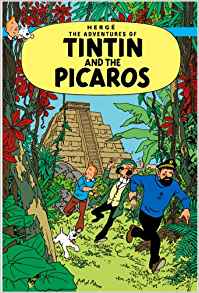
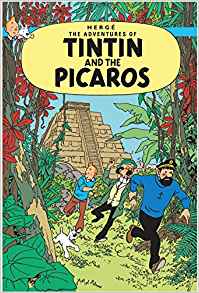
Tintin and the Picaros


By Hergé and Studios Hergé, translated by Leslie Lonsdale-Cooper & Michael Turner (Egmont)
ISBN: 978-1-40520-823-9 (HB) 978-1-405206-35-8 (Album PB)

Win’s Christmas Gift Recommendation: A Great British Tradition of Belgian Origin. Gotta Get ‘Em All… 10/10

Georges Prosper Remi, AKA Hergé, created an eternal masterpiece of graphic literature with his tales of a plucky boy reporter and entourage of iconic associates. Singly, and later with assistants including Edgar P. Jacobs, Bob de Moor, Roger Leloup and other supreme stylists of the Hergé Studio, he created 23 timeless yarns (initially serialised in instalments for a variety of newspaper periodicals) which have since grown beyond their pop culture roots to attain the status of High Art and international cultural icons.

On leaving school in 1925, Remi began working for conservative Catholic newspaper Le Vingtiéme Siécle where he fell under the influence of its Svengali-esque editor Abbot Norbert Wallez. A devoted boy scout, one year later the artist was producing his first strip series – The Adventures of Totor – for the monthly Boy Scouts of Belgium magazine. By 1928 Remi was also in charge of producing the contents of the Le Vingtiéme Siécle weekly children’s supplement Le Petit Vingtiéme.

While he was illustrating The Adventures of Flup, Nénesse, Poussette and Cochonette – written by the staff sports reporter – Wallez required his compliant creative cash-cow to concoct a new and contemporary adventure series. Perhaps a young reporter who roamed the world, doing good whilst displaying solid Catholic values and virtues?

The rest is history…

Some of that history is quite dark: During the Nazi Occupation of Belgium, Le Vingtiéme Siécle was closed down and Hergé was compelled to move his supremely popular strip to daily newspaper Le Soir (Brussels’ most prominent French-language periodical, and thus appropriated and controlled by the Nazis).

He diligently toiled on for the duration, but following Belgium’s liberation was accused of collaboration and even of being a Nazi sympathiser. It took the intervention of Belgian Resistance war hero Raymond Leblanc to dispel the cloud over Hergé, which he did by simply vouching for the cartoonist through words and deeds.

Leblanc provided cash to create a new magazine – Le Journal de Tintin – which he published and managed. The anthology comic swiftly achieved a huge weekly circulation, allowing Remi and his studio team to remaster past tales: excising material dictated by the Fascist invaders to ideologically shade the wartime adventures. The post-war modernising exercises also improved and updated the great tales, just in time for Tintin to become a global phenomenon, both in books and as an early star of animated TV adventure.

With the war over and his reputation restored, Hergé entered the most successful period of his artistic career. He had mastered his storytelling craft, possessed a dedicated audience eager for his every effort and was finally able to say exactly what he wanted in his work, free from fear or censure, if not his personal demons and declining health…

The greatest sign of this was not substantially in the comics tales – although Hergé continued to tinker with the form of his efforts – but rather in how long the gaps were between new exploits. The previous romp had finished serialisation in 1967 and was collected as an album in 1968. It was eight years before Tintin et les Picaros was simultaneously serialised in Belgium and France in Tintin-l’Hebdoptmiste magazine (from 16th September 1975 to April 13th 1976) but at least the inevitable book collection came out almost immediately upon completion in 1976.

Tintin and the Picaros is in all ways the concluding adventure, as many old characters and locales from previous tales make one final appearance. A partial sequel to The Broken Ear it finds Bianca Castafiore implausibly arrested for spying in Central American republic San Theodoros with Tintin, Haddock and Calculus eventually lured to her rescue.

Insidious Colonel Sponsz – last seen in The Calculus Affair – is the Bordurian Military Advisor to the Government of usurper General Tapioca, and has used his position to exact revenge on the intrepid band who humiliated him in his own land. When the Tintin and company escape into the jungles during a murder attempt they soon link up with their old comrade Alcazar, who now leads a band of Picaro guerrillas dedicated to restoring him to power.

South American revolutions were all the rage in the 1970s – even Woody Allen made one the subject of a movie – and Hergé’s cast had been involved with this one on and off since 1935. With the welcome return of anthropologist Doctor Ridgewell and the hysterical Arumbayas, and even an improbable action role (of sorts) for obnoxious insurance salesman and comedy foil Jolyon Wagg, the doughty band bring about the final downfall of Tapioca in a thrilling and bloodless coup during Carnival time, thanks to a hilarious comedy maguffin (initially targeting dipsomaniac Haddock) that turns out to be a brilliant piece of narrative misdirection by the author.

Sly, subtle, thrilling and warmly comforting, this tale was generally slated when first released but with the perspective of intervening decades can be seen as a most fitting place to end the Adventures of Tintin… but only until you pick up another volume and read them again – as you indubitably will.
Tintin and the Picaros: artwork © 1976 by Editions Casterman, Paris & Tournai. Text © 1976 Egmont UK Limited. All rights reserved.

Charlie Brown’s Christmas Stocking


By Charles M. Schulz (Fantagraphics Books)
ISBN: 978-1-60699-624-9 (HB)

Win’s Christmas Gift Recommendation: Lost Treasures for the Nubbin-Sized Nostalgiacs… 9/10

Peanuts is unequivocally the most important comics strip in the history of graphic narrative. It is also the most deeply personal, especially as, since the characters made the jump to television with the airing on December 9th 1965 of A Charlie Brown Christmas, the little nippers have become an integral part of the American Yule experience.

Cartoonist Charles M. Schulz crafted his moodily hilarious, hysterically introspective, shockingly philosophical epic for fifty years. He published 17,897 strips from October 2nd 1950 to February 13th 2000 and died from the complications of cancer the day before his last strip was published…

At its height, the strip ran in 2,600 newspapers in 75 countries, translated into 21 languages. Many of those venues are still running perpetual reprints, as they have ever since his departure. Attendant book collections, a merchandising mountain and television spin-offs made the publicity-shy artist a billionaire. That profitable sideline – one Schulz devoted barely any time to over the decades – is where this little gem originates from…

Peanuts – a title Schulz loathed, but one the syndicate forced upon him – changed the way comics strips were received and perceived by showing that cartoon comedy could have edges and nuance as well as pratfalls and punchlines.

The usual focus of the feature (we just can’t call him “star” or “hero”) is everyman loser Charlie Brown who, with high-maintenance, fanciful mutt Snoopy endures a bombastic and mercurial supporting cast who hang out doing kid things in a most introspective, self-absorbed manner.

The daily gags centre on playing (pranks, sports, musical instruments), teasing each other, making ill-informed observations and occasionally acting a bit too much like grown-ups. The cast also includes mean girl Violet, infant prodigy Schroeder, “world’s greatest fussbudget” Lucy Van Pelt , her other-worldly baby brother Linus and dirt-magnet “Pig-Pen”: each with a signature twist to the overall mirth quotient and sufficiently fleshed out and personified to generate jokes and sequences around their own foibles.

Charlie Brown is settled into his existential angst and resigned to his role as eternal loser: singled out by fate. It’s a set-up that was timelessly funny and infinitely enduring…

Available in a child-friendly hardback and digital formats, Charlie Brown’s Christmas Stocking re-presents two rare and seasonally-appropriate Peanuts offerings that will delight fans whilst offering a largely counter-capitalist spin to this time of year.

In 1962 Happiness is a Warm Puppy – a book of original Peanuts material – hit the national Best-Seller lists and stayed there for a year, prompting the author to create another. However, “Sparky” Schulz was a deeply religious man and was very concerned about reminding his readers of the true meaning of Christmas, not just developing another revenue stream.

When the opportunity arose, Schulz jumped at the chance to craft a mini-book premium that would be given away with the December 1963 issue of Good Housekeeping.

In the strips, Schulz always considered guileless innocent Linus as his spiritual spokesperson (we’d probably say “avatar” today), and in the booklet the blanket-lover leads the kids in examining the season and their unquestioned practise of leaving out their woollen loot-catchers with disarming candour and wry wit. The tale is told in a series of full-page, flat-colour illustrations balanced by a simple text block: the usual format for kids’ picture books.

The remainder of this archival treasure is a similarly-themed project from 1968: three years after the monster-hit TV special which had be retransmitted every December since its debut.

Here ‘The Christmas Story’ is also printed at one panel (with word balloons) per page, but when it was first seen in the December 1968 Woman’s Day magazine, the characters copped not only the cover but four full pages of the interior in a proper, respectable, prestigious comics section.

Overtly spiritual in tone, this tale sees Linus reading the nativity story from the Gospel of St. Luke to Snoopy, who then endures a baffling and thought-provoking alternate view of the season from arch bread-head Lucy…

Supplementing the well-meaning whimsy are informative background articles About “Charlie Brown’s Christmas Stocking”, About “The Christmas Story” and About the Author, adding historical context to the cartoon wonderment: a rare masterpiece of thoughtful comedy gold demonstrating Schulz’s spellbinding graphic mastery that how his kids have become part of the fabric of billions of lives.
Charlie Brown’s Christmas Stocking © 1963, 1968, 2013 Peanuts Worldwide, LLC. All rights reserved.

The Graphic Canon volume 2: From “Kubla Khan” to the Brontë Sisters to The Picture of Dorian Gray


By many and various, edited by Russ Kick (Seven Stories)
ISBN: 978-1-60980-378-0 (TPB)

Win’s Christmas Gift Recommendation: A “Worthy” Present That’s Actually a Joy to Receive and Devour… 10/10

Once upon a time in the English-speaking world, nobody clever, educated or in any way grown-up liked comics. Now we’re an accredited really and truly art form and spectacular books like this can be appreciated…

The Graphic Canon is an astounding literary and art project instigated by legendary editor, publisher, anthologist and modern Renaissance Man Russ Kick, which endeavours to interpret the world’s great books through the eyes of masters of crusading sequential narrative in an eye-opening synthesis of modes and styles.

The project is divided into three periods, roughly equating with the birth of literature and its evolution up to the rise of the modern novel. Debut volume From the Epic of Gilgamesh to Shakespeare to Dangerous Liaisons covers literature from ancient times to the end of the 1700s in stories and poetry, and this sequel edition takes us up to the end of the 19thcentury and the rise of mass-market fiction and (nigh) universal literacy…

Much of the material for the project has been taken from already extant or ongoing projects: as editor Russ Kick explains in his Introduction, it was the realisation that so many creative individuals were attempting to publish their own graphic responses to global heritage literature that led him to initiate this mammoth project in the first place…

Rather than simply converting the stories, the artists involved have enjoyed the freedom to respond to texts in their own way, producing graphics – narrative or otherwise, monochrome or something else, sequential or not – to accompany, augment or even offset the words before them and the result is simply staggering…

Make no mistake: this is not a simple bowdlerising “prose to strip” exercise like generations of Classics Illustratedcomics, and you won’t pass any tests on the basis of what you see here. Moreover, these images will make you want to re-read the texts you know and hunger for the ones you haven’t got around to yet. You will of a certainty marvel at the infinite variety of the artistic responses the canonical works inspired.

Available in mammoth paperback and digital formats, each piece here is preceded by an informative commentary page by Kick, and the wonderment is presaged by a barrage of micro-comic ‘Three Panel Reviews’ by Lisa Brown (specifically Charles Dickens’ A Tale of Two Cities; Gustav Flaubert’s Madame Bovary; Louisa May Alcott’s Little Women and Nathaniel Hawthorne’s The Scarlet Letter) before Alice Duke sets the ball properly rolling with a stunning painted interpretation of Samuel Taylor Coleridge’s ‘Kubla Khan’.

National treasure Hunt Emerson has already wonderfully and hilariously adapted the poet’s Rime of the Ancient Mariner and here loans ‘Part the Second’ to this tome wherein the foolish sailor realises why he shouldn’t have shot that damn sea bird…

Straight text-&-picture juxtapositions by Aidan Koch of William Blake’s ‘Auguries of Innocence’, lead to a formal and most mannerly adaption in ‘A Selection from Jane Austen’s Pride and Prejudice: Chapter 2’ by Huxley King with designer Terrence King, after which George Gordon, Lord Byron reminds us ‘She Walks in Beauty’, courtesy of David Lasky.

The period poesy corner continues and briefly concludes with Percy Bysshe Shelley and ‘Ozymandias’ as interpreted by Anthony Ventura, William Wordsworth’s ‘I Wandered Lonely as a Cloud’ via a futuristic vision from PMurphy before enjoying another Hunt Emerson gem re-examining John Keats’ ‘O Solitude’…

The novel makes its first appearance here with a gothic classic as Jason Cobley & Declan Shalvey precis a key moment from Mary Shelley’s ‘Frankenstein’ after which, a selection of Fairy Tales begins with text-heavy original extracts from ‘The Valiant Little Tailor’, ‘Hansel and Gretel’ and ‘Little Snow White’ by the Brothers Grimm, all deliriously illuminated by S. Clay Wilson.

The Grimm kids’ stuff then translates to comic strip form as Shawn Cheng adapts ‘How Six Made Good in the World’before Neil Cohn pictorializes Keats’ ‘La Belle Dame Sans Merci’ and William Blake’s own words and images are combined to bring to life ‘Jerusalem: The Emancipation of the Giant Albion’.

‘The Confessions of Nat Turner’ is a contemporary account of a southern slave rising as narrated, prior to his execution, by Turner himself to lawyer Thomas R. Gray, adapted by controversial artist John Pierard, whilst Lance Tooks devilishly tackles a lost classic by Mary Shelley in ‘The Mortal Immortal’ before another tranche of Fairy Tales commences with more original text limned by S. Clay Wilson.

Here Hans Christian Andersen is represented by ‘The Emperor’s New Clothes’, ‘The Nightingale’ and ‘The Little Match Girl’ after which Ellen Lindner presents ‘Rondeau (Jenny Kiss’d Me)’ as first conciev’d and craft’d by James Henry Leigh Hunt.

Hysterical history cartoonist Kevin Dixon concocts a beautifully bonkers snippet from Dickens’ ‘Oliver Twist’, a delightful prelude to a dose of Victorian nonsense as seen in Hunt Emerson’s depiction of Edward Lear’s ‘The Jumblies‘ and Sanya Glisic’s bombastic treatment of a selection from Heinrich Hoffman’s moralizing cautionary tales collection Der Struwwelpeter: specifically ‘Struwwelpeter: the Story of Shock-Headed Peter’, ‘The Story of the Inky Book’ ‘The Story of the Man that went out Shooting’ and ‘The Story of Little Suck-A-Thumb’.

Literary giant Edgar Allen Poe is celebrated in a haunting Poe Montage by Gris Grimly and fuller adaptations such as‘The Raven’ by Yien Yap as well as original text extracts from ‘The Tell-Tale Heart’, ‘The Raven’, ‘The Bells’, ‘The Pit and the Pendulum’ and ‘The Masque of the Red Death’ – all grotesquely illustrated by Maxon Crumb – before we switch themes and tone for Elizabeth Watasin to open a Brontë section with stylish interpretation of Charlotte’s ‘Jane Eyre’, whilst Tim Fish adapts Emily’s ‘Wuthering Heights’, after which Ali J in one image encapsulates Hawthorne’s ‘The Scarlet Letter’ and Matt Kish offers a post-futurist and quite disturbing vision of Herman Melville’s ‘Moby-Dick’…

John Porcellino offers a compelling and effective cartoon analogue of Henry David Thoreau’s ‘Walden’ after which Walt Whitman is addressed through two vastly different depiction of ‘Leaves of Grass’: one by Tara Seibel’s and Dave Morice’s cheeky ‘Leaves of Grass: The Adventures of Walt Whitman’.

Tinges of literary modernism coincide with John Pierard’s hallucinatory adaptation of Fitz Hugh Ludlow’s ‘The Hasheesh Eater’ after which Michael Keller & Nicolle Rager Fuller lavishly and magnificently illuminate and interpret Chapter 4 from Charles Darwin’s ‘On the Origin of Species’ (or if you’re a pedant like me On the Origin of Species by Means of Natural Selection, or the Preservation of Favoured Races in the Struggle for Life) and Seth Tobocman re-delivers former slave, equal rights advocate and freedom fighter Frederick Douglass’ thoughts on the Nature of Power from ‘The Message from Mount Misery’.

More exploration of social justice issues comes via Tara Seibel’s lengthy treatment of portions of Victor Hugo’s ‘Les Misérables’, before Dame Darcy leads off a brace of entries celebrating Emily Dickinson with ‘Because I Could Not Stop for Death’. Diana Evans then responds visually to ‘I Taste a Liquor Never Brewed’, before Corinne Mucha adapts Gustave Flaubert’s Letter to George Sand ‘Dear Master’ and Darcy returns to delineate a wild interpretation of Lewis Carroll’s ‘Alice’s Adventures in Wonderland and Through the Looking Glass’ and Eran Cantrell compellingly details his monstrous epic ‘Jabberwocky’.

Such is the impact of Carroll (AKA Charles Lutwidge Dodgson) – on artists and creators, if not the entire wider world – that a host of submissions led to the ‘Alice Gallery’ that follows, with inclusions by Alice and Mad Bill Carman, Kim Deitch, John Coulthart, May Ann Licudine, Andrea Femerstrand, Olga Lopata, Natalie Shau, Emerson Tung, Peter Kuper, John Ottinger, David W. Tripp, Christopher Panzer, Jasmine Becket-Griffith and Molly Kiely: all letting their imaginations run wild and proving the infinite power of a good book…

Another one such is Fyodor Dostoevsky’s ‘Crime and Punishment’, starkly and paranoically envisioned here by Kako, before Molly Keilly delivers details from Leopold von Sacher-Masoch’s long-forbidden classic ‘Venus in Furs’ and Arthur Rimbaud’s pioneering drama ‘The Drunken Boat’ is adapted by Julian Peters…

Shifting to more sedate climes and themes, Megan Kelso deliciously delves into George Elliot’s ‘Middlemarch’ before Carroll pops up again, thanks to Mahendra Singh’s treatment of The Hunting of the Snark in ‘Fit the Second: The Bellman’s Speech’, before Ellen Lindner channels Leo Tolstoy with stylish extracts from ‘Anna Karenina’ whilst J. Ben Moss offers a key moment from Mark Twain’s ‘Adventures of Huckleberry Finn’…

Laurence Gane & Piero impressively summarize Friedrich Nietzsche’s ‘Thus Spake Zarathustra’ in a sequence of short, sharp graphic lectures after which we enter the first moments of modernity with the accent on suspense and terror as Danusia Schejbal & Andrzej Klimowski open Robert Louis Stevenson’s ‘The Strange Case of Dr. Jekyll and Mr. Hyde’, whilst Sandy Jimenez effectively and chillingly recounts Ambrose Bierce’s ‘An Occurrence at Owl Creek Bridge’ before John Coulthart epically and experimentally ends our literary excursions by uniquely adapting Oscar Wilde’s ‘The Picture of Dorian Gray’.

Wrapping up the elucidatory experience are background, context and suggestions in ‘Further Reading’ from Jordyn Ostroff, regarding all the works contained herein, a full list of ‘Contributors’, details of ‘Credits and Permissions’ and an ‘Index to Volume 2’.

Although no replacement for actually reading as much of the source material as you can find, this astonishing agglomeration of visual interpretations is a magnificent achievement and one every fan of the comics medium should see: a staggering blend of imperishable thoughts and words wedded to and springing from sublimely experimental pictures.

This type of venture is just what our art form needs to grow beyond our largely self-imposed ghetto, and anything done this well with so much heart and joy simply has to be rewarded.
© 2012 Russ Kick. All work © individual owners and copyright holders and used with permission. All rights reserved.

Amazing Spider-Man Epic Collection volume 1: Great Power 1962-1964


By Stan Lee & Steve Ditko, with Jack Kirby & various (Marvel)
ISBN: 978-0-7851-8834-6 (TPB)

Win’s Christmas Gift Recommendation: Timeless and Essential Comics Perfection… 10/10

Marvel is often termed “the House that Jack Built” and King Kirby’s contributions are undeniable and inescapable in the creation of a new kind of comic book storytelling, but there was another unique visionary toiling at Atlas-Comics-as-was: one whose creativity and even philosophy seemed diametrically opposed to the bludgeoning power, vast imaginative scope and clean, broad lines of Kirby’s ever-expanding search for the external and infinite.

Steve Ditko was quiet and unassuming, voluntarily diffident to the point of invisibility, but his work was both subtle and striking: innovative and meticulously polished. Always questing for detail, he ever explored the man within. He found heroism – and humour and ultimate evil – all contained within the frail but noble confines of human scope and consciousness. His drawing could be oddly disquieting… and, when he wanted, decidedly creepy.

Crafting extremely well-received monster and mystery tales for and with Stan Lee, Ditko had been rewarded with his own title. Amazing Adventures/Amazing Adult Fantasy featured a subtler brand of yarn than Rampaging Aliens and Furry Underpants Monsters and the ilk which, though individually entertaining, had been slowly losing traction in the world of comics ever since National/DC had successfully reintroduced costumed heroes.

Lee & Kirby had responded with Fantastic Four and the ahead-of-its-time Incredible Hulk but there was no indication of the renaissance to come when the cover of officially just-cancelled Amazing Fantasy featured a brand new and rather eerie adventure character.

This compelling and economical full-colour trade paperback and digital compilation re-presents the early run of Amazing Spider-Man #1-17, plus Annual #1 and that auspicious tale from Amazing Fantasy #15 (spanning August 1962 through October 1964): allowing newcomers and veteran readers to relive some of the greatest moments in sequential narrative.

The wonderment came and concluded in 11 captivating pages: ‘Spider-Man!’ tells the parable of Peter Parker, a smart but alienated kid bitten by a radioactive spider on a high school science trip. Discovering he has developed arachnid abilities – which he augments with his own natural engineering genius – he does what any lonely, geeky nerd would do when given such a gift… he tries to cash in for girls, fame and money.

Creating a costume to hide his identity in case he makes a fool of himself, Parker becomes a minor celebrity – and a vain, self-important one. To his eternal regret, when a thief flees past, he doesn’t lift a finger to stop him, only to find when he returns home that his Uncle Ben has been murdered.

Crazy for vengeance, Parker stalks the assailant who made his beloved Aunt May a widow and killed the only father he had ever known, only to find that it is the felon he couldn’t be bothered with. Since his social irresponsibility led to the death of the man who raised him, the boy swears to always use his powers to help others…

It wasn’t a new story, but the setting was one familiar to every kid reading it and the artwork was downright spooky. This wasn’t the gleaming high-tech world of moon-rockets, giant monsters and flying cars – this stuff could happen to anybody…

Amazing Fantasy #15 came out the same month as Tales to Astonish #35 (cover-dated September 1962) – the first to feature the Astonishing Ant-Man in costumed capers, but it was the last issue of Ditko’s Amazing playground. In this volume you’ll find the ‘Fan Page – Important Announcement from the Editor!’ that completely misled fans as to what would happen next…

However, the tragic last-ditch tale struck a chord with the reading public and by Christmas a new comicbook superstar was ready to launch in his own title, with Ditko eager to show what he could do with his first returning character since the demise of Charlton action hero Captain Atom…

Holding on to the “Amazing” prefix to jog reader’s memories, the bi-monthly Amazing Spider-Man #1 arrived with a March 1963 cover-date and two complete stories. It also prominently featured the Fantastic Four and took the readership by storm. The opening tale, again simply entitled ‘Spider-Man!’, recapitulated the origin whilst adding a brilliant twist to the conventional mix…

By now the wall-crawling hero was feared and reviled by the general public thanks in no small part to J. Jonah Jameson, a newspaper magnate who pilloried the adventurer from spite and for profit. With time-honoured comicbook irony, Spider-Man then had to save Jameson’s astronaut son John from a faulty space capsule in extremely low orbit…

The second yarn ‘Vs the Chameleon!’ finds the cash-strapped kid trying to force his way onto the roster – and payroll – of the FF whilst elsewhere a spy perfectly impersonates the web-spinner to steal military secrets. This is a stunning example of the high-strung, antagonistic crossovers and cameos that so startled the jaded kids of the early 1960s. Heroes just didn’t act like that and they certainly didn’t speak directly to the fans as in ‘A Personal Message from Spider-Man’ that’s reprinted here…

With his second issue, our new champion began a meteoric rise in quality and innovative storytelling. ‘Duel to the Death with the Vulture!’ catches Parker chasing a flying thief as much for profit as justice. Desperate to help his aunt make ends meet, Spider-Man starts to taking photos of his cases to sell to Jameson’s Daily Bugle, making his personal gadfly his sole means of support.

Matching his deft comedy and moody soap-operatic melodrama, Ditko’s action sequences were imaginative and magnificently visceral, with odd angle shots and quirky, mis-balanced poses adding a vertiginous sense of unease to fight scenes. But crime wasn’t the only threat to the world and Spider-Man was just as (un)comfortable battling “aliens” in ‘The Uncanny Threat of the Terrible Tinkerer!’

Amazing Spider-Man #3 introduced possibly the apprentice hero’s greatest enemy in ‘Versus Doctor Octopus’; a full-length saga wherein a dedicated scientist survives an atomic accident only to discover his self-designed mechanical tentacles have permanently grafted to his body. Power-mad, Otto Octavius initially thrashes Spider-Man, sending the lad into a depression until an impromptu pep-talk from Human Torch Johnny Storm galvanises Spider-Man to one of his greatest victories. Also included here is a stunning ‘Special Surprise Bonus Spider-Man Pin-up Page!’…

‘Nothing Can Stop… the Sandman!’ was another instant classic wherein a common thug who gains the power to transform to sand (another pesky nuclear snafu) invades Parker’s school, and must be stopped at all costs, whilst issue #5 finds the webspinner ‘Marked for Destruction by Dr. Doom!’ – not so much winning as surviving his battle against the deadliest man on Earth.

Presumably he didn’t mind too much, as this marked the transition from bi-monthly to monthly status for the series. In this tale Parker’s social nemesis, jock bully Flash Thompson, first displays depths beyond the usual in contemporary comicbooks, beginning one of the best love/hate buddy relationships in popular literature…

Sometime mentor Dr. Curtis Connors debuts in #6 when Spidey comes ‘Face-to-face with… The Lizard!’ Ttttas the wallcrawler fights far from the concrete canyons and comfort zone of New York – specifically in the murky Florida Everglades. Parker was back in the Big Apple in #7 to breathtakingly tackle ‘The Return of the Vulture’ in a full-length masterpiece.

Fun and youthful hi-jinks were a signature feature of the series, as was Parker’s budding romance with “older woman” Betty Brant, Jameson’s secretary/PA at the Daily Bugle. Youthful exuberance was the underlying drive in #8′s lead tale ‘The Living Brain!’ wherein an ambulatory robot calculator threatens to expose Spider-Man’s secret identity before running amok at beleaguered Midtown High, just as Parker is finally beating the stuffings out of school bully Flash Thompson.

This 17-page triumph was accompanied by ‘Spiderman Tackles the Torch!’: a 6-page vignette drawn by Jack Kirby and inked by Ditko, wherein a boisterous wall-crawler gate-crashes a beach party thrown by the flaming hero’s girlfriend… with suitably explosive consequences.

Amazing Spider-Man #9 is a qualitative step-up in dramatic terms, as Aunt May is revealed to be chronically ill – adding to Parker’s financial woes – with the action supplied by ‘The Man Called Electro!’ – an accidental super-criminal with grand aspirations.

Spider-Man was always a loner, never far from the streets and small-scale-crime, and with this tale – wherein he also quells a prison riot single handed – Ditko’s preference for tales of gangersterism starts to show through; a predilection confirmed in #10′s ‘The Enforcers!’ This is a classy mystery with a masked mastermind known as the Big Man using a position of trust at the Bugle to organise all New York mobs into one unbeatable army against decency.

Longer plot-strands are also introduced as Betty mysteriously vanishes, although most fans remember this one for the spectacularly climactic 7-page fight scene in an underworld chop-shop that has still never been beaten for action-choreography.

The wonderment intensifies with a magical 2-part yarn. ‘Turning Point’ and ‘Unmasked by Dr. Octopus!’ sees the return of the lethally deranged and deformed scientist and the disclosure of a long-hidden secret which had haunted Parker’s girlfriend Betty Brant for years.

The dark, tragedy-filled tale of extortion and excoriating tension stretches from Philadelphia to the Bronx Zoo and cannily tempers the trenchant melodrama with spectacular fight scenes in unusual and exotic locations, before culminating in a truly staggering super-powered duel as only the masterful Ditko could orchestrate it.

A new super-foe premiered in Amazing Spider-Man #13 with ‘The Menace of Mysterio!’ as a seemingly eldritch bounty-hunter hired by publisher J. Jonah Jameson to capture Spider-Man eventually reveals his own dark criminal agenda, whilst #14 is an absolute milestone in the series as a hidden criminal mastermind manipulates a Hollywood studio into making a movie about the wall-crawler.

Even with guest-star opponents the Enforcers and Incredible Hulk, ‘The Grotesque Adventure of the Green Goblin’ is most notable for introducing Spider-Man’s most perfidious and flamboyant enemy.

Jungle superman and thrill-junkie ‘Kraven the Hunter!’ makes Spider-Man his intended prey at the behest of embittered Spidey-foe the Chameleon in #15, and promptly reappears in the first Amazing Spider-Man Annual that follows.

A timeless landmark and still magnificently thrilling battle, tale, the ‘Sinister Six’ begins after a team of villains comprising Electro, Kraven, Mysterio, Sandman, Vulture and Doctor Octopus abduct Aunt May and Betty, and Spider-Man is forced to confront them without his Spider-powers – lost in a guilt-fuelled panic attack. A staggeringly enthralling Fights ‘n’ Tights saga, this influential tale also featured cameos (or, more honestly, product placement segments) by every other extant hero of the budding Marvel universe.

Also included from the colossal comic book are special feature pages on ‘The Secrets of Spider-Man!’ and the comedic short ‘How Stan Lee and Steve Ditko Created Spider-Man’ and a gallery of pin-up pages featuring ‘Spider-Man’s Most Famous Foes!’ – (the Burglar, Chameleon, Vulture, Terrible Tinkerer, Dr. Octopus, Sandman, Doctor Doom, The Lizard, Living Brain, Electro, The Enforcers, Mysterio, Green Goblin and Kraven the Hunter) – plus pin-ups of Betty and Jonah, Parker’s classmates and house and heroic guest stars…

Amazing Spider-Man #16 extended that circle of friends and foes as the webslinger battles the Ringmaster and his Circus of Evil and meets a fellow loner hero in a dazzling and delightful ‘Duel with Daredevil’.

An ambitious 3-part saga began in Amazing Spider-Man #17 wherein the rapidly-maturing hero touches emotional bottom before rising to triumphant victory over all manner of enemies. Sadly, ‘The Return of the Green Goblin!’ only opens that encounter here and you’ll need the next Epic Collection to conclude the saga…

Offering some consolation however is the entire debut tale from AF #15, in original art form, taken from the Library of Congress where it now resides and fully curated and commented upon by historian and scholar Blake Bell. Also on view are unused Ditko covers and early monochrome pin-ups, unretouched cover art for AS #11 and a barrage of pulse-pounding house ads, plus a photo-feature on the Marvel Bullpen circa 1964.

These immortal epics are something no serous fan can be without, and will make the ideal gift for any curious newcomer.
© 1962, 1963, 1964, 2019 MARVEL. All rights reserved.

Adventures of Tintin: Flight 714 to Sydney


By Hergé, Bob De Moor, Roger Leloup and others, translated by Leslie Lonsdale-Cooper & Michael Turner (Egmont UK/Methuen/Little Brown Books)
ISBN: 978-1-40520-821-5 (HB) 978-0-31635-837-8 (Album PB)

Win’s Christmas Gift Recommendation: A Great British Tradition of Belgian Origin. Gotta Get ‘Em All… 10/10

Georges Prosper Remi, AKA Hergé, created an eternal masterpiece of graphic literature with his tales of a plucky boy reporter and entourage of iconic associates. Singly, and later with assistants including Edgar P. Jacobs, Bob de Moor, Roger Leloup and other supreme stylists of the Hergé Studio, he created 23 timeless yarns (initially serialised in instalments for a variety of newspaper periodicals) which have since grown beyond their pop culture roots to attain the status of High Art and international cultural icons.

On leaving school in 1925, Remi began working for conservative Catholic newspaper Le Vingtiéme Siécle where he fell under the influence of its Svengali-esque editor Abbot Norbert Wallez. A devoted boy scout, one year later the artist was producing his first strip series – The Adventures of Totor – for monthly Boy Scouts of Belgium magazine. By 1928 Remi was in charge of producing the contents of the newspaper’s weekly children’s supplement Le Petit Vingtiéme.

While he was illustrating The Adventures of Flup, Nénesse, Poussette and Cochonette – written by the staff sports reporter – Wallez required his compliant creative cash-cow to concoct a new and contemporary adventure series. Perhaps a young reporter who roamed the world, doing good whilst displaying solid Catholic values and virtues?

The rest is history…

Some of that history is quite dark: During the Nazi Occupation of Belgium, Le Vingtiéme Siécle was closed down and Hergé was compelled to move his supremely popular strip to daily newspaper Le Soir (Brussels’ most prominent French-language periodical, and thus appropriated and controlled by the Nazis).

He diligently toiled on for the duration, but following Belgium’s liberation was accused of collaboration and even of being a Nazi sympathiser. It took the intervention of Belgian Resistance war-hero Raymond Leblanc to dispel the cloud over Hergé, which he did by simply vouching for the cartoonist through words and deeds.

Leblanc provided cash to create a new magazine – Le Journal de Tintin – which he published and managed. The anthology comic swiftly achieved a huge weekly circulation, allowing Remi and his studio team to remaster past tales: excising material dictated by the Fascist invaders to ideologically shade the wartime adventures. These modernising post-war exercises also generally improved and updated the great tales, just in time for Tintin to become a global phenomenon, both in books and as an early star of animated TV adventure.

With the war over and his reputation restored, Hergé entered the most successful period of his artistic career. He had mastered his storytelling craft, possessed a dedicated audience eager for his every effort and was finally able to say exactly what he wanted in his work, free from fear or censure, if not his personal demons and declining health…

The greatest sign of this was not substantially in the comics tales – although Hergé continued to tinker with the form of his efforts – but rather in how long the gaps were between new exploits. The last romp had finished serialisation in September 1962 and been collected as an album in 1963. Vol 714 pour Sydney began its weekly run in Le Journal de Tintin #936 – 27th September 1966 – and concluded in #997, cover-dated November 28th 1967. The inevitable book collection came in May 1968.

Flight 714 To Sydney appears to be a return to classic adventure, but conceals some ironic modernist twists, opening with our heroes hurriedly en route to Australia. During an intrigue-redolent stopover at Djakarta, Tintin, Captain Haddock and Professor Calculus are inveigled (almost duped) into joining unconventional and somewhat unpleasant aviation tycoon Laszlo Carreidas on his personal supersonic prototype. The petty-minded multi-millionaire obviously has some ulterior design but cannot be dissuaded.

However, due to the type of coincidence that plagues our heroes, that plane has been targeted by the villainous outlaw Rastapopoulos whose gang hijack the aircraft and land it on a desolate Pacific island. The former criminal mastermind has a crazy scheme to siphon off Carreidas’ fortune but has lost a lot of his old sinister efficiency…

After many ploys and countermoves between the opposing forces, and with danger a constant companion, the prisoners escape the villain’s clutches only to discover that the Island is volcanic and conceals a fantastic ancient secret that dwarfs the threat of mere death and penury before escalating to a spectacular climax no reader will ever forget…

Although full of Hergé’s trademark slapstick humour, there is also a sly undercurrent of self-examination that highlights the intrinsic futility of the criminals’ acts. As time has passed, the murderous human monsters have all been exposed as foolish, posturing and largely ineffectual.

Nevertheless, the yarn is primarily an extremely effective, suspenseful action thriller with science fiction roots as the author plays with the multifarious strands of international research then in vogue which led to Erich von Däniken’s Chariots of the Gods and other lesser known tracts of cod science.

Once more the supernormal plays a large part in proceedings – but not as a malign force – and this time science and rationality, not the supernatural, are the basis of the wonderment. Flight 714 To Sydney is slick, compelling and astoundingly engaging: a true epic escapade no fan of fun could fail to adore.
Flight 714 To Sydney: artwork © 1968 Casterman, Paris & Tournai. Text © 1968 Egmont UK Limited. All rights reserved.

Asterix Omnibus volume 10: Asterix and the Magic Carpet, Asterix and the Secret Weapon, Asterix and Obelix all at Sea


By Uderzo, translated by Anthea Bell & Derek Hockridge (Orion Childrens’ Books and others)

ISBNs: 978-1-40910-134-5 (HB Album) 978-1-44400-425-0 (PB)

Win’s Christmas Gift Recommendation: Celebrating the Season with Historical Hysterics… 10/10

Alberto Aleandro Uderzo was born on April 25th 1927 in Fismes, on the Marne, a son of Italian immigrants. Showing great artistic flair as a child reading Mickey Mouse in Le Pétit Parisien, he dreamed of becoming an aircraft mechanic one day.

He became a French citizen at age seven and found employment at 13, apprenticed to the Paris Publishing Society, where he learned design, typography, calligraphy and photo retouching.

When WWII broke out, Albert spent time with farming relatives in Brittany and joined his father’s furniture-making business. Brittany beguiled and fascinated Uderzo: when a location for Asterix’s idyllic village was being mooted, the region was the only choice.

During the post-war rebuilding of France, Uderzo returned to Paris and became a successful artist in the country’s revitalised and burgeoning comics industry. His first published work – a pastiche of Aesop’s Fables – appeared in Junior, and in 1945 he was introduced to industry giant Edmond-François Calvo (whose own comics masterpiece The Beast is Dead is long overdue for a new edition and, if you follow current events, sorely needed as a warning shot…).

Indefatigable Uderzo’s subsequent creations included indomitable eccentric Clopinard, Belloy, l’Invulnérable, Prince Rollin and Arys Buck. He illustrated Em-Ré-Vil’s novel Flamberge, worked in animation, as a journalist and illustrator for France Dimanche, and created vertical comic strip Le Crime ne Paie pas for France-Soir. In 1950, he illustrated a few episodes of the franchised European version of Fawcett’s Captain Marvel Jr. for Bravo!

An inveterate traveller, the prodigy met Rene Goscinny in 1951. Soon fast friends, they decided to work together at the new Paris office of Belgian publishing giant World Press. Their first collaboration was in November of that year; a feature piece on savoir vivre (how to live right, or perhaps gracious living) for women’s weekly Bonnes Soirée, after which an avalanche of splendid strips and serials poured forth.

Jehan Pistolet and Luc Junior were created for La Libre Junior before they devised a western with a native hero who eventually evolved into the delightfully infamous Oumpah-Pah. In 1955, with the formation of Édifrance/Édipresse, Uderzo drew Bill Blanchart for La Libre Junior, replaced Christian Godard on Benjamin et Benjamine, and in 1957 added Charlier’s Clairette to his bulging portfolio.

The following year he made his debut in Le Journal de Tintin, as Oumpah-Pah finally found a home and rapturous audience. In his quieter moments Uderzo also drew Poussin et Poussif, La Famille Moutonet and La Famille Cokalane.

When Pilote launched in 1959, Uderzo was a major creative force for the new magazine, collaborating with Charlier on Tanguy et Laverdure and launching – with Goscinny – a little something called Astérix le gaulois

Despite Asterix being a massive hit from the start, Uderzo continued working on Les Aventures de Tanguy et Laverdure, but once the first Roman romp was compiled and collected as hit album Astérix le gaulois in 1961, it became clear that the series would demand most of his time – especially as the incredible Goscinny seemed to never require rest or run out of ideas.

By 1967 the strip occupied all Uderzo’s time and attention, so in 1974 the partners formed Idéfix Studios to fully exploit their inimitable creation. When Goscinny passed away three years later, Uderzo had to be convinced to continue the adventures as writer and artist, producing a further ten volumes until 2010 when he retired.

After nearly 15 years as a weekly comic strip subsequently collected into albums, in 1974 the 21st tale (Asterix and Caesar’s Gift) was the first to be published as a complete original book before being serialised. Thereafter, each new release was a long-anticipated, eagerly-awaited treat for the strip’s millions of fans…

According to UNESCO’s Index Translationum, Uderzo is the 10th most-often translated French-language author in the world and the third most-translated French language comics author – right after his old mate René Goscinny and the grand master Hergé.

Global sales will soon top 380 million copies of the 38 canonical Asterix books, making his joint creators – and their successors Jean-Yves Ferri and Didier Conrad – France’s best-selling international authors.

One of the most popular comics features on Earth, the collected chronicles of Asterix the Gaul have been translated into more than 100 languages since his debut, with a wealth of animated and live-action movies, TV series, assorted games, toys, merchandise and even a theme park outside Paris (Parc Astérix, naturellement)…

So what’s it all about?

Like all the best stories the premise works on more than one level: read it as an action-packed comedic saga of sneaky and bullying baddies coming a cropper if you want or as a punfully sly and witty satire for older, wiser heads. We Brits are further blessed by the brilliantly light touch of master translators Anthea Bell & Derek Hockridge who played no small part in making the indomitable little Gaul so very palatable to English tongues.

More than half of the canon is set on Uderzo’s beloved Brittany coast, where – circa 50 B.C. – a small village of cantankerous, proudly defiant warriors and their families resist every effort of the mighty Roman Empire to complete the conquest of Gaul. The land has been divided by the conquerors into compliant provinces Celtica, Aquitania and Amorica, but the very tip of the last cited just refuses to be pacified…

The remaining epics occur in various locales throughout the Ancient World, with the Garrulous Gallic Gentlemen visiting every fantastic land and corner of the myriad civilisations that proliferated in that fabled era…

When the heroes are playing at home, the Romans, unable to defeat the last bastion of Gallic insouciance, futilely resort to a policy of absolute containment. Thus, the little seaside hamlet is permanently hemmed in by the heavily fortified garrisons of Totorum, Aquarium, Laudanum and Compendium.

The Gauls couldn’t care less: daily defying the world’s greatest military machine simply by going about their everyday affairs, protected by the magic potion of resident druid Getafix and the shrewd wits of the diminutive dynamo and his simplistic, supercharged best friend Obelix…

Firmly established as a global brand and premium French export by the mid-1960s, Asterix continued to grow in quality as Goscinny & Uderzo toiled ever onward, crafting further fabulous sagas; building a stunning legacy of graphic excellence and storytelling gold. Moreover, following the civil unrest and nigh-revolution in French society following the Paris riots of 1968, the tales took on an increasingly acerbic tang of trenchant satire and pithy socio-political commentary…

By the time of the first tale in this omnibus edition was released Goscinny had been gone for a decade and Uderzo was slowly but surely finding his own authorial voice…

Asterix and the Magic Carpet (originally and rather ponderously entitled Astérix chez Rahàzade ou Le compte des mille et une heures – which translates as Asterix meets Orinjade or the 1001 Hours Countdown) was released in 1987 and once again saw Asterix and Obelix undertake a long voyage into the unknown: one packed with exotic climes, odd people and bold adventure, all deliciously underpinned by topical lampooning and timeless swingeing satire.

Before the Arabian adventure begins, a delightful in-character portrait of Goscinny and Uderzo as their greatest creations Asterix and Obelix whets the appetite for the fun to come, after which the 28th saga starts with a friendly feast, abruptly ruined twice over by the musical efforts of raucous Bard Cacofonix.

Firstly, there’s the plain fact that he is singing at all, but the real problem is that his newly discovered vocal style summons up storms and creates violent downpours.

The thunderous deluge delivers a surprised visitor to the village. Watziznehm the Fakir was passing by far above on his flying carpet when the tempest tossed him to earth. It’s a painful but happy accident since the Indian wise man is on a mission to find some miraculous Gauls and a certified rainmaker…

Soon Asterix, Obelix and canine wonder Dogmatix are heading Due East to save beautiful princess Orinjade from the machinations of Guru Hoodunnit, who wants to sacrifice her to end a terrible drought and consequently seize the reins of power from her father Rajah Watzit. When the flying wizard left home, it was with a countdown of 1001 hours to doomsday…

Our heroes are only accompanying the real star of the Fakir’s quest: with a deadline looming to execute the princess, Watziznehm needs to get Cacofonix there in time to sing up a storm – or rather a monsoon…

Travel aboard a flying carpet is swift and comfortable but ever-hungry Obelix is continually holding up proceedings with many pit-stops to refuel his cavernous stomach, whilst the Bard’s practising frequently leads to stormy weather and unnecessary diversions…

After the usual dalliance with pirates, a bird’s eye tour of Rome and a brief voyage on a Greek trading ship, our tourists soar over Athens and get shot at above Tyre before a natural storm sets the carpet alight and they crash-land in Persia.

Despite being in the land of carpets, the travellers are unable to secure a replacement until a band of Scythian raiders attack the village. Once Asterix and Obelix negotiate a trade deal, the embattled villagers take charge of hundreds of pummelled plunderers in return for a freshly unbeatable new rug…

As the heroes plunge ever eastward, in the Valley of the Ganges Hoodunnit and his creepy mystic crony Owzat gloat at their impending takeover, even as poor Orinjade’s stout defiance begins to weaken.

When the Gauls and their Fakir chauffeur arrive with only a day to spare, it all seems over for the ghastly guru, but as the Bard begins his song, Cacofonix discovers that the arduous journey has given him laryngitis.

For the first time ever, somebody wants him to sing and he has lost his voice…

With time running out, the Rajah’s doctors’ diagnosis seems crazy: immersion in various unwholesome by-products of sacred elephants. Rather than settle for half-measures the Gauls decide to take Cacofonix to the jungle abode of Howdoo the Elephant Trainer and bury him in the curative well away from civilised senses…

This only gives the villains the opportunity they have been hoping for. When Watziznehm and the Gauls go to collect the Bard in the morning, Owzat engages the Fakir in a magical duel. Leaving them to their tricks Asterix and Obelix press on and find that the storm-singer has been kidnapped…

Happily, dashing Dogmatix is on hand to track down the Bard, an especially easy task as he now smells like he sings…

Hoodunnit is mirthfully preparing the stage for Orinjade’s sacrifice when, after the usual Gallic fisticuffs from our heroes, Cacofonix makes his Asian debut and sets everything – including the skies – to rights in the very nick of time…

Stuffed with light-hearted action, good-natured joshing, raucous, bombastic, bellicose hi-jinks and a torrent of punishing puns to astound and bemuse youngsters of all ages, this tale is full of Eastern Promise, a sublime slice of whimsy and all you need to make any holiday excursion or comfy staycation unforgettable.

The 29th volume Asterix and the Secret Weapon (originally Astérix: La Rose et le Glaive) was released in 1991 and Uderzo’s fifth as solo creator. It begins in the boisterous, far from idyllic little hamlet with a multi-generational battle of the sexes in full swing…

The perpetual jockeying for position between males and females comes to a head when Chief’s wife Impedimenta and the village matrons fire Cacofonix from his role as teacher of their children and bring in a new educator more to their liking.

Bard Bravura is a woman – and someone who knows how to get things done properly. With the village men reluctant to get involved, Cacofonix has no choice but to resign in high dudgeon and go live in the forest…

The situation worsens when the massed mothers demand a party to welcome their new tutor and Chief Vitalstatistix is bullied into arranging it. At the feast, Bravura sings and is discovered to be just slightly less awful than Cacofonix ever was. At least her bellowing doesn’t result in instant thunderstorms…

Meanwhile in Rome, Julius Caesar is listening to another bright spark with an idea to defeat and destroy the Gallic Gadflies who won’t admit they are part of his empire. Wily Manlius Claphamomnibus is convinced he has discovered a fatal chink in the rebels’ indomitable armour…

Bravura is rapidly becoming unwelcome to at least half the village: enflaming the women with her talk of “masculine tyranny”, and aggravating the men by singing every morning before the sun comes up. She even manages to offend easygoing Obelix by refusing to let him bring Dogmatix to the kindergarten class his owner attends every day…

Most shocking of all, the Bard has convinced the women to wear trousers rather than skirts, and Impedimenta has taken to being carried around on a shield just like a proper – Male – Chief…
With the situation rapidly becoming intolerable, outraged Vitalstatistix orders his top troubleshooter to sort it out, but Bravura won’t listen to the diminutive warrior. She thinks Asterix is an adorable little man and bamboozles him into giving her his hut.

… And at sea a band of phenomenally unlucky pirates attack a Roman ship filled with Claphamomnibus’ secret weapons and quickly wish it had been the Gauls who usually thrash and sink them, instead of these monsters sending them to the bottom of the sea…

Relations have completely broken down in the village. The new Bard’s suggestion that Impedimenta should be chief has resulted in a massive spat and Vitalstatistix has repaired to the forest for the foreseeable future. It’s not long before every man in town joins him…

In an effort to calm the seething waters, Druid Getafix organises a referendum to decide who should rule, but whilst all the women naturally vote for Impedimenta, no men except Asterix and Obelix dare to vote for Vitalstatistix. After all, they don’t have wives…

When the little warrior confronts Bravura, she again belittles him: even suggesting that if they get together, they can rule the village jointly. Incensed beyond endurance, the furious hero slaps her when she kisses him and immediately crumbles in shock and horror.

He has committed the unpardonable sin. The Gaulish Code utterly forbids warriors to harm women or maltreat guests and in his honest outrage has betrayed his most sacred principles…

He’s still in shock when Getafix defends him at a trial where Bravura even angers the wise old sage to the point that he also storms off to join Cacofonix and Vitalstatistix…

Before day’s end the entire male contingent – overcome by a wave of masculine solidarity and “Sod This-ery” – is living a life of carefree joy under the stars and Impedimenta is rightly concerned with how the village can be defended without the Druid’s potions.

Bravura has an answer to that too: an infallible peace plan to present to the besieging Romans…

Meanwhile on the dock at Aquarium, the Secret Weapons are disembarking to the amusement and – quite quickly – sheer terror and consternation of the weary garrison. From the safety of some bushes, Asterix and Obelix watch in astonishment as an army of ferocious women – a female Legion of lethal warriors – takes over the running of the fort and prepares for total war…

Extremely worried, the spies quickly report back to the men in the trees. The situation is truly dire for no honourable Gaul could possibly fight a woman. Despite the ongoing domestic situation, Vitalstatistix decides the women of the village must be warned and despatches the horrified Asterix and still-bewildered Obelix to carry the message.

Worried and nervous at their potential reception, the unlikely lads wander into a rather embarrassing fashion show and are greeted with a wave of questions from the women who are missing their men more that they realised…

Bravura arrogantly refuses the offer to provide the women with their own magic potion, confident in her peace plan, but when she meets with Claphamomnibus she is beaten, abused and humiliated by the cocky Roman. She surprisingly finds a sympathetic ear and keen collaborator in Asterix, who has a scheme to take appropriate vengeance and send the notionally irresistible female furies packing…

It will, of course, mean the men and women of the village working closely together…

Although quite heavy-handed by today’s standards, this is at its core a superb lampooning of the endlessly entertaining “Battle of the Sexes”: combining swingeing satire, broad slapstick and surreal comedy in a delicious confection of sexual frisson and eternally evergreen “My Wife…” jokes.

Bravura is one of Uderzo’s most enigmatic caricatures, bearing resemblances to a number of high profile female public figures of the time, including then-French Prime Minister Edith Cresson, Belgian tele-journalist Christine Ockrent and German operatic star Diana Damrau, but the grievances of both male and female combatants are as unchanging and perennial as the characters here who enact and – for a short time at least – embody them…

Uderzo’s sixth solo session was Asterix and Obelix All at Sea (released in 1996 as La Galère d’Obélix) and the 30th volume of the ever-unfolding saga.

It opens in the cruel and callous capital of civilisation wherein the Master of the World is having a bit of a bad day. Not as bad, however, as his Grand Admiral Crustacius, who has just allowed a bunch of galley slaves to mutiny and steal Julius Caesar’s personal galley…

As the severely tongue-lashed mariner and his browbeaten aide Vice-Admiral Nautilus scurry away to pursue the fugitives, aboard the magnificent vessel magnificent Greek rebel Spartakis – bearing a striking resemblance to the magnificent Kirk Douglas in all his glory – debates with his recently-liberated comrades from many nations on where in the Rome-ruled world they can go to remain free…

A British oarsman then suggests a certain Gaulish village on the coast of Armorica which the empire has never conquered…

Meanwhile in the faraway subject of the rebels’ discussions, Asterix and Obelix are in an argumentative mood too, but their clash is put aside when word comes that the entire complement of all four encircling garrisons are massing on the far side of the forest…

Always eager for a little martial recreation, the villagers dose up on Getafix the Druid’s strength-boosting magic potion. Once again, Obelix is frustrated in his attempt to get a share of the tantalising elixir and stumbles off in high dudgeon. The generally genial giant had fallen into a vat of potion as a baby and grown up a permanently superhuman, eternally hungry hulk who hates being told no and doesn’t believe more of the mouth-watering miracle mixture might harm him…

The Romans are utterly unaware of the danger insouciantly sauntering towards them, engaged as they are in military drills to celebrate the imminent arrival of Admiral Crustacius. Thoroughly thrashing the amassed legions, the victorious Gauls wonder why Roman-bashing addict Obelix is absent and Getafix, dreading the worst, dashes back to discover his greatest fears realised.

The intransigent idiot has foolishly imbibed deeply from the potion and been turned to stone…

Nothing the Druid can conceive seems able to cure the calcified colossus and it’s during this time of trouble that Spartakis and his freed slaves arrive, requesting sanctuary. As the welcoming villagers carry the huge ornate galley into the village, the Obelix ordeal takes a strange turn as his stony spell wears off and the former fighting fool returns to flesh and blood – albeit as the puny helpless little boy he was before ever falling into the potion pot. The little wimp can’t even eat roast boar anymore…

The puny pipsqueak is the darling of the town but cannot abide his weak ineffectual status. The situation becomes truly intolerable after the boy is captured by Crustacius and shipped off to Rome. After suitably castigating the soldiery, Asterix, Getafix and faithful mutt Dogmatix give chase in Caesar’s ship, crewed by Spartakis and his valiant band of brothers.

Powered by potion, the pursuers easily overtake the Romans, who have been hampered by the obnoxious antics of Obelix and the predations of the perennially, phenomenally unlucky pirates to whom – after a period of traditional chastisement – Asterix gives Caesar’s stolen galley.

Crucially, however, in his haste the little warrior leaves behind a barrel of potion when his comrades and little Obelix all transfer to a new, less conspicuous vessel.

As the Gauls sail off in the pirate’s ship, Getafix has an inspired idea and suggests to Spartakis that they make for the last remnant of Atlantis, explaining that the idyllic Canary Islands survived the inundation of the magic continent and the people living there now are reclusive beings of great power and knowledge who might be able to restore Obelix to his natural state…

When they arrive in that beautiful land of miracles, they are greeted by aged Absolutlifabulos and hordes of beautiful, happy children riding dolphins, centaurs, swans and winged cattle. The jolly dotard explains that the Atlanteans reverted themselves to carefree immortal childhood, but their powers cannot do anything to cure Obelix. As the downhearted Gauls make their way home, Spartakis and his men opt to stay and become forever kids too…

Meanwhile on Caesar’s galley, Crustacius has discovered Getafix’s stashed potion and powered up, dreaming of ousting his foul-tempered boss and making himself Emperor, even as leagues away, a Roman boarding party invades the pirate galley and menaces the powerless Gauls.

With Asterix about to be killed, little Obelix goes berserk and the emotional overload restores him to his corpulent, hyper-charged older self, much to the distress of the terrified soldiers…

By the time Crustacius reaches Rome, he has made the same mistake Obelix did and his rapid overdosing on potion only provides Julius Caesar with another statue for the Circus Maximus…

In Gaul however, Obelix – with a lot of frustration to work through – debarks at recently repaired Aquarium for a spot of cathartic violence before he accompanies his faithful chums back to the village for a celebratory feast…

This rollicking fantasy and paean to family and true friendship cemented Uderzo’s reputation as a storyteller whilst his stunning illustrative ability affords glimpses of sheer magic to lovers of cartoon art. Asterix and Obelix All at Sea proves that the potion-powered paragons of Gallic Pride will never lose their potent punch. If you still haven’t experienced this sublime slice of French polish and graphic élan, it’s never too late…
© 1980-1996 Goscinny/Uderzo. Revised English translation © 2002-2003 Hachette. All rights reserved.