Jiggs is Back


By George McManus (City Lights/Celtic Book Company)
ISBN: 978-0-91366-682-1 (Album PB)

Variously entitled Maggie and Jiggs or Bringing Up Father, the comedic magnum opus of George McManus ranks as one of the best and most influential comic strips of all time: a brilliant blend of high satire and low wit that drapes the rags-to-riches American dream with the cautionary admonition to be careful of what you wish for…

Increasingly obscure as years go by, relatively recently this magnificent series was celebrated with a lavish hardcover collection reprinting the strip’s captivating beginnings (see George McManus’s Bringing Up Father: Forever Nuts – Classic Screwball Strips) but that book, wonderful though it is, only prints black and white daily episodes, whilst this colossal softcover (from 1986 and well overdue for re-issue) concentrates on the exceptionally beautiful Sunday colour pages – a perfect proving ground for the artist’s incredible imagination to run wild with slapstick set-pieces, innovative page design and a near-mystical eye for fashion and pattern.

McManus was born on January 23rd in either 1882 or 1883 and drew from a very young age. His father, realising his talent, found him work in the art department of the St. Louis Republic newspaper. At thirteen, George swept floors, ran errands and drew when ordered to. In an era before cheap, reliable photography, news stories were supplemented by drawn illustrations; usually of disasters, civic events and executions: McManus claimed he had attended 120 hangings (a national record!) but still found time to produce cartoons: honing his mordant wit and visual pacing. His first sale was Elmer and Oliver. He hated it.

The jobbing cartoonist had a legendary stroke of luck in 1903. Acting on a bootblack’s tip, he placed a $100 bet on a 30-1 outsider and used his winnings to fund a trip to New York City. The young hopeful splurged his cash reserves but on his last day got two job offers: one from the McClure Syndicate and a lesser bid from Joseph Pulitzer’s New York World.

He took the smaller offer, went to work for Pulitzer and created a host of features for the paper including Snoozer, The Merry Marceline, Ready Money Ladies, Cheerful Charlie, Panhandle Pete, Let George Do It, Nibsy the Newsboy in Funny Fairyland (one of the earliest Little Nemo knock-offs) and, in 1904, his first big hit The Newlyweds.

This last brought him to the attention of Pulitzer’s arch rival William Randolph Hearst who, acting in tried-&-true manner, lured him away with big money in 1912. In Hearst’s papers, The Newlyweds became Sunday page feature Their Only Child, and soon – supplemented by Outside the Asylum, The Whole Blooming Family, Spare Ribs and Gravy – at last, Bringing Up Father.

At first it alternated with other McManus domestic comedies in the same slot, but eventually the artist dropped Oh, It’s Great to be Married!, Oh, It’s Great to Have a Home and Ah Yes! Our Happy Home! (as well as a second Sunday strip Love Affairs of a Muttonhead) to concentrate on the story of Irish hod-carrier Jiggs whose sudden and vast newfound wealth brings him no joy, whilst his parvenu wife Maggie and (flouting all laws of genetics) their inexplicably comely and cultured daughter Nora constantly seek acceptance in “Polite” society.

The strip turned on the simplest of premises: as Maggie and Nora perpetually fete wealth and aristocracy, Jiggs – who only wants to booze and schmooze and eat his beloved corned beef and cabbage – will somehow shoot down their plans… usually with severe personal physical consequences.

Maggie might have risen in society but she never lost her devastating accuracy with crockery and household appliances…

Bringing Up Father launched on January 12th 1913, originally appearing three times a week, then four and eventually every day. It made McManus two fortunes (the first lost in the 1929 Stock Market crash), spawned a radio show, a movie in 1928 – with five more between 1946-1950 as well as an original Finnish film in 1939 – and 9 silent animated short features. There was also all the assorted marketing paraphernalia that fetch such high prices in today’s antique markets.

McManus died in 1954, and other creators continued the strip until May 28th 2000: its unbroken 87 years making it the second longest running newspaper strip of all time.

McManus said that he got the basic idea from The Rising Generation, a musical comedy he’d seen as a boy, but the premise of wealth not bringing happiness was only the foundation of the strip’s success. Jiggs’ discomfort at his elevated position, his yearnings for the nostalgic days and simple joys of youth are something every one of us is prey to. However, the deciding factor and real magic at work here is an entrancing blend of slapstick, social commentary, sexual politics and flashy fashion, all cannily composted together and delivered by a man who lived and breathed comedy timing and could draw like an angel with the propensities of a devil.

His incredibly clean simple lines and the superb use – and implicit understanding – of art nouveau and art deco imagery as well as Jazz Age philosophy – especially proffered in full colour as here – make this book a stunning treat for the eye. The glorious rainbow of mirth includes an introduction from Pulitzer-winning author William Kennedy and an incisive analytical commentary from comics historian Bill Blackbeard for those that need or desire a grounding for their reading, but of course what we all want is to revel in the 48 magnificent, full-page escapades; thoughtfully divided into palatable sections starting with ‘The Joys of Poverty’ from 1923, wherein the family suffers a reversal of fortune and became once more poor, but happy.

It’s followed by ‘The Vacation’ (December 9th 1939 to July 7th 1940), a visually spectacular epic following the wealthy-once-more family – complete with spiffingly new aristocratic English Twit son-in-law – on a city-by-city tour of America, and ‘Maggie, Do You Remember When…’ (picked from the feature’s peak period between 1933 and 1942): a shamelessly sentimental, dryly witty occasional series of bucolic recollections culled from “the good old days” which generated some of the most heart-warming and inventive episodes in the series’ entire history…

An added surprise for a strip of this vintage is the great egalitarianism of it. Although there is an occasional unwholesome visual stereotype to swallow and excuse, what we regard as racism is practically absent. The only thing to watch out for is the genteel sexism and class (un)consciousness, although McManus clearly pitched his tent on the side of the dirty, disenfranchised and downtrodden – as long as he could get a laugh out of it.

This wonderful, evocative celebration of the world’s greatest domestic comedy strip is a little hard to find but well worth the effort. Hopefully some sagacious entrepreneur will eventually get around to giving Bringing Up Father the deluxe reprint treatment it so richly deserves or at least create a digital collection for modern-minded, old-fashioned comedy mavens to relish and revel in.
© 1986 Celtic Book Company.

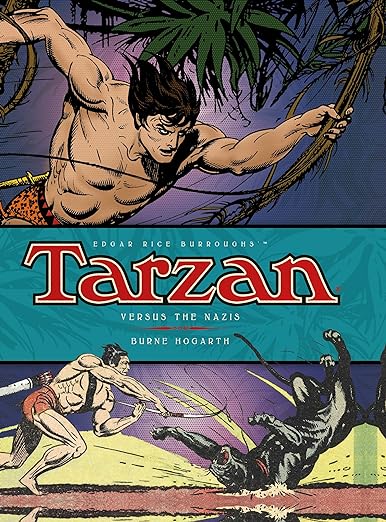
Tarzan in the City of Gold (The Complete Burne Hogarth Comic Strip Library volume 1)


By Burne Hogarth and Don Garden (Titan Books)
ISBN: 978-1-78116-317-7 (HB)

Modern comics and graphic novels evolved from newspaper comic strips. These daily pictorial features were – until relatively recently – extremely popular with the public and highly valued by publishers who used them as a powerful weapon to guarantee and even increase circulation and profits. From the earliest days humour was paramount; hence the terms “Funnies” – and of course, “Comics”.

The 1930s saw an explosion of action and drama strips launched with astounding rapidity and success. Not just strips but actual genres were created in that decade which still impact on not just today’s comic-books but all our popular fiction. Despite the odd ancestor or precedent like Roy Crane’s Wash Tubbs (comedic when it began in 1924, but gradually moving through mock-heroics to light-action and becoming a full-blown adventure serial with the introduction of Captain Easy in 1929), the majority of strips in production were feel-good humour strips with the occasional child-oriented fantasy.

The full-blown adventure serial strip started on January 7th 1929 with Buck Rogers and Tarzan launching on the same day. Both were adaptations of pre-existing prose properties – although the Ape-Man had already conquered the silver screen – and their influence changed the shape of the medium forever. In terms of sheer quality of art, the adaptations of Edgar Rice Burroughs’ novels starring jungle-bred John Clayton, Lord Greystoke by Canadian commercial artist Harold “Hal” Foster were unsurpassed, and the strip became a firm favourite of the reading masses, supplementing movies, books, a radio show and ubiquitous advertising appearances.

As fully detailed in Tarzan historian/author Scott Tracy Griffin’s informative overview ‘Burne & Burroughs: The Story of Burne Hogarth and Edgar Rice Burroughs’, Foster initially quit the strip after the10-week adaptation of Tarzan of the Apes. He was replaced by Rex Maxon, but returned (at the insistent urging of Edgar Rice Burroughs) when the black-&-white daily was expanded to include a lush, full colour Sunday page of new tales.

Leaving Maxon to cater the Monday through Saturday series of novel adaptations, Foster produced the Sunday page until 1936 (233 weeks) after which he momentously moved to King Features Syndicate and created his own weekend masterpiece. Prince Valiant in the Days of King Arthur debuted on February 13th 1937. Once a four month backlog of material he had built up was gone, Foster was succeeded by a precociously brilliant 25-year old artist named Burne Hogarth: a young graphic visionary whose superb anatomical skill, cinematic design flair and compelling page composition revolutionised action/adventure narrative illustration.

The galvanic modern dynamism of the idealised human figure in comic books is directly attributable to Hogarth’s pioneering drawing and, in later years, educational efforts.

When he in turn finally left the strip, Hogarth found his way into teaching as co-founder – with Silas H. Rhodes – of the Cartoonist and Illustrators School for returning veterans. This became the New York School of Visual Arts and Hogarth produced an invaluable and inspirational series of art textbooks including Dynamic Anatomy and Dynamic Figure Drawing, shaping generations of aspiring pencillers. I can see my own well-worn copies from where I sit typing this.

In the early 1970s, Hogarth was lured back to the leafy domain of legendary Lord Greystoke, producing two magnificent volumes of graphic narrative in the dazzling style that had captivated audiences more than 30 years previously. Large bold panels, vibrantly coloured, with blocks of Burroughs’ original text, leapt out at the reader in a riot of hue and motion as they retold the triumphant, tragic tale of an orphaned scion of British nobility raised to puissant manhood by Great Apes in Tarzan of the Apes and Jungle Tales of Tarzan.

Burroughs cannily used the increasingly popular strip feature to cross-market his own prose efforts with great effect. Tarzan and the City of Gold was first serialised in pulp magazine Argosy in 1932 and released in book form the following year. So by May 17th 1936, Foster’s new and unconnected Tarzan in the City of Gold could be described as a brand new adventure on one hand, whilst boosting already impressively book sales by acting as a subtle weekly ad for the fantastic fantasy novels.

As discussed and précised in ‘Hal Foster’s Tarzan in the City of Gold – the Story So Far’, the illustrator and regular scripter Don Garden’s final yarn began with the 271st weekly page: revealing how the wandering Ape-Man had stumbled upon a lost outpost built by ancient refugees from Asia Minor in a desolate region of the “Dark Continent”.

The city of Taanor was so rich in gold that the material was only useful for weather-proofing roofs and domes of houses, but when white ne’er-do-wells Jim Gorrey and Rufus Flint discover the fantastic horde they marshalled a mercenary army, complete with tanks and aircraft to plunder the lost kingdom. Tarzan, meanwhile, had become war-chief of noble King Dalkon and his beautiful daughter Princess Nakonia and determined to use every trick and stratagem to smash the invaders…

After 51 epic weekly episodes, Foster was gone and we pick up the story of ‘Tarzan in the City of Gold’ (episodes #322-343, 9th May to October 3rd 1937) as the drama takes a bold new direction when the embattled Jungle Lord leads a slow war of attrition against the invaders whilst simultaneously recruiting a bizarre battalion of beasts comprising apes, lions and elephants to crush the greedily amassed armaments of 20th century warfare with fang and claw, sinew and muscle…

In those halcyon days the action was non-stop and, rather than cleanly defined breaks, storylines flowed one into another. Thus, Tarzan allowed the victorious Taanorians to believe he had perished in battle and journeyed to familiar territory, revisiting the cabin where he had been born and the region where he was raised by the she-ape Kala – stopping to punish a tribe of humans hunting and tormenting his old family/band of apes. Then, Hogarth’s first full epic began.

‘Tarzan and the Boers Part I’ (pages #344-377, 10th October 1937 – 29th May 1938) sees the erstwhile Greystoke lured to the assistance of duplicitous chieftain Ishtak who craves the Ape-Man’s assistance in repulsing an “invasion” by white pioneers from South Africa.

It isn’t too long before Tarzan discovers Ishtak is playing a double game. Having sold the land in question to families led by aged Jan Van Buren, the avaricious king intends to wipe them out and keep his tribal territories intact…

When Tarzan unravels the plot he naturally sides with the Boers and, over many bloody, torturous weeks, helps the refugees survive Ishtak’s murderous campaign of terror to establish a sound, solid community of honest (white) farmers…

When Hogarth first took over he had used an affected drawing style mimicking Foster’s static realism, but by the time of ‘Tarzan and the Chinese’ (#378-402, 5 June – 20th November 1938) had completed a slow transition to his own tautly hyper-kinetic visual methodology, perfectly suited to the electric vitality of the ever-onrushing feature’s exotic wonders.

Here, after leaving the new Boer nation, Tarzan finds a vast, double-walled enclosure and – ever curious – climbs into a fabulous hidden kingdom populated by the descendants of imperial Chinese colonists.

Once again he was just in time to prevent the overthrow of the rightful ruler – firstly by rebels and bandits, then a treacherous usurper and latterly by invading African warriors – before slipping away to befriend another clan of Great Apes and be mistaken for an evolutionary missing link by Professor John Farr in ‘Tarzan and the Pygmies’ (#403-427, 27th November 1938 to 14th May 1939). However, the boffin’s nefarious guide Marsada knows exactly who and what the Ape-Man is and spends a great deal of time and effort trying to kill Tarzan, as payback for his destroying a profitable poaching racket years before. Most infuriatingly, the husky newcomer had caught the passionate fancy of Farr’s lovely daughter Linda

Following an extended clash with actual missing links – a mountain tribe of primitive, bestial half-men – Tarzan and Linda fall into the brawny hands of magnificent (white) tree-dwelling viragos who all want to mate with a man who seems their physical equal. The trials and tribulations of ‘Tarzan and the Amazons’ (#428-437, 21st May-23rd July 1939) only ends when the jungle Adonis fakes his own death…

More relatively aimless perambulations bring the hero once more to the nascent homeland of his Afrikaans friends. ‘Tarzan and the Boers Part II’ (#438-477, 30th July 1939 – 28th April 1940) has him perfectly matched against cunning, truly monstrous villain Klaas Vanger. This wandering diamond hunter has discovered a mother-lode of gems on Jan Van Buren’s farm and, after seducing his way into the family’s good graces by romancing impressionable daughter Matea, he tries to murder them all. When this also fails, Vanger instigates a new war between settlers and natives, whilst absconding with a cache of diamonds and massacring a tribe of baboons befriended by Tarzan…

These vile acts lead to a horrific boom town of greedy killers springing up on Boer lands, compelling Tarzan, baby baboon Bo-Dan and hulking. tongue-tied lovelorn farmhand Groot Carlus to take a terrible but well-deserved vengeance on the money-crazed monster and his minions and rescuing crestfallen Matea from the seducer’s vile clutches…

Edgar Rice Burroughs was a master of populist writing and always his prose crackled with energy and imagination. Hogarth was an inspired intellectual and, as well as gradually instilling his pages with ferocious, unceasing action, layered the panels with subtle symbolism. Even vegetation looked spiky, edgy and liable to attack at a moment’s notice…

His pictorial narratives are all coiled-spring tension or vital, violent explosive motion, stretching, running, fighting: a surging rush of power and glory. It’s wonderful these majestic exploits are back in print – especially in such a lavish and luxurious oversized (330 x 254mm) hardback format – even if only to give us comic lovers and other couch potatoes a thorough cardio-vascular work-out. Nevertheless, I won’t be completely happy until all this wild wonderment is online too…

Beautifully rendered and reassuringly formulaic, these masterful interpretations of the utterly authentic Ape-Man are a welcome addition to any comics’ connoisseurs’ cupboard and you would be crazy not to take advantage of this beautiful collection; the first of five in the Complete Burne Hogarth Comic Strip Library.
Tarzan® & © 2014 ERB, Inc. All Rights Reserved. All images copyright of ERB, Inc 2014. All text copyright of ERB, Inc 2014.

Popeye volume 3: The Sea Hag & Alice the Goon (The E.C. Segar Popeye Sundays)


By Elzie Crisler Segar with Bong Redila & various (Fantagraphics Books)
ISBN: 978-1-68396-884-9 (TPB/Digital edition)

Popeye first embarked in the Thimble Theatre comic feature on January 17th 1929. The unassuming newspaper strip had launched on 19th December 1919: one of many cartoon funnies to parody and burlesque the era’s silent movie serials. Its more successful forebears included C.W. Kahles’ Hairbreadth Harry and Ed Wheelan’s Midget Movies/Minute Movies – which Thimble Theatre replaced in William Randolph Hearsts’ papers.

All these strips employed a repertory company of characters playing out generic adventures based on those expressive cinema antics. Thimble Theatre’s cast included Nana and Cole Oyl, their gawky, excessively excitable daughter Olive, diminutive-but-pushy son Castor and Olive’s sappy, would-be beau Horace Hamgravy. The series ticked along nicely for a decade: competent, unassuming and always entertaining, with Castor and Ham Gravy (as he became) tumbling through get-rich-quick schemes, frenzied, fear-free adventures and gag situations until September 10th 1928, when explorer uncle Lubry Kent Oyl gave Castor a spoil from his latest exploration of Africa. It was the most fabulous of all birds – a hand-reared Whiffle Hen – and was the start of something truly groundbreaking…

Whiffle Hens are troublesome, incredibly rare and possessed of fantastic powers, but after months of inspired hokum and slapstick shenanigans, Castor was inclined to keep Bernice – for that was the hen’s name – as a series of increasingly peculiar circumstances brought him into contention with ruthless Mr. Fadewell, world’s greatest gambler and king of the gaming resort dubbed ‘Dice Island’. Bernice clearly affected and inspired writer/artist E.C. Segar, because his strip increasingly became a playground of frantic, compelling action and comedy during this period…

When Castor and Ham discovered everybody wanted the Whiffle Hen because she could bestow infallible good luck, they sailed for Dice Island to win every penny from its lavish casinos. Big sister Olive wanted to come along, but the boys planned to leave her behind once their vessel was ready to sail. It was 16th January 1929…

The next day, in the 108th episode of that extended saga, a bluff, brusquely irascible, ignorant, itinerant and exceeding ugly one-eyed old sailor was hired by the pathetic pair to man the boat they had rented, and the world was introduced to one of the most iconic and memorable characters ever conceived. By sheer surly willpower, Popeye won readers’ hearts and minds: his no-nonsense, rough grumbling simplicity and dubious appeal enchanting the public until, by tale’s end, the walk-on had taken up residency. He would soon make Thimble Theatre his own…

The Sailor Man affably steamed onto the full-colour Sunday Pages forming the meat of this curated collection. This paperback prize is the third of four designed for swanky slipcases, and will present Segar’s entire Sunday canon. Spiffy as that sounds, the wondrous stories are also available in digital editions if you want to think of ecology or mitigate the age and frailty of your spinach-deprived “muskles”…

Son of a handyman, Elzie Crisler Segar was born in Chester, Illinois on 8th December 1894. His early life was filled with solid, earnest blue-collar jobs that typified his generation of cartoonists. Young Segar worked as a decorator/house-painter, played drums to accompany vaudeville acts at the local theatre and when the town got a movie house played for the silent films. This allowed him to absorb staging, timing and narrative tricks from close observation of the screen, and these became his greatest assets as a cartoonist. It was whilst working as a film projectionist, he decided to draw for his living, and tell his own stories. He was 18…

Like so many from that “can-do” era, Segar studied art via mail: in this case W.L. Evans’ cartooning correspondence course out of Cleveland, Ohio – from where Jerry Siegel & Joe Shuster would launch Superman upon the world. Segar gravitated to Chicago and was “discovered” by Richard F. Outcault (The Yellow Kid, Buster Brown), arguably the inventor of newspaper comics. Outcault introduced Segar around at the prestigious Chicago Herald and soon – although still wet behind the ears – Segar’s first strip Charley Chaplin’s Comedy Capers debuted on 12th March 1916. Two years later, Elzie married Myrtle Johnson and moved to Hearst’s Chicago Evening American to create Looping the Loop. Managing Editor William Curley saw a big future for Segar and promptly packed the newlyweds off to the Manhattan headquarters of the mighty King Features Syndicate.

Within a year Segar was producing Thimble Theatre for The New York Journal. In 1924, Segar created a second daily strip. The 5:15 was a surreal domestic comedy featuring weedy commuter/would-be inventor John Sappo and his formidable, indomitable wife Myrtle (!).

A born storyteller, Segar had from the start an advantage even his beloved cinema couldn’t match. His brilliant ear for dialogue and accent shone out from the admittedly average melodrama adventure plots, adding lustre to stories and gags he always felt he hadn’t drawn well enough. After a decade or so – and just as cinema caught up with the introduction of “talkies” – he finally discovered a character whose unique sound and individual vocalisations blended with a fantastic, enthralling nature to create a literal superstar.

Incoherent, plug-ugly and stingingly sarcastic, Popeye shambled on stage midway through ‘Dice Island’ and once his very minor part played out, simply refused to leave. Within a year he was a regular. As circulation skyrocketed, he became the star. In the less than 10 years Segar worked with his iconic sailor-man (from January 1929 until the artist’s untimely death on 13th October 1938), the auteur constructed an incredible metaworld of fabulous lands and lost locales, where unique characters undertook fantastic voyages, spawned or overcame astounding scenarios and experienced big, unforgettable thrills as well as the small human dramas we’re all subject to. They also threw punches at the drop of a hat…

This was a saga both extraordinary and mundane, which could be hilarious or terrifying – frequently at the same time. For every trip to the rip-roaring Wild West or lost kingdom, there was a brawl between squabbling neighbours, spats between friends or disagreements between sweethearts – any and all usually settled with mightily-swung fists and a sarcastic aside.

Popeye was the first Superman of comics and ultimate working-class hero but he was not a comfortable one to idolise. A brute who thought with his fists, lacking respect for authority, he was uneducated, short-tempered and – whenever hot tomatoes batted their eyelashes (or thereabouts) at him – fickle: a worrisome gambling troublemaker who wasn’t welcome in polite society… and wouldn’t want to be. However, the mighty marine marvel may be raw and rough-hewn,  but he is fair and practical, with an innate and unshakable sense of what’s right and what’s not: a joker who wants kids to be themselves – but not necessarily “good” – and someone who takes no guff from anybody. Always ready to defend the weak and with absolutely no pretensions or aspirations to rise above his fellows, he was and will always be “the best of us”…

Preceding the vintage views, this tome offers another sublime and compellingly whimsical cartoon deconstruction, demystification and appreciation in Allegro in C Hag Minor’ – An Introduction by Bong Redila’ wherein the multi award winning Filipino American cartoonist (Meläg, Borderline) explores the sparking relationship of the witch and her hairy pal…

There is more than one Popeye. If your first thought when you hear the name is the cheerful, indomitable sailor in full Naval whites always biffing a hulking great beardy-bloke and mainlining tinned spinach, that’s okay. The Fleischer Studios and Famous Films animated features have a vivid brilliance and spontaneous energy of their own (even the later, watered-down anodyne TV versions have some merit) and they are indeed all based on the grizzled, crusty, foul-mouthed, bulletproof, golden-hearted old swab who shambled his way into the fully cast and firmly established newspaper strip Thimble Theatre on January 17th and simple wouldn’t leave. But they are really only the tip of an incredible iceberg of satire, slapstick, virtue, vice and mind-boggling adventure.

This third collection of Segar’s Sunday Colour comics masterpiece spans December 3rd 1933 to February 16th 1936, opening with his magnum opus ‘Plunder Island’ in full, unexpurgated totality, with the epitome of stirring sea-sagas taking up the first six months of that time (ending with the July 15th 1934 instalment). It all kicks off when Popeye’s old shipmate Salty Bill Barnacle invites him to go adventuring in search of fabled Plunder Island, land of stolen treasure, little suspecting that the ghastly villainous Sea Hag who rules it has reared her homely head once more and is very close…

With her new gang of deadly henchmen – including brutal Mister Skom and the monstrous Goon – she kidnaps nerve-wracked Professor Cringly: an aged scholar who knows the lost island’s location. Is Popeye’s latest voyage over before it has begun…?

Gathering a bunch of decidedly dubious amateur Argonauts – including but not exclusively comprising – J. Wellington Wimpy, diner owner Rough-House, “Gobbler” George W. Geezil and private cop G.B. Gritmore, Olive Oyl, Salty Bill and Popeye give chase. It seems hopeless until the Witch of the Seas makes her big mistake and sends her monstrous mute Goon to take hostages. The uncanny creature returns with the indomitable sea salt and inexplicably irresistible Wimpy. The latter’s heretofore unsuspected amatory attractions promptly turn the gruesome heads of both the Hag and her mute minion – who is apparently a rather decent if unprepossessing mother answering to Alice

In this sinister saga Segar’s second greatest character creation – morally maladjusted master moocher Wimpy – gradually takes over, threating Popeye’s star status with shameful antics and scurrilous schemes. Among so many timeless supporting characters, craven mega moocher Wimpy stands out as the utter antithesis of feisty big-hearted Popeye, but unlike any other nemesis I can name, this black mirror is not an “emeny” of the hero, but his best – maybe only – friend…

The Mr. Micawber-like coward, moocher and conman debuted on 3rd May 1931 as an unnamed referee officiating a bombastic month-long bout against pugilist Tinearo. He struck a chord with Segar who made him a (usually unwelcome) fixture. Eternally ravenous and always soliciting (probably on principle) bribes of any magnitude, we only learned the crook’s name in May 24th’s instalment. The erudite rogue uttered the first of many immortal catchphrases a month later. That was June 21st – but “I would gladly pay you Tuesday for a hamburger today” – like most phrases Everybody Knows, actually started as “Cook me up a hamburger, I’ll pay you Thursday”. It was closely followed by my personal mantra “let’s you and him fight”…

Sunday Pages followed a decidedly domestic but rowdily riotous path, increasing given over to – or more correctly, appropriated – by the insidiously oleaginous grifter: ever hungry, intellectually stimulating, casually charming and usually triumphant in all his mendicant missions. Whilst continuing Popeye’s pugilistic shenanigans, the strips moved away from him hitting quite so much to alternately being outwitted by the unctuous beggar or saving him from the vengeance of furious eatery-owner Rough-House and fellow daily diner Geezil. The soup-slurping cove began as an ethnic Jewish stereotype, but like all Segar’s characters soon developed beyond his (now so very offensive) comedic archetype into a whole person with his own story and equally unique voice. Geezil was the most vocal advocate for murdering the insatiable sponger…

Fair warning: this was an era of casual racial stereotyping completely acceptable and indeed a key component of cartooning and all mass entertainment. Segar sinned far less than most: his style was more character-specific, and his personal delight was playing with accents and how folk interacted. Geezil wasn’t just a Jewish stock figure of fun, but as fully rounded as any of nearly 50 supporting cast members could be within page/panel count constrictions.

Wimpy was incorrigible and unstoppable – he was even a rival suitor for Olive’s unappealing affections whenever food or money (for food) was in play. He grew from Segar’s love and admiration of comedian W.C. Fields. A mercurial force of nature, the unflappable mendicant is the perfect foil for Popeye. Where the sailor is heart and spirit, unquestioning morality and self-sacrifice, indomitable defiance, brute force and no smarts at all, Wimpy is intellect and self-serving greed, freed from ethical restraint and devoid of impulse-control.

Wimpy literally took candy from babies and food from the mouths of starving children, yet somehow Segar made us love him. He is Popeye’s other half: weld them together and you have an heroic ideal… (and yes, those stories are all true: Britain’s Wimpy burger bar chain was built from the remnants of a 1950s international merchandising scheme seeking to put a J Wellington Wimpy-themed restaurant in every town and city).

Rollercoaster adventure, thrills, chills and raucous riotous comedy have never been better blended than in Plunder Island, but when the victorious crew return home, the fun doesn’t stop as we see the bitter aftermath and how our various treasure-seekers dispose of or lose the fabulous wealth they’ve won. Wimpy simply and rapidly eats his way through most of his, whilst Popeye once again gives his cash away, prompting a return to prize fighting against a succession of increasingly scary and barely human opponents. One such man-mountain is Kid Nitro with Wimpy again playing extremely partial referee. When the unscrupulous umpire bets all he has left against Popeye, the Sailor Man pauperises the cheat just by being his valiant self…

For a while, unrelated gag sequences (fights and romantic tiffs) keep the ball rolling every sabbath before mighty “infink” Swee’pea makes his Sunday debut on 28th October 1934 (after being initially introduced in the daily strip: see E.C. Segar’s Popeye volume 3: “Let’s You and Him Fight” ). Adopted by Popeye, he became the focus of many outrageous episodes allowing audiences to comfortably decompress before the next Big Story. These gag exploits see Popeye dally with “High Sassiety” and inadvertently turn effete, spoiled rich child William Bankley into wholesome fun-loving little tough guy Bill whilst honing in on Wimpy’s appetite, ruthless scavenging of pets and livestock and duck hunting antics.

They culminate in appalling excess consumption and his mooching never ends: permanently predating on Rough-House and the distressed cobbler and leading to a shocking sequence of strips where – driven mad by Wimpey’s relentless mooching – the shoemaker kills his despised nemesis with burgers garnished with rat poison…

That aforementioned approaching epic then mines western themes as the cast (plus prodigal brother Castor Oyl) head west to Slither Creek (April 14th to August 25th 1935) as gold prospectors, with Wimpy lost in the desert, undergoing incredible – and well-deserved – hardships as Swee’Pea perpetually proves the benefits of a spinach-&-milk diet. Somehow, the sunny sojourn leaves Wimpy rolling in gold when they return home. As Popeye goes back to battling bulky boxers and sparring with Olive, the temporarily wealthy, eternally empty Wimpy buys his own diner in the ultimate expression of blind optimism and sheer folly. Eventually, the master beggar triumphs over all and gets to eat his fill… and must deal with the consequences of his locust-like consumption…

These tales are as vibrant and compelling now as they’ve ever been, comprising a classic of graphic literature only a handful of creators have ever matched. Segar famously considered himself an inferior draughtsman – most of the world disagreed and still does – but his ability to weave a yarn was unquestioned, and grew to astounding and epic proportions in these strips. Week by week he was creating the syllabary and lexicon of a brand-new artform: inventing narrative tricks and beats that generations of artists and writers would use in their own creations. Despite some astounding successors, no one ever bettered Segar.

Popeye is five years shy of his centenary and deserves his place as a global icon. How many comics characters are still enjoying new adventures 95 years after their first? These volumes are a perfect way to celebrate the genius and mastery of E.C. Segar and his brilliantly flawed superman. These are tales you’ll treasure all of your life and superb books you must not miss.

Popeye volume 3: The Sea Hag & Alice the Goon is copyright © 2023 King Features Syndicate, Inc./™Hearst Holdings, Inc. This edition © 2023 Fantagraphics Books Inc. Segar comic strips provided by Bill Blackbeard and his San Francisco Academy of Comic Art. “Allegro in C Hag Minor” © 2023 Bong Redila. All rights reserved.

Judge Dredd: The Complete Case Files 01 – 10th Anniversary Edition


By John Wagner, Pat Mills, Kelvin Gosnell, Peter Harris, Malcolm Shaw, Charles Herring, Gerry Finlay-Day, Robert Flynn, Joe Collins, Carlos Ezquerra, Mike McMahon, Ian Gibson, Massimo Belardinelli, Ron Turner, John Cooper, Bill Ward, Brian Bolland & various (Rebellion/REBCA)
ISBN: 978-1-78108-332-1 (HB/Digital edition)

Britain’s last great comic icon can be described as a combination of the other two, combining the futuristic milieu and thrills of Dan Dare with the terrifying anarchy and irreverent absurdity of Dennis the Menace. He’s the longest-lasting adventure character in our rather meagre comics stable, having been continually published every week since February 1977 when he kicked off in the second issue of science-fiction anthology 2000AD – and now that The Dandy’s gone, veterans Korky the Cat and Desperate Dan might one day be overtaken in the comedy stakes too…

However, with at least 52 2000AD episodes a year, annuals, specials, a newspaper strip (in the Daily Star and The Metro), Judge Dredd Megazine, numerous reprinted classic comics collections, some rather appalling franchised foreign comic book spin-off titles, that adds up to a phenomenal amount of material, most of which is still happily in print.

Judicial Review: Dredd and dystopian ultra-metropolis Mega-City One – originally posited as 21st century New York – were formulated by a very talented committee including Pat Mills, Kelvin Gosnell, Carlos Ezquerra, Mike McMahon and others, with major contributions from legendary writer John Wagner who has written the largest portion of the canon under his own name and several pseudonyms.

Joe Dredd is a fanatically dedicated law enforcer dubbed a Judge in the super-city, where hundreds of millions of citizens idle away their days in a world where robots are cheaper, more efficient and frequently crazier than humans, where jobs are both beloved pastime and treasured commodity. Boredom is at epidemic proportions and almost everybody is just one askance glance away from mental meltdown. Judges are peacekeepers who maintain order at all costs: investigating, taking action and trying all crimes and disturbances to the hard-won equilibrium of the constantly boiling melting pot. Justice is always immediate…

Dredd’s world is a polluted and precarious Future (In)Tense, with all key analogues for successful sci fi (as ever a social looking-glass for the times it’s created in) situated and sharply attuned to a Cold War Consumer Civilisation. The ravaged planet is split into political camps with post-nuclear holocaust America locked in a slow death-struggle with Sov Judges of the old Eastern Communist blocs. Eastern lawmen are militaristic, oppressive and totalitarian – and that’s by the US Judges’ standards – so just imagine what they’re actually like. Judges are necessary fascists in a world permanently on the edge of catastrophe, and sadly, what far too many readers never realised is the strip is a gigantic satirical black comedy with oodles of outrageous, vicarious cathartic action.

Such was not the case when the super-cop debuted in 2000AD Prog (that’s issue number to you) #2 on March 5th 1977. He was stuck at the back of the new weekly comic in a tale finally scripted – after much intensive re-hashing – by Peter Harris and illustrated by Mike McMahon & Carlos Ezquerra. The blazing, humourless, no-nonsense (there would be plenty of yes nonsense later) action extravaganza introduced a bike-riding Sentinel of Order in the cautionary tale of brutal bandit Whitey, whose savage crime spree was ended with ferocious efficiency before the thug was sentenced to Devil’s Island – a high-rise artificial plateau surrounded by the City’s constant stream of lethal, never-ending, high-speed traffic. Prog #3 saw Dredd investigate ‘The New You in a cunning thriller by Gosnell & McMahon wherein a crafty crook tries to escape justice by popping into his local face-changing shop, whilst #4 saw the first appearance of the outcast mutants in ‘The Brotherhood of Darkness’ (Malcolm Shaw & McMahon) as ghastly post-nuclear pariahs raid the megalopolis for slaves.

Early hints of humour began in Prog 5’s ‘Krong’ by Shaw & Ezquerra, introducing Dredd’s little-old-lady cleaner/landlady Maria, wherein deranged horror film fan/hologram salesman Kevin O’Neill – yes it’s an in-joke – unleashes a giant mechanical gorilla on the city. The issue was the first to cover-feature old Stone Face (that’s Dredd, not Kev)…

‘Frankenstein 2’ pits the Lawman against an audacious medical mastermind, hijacking citizens to keep his rich-but-aging clients in fresh, young organs, whilst #7 sees ruthless reprobate Ringo’s gang of muggers flaunting their criminality in the very shadow of ‘The Statue of Judgement until Dredd lowers the boom on them…

The first indications that the super-cop’s face was somehow hideously disfigured emerge in #8, as Charles Herring & Massimo Belardinelli’s ‘Antique Car Heist’ finds the Judge tracking down a murdering thief who stole an ancient petrol-burning vehicle, after which co-creator John Wagner returned in Prog 9 to begin a staggering run of tales with ‘Robots’, illustrated by veteran British science fiction artist Ron Turner. The gripping vignette was set at the Robot of the Year Show, exposing callous cruelty citizens inflicted upon their mechanical slaves as a by-product of a violent blackmail threat by a disabled maniac in a mechanical-super chair… This set the scene for an ambitious mini-saga in #10-17 as those casual injustices paved the way for ‘Robot Wars’ (alternately illustrated over the weeks by Ezquerra, Turner, McMahon & much missed arch wag Ian Gibson) wherein carpentry-robot Call-Me-Kenneth succumbs to a mecha mind meltdown to emerge as a human-hating steel Spartacus, spearheading a bloody revolution against fleshy oppressors.

The slaughter is widespread and terrible before the Judges regain control, helped in no small part by loyal, lisping Vending droid Walter the Wobot, who graduated at the conclusion to Dredd’s second live-in comedy foil…

With order restored, self-contained stories firmed up the vision of the crazed city. In Prog 18 Wagner & McMahon introduced the menace of mind-bending ‘Brainblooms’ cultivated by another little old lady/career criminal, and Gerry Finley-Day & John Cooper described the galvanising effect of a ‘Muggers Moon’ on Mega-City 1’s criminal class before Dredd demonstrated the inadvisability of being an uncooperative witness…

Wagner & McMahon then debuted Dredd’s bizarre paid informant Max Normal in #20, whose latest tip ended the profitable career of ‘The Comic Pusher’; Finley-Day & Turner turned in a workmanlike thriller as the laconic lawmaker tackles a seasoned killer with a deadly new weapon in ‘The Solar Sniper’ and Wagner & Gibson showed the draconian steps Dredd was prepared to take to bring in mutant assassin ‘Mr Buzzz’.

Prog 23 comfortably catapulted the series into all-out ironic satire mode with Finley-Day & McMahon’s ‘Smoker’s Crime’ when Dredd stalks a killer with a nicotine habit to a noxious City Smokatorium, after which Malcolm Shaw, McMahon & Ezquerra reveal the uncanny secret of ‘The Wreath Murders’ in #24. The next issue began the long tradition of spoofing TV and media fashions with Wagner & Gibson concocting lethal illegal game show ‘You Bet Your Life’ whilst #26 exposes the sordid illusory joys and dangers of the ‘Dream Palace’ (McMahon) before #27-28 offer some crucial background on the Judges themselves when Dredd visits ‘The Academy of Law’ (Wagner & Gibson) to give Cadet Judge Giant his final practical exam. Of course, for Dredd there are no half measures or easy going and the novice barely survives graduation…

With the concluding part in #28, Dredd moved to second spot in 2000AD (behind brutally jingoistic thriller Invasion) and the next issue saw Pat Mills & Gibson confront robot racism as Ku Kux Klan-analogue ‘The Neon Knights’ brutalised the reformed and broken artificial citizenry until the Juggernaut Judge krushes them.

Mills then offered tantalising hints on Dredd’s origins in ‘The Return of Rico!’ (McMahon) as a bitter criminal resurfaces after twenty years on the penal colony of Titan. The outcast wants vengeance on the Judge who had sentenced him, but from his earliest days as a fresh-faced rookie, Joe Dredd had no time for corrupt lawmen – even if one were his own clone-brother…

Whitey escapes from Devil’s Island’ (Finley-Day & Gibson) in Prog 31, thanks to a cobbled-together contraption that turns off weather control, but doesn’t get far before Dredd sends him back, whilst fully automated skyscraper resort ‘Komputel’ (Robert Flynn & McMahon) becomes a multi-story murder factory that only Mega-City’s greatest Judge can counter before Wagner (as John Howard) took sole control for a series of savage, whacky escapades beginning with #33’s ‘Walter’s Secret Job’ (art by Gibson). Here the besotted droid is discovered moonlighting as a cabbie to buy “pwesents” for his beloved master…

McMahon & Gibson illustrated 2-parter ‘Mutie the Pig’: a flamboyant criminal and bent Judge, and perform the same tag-team effort on ‘The Troggies’, a debased colony of ancient humans living under the city and preying on the unwary…

Something of a bogie man for wayward kids and exhausted parents, Dredd does himself no favours in Prog 38 bursting in on ‘Billy Jones’ (Gibson) and exposing a vast espionage plot utilising toys as surveillance tools. On tackling ‘The Ape Gang’ in #39 (19th November 1977 by McMahon), the Judge graduated to lead spot whilst quashing a turf war between augmented, educated, criminal anthropoids in the unruly district dubbed “the Jungle”…

‘The Mega-City 5000’ was an illegal, murderously bloody street race the Judges were determined to shut down, but the gripping action-illustration of the Bill Ward drawn first chapter is sadly overshadowed by hyper-realist rising star Brian Bolland, who began his legendary association with Dredd by concluding the mini-epic in blistering, captivating style in Prog 41. Bolland, by his own admission, was an uncommercially slow artist and much of his later Dredd work would appear as weekly portions of large epics with others handling intervening episodes, giving him time to complete his own assignments with a minimum of pressure.

From out of nowhere in a bold change of pace, Dredd is seconded to the Moon for a 6-month tour of duty beginning in #42. His brief is to oversee the nigh-lawless colony set up by the unified efforts of three US Mega-Cities there. The outpost was as bonkers as Mega-City One and a good deal less civilised – a true Final Frontier town…

The extended epic began with Wagner & Gibson’s ‘Luna-1’, with Dredd and stowaway Walter almost shot down en route in a mysterious missile attack before being targeted by a suicide-bomb robot before they can even unpack. ‘Showdown on Luna-1’ introduces permanent Deputy-Marshal Judge Tex from Texas-City, whose jaded, laissez-faire attitudes get a sound shaking up when Dredd demonstrates he’s one lawman who won’t coast for the duration of his term in office. Hitting dusty mean streets, Dredd starts cleaning up the wild boys by outdrawing a mechanical Robo-Slinger and uncovering another assassination ploy. It seems reclusive mega-billionaire ‘Mr. Moonie’ has a problem with the latest law on his lunar turf…

Whilst dispensing aggravating administrative edicts like a frustrated Solomon, Dredd chafes to hit the streets and do real work in #44’s McMahon-limned ‘Red Christmas’. Opportunity arises when arrogant axe-murderer ‘Geek Gorgon’ abducts Walter and demands a showdown he barely lives to regret, whilst ’22nd Century Futsie!’ (Gibson) finds Moonie Fabrications clerk Arthur Goodworthy cracking under the strain of overwork: going on a destructive binge, with Dredd compelled to protect a future-shocked father’s family from Moonie’s overzealous security goons. The arc concludes in Prog 46 with ‘Meet Mr. Moonie’ (Gibson) as Dredd & Walter confront the manipulative manufacturer and uncover his horrific secret.

The feature moved to the prestigious middle spot with this episode, allowing artists to really open up and exploit full-colour centre-spreads, none more so than Bolland as seen in #47’s ‘Land Race’ as Dredd officiates over a frantic scramble by colonists to secure newly opened plots of habitable territory. Of course, there’s always someone who doesn’t want to share…

Ian Gibson illustrated 2-part drama ‘The Oxygen Desert’ (#48-49), wherein veteran moon-rat Wild Butch Carmody defeats Dredd using superior knowledge of the airless wastes beyond the airtight domes. Broken, the Judge quits and slides into despondency, but all is not as it seems…

Prog 50 debuted single-page comedy supplement Walter the Wobot: Fwiend of Dwedd – but more of that later – whilst the long-suffering Justice found himself knee-boot deep in an international interplanetary crisis when ‘The First Lunar Olympics’ (Bolland) against a rival lunar colony controlled by the Machiavellian Judges of the Sov-Cities bloc escalates into assassination and a murderous, politically-fuelled land grab. The conflict was settled in ostensibly civilised manner with strictly controlled ‘War Games’, yet there’s still a grievously high body-count by the time the moon-dust settles. This vicious swipe at contemporary sport’s politicisation was and still is bloody, brutal and bitingly funny…

Bolland illustrated a sardonic saga of ruthless bandits up for a lethal laugh in #52’s ‘The Face-Change Crimes’, employing morphing tech to change their appearances and rob at will until Dredd beats them at their own game. Wagner & Gibson crafted a 4-part epic (Progs 53-56) wherein motor fanatic Dave Paton’s cybernetic, child-like pride-&-joy blows a fuse and terrorises the domed territory: slaughtering humans and infiltrating Dredd’s own quarters before the Judge finally stops ‘Elvis, The Killer Car’.

Bolland stunningly limned a savagely mordant saga of killer bandits who hijack the moon’s air before themselves falling foul of ‘The Oxygen Board’ in #57, but only managed the first two pages of 58’s ‘Full Earth Crimes’, leaving McMahon to complete the tale of regularly occurring chaos in the streets whenever the Big Blue Marble dominates the black sky above.

It was a fine and frantic note to end on as, with ‘Return to Mega-City’, Dredd rotates back Earthside and resumes business as unusual. Readers were probably baffled as to why the returned cop utterly ignored countless crime and misdemeanours, but Wagner & McMahon provide a logical answer in a brilliant, action-packed set-up for madcap dramas to come

This first Case Files chronicle nominally concludes with Wagner & McMahon’s ‘Firebug’ from Prog 60, as the ultimate lawgiver deals with a seemingly-crazed arsonist literally setting the city ablaze. The Law soon discovers a purely venal motive to the apparent madness…

There’s still a wealth of superb bonus material to enjoy before we end, however, and kicking off proceedings is the controversial First Dredd strip (illustrated by Ezquerra) which was bounced from 2000AD #1 and vigorously reworked – a fascinating glimpse of what the series might have been. It’s followed by the eawliest Walter the Wobot: Fwiend of Dwedd stwips (sowwy – can’t wesist!) from 2000AD Progs 50-58. Scripted by Joe Collins, these madcap comedy shorts were seen as antidote to the savage, brutal action strips and served to set the scene for Dredd’s later full-on satirical lampoonery. Illustrated by Gibson, ‘Tap Dancer’ dealt with an embarrassing plumbing emergency whilst ‘Shoot Pool!’ has the Wobot again taking his Judge’s instructions far too literally…

Bolland came aboard giving full rein to his own sense of the absurd with 5-parter ‘Walter’s Brother’: a bizarre tale of evil twins, cunning frame-ups and malign muggings inevitably resulting in us learning all we needed to know about the insipidly faithful, annoying rust-bucket. Dredd then had to rescue the plastic poltroon from becoming a pirate of the airwaves in ‘Radio Walter’ before the star-struck servant finds his 15 seconds of fame as winner of rigged quiz-show ‘Masterbrain’ and this big, big book concludes with a trio of Dredd covers from Progs 10, 44 and 59, courtesy of artists Ezquerra, Kev O’Neill and McMahon.

Mesmerising and beautifully limned, these punchy stories of Britain’s most successful and iconic comics character are the narrative bedrock from which all the later successes of the Mirthless Moral Myrmidon derive. More importantly, they are timeless classics no comic fan can ignore – and just for a change something that you can easily get your hungry hands on. Even my local library has copies of this masterpiece of British literature and popular culture…
© 1977, 1978, 2006 Rebellion A/S. All rights reserved. Judge Dredd & 2000AD are ® & ™ Rebellion.

Buck Rogers in the 25th Century: The Complete Newspaper Dailies volume 1 – 1929-1931


By Philip Nowlan & Dick Calkins with an introduction by Ron Goulart (Hermes Press)
ISBN: 978-1-93256-319-1 (HB/Digital edition)

There’s not really a lot you can say about Buck Rogers that hasn’t been said before – and probably better – by the likes of such luminaries and fans as Ray Bradbury, Howard Hughes and Chuck Jones. The landmark, game changing comics strip feature grew out of a cover-featured prose novella printed in the August 1928 issue of “scienti-fiction” pulp magazine Amazing Stories. Written by journalist Philip Francis Nowlan, “Armageddon 2419A.D.” told of retired US Army Air Corps officer Anthony Rogers, who fell into a 500-year coma whilst surveying a deep mine. He awakened to a world controlled by a Chinese looking Empire governed by tyrants called “Mongols” or “The Han”.

…And that’s my cue to remind everyone NOW that at that time in human evolution, creators and consumers of popular culture were far less socially advanced. You might even want to call them racist, but it’s works like these that – whilst pandering to popular tastes – also began a process of change. Perceived as Past or Future though, these were Very Different Times and if that could offend then stay away…

The valiant battle to free America from Asiatic oppression was another thinly-veiled “Yellow Peril” story, (embarrassingly for us liberals, this dubious prejudice has generated some of the most enduring escapist adventure fiction of the 20th century) but something about this particular tale caught the public’s attention. Consequently John Flint Dille – head of National Newspaper Service Syndicate – secured the rights to adapt the text tale into ongoing picture form and had the author and artist Dick Calkins (Sky Roads) produce the industry’s first action/drama continuity feature. It became the most influential Science Fiction strip ever: jet packs, robots, space flight, atomic bombs, weaponized medicine, anti-gravity and even television all appeared in these panels long before their real world introductions…

The daily strip premiered on January 7th 1929, about the time prose sequel The Airlords of Han appeared in Amazing Stories (cover-dated March 1929). It was also the day that the Tarzan newspaper strip debuted.

Renamed Buck Rogers, 2429 A.D. (and advancing one year every January 1st thereafter), the strip was a monster hit and Dille’s marketing genius made it an incredibly profitable one. There was merchandise, premiums, giveaways, a radio show, books and a movie serial. What we now consider part and parcel of an entertainment franchise was all invented by Dille.

This premiere tome gathers the 6-days-a-week monochrome episodes covering the first two years and is preceded by a captivating Introduction by author and strips expert Ron Goulart, describing the genesis of the feature, its antecedents, impact and successors. ‘Buck Rogers, Ray Guns, and Science Fiction’ is also a cornucopia of captivating toys, figures, games, house ads, comic book, pulp mag and pop-up book covers, posters and movie memorabilia and other promo material.

Although the feature just unrolled in a wave of innovation, here the saga is partitioned into discrete tales beginning with ‘Chapter 1: Meeting the Mongols’ as Buck awakens, meets freedom fighter Wilma Deering and all-knowing scientist Dr. Huer and enlists in their struggle to liberate a subjugated America (AKA “the Federate Orgzones”) of scattered enclaves, bewildered, amazed but never overwhelmed by the fantastic changes…

Buck’s life takes a big twist when Wilma is captured and taken to the Han’s World Capital. Doggedly in pursuit amidst fresh wonders and ancient lusts and intrigues, our hero repeatedly upsets the applecart: winning staunch allies across the enslaved globe. His protracted campaign memorably debuts “race traitor”, arch-collaborator and ultimate nemesis Killer Kane and opens the planetary saga to the marvels and terrors of space warfare.

Despite being framed and judged a traitor to the freedom fighters, Rogers soldiers on. After clearing his name and reuniting with Wilma, ‘Chapter 2: Capturing the Mongol Emperor’ sees him and his allies retaliate as the war of superweapons intensifies…

Ultimately victorious, the aftermath provides more peril as ‘Chapter 3: Pact of Perpetual Peace’ sees Buck, Wilma, Chilean guide Enrique and Mongol rebels Morke Ka Lono, Liu and Lanlu despatched as envoys to meet the Emperor’s unsuspected superior officer – The Celestial Mogul

The perilous voyage takes them from ocean depths to mountain top fortresses, facing pirates, monsters, traitors and bigots before shockingly discovering the past four centuries of enslavement were the result of a single foe’s prejudice and greed…

With diplomacy triumphant and the world free, ‘Chapter 4: Defeat of the Mongol Rebels’ sees Buck and his pals pitted against those inevitable power-hungry hold-outs who benefitted most from the previous status quo. The insidious insurgents begin by kidnapping Wilma and luring Buck into a deadly chase across medical monolith the Aseptic City. Perpetrator Hum-Toy’s greatest threat was to destroy everyone with her deadly germ bombs and her resistance inspired legions of Mongols to take up arms again and destroy the Celestial Mogul’s new peace…

With Earth again at war, ‘Chapter 5: Tiger Men of Mars’ upped the ante as curious aliens witness the carnage and – after taking Wilma as a specimen for further study – head for home on the Red Planet. Deering was a dangerously uncooperative lab rat whose antics allowed Buck and Earth’s forces to effect a rescue. Negotiations seemed to settle the crisis and both sides opened diplomatic relations, but soon after, humans started disappearing. Among them was Wilma’s sister Sally and when hostilities erupted the Tiger Men briefly lost custody of another captive: a golden girl called Illana from a rival race on the Red Planet…

When the Tigers flee back to their world with Sally and Illana, Buck spearheads a rapid construction project to build an interplanetary rescue rocket and humanity takes its first big step into the cosmos…

After some teething troubles and a brief stopover on The Moon, the humans head off only to encounter a derelict alien ship and revive its sole survivor. Tallan is from Jupiter and the last time he saw humans they still lived in caves. With his aid the humans soon establish contact with Sally and Illana and before long Buck and Tallan have infiltrated the Tiger City, just in time to spectacularly scotch a scheme to conquer Earth. That battle separates many of the Earthling space-farers and leads to more conflict in ‘Chapter 6: Land of the Golden People’, with the Martian conflict soon drawing in Earth too.

With Humanity’s home invaded by terrifying war machines, this first volume concludes with ‘Chapter 7: Synthetic Gold Plot’ as Wilma goes missing again. As Buck hunts her beside acerbic journalist Herby Swipe, their frantic inquiries unearth a covert mission on behalf of the World Government and that she may not be a willing companion of suave plutocratic rat Wyn Winters. Rogers’ increasingly wild and inept efforts against a backdrop of espionage chicanery and economic chaos soon make him many new enemies and a fugitive from the law, but also point to a connection with global pariah Killer Kane as he seeks an incredible secret weapon…

First in a line of Daily and Sunday collections now criminally out of print and (other than this tome) unavailable digitally, Buck Rogers in the 25th Century: The Complete Newspaper Dailies volume 1 offers a crucial window into the birth of our art form, one that should be revered for its innovations and discussed for its social impact good and bad. Let’s hope the publishers can revive the project and make all that happen in our imminent future.
© 2009 The Dille Family Trust, reprinted with permission.

The Usagi Yojimbo Saga Book 1


By Stan Sakai (Dark Horse Books)
ISBN: 978-1-61655-671-6(HB) 978-1-61655-609-9(TPB) eISBN: 978-1-63008-081-5

Back in 1955, when Stan Sakai was two years old, the family moved from Kyoto, Japan to Hawaii. Growing up in a cross-cultural paradise, he graduated from the University of Hawaii with a BA in Fine Arts, before leaving to pursue further studies at Pasadena’s Art Center College of Design in California. His early forays into comics were as a letterer – most famously for Groo the Wanderer and the Spider-Man newspaper strip – before his nimble pens and brushes found a way to express his passion for Japanese history, legend and Akira Kurosawa films, inspirationally transforming a proposed story about a human historical hero into one of the most enticing and impressive fantasy sagas of all time.

Usagi Yojimbo (“rabbit bodyguard”) first appeared in 1984’s Albedo Anthropomorphics #1: a background character in Stan Sakai’s The Adventures of Nilson Groundthumper and Hermy, and premiering amongst assorted furry ‘n’ fuzzy folk. He soon graduated to a nomadic solo act in Critters, Amazing Heroes, Furrlough and the Munden’s Bar back-up series in Grimjack. Although the expansive period epic stars sentient animals and details the life of a peripatetic Lord-less Samurai eking out as honourable a living as possible as a Yojimbo (bodyguard-for-hire), the milieu and scenarios scrupulously mirror Japan’s Feudal Edo Period (roughly 16th-17th century AD by Western reckoning) whilst simultaneously referencing other cultural icons from sources as varied as Zatoichi to Godzilla.

Miyamoto Usagi is brave, noble, industrious, honest, sentimental, gentle, artistic, empathetic, long-suffering and conscientious: a rabbit devoted to the tenets of Bushido and utterly unable to turn down any request for help or ignore the slightest evidence of injustice. As such, his destiny is to be perpetually drawn into an unending panorama of incredible situations.

Despite changing publishers a few times, the Roaming Rabbit has been in publication since 1987, with nearly 60 assorted collections of comics and at least 5 art books to date. He’s guest-starred in many other series (most notably Teenage Mutant Ninja Turtles and its TV incarnation) and even made it into his own small-screen Netflix show – albeit in a futuristic setting. There are high-end collectibles, art prints, computer games and RPGs, spin-off comics serials and lots of toys. Author Sakai and his creation have won numerous awards both within the Comics community and amongst the greater reading public… And it’s still more educational, informative and authentic than any dozen Samurai sagas you can name…

The title is as much a wanderer as its star, migrating from Fantagraphics to Mirage, Dark Horse, Radio Comix, IDW and Dark Horse again under Sakai’s own Dogu Publishing imprint. None of that matters: what you need to know is that this stuff is superb and no matter which version you see, you will be a better being for reading it…

This guest-star stuffed premiere monochrome masterpiece draws together yarns released by Mirage Publishing as Usagi Yojimbo volume 2 #1-16 and Usagi Yojimbo volume 3 #1-6

Following a fulsome Foreword from former editor Jamie S. Rich, pictorial rundown of dramatis personae in ‘Cast of Characters’ and rousing strip recap ‘Origin Tale’, an evocative Introduction from legendary illustrator and Dean of Dinosauria William Stout leads into the magnificent and ever-unfolding medieval mystery play…

It begins with 3-parter ‘Shades of Green’ wherein Usagi and crusty companion Gennosuke (an irascibly bombastic, money-mad bounty-hunter and conniving thief-taking Indian rhino with a heart of gold) are recruited by Kakera: a ratty shaman in dire need of protection from the dwindling remnants of the once-mighty Neko Ninja clan. The former imperial favourites have fallen upon hard times since they and the Ronin Rabbit crushed the Dragon Bellow plot of rebel Lord Takamuro. Now, bat assassins of the Komori Ninja clan are constantly harrying, harassing and actively seeking to supplant them in Lord Hikiji’s service…

Chunin (deputy leader) Gunji believes the rodent wizard would make a mighty useful slave, and is scheming to overthrow the new – female – clan chief Chizu whilst acquiring him…

With the Neko’s trap closing around them all, the sagacious sensei summons spirits of four fantastic fighters to aid Usagi and Gen. These phantoms promptly possess a quartet of little Kame (tortoises) and are reshaped into adolescent amphibian Ninja Turtles, identifying themselves as Leonardo, Raphael, Michelangelo and Donatello. Crucially, Usagi has fought beside one of their number before…

Subsequent battles go badly and eventually Gunji’s forces make off with Kakera-sensei. As Usagi leads the remaining heroes in relentless pursuit, the conniving Chunin makes his move. Gunji’s attempt to assassinate Chizu is bloodily and efficiently ended by late-arriving Usagi who is astounded to be told by the lady he has saved that the Neko’s lethal interest in him is now at an end…

With Kakera rescued and Gunji dead, the adventure closes with the turtle spirits returning to their own place and time, leaving Gen and Usagi to follow their own (temporarily) separate roads before ‘Jizo’ offers a delightfully gripping interlude as a grieving mother dedicates a roadside shrine to her murdered child and ineffable Karma places the killers in the path of a certain justice-dispensing, long-eared wanderer…

Next comes a brace of stories offering elucidating glimpses of the rabbit’s boyhood. Once, Miyamoto Usagi was simply son to a small-town magistrate before being sent to spend his formative years learning the Way of Bushido from gruff and distant leonine hermit Katsuichi. The stern sensei taught not just superior technique and tactics, but also an ironclad creed of justice and restraint which would serve the Ronin well throughout his turbulent life.

In ‘Usagi’s Garden’ the callow pupil rebels against the arduous and undignified task of growing food until the lion delivers a subtle but lifechanging lesson, whilst in ‘Autumn’ a painful fall propels the lad into a nightmare confrontation with a monster who has trapped the changing of the seasons in a bamboo cage…

Two-part tale ‘Shi’ sees Usagi comes to the aid of a valley of poor farmers under constant attack by bullies and brigands seeking to force them from their impoverished homes. The thugs are secretly employed by a local magistrate and his ruthless brother who discovered gold under the peasants’ land and want to extract it without attracting the attention of the local Lord’s tax collectors. When the Ronin’s formidable skills stall the brothers’ scheme they hire a quartet of assassins whose collective name means “death”. However, the killers are far less trouble than the head farmer’s daughter Kimie, who has never seen someone as glamorous or attractive as the soft-spoken defrocked samurai…

Although there are battles aplenty for Usagi, the brothers’ remorseless greed ends them before the Yojimbo can…

Delightful silent comedy follows as ‘The Lizard’s Tale’ pantomimically depicts the ronin playing unwilling Pied Piper and guardian to a wandering flock of tokagé lizards (ubiquitous, omnivorous reptiles populating the anthropomorphic world, replacing scavenger species like rats, cats and dogs in the fictitious ecosystem). The rambunctious trouble-magnets repay the favour when the wanderer is ambushed in snow-drowned mountains by vengeful bandits…

‘Battlefield’ is a 3-chapter fable sharing a key moment and boyhood turning point in the trainee warrior’s life. It begins when a mind-broken, fleeing soldier shatters the boy’s childish dreams of warrior glory. The fugitive is a survivor of the losing side in a mighty battle and his sorry state forces Usagi to rethink his preconceptions of war. Eager to ram home the lesson, Katsuichi takes his pupil to the battlefield where peasants and scavengers busily snatch up whatever they can from the scattered corpses. Usagi is horrified. To take a samurai’s swords is to steal his soul, but even so, a little later he cannot stop himself picking up a fallen hero’s Wakizashi (short sword)…

After concealing the blade in a safe place, the apprentice is haunted by visions of the unquiet corpse and sneaks off to return the stolen steel soul. Caught by soldiers who think him a scavenging looter and about to lose his thieving hands, little Miyamoto is saved by the intervention of victorious Great Lord Mifune. The noble looks into the boy’s face and sees something honest, honourable and – perhaps one day – useful…

Following an Introduction on ‘Classic Storytelling’ from James Robinson, the ronin roaming resumes with ‘The Music of Heaven’ as Miyamoto and a wandering flock of tokagé lizards encounter a gentle, pious priest whose life is dedicated to peace, music and enlightenment. When their paths cross again later, the rabbit narrowly avoids being murdered by a ruthless assassin who has since killed and impersonated holy man Komuso in an attempt to catch Usagi off guard. Evocative and movingly spiritual, this classic of casual tragedy perfectly displays the vast range of storytelling Sakai can pack into the most innocuous of tales.

More menaces from the wanderer’s past reconnect in ‘The Gambler, The Widow and the Ronin’ as a professional conman who fleeces villagers with rigged samurai duels plies his shabby trade in just another little hamlet. Unfortunately, this one is home to his last stooge’s wife, and to make matters worse, whilst his latest hired killer Kedamono is attempting to take over the business, the long-eared nomad who so deftly dispatched his predecessor Shubo strolls into town looking for refreshments…

Again forced into a fight, Miyamoto makes short work of Kedamono, leaving the smug gambler to safely flee with the entire take. Slurping back celebratory servings of sake, the villain has no idea the inn where he relaxes employs a vengeful widow and mother who knows just who really caused her man’s death…

A note of portentous foreboding informs ‘The Nature of the Viper’, opening a year previously when a boisterous, good-hearted fisherman pulled a body out of the river and nursed his amazingly still breathing catch back to health. If he expected gratitude or mercy, the peasant was sadly mistaken, as the fondling explained whilst killing his benefactor as soon as he was able. The ingrate is Jei: a veritable devil in mortal form, who believes himself a “Blade of the Gods” and singled out by the Lords of Heaven to kill the wicked. The maniac makes a convincing case: when he stalked Usagi, the monster was struck by a fortuitous – or possibly divinely sent – lightning bolt but is still going strong and keenly continuing to hunt the Ronin.

‘Slavers’ begins a particularly dark journey for our hero as Usagi stumbles across a boy in chains escaping from a bandit horde. Little Hiro explains how the ragtag rogues of wily “General” Fujii have captured a whole town: making the inhabitants harvest their crops for the scum to steal…

Resolved to save them, the rabbit infiltrates the captive town as a mercenary seeking work, but is soon exposed and taken prisoner. ‘Slavers Part 2’ finds Miyamoto stoically enduring the General’s tortures until the boy he saved bravely returns the favour – after which the Yojimbo’s vengeance is awesome and terrible…

However, even as the villagers rebel and take back their homes and property, chief bandit Fujii escapes, taking Usagi’s daish? (matched long and short swords) with him. To take a samurai’s swords is to steal his soul, and the monster not only has them but continually dishonours them by slaughtering innocents as he flees the ronin’s relentless pursuit.

‘Daish? – Part One’ opens with a hallowed sword-maker undertaking the sacred process of crafting blades and the harder task of selecting the right person to buy them. Three hundred years later, Usagi is on the brink of madness as he follows Fujii’s bloody trail, pitilessly picking off the General’s remaining killers whilst attempting to redeem those soiled dispensers of death. The chase leads to another town pillaged by Fujii where Miyamoto almost refuses to aid a wounded man… until one woman accuses him of being no better than the beast he hunts…

Shocked back to his senses, the yojimbo saves the elder’s life and in gratitude the girl Hanako offers to lead him to where Fujii was heading. ‘Mongrels’ changes tack as erstwhile ally and hard-to-love friend Gennosuke reenters the picture. The bombastic, money-mad bounty-hunter and conniving thief-taker is on the prowl for suitably profitable prospects when he meets The Stray Dog: his greatest rival in the unpopular profession of cop-for-hire.

After some posturing and double-dealing wherein each tries to edge out the other in the hunt for Fujii, they inevitably come to blows and are only stopped by the fortuitous intervention of the Rabbit Ronin…

‘Daish? – Part Two’ sees the irascible rugged individualists form a shaky truce in their overweening hunger to tackle the General. Mistrustful of each other, they nevertheless cut a swathe of destruction through Fujii’s regrouped band, but even after furious Usagi regains his honour swords there is one last betrayal in store…

Older, wiser and generally unharmed, Gen and Usagi part company again as ‘Runaways’ delves deeper into the wanderer’s past. Stopping in a town he hasn’t visited in decades, the rabbit hears a name called out and his mind retreats to a time when he was a fresh young warrior in the service of Great Lord Mifune.

Young princess Takani Kinuko had been promised as bride to trustworthy ally Lord Hirano and the rabbit was a last-minute replacement as leader of the “babysitting” escort column to her impending nuptials. When an overwhelming ambush eradicated the party, Usagi was forced to flee with the stuck-up brat: both of them masquerading as carefree, unencumbered peasants as he strove to bring her safely to her future husband past an army of ninjas killers.

The poignant reverie concludes in ‘Runaways – Part 2’ as valiant hero and spotless maiden fell in love whilst fleeing from pitiless, unrelenting marauders. Successful at last, their social positions naturally forced them apart once she was safely delivered.

Shaken from his memories, the ronin moves on, tragically unaware he was not the only one recalling those moments and pondering what might have been…

Originally collected as The Brink of Life and Death, an evocatively enticing third tranche of torrid tales opens with ‘Discoveries’ – a heartfelt and enthusiastic Introduction from comics author Kurt Busiek – before more epics of intrigue intermingle with vignettes of more plebeian dramas and even an occasional supernatural thriller, all tantalisingly tinged with astounding martial arts action and drenched in wit, irony, pathos and tragedy…

Far away from our nomadic star a portentous interlude occurs as a simple peasant and his granddaughter are attacked by bandits. The belligerent scum are about to compound extortion and murder with even more heinous crimes when a stranger with a ‘Black Soul’ stops them…

This is Jei and nothing good comes from even innocent association with the Blade of the Gods. Still pursuing his crusade, the monster deals most emphatically with the criminals before “permitting” orphaned granddaughter Keiko to join him…

‘Kaise’ then finds Miyamoto Usagi befriending a seaweed farmer who’s experiencing a spot of bother with his neighbours. At peace with himself amongst hard-toiling peasants, Usagi is soon embroiled in their escalating battle with a village of rival seaweed sellers – previously regarded as helpful and friendly – and quickly realises scurrilous merchant Yamanaka is fomenting discord and unrest between his suppliers to make extra profit…

In a roadside hostelry ‘A Meeting of Strangers’ introduces a formidable female warrior to the ever-expanding cast as the Lepine Legend graciously offers a fellow weary mendicant the price of a drink. A professional informer then sells Usagi out to still-smarting Yamanaka and lethally capable Inazuma has ample opportunity to repay her slight debt to the Rabbit Ronin when he’s ambushed by an army of hired brigands…

Despite – or because – it is usually one of the funniest comics on the market, occasionally Usagi Yojimbo will brilliantly twist readers’ expectations with tales that rip your heart apart. Such is the case with ‘Noodles’, as the ronin meets again street performer, shady entertainer and charismatic pickpocket Kitsune. She was plying all her antisocial trades in a new town just as eternally-wandering Usagi rolls up. The little metropolis is in uproar at a plague of daring robberies and when inept enforcers employed by Yoriki (Assistant Commander) Masuda try – and painfully fail – to arrest the long-eared stranger as a probable accomplice, the ferociously resistant rabbit earns the instant enmity of the pompous official.

Following the confrontation, a hulking, mute soba (buckwheat noodle) vendor begins to pester the still-annoyed ronin and eventually reveals he’s carrying elegant escapologist Kitsune in his baskets. Astounded, the yojimbo renews his acquaintance with her before the affable thieves go on their way, unaware that trouble and tragedy are just around the corner…

The town magistrate is leaning heavily on his Yoriki to end the crimewave but has no conception Masuda is actually in the pay of a vicious gang carrying out most of the thefts. What they all need is a convincing scapegoat to pin the blame on, and poor dumb peasant Noodles is ideal – after all, he can’t even deny his guilt…

With a little sacrificed loot planted, the gentle giant becomes a perfect patsy and before Usagi and Kitsune even know he’s been taken, the simple fool has been tried and horrifically executed. ‘Noodles Part 2’ opens as our aggrieved heroes frantically dash for the public trial and almost immediate crucifixion. Neither pickpocket nor bodyguard can save the innocent stooge: all they can do is swear to secure appropriate vengeance and a kind of justice…

In sober mien the rabbit roves on, stumbling into a house of horror and case of possession. ‘The Wrath of the Tangled Skein’ finds Usagi returning to a region plagued by demon-infested forests. Offered hospitality at a merchant’s house, he subsequently saves the daughter from doom at the claws of a demonic Nue (tiger/fox/pig/snake devil), but is almost too late and only alerted to a double dose of danger when a Bonze (Buddhist Priest) arrives to exorcise the poor child – just like the cleric already praying over the afflicted waif upstairs…

This duel with the forces of hell leads into ‘The Bonze’s Story’ as Usagi befriends the real priest and learns how misfortune and devotion to honour compelled elite samurai Sanshobo to put aside weapons and war in search of greater truths and inner peace…

Political intrigue and explosive espionage return to the fore in ‘Bats, the Cat, & the Rabbit’ as Neko ninja chief Chizu re-enters Usagi’s life, fleeing a flight of rival Komori (bat) ninjas. These winged horrors are determined to possess a scroll containing the secrets of making gunpowder and, after a tremendous, extended struggle, the exhausted she-cat cannot believe her rabbit companion is willing to simply hand it over. She soon shrugs it off, after all the Komori have fallen into her trap and quickly regret testing the purloined formula…

The peripatetic yojimbo then walks into a plot to murder Great Lord Miyagi involving infallible unseen assassin Kuroshi at ‘The Chrysanthemum Pass’. Although the valiant wanderer is simply aiding karma to a just outcome despite overwhelming odds and a most subtle opponent, this act will have appalling repercussions in days ahead…

Hunted woman and deadly adept Inazuma then proves ‘Lightning Strikes Twice’ when found – as always – at the heart of a storm of hired blades trying to kill her. However, during one peaceful moment, she makes time to share with a fellow swordsmaster the instructive tale of a dutiful daughter who married the wrong samurai. By exacting rightful vengeance upon his killer, she won the undying hatred of a powerful lord and set her own feet irredeemably upon the road of doom…

Rounding out in this epic collection are copious ‘Story Notes by Stan Sakai’, a full-colour ‘Gallery’ of the covers from both comic books and their attendant paperback compilations, annotated ‘Cover Sketches’ and designs, plus biographical data ‘About the Author’.

Fast-paced yet lyrical, informative and funny, the saga alternately bristles with tension and thrills and frequently crushes your heart with astounding tales of pride and tragedy, evil and duty. Bursting with veracity and verve, Usagi Yojimbo is the perfect comics epic: a monolithically magical, irresistibly appealing tale to delight devotees and make converts of the most hardened haters of “funny animal” stories.
Text and illustrations © 1993-1998, 2014 Stan Sakai. All rights reserved. Foreword © 2014 Jamie S. Rich. Teenage Mutant Ninja Turtles © 2014 Viacom International, Inc. All rights reserved. All other material and registered characters are © and TM their respective owners. Usagi Yojimbo and all other prominently featured characters are registered trademarks of Stan Sakai.
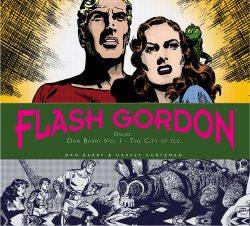
Marvels (25th Anniversary Edition)


By Kurt Busiek & Alex Ross, with Steve Darnall, Mark Braun, Richard Starkings, John Roshell & various (MARVEL)
ISBN: 978-0-7851-4286-7 (TPB) 978-0-7851-1388-1(HC/Digital edition)

Every so often in mainstream comics something comes along that irrevocably alters the landscape of our art-form, if not the business itself. After each such event the medium is never quite the same again. One such work was 4-issue Prestige Format Limited Series Marvels by jobbing scripter Kurt Busiek and just-breaking illustrator Alex Ross. This year that landmark game-changing graphic collection turns 30…

I’m usually quite reticent in suggesting people read stuff I know damn well they’ve almost certainly already seen, but apparently every day is somebody’s first, and as years pile up and more stuff gets made, even certified bona fide “unmissables” get shuffled into touch and forgotten…

This tale is all about history and human perspective, following the working life of photo-journalist Phil Sheldon, whose career paralleled the double dawning of the heroic era; when science, magic, courage and overwhelming super-nature give birth to an Age of Marvels…

The saga opens with Alex Ross’ brief, preliminary retelling of the origin of the Golden Age Human Torch as first seen in Marvels #0 (co-written by Steve Darnall and produced in classicist pic-&-text block format) before the story proper opens in ‘A Time of Marvels’. In 1939 a gaggle of ambitious young newspapermen discuss the “War in Europe”. Brash up-and-comer J. Jonah Jameson is trying to dissuade his shutterbug pal Phil from heading overseas, claiming there’s plenty of news to snap in New York…

Unconvinced, Sheldon heads to his next assignment: a press conference with scientific crackpot Professor Phineas T. Horton. The photographer’s head is filled with thoughts of journalistic fame and glory on distant battlefields and he almost misses the moment Horton unveils his artificial man: a creature that bursts into flame like a Human Torch

From that moment on Sheldon’s life is transformed forever. His love-hate fascination with the fantastic miracles which rapidly, unceasingly follow in the inflammatory inhumanoid’s fiery wake is used to trace the rise of superhumanity and monstrous menace which comprises the entire canon of what we know as the Marvel Universe….

Soon the android is accepted as a true hero, frequently battling aquatic invader Sub-Mariner like elemental gods in the skies above the city whilst seemingly-human vigilante supermen like The Angel constantly ignore the law and daily diminish Phil’s confidence and self-worth. It’s as if by their well-meaning actions these creatures are showing that mere men are obsolete and insignificant…

Feelings of ineffectuality and inadequacy having crushed the camera jockey’s spirit, Phil turns down a War Correspondent assignment and descends into a funk. He even splits up with fiancée Doris Jaquet. After all, what kind of man brings children into a world with such inhuman horrors in it? Nevertheless, Sheldon cannot stop following the exploits of the singular human phenomena he’s collectively dubbed “Marvels”…

Everything changes with the arrival of patriotic icon Captain America. With the Land of Liberty in World War II at long last, many once-terrifying titans have become the nation’s allies and secret weapons, turning their awesome power against the Axis foe and winning the fickle approval of a grateful public. However, some were always less dutiful than others. When tempestuous Sub-Mariner again battles the Torch, Prince Namor of Atlantis petulantly unleashes a tidal wave against Manhattan. Phil is critically injured snapping the event…

Even after losing an eye, Phil’s newfound belief in Marvels never wavers and he rededicates himself to his job and Doris; going to Europe where his pictures of America’s superhuman Invaders crushing the Nazi threat become part of the fabric of history…

The second chapter jumps to the 1960s where Sheldon, wife Doris and daughters Jenny and Beth are – like most New Yorkers – at the epicentre of another outbreak of metahumanity… a second Age of Marvels…

Two new bands of costumed champions operate openly: A Fantastic Four-some comprising famous scientist Reed Richards and test pilot Ben Grimm plus Sue and Johnny Storm. Another anonymous team who hide their identities call themselves The Avengers. There are also numerous independent mystery men streaking across the skies and hogging headlines, which Jonah Jameson – now owner/publisher of the newspaper he once wrote for – is none too happy about. After all, he has never trusted masks and is violently opposed to this new crop of masked mystery-men. Phil is still an in-demand freelancer, but has a novel idea, signing a deal for a book of his photos just as the first flush of popular fancy wanes and increasing anxiety about humanoid mutants begins to choke and terrify the man in the street…

When the mysterious X-Men are spotted, Sheldon is caught up in a spontaneous anti-mutant race riot: appalled to find himself throwing bricks with the rest of a deranged mob. He’s even close enough to hear their leader dismissively claim “They’re not worth it”…

Shocked and dazed, Sheldon goes home to his nice, normal family, but the incident won’t leave him, even as he throws himself into work and his book. He worries that his daughters seem to idolise Marvels. “Normal” people seem bizarrely conflicted, dazzled and besotted by the celebrity status of the likes of Reed Richards and Sue Storm as they prepare for their upcoming wedding, yet prowl the streets in vigilante packs lest some ghastly “Homo Superior” abomination show its disgusting face…

Events come to a head when Phil finds his own children harbouring a mutant in the cellar. During WWII, Phil photographed the liberation of Auschwitz, and looking into the huge deformed orbs of “Maggie” he sees what he saw in the faces of those pitiful survivors. His innate humanity wins out and Phil lets her stay, but can’t help dreading what friends and neighbours might do if they find such a creature mere yards from their own precious families…

Hysteria keeps growing and the showbiz glitz of the Richards/Storm wedding is almost immediately overshadowed by the catastrophic launch of anthropologist Bolivar Trask’s Sentinels. At first the mutant-hunting robots behave like humanity’s boon but when they override their programming and attempt to take over Earth, it is despised and dreaded mutants who save mankind.

Naturally, the man in the street knows nothing of this and all Phil sees is more panicked mobs rioting and destroying their own homes. In fear for his family, he rushes back to Doris and the girls, only to find Maggie has vanished: the unlovely little child had realised how much her presence had endangered her benefactors. They never see her again…

The third chapter focuses on the global trauma of ‘Judgement Day’ as the shine truly starts coming off the apple. Even though crises come thick and fast and are as quickly dealt with, vapid, venal humanity becomes jaded with the ever-expanding metahuman community and once-revered heroes are plagued by scandal after scandal. Exhausted, disappointed and dejected, Phil shelves his book project, but fate takes a hand when the skies catch fire and an incredible shiny alien on a skyborne surfboard announces the end of life on Earth…

Planet-devouring Galactus seems unstoppable and the valiant, rapidly-responding Fantastic Four are humiliatingly defeated. Phil, along with the rest of Earth, embraces the end and wearily walks home to be with his loved ones, repeatedly encountering humanity at its best and nauseating, petty, defeated worst. However, with the last-minute assistance of the Silver Surfer – who betrays his puissant master and suffers an horrific fate – Richards saves the world, but within days is accused of faking the entire episode. Disgusted with his fellow men, Sheldon explodes in moral revulsion…

Phil’s photobook is finally released in concluding instalment ‘The Day She Died’. Now an avowed and passionate proponent of masked heroes, humanity’s hair-trigger ambivalence and institutionalised rushes to judgement constantly aggravate Phil even as he meets the public and signs countless copies of “Marvels”.

The average American’s ungrateful, ungracious attitudes rankle particularly since the mighty Avengers are currently lost in another galaxy defending Earth from collateral destruction in a war between rival galactic empires – the Kree and the Skrulls – but the most constant bugbear is old associate Jameson’s obsessive pillorying of Spider-Man. Phil particularly despises a grovelling, ethically-deprived young freelance photographer named Peter Parker who constantly curries favour with the Daily Bugle’s boss by selling pictures deliberately making the wallcrawler look bad…

Phil’s book brings a measure of success, and when the aging photographer hires young Marcia Hardesty as a PA/assistant whilst he works on a follow-up, he finds a passionate kindred spirit. Still, everywhere Sheldon looks costumed champions are being harried, harassed and hunted by hypocritical citizens and corrupt demagogues, although even he has to admit some of the newer heroes are hard to like…

Ex-Russian spy Black Widow is being tried for murder, protesting students are wounded by a Stark Industries super-armoured thug and in Times Square a guy with a shady past is touting himself as a Hero for Hire. When respected Police Captain George Stacy is killed during a battle between Spider-Man and Doctor Octopus, Jameson is frantic to pin the death on the webspinner, but hero-worshipping Phil digs deeper. Interviewing many witnesses – including the murderously malign, multi-limed loon himself – Phil consequently strikes up a friendship with Stacy’s daughter Gwen, a truly sublime young lady who is inexplicably dating that unscrupulous weasel Parker…

One evening, hoping for another innocuous chat with the vivacious lass, Phil sees her abduction by the Green Goblin and, desperately giving chase, watches as his vaunted hero Spider-Man utterly fails to save her from death. Her murder doesn’t even rate a headline; that’s saved for industrialist Norman Osborn who is found mysteriously slain that same night…

Gutted, worn out and somehow betrayed, Sheldon chucks it all in, but seeing Marcia still has the fire in her belly and wonder in her eyes, leaves her his camera and his mission…

Although this titanic tale traces the arc of Marvel continuity, the sensitive and evocative journey of Phil Sheldon is crafted in such a way that no knowledge of the mythology is necessary to follow the plot; and would indeed be a hindrance to sharing the feelings of an ordinary man in extraordinary times.

One of Marvel’s – and indeed the genre’s – greatest tales (but you probably already know that and if you don’t what are you waiting for?), I count at least four separate versions available currently and suggest if you have any money left you opt for the 25th Anniversary edition that comes heavily annotated with numerous articles and extras. These include aforementioned prequel ‘Marvels Book Zero’, and the ‘Marvels Epilogue’ short story. The bonus section comprises a 39-page, panel-by-panel comparison of original 1960s Marvel material with the reinterpretations of #0-4 compiled by Jess Harrold: followed by ‘Marvels: The Proposals’ as Ross & Busiek pitched their big idea: four shots to get it just right, aided by an abundance of glorious ‘character studies’ incorporating a vast cast, and supplemented by text articles on the finished product from November 1993’s Marvel Age #130.

Busiek’s full scripts for #1-4 and a wealth of ‘layouts, pencils & Original Art’ (11 pages) follow, before diving deeper in with a 6-page peek ‘Inside Alex Ross’ Marvels Epilogue Sketchbook’. More commentary follows with recovered Introductions, Busiek’s in-story prose pieces ‘Marvels: The Articles’; 8 pages of Ross’ contribution via ‘Marvels: The Artistic Process’, and Harrold’s popular press features courtesy of ‘The Story of Marvels’, ‘Modern-Day Marvels’, ‘Understanding Marvels by Scott McCloud’, ‘McLaurin’s Mark on Marvels’.

Next comes a ‘Mahvels Parody’ by Darnall, Busiek, Ross & artist Mark Braun, accompanied by ‘Posters, Art & Homage Covers’, Ross’ ‘Marvels Collected-Edition Cover Gallery’, and material seen in previous collections, including an ‘Annotated Cover Gallery’; a selection of ‘Marvels 25th Anniversary Variants’, ‘Marvels 25th Anniversary Tributes Variants’ and ‘Marvels Epilogue Variants’: with 5- full page contributions from Paolo Rivera, Michael Cho, Gabriele Dell’Otto, Stephanie Hans, Daniel Acuña, Mark Brooks, David Mack, Julian Totino Tedesco, Mico Suayan & Brian Reber, Inhyuk Lee, Carlos Pacheco, Leinil Francis Yu & Sunny Cho, Adi Granov, Alan Davis, Mark farmer & Matt Hollingsworth, Nick Bradshaw, Gerlad Parel, Greg Smallwood, Marcos Martin, Tomm Coker, Yasmine Putri, Clayton Crain, Phil Noto, Simone Bianchi, Dave Johnson, Ron Lim & Dean White, Remsy Atassi, Dave Cockrum & Edgar Delgado, Fred Hembeck & Felipe Sobreiro, Skottie Young and more.

The epic history lesson ends with a list of ‘Marvels Sources’, citing where each re-envisioned scene first appeared in comics continuity before closing with Stan Lee’s Marvels TPB (1994) Introduction, full Acknowledgements and a final Afterword from Kurt Busiek & Alex Ross.

A truly groundbreaking achievement, Marvels – in whatever form you see it – is a comics tale you must not miss.
© 2020 MARVEL.

The Juggler of Our Lady – The Classic Christmas Story


By R. O. Blechman with a Foreword by Jules Feiffer and Introduction by Maurice Sendak (Dover Comics & Graphic Novels/Dover Children’s)
ISBN: 978-0-486-80030-1 (HB/Digital edition)

Win’s Christmas Gift Recommendation: An Immaculate Confection… 10/10

Christmas is not just about shiny new toys and sparkly knitwear. It’s also about unearthing or revisiting old, beloved and – in this case – almost totally forgotten treasures like a magnificent hardback picture-perfect gift that’s still readily available; thanks to the perspicacious souls at Dover Books.

Oscar Robert Blechman is a glittering star in America’s graphic arts firmament and an international superstar. Brooklyn-born in 1930, he has excelled as cartoonist, illustrator, author, animator & director, editorial cartoonist, Editorial Director and ad-man.

He won awards for his commercials and TV specials and been venerated in an exhibition at The Museum of Modern Art. His anti-Vietnam cartoons graced The Village Voice through the early 1970s whilst his cartoons and illustrations appeared in such prestigious vehicles as Punch, The New Yorker, Trump, Harper’s Bazaar, Esquire, Show, Theater Arts and Humbug. He’s also produced fascinating graphic narratives such as Franklin the Fly, Talking Lines and Georgie and can reasonably claim to have produced one of the very first English-language Graphic Novels – and thus beginneth today’s lesson…

In 1952 Blechman used his groundbreaking and soon-to-be phenomenally influential minimalist line-style – deftly augmented with judicious watercolours – to make a much-told tale all his own. The Juggler of Our Lady was his first book: initially published by Henry Holt, and superbly fetishized and commemorated through brother-cartoonist Maurice Sendak’s fondly emotional Introduction in this sublime pocket edition. The slim tome became a landmark in graphic narrative and is beloved by generations.

Anatole France’s 1892 tale Le Jongleur de Notre Dame is probably the most widely accepted version of the original medieval religious-miracle myth but there have been so many others the story is as much part of most people’s seasonal landscape as Santa Claus or Rudolph the Red-Nosed Reindeer.

Blechman’s reinvigoration retains all the awe and wonder, whilst adding such a potent blend of wry humour, pitiful humility and gentle hope to the mix that it can make a grown man weep. In 1958 his book became an animated Terrytoons TV short with a huge impact when it was adapted by Al Kouzel & Gene Deitch and narrated by that legendary Spirit of Christmas Past Boris Karloff

You surely know the story: Cantalbert is an itinerant juggler who loves his work. He feels that if more people juggled there would less time for war and misery and folk would act better, feel better and be better. Nobody, however, will listen and the despondent performer – hungry for spirituality – joins a monastery. Even here he does not fit in and is saddened by his lack of suitable talents to venerate The Lord and especially his mother The Virgin Mary…

Everything comes to a head on Christmas Eve when the monks all display the magnificent presents they have made for the Madonna and poor Cantalbert has nothing worthy to give.

Later, when all is quiet, the sad juggler offers the only thing he knows and loves to the statue of The Virgin and something wonderful happens…

Deftly deconstructed and wondrously appreciated in a Foreword by comics and cartooning Titan Jules Feiffer, The Juggler of Our Lady is a masterpiece of graphic dexterity and an utterly beguiling experience no lover of the storytelling arts should be without.

Text and illustrations © 1997 R. O. Blechman. Foreword © 1997 2015 Jules Feiffer. Introduction © 1980 Maurice Sendak. All rights reserved.
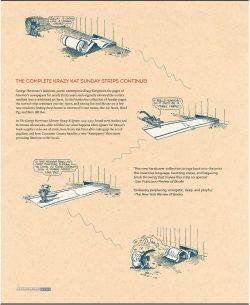
Check out www.doverpublications.com, internet retailers or local comic or bookshop.

Walt Disney’s Mickey Mouse Color Sundays “Call of the Wild” (volume 1)


By Floyd Gottfredson & various: edited by David Gerstein & Gary Groth (Fantagraphics Books)
ISBN: 978-1-60699-643-0 (HB/Digital edition)

Win’s Christmas Gift Recommendation: A Mouse in Every House… 10/10

Happy technical 100th Anniversary Disney, but we all know it all REALLY started with this little guy…

As collaboratively co-created by Walt Disney & Ub Iwerks, Mickey Mouse was first seen – if not heard – in silent cartoon Plane Crazy. The animated short fared poorly in a May 1928 test screening and was promptly shelved. That’s why most people who care cite Steamboat Willie – the fourth Mickey feature to be completed – as the debut of the mascot mouse and co-star and paramour Minnie Mouse, since it was the first to be nationally distributed, as well as the first animated feature with synchronised sound. The astounding success of the short led to a subsequent and rapid release of fully completed predecessors Plane Crazy, The Gallopin’ Gaucho and The Barn Dance, once they too had been given soundtracks. From those timid beginnings grew an immense fantasy empire, but film was not the only way Disney conquered hearts and minds. With Mickey a certified solid gold sensation, the mighty mouse was considered a hot property and soon joined America’s most powerful and pervasive entertainment medium: comic strips…

Floyd Gottfredson was a cartooning pathfinder who started out as just another warm body in the Disney Studio animation factory. Happily, he slipped sideways into graphic narrative and evolved into a pioneer of pictorial narratives as influential as George Herriman, Winsor McCay and Elzie Segar. Gottfredson’s Mickey Mouse entertained millions – if not billions – of eagerly enthralled readers and shaped the very way comics worked. Via some of the earliest adventure continuities in comics history he took a wildly anarchic animated rodent from slap-stick beginnings and transformed a feisty everyman/mouse underdog into a crimebuster, detective, explorer, lover, aviator and cowboy. Mickey was the quintessential two-fisted hero whenever necessity demanded. In later years, as tastes – and syndicate policy – changed, Gottfredson steered that self-same wandering warrior into a sedate, gently suburbanised lifestyle, employing crafty and clever sitcom gags suited to a newly middle-class America: comprising a 50-year career generating some of the most engrossing continuities the comics industry has ever enjoyed.

Arthur Floyd Gottfredson was born in 1905 in Kaysville, Utah, one of eight siblings in a Mormon family of Danish extraction. Injured in a youthful hunting accident, Floyd whiled away a long recuperation drawing and studying cartoon correspondence courses. By the 1920s he had turned professional, selling cartoons and commercial art to local trade magazines and Big City newspaper the Salt Lake City Telegram.

In 1928, he and wife Mattie moved to California where, after a shaky start, the doodler found work in April 1929 as an in-betweener with the burgeoning Walt Disney Studios. Just as the Great Depression hit, he was personally asked by Walt to take over the newborn but already ailing Mickey Mouse newspaper strip. Gottfredson would plot, draw and frequently script the strip for the next five decades: an incredible accomplishment by of one of comics’ most gifted exponents.

Veteran animator Ub Iwerks had initiated the print feature with Disney himself contributing, before artist Win Smith was brought in. The nascent strip was plagued with problems and Gottfredson was only supposed to pitch in until a qualified regular creator could be found.

His first effort saw print on May 5th 1930 (his 25th birthday) and Floyd just kept going for fifty years. On January 17th 1932, Gottfredson crafted the first colour Sunday page, which he also handled until retirement. At first he did everything, but in 1934 Gottfredson relinquished scripting, preferring plotting and illustrating the adventures to playing about with dialogue. Thereafter, collaborating wordsmiths included Ted Osborne, Merrill De Maris, Dick Shaw, Bill Walsh, Roy Williams & Del Connell. At the start and in the manner of film studio systems, Floyd briefly used inkers such as Ted Thwaites, Earl Duvall & Al Taliaferro, but by 1943 had taken on full art chores.

This superb archival compendium – part of a magnificently ambitious series collecting the creator’s entire canon – re-presents the initial colour sequences, jam-packed with thrills, spills and chills, whacky races, fantastic fights and a glorious superabundance of rapid-fire sight-gags and verbal by-play. The manner by which Mickey became a syndicated star is covered in various articles at the front and back of this sturdy tome devised and edited by truly dedicated, clearly devoted fan David Gerstein who also provides an Introduction. The tome is stuffed with lost treats such as a try-out sketch (of the Wolf Barker storyline) by Carl Barks from 1935 when he joined Disney Studios.

Under the guise of Setting the Stage unbridled fun and incisive revelations begin with J.B. Kaufman’s ‘Mickey’s Sunday Best: A New Arena’ introducing us to this unique graphic world before Kevin Huizenga’s Appreciation ‘A Brief Essay About Floyd Gottfredson’ details the pictorial pathfinder’s visual innovations prior to The Sundays: Floyd Gottfredson’s Mickey Mouse Stories With Introductory Notes concluding scene-setting with Gerstein offering some preliminary insights in ‘Sunday Storytelling’…

At the start – just like the daily feature – the strip was treated like an animated feature, with diverse hands working under a “director” and each day seen as a full gag with set-up, delivery and a punchline, usually all in service to an umbrella story or theme. Such was the format Gottfredson inherited from Walt Disney for his first full yarn, and here generally unconnected Gag Strips spanning January 10th to July 24th 1932 were by Duval (story & pencils) and Gottfredson until they switched and Floyd drew with Duval and Al Taliaferro inking. The result was a barrage of fast-paced and funny anthropomorphic animal antics starring Mickey, Minnie Mouse, Horace Horsecollar, Clarabelle Cow, plus prototype pet Pluto dodging dogcatchers, visiting circuses and funfairs, fighting fires, skating, fighting Indians (sorry, it was an inescapable factor of less-evolved times), joyriding, farming, fishing, gardening, cooking, quarrelling, messing with model planes and trying to make money. As the weekly funfest progressed, Pluto’s part grew exponentially and – after a monochrome poser for film short Puppy Love (1933) – a brief briefing in The Peter Principle’ leads to the first extended storyline.

Running from July 31st to September 4th 1932 ‘Dan the Dogcatcher’ saw Gottfredson inked by Ted Thwaites in a dogged (sorry, not sorry) battle of wills as future returning foe Peg-Leg Pete debuted as an unscrupulously uncivil civil servant seeking to put Pluto in the pound at any cost. The tale wandered eccentrically and frenetically all over the small town scenario, adding drama and bathos to chaos and comedy before seamlessly slipping into more Gag Strips (January 10-July 24 1932) with story & pencils by Duval & Gottfredson and inks by Duval and Al Taliaferro.

One last Gag Strip (September 11th 1932 by Gottfredson & Thwaites neatly segues into ‘Mickey’s Nephews’ (September 18th – November 6th 1932 by Gottfredson & Thwaites) and is notable for introducing Mickey’s mischief-making nephews when he looks after the anarchic offspring of neighbour Mrs. Fieldmouse for a few weeks. The sentient cyclones soon start calling the guardian/jailer “unca Mickey”…

Gag Strips spanning November 13th 1932 to January 22nd 1933 (story Gottfredson & Webb Smith, pencils by Gottfredson inked by Thwaites & Taliaferro) leads to an essay detailing ‘Mickey’s Delayed Drama’ before landmark romp ‘Lair of Wolf Barker’ (January 29th – June 18th) changed the tone of the strip forever.

The first extended Mickey Sunday colour epic was partially scripted by Osborne and inked by Taliaferro & Thwaites, but is pure Gottfredson at his most engaging: a rip-roaring comedy western featuring a full wide-screen repertory cast: Mickey, Minnie, Horace, Clarabelle and Goofy, who originally answered to the moniker Dippy Dog.

The gang head west to look after Uncle Mortimer’s sprawling ranch and enjoy fresh air and free lodgings but after meeting his foreman Don Poocho stumble into a baffling crisis. Mortimer’s cattle are progressively vanishing, with the unsavoury eponymous villain riding roughshod over the territory and terrorising assorted characters and stock figures culled from a million movies. Desperados and deviltry notwithstanding, before long Barker gets his ultimate and well-deserved come-uppance thanks the Mouses’ valiant efforts. This is action comics on the fly, with plenty of rough-&- tumble action, twists, turns and surprises always alloyed to snappy, fast-packed sight and slapstick gags.

Without pausing for breath the cast’s return home leads to more unconnected frenzied Gag Strips (June 25th 1933 to March 4th 1934: story by Osborne, pencils by Gottfredson and inks by Thwaites & Taliaferro) with Mickey as much silly nuisance as closet hero until extended tales return, with ‘The Longest Short Story Ever Told!’ first supplying some context about the filmic origins of the next epic ‘Rumplewatt The Giant.’

The fantasy fable ran March 11th to April 29th 1934 by Osborne, Gottfredson, Thwaites & Taliaferro and sees Mickey reading a bedtime story to youngsters with himself as a giant killer in fairyland, after which rustic domesticity and free enterprise dominate as Mickey and Minnie anticipate – over a number of episodes – replacing the decrepit horse in his new delivery service. Many mishaps occur until ‘Tanglefoot Pulls His Weight’ (May 6th – June 3rd), and a single Gag Strip (June 10th 1934) leads to essay ‘Call of the Wild’ debating the history and tangled relationship of Horace Horsecollar, Clarabelle and Goofy prior to Osborne, Gottfredson & Taliaferro dipping into sinister mad science courtesy of ‘Dr. Oofgay’s Secret Serum’ (June 17th– September 9th 1934). A double date camping trip to the woods goes awry when the reclusive scientist – seeking a way to tame ferocious animals by chemistry, instead injects Horace with the antidote turning him into a rampaging beast…

‘TOPPER Strip “Introducing Mickey Mouse Movies”’ (June 24 1934 by Osborne, Gottfredson, & Taliaferro) reveals the ancillary feature that augmented the weekly feature and precedes more unconnected but house-based Gag Strips (September 16th to December 2nd 1934) and article ‘Death Knocks, Fate Pesters’ explores the strip’s early use of what we now call disaster capitalism before ‘Foray to Mt. Fishflake’ (December 9th 1934 to February 10th 1935 by Osborne, Gottfredson & Thwaites) finds the four friends seeking to scale a peak for prize money – a thrilling romp that led to also included Gag Strips from January 27th to February 10th and saw the comics debut of new Disney screen sensation Donald Duck

‘Beneath the Overcoat’ is a treatise on Osborne, Gottfredson & Thwaites’ landmark crime yarn running from February 17th to March 24th that reshaped the Mouse’s modus operandi and future exploits before serialised gem ‘The Case of the Vanishing Coats’ sees Mickey helping Donald’s Uncle Amos solve a baffling mystery of invisible shoplifters just before Morty and Ferdie Fieldmouse return to Gag Strips appearing between March 31st and July 21st in pranks and hijinks exacerbated by wild spark Donald….

Another Gottfredson promo drawing precedes the next big addition with text tract ‘Hoppy the Ambassador’ bringing readers up to speed on previous antipodean animals just so Osborne, Gottfredson & Thwaites can fully enthral and beguile with the saga of originally unwelcome new pet ‘Hoppy the Kangaroo’ (July 28th – November 24th). The bouncy ’roo eventually wins everyone over after a boxing bout with a gorilla named Growlio, managed by old enemy Peg-Leg Pete…

Osborne, Gottfredson & Thwaites’ Gag Strips carry the feature over the Holiday period of December 1st – 29th 1935, but although the chronological cartooning officially concludes here, there’s still a wealth of glorious treats and fascinating revelations in store. A 1935 painted colour cover by Gottfredson & Tom Wood for Italian magazine Modellina takes us into The Gottfredson Archives: Essays and Special Features section that follows. Here a picture packed essay on ‘The Monthly “Sundays”’ by Gerstein & Jim Korkis reveals a long-lost publication for Masonic youth in “Mickey Mouse Chapter” (A Mickey Supplement) sourced fromInternational DeMolay CordonVol. 1 #9-11, Vol. 2 #1-2 (December 1932 – May 1933) and written by Fred Spencer (first 4 strips) & Gottfredson (5), with art by Spencer.

International reprints of our opening saga are seen in ‘Gallery Feature – Gottfredson’s World: Dan the Dogcatcher’ whilst background and context on ‘The Cast: Morty and Ferdie’ by Gerstein segues into a sidebar project detailed in ‘Behind the Scenes: Minnie’s Yoo-Hoo’.

More international editions can be seen in ‘Gallery Feature – Gottfredson’s World: Mickey’s Nephews.’ A foray into pop-up books is covered in Gerstein’s ‘The Comics Department at Work: The Mouseton Pops’, supplemented with covers and interior art from Gottfredson, Taliaferro & Tom Wood. More reprint covers of many nations are gathered in ‘Gallery Feature – Gottfredson’s World: Early Epics’ after which ‘The Gottfredson Gang: In “Their Own” Words’ sees Gerstein revisit text by Irene Cavanaugh from 1932, introducing Dippy Dawg to the world and revealing Mickey’s astrological aspects…

Topolino covers fill the ‘Gallery Feature – Gottfredson’s World: Going Places’ whilst storyboards by Homer Brightman adorn Gerstein’s ‘Behind the Scenes: Interior Decorators’ before William Van Horn’s ‘“Wrapping Up” The Case of the Vanishing Coats’ focuses on later reprintings and alterations…

Another tranche of foreign imports can be seen in ‘Gallery Feature – Gottfredson’s World: Curiosities of 1935’ and ‘Gallery Feature – Gottfredson’s World: Hoppy the Kangaroo’ in advance of feature article ‘The Heirs of Gottfredson’s World: Topolino’ by Sergio Lama & Gerstein leading to capacious translated Christmas-themed Gag Strips in Verse (A Mickey Supplement) offering excerpts from Italian Il Popolo Di Roma (May-July 29 1931: story by Guglielmo Guastaveglia); The Delineator (December1932: story & art by Gottfredson et al) and Italian Topolino #1 & 7 (December 31st 1932 & February 11th 1933 with story & art by Giove Toppi & Angelo Burattini) before closing with an illustrated quote – “Any time you can tell a story…” – giving Gottfredson himself the last word…

Floyd Gottfredson’s influence on not just Disney’s canon but sequential graphic narrative itself is inestimable: he was among the first to produce long continuities and “straight” adventures, pioneered team-ups and invented some of the art form’s first “super-villains”.

When Disney killed their continuities in 1955, dictating henceforth strips would only contain one-off gag strips, Floyd adapted seamlessly, working until retirement in 1975. His last daily appeared on November 15th with a final Sunday published on September 19th 1976.

Like all Disney creators, Gottfredson worked in utter anonymity. However, in the 1960s his identity was revealed and the roaring appreciation of previously unsuspected hordes of devotees led to interviews, overviews and public appearances, leading to subsequent reprinting in books, comics and albums which now all carried a credit for the quiet, reserved master. Floyd Gottfredson died in July 1986. Thankfully we have these Archives to enjoy, inspiring us and hopefully a whole new generation of inveterate tale-tellers…
Walt Disney’s Mickey Mouse Color Sundays “Call of the Wild” © 2013 Disney Enterprises, Inc. Text of “Mickey’s Sunday Best: A New Arena” by J.B. Kaufman is © 2013 by J.B. Kaufman. All contents © 2013 Disney Enterprises unless otherwise noted. All rights reserved.
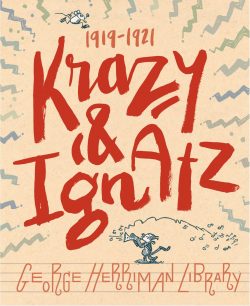
Alley Oop: The First Time Travel Adventure (Library of American Comic Essentials)


By V.T. Hamlin (IDW/Library of American Comics)
ISBN: 978-1-61377-829-6 (Landscape HB)

Win’s Christmas Gift Recommendation: Reliving Those Golden Days… 9/10

Modern comics evolved from newspaper strips. These pictorial features were, until relatively recently, extremely popular with the public and highly valued by publishers who used them as a powerful weapon to guarantee and even increase circulation and profits. From the outset humour was paramount; hence our umbrella terms “Funnies” and of course “comics”.

Despite the odd ancestor or precedent like Roy Crane’s Wash Tubbs (comedic when it began in 1924; gradually moving from mock-heroics to light-action into full-blown adventure with the introduction of Captain Easy in 1929) or Tarzan and Buck Rogers – both debuting January 7th 1929 as adaptations of pre-existing prose properties – the vast bulk of strips produced were generally feel-good humour strips supplemented by the occasional jolly child-oriented fantasy.

This abruptly changed in the 1930s when an explosion of rollicking drama strips launched with astounding rapidity. Not only features but actual genres were created in that decade which still impact on not just today’s comicbooks but all our popular fiction.

Another infinitely deep well of fascination for humans is cavemen and dinosaurs. During that distant heyday of America’s strip-surge a rather unique real character created a rather unique and paradoxical cartoon character: at once both adventurous and comedic; simultaneously forward-looking and fantastically “retro” in the same engagingly rendered package…

Vincent Trout Hamlin was born in 1900 and did many things before settling as a cartoonist. After mustering out of the US Expeditionary Force at the end of the Great War, V.T. finished High School and then went to the University of Missouri. This was in 1920 and he studied journalism but, since he’d always loved drawing, the eager beaver took advantage of the institution’s art courses too.

Hamlin was always a supreme storyteller and lived long enough to give plenty of interviews and accounts – many impishly contradictory – about the birth of his antediluvian archetype…

As a press photographer, Hamlin had roamed the Lone Star State filming the beginnings of the petroleum industry and caught the bug for finding fossils. Whilst drawing ads for a Texas Oil company, he became further fascinated with bones and rocks as he struggled to create a strip which would provide his family with a regular income…

When V.T. resolved to chance his arm at the booming comic strip business, those fossil fragments got his imagination percolating and he came up with a perfect set-up for action, adventure, big laughs and even a healthy dose of social satire.

Alley Oop is a Neanderthal (-ish) caveman inhabiting a lush, fantastic land where dinosaurs still thrive. In fact his greatest friend and boon companion is Dinny; a faithful, valiant saurian chum who terrifies every other dinosaur in creation… as well as all the annoying spear-waving bipeds swarming about. Because Dinny is as smart and obedient as a dog, all the other cave folk – like arrogant, insecure King Guzzle – generally treat the mighty, free-thinking, disrespectful Oop with immense caution…

Unlike most of his audience, Hamlin knew such things could never have occurred, but didn’t much care: the set-up was too sweet to waste and it would prove to be the very least of the supremely imaginative creative anachronisms he and his brilliant wife Dorothy would concoct as the strip grew in scope and popularity.

Oop actually launched twice. In 1930 Hamlin whipped up primeval prototype Oop the Mighty which he then radically retooled and sold to small, local Bonnet-Brown Syndicate as Alley Oop. It debuted on December 5th 1932 and was steadily gaining traction when Bonnet-Brown foundered in the worst days of the Great Depression a year later.

Happily the strip had enough of a popular following that Newspaper Enterprise Association syndicate – whose other properties included Major Hoople, Boots and Her Buddies and the aforementioned Wash Tubbs – tracked down the neophyte scribbler and offered him a regular slot in papers all over America. Thus Alley Oop re-debuted as a daily strip on August 7th 1933, swiftly reprising old stories for a far larger audience before starting new adventures. He inevitably won a Sunday colour page on September 9th 1934, the year V.T., Dorothy and new daughter Theodora relocated to affluent Sarasota, Florida.

Sadly for such a revered series with a huge pedigree – still running today, scripted by Joey Alison Sayers and drawn by Jonathan Lemon – there has never been a concerted effort to properly collect the entire epic. There have however been tantalising reprints in magazines and archive editions from Kitchen Sink, Dark Horse and IDW. This intriguing monochrome hardback (part of The Library of American Comics Essentials range) re-presents – in one day per elongated landscape page – the absolutely most crucial game-changing sequence in the strip’s history as the protagonists escaped their antediluvian environs and calamitously catapulted into the 20th century…

Supplementing the cartoon bedazzlement is a superbly informative and candidly-picture packed introduction by Michael H. Price. ‘V.T. Hamlin and the Road to Moo’ reviews the creator’s amazing life and other strip endeavours before starting his magnum opus and what the feature meant to him, before the grand adventure (Monday March 6th 1939 to Saturday March 23rd 1940) opens in a strange land a long, long way from here and now…

A little background: the cave-folk of that far-ago time lived in a rocky village ruled over by devious, semi-paranoid King Guzzle and his formidable, achingly status-conscious wife Queen Umpateedle. The kingdom was known as Moo and the elite ruling couple were guided, advised and manipulated in equal amounts by the sneaky shaman Grand Wizer, and all three constantly sought to curb the excesses of a rebelliously independent, free-spirited, instinctively democratic kibitzer. Our hero – the toughest, most honest man in the land – had no time for silly fripperies and dumb made-up rules of interfering civilisation, but he did usually give in to the stern glances and fierce admonishments of his long-suffering girl “companion” Ooola. The uneasy balance of power in the kingdom comes from the fact that Guz and the Wizer – even with the entire nation behind them – were never a match for Oop and Dinny when they got mad – which was pretty often…

The big change came when Dinny turned up with an egg: all broody and uncooperative. With Oop’s mighty pal out of sorts, the Wizer played a cruel master-stoke and declared that only the contents of the egg could cure the King’s mystery ailment, prompting a mini civil war…

After revolution and counterrevolution Oop & Ooola are on the run when they encounter a bizarre object which vanishes before their eyes. As they stare in stupefaction they’re ambushed by Guz’s men and only escape because they too fade from sight…

Somewhere in rural America in 1939, brilliant researcher Dr. Elbert Wonmug (that’s a really convoluted but clever pun) discusses with his assistant movies their camera took when they sent it into the distant past via their experimental time machine…

The heated debate about the strangely beautiful and modern-looking cave woman and her monstrously odd-looking mate are curtailed as the subjects actually materialise in the room and the absentminded professor realises he left his chronal scoop running…

Before he can reverse his mistake and return the unwilling, unwitting guests to their point of origin, the colossal mechanism catastrophically explodes, wrecking the lab and burying the astounded antediluvians in rubble.

Thanks to an unexplained quirk of temporal trans-placement, time travellers always speak the language of wherever they’ve fetched up – albeit through their own slang and idiom – so after utterly unharmed Oop digs his way out, explanations are soon forthcoming from the modern tinkerers. Before long the cave folk are introduced to the fabulous advances of 20th century America.

At least Ooola is – thanks to the friendly advice of Wonmug’s daughter Dee – but the hulking male primitive is quickly fed up with this fragile place, all snarled up with just as many foolish rules and customs as home…

Storming off to catch and eat something he understands, Oop is suddenly whisked across country in a spectacular and hilarious rampage of destruction – in the best silent movie chase tradition – after falling asleep in a transcontinental freighttrain car. After weeks of wondering, Wonmug and the now thoroughly-acclimated Ooola read newspaper reports of a cunning and destructive “Great White Ape” and make plans to fetch their stray home. The government meanwhile have put top agent G.I.Tum on the case…

The Phantom Ape has plans of his own and, after “trapping” an aeroplane and its pilot, makes his own tempestuous way back to the isolated lab. Eventually the whole story comes out and the displaced primal pair become media sensations, just as Wonmug finally completes repairs to the time machine. Now though, Ooola – and to a lesser extent Alley – are not keen on returning to their dangerous point of origin…

Moreover, not everybody believes Elbert has actually cracked the time barrier and the next segment sees scientific sceptic Dr. Bronson demand proof. However, when he eagerly zips off to experience Moo first hand, he disappears and – after much pleading – Oop is convinced to follow him and find out what happened. When the swirling sensation ends, our hirsute hero discovers what the problem is: the machine is by no means accurate and its focus has shifted,  rematerializing outside a gigantic walled city of what we’d call the Bronze Age…

What follows is a stupendous romp of action, adventure and so many laughs as Oop and Bronson become improbable and forgotten heroes of the Trojan War, turning the so-pretty head of enchanting Helen of Troy and becoming the embattled city’s top warrior generals.

In the 20th century Wonmug is arrested for murder. Dee and his assistant Jon struggle to perfect their chronal contraption but in the end resort to busting the genius out to fix the problem and bring the time-lost wanderers back.

In a race against time that’s all soon sorted and Ooola heads for ancient Greece to save the lost boys. Unfortunately she’s picked up by besieging Greeks and, thanks to her skill with guns, mistaken for the goddess Minerva. The legendary story further unfolds with Oop & Ooola on opposite sides until wily Bronson makes a breakthrough based on his historical knowledge and they all return home in time to save Wonmug from the cops…

Soon a compact time team is established to exploit the invention – but not before Oop returns to devastated Troy to retrieve his beloved stone axe. With Bronson and Ooola in tow he then finds himself swept up in little sea voyage we know as The Odyssey

Back in America, the team expands after college chum and genius of all knowledge G. Oscar Boom invites himself to Wonmug’s scientific party. With all contact lost, the unscrupulous rogue offers to go looking for them in the untrammelled past …providing he can take his specially tricked-out station wagon. As this stunning collection concludes Boom and a mighty hitchhiker named Hercules have just run into the missing chrononauts as they are about to enter the Amazonian wilds of the Land of Warrior Women

Escaping the ultimately limiting confines of the strip and becoming a seasoned time travellers Hamlin made the best of all worlds for his characters: Oop and Ooola periodically returned home to Dinny and Moo but they also roamed every intriguing nook and cranny of history – even escaping planet Earth entirely. Hopefully our own future holds the prospect of more such splendid strip sagas. Fast-paced, furious, fantastically funny and bitterly barbed in the wryly acerbic manner of Billy Wilder and Preston Sturges, Alley Oop is a bone fide classic of strip narrative, long overdue the respect of a complete curated chronological collection.

However, until some enlightened publisher gets around to it, by all means start digging online and in bargain bins for each – or any – of the wonderful tomes already released. It’s barely the tip of an iceberg, but we all have to start sometime…
Alley Oop © and ® 2013 United Features Syndicate, Inc. All rights reserved.