Invasion 1984!


By John Wagner, Alan Grant, Eric Bradbury & various (Rebellion Studios)
ISBN: 9-781-78108-675-9 (TPB/Digital edition)

For most of the industry’s history, British comics were renowned for the ability to tell a big story in satisfying little instalments. This, coupled with supremely gifted creators and the anthological nature of our publications, guaranteed hundreds of memorable characters and series seared themselves into the little boy’s psyche lurking inside most adult males.

One of the last great weeklies was Battle: a strictly combat-themed confection which began as Battle Picture Weekly, launching on 8th March 1975. Through absorption, merger and re-branding (as Battle Picture Weekly & Valiant, Battle Action, Battle, Battle Action Force and Battle Storm Force), it reigned supreme in Blighty before itself being combined with Eagle on January 23rd 1988.

Over 673 blood-soaked, testosterone-drenched issues, it carved its way into the bloodthirsty hearts of a generation, producing some of the best and most influential war stories ever.

Happily, many of the very best – like Charley’s War, The Sarge and El Mestizo – have been preserved and revisited in resilient reprint collections, but there’s still loads of superb stuff to rediscover, as typified by recent releases from Rebellion Studios (stay alert for those in days to come, chums…!).

This is nothing like any of them…

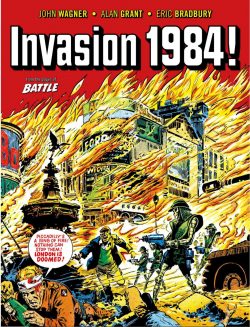
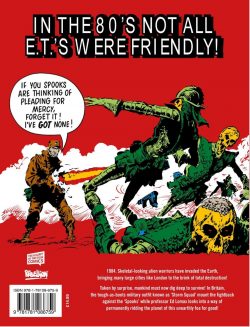
This particular combat compendium re-presents possibly the most unconventional series in the title’s eccentric history one that ran in Battle from 26th March to 31st December 1983. The entire saga is done in one book and comes with an enthused Introduction from editor and veteran scripter (Death Wish, Survivor, Real Roy of the Rovers Stuff, Comic Book Hero) Barrie Tomlinson.

What we have in Invasion 1984! is a classic end of the world/alien attack yarn in the vein of HG Wells’ War of the Worlds, published in the months leading up to the long-awaited literary moment of prophesied dystopia foretold by George Orwell. Deep stuff for a kids’ comic primarily about how their grandads were shot at by German and Japanese soldiers. However, the topic was evergreen, the fantastic elements were commonplace at this time and the actual work was left to three of the industry’s biggest guns…

Credited writer “R. Clark” was in fact John Wagner working with his regular co-scripter Alan Grant. Wagner (Bella at the Bar, One-Eyed Jack, Joe Two Beans, Roy of the Rovers, Judge Dredd, Strontium Dog, Outcasts, Fight for the Falklands, Button-Man, The Bogie Man, Batman, A History of Violence, Darkie’s Mob, Rok of the Reds and countless more) was born in Pennsylvania in 1949, but returned to Greenock in Scotland with his war-bride mum and siblings 12 years later.

He began his professional comic career at the end of the 1960s, firstly in an editorial capacity with Dundee-based DC Thomson & Co. He became a freelance writer soon after and moved to IPC in London. With him came colleague Alan Grant…

Born in Bristol, Grant (February 9th 1949 – July 21st 2022) grew up a true Scot in the heart of Midlothian. Wayward and anarchic, after trying regular life a couple of times he began his comics career in 1967 as an editor for DC. Soon he was writing scripts – many with Wagner – and inventing characters, first for British outfits but eventually all over the world.

His triumphs include Tarzan, Judge Dredd, Strontium Dog, Batman, Lobo, L.E.G.I.O.N., Judge Anderson, The Bogie Man, Channel Evil, Kidnapped, The Demon, Robo-Hunter, Anarky, The Loxleys and the War of 1812, Rok of the Reds and so many more.

He also contributed to amateur fanzines, encouraging and supporting new talent; adapted classic literature to comics form for major art festivals; worked in animation; organized his own comic conventions (in home village Moniaive) and self-published and ran his own publishing house Berserker Comics. In 2020, he led a community outreach project to inform about CoVID-19 via a comic book.

Handling the art was arguably Britain’s most accomplished dramatic illustrator.

The incredible and prolific career of Eric Bradbury (January 4th – 1921 – May 2001) began in 1949 in Knockout. Born in Sydenham, Kent, he studied at Beckenham Art School from 1936 and served in the RAF as a bomber rear gunner during the war. Demobbed, he worked at Gaumont-British Animation, where he met other future cartooning and comics masters Mike Western, Ron Smith, Bill Holroyd, Harry Hargreaves and Nobby (AKA Ron) Clark. When the studio closed Clark and Bradbury were hired by comics everyman Leonard Matthews at Amalgamated Press (latterly Fleetway/IPC).

Frequently working with studio mate Western, Bradbury drew strips such as Our Ernie, Blossom, Lucky Logan, Buffalo Bill, No Hiding Place, The Black Crow and Biggles. He was an “in-demand” illustrator well into the 1990s on many landmark strips including The Avenger, Cursitor Doom, Phantom Force 5, Maxwell Hawke, Joe Two Beans, Mytek the Mighty, Death Squad, Doomlord, Darkie’s Mob, Crazy Keller, Hook Jaw, The Sarge, Invasion (the 2000 AD strip), The Mean Arena, The Fists of Jimmy Chang, The Dracula Files, Rogue Trooper, Future Shocks, Tharg the Mighty and so much more…

Together this triumphant triumvirate crafted a sublimely simple but compellingly cathartic scary story of doom and resurrection, which began and proceeded in real time one year into the future…

On March 21st 1984, astronomers detect a vast fleet of city-sized extraterrestrial craft heading directly for Earth. When space shuttle Columbia is despatched to intercept and extend peaceful greetings, it is blasted to atoms…

From then on, the 3-page weekly instalments catalogue the crushing of our planetary defences, military helplessness, mass panic and displacement of humanity. Terrified and running, people are picked off by silent skeletal warriors or bombed and ray-blasted into annihilation. Once the city-ships land, increasing numbers of shattered shell-shocked humans are captured and flown away…

Amongst the panicking masses fleeing London is language professor Edward Lomax who quite sensibly packs up his wife Marion and son Mike and tries desperately to get out of the capital. As Britain’s armed forces stubbornly resist to the last, the Lomaxes strive to escape the carnage and Edward confirms his own fighting spirit by killing dozens of the intruders with their own weapons.

Ultimately, resistance proves useless and civilisation falls in days, but just when Edward is ready to give up, he and his loved ones are somehow found and rescued by an unconventional unit of brutal killers…

Modern day Dirty Dozen Storm Squad have been tasked with finding the professor by the last free remnants of the army. Plucked from the rubble of London after days of constant running and killing, Lomax and his kin are whisked to a hidden Command Bunker in Bedfordshire, where General Lapsley and Britain’s Defence Secretary (the last survivor of Parliament) put him to work finding out how the invaders communicate and devising a way to talk to them…

The task becomes increasingly urgent after even nuking occupied cities fails to slow the invaders, and Storm Squad (Major “Mad Mac” McVicker, Sergeant Dent, Corporal Cheyney, Plank, creepy Geiger, repulsive deviant Burke and the rest) are despatched to capture some live “spooks” to experiment on…

The most savagely effective killers on Earth quickly succeed – despite sustained resistance from the aliens and opportunistic interference from humans quickly returned to primal self-reliance. With the world a depleted wreck mired in constant conflict, Lomax cracks the mystery, just as Storm Squad learn first-hand what’s become of the millions taken by the Spooks. It only makes more imperative his efforts to talk to the newcomers…

His inevitable success comes at a cost and illuminate a relentless countdown. The aliens have brought a ghastly plague into the bunker that is also ravaging what remains of life on Earth…

At last aware of why they’re here and determined to secure the spooks’ universal cure for illness, Earth’s last defenders deploy for their final sortie with an ultimate weapon of their own, knowing they won’t all be standing at the end…

Bombastic, brilliantly bellicose and mischievously misusing the British Bulldog Spirit, this grim game-changing fable is a delightful response to the toxic tone of the mid-Eighties, whilst still fabulously filling the brief of a boys’ combat yarn: offering casual heroism and vicarious carnage sans any moral nuance. It’s a case of us or them and we will always choose us…

This mostly monochrome masterpiece also includes the 5 full-colour covers the short series spawned plus biographies of all involved, offering the kind of uncomplicated unshaded thrills we all secretly yearn for…
© 1983, 2019 Rebellion Publishing Ltd. All Rights Reserved.

Rick and Morty: Sometimes Science Is More Art Than Science – The Official Colouring Book


Illustrated by Austin Baechle (Titan Books)
ISBN: 978-1-80336-598-5 (PB)

Multi award-winning Adult Swim (the grown-up after-dark division of Cartoon Network) animated comedy science fiction series Rick and Morty was created by Justin Roiland & Dan Harmon. It was developed from the former’s parody short of Back to The Future in 2006, and with Harmon’s eventual collaboration was unleashed on the universe – arguably all of them – in December 2013. We’re up to Season 7, with 3 more contracted for.

The show combines edgy domestic comedy with outrageous fantasy spread across all of reality, as moral and impressionable Rick Smith is consistently lured into incredible and upsetting situations by his grandfather Morty Sanchez: an alcoholic and extremely brilliant mad scientist who lives with the Smith family. It’s all very funny, wildly imaginative and better read than talked about. (Un)Naturally, there’s a comic book tie-in too, and even a crossover series with the Dungeons & Dragons franchise that you can try too…

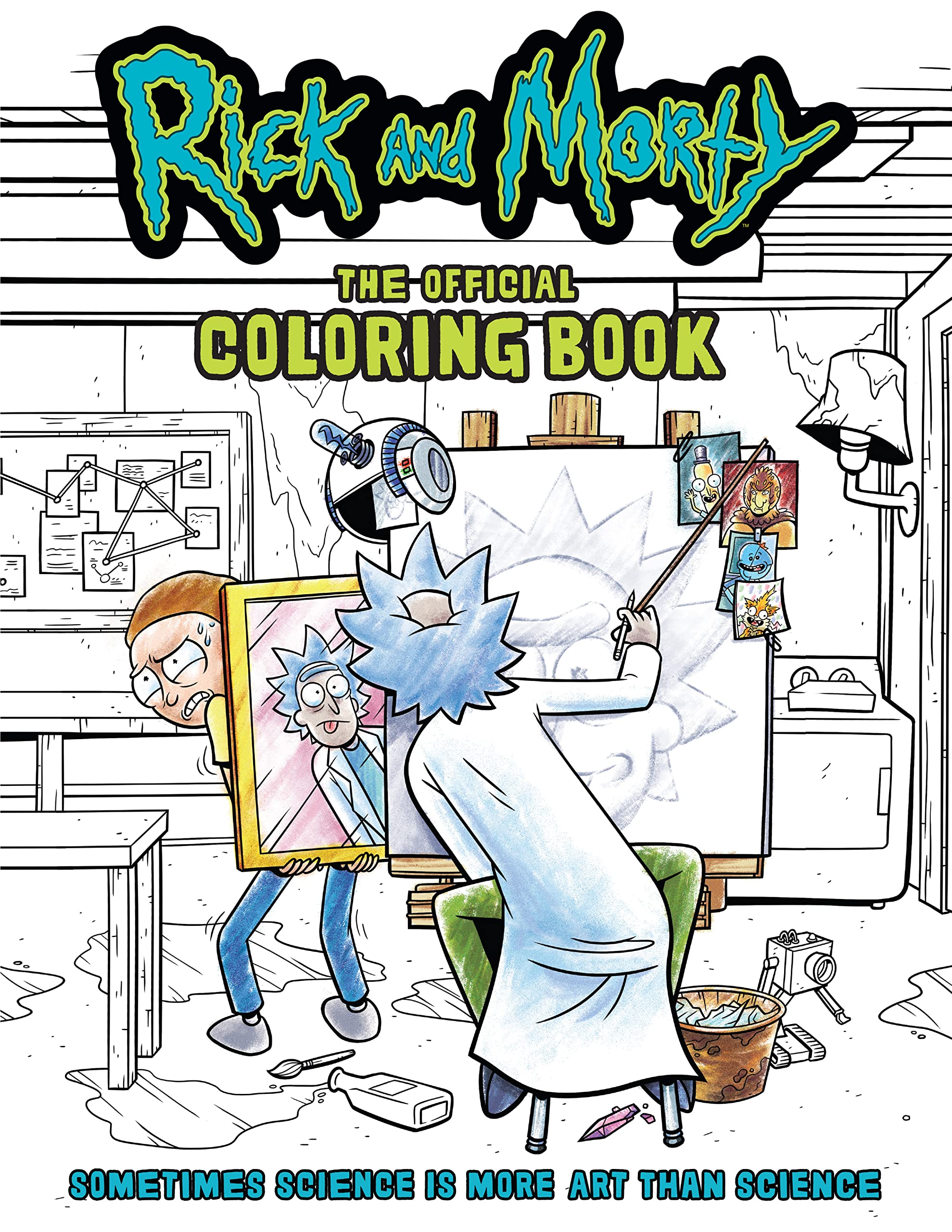
This decidedly peculiar and utterly interactive tribute to a strange time all around offers over 60 lusciously large and madly memorable images inspired by the show. Ranging from bizarrely disturbing to profoundly comic, these cartoon confabulations include weird places, odd characters, the Smiths in all their hoary glory, icky, sticky things, dragons, monsters and so much more, all delivered by animator Austin Baechle (Pre Fab), who preloads the magic of the grand parade through time, space, parallel dimensions and the backyard and bedroom in seductive style to delight the already dedicated and entice the uninitiated…

It’s never too soon or too late to unhinge your personal reality and get in touch with your visually expressive side, and the only way this wonderfully whacky experience could be improved is with crayons, paints and pens. Or maybe glue, glitter, fur and precious metals? No digital edition as yet, so if you want to play on a computer, you’ll need to get scanning. However, if you can work a keyboard and acclimatise to Rick and Morty’s many worlds you can surely get by…

Irreverent, subversive and appallingly addictive, the combination of great characters, compelling pictures and mirthful attention-seizing is a welcome way to while away the hours between life and the beyond…

Forget video-games – buy this (renewably resourced) book. If you’re worried about exercise, do the colouring-in standing up and if a mess (or winged dinosaur invasion) ensues, you can boost your cardio rate by cleaning it all up.

Challengingly eccentric and modernistically retro wonderment, this is a fun you can’t imagine …but can purchase.

© 2023 Cartoon Network. RICK AND MORTY and all related characters and elements are © & ™ Cartoon Network.  All Rights Reserved.

Shazam! The Golden Age of the World’s Mightiest Mortal


By Bill Parker & C.C. Beck, Roscoe Fawcett, Marcus Swayze, Pete Costanza, Otto Binder, Jack Binder, Mac Raboy, Joe Simon & Jack Kirby, Chad Grothkopf, Kurt Schaffenberger, and many & various: compiled & written by Chip Kidd and photographed by Geoff Spear (Abrams ComicArts/Harry N. Abrams, Inc.)
ISBN: 978-0-8109-9596-3 (2010 HB) 978-1-4197-3747-3 (2019 PB)

One of the most venerated and beloved characters in American comics was devised by Bill Parker & Charles Clarence Beck as part of a wave of opportunistic creativity following Superman’s debut in 1938. Although there were many similarities in the early years, the Fawcett Comics character moved swiftly and solidly into the realm of light entertainment -and even broad comedy – whilst, as the 1940s progressed the Man of Steel increasingly put whimsy aside in favour of action and drama.

Homeless orphan and thoroughly good kid Billy Batson was selected by an ancient wizard to battle injustice: granted the powers of six gods and mythical heroes. By speaking aloud the mage’s name – an acronym for the patrons Solomon, Hercules, Atlas, Zeus, Achilles and Mercury – Billy transformed from scrawny boy to brawny adult Captain Marvel.

At the height of his popularity, “the Big Red Cheese” significantly outsold The Man of Steel – published twice monthly and topping 14 million copies per month. Before eventually evolving his own affable personality the full-grown hero was a serious, bluff and rather characterless powerhouse, whilst alter ego Billy was the true star: a Horatio Alger archetype of impoverished, resourceful, boldly self-reliant youth overcoming impossible odds through gumption, grit and sheer determination…

However, as the decade moved on, tastes changed and sales slowed. A court case begun in 1941 by National Comics contesting copyright infringement was settled. Like many other superheroes, Cap disappeared, reduced to a fond memory for older fans. A big syndication success, he was missed all over the world…

In Britain, a reprint line had run for many years, so creator/publisher Mick Anglo had an avid audience and no product. His solution was to reimagine the franchise with atomic age hero Marvelman and Co. continuing to thrill readers well into the 1960s.

As America experienced another superhero boom-&-bust, the 1970s dawned with a shrinking industry and wide variety of comics genres servicing a base increasingly dependent on collectors and fans rather than casual or impulse buyers. DC needed sales and were prepared to look for them in unlikely places. Following a 1953 court settlement with Fawcett, DC ultimately secured the rights to Captain Marvel, his spun-off extended Family and attendant strips and characters.

Despite the actual name having been taken by Marvel Comics (via a circuitous route and quirky robotic hero published by Carl Burgos and M.F. Publications in 1967), the home of Superman opted for tapping into that discriminating, if aging, fanbase. In 1971, they licensed the dormant rights to the character stable (only fully buying them out in 1991) and two years later, riding a wave of national nostalgia on TV and in movies, DC resurrected and relaunched the entire beloved cast in their own kinder, weirder, completely segregated and separate universe.

To circumvent intellectual property clashes, they named the new/old title Shazam! (‘With One Magic Word…’): the unforgettable trigger phrase used by the majority of Marvels to transform to and from mortal form and a word that had entered the American language thanks to the success of the franchise (especially an excellent movie serial) the first time around.

Issue #1 carried a February 1973 cover-date and generated mixed reviews and unconvincing sales, but was pushed hard by DC. It even briefly scored the big prize in the publisher’s eyes. Adapted as live action Saturday morning TV series Shazam!, it ran three season (28 episodes) from 7th September 1974 to October 1976…

The comics are universally welcoming and wonderful and you should read them all, but we’re looking at a different aspect of the phenomenon here. Like any multi-media property, the Marvel Family franchise spawned tons of merchandise and this compendium sublimely showcases those tantalising collectables and examples of ephemera from the first 14 years – 1940-1953.

Most gems reproduced here come from the truly enviable personal collection of Harry Matesky as photographed by Geoff Spear (Batman Collected, The Peanuts Poster Collection, Mythology: The DC Art of Alex Ross). The multi-media melange is compiled, arranged and curated by frequent collaborator and acme and everyman of design fascinations and armchair indolences Chip Kidd (Cheese Monkeys, Batman: Death by Design, Only What’s Necessary: Charles M. Schulz and the Art of Peanuts, Go: A Kidd’s Guide to Graphic Design, Batmanga!: The Secret History of Batman in Japan, Jack Cole and Plastic Man: Forms Stretched to Their Limits).

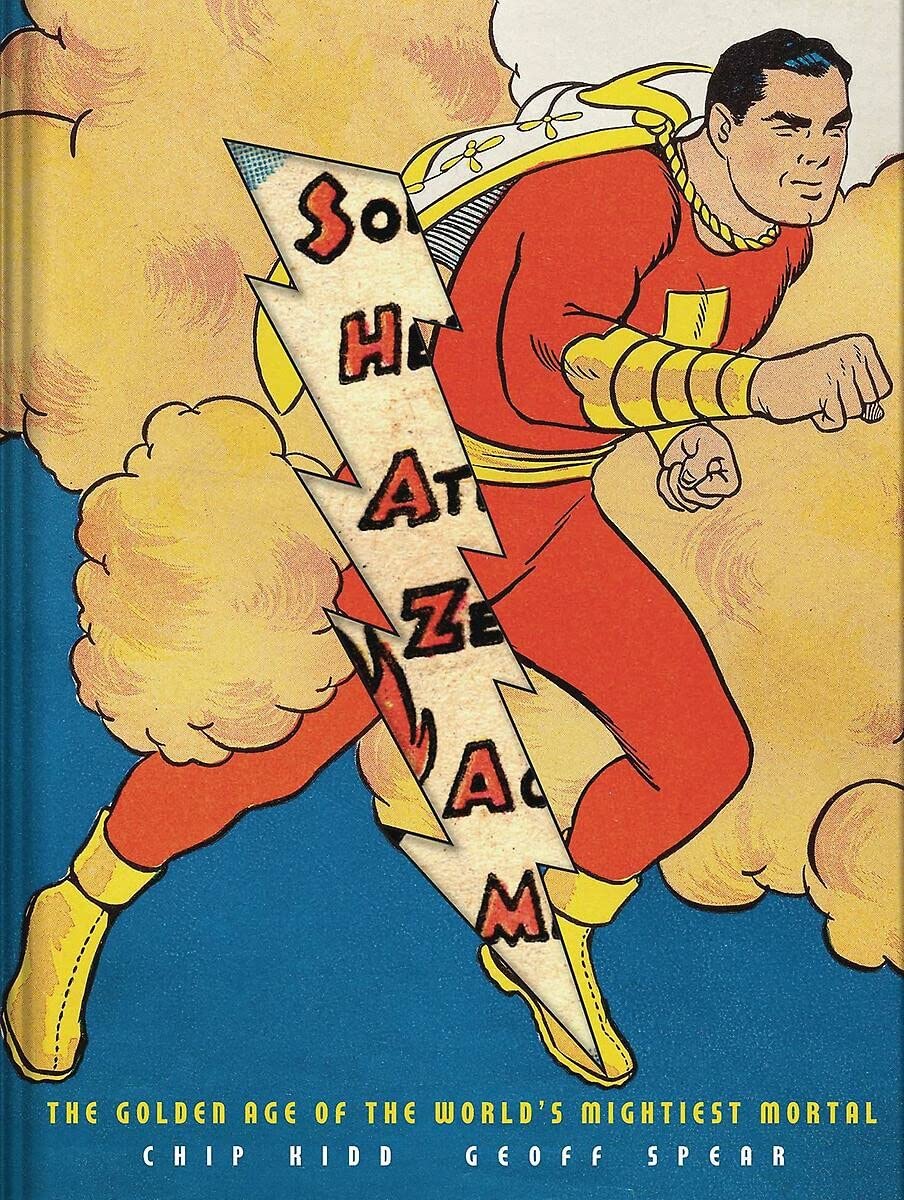
This celebration of comics’ true magic was first released in 2010 as an epic oversized (235 x 310mm) hardback jam-packed with 3D cutaways, gatefolds and other print technology “bells & whistles”, and re-released in paperback (260 x 190mm) to tie-in with the first modern Shazam movie in 2019.

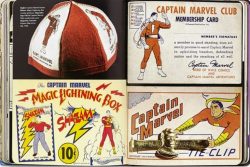
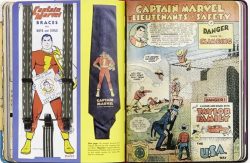
It’s a virtual wonderland for anyone who’s still a kid inside (AKA all men), overflowing with letters from the Captain Marvel Club, dynamic blow-ups of key characters such as Dr Thaddeus Bodog Sivana, classic covers, early toys, models, games, action figures and even candid shots of happy kids in their Captain and Mary Marvel costumes.

In its heyday, the Captain Marvel Club boasted a membership topping 400,000, serviced by a steady stream of priceless – and exclusive – tat to acquire: buttons, watches, key chains, paper rockets, tin toys, figurines, clothing, patches, transfers and more. Its inclusive and commercially canny model was repeated by later stars like Mary Marvel and others.

These feature amidst a wealth of mouth-watering displays of old comics, covers, original art, movie posters, apparel, toys, games and far rarer items – like Fawcett’s outreach material for potential manufacturers and merchandising partners and in-house writing guidelines.

Publishing house Fawcett first gained prominence through an immensely well-received light entertainment magazine for WWI veterans. From Captain Billy’s Whiz-Bang they branched out into books and general interest magazines. Most successful publication – at least until Batson hit his stride – was ubiquitous boy’s building/activity bible Mechanix Illustrated. As the 1940s unfolded, scientific and engineering discipline and can-do demeanour underpinning MI suffused and informed both art and plots of Marvel Family titles.

On show here are long-lost treats like the Captain Marvel Magic Whistle (complete with packaging), secret codes and decoders, the Captain Marvel Magic Membership Card, gewgaws and gimcracks, house ads, prize competitions and editorials, interspersed with a terse but informative history of the company, the creators, characters and entire beguiling phenomenon,

The star and his spin-offs sparked a huge campaign of coordinated ancillary merchandising, especially once the Big Red Cheese made a spectacular leap to the silver screen in 12-part chapter play The Adventures of Captain Marvel. That luminous landmark provides some rousing stills featuring star Tom Tyler as the Good Captain…

As detailed in ‘Hey Kids! See Capt. Marvel in the Movies’, in 1940 Republic Pictures reached out to Detective Comics Incorporated with the notion of turning Superman into a movie serial. No deal was struck and a year later Republic catapulted Fawcett’s big gun onto screens and into history. This essay is augmented by biographies, lobby cards, posters from many countries, contemporary ads and write-ups from magazines and comics of the period.

The only complete comics yarn included here is a corker. In the formative years as the feature rocketed to the first rank of superhero superstars, there was a scramble to fill pages. Following his Whiz Comics residency and epic one-shot Special Edition Comics, the indomitable innocent was promoted to his own solo title, but with Beck and his studio overstretched, Captain Marvel Adventures #1 (cover-dated March 1941, and on sale from January 17th) was farmed out to up-and-coming whiz-kids Joe Simon & Jack Kirby. With inker Dick Briefer they produced the entire issue in a hurry from Beck and Parker’s guides. Apparently they did it in two weeks whilst finalising the launch of Captain America

‘Captain Marvel versus Z’ remains a visually impressive action-drama with the irrepressible Sivana creating a hulking android brute designed to be the Captain’s equal. Despite numerous clashes and subsequent upgrades, after one last brutal knock-down, drag-out, Kirby-co-ordinated dust-up, it is apparent that Z isn’t…

The hero soon spawned sidekicks and assistants aplenty. The two most successful were Captain Marvel Junior and Mary Marvel who each have their own sections, replete with merch and memorabilia – both American made and from syndicating publishers who reprinted them around the world. There are also short sections devoted to other Fawcett stars Spy Smasher (who also had a Republic movie serial and club – the “Victory Battalion”) and Hoppy the Marvel Bunny.

Toys, stationary, puzzles and games include Captain Marvel Lightning Racing Cars (glorious tin toys!), Captain and Mary Marvel Wristwatches (plus ads and packaging), keychains, a Captain Marvel Fun Kit, Helicopter and Power Siren (“world’s mightiest whistle!”). There are images of Captain Marvel’s Radar Racer, Rocket Raider and Magic Eyes (all with some assembly required); a compass-ring, Shazam board game, 3-D Magic Picture, a jigsaw, paper “punch-out book, and ceramic figurines ready to illuminate in the Captain Marvel Adventures in Paint set.

Throwable toy Hoppy the FLYING Marvel Bunny also needs assembling before launch, as does his Musical Evening Miracle Toy of Today, and there are examples of ultra-rare velveteen stuffed dolls of both the rabbit and his human inspiration…

As well as painting and colouring books, pencils, plastic statuettes, buzz bomb paper planes and Christmas tree decorations, are projects and covers from all across the globe, like lead figures and assorted Pre-Mick Anglo comics from Britain, plus a (gloriously painted) trading card set from Spain. There’s even a bootleg trading card album set from Havana, Cuba, based on the 1941 Republic serial.

Ready to wear items include novelty shirts, braces, neckties and a cape; bean bags, tie-clips, beanie-hats, vinyl saddlebag, bike/wall pennants, “overseas style” hats and caps, skin tattoo and iron-on tee-shirt transfers, illustrated soap (!?), numerous Premium postcards, patches and badges with even Billy and Hoppy the Marvel Bunny proudly included amongst the regular costumed heroes…

Leasing his fame, the Captain appears in strip ads for Coola Cola and other salient sales points (illustrated by Costanza) and proudly confirms his patriotic zeal via many inspirational war-time covers and with the Comics Canteen! packs (comics distributed gratis by Fawcett to US servicemen in 1942).

The titanic tome terminates with an examination of the end as ‘Twilight of the Golden Age’ reveals details of the court settlement, and reviews extracts from trial transcripts.

All items cited here are merely the tip of an iceberg of fabulous stuff no fan could resist, and an evocation to the simple pleasure of youth, making this book an unparalleled package of pure weaponised nostalgia impossible to resist. So don’t…
© 2010, 2019 DC Comics. All rights reserved.

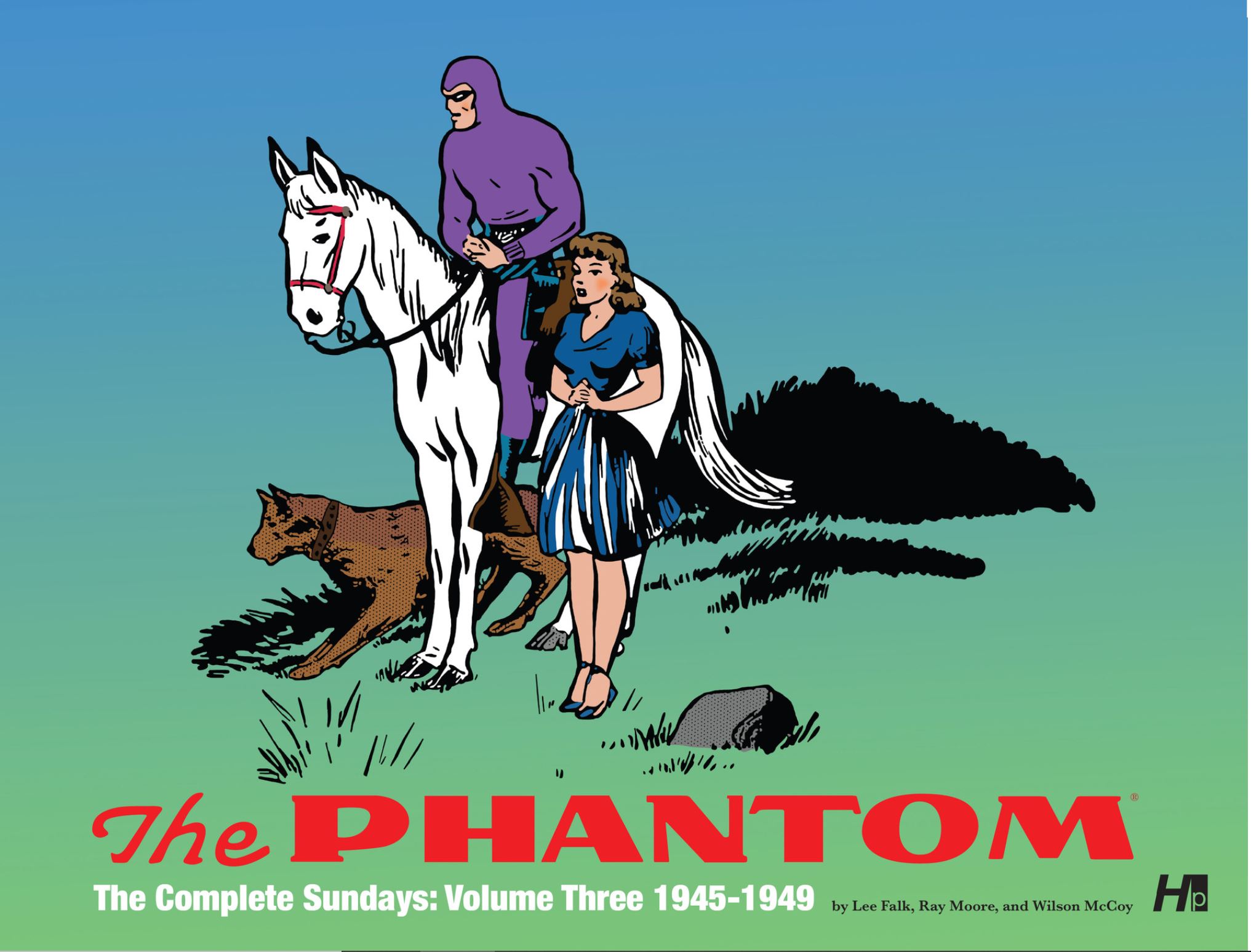
The Phantom: The Complete Sundays Archive Volume Three 1945-1949


By Lee Falk, Ray Moore & Wilson McCoy: introduction by Daniel Herman (Hermes Press)
ISBN: 978-1-61345-100-7 (HB/Digital edition)

Born Leon Harrison Gross, Lee Falk created the Ghost Who Walks at the request of his King Features Syndicate employers who were already making history, public headway and loads of money with his first strip sensation Mandrake the Magician. Although technically not the first ever costumed champion in comics, The Phantom became the prototype paladin to wear a skin-tight body-stocking and the first to have a mask with opaque eye-slits…

The generational champion debuted on February 17th 1936, in an extended sequence pitting him against an ancient global confederation of pirates. Falk wrote and drew the daily strip for the first two weeks before handing over illustration to artist Ray Moore. The spectacular and hugely influential Sunday feature began in May 1939.

For such a long-lived, influential series, in terms of compendia or graphic collections, The Phantom has been quite poorly served in the English language market (except for the Antipodes, where he has always been accorded the status of a pop culture god). Many companies have sought to collect strips from one of the longest continually running adventure serials in publishing history, but in no systematic or chronological order and never with any sustained success. That began to be rectified when archival specialists Hermes Press launched their curated collections…

This third edition is a lovely and large (229 x 330 mm) landscape hardback/digital tome, displaying a complete full colour Sunday per page. Released in March 2016, its 208 pages are stuffed with sumptuous visual goodies like panel and logo close-ups, comics covers and lots of original art and opens with publisher Daniel Herman’s ‘Introduction: The Sunday’s Continue…’ recapping all you need to know about the feature and disclosing how Wilson McCoy assumed the illustrator’s role from Ray Moore – and why nobody knows exactly when he did…

For those who came in late: 400 years previously, a British mariner survived an attack by pirates, and – after washing ashore on the African coast – swore on the skull of his father’s murderer to dedicate his life and that of his descendants to destroying all pirates and criminals. The Phantom fights evil and injustice from his fabulous lair deep in the jungles of Bengali. Throughout Africa and Asia he is known as the “Ghost Who Walks”…

His unchanging appearance and unswerving war against injustice led to his being considered an immortal avenger by the uneducated, credulous and wicked. Down the decades, one heroic son after another has inherited the task, fought and died in an unbroken family line, with the latest wearer of the mask indistinguishable from the first and proudly continuing the never-ending battle.

In his first published exploit the Phantom met and fell for wealthy American adventurer Diane Palmer and his passion for her was soon reciprocated and returned and she became a continuing presence in both iterations of the series as ally, partner, sounding board, a means of reader identification and naturally a plot pawn and perennial hostage to fortune.

Almost every saga featured powerful, capable and remarkably attractive women as both heroes and villains, and in opening tale ‘Queen Pera the Perfect’ (running from December 9th 1945 to March 17th 1946), Diana saw the tables turned…

The aforementioned ruler of remote but rich Karola was constrained to find a husband, and so sent her fanatical minions into the world to find a man worthy of her. They returned with a musical genius, celebrated fighter pilot, champion pugilist and cinema’s greatest lover, but wherever they went they heard legends of an incredible superman…

After The Phantom repeatedly refuses her men’s offer, and gives her stern lesson in manners, she responds by having him imprisoned in her dungeons until he sees sense, and this time it’s his true love who has to save the day…

Spanning March 24th to August 4th 1946, ‘King of Beasts’ sees the liberated champion retuned to Bengali in time for Diana to be unjustly imprisoned. A priceless pearl necklace has been stolen from a maharajah and nobody believes the story of who actually took it: not the police and certainly not American mobster Poison Ivy and his boys…

When The Phantom tries to engineer a jailbreak, he’s caught too and charged with being an accomplice, only for the true thief to free him and Diana by sending a pickpocketing monkey to unlock their cell. In the ensuing flight, Diana is snatched by the mobsters, who don’t believe a word about a hidden mastermind using trained beasts to burgle. That all changes when a trained troop of elephants bust into the bank and porcupines empty a packed casino for their masked master…

With chaos unleashed, The Phantom retrenches and calls in his own equine ally and canine corps. Mighty steed Hero and lupine assistant Devil soon track down the King of Beasts who is far from what anyone expected. However even after he’s handled, there’s still increasingly murderous Poison Ivy to deal with…

Another female fury debuts in ‘The Scarlet Sorceress’ (August 11th – December 22nd) as a royal visit to the Deep Woods of the Bandar People introduces little Princess Valerie and her grandfather the Rajah of Volara. The child will soon become a pawn in a wicked plot…

When the princess of neighbouring kingdom Wogu falls ill, a devious manipulator “prophesies ” that only golden-haired Valerie’s blood can save the ailing waif, prompting a kidnapping and a frantically fast response from the Ghost Who Walks. Not all the monstrous forces set against him can slow the Phantom, but after exposing the witch as a charlatan, the hero discovers that he’s fighting not a villain but another victim. Soon, however, his efforts save all involved and pacify two kingdoms…

December 29th 1946 to June 29th 1947 finds The Phantom once more battling to save Diana after the filthy rich and spoiled Potentate of Ptjar Prince Pepe abducts her to be his very best bride. Law and reason mean nothing to the repulsive despot and by the time the hero reaches the distant kingdom, she is beyond even the Ghost’s reach. His only recourse is to play Pepe’s game and in a dozen days complete ‘The 12 Tasks’ conceived to frustrate and humiliate the hero. However, wit and ingenuity married to his mighty physicality make short work of the impossible – such as capturing an invulnerable giant bandit, emptying a river of carnivorous fish, banishing every shark in the bay or stopping all crime for 24 hours – and despite Pepe’s cheating equivocations the final task changes the nation forever and for the better…

A return to jungle warfare and tribal feuding underpins ‘The Dragon God’ (July 26th to November 16th) as Diana’s interest in an ancient Wambesi idol presages the fire-breathing saurian coming to life and demanding its worshippers kill and plunder their neighbours the Ulangi. With “The Phantom’s Peace” broken, the Ghost Walks amongst them to re-establish order and quickly discovers white instigators and recovered wartime weaponry behind the uprising, but once begun war has its own momentum and tribal grudges run deep and burn forever…

With bloodshed ended, a change of pace and tone heralds the return of an appalling duo who had previously made life miserable for The Phantom. Spanning November 23rd 1947 to May16th 1948, ‘The Marshall Sisters’ sees over-privileged brats Lana and Greta return to Africa in a ruthless no-holds barred competition to seduce and wed the mighty jungle avenger. This is after their last attempt to land the ultimate trophy husband was foiled by Diana Palmer…

When allure, deception and blackmail all fail, the hellions even try shanghaiing and blunt force trauma to achieve their aims, but lose all control when the various thugs they hire hijack the caper…

A relatively short story running from May 23rd through September 5th follows, revealing how a long-running annual sporting contest devised by the original ancestral Phantom has served to ameliorate tribal tensions for four centuries. Although its dollar value is meaningless to the competitors who strive for pride and bragging rights alone, the gem-stuffed urn that acts as ‘The Phantom Trophy’ is an irresistible prize for cop-killing fugitives Spike and Grunt.

When they rope in more scallywags to swipe the prize from the previous holders/custodians, before it can be handed over to the new champions tribal war erupts. Although The Phantom hunts the thieves he might be too late as naked greed turns the rogues against each other…

The final sequence in this volume visits ‘The Haunted Castle’ (September 12th 1948 – February 13th 1949) as Diana goes exploring alone and is propelled into wild unexplored country. As The Phantom and Devil search for her, she wanders a lost valley whose people are enslaved by sinister wizard Great Moogoo who shrinks anyone who opposes him to the size of a plaster gnome and adds them to his terrifying garden…

As the lascivious sorcerer captures her, Diana’s man has tracked her to the stone citadel and begun a one-man siege that exposes his nefarious trickery and wrecks his powerbase…

Taken from America’s immediate post-war period, these brief encounters are bold, brash, uncomplicated fare, full of despicable rogues, lost kingdoms, savage tribes, dangerous but still redeemable dames and very bad guys, but thrillingly reassuring entertainment for all that. Just remember, different times have different values. If the kind of fare you’d encounter in a 1940s Tarzan movie or cop thriller might offend, you should consider carefully before starting this…

Finally rediscovered, these lost treasures are especially rewarding as the material is still fresh, entertaining and addictively compelling. However, even if it were only of historical value (or just printed for Australians – manic devotees of the implacable champion from the get-go) surely the Ghost Who Walks is worthy of a little of your time?
The Phantom® © 1945-1949 and 2016 King Features Syndicate, Inc. ® Hearst Holdings, Inc. Reprinted with permission. All rights reserved.

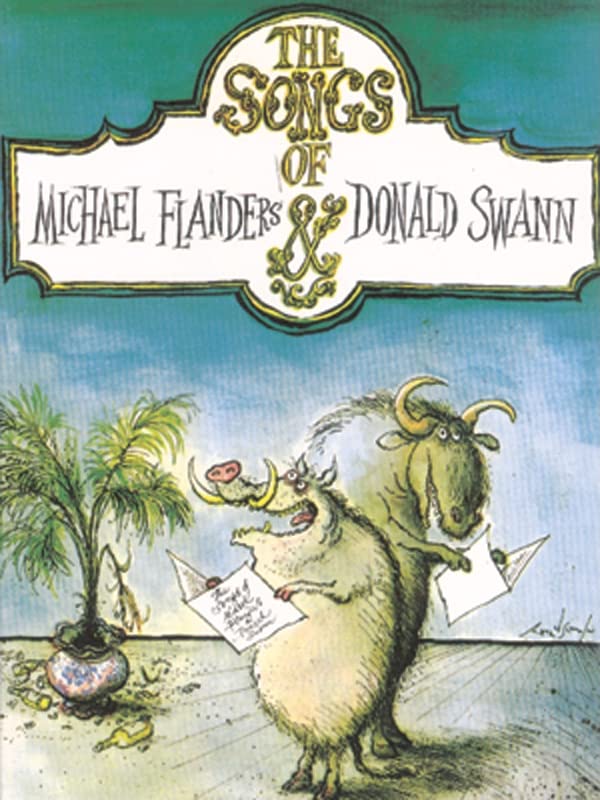
The Songs of Michael Flanders & Donald Swann


Lyrics by Michael Flanders & Donald Swann, illustrated by H. M. Bateman, Gerard Hoffnung, Osbert Lancaster, David Low, Gerald Scarfe, Trog (Willy Fawkes), Edward Burra, Ionicus (Joshua Charles Armitage), William Hewison, Michael ffolkes, Ronald Searle and Many & Various (Elm Tree Books/International Music Publications Limited)
ISBN: 978-0-24189-738 6 (HB) 978-1-85909-439-6 (PB)

When music becomes global major news and both a political hot potato and celebration of Gay Pride, I’d be a sucker not to mark the occasion with a cheap shot and hearty paean for my own aspirational dreams. I want new people to recognise some good old days of my own – in words and pictures as well as musically. If you are intrigued, track these down…

I’m stretching my brief again here (and isn’t that a grisly image to conjure with?) to review this superb slice of comedy nostalgia that’s still readily available. Michael Flanders (1922-1975) and Donald Swann (1923-1994) were primarily songwriters who became a huge international success performing their own material and acting as charming social commentators.

All this they did, live on stage in a vibrant, satirical manner that captivated audiences both in theatres across the globe, but also on the increasingly important television variety circuit.

Their brand of gently jibing whimsy (mostly skewering themselves and a rapidly changing Britain and “Englishness”) through mordant sarcasm delighted the folk of many nations, and songs such as “The Hippopotamus” (you may know it as “Mud, Mud, Glorious Mud”) or “The Reluctant Cannibal” are still liable to break out whenever people of a certain age congregate near a piano.

The dapper duo first teamed up in 1948 and were brilliantly funny on stage. Live albums like At the Drop of a Hat and At the Drop of Another Hat are classic examples of comedy stand-up that still leave contemporary improv performers agog and breathless. Both of them died far too early.

This brain-blistering book gathers 41 of their funniest, most sarcastic, touching and best songs, with both sheet music and separate lyrics. It’s also augmented by cartoons and illustrations from some of Britain’s greatest humorous illustrators such as H. M. Bateman, Hoffnung, Osbert Lancaster, David Low, Gerald Scarfe, Trog, Edward Burra, Ionicus, Hewison, ffolkes, Ronald Searle and many others.

If you’re a sucker for shopping lists the delicious ditties done here are In The Bath, Design For Living, Misalliance, The Gas-Man Cometh, A Song Of The Weather, Pillar To Post, Rain On The Plage, Motor Perpetuo, Slow Train, A Transport Of Delight (Omnibus), Last Of The Line, Twenty Tons Of TNT, The Reluctant Cannibal, Pee-Po-Belly-Bum-Drawers, Budget Song, Ballad For The Rich, All Gall, Philological Waltz (Tonga), Song Of Patriotic Prejudice, The Lord Chamberlain’s Regulations, The Album, Ill Wind, Guide To Britten, Song Of Reproduction, Bedstead Men, Excelsior, Vanessa, Twice Shy and the rather worrisome-by-modern-standards Madeira, M’dear?

Also included are a selection of their generally child-friendly airs such as The Armadillo, …Hippopotamus, …Ostrich, …Elephant, …Gnu, …Rhinoceros, …Sloth, …Spider, …Wild Boar, The Whale (Mopy Dick), The Warthog and The Wompom, acting in concert to make this grand book a delight to look at as well read. If you ever needed a reason to dust off the old piano lessons…
© 1977, 1996 International Music Publications Limited. Illustrations © 1977 their respective copyright holders.

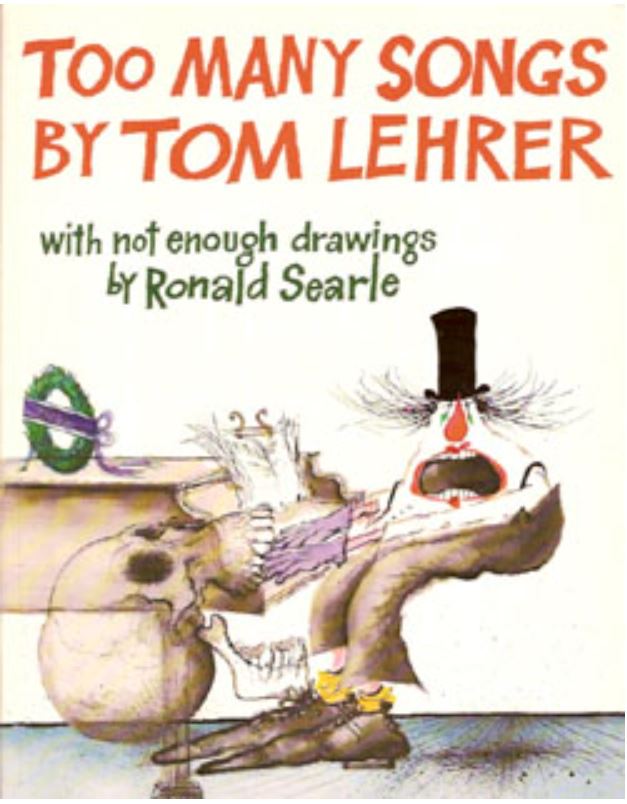
Too Many Songs by Tom Lehrer, With Not Enough Drawings by Ronald Searle


By Tom Lehrer & Ronald Searle (Methuen)
ISBN: 978-0-41348-570-0 (HB) 978-0-41374-230-8 (PB)

And we will all go together when we go.
What a comforting fact that is to know.
Universal bereavement – an inspiring achievement,
Yes, we all will go together when we go.
We will all go together when we go.
All suffused with an incandescent glow.
No one will have the endurance – to collect on his insurance
Lloyd’s of London will be loaded when they go.

Are you musical? I already know that you are a lover of graphic narrative excellence and fine art, so the wonderfully dark, sinister, disturbing and utterly brilliant cartoon illustrations of Ronald Searle will delight you.

But the name of mathematician, songwriter, satirist, Intellectual and early proponent of sick and bad taste humour Tom Lehrer is perhaps not so well known, although his achievements are as remarkable and far-reaching. If you already know of him you’ll know why I’m such a fanatical fan. If not, crack open your search engines. It’ll be the most fun you’ve had in ages.

This terrifically terse yet near-terpsichorean tome – often re-issued as a comedy classic (the last time was 1999) – contains the music, lyrics, words, tunes, piano accompaniments, and guitar chords for 34 classics from a frankly staggering oeuvre and back-catalogue comprising decades of educational and comedic songs. From such classics as “Poisoning Pigeons in the Park”, the deeply disturbing yet hilarious “I Hold your Hand in Mine”, “The Old Dope Peddler” and “The Masochism Tango” to the lightly spiky “Be Prepared” or “I Got it from Agnes”, Lehrer makes smart people laugh, venal people squirm and all people think.

Also included are edgy examples from his tenure as songwriter for That Was The Week That Was and educational ditties penned for the Electric Company/Children’s Television Workshop (now the Sesame Workshop).

Some songs have been adapted by George Woodbridge in Mad Magazine,

In 2020, aged of 92, Professor Lehrer donated all lyrics and music written by him to the public domain, and on November 1st, followed up with all recording and performing rights of any kind, making all his originally composed or performed confections free for anyone to use. They are available directly from his site for free download (http://tomlehrersongs.com/).

His accompanying statement concluded with: “This website will be shut down at some date in the not-too-distant future, so if you want to download anything, don’t wait too long.”

Just as with Flanders & Swann there’s no substitute for actual performances, but in case you need more to go on, lurking here all snappy and sharp arias including The Irish Ballad, Fight Fiercely Harvard!, Be Prepared, The Old Dope Peddler, The Wild West Is Where I Want to Be, I Wanna Go Back to Dixie, Lobachevsky, The Hunting Song, I Hold Your Hand in Mine, My Home Town, L-Y, When You Are Old and Gray, The Wiener Schnitzel Waltz, Poisoning Pigeons in the Park, A Christmas Carol, Bright College Days, In Old Mexico, She’s My Girl, The Elements, The Masochism Tango, National Brotherhood Week, MLF Lullaby, The Folk Song Army, Smut, Send the Marines, New Math, Pollution, So Long Mom, Who’s Next?, The Vatican Rag, Wernher Von Braun, I Got It from Agnes, Silent E and We Will All Go Together When We Go.

Wedded to the razor-wrought drawings of Ronald Searle, this is an astoundingly entertaining book and what every liberal should make the piano teacher use on the kids: a melodic match for EC horror comics. Lehrer’s music and performances are readily available: go avail yourself of them online – or via your favoured news platform or source.

Moreover, I can’t resist ending with a famous quote. Just remember, please, this is not a malicious man, just a keenly observant Wit who claimed he’d stopped doing satire because “Awarding the Nobel Peace Prize to Henry Kissinger made political satire obsolete”…
© 1981, 1999 Tom Lehrer. Illustrations © 1981 Ronald Searle.

Avengers by Brian Michael Bendis volume 1


By Brian Michael Bendis, John Romita Jr., Klaus Janson, Tom Palmer& various (MARVEL)
ISBN: 978-0-7851-4500-4 (HB/Digital Edition) 978-0-7851-4501-1 (TPB/ Digital Edition)

Probably Marvel’s biggest global franchising success, The Avengers celebrate their 60th anniversary in September 2023, so let’s again acknowledge and anticipate that landmark event with another glorious past triumph…

Once upon a time Norman Osborn was America’s Security Czar: an untouchable “top-cop” in sole charge of a beleaguered nation’s defence and freedom, especially in regard to the USA’s costumed and metahuman community.

When the former-but-still-deranged Green Goblin at last but inevitably overplayed his hand, a coalition of outlawed champions united to defeat him, and his fall from grace was staggering and total.

The chaos and carnage led to a new Age of Heroes, and as part of that resurgence, original Captain America Steve Rogers was appointed Supreme Commander of US metahuman resources. He promptly set about redefining the what, who and how of the World’s Mightiest Heroes which launched a flotilla of new teams and titles, with Avengers volume 4 being the official spine of the comic book franchise.

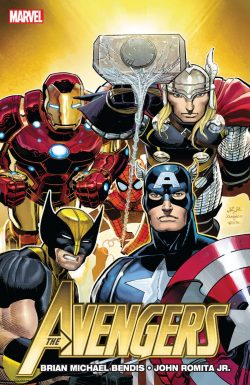
Available in a number of formats, this initial collection gathers issues #1-6 as written by Brian Michael Bendis and illustrated by John Romita Jr. with inkers Klaus Janson & Tom Palmer colourist Dean White and letterer (VC’s) Cory Petit adding to the spectacle and wonderment. The book spans cover-dates July to December 2010) and opens with a peek at a terrifying future before skipping back to Now where a triumphant, reunited army of heroes is trying to democratically decide just who goes where and does what…

Those deliberations are rudely interrupted in ‘Next Avengers Part One’ when time-tyrant Kang the Conqueror beams in with a frantic warning. He barely opens his mouth before he’s blasted across the city by the wary, twice-shy heroes, but as they converge to press their attack the Conqueror stops all hostilities by brandishing an ultimate weapon.

Iron Man Tony Stark prevents his comrades from finishing off Kang as he recognises the Dark Matter Accelerator. It’s something he thought up and swore never to build. The only way the future Fuhrer can have it is if Stark made it and gave it to him…

In the cautious ceasefire that follows, Kang explains he’s come to beg the aid of the Avengers. In his current future he is one of a team that includes the children of the Avengers, united to stop life-loathing Artificial Intelligence Ultron from exterminating humanity.

They have at last succeeded in destroying the mechanoid marauder but the children are now an even greater menace. Moreover, Kang’s attempts to stop them have resulted in time itself shredding… and all of reality is now collapsing…

The arrogant time-terrorist expects the Avengers to stop their errant offspring, but as Rogers heads off all debate to arbitrarily assemble teams, back in the future Kang and his hidden allies make preparations to carry out their true scheme…

Not every past Avenger is keen to answer the call to reassemble. Simon Williams has come to believe the team has done more harm than good and threatens to stop them if they start up again. ‘Wonder Man Attacks?!!’ sees him make good on his warning whilst a small squad locate Kree outcast Noh-Varr The Protector to request his expertise in time travel.

As the alien and Stark’s efforts finally bear fruit, Wonder Man brutally engages the entire team. In the resultant blockbusting battle, something goes terribly wrong, and an alternate Apocalypse and his horrendous Horsemen materialise, intent on ending mankind.

As the embattled titans swiftly mobilise to tackle the next crisis, a ‘Menace from Beyond Time’ manifests as various time-streams and realities begin to coalesce and overlap in New York City. With All of Everything endangered, a unit of heroes heads into the unhappy future leaving their harried comrades to hold back a tidal wave of time-tossed menaces – and the occasional misplaced hero such as Killraven and Devil Dinosaur

Far away from now, Iron Man, Wolverine, replacement Captain America James “Bucky” Barnes and Noh-Varr witness first-hand the cataclysmic war against Ultron before being ambushed by the next generation in ‘Only the Good Die Young’.

Back in their home era, a multitude of past menaces – from cavemen to cowboys to cosmic devourer Galactus – are keeping the majority of Avengers busy, whilst in the foredoomed tomorrow the questing quartet are painfully discovering they’ve been played by Kang yet again…

Full explanations are promised by an incredibly aged Tony Stark and the architect of the chronal rescue plan: Bruce Banner in his gamma-charged arch-villain persona of ‘The Maestro’

With two Starks, an incredibly sagacious and experienced Banner and new element Noh-Varr all intent on fixing the problem, the sorry story soon comes out. All of creation’s future is stuck in a temporal loop: a cosmic “Groundhog Day” with Kang interminably trapped battling Ultron. Now, with the odds altered by the historical Avengers, there’s a real chance to make things right in one final ‘Battle for the Future’

Tragically, as Thor’s clash with Galactus escalates and the assembled Avengers resolutely resist Apocalypse and his minions in the now, there may not be a past to return to…

Layers of murderous duplicity are peeled back in ‘Next Avengers Part 6: Conclusion’ as a cunning solution to the Ultron-Kang impasse is conceived. However, even as reality reasserts itself and four weary heroes return home, old man Stark takes the risky chance of giving his younger self a deadly device and a portentous warning from the future…

Epic in scale, vast in scope and overflowing with action, this a magnificently rendered tale that might bewilder new readers looking for a post-movie fix, but will delight dyed-in-the-wool Fights ‘n’ Tights fanatics. It comes with a gallery of covers-&-variants by Romita Jr., Janson & Dean White, John Romita Sr., Greg Land & Morry Hollowell, Jim Cheung & Justin Ponsor, Alan Aldridge, Phil Jimenez & D’Armata, plus a massive combined variant cover by Marko Djurdjevic.
© 2018 MARVEL.

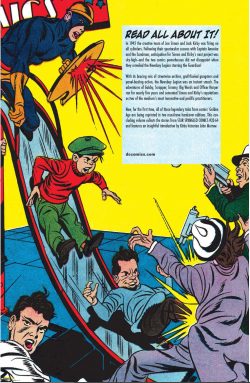
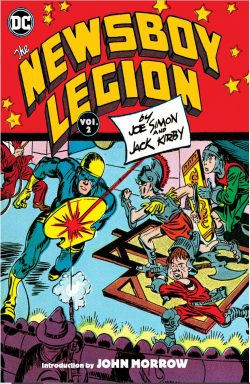
The Newsboy Legion by Joe Simon & Jack Kirby volume Two


By Joe Simon & Jack Kirby with Don Cameron, Joe Samachson, Ed Herron, Arturo Cazeneuve, Curt Swan, Gil Kane, Joe Kubert & others (DC Comics)
ISBN: 978-1-4012-7236-4 (HB/Digital edition)

Just as the Golden Age of comics was beginning, two young men with big dreams met up and began a decades-long association that was always intensely creative, immensely productive and spectacularly in tune with popular tastes. As kids they had both sold newspapers on street-corners to help their families survive the Great Depression…

Joe Simon was a sharp-minded, talented guy with 5 years’ experience in “real” publishing; working from the bottom up to become art director on a succession of small papers – such as the Rochester Journal American, Syracuse Herald and Syracuse Journal American – before moving to New York City to freelance as an art/photo retoucher and illustrator. Recommended by his boss, Simon joined Lloyd Jacquet’s pioneering Funnies Inc. This was a production “shop”: a conveyor belt of eager talent generating strips and characters for numerous publishing houses eager to cash in on the success of Action Comics and its stellar attraction Superman.

Within days, Simon created The Fiery Mask for Martin Goodman of Timely Comics (now Marvel) and met Jacob Kurtzberg, a cartoonist and animator just hitting his stride with the Blue Beetle for the Fox Feature Syndicate.

Together, Simon and Kurtzberg (who went through many pen-names before settling on Jack Kirby) enjoyed a stunning creative empathy and synergy: galvanizing an already electric neo-industry with a vast catalogue of features and even sub-genres.

They produced influential monthly Blue Bolt, rushed out Captain Marvel Adventures #1 for Fawcett and – after Martin Goodman appointed Simon editor at Timely – created a host of iconic characters such as Red Raven, the first Marvel Boy, Hurricane, The Vision, Young Allies and million-selling mega-hit Captain America.

Famed for his larger-than-life characters and colossal cosmic imaginings, “King” Kirby was an astute, spiritual hard-working family man who lived through poverty, gangsterism and the Depression. He loved his work, hated chicanery of every sort and saw a big future for the comics industry…

When Goodman failed to make good on his financial obligations, Simon & Kirby jumped ship to industry leader National/DC, who welcomed them with open arms and open chequebook. The pair were initially an uneasy fit, bursting with ideas the staid company were not comfortable with and thus given two strips that were in the doldrums until they found their creative feet…

Turning both around Sandman and Manhunter virtually overnight and – once established and left to their own devices – went on to devise the “Kid Gang” genre (technically, it was “recreating” as the notion was one of the duo’s last innovations for Timely as seen in 1941’s Young Allies). The result was unique and trendsetting juvenile Foreign Legion The Boy Commandos.

The little warriors began by sharing the spotlight with Batman in flagship publication Detective Comics, but before long they won their own accompanying solo title – which promptly became one of the company’s top three sellers. Frequently cited as the biggest-selling US comic book in the world at that time – Boy Commandos was such a success that the editors, painfully aware that the Draft was lurking, green-lit the completion of extra material to lay away for when their star creators were called up.

S&K assembled a creative team that generated so many stories in a phenomenally short time that publisher Jack Liebowitz then suggested they retool some of it into adventures of a second kid gang…

Thus was born The Newsboy Legion and super-heroic mentor The Guardian

Probably based on the Our Gang/Little Rascals film shorts (1922-1944) and pitched halfway between a surly comedy grotesques and charmingly naive ragamuffins, the Newsboy Legion comprised four ferociously independent orphans living together on the streets of “Suicide Slum” peddling papers to survive. Earnest, good-looking Tommy Tompkins, garrulous genius Big Words, diminutive, hyper-active chatterbox Gabby and feisty, pugnacious Scrapper – whose Brooklyn-based patois and gutsy belligerence usually stole the show – were all headed for a bad end until somebody extraordinary entered their lives…

Their exploits offered a bombastic blend of crime thriller and comedy caper, leavened with dynamic superhero action and usually seen from a kid’s point of view. The series debuted in Star-Spangled Comics #7, forcing Star-Spangled Kid and Stripesy off the covers and to the back of the book. The Legion remained lead feature until the end of 1946 when, without fanfare or warning, issue #65 was published without them.

The lads had been ousted and replaced by solo tales of Robin, the Boy Wonder. His own youth-oriented solo series subsequently ran all the way to SSC #130 in 1952, by which time superhero romps had largely been supplanted throughout the industry by general genre tales.

This second superb collection concludes their Golden Age exploits, with tales from Star-Spangled Comics #33-64 (cover-dated June 1944 – January 1947), including every stunning cover by Kirby, Simon, Fred Ray and teenager Gil Kane all inked by Arturo Cazeneuve, John Daly, Steve Brodie, George Roussos & Stan Kaye. There’s also an informative Introduction from The Jack Kirby Collector/Two Morrows’ publishing guru John Morrow setting the scene for the fun that follows…

In the very first tale, rookie cop Jim Harper adopted a superhero alter ego to administer hands-on justice when The Law was not enough. His vigilantism resulted in the capture of an infamous kidnap ring. Newspapers dubbed the mysterious hero the Guardian of Society and sold like hotcakes on all street corners, making money for even the poorest junior entrepreneurs.

Harper initially had no intention of repeating his foray into vigilantism but when he caught Tommy, Big Words, Gabby and Scrapper shoplifting, his life changed forever. The tough little monkeys were headed for reform school, but he made an earnest plea for clemency on their behalf and the judge appointed him their responsible adult: their “guardian”.

“The Newsboy Legion” were set on a righteous path, but their suspicions were aroused. Frustratingly, no matter how hard they tried, the boys could never prove that their two Guardians were the same guy…

With tales of the war declining in popularity, Star Spangled Comics #33 opens this concluding compilation with ‘The Case of the Bashful Bride!’ Regular illustrator Arturo Cazeneuve limns a fast-paced but uncredited yarn as gangster Sloppy Sam seemingly hangs up his gat after marrying into money. The nosy kids simply can’t accept the transformation and their poking around soon uncovers a cunning plot, cruel criminality and just a hint of hilarious hoity-toity crossdressing behind the scheme…

Naturally, by the time they’re in over their heads, Harper has again swapped his badge and gun for golden helmet and shield to wrap up the case…

The boys’ lives were peppered by dozens of get-rich-quick notions that inevitably uncovered crimes and unleashed chaos. In ‘From Rags to Ruin!’ (#34, by Cazeneuve, July 1944), Gabby discovers the power of positive thinking and talks himself into a high-paying executive position at an insurance company. His dream sours after discovering he’s the figurehead – and fall guy – for a protection racket. Time to call in some old pals…

Still calling himself Eli Katz, future superstar Gil Kane illustrated #35’s ‘The Proud Poppas!’ as the Newsboys adopt a homeless orphan fleeing a cruel and repressive institution. Peter wants to be an artist and gleefully moves into the Boys’ orbit – and shack – but his rightful carers desperately want him back and ruthless kidnappers now know who he is and where he’s hiding…

Cazeneuve returned for ‘The Cowboy of Suicide Slum!’ as grizzled former western sheriff Hawkeye Hawkins of Howlin’ Gulch comes Back East to see the sights. The Legion are all beguiled by his tall tales and before long hip-deep in trouble after they convince the ornery coot to display his talents by going after local gang boss Little Dodo

After saving a swell from bullies in the slum, Scrapper is offered an apprenticeship by the city’s top gem cutter in ‘Diamonds in the Rough!’ However, as a business prone to criminality, the benefactor expects the fisty firebrand to protect his hands and quit fighting…

When workmen fixing waterpipes trigger a crude oil gusher in Suicide Slum, everybody wants to cash in whilst the toffs in swanky Doughbilt Apartments don’t want their views ruined by derricks. Into that bubbling cauldron of trouble come opportunists; crooks too, so it’s not long until The Guardian and the Legion discover what’s actually going on in ‘Roll Out the Barrels’

Steve Brodie begins inking Cazeneuve in #39’s ‘Two Guardians Are a Crowd!’ (December 1944) as a crooked doppelganger plays hob with the hero’s reputation and the boys’ conviction of Harper’s double life – until the inevitable face-off – after which notorious thief Danny the Dip bids ‘Farewell to Crime!’ by writing a tell-all memoir. When the kids get involved, it’s exposed as less a confession and more perjury and blame-shifting, leading to the Guardian getting truth – and justice – his way…

When a criminal set fires and create street accidents to tie up first responders in ‘Time Out for the Guardian!’, cop Harper is among the injured. Mistakenly diagnosed with a broken leg, he uses the mistake to convince his wards that the superhero is another guy when they go after the culprits. However, they are just young, not idiots…

In #42, the Legion discovers ‘The Power of the Press!’ when they produce a grassroots periodical going after crooks at ground level. It’s good enough to get them framed by malign mastermind The Undertaker until good old Jim steps in, before the boys test their musical chops in a (naturally fixed and wildly comedic) barbershop quartet singing competition designed to expose the ‘Trials of a Tenor!’

Misguided philanthropy and unthinking privilege steer Ethelreda Winkle and her nephew Cuthbert when the daft dowager sets up an institute to elevate the poor by teaching them proper manners in ‘Etiquette Comes to Suicide Slum!’ With thieves flocking in to improve their chances of better scores, Harper asks the Newsboys to get with the program and learns all is not as seems, after which ‘Crime Gets Clipped!’ finds the lads setting up a …news-gathering “clipping service” and catching a vain bigshot plundering the city’s banks…

‘Clothes Make the Criminal!’ finds the kids on the trail of crooks using a selection of stolen uniforms and costumes to commit outrages before Jim and the boys again prove they have the right stuff…

With George Roussos inking Cazeneuve, ‘The Triumph of Tommy!’ sees the bold Newsboy gunned down by a robber. To recuperate, he’s carted off to Camp Woko-ni-to (“for underprivileged children of the slums”) by his doctor, and when his comrades visit, it sparks another fight when Tommy spots the thug who shot him laying low. Meanwhile, The Guardian has been following another trail and pops up just when he’s most needed…

‘Booty and the Blizzard!’ is one of the few stories we know the writer of. Don Cameron scripts for Cazeneuve & Roussos as an icy cold snap cuts off Suicide Slum and the industrious boys shovel out a network of tunnels for fellow residents trapped behind ten feet of hard-packed snow. Too bad it’s also an ideal escape route for wily bank bandits, until the Guardian learns to ski…

The same creative team measure out ‘One Ounce to Victory!’ as a scrap paper drive gets hyper-competitive when the Newsboys compete with rival news peddlers the Hawker Street Hawks. As if bitter enmity isn’t enough, the effort is made more dangerous after recently released convict Tightlips Leo hides the map to his stashed loot in one of those collected paper piles and resorts to murderous means to retrieve it…

Cover-dated November 1945, Star Spangled #50 features Joe Samachson, Joe Kubert & Roussos adding a flash of film fantasy in ‘The Leopard Man Changes his Spots!’ Here the boys help a meek movie star specialising in monsters channel his inner hero and escape the clutches of a racketeering mobster.

Another industrious enterprise transforms into a means of corralling crooks when the boys start a second-hand apparel business. Naturally, any way to help poor folk advance draws cunning connivers with a perfidious plan, but ‘The Style Show of Suicide Slum’ (Cameron & Kubert) also triggers a wicked comedy of errors when the ugliest jacket on Earth (concealing a fortune in stolen cash) is inadvertently passed from one ungrateful recipient to the next…

Cameron, Cazeneuve & Brodie reunite for #52’s ‘Rehearsal for a Crime!’ as Gabby breaks into an abandoned theatre and mistakes a practise run for robbery for a new play pre-debut. When he comes back with his pals they are all captured and it’s up to Harper to seek them out, shut them down and save the day…

Kirby returned in the next issue where Gabby won a jingle contest – and $500 – and pursued a career in rhyme as ‘The Poet of Suicide Slum!’ (script by Cameron and inked by Brodie). His delusions and propensity for naming gangsters and their plans in his odes soon made him a target for early immortality… until The Guardian applied his own brand of two-fisted criticism…

Another acknowledgement of the rise in western themes informs ‘Dead-Shot Dade’s Revenge!’ (by an uncredited writer, Kirby & Brodie) as a spiky relic of pioneer days drives his “prairie schooner” into Suicide Slum. He’s come 2000 miles in pursuit of Gaspipe Gosser, who stole Dade’s life savings, and it’s all The Guardian can do to stop the old coot shooting him dead like a dawg just to see him drop…

Happily, Gosser’s guilt triggers a pre-emptive strike that gives the hero all he needs to put the thug away, after which Curt Swan & Jack Farr depict how ‘Gabby Strikes a Gusher!’ He had been tending his vegetable garden when he discovered oil, but just as he looks into setting up a company, the thugs who originally stole the stuff came calling…

Cooking for the Newsboys was done on a strict rota basis, with dealer’s choice the prime consideration. When Gabby accidentally came into possession of oysters dropped by fleet-footed Willy Wetsell, he thought it solved his problem of what the gang would eat that night.

Instead, each mollusc contained a superb, huge fully processed Arabian pearl and Jim Harper realised that this ‘Treasure of Araby’ (art by Kirby & Ray Burnley) was far more than chance and not in the least lucky…

Kirby & John Daly limned Star Spangled Comics #57’s cunning shocker as mobster Snake Huggins resolved to fix the interfering brats for good. His plan was to hit him at his weakest point and resulted in ‘A Recruit for the Legion!’ but wealthy Timothy Tuck was not what he seemed and proved a far bigger threat that he looked…

Kirby handled exotic diversion ‘Matadors of Suicide Slum!’ as the boys befriend elderly janitor Perez and hear rousing tales of his glory days in the bullrings of Mexico. Coincidentally, Yankee businessmen are trying to bring the bloody sport to Suicide Slum, leading to a decades-delayed concluding duel between the man and his nemesis El Diabolo. Only, it’s not quite as they recalled or any onlooker quite expected…

From sentimental slapstick, we turn to criminal mystery in Kirby’s Daly inked ‘Answers, Inc.!’ (#59, August 1946) wherein Tommy cashes in on an unsuspected gift for solving riddles, puzzles and general knowledge quizzes. Although he’s smart, he’s still a kid though and when a cunning cove poses a pithy conundrum, Tommy hands over a method for a foolproof heist. Happily, jaded, cynical Jim Harper is on hand to ask his own difficult questions whilst The Guardian is ready to answer them…

Ed Herron, Swan and Stan Kaye then detail a whimsical winner as Scrapper seeks to become ‘Steve Brodie Da Second!’ to one-up friendly rivals the Boy Commandos. The Brodie in question is not the inker, but the turn of the century sportsman who claimed to have survived jumping off the East River Bridge. Here, however, Scrapper’s idiotic emulation ends when he jumps right into a gangster’s secret submarine, and silly season stunt escalates to front page crime caper…

Swan & Kaye then continued the new trend for stunts as Guardian’s pursuit of a crook leads to a syndicate dictating the demise of him and the Newsboy Legion under the pretence of sponsoring them in ‘The Great Balloon Race!’ across America, after which ‘Prevue of Tomorrow’ sees a mysterious stranger spark chaos by handing out papers offering news from 24 hours into the future. Of course for our heroes forewarned is simply forearmed…

Brodie inked Swan on penultimate outing ‘Code of the Newsstand!’ as the boys visit Chinatown just as Harper enters the enclave to find escaped convict Stiletto Mike. Of course, they are first to find the felon but it’s The Guardian who has the last word… and punch.

Cover-dated January 1947, Star Spangled Comics #64 closed the Newsboy Legion’s eclectic run with ‘Criminal Cruise!’ wherein Swan & Brodie had the kids literally sailing off into the sunset after winning an all-inclusive holiday to the South Seas. Naturally, trouble followed with lost tickets, stowaways and a gang of jewel thieves spicing up the voyage…

And that was that for almost 25 years, until Kirby brought them back in Superman’s Pal Jimmy Olsen #133 (October 1970), spearheading his mega revitalisation of DC’s continuity – but let’s talk of that another day…

There is a glorious abundance of Jack Kirby material available these days: true testament to his influence and legacy, with this magnificent and compelling collection in collaborations with fellow pioneer Joe Simon being another gigantic box of delights perfectly illustrating the depth, scope and sheer thundering joy of the early days of comics. Funny, thrilling and ideally accessing simpler days, this is a treat every fan should enjoy and share.
© 1944, 1945, 1946, 2017 DC Comics. All rights reserved.

Armed With Madness – The Surreal Leonora Carrington


By Mary M. Talbot & Bryan Talbot (SelfMadeHero)
ISBN: 978-0-914224-12-6 (HB/Digital edition)

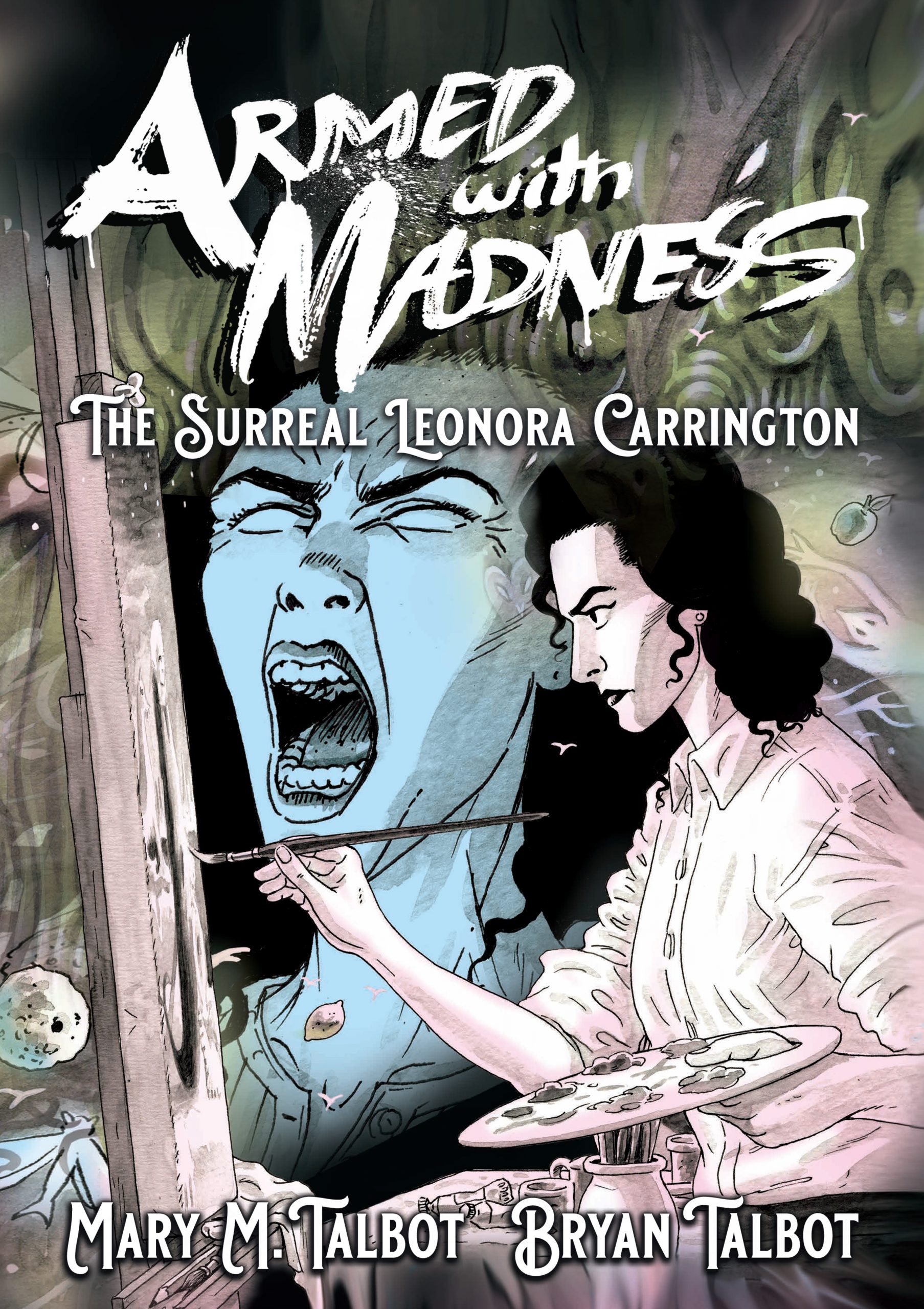
Mary Leonora Carrington overcame wealth, privilege, entrenched unwanted religion and the repressive straitjackets of her class and gender to follow a dream and be her own self. You may never have heard of her (but should have) and this sublime depiction exploration by Mary M. Talbot and spouse Bryan Talbot – focussing on her most troubled years and humanity’s darkest hours – offers compelling and beautiful arguments for why.

Dr. Mary is an academic, educator, linguist, social theoretician, author and specialist in Critical discourse analysis who in 2012 added graphic novelist to her portfolio of achievements: collaborating with her husband on Dotter of Her Father’s Eyes.

That award-winning memoir/biography of Lucia Joyce was followed by Sally Heathcote: Suffragette (drawn by Kate Charlesworth), The Red Virgin and the Vision of Utopia and Rain (both with Bryan), all supplementing a glittering educational career and such academic publications as Language and Gender: an Introduction and Fictions at Work: language and social practise in fiction. She is particularly drawn to true stories of gender bias and social injustice…

Bryan has been a fixture of the British comics scene since the late 1960s, moving from Tolkien-fandom to college strips, self-published underground classics like Brainstorm Comix (starring Chester P. Hackenbushthe Psychedelic Alchemist!), early Luther Arkwright and Frank Fazakerly, Space Ace of the Future to paid pro status with Nemesis The Warlock, Judge Dredd, Sláine, Ro-Busters and more in 2000 AD.

Inevitably headhunted by America, he worked on key mature-reading titles for DC Comics (Hellblazer, Shade the Changing Man, The Nazz, Batman: Legends of the Dark Knight, Fables, The Dead Boy Detectives and The Sandman) and was a key creative cog in short-lived shared-world project Tekno Comix, before settling into global acclaim via steady relationships with Dark Horse Comics and Jonathan Cape. These unions generated breakthrough masterpieces like The Tale of One Bad Rat and a remastered epic revival of The Adventures of Luther Arkwright.

Since then he’s been an independent Force To Be Reckoned With, doing just what he wants, promoting the art form in general and crafting a variety of fascinating and compelling works, from Alice in Sunderland and Cherubs! (with Mark Stafford), to Metronome (as Véronique Tanaka) and his fabulously wry, beguiling and gallic-ly anthropomorphic Grandville sequence, as well as his mostly biographical/historical collaborations with Mary…

In the interest of propriety, I must fully disclose that I’ve known him since the early 1980s, but other than that shameful lack of taste and judgement on his part, have no vested interest in confidently stating that he’s probably Britain’s greatest living graphic novelist…

Here their vast talents combine to capture and expose the early life of a woman driven by a need to create: a forgotten star who resisted powerful family pressure and rejected social conditioning to run away and become an artist. Her choices – or perhaps compulsion – led to pain, isolation, ostracization, desertion and mental illness, before her innate determination, tenacity and sheer will to overcome won her peace, security, success and the chance to make the world a different, better place for those that followed her…

Leonora Carrington was born on April 6th 1917, daughter of a wealthy northern textiles magnate who inherited control of ICI and moved in Royal circles. An imaginative, wilful child raised Roman Catholic, she loved animals, art and stories, particularly identifying with horses, and – when provoked – hyenas…

After continually frustrating her overbearing father (by – for example – sabotaging the local fox hunt), her education was shifted from private governesses to draconian Catholic boarding schools, two of which were compelled to expel despite all the cash Daddy lavished on them…

Her Irish mother was obsessed with introducing her at (Royal) Court, but Leonora wanted to make art and tell stories. Before long she was packed off to a Finishing School in Florence, affording the rebel with the unintended opportunity of seeing the landmarks of human artistic endeavour first hand.

Eventually, with mother playing peacemaker, Leonora was permitted to study painting, firstly at the Chelsea School of Art and then briefly with iconoclastic French modernist Amédée Ozenfant at his Ozenfant Academy of Fine Arts.

Wayward young Carrington had seen her first Surrealist painting in 1927 when she was only ten, and the event marked her deeply. Now able to access more of the works that set her soul afire, she put up with her mother’s ambitions for as long as possible before running away to Paris in 1937: beginning a turbulent affair with the leading light and conceptual leader of the movement. Max Ernest was old, fascinating, selfish, married and German…

Naturally, her father responded by cutting off if not outright disowning her, and an idyllic period – albeit punctuated by moments of violence and terror inflicted on Leonora by the frankly terrifying and justly furious Mrs Ernst – evolved into a retreat.

The “May/November” couple fled south to the rural solitude of Saint Martin d’Ardèche. Here, her writing and art grew wilder and more inspired, but also brought added tension and strain for both of them. Political infighting amongst the male-dominated Surrealist elite and increasing suspicion of the “kraut” Ernst by local neighbours ended the honeymoon period as clouds of war gathered over Europe.

Ultimately, he was arrested as an enemy alien. By the time his friends secured his release, the Nazis had invaded and Ernst was arrested again, this time by the Gestapo who targeted him for his “degenerate” art. On his second bout of freedom, Max bolted to America, supported by friends and eventual next wife millionairess Peggy Guggenheim

Always nervous, prone to anxiety and now under enormous pressure, Leonora Carrington’s stability took ever-increasing hits as she dwelt alone in her lonely, rustic hostile environment. Upon at last escaping to Madrid with her friend Catherine Yarrow, Leonora arrived in the throes of a full-blown psychotic break and was left to the tender mercies of an asylum.

Here she endured tedium, repression, a brutal drug regimen and electroconvulsive therapy as well as regular sexual assault from her minders. Again controlled by her parents, she was eventually released into the care of a “minder” (these scenes are particularly harrowing – so be warned) preparatory to being bundled off to a sanatorium in distant South Africa.

Instead, she escaped and went to Portugal, linking up with Mexican consular official Renato Leduc. He agreed to a marriage of convenience and – before divorcing her in 1943 – moved her to the safety of his homeland. She thereafter made Mexico home for most of her life.

Many other creative refugees from Europe – especially many old Surrealist friends – had also migrated there and over the succeeding years Leonora prospered, finding acceptance and a new cause. After years of independence and street level activism for gender equality and personal freedom, in the 1970 she co-founded Mexico’s Women’s Liberation Movement. She reunited with old friend and artistic soul mate Remedios Varo who introduced her to her second and last husband. Hungarian photographer/physician Emerico “Chiki” Weisz was her partner in art and practical jokes until his death in 1997.

They had two kids and Leonora grew in stature: making wild and marvellous paintings, murals and sculptures, publishing ten books, starring in numerous gallery and museum shows, confronting Mexico’s totalitarian rulers in the 1960s and always shaping thought and attitudes of, to and about women. She died on May 25th 2011 aged 94, another beloved and revered artistic icon of Mexico who lived life her own way on her own terms.

This epic of creative struggle comes with a full Bibliography and a scrupulously meticulous Notes section, explaining unfamiliar moments or terms and sharing times when the demands of drama superseded the tedious truth of simple documentary fact…

Compellingly scripted with a fine eye for elucidatory minutiae, visually Mary Talbot’s carefully overlaid, chronologically unmoored events ranging from gentle reportage of consensual reality to shocking interpretations of her delusions are realised in soft monochrome tones, interspersed with fiercely dynamic blasts of colour. The technique allows us to share her perpetually overlapping worlds, vacillating visions and hallucinations in a history drenched in narrative symbolism and – naturally – surreal visitations.

Powerful, enraging and uplifting, this mesmerising introduction to yet another forgotten woman of achievement is a sheer delight and will definitely compel all readers to look for more…
Text © 2023 Mary M Talbot. Illustrations © 2023 Bryan Talbot. All rights reserved.

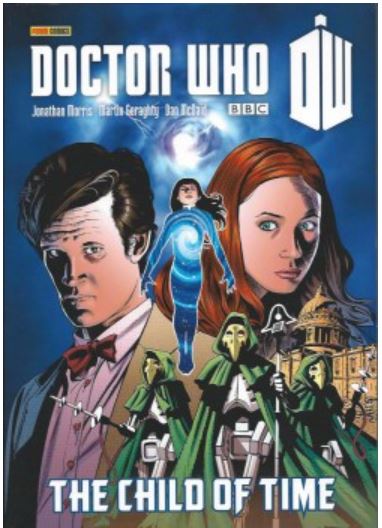
Doctor Who Graphic Novels volume 14: The Child of Time


By Jonathan Morris, Mike Collins, David A. Roach, Roger Langridge, Martin Geraghty, Dan McDaid, Rob Davis, Geraint Ford, Adrian Salmon, & James Offredi (Panini Books)
ISBN: 978-1-84653-460-7 (TPB)

Multimedia monolith Doctor Who launched on television with the first episode of ‘An Unearthly Child’ on November 23rd 1963. Happy 60th Anniversary, Time Lord!

Within a year, a decades-long run in TV Comic began in issue #674: and the premier instalment of ‘The Klepton Parasites’. On 11th October 1979 (but adhering to the US off-sale cover-dating system, so it says 17th), Marvel’s UK subsidiary launched Doctor Who Weekly, which regenerated into a monthly magazine in September 1980 (#44) and has been with us under various names ever since.

All of which only goes to prove that the Time Lord is a comic hero with an impressive pedigree…

Marvel UK – and latterly Panini – spent a lot of effort (and time!) compiling every strip from its archive into a uniform series of oversized graphic albums, each concentrating on a particular incarnation of the deathless nomad of infinity.

This one gathers stories short and long which, taken together, comprise a 2-year extended epic. From Doctor Who Magazine (or DWM) #421-441 (originally published in 2010-2011), this run details the strip debut of Matt Smith’s incarnation of the far-flung, far-out Time Lord as well as his capable companion Amy Pond as played by Nebul Karen Gillan.

None of which is relevant if all you want is a darn good read. All involved have successfully accomplished the ultimate task of any comics creator by producing engaging, thrilling, fun stories which can be equally enjoyed by the merest beginner and the most slavishly dedicated – and opinionated – fans imaginable.

Written by Jonathan Morris (with liberal input from editors Scott Gray & Tom Spilsbury), coloured by James Offredi and lettered by Roger Langridge, the time trek kicks off in ‘Supernature’ (illustrated by Mike Collins & David A. Roach), as first espied in DWM #421-423 (May-July 2010).

Arriving on a jungle paradise world, The Doctor and Amy soon discover Earthling colonists in the midst of a terrifying plague. The humans – all convicts press-ganged to turn the planet into a suitable home before being abandoned – are transforming into uncanny mutant beasts, and even the Time Lord and his new companion are “monster-ised” before the crisis is solved. However, when they depart they take part of the problem with them…

A rare but welcome illustrative role for regular letterer Langridge delivers a bizarre yet wonderful spoof on ‘Planet Bollywood!’, when warring factions of an ancient empire – and a romantic leading man – jointly struggle to possess a sexy humanoid device. The bewildering tool compulsively compels all who hear it to break out in song and dance routines…

On the go again afterwards, a trip to Tokyo finds fresh horror for the travellers in the metamorphosis of innocent – if educationally lacking – children being converted into a deadly fifth column in ‘The Golden Ones’ (Martin Geraghty & Roach in #425-428). This is a grand old-fashioned blockbuster invasion saga with a huge body-count, valiant armed resistance by dedicated UNIT soldiers, a classic villain’s return, brilliant scientific solutions and a slew of subtle clues to the greater saga unfolding. And just who is that strange little girl who keeps popping up everywhen?

From #429 comes literary fantasy-homage ‘The Professor, the Queen and the Bookshop’ (Rob Davis & Geraint Ford) as our heroes meet a reclusive writer and evacuee children whilst Amy – and hubby-to-be Rory – encounter a strange man in an infinite shop which can travel anywhere…

It’s back to Paris circa 1858 for Dan McDaid’s ‘The Screams of Death’ when aspiring but hopeless singer Cosette is taken under the wing of impresario Monsieur Valdemar, and develops a voice that could shake the Opera House to its foundations. Of course, this Svengali-like Fugitive from the Future has far grander plans for his many captive songbirds …until Mam’selle Pond and M’sieu le Docteur turn up to foil another mad scheme to rewrite history…

The over-arching storyline takes a big step forward in #432’s ‘Do Not Go Gentle into that Good Night’ (offering a welcome full-art outing for the splendidly gifted David Roach) as the Tardis turns up in an old people’s home staffed by robots, haunted by children and plagued by a rapidly diminishing roster of residents. Adrian Salmon then gets his freak on in trippy terror-tale ‘Forever Dreaming’ (#433-434) as Amy is apparently trapped in a 1960’s seaside town with a dark secret, a phantom octopus and a legion of psychedelic icons who really should be dead…

The saga swings into full acceleration with ‘Apotheosis’ (DWM #435-437 and limned by McDaid) when the Doctor and Amy land aboard a derelict space station and walk into the closing act of a galaxy-spanning war between humanity and their scheduled replacements: the awesome autonomous androids of Galatea.

Aboard the station, a cadre of warrior Space Nuns seek an ultimate weapon to tip the scales of the conflict, but with lethal sanitation robots everywhere and rogue time-distortion fields making each step a potential death-march, their hunt is hard going. With everybody – even the Time Lord – hyper-aging at vastly different rates, and the Tardis mutating into something impossible, the stage is set for the spectacular nativity of a true threat to all of creation…

Of course, before the big finish, Machiavellian, monstrously manipulative and atrociously amoral creature Chiyoko must carry out a number of crucial appointments in Eternity to ensure the existence and consolidate the celestial dominance of ‘The Child of Time’ (art by Geraghty & Roach from DWM #438-441 spanning August to November 2011).

Two years of cleverly-concocted mystery and imagination then wrap up in a staggering, creatively-anachronistic display of temporal hocus-pocus steered by scripter Morris as The Doctor, Amy and stalwart allies Alan Turing and the Bronte Sisters ward off the unmaking of time, the end of humanity and eradication of all life in the universe before a tragic finale and Happy-Ever-After… of sorts…

Dedicated fans will enjoy a treasure-trove of background information in the 25-page Commentary section at the back, comprising chapter-by-chapter background, history and insights from the author and each illustrator, supplemented by sketches, roughs, designs, production art and even excised material from all concerned.

We all have our private joys and hidden passions. Sometimes they overlap and magic is made. This is a superb selection of supremely satisfying strips, starring an absolute Pillar of the British Fantasy pantheon. And even if you’re a fan of only one, The Child of Time will certainly spark your hunger for the other. A fabulous book for casual readers, this is also a fine shelf addition for devotees of the show, an ideal opportunity to cross-promote our particular art-form and the perfect present for the Telly Addict haunting your house…

All Doctor Who material © BBCtv. Doctor Who logo © BBC 2012. Tardis image © BBC 1963. Doctor Who, Tardis and all logos are trademarks of the British Broadcasting Corporation and are used under licence by BBC Worldwide. Published 2012 by Panini Publishing, Ltd. All rights reserved.