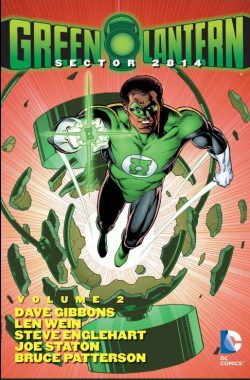
Green Lantern Sector 2814 volume 2


By Len Wein, Paul Kupperberg, Steven Englehart, Dave Gibbons, Bill Willingham, Joe Staton, Bruce Patterson, Mark Farmer, Rich Rankin & various (DC Comics)
ISBN: 978-1-4012-4078-3

When mortally wounded alien cop Abin Sur crashed on Earth he commanded his power ring – a device which could materialise thoughts – to seek out a replacement officer, honest and without fear. Scanning the planet, it selected brash young test pilot Hal Jordan in nearby Coast City, California and brought him to the crash-site. The dying alien bequeathed his ring, the lantern-shaped Battery of Power and his professional vocation to the astonished Earthman.

Over many traumatic years, Jordan grew into one of the greatest members of a serried band of law-enforcers. The Green Lantern Corps protected the cosmos from evil and disaster for billions of years, policing vast numbers of sentient beings under the severe but benevolent auspices of immortal super-beings who consider themselves the Guardians of the Universe.

These undying patrons of Order were one of the first races to evolve and dwelt in sublime, emotionless security and tranquillity on the world of Oa at the very centre of creation.

Green Lanterns are chosen for their capacity to overcome fear and are equipped with a ring that creates solid constructs out of emerald light. The miracle weapon is fuelled by the strength of the user’s willpower, making it one of the mightiest tools imaginable.

For eons, a single individual from each of the 3600 sectors of known space was selected to patrol his, her or its own beat, but being cautious and meticulous masters, the Guardians laid contingency plans as appointing designated reserve officers.

Jordan’s substitute was a nice quiet (white) PE teacher named Guy Gardner, but when he was critically injured the Oans’ fallback option was a little worrying to staid, by-the-book Hal.

In Green Lantern/Green Arrow #87 (December 1971/January 1972) ‘Beware My Power!’ introduced a bold new character to the DCU. John Stewart was an unemployed architect and full-time radical activist: an angry black man always spoiling for a fight and prepared to take guff from no-one.

Jordan was convinced the Guardians had grievously erred when selecting rash, impetuous Stewart as Sector 2814’s official Green Lantern stand-in, but after seeing how his proposed pinch-hitter handled a white supremacist US presidential candidate trying to foment a race war, the Emerald Gladiator was delighted to change his tune…

As time progressed Stewart popped up occasionally even as the Guardians’ motives and ineffability increasingly came into question by many of their once-devoted operatives and peacekeepers. All too frequently, the grunts began seeing their formerly infallible little blue gods exposed as venal, ruthless, doctrinaire and even capricious…

As his repute grew, headstrong Hal enjoyed an extremely tempestuous relationship with his bosses which eventually resulted in them accusing him of neglecting his space sector – 2814 – to concentrate on Earth’s problems and criminals.

When he couldn’t reconcile his love for Carol Ferris and duty to the Corps, Hal Jordan quit…

This second stellar Fight’s ‘n’ Tights trade paperback compilation – also available in eBook editions – gathers Green Lantern #182-183 and 185-193, covering November 1984 through October 1985: a period of radical change and increasing cosmic calamity as the DCU counted inexorably down to a reality-altering Crisis on Infinite Earths…

Len Wein, Dave Gibbons & Mark Farmer continued their groundbreaking reshaping of the legend as ‘It’s a Dirty Job, But…!’ saw the now merely mortal Jordan second-guessing his decision as he revisits Abin Sur’s remote resting place. Meanwhile, across the universe, the Guardians moved swiftly, promoting Stewart to the prime position in his sector. At the time the architect was working on rebuilding the shattered Ferris Aircraft complex and had no idea that Hal Jordan was the alter ego of his abruptly “retired” predecessor, nor that GL Jordan’s old enemy Major Disaster was back and looking for a fight…

Further complicating matters, Dr. Bruce Gordon – currently building a solar engine for Ferris – was being stalked and harassed by his own inner demon made manifest. Before Green Lantern had helped cure him, Gordon was the unwilling host of a demonic hate-filled energy spirit called Eclipso. Now the monster was apparently back and trying to steal the almost-completed solar engine…

When Major Disaster furiously threatens to destroy a massive hydroelectric dam and flood the entire state, the Emerald Gladiator he stridently demands a rematch with is not the one who turns up…

Refusing to accept any substitute the madman triggers a ‘Day of Disaster’ and learns to his sorrow that the masked black man is every inch as competent and formidable as his despised archfoe.

Green Lantern #184 reprinted the origin of Guy Gardner from #59 in 1968 and has been omitted from this collection but Wein & Gibbons (inking himself again) return for #185 as ‘In Blackest Day…!’ sees the new ringbearer for Sector 2814 fully acclimate to his responsibilities. An overnight celebrity and media sensation, Stewart is courted by TV reporter Tawny Young but earns her enmity after refusing to divulge the circumstances of his origin and promotion.

On a more mundane level, Hal still frets about his decision and loss of power, even as his romance with Carol hits a new snag. Unknown to either of them she has acquired a super-powered stalker determined to protect her from anything he perceives as a threat…

With Eclipso still secretly badgering Gordon, Hal prepares to test-fly the prototype Ferris solar jet, but is ambushed by his old pal and mentor Rich Davis.

The medically-disqualified pilot wants one last flight of glory and takes Hal’s place, only to become a hostage when Eclipso snatches the jet out of the sky in his fantastic landscape-rending moon satellite…

‘In Brightest Night…!’ Wein & Gibbons (with plotting input from Paul Kupperberg) sees the new GL rush to the rescue as Hal can only look on helplessly, but when Carol’s mystery suitor The Predator also boars the moon globe the situation flares beyond control and results in victory at a terrible price…

Kupperberg, Bill Willingham & Rich Rankin then provide a rapid fill-in for #187 (April 1985) as ‘A Day in His Life…’ finds Carol confronted by the Predator who declares his amorous intentions by beating up her current boyfriend Hal even as John Stewart tackles his first space catastrophe and narrowly escapes destroying the malfunctioning space shuttle he was trying to save…

Thankfully, the all-wise Guardians have anticipated teething troubles and despatched veteran GL Katma Tui be his training officer…

The next issue heralded a changing of the guard as writer Steve Englehart and illustrators Joe Staton & Bruce Patterson signed on with ‘Decent Exposure’ wherein Tawny Young outs John Stewart on national TV, and he – after some early frustration – decides “so what?”

With the Predator proving to be far more than a mere abusive, controlling maniac, Hal swears revenge even as European ultra-nationalist Sonar returns to destroy the new Green Lantern to prove the superiority of his postage -stamp principality Modora…

After Stewart proves his worth with a uniquely elegant solution to the villain’s sound weapons, ‘Echoes!’ sees Sonar bounce back: escaping from custody with enhanced allies Blindside and Throttle, despite the assistance of Katma Tui. Hal and Carol’s search for Predator lead them to a much-delayed visit with practically-braindead shut-in Guy Gardner, inadvertently starting those long-dormant cogs clicking again…

After Stewart at last apprehends his fugitives a new crisis has struck. ‘Time Out of Mind!’ starts with Tawny Young re-entering the picture, touting years-old video-tape interviews she carried out with Green Arrow, Black Canary, the previous GL, Carol Ferris and Stewart himself. Disturbingly, nobody on Earth remembers the meetings and if the journalist hadn’t been raiding the archives never would…

As she shows the tapes to the astounded superheroes, Predator nonchalantly ambles in to steal the tapes and is stunned to realise that the gimmick he’s used to make everyone unable to see him doesn’t work on alien Katma…

Back-up tale ‘Mind Out of Time!’ then focuses on Hal’s hunt for Predator and furious confrontation in a theatre in front of a bizarre alien musical organ. That preliminary bout becomes the main event in GL #191 as ‘Macho!’ finds John and Katma off-earth and working with Dalor of Timron – Green Lantern of neighbouring Sector 2813 – whilst Jordan’s final confrontation with Predator reveals an uncanny, impossible connection to Carol which revives her own darkest secret…

Green Lantern #192 sees the separate storylines converging in ‘First Star I See Tonight!’ as the space-borne Emerald officers tackle the immortal amazon warriors of Zamaron even as on Earth, Carol reverts to sometime-alter ego Star Sapphire: now finally purged of the annoying, pitiful humanity that held her back from operating as the dominating tyrant and chosen queen of those self-same Zamarons…

Utterly dominating powerless Hal, she reveals the decades long machinations that have led to this moment of terrible triumph before teleporting home where three furious Green Lanterns are waiting…

This volume concludes with the return of another Hal villain in ‘Dead Ringer’, but where Jordan defeated the tragic alien Replikon through brute force and guile, Stewart proves his worth through innovation and compassion: building a solution which makes friend out of foe and rights a grave cosmic injustice…

At the time, many fans and critics felt that the substitution of Hal Jordan with John Stewart was little more than a PC stunt, but time and the quality of the stories has proved the decision to be brilliant one. It certainly offered a cruelly under-served portion of the readership another solid role model but as time progressed and the different personalities and approaches coalesced, the move led to an expansion and re-evaluation the nature of being a DC hero.

And the best was still to come…
© 1984, 1985, 2013 DC Comics. All Rights Reserved.
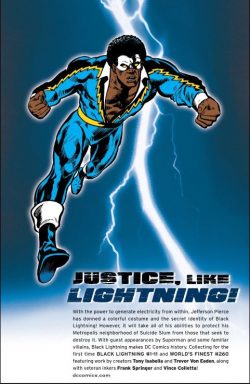
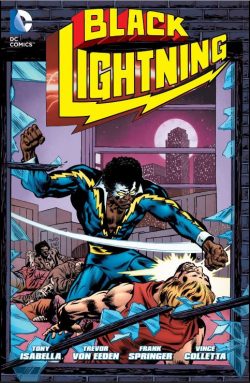
Black Lightning volume 1


By Tony Isabella, Denny O’Neil, Trevor Von Eeden, Mike Netzer, Frank Springer, Vince Colletta & various (DC Comics)
ISBN: 978-1-4012-6071-2

As a pale, sickly kid growing up in a uniformly and unrelentingly white area of the Home Counties in the 1960s, I got almost all my early experience of black people from television and films (for which I’m most profoundly sorry) – and, of course, comics – for which I’m not.

Almost completely unaware of the struggle for racial equality in my formative years, the incredible consciousness-raising explosion of Black Power after the 1968 Olympic Games somewhat politicised me and gripped my unassailable sense of fairness.

However, in my village and school, even though some comics companies had by this time made tentative efforts to address what were national and socio-political iniquities, issues of race and ethnicity took a long time to filter through to the still-impressionable young minds avidly absorbing knowledge and attitudes via four colour pages that couldn’t even approximate the skin tones of African-Americans.

As the struggle progressed, on television and in comics breakthroughs were small, incremental and too often reduced to a cold-war of daringly liberal “firsts.”

Excluding a few returning characters in Jungle-themed comicbooks of the 1940s and 1950s, War comics truly opened the door in the early 1960s, with Robert Kanigher & Joe Kubert creating negro boxer Jackie Johnson as a stalwart member of Sgt. Rock‘s easy company in Our Army at War #113 (December 1961).

Marvel followed suit with a black member of Sgt. Fury’s Howling Commandos team (Gabe Jones who debuted in #1, May 1963, but was accidentally re-coloured Caucasian at the printers: hard-working artisans who clearly didn’t realise his ethnicity), but pulled ahead in the diversity stakes after introducing Americas’ first negro superheroes Black Panther (Fantastic Four #52, July 1966) and the Falcon (Captain America #117, September 1969).

The honour of being the country’s first black hero to carry in his own title came via a little-remembered (or regarded) title from Dell Comics.

Created by artist Tony Tallarico & scripter D.J. Arneson, Lobo was a gunslinger and vigilante in the wild west who sought out injustice just like any cowboy hero would. He first appeared in December 1965 with his second and final issue cover-dated October 1966…

Arguably a greater breakthrough was Marvel’s Joe Robertson; City Editor of the Daily Bugle and a smart, brave, competent and magnificently ordinary mortal distinguished by his sterling character, not a costume or skin tone. He debuted in Amazing Spider-Man # 51 (August 1967), proving in every panel that the world wouldn’t end if black folk and white folk worked and ate together…

This big change slowly grew out of raised social awareness during a terrible time in American history – although Britain had nothing to be smug about either. Race riots had started early in the Sixties and left simmering scars that only comedians and openly racist politicians dared to talk about.

Shows such Till Death Us Do Part and Love Thy Neighbour made subtly telling headway but still raise a shudder whenever I see clips today…

Slowly, more positive ethnic characters appeared, with DC finally getting a black-skinned hero in John Stewart (Green Lantern #87, December 1971/January 1972), although his designation as a “replacement” Green Lantern might be construed as more conciliatory and insulting than revolutionary.

Jack Kirby had introduced teen New God Vykin the Black in Forever People #1 (March 1971) and created ghetto kid Shilo Norman as the hero’s apprentice (and eventual successor) in Mister Miracle ##15 (August, 1973) but DC’s first superhero to have his own solo title was Black Lightning, who didn’t debut until 1977…

Now with the urban avenger the star of his own television series, those early groundbreaking adventures have been gathered into an astoundingly accessible, no-nonsense trade paperback and eBook collection (comprising Black Lightning #1-11, plus material from Cancelled Comics Cavalcade #1 and World’s Finest Comics #260, cumulatively spanning April 1977 to January 1980) that dashes into action following a forthright and informative Introduction by series and character originator Tony Isabella.

It all begins as ‘Black Lightning’ (illustrated by neophyte penciller Trevor Von Eeden & veteran inker Frank Springer) sees former Olympic decathlete Jefferson Pierce return to the streets of Suicide Slum, Metropolis to teach at inner city Garfield High School.

Pierce is determined to make a difference to the troubled kids he used to be numbered amongst, but when the educator interrupts a drug buy on school grounds and sends the dealer packing, the door is opened to vengeance and tragedy.

When the mob – an organised syndicate dubbed The 100 – come seeking retaliation, one of Pierce’s students pays the ultimate price and the teacher realises he needs the shield of anonymity if he is to win justice and safety for his beleaguered home and charges…

Happily, tailor Peter Gambi – who took Jefferson and his mother in after the elder Pierce was murdered – has some useful ideas and inexplicable access to some pretty far-out technology…

Soon, equipped with a strength-&-speed enhancing forcefield belt and costume, with mask and wig that completely change his appearance, a fierce new vigilante stalks the streets of Metropolis…

The local chapter of The 100 is run by a monstrous and cunning freak called Tobias Whale and once Black Lightning’s harrying of his soldiers starts to bite into profits and give the downtrodden populace a glimmer of hope, the sinister strategist starts laying traps, culminating in hiring a lethal super-assassin who previously battled Green Arrow and the Justice League of America.

When the killer pounces, Pierce is forced into an uneasy alliance with mystery woman Talia Al Ghul, but their alliance ends as soon as the bodies start piling up all over the school gym in ‘Merlyn Means Murder’…

As Vince Colletta assumes the inker’s role, Black Lightning’s continued war against The 100 forces “the Whale” to fight smart, and Metro Police – led by doughty Inspector William Henderson – begin pursuing the mysterious vigilante as vigorously aa any gangster or felon. Taking seedy stoolie Two Bits Tanner into his confidence, Pierce savagely works his way up the criminal chain of command. He eventually confronts Tobias in his inner sanctum only to find ‘Every Hand Against Him’ as someone the police pounce. Has someone he trusts betrayed him?

A more palatable answer seems apparent in #4 as suspicion falls on Tanner’s source, Daily Planet journalist Jimmy Olsen. When the outraged Pierce tries to force a confession from the baffled cub reporter, they are attacked by the 100’s latest super heavy in ‘Beware the Cyclotronic Man’.

Although they combine to fight off the atomic villain Jimmy is hurt and Black Lightning is suddenly confronted by the kid’s enraged and late-arriving best pal, who jumps to the wrong conclusion and quickly proves ‘Nobody Beats a Superman!’

In fact, had Cyclotron not switched attention to the true target the Whale wanted him to kill, everybody might have died, but the heroes’ misunderstandings are all forgotten when Lightning saves the Man of Tomorrow from a nuclear meltdown, beats the bad guys and uncovers a mole in the police force…

His patience exhausted and under pressure from his own bosses, the Whale declares open season and offers an astounding bounty on Black Lightning. When deeply conflicted manhunter Syonide (and his hilarious Marvel-baiting in-joke kung fu assistants) stalk the Saviour of Suicide Slum, their first move is to shadow and learn everything about their quarry.

Before long Gambi is abducted and Jefferson’s secret finally exposed in ‘One Man’s Poison’…

Afflicted with a bizarre sense of honour, Syonide hands over a helpless Black Lightning to the Whale in #7: ‘The Conscience of the Killer’ compelling him to shelter the captive tailor from the 100’s vengeance and voluntarily pay the ultimate price when ordered to kill the seemingly-helpless masked hero.

Tragically, even as Black Lightning undergoes a miraculous transformation and takes out the gathered crooks and villains, he loses another innocent to the new violent life he has embraced…

With the power of the 100 apparently broken and Tobias Whale in custody, the fight seems over until the gigantic gangster breaks free and takes hostages from Police HQ. Determined to end the vendetta Black Lightning tracks him down for one last duel and in the ‘Deadly Aftermath’ finds purpose to carry on his alternate lifestyle…

Now considering himself more hero than avengers, Pierce experiences ‘Fear and Loathing at Garfield High’ when the school is invaded by a maniac terrorist operating an army of robotic killers after which a circus trip exposes ‘The Other Black Lightning’. Unfortunately, although the well-meaning admirer is a mostly-harmless copycat, a gang of jewel thieves and former Flash foe The Trickster provide plenty of genuine danger and menace before the big top sawdust settles…

Comicbooks were experiencing another general sales downturn at this time just as Denny O’Neil took over the scripting, Black Lightning was cancelled with the 11th (October 1978) issue.

‘All They Will Call You Will Be… Deportee!’ offered promise of a new direction as the urban avenger exposed an insidious people trafficking ring luring South American refugees into slave jobs at a fast food chain, but for most readers that was the last sight of the hero for some time.

So abrupt was the cancellation, that for legal reasons and to secure copyrights, DC had to put out a black-&-white ashcan anthology entitled Cancelled Comics Cavalcade, printing completed but unpublished stories of Claw the Unconquered, The Deserter, the Green Team, Madame Xanadu, Firestorm and others, including Black Lightning #12.

The wider world got to see that last adventure – ‘Lure of the Magnetic Menace’ by O’Neil, Mike Nasser (nee Netzer) & Colletta – a year later when the January 1980 cover-dated World’s Finest Comics #260 ran the story as a prelude to a series of new BL back-up adventures.

This edgy yarn details how the electrifying hero is attacked by costumed crazy Doctor Polaris after Jefferson Pierce investigates a possible case of child neglect and abuse involving one of his more troubled students…

Wrapping up this initial outing is a copious selection of working drawings from the ‘Black Lightning Sketchbook’ by Von Eeden and Mike Netzer’s unfinished cover for never-seen issue #13.

Although closely interlinked to then-current DC continuity, these fast-paced Fights ‘n’ Tights thrillers are so skilfully constructed that even the freshest neophyte will be able to settle in for the ride without any confusion and enjoy a self-contained rollicking rollercoaster of terrifically traditional superhero shenanigans.

So, go do that then…
© 1977, 1978, 1979, 2016 DC Comics. All Rights Reserved.
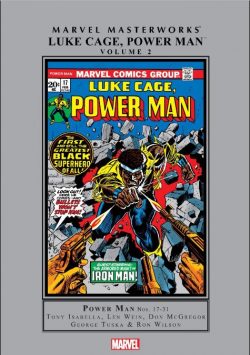
Luke Cage, Power Man Marvel Masterworks volume 2


By Len Wein, Tony Isabella, Don McGregor, Bill Mantlo, Georges Pérez, Steve Englehart, George Tuska, Ron Wilson, Rich Buckler, Arvell Jones, Sal Buscema & various (Marvel)
ISBN: 978-1-3029-0343-5

As is so often the case, it takes a few a bold creative types and radically changing economics to really promote lasting change. In America, with declining comics sales at a time of enhanced social awareness and rising Black Consciousness, cash – if not cashing in – was probably the trigger for “the Next Step” in the evolution of superheroes.

In the opening years of the 1970s, contemporary “Blacksploitation” cinema and novels had fired up commercial interests throughout the USA and in that atmosphere of outlandish dialogue, daft outfits and barely concealed – but completely justified – outrage, an angry black man with a shady past and apparently dubious morals debuted as Luke Cage, Hero for Hire in the summer of 1972.

A year later the Black Panther finally got his own series in Jungle Action #5 and Blade: Vampire Hunter debuted in Tomb of Dracula #10.

Cage’s origin was typically bombastic: Lucas, a hard-case inmate at brutal Seagate Prison always claimed to have been framed and his inflexible, uncompromising attitude made mortal enemies of the racist guards Rackham and Quirt whilst not exactly endearing him to the rest of the prison population – such as out-&-out bad-guys Shades and Comanche…

The premiere issue was written by Archie Goodwin and illustrated by George Tuska & Billy Graham (with some initial assistance from Roy Thomas and John Romita) detailing how a new warden promised to reform the hell-hole into a proper, legal penal institution.

New prison doctor Noah Burstein then convinced Lucas to participate in a radical experiment in exchange for a parole hearing, having heard the desperate con’s tale of woe…

Lucas had grown up in Harlem, a tough kid who’d managed to stay honest even when his best friend Willis Stryker had not. They remained friends even though they walked different paths – at least until a woman came between them. To get rid of his romantic rival, Stryker planted drugs and had Lucas shipped off to jail.

While he was there his girl Reva – who had never given up on him- was killed when she got in the way of bullets meant for Stryker…

With nothing left to lose Lucas underwent Burstein’s process – an experiment in cell-regeneration – but Rackham sabotaged it, hoping to kill the con before he could expose the guard’s illegal treatment of convicts. It all went haywire and something incredible happened. Lucas, now incredibly strong and pain-resistant, punched his way out of the lab and the through the prison walls, only to be killed in hail of gunfire. His body plunged over a cliff and was never recovered…

Months later, a vagrant prowling the streets of New York City stumbled into a robbery. Almost casually downing the felon, he accepted a cash reward from the grateful victim, prompting a bright idea…

Super-strong, bullet-proof, street-wise and honest, Lucas would hide in plain sight while planning his revenge on Stryker. Since his only skill was fighting, he became a private paladin – A Hero For Hire…

This second sturdy hardback (or eBook) volume collects #17-31 of Cage’s adventures – Luke Cage, Power Man – spanning February 1974-May 1976 of the breakthrough series and begins with fond and informative Introduction ‘Always Forward’ from series scripter Tony Isabella.

Whilst making allowances for the colourful, often ludicrous dialogue necessitated by the Comics Code’s sanitising of “street-talking Jive” this was probably the edgiest series of Marvel’s early years, but even so, after a few years the tense action and peripheral interactions with the greater Marvel Universe led to a minor rethink and the title was altered, if not the basic premise…

The private detective motif proved a brilliant stratagem in generating stories for a character perceived as a reluctant champion at best and outright anti-hero by nature. It allowed Cage to maintain an outsider’s edginess but also meant that adventure literally walked through his shabby door every issue.

Cage had set up an office over a movie house on 42nd Street and met a young man who would become his greatest friend: D.W. Griffith – nerd, film freak and plucky white sidekick. Noah Burstein resurfaced, running a rehab clinic on the dirty, deadly streets around Times Square, aided by a beautiful woman Dr. Claire Temple. Soon she too was an integral part of Luke’s new life…

Following a calamitous clash with many of his oldest enemies, most old business was settled and a partial re-branding of America’s premier black crusader began in issue #17. The mercenary aspect was downplayed (at least on covers) as Luke Cage, Power Man – by Len Wein, George Tuska & Billy Graham – got another new start during a tumultuous team-up in ‘Rich Man: Iron Man… Power Man: Thief!’

Here the still “For Hire” hero is commissioned to test Tony Stark‘s security by stealing his latest invention. Sadly, neither Stark nor his alter ego Iron Man know anything about it and the result is another classic hero-on-hero duel…

Vince Colletta joined the team as inker for #18’s ‘Havoc on the High Iron!’ as Cage takes on a murderous high-tech Steeplejack before the next two issues offered the still-wanted fugitive hero a tantalising chance to clear his name.

‘Call Him… Cottonmouth!’ introduced a crimelord with inside information of the frame-up perpetrated by Willis Stryker in issue #1. Tragically, that hope of a new clean life is snatched away after all Cage’s explosive, two-fisted efforts in the Isabella scripted follow-up ‘How Like a Serpent’s Tooth…’

Isabella, Wein, Ron Wilson & Colletta collaborated on ‘The Killer with My Name!’ which sees Cage attacked by old Avengers villain Power Man who understandably wanted his nom de guerre back, but who changed his mind after waking up from the resultant bombastic battle that ensued…

Psychotic archenemy Stiletto returned with his equally high-tech balmy brother Discus in ‘The Broadway Mayhem of 1974’ (Isabella, Wilson & Colletta), subsequently revealing a startling connection to Cage’s origins…

All this constant carnage and non-stop tension had sent sometime romantic interest Claire Temple scurrying for points distant, and finally in LCPM #23 Cage and D.W. went looking for her, promptly fetching up in a fascistic planned-community run by old foe and deranged military terrorist Gideon Mace.

‘Welcome to Security City’ (inked by Dave Hunt) fed directly into a two-part premier for another African American superhero as Cage and D.W. tracked Claire to the Ringmaster’s Circus of Crime in #24’s ‘Among Us Walks… a Black Goliath! (Isabella, Tuska & Hunt)…

Bill Foster was a highly educated black supporting character; a biochemist working with Henry Pym (the scientist-superhero known as Ant-Man, Giant-Man, Goliath and/or Yellowjacket over the decades of his costumed career). Foster first appeared in Avengers #32 (September 1966), before fading from view when Pym eventually regained his size-changing abilities…

Carrying on his own researches in size-shifting, Foster was now trapped as a giant, unable to shrink to normal size, and Cage discovered he was also Claire’s former husband. When the experiments trapped him at fifteen feet tall, she had rushed back to Bill’s colossal side to help find a cure.

After Luke turned up, passions were stoked, resulting in another classic heroes-clash moment until the mesmeric Ringmaster hypnotised all the combatants, intent on using their strength to feather his own three-ring nest. ‘Crime and Circuses’ (by Isabella, Bill Mantlo, Wilson & Fred Kida) saw the heroes helpless until Claire came to the rescue, before making her choice and returning to New York with Luke.

Foster soon thereafter gravitated to his own short-run series, becoming Marvel’s fourth African American costumed hero under the heavy-handed and rather obvious sobriquet Black Goliath…

The timely spoofing of a popular ’70’s TV show provided the theme for ‘Night Shocker!‘ (by Steve Englehart, Tuska & Colletta) when Cage stalked an apparent vampire attacking 42nd Street patrons, after which a touching human drama finds Cage forced to subdue a tragically simple-minded but super-powered wrestler in ‘Just a Guy Named “X”!’ (by Mantlo, George Pérez & Al McWilliams, all paying tribute to the Steve Ditko classic from Amazing Spider-Man #38).

A new level of sophistication, social commentary and bizarre villainy began in issue 28 after Don McGregor came aboard to craft a run of macabre crime sagas, opening when Cage meets The Man Who Killed Jiminy Cricket! (illustrated by George Tuska & Vince Colletta).

Hired by a chemical company to stop industrial espionage, Luke fails to prevent the murder of his prime suspect and is somehow defeated by deadly weirdo Cockroach Hamilton (and his beloved shotgun “Josh”) Left for dead in one of the most outré cliffhanger situations ever seen, Cage took two issues to escape as the next issue featured a “deadline-doom” busting fill-in tale…

Produced by Mantlo, Tuska & Colletta Luke Cage, Power Man #29 claimed No One Laughs at Mr. Fish (although the temptation is rather overwhelming) as Cage fights a fin-faced mutated mobster robbing shipping trucks for organised crime analogue The Maggia after which the story already in progress resumes in issue #30 with Look What They’ve Done to Our Lives, Ma! (by McGregor, Rich Buckler, Arvell Jones & Keith Pollard).

Escaping at last from a deadly deathtrap, Cage hunts down Hamilton, and confronts his erudite, sardonic, steel-fanged boss Piranha Jones just after they succeed in stealing a leaking canister of deadly nerve gas…

The dread drama then concludes in Over the Years They Murdered the Stars!’ (Sal Buscema & the legion of deadline busting Crusty Bunkers) as Cage saves his city at the risk of his life before serving just deserts to the eerie evildoers…

Adding extra value to this sterling selection are the cover of reprint one-shot Giant-Size Power Man from 1976; a House ad from 1974 and Dave Cockrum & John Romita’s Cage entry from the 1975 Mighty Marvel Calendar (March, in case you were wondering). Also on view are original cover art by Gil Kane & Mike Esposito (#20 and #24).

Arguably a little dated now (me, Genndy Tartakovsky and others in the know prefer the term “retro”), these tales were nonetheless instrumental in breaking down one more barrier in the complacent, intolerant, WASP-flavoured American comics landscape and their power if not their initial impact remains undiminished to this day. These are tales well worth your time and money.
© 1974, 1975, 1976, 2017 Marvel Characters, Inc. All rights reserved.

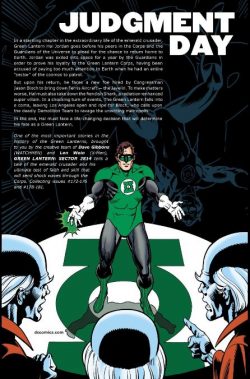
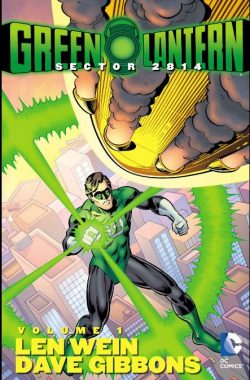
Green Lantern Sector 2814 volume 1


By Len Wein, Dave Gibbons & various (DC Comics)
ISBN: 978-1-4012-3689-2

Since the dawn of American comics’ Silver Age, where and when The Flash kick-started it all to become the fast-beating heart of the revived genre of superheroes, his fellow jet-age re-tread Green Lantern has always provided the conceptual framework for the comprehensive, pervasive magic of the DC Universe’s monolithic shared continuity.

Hal Jordan was a brash young test pilot in Coast City, California when an alien cop crashed on Earth. Mortally wounded, Abin Sur commanded his power ring – a device which could materialise thoughts – to seek out a replacement officer, honest and without fear.

Scanning the planet, it selected Jordan and brought him to the crash-site. The dying alien bequeathed his ring, the lantern-shaped Battery of Power and his professional vocation to the astonished Earthman.

Jordan grew to be one of the greatest members of a serried band of law-enforcers. The Green Lantern Corps has protected the cosmos from evil and disaster for billions of years, policing vast numbers of sentient beings under the severe but benevolent auspices of immortal super-beings who consider themselves the Guardians of the Universe.

These undying patrons of Order were one of the first races to evolve and dwelt in sublime, emotionless security and tranquillity on the world of Oa at the very centre of creation.

Green Lanterns are chosen for their capacity to overcome fear and are equipped with a ring that creates solid constructs out of emerald light. The miracle weapon is fuelled by the strength of the user’s willpower, making it one of the mightiest tools in the universe.

For eons, a single individual from each of the 3600 sectors of known space was selected to patrol his, her or its own beat.

As the series progressed The Guardians’ motives and ineffability increasingly came into question by many of their once-devoted operatives and peacekeepers, who too frequently saw the formerly infallible little blue gods exposed as venal, ruthless, doctrinaire and even capricious…

Even as his fame and repute grew, headstrong Hal had endured an extremely tempestuous relationship with his bosses which eventually resulted in them accusing him of neglecting his space sector – 2814 – to concentrate on Earth’s problems and criminals.

This led to the Oan overlords banishing Jordan: compelling him to scrupulously patrol his appointed interstellar beat and never again set foot on Earth…

This fabulous cosmic Fight’s ‘n’ Tights trade paperback compilation – also available in eBook editions – gathers Green Lantern #172-176 and 178-181. It spans January – October 1984 and celebrates the end of that exile as new writer/editor Len Wein united with illustrator/letterer (and vanguard of a “British Invasion” of talent that would reshape the comicbook industry) Dave Gibbons to bring the wanderer home…

After a year way performing heroic service across the starways, Jordan stridently petitioned his master on Oa where a phalanx of his comrades supported his request to be allowed back to his birthworld. His ‘Judgment Day!’ gave him everything he wanted but when Jordan returned to Coast City he quickly discovered that the world had moved on without him…

Reunited with lover Carol Ferris, Hal tries to readjust in ‘Old Friends, New Foes…!’ but an unsuspected rival at work is as nothing compared to the covert machinations of an unsuspected observer and power-broker known as the Monitor (yes, that guy! Check out Crisis on Infinite Earths for more detail) who supplies the mystery villain with a selection of super-powered mercenaries…

The first of these is a German maniac with a penchant for high-tech trick spears who attempts to kill the Emerald Crusader and vaporise Ferris Aircraft in #174’s ‘I Shot a Javelin into the Air…!’

GL #175 offers a fraught reunion with old pal Barry Allen – AKA the Flash – before a predatory mutant archenemy resurfaces to turn Hal’s city and friends into ‘Shark Bait!’

The Shark‘s mental assault consumes the hero’s mind, leaving the Emerald Gladiator brainwiped, comatose and dying, but in #176 (inked by Dick Giordano and lettered by Ben Oda) the indomitable personality of Hal Jordan battles his way out of the paranormal predator’s cerebral gullet and back into action through a series of ‘Mind Games!’

The enigmatic enemy in the background still wants GL gone and Ferris obliterated, however, and subsequently commissions more high-tech hirelings in #178: specifically, a squad of construction-worker themed wreckers dubbed the Demolition Team.

Throughout the period of these tales, ferocious deadlines plagued the creative team, with Gibbon’s preference to draw, ink and letter the stories perpetually confounded by the fact that he was generally receiving scripts three pages at a time. In an era before the internet when the fax machine was the acme of technological communication, something had to give, and after a fill-in issue (#177 and not included here) failed to solve the problems, two last all-Gibbons issues were followed by a separation of roles…

Before that though, just as Ferris is battered and shattered by ‘A Bad Case of the D.T.s!’, Green Lantern is called way from Earth by the implacable Guardians to save an exploding planet. Heartbroken and terrified, Carol sees her company practically destroyed until a new, brutally vicious protagonist steps in to stop the Demolition Team in #179’s ‘Let Us Prey!’ (both by Wein & Gibbons).

By the time Jordan returns to view the ‘Aftermath!’ (GL #180 with Mike DeCarlo inking and Ben Oda on letters) the damage has been done both to the factory and Hal’s now-crippled friend Clay Kendell. Appalled at his own dereliction of duty and personal failures, Jordan consults with a number of Justice League colleagues before heading to Oa in #181 (Mark Farmer inks & John Costanza letters) and telling the Guardians to ‘Take This Job… And Shove It!’

They accept, precipitating one of the biggest events in DC history…

To Be Continued…
© 1984 DC Comics. All Rights Reserved.
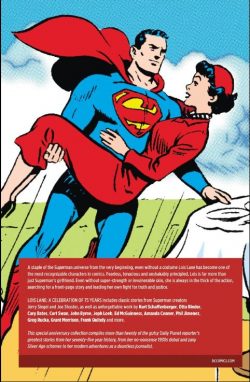
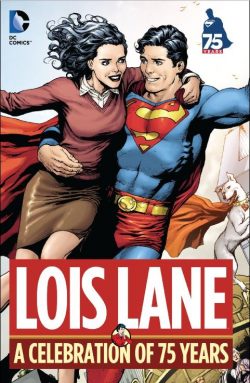
Lois Lane: A Celebration of 75 Years


By Jerry Seigel & Joe Shuster, Don Cameron, William Woolfolk, Whitney Ellsworth, Jerry Coleman, Robert Kanigher, Cary Bates, John Byrne, Jeph Loeb, Phil Jimenez, Katheryn Immonen, Greg Rucka, Grant Morrison, Ed Dobrotka, Sam Citron, Al Plastino, Wayne Boring, Curt Swan, Kurt Schaffenberger, Ed McGuiness, Matthew Clark, Renato Guedes, Frank Quitely & various (DC Comics)
ISBN: 978-1-4012-4703-4 (HB)

When the Man of Steel debuted in Action Comics #1 (June 1938) he was instantly the centre of attention, but even then, the need for a solid supporting cast was understood and cleverly catered for. Glamorous daredevil journalist Lois Lane premiered right beside Clark Kent – a constant companion and foil from the outset.

This stunning compilation – part of a dedicated series introducing and exploiting the comics pedigree of venerable DC icons – is available in hardback and digital formats, offering a sequence of snapshots detailing how the original “plucky news-hen” has evolved right beside Superman in that “never-ending battle”…

The groundbreaking appearances selected are preceded here by a brief critical analysis of the significant stages in Lois’ development, beginning with

Part I 1938-1956: Girl Reporter

Most of the early tales were untitled, but for everyone’s convenience have been given descriptive appellations by the editors. Thus, after describing the foundling’s escape from exploding Planet Krypton and explaining his astonishing powers in nine panels, with absolutely no preamble the wonderment begins in ‘Superman, Champion of the Oppressed’ and ‘War in San Monte’ from Action Comics #1 and 2 (June and July 1938 by Jerry Seigel & Joe Shuster) as the costumed crusader – masquerading by day as reporter Clark Kent – began averting numerous tragedies.

As well as saving an innocent woman from the electric chair and roughing up a wife-beater, the tireless crusader worked over racketeer Butch Matson – consequently saving suave and feisty colleague Lois from abduction and worse since she was attempting to vamp the thug at the time!

The mysterious Man of Steel made a big impression on her by then outing a lobbyist for the armaments industry who was bribing Senators on behalf of greedy munitions interests fomenting war in Europe…

The next breathtaking instalment sees the mercurial mystery-man travelling to the actual war-zone and spectacularly dampen down the hostilities already in progress, after which in #6 canny chiseller Nick Williams attempts to monetise the hero – without asking first. ‘The Man Who Sold Superman’ (Action Comics #6 1938, Seigel & Shuster) had Superman’s phony Manager even attempting to replace the real thing with a cheap, musclebound knock-off before quickly learning a very painful lesson in business ethics…

In those turbulent times the interpretation of the dogged journalist was far less derogatory than the post-war sneaky minx of the 1950s and 1960s. Lois might have been ambitious and life-threateningly precipitate, but it was always to advance her own career, help underdogs and put bad guys away, not trap a man into marriage. At his time, she was much more Nellie Bly than Zsa Zsa Gabor.

After proving a worthy rival and foil to Clark Kent and his alter ego, Lois won her own occasional solo feature beginning in Superman #28 (May/June 1944). Examples included here begin with ‘Lois Lane, Girl Reporter: The Bakery Counterfeiters’ (Superman #29, July/August 1944, by Don Cameron, Ed Dobrotka & George Roussos) which finds the peerless newshound turning her demotion to the women’s cookery pages into another blockbusting scoop by uncovering a crafty money scam at the local patisserie…

In Superman #33 (March 1945) Whitney Ellsworth & Ed Dobrotka detail how a typically cruel prank by male colleagues and cops turns into another front-page scoop as Lois Lane, Girl Reporter: The Purloined Piggy Bank’ sees her help a little kid and unmask big time jewel thieves after which ‘Lois Lane, Girl Reporter: The Foiled Frame Up’ (Superman #34 May 1945 by Ellsworth, Sam Citron & Roussos) has her expose political corruption by exposing grafters seeking to discredit Daily Planet Editor Perry White…

Originally seen in Superman #58 (May-June 1949) ‘Lois Lane Loves Clark Kent’ is by William Woolfolk, Wayne Boring & Stan Kaye: a beguiling teaser finding our “Girl Friday” (that’s a movie reference: look it up) consulting a psychiatrist because of her romantic obsession with the Man of Steel.

The quack tells her to switch her affections to her bewildered, harassed workmate!

Part II 1957-1985: Superman’s Girl Friend

When Lois Lane – arguably the oldest supporting character/star in the Superman mythology if not the DC universe – finally received her own shot at a solo title, it was very much on the terms of the times.

When the Adventures of Superman television show launched in the autumn of 1952 it was an overnight sensation and National Periodicals began cautiously expanding their revitalised franchise with new characters and titles.

First to get a promotion to solo-star status was the Daily Planet’s impetuously capable if naïve “cub reporter”. His gloriously charming, light-hearted, semi-solo escapades began in Superman’s Pal Jimmy Olsen #1 (September-October 1954): the first spin-off star in the Caped Kryptonian’s ever-expanding entourage.

It took three years for the cautious Editors to tentatively push the boat out again. In 1957, just as the Silver Age of Comics was getting going try-out title Showcase – which had launched The Flash (#4) and Challengers of the Unknown (#6) – followed up with a brace of issues entitled Superman’s Girl Friend Lois Lane.

Soon after they swiftly awarding the “plucky News-hen” a series of her own. Technically it was her second, following her brief mid-1940s solo back-ups in Superman.

In previous reviews I’ve banged on at length about the strange, patronising, parochial – and to some of us, potentially offensive – portrayals of kids and most especially women during this period, and although at least fairer and more affirmative instances were beginning to appear, the warnings still bear repeating.

At that time Lois Lane was one of precious few titles with a female lead, and, in the context of today, one that gives many 21st century fans a few uncontrollable qualms of conscience. Within the confines of her series the valiant, capable working woman careened crazily from man-hungry, unscrupulous bitch, through ditzy simpleton, to indomitable and brilliant heroine – often all in the same issue.

The comic was clearly intended to appeal to the family demographic that made I Love Lucy a national phenomenon and Doris Day a saccharine saint, with many stories played for laughs in that same patriarchal, parochial manner; a “gosh, aren’t women funny?” tone that appals me today – but not as much as the fact that I still love them to bits.

It honestly helps that they’re mostly sublimely illustrated by the wonderfully whimsical Kurt Schaffenberger.

During the 1950s and early 1960s in America, being different was a bad thing. Conformity was sacrosanct, even in comicbooks, and everybody and thing was meant to keep to its assigned and intended role. For the Superman family and cast the tone of the times dictated a highly-strictured code of conduct and parameters: Daily Planet Editor Perry White was a stern, shouty elder statesman with a heart of gold, Cub Reporter Jimmy Olsen was a bravely impulsive unseasoned fool – with a heart of gold – and Plucky News-Hen (what does that even mean?) Lois Lane was brash, nosy, impetuous, unscrupulous and relentless in her obsession to marry Superman, although she too was – deep down – another owner of an Auric aorta.

Yet somehow even with these mandates in place the talented writers and artists assigned to detail their wholesomely uncanny exploits managed to craft tales both beguiling and breathtakingly memorable: frequently as funny as they were exciting.

I must shamefacedly admit to a deep, nostalgic affection for her bright, breezy, fantastically fun adventures, but as a free-thinking, (notionally) adult liberal of the 21st century I’m simultaneously shocked nowadays at the jolly, patronising, patriarchally misogynistic attitudes underpinning too many of the stories.

Yes, I’m fully aware that the series was intended for young readers at a time when “dizzy dames” and matronly icons played to the popular American gestalt stereotype of Woman as jealous minx, silly goose, diffident wife and brood-hungry nester, but to ask kids to seriously accept that intelligent, courageous, ambitious, ethical and highly capable females would drop everything they’d worked hard for to lie, cheat, inveigle, manipulate and entrap a man just so that they could cook pot-roast and change super-diapers is just plain crazy and tantamount to child abuse.

I’m just saying…

Showcase #9 (cover-dated July/August 1957) featured Superman’s Girl Friend Lois Lane and opened with the seminal yarn ‘The Girl in Superman’s Past’ (by Jerry Coleman & Al Plastino) wherein Lois first met red-headed hussy Lana Lang: childhood sweetheart of Superboy and a pushy conniving go-getter out to win Lois’ intended at any and all costs. Naturally Miss Lane invited Miss Lang to stay at her apartment and the grand rivalry was off and running…

Then ‘The New Lois Lane’ (Otto Binder, Ruben Moreira & Plastino) aggravatingly sees Lois turn over a new leaf and stop attempting to uncover his secret identity just when Superman actually needs her to do so…

Superman’s Girlfriend Lois Lane #1 (March/April #1958) then confirms all stereotypes in Binder & Schaffenberger’s ‘The Fattest Girl in Metropolis’: wherein a plant growth ray accidentally super-sizes our vain but valiant reporter. Imagine her reaction when she finds out that Superman had deliberately expanded her dimensions… for good and solid reasons, of course…

In ‘The Kryptonite Girl’ (Superman’s Girlfriend, Lois Lane #16, April 1960), Siegel & Schaffenberger were responsible for another cruel lesson as Superman tries to cure Lois’ nosy impulses by tricking his own girlfriend into believing she has a radioactive death-stare. (Of course, as all married couples know, such a power develops naturally not long after the honeymoon…) I love these stories, but sometime words just fail me…

As contrived by Leo Dorfman & Schaffenberger, a personality-altering head blow then causes Lois to try tricking her Man of Steel into matrimony in ‘The Romance of Superbaby and Baby Lois’ (#42, July 1963). Sadly, whilst conniving she employs a stolen rejuvenation chemical which cause them to de-age below the age of legal consent…

Happily, the late 1960s, Feminism and the general raising of female consciousness rescued Lois from demented domesticity, and by the time of Superman’s Girlfriend, Lois Lane #106 (November 1970) she was a competent, combative, totally capable go-getting journalist every inch the better of her male rivals. It’s a shame more of those stories aren’t included in this collection.

However, ‘I Am Curious (Black)!’ by Robert Kanigher, Werner Roth & Vince Colletta showed the lengths she would go to get her story. Unable to truly grasp the nature of being African American, she borrows Kryptonian tech to become black for 24 hours and realises how friends, acquaintances and fellow liberals responds to different skins. She even asks Superman if he would marry her in her altered state…

Big changes and modifications were set in place for Part III 1986-1999: Lois and Clark.

When DC Comics decided to rationalise and reconstruct their continuity with Crisis on Infinite Earths, they used the event to regenerate their key properties. The biggest shake-up was Superman and it’s hard to argue that the change was unnecessary. The old soldier was in a bit of a slump, but he’d weathered those before. So how could a root and branch overhaul be anything but a marketing ploy that would alienate real fans for a few fly-by-night chancers who would jump ship as soon as the next fad surfaced?

Superman’s titles were cancelled/suspended for three months, and boy, did that make the media sit-up and take notice – for the first time since the debut Christopher Reeve movie. But there was method in this corporate madness…

Man of Steel – written and drawn by John Byrne and inked by Dick Giordano – stripped away vast amounts of accumulated baggage and returned the hero to the far from omnipotent, edgy but good-hearted reformer Siegel and Shuster had first envisioned. It was a huge and instant success, becoming the industry’s premiere ‘break-out’ hit and from that overwhelming start Superman re-inhabited his suspended comicbook homes with the addition of a third monthly title premiering the same month.

The miniseries presented six complete stories from key points in Superman’s career, reconstructed in the wake of the aforementioned Crisis. ‘From Out of the Green Dawn…’ (Man of Steel #1, June 1986) revealed a startling new Krypton in its final moments then followed the Last Son in his escape, through his years in Smallville to his first recorded exploit and initial encounter with Lois Lane.

Byrne was a controversial choice at the time, but he magnificently rekindled the exciting, visually compelling, contemporary and even socially aware slices of sheer exuberant, four-colour fantasy that was the original Superman, making it possible and fashionable to be a fan again, no matter your age or prejudice. Superman had always been great, but Byrne had once again made him thrilling and unmissable.

Included here though, is ‘The Story of the Century’ from The Man of Steel #2 (October 1986) wherein feisty top Daily Planet reporter Lois Lane puts all her efforts into getting the landmark exclusive first interview with Metropolis’ mystery superhero, only to be ultimately scooped by a nerdy, hick new hire named Clark Kent…

We then skip to anniversary issue Action Comics #600 (May 1988) for an untitled segment courtesy of Byrne, Roger Stern, Schaffenberger, Jerry Ordway of a mammoth ensemble piece. Codified for easy access as “Lois Lane” the tale depicts the jaded journalist – fresh from beating up and arresting a gang of thugs – rendezvous with rival Kent to discuss Superman’s possible romance with Wonder Woman…

As the years passed Lois and Clark grew beyond professionalism into a work romance but the hero kept his other identity from her. That all changed after the Man of Tomorrow narrowly defeated mystic predator Silver Banshee and decided there would no more ‘Secrets in the Night’ between him and his beloved (Action Comics #662, February 1991, by Stern & Bob McLeod).

Having finally married her man (in 1996) Lois and Clark settled down into a life of hectic wedded bliss, but trouble was never far from the happy couple.

Created as part of the Girlfrenzy publishing event, ‘Lois Lane’ from one-shot Superman: Lois Lane #1 (June 1998 by Barbara Kesel, Amanda Conner & Jimmy Palmiotti sees the relentless reporter heading to Canada to singlehandedly bust a child-snatch ring and illicit genetics-mutation lab…

In Part IV 2000-Present: Twenty-First Century Lois, the era of domesticity was marred by many external problems, such as Lex Luthor finagling himself into America’s presidency. ‘With This Ring’ (Superman #168, May 2001 from Jeph Loeb, Ed McGuiness & Cam Smith) details how Lois and Batman infiltrate the White House to steal the gimmick Bad PotUS has been using to keep the Man of Steel at bay, after which ‘She’s a Wonder’ (Wonder Woman #170 (July 2001, by Phil Jimenez, Joe Kelly & Andy Lanning) offers a pretty but relatively slow day-in-the-life tale.

Here Lois interviews the impossibly perfect Amazon cultural ambassador to Mans’s World – and potential romantic rival – providing readers with valuable insights into both.

Greg Rucka, Mathew Clark, & Renato Guedes & Nelson then craft ‘Battery: Part Five’ (Adventures of Superman #631 (October 2004) as Lois’s devil-may-care luck finally runs out and the Caped Kryptonian arrives seconds too late after she becomes a sniper’s target.

Slipping back into comedy, ‘Patience-Centred Care’ comes from Superman 80-Page Giant 2010, where Katheryn Immonen & Tonci Zonjic show how even the Action Ace can’t cope with a bed-ridden wife who won’t let flu stop her nailing a story…

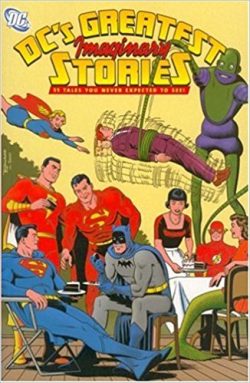
Part V 1957-1985: Imaginary Tales then takes a step sideways to highlight the many memorable out-of-continuity stories the Superman-Lois relationship has generated.

‘The Wife of Superman’ was part of an occasional series running in early issues of Superman’s Girlfriend, Lois Lane. Probably scripted by Seigel and definitely drawn by Schaffenberger) this third outing (from #23, February 1961), revisits a possible future wherein Lois is worn to a frazzle by two unmanageable super-toddlers and yearns for her old job at the Daily Planet…

From a period where Golden Age stories where assumed to have occurred on parallel world Earth-Two, ‘Superman Takes a Wife’ comes from 40th Anniversary issue Action Comics #484 (June 1978). Here Cary Bates, Curt Swan & Joe Giella detail how the original Man of Tomorrow became editor of the Metropolis Daily Star in the 1950s and married Lois. Thanks to villainous rogues Colonel Future and the Wizard who had discovered a way to make Superman forget his own existence, only she knew that her husband was once Earth’s greatest hero…

When I was a nipper, Superman had outlandish adventures and was a decent regular guy. His head could be replaced by a lion’s or an ant’s and he loved playing jokes on his friends. His exploits were routinely mind-boggling and he kept a quiet dignity about him. He only shouted to shatter concrete, and not to bully villains. He was quietly cool.

And in All Star Superman he was again. Grant Morrison & Frank Quitely produced a delightful evocation of those simpler, gentler times with a guided tour of the past redolent with classic mile-markers. Superman was the world’s boy scout, Lois was spending her days trying to prove Clark is the Man of Steel, Jimmy Olsen was a competent young reporter dating Lucy Lane and all of time and space knew they could always rely on the Man of Tomorrow.

As seen in All-Star Superman #2 and 3 (February and May 2006), ‘Superman’s Forbidden Room’ and ‘Sweet Dreams, Superwoman’ sees Lois takes centre stage as a plot to kill Superman forces the hero to acknowledge his feelings for her. The result is an astonishing trip to his Fortress of Solitude and a hyper-empowering birthday gift she will never forget… Wrapping up the recollections is an astounding Cover Gallery to accompany the works already seen in conjunction with the stories cited above with covers by Shuster, Swan & Stan Kaye, Schaffenberger, Murphy Anderson, Byrne, Kerry Gammill & Brett Breeding, Leonard Kirk & Karl Story, Ed McGuiness & Cam Smith, Adam Hughes, Gene Ha, José Luis García-López, Quitely & Jamie Grant.

These extras comprise Superman #51 (March/April 1948) and Action Comics #137 (October 1949) both by Boring & Kaye; Superman’s Girlfriend, Lois Lane #1 (April 1958) by Swan & Kaye; issue #25 (May 1961) by Schaffenberger; #80 (January 1967) by Swan & Neal Adams and #111 (July 1971) by Giordano.

Later classics covers include Superman volume 2 #59 (September 1991) by Dan Jurgens & Brett Breeding; Superman: The Wedding Album and Beyond (1995) by Jurgens & Ordway; Superman volume 2 #157 (June 2000) by McGuiness & Smith; Superman Returns Prequel #4 (August 2006) by Hughes; Superman Confidential #2 (February 2007) by Tim Sale and Superman Unchained #1 (2013 variant cover) by José Luis García-López.

This monolithic testament to the most enduring love affair in comics is a guaranteed delight for fans of all ages and a perfect introductory time capsule for all readers of fantastic fiction.
© 1940, 1942, 1952, 1954, 1957, 1960, 1961, 1963, 1972, 1983, 1986, 1987, 1992, 1997, 2001, 2005, 2006, 2007, 2010, 2014, 2015 DC Comics. All Rights Reserved.
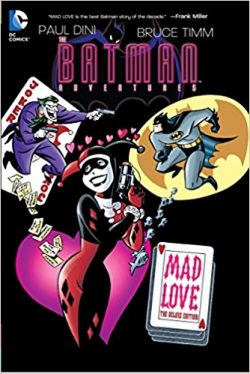
The Batman Adventures: Mad Love Deluxe Edition


By Paul Dini & Bruce Timm, with Rick Taylor & Tim Harkins (DC Comics)
ISBN: 978-1-4012-5512-1

Harley Quinn wasn’t supposed to be a star… or even an actual comicbook character. As soon became apparent, however, the manic minx always has her own astoundingly askew and off-kilter ideas on the matter… and any other topic you could name: ethics, friendship, ordnance, true love…

Created by Paul Dini & Bruce Timm, Batman: The Animated Series aired in the US from September 5th 1992 to September 15th 1995. Ostensibly for kids, the breakthrough television cartoon revolutionised everybody’s image of the Dark Knight and immediately began feeding back into the print iteration, leading to some of the absolute best comicbook tales in the hero’s many decades of existence.

Employing a timeless visual style dubbed “Dark Deco”, the show mixed elements from all iterations of the character and, without diluting the power, tone or mood of the premise, reshaped the grim avenger and his extended team into a wholly accessible, thematically memorable form that the youngest of readers could enjoy, whilst adding shades of exuberance and panache that only most devout and obsessive Batmaniac could possibly object to…

Harley Quinn was first seen as the Clown Prince of Crime’s slavishly adoring, extreme abuse-enduring assistant in Joker’s Favor (airing on September 11th 1992) where she instantly captured the hearts and minds of millions of viewers. From there on she began popping up in the incredibly successful licensed comicbook and – always stealing the show – soon graduated into mainstream DC continuity.

After a period bopping around the DCU she was re-imagined as part of the company’s vast post-Flashpoint major makeover and appeared as part of a new gritty-but-still-crazy iteration of the Suicide Squad, but at heart she’s always been a cartoon glamour-puss, with big, bold, primal emotions and only the merest acknowledgement of how reality works…

Re-presenting the 1994 one-shot Batman Adventures: Mad Love, this slight and breezy hardcover is made up of mostly recycled material – including writer Paul Dini’s comfortably inviting Foreword and co-plotter/illustrator Bruce Timm’s effusive and candidly informative ‘Mad Love Afterword’.

However, a truly unmissable bonus treat for art-lovers and all those seeking technical insight (perhaps with a view to making comics or animation their day job) is the illustrator’s full monochrome ‘Original Layouts for The Batman Adventures: Mad Love’; displaying how the story materialised page by page; previous and variant covers to earlier editions and unused painted back cover art plus highly detailed, fully-annotated colour guides for the complete story offering a perfect “How To…” lesson for aspiring creators…

All that being said though, what we want most is a great story, and the magnificently madcap mayhem commences here as Police Commissioner James Gordon heads to the dentist. When Batman easily foils the Joker’s latest manic murder attempt, the mountebank of Mirth pettishly realises he’s lost his inspirational spark.

He’s therefore in no mood for lasciviously whining lapdog Harley’s words of comfort or flirtatious pep talks…

As the Dark Knight reviews his files on the Joker’s girlfriend and ponders on how Harleen Frances Quinzel breezed through college and came away with a psychology degree that got her a position at Arkham Asylum, the larcenous lady in question has gone too far in the Joker’s lair. The trigger was comforting sympathy and telling her “precious pudden” how his baroque murder schemes could be improved…

Kicked out and almost killed (again), Harleen harks back to her first meeting with the devilishly desirable crazy clown and how they instantly clicked. She fondly recalls how her original plan to psychoanalyse the Joker and write a profitable tell-all book was forgotten the moment she fell under his malign spell to become his adoring, willing and despised slave…

She also realises that Batman quickly scotched their budding eternal love by capturing the grinning psycho-killer she secretly aided and abetted, both before and after she created her own costumed alter ego…

In fact, Batman always spoils her dreams and brutalises her adored “Mistah J”! It’s long past time she took care of him forever…

Driven by desperation and fuelled by passion, Harley Quinn swipes one of the Joker’s abortive schemes and tweaks it, and before long the Gotham Gangbuster is duped, doped, bound and destined for certain doom.

Sadly, the triumphant Little Woman hasn’t reckoned on how her barmy beloved will react when he learns she has done in mere hours what he’s failed to accomplish over many bitter years…

Coloured by Rick Taylor and lettered by Tim Harkins, the classy and classically staged main feature plays very much like a 1940s noir blend of morbid melodrama and cunning crime caper – albeit with outrageous over-the-top gags, sharply biting lines of dialogue and a blend of black humour and bombastic action – and easily qualifies as one of the top five bat-tales of all time.

A frantic, laugh-packed hoot that manages to be daring and demure by turns, Mad Love is an absolute delight, well worth the price of admission and an irresistible treasure to be enjoyed over and over again.
© 1994, 2015 DC Comics. All Rights Reserved.
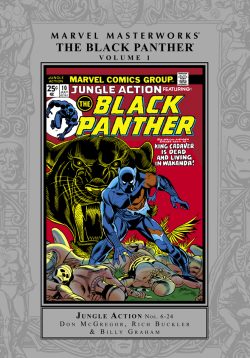
Black Panther Marvel Masterworks, volume 1


By Don McGregor, Rich Buckler, Gil Kane, Billy Graham, Keith Pollard, Klaus Janson & various (Marvel)
ISBN: 978-0-7851-4198-3 (HB)

Acclaimed as the first black superhero in American comics and one of the first to carry his own series, the Black Panther‘s popularity and fortunes have waxed and waned since his debut.

In fact, the cat king actually attacked Marvel’s First Family as part of an extended plan to gain vengeance on the murderer of his father. He was also the first black superhero in American comics, catapulting to instant fame and glory in Fantastic Four #52 (cover-dated July 1966).

As created by Jack Kirby & Stan Lee, T’Challa, son of T’Chaka, is an African monarch whose clandestine domain is the only source of vibration-absorbing wonder mineral Vibranium. The miraculous alien metal – supposedly derived from a fallen meteor which struck the continent in lost antiquity – is the basis of the country’s immense wealth, enabling Wakanda to become one of the wealthiest and most secretive nations on Earth. These riches also allowed the young king to radically remake his country, creating a technological wonderland even after he left Africa to fight as one of the mighty Avengers.

For much of its history Wakanda has been an isolated, utopian kingdom with the tribal resources and people safeguarded and led since time immemorial by a human warrior-king deriving cat-like physical advantages from secret ceremonies and a mysterious heart-shaped herb. This has ensured the generational dominance of the nation’s Panther Cult and Royal Family…

The top-secret “Vibranium mound” had guaranteed the country’s status as a clandestine superpower for centuries but in modern times has increasingly made Wakanda a target for subversion, incursion and even invasion as the world grew ever smaller.

After wandering around the Marvel Universe, enjoying team-ups and saving the world on a semi-regular basis as one the “Earth’s Mightiest Superheroes”, in the summer of 1973 the Black Panther finally won his own solo series, Scripter Don McGregor opted to return the King to his people for an ambitious epic of love, death, vengeance and civil war: inventing from whole cloth, and Kirby’s throwaway notion of a futuristic jungle, the most unique African nation ever seen…

Gathering the groundbreaking stories from Jungle Action volume 2 #6-24 (spanning September 1973 to November 1976 and available in hardback and digital formats), the saga opens with an erudite and informative Introduction by Don McGregor.

‘Panther’s Chronicles’ discusses the author’s work practises, close relationship with his artistic collaborators, and the cultural context and milieu surrounding the creation of the series at a time when segregation and civil rights were still a hot button topic in America…

Now with the Panther’s own big-budget big-screen blockbuster imminently expected, the long-lauded, brilliantly effective and fantastically poetic work of Don McGregor and his collaborators can be enjoyed as the groundbreaking narrative landmark it is, free of the torturous months-long wait between cliff-hanging chapters…

Jungle Action launched with an October 1972 cover-date, a cheap reprint vehicle for old Atlas-era Tarzan and Sheena knock-offs like Tharn, Jann and Lorna (…of the Jungle). The fifth issue abruptly changed tack, reprinting the Black Panther-starring contents of Avengers #62 as prelude to the start of T’Challa’s own all new adventures, which open here with #6 and the eponymous ‘Panther’s Rage’ illustrated by Rich Buckler & Klaus Janson.

The story opens with the Panther back in his African homeland and stumbling upon the torture of an elderly farmer. Despite his best efforts the victim dies in his arms, swearing he never lost faith in king or country…

Learning the attack is the work of a mysterious, brutal rebel leader named Erik Killmonger, T’Challa sets all the resources of his inner court circle to finding the monster. With reports of further atrocities mounting, he leaves his American lover Monica Lynne to hunt the perpetrators and soon confronts his potential usurper at the potently symbolic Warrior Falls roaring above the life-sustaining River of Grace and Wisdom.

The barbarous-seeming giant is not cowed by the Panther’s power or prowess and easily wins the no-holds barred battle that follows…

The initial episode is supplemented by detailed maps of Wakanda (the first fans had ever seen) before JA #7 mobilises ‘Death Regiments Beneath Wakanda’. Barely surviving his fight with Killmonger, T’Challa is nursed back to health by Monica at the Palace even as hideously disfigured American Horatio displays his skill with snakes and poisons to his friend N’Jadaka.

Known to their recruits as Venomm and Erik Killmonger, these rebel leaders plot their next attack which results in the reptilian insurgent ambushing T’Challa when the king investigates an illegal mine. This shocking atrocity is being used to siphon off raw Vibranium to pay for Killmonger’s increasingly violent and widespread attacks on the outlying population centres…

Although triumphant this time, T’Challa realises this is many-layered war: one he might not win…

Cover-dated January 1974, Jungle Action #8 introduced another super-powered rebel as – whilst the Black Panther renews his powers through ancient ritual – ‘Malice by Crimson Moonlight’ sees a spear-wielding wonder woman invade the Royal Palace.

Advisor Taku is interrogating Venomm and gradually making inroads into turning the bitter outcast when Malice attacks. Only the power of the Panther saves him and prevents the brutal jailbreak from succeeding…

After more maps of the hidden country and detailed plans of ‘Central Wakanda’s Palace Royale’ the saga resumes in #9 with ‘But Now the Spears Are Broken’ (illustrated by Gil Kane & Janson) as T’Challa goes in-country to learn the effects of the power-struggle on ordinary Wakandans.

After saving little boy Kantu from a rhino, the king is made painfully aware that the common people view his foreign woman Monica with as much suspicion as the constantly-raiding insurgents. That feeling even penetrates to the heart of the palace. When advisor Zatama is murdered, Monica is arrested for the crime…

T’Challa is not there to protest or defend her: he has returned to Kantu’s village to investigate strange disappearances, discovering a seeming mass-rising of zombies led by a skeletal maniac called Baron Macabre. Once more the Great Cat is forced to ignominiously retreat…

Supreme stylist Billy Graham takes over the pencilling with #10 as the Black Panther returns to the zombie nest, exposing a cunning charade beneath the deserted village as well as a super-scientific base run by a malignant, mind-warping mutant in ‘King Cadaver is Dead and Living in Wakanda!’

Accompanying the dark drama here are examples of ‘Black Panther Artistry’: specifically, Kirby’s first designs for the hero back when he was going by the provisional title of ‘The Coal Tiger’ and Buckler and Janson’s first depiction of ‘Erik Killmonger’…

Due to an extremely unfavourable publishing schedule, Panther’s Rage unfolded with agonising slowness, but the lengthy wait between episodes allowed McGregor the latitude to pick and choose key events, with readers accepting that some stuff was actually occurring between issues.

In #11 (September 1974), the civil war had proceeded unchecked and ‘Once You Slay the Dragon!’ sees the Panther and his forces launching a long-awaited counterattack on Killmonger’s base in N’Jadaka Village. The battle is vicious and brief, introducing yet another powered lieutenant in the shape of pitiless high-tech armourer Lord Karnaj…

And on the home front, T’Challa finally clears Monica and captures Zatama’s killer…

With Killmonger temporarily pushed back, the Panther goes on the offensive, using the rebel’s most inconsequential converts – Tayete and Kazibe – as guides to follow his ultimate enemy to his most secret strongholds. Heading into the mountains and the fabled Land of Chilling Mists, the Panther discovers mutagenic temple the Resurrection Altar.

Used by Killmonger to create his grotesque super-warriors, it is presided over by scientifically-spawned vampire Sombre. When T’Challa confronts them, he is again overpowered by Erik and left for the wolves to devour in ‘Blood Stains on Virgin Snow!’

Craig Russell inked the next chapter as, enduring incomprehensible hardships in sub-arctic conditions, T’Challa perseveres to follow Killmonger into the temperate swamps of Serpent Valley in #13.

However, this is only after facing a pack of Wakanda’s white apes. To survive, the Panther must blasphemously ignore the sacred religious aspect of the mighty carnivores and become ‘The God Killer’…

Following a Venomm pin-up, JA #14 reveals that ‘There Are Serpents Lurking in Paradise’ (inked by Pablo Marcos) as T’Challa again clashes with Sombre and encounters an affable forest sprite guarding Serpent Valley. Pixie-like Mokadi asks difficult moral questions as T’Challa rushes towards his next battle with Killmonger, making him too late to stop the rebel capturing a legion of the valley’s awesome dinosaurs. The usurper even has time to leave one behind as a lethal parting gift for the embattled Wakandan chieftain…

The endgame rapidly approached in #15 as ‘Thorns in the Flesh, Thorns in the Mind’ (inked by Dan Green) finds T’Challa tracking his nemesis only to be overcome by Killmonger’s archer assassin Salamander K’Ruel and left to be dismembered by a ravenous Pterosaur before – against all odds – staggering back to Monica for another bout of recuperation…

Graham inked his own pencils for the beginning of the end in #16 as T’Challa and Monica’s time of idyllic passion culminates in catastrophe when ‘And All Our Past Decades Have Seen Revolutions!’ reveals the origins of Killmonger and sees the vast cast all converge for one final battle…

That comes in #17 as an army of war-trained dinosaurs invades Central Wakanda only to be finally crushed by the Panther’s forces and superior technology. The affair concludes as it began at Warrior Falls, but ‘Of Shadows and Rages’ also holds a shocking twist as the great game of kings is decided by a player no one considered of any relevance…

With its nuanced emotional interplay, extended scope and fiercely independent supporting cast, Panther’s Rage was a milestone in dramatic comics storytelling but it harboured one last punch in a gripping ‘Epilogue!’ (Jungle Action #18, November 1975). Bob McLeod inked McGregor & Graham’s forceful look at the repercussions of conflict as T’Challa and maimed security chief Wakabi are targeted by feral woman Madame Slay: Killmonger’s ardent and unsuspected lover who believes her loss can only be assuaged by having her pack of loyal leopards eviscerate the victorious Wakandans…

Cover-dated January 1976, Jungle Action #19 opened McGregor’s most audacious and ultimately frustrating project, as T’Challa accompanies Monica back to America. The Panther versus the Klan shifted focus from war stories to detective fiction, replacing fabulously exotic Africa for America’s poverty-wracked, troubled Deep South and a head-on collision with centuries of entrenched and endemic racism.

Illustrated by Graham & McLeod, ‘Blood and Sacrifices!’ sees Monica reunite with her family after her sister is murdered. All too soon T’Challa is battling a gang of purple-hooded killers who appear to have set up in opposition to the ancient white-hooded Ku Klux Klan. Moreover, both sects seem determined to conceal the truth of Angela Lynne’s death…

A break comes when bumbling, well-meaning reporter Kevin Trublood stumbles into an attack on the newcomers by the strangely multi-racial Klan sect calling itself the Dragon Circle…

With neither townsfolk nor lawmen offering any welcome, T’Challa faces unbridled hostility and suspicion at every turn. He is even attacked by cops and a mob of citizens when he thwarts a knife attack on Monica. Although Sheriff Roderick Tate makes all the right noises and seems helpful, in ‘They Told Me a Myth I Wanted to Believe’, the Panther opts to pursue his own investigation before being overwhelmed by an army of white-robed Klansmen who tie him to a burning cross and leave him to die…

As Monica and Kevin puzzle out the convoluted web of mysteries, the Panther exerts all his gifts to escape becoming ‘A Cross Burning Darkly Blackening the Night!’ Later, as he slowly recovers in hospital, the family, Kevin and Tate review the few verifiable facts of Angela’s demise before patriarch Lloyd Lynne urges T’Challa to stop looking. He only has one daughter left after all…

Nevertheless, when the Panther and Trublood invade and disrupt a Klan rally, Lloyd is right there with them…

With Rick Buckler joining Graham on pencils and Jim Mooney alternating with McCleod on inks, Jungle Action #22 takes a bizarre turn as ‘Death Riders on the Horizon’ explores a Lynne family legend dating back to the formative days of the Klan in 1867 when old Caleb was targeted by the vile southern knights and their seemingly supernatural sponsor the Soul Strangler. As Monica listens to the ghastly, appallingly unjust tale, her mind fills in how T’Challa would have acted in such a hopeless situation…

Issue #23 (September 1976) was a deadline missed and a rapidly-sourced reprint from Daredevil #69 – represented here only by the pertinent cover and a Buckler pin-up – before this tantalising tale is unhappily cut short in final published instalment ‘Wind Eagle in Flight’ (by McGregor, Buckler & Keith Pollard).

The multi-layered, many-stranded plot suddenly expands as the Black Panther is almost killed by a mysterious new player who flies into the ever-more bewildering clash between cops, Klan, Dragon Circle and Lynne family, but, before the mystery could move any further, Jungle Action was cancelled…

A wholly different kind of Black Panther and utterly unrelated adventures would reappear two months later, under the auspices of returning creative colossus Jack Kirby. It would be years before the enigma of Angela’s death and the hero’s war against the Klan would be resolved…

So that’s what to look forward to in the next volume…

Here, however, a passionate reminiscence and appraisal follows in an ‘Afterword by Dwayne McDuffie’, as well as John Romita’s cover for Jungle Action #5; original cover art, pages and sketches by Buckler & Janson and Kane; pencils and layouts by Graham and Buckler as well as Steve Gerber’s ‘Jungle Re-Actions’ feature from JA #7, plus the un-inked Buckler story pages that would have been #25.

Also included are McGregor’s correspondence with then-fan Ralph Macchio and the author’s original working notes, plot synopses and candid contemporary photos of the close-knit creative team.

A truly bold masterpiece of comics narrative, Don McGregor’s Black Panther is stark, vibrant proof that the superhero genre works best when ambitious and passionate creators are given their head and let loose to get on with it. Now, supported by a major movie, perhaps readers will finally see how the Fights ‘n’ Tights game should be played…
© 1973, 1974, 1975, 1976, 2016 Marvel Characters Inc. All rights reserved.

Jonah Hex volume 9: Counting Corpses


By Justin Gray, Jimmy Palmiotti, Paul Gulacy, Darwyn Cooke, Dick Giordano, Jordi Bernet, Billy Tucci, Dave Stewart, Rob Schwager & Rob Leigh (DC Comics)
ISBN: 978-1-4012-2899-6

When Justin Grey & Jimmy Palmiotti revived DC’s western wild-man Jonah Hex, they cunningly incorporated an even more mordant, blackly ironic streak of wit than that pioneered by the lone gunman’s originators John Albano & Tony DeZuñiga to amplify the already sanguine view of morality and justice that permeates the feature. The gritty – often outright chilling – narratives thus result in some of the most accessible and enjoyable comics fiction ever.

The writers also had the services of extremely talented people like colourists Dave Stewart, Paul Mounts and Rob Schwager and letterer Rob Leigh plus a virtual Who’s Who of top artists to lend veracity, authenticity and sheer style to the always uncompromising tales such as those populating this ninth trade paperback (or eBook) compilation from 2010.

The contents comprise issues #43 and 50-54 of this much-missed iteration of the greatest gunman of all time: a perambulation passel of potent one-shot yarns to entice and bedazzle one and all…

The suspense-drenched action opens with ‘The Hyde House Massacre’ with art by Paul Gulacy & Schwager from issue #43 (July 2009). Hired to rescue a kidnapped hotelier and his daughter from an army of bandits, the bounty killer is only half successful, and makes the painful and foolish error of trying to negotiate with the clients about how much of his fee he actually deserves…

‘The Great Silence’ crafted by Darwyn Cooke & Stewart for anniversary issue #50 (February 2010) is a milestone of action and tragedy as Hex contracts to hunt down fifty outlaws even as old hunting ally and sometime dalliance Tallulah Black moves into a quiet little town to secretly bring her baby to term.

Of course, villains and mad killers can be found everywhere and when Hex’s surviving quarry lay a trap, grim fate intervenes to destroy his last hope for happiness before he even knows it exists…

Dick Giordano & Schwager then offer up a lush and sultry tale of grifters and men of faith when Hex is hired to track down bandits who murdered a prominent citizen of a frontier town. More importantly, those road agents also stole the ‘Divining Rod’ the victim used to ferret out gold, silver and water for the newly established boom town-to-be, and his decent god-fearing widow, the creepy preacher and the shocked citizens all seem more concerned with the theft than the killing.

Hex soon smells a rat but he’s underestimated quite how many…

A double bill for illustrator Jordi Bernet & Schwager opens with ‘Too Mean to Die’ (#52, April) as a gravely-wounded Jonah stumbles upon a cabin in the swamp and a mother nursing her infant. When she offers assistance and he accepts neither realise the family bonds of blood and vengeance they’re breaking… until the shooting (and stabbing and punching and drowning and…) starts…

Never one to make big plans, Hex plays against type and concocts a cunning trap to drawn in a gang of train robbers, before learning again that you can’t trust anybody – especially gorgeous, crafty saloon girls and actresses – before the dust settles in ‘“You’ll Never Dance Again”’, as limned by Billy Tucci & Mounts.

Bernet then shuts down the show in ‘Shooting Stars’ (#54, June) as Hex links up again with the one outlaw he won’t hunt to confront a lawman and his deputies who are far worse than any bandit, owlhoot or renegade…

With covers and variants by Gulacy, Cooke, Giordano, Bernet and Tucci, these smart, fast-paced, deliciously convoluted and compellingly gritty stand-alone sagas provide maximum bang for your buck and a front row seat as the darkest knight of the Wild West proves over and again why he’s the greatest antihero in comics.
© 2009, 2010 DC Comics. All Rights Reserved.
Fantastic Four Marvel Masterworks volume 7


By Stan Lee, Jack Kirby & Joe Sinnott, with Frank Giacoia & various (Marvel)
ISBN: 978-0-7851-5062-6 (PB)                     : 978-0-7851-1585-4 (HB)

The FF was the indisputable central title and most consistently groundbreaking series of Marvel’s ever-unfolding web of cosmic creation: a forge for new concepts and characters at a time when Jack Kirby was in his conceptual prime and continually unleashing his vast imagination on plot after spectacular plot as Stan Lee scripted some of the most passionate superhero sagas that Marvel – or any publisher, for that matter – has ever seen.

Both were on an unstoppable roll, at the height of their creative powers, and full of the confidence that only success brings, with The King particularly eager to see how far the genre and the medium could be pushed.

This full-colour compendium – available in hardcover, trade paperback and digital editions – re-presents Fantastic Four #61-71 and includes the fifth giant-sized Annual: issues of progressive and increasingly impressive landmarks spanning April 1967 through February 1968 with Stan & Jack cannily leading from the front as an ever-expanding and cohesive shared universe grew around the fruits of their labours.

As seen in the landmark premier issue, maverick scientist Reed Richards, his fiancé Sue Storm, their close friend Ben Grimm – with Sue’s tag-along teenaged brother Johnny – survived an ill-starred private space-shot after Cosmic Rays penetrated their ship’s inadequate shielding and mutated them all.

Richards’ body became elastic, Sue gained the power to turn invisible and the kid could turn into living flame, but poor, tragic Ben horrifically devolved into a shambling, rocky freak…

Following a vivid reminiscence from star inker Joe Sinnott in his Introduction, the magic resumes with Fantastic Four #61.

Even though the team had just defeated a cosmically-empowered Doctor Doom and returned to the Silver Surfer his purloined life-energies there was never a dull moment: no sooner had the heroes relaxed than a new and improved foe attacked once more in ‘Where Stalks the Sandman?’.

This began another explosive multi-part tale wherein Johnny and his imprisoned beloved Crystal were reunited even as Reed is defeated in battle and lost to the anti-matter hell of the Negative Zone’s sub-space corridor…

It was Crystal to the rescue in ‘…And One Shall Save Him!’ as guest-star Triton (of the newly liberated Inhuman Royal Family) plucked the doomed genius from the jaws of disaster and inadvertently introduced another unique enemy who followed Reed back from the anti-matter dimension and straight into partnership with the still-seething Sandman. The resulting battle against ‘Blastaar, the Living Bomb-Burst!’ (FF #63, June 1967) wrecked half the city before some modicum of security was restored…

Looking for a little peace and quiet the exhausted team then tackled ‘The Sentry Sinister’: a frenetic south seas adventure romp pitting the vacationing heroes against a super-scientific robot buried for millennia by an ancient star-faring race.

This tropical treat expanded the burgeoning interlocking landscape to an infinite degree by introducing the ancient, imperial and alien Kree who would grow into one of the fundamental pillars supporting the continuity of the Marvel Universe.

Although regarded as a long-dead race, the Kree themselves resurface in the very next issue as the team is targeted by an alien emissary of vengeance ‘…From Beyond this Planet Earth!’ The formidable Ronan the Accuser has come looking to see what could possibly have destroyed an invincible Sentry and finds out to his great regret but whilst the fight ensues Bens’s blind girlfriend Alicia is abducted by a super scientific stranger…

The mystery of her disappearance is revealed in #66 in ‘What Lurks Behind the Beehive?’ as the outraged team trail the seemingly helpless artisan to a man-made technological wonderland where a band of rogue geniuses have genetically engineered the next phase in evolution, only to lose control of it even before it can be properly born…

‘When Opens the Cocoon!’ exposes the secret of the creature known as Him and only Alicia’s gentle nature is able to placate the nigh-omnipotent creature (who would eventually evolve into tragic cosmic voyager Adam Warlock), after which the tight continuity pauses to allow the Inhumans (a time-lost race of paranormal beings long secluded from mortal men) and old FF ally the Black Panther to share the stage in that year’s Fantastic Four Annual wherein the sinister invader Psycho-Man attempts to ‘Divide… and Conquer!’ the Earth.

Frank Giacoia inked this yarn, with the emotion-bending micro-marauder holding both the King of Wakanda and the Royal Family of hidden Attilan at bay until the FF can pitch in, delayed as they were by the news that the Sue Richards is pregnant… and soon to confined in the most appallingly sexist manner until the birth…

The Annual also includes another comedy insight into the creation of Marvel Epics as Stan, Jack and Frank ask ‘This is a Plot?’ and – after the now customary Kirby pin-ups (Inhumans Black Bolt, Gorgon, Medusa, Karnak, Triton, Crystal and Maximus, a colossal group shot of Galactus, the Silver Surfer and others plus a double-page spread of the quirky quartet) – a rapidly rising star-in-the-making got his first solo appearance in ‘The Peerless Power of the Silver Surfer’: a pithy fable of cruel ingratitude reintroducing and upgrading the threat-level of the Mad Thinker‘s lethal Artificial Intelligence murder-machine Quasimodo…

In FF #68 (inked as ever by the remarkable Joe Sinnott), the Thinker resurfaces to enact his latest scheme, ‘His Mission: Destroy the Fantastic Four!’ beginning with the cogitating criminal replacing a famous doctor to subvert a potential cure for The Thing’s rocky condition.

Phase two involves a mind-warping scheme to turn the rocky stalwart against his comrades, progressing in ‘By Ben Betrayed!’ as the newly malevolent Grimm tries to mercilessly murder his comrades only to be driven temporarily away.

Desperately searching for their brainwashed friend, the FF quickly capture the Thinker and free Ben’s shackled mind in ‘When Fall the Mighty!’, but the victory leaves the heroes unconscious with only Sue conscious to tackle the villain’s last-ditch killer android in ‘…And So It Ends…’

Art lovers can also enjoy a boundless hidden bounty at the end of this volume as the titanic tome wraps up with a selection of Kirby pencil pages, including alternative covers to FF #64 and #71, plus a gallery of Sinnott-inked covers and pages from #61, 63, 65 and 66.

Epic, revolutionary and unutterably astounding, these are the stories which made Marvel the unassailable leaders in fantasy entertainment and remain the most unmissable superhero comics ever crafted.
© 1967, 1968, 2017 Marvel Characters, Inc. All rights reserved.

DC’s Greatest Imaginary Stories


By Otto Binder, Bill Finger, Jerry Siegel, John Broome, Leo Dorfman, Edmond Hamilton, Jim Shooter, C.C. Beck, Dick Sprang, Kurt Schaffenberger, Curt Swan, Carmine Infantino, Bob Kane & various (DC Comics)
ISBN: 978-1-4012-0534-8

Alan Moore’s infamous epigram notwithstanding, not all comics tales are “Imaginary Stories.”

When DC Editor Mort Weisinger was expanding the Superman continuity and building the legend, he realised that each new tale was an event that added to a nigh-sacred canon: that what was written and drawn mattered to the readers. But as a big concept guy he wasn’t going to let that aggregated “history” stifle a good idea, nor would he allow his eager yet sophisticated audience to endure clichéd deus ex machina cop-outs to mar the sheer enjoyment of a captivating concept.

The mantra known to every baby-boomer fan was “Not a Dream! Not a Hoax! Not a Robot!” boldly emblazoned on covers depicting scenes that couldn’t possibly be true… even if it was only a comicbook.

Imaginary Stories were conceived as a way of exploring non-continuity plots and scenarios devised at a time when editors believed entertainment trumped consistency and knew that every comic read was somebody’s first …or potentially last.

This jolly little compilation celebrates that period when whimsy and imagination were king and stretches the point by leading with a fanciful tale of the World’s Mightiest Mortal as ‘Captain Marvel and the Atomic War’ (Captain Marvel Adventures #66, October 1946) actually hoaxes the public with a demonstration of how the world could end in the new era of Nuclear Proliferation, courtesy of Otto Binder & CC Beck.

‘The Second Life of Batman’ (Batman #127 October 1959) by Bill Finger, Dick Sprang & Charles Paris doesn’t really fit the strict definition either, but the tale of a device that predicts how Bruce Wayne‘s life would have run if his parents had not been killed is superb and engaging all the same.

‘Mr. and Mrs. Clark (Superman) Kent!’ by Binder and the brilliant Kurt Schaffenberger, was the first tale of an occasional series that began in Superman’s Girlfriend Lois Lane #9 (August 1960); depicting the laughter and tears that might result if the plucky news-hen secretly married the Man of Steel. From an era uncomfortably parochial and patronizing to women, there’s actually plenty of genuine heart and understanding in this tale and a minimum of snide sniping about “silly, empty-headed girls”…

Eventually the concepts became so bold that Imaginary Stories could command book-length status. ‘Lex Luthor, Hero!’ (Superman #149, November 1961) by Jerry Siegel, Curt Swan & Sheldon Moldoff details the mad scientist’s greatest master-plan and ultimate victory in a tale as powerful now as it ever was. In many ways this is what the whole concept was made for…

No prizes for guessing what ‘Jimmy Olsen Marries Supergirl!’ (Superman’s Pal Jimmy Olsen, #57, December 1961) is about, but the story is truly a charming delight, beautifully realized by Siegel, Swan & Stan Kaye.

Once more stretching the point ‘The Origin of Flash’s Masked Identity!’ (The Flash# 128, May 1962) by John Broome, Carmine Infantino & Joe Giella, although highly entertaining, is more an enthusiastic day-dream than alternate reality, and, I suspect, added to bring variety to the mix – as is the intriguing ‘Batman’s New Secret Identity’ (Batman #151, November 1961, by Finger, Bob Kane & Paris).

‘The Amazing Story of Superman-Red and Superman-Blue!’ (Superman #162, July 1963) is possibly the most influential tale of this entire sub-genre. Written by Leo Dorfman, with art from Swan & George Klein, this startling utopian classic was so well-received that decades later it influenced and flavoured the post-Crisis on Infinite Earths Superman continuity for years. The plot involves the Action Ace being divided into two equal wonder men who promptly solve all universal problems and even the love rivalry between Lois Lane and Lana Lang!

The writer of ‘The Three Wives of Superman!’ is currently unknown to us but the ever-excellent Schaffenberger can at least be congratulated for this enchanting tragedy of missed chances that originally saw print in Superman’s Girlfriend Lois Lane #51, from August 1964.

‘The Fantastic Story of Superman’s Sons’ (Superman #166, November 1964) by Edmond Hamilton, Swan & Klein is a solid thriller built on a tragic premise (what if only one of Superman’s children inherited his powers?), and this bright and breezy book closes with the stirring and hard-hitting ‘Superman and Batman… Brothers!’, wherein orphaned Bruce Wayne is adopted by the Kents, but cannot escape a destiny of tragedy and darkness.

Written by Jim Shooter, with art from Swan & Klein for World’s Finest Comics # 172 (cover-dated December 1967) this moody thriller in many ways signalled the end of the carefree days and the beginning of a grittier, more cohesive DC universe for a less whimsical, fan-based audience.

This collection is a glorious slice of fancy, augmented by an informative introduction from columnist Craig Shutt, and bolstered with mini-cover reproductions of many tales that tragically never made it into the collection, but I do have one minor quibble: No other type of tale was more dependent on an eye-catching, conceptually intriguing cover, so why couldn’t those belonging to these collected classics have been included here, too?

Surely, it’s time for a re-issue in either print or eBook format with all those arresting covers included. Yes, it is… and don’t call me Shirley…
© 1946, 1959-1964, 1967, 2005 DC Comics. All Rights Reserved.