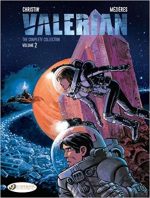
Valerian – The Complete Collection volume 2


By J.-C. Méziéres & P. Christin with colours by E. Tranlé and translated by Jerome Saincantin (Cinebook)
ISBN: 978-1-84918-356-7

Valérian is arguably the most influential pictorial science fiction series ever published – and yes, I am including both Buck Rogers and Flash Gordon in that expansive and undoubtedly contentious statement.

Although to a large extent those venerable newspaper strips formed the medium itself, anybody who has seen a Star Wars movie has seen some of Jean-Claude Méziéres & Pierre Christin’s brilliant imaginings which the filmic phenomenon has shamelessly plundered for decades: everything from the look of the Millennium Falcon to Leia’s Slave Girl outfit…

Simply put, more carbon-based lifeforms have experienced and marvelled at the uniquely innovative, grungy, lived-in tech realism and light-hearted swashbuckling roller-coasting of Méziéres & Christin than any other cartoon spacer ever imagined possible.

Valérian: Spatio-Temporal Agent launched in the November 9th 1967 edition of Pilote (#420, running until February 15th 1968). Although it was a huge hit, graphic album compilations only began with second tale The City of Shifting Waters, as all concerned considered the first yarn as a work-in-progress and not quite up to a preferred standard.

You can judge for yourself, by getting hold of the previous hardcover compilation volume…

The groundbreaking series followed a Franco-Belgian mini-boom in science fiction triggered by Jean-Claude Forest’s 1962 creation Barbarella. Other notable successes of the era include Greg & Eddy Paape’s Luc Orient and Philippe Druillet’s Lone Sloane cosmic excursions, which all – with Valérian – stimulated mass public reception to science fiction and led to the creation of dedicated fantasy periodical Métal Hurlant in 1977.

Valérian and Laureline (as the series became) was a light-hearted, wildly imaginative time-travel adventure-romp (a bit like Doctor Who, but not really all that much), drenched in wry, satirical, humanist and political social commentary, starring (at least at first) an affable, brawny, capably unimaginative and by-the-book cop tasked with protecting the universal time-lines and counteracting paradoxes caused by casual time-travellers…

In the course of the first escapade Valerian picked up fiery, capable Laureline – originating in the 11th century but later becoming our hero’s (far smarter) assistant and deputy. The indomitable girl trained as a Spatio-Temporal operative and was soon an accompanying Val on missions throughout time and space… luckily for him…

Valérian adventures were initially serialised in weekly Pilote until the conclusion of 13th adventure The Rage of Hypsis (January 1st-September 1st 1985) after which the mind-bending exploits were simply premiered as all-new complete graphic novels, until the magnificent saga concluded in 2010.

(One clarifying note: in the canon “Hypsis” is counted as the twelfth tale, due to the collected albums being numbered from The City of Shifting Waters. When Bad Dreams was finally released in a collected edition in 1983 it was given the number #0).

This splendid second oversized hardback compendium – designed to cash in on this summer’s spectacular movie adaptation from Luc Besson – once again boasts a wealth of text features. These include the next chapter of the continuing ‘Interview Luc Besson, Jean-Claude Méziéres and Pierre Christin’, after which Stan Barets picks out the creative highpoints and methodology of the creators in his essay ‘The Intergalactic Unites the Human Race!’.

‘Valerian in His Own Time’ traces the development of the strip in France, with unseen and remastered art examples. Between 1981 and 1985, Dargaud-Canada and Dargaud-USA published a quartet of albums in English (with a limited UK imprint from Hodder-Dargaud) under the umbrella title Valerian: Spatiotemporal Agent. Written by Will Eisner and Daniel Richie, the original Introductions to two pertinent early editions are included here after which ‘The Stories in this Book’ offers context and a taste of things to come…

Once more re-presenting a trio of classic formative fantasy-fests, the fabulous fun recommences here with The Land Without Stars. This originally ran in Pilote #570-592 (October 8th 1970 to March 11th 1971) and follows the Spatio-Temporal agents as they undertake a tedious pro forma inspection of a cluster of new Terran colonies in the Ukbar star-system at the very edge of inter-galactic space…

However, the mission soon goes awry when a wandering world is detected on a collision course with the system and Valerian, still labouring under the effects of too many local alcoholic “diplomatic protocols”, decides that they should investigate at close quarters…

Despite being pickled, the rather insufferable lead agent lands with his long-suffering assistant on the runaway planet and discovers that this celestial maverick is hollow. Moreover, a thriving ancient culture or three thrive there, utterly unaware that they are not the only beings in all of creation…

Typically, however, of sentient beings everywhere, two of the civilisations are currently locked in a millennia-old war, armed and supplied by the third…

After an accident wrecks their exploratory scout ship Valerian and Laureline deduce the constant warfare originally caused the hollow world to tumble unchecked through space and will eventually result in its complete destruction, so in short order the professional meddlers split up to infiltrate the warring nations of Malka and Valsennar.

However, they are in for more surprises. Both city-states are divided on gender grounds, with Malka home to prodigious warrior women who subjugate their effete and feeble males whilst the aristocratically foppish but deadly dandies of Valsennar delight in beautiful, proficient and lethally lovely ladies – but only as totally compliant servants and chattels…

The highly-trained Galaxity operatives quickly rise in the ranks of each court – from slaves and toys to perfectly placed, trusted servants – and soon have ample opportunity to change the nature of the doomed civilisations within the collision-course world, after which the heroes even concoct a cannily cunning method of ending the planet’s random perambulations; giving it a stable orbit and new lease on life…

All in a day’s work, naturally, although it does take a few months to sort out: still what’s time to a couple of brilliant Spatio-Temporal agents?

Happily, this mind-boggling socio-sexual satire is packed with astounding action, imaginative imagery and fantastic creatures to provide zest to a plot that has since become rather overused – sure proof of the quality of this delightful, so-often imitated original yarn – but, as always, the space-opera is fun-filled, witty, visually breathtaking and stunningly ingenious. Drenched in wickedly wide-eyed wonderment, science fiction sagas have never been better than this.

Welcome to Alflolol was first seen in Pilote #631-652 (December 1971-May 1972) and starts as the Spatio-Temporal agents depart from Technorog, a desolate industrial planet whose vast resources are crucial to the running of human civilisation.

So vital in fact, that Galaxity sends her best agents just to inspect it every now and then…

As the S-T agents carefully negotiate the immense forcefield and lethal asteroid belt that surrounds the harsh, ferociously capitalistic factory world, Laureline is repeatedly possessed by an uncanny force. The fits draw the couple to an immense ship which has foundered between the floating rocks and searing energy screen…

Investigating the vessel, which is purposely open to hard vacuum, Laureline again lapses into a glowing coma and eerily drifts towards a family of incredibly powerful yet rustically affable alien primitives sitting on the hull of their seemingly derelict vehicle.

Valerian, closely following behind, prevents a terrible accident to his companion and is warmly greeted by the strangers, who explain that the eldest of their contingent is very ill and in her fevered throes has locked minds with his female. If they’re not careful, both might die…

Garrulous, easy-going Argol agrees to let Valerian treat the problem, so his wife Orgal telekinetically transports the Earthlings, her entire family and their pet Gumun back to the Earthlings’ astroship in mere moments. Soon, Terran technology has saved both human and alien and Argol settles back to explain what has happened…

These wanderers are naively friendly and immensely long-lived – like all their species – and are simply returning to their homeworld Alflolol after an amusing and gentle perambulation through space. However, since their departure – 4,000 Earth years ago – somebody else has moved in…

Problems soon occur. Despite the Technorog Governor’s outraged protests, Galaxity law is clear and the Alflololians must be allowed back on their planet, no matter the cost to productivity or profits…

However, the wheedling plutocrat – secure in his job’s importance to the empire – realises he doesn’t have to hand over the keys, just make room for five meekly polite cosmic gypsies. The nomadic returnees, meanwhile, simply cannot grasp the concept of business and don’t understand why anybody would put up lots of flimsy, ugly buildings which spoil the hunting……

As Valerian allows the businessmen to walk all over the aliens’ rights, Laureline goes berserk: arguing for Argol’s family whilst indulging in a little light-hearted sabotage because the gentle giants won’t do it for themselves…

She needn’t bother though: their mere presence and incredible abilities are enough to disrupt the Governor’s precious productivity, especially when they get bored of sterile human accommodations and return to their ancestral ranges…

The real crisis only begins when the rest of the nomadic Alflololians return: one hundred separate ships full of natives protected by law and fully entitled to reclaim their homes.

The humans won’t leave, however, and soon the Governor is herding the wanderers onto a reservation and demanding they work if they want to eat.

Big mistake…

Poignantly challenging if not actually ruthlessly crusading, this is one of the earliest comics tales to catch the 1970s wave of ecological awareness and still ranks amongst the very best to explore the social iniquities which beset indigenous peoples at a time when most European ex-empires were still grudgingly divesting themselves of their colonial possessions.

The theme of Capitalism versus Native Culture and the eternal struggle between territorial imperatives, moral rights and holy profit have seldom been dealt with in such an effective, sardonic and hilariously surreal manner. Ending on an outrageous twist, the story has lost none of its wit and punch forty years later.

And, of course, there’s the usual glorious blend of astounding action, compelling imagery and fantastic creatures to leaven the morality play with space-operatic, visually breathtaking and stunningly ingenious wide-eyed wonderment…

Concluding the intergalactic investigations this go-round is Birds of the Master (originally serialised in Pilote #710-720 from June 14th to September 16th 1973) rejoining our now perpetually bickering odd couple as they are drawn into an eerie space Sargasso and marooned on a planetoid that has become a cemetery for spaceships.

Swept away by a tidal wave over a colossal waterfall, they are drowning amidst beds of kelp when a motley band of fisherfolk – comprised of many different species – haul the Spatio-Temporal agents aboard a ramshackle boat. In the skies high above, a vast cloud of malevolent birds circle, the same incredible creatures which had brought down their astroship.

Compelled to join in gathering the seaweed, the humans soon learn that the crop is destined for a mysterious unseen overlord dubbed The Master and the critically circling ugly avians are his enforcers: violent creatures inflicting madness with a bite…

The workers are nothing but despondent slaves. Bitterly discontented recent arrival Sül takes it upon himself to teach Valerian and Laureline what they need to know to survive as the slimy cargo is torturously shipped across bleak, unforgiving and forlorn terrain. As they toil onwards the newcomers observe an entire society all dedicated to providing vast amounts of food for the hidden overlord.

At the central gathering point where assorted food items from a hundred different sources are reduced to a liquid mass dubbed “Klaar” one of the starving toilers cracks, seeking to consume a morsel of the Master’s provender, and is immediately set upon by the sinister Birds of Madness. Furious Sül breaks too and – dashing to the worker’s aid – is similarly accosted. Cautious Valerian can barely stop his partner using her concealed ray-weapons in a futile attempt to save them…

When the Birds are done the battered survivors can barely speak. The first rebel now believes he can fly whilst Sül is left a babbling, aggressive shadow of his former self.

With the Klaar safely dispatched through a complex system of pipes to a distant hidden destination, the emaciated workers fall upon the spilled scraps before hurling the latest victims of the birds into the Pit of Crazies. Despite being thoroughly beaten in the melee, our heroes follow and join Sül in a peculiar enclave of deranged beings, each manifesting their own brand of bewilderment yet all sharing the same strange and disturbing speech impediment…

Valerian and Laureline are again viciously attacked when they seek aid from the “sane” slaves, and instead opt to follow the pipeline with the most ambulatory of the insane, heading deep into increasingly inhospitable country to confront the hidden cause of all their woes.

At first frantically followed by the outraged slave force, the strange crew eventually outdistance their pursuers as they head deeper into the harsh, barren wastelands until they are attacked by the ever-circling birds. As a result, the Spatio-Temporal agents are also infected by the speech-wrecking madness…

Pressing on regardless, the raving rovers follow an eerie glowing mist and at last face the vile creature which has lured, trapped and enslaved so many sentient beings. Subjected to an overwhelming psychic assault that no single mind – sane or otherwise – could resist, all hope seems lost.

Happily, the Master has never faced anyone as ingenious as Laureline and her desperate plan enables the assembled “Loonies” to fight back and drive the predatory horror off-planet and into the depths of space…

With the creature’s pernicious influence dispelled, the voyagers’ senses return and the victims head back to the settlements where the slaves have descended into a food-fuelled debauch. Surprisingly, once Valerian and Laureline have freed and repaired their astroship from the stellar graveyard, only Sül wants to leave with them…

Expansive, thrilling, funny, clever and holding back one last wry twist in the tale, The Birds of the Master might be one of the lesser galactic classics of this superb series, but it still packs a gripping narrative punch and some of the most impressive artwork ever to grace sci-fi comics.

These spectacular space-opera romps are fun-filled, action-packed, conceptually engaging and mind-bogglingly ingenious: drenched in wide-eyed fantasy wonderment, this is a slice of sheer science fiction heaven that has never been bettered…
© Dargaud Paris, 2016 by Christin, Méziéres & Tranlệ. All rights reserved. English translation © 2016 Cinebook Ltd.
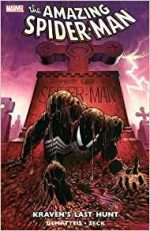
Amazing Spider-Man: Kraven’s Last Hunt


By J.M. DeMatteis, Mike Zeck, Bob McLeod & various (Marvel)
ISBN: 978-0-7851-2330-9 (HC)                    978-0-7851-3450-3 (TPB)

A character with the longevity and sheer number of separate venues to shine in as Spider-Man throws up a lot of dross over the decades, but is also infinitely evergreen when thoughtfully handled by top flight creators. Sometimes the writers and artists involved don’t even realise at the time that their crafting something memorable and timelessly special…

Kraven’s Last Hunt (originally collected as Spiderman: Fearful Symmetry) is just such a saga and is thankfully handily available in a variety of formats from spiffy hardback to cheap’n’cheerful trade paperback – and now even as a digital edition for all true sons and daughters of the 21st century…

Heck, there’s even a picture-free novelisation by Neil Kleid out there, but perhaps that’s a step too far for most comics addicts…

The eerie psycho-drama originally ran in the October and November 1987 issues of Web of, Amazing, and Peter Parker, the Spectacular Spider-Man; following darkly obsessed and suicidal Russian émigré Kraven the Hunter as years of rivalry and constant defeats are turned around, leading the aging monster inexorably to his greatest triumph and ultimate downfall.

In the process the sinister stalker conquers, inters and Oedipally replaces his arch-nemesis, before inevitably succumbing to his own tragic just deserts.

After years of pointless struggle, Kraven here is back-written into an intrinsically noble but twisted relic of a bygone era, whose compulsion to defeat Spider-Man spirals into a demented desire to consume and then become him. The Hunter’s initial success only serves to highlight the fundamental differences between him and his prey, such as how each man deals with the savagely cannibalistic rat/man hybrid Vermin who brutally rampages through the rain-soaked and terrified city in a compelling and efficient sub-plot, or with those ordinary people who impinge upon the lives of protagonist and antagonist equally.

After years of generally C-List villainy, Kraven’s latest plan initial succeeds in ‘Coffin’ (Web of Spider-Man #31) after the Hunter ritualistically devours his foe’s totems before ambushing the webspinner…

In ‘Crawling’ (Amazing Spider-Man #31), sewer-dwelling psychopath Vermin begins brutally marauding through a sodden city, drawing delusional “Spider the Hunter” – now wearing his foe’s pelt (for which read Spider-Man costume) – into conflict. Kraven is attempting to take his beaten enemy’s place even as newlywed Mary Jane Watson-Parker starts really worrying over the current whereabouts of her husband…

When she sees Spider-Man savagely thrashing a pack of street thugs, she knows the man standing before her isn’t Peter…

‘Descent’ (Peter Parker, the Spectacular Spider-Man #131) sees Kraven capture Vermin and finally acknowledge that his own victory is not what he wanted, before seemingly dead and buried Peter Parker literally resurfaces in ‘Resurrection’ (WoS #31) to battle his own shattering psychological demons. Final scores are settled in ‘Thunder’ (ASM #32), before all the horror comes to a shocking halt in PPSS #132’s epic confrontation ‘Ascending’…

Despite its heavy psychological underpinnings, Fearful Symmetry/Kraven’s Last Hunt is a gripping helter-skelter thrill ride, simultaneously moody and fast-paced. Writer J.M. DeMatteis curtails his tendency to overwrite, stifles his leanings toward snappy one-liners or maudlin sentimentality and lets terror and trauma rule, giving art team Mike Zeck & Bob McLeod plenty of opportunities to impress with traditional yet spectacular comic art set-pieces.

This series electrified Spider-Man fans when it first appeared and it has lost none of its power today. This is a must-have item for any fan of the Amazing Arachnid or the superhero medium.
© 1989, 2013 Marvel Characters, Inc. All rights reserved.

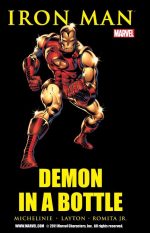
Iron Man: Demon in a Bottle


By David Michelinie, John Romita Jr., Bob Layton & various (Marvel)
ISBN: 978-0-7851-3095-6(HB)                 978-0-7851-2043-8(TPB)

Tony Stark is a millionaire inventor who moonlights as a superhero: wearing a suit of armour stuffed with his own ingenious creations. The supreme technologist hates to lose and constantly upgrades his gear, making Iron Man is one of the most powerful characters in the Marvel Universe. However, at the time of these tales (reprinting Iron Man #120-128 spanning March to November 1979), the unrelenting pressure of running a multi-national corporation and saving the world daily has started to show itself in the subtle increase in Tony Stark’s partying – and drinking.

This light, breezy compilation contains some of the best mainstream super-hero sagas of the 1980s but is also regarded as one of the most remarkable, transformative and powerfully redemptive tales of the period (crafted by David Michelinie, John Romita Jr., Carmine Infantino and Bob Layton), as an epic battle of Good against Evil became seditiously relevant to the readership through its full-on confrontation of a modern social evil.

Following an already stellar run of stories, ‘The Old Man and the Sea Prince!’ (by Michelinie, Romita Jr. & Layton) found the Armoured Avenger battling amphibian superman and sometime ally the Sub-Mariner before uniting against officious military martinets intent on dislodging aged hermit Hiram Cross from the strategically useful island he lived on.

And unsuspected in the background, financial predator Justin Hammer continued his preparations to destroy Iron Man and break Stark’s financial empire…

His first strike was to override the amazing armour in the middle of an underwater duel in ‘A Ruse by Any Other Name…’ but even with that handicap, Stark and his allies Bethany Cabe and Jim Rhode managed to expose unscrupulous conglomerate Roxxon as the cause of all Hiram’s woes… not that it did them any good…

Infantino then pencils a refitted recap of Iron Man’s origins in ‘Journey’ before Hammer steps up his campaign in #123’s ‘Casino Fatale!’ (Michelinie, Romita Jr. & Layton) as a small army of hired villains attack the hero in Atlantic City just when the Iron Man suit is at its most gremlin-afflicted…

The assault escalates in ‘Pieces of Hate!’ (“Layton & Friends” sharing inking duties) but even after scoring an incredible, improbable victory Stark is left reeling when Hammer plays his ace. Taking full control of Iron Man’s armour, the evil plutocrat makes Stark the unwilling accomplice and murder weapon in a monstrous crime, pushing the hero over the edge and into a spiral of despair…

After his super-sophisticated suit “malfunctions” again, killing a foreign ambassador at a major diplomatic function the disgraced and grieving Stark surrenders the armour to the authorities. However, undaunted and finally aware of what’s been going on, he enlists new Ant-Man Scott Lang to his small band of allies and goes undercover to find his hidden enemy in #125’s ‘The Monaco Prelude’.

Nonetheless, the villain seems triumphant when ‘The Hammer Strikes!’, abducting the heroes and gloatingly revealing his dastardly scheme. However, the smirking monster has grievously underestimated his rival’s capabilities and the power of Iron Man in the spectacular final clash ‘…A Man’s Home is His Battlefield!’…

Tragically, when the dust settles and the bad guys are all disposed of, Stark has time to obsess over the lives lost and turns to the booze that has increasingly been his only solace in the past months…

The fall and rise of a hero is a classic plot, and it’s seldom been better used in the graphic narrative medium and never bettered in the super-hero field than in ‘Demon in a Bottle’ as the traumatised hero plumbs the depths of grief and guilt, buries himself in pity, and alienates all his friends and allies before an unlikely intervention forces him to take a long, hard look at his life and actions…

Available in hardback, trade paperback and as an eBook, Iron Man: Demon in a Bottle is a complex and very mature tale for kids of all ages, and an unforgettable instance of Triumph and Tragedy perfectly told. If you have let this tale pass you by, you are the poorer for it and should amend that situation as soon as possible.
© 1984, 2006 Marvel Characters, Inc. All rights reserved.

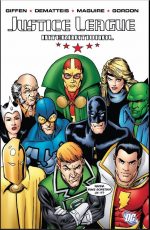
Justice League International volume 1


By Keith Giffen, J.M. DeMatteis, Kevin Maguire, Al Gordon & Terry Austin (DC Comics)
ISBN: 978-1-84576-787-7(HB)                      978-1-4012-1739-6(TPB)

Way back in 1986 DC’s editorial leaders felt their then-vast 50-year continuity was stopping them winning new readers. The solution was a colossal braided-mega series to streamline, redefine and even add new characters to the mix.

The worlds-shattering, reality-altering bombast of Crisis on Infinite Earths resulted in such spectacular commercial success, those movers-&shakers must have felt more than justified in revamping a number of their hoariest icons for their next fifty years of publishing. As well as Superman, Flash, and Wonder Woman, the moribund and unhappy Justice League of America was earmarked for a radical revision.

Editor Andy Helfer assembled plotter Keith Giffen, scripter J.M. DeMatteis and untried penciller Kevin Maguire to produce an utterly new approach to the superhero monolith: they played them for laughs…

The series launched as Justice League with a May 1987 cover-date before retitling itself as Justice League International with #7 (November) and all those splendidly enticing tales can be found here.

The new super-team was formed from the ashes of the old on the basis of events comprising follow-up DC crossover-event Legends. The gathering comprised a roster of relative second-stringers as America’s newest champions – Black Canary, Blue Beetle, Captain Marvel, Dr. Fate, Guy Gardner/Green Lantern, and Mr. Miracle with heavyweights Batman and Martian Manhunter J’onn J’onzz as nominal straight-men.

As the often-silly saga unfolded the squad was supplemented by Captain Atom, Booster Gold, Dr. Light, and Russian mecha-warrior Rocket Red.

According to Keith Giffen’s reflective Introduction the initial roster was mandated from on high, but there’s certainly no stiffness or character favouritism apparent in these early tales.

Introducing the charismatic filthy-rich manipulator Maxwell Lord – who used wealth and influence to recreate the super-team – the creators took their time, crafting a convoluted mystery that took an entire year to play out (happily there’s a second volume sitting on my “to be re-read again” pile and another nostalgic review coming soon!).

The neophyte and rather shambolic team started their march to glory by fighting and defeating a bunch of rather inept terrorist bombers in initial outing ‘Born Again’ (inked by Terry Austin), before confronting displaced alien heroes determined to abolish nuclear weapons in a 2-part thriller ‘Make War No More’ and ‘Meltdown’ before seeing off old-fashioned super-creeps the Royal Flush Gang in #4’s ‘Winning Hand’, which added future-born tech hero Booster Gold to the mix.

The Creeper outrageously guest-starred in ‘Gray Life, Gray Dreams’ and concluding chapter ‘Massacre in Gray’: joining forces against an immortal man tasked by supernal gods with collecting mankind’s excess dream essence. When he went mad and rebelled, all of humanity was imperilled…

Lord’s Byzantine scheme bore fruit in #7’s ‘Justice League… International’ as the team achieved the status of a UN agency, with rights, privileges and embassies in every corner of the World…

Sadly, that merely meant that phase two of his plan came into play and deadly links to New God hellworld Apokolips began to be revealed…

To Be Continued…

Available as an impressive hardcover, accessible trade paperback and even digitally for the go-getting moderns among you, these wild and woolly tales are a perfect panacea to all the doom and gloom that infests so much of today’s comics content.

I’m also happy to say that the editors found room to include alternate covers, the great Ed Hannigan, Maguire & Austin JLI poster from 1987 plus a fact and picture-packed Who’s Who entry to back up the fun with some irrefutable facts about the World’s Greatest Superheroes…

These wonderful yarns are full of sharp lines and genuinely gleeful situations, perfect for young fans and old addicts alike and still as appealing today. That the art is still great is no surprise and the action still engrossing most welcome, but to find that the jokes are still funny is a glorious relief. Indulge yourself and join that secret comics brotherhood who greet each other with the fateful mantra “Bwah-Hah-Hah!”…
© 1987, 2008 2014 DC Comics. All Rights Reserved.

The Usagi Yojimbo Saga Book 1


By Stan Sakai (Dark Horse Books)
ISBN: 978-1-61655-671-6(HB)     978-1-61655-609-9(PB)      eISBN: 978-1-63008-081-5

Usagi Yojimbo (“rabbit bodyguard”) first appeared as a background character in Stan Sakai’s The Adventures of Nilson Groundthumper and Hermy, premiering amongst assorted furry ‘n’ fuzzy folk in 1984’s Albedo Anthropomorphics #1. He then graduated to a solo act in Critters, Amazing Heroes, Furrlough and the Munden’s Bar back-up series in Grimjack.

In 1955, when Sakai was two years old, the family moved from Kyoto, Japan to Hawaii. Growing up in a cross-cultural paradise he graduated from the University of Hawaii with a BA in Fine Arts, before leaving the state to pursue further studies at Pasadena’s Art Center College of Design in California.

His early forays into comics were as a letterer – most famously for the inimitable Groo the Wanderer and the Spider-Man newspaper strip – before his nimble pens and brushes found a way to express his passion for Japanese history, legend and the filmic works of Akira Kurosawa and his peers, inspirationally transforming a proposed story about a human historical hero into one of the most enticing and impressive fantasy sagas of all time.

Although the deliriously expansive period epic stars sentient animals and details the life of a peripatetic Lord-less Samurai eking out as honourable a living as possible through selling his sword as a Yojimbo (bodyguard-for-hire), the milieu and scenarios all scrupulously mirror the Feudal Edo Period of Japan (roughly 16th and 17th century AD by Western reckoning) whilst simultaneously referencing other cultural icons from sources as varied as Zatoichi to Godzilla.

Miyamoto Usagi is brave, noble, industrious, honest, sentimental, gentle, artistic, empathetic, long-suffering and conscientious: a rabbit devoted to the tenets of Bushido. He is utterly unable to turn down any request for help or ignore the slightest evidence of injustice. As such, his destiny is to be perpetually drawn into an unending panorama of incredible situations.

Despite changing publishers a few times, the Roaming Rabbit has been in continuous publication since 1987, with more than 30 collections and books to date. He has guest-starred in many other series (most notably Teenage Mutant Ninja Turtles and its TV incarnation) and even almost made it into his own small-screen show.

There are high-end collectibles, art prints, computer games and RPGs, a spin-off sci-fi comics serial and lots of toys. Author Sakai and his creation have won numerous awards both within the Comics community and amongst the greater reading public.

And it’s still more educational, informative and authentic than any dozen Samurai sagas you can name…

The title was as much a wanderer as its star, migrating from Fantagraphics to Mirage and finally Dark Horse where after publishing more than two dozen paperback collections, the canny business types have sagely opted to re-bundle their earlier efforts into hefty tomes offering three times the thrills. There are even digital editions for forward-looking fans of the vintage wonderment…

This guest-star stuffed premiere monochrome masterpiece draws together yarns released by Mirage Publishing as Usagi Yojimbo volume 2 #1-16 and Usagi Yojimbo volume 3 #1-6

Following a fulsome Foreword from former editor Jamie S. Rich, pictorial rundown of dramatis personae in ‘Cast of Characters’ and rousing strip recap ‘Origin Tale’, an evocative Introduction from legendary illustrator and Dean of dinosauria William Stout leads into the magnificent and ever-unfolding medieval mystery play…

It all begins with 3-part crossover epic ‘Shades of Green’ wherein Usagi and his crusty companion Gennosuké (an irascibly bombastic, money-mad bounty-hunter and conniving thief-taking rhino with a heart of gold) are recruited by Kakera: a ratty shaman in dire need of protection from the dwindling remnants of the once-mighty Neko Ninja clan.

The former imperial favourites have fallen upon hard times since they and the Ronin Rabbit crushed the Dragon Bellow plot of rebel Lord Takamuro. Now, the bat assassins of the Komori Ninja clan are constantly harrying, harassing and actively trying to supplant them in patron Lord Hikiji‘s service…

Chunin (deputy leader) Gunji believes the rodent wizard would make a mighty useful slave, and is scheming to overthrow the new – female – clan chief Chizu whilst acquiring him…

With the Neko’s trap closing around them all, the sagacious sensei summons the spirits of four fantastic fighters to aid Usagi and Gen. The phantoms promptly possess a quartet of little Kamé (tortoises) and are reshaped into adolescent amphibian Ninja Turtles, identifying themselves as Leonardo, Raphael, Michelangelo and Donatello.

Usagi has fought beside one of their number before…

The subsequent battles go badly and eventually Gunji’s forces make off with Kakera-sensei. As Usagi leads the remaining heroes in relentless pursuit, the conniving Chunin makes his move. Gunji’s attempt to assassinate Chizu is bloodily and efficiently ended by the late-arriving Usagi who is astounded to be told by the lady he has saved that the Neko’s lethal interest in him is now at an end…

With Kakera rescued and Gunji dead, the adventure closes with the turtle spirits returning to their own place and time, leaving Gen and Usagi to follow their own (temporarily) separate roads…

‘Jizo’ then offers a delightful and gripping interlude as a grieving mother dedicates a roadside shrine to her murdered child and mysterious Karma places the killers in the path of a certain justice-dispensing, long-eared wanderer…

Next comes a brace of stories offering elucidating glimpses of the rabbit’s boyhood. Once, Miyamoto Usagi was simply the son of a small-town magistrate sent to spend his formative years learning the Way of Bushido from a gruff and distant leonine hermit Katsuichi.

The stern sensei taught not just superior technique and tactics, but also an ironclad creed of justice and restraint which would serve the Ronin well throughout his turbulent life.

In ‘Usagi’s Garden’ the callow pupil rebels against the arduous and undignified task of growing food until the lion delivers a subtle but life changing lesson, whilst in ‘Autumn’ a painful fall propels the lad into a nightmare confrontation with a monster who has trapped the changing of the seasons in a bamboo cage…

‘Shi’ is a 2-part tale wherein Usagi comes to the assistance of a valley of poor farmers under constant attack by bullies and brigands seeking to make them leave their impoverished homes. The thugs are secretly employed by a local magistrate and his ruthless brother who have discovered gold under the peasants’ land and want to extract it without attracting the attention of the local Lord’s tax collectors.

When the Ronin’s formidable opposition stalls the brothers’ scheme they hire a quartet of assassins whose collective name means “death”, but the killers are far less trouble than the head farmer’s daughter Kimie who has never seen someone as glamorous or attractive as the soft-spoken samurai…

Although there are battles aplenty for Usagi, the remorseless greed of the brothers finishes them before the Yojimbo can…

A delightful silent comedy follows as ‘The Lizard’s Tale’ pantomimically depicts the Ronin playing unwilling Pied Piper and guardian to a wandering flock of tokagé lizards (ubiquitous, omnivorous reptiles that populate the anthropomorphic world, replacing scavenger species like rats, cats and dogs in the fictitious ecosystem). The rambunctious trouble-magnets then repay the favour when the wanderer is ambushed in the snow-drowned mountains by an army of vengeful bandits…

The 3-chapter fable ‘Battlefield’ then discloses a key moment and boyhood turning point in the trainee warrior’s life.

It begins when a mind-broken, fleeing soldier shatters the boy’s childish dreams of warrior glory. The fugitive is a survivor of the losing side in a mighty battle and his sorry state forces Usagi to rethink his preconceptions of war.

Eager to ram home the lesson, Katsuichi takes his student to the battlefield where peasants and scavengers are busy snatching up whatever they can from the scattered corpses…

Usagi is horrified. To take a samurai’s swords is to steal his soul, but even so, a little later he cannot stop himself picking up a fallen hero’s Wakizashi (short sword)…

However, after concealing the blade in safe place, the apprentice is haunted by visions of the unquiet corpse and sneaks off to return the stolen steel soul.

Caught by soldiers who think him a scavenger and looter and about to lose his thieving hands, little Miyamoto is only saved by the intervention of victorious Great Lord MifunÄ—. The noble looks into the boy’s face and sees something honest, honourable and perhaps, one day, useful…

Following an Introduction on ‘Classic Storytelling’ from writer James Robinson, the Ronin roaming resumes with ‘The Music of Heaven’ wherein Miyamoto and a wandering flock of tokagé lizards encounter a gentle, pious priest whose life is dedicated to peace, music and enlightenment…

When their paths cross again later, the rabbit is almost murdered by a ruthless assassin who has since killed and impersonated holy man Komuso in an attempt to catch Usagi off guard…

Evocative and movingly spiritual, this classic of casual tragedy perfectly displays the vast range of storytelling Sakai can pack into the most innocuous of tales.

More menaces from the wanderer’s past reconnect in ‘The Gambler, The Widow and the Ronin’ as a professional conman who fleeces villagers with rigged samurai duels plies his shabby trade in just another little hamlet.

Unfortunately, this one is home to his last stooge’s wife, and to make matters worse, whilst his latest hired killer Kedamono is attempting to take over the business, the long-eared nomad who so deftly dispatched his predecessor Shubo strolls into town looking for refreshments…

Again forced into a fight he doesn’t want, Miyamoto makes short work of the blustering Kedamono, leaving the smug gambler to safely flee with the entire take. Slurping back celebratory servings of Saké, the villain has no idea that the inn where he relaxes employs a vengeful widow and mother who knows just who really caused her man’s death…

A note of portentous foreboding informs ‘The Nature of the Viper’, opening a year previously when a boisterous, good-hearted fisherman pulled a body out of the river and nursed his amazingly still breathing catch slowly back to health. If he expected gratitude or mercy the peasant was sadly mistaken, as the victim explained whilst killing his benefactor as soon as he was able…

The ingrate is Jei: a veritable devil in mortal form, who believes himself a “Blade of the Gods”; singled out by the Lords of Heaven to kill the wicked. The maniac makes a convincing case: when he stalked Usagi the monster was struck by a fortuitous – or possibly divinely sent – lightning bolt but is still going strong and still keen to continue his quest for the Ronin…

‘Slavers’ then begins a particularly dark journey for our hero as Usagi stumbles across a boy in chains escaping from a bandit horde. Little Hiro explains how the ragtag rogues of wily “General” Fujii have captured an entire town and are making the inhabitants harvest all their crops for the scum to steal…

Resolved to save them the rabbit infiltrates the captive town as a mercenary seeking work, but is soon exposed and taken prisoner and ‘Slavers Part 2’ finds Miyamoto stoically enduring the General’s tortures until the boy he saved bravely returns the favour… after which the Yojimbo’s vengeance is awesome and terrible…

However even as the villagers rebel and take back their homes and property, chief bandit Fujii escapes, taking Usagi’s daishō (matched long and short swords) with him.

As previously seen, to take a samurai’s swords is to steal his soul, and the monster not only has them but continually dishonours them by slaughtering innocents as he flees the Ronin’s relentless pursuit.

‘Daisho – Part One’ opens with a hallowed sword-maker undertaking the holy methodical process of crafting blades and the harder task of selecting the right person to buy them. Three hundred years later, Usagi is on the brink of madness as he follows the bloody trail of Fujii, remorselessly picking off the General’s remaining killers whilst attempting to redeem those sacred dispensers of death…

The chase leads him to another town pillaged by Fujii where he almost refuses to aid a wounded man until one of the women accuses him of being no better than the beast he hunts…

Shocked back to his senses, Miyamoto saves the elder’s life and in gratitude the girl Hanako offers to lead him to where Fuji was heading…

‘Mongrels’ then changes tack as erstwhile ally and hard-to-love friend Gennosuké enters the picture. The irascibly bombastic, money-mad bounty-hunter and conniving thief-taker is on the prowl for suitably profitable prospects when he meets the Stray Dog: his greatest rival in the unpopular profession of cop-for-hire.

After some posturing and double-dealing wherein each tries to edge out the other in the hunt for Fujii, they inevitably come to blows and are only stopped by the fortuitous intervention of the Rabbit Ronin…

‘Daisho – Part Two’ sees the irascible rugged individualists come to a shaky truce in their overweening hunger to tackle the General. Mistrustful of each other, they nevertheless cut a swathe of destruction through Fujii’s regrouped band, but even after the furious Usagi regains his honour swords there is one last betrayal in store…

Older, wiser and generally unharmed, Gen and Usagi part company again as ‘Runaways’ once more delves into the wanderer’s past. Stopping in a town he hasn’t visited in decades, the rabbit hears a name called out and his mind goes back to a time when he was a fresh young warrior in the service of Great Lord MifunÄ—.

Young princess Takani Kinuko had been promised as bride to trustworthy ally Lord Hirano and the rabbit had been a last-minute replacement as leader of the “babysitting” escort column to her impending nuptials.

When an overwhelming ambush destroyed the party, Usagi was forced to flee with the stuck-up brat, both masquerading as carefree, unencumbered peasants as he strove to bring her safely to her husband-to-be through a seeming army of ninjas killers.

The poignant reverie concludes in ‘Runaways – Part 2’ as valiant hero and spotless maid fell in love whilst fleeing from the pitiless, unrelenting marauders on their heels. Successful at last, their social positions naturally forced them apart once she was safely delivered.

Shaken from his memories the Ronin moves on, tragically unaware that he was not the only one recalling those moments and pondering what might have been…

Originally collected as The Brink of Life and Death, the evocative and enticing third tranche of torrid tales opens with ‘Discoveries’ – a heartfelt and enthusiastic Introduction from comics author Kurt Busiek – before more epic sagas of intrigue intermingle with brief vignettes attending to more plebeian dramas and even the occasional supernatural thriller, all tantalisingly tinged with astounding martial arts action and drenched in wit, irony, pathos and even true tragedy…

Far away from our nomadic star a portentous interlude occurs as a simple peasant and his granddaughter are attacked by bandits. The belligerent scum are about to compound extortion and murder with even more heinous crimes when a stranger with a ‘Black Soul’ stops them…

His is called Jei… and nothing good comes from even innocent association with the Blade of the Gods. Still keen to continue his crusade, the monster deals most emphatically with the criminals before “allowing” orphaned granddaughter Keiko to join him…

‘Kaisō’ then finds Miyamoto Usagi befriending a seaweed farmer who’s experiencing a spot of bother with his neighbours…

At peace with himself amongst hard-toiling peasants, Usagi becomes embroiled in their escalating battle with a village of rival seaweed sellers – previously regarded as helpful and friendly – and soon realises scurrilous merchant Yamanaka is fomenting discord and unrest between his suppliers to make extra profit…

‘A Meeting of Strangers’ in a roadside hostelry introduces a formidable female warrior to the constantly expanding cast as the Lepine Legend graciously offers a fellow weary mendicant the price of a drink. A professional informer then sells Usagi out to the still-smarting merchant Yamanaka and lethally capable Inazuma has ample opportunity to repay her slight debt to the Rabbit Ronin when he’s ambushed by an army of hired brigands…

Despite – or perhaps because – it is usually one of the funniest comics on the market, occasionally Usagi Yojimbo can brilliantly twist readers’ expectations with tales that rip your heart apart.

Such is the case with ‘Noodles’ wherein the nomadic Ronin meets again street performer, shady entertainer and charismatic pickpocket Kitsune. She has been plying all her antisocial trades in a new town just as eternally-wandering Usagi rolls up.

The little metropolis is in uproar at a plague of daring robberies and when the inept enforcers employed by Yoriki (Assistant Commander) Masuda try – and painfully fail – to arrest the long-eared stranger as a probable accomplice, the ferociously resistant Ronin earns the instant enmity of the pompous official.

Following the confrontation, a hulking, mute soba (buckwheat noodle) vendor begins to pester the still-annoyed rabbit and eventually reveals he’s carrying elegant escapologist Kitsune in his baskets…

Astounded, the Yojimbo renews his acquaintance with her before the affable thieves go on their way, but trouble and tragedy are just around the corner…

The town magistrate is leaning heavily on his Yoriki to end the crime wave but has no conception Masuda is actually in the pay of a vicious gang carrying out most of the thefts. What they all need is a convincing scapegoat to pin the blame on and poor dumb peasant Noodles is ideal – after all, he can’t even deny his guilt…

With a little sacrificed loot planted, the gentle giant becomes the perfect patsy and before Usagi and Kitsune even know he’s been taken, the simple fool has been tried and horrifically executed…

‘Noodles Part 2’ opens as the aggrieved heroes frantically dash for the public trial and almost immediate crucifixion but neither pickpocket nor bodyguard can do anything to save the innocent stooge. All they can do is swear to secure appropriate vengeance and a kind of justice…

In sober mien the rabbit roves on, stumbling into a house of horror and case of possession as ‘The Wrath of the Tangled Skein’ finds Usagi returning to a region plagued by demon-infested forests. Offered hospitality at a merchant’s house he subsequently saves the daughter from doom at the claws of a demonic Nue (tiger/fox/pig/snake devil).

He is, however, almost too late and only alerted to a double dose of danger when a Bonze (Buddhist Priest) arrives to exorcise the poor child… just like the cleric already praying over the afflicted waif upstairs…

This duel with the forces of hell leads into ‘The Bonze’s Story’ as Usagi strikes up a friendship with the true priest and learns how misfortune and devotion to honour compelled elite samurai Sanshobo to put aside weapons and war in search of greater truths and inner peace…

Political intrigue and explosive espionage return to the fore in ‘Bats, the Cat, & the Rabbit’ as Neko ninja chief Chizu re-enters Usagi’s life, fleeing a flight of rival Komori (bat) ninjas. The winged horrors are determined to possess a scroll containing the secrets of making gunpowder and, after a tremendous, extended struggle the exhausted she-cat cannot believe her rabbit companion is willing to simply hand it over. She soon shrugs it off.

After all the Komori have fallen into her trap and quickly regret testing the purloined formula…

The peripatetic Yojimbo then walks into a plot to murder Great Lord Miyagi involving infallible unseen assassin Kuroshi at ‘The Chrysanthemum Pass’. The valiant wanderer is simply aiding karma to a just outcome despite overwhelming odds and a most subtle opponent, the act will have appalling repercussions in the days ahead…

Hunted woman and deadly adept Inazuma then proves ‘Lightning Strikes Twice’ when found – as always – at the heart of a storm of hired blades trying to kill her. However, during one peaceful moment, she makes time to share with a fellow swordsmaster the instructive tale of a dutiful daughter who married the wrong samurai and, by exacting rightful vengeance upon his killer, won the undying hatred of a powerful lord and set her own feet irredeemably upon the road of doom…

Also included to round out in this epic collection are copious ‘Story Notes by Stan Sakai’, a full-colour ‘Gallery’ of the covers from both comicbooks and their attendant paperback compilations, annotated ‘Cover Sketches’ and designs plus biographical data ‘About the Author’.

Fast-paced yet lyrical, informative and funny, the saga alternately bristles with tension and thrills and frequently crushes your heart with astounding tales of pride and tragedy, evil and duty.

Bursting with veracity and verve, Usagi Yojimbo is the perfect comics epic: a monolithic magical irresistibly appealing saga to delight devotees and make converts of the most hardened haters of “funny animal” stories.
Text and illustrations © 1993-1998, 2014 Stan Sakai. All rights reserved. Foreword © 2014 Jamie S. Rich. Teenage Mutant Ninja Turtles © 2014 Viacom International, Inc. All rights reserved. All other material and registered characters are © and™ their respective owners. Usagi Yojimbo and all other prominently featured characters are registered trademarks of Stan Sakai.

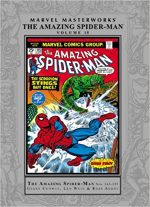
Amazing Spider-Man Masterworks volume 15


By Gerry Conway, Len Wein, Archie Goodwin, Ross Andru, Gil Kane, Sal Buscema & various (Marvel)
ISBN: 978-0-7851-6631-3

After a shaky start in 1962 The Amazing Spider-Man quickly rebounded, rapidly proving a sensation with kids of all ages and rivalling the creative powerhouse of Lee & Kirby’s Fantastic Four. Soon the quirky, charming, action-packed comicbook soap-opera would become the model for an entire generation of younger heroes elbowing aside the staid, (relatively) old costumed-crimebusters of previous publications.

Previously: Peter Parker was a smart yet alienated kid bitten by a radioactive spider during a school science trip. Discovering astonishing arachnid abilities – which he augmented with his own natural chemistry, physics and engineering genius – the kid did what any lonely, geeky nerd would do with such newfound prowess: he tried to cash in for girls, fame and money.

Making a costume to hide his identity in case he made a fool of himself, Parker became a minor media celebrity – and a criminally self-important one. To his eternal regret, when a thief fled past him one night he didn’t lift a finger to stop him, only to find when he returned home that his guardian uncle Ben Parker had been murdered.

Crazed with a need for vengeance, Peter hunted the assailant who had made his beloved Aunt May a widow and killed the only father he had ever known, finding, to his horror, that it was the self-same felon he had neglected to stop. His irresponsibility had resulted in the death of the man who raised him, and the traumatised boy swore to forevermore use his powers to help others…

Since that night the Wondrous Wallcrawler has tirelessly battled miscreants, monsters and madmen, with a fickle, ungrateful public usually baying for his blood even as he perpetually saves them.

The Amazing Spider-Man was always a comicbook that matured with – or perhaps just slightly ahead of – its fan-base, and this 15th exceptionally enthralling full-colour compendium of chronological web-spinning adventures confirms that notion as the World’s Most Misunderstood Hero survives one of the most macabre and Byzantine vengeance plots ever conceived. Further backing up the thought is author Gerry Conway’s farewell Introduction – ‘All Things Must Pass’ – which candidly revealed why after killing Peter’s one true love the editors and especially publisher moved heaven and earth to bring her back…

With the material in this sturdy Hardcover compilation (and latterly eBook) Stan Lee’s hand-picked successor Conway moved on after reaching a creative plateau giving way to fresh authorial guide Len Wein. However, scripts continued to blend contemporary issues (which of course often feel quite outdated from here in the 21st century) with soap opera subplots to keep older readers glued to the series as the outrageous adventure and bombastic battle sequences beguiled the youngsters.

Thematically, there’s further decline in the use of traditional crimes and gangsters, as super-science, outlandish villains and monsters took centre stage, but the most sensational advance was an insidious scheme which would reshape the nature of the web-spinner’s adventures for decades to come…

For all that, the wallcrawler was still indisputably mainstream comics’ voice of youth; defining being a teenager for young readers of the 1970s, tackling incredible hardships, fantastic foes and the most pedestrian and debilitating of frustrations.

High School nerd Peter Parker had grown up and gone to college. Because of his guilt-fuelled double-life he struggled there too, developed a stress ulcer but found true love with policeman’s daughter Gwen Stacy…

This volume – spanning April 1975 to April 1976 – re-presents Amazing Spider-Man #143-155, Annual #10 and opens with Amazing Spider-Man #143 ‘…And the Wind Cries: Cyclone!’ (Conway Ross Andru, Frank Giacoia & Dave Hunt).

Peter Parker is in Paris to deliver a ransom and save kidnapped publisher J. Jonah Jameson but soon calls in his arachnid alter ego to deal with a hyper-fast French super-villain. The story is fairly run-of-the-mill but the real kicker comes from an overly-fond farewell expressed by “casual chum” Mary Jane Watson: a kiss that finally shifts traumatised, depressed Peter’s thoughts from his beloved, recently murdered Gwen…

The creative team capitalised on the situation when Pete returns to New York and his – rather extraordinary – daily travails as #144 launched ‘The Delusion Conspiracy’, whilst #145 focuses on a baffled girl’s confusion and terror at everyone’s reactions when she comes home and the entire world screams ‘Gwen Stacy is Alive …and, Well…?!’

With Gwen somehow resurrected and Peter on the edge of a breakdown, Aunt May is hospitalised just in time for another old foe to strike again in ‘Scorpion… Where is Thy Sting?’, but the real kick in the tale is irrefutable scientific and medical reports proving the increasingly bewildered Miss Stacy is not an impostor but the genuine article…

In Spider-Man #147 Peter finds some answers as further tests prove Gwen is actually a true human clone (remember, this was new and cutting-edge stuff in 1975) but all too soon he’s distracted by another foe bad-guy with a grudge and hungry to prove ‘The Tarantula is a Very Deadly Beast’ (illustrated by Andru, Esposito & Hunt).

It’s all part of a convoluted and utterly Byzantine revenge scheme conceived by a malign old enemy. When the hero is ambushed by a mesmerised Gwen at the behest of the archfiend, ‘Jackal, Jackal, Who’s Got the Jackal?’ (art by Andru, Mike Esposito & Hunt) at last discloses some shocking truths about one of Peter’s most trusted friends before the Delusion Conspiracy explosively concludes with #149’s ‘Even if I Live, I Die!’ (Andru & Esposito).

Learning that he and Gwen had been covertly cloned by their biology teacher Miles Warren, the Amazing Arachnid has to defeat his alchemical double in a grim, no-holds-barred identity-duel, with neither sure who’s the real McCoy. The battle eventually results in the copy’s death… maybe…, perhaps… probably…

That moment of doubt over who actually fell informs anniversary issue Amazing Spider-Man #150, as Archie Goodwin, Gil Kane, Esposito & Giacoia take the hero down memory lane and up against a brigade of old antagonists to decide whether ‘Spider-Man… or Spider-Clone?’ survived that final fight, before debuting regular scripter Len Wein joins Andru & John Romita Sr. to launch a new era of adventure…

After disposing of his duplicate’s corpse in an incineration plant, Spider-Man finds time to let Peter reconnect with his long-neglected friends. However, a jolly party is soon disrupted as blackouts triggered by a super-menace lead the wallcrawler down into the sewers for a ‘Skirmish Beneath the Streets!’, resulting in our hero almost drowning and nearly being ‘Shattered by the Shocker!’(Esposito & Giacoia inks) in a conclusive and decisive return engagement…

A moving change-of-pace tale then finds a blackmailed former football star giving his all to save a child in ‘The Longest Hundred Yards!’ (Andru & Esposito) but it is left to Spider-Man to make the computer-crook culprits pay, after which #154 reveals ‘The Sandman Always Strikes Twice!’ (art by Sal Buscema & Esposito) – albeit with little lasting effect – until devious murder-mystery ‘Whodunnit!’ (Buscema & Esposito again) cunningly links three seemingly unconnected cases in a masterful “Big Reveal”…

This copious compendium then concludes with some contemporary house ads, an editorial explanation of the original “Clone Saga” and biographies. Despite some qualifications this is a superb selection starring an increasingly relevant teen icon and symbol. Spider-Man was and still is a crucial part of many youngsters’ existences: living a life as close to theirs as social mores and the good taste allow.

Blending cultural veracity with glorious art and making a dramatic virtue of the confusion, awkwardness and sense of powerlessness most of the readership experienced daily resulted in an irresistibly intoxicating read, delivered in addictive prime time melodrama moments, but none of that would be relevant if the stories weren’t so compellingly entertaining.

This action-packed collection comprises one of the most momentous periods in Spider-Man’s astounding life and is one every Fights ‘n’ Tights fanatic should see…
© 1975, 1976, 2011, 2015 Marvel Characters, Inc. All rights reserved.

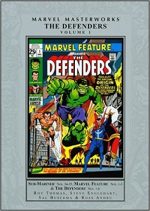
Defenders Masterworks volume 1


By Roy Thomas, Steve Englehart, Sal Buscema, Ross Andru & various (Marvel)
ISBN: 978-0-7851-3044-4 (HC)

Last of the big star conglomerate super-groups, the Defenders would eventually count amongst its membership almost every hero – and a few villains – in the Marvel Universe. No surprise there then, as initially they were composed of the company’s bad-boy antiheroes: misunderstood, outcast and often actually dangerous to know.

For Marvel, the outsider super-group must have seemed a conceptual inevitability – once they’d finally published it. Apart from Spider-Man and Daredevil all their superstars regularly teamed up in various mob-handed assemblages and, in the wake of the Defenders’ success, even more super-teams comprising pre-existing characters were rapidly mustered. These included the Champions, Invaders, New Warriors and so on – but none of them had any really Very Big Guns…

For kids – of any and all ages – there is a positively primal fascination with brute strength and feeling dangerous, which surely goes some way towards explaining the perennial interest in angry tough guys who break stuff as best exemplified by Prince Namor, the Sub-Mariner and the Incredible Hulk. When you add the mystery and magic of Doctor Strange, the recipe for thrills, spills and chills becomes simply irresistible…

Although the genesis of the team may have derived from their status as publicly distrusted but well-selling “villains”, originator Roy Thomas shares his own recollections and deeper ruminations in an informative Introduction which namechecks a pivotal continued experimental crossover which didn’t make the cut in this sterling and sturdy hardcover (and eBook) compendium.

I only mention it as the sinister antagonists of those tales play a crucial role in the later stories that do appear here; namely Sub-Mariner #34-35, Marvel Feature #1-3 and Defenders #1-6, spanning February 1971 through June 1973…

So, for fuller enjoyment, you might want to track down Dr. Strange #183(November 1969), Sub-Mariner #22 (February 1970) and Incredible Hulk #126 (April 1970) – Essential Defenders volume 1 has those plus all these and much more, but only in stark monochrome reproduction – which collectively detailed how ancient necromantic threat the Undying Ones returned to bedevil Earth…

An elder race of demons hungry to reconquer humanity, they clashed with Stephen Strange, but as his series unexpectedly ended with that issue the story went nowhere until the Sub-Mariner #22 brought the Prince of Atlantis into the mix. A sterling tale of sacrifice in which the Master of the Mystic Arts seemingly died holding the gates of Hell shut with the Undying Ones pent behind them then concluded on an upbeat note in Incredible Hulk #126, after a New England cult dispatched helpless Bruce Banner to the nether realms in an attempt to undo Strange’s heroic gesture.

Luckily cultist Barbara Norris had last-minute second thoughts and her own sacrifice freed the mystic, seemingly ending the threat of the Undying Ones forever. At the end of that issue Strange retired, forsaking magic, although he was back before too long as the fates – and fickle reading tastes – called him back to duty.

The Defenders’ story officially begins here with Sub-Mariner #34-35 of his own title (February and March 1971). The Prince of Atlantis had become an early advocate of the ecology movement, and here he took the next step in their evolution by fractiously recruiting Hulk and the Silver Surfer to help him destroy an American Nuclear Weather-Control station.

In ‘Titans Three’ and the concluding ‘Confrontation’ (by Thomas, Sal Buscema & Jim Mooney) the always-misunderstood trio battled a despotic dictator’s forces, the US Army, UN defence forces and the mighty Avengers to prevent the malfunctioning station from accidentally vaporising half the planet…

With that debacle smoothed over life resumed its usual frenetic pace for the Hulk and Namor until giant-sized try-out comic Marvel Feature #1 (December 1971) presented ‘The Day of the Defenders!’ wherein a mysteriously returned Dr. Strange recruited the Avenging Son and the Jade Giant to help him stop the deathbed doom of crazed super-mind Yandroth.

Determined to not go gently into the dark, the Scientist Supreme had built an Omegatron weapon programmed to obliterate the Earth as soon as Yandroth’s heart stopped beating and only the brute strength of the misunderstood misanthropes could possibly stop it…

Naturally the fiend hadn’t told the whole truth but the day was saved – or at least postponed – in a canny classic from Thomas, Ross Andru & Bill Everett.

Clearly and immediately destined for great things, the astounding antiheroes returned in Marvel Feature #2 (March 1972) with Sal Buscema replacing Everett as inker for late Halloween treat ‘Nightmare on Bald Mountain!’

By capturing arch-foe Dr. Strange, extra-dimensional dark lord Dormammu sought to invade our realm through a portal in Vermont, only to be savagely beaten back by the mage’s surly sometime comrades, whilst in #3 (June 1972) Thomas, Andru & Everett reunited to revive an old Lee/Kirby “furry underpants” monster in ‘A Titan Walks Among Us!’

Xemnu the Titan was an alien super-telepath seeking to repopulate his desolate homeworld by stealing America’s children until thrashed by the Defenders, but older fans recognised him as the cover-hogging star of Journey into Mystery #62 (November 1960) where he acted as a road-test for a later Marvel star in a short tale entitled ‘I Was a Slave of the Living Hulk!’…

An assured hit, The Defenders exploded swiftly into their own title (cover-dated August 1972), to begin a bold and offbeat run of reluctant adventures scripted by super-team wunderkind Steve Englehart. As a group of eclectic associates occasionally called together to save the world (albeit on a miraculously monotonous monthly basis) they were billed as a “non-team” – whatever that is – but it didn’t affect the quality of their super-heroic shenanigans.

With Sal Buscema as regular penciller an epic adventure ensued with ‘I Slay by the Stars!’ (inked by Giacoia) as sorcerer Necrodamus attempted to sacrifice Namor and free those pesky Undying Ones; a mission that promptly led to conflict with an old ally in ‘The Secret of the Silver Surfer!’ (inked by John Verpoorten) before concluding in the Jim Mooney-inked ‘Four Against the Gods!’

Here the Defenders took the war to the dimensional dungeon of the Undying Ones and rescued the long-imprisoned and now utterly insane Barbara Norris.

Clearly a fan of large casts and extended epics, Englehart added a fighting female to the non-team with ‘The New Defender!’ (inked by new regular Frank McLaughlin) as Asgardians exiles Enchantress and Executioner embroiled the antiheroes in their long-running and lethal love-spat. The fallout included bringing the Black Knight briefly into the mix and turning Barbara into the latest incarnation of Feminist Fury (these were far less enlightened days) The Valkyrie.

Defenders #5 began a long-running plot thread that would have major repercussions for the Marvel Universe. The denouement of the previous tale had left the Black Knight an ensorcelled, immobile stone statue, and, as Strange and Co. searched for a cure, the long defused Omegatron suddenly resumed its countdown to global annihilation in ‘World Without End?’

This initial collection then concludes with the increasingly isolationist Silver Surfer momentarily “rejoining” in #6 to share ‘The Dreams of Death!’ as new lightweight magic menace Cyrus Black attacked, and was as rapidly repulsed…

After a spiffy team pin-up by Sal Buscema, a revelatory Afterword by Steve Englehart segues into a brief bonus feature including unpublished cover art, contemporary house ads and creator biographies.

For a brief while The Defenders would be one of the best and weirdest superhero comics in the business, but to get there you really need to observe this unruly, uncomfortable selection of misfit heroes in their salad days here. At least the fact that their widespread and far-reaching origins are still so eminently entertaining should be both a relief and delight.

Go on, Enjoy, Pilgrim… the best is yet to come…
© 1970, 1971, 1972, 1973, 2009, 2016 Marvel Characters, Inc. All rights reserved.

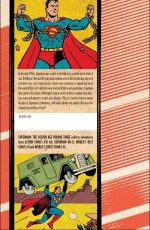
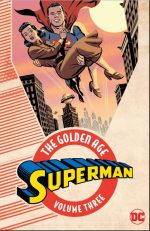
Superman: The Golden Age volume 3


By Jerry Siegel & Joe Shuster, Wayne Boring, Jack Burnley, Paul Cassidy, Ed Dobrotka, Don Komisarow, Leo Nowak, Fred Ray, John Sikela & various (DC Comics)
ISBN: 978-1-4012-7089-6

As his latest record-breaking anniversary rapidly approaches, the popularity of Superman is on the climb again. The American comicbook industry – if it existed at all by now – would have been an utterly unrecognisable thing without The Man of Steel. His unprecedented invention and adoption by a desperate and joy-starved generation gave birth to an entire genre if not an actual art form.

Moreover, with moviegoers anticipating fresh cinematic revelations in the upcoming Justice League blockbuster, expect a wealth of book releases celebrating the serried past of the heroic universe’s ultimate immigrant.

Imitation is the most honest compliment and can be profitable too. Superman triggered an inconceivable army of imitators and variations and, within three years of his Summer 1938 debut, the intoxicating blend of action and social wish-fulfilment which hallmarked the early Action Ace had grown to encompass cops-and-robbers crime-busting, socially reforming dramas, science fiction, fantasy, whimsical comedy and, once the war in Europe and the East finally involved America, patriotic relevance for a host of gods, heroes and monsters, all dedicated to profit through exuberant, eye-popping excess and vigorous dashing derring-do.

In comicbook terms at least, Superman was master of the world. He had already utterly changed the shape of the fledgling industry by the time of these tales. There was a successful newspaper strip, foreign and overseas syndication and the Fleischer studio was producing some of the most expensive – and best – animated cartoons ever conceived.

Thankfully the quality of the source material was increasing with every four-colour release, and the energy and enthusiasm of Jerry Siegel and Joe Shuster had infected the burgeoning studio that grew around them to cope with the relentless demand.

This latest addition to the splendid Golden Age/Silver Age strand of DC reprint compendia presents more of an epochal run of raw, unpolished but viscerally vibrant stories by Siegel, Shuster and the sterling crew of their ever-expanding “Superman Studio” who were setting the funnybook world on fire: crude, rough, uncontrollable wish-fulfilling, cathartically exuberant exploits of a righteous and superior man dealing out summary justice equally to social malcontents, exploitative capitalists, thugs and ne’er-do-wells that initially captured the imagination of a generation.

This third remastered paperback collection (also available digitally) of the Man of Tomorrow’s earliest exploits – reprinted in the order they first appeared – covers the still largely innocent, carefree period between January and September 1941: encompassing Action Comics #32-40, Superman #8-11 and solo-adventures from World’s Best Comics #1 and World’s Finest Comics #2 (an oversized anthology title where he shared cover-stardom with Batman and Robin). As always, every comic appearance is preceded by the original cover illustration, another fine bunch of graphic masterpieces from Paul Cassidy, Wayne Boring and Fred Ray.

Although Siegel & Shuster had very much settled into the character by now, the latter was increasingly involved with the Superman newspaper strip. Even so, the buzz of success still fired them both and innovation still sparkled amidst the exuberance.

Written entirely by Seigel this incredible panorama of torrid tales opens with ‘The Gambling Rackets of Metropolis’ from Action Comics #32.

Like many stories of the time there was no original title and it’s been designated as such simply to make my job a little easier, as Superman crushes an illicit High Society gambling operation that has wormed its nefarious ay into the loftiest echelons of Government, a typical Jerry Siegel social drama magnificently illustrated by the great Jack Burnley.

Superman #8 (January/February 1941) was another spectacular and varied compendium containing four big adventures ranging from fantastic fantasy in ‘The Giants of Professor Zee’ (illustrated by Paul Cassidy); topical suspense in spotlighting ‘The Fifth Column’ (Wayne Boring & Don Komisarow); common criminality in ‘The Carnival Crooks’ (Cassidy) and concluding with an increasingly rare comic-book outing for Joe Shuster – inked by Boring – in the cover-featured ‘Perrone and the Drug Gang’, wherein the Metropolis Marvel battled doped-up thugs and the corrupt lawyers who controlled them.

Action Comics#33 and 34 are both Burnley extravaganzas wherein Superman goes north to discover ‘Something Amiss at the Lumber Camp’, before heading to coal country to save ‘The Beautiful Young Heiress’; both superbly enticing character-plays with plenty of scope for super-stunts to thrill the gasping fans.

Superman #9 (March/April 1941) was another four-star thriller with all the art credited to Cassidy. ‘The Phony Pacifists’ is an espionage thriller capitalising on increasing US tensions over “the European War”, ‘Joe Gatson, Racketeer’ recounts the sorry end of a hot-shot blackmailer and kidnapper, ‘Mystery in Swasey Swamp’ combines eerie rural events with ruthless spies whilst the self-explanatory ‘Jackson’s Murder Ring’ pits the Caped Kryptonian against an ingenious gang of commercial assassins.

The success of the annual World’s Fair premium comic-books had convinced National/DC editors that an over-sized anthology of their characters, with Superman and Batman prominently featured, would be a worthwhile proposition even at the exorbitant price of 15¢ (most 64-page titles retailed for 10¢ and would do so until the 1960s).

At 96 pages, World’s Best Comics #1 debuted with a Spring 1941 cover-date, before transforming into the venerable World’s Finest Comics from issue #2 onwards. From that landmark one-and-only edition comes gripping disaster thriller ‘Superman vs. the Rainmaker’, illustrated by Cassidy, after which Action Comics#35 headlines a human-interest tale with startling repercussions in ‘The Guybart Gold Mine’, and Superman is mightily stretched to cope with the awesome threat of ‘The Enemy Invasion’: a canny and foreboding taste of things to come if – or rather, when – America entered World War II.

Superman #10 (May/June 1941) opens with ‘The Invisible Luthor’ (illustrated by Leo Nowak), ‘The Talent Agency Fraud’ (ditto), ‘The Spy Ring of Righab Bey’ and ‘The Dukalia Spy Ring’ (both by Boring & Shuster), topical and exotic themes of suspense as America was still at this time still officially neutral in the “European War.”

Action Comics #37 (June 1941) returned to tales of graft, crime and social injustice in ‘Commissioner Kent’ (Cassidy art) as the Man of Steel’s timid alter-ego is forced to run for the job of top cop in Metropolis, before World’s Finest Comics #2 (Summer 1941) unleashes Nowak & Cassidy’s ‘The Unknown X’; a fast-paced mystery of sinister murder-masterminds, whilst Action #38 provides a spectacular battle against a sinister hypnotist committing crimes through ‘Radio Control’ (Nowak & Ed Dobrotka)…

Superman #11 (July/August 1941) was an all Nowak affair, beginning with ‘Zimba’s Gold Badge Terrorists’, wherein thinly disguised Nazis “Blitzkrieg” America, after which “giant animals” go on a rampage in ‘The Corinthville Caper’. Seeking a cure for ‘The Yellow Plague’ takes Superman to the ends of the Earth whilst ‘The Plot of Count Bergac’ takes him back home to crush a band of High Society gangsters.

Horrific mad science creates ‘The Radioactive Man’ (Action #39, by Nowak & Shuster) whilst the concluding episode here from issue #40 featured ‘The Billionaire’s Daughter’ (John Sikela) wherein the mighty Man of Tomorrow needs all his wits to set straight a spoiled debutante…

Stories of corruption and social injustice gradually gave way to more spectacular fare, and with war in the news and clearly on the horizon, the tone and content of Superman’s adventures changed too: the scale and scope of the stunts became more important than the motive. The raw passion and sly wit still shone through in Siegel’s stories but as the world grew more dangerous the Man of Tomorrow simply had to become stronger and more flamboyant to deal with it all, with Shuster and his team consequently stretching and expanding the iconography for all imitators and successors to follow.

These Golden Age tales are priceless enjoyment at an absurdly affordable price. How can you possibly resist them?
© 1941, 2017 DC Comics. All Rights Reserved.

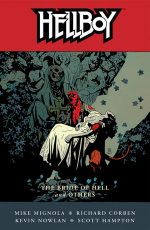
Hellboy volume 11: The Dead Bride and others


By Mike Mignola, Richard Corben, Kevin Nowlan, Scott Hampton, Dave Stewart & Clem Robins (Dark Horse Books)
ISBN: 978-1-59582-740-1

Towards the end of World War II an uncanny otherworldly baby was confiscated from Nazi cultists by American superhero The Torch of Liberty and a squad of US Rangers moments after his eldritch nativity on Earth. The good guys had interrupted a satanic ritual predicted by parapsychologist Professor Trevor Bruttenholm and his associates who were waiting for Hell to literally come to Earth…

The heroic assemblage was stationed at a ruined church in East Bromwich, England when the abominable infant with a huge stone right hand materialised in an infernal fireball. This “Hellboy” was subsequently raised by Bruttenholm, and grew into a mighty warrior engaged in fighting a never-ending secret war against the uncanny and supernatural. The Professor assiduously schooled and trained his happy-go-lucky foundling whilst forming and consolidating an organisation to destroy arcane and occult threats – the Bureau for Paranormal Research and Defense.

After years of such devoted intervention, education and warm human interaction, in 1952 the neophyte hero began hunting down agents of the malign unknown, from phantoms to monsters as lead agent for the BPRD. Hellboy rapidly became its top operative; the world’s most successful paranormal investigator…

As decades passed, Hellboy gleaned snatches of his origins and antecedents, learning he was a supposedly corrupted beast of dark portent: a demonic messiah destined to destroy the world and bring back ancient powers of evil.

It is a fate he despised and utterly rejected…

This eerily esoteric collection of tales concocted by Mike Mignola re-presents a selection of short stories as originally published on/in USAToday.com, Hellboy In Mexico, Hellboy: Double Feature of Evil, Hellboy: The Sleeping and the Dead #1-2, Hellboy: The Bride of Hell and Hellboy: Buster Oakley Gets His Wish, all between 2009 and 2011. These tales draw together many subtly scattered clues disseminated throughout his innumerable tempestuous exploits and contribute to more than fifteen years of slowly boiling magical suspense… as well as hinting at the incredible enigma of the horrific hero’s doom-drenched double destiny…

Following some informative commentary from Mignola the arcane action begins with ‘Hellboy in Mexico or, A Drunken Blur’, (May 2010) illustrated by Richard Corben with colourist Dave Stewart & letterer Clem Robins applying their own seamless contributions to the mix…

In 1982 Hellboy and amphibious ally Abe Sapien are winding down after a strenuous mission in Mexico. Looking for a quiet drink they amble into a ramshackle cantina and discover a sort of shrine comprising a Holy Virgin statue and hundreds of faded photos, posters and tickets for luchadors (masked wrestlers). One of them features Hellboy and three grinning, hooded grapplers…

Shocked and stunned, Hellboy’s mind drifts back to a drunken binge in 1956…

And thus unfolds an untold tale of sterling comradeship and collaborative chaos-crushing as the Demon Detective joins a trio of fun-loving masked brothers who combined their travels on the wrestling circuit with a spot of monster-hunting and devil-destroying, and how it all fell apart after young Esteban fell to the deadly embrace of vampiric bat-god Camazotz…

With the golden times over Hellboy went on an epic memory-eradicating booze-bender until months later BPRD agents found, dried out and brought home their errant top gun…

From Hellboy: Double Feature of Evil (November 2010) – and again illustrated by Corben – comes a brace of theatrically themed terrors. ‘Sullivan’s Reward’ sees Hellboy lured to a phantom-infested manse with a wicked reputation and corrupt mortal owner after which ‘The House of Sebek’ details the mystically inept lengths a horny Egyptology buff descends to in order to slake his lusts. Sadly for him, old crocodile gods never die but do get really ticked off when summoned for the wrong reasons…

A love of classic vampire yarns permeates the epic clash from ‘The Sleeping and the Dead’ #1-2 (December 2010-February 2011) as Scott Hampton, Stewart & Robbins render Mignola’s spooky saga of a nosferatu clan abiding for centuries in a sleepy Suffolk village until Hellboy visited England in 1966 and explosively cleaned house, hearth and home…

Corben returns to illustrate ‘The Bride of Hell’ (December 2009), wherein an American student vanishes in France in 1985. Sent to save her, Hellboy encounters deranged Satan-worshippers, fiends from the Pit and the ghosts of Knight Templar, and learns a small piece of lost history from the annals of the eternal war between Man and the Devil. Tragically, that lesson doesn’t include an appendix on the irresponsibility and unpredictability of human nature and the tale takes a sharp twist which leaves the hero bereft and defeated…

Created as a promotional piece for USA Today‘s website ‘Hellboy: The Whittier Legacy’ (by Mignola with Stewart & Robbins from October 2010) sees the Paranormal Paragon track down the last disgruntled by-blow (it means “illegitimate child”: can’t say my stuff isn’t educational or informative) of an infamous family of Rhode Island Occultists (no; not eye-doctors) determined to enjoy the power and knowledge of his true ancestors. Of course, the old pretender might have shared the heritage, but not the wisdom or foresight to leave well enough alone…

Wrapping up the perilous proceedings, ‘Buster Oakley Gets His Wish’ (April 2011) affords man of many gifts Kevin Nowlan an opportunity to display his mastery of art, colours and letters in a blackly hilarious romp set in Rooks County, Kansas in 1985. Buster was just a bored young farmboy until he performed that ritual from the witchcraft book he’d gotten hold of. Now as Hellboy investigates cow mutilations, he is confronted by weird aliens and teams up with a tragic bovine ally who wishes he’d never heard of the Unknown…

‘Hellboy Sketchbook’ then shares all the covers, story-layouts, doodles, roughs, models and designs; all fully annotated by contributors Nowlan, Corben, Hampton, editor Scott Allie and Mignola, to flesh out the fearsome thrills and chills experience.

Delivered as a succession of short, sharp shockers of beguiling power and ingenuity, this succulent slice of Hellboy’s irresistible history is a perfect example of comics storytelling at its very best: offering astounding supernatural spectacle, amazing arcane action and momentous mystical suspense – something every fear fan and adventure aficionado will enjoy.
™ and © 2009, 2010, 2011 Mike Mignola. Hellboy is ™ Mike Mignola. All rights reserved.

The Joker: A Celebration of 75 Years


By Bob Kane, Bill Finger, Jerry Robinson and many & various (DC Comics)
ISBN: 978-1-4012-4759-1

When the very concept of high priced graphic novels was just being shelf-tested way back in in the late 1980s, DC Comics produced a line of glorious full-colour hardback compilations spotlighting star characters and celebrating standout stories decade by decade from the company’s illustrious and varied history.

They then branched out into themed collections which shaped the output of the industry to this day; such as a fabulous congregation of yarns which offer equal billing and star status to one of the most enduring arch-foes in fiction: The Maestro of Malignant Mirth known only as The Joker.

So much a mirror of and paralleling the evolution of the epochal Batman, the exploits of the Joker are preceded here by a brief critical analysis of the significant stages in the villain’s development, beginning with the years 1940-1942 and Part I: The Grim Jester.

After deconstruction comes sinister action as debut appearance ‘Batman Vs. The Joker’ (by Bill Finger & Bob Kane from Batman #1, Spring 1940) provides suspenseful entertainment whilst introducing the most diabolical member of the Dark Knight’s rogues’ gallery. A chilling moody tale of brazen extortion and wilful wanton murder begins when an eerie character publicly announces that he will kill certain business and civic figures at specific times…

An instant hit, the malignant murdering Joker kept coming back. ‘The Riddle of the Missing Card’ (Finger, Kane & Jerry Robinson, Batman #5 1941) once again saw the Crime Clown pursue loot and slaughter, but this time with a gang of card-themed crooks at his side. It did not end well for the whimsical butcher…

Fame secured, the Devil’s Jester quickly became an over-exposed victim of his own nefarious success. In story terms that meant seeking to “reform” and start over with a clean slate. Turning himself in, the maniac grasses on many criminal confederates but ‘The Joker Walks the Last Mile’ (Finger, Kane & Robinson, Detective Comics #64 June 1942) soon shows that tousled viridian head twisting inexorably back towards murderous larceny…

As years passed and tastes changed, the Laughing Killer mellowed into a bizarrely baroque bandit and Part II: The Clown Prince assesses that alteration, before providing fascinating examples beginning with ‘Knights of Knavery’ from Batman #25 (1944 by Don Cameron, Jack Burnley & Robinson).

Here he and arch-rival The Penguin fractiously join forces to steal the world’s biggest emerald and outwit all opposition, before falling foul of their own mistrust and arrogance once the Caped Crusaders put their own thinking caps on.

‘Rackety-Rax Racket’ Batman #32 (1945 by Cameron & Dick Sprang) is another malevolently marvellous exploit which sees the ideas-starved Prankster of Peril finding felonious inspiration in college-student hazing and initiation stunts, after which ‘The Man Behind the Red Hood’ (Detective Comics #168, February 1951) reveals a partial origin as part of a brilliantly engrossing mystery by Finger, Lew Sayre Schwartz & Win Mortimer, which all began when the Caped Crusader regales eager young criminology students with the story of “the one who got away”… just before the fiend suddenly came back…

In ‘The Joker’s Millions’ (Detective Comics #180, February1952) pulp sci fi writer David Vern Reed, Sprang & Charles Paris provide a gloriously engaging saga disclosing how the villain’s greatest crime rival took revenge from the grave by leaving the Harlequin of Hate too rich to commit capers.

It was all a vindictive double-barrelled scheme though, making the Joker a patsy and twice a fool as the Caped Crusaders eventually find to their great amusement…

Then from World’s Finest Comics #61 (November 1952) Reed, Kane, Schwartz & Paris perpetrate ‘The Crimes of Batman’ as Robin is taken hostage and the Gotham Gangbuster is compelled to commit a string of felonies to preserve the lad’s life. Or so the Joker vainly hopes…

‘Batman – Clown of Crime’ (Batman #85, August 1954 by Reed, Sheldon Moldoff & Paris) captures the dichotomy of reason versus chaos as the eternal arch enemies’ minds are swapped in a scientific accident. Soon a law-abiding Joker and baffled Robin are hunting down a madcap loon with the ultimate weapon at his disposal, the secret of the Gotham Guardian’s true identity

The Silver Age of comicbooks utterly revolutionised a flagging medium, bringing a modicum of sophistication to the returning sub-genre of masked mystery men. However, for quite some time the changes instigated by Julius Schwartz in Showcase #4 – which rippled out to affect all National/DC Comics’ superhero characters – generally passed Batman and Robin by.

Fans buying Batman, Detective Comics, World’s Finest Comics and even Justice League of America would read adventures that in look and tone were largely unchanged from the safely anodyne fantasies that had turned the grim Dark Knight into a mystery-solving, alien-fighting costumed Boy Scout as the 1940s turned into the1950s.

By the end of 1963, Schwartz – having either personally or by example revived and revitalised much of DC’s line and by extension the entire industry with his modernizations – was asked to work his magic with the creatively stalled and nigh-moribund Caped Crusaders just as they were being readied for mainstream global stardom.

‘The Joker’s Jury’ (Batman #163 May 1963) by Finger, Moldoff & Paris was the last sight of the Clown before his numerous appearances on the blockbuster Batman TV show warped the villain and left him unusable for years…

Here, however, Robin and his mentor are trapped in the criminal enclave of Jokerville, where every citizen is a fugitive bad-guy dressed up as the Clown Prince and where all lawmen are outlaws…

The story of the how the Joker was redeemed as a metaphor for terror and evil is covered in Part III: The Harlequin of Hate and thereafter confirmed by the single story which undid all that typecasting damage.

‘The Joker’s Five-Way Revenge’ (Batman #251 September 1973 by Dennis O’Neil & Neal Adams) reversed the zany, “camp” image by re-branding the characters and returning to the original 1930s concept of a grim and driven Dark Avenger chasing an insane avatar of pure evil.

Such a hero needs far deadlier villains and, by reinstating the psychotic, diabolically unpredictable Killer Clown who scared the short pants off the readers of the Golden Age, set the bar high. A true milestone that utterly redefined the Joker for the modern age: the frantic saga sees the Mirthful Maniac stalking his old gang, determined to eradicate them all with the hard-pressed Gotham Guardian desperately playing catch-up. As the crooks die in all manner of Byzantine and bizarre ways, Batman realises his arch-foe has gone irrevocably off the deep end.

Terrifying and beautiful, for many fans this is the definitive Batman/Joker story.

The main contender for that prize follows. ‘The Laughing Fish/The Sign of the Joker’ appeared in Detective Comics #475-476 (February and April 1978) concluding a breathtaking signature run of retro tales by Steve Englehart, Marshall Rogers & Terry Austin

The absolute zenith in a short but stellar sequence resurrecting old foes naturally starred the Dark Knight’s nemesis at his most chaotic; beginning with ‘The Laughing Fish’ before culminating in ‘The Sign of the Joker!’, comprising one of the most reprinted Bat-tales ever concocted and even adapted as an episode of the award-winning Batman: The Animated Adventures TV show in the 1990s.

In fact, you’ve probably already read it. But if you haven’t… what a treat you have awaiting you!

As fish with the Joker’s horrific smile began turning up in sea-catches all over the Eastern Seaboard, the Clown Prince attempts to trademark them. When patent officials foolishly tell him it can’t be done, they start dying… publicly, impossibly and incredibly painfully…

The story then culminated in a spectacular apocalyptic clash which shaped, informed and redefined the Batman mythos for decades to come…

Although Crisis on Infinite Earths transformed the entire DC Universe it left the Joker largely unchanged, however it did narratively set the clock back far enough to present fresher versions of most characters.

‘To Laugh and Die in Metropolis’ comes from Superman volume 2 #9 (September1987) wherein John Byrne & Karl Kesel reveal how the Malicious Mountebank challenges the Man of Steel for the first time. The result is a captivating but bloody battle of wits, with the hero’s friends and acquaintances all in the killer clown’s crosshairs…

The next (frustratingly incomplete) snippet comes from one of the most effective publicity stunts in DC’s history.

Despite decades of wanting to be “taken seriously” by the wider world, every so often a comicbook event gets away from editors and publishers and takes on a life of its own. This usually does not end well for our beloved art form, as the way the greater world views the comics microcosm is seldom how we insiders and cognoscenti see it.

One of the most controversial sagas of the last century saw an intriguing marketing stunt go spectacularly off the rails – for all the wrong reasons – and become instantly notorious whilst sadly masking the real merits of the piece.

‘A Death in the Family’ Chapter Four originated in Batman #427 (December 1988), concocted by Jim Starlin, Jim Aparo & Mike DeCarlo and needs a bit more background than usual…

Robin, the Boy Wonder debuted in Detective Comics#38 (April 1940) created by Bob Kane, Bill Finger & Jerry Robinson. He was a juvenile circus acrobat whose parents were murdered by a mob boss. The story of how Batman took the orphaned Dick Grayson under his scalloped wing and trained him to fight crime has been told, retold and revised many times over the decades and still undergoes the odd tweaking to this day

The child Grayson fought beside Batman until 1970 when, as a sign of the turbulent times, he flew the nest, becoming a Teen Wonder and college student. His invention as a junior hero for younger readers to identify with had inspired an incomprehensible number of costumed sidekicks and kid crusaders, and Grayson continued in similar vein for the older, more worldly-wise readership of America’s increasingly rebellious youth culture.

During the 1980s the young hero led the New Teen Titans, re-established a turbulent working relationship with Batman and reinvented himself as Nightwing. This of course left the post of Robin open…

After Grayson’s departure Batman worked alone until he caught a streetwise young urchin trying to steal the Batmobile’s tires. Debuting in Batman#357 (March 1983) this lost boy was Jason Todd, and eventually the little thug became the second Boy Wonder (#368, February 1984), with a short but stellar career, marred by his impetuosity and tragic links to one of the Caped Crusader’s most unpredictable foes…

Todd had some serious emotional problems which became increasingly apparent in the issues leading up to ‘A Death in the Family’ story arc. As the street kid became more callous and brutal in response to the daily horrors he was exposed to he deliberately caused the death of a vicious drug-dealer with diplomatic immunity. Jason then began a guilty spiral culminating in the story-arc which comprised Batman#426-429.

Ever more violent and seemingly incapable of rudimentary caution, Jason is suspended by Batman. Meanwhile the Joker is returns, but rather than his usual killing frenzy, the Clown Prince is after mere cash, because the financial disaster of “Reaganomics” has depleted his coffers – meaning he can’t afford his outrageous murder gimmicks…

Without purpose, Jason has been wandering the streets where he grew up. Encountering a friend of his dead mother, he learns a shocking secret. The woman who raised him was not his birth-mother, and there exists a box of personal papers indicating three different women who might be his true mother.

Lost and emotionally volatile Jason sets out to track them down…

After monumental efforts, he locates Dr. Sheila Haywood working as a famine relief worker in Ethiopia. As Jason heads for the Middle East and a confrontation with destiny, he is unaware that Batman is also in that troubled region, hot on the Joker’s trail since the Maniac of Mirth is attempting to sell stolen nuclear weapons to any terrorist who can pay…

When Jason finds his mother, he has no idea that she has been blackmailed into a deadly scam involving stolen relief supplies by the Clown Prince of Crime…

I’m not going to bother with the details of the voting fiasco that plagues all references to this tale as it’s all copiously detailed elsewhere, but suffice to say that to test then-new marketing tools a 1-900 number was established and, thanks to an advanced press campaign, readers were offered the chance to vote on whether Robin would live or die in the story.

Against every editorial expectation vox populi voted thumbs down and Jason died in a most savage and uncompromising manner….

The kid had increasingly become a poor fit in the series and this storyline galvanised a new direction with a darker, more driven Batman, beginning almost immediately as the Joker, after killing Jason in a chilling and unforgettably violent manner, became UN ambassador for Iran (later revised as the fully fictional Qurac – just in case…) and at the request of the Ayatollah himself attempted to kill the entire UN General Assembly during his inaugural speech…

And here is the true injustice surrounding this tale: the death of Robin (who didn’t even stay dead) and the media uproar over the voting debacle took away from the real importance of this story – and perhaps deflected some real scrutiny and controversy. Starlin had crafted a clever and bold tale of real world politics and genuine issues which most readers didn’t even notice.

Terrorism Training Camps, Rogue States, African famines, black marketeering, Relief fraud, Economic, Race and Class warfare, Diplomatic skullduggery and nuclear smuggling all featured heavily, as did such notable hot-button topics as Ayatollah Khomeini, Reagan’s Cruise Missile program, the Iran-Contra and Arms for Hostages scandals and the horrors of Ethiopian refugee camps. Most importantly it signaled a new and fearfully casual approach to violence and death in comics-books.

The story selected to represent the lad here is a poor choice, however. This is not to say that ‘A Death in the Family’ is a lesser tale: far from it, and Starlin, Aparo & DeCarlo’s landmark, controversial story of the murder of brash, bright Jason Todd by the Joker shook the industry and still stands the test of time.

However, all that’s included here is the final chapter, and even I, having read it many times, was bewildered as to what was going on.

If you want to see the entire saga – and trust me, you do – seek out a copy of the complete A Death in the Family…

In 1989 Batman broke box office records in the first of a series of big budget action movies. The Joker was the villain du jour and stole the show. That increased public awareness again influenced the comics and is covered in Part IV: Archnemesis before ‘Going Sane’ Part Two ‘Swimming Lessons’ provides a fresh look at the motivations behind the maniacal madness.

The story comes from Batman: Legends of the Dark Knight #66 (December 1994) LoDK began in the frenzied atmosphere following the movie. With planet Earth completely Bat-crazy for the second time in 25 years, DC wisely supplemented the Gotham Guardian’s regular stable of titles with a new one specifically designed to focus on and redefine his early days and cases through succession of retuned, retold classic stories.

Three years earlier the publisher had boldly begun retconning their entire ponderous continuity via the landmark maxi-series Crisis on Infinite Earths; rejecting the concept of a vast multiverse and re-knitting time so that there had only ever been one Earth.

For new readers, this solitary DC world provided a perfect place to jump on at a notional starting point: a planet literally festooned with iconic heroes and villains draped in a clear and cogent backstory that was now fresh and newly unfolding.

Many of their greatest properties were graced with a reboot, all enjoying the tacit conceit that the characters had been around for years and the readership were simply tuning in on just another working day.

Batman’s popularity was at an intoxicating peak and, as DC was still in the throes of re-jigging narrative continuity, his latest title presented multi-part epics reconfiguring established villains and classic stories: infilling the new history of the re-imagined, post-Crisis hero and his entourage.

An old adage says that you can judge a person by the calibre of their enemies, and that’s never been more ably demonstrated than in the case of Batman and The Joker. The epic battles between these so similar yet utterly antithetical icons have filled many pages and always will…

With that in mind, 4-part psychological study ‘Going Sane’ by J.M. DeMatteis, Joe Staton & Steve Mitchell takes us back to a time when Batman was still learning his job and had only crossed swords with the Clown Prince of Crime twice before…

After a murderously macabre circus-themed killing-spree in the idyllic neighbourhood of Park Ridge and abduction of crusading Gotham Councilwoman Elizabeth Kenner, a far-too-emotionally invested Batman furiously plays catch-up. This leads to a disastrous one-sided battle in front of GCPD’s Bat signal and a frantic pursuit into the dark woods beyond the city.

Driven to a pinnacle of outrage, the neophyte manhunter falls into the Joker’s devilishly prepared trap and is caught in an horrific explosion. His shattered body is then dumped in the by an incredulous, unbelieving killer clown reeling in shock at his utterly unexpected ultimate triumph…

Stand-alone extract ‘Swimming Lessons’ opens here with Batman missing and Police Captain James Gordon taking flak from all sides for not finding the Predatory Punchinello or the savage mystery assailant who recently murdered an infamous underworld plastic surgeon…

Under Wayne Manor faithful manservant Alfred fears the very worst whilst in a cheap part of town thoroughly decent nonentity Joseph Kerr suffers terrifying nightmares of murder and madness.

His solitary days end when he bumps into mousy spinster Rebecca Brown. Days pass and the two lonely outcasts find love in their mutual isolation and a shared affection for classic slapstick comedy. The only shadows blighting this unlikely romance are poor Joe’s continual nightmares and occasional outbursts of barely suppressed rage…

As days turn to weeks and then months, Alfred sorrowfully accepts the situation and prepares to close the Batcave forever. As he descends, however, he is astounded to see the Dark Knight has returned…

The story of Joe Kerr – fictive product of a deranged mind which simply couldn’t face life without Batman – is another yarn readers will want to experience in full, but that too will only happen in a different collection…

The World’s Greatest Detective continues to relentlessly battle the Clown Prince in ‘Fool’s Errand’ (Detective Comics #726, October 1998) as Chuck Dixon & Brian Stelfreeze depict a vicious mind-game conducted by the Hateful Harlequin from his cell, using a little girl as bait and an army of criminals as his weapon against the Dark Knight after which ‘Endgame’ Part Three ‘…Sleep in Heavenly Peace’ (Detective Comics #741 February 2000 by Greg Rucka, Devin Grayson, Damian Scott, Dale Eaglesham, Sean Parsons, Sal Buscema & Rob Hunter) sees the Joker plaguing a Gotham City struggling to recover from a cataclysmic earthquake.

It’s Christmas but the stubborn survivors are so stretched striving to stop The Joker’s plan to butcher all the babies left in town they are unable to notice that his real scheme will gouge a far more personal wound in their hearts…

‘Slayride’ by Paul Dini, Don Kramer & Wayne Faucher (Detective Comics #826 February 2007 and another Seasonal special) is one of the best Joker – and definitely the best Robin – stories in decades. This Christmas horror story sees our Crazed Clown trap third Boy Wonder Tim Drake in a stolen car, making him an unwilling participant in a spree of vehicular homicides amongst the last-minute shoppers.

If there is ever a Greatest Batman Christmas Stories Ever Told collection (and if there’s anybody out there with the power to make it so, get weaving please!), this just has to be the closing chapter….

Brining us up to date Part V: Rebirth focuses on the 2011 New 52 continuity-wide reboot and an even grimmer, Darker Knight who debuted in Detective Comics volume 2 #1 with what might be assumed to be the last Joker story. As crafted by Tony Daniel & Ryan Winn, ‘Faces of Death’ follows the mass-murdering malcontent on another pointless murder spree which culminates in his apparent death, leaving behind only his freshly skinned-off face nailed bloodily to an asylum wall…

A year later the Joker explosively returned, mercilessly targeting all of Batman’s allies in a company-wide crossover event dubbed Death of the Family. The crippling mind-games and brutal assaults culminated in ‘But Here’s the Kicker’ (Batman #15, February 2013 by Scott Snyder, Greg Capullo & Jonathan Glapion) and purportedly the final battle between Bat and Clown: but we’ve all heard that before, haven’t we…?

The Joker has the rare distinction of being arguably the most iconic villain in comics and can claim that title in whatever era you choose to concentrate on; Noir-esque Golden Age, sanitised Silver Age or malignant modern and Post-Modern milieus. This book captures just a fraction of all those superb stories…

Including pertinent covers by Sayre Swartz & Roussos, Mortimer, Moldoff, Adams, Rogers & Austin, Byrne, Mike Mignola, Staton & Mitchell, Stelfreeze, Alex Maleev & Bill Sienkiewicz, Simone Bianchi, Daniel & Winn and Capullo, this monolithic testament to the inestimable value of a good bad-guy is a true delight for fans of all ages and vintage.
© 1940, 1941, 1942, 1944, 1945, 1951, 1952, 1954, 1964, 1973, 1978, 1987, 1988, 1994, 1998, 2000, 2007, 2011, 2012, 2014 DC Comics. All Rights Reserved.