Sleepwalk and Other Stories


By Adrian Tomine (Drawn & Quarterly Publications 1998/Faber & Faber)
ISBN: 978-1-89659-711-9 (D&Q), 978-0-57123-331-1 (Faber HB)

We often talk of comics and graphic narrative as if it’s one homogenous lump, and as well as doing the medium a tremendous disservice it’s also incredibly misleading. Those people that haughtily declaim “Oh, We Never Watch Television” usually mean they deplore whatever it is you’ve just mentioned, but that their own viewing habits somehow don’t count.

And in a way they’re absolutely correct. For them the term is a group pejorative. But Bake Off is not Eastenders is not The Sky at Night is not Stranger Things. The medium is now a conveyance, the content is a product you can select or decline. Now try that phrase with the concept of comics.

Adrian Tomine draws pictures and tells stories. They are about “Now”, and “I feel that…” and “How does…?” His Spartan monochromatic drawing style works as an ideal camera for his elegiac documentaries. In an art form that too often relies on hyperbole and melodrama – not just for content but for narrative technique – he eschews bravura for insight, telling little tales about the commonplace and the ordinary, showing just how extraordinary and poetic a “realer” life can be. As an exemplar and primer of one of the greatest graphic storytellers of our age (well mine, at least) this is a still his most compelling work, although you (and probably I) might want to reflect and consider 2020’s The Loneliness of the Long-Distance Cartoonist

Originally released as issues 1-4 of Optic Nerve, Sleepwalk presented sixteen vignettes of broken hearts and trampled dreams, of uncompromising self-recriminations and day-to-day reminiscences that make us all shrug and think “well, there’s always tomorrow…”

If you read Maus for the scale of Man’s capacity for evil or Stuck Rubber Baby for his ability to change and overcome, then Sleepwalk should access your capacity to empathise and endure. Few comics comment on the Human Condition without taking a strident position. Here’s one that asks you to choose your own, and choose it every single time. Find it. Buy it. Read it.

Think about it. Agitate for one its many past publishers to re-release it…
© 1995, 1996, 1997, 1998 Adrian Tomine. All Rights Reserved.
Yesterday in 1847, pioneering French cartoonist/caricaturist “Grandville” (AKA Jean Ignace Isidore Gérard/Jean-Jacques/J. J. Grandville et al) ended an era by dying…

In 1877, Dutchman of similar status and impact Albert Hahn was born, as was legendary Marvel Comics icon Flo Steinberg in 1939, and in 1950 German satirist (imagine that!) and comics star creator of Werner Rötger Werner Friedrich Wilhelm Brösel Feldmann arrived, as did Mutts creator Patrick McDonnell in 1956.

Yesterday in 1972 we lost Cuban star Antonio Rubio in 1972 and US cartoonist Russell Patterson (Mamie), but the day in 1951 saw Davie Law’s Dennis the Menace begin in The Beano, the premiere issue of Japan’s Weekly Shonen Magazine in 1959 and the first episode of Greg EvansLuann in 1985.
Today in 1889 Reg’lar Fellers cartoonist Gene Byrnes was born, just like author/artist/inker (Frank McLaughlin (Judomaster, Justice League of America, everything) in 1935.Belgian creator Marcel Denis (Hultrasson) passed away in 2002 and we lost the magnificently macabre Bernie Wrightson (Swamp Thing, Frankenstein, Batman) in 2017. In 1985 UK weekly Buster published the last episode of The Leopard from Lime Street

Demeter & Persephone: Spring Held Hostage – A Greek Myth


By Justine & Ron Fontes, Steve Kurth & Barbara Schulz (Graphic Universe)
ISBN: 978-1-58013-318-0 (HB), 978-0-82256-570-3 9 (TPB/Digital edition)

Look! Out the window!! The sun! Flowers!

The heroic tales and legends of older cultures have, for centuries formed an integral part of children’s educational development – and a good thing too. These days though, those magnificently inspiring and memorably visual yarns are as likely to be disseminated in graphic novel form as through the illustrated prose books which had such a formative influence on my early days.

Demeter & Persephone: Spring Held Hostage was released in 2007, one self-contained tome in a larger series which also retold in comics other Hellenic myths such as the Labours of Hercules, or Jason’s journey with the Argonauts as well as other cultures’ founding fables like Isis & Osiris or King Arthur.

Packaged as full-colour, 48 page, card-cover booklets they – hopefully – introduced a wealth of kids to the magical riches of human imagination. They also read very well as comics in their own right.

All religious stories are devised to explain away contemporary unsolved questions and unknowable mysteries. The liturgical lesson retold here was one people’s attempt to rationalise the progress of the seasons and the man-made miracle of agriculture, opening in the paradisiacal golden age of ‘A Winterless World’ where, thanks to the joyful bounty of the goddess Demeter, plants bloomed all year long and the Earth was bathed in perpetual warmth. The harvest goddess’ greatest joy was her glorious daughter Persephone, offspring of one of Zeus’ constant infidelities with any deity, supernatural creature or mortal he took a fancy to…

The supreme god ruled over the skies and Earth whilst his brothers Poseidon and Hades controlled the oceans and underworld respectively. However, when the dolorous, lonely Lord of the Dead saw Persephone he wanted her for his wife, and callous, unthinking Zeus told him to just steal her and take her down to ‘The Dark Domain’ he ruled…

Despite her plight, Demeter’s daughter found a great deal that was admirable about Hades and his vast kingdom of judgement, punishment and reward. However, knowing how perilous her fate was, Persephone refused to eat anything that her embarrassed abductor offered, knowing that to do so would bind her to him forever. In the bright lands above, Demeter frantically searched for her child. Discovering how Persephone had been taken, the Harvest Goddess pleaded with Zeus who refused to intervene, prompting her to abandon the pantheon’s home on Mount Olympus. She wandered the Earth as ‘A Worried Mother’ and in the guise of a broken old woman became the nurse to Prince Demophoon of Eleusis, infant son of King Celeus.

Months passed whilst Demeter neglected the world’s lush abundance, defiantly ignoring the desperate pleas of man and god alike. Plants withered and starvation gripped the Earth, and on Olympus the crisis at last forced Zeus to act. He despatched messenger god Hermes to the underworld to negotiate with Hades and a compromise was reached. ‘The Seeds of Change’ saw a now reluctant Persephone leave the abductor she had come to care for. In all that time she had eaten nothing but as they parted she swallowed a few pomegranate seeds from a fruit Hades offered as final gesture…

Even whilst back in the clean air above, this caused great consternation as their consumption gave Hades a legitimate claim to Persephone. Moreover, she had come to love him but as her mother refused to be separated from her, her marriage to Hades would have doomed mankind to starvation. ‘The Pomegranate Problem’ was only solved by Rhea, mother of all gods, who suggested that the lovers should marry but that Persephone must spend two thirds of each year with her mother who would then cause the world’s plants to germinate, blossom, grow and ripen. After that the daughter would spend four months with her husband in the underworld, with Earth consequently becoming temporarily cold, dark and bleakly barren.

Satisfied with the solution but plagued by guilt, Demeter eventually returned to Eleusis where the baby Demophoon had grown to manhood. Here she taught her human charge the secrets of cultivation and plant improvement and the prince travelled the Earth, sharing his divinely-bestowed knowledge of agriculture to a grateful and eager humanity…

Engrossing, dynamic, pretty and blessed with a light touch despite its toxic message of male ownership and inescapable dominance (it’s history, you can’t ignore or cover up but must adapt and redefine terms and context!) this splendid introduction to mythology is designed for kids with a reading age of nine or above – that’s Year 4, I think – and also contains a full glossary; Further Reading and an index as well as fact-features on Creating Demeter & Persephone and biographies of the creators.
© 2007 Lerner Publishing Group, Inc. All rights reserved.
Today in 1902, Ozzie artist, caricaturist, cartoonist Alex Gurney (Bluey and Curly) was born, as was master scribe Bob Haney in 1926 and Spanish cartoonist Francisco Ibáñez Talavera (Mortadelo y Filemón/Morty & Phil). In 1954, Dan Adkins came along, with Bob Budiansky joining the party in 1958 and Sailor Moon creator Noaka Takeuchi in 1967.

In 2002 we lost Canadian underground star Rand Holmes, and writer of The Official Underground and Newave Comix Price Guide/King Features Editor Jay Kennedy in 2007. In 2012 died strip legend Fran Matera whose Steve Roper and… ran from November 23rd 1936 to December 26th 2004.
In 1958 today Ken Reid’s astounding Jonah set sail in The Beano for the first time.

I have no idle comics thoughts for Monday so just read a book instead. However…

Tomorrow in 1892 Swedish children’s periodical Kamratposten launched. Italian western star Gino D’Antonio (Storia del West) was born in 1927 as was Kate Worley in 1958, Todd McFarlane in 1961, Harold Sakushi (Gorillaman, Stopper Busujima, Beck) in 1969 and Paolo Rivera (Spider-Man, Daredevil, The Valiant) in 1981. In 2017 Underground Commix superstar Mervyn “Skip” Williamson (Bijou Funnies, Snappy Sammy Smoot) died.

U.S.S. Stevens – The Collected Stories


By Sam Glanzman (Dover Comics & Graphic Novels)
ISBN: 978-0-486-80158-2 (HB/Digital edition)kuno

This book includes Discriminatory Content produced for dramatic and comedic effect.

To the shame and detriment of the entire comics industry, for most of his career Sam Glanzman was one of the least-renowned creators in American comic books. Despite having one of the longest careers, most unique illustration styles and the respect of his creative peers, he just never got the public acclaim his work deserved. Thankfully that all changed in recent years and he lived long enough to enjoy the belated spotlight and bask in some well-deserved adulation.

Glanzman drew and wrote comics since the Golden Age, most commonly in classic genres ranging from war to mystery to fantasy, where his work was – as always – raw, powerful, subtly engaging and irresistibly compelling. On titles such as Kona, Monarch of Monster Island, Voyage to the Deep, Combat, Jungle Tales of Tarzan, Hercules, The Haunted Tank, The Green Berets, The Private War of Willie Schultz, and especially 1980s graphic novels A Sailor’s Story and Wind, Dreams and Dragons – which you should buy in a single volume from Dover – Glanzman produced magnificent action-adventure tales which fired the imagination and stirred the blood. His stuff always sold and at least won him a legion of fans amongst fellow artists, if not from the small, insular and over-vocal fan-press.

In later years, Glanzman worked with Tim Truman’s 4Winds outfit on high-profile projects like The Lone Ranger, Jonah Hex and barbarian fantasy Attu. Moreover, as the sublime work gathered here attests, he was also one of the earliest pioneers of graphic autobiography; translating personal WWII experiences as a sailor in the Pacific into one of the very best things to come out of DC’s 1970s war comics line.

U.S.S. Stevens, DD479 was a peripatetic filler-feature bobbing about between Our Army at War, Our Fighting Forces, G.I. Combat, Star Spangled War Stories and the other anthological battle books; quietly backing-up the cover-hogging, star-attraction glory-boys. It provided wry, witty, shocking, informative and immensely human vignettes of shipboard life, starring the fictionalised crew of the destroyer Glanzman had served on. It was, in most ways, a love story and tribute to the vessel which had been their only home and refuge under fire. In 4- or 5-page episodes, the auteur recaptured and shared a kind of comradeship we peace-timers can only imagine and, despite the pulse-pounding drama of the lead features, us fans all knew these little snippets were what really happened when the Boys went “over there”. Just like now…

A maritime epic to rank with Melville or Forester – and with stunning pictures too – every episode of this astounding unsung masterpiece is housed in one stunning hardback compilation (also available digitally for limp-wristed old coots like me) and if you love the medium of comics, or history, or just a damn fine tale well-told, you must have it.

That’s really all you need to know, but if you’re one of the regular crowd needful of more of my bombastic blather, a much fuller description follows.

As I’ve already stated, Glanzman belatedly enjoyed some well-earned attention, and this tome opens by sharing Presidential Letters from Barack Obama and George Herbert Walker Bush for his service and achievements. Then follows a Foreword from Ivan Brandon and a copious and informative Introduction by Jon B. Cooke detailing ‘A Sailor’s History: The Life and Art of Sam J. Glanzman’. Next comes a brace of prototypical treats; the initial comic book appearance of U.S.S. Stevens from Dell Comics’ Combat #16 (cover-dated April-June 1965) and the valiant vessel’s first cover spot from Combat #24, April 1967.

The first official U.S.S. Stevens, DD479 appeared after Glanzman approached Joe Kubert, who had recently become Group Editor for DC’s war titles. He commissioned ‘Frightened Boys… or Fighting Men’ (appearing in Our Army at War #218, April 1970), depicting a moment in 1942 as boredom and tension were replaced by frantic action when a suicide plane targeted the ship…

A semi-regular cast was introduced slowly throughout 1970; fictionalised incarnations of old shipmates including skipper Commander T. A. Rakov, who ominously pondered his Task Force’s dispersal, moments before a pot-luck attack known as ‘The Browning Shot’ (Our Fighting Forces #125, May/June) proved his fears justified…

Glanzman’s pocket-sized tales always delivered a mountain of information, mood and impact and ‘The Idiot!’ (OAaW#220, June) is one of his most effective, detailing in 4 mesmerising pages not only the variety of suicidal flying bombs the Allies faced, but also how appalled American sailors reacted to them. Sudden death was everywhere. ‘1-2-3’ (OFF #126, July/August) details how quick action and intuitive thinking saves the ship from a hidden gun emplacement whilst ‘Black Smoke’ (Our Army at War #222, from the same month) shows how a know-it-all engineer causes the sinking of the Stevens’ sister-ship by not believing an old salt’s frequent, frantic warnings. All aboard ship were regularly shaken by the variety of Japanese aircraft and skill of the pilots. ‘Dragonfly’ (OFF #127, September/October) shows exactly why, whilst an insightful glimpse of the enemy’s psychological other-ness is tragically, graphically depicted in the tale of ‘The Kunkō Warrior’ (OAaW #223, September).

A weird encounter with a wooden WWI vessel forces a ‘Double Rescue!’ (Star Spangled War Stories #153, October/November) before OFF #128’s (November/December) ‘How Many Fathoms?’ again counts the human cost of bravery with devastating, understated impact. ‘Buckethead’ (OAaW #225, November) then relates one swabbie’s unique reaction to constant bombardment before ‘Missing: 320 Men!’ (G.I. Combat #145, December 1970-January 1971) debuted Glanzman-avatar Jerry Boyle, who whiled away helpless moments during a shattering battle by sketching cartoons of his astonished shipmates.

‘Death of a Ship!’ (OAaW #227, January 1971) deals with classic war fodder as submarine and ship hunt each other in a deadly duel. A military maritime mystery was solved by Commander Rakov in ‘Cause and Cure!’ Our Army at War #230, March) whilst next issue (April 1971) posed a different conundrum as the ship lost all power and was stuck ‘In the Frying Pan!’

The vignettes were always less about warfare than its effect – immediate or cumulative – on ordinary guys. ‘Buck Taylor, You Can’t Fool Me!’ (OAaW #232) catalogues his increasingly aberrant behaviour but posits some less likely reasons, after which old school hero Bos’n Egloff saves the day during the worst typhoon of the war in ‘Cabbages and Kings’ (OFF #131, July/August) whilst ‘Kamikaze’ (OAa #235 August) boldly and provocatively tells a poignant life-story from the point of view of the pilot inside a flying bomb.

An informative peek at the crew of a torpedo launch station in ‘Hip Shot’ (G.I. Combat #150 October/November) segues seamlessly into the dangers of shore leave ‘In Tsingtao’ (OFF #134, November/December) whilst ‘XDD479’ (OAaW #238 November) reveals a lost landmark of military history. The real DD479 was one of three destroyers test-trialling ship-mounted spotter planes. This little gem explains why that experiment was dropped…

Buck bounces back in ‘Red Ribbon’ (G.I.C #151 December 1971-January 1972), sharing a personal coping mechanism for making shipboard chores less “exhilarating”, whilst ‘Vela Lavella’ (OAaW #240, January 1972) captures the claustrophobic horror of nighttime naval engagement before ‘Dreams’ (G.I.C #152 February/March) peeps inside various heads to see what the ship’s company would rather be doing. ‘Batmen’ (OAaW #241, February) uses a lecture on radar to recount one of the most astounding exploits of the war…

Every episode was packed with fascinating fact and detail, culled from the artist’s letters home and service-time sketchbooks, but those invaluable memento belligeri also served double duty as the basis for a secondary feature. The debut ‘Sam Glanzman’s War Diary’ appeared in Our Army at War #242 (March 1972): a compendium of pictorial snapshots sharing quieter moments, such as the first passage through the Panama Canal, sleeping arrangements or K.P. duties peeling spuds, and precedes an hilarious record of the freshmen sailors’ endurance of an ancient naval hazing tradition inflicted upon every “pollywog” crossing the equator for the first time in ‘Imperivm Neptivm Regis’ (OFF #136 (March/April 1972).

A second ‘Sam Glanzman’s War Diary’ (OAaW #244, April) reveals the mixed joys of ‘Liberty in the Philippines’ after which a suitably foreboding ‘Prelude’ (Weird War Tales #4 (March/April 1972) captures the passive-panicked tension of daily routine whilst a potentially morale-shattering close shave is shared during an all-too-infrequent ‘Mail Call!’ (G.I. Combat #155, April/May)…

A thoughtful man of keen empathy and insight, Glanzman often offered readers a look at the real victims. ‘What Do They Know About War?’ (OAaW #244, April) sees peasant islanders trying to eke out a living, only to discover far too many similarities between Occupiers and Liberators, whilst the next issue focussed on sailors’ jangling nerves and stomachs. ‘A Funny Thing Happened on the Way to the War!’ (#245, May) reveals what happened when DD479 was mistakenly declared destroyed and, thanks to an administrative iron curtain, found it impossible to refuel or take on food stores. Cartoonist Jerry Boyle resurfaced in a ‘Comic Strip’ (OFF #138, July/August) after which Glanzman produced one of the most powerful social statements in an era of tumultuous change.

Our Army at War #247 (July 1972) featured a tale based on decorated Pearl Harbor hero Doner Miller who saved lives, killed the enemy and won medals, but was not allowed to progress beyond the rank of shipboard domestic because of his skin. ‘Color Me Brave!’ was an excoriating attack on the U.S. Navy’s segregation policies and is as breathtaking and rousing now as it was then.

‘Ride the Baka’ (OAaW #248 August) revisits constant near-miss moments sparked by suicide pilots after which Glanzman shares broken sleep in ‘A Nightmare from the Beginning’ (OFF #139, September/October) whilst ‘Another Kunkō Warrior’ (OFF #140, November/December) sees marines taking an island and encountering warfare beyond their comprehension…

1973 began with a death-dipped nursery rhyme detailing ‘This is the Ship that War Built!’ (G.I.C #157 December 1972-January 1973) before ‘Buck Taylor’ (OFF #141 January/February) delivers an impromptu lecture on maritime military history. Glanzman struck an impassioned note for war-brides and lonely ships passing in the night with ‘The Islands Were Meant for Love!’ (Star Spangled War Stories #167 February). Terror turns to wonder when sailors encounter the ‘Portuguese Man of War’ (OAaW #256 August), a shore leave mugging is thwarted thanks to ‘Tailor-Mades’ (OFF #143 June/July) and letters home are necessarily self-censored in ‘The Sea is Calm… The Sky is Bright…’ (OAaW #257 June), but shipboard relationships remain complex and bewildering, as proved in ‘Who to Believe!’ (SSWS #171, July).

The strife of constant struggle comes to the fore in ‘The Kiyi’ (OAaW #258 July) and is seen from both sides when souvenir hunters try to take ‘The Thousand-Stitch-Belt’ (SSWS #172 August), but, as always, it’s noncombatants who truly pay the price, just like the native fishermen in ‘Accident…’ (OAaW #259, August). Even the quietest, happiest moments can turn instantly fatal as good-natured pilferers swiping fruit at a refuelling station discover in ‘King of the Hill’ (SSWS #174, October). An unlikely tale of a kamikaze who survives his final flight but not his final fate, ‘Today is Tomorrow’ (OAaW #261, October) precedes a strident, wordless plea for understanding in ‘Where…?’ (OAaW #262 November 1973) before our sombre mood is briefly lifted with a tale of selfishness and sacrifice in ‘Rocco’s Roost’ from OAaW #265, February 1974.

The following issue provided both a gentle ‘Sam Glanzman’s War Diary’ covering down-time in “The Islands” and a brutal tale of mentorship and torches passed seen in ‘The Sorcerer’s Apprentice’, after which a truly disturbing tale of what we now call gender identity and post-traumatic stress disorder is recounted in the tragedy of ‘Toro’ ( April/May Our Fighting Forces #148)…

‘Moonglow’ from OAaW #267 (April 1974) reveals how quickly placid contemplation can turn to blazing conflagration, whilst – after a chilling, evocative ‘Sam Glanzman’s War Diary’ (OAaW #269 June) – ‘Lucky… Save Me!’ (OAaW #275, December 1974) shows how memories of unconditional love can offset the cruellest of injuries. ‘Heads I Win, Tails You Lose!’ (OAaW #281, June 1975) explores how both friend and foe alike can be addicted to risk, after which the next issue’s ‘I Am Old Glory…’ sardonically transposes a thoughtful veneration with the actualities of combat before ‘A Glance into Glanzman’ by Allan Asherman (Our Army at War #284, September 1975) takes a look at the author’s creative process.

Then it’s back to those sketchbooks and another peep ‘Between the Pages’ (OAaW #293, June 1976) before ‘Not Granted!’ (OAaW #298, November 1976) discloses every seaman’s most fervent wish…

Stories were coming at greater intervals at this time and it was clear that – editorially at least – the company was moving on to fresher and more fantastical fields. Glanzman, however, had saved his best till last as a stomach-churning visual essay displayed the force of tension sustained over months in ‘…And Fear Crippled Andy Payne’ (Sgt. Rock #304, May 1977) before an elegy to bravery and stupidity asked ‘Why?’ in Sgt. Rock #308 (September 1977).

And that was it for nearly a decade. Glanzman – a consummate professional – moved on to other ventures. He was, however, constantly asked about U.S.S. Stevens and eventually returned to his spiritual stomping grounds in expanded tales of DD479: both in his graphic novel memoirs and comic strips. The latter appeared in anthological monochrome Marvel magazine Savage Tales (#6-8, spanning August-December 1986) under the umbrella title ‘Of War and Peace – Tales by Mas’.

First up was ‘The Trinity’ blending present with past to detail a shocking incident of a good man’s breaking point, whilst a lighter tone informed ‘In a Gentlemanly Way’, as Glanzman recalled different means by which officers and swabbies showed pride for their ships. ‘Rescued by Luck’ than concentrated on a saga of island survival for sailors whose ship had sunk. Next comes a hauntingly powerful black-&-white tale of then and now entitled ‘Even Dead Birds Have Wings’ (created for the Dover Edition of A Sailor’s Story from 2015), after which a chronologically adrift yarn (from Sgt. Rock Special #1, October 1992) evokes potently elegiac feelings, describing an uncanny act of gallantry under fire and the ultimate fate of old heroes in ‘Home of the Brave’

Some years ago, by popular – and editorial – demand, Glanzman returned to the U.S.S. Stevens for an old friend’s swan song series; providing new tales for each issue of DC’s anthological 6-issue miniseries Joe Kubert Presents (December 2012 – May 2013). More scattershot reminiscences than structured stories, ‘I REMEMBER: Dreams’ and ‘I REMEMBER: Squish Squash’ recapitulate unforgettable moments seen through eyes at the sunset end of life; recalling giant storms and lost friends, imagining how distant families endured war and absence and, as always, balancing funny memories with tragic, like that time when the stiff-necked new commander…

‘Snapshots’ continues the reverie, blending a veteran’s war stories with cherished times as a kid on the farm whilst ‘The Figurehead’ delves deeper into the character of Buck Taylor and his esoteric quest for seaborne nirvana…

Closing that last hurrah were ‘Back and Forth 1941-1944’ and ‘Back and Forth 1941-1945’: an encapsulating catalogue of war service as experienced by the creator, mixing facts, figures, memories and reactions to form a quiet tribute to all who served and all who never returned…

With the stories mostly told, ‘Afterword’ by Allan Asherman details those heady days when he worked in DC Editorial, and Glanzman would unfailingly light up the offices by delivering his latest strips, after which this monolithic milestone offers a vast and stunningly detailed appendix of ‘Story Annotations’ by Jon B. Cooke.

This is a magnificent collection of comic stories based on real life and what is more fitting than to end it with ‘U.S.S. Stevens DD479’ (coloured by Frank M. Cuonzo & lettered by Thomas Mauer): one final, lyrical farewell from Glanzman to his comrades and the ship which still holds his heart after all these years?

This is an extraordinary work. In unobtrusive little snippets, Glanzman challenged myths, prejudices and stereotypes – of morality, manhood, race, sexuality and gender – decades before anybody else in comics even thought to try. He also brought an aura of authenticity to war stories which has never been equalled: eschewing melodrama, faux heroism, trumped-up angst and eye-catching glory-hounding to instead depict how brothers-in-arms really felt and acted and suffered and died.

Shockingly funny, painfully realistic and visually captivating, U.S.S. Stevens is phenomenal and magnificent: a masterpiece by one of the very best of “The Greatest Generation”. I waited over 40 years for this and I couldn’t be happier that ten years later this is one comics classic that is still available to all: a sublimely insightful, affecting and rewarding graphic memoir every home, school and library should have and one every reader will return to over and over.
Artwork and text © 2015 Sam Glanzman. All other material © 2015 its respective creators.

Today in 1920. US Dennis the Menace originator Hank Ketcham was born as was Funky Winkerbean cartoonist Tom Batiuk in 1947, and comics horror god Stephen R. Bissette in 1955. In 1973 we mourned Blondie creator Chic Young.

Mandrake the Magician: The Hidden Kingdom of Murderers – Sundays 1935-1937


By Lee Falk & Phil Davis (Titan Books)
ISBN: 978-0-85768-572-8 (HB)

This book includes Discriminatory Content produced in less enlightened times.

Regarded by many as comics’ first superhero, Mandrake the Magician debuted as a daily newspaper strip on June 11th 1934, although creator Lee Falk had sold the strip almost a decade previously. Initially drawing it too, Falk replaced himself as soon as feasible, allowing the early wonderment to materialise through the effective understatement of sublimely solid draughtsman Phil Davis. An instant hit, Mandrake was quickly supplemented by a full-colour Sunday companion page from February 3rd 1935.

Falk – as 19-year-old college student Leon Harrison Gross – had sold the strip to King Features Syndicate years earlier, but asked the monolithic company to let him finish his studies before dedicating himself to it full time. Schooling done, the 23-year-old born raconteur settled into his life’s work, entertaining millions with astounding tales. Falk also created the first costumed superhero in moodily magnificent generational manhunter The Phantom, going on to spawn an entire comic book subgenre with his first creation.

Most Golden Age publishers boasted at least one (and usually many) nattily attired wizards in their gaudily-garbed pantheons: all roaming the world(s) making miracles and crushing injustice with varying degrees of stage legerdemain or actual sorcery – characters like Mr. Mystic, Ibis the Invincible, Sargon the Sorcerer, and an assortment of the Magician”’s like Zatara, Zanzibar and Kardak. In the Antipodes, Mandrake was a suave, stalwart of Australian Women’s Weekly and a cherished icon of adventure in the UK, Australia, Italy, Brazil, Germany, Spain, France, Turkey and across Scandinavia: a major star of page and screen, pervading every aspect of global consciousness.

Over many decades he has been a star of radio, movie chapter-serials, a theatrical play, television and animation (as part of series Defenders of the Earth). With all that came the usual merchandising bonanza – games, toys (including magic trick kits), books, comics and more…

Falk worked on Mandrake and “The Ghost who Walks” until his death in 1999 (even on his deathbed, he was laying out one last story), but also found a few quiet moments to become a renowned playwright, theatre producer and impresario, as well as an inveterate world-traveller. A man of many talents, Falk drew the first few weeks himself before uniting with sublimely imaginative cartoonist Phil Davis, whose sleekly understated renditions took the daily strip – and especially these expansive full-page Sunday offerings – to unparalleled heights of sophistication: his steady assured realism the perfect tool to render the Magician’s mounting catalogue of wondrous miracles…

Those in the know are well aware that Mandrake was educated at the fabled College of Magic in Tibet, thereafter becoming a suave globe-trotting troubleshooter, always accompanied by his faithful African partner Lothar and beautiful, feisty companion (and eventually, in 1997 (!), bride) Princess Narda of Cockaigne, solving crimes and fighting evil. Those days, however, are still to come as the comics section opens in this splendidly oversized (315 x 236 mm) full-colour luxury hardback – and digital equivalents – with ‘The Hidden Kingdom of Murderers’ (running from February 3rd to June 2nd 1935) as the eccentrically urbane Prince of Prestidigitation and his herculean companion are approached by members of the international police to help expose a secret society of criminals and killers acting against the civilised world from their own hidden country.

After officer Duval is assassinated, Mandrake and Lothar – accompanied by panther woman Rheeta and surviving cop Pierce – embark upon a multi-continental search which, after many adventures, eventually brings them to a desolate desert region where they are confronted by bloody-handed Bull Ganton, King of Killers. With the master murderer distracted by Rheeta, Mandrake easily infiltrates the odious organisation and quickly begins dismantling a secret society of two million murderers. By the time Ganton wises up and begins a succession of schemes to end Mandrake, it’s far too late…

That deadly drama concluded, Mandrake & Lothar head to India to revisit old haunts and end up playing both peacemaker and cupid in the ‘Land of the Fakirs’ (June 9th – October 6th). When Princess Jana, daughter of Mandrake’s old acquaintance Jehol Khan, is abducted by rival ruler Rajah Indus of Lapore, the Magician ends his mischievous baiting of the street fakirs to intervene. In the meantime, Captain Jorga – who loves Jana despite being of a lower caste – sets off from the Khan’s palace to save her or die in the trying…

After many terrific and protracted struggles, Mandrake, Lothar & Jorga finally unite to defeat the devious duplicitous Rajah before the westerners set about their most difficult and important feat – overturning centuries of tradition so that Jorga and Jana might marry…

Heading north, the peripatetic performers stumble into amazing fantasy after entering the ‘Land of the Little People’ (13th October 1935 – March 1st 1936), encountering a lost race of tiny people embroiled in centuries-long war with brutal cannibalistic adversaries. After saving the proud warriors from obliteration, Mandrake again plays matchmaker, allowing valiant Prince Dano to wed brave and formidable commoner Derina who fought so bravely beside them. With this sequence, illustrator Davis seemed to shake off all prior influences and truly blossomed into an artist with a unique and mesmerising style all his own.

That is perfectly showcased in the loosely knit sequence (8th March to 23rd August 1936) which follows, as Mandrake & Lothar return to civilisation only to narrowly escape death in an horrific train wreck. Crawling from the wreckage, our heroes help ‘The Circus People’ recapture and calm the animals freed by the crash, subsequently sticking around as the close-knit family of nomadic outcasts rebuild. Mighty Lothar has many clashes with jealous bully Zaro the Strongman, culminating in thwarting attempted murder, whilst Mandrake uses his hypnotic hoodoo to teach sadistic animal trainer Almado lessons in how to behave, but primarily the newcomers act as a catalyst, making three slow-burning romances finally burst into roaring passionate life…

Absolutely the best tale in this tome and an imaginative tour de force that inspired many soon-to-be legendary comic book stars, ‘The Chamber into the X Dimension’ (30th August 1936 to March 7th 1937) is a breathtaking, mindbending saga starting when Mandrake & Lothar seek the missing daughter of a scientist whose experiments have sent her literally out of this world. Professor Theobold has discovered a way to pierce the walls between worlds but his beloved Fran never returned from the first live test. Eager to help – and addicted to adventure – Mandrake & Lothar volunteer to go in search of her and find themselves in a bizarre timeless world where the rules of science are warped and races of sentient vegetation, living metal, crystal and even flame war with fleshly humanoids for dominance and survival.

After months of captivity, slavery, exploration and struggle our human heroes finally lead a rebellion of the downtrodden fleshlings and bring the professor the happiest news of his long-missing child…

Concluding this initial conjuror’s compilation is a whimsical tale of judgement and redemption as Mandrake uses his gifts to challenge the mad antics of ‘Prince Paulo the Tyrant’ 14th (March 14th – 29th August 1937). The unhappy usurper had stolen the throne of Ruritanian Dementor and promptly turned the idyllic kingdom into a scientifically created madhouse. Sadly, Paulo had no conception of what true chaos and terror were until the magician exercised his mesmeric talents…

This epic celebration also offers a fulsome, picture-packed and informative introduction to the character – thanks to Magnus Magnuson’s compelling essay ‘Mandrake the Magician Wonder of a Generation’ – plus details on the lives of the creators (‘Lee Falk’ and ‘Phil Davis Biography’ features) plus a marvellous Davis pin-up of the cast to complete an immaculate confection of nostalgic strip wonderment for young and old alike.
Mandrake the Magician © 2016 King Features Syndicate. All Rights Reserved. “Mandrake the Magician Wonder of a Generation” © 2016 by Magnus Magnuson.

MAD day today. Al Jaffee was born in 1921 and Sam Viviano turned up in 1953. In between, Italian creator of Zagor Franco Donatelli was born in 1924 and Spain’s Superlópez creator Jan (Juan López Fernández) arrived in 1939.

As you are already aware today was the Day Lee Falk embarked on his final voyage.

DC Finest: The Demon – Birth of the Demon


By Jack Kirby with Mike Royer, Bob Haney, Bob Rozakis, Len Wein, Gerry Conway, Jim Aparo, John Calnan, Mike Golden, Steve Ditko, José Delbo, Bob McLeod, Dick Giordano, Dave Hunt & various (DC Comics)
ISBN: 978-1799507437 (HB/Digital edition)

This book includes Discriminatory Content produced in less enlightened times.

Jack “King” Kirby shaped the very nature of comics narrative. A compulsive storyteller, Jack was an astute, spiritual man who had lived through poverty, gangsterism, the Depression and World War II. He had seen Post-War optimism, Cold War paranoia, political cynicism and the birth and death of peace-seeking counter-cultures. He was open-minded and utterly wedded to the making of comics stories on every imaginable subject. He began at the top of his game, galvanising the comic book scene from its earliest days with long-term creative partner Joe Simon: creating Blue Bolt, drawing Captain Marvel and adding lustre to Timely comics with creations such as Red Raven, Hurricane, Captain America and The Young Allies.

In 1942 Simon & Kirby moved to National/DC and hit even more stellar highs with The Boy Commandos, Newsboy Legion, Manhunter and The Sandman before the call of duty saw them inducted into the American military.

On returning from World War II, they reunited, forming a studio working primarily for the Crestwood/Prize publishing outfit. Here they invented the entire genre of Romance comics. Amongst that dynamic duo’s other concoctions for Prize was a noir-ish, psychologically underpinned supernatural anthology Black Magic and its short-lived but fascinating companion title Strange World of Your Dreams. All their titles eschewed traditional gory, heavy-handed morality plays and simplistic cautionary tales for deeper, stranger fare. Until the EC comics line hit their peak, S&K’s were far and away the best and most mature titles on the market.

Kirby understood the fundamentals of pleasing his audience and always strived diligently to combat the appalling state of prejudice about the comics medium – especially from industry insiders and professionals who despised the “kiddies world” they felt trapped in. When the 1950s anti-comics comics witch hunt devastated the industry, Simon & Kirby parted ways. Jack went back to DC briefly and created newspaper strip Sky Masters of the Space Force before partnering with Stan Lee at what remained of Timely Comics to create the monolith of stars we know as Marvel. After more than a decade there he felt increasingly stifled and side-lined and in 1970 accepted an offer of complete creative freedom at DC. The jump resulted in a root and branch redefinition of superheroes in his quartet of interlinked Fourth World series.

When those controversial, grandiose, groundbreaking titles were cancelled, Kirby looked for other concepts to stimulate his vast creativity and still appeal to an increasingly fickle and divided market. General interest in the Supernatural was peaking, with books and movies exploring the unknown in gripping and stylish new ways, and the Comics Code Authority had already released its censorious choke-hold on mystery and horror titles, thereby saving the entire industry from implosion when the superhero boom of the 1960s fizzled away.

At DC’s suggestion, Kirby had already briefly returned to his supernatural experimentation in a superb but poorly received and largely undistributed monochrome magazine. Spirit World launched in the summer of 1971, but as before, editorial cowardice and back-sliding scuppered the project before it could get going. You can see what might have been in a collected edition re-presenting the sole published issue and material from a second, unreleased sequel in Jack Kirby’s Spirit World

With most of his ideas misunderstood, ignored or side-lined by the company, Kirby opted for more traditional fare. Never truly defeated though, he cannily blended his belief in the marketability of the mystic unknown with flamboyant super-heroics to create another unique and lasting mainstay for the DC universe: one whom lesser talents would make a pivotal figure of the company’s continuity.

This compilation collects The Demon #1-16 (1972-1973), classic team-ups from The Brave and the Bold #109 & 137 and key appearances from Batman Family #17, Detective Comics #482-485 and Wonder Woman volume 1 #280-282, cumulatively spanning cover dates August/September 1972 through August 1981, providing a comprehensive introduction to one of Kirby’s most broadly reinterpreted and reimagined characters.

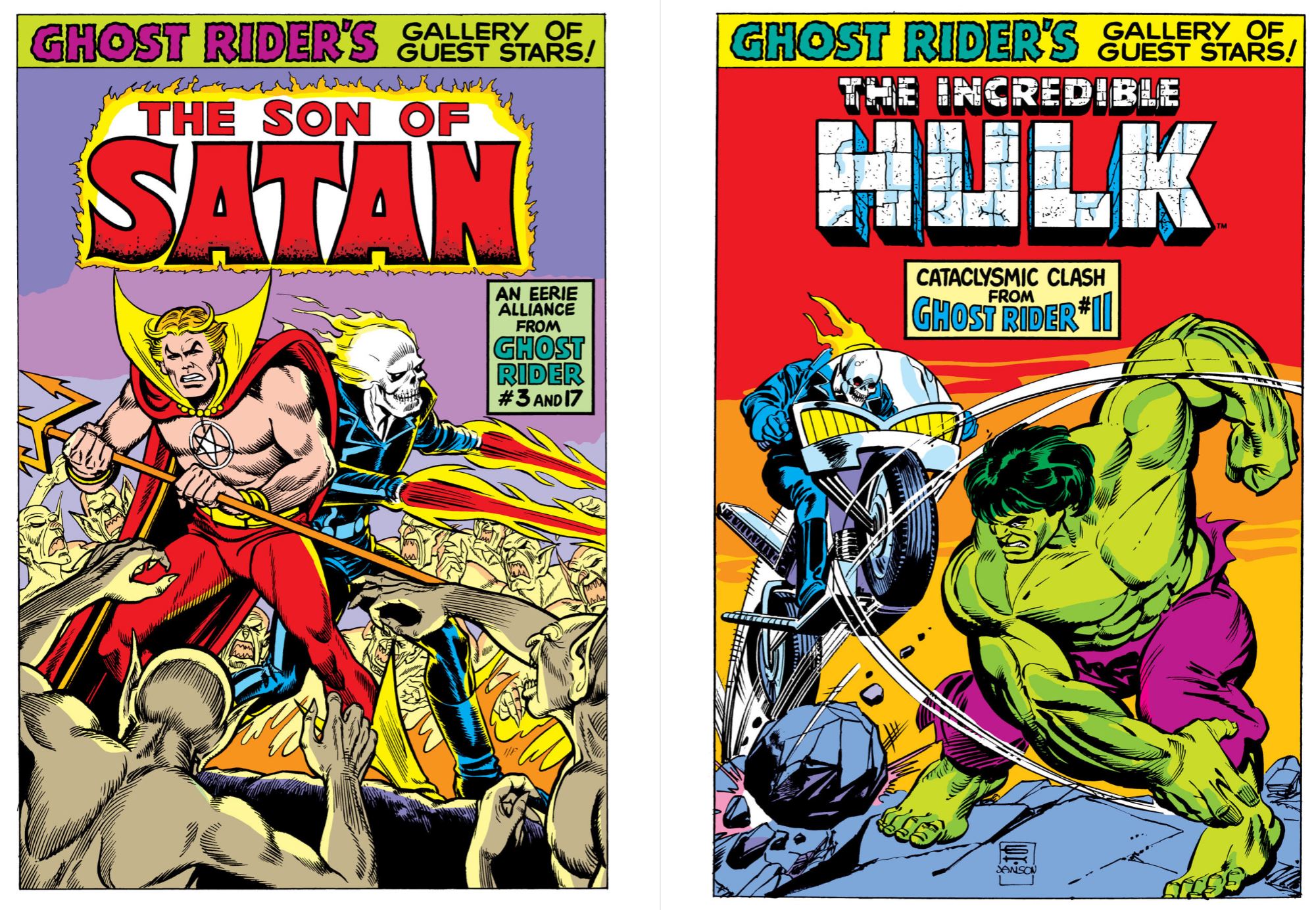
Inked by Mike Royer, The Demon #1 introduces a howling, leaping monstrosity (modelled after a 1939 sequence from Hal Foster’s Arthurian epic Prince Valiant) in ‘Unleash the One Who Waits’. This shocking force of un-nature battles beside its master Merlin as Camelot dies in flames, a cataclysmic casualty of the rapacious greed of sorceress Morgaine Le Fey. Out of that apocalyptic destruction, a man arises and wanders off into the mists of history…

In our contemporary world (or at least the last quarter of the 20th century) demonologist and paranormal investigator Jason Blood has a near-death experience with an aged collector of illicit arcana. This culminates in a hideous nightmare about a demonic being and the last stand of Camelot. He has no idea that Le Fey is still alive and has sinister plans for him…

And in distant Moldavia, strange things are stirring in crumbling Castle Branek, wherein lies hidden the lost Tomb of Merlin…

Blood is wealthy, reclusive and partially amnesiac, but one night he agrees to host a small dinner party, entertaining acquaintances Harry Mathews, psychic UN diplomat Randu Singh and his wife Gomali plus their flighty young friend Glenda Mark.

The soiree does not go well. Firstly, there is the painful small talk, and the sorcerous surveillance of Le Fey, but the real problems start when an animated stone giant arrives to “invite” Blood to visit Castle Branek. This shattering voyage leads to Merlin’s last resting place but just as Blood thinks he may find some answers to his enigmatic past, Le Fey pounces. Suddenly he starts to change, transforming into the horrific beast of his dreams…

Issue #2 – ‘My Tomb in Castle Branek!’ – opens with wary villagers observing a terrific battle between a yellow monster and Le Fey’s forces, but when the Demon is defeated and Blood arrested, only the telepathic influence of Randu back in America can help him. Le Fey is old, dying, and needs Merlin’s grimoire, the Eternity Book, to extend her life.

Thus, she manipulates Blood – who has existed for centuries, completely unaware that Merlin’s hellish attack dog the Demon Etrigan is chained inside him – to regain his memories and awaken the slumbering master mage. It looks like the last mistake she will ever make…

Kirby’s tried-&-trusted approach was always to pepper high concepts throughout blazing, breakneck action, and #3 was one of the most imaginative yet. ‘Reincarnators’ finds Blood back in the USA, aware at last of his tormented history, and with a small but devoted circle of friends. Adapting to a less lonely life, he soon encounters a cult able to physically regress people to a prior life… and use those time-lost beings to commit murder. The Demon #4-5 comprise one single exploit, wherein a simple witch and her macabre patron capture the reawakened, semi-divine Merlin. ‘The Creature from Beyond’ and ‘Merlin’s Word’s …Demon’s Wrath!’ introduce cute little monkey Kamara the Fear-Monster (later used with devastating effect by Alan Moore in Saga of the Swamp Thing #26-27) and features another startling “Kirby-Kritter”: Somnambula, the Dream-Beast

It seems odd in these blasé, anything goes modern times but The Demon was a deeply controversial book in its day – cited as providing the first post-Comics Code depiction of Hell, and one where problems were regularly solved with sudden, extreme violence. ‘The Howler!’ in issue #6 is a truly spooky yarn with Blood hunting a primal entity of rage and brutal terror that transforms victims into murderous lycanthropic killers, whilst #7 debuts a spiteful, malevolent young fugitive from a mystical otherplace.

‘A Witchboy!!’’ introduces Klarion and his cat-familiar Teekl – utterly evil little sociopaths in a time where all comic book politicians were honest, cops only shot to wound and “bad” kids were only misunderstood: thus, another Kirby first…

An extended epic, ‘Phantom of the Sewers’ skilfully combines movie and late-night TV horror motifs in the dark and tragic tale of actor Farley Fairfax, cursed by the witch he once spurned. Unfortunately, Glenda is the spitting image of the departed Galatea, and when, decades later, the demented thespian kidnaps her (in ‘Whatever Happened to Farley Fairfax?!!’) to raise the curse, it could only end in a flurry of destruction, death, consumed souls and ‘The Thing That Screams’…

In case you were wondering: the first musical adaption of The Phantom of the Opera (by Ken Hill) was in 1976, and the one you’re thinking of launched in 1986. The King was always ahead of the curve and subtly influential…

This 3-part thriller is followed by another moody, multi-part masterpiece (The Demon #11-13). ‘Baron von Evilstein’, ‘Rebirth of Evil!’ and ‘The Night of the Demon!’ comprise a powerful parable about worth and appearance, featuring the ultimate mad scientist and the tragic, misunderstood monster he so casually builds. It’s a truth that bears repeating: ugly doesn’t equal bad…

An opportunity to widen the horror-hero’s appeal came next in The Brave and the Bold #109: as Bob Haney & Jim Aparo unship superb supernatural thriller ‘Gotham Bay, Be My Grave!’ wherein the Caped Crusader and Kirby’s Kritter Etrigan the Demon fractiously unite to battle an unquiet spirit determined to avenge his own execution after nearly a century…

Despite the King’s best efforts The Demon was not a monster hit – unlike his science-fiction disaster drama Kamandi – and by #14 it’s clear the book was in its last days. Not because the sheer pace of imagination, excitement and passion diminished – far from it – but because the well-considered, mood-drenched stories were suddenly replaced by rocket-fast, eldritch romps populated with returning villains. First back was Klarion in ‘Return of the Witchboy!’ who creates a deadly doppelganger to replace Jason Blood and kill his friends in ‘The One Who Vanished!!’ (#14-15) before the series succumbed to irresistible economic forces with #16 (cover dated January 1974) in a climactic if hasty showdown with ‘Immortal Enemy’ Morgaine Le Fey…

Etrigan and cohort resurfaced in 1977 and B&B #137 (October) as Haney, John Calnan & Bob McLeod subjected Batman, Jason Blood’s friends and The Demon to war with resurrected Chinese wizard Shahn-Zi at ‘The Hour of the Serpent!’ before in a guest shot led to short revival. In Batman Family #17 (cover-dated April/May 1978), the Man-Bat serial saw Bob Rozakis & Mike Golden celebrate a happy event as the Chiropteran Crusader awaited the natal event of his firstborn child only to learn ‘There’s a Demon Born Every Minute!’ with devil babies infesting the maternity ward the hero welcomes the arrival of Etrigan (eventually) before teaming up to again thwart the diabolical schemes of malign Morgaine Le Fey.

Implicit invite accepted, Gotham resident The Demon took up residence in anthological blockbuster Detective Comics beginning with #482 (February/March 1979). Here Len Wein, Golden & Dick Giordano opened a tense quest for ‘The Eternity Book’ of Merlin. As Steve Ditko added his unique vision to the optics, the chase caught Etrigan clashing with mad mystic academic Baron Tyme in DC #483’s ‘Return to Castle Branek!’ before hurtling to a chaotic, cataclysmic conclusion in #484’s ‘Tyme Has No Secrets!’ and furious finish in #485’s ‘The Fatal Finale!’

The riotous revelries conclude with an often overlooked team-up. For Wonder Woman #280 (volume 1, June 1981), Gerry Conway, José Delbo & Dave Hunt detail how Air Force officers Diana Prince and Steve Trevor investigate the prestigious Delphi Foundation after demon Baal-Satyr abducts their friend Etta Candy. They uncover senatorial corruption and insidious infiltration by witchboy Klarion and use arcane connections to link up with Randu Singh, Blood and his infernal alter ego prior to a rescue raid on ‘The Castle Outside Time!’ (WW #281), enduring more hellish treatment prior to #282’s triumphant, resurgent ‘Return and Redemption’

With covers by Kirby, Royer, Tatjana Wood, Aparo, Rich Buckler, Ross Andru & Dick Giordano, this is a sublime slice of Right Place, Wrong Time entertainment: a wondrously economical collection every comics fan of today should have and cannot help but enjoy.
© 1972, 1973, 1977, 1978, 1979, 1981, 2026 DC Comics. All Rights Reserved.

Today comic strip master Sy Barry arrived in 1928, whilst Graham Nolan didn’t turn up until 1962 and much-missed Italian artist Massimiliano Frezzato (I custodi del Maser, Margot) in 1967.

We lost Barney Baxter cartoonist Frank Miller in 1949, and the amazing Arnold (Deadman, Doom Patrol, Guardians of the Galaxy) Drake in 2007 but could enjoy Treasure Chest comics from 1946 and Hank Ketchum’s (US) Dennis the Menace from 1951.

Footrot Flats Book 7


By Murray Ball (Onrin Books)
ISSN: 978-0864640222 (PB)

This book includes Discriminatory Content produced for comedic effect.

Once upon a time, Britain ran an Empire, and now we’ve found a more equitable station as just one of 56 (ish) independent nations in a Commonwealth. This is a fluid and ongoing situation so keep watching…

Some of those nations have always been handy with comebacks, rejoinders and cartoon salvos of their own, and whilst this particular item may not have the political venom of Murray Ball’s earlier works, it more than makes up for it by being the absolute best comedy strip the Commonwealth has ever produced (and yes, I’m even including our very own long lost and much missed The Perishers).

New Zealand’s greatest natural wonder and National Treasure was in fact a comic strip. Footrot Flats is one of the funniest ever created, designed as a practical antidote to idealistic pastoral fantasy and bucolic self-deception and concocted in 1975 by cartoonist and comics artist Murray Ball after returning to his New Zealand homeland from an extended work tour of the UK and other, lesser, climes.

The fantastical farm feature ran for a quarter of a century, appearing in newspapers on four continents until 1994 when Ball retired it, citing reasons as varied as the death of his own dog and the state of New Zealand politics. Such success naturally spawned a multitude of merchandising material such as strip compendia, calendars and special editions released regularly from 1978 onwards.

Once Ball officially ceased the daily feature he began periodically releasing books of all-new material until 2000, with a net yield of 27 collections of the daily strip, 8 volumes of Sunday pages dubbed “Weekenders”, 5 pocket books and ancillary publications such as “school kits” aimed at younger fans and their harried parents. There was a stage musical, a theme park and in 1986 a truly superb feature-length animated film. The Dog’s Tail Tale became New Zealand’s top-grossing film (and remained so until Peter Jackson started associating with Hobbits) – track it down online or petition the BBC to show it again; it’s been decades, for Pete’s sake…

The well-travelled, extremely gifted and deeply dedicated Mr. Ball had originally moved to England in the early 1960s, becoming a cartoonist for Punch (crafting Stanley the Palaeolithic Hero and All the King’s Comrades) as well as drawing numerous strips for DC Thompson and Fleetway and even concocting a regular political satire strip in Labour Weekly. After marrying, he returned to the Old Country and resettled in 1974 – but not to retire. Ball was busier than ever once he’d bought a small-holding on the North Island to farm in his “spare time”, which inevitably led to the strip under review here.

Taking the adage “write what you know” to startling, heartbreaking and occasionally stomach-turning heights, the peripatetic pencilpusher broke most of the laws of relativity to make time for these captivatingly insane episodes concerning the highs and lows – and most frequently “absurd” – of the rural entrepreneur as experienced by the earthily metaphoric Wallace Footrot Cadwallader: a proper bloke never too-far removed from mud, mayhem, ferocity and frustration…

Wal is a big, bluff farmer. He likes his grub; loves his sport – Rugby, Football (the Anzac sort, not the kiddie version Yanks call Soccer) Cricket, Golf(ish) and even hang-gliding; each in its proper season and at no other, since he just wants the easiest time a farmer’s life can offer…

Wal owns a small sheep farm (the eponymous Footrot Flats) honestly described as “400 acres of swamp between Ureweras and the Sea”…

With his chief – and only – hand Cooch Windgrass (a latter-day Francis of Assisi), and a verbose and avuncular sheepdog, Wal enjoys being his own boss – as much as the farm cat, goats, chickens, livestock and his auntie will let him.

Other persons of perennial interest include Wal’s fierce and prickly little niece Janice – known to all as Pongo – the aforementioned Aunt Dolly (AKA sternly staunch and starched Dolores Monrovia Godwit Footrot); smart-ass local lad Rangi Wiremu Waka Jones; Dolly’s pompous and pampered Corgi Prince Charles and Pew, a sadistic, inventive, obsessed and vengeful magpie who bears an unremitting grudge against Wal…

When not living in terror of the monumental moggy dubbed Horse, teasing the corpulent Corgi or panic-attacking himself in imagined competition with noble hunting hound Major, The Dog narrates and hosts the strip.

A cool, imaginative and overly sentimental know-all and blowhard, Dog is utterly devoted to his (for lack of a better term) Master – unless there’s food about, or Jess the sheepdog bitch is in heat again. However, the biggest and most terrifying scene-stealer was that fulsome feline Horse; a monstrous and imperturbable tomcat who lords it over every living thing in the district…

One of the powerful and persistent clichés of life is that to make people laugh one truly needs to experience tragedy and, having only recently lost two of my own four-footed studio-mates and constant companions, I can certainly empathise with the artist’s obvious manly distress as this otherwise magnificently hilarious collection is movingly dedicated to the uniquely charming real-world inspiration for the battered and bewhiskered juggernaut… which only makes the comedy capers contained within even more bittersweet and effective, beginning with the poem to his departed companion and the bluff, brisk photo tribute which opens proceedings.

Once again the funny businesses comes courtesy of the loquacious canine softie, taking time out from eking out his daily crusts (and oysters and biscuits and cake and lamb’s tails and scraps and chips and…) and alternately getting on with or annoying the sheep, cows, bull, goat, hogs, ducks, bugs, cats, horses and geese, as well as sucking up to the resolutely hostile wildlife and the decidedly odd humans his owner knows or is related to.

Dog – his given name is an embarrassing, closely and violently guarded secret – loves Wal but always tries to thwart him if the big bloke is trying to do unnecessarily necessary farm chores like chopping down trees, burning out patches of scrub, culling livestock, or trying to mate with the pooch’s main rival Darlene “Cheeky” Hobson, hairdresser-in-residence of the nearest town. As is also the case with the adoring comradeship of proper blokes, Dog is never happier than when embarrassing his mate in front of others, which explains those pages extracted from Wal’s old albums, showing the man to be in various humiliating baby shots and schoolboy scrapes…

Following on is the epic adventure ‘The Invasion of the Murphy Dogs’ – barbaric hounds from a neighbouring farm only afraid of one thing…

This extra-large (262 x 166 mm) landscape monochrome seventh volume came from Australian Publisher Onrin Books and continued the policy of dividing strips into approximately seasonal sequences, and after a few more all-original cartoons again opens with ‘Spring’ – the busiest season of the farmer’s year (apart from the other three) – and concentrates on Pew’s first attempts at avian homemaking, Dog’s libido, horny farmers and hussy-hairdressers, loopy lambs, wild pigs, killer eels and CRICKET, as well as an extended sequence in which Wal and the Dog become involved in the local school’s curriculum and cuisine…

Once the long hot ‘Summer’ settles in, bringing fun with chicken-shearing, busy bees, a plague of carnivorous Wekas, thistles, Horse’s softer side (!) and his war with Pongo and Aunt Dolly, Hare infestations, river-rafting, Irish Murphy’s Pigs (far worse than his dogs), Cheeky’s picnic charm-offensive and the growing closeness of Rangi and Pongo…

‘Autumn’ brings piglets, scrub-burning, the revenge of dispossessed magpies, amorous bovines, fun with artificial insemination, fence-lining and back country cattle, honey-harvesting, darts and rugby, a confused ram who’d rather pursue Dolly than associate with eager ewes and Horse’s crucial role in the war against the magpies…

As ‘Winter’ closes in, offering floods, the mixed messy joy of lambing season, mud, mad goats, whitebait fishing and footy, Wal unwisely agrees to take a class of schoolkids and their puritanical, prudish and priggish teacher on an eye-opening nature-lesson around Footrot Flats. Touched by the painful experience, the bluff cove then volunteers to coach the school’s sports and, after much humiliation, spends the rest of the book discovering how hard – and, for all us observers, funny – farming in a plaster cast can be…

As you’d expect, the comedy content is utterly, absolutely top-rate and the extended role played throughout by the surly star Horse all the more poignant…

Murray Ball – who died in 2017 – was one of those truly gifted individuals who could actually imbue a few lines on paper with the power of Shakespeare’s tragedy and the manic hilarity of jester geniuses like Tommy Cooper or the Marx Brothers. When combined with his sharp, incisive yet warmly human writing, the result was, is, and will remain sheer, irresistible magic.

In the early 1990s Titan Books published British editions of the first three volumes and German, Japanese, Chinese and American translations also exist, as well as the marvellous Australian compendia reviewed here – as ever the internet is your friend (although prices for individual volumes can make your eyes water, so if ever there was an argument for a comprehensive archival re-release, sheer profit would seem to be it)…

Dry, surreal and wonderfully self-deprecating, Footrot Flats always successfully wedded together sarcasm, satire, slapstick and strikingly apt surrealism in a perfect union of pathos and down to earth (and up to your eyebrows) fun that was and still is utterly addicting, exciting and just plain wonderful.

Plant the seeds for a lifetime of laughs by harvesting this or indeed any volume and you’ll soon see a bumper crop of fun irrespective of the weather or market forces.
© 1981-1982 Murray Ball. All Rights Reserved.

Today in 1900, Frederick Burr Opper’s Happy Hooligan first appeared, as did legendary Spanish comic TBO in 1917 and Mort Walker’s Boner’s Ark in 1968. Colour artist Lynn Varley was born today in 1958, and deaths include The Gambols creator Barry Appleby in 1996, Harvey Comics stalwart Sid Couchey in 2012 and Murray Ball in 2017.

Dargaud Presents Lieutenant Blueberry: Fort Navajo & Thunder in the West


By Charlier & Giraud, translated by Anthea Turner & Derek Hockridge (Egmont/ Methuen)
ISBN: 978-0-41605-370-8 and 978-0-41605-370-X (Album PBs)

This book includes Discriminatory Content produced in less enlightened times.

Franco-Belgian comics have enjoyed a decades-long love affair with the mythos of the American West and responded with some of the most beautiful and exciting graphic narratives in the history of the medium. They have, however, had less success creating characters that have gone on to be global household names. One that did has made that jump is Michel Charlier & Jean Giraud’s immortal bad-ass Blueberry.

Sadly, although many publishers have sporadically attempted to bring him to our thrill-starved shores, there’s no readily available complete catalogue (STILL!) of the quintessential antihero in the English language. Thus, this first of many forthcoming reviews with a brace of albums that are decades old, although they do still turn up in back-issue bins and in second hand or charity shops – if those still exist…

Jean-Michel Charlier was arguably Europe’s most important writer of realistic adventure strips.

Ever.

He was born in Liege, Belgium in 1924 and like so many groundbreaking comics creators, began as an artist, joining the staff of Le Journal de Spirou in September 1944, contributing aviation illustrations, and a strip about gliders co-produced with Flettner. In 1946 Charlier’s love affair with flying inspired him to co-create fighter-pilot strip Buck Danny, providing scripts for star turn artist Victor Hubinon. Before long – and on the advice of prestigious senior illustrator Jijé – Charlier was scripting full time and expanding his portfolio with many other series and serials.

In 1951 he co-created historical series Belles Histoires de l’Oncle Paul which afforded dozens of major artists their big break over the years, and supplemented the series with other strips such as Kim Devil (art Gérald Forton), Jean Valhardi and Marc Dacier (both with artist Paape) and Thierry le Chevalier (with Carlos Laffond), as well as popular scouting series La Patrouille des Castors, illustrated by MiTacq. In conjunction with Goscinny and Uderzo, Charlier founded the business and industry oriented commercial comics agency Edifrance after which Charlier and Goscinny edited the magazine Pistolin (1955-1958) before launching Pilote together in October 1959. For the soon to be legendary periodical Charlier created Tanguy and Laverdure (with Uderzo and later Jijé), Barbe-Rouge (with Hubinon) and Jacques le Gall (with MiTacq). In 1963, after Charlier visited the US he created arguably his most significant character – and Europe’s greatest Western comic – which would eventually be known as Blueberry.

In later years, the engaging antihero supported his own equally successful spin-off La Jeunesse de Blueberry (AKA Young Blueberry, illustrated by Colin Wilson) but Charlier never rested on his laurels, concocting further grittily realistic fare: historical biographies in collaboration with Hubinon (Surcouf, Jean Mermoz, and Tarawa) and Martial (Alain et Christine in Libre Junior, Rosine in Pistolin), Brice Bolt for Spirou with Aldoma Puig, Los Gringos with Victor de la Fuente and many more. He passed away in 1989.

Jean Henri Gaston Giraud was born in the suburbs of Paris on 8th May 1938. Raised by grandparents after his mother and father divorced in 1941, he began attending Institut des Arts Appliqués in 1955, becoming friends with Jean-Claude Mézières who, at 17, was already selling strips and illustrations to magazines such as Coeurs Valliants, Fripounet et Marisette and LJdS. Giraud apparently spent most of his college time drawing cowboy comics and left after a year.

In 1956 he travelled to Mexico, staying with his mother for eight months, before returning to France and a full-time career drawing comics, mostly Westerns such as Frank et Jeremie for Far West and King of the Buffalo, A Giant with the Hurons and others for Coeurs Valliants, all in a style based on French comics legend Joseph Gillain AKA Jijé. Between 1959 and 1960 Giraud spent his National Service in Algeria, working on military service magazine 5/5 Forces Françaises before returning to civilian life as Jijé’s assistant in 1961, working on the master’s long-running (1954-1977) western epic Jerry Spring. A year later, Giraud and Belgian Jean-Michel Charlier launched serial Fort Navajo in Pilote #210. All too soon the ensemble feature threw forth a unique icon in the shabby shape of disreputable, rebellious Lieutenant Mike Blueberry who took over as the star and evolved into one of the most popular European strip characters of all time…

In 1963-1964, Giraud produced numerous strips for satire periodical Hara-Kiri and, keen to distinguish and separate the material from his serious day job, first coined pen-name Moebius

He didn’t use it again until 1975 when he joined Bernard Farkas, Jean-Pierre Dionnet and Philippe Druillet – all devout science fiction fans – as founders of a revolution in narrative graphic arts created by Les Humanoides Associes. Their ground-breaking adult fantasy mag Métal Hurlant utterly enraptured the comics-buying public and Giraud again wanted to utilise a discreet creative persona for the lyrical, experimental, soul-searching material he was increasingly driven to produce: series such as The Airtight Garage, The Incal and mystical, dreamy flights of sheer fantasy contained in Arzach

To further separate his creative twins, Giraud worked his inks with a brush whilst the dedicated futurist Moebius rendered his lines with pens. After a truly stellar career which saw him become a household name, both Giraud & Moebius passed away today in 2012.

Fort Navajo and Thunder in the West were originally released in Britain in 1977 by Euro-publishing conglomerate Egmont/Methuen; the first of four full-colour albums which utterly failed to capture the attention of a comics-reading public besotted in equal amounts by Science Fiction in general, Star Wars in specific and new anthology 2000AD in the main. It’s a great shame: if the translated series had launched even a year earlier, I might not be whining about lack of familiarity with a genuine classic of genre comics…

The magic begins in Fort Navajo as clean-cut West Point graduate Lieutenant Craig takes a break from his dusty journey. The stagecoach stopover is just another town on the border between Arizona and New Mexico, but leads to involvement in a brutal battle sparked by a cheating cardsharp. After the gun-smoke clears the military paragon is appalled to discover that the quick-shooting cad at the centre of the chaos is a fellow officer stationed at his new posting.

Further outraged after Lieutenant Mike Blueberry inadvertently insults Craig’s father – a much-decorated general – the pair acrimoniously part company, but are soon reunited on the trail as the scoundrel’s horse dies even as Craig’s stagecoach encounters remnants of settlers slaughtered by marauding Indians…

Dying survivor Stanton informs them that his son has been taken by the Apache. However, Craig’s vow to hunt them down is overruled by Blueberry and the stage crew and passengers. Incensed, the young fool sets off in pursuit of the attackers on his own. Despite his better judgement, Blueberry trails him, cursing all the while. After using an arsenal of canny tricks to repeatedly save Craig from his suicidal notions of heroism, the pair are picked up by a relief column from Fort Navajo led by Major Bascom: a man who sincerely believes the old maxim that the only good Indians are dead ones…

Ignoring orders and the advice of his officers, Bascom decides to pursue the kidnappers and compounds that insubordination by attacking a group of women, children and old men. The massacre would have been total had not Blueberry “accidentally” given the wrong bugle calls and called the cavalry back too soon. Learning quickly, Lieutenant Craig covertly assists the rogue in calling back the troops…

In the aftermath, Bascom demonstrates how unstable he is by trying to execute Blueberry without convening a court martial and goes near-ballistic when Craig prevents him by quoting chapter and verse of the military code. Frustrated on all sides, Bascom can only turn the column back to Fort Navajo and plan revenge on the puppies that baulked his bloodlust. Commanding officer Colonel Dickson is a reasonable man, however, and refuses Bascom’s entreaties. He even tries to broker a “pow-wow” and new treaty with great chief Cochise for the return of the kidnapped boy and to forestall the war Bascom so fervently desires. It’s a valiant effort doomed to failure. The Apache were not responsible for the butchery and abduction at all. The true culprits were Mescaleros from across the Mexican border.

Tragically, when Dickson is bitten by a rattlesnake, Bascom seizes command and uses peace talks to capture Cochise and his delegation. In a flurry of action the aged warrior breaks free and escapes to his waiting armies: determined to make the two-faced soldiers pay for their treachery by bringing blood and vengeance to all of Nevada, Arizona and New Mexico…

The brooding tension resumes in Thunder in the West as affronted tribal chiefs fiercely debate how to liberate the rest of their hostage peace-delegation before their own war-hungry followers start a bloodbath no one can win. At Fort Navajo Blueberry & Craig ponder the coming dawn and are on hand when a tortured settler arrives to warn them every messenger sent for reinforcements has perished, and the savages have taken dozens of new prisoners. The weary soul then delivers an ultimatum and final offer from Cochise: safe passage for the soldiers to Tucson or Albuquerque in return for the captive Indians in their custody. Bascom, clearly beyond all reason, instead threatens to execute the prisoners…

Desperate Blueberry counters with a tactic to forestall the growing certainty of all-out war: attempting to cross the siege lines and reach Tucson for reinforcements. However, before he can start, a fellow officer – “half-breed” scout Lieutenant Crowe – acts precipitately and frees the Indians from the stockade. Whilst Bascom raves and blusters, Blueberry takes off anyway, undertaking an epic journey through hostile territory past hundreds of warriors hungry for blood, not just to call for more troops but to get snakebite antidote for Dickson so that he can end the escalating madness…

Capping peril-filled days of fight & flight, the battered cavalryman successfully crosses searing desert only to stumble into Mexican bandits who almost end his voyage and life… until he turns their own greed against them. Finally, Mike rides into Tucson, only to find the town all but deserted because thousands of Apaches have been approaching the outskirts of town for hours…

Frantically batting his way out of the trap, Mike wearily retraces his route to Fort Navajo. The citadel is deserted except for Crowe, who tells him that after a catastrophic battle he negotiated a truce allowing the white survivors a means of escape. Now the half-breed has a new plan. He and Blueberry will track down the Mescalero renegades who actually started the war by abducting young Stanton…

A feat of staggering bravado, the audacious plan succeeds, but as Blueberry outdistances the outraged renegades and thunders through the mountains with the rescued boy on his horse, he realises Crowe is missing and must go back for him…

To Be Continued…

Although perhaps a tad traditional (and painfully unreconstructed!) for modern tastes and nowhere near as visually or narratively sophisticated as it was to become, this epic opening to the saga of immortal Blueberry is an engaging all-action romp and stunning reaffirmation of the creative powers of Charlier & Giraud. This potent testimony to the undying appeal and inspiration of the Western genre deserves it place on graphic novel shelves and must be seen by all who love comics.
© 1965, 1966 Dargaud Editeur. Text these editions © 1977 by Egmont Publishing Limited, London. All rights reserved.
Today in 1877 was born political cartoonist turned strip star Norman E. Jennett (The Monkey Shines of Marseleen) and in 1935 Bill Holman’s epic strip Smokey Stover debuted.

It’s a remarkable day for departures however, with Tex Willer co-creator Aurelio Galleppini passing on in 1994, Stan Drake (Blondie, Heart of Juliet Jones, Kelly Green) in 1997, historian, founder of the San Francisco Academy of Comic Art & co-editor of The Smithsonian Collection of Newspaper Comics Bill Blackbeard in 2011, as well as historian Don Markstein (Don Markstein’s Toonopedia) and Giraud one year later.

Giant


By Mikaël, translated by Matt Maden (NBM)
ISBN: 978-1-68112-253-3 (HB) eISBN: 978-1-68112-254-0

As a purported land of promises and untapped opportunity, America has always fascinated storytellers – especially comics-creators – from the “Old World” of Europe: an inclination and interest that has frequently delivered potent and rewarding results. This continentally-published yarn by self-taught, multi-disciplined, multi award-winning French-born Québecois auteur Mikaël (Harlem, Junior l’Aventurier, Rapa Nui, Promise) was first released by Dargaud in 2018 as twinned albums before breaking into English via a monolithically oversized hardback (229 x 305mm) edition that got the entire story done-in-one.

Everything about this stylish Depression-era drama is big and powerfully mythic. In March 1932, with poverty wracking the nation and the world, and Herbert Hoover dreading the upcoming Presidential election, immigrants and natives flock to Manhattan and the bustling, dangerous construction site that will one day be Rockefeller Center. Casualties are high as we focus on the Irish contingent rushing daily into the skies to rivet and weld a concrete and steel colossus into New York City’s ever-changing skyline.

The story unfolds through the eyes of fresh-off-the-boat new recruit Dan Shackleton who joins the crew after the death of “high-steel” man Ryan Murphy. Dan is a garrulous, easy-going son-of-the-sod, but even he has difficulty befriending the taciturn, thoughtful, barely-human behemoth everyone calls Giant. A formidable, remarkable worker, Giant lives in a grubby flophouse and keeps to himself, but affable Dan persists and eventually the big man almost-imperceptibly thaws… at least enough that Shackleton becomes unwitting witness to a strange ritual…

Hiding a tragic secret that dates back to the recent Irish War of Independence, the Big Man is a solitary creature of fiercely controlled passions who keeps his every opinion to himself. A dutiful worker, Giant was given the task of informing Murphy’s widow in Ireland when he died. Instead, he began impersonating the dead man in a string of letters containing the bulk of his own carefully-hoarded wages and savings. Over months, a bizarre one-sided relationship develops that metastasizes into a full-blown crisis after the silent bruiser falls foul of organised crime. When the letters and money stop, Mary Ann Murphy and her children take ship for America to be reunited with her beloved husband. As the wounded colossus recuperates, he has no idea of the troubles that are heading his way…

Tapping into a wealth of powerful socially-crusading movies that immortalised pre-WWII America and packed with period detail and mythology, pungent political commentary, a broad cast of moving characters and timeless drama, this is a human-scaled tale playing out amongst mighty edifices – both human and architectural – with warmth, passion, humour and beguiling humanity.

Supplemented with an Introduction by Jean-Louis Tripp and a stunning selection of production sketches, covers and other art, Giant is a stunning saga of uncommon folk in perilous times and one no lover of grand stories could possibly resist.
© 2018 Dargaud-Benelux. © 2020 NBM for the English Translation. All rights reserved.
Most NBM books are also available in digital formats. For more information and other great reads go to NBM Publishing at nbmpub.com.

Today in 1923 American Blondie artist Paul Fung Jr was born, while Warrington’s finest author/animator/cartoonist/editor John Geering (Puss ‘n’ Boots, Smudge, Bananaman, Danger Mouse, Count Duckula) came along in 1941, and Rich Burchett (The Batman Adventures, Superman Adventures, Blackhawk) in 1952, but we lost Doc Attaboy, It’s Papa Who Pays! and Toots and Casper cartoonist Jimmy Murphy in 1965.

In 1974 the 11-year run of UK goggle fest Whoopee! began today.

No Surrender


By Constance Maud: adapted by Scarlett & Sophie Rickard (SelfMadeHero)
ISBN: 978-1-91422-406-5 (TPB/Digital edition)

Happy International women’s day 2026! And if you’re a guy who groaned. swore and reached for your huge, Massive THROBBING keyboard to type out those trollish insults someone else made up for you, HAPPY INTERNATIONAL WOMEN’S DAY 2026 AGAIN! SEE YOU NEXT YEAR?

Constance Elizabeth Maud (1857-1929) was a child of privilege: daughter of a celebrated English scholar and cleric. She was primarily educated in France and lived there or in Chelsea for most of her life. Between 1895 and 1924 she wrote numerous articles and 8 novels – of which No Surrender was the penultimate – and became a member of the 400-strong Women Writers Suffrage League. In 1908 she joined The Women’s Social and Political Union and The Women’s Freedom League: turning her writings to the needs of the cause. Her work subsequently appeared in many periodicals, especially magazines like the Suffragist movement’s newspaper Votes For Women.

In No Surrender (published in 1911 – and again in an annotated centenary edition released by publisher Persephone in 2011), Maud incorporated actual events with fictionalised analogues of many contemporary activists participating in the struggle to craft a history and playbook of the campaign for emancipation. The book became a rallying point and recruiting tool for the movement and was used to promote the soft end of the battle for equality. It inspired countless women (and presumable many male sympathisers) with a dramatised story of how the great and good would join with the humblest workers and unite to overcome…

Maud lived just long enough to see British women secure the right to vote: in 1918 with the Representation of the People Act – which enfranchised women over 30 years old – and at last witnessing universal female suffrage established in 1928’s Act, legislating that all Britons of 21 years or above could freely vote.

The main reason why No Surrender was such an effective weapon in the war to win the vote for all is that its propaganda and polemic were deftly disguised by readily accessible drama. Beginning in industrial hub Greyston, ‘The Mill’ tells how northern mill worker Jenny Clegg is fired up by the many injustices afflicting women’s lives: with cruelty, unfair taxation, financial neglect, legitimised maltreatment and a status of second-class citizens chaining every female to a man of the gutter…

Rebelling, she forsakes her crusading socialist love interest Joe Hopton – a successful prime mover in winning better lives and wages for male workers – and dedicates her life to winning those same rights and representation for women. Upper class Suffragist Mary O’Neill has a more refined but similarly intransigent family at ‘The Country House’, all decrying her passion for women’s suffrage. She and Jenny will become friends, allies and leading lights in the struggle, inspiring millions of women, converting men, embarrassing the authorities and challenging a society where even other women refuse to see a status quo threatened…

Both driven by ‘The Calling’, they and a growing army of allies will invade London and suffer police and legal suppression in ‘The Courtyard’ and face ‘The Magistrate’ but never stray from their course. Whether testing tactics in ‘The Routes To Battle’ or challenging their detractors through heated debate on ‘The Cart’, the socially-distanced allies never stop their work, and gradually make converts even amongst the stratified intelligentsia who enjoy the closeted luxuries of ‘The Weekend Cottage’

Just like a soap opera, the story sees multiple characters interact on many levels but underpinning it all is a roster of actual protest events woven into the plot, such as ambushing off-duty cabinet ministers in ‘The Church’ and then infiltrating ‘The Dinner Party’ to reinforce their message.

The darkest and most notorious moments of the cause are also featured, as Clegg, O’Neill and other noted activists of every class endure imprisonment, abuse and medical torture – but each according to their own social rank and standing – in ‘The Crushed Butterfly’, ‘The Prison’ and the deeply distressing culmination of ‘The Punishment’. Always, efforts to disunite and separate rich from poor, inherently virtuous from tawdry and lowborn, fails as their core principle – that they are all women together – utterly eludes the smug, hectoring, insensate elitist male oppressors; prejudiced and scared working men and the Anti-Suffrage Women’s groups populated with ladies who know and defend their privileged positions in the world…

Ultimately, Jenny and Joe are united in the cause and Mary makes her own converts in ‘The Homecoming’ before the story ends with a proud rallying of all in the march to inevitable universal enfranchisement and victory in ‘The Standard is Raised’ – a rousing graphic tour de force with illustrator Sophie Rickard crafting a stunning multi-page fold-out any art fan would cry to see…

Maud’s tale was ostensibly a romance and account of families in crisis with a thinly disguised moral message like any Dickens or Thomas Hardy novel. She explored and contrasted the lives of poor working folk with gentry and aristocracy, but also scrupulously catalogued the added travails and insecurities of working women. At this time women had been successively deprived of most financial and civil rights and privileges. They had to pay taxes but enjoyed no representation under the law; could not be legal guardians of their own children or property and, if married, could not divorce whilst their husbands could. The men could also beat them, but only with cudgels of judicially-mandated size…

At the end of this hefty and deliciously substantial graphic novel there’s a chart showing when – and how incrementally – nations of the world instituted female enfranchisement, and an Afterword by adapting creators Scarlett & Sophie Rickard (This Slavery, Mann’s Best Friend, A Blow Borne Quietly, The Ragged Trousered Philanthropists), naming names and offering factual provenance for incidents and characters enriching the narrative. It also declares why – in the current environment where a citizen’s right to dissent and protest is being deviously and criminally whittled away – the principles of organised resistance and role and consequences of righteous civil disobedience must be stridently defended…

Fair minded, honestly and powerfully expressing the views of all – including those opposing universal enfranchisement (and restoration of previously-removed social and civil rights) – Maud’s words are reinvigorated here with the authorities, capitalists, police and judiciary all given a fair hearing – and generally convicted out of their own mouths. Of particular interest to modern readers will be the opinions of women who didn’t want a vote and the low workingmen who were generally the most passionate and violent opponents of change and equality…

Powerful, enraging, engaging and even occasionally funny, this never-more-timely tale of the force of the disenfranchised with their backs to the wall and ready to fight is supremely readable and should be compulsory viewing for all – as long as we don’t force anyone to…
© 2022 SelfMadeHero. Text © 2022 Sophie Rickard. Artwork © 2022 Scarlett Rickard. All rights reserved.
Today in 1880 Wonder Woman co-creator Harry G. Peter was born.

In 1907 Dutch comics master Charles Boost (Broeder Bastiaan, Knor de Pot, Neppie Tuun, Jan de Zeehond, Robinson Crusoë) was born, as was Mad magazine cartoonist Jack Rickard in 1922, Sal Amendola in 1948, and Eric Powell in 1975.

In 1936 The Sunday Post featured Dudley D. WatkinsThe Broons & Oor Wullie for the first time, and in 1975 iconic UK comic Battle Picture Weekly launched the first of its 644 issues, and just kept on doing it until January 1988.

Batman: The Doom That Came to Gotham


By Mike Mignola, Richard Pace, Troy Nixey, Dennis Janke & Dave Stewart (DC Comics) ISBN: 978-1-4012-5806-1 (TPB/Digital edition)
This book includes Discriminatory Content produced for dramatic effect.

The origins of the Dark Knight are so well-known now that it’s simple to twist and tweak them to suit almost any tale. It doesn’t hurt that the character has a universal recognition factor that holds up in almost any imaginary scenario…

Released in 2015, available in trade paperback and digital formats and collecting a 3-issue Elseworlds miniseries (from November 2000 – January 2001), The Doom That Came to Gotham was written by horror mood-meister Mike Mignola (Hellboy; duh!) and Richard Pace (Negative Burn; Ashes; Starman; Terror Inc.; Imaginary Fiends), limned by Troy Nixey (Harley Quinn; Trout; Only the End of the World Again; The Matrix Comics), inker Dennis Janke & colourist Dave Stewart.

In case you came in late: During the 1990s, DC regrouped to rebrand its frequent dalliances with alternate reality scenarios under the copious and broad umbrella of a separate imprint. The Elseworlds banner and credo declared heroes would be taken out of their usual settings and put into strange places and times – some that have existed, or might have existed, and others that can’t, couldn’t or shouldn’t exist…

No doubts here, however, as the tale deftly takes us back to Roaring Twenties America, dishing out a daring dose of pulp fiction plumb centre of the ghastly spine-chilling mythos of Clark Ashton Smith, H.P. Lovecraft and their darkly-dementing contemporaries…

It’s 1928 and orphaned Bruce Wayne returns to Gotham City two decades after his parents were murdered by a maniac. He’s been roving the world, and recently uncovered the fate of long-lost Professor Cobblepot’s fabled Antarctic expedition. That jaunt resulted in a clash with a naked madman who talked to penguins and a large slab of ice with a creature inside it: a thing that never evolved on this world…

By the time he and his close associates Alfred, Dick, Jason and the rest have docked in his bleakly daunting home town, they have all had more than enough of the vile dreams the thing in the hold has generated…

There are more surprises when he reaches his long-shuttered mansion: a dead man who somehow speaks and a mysterious stranger named Jason Blood who claims he’s been sent to deliver a dire warning. Turning into an actual demon, the visitor warns that to save Gotham, Bruce must cut out its heart. Although shocked, Bruce is ready to act, and dons the bizarre outfit that makes him look like a human bat…

…And thus begins a skilful, macabre pastiche of classic noir horror traditions, as the desperate, driven mystery man haunts the alleys and byways of the city, testing corrupt cops, self-serving officials and outright villains – all with names most comics fans will recognise – uncovering a long-suppressed, centuries-old secret, even as literal Things From Beyond Human Comprehension and the borders of time and space congregate.

Can even a heroic Bat Man triumph against such odds and if so, at what cost…

Taking its title from H.P. Lovecraft’s 1920 novella The Doom That Came to Sarnath and inspired by August Derleth’s 1945 novel The Lurker at the Threshold (written from Lovecraft’s unfinished plot notes), the eldritch epic is complemented by a full cover gallery by Mignola and a hefty sketches & design section featuring pencilled pages by Pace (originally slated to illustrate the tale) and layouts by Nixey.

Bold, compelling, potently stylish and chilling in all the right places, The Doom That Came to Gotham is a supernatural romp to delight and impress: once read and never forgotten. Yes there’s an animated movie released in 2023, but truly that’s just gilding. This dark lily is what you must have…
2000, 2001, 2015 DC Comics. All Rights Reserved.
Today in 1920 Belgian wonder Eddy Paape (Emmanuel, Valhardi, Luc Orient, Johnny Congo) was born, with Gray Morrow (Man-Thing, Tarzan, Buck Rogers, Flash Gordon) arriving in 1934 and Alan Weiss (Warlock, Batman: the Blue, the Grey and the Bat, Steelgrip Starkey) in 1948. In 1949 Godfather of British Comics Pat Mills was born and in 1967 mangaka marvel Ai Yazaw, (Nana, I’m No Angel, Neighborhood Story, Paradise Kiss) arrived. Two years later Cully Hamner (Down, Green Lantern: Mosaic, Blue Beetle, Red) came along, but it was 1978 before Australian horror star Ben Templesmith (30 Days of Night) turned up.