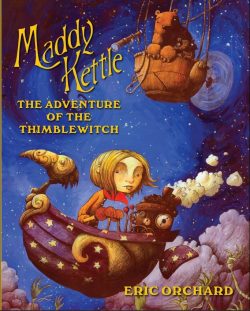
Maddie Kettle – The Adventure of the Thimblewitch


By Eric Orchard (Top Shelf Productions)
ISBN: 978-1-60309-072-8 (TPB)
When this fantastic tale – the debut graphic novel of Canadian cartoonist and illustrator Eric Orchard – was released a few years ago, it created quite a stir among critics and comics fans, won a Spectrum Award and made us all hungry for more. We’re still waiting for a sequel but the power and imagination of the story hasn’t diminished one whit…

Maddy Kettle is eleven years old and used to work in her parents’ bookshop in Dustcloud Gap, but now she’s a girl with a mission. Unfortunately, that mission keeps changing on the fly…

With her pet floating Spadefoot Toad Ralph, she takes a steam train across the wild country, seeking the spider goblins who attacked their store and seeking the mysterious Thimblewitch who turned mum and dad into mole rats…

When more goblins attack the train, Maddie is lost in the desert, but soon finds new allies in cloud cartographers Harry the bear and musical raccoon Silvio. They offer her a ride in their moon-gas powered balloon, but refuse to believe her story. After all, the Thimblewitch used to be the protector of the cloudscape and these days doesn’t even use magic anymore…

After many adventures, and encounters with strange creatures such as vampire bats and unlikely warrior Splike, Maddy finally has her showdown with the Thimblewitch, only to learn a few amazing truths and set out on even more perilous quests…

Visually spectacular, hyper-imaginative and mordantly moody in the manner of Ghormenghast and the darker passages of Baum’s Oz books, this is a deliciously dark fable with a wonderfully memorable girl hero, showing that intelligence, determination, creativity, courage and a willingness to admit mistakes are also super powers.

Available in paperback and eBook formats, this is a fabulous romp no kid of any vintage could resist.
© and ™ 2014 Eric Orchard. All Rights Reserved.

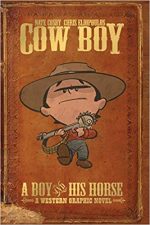
Cow Boy – a Boy and His Horse


By Nate Cosby & Chris Eliopoulos, with Roger Langridge, Brian Clevinger, Scott Wegener, Mitch Gerads, Colleen Coover, Mike Maihack & various (Archaia/Boom Entertainment)
ISBN: 978-1 936393-67-1 (HB Archaia) 978-1-60886-419-5 (PB Boom Entertainment)

The Wild West is a place of myth, mayhem, pure ideals, shining imagery and utter paradox. This superb all-ages yarn proves all that and still hides a surprise or two, so get it for your young ‘uns and read it too. It comes in hard and soft cover and even over the wireless telegraph of that there digital book stuff…

Boyd Linney is an honest bounty hunter with a unique specialty. He’s ten years old and only tracks his own kin: owlhoots, sharpers and scoundrels, every one of ’em…

Delivered with delicious irony and captivating cartoon visuals, this fistful of rootin’ tootin’ yarns comes courtesy of writer Nate Cosby (Pigs, Jim Henson’s The Storyteller) and illustrator/colourist/letterer Chris Eliopoulos (Franklin Richards, Misery Loves Sherman), kicking every trope and meme of the ancient west sharply in the ankles (Boyd’s smart, tough and ornery, but really, really short) as the kid on a mission busts his dad out of jail just to bring him to justice.

On the ride to the marshal’s office the hard-bitten kid learns his early life was even harder and more debased than he ever reckoned. It does not ease his temperament as he goes after double dealing, saloon owner Zeke Linney, but he never liked his oldest brother, anyway…

The hardest part was tracking down his Granpappy…

Augmenting the dry, witty whimsy and gritty daftness are a succession of short vignettes by invited artisans of similar mien, beginning with multi-talented Roger Langridge (The Muppet Show, Fred the Clown, Thor: the Mighty Avenger, Popeye) who briefly details the downfall of ‘The Man with No Underpants’, after which Brian Clevinger, Scott Wegener & Mitch Gerards (Atomic Robo), silently detail destructive progress in ‘The Wireless West’.

Colleen Coover (Small Favors, Banana Sunday, X-Men First Class, Jim Henson’s The Storyteller) outlines a portentous proposal in ‘Yellow Rose & Black Billy’ before Mike Maihack (Cleopatra in Space) reveals another day in the explosive life of one of the oddest pairings in gunfighting annals, concluding that ‘A Penguin Never Misses’ before the sagebrush homage halts with a terse prose epigram by Cosby – ‘Boyd’s Wagon: A Cow Boy Short Story’…

Hugely enjoyable and profoundly disrespectful, this western delight is a supreme treat for aficionados of the timeless genre and anybody deeply in need of a hearty horse laugh…
Cow Boy is ™ and © 2012 Nate Cosby and Chris Eliopoulos. All rights reserved.

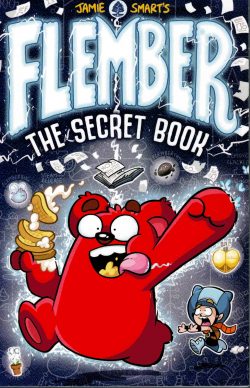
Flember – the Secret Book (Advance galley proof copy)


By Jaimie Smart (David Fickling Books)
ISBN: 978-1-910989-46-3 (PB Illustrated novel)

There are precious few perks in the high stakes, cut & thrust world of writing about graphic novels and books, but one is getting to see great stories before you all do and then acting all smugly know-it-all and blasé about how good they are, as if I’m in with the In Crowd.

This review of Flember is based on a proof copy and I’ll probably review the proper book too when it comes out in Early October. It’s that good…

Unlike writer/artist Jamie Smart’s previous outings (Fish Head Steve!, Space Raoul, Bunny vs. Monkey, Looshkin – the Adventures of the Maddest Cat in the World!!, Corporate Skull and bunches of brilliant strips for The Beano, Dandy and others), this is an illustrated novel, not comics strips, but that only means he’s really good at the wordy stuff too, and even so his dynamic cartoons, diagrams and maps are lavished all over the text and act as an integral part of the storytelling.

Here’s a little digression that might assuage any confusions I’ve inadvertently caused…

The old demarcations – whether in format or content – between comics and books are all but gone these days but once the items of printing were reckoned as different as chalk and chuck wagons.

From the pre-print era of illustrated manuscripts, books always possessed a capacity (time, manpower and budgets permitting) to include images in the text. As the book trade evolved, pictures were generally phased out of cheaper, mass-market editions because they required costly, time-consuming extra effort by skilled technicians. Most artists and illustrators wanted payment for their efforts too, so volumes with pictures were regarded as extra special, most often crafted for children, students or aficionados of textbooks…

Comics strips grew out of cartoon images, beginning as static illustrations accompanied by blocks of printed text before gradually developing into pictorial sequences with narration, dialogue and sound effects incorporated into the actual design. Print procedures and physical strictures of manual typesetting often dictated that pictures (printed on the pages or added as separate plates) frequently appeared nowhere near the snippets of text they illumined).

These days digital print processes are speedy, efficient and flexible, and many creative bright sparks have realised that they can combine all these tangential disciplines into a potent synthesis.

Gosh, wasn’t that lecture dull?

What I’m saying is that these days, the immediacy of comics, the enchantment of illustrated images, the power of well-designed infographics and the mesmeric tone and mood of well-written prose can all be employed simultaneously to create tales of overwhelming entertainment. Flember – The Secret Book does it with aplomb, imagination, dexterity and sundry other fruit and veg you’ve never heard of. That’s an inside joke until you read the book…

But what’s it about, Win?

I’m giving little away but suffice to say that somewhere far away the island of Flember houses a rather rural and backwards facing community who live in a little walled village called Eden. The citizens are an odd bunch, set in the old traditional ways and they don’t particularly like inventors anymore.

Young Dev Everdew doesn’t really fit in. His brother is a snarky would-be leader of the local Guild and Mum doesn’t like to cause a fuss. Dad used to be Mayor but he’s gone now…

Life on the island depends on a seemingly-mystical force called Flember: an energising life force that animates the trees, living creatures and crops and even people. Did I mention that Dev’s addicted to inventing? He is, and all his contraptions always go wrong and cause the fuss previously mentioned.

The boy can’t stop himself, though, and just knows his devices can make life better for everybody. Despite the pleadings, help and advice of his young pals, Dev keeps making things and accidentally hurting people, but the situation gets completely out of hand after he builds a giant bear that absorbs all the Flember and comes shockingly alive. Sadly, that puts the little genius on the trail of a colossal secret underpinning everything and teaches him the consequences of rash actions…

Fast-paced, astoundingly inventive, raucously hilarious, deeply moving even while sagely exploring how carefree childishness grows into empathy and responsibility, this is a marvellous romp and an ideal example of words and pictures acting in harmony… almost like a well-oiled machine.

Just to be clear here though; never oil books or any digital reading device, ok? Just use them to acquaint yourself with tales as good as this one…
Text and illustrations © Jamie Smart 2019. All Rights Reserved.

Flember – The Secret Book is scheduled for release on October 3rd 2019 and is available for pre-order now. It’s a perfect item if you’re already stuck for options about Great Big Gift-Giving Season…

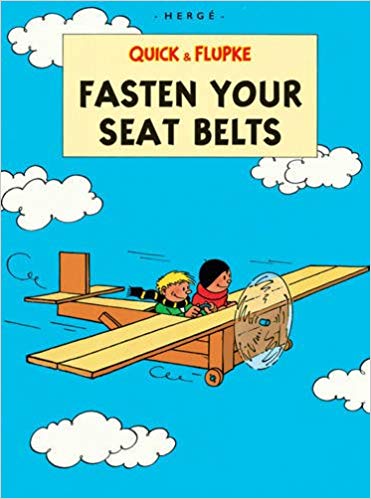
Quick & Flupke: Fasten Your Seatbelts


By Hergé, translated by David Radzinowicz (Egmont UK)
ISBN: 978-1-4052-4742-9 (PB Album)

Georges Prosper Remi – known to all as Hergé – created a genuine masterpiece of graphic literature with his tales of a plucky boy reporter and his entourage of iconic associates. Singly, and later with assistants including Edgar P. Jacobs, Bob de Moor and other supreme stylists of the select Hergé Studio, he crafted 23 splendid volumes (originally produced in brief instalments for newspaper periodicals) which have since grown beyond their popular culture roots and attained the status of High Art.

Globally renowned for these magnificent Tintin adventures, Hergé also did much to return comics to the arena of mass entertainment, a position largely lost after the advent of television, video-recording and computer games.

However, the bold boy and his opinionated dog were by no means his only creation. The author was a prodigious jobbing cartoonist in the years before the junior journalist finally assured him immortality and he generated a minor pantheon of other topical strips and features such as Tim the Squirrel in the Far West, The Amiable Mr. Mops, Tom and Millie and Popol Out West.

Among the best of the rest were the tales of Jo and Zette Legrand and their chimpanzee Jocko in much the same wholesome action vein as Tintinand the episodic, all-ages shenanigans of a pair of mischievous ragamuffins in pre-WWII Belgium.

In 2005 Egmont translated three escapades of Jo, Zette and Jocko into English (although there are more just sitting out there, all foreign and unreadable by potential fans too lazy to learn French or any of a dozen other civilised languages…) so in 2009 the publisher tried again with two collections of the Master’s second most successful creation: Quick et Flupke, gamins de Bruxelles.

These rambunctiously subversive, trouble-making working-class rapscallions and scallywags were precursors and thematic contemporaries of such beloved British boy acts as The Bash Street Kids, Winker Watson, Roger the Dodger et. al., and for more than a decade – January 1930 to May 1940 – rivalled the utterly irresistible Tintin in popularity and almost certainly acted as a rehearsal room for all the humorous graphic and slapstick elements which became so much a part of future Tintin tales.

Ten years ago Egmont had a brief stab at reviving the likely lads and it was only the general public’s deplorable lack of taste and good sense which stopped the kids from taking off again…

On leaving school in 1925, Hergé began working for Catholic newspaper Le XXe Siécle, falling under the influence of its Svengali-like editor Abbot Norbert Wallez. Remi produced his first strip series The Adventures of Totor for Boy Scouts of Belgium monthly magazine the following year, and by 1928 was in charge of producing the paper’s children’s weekly supplement Le Petit Vingtiéme.

He was unhappily illustrating The Adventures of Flup, Nénesse, Poussette and Cochonette, written by the staff sports reporter, when Abbot Wallez asked him to create a new adventure series. Perhaps a young reporter who would travel the world, doing good whilst displaying solid Catholic values and virtues?

Having recently discovered the word balloon in imported newspaper strips, Remi decided to incorporate the innovation into his own work. He created a strip both modern and action-packed – and heavily anti-communist. From January 10th 1929, weekly episodes of Tintin in the Land of the Soviets appeared in Le Petit Vingtiéme, running until May 8th 1930.

Around this time the cartoonist also began crafting weekly 2-page gag strips starring a pair of working-class rascals on the streets of Brussels. They played pranks, got into good-natured trouble and even ventured into the heady realms of slapstick and surrealism: the sort of antics any reader of Dennis the Menace (ours, not the Americans’) would find fascinatingly familiar.

Originally seen in black-&-white in Le Petit Vingtiéme, the lads larked about for over a decade until the war and mounting pressures of producing Tintin meant they had to go. They were only rediscovered in 1985 and their collected adventures ran to a dozen best-selling albums… so there’s still plenty left out there to be translated into English…

Fasten Your Seat Belts contains a superbly riotous celebration of boyish high spirits, beginning with hose-pipe pranks in ‘The Big Clean’, before a rare good deed leads to strife with ‘A Poor Defenceless Woman’ and a day ‘At the Seaside’ results in another round of boyish fisticuffs after which their arch-foe the policeman succumbs to the irresistible temptations of a handy catapult in ‘Everyone Gets a Turn’.

Quick – the tall one in the beret – then learns to his cost ‘How Music Calms the Nerves’ and discovers the drawback of ‘Pacifism’, whilst portly Flupke tries tennis and finds himself far from ‘Unbeatable’…

‘Advertising’ then proves to be a dangerous game and an annoying insect meets its end in ‘Instructions for Use’, before ‘Quick the Clock Repairer’, proves to be something of an overstatement and ‘Football’ becomes just another reason for the pals to fall out…

Although unwelcome ‘At the Car Showroom’, some Eskimos (you’re going to have to suspend some of your modern sensitivities every now and again, remember) seem happy to share in ‘A Weird Story’ whist Hergé himself turns up in ‘A Serious Turn of Events’, even as the kids are disastrously ‘At Odds’ over a funny smell in their proximity.

Then, ‘Quick the Music Lover’ cleverly deals with an annoying neighbour, Flupke goes Christmas skiing in ‘That’s How It Is’ and another good turn goes bad in ‘All Innocence’ before a sibling spat gets sorted through ‘Children’s Rights’ and Quick cocks up cuisine even with ‘The Recipe’…

A handy ‘Yo-yo’ causes traffic chaos and a milk run goes spectacularly awry in a buttery ‘Metamorphosis’ before this magical blast from the past concludes with cleverly appealing ‘Tale Without a Tail’.

Regrettably hard to find now (and past time for a digital edition if not paper reissue), this book and the simple, perfect gags it contains show another side to the supreme artistry of Hergé – and no lover of comics can consider life complete without a well-thumbed copy of their own…
© Hergé – Exclusivity Editions Casterman 1991. All Rights Reserved. English translation © 2009 Egmont UK Limited. All rights reserved.

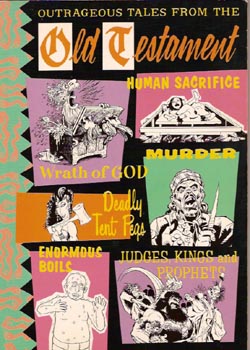
Outrageous Tales from the Old Testament


By Arthur Ranson, Donald Rooum, Dave Gibbons, Alan Moore, Hunt Emerson, Neil Gaiman, Mike Matthews, Julie Hollings, Peter Rigg, Graham Higgins, Steve Gibson, Dave McKean, Kim Deitch, Carol Bennett, Brian Bolland & various (Knockabout)
ISBN: 978-0-86166-054-4

Although I couldn’t be happier with the state of the graphic novel market these days, I do miss the early days when production costs were high and canny pioneer publishers resorted to producing anthologies of short tales.

Knockabout Comics has been providing cutting edge and controversial cartoon triumphs since 1975 and although this cracking all-star oddment is actually out of print – like far too many of the graphic novels and collections I recommend – it remains one of their most potent and engaging releases.

However, if you’re a devout Christian you be best advised to just jump to the next review.

Originally released in 1987, it features a varied band of British creators adapting – with tongues firmly in cheeks – a selection of Biblical episodes, and the results are mordantly earnest, deeply bitter and darkly funny.

‘Creation’ is the preserve of supreme stylistic realist Arthur Ranson, whilst affable anarchist legend Donald Rooum explores Eden in ‘Gandalf’s Garden’ and Dave Gibbons puts some decidedly modernistic top-spin to the saga of ‘Sodom and Gomorrah’.

Alan Moore & Hunt Emerson examine ‘Leviticus’ (that would be the one with all those pesky Commandments) after which Neil Gaiman tackles ‘The Book of Judges’ accompanied by Mike Matthews (both the introduction and ‘The Tribe of Benjamin’); with Julie Hollings (for ‘Jael and Sisera’); Peter Rigg (‘Jephthah and His Daughter’); Graham Higgins (‘Samson’) and Steve Gibson (‘Journey to Bethlehem’). He even finds time to produce ‘The Prophet Who Came to Dinner’ (From the Book of Kings) with seminal long-time collaborator Dave McKean.

Closing the slim oversized (290 x204 mm) monochrome tome are underground cartooning icon Kim Deitch with ‘The Story of Job’, ‘Daddy Dear’ (from Ecclesiastes) adapted by Carol Bennett & Julie Hollings and the intensely uncompromising ‘A Miracle of Elisha’ (also from the Book of Kings) by the magnificent Brian Bolland.

Powerful and memorable, these interpretations won’t win any praise from Christian Fundamentalists, but they are fierce, subtle and scholarly examinations of the Old Testament realised by passionate creators with something to say and an unholy desire to instruct. As free-thinking adults you owe it to yourself to read these stories, but only in the spirit in which they were created.
© 1987 Knockabout Publications and the Artists and Writers. All Rights Reserved.

Addams and Evil


By Charles Addams Methuen)
ISBN: 978-0-413-55370-1

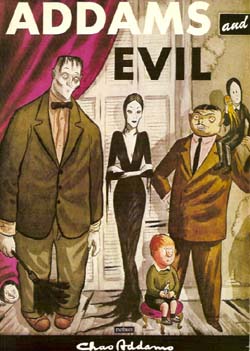
Charles Samuel Addams (1912 – 1988) was a cartoonist and distant descendant of two American Presidents (John Adams and John Quincy Adams) who made his real life as extraordinary as his dark, mordantly funny drawings.

Born into a successful family in Westfield, New Jersey, the precocious, prankish, constantly drawing child was educated at the town High School, Colgate University, the University of Pennsylvania, and New York City’s Grand Central School of Art, producing cartoons and illustrations for a raft of institutional publications.

In 1932 he became a designer for True Detective magazine – retouching photos of corpses – and soon after began selling drawings to The New Yorker. In 1937 he began creating the macabre ghoulish family portraits that become his signature creation. During WWII he served with Signal Corps Photographic Center, devising animated training films for the military.

Whether he artfully manufactured his biography to enhance his value to feature writers or was genuinely a warped and wickedly wacky individual is irrelevant (although it makes for great reading:- especially the stuff about his second wife – and, as always, the internet awaits the siren call of your search engine…).

What is important is that in all the years he drew and painted those creepily sardonic, gruesome gags and illustrations for The New Yorker, Colliers, TV Guide and others, he managed to enthral his audience with a devilish mind and a soft, gentle approach that made him a household name long before television turned his characters into a hit and generated a juvenile craze for monsters and grotesques that lasts to this day. That eminence was only magnified once the big screen iterations debuted…

This stunningly enticing volume is a reissue of his second collection of cartoons, first published in 1947, and semi-occasionally since then. It’s still readily available if you’ve a big bank book, but the time is ripe for a definitive collected edition, or better yet a reissue of his entire canon (eleven volumes of drawings and a biography) either in print or digitally.

Should you not be as familiar with his actual cartoons as with their big and small screen descendants you really owe it to yourself to see the uncensored brilliance of one of America’s greatest humourists. It’s dead funny…
© 1940-1947 the New Yorker Magazine, Inc. In Canada © 1947 Charles Addams.

Captain America Marvel Masterworks volume 8

By Steve Englehart, Roy Thomas, Tony Isabella, Mike Friedrich, Sal Buscema, Alan Weiss & various (Marvel)
ISBN: 978-0-7851-9929-8 (HB)

Created by Joe Simon & Jack Kirby in an era of frantic patriotic fervour, Captain America was a bombastic, dynamic and highly visible response to the horrors of Nazism and the threat of Liberty’s loss.

He faded away during the post-war reconstruction but briefly reappeared after the Korean War: a harder, darker sentinel ferreting out monsters, subversives and the “commies” who lurked under every brave American kid’s bed. Then he vanished once more until the burgeoning Marvel Age resurrected him just in time for the turbulent, culturally divisive 1960s.

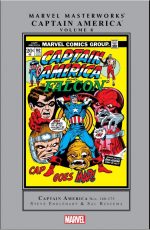
By the time of the tales gathered in this eighth Masterworks volume (available in luxurious hardback and accessible eBook formats and re-presenting issues #160-175 of Captain America and the Falcon from April 1973 to July 1974), the once convinced and confirmed Sentinel of Liberty had become an uncomfortable symbol of a divided nation, but was looking to make the best of things and carve himself a new place in the Land of the Free. Real world events were about to put paid to that American dream…

Into an already turbulent mix of racial and gender inequality played out against standard Fights ‘n’ Tights villainy came creeping overtones of corruption and betrayal of ideals that were fuelled by shocking real-world events…

Following an informative behind-the-scenes reminiscence from scripter Steve Englehart in his Introduction, the action opens here with ‘Enter: Solarr!’ (illustrated by Sal Buscema &Frank McLaughlin), offering an old-fashioned clash with a super-powered maniac as the main attraction.

However, the real meat is the start of twin sub-plots that would shape the next half-dozen adventures, as the Star-Spangled Avenger’s newfound super-strength increasingly makes partner-in-crimefighting Sam – the Falcon – Wilson feel like a junior and inferior hindrance, even as Steve Roger’s long-time romantic interest Sharon Carter leaves him without a word of explanation…

Inked by John Verpoorten, Captain America and the Falcon #161 ramps up the tension between Steve and Sam as the heroes search for Sharon in ‘…If he Loseth His Soul!’, and find a connection to the girl Cap loved and lost in World War II in a deadly psycho-drama overseen by criminal shrink Dr. Faustus. This culminates one month later in a singular lesson in extreme therapy which only proves ‘This Way Lies Madness!’

‘Beware of Serpents!’ heralded the return of super snakes Viper and Eel, who combine with the Cobra to form a vicious but ultimately unsuccessful Serpent Squad to attack the heroes. Defeated former ad-exec Viper then vengefully begins a media manipulation campaign to destroy the Sentinel of Liberty with the “Big Lie”, fake news weapons and the worst tactics of Madison Avenue. Although the instigator quickly falls, his scheme rumbles on with slow, inexorable and dire consequences…

Issue #164 offers a stunningly scary episode illustrated by Alan Lee Weiss, introducing faux-coquette mad scientist Deadly Nightshade: a ‘Queen of the Werewolves!’ who infects Falcon with her chemical lycanthropy as an audition to enlist in the fearsome forces of one of the planet’s greatest menaces…

The full horror of the situation is only revealed when ‘The Yellow Claw Strikes’ (Englehart, Buscema & McLaughlin); renewing a campaign of terror begun in the 1950s, but this time attacking his former Chinese Communist sponsors and the USA indiscriminately. Giant bugs, deadly slave assassins and reanimated mummies are bad enough, but when the Arcane Immortal’s formidable mind-control dupes Cap into almost beating S.H.I.E.L.D. supremo Nick Fury to death during the ‘Night of the Lurking Dead!’, the blistering final battle results in further tragedy when an old ally perishes in the Frank Giacoia inked ‘Ashes to Ashes’…

One of the Star-Spangled Avengers most durable foes sort-of resurfaces in tense, action-heavy romp ‘…And a Phoenix Shall Arise!’ (scripted by Roy Thomas & Tony Isabella and inked by John Tartaglione & George Roussos) before Viper’s long-laid plans begin to finally bear bitter fruit in #169’s ‘When a Legend Dies!’ (with additional scripting from Mike Friedrich).

As anti-Captain America TV spots make people doubt the honesty and sanity of the nation’s greatest hero, the Falcon and his “Black Power” activist girlfriend Leila Taylor depart for the super-scientific African nation of Wakanda in search of increased powers, leaving Cap to battle third-rate villain the Tumbler.

In the heat of combat the Avenger seemingly goes too far and the thug dies…

‘J’Accuse!’ (Englehart, Friedrich, Buscema & Vince Colletta) sees Cap beaten and arrested by too-good-to-be-true neophyte crusader Moonstone, whilst in Africa Leila is kidnapped by exiled Harlem hood Stone-Face: far from home and hungry for some familiar foxy ghetto friendship…

‘Bust-Out!’ in #171 finds Cap forcibly sprung from jail by a mysterious pack of “supporters” as Black Panther and the newly-flying Falcon crush Stone-Face preparatory to a quick dash back to America and a reunion with the beleaguered and tarnished American icon.

‘Believe it or Not: The Banshee!’ opens with Captain America and the Falcon beaten by – but narrowly escaping – Moonstone and his obscurely occluded masters, after which the hard-luck heroes trace a lead to Nashville, encounter the fugitive mutant Master of Sound and stumble into a clandestine pogrom on American soil.

For long months mutants have been disappearing unnoticed, but now the last remaining X-MenCyclops, Marvel Girl and Professor Charles Xavier – have tracked them down, only to discover that Captain America’s problems also stem from ‘The Sins of the Secret Empire!’, whose ultimate goal is the conquest of the USA…

Eluding capture by S.H.I.E.L.D., Steve and Sam infiltrate the evil Empire, only to be exposed and confined in ‘It’s Always Darkest!’ before abruptly turning the tables and saving the day in #175’s ‘…Before the Dawn!’, wherein the vile grand plan is revealed, the mutants liberated and the culprits captured.

In a shocking final scene, the ultimate instigator is unmasked and horrifically dispatched within the White House itself…

At this time America was a nation reeling from a loss of unity, solidarity and perspective as a result of a torrent of shattering blows such as losing the Vietnam war, political scandals like Watergate and the (partial) exposure of President Nixon’s lies and crimes.

The general loss of idealism and painful public revelations that politicians are generally unpleasant – and even possibly ruthless, wicked exploiters – kicked the props out of most Americans who had an incomprehensibly rosy view of their leaders, so a conspiracy that reached into the halls and backrooms of government was extremely controversial yet oddly attractive in those distant, simpler days…

Unable to process the betrayal of all he has seen, the Star-Spangled Avenger cannot accept that this battle has any winner: a feeling that will change his life forever – in the next volume…

Any retrospective or historical re-reading is going to turn up a few cringe-worthy moments, but these tales of matchless courage and indomitable heroism are fast-paced, action-packed and still carry a knockout conceptual punch. Here Captain America was finally discovering his proper place in a new era and would once more become unmissable, controversial comicbook reading, as we shall see when I get around to reviewing the next volume…
© 1973, 1974, 2016 Marvel Characters, Inc. All rights reserved.

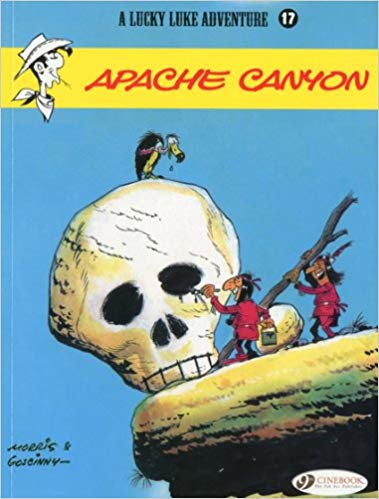
Lucky Luke Volume 17 – Apache Canyon


By Morris & Goscinny, translated by Frederick W. Nolan (Cinebook)
ISBN: 978-1-905460-92-2 (PB Album)

Doughty yet dependable cowboy champion Lucky Luke is a rangy, even-tempered do-gooder able to “draw faster than his own shadow”. He amiably roams the fabulously mythic Old West, enjoying light-hearted adventures on his rather sarcastic wonder-horse Jolly Jumper. The taciturn nomad regularly interacts with a host of historical and legendary figures as well as even odder folk in tales drawn from key themes of classic cowboy films – as well as some uniquely European ideas…

His unceasing exploits over 7 decades have made him one of the best-selling comic characters in Europe – if not the world – generating upwards of 85 individual albums and sales totalling in excess of 300 million in 30 languages… so far. That renown has led to a mountain of spin-off albums and toys, computer games, animated cartoons, a plethora of TV shows and live-action movies and even commemorative exhibitions. No theme park yet but who knows when…?

The brainchild of Belgian animator, illustrator and cartoonist Maurice de Bévère (“Morris”) and first seen in Le Journal de Spirou‘s seasonal Annual L’Almanach Spirou 1947, Luke sprang to laconic life in 1946, before inevitably ambling into his first weekly adventure ‘Arizona 1880’ on December 7th 1946.

Working solo until 1955, Morris produced nine albums of affectionate sagebrush spoofery before teaming with old pal and fellow trans-American tourist Rene Goscinny. When he became regular wordsmith Luke attained dizzying, legendary, heights starting with Des rails sur la Prairie (Rails on the Prairie). This began serialisation in Spirou on August 25th 1955.

In 1967, the six-gun straight-shooter switched sides, joining Goscinny’s own magazine Pilote with La Diligence (The Stagecoach). Goscinny co-created 45 albums with Morris before his untimely death, from whence Morris soldiered on both singly and with fresh collaborators.

Morris died in 2001, having drawn fully 70 adventures, plus numerous sidebar sagebrush sagas crafted with Achdé, Laurent Gerra, Benacquista & Pennac, Xavier Fauche, Jean Léturgie, Jacques Pessis and others, all taking their own shot at the venerable vigilante…

Lucky Luke has history in Britain too, having first pseudonymously amused and enthralled young readers during the late 1950s, syndicated to weekly anthology Film Fun. He later rode back into comics-town in 1967 for comedy paper Giggle, where he used the nom de plume Buck Bingo.

In each of these venues – as well as many attempts to follow the English-language album successes of Tintin and Asterix – Luke laconically puffed on a trademark roll-up cigarette which hung insouciantly and almost permanently from his lip. However, in 1983 Morris – amidst pained howls and muted mutterings of “political correctness gone mad” – deftly substituted a piece of straw for the much-travelled dog-end, thereby garnering for himself an official tip of the hat from the World Health Organization.

For historical veracity, that tatty dog-end has been assiduously restored for this particular tale and indeed all of Cinebook’s fare – at least on interior pages…

The Canterbury-based publisher is the most successful in bringing Lucky Luke to our shores and shelves, and it’s clearly no big deal for today’s readership as we’re at 73 translated books and still going strong.

Canyon Apache was Morris & Goscinny’s 28th collaboration, originally serialised in 1971 before becoming the 37th album release: a grimly hilarious saga of obsession and intransigence, fuelled by sworn enemies driven to extremes by past wrongs. As such, it’s also one of the most daftly slapstick and wonderfully ludicrous tales of the canon, spoofing particularly on the venerated, semi-sacrosanct cavalry trilogy of John Ford (that’s Fort Apache, She Wore a Yellow Ribbon and Rio Grande to you. You really should see more old movies…).

Far, far out west stubborn Colonel O’Nollan and his worthy Irish lads of the US Cavalry man Fort Canyon. They’re caught in a constant spiral of attack and counterattack with renegade chief Patronimo, who leads his band of Kimikuris on raids into America from a base across the border in Mexico. It’s a war of perpetual attrition nobody can win but they will not listen to reason…

Most of the region is peaceful and the great chiefs have foresworn warfare, but the intensely personal duel between O’Nollan – whose son was abducted by raiders decades previously – and Patronimo threatens that détente even as it endlessly escalates in scale. The tit-for-tat attacks are constant and even endanger relations with the Mexican government.

Into that hostile mess shuffles laconic scout Mr Smith, soon exposed as an exceedingly put-upon Lucky Luke: despatched by Washington to end the strife at all costs. Sadly, the vendetta is too deeply ingrained. Even talking with the noble, misunderstood Kimikuris and especially their white-hating Medicine Man proves to be an uphill struggle.

His temper fraying, the hero tries joining the Indians, infiltrating Mexico and reasoning with the Colonel, but is branded a traitor and barely escapes execution by both sides before stumbling into a bizarre solution…

Tense as that sounds, this tale is an epic farce, heavy on satire and absurdity, with a brilliant sub-plot and plenty of weird twists to keeps readers guessing… and giggling.

Apache Canyon is wildly entertaining: another perfect all-ages confection by unparalleled comics masters, affording an enticing glimpse into a unique genre for today’s readers who might well have missed the romantic allure of an all-pervasive Wild West that never was…
© Dargaud Editeur Paris 1971 by Goscinny & Morris. © Lucky Comics.

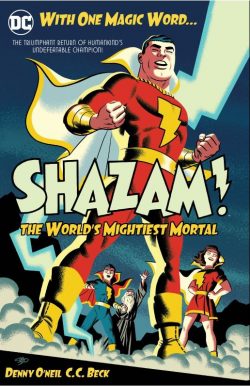
Shazam! The World’s Mightiest Mortal volume 1


By Denny O’Neil, Elliot S. Maggin, E. Nelson Bridwell, C.C. Beck, Kurt Schaffenberger, Dave Cockrum, Bob Oksner, Dick Giordano & various (DC)
ISBN: 978-1-4012-8839-6 (HB)

One of the most venerated and loved characters in American comics was created by Bill Parker and Charles Clarence Beck as part of the wave of opportunistic creativity that followed the successful launch of Superman in 1938. Although there were many similarities in the early years, the Fawcett character moved swiftly and solidly into the area of light entertainment and even broad comedy, whilst as the 1940s progressed the Man of Steel increasingly left whimsy behind in favour of action and drama.

Homeless orphan and good kid Billy Batson is selected by an ancient wizard to battle injustice and subsequently granted the powers of six gods and mythical heroes. By speaking aloud the wizard’s name – itself an acronym for the six patrons Solomon, Hercules, Atlas, Zeus, Achilles and Mercury – he can transform from scrawny boy to brawny (adult) hero Captain Marvel.

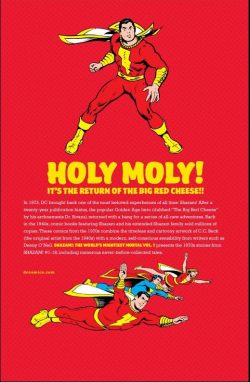
At the height of his popularity Captain Marvel hugely outsold Superman and was even published twice a month, but as the decade progressed and tastes changed sales slowed, and an infamous court case begun in 1941 by National Comics citing copyright infringement was settled. Like many other superheroes the “Big Red Cheese” disappeared, becoming a fond memory for older fans. A big syndication success, he was missed all over the world…

In Britain, where an English reprint line had run for many years, creator/publisher Mick Anglo had an avid audience and no product, and transformed Captain Marvel into atomic age hero Marvelman, continuing to thrill readers into the early 1960s.

As America lived through another superhero boom-and-bust, the 1970s dawned with a shrinking industry and wide variety of comics genres servicing a base that was increasingly founded on collectors and fans rather than casual or impulse buyers. National – now DC – Comics needed sales and were prepared to look for them in unusual places.

After the court settlement with Fawcett in 1953 they had secured the rights to Captain Marvel and his spin-off Family. Now and though the name itself had been taken up by Marvel Comics (via a circuitous and quirky robotic character published by Carl Burgos and M.F. Publications in 1967), the publishing monolith decided to tap into that discriminating if aging fanbase.

In 1973, riding a wave of national nostalgia on TV and in the movies, DC brought back the entire beloved cast of the Captain Marvel crew in their own kinder, weirder universe. To circumvent the intellectual property clash, they named the new title Shazam! (‘With One Magic Word…’): the memorable trigger phrase used by myriad Marvels to transform to and from mortal form and a word that had already entered the American language due to the success of the franchise the first time around.

Now the latest star of film and TV is back in print in this stylish Hardback and digital compendium, collecting the first 18 issues (spanning February 1973 – May/June1975) of a glorious revival. It’s by rapturous and informative introduction With One Magic Word… by Jerry Ordway, writer and artist of latter day reinvention The Power of Shazam!

Back in 1972, the company tapped editor Julie Schwartz – instigator of the Silver Age of Comics and the go-to guy for hero revivals – to steer the project. He teamed top scripter Denny O’Neil with original artist C.C. Beck for the initial re-introductory story. ‘…In the Beginning…’

Delivered in grand old self-referential style, the engaging yarn reprised the classic origin after which ‘The World’s Wickedest Plan’ relates how the entire cast were trapped in a timeless “Suspendium” trap for twenty years after their arch-foes the Sivana family (Doctor Thaddeus Bodog Sivana and his vile but equally brilliant children Georgia and Thaddeus Jr.) attacked them all at a public awards ceremony.

Two decades later, they were all freed, baddies included, to restart their lives. That first issue also included a text-feature/score-card by devotee E. Nelson Bridwell to bring new and old readers up to speed, and ‘Shazam & Son: The Story of the World’s Mightiest Mortal’ is included here to again bring new readers up to super speed.

With issue #2, a format of two stories per issue was instigated. ‘The Astonishing Arch Enemy’ heralds the return of super-intelligent Venusian worm Mr. Mind and a running gag about how strange people in the 1970s are. Written by Elliot Maggin, the second tale introduces eerily irresistible, scrupulously honest Sunny Sparkle who lives awash in the generosity of others who can’t resist giving stuff to ‘The Nicest Guy in the World’. Once again, the fun is counterpointed by a Bridwell text feature listing the many heroes sharing the powers of the gods in ‘Shazam and Family’.

For #3, O’Neil wrote ‘A Switch in Time’ wherein scrofulous underage magician Shagg Nasté disrupts the puny-boy-to-super-adult gimmick for young Billy, whilst Maggin & Beck craft a wry spy tale of daffy inventors in ‘The Wizard of Phonograph Hill’. Next issue evil Captain Marvel analogue ‘Ibac the Cursed’ disastrously re-emerged, courtesy of O’Neil & Beck, with Maggin again opting for a human-interest yarn in ‘The Mirrors that Predicted the Future’.

In the ’70s economics dictated costs in comics be cut whenever possible so there was really no choice about filling pages with reprints, which had been an addition from the start. A huge benefit, however, was that those stories were unknown to the general readership and of a very high standard. Although not included in this volume, I mention them simply because they kept the page-count of most issues to around fifteen pages of new material per month (Shazam! was actually published eight times a year so the savings were even greater). Hopefully DC will get around to reprinting the Fawcett stories too – perhaps in the same format as their excellent Batman, Wonder Woman and Superman Golden Age collections…

Maggin took the lead slot with #5’s ‘The Man who Wasn’t’ (a potentially offensive tale of leprechauns with a rather heavy-handed racial stereotype as the magical foe) as well as a back-up which sees the return of Sunny Sparkle. Here, his obnoxious cousin Rowdy briefly becomes ‘The World’s Toughest Guy!’

O’Neil returned in #6, as did Sivana in time bending tale ‘Better Late than Never!’ whilst Maggin reintroduced a 1940’s boy-genius in the charming ‘Dexter Knox and his Electric Grandmother’. The following issue, loquacious science experiment Tawky Tawny took centre-stage in O’Neil’s ‘The Troubles of the Talking Tiger’ before uber-fan and wonderful guy E. Nelson Bridwell finally got to write a script with the delightfully zany and clever ‘What’s in a Name? Doomsday!

Shazam! #8 was the first of many 100-Page Spectaculars stuffed with great Golden Age reprints, but as such it’s only represented here by the C.C. Beck cover, whilst normal-sized #9 provides us with O’Neil’s ‘Worms of the World Unite’ – another clash with scurrilous dictator Mr. Mind – and the first solo adventure of Captain Marvel Jr. in over twenty years.

‘The Mystery of the Missing Newsstand! is an action-heavy romp and fine tribute to the works of early Fawcett mainstay (and Flash Gordon maestro Mac Raboy); written by Maggin and illustrated by young Dave Cockrum. It is truly lovely to look upon. A third original story completes the issue and Maggin & Beck clearly had heaps of fun on ‘The Day Captain Marvel Went Ape!’ when a mystic jewel deflects Shazam’s magic lightning into a chimpanzee.

Beck, notoriously opinionated, had been unhappy with the stories he was being asked to draw and left the series with #10. He was a supremely understated draughtsman with a canny eye for caricature and gag-timing, and his departure took away some of that indefinable charm. Many other gifted artists continued the strip but a certain kind of magic left the strip with him. He wasn’t even the lead or cover artist on the issue.

Bob Oksner & Vince Colletta illustrated Maggin’s mediocre flying saucer yarn ‘Invasion of the Salad Men’, but happily, Mary Marvel’s solo debut ‘The Thanksgiving Thieves’ is a much better effort with Bridwell’s script handled by Oksner alone (if ever an artist should ink himself it was this superb stylist). Beck bowed out with Bridwell’s ‘The Prize Catch of the Year’ which featured the reappearance of formidable octogenarian villainess Aunt Minerva – one of the most innovative rogues of the Golden Age and here again on the prowl for a new husband…

Issue #11 kicks off with ‘The World’s Mightiest Dessert!’ (Bridwell, Oksner & Colletta) wherein a new sweet treat goes berserk, but the real gem of this comic is ‘The Incredible Cape-Man’. Written by Maggin it saw the long-awaited return of Kurt Schaffenberger, a brilliant and highly accomplished artist who, by his own admission, considered drawing Captain Marvel the best of all possible jobs.

He began his career at Fawcett before moving to DC, ACG and others when the company folded. When the Big Red Cheese returned, his resumption of the art-chores was inevitable. In this tale of a mail man who becomes a Mystery Man, the art positively glows with joyous enthusiasm. This end-of-year issue then concludes with a good old-fashioned Yule yarn featuring the entire extended cast in Maggin & Schaffenberger’s ‘The Year Without a Christmas!’, with our heroes again clashing with the wicked Sivana clan to save the season.

The 12th issue was another 100-Page Spectacular but included 3 all-new stories: modern-day Midas menace ‘The Golden Plague’ (Bridwell & Oksner); another glorious Captain Marvel Jr. adventure ‘The Longest Block in the World!’ (Maggin & Dick Giordano), and cheerfully daft Kung Fu spoof ‘Mighty Master of the Martial Arts!’ by Maggin, Oksner & Colletta. Also included are clip-art features detailing the boy hero’s heroic heritage in ‘Billy Batson’s Family Album’ and his divine sponsors in ‘The Shazam Gods and Heroes’.

The next six issues retained this same format, combining around 20 pages of new material with a superb selection of Fawcett reprints, but once the character was picked up for a children’s TV show, the comic was again slimmed down to a cheaper standard format and increased publication frequency.

Maggin and Oksner led in #13 as ‘The Case of the Charming Crook!’ revealing how a felon manages to synthesise “essence of Sunny Sparkle” to make his crimes easier. This is followed by clip-art historical features ‘The Seven Deadly Enemies of Man!’, ‘Friends of the Shazam Family!’ and ‘Mary Marvel’s Fashion Parade!’ before Oksner returns to familiar ground as an illustrator of beautiful women in Bridwell’s Mary Marvel solo strip ‘The Haunted Clubhouse!’

The entire Marvel Family was needed in the next issue when O’Neil & Schaffenberger crafted ‘The Evil Return of the Monster Society’: a splendid action thriller serving to remind us that the Original Captain Marvel Shazam was never just about charm and comedy…

You know what fans are like: they had been arguing for decades – and still do – over who is best (for which read “who would win if they fought?”) out of Superman or Captain Marvel, so it’s amazing that a face off meeting took as long as it did to materialise.

However, despite the cover, the lead strip in #15 wasn’t it. Instead fans had to be content with a notoriously familiar guest villain when Mr. Mind and ‘Captain Marvel Meets… Lex Luthor!?!’: the work of O’Neil, Oksner and veteran inker (Phillip) Tex Blaisdell, who had worked un-credited on many DC strips over the decades, as well as drawing Little Orphan Annie, On Stage and many others.

Bridwell & Schaffenberger closed the issue with an excellent crime-caper in ‘The Man in the Paper Armor!’, preceded by clip features ‘Shazam’s Scientists and Inventors’ and ‘A Tour of American Cities with Captain Marvel!’

Schaffenberger kicked off #16 with Maggin’s ‘The Man who Stole Justice’; a taut thriller involving the incarnation of the one of the iconic Seven Deadly Enemies of Man (Sins to you and me) and a key part of the legend since the strip’s inception. Bridwell & Oksner utilised another Deadly Enemy in Mary Marvel solo story ‘The Green-Eyed Monster!’, but aliens and a Hippie musician were the antagonists in the feature-length tale leading off #17, the last 100-page issue. ‘The Pied Un-Piper’ is a tongue-in-cheek thriller from O’Neil & Schaffenberger, whereas a slightly more modern tone tinged the whimsy in #18’s ‘The Celebrated Talking Frog of Blackstone Forest!’ (Maggin & Oksner) and Bridwell & Schaffenberger’s CM Jr. clash with Sivana Jr. in ‘The Coin-Operated Caper’, albeit not enough to deaden the charm…

DC pulled out all the stops with their new baby. Production ace Jack Adler teamed with illustrators such as Nick Cardy, Murphy Anderson, Beck and Oksner to create a string of amazing photo/drawn art covers. The experiments ended with 7, but even so, it gave the title a unique presence on newsstands of the time and you can also enjoy them here.

Although controversial amongst older fans, the 1970’s incarnation of Captain Marvel has a tremendous amount going for it. Gloriously free of angst and agony, beautifully, simply illustrated, and wittily scripted, these are clever, funny, wholesome adventures that would appeal to any child and positively promote a love of graphic narrative. There’s a horrible dearth of exuberant fun superhero adventure these days so isn’t it great that there’s somewhere to go for a little light action again?
© 1973, 1974, 1975, 2019 DC Comics. All Rights Reserved.

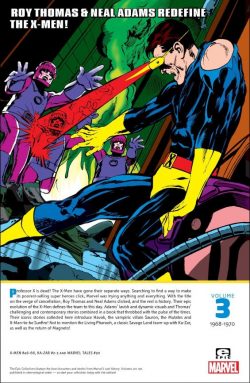
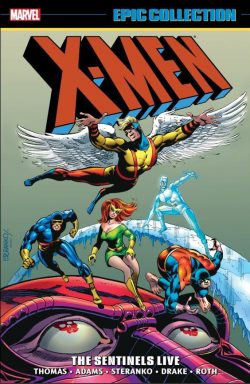
X-Men Epic Collection volume 3 1968-1970: The Sentinels Live


By Roy Thomas, Arnold Drake, Gary Friedrich, Dennis O’Neil, Linda Fite, Jerry Siegel, Neal Adams, Jim Steranko, Werner Roth, Don Heck, George Tuska, Barry Windsor-Smith, Sal Buscema & various (Marvel)
ISBN: 978-1-3029-1275-8 (TPB)

X-Men was never one of young Marvel’s top titles but it did secure a devout and dedicated following, with the frantic, freakish energy of Jack Kirby’s heroic dynamism comfortably transiting into the slick, sleek prettiness of Werner Roth as the blunt tension of hunted outsider kids settled into a pastiche of the college and school scenarios so familiar to the students who were the series’ main audience.

The core team still consisted of tragic Scott Summers/Cyclops, telepath and mind-reader Jean Grey/Marvel Girl, wealthy golden boy Warren Worthington/Angel, ebullient Bobby Drake/Iceman, and erudite, brutish genius Henry McCoy/Beast in training with Professor Charles Xavier, a wheelchair-bound (and temporarily deceased) telepath dedicated to brokering peace and integration between the masses of humanity and the gradually emerging race of mutant Homo Superior.

However, by the time of this massive full-colour paperback and digital tome (collecting issues #46-66 from July 1968 to February 1970) of the turbulent teens’ original series, plus material from Ka-Zar volume 1 #2-3 and Marvel Tales #31, despite some of the most impressive and influential stories and art of the decade, the writing was definitely on the wall for Marvel’s misunderstood mutants…

Following the supposed death of their mentor and founder the team was in for even greater heartache when ‘The End of the X-Men!’ (by Gary Friedrich, Werner Roth, Don Heck & John Tartaglione) was declared in issue #46, with the reading of Charles Xavier’s will.

Former government liaison FBI Agent Duncan reappeared and ordered the team to split-up: monitoring different parts of the country for mutant activity just as the unstoppable Juggernaut turned up once more…

The series was at that time offering ‘The Origins of the Uncanny X-Men’ in the back of each issue and Iceman’s past concludes here with ‘…And Then There were Two!’ (Friedrich, George Tuska & Tartaglione) as Cyclops rescues the kid from a human mob and recruits him to Xavier’s school…

Friedrich was joined by Arnold Drake to script Beast and Iceman’s adventure ‘The Warlock Wears Three Faces!’ wherein the ancient mutant once called Merlin once more re-branded himself: this time as the psychedelic guru Maha Yogi, whilst Drake, Roth & John Verpoorten explained the cool kid’s powers in the info feature ‘I, the Iceman.’

Drake penned the Cyclops and Marvel Girl tale ‘Beware Computo, Commander of the Robot Hive’; a fast-paced thriller with a surprise guest villain, whilst ‘Yours Truly the Beast’ wrong-footed everybody by explaining his powers before actually telling his origin epic.

X-Men #49 gave a tantalising taste of things to come with a startling and stylish Jim Steranko cover, behind which Drake, Heck, Roth & Tartaglione revealed ‘Who Dares Defy… the Demi-Men?’: nominally an Angel story, but one which reunited the team to confront the assembled mutant hordes of Mesmero and Iceman’s new girlfriend – the daughter of Magneto! This shocker was supplemented by Drake Roth & Verpoorten’s natal chapter ‘A Beast is Born.’

Drake, Steranko & Tartaglione reached astounding heights with the magnificent ‘City of Mutants’ in #50: a visual tour de force that remains as spectacular now it did in 1968, but which was actually surpassed by Magneto’s return as ‘The Devil had a Daughter’ in #51 before the saga concluded in a disappointing ‘Twilight of the Mutants!’

Don’t misunderstand me, however: This isn’t a bad story, but after two issues of Steranko in his creative prime, nobody could satisfactorily end this tale, and I pity Heck & Roth for having to try.

The pertinent Beast origin chapters in those issues were ‘This Boy, This Bombshell’; ‘The Lure of the Beast-Nappers!’ and ‘The Crimes of the Conquistador!’ and that particular epic of child exploitation and the isolation of being different ended in #53’s ‘Welcome to the Club, Beast!’ but that last issue’s main claim to fame was a lead feature drawn by another superstar in the making.

Hard to believe now, but in the 1960s, X-Men was a series in perpetual sales crises, and a lot of great talent was thrown at it back then. ‘The Rage of Blastaar!’ was illustrated by a young Barry Smith – still in his Kirby appreciation phase – and his unique interpretation of this off-beat battle-blockbuster from Drake, inked by the enigmatic Michael Dee, is memorable but regrettably brisk.

More mutant mayhem commences with ‘Wanted: Dead or Alive… Cyclops!’ (X-Men#54 by Drake, Heck & Vince Colletta), which introduces Scott’s kid brother Alex just in time for the lad to be kidnapped by Egyptian acolytes of The Living Pharaoh. It appears the boy has a hidden power the Pharaoh covets, necessitating framing the X-Men’s leader for murder…

At the back, ‘The Million Dollar Angel’ (Drake & Roth) began the tale of Warren Worthington III, precocious rich boy rushed off to prep school. When he grew wings, he hid them by making himself the most despised and lonely person on campus…

Roy Thomas returned as scripter for #55’s ‘The Living Pharaoh!’ (Heck, Roth & Colletta) which saw the full team follow the Summers brothers to the Valley of the Kings and soundly thrash the faux king’s minions, only to have the new mutant’s unsuspected power go wild. Meanwhile, in ‘Where Angels Fear to Tread!’ (Thomas, Roth & Sam Grainger) little Warren has left school and plans a superhero career until an atomic accident brings him into contact with a couple of kids code-named Cyclops and Iceman…

Nobody knew it at the time – and sales certainly didn’t reflect it – but with X-Men #56 superhero comics changed forever. Neal Adams had already stunned the comics buying public with his horror anthology work and revolutionary adventure art on Batman and Green Lantern/Green Arrow but here, with writer Thomas in iconoclastic form, they began expanding the horizons of graphic narrative with a succession of boldly innovative, tensely paranoid dramas pitting mutants against an increasingly hostile world.

Pitched at an older audience, the run of gripping, addictively beautiful epics captivated and enchanted a small band of amazed readers – and were completely ignored by the greater mass of the buying public. Without these tales the modern X-phenomenon could not have existed, but they couldn’t save the series from cancellation. The cruellest phrase in comics is “ahead of its time…”

Courtesy of Thomas, Adams & inker extraordinaire Tom Palmer, ‘What is… the Power?’ reveals the uncanny connection between Pharaoh and Alex Summers, and as the Egyptian mastermind transforms into a colossal Living Monolith, the terrified boy’s mutant energies are unleashed with catastrophic results. At the back, an unbalanced Angel had become ‘The Flying A-Bomb!’ but luckily is defused in time to become the newest X-Man…

Issue #57 revives the team’s most relentless adversaries in ‘The Sentinels Live!’, as a public witch-hunt prompts the mutant-hunting robots to capture X-Men across the globe. Amongst the first victims are magnetic Lorna Dane and Alex Summers, but the sinister cybernoids have their unblinking eyes set on all mutants…

That issue also offers a rundown on Marvel Girl’s abilities in the final back-up feature ‘The Female of the Species!’. From the next issue, Thomas & Adams would have all the pages to play with…

‘Mission: Murder!’ ramps up the tension as the toll of fallen mutants increases, with Iceman, the Pharaoh, Angel and Mesmero all falling to the murderous mechanoids, but when their human controller discovers an unsuspected secret the automatons strike out on their own…

With all other mutants in the Marvel universe captured, Cyclops, Marvel Girl and Beast are reduced to a suicidal frontal assault in ‘Do or Die, Baby!’: pulling off a spectacular victory, but only at great cost to Alex Summers, now known as Havok…

Badly injured, Alex is brought to an old colleague of Professor Xavier’s named Karl Lykos – a discreet physician hiding a dark secret. ‘In the Shadow of Sauron!’ reveals that the not-so-good doctor had been bitten by Pterodactyls from the Antarctic Savage Land and become an energy vampire. Now, with a powerful mutant to feed on, his addiction fully manifests as Lykos transforms into a winged saurian with hypnotic powers, determined to sate himself on the other X-Men.

After a shattering struggle in ‘Monsters Also Weep!’ Lykos is defeated, instinctively flying South to the Savage Land. Drained of his power, he reverts to human form and when the X-Men track him down, the tormented leech chooses suicide rather than become Sauron once more…

Searching for his body, Angel is also attacked by Pteranodons and crashes to the bottom of a vast crevasse, precipitating the mutants into another primordial encounter with wild man Ka-Zar as ‘Strangers …in a Savage Land!’

Marooned once more in a lost world, Angel is healed by the enigmatic Creator: a wounded genius protecting the Savage Land’s mutant population with his own team of X-Men counterparts.

As his team-mates search for him, the Winged Wonder switches allegiance, unaware that his benefactor is actually the X-Men’s ultimate enemy…

‘War in the World Below!’ sees the villain’s plans revealed and finally thwarted by the heroes and Ka-Zar, leaving the returning team to tackle a controversial Japanese extremist in ‘The Coming of Sunfire!’ (#64, with stalwart Don Heck doing an impressive fill-in job for Adams) before the next issue revives the long-dead Professor Xavier – only to nearly kill him again in the Denny O’Neil scripted alien invasion yarn ‘Before I’d Be Slave…’: an astounding epic that ended Neal Adams’ artistic tenure in grand style.

The rapid staffing changes were hints of a bigger shake-up and with X-Men #66 (March 1970), despite all the frantic and radical innovations crafted by a succession of supremely talented creators, the series was at last cancelled. ‘The Mutants and the Monster’ by Thomas, Sal Buscema & Sam Grainger, is a potent swansong though, as the team hunt for Bruce Banner in an attempt to save Professor X from a coma induced by his psychic battle against the aliens.

Unfortunately, when you hunt Banner what you usually end up with is an irate Incredible Hulk…

Although gone, the mutants were far from forgotten. The standard policy at that time to revive characters that had fallen was to pile on the guest-shots and reprints. X-Men #67 (December 1970) saw them return, re-presenting early classics and in that same month a 3-chapter miniseries began in the pages of Ka-Zar #2. Crafted by Jerry Siegel, Tuska & Dick Ayers, ‘From the Sky… Winged Wrath!’ focused on the Angel and his plutocratic home life, as his father is murdered by a super-scientific foe. Hungry for justice the enraged winged mutant quickly falls ‘…In the Den of the Dazzler!’ (Ka-Zar #3 March 1971), before gaining his revenge in concluding episode ‘To Cage an Angel!’ (from Marvel Tales #30, April 1971).

A hoard of graphic goodies packs out the bonus section here. As well as unused original Roth and Adams art, there is a gallery of original Heck, Steranko and Adams pages; 20 pages of colour Adams’ guides; covers and additional story pages by Mike Zeck & Palmer from 1980s Classic X-Men reprints plus cover art for Adams’ X-Men Visionaries volume, and previous collection covers painted and modified by Richard Isanove…

Although a little scrappy and none too cohesive, these disparate stories are wonderful comics sagas that were too radical for the readership of the times but have since been acknowledged as groundbreaking mini-masterpieces that reshaped the way we tell stories to this day.

These tales perfectly display Marvel’s evolution from quirky action romps to more fraught, breast-beating, convoluted melodramas that inexorably led to the monolithic X-brand of today. Well drawn, highly readable stories are never unwelcome or out of favour, and it should be remembered that everything here informs so very much of today’s mutant mythology. Everyone should own this book.
© 1968, 1969, 1970, 2019 Marvel Characters, Inc. All rights reserved.