The City


By James Herbert & Ian Miller (Pan Books)
ISBN13: 978-0-33032-471-7 (PB Album)

In the early 1990s, a number of British publishers – fired up by the massive mainstream sales of breakthrough sequential narratives such as Watchmen, The Dark Knight Returns and Maus – dipped their corporate toes in the waters of graphic novel publication, with varying degrees of commercial and aesthetic success.

Macmillan, through its Pan Books imprint, was one that took it all very seriously and it’s a crying shame that they were not better rewarded for their bold efforts. Still and all, with the way the country and the world are going at present, a timely reissue couldn’t be more relevant…

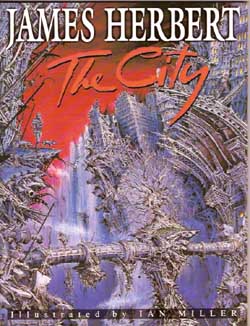
This particular slim, apocalyptic tome built upon an already popular property. Horror author James Herbert began his extensive writing career with The Rats (1974) following up with sequels Lair in 1979 and Domain in 1984. Those three novels told of a post-Holocaust Britain where mutated giant Black Rats have risen as humanity declined. In The City (technically Herbert’s 17th book) – and more of an episode than a narrative – an armoured figure known as The Traveller fights his way into the devastated ruins of London.

The decimated Capital is now the undisputed kingdom of the rats and their truly monstrous queen, but the lone human is set irrevocably on a mission of murder, and he has a secret, personal purpose for going into the hellish ruins…

Dark, simplistic and terrifying, the story is elevated to nightmare heights and depths by the astonishing, grotesquely beautiful art of sculptor, painter, film-designer and illustrator Ian Miller (Ratspike, The Luck in the Head, Green Dog Trumpet, Magic: The Gathering). Armageddon has never been better realised, the skies have never looked uglier and the shabby remains and detritus of civilisations never more familiar. His mutants are appalling to see and his intense line-work and domineering colours will haunt you.

Horror is tough to write and nearly impossible to illustrate. This book manages to tell no real story and make it scarier every time you return to it. Let’s hope some sagacious publisher does so before it’s too late for us all…
©1994 James Herbert. Illustrations ©1994 Ian Miller. All Rights Reserved.

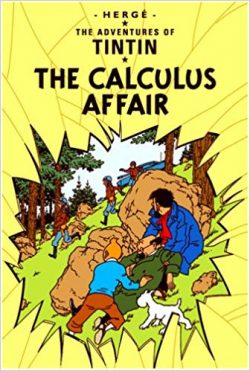
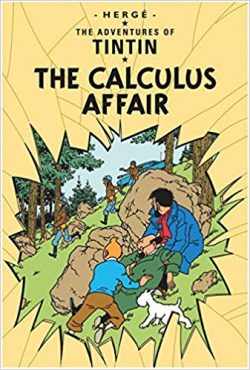
Adventures of Tintin: The Calculus Affair


By Hergé, Bob De Moors and others, translated by Leslie Lonsdale-Cooper & Michael Turner (Egmont UK)
ISBN: 978-1-40520-817-8 (HB) 978-1-40520-629-7 (TPB)

Georges Prosper Remi, known all over the world as Hergé, created an incontrovertible masterpiece of graphic literature with his tales of a plucky boy reporter and his entourage of iconic associates.

Singly, and later with assistants including Edgar P. Jacobs, Bob de Moor and other supreme stylists of the select Hergé Studio, he created 23 splendid volumes (originally produced in brief instalments for a variety of periodicals) that have grown beyond their popular culture roots and attained the status of High Art.

On leaving school in 1925, he worked for the conservative Catholic newspaper Le Vingtiéme Siécle where he fell under the influence of its Svengali-esque editor Abbot Norbert Wallez. A devoted boy scout, a year later Remi produced his first strip series The Adventures of Totor for monthly Boy Scouts of Belgium magazine, and by 1928 was producing the contents of the newspaper’s weekly children’s supplement Le Petit Vingtiéme.

He was illustrating The Adventures of Flup, Nénesse, Poussette and Cochonette, written by the staff sports reporter when Wallez asked Remi to create a new adventure series. Perhaps a young reporter who roamed the world, doing good whilst displaying solid Catholic values and virtues?

The rest is history…

After a troubled period during the war years, the Boy Reporter and his companions became a staple of the European childhood experience through weekly trans-national magazine Le Journal de Tintin and regular album collections. The anthology comic regularly achieved a circulation in the hundreds of thousands, allowing the artist and his team to remaster past tales and create bold new romps reflecting the tone of the times.

Although Hergé’s later life was troubled by personal problems and health issues, this only seemed to enhance his storytelling abilities. The later adventures are all sleek, polished thrillers, rife with intrigue and camaraderie; perfectly garnished with comedy set-pieces of timeless brilliance. Even after decades of working, the artist/auteur continued fresh and challenging, always seeking new arenas of drama to explore.
Hergé entered the most successful period of his artistic career. He had mastered his storytelling craft, possessed a dedicated audience eager for his every effort and was finally able to say exactly what he wanted in his work, free from fear or censure. That meant a return to observations of contemporary themes and situations, as in this effective treatise on the burgeoning Cold War…

L’Affaire Tournesol began in the Christmas issue of the Belgian edition of Le Journal de Tintin (dated December 22nd 1954) and ran uninterrupted until February 22nd 1956. The French editions ran it from February 1955, and the completed saga was collected as an album in 1956 and is notable for the introduction of three characters who would become semi-regular cast members: Jolyon Wagg, Cutts the Butcher, and recurring villain Colonel Spoons.

The Calculus Affair once again sees the zany Professor abducted from the palatial home of Captain Haddock, resulting in a dire and desperate chase through espionage-infested Europe. Our heroes are hampered in their efforts to save their friend by the introduction of the infinitely annoying and crushingly dull insurance salesman Jolyon Wagg and, more ominously, rival bands of relentless, ruthless spies.

As they doggedly pursue Calculus to Geneva, Tintin and Haddock encounter not only the insidious agents of Borduria but find that their erstwhile allies of Syldavia are also trying to make the Professor “disappear”. After frantic chases, pitched battles and assassination attempts, diplomatic duplicity defeats them, and Calculus becomes an unwilling guest of the totalitarian Bordurians, who are pleased to accept as a “gift” his new invention, which they intend to use as a weapon of mass destruction.

Temporarily stymied, Tintin and Haddock finagle their way into the country, and with the aid of Opera Diva and human tornado Bianca Castafiore, bamboozle the secret police to rescue the Professor and save the day.

Although all the elements in play are tried and trusted ingredients of the Tintin formula, the level of artistic achievement here is superb and the interplay of tense drama, slapstick comedy and breakneck action make this brooding thriller the most accomplished of Hergé’s tales. The simple fact that the contemporary Cold War fever is absent for modern readers makes no difference at all to the enjoyment of this magnificent graphic masterpiece.

The Calculus Affair: artwork © 1956, 1984 Editions Casterman, Paris & Tournai. Text © 1960 Methuen & Co Ltd/2012 Egmont UK Limited. All Rights Reserved.

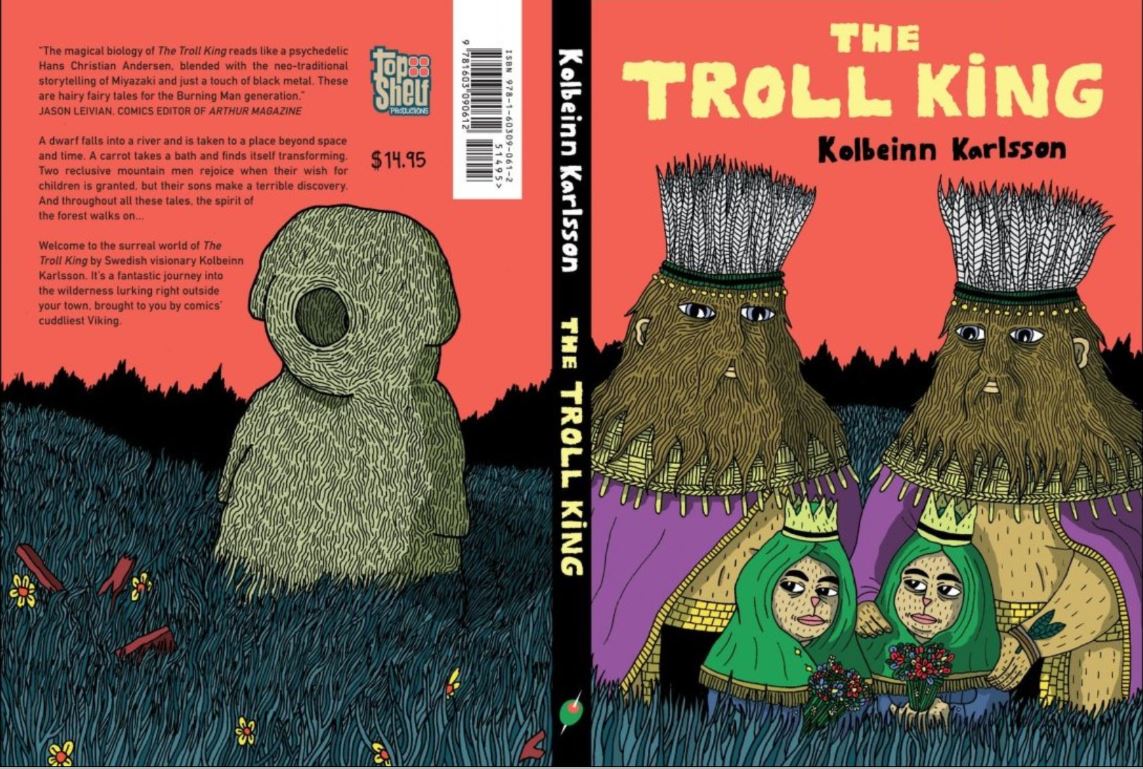
The Troll King


By Kolbeinn Karlsson (Top Shelf Productions)
ISBN: 978-1-60309-061-2 (TPB)

The power of fairy tales and magical sagas has shaped human thought and psychology fully as much as science and philosophy, and as such is infinitely evergreen – especially when seen through the lens of a truly gifted artist.

Swedish artisan and imaginer Kolbeinn Karlsson was born in Uppsala in 1982, and studied at Malmö’s Kvarnby School of Comic Arts. From 2006 he began publishing mini-comics which quickly won him a far-ranging and appreciative global audience. His stylish renderings have been published throughout Europe in magazines such as Strapazin, Glömp and C’est Bon.

The Troll King (available in both paperback and digital formats) is his first book, released in 2009 and since then adapted into an animated film. It’s a superb marriage of bizarre situations and legendary fictions, illustrated in a compelling, evocative and unique style, all tied together with a superb sense of guided absurdity that no fan of narrative art of fantastic fiction could possibly resist.

It also gives the initial appearance of relating unrelated tales but that is not truly the case…

Two hairy overly-masculine hermits live together in the wilds: shunning civilisation, exercising, and secretly wishing they had a child. When they perform a rite to bind themselves together, a strange forest creature blesses their union and their greatest desire is made real…

Elsewhere, ‘Sleeping and Dreaming of Food’ a starving, hallucinating dwarf falls into the Black River and endures visions and strange transformations, even as in another elsewhere an ambulatory carrot invades an ornate indoor pool and begins to sprout uncontrollably…

And so unravels a fevered stream of peculiar pictorial encounters that demand the reader’s full attention and participation, with always that ponderous forest presence intersecting the story strands…

Blending humour with horror and salutary moral warnings with random acts of fate, The Troll King offers a truly unsettling but incredibly rewarding walk on the weird wild side thatwill haunt your dreams until you can no longer separate the surreal from the ridiculous…
© 2009 Kolbeinn Karlsson. All rights reserved.

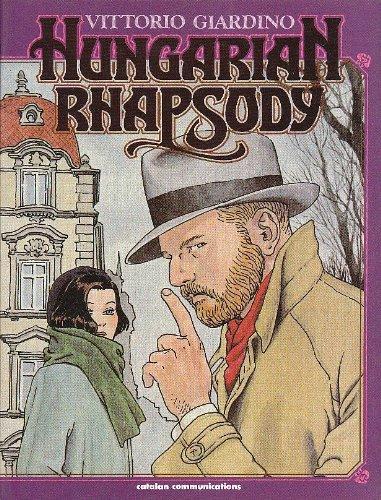
Hungarian Rhapsody


By Vittorio Giardino (Catalan Communications)
ISBN: 978-0-87416-033-8 (TPB Album)

Born on Christmas Eve 1946, Vittorio Giardino was an electrician who switched careers at age 30. He initially worked for a number of comics magazines before his first collection – Pax Romana – was released in 1978. Giardino has toiled, slowly but consistently, on both feature characters such as the detective Sam Pezzo, saucy Winsor McKay homage Little Ego and cold-war drama Jonas Fin, as well as general fiction tales, producing over 43 albums to date.

In 1982 he began the tale of a quiet, bearded fellow recalled by the Deuxieme Bureau (the French Secret Service) to investigate the slaughter of almost every agent in the cosmopolitan paradise of Budapest. The series ran in four parts in the magazine Orient Express before being collected as Rhapsodie Hongroise Giardino’s thirteenth book and in no way unlucky for him. Reluctant spy Max Fridman (transliterated into Max Friedman for the English-speaking world), was dragged back into the “Great Game” in the years of uneasy peace just before the outbreak of World War II: a metaphor for the nations of Europe…

Over the course of ten years, the masterful Italian graphic novelist crafted two more individual tales and in 1999 added a stunning triptych of albums. The three volumes of No Pasarán! detailed a key moment during the conflict in Republican Spain and the dying days of the Civil War which revealed many clues into the life of the diffident and unassuming hero. Two further volumes have been added to the canon in 2002 and 2008, and I’m declaring they are all now long past due to be revived and revisited…

In Hungarian Rhapsody, Friedman debuts as a troubled, cautious man with a daughter he adores and a nebulous past that somehow stems from undisclosed experiences in the Spanish Civil War where he fought as a Republican in the International Brigades against Franco’s Nationalists.

He is no ideologue or man of action, but still, somehow, is convinced – call it blackmailed – to leave his idyllic home in Switzerland to investigate the plague of assassinations for his devious French taskmasters….

Friedman is a hero in the mould of John le Carré’s George Smiley: a methodical thinker and the very antithesis of such combat supermen as James Bond, Napoleon Solo or Jason Bourne. Arriving in Budapest, Friedman gently prods and pokes about, swiftly becoming the target of not just the mysterious killers, but seemingly every rabid faction in a city crammed full of spies of every type and description, from Soviet agitators to Nazi plotters.

In a city of stunning, if decadent, beauty and cultural extremes where East meets West, Friedman finds that like the spy-game itself, nobody and nothing can be trusted…

Somebody somewhere has a master-plan but who it is and what it is..?

That’s a mystery that could get even the most cautious agent killed…

Giardino is a powerfully subtle writer who lets tone and shaded nuance carry a tale, and his captivating art – a semi-representational derivation of Hergé’s “Ligne Claire” style – makes the lovingly rendered locations as much a character in this smart, gripping drama as any of the stylishly familiar operatives of a dark, doomed world on the brink of holocaust.

Although largely an agent unknown in the English-speaking world, Max Friedman is one of espionage literature’s greatest characters. Giardino’s work is like honey for the eyes and mind. Hungarian Rhapsody is a graphic novel any fan of comics or the Intelligence Game should know.

© 1986 Vittorio Giardino. All rights reserved.

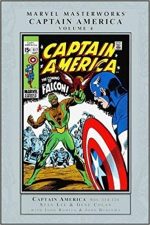
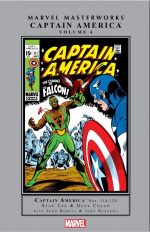
Captain America Marvel Masterworks volume 4


By Stan Lee, Gene Colan, John Romita Sr., John Buscema & various (Marvel)
ISBN: 978-0-7851-2936-3 (HB)

During the Marvel Renaissance of the early 1960’s Stan Lee & Jack Kirby tried a tactic that had reaped huge dividends for DC Comics. Although initially generating mixed results, their efforts eventually changed the nature of comicbooks. Julie Schwartz had scored an incredible success with his revised versions of the company’s Golden Age greats, so it seemed natural to try and revive the characters that had dominated Timely/Atlas in those halcyon days.

A new Human Torch had premiered as part of the revolutionary Fantastic Four, and in the fourth issue of that title the Sub-Mariner resurfaced after a 20-year amnesiac hiatus (everyone concerned had apparently forgotten the first abortive attempt to revive an “Atlas” superhero line in the mid-1950s).

The Torch was promptly given his own solo feature in Strange Tales from issue #101 on and in #114 the flaming teen fought an acrobat pretending to be Captain America. With reader-reaction strong, the real thing promptly resurfaced in Avengers #4 and, after a captivating and centre-stage-hogging run in that title, was granted his own series as half of the “split-book” Tales of Suspense with #59 (cover-dated November 1964). An unmissable string of classics ensued and in 1968 the Star-Spangled Avenger won his own solo title… but not for long…

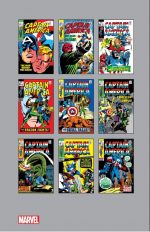
This groundbreaking full-colour compilation (available in hardback and digital editions) gathers Captain America #114-124 – spanning June 1969 to September 1970 – and opens with a captivating Introduction from illustrator Gene Colan revealing amongst other things how he created The Falcon…

The comics portion of this treat opens as the Sentinel of Liberty has just acrimoniously retired from superhero service and reclaimed his anonymity after impetuously revealing his secret identity to the world mere months earlier.

The hiatus doesn’t last long as, again a man of mystery, Captain America bursts into action to save his lover Sharon Carter (SHIELD Agent 13) from a suicide mission against Advanced Idea Mechanics.

The tale coincided with an ongoing period of artistic instability as here John Romita the Elder (inked by Sal Buscema) illustrated Stan Lee’s tense spy-caper ‘The Man Behind the Mask!’.

The action and suspense were merely prologue to an extended war against the Red Skull. Issue #115 – ‘Now Begins the Nightmare!’ – was drawn by John Buscema and inked by his brother Sal, wherein the fascist arch-villain uses the reality-warping Cosmic Cube to switch bodies with the shield-slinger and trash the hero’s reputation, after which ‘Far Worse than Death!’ in #116 follows Cap’s frantic attempts to escape his own friends and allies the Avengers, as well as the villain’s callous reality-warping torments.

This issue saw the start of Gene Colan’s impressive run on the character, here augmented by the smooth, slick inks of Joe Sinnott.

This next instalment returns him to the Isle – and clutches – of aging war criminals the Exiles in a tale that introduced Marvel’s second black superhero.

‘The Coming of … the Falcon!’ in issue #117 was a terse, taut build-up to a cataclysmic clash before the neophyte hero-in-training takes centre-stage in ‘The Falcon Fights On!’ after which all the ducks drop neatly into place for a spectacular finale in ‘Now Falls the Skull!‘ in #119.

As 1970 dawned, Marvel imposed a moratorium on continued stories for most of their titles, and Cap – having returned to his hectic twin lives as unofficial SHIELD Agent and mighty Avenger – here hops on the disaffected youth/teen revolt bandwagon for a series of slight but highly readable puff-pieces promising nothing but delivering much.

Kicking off is ‘Crack-up on Campus!’ by Lee, Colan & Sinnott: an odd mélange of student radicalism and espionage that sees itinerant cipher Steve Rogers become a Physical Education teacher to foil a scheme by the sinister cyborg Modok and his AIM cohorts.

Demented bio-chemist Silas X. Cragg then rediscovers the fabled Super Soldier serum that had originally created Captain America in ‘The Coming of the Man-Brute!’ Sadly, the bonkers boffin picks the wrong candidate to become his Blockbuster stooge…

Spider-Man’s old sparring partner mugs the wrong guy in #122’s ‘The Sting of the Scorpion!’ and subsequently falls to Cap’s bludgeoning fists before issue #123 taps into the seemingly eternal “battle of the sexes” zeitgeist with ‘Suprema, The Deadliest of the Species!’ turning her espionage-tinged attentions to the Star-Spangled Avenger…

The blazing battle action then concludes here as AIM returns with a deadly new hi-tech human weapon. Despite all their efforts the Sentinel of Liberty triumphs yet again in ‘Mission: Stop the Cyborg!’…

Supplementing the drama is Romita’s original art cover for #114s and its colour roughs.

These are tales of dauntless courage and unmatchable adventure, fast-paced and superbly illustrated, which rightly returned Captain America to the heights that his Golden Age compatriots the Human Torch and the Sub-Mariner never regained. They are pure escapist magic. Glorious treats for the eternally young at heart, these are episodes of sheer visual dynamite that cannot be slighted and should not be missed.
© 1969, 1970, 2016 Marvel Characters, Inc. All rights reserved.

The Broons and Oor Wullie: The Roaring Forties


By R.D. Low & Dudley D. Watkins (DC Thomson)
ISBN: 978-0-85116-804-3 (HB)

The Broons is one of the longest running newspaper strips in British history, having run almost continuously in Scottish newspaper The Sunday Post since its delirious debut in the March 8th 1936 edition: the same issue which launched mischievous and equally unchanging wee laddie Oor Wullie.

Both the boisterous boy and the gregariously engaging working-class family were co-created by journalist, writer and editor Robert Duncan Low in conjunction with DC Thomson’s greatest artist Dudley D. Watkins. Moreover, once the strips began to be collected in reprint editions as Seasonal Annuals, those books became as much a Yule tradition as plum pudding or shortbread.

Low (1895-1980) began at DC Thomson as a journalist, rising to the post of Managing Editor of Children’s Publication and launching, between 1921 and 1933, the company’s “Big Five” story papers for boys: Adventure, The Rover, The Wizard, The Skipper and The Hotspur.

In 1936 his landmark notion was the “Fun Section”: an 8-page pull-out comic strip supplement for national newspaper The Sunday Post. This illustrated accessory launched on 8th March and from the outset The Broons and Oor Wullie were the headliners…

Low’s shrewdest notion was to devise both strips as comedies played out in the charismatic Scottish idiom and broad unforgettable vernacular where, supported by features such as Auchentogle by Chic Gordon, Allan Morley‘s Nero and Zero, Nosey Parker and other strips. These pioneering comics then laid the groundwork for the company’s next great leap.

After some devious devising in December 1937 Low launched the first DC Thomson weekly comic. The Dandy was followed by The Beano in 1938 and early-reading title The Magic Comic in 1939.

War-time paper shortages and rationing sadly curtailed the burgeoning strip periodical revolution, and it was 1953 before the next wave of cartoon caper picture paper releases. The Topper started the ball rolling again with Oor Wullie in the logo and masthead but not included in the magazine’s regular roster. In that same year Low & the magnificent Ken Reid created Roger the Dodger for The Beano…

Low’s greatest advantage in the early days was his prolific illustrator Dudley Dexter Watkins, whose style – more than any other – shaped the look and form of DC Thompson’s comics output, until the bombastic advent of Leo Baxendale shook things up in the mid-1950s.

Watkins (1907-1969) had started life in Manchester and Nottingham as an artistic prodigy before entering Glasgow College of Art in 1924. Before too long he was advised to get a job at expanding, Dundee-based DCT, where a 6-month trial illustrating prose boys’ stories led to comic strip specials and some original cartoon creations.

Percy Vere and His Trying Tricks and Wandering Willie, The Wily Explorer made him a dead cert for both lead strips in the Sunday Post‘s new Fun Section. Without missing a beat, Watkins quickly added The Dandy‘s Desperate Dan to his weekly workload in 1937, and The Beano‘s placidly outrageous Lord Snooty seven months later.

Watkins soldiered on in unassailable triumph for decades, drawing some of the most lavishly lifelike and winningly hilarious strips in comics history. He died at his drawing board on August 20th 1969.

For every week of all those astonishingly productive years, he had unflaggingly crafted a full captivating page each of Oor Wullie and The Broons, and his loss was a colossal blow to the company.

DC Thomson reprinted old episodes of both strips in the newspaper and the Annuals for seven years before a replacement was agreed upon, whilst The Dandy reran Watkins’ Desperate Dan stories for twice that length of time.

An undeniable, rock-solid facet of Scots popular culture from the start, the first Broons Annual (technically Bi-Annual due to wartime paper rationing) had appeared in 1939, alternating with Oor Wullie – although, due to those same resource restrictions, no annuals were published between 1943 and 1946 – and for millions of readers a year cannot truly end without them.

So What’s the Set Up?: the multigenerational Broon family inhabit a tenement flat at 10 Glebe Street, in the timelessly metafictional Scottish industrial everytown of Auchentogle (sometimes Auchenshoogle); based in large part on the working class Glasgow district of Auchenshuggle. As such, it’s an ideal setting in which to tell gags, relate events and fossilise the deepest and most reassuring cultural archetypes for sentimental Scots wherever in the world they might actually be residing.

As is always the case, the adamant, unswerving cornerstone of any family feature is long-suffering, understanding Maw, who puts up with cantankerous, cheap, know-it-all Paw, and a battalion of stay-at-home kids comprising hunky Joe, freakishly tall Hen (Henry), sturdy Daphne, pretty Maggie, brainy Horace, mischievous twins Eck and the unnamed “ither ane” plus a wee toddler referred to only as “The Bairn”.

Not officially in residence but always hanging around is gruffly patriarchal buffoon Granpaw – a comedic gadfly who spends more time at Glebe Street than his own quaint cottage, constantly seeking to impart decades of out-of-date, hard-earned experience to the kids… but do they listen…?

Offering regular breaks from the inner city turmoil and a chance to simultaneously sentimentalise, spoof and memorialise more traditional times, the family frequently repair to their But ‘n’ Ben (a dilapidated rustic cottage in the nearby Highlands): there to fall foul of the weather, the countryside and all its denizens: fish, fowl and farm-grown…

As previously stated, Oor Wullie also debuted on 8th March 1936 with his collected Christmas Annuals appearing in the even years.

The basic set-up is sublimely simply and eternally evergreen, featuring an imaginative, good-hearted scruff with a talent for finding trouble and no hope of ever avoiding parental retribution when appropriate…

Wullie – AKA William MacCallum – is an archetypal young rascal with time on his hands and can usually be found sitting on an upturned bucket at the start and finish of his page-a-week exploits.

His regular cast includes Ma and Pa, long-suffering local bobby P.C. Murdoch, assorted teachers and other interfering adults who either lavish gifts or inflict opprobrium upon the little pest and his pals Fat Bob, Soapy Joe Soutar, Wee Eck and others…

The Roaring Forties was released in 2002 as part of a concerted drive to keep earlier material available to fans: a lavish hardback compilation (sadly not yet available digitally) which proffers a tantalising selection of strips from 1940-1949, covering every aspect of contemporary existence except a rather obvious one.

Although for half the book World War II was a brutal fact of life, it barely encroached upon the characters’ lives except perhaps in the unexplained occasional shortages of toys, sweets and other scrummy comestibles…

The parade of celtic mirth begins with – and is regularly broken up by – a number of atmospheric photo-features such as a celebration of film stars of the period in ‘A Nicht at the Picters’ (in three glamour-studded showings) and ‘Cartoon Capers’, which reproduces a wealth of one-off gag panels from The Sunday Post by such luminaries as Carmichael, Eric Cook, Campbell and Housley, whilst ‘Whit’s in The Sunday Post Today?’ gathers a selection of the era’s daftest news items.

The endless escapades of the strip stars comprise the usual subject-matter: gleeful goofs, family frolics and gloriously slapstick shenanigans. Whether it’s a visit with family or just trying to keep pace with the wee terror, highlights include plumbing disasters, fireplace fiascos, food foolishness, dating dilemmas, appliance atrocities, fashion freak-outs, exercise exploits and childish pranks by young and old alike…

Punctuated by editorial extras, such as ‘Correction Corner’ – offering an intriguing look into the strips’ creative process – and ‘Dinnae Mention the War’ which reprints a selection of morale-boosting ads and items, are rib-tickling scenes of sledding and skating, stolen candies, torn clothes, recycled comics, visiting circuses, practical jokes, and social gaffes: stories intended to take the nation’s collective mind off troubles abroad, and for every thwarted romance of poor Daphne and Maggie or embarrassing fiasco focussed on Paw’s cussedness, there’s an uproarious chase, riotous squabble and no-tears scrap for the little ‘uns.

With snobs to deflate, bullies to crush, duels to fight, chips to scoff, games to win and rowdy animals (from cats to cows) to avoid at all costs, the timeless gentle humour and gently self-deprecating, inclusive fun and frolics make these superbly crafted strips an endlessly entertaining serving of superbly nostalgic an unmissable treat.

So why not return to a time of local blacksmiths and coalmen, best china and full employment, neighbours you knew by first names and trousers that always fell apart or were chewed by goats? There are even occasional crossovers to marvel at here, with Wullie and Granpaw Broon striving to outdo each other in the adorable reprobate stakes…

Packed with all-ages fun, rambunctious slapstick hilarity and comfortably domestic warmth, these unchanging examples of happy certainty and convivial celebration of a mythic lost life and time are a sure cure for post-modern glums…
© D.C. Thomson & Co., Ltd. 2002.

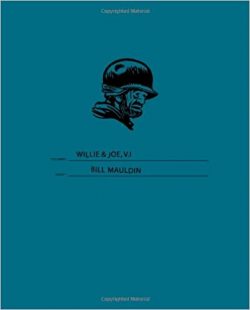
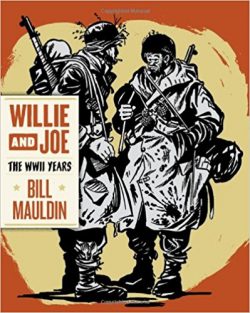
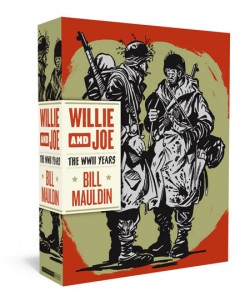
Willie and Joe: The WWII Years


By Bill Mauldin, edited by Todd DePastino (Fantagraphics Books)
ISBN: 978-1-60699-439-9 (PB)

During World War II a talented, ambitious young man named William Henry “Bill” Mauldin (29/10/1921 – 22/01/2003) fought “Over There” with the 45th Division of the United States Infantry as well as many other fine units of the army. He learned to hate war and love his brother soldiers – and the American fighting man loved him back. During his time in the service he produced civilian cartoons for the Oklahoma City Times and The Oklahoman, and devastatingly, intimately effective and authentic material for his Company periodical, 45th Division News. He also produced work for Yank and Stars and Stripes; the US Armed Forces newspapers. Soon after, his cartoons were being reproduced in newspapers across Europe and America.

They mostly featured two slovenly “dogfaces” – a term he popularised – offering their trenchant and laconic view of the war from the muddied tip of the sharpest of Sharp Ends…

Willie and Joe, much to the dismay of the brassbound, spit-and-polish military martinets and diplomatic doctrinaires, became the unshakable, everlasting image of the American soldier: continually exposing in all ways and manners the stuff upper echelons of the army would prefer remained top secret. Not war secrets, but how the men at arms lived, felt and died.

Willie and Joe even became the subject of two films (Up Front -1951 and Back at the Front – 1952) whilst Willie made the cover of Time magazine in 1945, when 23-year old Mauldin won his first Pulitzer Prize.

In 1945, a collection of his drawings, accompanied by a powerfully understated and heartfelt documentary essay, was published by Henry Holt and Co. Up Front was a sensation, telling the American public about the experiences of their sons, brothers, fathers and husbands in a way no historian would or did. A biography, Back Home, followed in 1947.

Mauldin’s anti-war, anti-Idiots-in-Charge-of-War views became increasingly unpopular during the Cold War and, despite being a certified War Hero, Mauldin’s increasingly political cartoon work fell out of favour (those efforts are the subject companion volume Willie & Joe: Back Home). Mauldin left the increasing hostile and oversight-ridden business to become a journalist and illustrator.

He was a film actor for a while (appearing, amongst other movies, in Red Badge of Courage with veteran war hero Audie Murphy); a war correspondent during the Korean War and – after an unsuccessful campaign for Congress in 1956 – finally returned to newspaper cartooning in 1958.

He retired in 1991 after a long, glittering and award-studded career. He only drew Willie and Joe four times in that entire period (for an article on the “New Army” in Life magazine; for the funerals of “Soldier’s Generals” Omar Bradley and George C. Marshall; and to eulogize Milton Caniff). His fondest wish had been to kill the iconic dogfaces off on the final day of World War II, but Stars and Stripes vetoed it.

The Willie and Joe cartoons and characters are some of the most enduring and honest symbols of all military history. Every Veterans Day in Peanuts from 1969 to 1999, fellow veteran Charles Schulz had Snoopy turn up at Mauldin’s house to drink root beers and tell war stories with an old pal. When you read Sgt. Rock you’re looking at Mauldin’s legacy, and Archie Goodwin drafted the shabby professionals for a couple of classy guest-shots in Star-Spangled War Stories (see Showcase Presents the Unknown Soldier).

This immense, mostly monochrome (with some very rare colour and sepia items) softcover compendium comes in at 704 pages, (229 x 178mm for the physical copy or any size you want if you get the digital edition): assembling all his known wartime cartoons – as originally released in two hardback editions in 2008. It features not only the iconic dog-face duo, but also the drawings, illustrations, sketches and gags that led, over 8 years of army life, to their creation.

Mauldin produced most of his work for Regimental and Company newspapers whilst under fire: perfectly capturing the life and context of fellow soldiers – also under battlefield conditions – and shared a glimpse of that unique and bizarre existence to their families and civilians at large, despite constant military censorship and even face-to-face confrontations with Generals. George Patton was perennially incensed at the image the cartoonist presented to the world, but fortunately Supreme Commander Dwight D. Eisenhower, if not a fan, knew the strategic and morale value of Mauldin’s Star Spangled Banter and Up Front features with those indomitable everymen Willie and Joe…

This far removed in time, many of the pieces here might need historical context for modern readers and such is comprehensively provided by the notes section to the rear of the volume. Also included are unpublished pieces and pages, early cartoon works, and rare notes, drafts and sketches.

Most strips, composites and full-page gags, however, are sublimely transparent in their message and meaning: lampooning entrenched stupidity and cupidity, administrative inefficiency and sheer military bloody-mindedness. They highlight equally the miraculous perseverance and unquenchable determination of ordinary guys to get the job done while defending their only inalienable right – to gripe and goof off whenever the brass weren’t around…

Most importantly, Mauldin never patronised civilians or demonised the enemy: the German and Italians are usually in the same dismal boat as “Our Boys” and only the war and its brass-bound conductors are worthy of his inky ire…

Alternating crushing cynicism, moral outrage, gallows humour, absurdist observation, shared miseries, staggering sentimentality and the total shock and awe of still being alive every morning, this cartoon catalogue of the Last Just War is a truly breathtaking collection that no fan, art-lover, historian or humanitarian can afford to miss.

…And it will make you cry and laugh out loud too.

With a fascinating biography of Mauldin that is as compelling as his art, the mordant wit and desperate camaraderie of his work is more important than ever in an age where increasingly cold and distant brass-hats and politicians send ever-more innocent lambs to further foreign fields for slaughter. With this volume and the aforementioned Willie & Joe: Back Home, we should finally be able to restore the man and his works to the forefront of graphic consciousness, because tragically, it looks like his message is never going to be outdated… or learned from by the idiots in charge who most need to hear it…
© 2011 the Estate of William Mauldin. All right reserved.

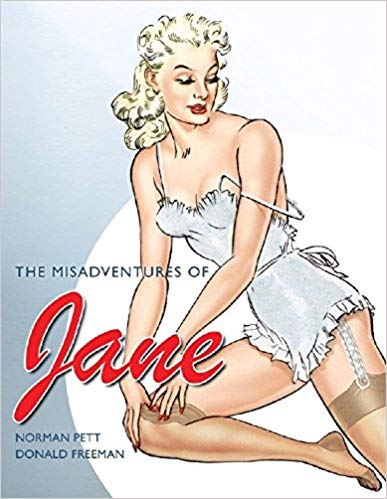
The Misadventures of Jane


By Norman Pett & J.H.G. (“Don”) Freeman (Titian Books)
ISBN: 978-1-84856-167-0 (HB)

Once upon a time, Jane was one of the most important and well-regarded comic strips in British, if not World, history. It debuted on December 5th 1932 as Jane’s Journal: or The Diary of a Bright Young Thing: a frothy, frivolous gag-a-day strip in the Daily Mirror, created by (then) freelance cartoonist Norman Pett.

Originally a nonsensical comedic vehicle, it consisted of a series of panels with cursive script embedded within to simulate a diary page. It switched to more formal strip frames and balloons in late 1938, when scripter Don Freeman came on board and Mirror Group supremo Harry Guy Bartholomew was looking to renovate the serial for a more adventure- and escape-hungry audience. It was also felt that a continuity feature such as Freeman’s other strip Pip, Squeak and Wilfred would keep readers coming back; as if Jane’s inevitable – if usually unplanned – bouts of near nudity wouldn’t…

Jane’s secret was skin. Even before war broke out there were torn skirts and lost blouses aplenty, but once the shooting started and Jane became an operative for British Intelligence, her clothes came off with terrifying regularity and machine gun rapidity. She even went topless when the Blitz was at its worst.

Pett drew the strip with verve and style, imparting a uniquely English family feel: a joyous lewdness-free innocence and total lack of tawdriness. The artist worked from models and life, famously using first his wife, his secretary Betty Burton, and editorial assistant Doris Keay but most famously actress and model Chrystabel Leighton-Porter – until May 1948 when Pett left for another newspaper and another clothing-challenged comic star…

His art assistant Michael Hubbard assumed full control of the feature (prior to that he had drawn backgrounds and mere male characters), and carried the series – increasingly a safe, flesh-free soap-opera and less a racy glamour strip – to its conclusion on October 10th 1959.

This Titan Books collection added the saucy secret weapon to their growing arsenal of classic British comics and strips, and paid Jane the respect she deserved with a snappy black and white hardcover collection, complete with colour inserts.

Following a fascinating and informative article taken from Canadian paper The Maple Leaf (which disseminated her adventures to returning ANZAC servicemen), Jane’s last two war stories (running from May 1944 to June 1945) are reprinted in their entirety, beginning with ‘N.A.A.F.I, Say Die!’, wherein the hapless but ever-so-effective intelligence agent is posted to a British Army base where somebody’s wagging tongue is letting pre “D-Day” secrets out. Naturally (very au naturally), only Jane and her new sidekick and best friend Dinah Tate can stop the rot…

This is promptly followed by ‘Behind the Front’ wherein Jane and Dinah invade the continent, tracking down spies, collaborators and boyfriends in Paris before joining a ENSA concert party, and accidentally invading Germany just as the Russians arrive…

As you’d expect, the comedy is based on classic Music Hall fundamentals with plenty of drama and action right out of the patriotic and comedy cinema of the day – but if you’ve ever seen Will Hay, Alistair Sim or Arthur Askey at their peak you’ll know that’s no bad thing – and this bombastic book also contains loads of rare goodies to drool over.

Jane was so popular that there were three glamour/style books called Jane’s Journal for which Pett produced many full-colour pin-ups, paintings and general cheese-cake illustration. From these lost gems, this tome includes ‘The Perfect Model’, a strip “revealing” how the artist met his muse Chrystabel Leighton-Porter; ‘Caravanseraglio!’, an 8-page strip starring Jane and erring, recurring boyfriend Georgie Porgie plus 15 pages of the very best partially and un-draped Jane pin-ups.

Jane’s war record is frankly astounding. As a morale booster she was reckoned worth more than divisions of infantry and her exploits were cited in Parliament and discussed with actual seriousness by Eisenhower and Churchill. Legend has it that The Daily Mirror‘s Editor was among the few who knew the date of D-Day so as to co-ordinate her exploits with the Normandy landings.

In 1944, on the day she went full frontal, the American Service newspaper Roundup (provided to US soldiers) went with the headline “JANE GIVES ALL” and the sub-heading “YOU CAN ALL GO HOME NOW”. Chrystabel Leighton-Porter toured as Jane in a services revue – she stripped for the boys – during the war and in 1949 starred in the film The Adventures of Jane.

Although the product of simpler, less enlightened, and indubitably more hazardous, times, the charming, thrilling, innocently saucy adventures of Jane, patient but dedicated beau Georgie Porgie and especially her intrepid Dachshund Count Fritz Von Pumpernickel are incontestable landmarks of the art-form, not simply for their impact but also for the plain and simple reason that they are superbly drawn and huge fun to read.

After years of neglect, don’t let’s waste the opportunity to keep such a historical icon in our lives. You should find this book, buy your friends this book, and most importantly, agitate to have her entire splendid run reprinted in more books like this one. Do your duty, lads and lassies…
Jane © 2009 MGN Ltd/Mirrorpix. All Rights Reserved.

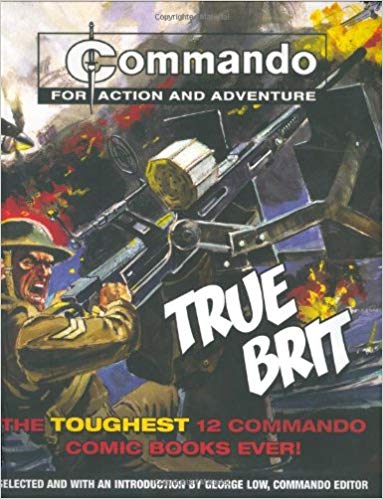
Commando: True Brit


By Many & various (DC Thomson/Carlton Books)
ISBN: 978-1-84442-121-3 (HB)

DC Thomson is probably the most influential comics publisher in British history. The Beano and Dandy revolutionised children’s comedy comics, newspaper strips Oor Wullie and The Broons (both created by writer Editor R. D. Low and legendary artist Dudley D. Watkins) have become a genetic marker for Scottishness and the uniquely British “ordinary hero” grew from the prose-packed pages of Adventure, Rover, Wizard, Skipper and Hotspur.

After decades of deft consumer-led publication for youngsters, in 1961 the company launched a digest-sized paperback title dubbed Commando. Broadly the size of a paperback book, it boasted 68 pages per issue and an average of two panels a page for its single stand-alone adventure tale, as well as the venerable British extras of themed information pages.

Not to belabour the point, but each issue told a complete war story (usually of World War I or II – although all theatres of conflict have featured since), a true rarity for British comics which usually ran action and thriller material in one or two-page instalments over many weeks. The sagas were tasteful yet gripping yarns of valour and heroism: stark black and white dramas which came charged with grit and authenticity. The full painted covers made them look more like novels than comics and they were a huge and instant success. They’re still being published today and are even available in digital editions.

This lovely volume comes from 2006, gathering an even dozen mini-epics selected by series editor George Low, and, although much of the collection’s original marketing concentrated on the baser nostalgic element by exhorting the reader to remember dashing about the playground shouting “Achtung” or “Donner und Blitzen” and saluting like Storm-troopers, these tales – subtitled “The Toughest 12 Commando Books Ever” are exemplary and compelling examples of dramatic comic storytelling.

Because of company policy these tales are all uncredited, (and I’d rather not prove my vast ignorance by guessing who did what), so unless you feel like consulting the numerous online sites devoted to the material, you’ll have to be content with the work itself, and that in itself is reward enough. So in this anniversary week, if you’re looking for a more homegrown comics experience, superbly-written and wonderfully illustrated, check out ‘Guns on the Peak’, ‘The Fighting Few’, ‘Bright Blade of Courage’, ‘The Haunted Jungle’, ‘Tiger in the Tail’, ‘The Specialists’, ‘Mighty Midget’, ‘VLR: Very Long Range’, ‘Flak Fever’, ‘Fight or Die!’, ‘Fearless Freddy’ and ‘Another Tight Spot…’ in this brilliant compilation.
™ & © 2006 DC Thomson & Co. Ltd. All Rights Reserved.

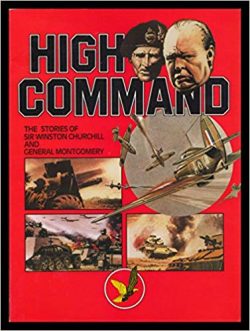
High Command – The stories of Sir Winston Churchill and General Montgomery


By Frank Bellamy & Clifford Makins (Dragon’s Dream)
ISBN: 978-9-06332-901-3 (PB)

Inexcusably absent as we commemorate the achievements and sacrifices of earlier generations are these twin neglected classics of British comic strip art, crafted by one of the world’s most talented narrative illustrators. These wonderful biographical series originally ran in The Eagle: the most influential comic of post-war Britain, which launched on April 14th 1950, to astound readers weekly until 26th April 1969.

It was the brainchild of a Southport vicar, the Reverend Marcus Morris, who was at that time concerned over the detrimental effects of American comicbooks on British children. He posited a good, solid, thoroughly decent Christian-inspired antidote and sought out like-minded creators. After jobbing around a dummy to many British publishers for over a year with little success, he eventually found an unlikely home at Hulton Press, a company that produced adult general interest magazines such as Lilliput and Picture Post.

The result was a huge hit spawning clones Swift, Robin and Girl (targeting other demographic sectors of the children’s market), as well as radio series, books, toys and all other sorts of merchandising.

An incredible huge number of soon-to-be prominent creative figures in many arenas of media worked on the weekly, and although Dan Dare is deservedly revered as the star, many other strips were as popular at the time, many even rivalling the lead in quality and entertainment value. As was the trend of the times, the content combined fact with fiction, stressing learning and discernment equally with adventure, thrills and fun…

At its peak, The Eagle sold close to a million copies a week, but eventually changing tastes and a game of “musical owners” killed the title. In 1960, Hulton sold out to comics megalith Odhams, who then became Longacre Press. A year later they were bought by The Daily Mirror Group who evolved into IPC. And so it goes in publishing…

In cost-cutting exercises, many later issues carried (relatively) cheap and oh-so-trendy Marvel Comics reprints rather than British originated material. It took time, but the Yankee cultural Invaders won out in the end…

With the April 26th 1969 issue Eagle was merged into Lion, eventually disappearing altogether. Successive generations have revived the prestigious glamour-soaked title, but never its success.

From its glorious Reithian heyday (“Educate, Elucidate and Entertain”) comes a brace of brief biographical serials devoted to two men who were crucial to the war effort that had imperilled the readership’s forebears, originally collected into a classy album by Dragons Dream in 1981.

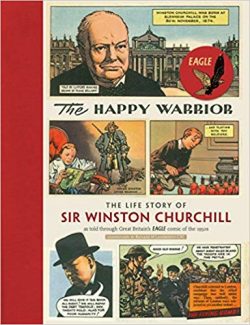
The first half was reprinted in 2014 as slim scarcely seen paperback The Happy Warrior: The Life Story of Sir Winston Churchill as Told Through the Eagle Comic of the 1950’s (ISBN: 978-1-90650-990-3) with a scholarly commentary from Richard M. Langworth CBE, but we’re long overdue for the combined volume to resurface (you will never know the effort involved in not just saying “the Full Monty” there…)

In High Command, however, we can devour the life story of Sir Winston Churchill and the quiet general (both scripted by Clifford Makins), beginning with the icon of Bulldog Spirit. Originally titled The Happy Warrior, the prestigious full-page back cover feature (running from October 4th 1957 until September1958) was Frank Bellamy’s first full colour strip. He followed up with Montgomery of Alamein (volume 13, #10-27, spanning March 10th to 7th July 1962), delivering twice the punch and more revelatory design in two-page colour-spreads that utterly spellbound readers, whether they were war-fans or not…

Churchill himself approved the early strips and was rumoured to have been consulted before the artist began the experimental layouts that elevated Bellamy from being merely a highly skilled representational draughtsman into the trailblazing innovator who revolutionized the comic page.

The tireless experimenter also began the explorations of the use of local and expressionistic colour palettes that would result in the extraordinary Fraser of Africa, Heros the Spartan and the deservedly legendary Thunderbirds strips.

The Churchill story follows the great man from his early days at Eton through military service in Cuba as a war correspondent, and into politics. Although a large proportion deals with World War II – and in a spectacular, tense and thrilling manner – the subtler skill Bellamy displays in depicting the transition of dynamic, handsome man of action into burly political heavyweight over the weeks is impressive and astonishing. It should be mentioned, though, that this collection doesn’t reproduce the climactic, triumphal last page, a portrait that is half-pin-up, half summation and all hagiography.

Bernard Law Montgomery’s graphic biography benefited from Bellamy’s newfound expertise in two ways. Firstly, the page count was doubled, and the artist capitalized on this by producing groundbreaking double page spreads that worked across gutters (the white spaces that divide the pictures). This allowed him to craft even more startling page and panel designs.

Secondly, Bellamy had now become extremely proficient in both staging the script and creating mood with colour. This strip is pictorial poetry in motion.

Makins doesn’t hang about either. Taking only three episodes to get from school days in Hammersmith, army service in India and promotion to Brigade Major by the end of the Great War, Monty’s WWII achievements are given full play, allowing Bellamy to create an awesome display of action-packed war comics over the remaining fifteen double-paged episodes. There really hasn’t been anything to match this level of quality and sophistication in combat comics before or since.

If you strain you might detect a tinge of post-war triumphalism in the scripts, but these accounts are historically accurate and phenomenally stirring to look at. If you love comic art you should hunt these down, or at least pray that somebody, somewhere has the sense to reprint this work.
© 1981 Dragon’s Dream B.V. ©1981 I.P.C. Magazines Ltd.