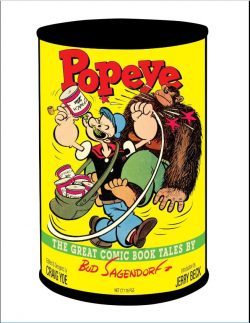
Popeye: The Great Comic Book Tales by Bud Sagendorf


By Bud Sagendorf, edited and designed by Craig Yoe (Yoe Books/IDW)
ISBN: 978-1-60010-747-4 (HB)                eISBN: 978-1-68406-381-9

There are few comic characters that have entered communal world consciousness, but a grizzled, bluff, uneducated, visually impaired old sailor with a speech impediment is possibly the most well-known of that select bunch.

Elzie Segar had been producing Thimble Theatre since December 19th 1919, but when he introduced a coarse, brusque “sailor man” into the saga of vaudevillian archetypes Ham Gravy and Castor Oyl on January 17th 1929, nobody suspected the giddy heights that walk-on would reach…

Yes, folks, its’s Happy 90th Anniversary for the old swab, who’s still going strong under the aegis of veteran cartoonist Hy Eisman (Kerry Drake, Little Iodine, Bunny, The Katzenjammer Kids, Little Lulu). Parent strip Thimble Theatre turns one hundred this year too, so there’s that to celebrate as well…

In 1924 Segar created a second daily strip The 5:15: a surreal domestic comedy featuring weedy commuter and would-be inventor John Sappo and his formidable wife Myrtle which endured – in one form or another – as a topper/footer-feature accompanying the main Sunday page throughout the author’s career.

It even survived his untimely death, eventually becoming the trainee-playground of Popeye’s second great stylist Bud Sagendorf…

After Segar’s tragic and far too premature death in 1938, Doc Winner, Tom Sims, Ralph Stein and Bela Zambouly all worked on the printed strip even as animated short features brought Popeye to the entire world via the magic of movies. Sadly, none of them had the eccentric flair and raw inventiveness that had put Thimble Theatre at the forefront of cartoon entertainments…

Born in 1915, Forrest “Bud” Sagendorf was barely 17 when his sister – who worked in the Santa Monica art store where Segar bought his supplies – introduced the kid to the master who became his teacher and employer as well as a father-figure. In 1958, Sagendorf took over the strip and all the merchandise design, becoming Popeye’s prime originator…

When Sagendorf took over, his loose, rangy style and breezy scripts brought the strip itself back to the forefront of popularity and made reading it cool and fun all over again. He wrote and drew Popeye in every graphic arena – including the majority of licensed merchandise – for 24 years. Sagendorf retired in 1986 after which “Underground” cartoonist Bobby London took over the Sailorman’s voyages and died in 1994.

Bud had been Segar’s assistant and apprentice, and from 1948 onwards he wrote and drew Popeye’s comicbook adventures in a regular monthly title published by America’s king of licensed periodicals, Dell Comics.

When Popeye first appeared, he was a rude, crude brawler: a gambling, cheating, uncivilised ne’er-do-well. He was soon exposed as the ultimate working-class hero: raw and rough-hewn, practical, but with an innate, unshakable sense of what’s fair and what’s not, a joker who wanted kids to be themselves – but not necessarily “good” – and someone who took no guff from anyone.

Naturally, as his popularity grew, Popeye mellowed somewhat. He was still ready to defend the weak and had absolutely no pretensions or aspirations to rise above his fellows but the shocking sense of dangerous unpredictability and comedic anarchy he initially provided was sorely missed… but not in Sagendorf’s comicbook yarns…

Collected in this enchanting full-colour hardback (also available in a digital edition) is an admittedly arbitrary and far from definitive selection of the Young Master’s compelling funnybook canon from Dell, spanning February/April 1948 to September 1957. Other yarns are readily available in IDW’s Popeye Classics series and I’ll be plugging those in the fullness of time.

The stunning, seemingly stream-of-consciousness stories are preceded here by an effusively appreciative Introduction from Jerry Beck before ‘Ahoy, Ya Swabs!’ relates history and recollection from inspired aficionado and historian/publisher Craig Yoe augmented by a fabulous collation of candid photos, original comicbook art, more.

Especial gems are Bud’s 1956 lessons on backgrounds from the Famous Artists Cartoon Course, series of postcards and the Red Cross booklet produced for sailors.

Popeye‘s fantastic first issue launched in February 1948, with no ads and duo-coloured (black and red) single page strips on the inside front and back covers. From that premiere issue a full-coloured crisis comes as ‘Shame on You! or Gentlemen Do Not Fight! or You’re a Ruffian, Sir!’ sees our salty swab earning a lucrative living as an occasional prize-fighter. That all ends when upcoming contender Kid Kabagge and his cunning manager Mr. Tillbox use a barrage of psychological tricks to put Popeye off his game. The key component is electing his sweetie Olive Oyl President of the fictitious Anti-Fisticuff Society to convince her man to stop being a beastly ruffian and abandon violence. It only works until the fiery frail learns she’s been gulled…

Next up is the lead tale from #9, (October/November) as ‘Misermites! or I’d Rather Have Termites!’ details how the peaceful coastal town of Seawet is plagued by an invasion of plundering dwarves. When the petty pilferers vanish back to their island with “orphink kid” Swee’ Pea as part of their spoils, Popeye and Wimpy give chase and end up battling a really, really big secret weapon…

‘Witch Whistle’ comes from Popeye #12 (April/May 1950) and sees the sailor revisit the embattled kingdom of Spinachovia where old King Blozo is plagued by a rash of vanishing farmers. The cause is sinister old nemesis the Sea Witch whose army of giant vultures seem unbeatable until Popeye intervenes…

‘Interplanetary Battle’ comes from Popeye #21 (July-September 1952) and taps into the growing fascination with UFOs as Wimpy innocently seeks to aid his old pal. When no prize fighter on Earth will box with Popeye, the helpful vagabond broadcasts a message to the universe and what answers the call is a bizarre shapeshifting swab with sneaky magic powers…

An engaging Micawber-like coward, cad and conman, the insatiable J. Wellington Wimpy debuted on in the Newspaper strip on May 3rd 1931 as an unnamed and decidedly partisan referee in one of Popeye’s pugilistic bouts. The scurrilous but polite oaf struck a chord and Segar gradually made him a fixture. Always hungry, keen to solicit bribes and a cunning coiner of many immortal catchphrases – such as “I would gladly pay you Tuesday for a hamburger today” and ‘Let’s you and him fight’ – Wimpy was the perfect foil for a simple action hero and increasingly stole the entire show… and anything else unless it was extremely well nailed down…

From Popeye #25 (July-September 1953), ‘Shrink Weed’ then details how some “wild spinach” reduces the old salt and baby Swee’ Pea to the size of insects with potentially dire and outrageous consequences before the entire cast visit ‘The Happy Little Island’ (Popeye #27, January-March 1954) and confront subsurface creatures doing their darndest to spoil that jolly atmosphere.

An epic thrill-fest manifests in ‘Alone! or Hey! Where is Everybody? or Peoples is All Gone!’ (#32, April-June 1955) as humans are abducted from all over the coast, leading Popeye into another ferocious battle with evil machines and his most persistent enemy, after which another family sea-voyage results in the cast being castaway on an island of irascible invisible folk in ‘Nothing!’ (#34, October-December 1955) before the fun concludes in sheer surreal strife as Popeye #41 (July-September 1957) displays capitalism at its finest when Olive gets a new boyfriend: one with a regular job and prospects. Stung to retaliate, Popeye devises ‘Spinach Soap!’ to secure his own fortune, but being un-ejjikated, rough-and-ready appoints Wimpy as his boss. Big mistake…

There is more than one Popeye. Most of them are pretty good, and some are truly excellent. The one in this book is definitely one of the latter and if you love lunacy, laughter and rollicking adventure you must now read this.
Popeye: The Great Comic Book Tales by Bud Sagendorf © 2018 Gussoni-Yoe Studio, Inc. All Rights Reserved. Popeye © 2018 King Features Syndicate. ™ Heart Holdings Inc.


Philip K. Dick – A Comics Biography


By Laurent Queyssi & Mauro Marchesi, translated by Edward Gauvin (NBM)
ISBN: 978-1-68112-170-3

Publisher NBM expand their fabulous line of European-created dramatized graphic biographies with this latest gem originally released as PHIL: Une vie de Philip K. Dick.

This compelling luxury hardcover (also available in digital formats) investigates one of the most intriguing characters of the 20th century: a man who could arguably be thought of as the John the Baptist of modern existential civilisation and a futurist seer of human interaction and competition.

Philip Kindred Dick (16th December 1928 – 2nd March 1982) explored political, social and philosophical themes through science fiction stories created during the most innovative period of the genre’s entire history. Despite personal feelings of failure, his genre work -incorporating and predicting monopolistic corporate capitalism, alternate realities, the blurry edges of artificial intelligence and altered states of consciousness – changed the way the world thinks and provided road maps for how we meat-minds think in an increasingly digital age.

However, as this superb graphic treatise shows, although he was driven to excel in its creation, he had no respect for his own “non-literary” canon and never realised he was the right man at just the right time…

Dick was demon-driven, charismatic, paranoid, inspired, drug-and-approval dependent, a serial lothario and usually deeply unhappy. Hardly a likable or even sympathetic character -even as seen through the lens of author, screenwriter and translator Laurent Queyssi (Neurotwistin’, Allison, Blackline) who clearly adores his subject’s oeuvre – this is nevertheless an incredibly enticing peek into the world of the legend, deftly and seductively pieced together in moving morsels of emotional highs and lows.

Much of the success must be attributed to artist, illustrator and educator Mauro Marchesi (enerazione M, Magico Mondiale, Mamba) whose graceful, understated art beguiles the reader every step of the way. I’m loathe to froth – or use made-up words I haven’t actually coined myself – but this book was literally unputdownable. I started late on the night my review copy arrived, intending to scan the opening and get a feel for it, and the next thing I know it’s 02:30 and I’m wondering why the house is so dark and quiet…

Accompanied by an adroit and incisive Postscript from the author and a fulsome Biography, this is another visual masterpiece honouring a major force in the history and culture of our complex world, and one you should track down as soon as you can, if not sooner …
© Blue Lotus Prod. Paris, 2017 by Goetzinger. © 2018 NBM for the English translation.

Philip K. Dick – A Comics Biography is scheduled for release January 30th, 2019 and is available for pre-order now.
For more information and other great reads go to NBM Publishing.

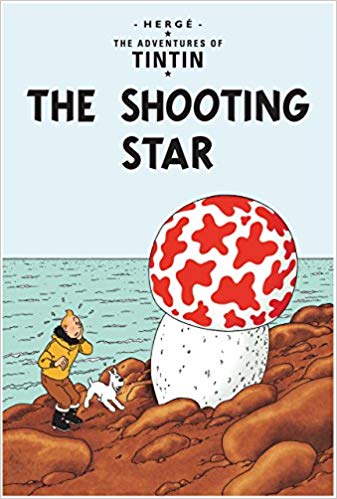
Adventures of Tintin: The Shooting Star


By Hergé & various; translated by Leslie Lonsdale-Cooper & Michael Turner (Egmont)
ISBN: 978-1-40520-621-1 (PB)

Georges Prosper Remi – AKA Hergé – created a true masterpiece of graphic literature with his astounding yarns tales of a plucky boy reporter and his entourage of iconic associates. Singly, and later with assistants including Edgar P. Jacobs, Bob de Moor and the Hergé Studio, Remi completed 23 splendid volumes (originally produced in brief instalments for a variety of periodicals) that have grown beyond their popular culture roots and attained the status of High Art.

It’s only fair, though, to ascribe a substantial proportion of credit to the many translators whose diligent contributions have enabled the series to be understood and beloved in 38 languages. The subtle, canny, witty and slyly funny English versions are the work of Leslie Lonsdale-Cooper & Michael Turner.

On leaving school in 1925, Remi worked for Catholic newspaper Le Vingtiéme Siécle where he fell under the influence of its Svengali-like editor Abbot Norbert Wallez. The following year, the young artist – a passionate and dedicated boy scout – produced his first series: The Adventures of Totor for monthly Boy Scouts of Belgium magazine.

By 1928 Remi was in charge of producing the contents of the parent paper’s children’s weekly supplement Le Petit Vingtiéme and unhappily illustrating The Adventures of Flup, Nénesse, Poussette and Cochonette when Abbot Wallez urged the artist to create an adventure series. Perhaps a young reporter who would travel the world, doing good whilst displaying solid Catholic values and virtues?

And also, perhaps, highlight and expose some the Faith’s greatest enemies and threats…?

Having recently discovered the word balloon in imported newspaper strips, Remi decided to incorporate this simple yet effective innovation into his own work. He would produce a strip both modernistic and action-packed.

Beginning January 10th 1929, Tintin in the Land of the Soviets appeared in weekly instalments, running until May 8th 1930.

Accompanied by his garrulous dog Milou (Snowy to us Brits), the clean-cut, no-nonsense boy-hero – a combination of Ideal Good Scout and Remi’s own brother Paul (a soldier in the Belgian Army) – would report back all the inequities of the world, since the strip’s prime conceit was that Tintin was an actual foreign correspondent for Le Petit Vingtiéme…

The odyssey was a huge success, assuring further – albeit less politically-charged and controversial – exploits to follow. At least that was the plan…

During the Nazi Occupation of Belgium, Le Petit Vingtiéme was closed down and Hergé was compelled to move the popular strip to the occupiers’ preferred daily newspaper Le Soir. He diligently continued producing strips for the duration, but in the period following Belgium’s liberation was accused of being a collaborator and even a Nazi sympathiser.

It took the intervention of Resistance hero Raymond Leblanc to dispel the cloud over Hergé, which he did by simply vouching for the cartoonist and by providing the cash to create a new magazine – Le Journal de Tintin – which Leblanc published and managed. The anthology comic swiftly achieved a weekly circulation in the hundreds of thousands.

With this tale we enter the Golden Age of an iconic creator’s work. Despite being produced whilst Belgium was under the control of Nazi Occupation Forces during World War II, the qualitative leap in all aspects of Hergé’s creativity is potent and remarkable.

After his homeland fell to the invaders in 1940, Georges Remi’s brief military career was over. He was a reserve Lieutenant, working on The Land of Black Gold when called up, but the swift fall of Belgium meant that he was back at his drawing board before year’s end, albeit working for a new paper on a brand-new adventure. He would not return to the unfinished Black Gold, with its highly anti-fascistic subtext, until 1949.

L’Étoile mystérieuse ran in Le Soir (the little nation’s premiere French-language newspaper and a crucial tool for the Germans to control minds, if not hearts) from October 20th 1941 to May 21st 1942: the second of six extraordinary tales of light-hearted, escapist thrills, blending strong plots and deep characterisation to create a haven of delight from the daily horrors of everyday life then and remain a legacy of joyous adventure to this day.

On completion it was collected as a full-colour book in 1942 and later serialised in French newspaper Coeurs Vaillants (from June 6th 1943). It was among a flurry of reissues of earlier albums – all but Tintin in America and The Black Island, both set in countries Germany was still at war with…

In 1954 it was remastered by Studio Hergé, to remove certain anti-Semitic and anti-American passages and imagery he had been forced to include by the paper’s controllers, and comes to us as a stunning piece of apocalyptic, sci-fi flavoured adventure…

The remastered edition of The Shooting Star was one of the first tales re-issued after World War II, due no doubt to its relatively escapist plot… it’s practically an old-fashioned pulp thriller.

It begins with the world gripped in terror as a fiery meteor is detected hurtling towards Earth. The end times are narrowly averted only by the sheerest chance, as the heavenly body narrowly misses our frail planet, although when a relatively small chunk breaks off, scientists find that it contains an unknown metal of immense potential value. And so begins a fantastic race to find and claim the fallen meteorite…

A party of European scientists charters the survey ship “Aurora”, with boozy stalwart Captain Haddock commanding and Tintin aboard as official Press representative. Frantically sailing north to the Pole, they discover that they are in competition with the unscrupulous forces of the evil capitalists of the Bohlwinkel Bank, whose rival expedition uses every dirty trick imaginable to sabotage or delay the scientists.

After a truly Herculean effort and by sheer dint of willpower – not to say spectacular bravery – Tintin is the first to claim their floating prize and successfully defends it from the villainous Bohlwinkel crew, but the fallen star itself is a far greater menace, as its mysterious and exotic composition induces monstrous gigantism in earthly organisms. Tintin and Snowy must survive assaults by mutated insects and plants before the breathtaking conclusion of this splendid tale.

Manifestly as the world experienced a new Dark Age, Hergé was concentrating on the next -Golden – one…

These ripping yarns for all ages are an unparalleled highpoint in the history of graphic narrative. Their unflagging popularity proves them to be a worthy addition to the list of world classics of literature, and stories you and your entire clan should know.
The Shooting Star: artwork © 1946, 1974 Editions Casterman, Paris & Tournai. Text © 1961 Egmont UK Limited. All rights reserved.

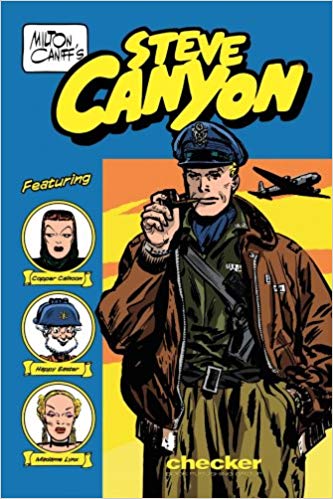
Milton Caniff’s Steve Canyon 1947


By Milton Caniff (Checker Book Publishing Group)
ISBN: 978-0-97102-49-9-1

Milton Caniff wasn’t an overnight sensation. He worked long and hard before he achieved stellar status in the comic strip firmament. Before Terry and the Pirates brought him fame, and Steve Canyon secured his fortune and reputation, the strip which brought him to the attention of legendary Press Baron “Captain” Joseph Patterson (in many ways the co-creator of Terry) was an unassuming daily feature about a little boy hungry for adventure.

Caniff was working for The Associated Press as an entry-level jobbing cartoonist when a gap opened in their strips department. AP was an organisation that devised and syndicated features for the thousands of local and small newspapers which could not afford to produce the cartoons, puzzles, recipes and other fillers that ran between the local headlines and the regional sports.

Over a weekend Caniff came up with Dickie Dare, a studious lad who would read a book and then fantasize himself into the story, taking his faithful little white dog Wags with him. The editors went for it and the strip launched on July 31st 1933. Caniff produced the adventures for less than eighteen months before moving on, but his replacement Coulton Waugh steered the series until its conclusion two decades later.

As well as being one of the greatest comic-strip artists of all time, Caniff was an old-fashioned honest American Patriot, from the time when it wasn’t a dirty word or synonym for fanatic.

The greatest disappointment of his life was that he was never physically fit enough to fight. Instead, during World War II he not only continued the morale-boosting China Seas epic Terry and the Pirates newspaper strip seven days a week, he also designed art, brochures and posters (all unpaid) for the War Department and made live appearances for soldiers and hospital residents. Even that wasn’t enough.

Again unpaid, he devised Male Cale: a strip to be printed in the thousands of local military magazines and papers around the world. Originally using established characters from Terry, Caniff swiftly switched (for reasons best explained in Robert C Harvey’s wonderful Meanwhile… a Biography of Milton Caniff) to a purpose-built (and was she built!) svelte and sexy ingénue who would titillate, amuse but mostly belong to the lonely and homesick American fighting men away from home and under arms.

Funny, saucy, even racy but never lewd or salacious, Miss Lace spoke directly to the enlisted man – the “ordinary Joe” – as entertainer, confidante and trophy date. She built morale and gave brief surcease from terror, loneliness or boredom. Although comparisons abound with our own Jane, the rationales behind each combat glamour girl were poles apart. Miss Lace spoke to and with the soldiers, and she wasn’t in normal papers. She was simply and totally theirs and theirs alone.

After leaving the incredibly successful and world-renowned Terry and the Pirates Caniff created another iconic comic hero in the demobbed World War II pilot Steve Canyon. The reasons for the move were basically rights and creative control, but it’s also easy to see another reason. Terry, set in a fabled Orient – even with the contemporary realism the author so captivatingly imparted – is a young man’s strip and limited by locale.

The worldly, if not war-weary, Canyon was a mature adventurer who could be sent literally anywhere and would appeal to the older, wiser readers of Atom-Age America, now a fully active, if perhaps reluctant, player on the world stage.

Canyon also reflects an older creator who has seen so much more of human nature and frailty than even the mysterious East could provide. Put another way, William Shakespeare could write Romeo and Juliet as a young man, but needed more than passion and genius to produce King Lear.

Steve Canyon began on 13th January 1947, after a long period of public anticipation following a very conspicuous resignation from Terry. Always a master of suspense and adept at manipulating his reader’s attention, Caniff’s eponymous hero didn’t actually appear until January 16th (and then only in a “file photograph”).

The public first met Stevenson Burton Canyon, former bomber pilot, medal winning war-hero, Air-Force flight instructor and latterly, independent charter airline operator in the first Sunday colour page, on 19th January 1947.

By then, eager readers had glimpsed his friends and future enemies, how acquaintances felt about him and even been introduced to ultra-rich, super-spoiled Copper Calhoun, the latest in a startlingly long line of devastating Femme Fatales created by Caniff to bedevil his heroes and captivate his audiences. And thus, the magic began…

This series of collections from Checker re-presents the strip in yearly segments (regrettably, with the Sundays printed in the same black-&-white as the daily episodes) and this one begins as Calhoun manoeuvres Canyon’s Horizons Unlimited charter line into flying her to countries where her pre-war holdings were disrupted. That seemingly simple job results in deadly peril from both strangers and trusted employees. There’s also a goodly helping of old-fashioned intrigue, jealousy and racketeering in the mix too…

The action and tragedy lead directly to an encounter with a couple of deadly female con-artists in ‘Delta’, and a gripping, yet light-hearted, romp in the booming petroleum industry in ‘Easter’s Oil’ which also introduces off-the-wall supporting character Happy Easter and the lascivious Madame Lynx, who would play such large and charismatic roles in the strip’s future.

The first volume ends with ‘Jewels of Africa’, a classic of suspense with modern-day pirate and wrecker Herr Splitz falling foul of our heroes in a world rapidly becoming a hotbed of International tension.

As Caniff’s strip became more and more a compass of geo-political adventure, his skill with human drama became increasingly mature and intense. This was comic strip noir that was still irresistible to a broad spectrum of readers. And that’s as true now as it was then. Steve Canyon is magnificent comic art at its two-fisted best.

These stories are also available in a fancy IDW hardcover archive, but although lovely it does suffer from small print – unless you have a digital edition – so if you love stunning artwork stick with this cheap-&-cheerful monochrome version.
© 2003, Checker Book Publishing Group, an authorized collection of works © Ester Parsons Caniff Estate 1947.

All characters and distinctive likenesses thereof are trademarks of the Ester Parsons Caniff Estate. All rights reserved.

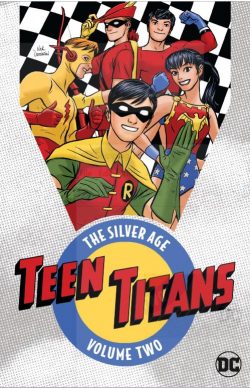
Teen Titans: The Silver Age Volume Two


By Bob Haney, Len Wein, Marv Wolfman, Nick Cardy, Irv Novick, Bill Draut, Gil Kane, Wally Wood, Neal Adams & various (DC Comics)
ISBN: 978-1-4012-8517-3 (TPB)

The concept of kid hero teams was already ancient when the 1960s Batman TV show finally prompted DC to trust their big heroes’ assorted sidekicks with their own regular comic. The outcome was a fab, hip and groovy ensemble as dedicated to helping kids as they were to stamping out insidious evil.

The biggest difference between the creation of the Teen Titans and wartime groups such as The Young Allies, Newsboy Legion and Boy Commandos or even 1950s holdovers like The Little Wise Guys or Boys Ranch was quite simply the burgeoning phenomena of “The Teenager” as a discrete social and commercial force.

These were kids who could – and should – be allowed to do things themselves without constant adult help or supervision…

This quirkily eclectic trade paperback and eBook compilation re-presents the rapidly-evolving and ending swinging Sixties exploits from Teen Titans #12-24 plus a guest-shot from The Brave and the Bold #83 collectively spanning November/December 1967 to November/December 1967 1969.

With Bob Haney still scripting and the accent still heavily on fun, the action resumes here with twin contemporary hot-topics the Space-Race and Disc Jockeys informing whacky sci fi thriller ‘Large Trouble in Space-Ville!’ Illustrated by Irv Novick & Nick Cardy, the gang thwart aliens stealing Earth’s monuments after which Cardy flies solo for TT #13, producing a seasonal comics masterpiece with ‘The TT’s Swingin’ Christmas Carol!’, a stylish retelling that’s one of the most reprinted Titans tales ever.

At this time Cardy’s art really opened up as he grasped the experimental flavour of the times. The cover of #14, as well as the interior illustration for the grim psycho-thriller ‘Requiem for a Titan’, are unforgettable. The tale introduces the team’s first serious returning villain (Mad Mod does not count!): the Gargoyle is mesmerising and memorable, and although Cardy only inked Lee Elias’s pencils for #15’s eccentric tryst with the Hippie counter-culture, ‘Captain Rumble Blasts the Scene!’ is a genuinely unique crime-thriller from a time when nobody over age 25 understood what the youth of the world was doing…

Teen Titans #16 returned to more solid ground with superb, scene-setting thriller ‘The Dimensional Caper!’ as rapacious sinister aliens infiltrate a rural high-school (and how many times have you seen that plot used since this 1968 epic?).

Cardy’s art reached dizzying heights of innovation both here and in the next issue’s waggish jaunt to London ‘Holy Thimbles, It’s the Mad Mod!’ (alternatively and uninspiringly retitled ‘The Return of the Mad Mod’ here). The frantic criminal chase through Cool Britannia which unfolds even includes a command performance from Her Majesty, the Queen!

Next up is a fannish landmark – and hint of things to come – as novice writers Len Wein & Marv Wolfman got their big break with a tale introducing Russian superhero Starfire (latterly redubbed Red Star) which set them firmly on a path of teen super-team writing. ‘Eye of the Beholder’ is a cool cat burglar/super heist yarn set in trendy Stockholm, drawn with superb understatement by Bill Draut, and acting a perfect indicator of the changes in style and attitude that would become part of the Teen Titans and the comics industry itself in later decades…

Maintaining the experiments with youthful authorial voices, the entertainment continues with a beautifully realised comedy-thriller as boy Bowman Speedy joins the team full-time. ‘Teen Titans: Stepping Stones for a Giant Killer!’ (#19, January/February 1969) is by Mike Friedrich, with stunning art from Gil Kane & Wally Wood, and pits the team against youthful criminal mastermind Punch who plans to kill the Justice League of America and thinks a trial run against the junior division a smart idea…

TT #20 took that long-running plot-thread of extra-dimensional invaders and gave it a counterculture twist in ‘Titans Fit the Battle of Jericho’: a spectacular rollercoaster romp deftly blending teen revolt, organised crime, anti-capitalist activism, bug-eyed monsters and cunning extraterrestrial conquerors written by Neal Adams, pencilled by him and Sal Amendola and inked by brush-maestro Nick Cardy – one of the all-out prettiest illustration jobs of that decade.

Team-up vehicle The Brave and the Bold # 83 (April-May 1969) then took a radical turn as in ‘Punish Not my Evil Son!’, the Teen Titans (sans Aqualad, who was dropped to appear more prominently in Aquaman and because there just ain’t that much sub-sea malfeasance) try to save Bruce Wayne‘s latest foster-son from his own inner demons in a tense thriller about trust and betrayal by Haney & Adams.

Symbolic super-teens Hawk and Dove briefly join the proceedings for #21’s ‘Citadel of Fear’ (Adams & Cardy), chasing smugglers, finding aliens and ramping up the surly teen rebellion quotient whilst moving the invaders story-arc towards a stunning conclusion. ‘Halfway to Holocaust’ is only half of #22; the abduction of Kid Flash and Robin leading to a cross-planar climax as Wonder Girl, Speedy and a radical new ally quash the invasion forever, but still leave enough room for a long overdue makeover in ‘The Origin of Wonder Girl’ by Wolfman, Kane & Cardy.

For years the series – and DC in general – had fudged the fact that the younger Amazon Princess was not actually human, a sidekick, or even a person, but rather an incarnation of the adult Wonder Woman as a child. As continuity backwriting strengthened its stranglehold on the industry, it was felt that the team-tottie needed a fuller background and this moving tale reveals that she is in fact a human foundling rescued by Wonder Woman and raised on Paradise Island where their super-science gave her all the powers of a true Amazon.

They even found her a name – Donna Troy – and an apartment, complete with hot roommate. All Donna has to do is sew herself a glitzy new costume…

Now thoroughly grounded in “reality”, the team jet south in #23’s fast-paced yarn ‘The Rock ‘n’ Roll Rogue’ (by Haney, Kane & Cardy), seeking to rescue musical rebel Sammy Soul from his grasping family and subsequently, his missing dad from Amazonian headhunters.

This volume, and an era of relative innocence, ends with ‘Skis of Death!’ by the same creative team which sees the adventurous quartet vacationing in the mountains and uncovering a scam to defraud Native Americans of their lands.

It’s a terrific old-style tale but with the next issue (and collected volume) the most radical change in DC’s cautious publishing history made Teen Titans a comic which had thrown out the rulebook…

Although perhaps somewhat dated in delivery, these tales were a liberating experience for kids when first released and remain a highly entertaining experience even now. They truly betokened a new empathy with independent youth and tried to address problems that were more relevant to and generated by that specific audience. That they are so captivating in execution is a wonderful bonus. This is absolute escapism and absolutely delightful.
© 1967, 1968, 1969, 2018 DC Comics. All Rights Reserved.

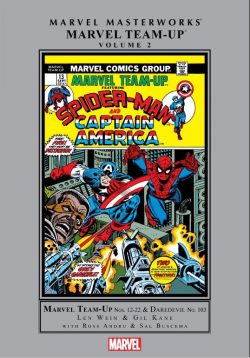
Marvel Team Up Marvel Masterworks volume 2


By Len Wein, Gerry Conway, Steve Gerber, Gil Kane, Ross Andru, Sal Buscema, Don Heck & various (Marvel)
ISBN: 978-0-7851-5933-9 (HB)

Inspiration isn’t everything. In fact, as Marvel slowly grew to a position of market dominance in the wake of the losing their two most innovative and inspirational creators, they did so less by experimentation and more by expanding proven concepts and properties. The only real exception to this was the en masse creation of horror titles in response to the industry down-turn in super-hero sales – a move expedited by a rapid revision in the wordings of the increasingly ineffectual Comics Code Authority rules.

The concept of team-up books – an established star pairing or battling (often both) with less well-selling company characters – was not new when Marvel decided to award their most popular hero the lion’s share of this new title, but they wisely left their options open by allocating an occasional substitute lead in the Human Torch. In those long-lost days, editors were acutely conscious of potential over-exposure – and since super-heroes were actually in a decline at that time they may well have been right.

Nevertheless, Marvel Team-Up was the second full-Spider-Man title (abortive companion title Spectacular Spider-Man was created for the magazine market in 1968 but had died after two issues), launching in March 1972, and becoming a resounding hit.

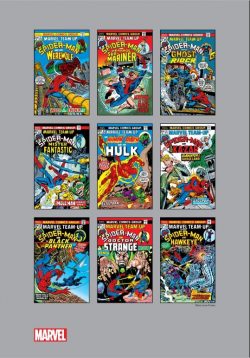
This second sturdy compilation (in hardback or digital formats) gathers material from MTU #12-22 plus a crossover with Daredevil (and the Black Widow) #103 spanning August 1973 to June 1974 and opens with a fond, if self-proclaimed foggy, recollection from then Editor-in-Chief Roy Thomas in his cheery Introduction before we plunge into the many-starred dramas…

Len Wein scripted a Gerry Conway plot for ‘Wolf at Bay!’ from MTU #12 as the Wall-Crawler meets the Werewolf By Night Jack Russell and malevolent mage Moondark in foggy San Francisco, as deftly delineated by Ross Andru & Don Perlin, after which we divert to the Man without Fear and the Black Widow’s own title. Here they share the left coast limelight as Daredevil #103 sees them joining with the still California-bound wallcrawler. A merciless cyborg attacks the odd couple while they pose for roving photojournalist Peter Parker in ‘…Then Came Ramrod!’ – by Steve Gerber, Don Heck & Sal Trapani – and the only response can be battle…

Gil Kane & Frank Giacoia illustrated ‘The Granite Sky!’ wherein Wein pits Spider-Man and Captain America against Hydra and the Grey Gargoyle in a simple clash of ideologies after which ‘Mayhem is… the Men-Fish!’ (inked by Wayne Howard – and, yes bad grammar, but great action-art!) matches the webslinger with the savage Sub-Mariner against vile villains Tiger Shark and Doctor Dorcas as well as an army (navy?) of mutant sea-beasts.

Wein, Andru & Perlin created The Orb to bedevil Spidey and the Ghost Rider in ‘If an Eye Offend Thee!’ in #15 after which Kane & Jim Mooney illustrated ‘Beware the Basilisk my Son!’: a gripping romp featuring (the original Kree) Captain Marvel, which concludes in ‘Chaos at the Earth’s Core!’ (inked by “everybody”!), as Mister Fantastic joins the fracas to stop the Mole Man from inadvertently blowing up the world.

Human Torch Johnny Storm teams with the Hulk in MTU #18 to stop antimatter malcontent Blastaar in ‘Where Bursts the Bomb!’ (inked by Giacoia & Esposito), but Spidey blazes back a month later with Ka-Zar in situ to witness ‘The Coming of… Stegron, the Dinosaur Man!’ (Wein, Kane & Giacoia) whose plans to flatten New York by releasing ‘Dinosaurs on Broadway!’ is foiled with the Black Panther‘s help – as well as the artistic skills of Sal Buscema, Giacoia & Esposito.

Dave Hunt replaced Esposito and aide Giacoia inking ‘The Spider and the Sorcerer!’ in #21 as Spidey and Doctor Strange once more battle Xandu, a wily wizard first seen in Spider-Man Annual #2, before ‘The Messiah Machine!’ brings the story glories to a conclusion by depicting Hawkeye and the Amazing Arachnid frustrating deranged computer Quasimodo‘s ambitious if absurd mechanoid invasion.

Adding extra lustre before we close, there’s a brace of original art pages from Andru & Perlin and Kane and Mooney to drool over, too…

These stories are of variable quality but nonetheless all have an honest drive to entertain and please, whilst artistically the work – particularly action-man-on-fire Gil Kane – is superb, and most fans of the genre would find little to complain about. Although not really a book for casual or more maturely-oriented readers there’s lots of fun on hand and young readers will have a blast, so there’s no real reason not to add this tome to your library…
© 1973, 1974, 2018 Marvel Characters, Inc. All rights reserved.

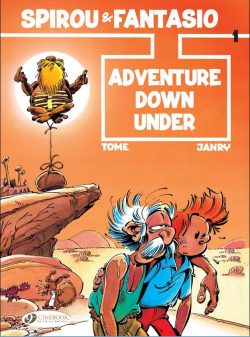
Spirou and Fantasia volume 1: Adventure Down Under


By Tome & Janry, translated by Jerome Saincantin (Cinebook)
ISBN: 978-1-84918-011-5

For most English-speaking comic fans and collectors Le Journal de Spirou is probably Europe’s biggest secret. The character is a rough contemporary – and bald commercial response – to Hergé’s iconic superstar Tintin, whilst the comic he has headlined for decades is only beaten in sheer longevity and creativity by our own Beano and Dandy.

First conceived at Belgian Printing House by Jean Dupuis in 1936, a magazine targeting a juvenile audience debuted on April 21st 1938 (three and a bit months before DC Thomson’s Beano, but still beaten by The Dandy which launched on December 4th 1937). It was edited by Charles Dupuis (a mere tadpole, only 19 years old himself) and took its name from the lead feature, which recounted the improbable adventures of a plucky bellboy/lift operator employed by the Moustique Hotel: a reference to the publisher’s leading magazine, Le Moustique.

With his pet squirrel, Spip (who joined the cast on June 8th 1939; he’s the longest running character in the strip after Spirou himself, so happy 80th anniversary, little dude!) the plucky kid was the idea of French artist Robert Velter, who signed himself Rob-Vel.

A Dutch language edition – Robbedoes – debuted a few weeks later and ran more-or-less in tandem with the French parent comic until it’s cancellation in 2005.

Although some home-grown product crept in, the bulk of the comic was taken up with cheap American reprint imports: Red Ryder by Fred Harman, William Ritt & Clarence Gray’s Brick Bradford and Siegel & Shuster’s landmark creation Superman. Most prominent were ‘Tif et Tondu’ by Fernand Dineur (which ran until the1990s) and ‘L’Epervier Blue’ by Sirius (Max Mayeu), and they were soon supplemented by comic-strip wunderkind Joseph Gillain – “Jije”. During World War II Jije legendarily drew the entire comic by himself, continuations of the banned US imports included, as well as assuming production of the Spirou strip where he created the current co-star Fantasio.

Except for a brief period when the Nazis closed the comic down (September 1943 to October 1944 when the Allies liberated Belgium) Spirou and its boyish star – now a globe-trotting reporter – have continued their weekly exploits in unbroken four-colour glory.

Among the other myriad major features that began within those pages are ‘Jean Valhardi’ (Jean Doisy & Jije), ‘Blondin et Cirage’ (Victor Hubinon), Buck Danny, ‘Jerry Spring’, ‘Les Schtroumpfs’ (AKA the Smurfs), Gaston Lagaffe (here seen as Gomer Goof) and a certain laconic cowboy named Lucky Luke.

Spirou the character (the name translates as both “squirrel” and “mischievous”) has starred in the magazine for most of its life, evolving – under a succession of creators – into a simultaneously urbane yet raucous fantasy/adventure hero with the accent heavily on light humour.

With comrade and rival Fantasio and crackpot inventor the Count of Champignac, Spirou travels to exotic places, uncovering crimes, revealing the fantastic and garnering a coterie of exotic arch-enemies.

During the War, when Velter went off to fight, his wife Blanche Dumoulin took over the strip using the name Davine, assisted by Luc Lafnet. Dupuis assumed control of and rights to the strip in 1943, assigning it to Jije who handed it to his assistant André Franquin in 1946. It was the start of a golden age.

Among Franquin’s innovations were villains Zorglub and Zantafio, Champignac and one of the first strong female characters in European comics, rival journalist Seccotine (renamed Cellophine in this current English translation), but his greatest creation – one he retained on his departure in 1969 – was the incredible magic animal Marsupilami (first seen in Spirou et les héritiers in 1952). The little perisher is now a star of screen, plush toy store, console and albums all his own.

From 1959 writer Greg and background artist Jidéhem assisted Franquin, but by 1969 the artist had reached his Spirou limit and resigned, taking his mystic yellow monkey with him. He was succeeded by Jean-Claude Fournier who updated the feature over the course of nine stirring adventures that tapped into the rebellious, relevant zeitgeist of the times with tales of environmental concern, nuclear energy, drug cartels and repressive regimes.

As the series entered the 1980s Spirou seemed to stall: three discrete creative teams alternated on the serial: Raoul Cauvin & Nic Broca, Yves Chaland and the creators of the graphic novel under review here: Philippe Vandevelde writing as Tome and artist Jean-Richard Geurts AKA Janry.

These last adapted and referenced the beloved Franquin era and revived the feature’s fortunes, producing 14 wonderful albums between 1984 and 1998. This one, Spirou et Fantasio 34 – Aventure en Australie from 1985, was their second.

Since their departure Lewis Trondheim, and the teams of Jean-Davide Morvan & Jose-Luis Munuera and Yoann & Vehlmann, have brought the official album count to 55 (there also are a bunch of specials, spin-offs and one-shots, official and otherwise)…

Without further ado we plunge straight into the bizarre, treasure-hunting drama as dire doings Down Under segue into Spirou and Fantasio arriving home exhausted from their latest assignment. They are intercepted by Cellophine at the airport: odd things are occurring in the depths of the Outback and the always-newsworthy Count of Champignac is right at the heart of it. Instantly awake again, all three jet out to Australia where nefarious deeds are occurring at the desolate Albuh Opal Mine.

The crazy inventor is there on the verge of a fabulous and incredible discovery far more precious than jewels, but the ruthless miners don’t seem that impressed, although they are worried by disappearing diggers, inexplicable accidents, men driven crazy and, if some observers are to be believed, levitating aborigines…

This classy blend of thrilling mystery, weird science, light adventure and broad slapstick remains a pure refreshing joy in a market far too full of adults-only carnage and testosterone-fuelled breast-beating. Easily accessible to readers of all ages drawn with all the welcoming style and panache that makes Asterix, Lucky Luke and Iznogoud so compelling and readily available in both paperback album and eBook formats, this is a cracking read and the start of a long line of translated epics that should be as much a household name as those series – and even Tintin himself…
Original edition © Dupuis, 1985 by Tome & Janry. All rights reserved. English translation 2009 © Cinebook Ltd.

Trish Trash Rollergirl of Mars: The Collected Edition


By Jessica Abel, with Lydia Roberts & Walter various (Super Genius/Papercutz)
ISBN: 978-1-5458-0167-3 (TPB)               978-1-5458-0166-6 (HB)

Our fascination with Mars has never faltered and now that we seem within touching distance, the Red Planet’s allure and presence in our fiction has never been more broad-based and healthily imaginative. Amidst all the recent TV, movie and literary product, one of the most engaging treatments has been a comics serial detailing the life of an extraordinary young woman in exceedingly trying times.

After Earth collapsed in an ecological and economic meltdown, the recently arrived first settlers on Mars became trapped under an increasingly burdensome fixed economic structure and oppressive corporate plutocracy. Two hundred years later, an entire class of indentured servants eke out a fraught existence, harvesting water and food with machines rented from Arex (“we’re the air that you breathe”). The air they don’t breathe is meagre, toxic, dust-filled and slightly radioactive…

On Mars, everything belongs to the company, and people usually go from cradle to grave in crippling debt. There is, ostensibly, a chance to escape: mandatory offworld mining missions to the asteroid belt. These Temporary Labor Assignments, however, are looked on as a quick ticket to certain death…

All tyrannies need bread and circuses though. On Mars that’s Hoverderby.

Based on the ancient Earth entertainment, teams of women race around a hover track in flying boots, scoring points by beating each other up. It’s the planet’s most popular spectator sport and Arex own that too…

Trish Nupindu is seven-and-a-half (on Mars: in Earth terms that’s 15), a smart, recently-orphaned kid who’s really good with engines and mechanical systems. Stuck on her aunt’s water farm, she dreams of becoming a Hoverderby star and is utterly discontented with the state of her existence…

All “Martys” reel from the force of crushing, inescapable poverty and Trish believes her only chance of getting out from under a system stacked from the get-go against ordinary people is to become a media star of the great sport.

Bold and impatient, she sneaks off to join the local team and is suckered into a binding intern’s contract, even though she’s under-age…

Trish doesn’t even get to play: the team manager wants her because she’s good at repairing the hoverboots continually malfunctioning due to the all-pervasive dust…

The world turns upside down after she and her avowed-revolutionary pal Marq discover a native Martian. Recalled from near-death, the mythical creature opens their eyes to a whole new world and “her” secrets will change forever not just the way Hoverderby is played but the very economic balance of power on the Red Planet… if the ruthless upper echelons of Arex don’t stop them first…

The inspirational drama is backed up by extensive supplemental features delivered in the manner of wiki pages such as the rules of Hoverderby; Derby Gear: Then and Now; illustrated specifications for Radsuits; fact-features on The Homestead Debate, Native Martians, Ares Collective Statement of Debt (ACSOD), TLAs, Asteroid Mining and legendary water miner Ismail Khan, faux kids’ comics “True Tales of the Early Colonists” and a complete Timeline of Mars Colonization.

Jessica Abel has been wowing readers and winning prizes since 1997 when she took both the Harvey and Lulu awards for Best New Talent. Her previous graphic delights include the fabulous Artbabe, Growing Gills, Life Sucks, Drawing Words & Writing Pictures, collections Soundtrack and Mirror, Window plus the Harvey-winning La Perdida.

Trish Trash has been gradually unfolding since 2016: a sublime blend of subversive human drama and hard science fiction thriller with a supremely human and believable lead taking charge and changing the world. After three previous album releases, the entire saga is now available in oversized (218 x 284 mm) hardback, paperback and eBook editions, at least one of which you really must see ASAP.
© Jessica Abel and Dargaud. All rights reserved. All other editorial material © 2018 by Super Genius.

Trish Trash Rollergirl of Mars: The Collected Edition will be released January 22nd 2019 and is available for pre-order now.

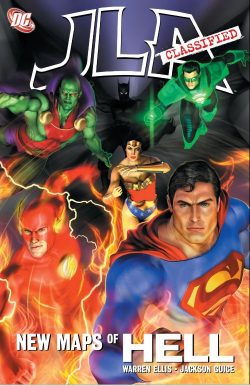
JLA Classified: New Maps of Hell


By Warren Ellis, Jackson Guice & various (DC Comics)
ISBN: 978-1-4012-0944-5 (TPB)

It’s been quite a while since we covered a good old-fashioned straightforward and no-strings-attached superhero blockbuster: one which any old punter can pick up with no worry over continuity or identification and where good guys and bad guys are clearly defined.

That’s due in large part to the fact that nobody really does those anymore, but at least it gives me the opportunity to take another look at a tale I didn’t much like when it first came out in 2006, but which has definitely grown on me with every re-read.

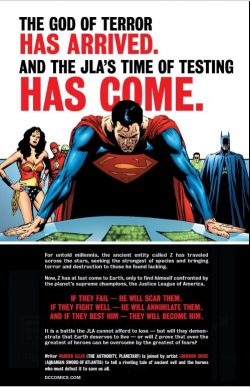
Produced at a time when the Justice League of America was enjoying immense popularity and benefiting from a major reboot courtesy of Grant Morrison, this politically-barbed, end-of-the-world epic – starring Superman, Batman, Wonder Woman, Flash, Green Lantern, Oracle and Martian Manhunter – originally ran in issues #10-15 of spin-off title JLA Classified (cover-dated September 2005 to February 2006), with gritty futurist super-scribe Warren Ellis upping the angst-quotient on a hoary old plot whilst hyper-realist illustrator Jackson Guice adds a terrifying veracity to events.

The drama begins as Clark Kent and wife Lois Lane stumble onto a dirty little secret. Assorted, and one would assume unconnected, scientists and bean-counters at President Luthor’s Lexcorp conglomerate have been committing suicide in large numbers and now, the intrepid reporters suspect something very nasty is going on…

In Gotham City, Batman learns the police have been turned away from an extremely unconventional crime-scene by Feds and a private security company, and he too starts digging…

In the Bermuda triangle, a group of researchers are invited to the Amazon’s ancient library of knowledge only to die when the sky-floating island explodes in a horrendous detonation.

Legacy Flash Wally West has terrible dreams of his beloved predecessor Barry Allen which lead him to a similar catastrophic conflagration, whilst Green Lantern Kyle Rayner ruminates on a primordial legend of the Corps’ origins until a wave of explosions rouse him to action.

In the ruins of each disaster the scattered, hard-pressed heroes find an ancient parchment of alien hieroglyphs and, when Superman recovers another page of the same from the shredded remnants of a plummeting space station, the call goes out to activate the League…

Tasking cyber-savant Oracle and aged Martian sole survivor J’onn J’onzz with uncovering information, the team learn of an antediluvian scourge which wracked the red planet millions of years past. A God/Devil which tested a species right to survive and heralded its coming through a written code…

Moreover, Luthor’s scientists have found such writings in remnants of ancient Sumeria and begun deciphering the text…

Mobilising to stop the summoning, our heroes confront Luthor in the White House but are too late. In Las Vegas the bowels of Hell vomit horrors into the streets and as the frantic super squad rush to battle they are snatched up, separated by the malign entity which has spent eons traversing the universe testing the worth of intelligent races and individually putting them to their sorest tests.

However, the monstrous terror has never faced beings like the JLA before, or a mind like Batman’s, and soon the horror’s own darkest secret is exposed and its fatal weakness exploited to devastating effect…

With a painted cover gallery by Michael Stribling, this book – now also available in eBook formats – offers simple, solid Fights ‘n’ Tights fun gilded with a sly and cynical post-modern edge: a sound example of costumed action blockbuster comics at their best.
© 2006 DC Comics. All Rights Reserved.

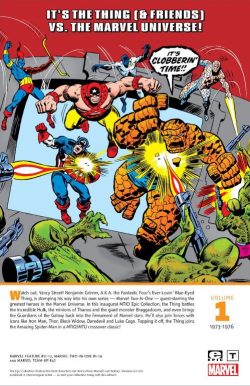
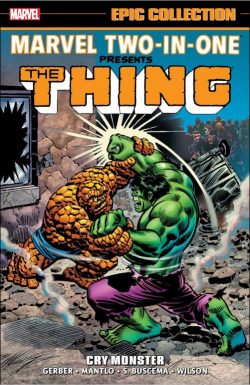
Marvel Two-In-One Epic Collection volume 1 1973-1976: Cry Monster


By Steve Gerber, Bill Mantlo, Len Wein, Mike Friedrich, Chris Claremont, Roy Thomas, Roger Slifer, Marv Wolfman, Scott Edelman, Tony Isabella, Jim Starlin, Gil Kane, Sal Buscema, George Tuska, Herb Trimpe, Bob Brown, Ron Wilson, Arvell Jones & various (Marvel)
ISBN: 978-1-3029-1332-8 (TPB)

Imagination isn’t everything. As Marvel slowly grew to a position of dominance in the wake of the losing their two most innovative and inspirational creators, they did so less by experimentation and more by expanding and exploiting proven concepts and properties.

The only real exception to this was the en masse creation of horror titles in response to the industry down-turn in super-hero sales – a move expedited by a rapid revision in the wordings of the increasingly ineffectual Comics Code Authority rules.

The concept of team-up books – an established star pairing, or battling – preferably both – with less well-selling company characters was not new when Marvel decided to award their most popular hero the lion’s share of this new title, but they wisely left their options open by allocating an occasional substitute lead in the Human Torch. In those long-lost days, editors were acutely conscious of potential over-exposure – and since super-heroes were actually in a decline, they may well have been right.

After the runaway success of Spider-Man’s Marvel Team-Up the House of Ideas carried on the trend with a series starring bashful, blue-eyed Ben Grimm – the Fantastic Four’s most iconic member – beginning with a brace of test runs in Marvel Feature before graduating to its own somewhat over-elaborate title.

This trade paperback and eBook compendium gathers together the contents of Marvel Feature #11-12, Marvel Two-In-One #1-19, 22-25 and Marvel Team-Up #47, covering the period September 1973 – September 1976, and kicks off with a perennial favourite pairing as the Thing again clashes with the Hulk in ‘Cry: Monster! (by Len Wein, Jim Starlin & Joe Sinnott) wherein Kurrgo, Master of Planet X and the lethal Leader manipulate the blockbusting brutes into duking it out – ostensibly to settle a wager – but with both misshapen masterminds concealing hidden agendas…

That ever-inconclusive yet cataclysmic confrontation strands Ben in the Nevada desert where Mike Friedrich, Starlin & Sinnott promptly drop him into the middle of the ongoing war against mad Titan Thanos as Iron Man – helped by the Thing – crushes monstrous alien invaders in ‘The Bite of the Blood Brothers!’ (#12, November 1973); another spectacular and painfully pretty, all-action punch-up.

Still stuck in the desert when the dust settles Ben eventually treks to an outpost of civilisation just in time to be diverted to Florida for Marvel Two-In-One #1 (January 1974). Here Steve Gerber, Gil Kane & Sinnott magnificently reveal the ‘Vengeance of the Molecule Man!’ as Ben learns some horrifying home truths about what constitutes being a monster, battling with and beside ghastly grotesque anti-hero Man-Thing.

With the second issue Gerber cannily traded a superfluous supporting character from the Man-Thing series to add some much-needed depth to the team-up title. ‘Manhunters from the Stars!’ pits Ben, old enemy Sub-Mariner and the Aquatic Avenger’s powerful cousin Namorita against each other and aliens hunting the emotionally and intellectually retarded superboy Wundarr in another dynamically intoxicating tale illustrated by Kane & Sinnott. That case also leaves the Thing de facto guardian of the titanic teenaged tot…

Sal Buscema signed on as penciller with #3 with the Rocky Ranger joining the Man Without Fear ‘Inside Black Spectre!’: a crossover instalment of an extended epic then playing out in Daredevil #108-112 (this action-packed fight-fest featuring the swashbuckler and the Black Widow occurring between the second and third chapters), after which ‘Doomsday 3014!’ (Gerber, Buscema & Frank Giacoia) finds Ben and Captain America catapulted into the 31st century to save Earth from enslavement by the reptilian Brotherhood of Badoon, leaving Wundarr with Namorita for the foreseeable future…

The furious future-shocker concluded in MTIO #5 as the Guardians of the Galaxy (the future team not the modern movie sensations) climb aboard the Freedom Rocket to help the time-lost heroes liberate New York before returning home. The overthrow of the aliens was completed by another set of ancient heroes in Defenders #26-29 in case you’re the kind of reader that craves comics closure…).

Marvel Two-In-One #6 (November 1974) began a complex crossover tale with the aforementioned Defenders as Dr. Strange and the Thing are embroiled in a cosmic event which begins with a subway busker’s harmonica and leads inexorably to a ‘Death-Song of Destiny!’ (Gerber, George Tuska & Mike Esposito) before Asgardian outcasts Enchantress and the Executioner attempt to seize control of unfolding events in #7’s ‘Name That Doom!’ (pencilled by Sal Buscema), only to be thwarted by Grimm and the valiant Valkyrie. There’s enough of an ending here for casual readers but fans and completists will want to hunt down Defenders #20 or one of many collected volumes for the full story…

Back here, though, issue #8 teamed the Thing and supernatural sensation Ghost Rider in a quirky yet compelling Yuletide yarn for a ‘Silent Night… Deadly Night!’ (Gerber, Buscema & Esposito) wherein the audacious Miracle Man tries to usurp a very special birth in a stable…

Gerber moved on after plotting the Thor team-up ‘When a God goes Mad!’ for Chris Claremont to script and Herb Trimpe & Joe Giella to finish: a frankly meagre effort with the Puppet Master and Radion the Atomic Man making a foredoomed powerplay, but issue #10 serves up a slice of inspired espionage action with Ben and the Black Widow battling suicidal terrorist Agamemnon. He plans to detonate the planet’s biggest nuke in the blistering thriller ‘Is This the Way the World Ends?’ by Claremont, Bob Brown & Klaus Janson.

Marvel Two-In-One had quickly become a clearing house for cancelled series and uncompleted storylines. Supernatural star The Golem had featured in Strange Tales #174, 176 and 177 (June-December 1974) before being summarily replaced mid-story by Adam Warlock and MTIO #11 provided plotter Roy Thomas, scripter Bill Mantlo and artists Brown & Jack Abel opportunity to end the saga when ‘The Thing Goes South’ results in stony bloke and animated statue finally crushing the insidious plot of demonic wizard Kaballa.

Young Ron Wilson began his lengthy association with the series and the Thing in #12 as Iron Man and Ben tackle out of control, mystically-empowered ancient Crusader Prester John in ‘The Stalker in the Sands!’; a blistering desert storm written by Mantlo and inked by Vince Colletta, after which Luke Cage, Power Man pops in to help stop a giant monster in ‘I Created Braggadoom!, the Mountain that Walked like a Man!’: an old fashioned homage scripted by Roger Slifer & Len Wein, after which Mantlo, Trimpe & John Tartaglione collaborate on a spooky encounter with spectres and demons in #14’s ‘Ghost Town!’ This moody mission is shared with bellicose newcomer The Son of Satan…

Mantlo, Arvell Jones & Dick Giordano bring on ‘The Return of the Living Eraser!’: a dimension-hopping invasion yarn introducing Ben to Morbius, the Living Vampire before a canny crossover epic begins with the Thing and Ka-Zar plunging ‘Into the Savage Land!’ to dally with dinosaurs and defeat resource-plunderers, after which the action switches to New York as Spider-Man joins the party in MTIO #17 to combat ‘This City… Afire!’ (Mantlo, Sal Buscema & Esposito) when a mutated madman transports an active volcano from Antarctica to the Hudson River with the cataclysmic conclusion (from Marvel Team-Up #47) following, wherein Mantlo, Wilson & Dan Adkins reveal how the day is saved in fine style with ‘I Have to Fight the Basilisk!’

Another short-changed supernatural serial was finally sorted out in MTIO #18. ‘Dark, Dark Demon-Night!’ by Mantlo, Scott Edelman, Wilson, Jim Mooney & Adkins, sees mystical watchdog The Scarecrow escape from its painted prison to foil a demonic invasion with the reluctant assistance of the Thing, after which Tigra the Were-Woman slinks into Ben’s life to vamp a favour and crush a sinister scheme by a rogue cat creature in ‘Claws of the Cougar!’ by Mantlo, Sal Buscema, & Don Heck.

This initial compendium also includes house ads, and loads of original art and covers from Kane, Wilson and Buscema to seal a splendid deal. These stories from Marvel’s Middle Period are of variable quality but nonetheless all are honest efforts to entertain and exhibit a dedicated drive to please. Whilst artistically the work varies from adequate to quite superb, most fans of frantic Fights ‘n’ Tights genre would find little to complain about.

Although not really a book for casual or more maturely-oriented readers there’s lots of fun on hand and young readers will have a blast, so why not add this titanic tome to your straining superhero bookshelves?
© 1973, 1974, 1975, 1976, 2018 Marvel Characters, Inc. All rights reserved.