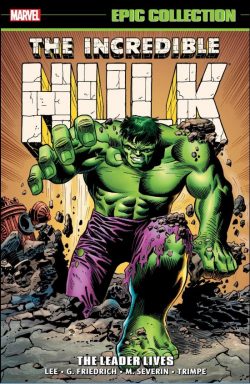
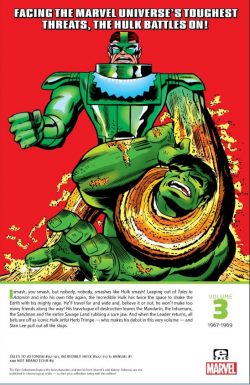
Incredible Hulk Epic Collection volume 3 1967-1969: The Leader Lives


By Stan Lee, Gary Friedrich, Roy Thomas, Bill Everett, Archie Goodwin, Marie Severin, Herb Trimpe, Frank Giacoia & various (Marvel)
ISBN: 978-1-3029-1313-7

We lost some grand masters of our art form this year, including arguably the biggest name left in the pantheon in American comics, Stan Lee. Also gone are the last vestiges of Marvel’s core “bullpen”: those often-unsung wonders who brought the fantastic and terrific tales to light. One of the best, most talented and certainly the nicest was Marie Severin. You should definitely look her up in all the old familiar places…

A lesser-known luminary, but one with some key credits to his name, is Gary Friedrich who died in August. As well as the material cited below, he worked on Rawhide Kid, Sgt Fury, Steve Ditko’s Blue Beetle and co-created Ghost Rider and the Phantom Eagle. You might also know him for Combat Kelly and Marvel UK’s Captain Britain.

Here’s a recently-released collection with all of them at their very best…

Bruce Banner was a military scientist who was caught in a gamma bomb blast. As a result of ongoing mutation, stress and other factors can cause him to transform into a giant green monster of unstoppable strength and fury.

After an initially troubled few years the gamma-irradiated gargantuan finally found his size 700 feet and a format that worked, becoming one of young Marvel’s most popular features. After his first solo-title folded, The Hulk shambled around the slowly-coalescing Marvel Universe as guest star and/or villain du jour until a new home was found for him and this trade paperback (and eBook) volume covers his years as co-star of “split-book” Tales to Astonish; specifically issues #97-101; issues #102-117 of the solo-starring Incredible Hulk, the first Incredible Hulk Annual and a splendidly silly spoof yarn from Not Brand Echh #9 – spanning collectively November 1964 to June 1969.

The wonderment begins with the Jade Juggernaut recently returned to Earth by the now god-like High Evolutionary, and unknowingly gearing up to the next big change in his life. In TtA #97 he shambles into a high-tech plot to overthrow America in courtesy of ‘The Legions of: the Living Lightning!’ (by Stan Lee, Marie Severin & Herb Trimpe), but the subversives’ beguilement of the monstrous outcast and conquest of a US military base in ‘The Puppet and the Power’ soon falters and fails ‘When the Monster Wakes!’: this last chapter inked by John Tartaglione.

As I’ve already mentioned Tales to Astonish was an anthological “split-book”, with two star-features sharing billing: a strategy caused by Marvel’s having entered into a highly restrictive distribution deal to save the company during a publishing crisis at the end of the 1950s.

At the time when the Marvel Age Revolution took fandom by storm, the company was confined to a release schedule of 16 titles each month, necessitating some doubling-up as characters became popular enough to carry their own strip. Fellow misunderstood misanthrope Namor the Sub-Mariner had proved an ideal thematic companion since issue #70, and to celebrate the centenary of the title, issue #100 featured a breathtaking “who’s strongest?” clash between the blockbusting anti-heroes as the Puppet Master decreed ‘Let There be Battle!’ and Lee, Severin & Dan Adkins made it so. A few years later Severin would produce some of her most beautiful and dynamic art on the Sub-Mariner’s own solo title…

The next issue was the last. With number #102 the comic was re-designated The Incredible Hulk and Ol’ Greenskin’s success was assured. Before that, however, Lee, Severin & Giacoia set the scene with ‘Where Walk the Immortals!’ wherein Loki, god of Evil transports the monster to Asgard in an effort to distract all-father Odin‘s attention from his other schemes.

The premiere issue (#102) launched with an April, 1968 cover-date.

‘…This World Not His Own!’ incorporates a rehashed origin for the Hulk before completing and concluding the Asgardian adventure in a troll invasion of the Eternal Realm with arch-villains Enchantress and the Executioner leading the charge. The issue was written by rising star Gary Friedrich, drawn by Severin and inked by veteran artist George Tuska. It was only the start of a big, bold and brutally enthralling things to come…

Veteran artist Frank Giacoia inks the all-action advent of a tragic alien antagonist in #103’s ‘And Now… the Space Parasite!’: a former planetary hero who seemingly perishes after attempting to consume the Green Goliath’s abundant life energies.

‘Ring Around the Rhino!’ in #104 is another paean to the Hulk’s destructive potential and visceral appeal as the gamma-fuelled enemy agent is tasked by his cruel masters with abducting Bruce Banner before a longer plot-strand, tinged with pathos and irony, began in Incredible Hulk #105, courtesy of surprise scripters Roy Thomas and Bill Everett, masterfully illumined by Severin & inker Tuska.

‘This Monster Unleashed!’ sees the Missing Link – a radioactive and violently mutating victim of Soviet aggression – dumped in New York, and easily capable of burning our dull-witted hero into glowing ashes.

The second part, ‘Above the Earth… A Titan Rages!’ – by Thomas and Archie Goodwin – was pencilled by the neophyte Trimpe over Severin’s breakdowns, with Tuska inking. Sadly, the result is rather a muddle: nearly as great as the story itself since the action abruptly switches from New York to Russia after the battling behemoths are suddenly abducted by Yuri Breslov, the Soviet counterpart to Nick Fury and his agents of S.H.I.E.L.D. who promptly lose them over a rural and isolated farm collective

Trimpe, associated with the character for nearly a decade, began his career as Marie Severin’s inker in TtA #94 and would eventually take over pencilling the Jade Juggernaut for a ten-year tenure…

The story neatly segues into a much more polished yarn with #107’s ‘Ten Rings Hath… the Mandarin’ (Friedrich & Trimpe with wonderfully rugged inking from the great Syd Shores) as the oriental despot tries to enslave the emerald engine of destruction…

The extended epic concludes with savage success as Stan Lee returns to script and Trimpe – inked by the legendary John Severin (yep, Marie’s big brother) – pulls all the strands together in the action-packed finale ‘Monster Triumphant!’, guest-starring Nick Fury, Yuri Breslov and even Chairman Mao Tse Tung!

Cover-dated October, The Incredible Hulk Annual #1 was one of the best comics of 1968 and indisputably Marie Severin’s artistic magnum opus. Behind an iconic Jim Steranko cover, Friedrich, Severin & Shores (with lots of last-minute inking assistance) delivered a passionate, tense and melodramatic parable of alienation that nevertheless was one of the most action-stuffed fight-fests ever depicted.

In 51 titanic pages ‘A Refuge Divided!’ sees the forlorn and perpetually lonely Green Goliath stumble upon the hidden Great Refuge of a mighty race of genetic outsiders. The Inhumans – recovering from a recent failed coup by new players Falcona, Leonus, Aireo, Timberius, Stallior, Nebulo and their secret backer (the king’s brother Maximus the Mad) – are distracted by the Hulk’s arrival.

All too soon, suspicion and short tempers result in carnage and chaos. The band of super-rebels start the fight but it’s the immensely powerful Black Bolt who eventually battles the infuriated Hulk to a standstill…

This is the vicarious thrill taken to its ultimate, still one of the very best non-Lee-Kirby tales of that period, and the issue also provides a pictorial extra with a Marvel Masterwork Pin-up featuring 11 different versions of the man-monster and a challenge to identify the artists…

Back at the monthly venue, Incredible Hulk #109 takes up from the end of the Mandarin saga with the Hulk rampaging through Red China, but still without a settled creative team in place.

Written by Lee, ‘The Monster and the Man-Beast!’ was laid out by Giacoia, pencilled by Trimpe and inked by John Severin, as the Hulk trashes the Chinese Army and accidentally interferes with a Red super-missile…

The upshot is that the man-monster is hurtled into space and blasted into the Antarctic paradise known as the Savage Land. This preserve of dinosaurs and cavemen is a visually perfect home for the Hulk, and the addition of Tarzan analogue Ka-Zar and a primitive death-cult worshipping an alien device designed to destroy the world ramps up the tension nicely.

The tale concludes with the advent of ‘Umbu the Unliving!’ (Lee, Trimpe & John Severin) as yet another extraterrestrial device left to facilitate Earth’s demise goes into overkill mode. Thankfully Banner and his viridian alter-ego dispatch it with Ka-Zar’s assistance… albeit at the cost of Banner’s life.

As the 1960s drew to a socially-divisive close, the Hulk was settling into a comfortable niche and enjoyable formula as tragic nuclear scientist Banner wandered America and the world, seeking cures for his self-inflicted gamma-transformative curse, alternately aided or hunted by prospective father-in-law US General “Thunderbolt” Ross and a variety of guest-star heroes and villains.

By this time, Lee was gradually distancing himself from the creative chair to become Marvel’s publisher, and neophyte artist Trimpe was increasingly making the character his own with the “standard-received” Jack Kirby-originated house art-style quickly evolving into startlingly abstract mannerism, augmented by an unmatched facility for drawing technology… especially honking great ordnance and vehicles.

And of course, as comics readers increasingly turned to monsters and supernatural themes, no one could deny the cathartic reader-release of a mighty big “Hulk Smash” moment…

With Umbu the Unliving dead, its makers come looking for the saboteurs at the behest of their tyrannical cosmic overlord Galaxy Master in ‘Shanghaied in Space!’ (Lee, Trimpe & Adkins), using their arcane technologies to reanimate Banner’s corpse so they have a scapegoat to hand to their demonic boss…

Transported to the heart of the evil empire, ‘The Brute Battles On!’, eventually destroying the inimical energy being and sparking a revolution before being rocketed back to Earth by a grateful alien princess…

Issue #113 finds the Hulk brutally battling an upgraded Sandman in ‘Where Fall the Shifting Sands!’, before the sinister silicon villain pops right back a month later beside the Mandarin in #114’s ‘At Last I Will Have My Revenge!’; two fast-paced, power-packed yarns to whet jaded (sorry, puns are my kryptonite!) appetites for the extended return of the Green Giant’s greatest foe.

Eponymous epic ‘The Leader Lives!’ opens with the man-monster a prisoner of the US Army, when the long-believed-dead gamma genius – as smart as the Hulk is strong – takes control of the base for his own nefarious purposes.

‘The Eve of… Annihilation!’ reveals the Leader’s atomic Armageddon plans for our pitiful planet even as the indomitable Hulk escapes a seemingly perfect prison with the aid of the always-unpredictable Betty Ross before the saga explosively concludes in countdown-clock thriller ‘World’s End?’, notable not just for its cataclysmic dramatic conclusion, but also for Trimpe taking over the inking of his own pencils.

Anyone who knew (or even knew of) Marie Severin soon learned that she was a gifted gag cartoonist with a devasting wit and this tome includes her at her most devilish: adding a not-so-serious alternative spin to one of her own classics with ‘Bet There’ll be Battle!’, from spoof satire mag Not Brand Echh #9 (August 1968). Here the Inedible Bulk and Prince No-More, the Sunk Mariner, create cartoon carnage and comedy gold…

Adding even more deal-appeal to this book is a stunning selection of comedy sketches and cartoons devised by the infamously puckish Marie “the She” Severin to cheer up her fellow Bullpen pals as well as Hulk original art pages and covers by her, brother John, Trimpe, Giacoia, and Steranko – plus her unused cover for that iconic Annual.

This titanic tome of Hulk heroics offers visceral thrillers and chaotic clashes overflowing with dynamism, enthusiasm and sheer quality: tales crucial to later, more cohesive adventures. Even at their most hurried, these epics offer an abundance of full-on, butt-kicking, “breaking-stuff” catharsis – all immaculately limned – to delight the destructive eight-year-old in all of us.
© 1967, 1968, 1969, 2018 Marvel. All rights reserved.

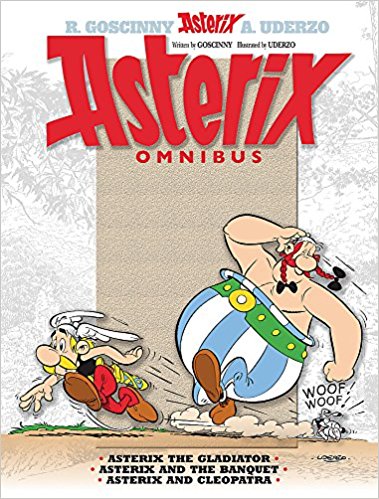
Asterix Omnibus volume 2: Asterix the Gladiator, Asterix and the Banquet, Asterix and Cleopatra


By René Goscinny & Albert Uderzo, translated by Anthea Bell & Derek Hockridge (Orion Childrens Books)
ISBN: 978-1-4440-0424-3

It’s been a painful year for lovers of comics, with many of our greatest practitioners – famous or otherwise – leaving us. I’m going to spend the remainder of the year dwelling on them and recommending examples of their work we can read to commemorate them in the best way possible… through enjoyment.

Suffolk-born Anthea Bell OBE came from prestigious stock. She was born in 1936 and translated numerous works from history books such as WG Siebald’s Austerlitz to the works of Hans Christian Andersen to fantasies such as Cornelia Funke’s Inkworld books Either singly or with Derek Hockridge, however, she found true immortality: translating thousands of pages of European comics and Bande Dessinée. She was a smart and dedicated woman and brilliantly adroit with worlds and concepts in many tongues. Her creative punning and naming techniques in the Asterix books garnered praise all over the world and many aficionados believe the strip is actually funnier in English than in any other language.

I can certainly confirm that’s the case with German…

Among her many triumphs are the aforementioned Asterix, Le Petit Nicolas, Lieutenant Blueberry and Iznogoud.

She died on 18th October 2018 and can never be replaced.

Asterix the Gaul is probably France’s greatest literary export: a wily wee warrior who resisted the iniquities, experienced the absurdities and observed the myriad wonders of Julius Caesar’s Roman Empire with brains, bravery and a magic potion which bestowed incredible strength, speed and vitality.

One of the most popular comics in the world, the chronicles have been translated into more than 100 languages; 8 animated and 3 live-action movies, assorted games and even into a theme park (Parc Astérix, near Paris). More than 325 million copies of 34 Asterix books have been sold worldwide, making Goscinny & Uderzo France’s bestselling international authors.

The diminutive, doughty hero was created as the transformative 1960s began by two of the art-form’s greatest masters, René Goscinny & Albert Uderzo and even though their perfect partnership ended in 1977 the creative wonderment still continues – albeit at a slightly reduced rate of rapidity.

When Pilote launched in 1959 was Asterix was a massive hit from the start. For a while Uderzo continued working with Charlier on Michel Tanguy, (Les Aventures de Tanguy et Laverdure), but soon after the first epic escapade was collected as Astérix le gaulois in 1961 it became clear that the series would demand most of his time – especially as the incredible Goscinny never seemed to require rest or run out of ideas (after the writer’s death the publication rate dropped from two books per year to one volume every three to five).

By 1967 the strip occupied all Uderzo’s time and attention. In 1974 the partners formed Idéfix Studios to fully exploit their inimitable creation and when Goscinny passed away three years later Uderzo was convinced to continue the adventures as writer and artist, producing a further ten volumes since then.

Like all great literary classics, the premise works on two levels: for younger readers as an action-packed comedic romp of sneaky, bullying baddies regularly getting their just deserts and as a pun-filled, sly and witty satire for older, wiser heads, enhanced here by the brilliantly light touch of the translators who played such a massive part in making the indomitable Gaul so very palatable to the English tongue.

Launched in Pilote #1 (29th October 1959, with the first page appearing a week earlier in a promotional issue #0, June 1st 1959), the stories were set on the tip of Uderzo’s beloved Brittany coast in the year 50BC, where a small village of redoubtable warriors and their families resisted every effort of the all-conquering Roman Empire to complete their conquest of Gaul. Unable to defeat these Horatian hold-outs, the Empire resorted to a policy of containment and the little seaside hamlet is perpetually hemmed in by the heavily fortified garrisons of Aquarium, Laudanum, Petibonum and Barbaorum (the latter two becoming Compendium and Totorum for us Brits).

The Gauls don’t care: they daily defy the world’s greatest military machine by just going about their everyday affairs, protected by a magic potion provided by the resident druid and the shrewd wits of a rather diminutive dynamo and his simplistic best friend…

With these volumes a key pattern was established: the adventures would henceforth – like a football match – alternate between Home and Away, with each globe-trotting escapade balanced by an epic set in and around he happily beleaguered Gaulish village (if you’re counting, home tales were odd numbered volumes and travelling exploits even-numbered…)

Asterix the Gladiator debuted in Pilote #126-168 (1963) with the canny rebel and his increasingly show-stealing pal Obelix (who had fallen into a vat of potion as a baby and was a genial, permanently superhuman, eternally hungry foil to the smart little hero) despatched to the heart of the Roman Empire on an ill-conceived mission of mercy…

When Prefect Odius Asparagus seeks to give Julius Caesar a unique gift he decides upon one of the indomitable Gauls who had been giving his occupying forces such a hard time.

Thus, he has village Bard Cacofonix abducted and bundled off to Rome. Although in two minds about losing the raucous harpist, pride wins out and the villagers mount a rescue attempt, but after thrashing the Romans again they discover that their lost comrade is already en route for the Eternal City…

Asterix and Obelix are despatched to retrieve the missing musician and hitch a ride on a Phoenician galley operated under a bold new business plan by captain/general manager Ekonomikrisis. On the way to Italy the heroes first encounter a band of pirates who would become frequent guest-stars and perennial gadflies.

The pirates were a creative in-joke between the close-knit comics community: Barbe-Rouge or Redbeard was a buccaneering strip created by Charlier & Victor Hubinon that also ran in Pilote at the time.

As Asterix and Obelix make friends among the cosmopolitan crowds of Rome, Caesar has already received his latest gift. Underwhelmed by his new Bard, the Emperor sends Cacofonix to the Circus Maximus to be thrown to the lions just as his chief of Gladiators Caius Fatuous is “talent-spotting” two incredibly tough strangers who would make ideal arena fighters…

Since it’s the best way to get to Cacofonix, our heroes join the Imperial Gladiatorial school; promptly introducing a little Gallic intransigence to the tightly disciplined proceedings. When the great day arrives, the lions get the shock of their lives and the entertainment-starved citizens of Rome “enjoy” a show they will never forget…

As always, the good-natured, comedic situations and sheer finesse of the yarn rattles along, delivering barrages of puns, oodles of insane situations and loads of low-trauma slapstick action, marvellously rendered in Uderzo’s expansive, authentic and continually improving big-foot art-style.

Asterix and the Banquet originated in Pilote #172-213 (1963), inspired by the Tour de France cycle race.

After being continually humiliated by the intractable Gauls coming and going as they please, Roman Inspector General Overanxius instigates a policy of exclusion and builds a huge wall around the little village, determined to shut them off from their country and the world. Modern world leaders might get a clue from this book, here… if they read books. Even books with pictures…

Incensed, Asterix best the smug Prefect that Gauls can go wherever they please and to prove it invites the Romans to a magnificent feast where they can sample the culinary delights of various regions. Breaking out of the stockade and through the barricades, Asterix and Obelix gather produce from as far afield as Rotomagus (Rouen), Lutetia (Paris, where they also picked up a determined little mutt who would eventually become a star cast-member), Camaracum (Cambrai) and Durocortorum (Rheims), easily evading or overcoming the assembled patrols and legions of man-hunting soldiers. However, they don’t reckon on the corrupting power of the huge – and growing – bounty on their heads and some Gauls are apparently more greedy than patriotic…

Even with Asterix held captive and all the might of the Empire ranged against them, Gaulish honour is upheld and Overanxius, after some spectacular fights, chases and close calls, eventually is made to eat his words – and a few choice Gallic morsels – in this delightful, bombastic and exceedingly clever celebration of pride and whimsy.

Asterix and Cleopatra ran from 1963-1963 in issues #215-257 and, although deriving its title from Shakespeare’s Antony and Cleopatra, is actually a broad visual spoof of the 1963 movie blockbuster Cleopatra (the original collected album cover was patterned on the film poster).

Rome is a big empire to run but Caesar always has time to spare for the fascinating Queen of Egypt – even though she can be a little overbearing at times…

When Caesar calls her people decadent, Cleopatra announces that her Egyptians will build a magnificent palace within three months to prove their continued ingenuity and vitality.

Her architect Edifis is less confidant and subcontracts the job, recruiting his old friend Getafix the Druid to help, with Asterix, Obelix and faithful pooch Dogmatix coming along to keep him out of trouble…

After another short, sharp visit with the pirates, the voyagers reach the Black Lands only to find the building site an utter shambles. Edifis’ arch rival Artifis has stirred up unrest among the labourers and consequently sabotaged the supply-chain, entombing the visitors in a deadly tourist-trap and even frames Edifis by attempting to poison the Queen.

For all these tactics the ingenious Gauls have a ready solution and the Palace construction continues apace, but when Caesar – determined not to lose face to his tempestuous paramour – sends his Legions to destroy the almost-completed complex, it’s up to the two smallest, smartest warriors to come up with a solution to save the day, the Palace and the pride of two nations…

Outrageously fast-paced and funny and magnificently illustrated by a supreme artist at the very peak of his form, Asterix and Cleopatra is one of the very best epics from a series that has nothing but brilliant hits.

This is supremely enjoyable comics storytelling and if you’re still not au fait with these Village People you must be as Crazy as the Romans ever were…
© 1964-1965 Goscinny/Uderzo. Revised English translation © 2004 Hachette. All rights reserved.

Merry Christmas, Boys and Girls!

In keeping with my self-imposed Holiday tradition here’s another pick of British Annuals selected not just for nostalgia’s sake but because it’s my house and my rules…

After decades when only American comics and memorabilia were considered collectable or worthy, the resurgence of interest in home-grown material means there’s lots more of this stuff available and if you’re lucky enough to stumble across a vintage volume or modern facsimile, I hope my words convince you to expand your comfort zone and try something old yet new…

Still topping my Xmas wish-list is further collections from fans and publishers who have begun to rescue this magical material from print limbo in (affordable) new collections…

Great writing and art is rotting in boxes and attics or the archives of publishing houses, when it needs to be back in the hands of readers once again. As the tastes of the reading public have never been broader and since a selective sampling of our popular heritage will always appeal to some part of the mass consumer base, let’s all continue rewarding publishers for their efforts and prove that there’s money to be made from these glorious examples of our communal childhood.

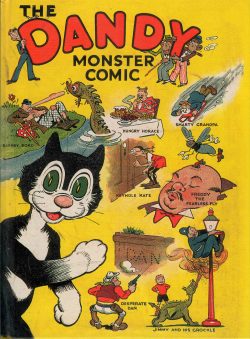
The Dandy Monster Comic (Dandy Annual 1939 Special Facsimile Edition)
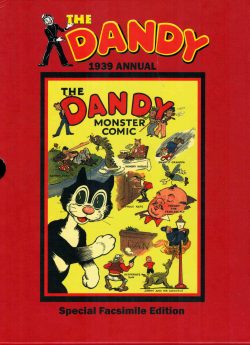
By Many and various (DC Thomson & Co/Aurum Press)
ISBN: 978-1- 84513-217-0

This one’s actually older than me – at least in its original incarnation…

Until it folded and was reborn as a digital publication on 4th December 2012, The Dandy was the third longest running comic in the world (behind Italy’s Il Giornalino – launched in 1924 – and America’s Detective Comics in March 1937).

Premiering on December 4th 1937, The Dandy broke the mould of traditional British predecessors by using word balloons and captions rather than narrative blocks of text under the sequential picture frames.

A colossal success, it was followed eight months later (on July 30th 1938) by The Beano and together they completely revolutionised the way children’s publications looked and, most importantly, how they were read.

Over the decades the “terrible twins” spawned a bevy of unforgettable and beloved household names who delighted generations of avid and devoted readers, and the end of year celebrations were graced with bumper bonanzas of the comics’ weekly stars in extended stories in magnificent bumper hardback annuals.

As WWII progressed, rationing of paper and ink forced the “children’s papers” into an alternating fortnightly schedule: on September 6th 1941 only The Dandy was published. A week later just The Beano appeared. They only returned to normal weekly editions on 30th July 1949…

As of this grand festive feast however that’s all in the future. Here, masterfully restored, is a treasure trove of joyous pranks and all-ages adventure to delight and enthral. It should be noted however, that all this buffoonery and jolly japery was crafted at a time socially far-removed from our own, and there are some terms and racial depictions that wouldn’t be given houseroom in today’s world. That was then, this is now, and that’s another thing you can be grateful for…

It all opens in classis DCT manner with the entire cast chowing down to a monumental feast – a staple reward of those leaner, impoverished times – before James Crichton’s ‘Korky the Cat’ kicks things off with spot of calamitous dockside fishing after which ‘Jimmy and his Grockle’ – a kind of Doberman dragon – foils a dognapping ring. Illustrated by James Clark, the strip was recycled from prose “Boys Paper” The Rover (where it was “Jimmy Johnson’s Grockle” in 1932).

Most pages come with riddles, jokes or single panel gags and many of the strips are delivered in the signature two colour process that typifies British Annuals and as usual none of the writers are named and precious few of the artists are credited. As always, I’ve offered a best guess as to whom we should thank, and of course I would be so very happy if anybody could confirm or deny my suppositions…

The prolific Allan Morley then details how ‘Keyhole Kate’ falls foul of a burglar and cowboy superman ‘Desperate Dan’ – by indisputable key man Dudley D. Watkins – braves harsh winter clime, before Morley’s ‘Freddy the Fearless Fly’ thwarts a human bully and thrashes a predatory spider.

These colossal tomes were all about variety and value for money and next up is a heavily-illustrated prose story enthrallingly detailing the feudal adventure of young shepherd-boy Gingan‘s dragon-slaying quest with magical weapon ‘The Sword of Crad’ after which wandering tramp ‘Barney Boko’ comes a-cropper after defacing public property in a wordless strip from John R. Mason.

As depicted by the superb Eric Roberts, ‘Podge’s Frame-Up’ sees the junior entrepreneur confusing art galleries with glaziers whilst nattily-dressed ‘Archie the Ape’ deals with a hungry lion and ‘Smarty Grandpa’ (by Watkins and a double for strip veteran Pa Broon) has a racially-charged moment at a minstrel show before anthropomorphic tortoise ‘Dan the Night-watchman’ confronts a gang of thieving rats…

‘The Boy that Beat the Band’ is another prose drama (illustrated by Fred Sturrock?) with a young orphan acrobat saving a disabled boy and rewarded with his heart’s desire – a job – after which Jack Glass’ text-block and pic strip ‘The Daring Deeds of Buck Wilson’ sees the singing cowboy battle kidnappers before the animal antics in ‘Bamboo Town’ see daring duo Bongo and Pongo organise a therapeutic gymnasium in a typically busy romp limned by Charlie Gordon.

Sam Fair’s ‘Wig and Wam the Skookum Kids’ were prank-playing Red Indian lads who here trick the Big Chief into baiting a bear before ‘Flippy the Sea Serpent’ – by Frank Minnitt – settles the hash of a snooty octopus whilst Smarty Grandpa fails to steal a pie…

Boneless Bill was a long-running but sadly anonymous strip starring an affable contortionist. Here he astounds an army recruiting officer before ‘Marmaduke Mean the Miser’ pays painfully for stealing a little lad’s Dandy comic before ‘Hungry Horace’ (Morley) finds his appetite briefly diminished after illicitly tapping the wrong barrel and a cunning old codger prevents a mugging in ‘Old Beaver’s Brainwaves’.

‘Wee Tusky’ was long-running prose feature and here the baby elephant’s propensity for trouble leads to deadly danger but secures him a human friend in the end, after which Roberts’ ‘Helpful Henry’ adjusts seating arrangements despite his history of calamitous consequences just as pompous (idiot) detective ‘Trackem Down’ botches another “case”…

Korky the Cat masters the fundamentals of golf whilst Jimmy and his Grockle find fun – and bananas – at the docks, after which Keyhole Kate’s snooping drenches a helpful bystander and Desperate Dan proves that building sites can be dangerous places… at least for other people…

After another get-rich-quick scheme from Podge, sausage-snaffling ‘Dipper the Dodger’ falls foul of the law. Probably drawn by James Jewell, Dipper is a dead ringer for Beano and The People’s Journal cartoon stalwart Wee Peem (“He’s a Proper Scream”), so there might have been some cross-pollination back then.

Freddy the Fearless Fly turns arsonist to escape a spider’s trap before Helpful Henry learns the perils of electricity, after which Jimmy Denton tries rodeo riding to save the ranch with the invaluable assistance of ‘White Star’s Star Turn’ in a prose thriller that leads seamlessly to Podge setting up his own postal service before ‘Bobby, the Boy Scout’ goes too far in his scheme to help a hobo…

Boneless Bill artfully apprehends a thief and Archie the Ape find busking hazardous to health, whilst Hungry Horace loses his lunch to a quick-witted sprinter, but savvy navies ‘Nick & Nack’ find a smart way to keep the cops from confiscating their grub.

Interfering busybodies Bobby, the Boy Scout and Helpful Henry both get it wrong again, after which we head west to see Wig and Wam the Skookum Kids prank their dad yet again even as Desperate Dan falls asleep in the park but still causes chaos

‘Willing Willie and his Pa’ experience decorating woes before we revisit the days of the Raj in prose thriller ‘Pam the Peace-Maker’ wherein a little girl prevents an outbreak of war after which Helpful Henry confuses radio and electric irons and Korky triumphs over a tiger when he goes on safari.

Jimmy and his Grockle clash violently with shopkeepers and Old Beaver’s Brainwaves sees the gamey geezer getting back at the thug who pinched his job after which itinerant Barney Boko pays through the nose for watching football without a ticket.

Dipper the Dodger meets a theatrical strongman and the Bamboo-Town boys convene a swimming class that would certainly have benefitted ‘Sandy Starfish, the Shipwrecked Sailor’ before Fred Sturrock illustrates a prose battle of wits between stubborn old men in ‘The House that Jack the Joker Built’.

More musical mayhem from Archie the Ape precedes Hungry Horace outwitting municipal bylaws in search of a big scoff, even as Podge dupes another crowd of sensation hungry oafs and Helpful Henry wrecks a house before it’s even built: a trick even Desperate Dan can’t match, even if he wasn’t so thirsty…

Mini vignettes for Podge, Barney Boko and Boneless Bill lead into a riotous schoolboy romp in prose – probably illustrated by George Ramsbottom – that I want you to be grown up about. ‘Invisible Dick Spoofs the Spoofer’ is a smart tale from a venerable feature that ran in The Rover for years and when he turns the tables on a cruel stage magician humiliating his school chums you should be proud and not titter or snigger…

A rapid-fire tranche of cartoon antics, starring Bobby the Boy Scout, Podge, Marmaduke Mean the Miser, Flippy the Sea Serpent, Boneless Bill and Willing Willie and his Pa, lead us to another text tale as animal-raised orphan ‘Buffalo Boy’ discovers toffee and begins his slow march back to civilisation…

From here it’s cartoon strip all the way with Korky, Keyhole Kate, Freddy the Fearless Fly, Helpful Henry, Wig and Wam the Skookum Kids, Smarty Grandpa and Dipper the Dodger all doing what they do best before Bamboo-Town brings down the curtain as Bongo and Pongo build an all-animal skating rink…

A marvel of nostalgia and timeless comics wonder, the true magic of this facsimile edition is the brilliant art and stories by a host of talents that have literally made Britons who they are today, and bravo to DC Thomson for letting them out for a half-day to run amok once again.

The DANDY is a trademark of and © D. C. Thomson & Co. Ltd. 2006. Associated characters, text and artwork © D. C. Thomson & Co. Ltd. 2006. All rights reserved.

Valiant Annual 1968
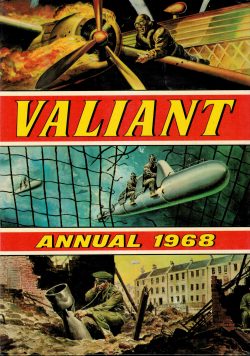
By Many & various (Fleetway)
No ISBN

From the late 1950s and increasingly through the 1960s, Scotland’s DC Thomson steadily overtook their London-based competitors – monolithic comics publishing giant Amalgamated Press.

Created by Alfred Harmsworth at the beginning of the twentieth century, AP perpetually sought to regain lost ground, and the sheer variety of material the southerners unleashed as commercial countermeasures offered incredible vistas in adventure and – thanks to the defection of Leo Baxendale and Ken Reid to the enemy – eventually found a wealth of anarchic comedy material to challenge the likes of the Bash Street Kids, Dennis the Menace, Minnie the Minx and their unruly ilk.

During the latter end of that period the Batman TV show sent the entire world superhero-crazy. Amalgamated had almost finished absorbing all its other rivals such as The Eagle‘s Hulton Press to form Fleetway/Odhams/IPC and were about to incorporate American superheroes into their heady brew of weekly thrills.

Once the biggest player in children’s comics, Amalgamated had stayed at the forefront of sales by latching onto every fad: keeping their material contemporary, if not strictly fresh. The all-consuming company began reprinting the early successes of Marvel comics for a few years; feeding on the growing fashion for US style adventure which had largely supplanted the rather tired True-Blue Brit style of Dan Dare or DC Thompson’s Wolf of Kabul.

Even though sales of all British comics were drastically declining, the 1960s were a period of intense and impressive innovation with publishers embracing new sensibilities; constantly trying new types of character and tales. At this time Valiant and its stable-mate Lion were the Boys’ Adventure big guns (although nothing could touch DC Thomson’s Beano and Dandy in the comedy arena).

Valiant was conceived as a “Boys’ Paper” in 1962 as the indigenous comics industry struggled to cope with a sudden importation of brash, flashy, full-colour comics from America. A weekly anthology concentrating on adventure features and offering a constantly changing arena of action, the magazine was the company’s most successful title for over a decade: absorbing many less successful periodicals between its launch and eventual amalgamation into new-styled, hugely popular Battle Picture Weekly in 1976.

There were 21 Annuals between 1964 to 1985, combining original strips with prose stories; sports, science and general interest features; short humour strips and – increasingly from the 1970s onwards – reformatted reprints from IPC/Fleetway’s vast back catalogue.

From their creative heyday (this book would have been on sale from the autumn of 1967) and sporting a gripping Don Lawrence cover, the all-boys excitement begins with a frontispiece spread of medal-winning British hero war heroes: a typical illustrated historical feature of the era.

The drama continues with a fictionalised full-colour tale of smugglers and the development of the customs men in ‘Contraband’ before ‘Kelly’s Eye’ – sublimely painted by Carlos Cruz (I think) – sees the indestructible adventurer saving beleaguered Coroba from revolutionaries and radioactive doom.

Kelly’s Eye featured ordinary, thoroughly decent chap Tim Kelly who came into possession of the mystical “Eye of Zoltec”: a fist-sized gem that kept him free from all harm… as long as held on to it.

You won’t be surprised to discover that, due to the demands of weekly boys’ adventures, Tim lost, dropped, misplaced and was nefariously deprived of that infernal talisman pretty darned often – and always at the most inopportune moment…

The moody and compelling artwork of Argentinean Francisco Solano Lopez was the prime asset of this series, with Tom Tully and Scott Goodall the usual scripters for this little gem of a series.

Resorting to economical monochrome, we come to ‘The House of Dolmann’. The weekly strip was a curious and inexplicably absorbing blend of super-spy and crime-buster strip from Tully and utterly wonderful master illustrator Eric Bradbury. Dolman’s cover was as a shabby ventriloquist (I digress, but an awful lot of “our” heroes were tatty and unkempt – we had “Grunge” down pat decades before the Americans made a profit out of it!) who designed and constructed an army of specialised robots which he disguised as his puppets.

Using these as his shock-troops, the enigmatic Dolman waged a dark and crazy war against the forces of evil…

Here, he and his hand-crafted squad hunted a scientific maniac pulling satellites out of the sky with a super-magnet.

The first photo/fact feature of the book is a thinly-disguised infomercial for a popular outdoor activity charity, propounding readers get ‘Outward Bound – to Adventure’ after which ‘The Steel Claw’ battles a madman and his gang determined to destroy Britain’s navy (illustrated, it seems to me, by Massimo Belardinelli).

One of the most fondly-remembered British strips of all time, the Steel Claw, ran from 1962- 1973 with Jesús Blasco and his small family studio enthralling the nation’s children through the breakneck adventures of scientist, adventurer, spy and even costumed superhero Louis Crandell. Initially written by novelist Ken Bulmer, the majority of the character’s career was scripted by Tully. Crandall had an artificial hand packed with gimmicks and possessed the disquieting ability to turn invisible whenever he was electrocuted…

‘The Astounding Jason Hyde’ was a series that ran in prose form, written by Barrington J. Bayley with spot illos from Bradbury. Hyde was a blind telepath with an “X-Ray mind” who here tracks missing potholers to an unsuspected cave civilisation populated by brutes and monsters…

After all that action and suspense it’s past time for some light relief and a brace of comedy capers follows: frenetic trend-chasers and backyard inventors ‘The Nutts’ cause carnage with their climate-challenging antics in a superb extended yarn from Spanish cartoonist Ángel Nadal whilst the astoundingly slick and wonderful ‘Sporty’ by Reg (Sporting Sam) Wootton learns a lesson about truth in advertising…

Appalling racist by today’s standards, ‘Captain Hurricane’ was a hugely popular strip for its entire decades-long run. Written by Scott Goodall or Jon Rose, he was originally drawn by R. Charles Roylance, but I think it’s either Jack Pamby or Fred T. Holmes limning this bizarre yarn as – thanks to skiving batman Maggot Malone – the marines are forced to fight their way through Japanese-controlled Malayan jungles to Singapore, armed with nothing but cricket equipment……

Brilliant Reg Parlett’s ‘The Crows’ see the youngest corvid cavorting with bats before – in scintillating pink duo-tones – ‘The Wild Wonders’ (Mike Western and probably Tully on script) offer comedic drama capers. Here Rick and Charlie Wilde and their long-suffering guardian Mike Flynn face ski-slope thrills with a side-order of kidnap and skulduggery… Shipwrecked on remote Worrag Island in the Hebrides, two toddlers were raised by animals and survived to become almost superhuman specimens. When rescued by Olympic swimmer Mike they became sporting sensations able to out-compete most adult athletes in any discipline. They could also talk to animals…

‘Tatty-Mane, King of the Jungle’ offers raucous animal antics as the regal rogue seeks to update his look, but the artist remains a mystery to me. Likely candidates include Nadal or Martz Schmidt (suggested by Steve Holland – you really should read his Bear Alley blog)…

A ‘Sporting Roundabout’ of facts lead into a prose tale of exploration and treasure hunting – illustrated by Weston – with the good guys using an ambulatory super-jeep dubbed ‘The Jungle Walker’ after which venerable schoolboy comedy property ‘Billy Bunter’ quits school and heads out to sea, encountering spies in a quirky yarn possibly illustrated by Parlett but it seems reminiscent of Frank Minnitt to me…

‘Legge’s Eleven’ was a typical example of the humorous freak-show football strip. Lanky player-manager Ted Legge took over failing Rockley Rangers and fields a team of misfits and individualists he struggles to make work together. Here the lads are trapped in a spiral of superstition and missing mascots in the run-up to a crucial international second leg…

Following ‘The Crows’ fowling up a wildlife film, ‘Operation “Rescue”’ (by Mike White?) recreates the 1957 efforts to save Royal Army Air Servicemen lost in the jungles outside Kuala Lumpur before a double dose of ‘“Horse” Laughs’ gags segues into a photo-packed footballing essay on ‘Great Moments with Great Clubs’.

Back in comics, ‘Captain Hurricane’ and crew are in the Western Desert in 1940, battling Italian infantry even as Maggot Malone spreads disorder with his latest fad: weightlifting…

‘Sporty’ disastrously discovers Squash and ‘The Nutts’ cause carnage on a film set before ‘Billy Bunter’s enforced diet creates carnage for the entire county after which another ‘Sporting Roundabout’ leads to a prose thriller about a multi-talented circus performer battling crooks attempting to fix his championship boxing match in ‘The Flying Fighter’.

‘Gabby McGlew – his yarns aren’t true’ is an example of recycled Buster strip Barney Bluffer by Nadal with boastful braggart channelling his inner Baran Munchausen after which photo-history feature ‘A Champion Champion’ details the career and achievements of Henry Cooper before everything wraps up with what I’m sure is another re-tread, even if I can’t find out where.

‘No. 13 Grimm Street’ sees Fleet Street reporter “Hack” Mackenzie struggling to solve a spree of daring art robberies and a house that seems to vanish at will: the answer to both mysteries leads to madness and death…

Eclectic, wide-ranging and always of majestically high quality, this blend of fact, fiction, fun and thrills is a splendid evocation of lost days of joy and wonder. We may not be making books like this anymore but at least they’re still relatively easy to track down. Of course, what’s really needed is for some sagacious publisher to start re-issuing them…
© Fleetway Publications Ltd., 1967

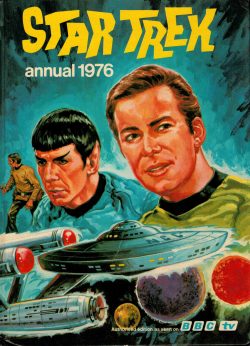
Star Trek Annual 1976
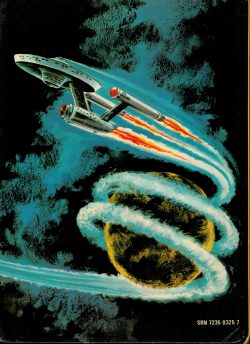
By John David Warner, Allan Moniz, Alberto Giolitti & various (World Distributors)
SBN: 7235-0325-7

British Comics have always fed heavily on other media and as television grew during the 1960s – especially the area of children’s shows and cartoons – those programmes increasingly became a staple source for the Seasonal Annual market. There would be a profusion of stories and strips targeting not readers but young viewers and more and more often the stars would be American not British.

Much of this stuff wouldn’t even be as popular in the USA as here, so whatever comic licenses existed usually didn’t provide enough material to fill a hardback volume ranging anywhere from 64 to 160 pages. Thus, many Annuals such as Daktari, Champion the Wonder Horse, Lone Ranger and a host of others required original material or, as a last resort, similarly-themed or related strips.

This book was produced in a non-standard UK format, with limited but full-colour for both the American comics reprints and the remainder: brief prose pieces, puzzles, games and fact-features on related themes. As for the writers and artists of the originated material your guess is, sadly, as good as or better than mine, but almost certainly generated by the wonderful Mick Anglo’s publishing/packaging company Gower Studios (these yearly slices of screen-to-page magic were an intrinsic part of growing up in Britain for generations and still occur every year with only the stars/celebrity/shows changing, not the package.

Star Trek launched in the USA on September 8th 1966, running until June 3rd 1969: three seasons comprising 79 episodes. A moderate success, the show only really achieved its stellar popularity after going into syndication; appearing in all American local TV regions perpetually throughout the 1970s and beyond.

It was also sold all over the world, popping up seemingly everywhere and developing a fanatically devoted fanbase.

Comicbook franchising specialist Gold Key produced a series which ran for almost a decade beyond the show’s cancellation. Initially these were controversially quite dissimilar from the screen iteration, but by the time of the tales in this sturdy Holidays hardback (reprinting Gold Key’s Star Trek issues #27and #30 from November 1974 and May 1975), quibbling fans had little to moan about and a great deal to cheer as the series was the only source of new adventures starring the beloved crew of the Starship Enterprise.

John David Warner scripted ‘Ice Journey’ and it was illustrated by the ever-amazing Alberto Giolitti. Here the Enterprise is conducting a highly-suspect population survey on sub-arctic world Floe I which soon drops Captain Kirk, Mr. Spock and evolutionary specialist Dr. Krisp into the middle of a eugenics-fuelled race war…

Dividing the tale are a brace of UK generated features a compendium of ‘Star Facts’ offering seven salient snippets of astronomical amazement and a ‘Cosmic Crossword’ to challenge your knowledge of the infinite unknown.

Following the conclusion of ‘Ice Journey’, there’s a board game to play at ‘Warp Factor Eight’ before a second serving of ‘Star Facts’ ushers in another comics adventure.

Bisected by an illustrated glossary of ‘Space Age Vocabulary’, Death of a Star’ (by Allan Moniz & Giolitti) comes from Star Trek #30 and finds Enterprise on site to observe a star going nova. The ship is subsequently catapulted into calamity as sensors pick up a planet full of life-readings where none should be. Moving swiftly to evacuate the endangered beings, the crew are astonished to discover only one creature: an old woman who claims to be the dying sun…

Thanks to the vagaries of image licensing, one thing you won’t find herein is a single photograph of any cast member, but there are plenty of nostalgia-tinged, all-ages sci fi thrills and dashing derring-do to delight not just TV devotees and comics fans but also any reader in search of a pictorially powerful grand adventure.
© MCMLX, MCMLXI, MCMLXXII, MCMLXXV Paramount Pictures Corporation.
(These days Star Trek and related marks are trademarks of CBS Studios, Inc.) All Rights Reserve

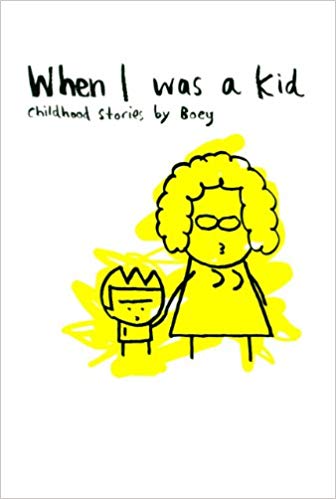
When I Was a Kid – Childhood Stories by Boey


By Cheeming Boey (Last Gasp)
ISBN: 978-0-86719-785-3

Unless your life’s even more unpredictable than mine, all the preparations and frantic panics should be sorted by now and it’s too late to pick up any meaningful gifts that aren’t actually immaterial and/or downloadable.

So, with that in mind, why not calmly ponder the meaning of it all and lay plans for next time?

As this little lost gem proves, the whole histrionic drama of the season is about making memories for those around you… good and bad. Why not strive to make them ones you and yours can share with friends instead of the police or EMTs?

The ability to go back into our childhoods and relive those bizarre, baffling and brilliantly fierce thoughts and every brand-new-day discoveries is a wondrous mixed blessing, but being able to share those recaptured experiences with jaded world-weary adults is a truly miraculous gift and thus utterly evergreen.

One of the most effective and memorable collections generated by an august crowd of halcyon salad-days wranglers comes from Malaysian animator, illustrator, educator, video game developer and cartoonist Cheeming Boey – who also produces gallery art on Styrofoam coffee cups and created an autobiographical webcomic about his life in America, entitled I Am Boey.

You should really check it out…

As a kind of prequel to his blog – if indeed growing up can be considered an introduction to a main event – Boey collected a huge number of visual memoirs and epigrams about his im-maturing years in Asia, bundling them up in a beguiling tome (and a rapidly released sequel) emphasising both the exoticism of life in Malaysia and the universal similarities and solidarities of being a kid.

Warm, sensitive, intimate, uproarious, disarmingly honest as well as on occasion brutal, shocking and sad, these 103 visual monologues (with heart-warming family photos scattered throughout) are invitations into a world of wonder, rivalry, confusion, punishment, resentment, humiliation, anticipation, frustration, greed, glee and always the security of family.

They all begin with “When I was a kid…” and prove that, apart from the odd surface detail, every happy, loving childhood is identical…

The stand-out incidents include such salutary universal reminiscences as ‘My First Pet’, ‘Baby Powder’, ‘Bedtime Stories’, ‘Bad for your Eyes’, ‘Grandma’s Leg’, ‘Nasal Noodles’, ‘R-Rated’, ‘Stealing Money’, ‘Sunday Cartoons’, ‘Not a Genius’ and of course ‘Failing Math’ but with such a wide catalogue to choose from, every little cartoon episode will resonate with somebody. Especially you. Particularly now…

And just in case I’ve made a convert – this one is available as an eBook if you need it right away…
© 2011, 2013 Cheeming Boey. All rights reserved.

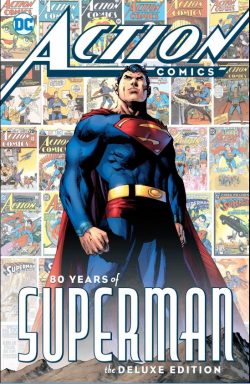
Action Comics: 80 Years of Superman the Deluxe Edition


By Jerry Siegel & Joe Shuster, Fred Guardineer, Don Cameron, Mort Weisinger, Jerry Coleman, Otto Binder, Edmond Hamilton, Len Wein, Cary Bates, Marv Wolfman, John Byrne, Roger Stern, Joe Kelly, Grant Morrison, Paul Levitz, Mort Meskin, Ed Dobrotka, Fred Ray, Wayne Boring, Al Plastino, Jim Mooney, Curt Swan, Carmine Infantino, Gil Kane, Dick Giordano, Kerry Gammill, Bob McLeod, Ben Oliver, Neal Adams plus Many & various (DC Comics)
ISBN: 978-1-4012-7887-8

Win’s Christmas Gift Recommendation: the Ultimate Stocking Stuffer… 9/10

It’s a fact (if such mythological concepts still exist): the American comicbook industry would be utterly unrecognisable without the invention of Superman. His unprecedented adoption by a desperate and joy-starved generation quite literally gave birth to a genre if not an actual art form.

Within three years of his June 1938 debut, the intoxicating blend of eye-popping action and social wish-fulfilment which hallmarked the early Man of Steel had grown to encompass cops-and-robbers crime-busting, socially reforming dramas, science fiction, fantasy, whimsical comedy and, once the war in Europe and the East embroiled America, patriotic relevance.

In comicbook terms at least Superman is master of the world, having utterly changed the shape of a fledgling industry and modern entertainment in general. There have been newspaper strips, radio and TV shows, cartoons games, toys, merchandise and blockbusting movies. Everyone on Earth gets a picture in their heads when they hear the name.

It all started with Action Comics #1 and this bold compilation celebrates the magic, not just with the now-traditional re-runs of classic Superman tales, but with informative articles and fascinating glimpses of some of the other characters who shared the title with him.

Available as a bonanza hardback and in various digital formats, this epic album offers material from Action Comics #0, 1, 2, 42, 64, 241, 242, 252, 285, 286, 309, 419, 484, 554, 584, 655, 662 and 800, and opens with an Introduction by Paul Levitz, a fond Foreword from Laura Siegel Larson and Jules Feiffer’s scene-setting, context-creating essay ‘The Beginning’ before the immortal wonderment commences…

Most of the early tales were untitled, but for everyone’s convenience have been given descriptive appellations by the editors. Thus, after that unmistakeable, iconic cover and a single page describing the foundling’s escape from exploding Planet Krypton (also explaining his astonishing powers in nine panels), with absolutely no preamble ‘The Coming of Superman’, by Jerry Seigel & Joe Shuster introduces a costumed crusader – masquerading by day as reporter Clark Kent – averting numerous tragedies.

As well as saving an innocent woman from the electric chair and roughing up a wife-beater, the tireless crusader works over racketeer Butch Matson – consequently saving suave and feisty colleague Lois from abduction and worse since she is attempting to vamp the thug at the time!

The mysterious Man of Steel makes a big impression on her by then outing a lobbyist for the armaments industry currently bribing Senators on behalf of greedy munitions interests fomenting war in Europe…

To say the editors were amazed by Superman’s popularity was an understatement. They had their money bet on a knock-off Mandrake the Magician crafted by veteran cartoonist Fred Guardineer. Zatara: Master Magician‘s mystic/illusion powers were fully demonstrated in ‘The Mystery of the Freight Train Robberies’ but it’s still a run-of-the-mill and rather sedate affair when compared to the bombastic stunts of the Caped Kryptonian.

Next up is a sneak peek at ‘The Ashcans’: unused and alternative illustrations that didn’t make that crucial first cut after which Action #2 (with a Leo O’Mealia generic adventure cover) supplies the conclusion of Superman’s first case as ‘Revolution in San Monte’ finds the mercurial mystery-man travelling to the war-zone before spectacularly dampening down the hostilities already in progress…

‘The Times’ by Tom DeHaven deconstructs the mythology of the title before Fred Ray’s Superman cover (from November 194)1 introduces Action #42’s ‘The Origin of the Vigilante’ by Mort Weisinger & the amazing Mort Meskin. This spectacular western-themed hero-romp proves that the anthology title had plenty of other captivating characters to enchant audiences…

Issue #64 debuted ‘The Terrible Toyman’ (Don Cameron, Ed Dobrotka & George Roussos), wherein an elderly inventor of children’s novelties and knick-knacks conducts a spectacular campaign of high-profile and potentially murderous robberies, with Lois as his unwilling muse and accessory, and is followed by a little tale of serendipity as Marv Wolfman harks back to his early days and explains ‘How I Saved Superman’…

That’s followed by a genuine lost treasure as ‘Too Many Heroes’ offers an unpublished 1940s Superman tale – credited to Siegel & Shuster – that was rescued from destruction and obscurity. What a gift!

David Hajdu then reveals the allure of the alter ego in ‘Clark Kent, Reporter’ after which we jump to June 1958 and the beginning of the Silver Age. Action Comics #241 cover-featured ‘The Key to Fort Superman’: a fascinating and clever puzzle-play guest-featuring Batman. Scripted by Jerry Coleman with art from Wayne Boring & Stan Kaye, here an impossible intruder vexes the Man of Steel in his most sacrosanct sanctuary…

One month later Otto Binder & Al Plastino introduced both the greatest new villain and most expansive new character concept the series had seen in years. ‘The Super-Duel in Space’ saw evil alien scientist Brainiac attempt to add Metropolis to his collection of miniaturised cities in bottles.

As well as a titanic tussle in its own right, this tale completely changed the mythology of the Man of Steel: introducing Kandor, a city full of Kryptonians who had escaped the planet’s destruction when Brainiac captured them. Although Superman rescued his fellow survivors, the new villain escaped to strike again, and it would be years before the hero could restore the Kandorians to their true size.

After a few intriguing test-runs, a future star of the ever-expanding Superman universe launched in Action Comics #252. In ‘The Supergirl from Krypton!’ (May 1959), Superman discovers he has a living relative. Cousin Kara Zor-El had been born on a city-sized fragment of Krypton, hurled intact into space when the planet exploded. Eventually Argo City turned to Kryptonite like the rest of the detonated world’s debris, and her dying parents, observing Earth through their scopes, sent their daughter to safety as they perished.

Landing on Earth, she met Superman and he created the cover-identity of Linda Lee, hiding her in an orphanage in small town Midvale so that she could master her new powers in secrecy and safety.

‘Endurance’ by Larry Tye discusses longevity and political merit before we return to Superman’s official Action Comics co-star…

Hogging the cover (by Super-stalwarts Curt Swan & George Klein) the simpler times of practicing in secret ended as a big change in the Maid of Might’s status occurred. When her new adoptive parents learn of their new daughter’s true origins, Superman allows cousin Kara to announce her existence to the world in 2-part saga ‘The World’s Greatest Heroine!’ (#285 February 1962) and ‘The Infinite Monster!’ (#286, March 196). Here Jerry Siegel & Jim Mooney detail how Supergirl becomes the darling of the universe: openly saving planet Earth and finally getting all the credit for it.

/telethon to pose a tricky puzzler in the hoary old secret-identity save plot. Written by Edmond Hamilton and illustrated by Swan & Klein, it sets up a scene where the Man of Tomorrow can use none of his usual tricks to be both Superman and Clark simultaneously, then delivers a truly shocking and utterly era-appropriate solution…

Hurtling forward to December 1972 and Action #419 we meet a surprisingly successful back-up feature created by Len Wein, Carmine Infantino & Dick Giordano. Debuting in‘The Assassin-Express Contract!’ Christopher Chance is the Human Target: hiring himself out to impersonate endangered individuals such as the businessman “accidentally” sitting in the sights of a hitman, thanks to a disgruntled employee dialling a wrong number…

From a period where Golden Age stories where assumed to have occurred on parallel world Earth-Two, ‘Superman Takes a Wife’ first appeared in 40th Anniversary issue #484 (June 1978).

Here Cary Bates, Curt Swan & Joe Giella detail how the original Man of Tomorrow became editor of the Metropolis Daily Star in the 1950s and married Lois. Thanks to villainous rogues Colonel Future and the Wizard who had discovered a way to make Superman forget his own existence, only she knew that her husband was once Earth’s greatest hero…

‘If Superman Didn’t Exist’ by Marv Wolfman & Gil Kane comes from Action #554 (April 1984) and posits an alien-invaded Earth deprived of heroes until two kids with big dreams invent one…

In 1985 DC Comics rationalised, reconstructed and reinvigorated their continuity with Crisis on Infinite Earths. They then used the event to regenerate their key properties at the same time. The biggest gun they had was Superman and it’s hard to argue that the change was not before time.

The big guy was in a bit of a slump, but he’d weathered those before. So how could a root and branch retooling be anything but a pathetic marketing ploy that would alienate the real fans for a few fly-by-night Johnny-come-latelies who would jump ship as soon as the next fad surfaced? This new Superman was going to suck…

He didn’t.

The public furore began with all DC’s Superman titles being “cancelled” (actually suspended) for three months, and yes, that did make the real-world media sit-up and take notice of the character everybody thought they knew for the first time in decades. However, there was method in this seeming corporate madness.

The missing mainstays were replaced by a 6-part miniseries running from October to December 1986. Entitled Man of Steel it was written and drawn by Marvel’s mainstream superstar John Byrne and inked by venerated veteran Dick Giordano.

The bold manoeuvre was a huge and instant success and the retuned Superman titles all came storming back with the accent on breakneck pace and action. Action Comics #584 had a January 1987 cover-date and featured a team-up with the Teen Titans as the young heroes had to battle an out-of-control hero with a ‘Squatter’ in his head…

Following a gentle cartoon “roasting” by Gene Luen Yang in ‘Supersquare’, ‘Ma Kent’s Photo Album’ (by Roger Stern, Kerry Gammill & Dennis Janke from #655, July 1990) offers some insights into growing up different before a major turning point began.

As the years passed Lois Lane and Clark gradually grew beyond professionalism into a work romance but the hero had always kept his greatest secret from her. That all changed after the Man of Tomorrow narrowly defeated mystic predator Silver Banshee and decided there would no more ‘Secrets in the Night’ between him and his beloved (Action Comics #662, February 1991, by Stern & Bob McLeod)…

Action #800 (April 2003) then offers a reverential examination of the ongoing myth thus far as ‘A Hero’s Journey’ combines a Joe Kelly script with art from Pasqual Ferry, Duncan Rouleau, Alex Ross, Tony Harris, Bill Sienkiewicz, Dave Bullock, Ed McGuiness, J.H. Williams III, Dan Jurgens, Klaus Janson, Killian Plunkett, Jim Lee, Tim Sale, Lee Bermejo, Cam Smith, Marlo Alquiza & Scott Hanna: cherry-picking unmissable moments from a life well lived…

In 2011 DC again rebooted their entire line and Superman was reimagined once more. ‘The Boy Who Stole Superman’s Cape’ by Grant Morrison & Ben Oliver comes from Action Comics #0, (November 2012) and focusses on a decidedly blue-collar champion just learning the game and painfully aware of the consequences if he makes a mistake…

Wrapping up the celebrations in April 2018’s ‘The Game’ by Levitz & Neal Adams wherein the ultimate enemies Superman and Luthor face off for another round in their never-ending battle…

Before the curtain comes down, though there’s still more unbridled joy and rekindled memories as ‘Cover Highlights’ brings a selection of stunning examples from the Golden, Silver, Bronze, Dark and Modern ages of the Man of Tomorrow, as well as the very best of Action Comics ‘Now’.

Should you be of a scholarly or just plain reverential mood you can then study the copious ‘Biographies’ section so you know who to thank…

Exciting, epochal and unmissable, this is book for all fans of superhero stories.
© 1938, 1941, 1943, 1958, 1959, 1961, 1963, 1972, 1978, 1984, 1986, 1990, 1991, 2003, 2012, 2018 DC Comics. All Rights Reserved.

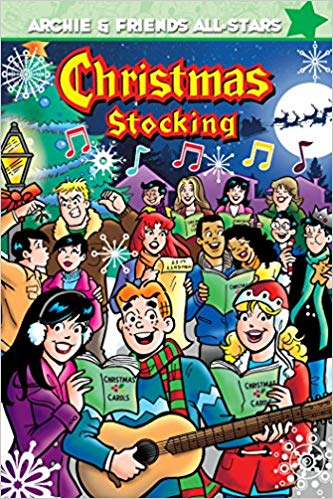
Archie & Friends All-Stars: Christmas Stocking


By Many & various (Archie Comics Publications)
ISBN: 978-1-879794-57-3

Win’s Christmas Gift Recommendation: An Unmissable Tradition… 8/10

My good lady wife and I have a peculiar ritual that I’m not ashamed to share with you. Every Christmas we lock the doors, draw the shutters and stoke up the radiators before settling down with a huge pile of seasonal comics from yesteryear. There’s a few DC’s, a bunch of Disneys and some British annuals, but the biggest bunch is Archie Comics (although we have graduated to graphic novel compilations and even digital collections).

From the 1950s onwards, The Archie team have made Yule time a brighter warmer, dafter time with a gloriously funny, charming, nostalgically sentimental barrage of top-notch stories capturing the spirit of the season throughout a range of comicbooks running from Archie to Veronica, Betty to Sabrina and Jughead to Santa himself…

For most of us, when we say comicbooks people’s thoughts turn to buff men and women in garish tights hitting each other and lobbing trees or cars about, or stark, nihilistic crime, horror or science fiction sagas aimed an extremely mature and sophisticated readership of confirmed fans – and indeed that has been the prolific norm of late. If you don’t count the barrage of licensed titles championing the other pillars of Christmas: toys game and cartoons…

Throughout the years though, other forms and genres have waxed and waned but one that has held its ground over the years – although almost completely migrated to television – is the teen-comedy genre begun by and synonymous with a carrot topped, homely (at first just plain ugly) kid named Archie Andrews.

MLJ were a small publisher who jumped on the “mystery-man” bandwagon following the debut of Superman. In November 1939 they launched Blue Ribbon Comics, promptly following with Top-Notch (see what I did earlier?) and Pep Comics. Content comprised the common blend of funny-book costumed heroes and two-fisted adventure strips, although Pep did make some history with its lead feature The Shield, who was the industry’s first super-hero to be clad in the flag.

After initially profiting from the Fights ‘N’ Tights crowd, Maurice Coyne, Louis Silberkleit and John Goldwater (hence MLJ) were quick to spot a gap in their blossoming market. In December 1941 the costumed heroes and two-fisted adventure strips were supplemented by a wholesome ordinary hero, an “average teen” who would have ordinary adventures like the readers, but with the laughs, good times, romance and slapstick emphasised.

Pep Comics #22 introduced a gap-toothed, freckle-faced red-headed goof showing off to the pretty blonde next door. Taking his lead from the popular Andy Hardy matinee movies starring Mickey Rooney, Goldwater developed the concept of a wholesome youthful everyman protagonist, tasking writer Vic Bloom and artist Bob Montana with the job of making it work.

It began with an innocuous six-page tale entitled ‘Archie’ which introduced boy-goofball Archie Andrews and pretty girl-next-door Betty Cooper. Archie’s unconventional best friend and confidante Jughead Jones also debuted in that first story as did the small-town utopia of Riverdale.

The feature was an instant hit and by the winter of 1942 had graduated to its own title. Archie Comics #1 was the company’s first non-anthology magazine and with it came a gradual transformation of the entire company. After the introduction of rich, raven-haired Veronica Lodge, all the pieces were in play for the industry’s second Phenomenon (Superman being the first).

By May 1946 the kids had taken over, so the company renamed itself Archie Comics, retiring its heroic characters years before the end of the Golden Age and becoming to all intents and purposes a publisher of family comedies. Its success, like the Man of Steel’s, changed the content of every other publisher’s titles, and led to a multi-media industry including TV, movies, pop-songs and even a chain of restaurants.

Those costumed cut-ups have returned on occasion, but the company now seems content to concentrate on what they do uniquely best.

Archie is a well-meaning boy but lacks common sense. Betty is the pretty, sensible girl next door, with all that entails, and she loves Archie. Veronica is rich, exotic and glamorous; she only settles for our boy if there’s nobody better around. She might actually love him, though. Archie, typically, can’t decide who or what he wants…

This family-friendly eternal triangle has been the basis of nearly seventy years of charming, raucous, gentle, frenetic, chiding and even heart-rending comedy encompassing everything from surreal wit to frantic slapstick, as the kids and an increasing cast of friends grew into an American institution. So pervasive is the imagery that it’s a part of Americana itself. Adapting seamlessly to every trend and fad of the growing youth culture, the battalion of writers and artists who’ve crafted the stories over the decades have made the “everyteen” characters of mythical Riverdale a benchmark for youth and a visual barometer of growing up.

Archie’s unconventional best friend Jughead Jones is Mercutio to Archie’s Romeo, providing rationality and a reader’s voice, as well as being a powerful catalyst of events in his own right. That charming triangle (+ one) has formed the foundation of decades of comics magic. Moreover, the concept is eternally self-renewing…

Each social revolution was painlessly assimilated into the mix (the company has managed to confront a number of social issues affecting the young in a manner both even-handed and tasteful over the years) and the addition of new characters such as Chuck, an African-American kid who wants to be a cartoonist, his girlfriend Nancy, fashion-diva Ginger, Hispanic couple Frankie and Maria, gay icon and role model Kevin Keller plus a host of others such a spoiled home-wrecker-in-waiting Cheryl Blossom all contributed to a broad and refreshingly broad-minded scenario.

This volume (available in paperback and digital formats) was the sixth in a line of albums blending old with new and capitalising on the growing popularity of graphic novels. It gathers some of the best Christmas stories of recent years as well as an all-original Yule adventure which delightfully shows the overwhelming power of good writing and brilliant art to captivate an audience of any age.

It all kicks off with ‘Have Yourself a Cheryl Little Christmas’, wherein the gang head off en masse for a winter break, not knowing Queen of Mean Cheryl Blossom is intending to spoil all their fun. Luckily the ever-vigilant Santa knows who’s going to be naughty or nice and dispatches his top agent Jingles the Elf (an Archie regular for decades) to foil her plans…

‘The Night Before Christmas’ adapts the perennial 1823 poem “A Visit from St. Nicholas” attributed to Clement Clarke Moore into a handy introduction to the Riverdale stars before culminating in a clever and heart-warming family moment for Archie and his long-suffering parents, whilst Jughead’s family take centre-stage in the mini-miracle ‘Playing Santa’.

The stresses of having two girlfriends finally overcome Archie in ‘A Not-So-Cool Yule’ before Veronica’s hard-pressed dad once more gets the short end of the stick in ‘Santa Cause’ after which rivals Betty & Veronica succumb to another bout of insane competition in ‘Tis the Season For… Extreme Decorating’.

That darned elf returns in ‘Jingles All the Way’ trying to pry Archie out from under Betty & Veronica’s shapely well-manicured (Ronnie’s at least) thumbs, but faces unexpected opposition from pixie hottie Sugar Plum the Yule Fairy, and we get a glimpse of the kids’ earliest experiences when Betty digs out her diary for a delightful trip ‘Down Memory Lane’.

This sparkling comic bauble concludes with another tale based on that inescapable ode in ‘The Nite Before X-Mas!’

These are perfect stories for young and old alike, crafted by those talented Santa’s Helpers Dan Parent, Greg Crosby, Mike Pellowski & George Gladir, and polished up by the artistic talents of Parent, Stan Goldberg, Fernando Ruiz, Rich Koslowski, Bob Smith, Al Milgrom, John Lowe, Jack Morelli, Vickie Williams, Jon D’Agostino, Tito Peña, Barry Grossman and Digikore Studios.

These stories epitomise the magic of the Season and celebrate the perfect wonder of timeless children’s storytelling: What kind of Grinch could not want this book in their stocking?
© 2010 Archie Comics Publications, Inc. All rights reserved.

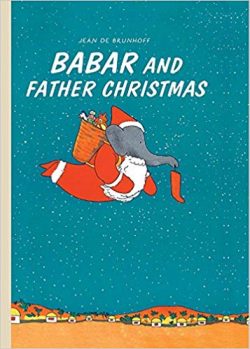
Babar and Father Christmas


By Jean de Brunhoff (Egmont)
ISBN: 978-1-4052-3822-9 (PB)                     978-1-4052-9259-7 (HB)

Win’s Christmas Gift Recommendation: All Aboard for a Splendid Santa Safari… 9/10

Babar the Elephant has been charming readers for generations and Egmont have stuck with the proud pachyderm since they revived the series in 2008.

The gentle and genteel big guy first appeared in France in 1931 where L’Histoire de Babar was an instant hit. An English-language version debuted in 1933, complete with introduction by A. A. Milne, bringing Jean de Brunhoff’s forthright and capable elephantine hero across the channel and thence across the Oceans to America and the Colonies.

By all accounts, the tale was a bedtime story his wife Cecile created for their own children. De Brunhoff wrote and painted seven adventures before his death in 1937, with two of them published posthumously. After World War II his son Laurent continued the family franchise producing ten more adventures between 1946 and 1966.

The books have in their time been controversial. Many critics regard them as being pro-colonialism, and as products of a more robust time, they could never be regarded as saccharine or anodyne, but they are sweet, alluring and irresistibly captivating.

When baby Babar is growing up in the jungle his mother is killed by white hunters. Terrified and sad, the baby flees in a panic, eventually coming to a very un-African provincial city. He meets a kind old lady there who gives him money to buy a suit. As he adapts to city-life he moves into her very large house and is educated in modern, civilised ways. But still, occasionally, he feels homesick and misses his jungle home.

After two years he meets his cousins Celeste and young Arthur wandering naked in the streets of the city and Old Lady gets them clothes too. Soon though, their mothers come to fetch them and Babar decides to return with them and show the other elephants all the wonderful things he has experienced. Buying a motor-car and filling it with clothes and presents he returns just in time, because the King of all the Elephants has eaten a bad mushroom and is dying…

The political assumptions of adults are one thing, but the most valid truth is that these are magical books for the young, illustrated in a style that is fluid, humorously detailed and splendidly memorable. Even after nearly 90 years they have the power to enthral and captivate, and that charm is leavened with an underlying realism that is still worthy of note.

In today’s recommendation (released in 1941 as Babar et le père Noël), our so-very-urbane elephant and now patient parent undertakes an arduous expedition to bring joy to his children and his people.

One day Zephir the monkey tells Babar’s children Pom, Flora and Alexander – and their ubiquitous Cousin Arthur – about the fabulous Father Christmas who brings presents to children in the world of Men.

Captivated, they decide to invite the venerable gentleman to visit them, but after a very long time with no reply, they become despondent. Devoted paternal Babar decides to seek out Father Christmas and personally invite him to the Land of the Elephants…

Produced at a time when the World desperately needed something bright, cheerful and filled with hope, this last tale from de Brunhoff is a fabulously inventive and escapist adventure brimming with simple charm and clever, enchanting artwork. Europhiles will also be delighted to discover that the North Pole is merely a forwarding address and his real home is where it’s always been – in the cold, snowy mountains of Bohemia.

Great Children’s Books are at once plentiful and scarce. There are many, but definitely never enough. This deceptively engaging series has weathered the test of time and has earned a place on your shelves and in your hearts.

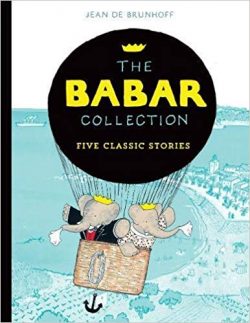
Moreover, if you’re looking for a big bold bargain you might want to pick up 2016’s The Babar Collection: Five Classic Stories which combines this seasonal gem with four other all-ages classics to astound and delight your herd.
© 2018 Edition. All Rights Reserved.

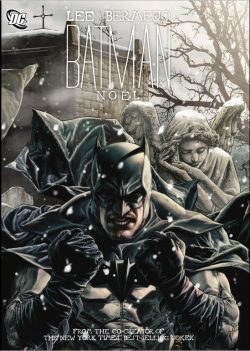
Batman: Noël


By Lee Bermejo, with Barbara Ciardo & Todd Klein (DC Comics)
ISBN: 978-1-4012-3213-9 (HB)

Win’s Christmas Gift Recommendation: A Fresh, Twisted Spin on a Seasonal Favourite… 9/10

Beginning with 1941’s Batman #9, the Dark Knight and festively-hued sidekick celebrated Christmas with specially crafted, tinsel-tinted topical tales (part warm spirituality, part Dickens homage, part O. Henry bittersweet irony, part redemption story), all perfectly encapsulating everything the festival ought to mean.

Although many his contemporaries – especially Superman – did likewise, the Batman Yule yarns somehow always got the balance between sentiment and drama just right. It led to the common comics fan assumption that Batman Owned Christmas. Given the evidence, it’s hard to dispute…

In 2011 writer-artist Lee Bermejo (Lex Luthor: Man of Steel, Joker, Before Watchmen: Rorschach) took his avowed love of Charles Dickens’ novels and the gritty, painterly heroic style he’d perfected and crafted a Times Best-Selling stand-alone Batman Original Graphic Novel. His creative partners in crime were colour-artist Barbara Ciardo award-winning letterer Todd Klein.

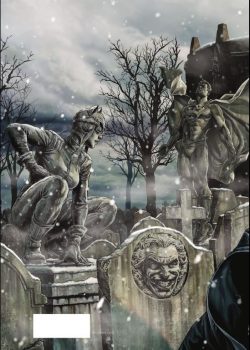
Available in deluxe hardback, Trade Paperback and eBook editions, Batman: Noël is a smart and imaginative reworking of Dicken’s redemptive masterpiece told from the point of view of Bob, a cheap hood with a guilty conscience and a sick kid. Bob’s got himself in a spot of bother with both his boss – The Joker – and the meanest bastard in Gotham, who’s selfishly using him to get to the killer clown…

Someone needs to have his views challenged and his path reset. Surely the Season will provide a miracle…

Featuring a big cast of star guests, this dark festive fable adds a bleak spin to the immortal events that will amaze and delight jaded readers, and also offers an Introduction by Jim Lee and many pages of production art and Author Commentary from Bermejo.

Batman Noël is a decidedly different take on one of the most fundamental cornerstones of the modern Christmas experience, and, while we’re recommending seasonal stuff, Dickens wrote four follow-ups to A Christmas Carol plus 22 other Christmas-themed or situated stories. They’re all in print – physically and digitally – so you should treat yourself to those too…
© 2011 DC Comics. All Rights Reserved.

Of Dust and Blood – A Story from the Fight at the Greasy Grass


By Jim Berry & Val Mayerik (Jim Berry)
ISBN: 978-0-692-63801-9

Win’s Christmas Gift Recommendation: Even More Potent, Powerful, Unmissable… 10/10

Back in October I reviewed a beautiful book published by NBM: a passionate and compelling re-examination of one of the most infamous and iconic moments in American history. I thought it was superb and said so in pixel-print.

After the review posted we were contacted by the writer of the book who very graciously thanked us. He also said that the original crowdfunded Kickstarter edition was not only better but how the book should be seen. He even sent us a copy to prove it.

He was right.

Here’s a tweaked review. Go buy this one. Even if you already have the perfectly excellent oversized, portrait format hardback edition. Get this one too. You won’t regret it…

Thanks to the twin miracles of humanity’s love of stories and the power of commercial narrative there’s no logic to how or why some events pass into the forgotten corners of history whilst others become touchstones of common experience or even actual living myths.

In 1875 final – official – tally of casualties for The Battle at Little Big Horn listed 268 US dead and 55 severely wounded men… and an unknown or unspecified number of native casualties.

Eleven years earlier the Chivington (Sand Creek) Massacre recorded a wildly estimated 500-600 killed and mutilated Cheyenne and Arapaho (two thirds of whom were women and children). To be fair, the figures might have been as low as 60 or 70 heathen souls, but practically nobody white really cared…

My point is that the reason you’ve heard of one but not the other is the force of publicity…

After Custer’s debacle and the slaughter of the 7th Cavalry, the Anheuser-Busch brewery commissioned prints of a painting memorialising “Custer’s Last Fight” and had them framed and hung in bars and saloons across America, forever connecting their product in the minds of generations of drinkers with unvarnished white heroism…

With historical veracity at a supreme disadvantage, the ill-judged clash at Little Big Horn – alternatively described by the winning side (on that day, at least) as the Battle of the Greasy Grass – has become the stuff of imagination and extrapolation.

Atrocity aside, that’s not necessarily a bad thing as it’s led numerous thoughtful creative types to examine the event on their own terms and applying the perspective of history to the events and the shameful, bloody aftermath…

Two of the very best are comics veteran Val Mayerik and journalist-turned-author Jim Berry who have here shaped the conflict to their own deeply moving ends with this superb offering. Originally crowdfunded through Kickstarter contributions, this stunning landscape format (295 x 192 mm) full-colour hardback explores truth and myth whilst adding another powerful fictive component to the sprawling patchwork.

Following Berry’s mood-setting and painfully timely Introduction – dramatically augmented by a linework Map of The Battle of the Greasy Grass/Little Big Horn by fellow graphic scholar and historian Rick Geary – the story (lettered by Simon Bowland) unfolds in rapid yet panoramic moments, and traces two ultimately converging paths.

On one side cavalry scout Greenhaw takes some time off to pen a letter to his beloved Rose, even as some distance away young Lakota warrior Slow Hawk performs the funeral rites for his brother. Now he is the last of his family…

Against the background of the tragically documented specifics of the inevitable, legendary greater clash, these two strangers are carried by events towards an inescapable and bloody confrontation…

Rendered with staggering virtuosity by Mayerik, the smaller moments and incidents contributing to the greater clash we all think we know are beguiling and breathtaking in their warmth and humanity, magnificently underscoring Berry’s incisive questioning of the point and merit of the battle.

Augmenting the visual narrative is a text essay describing what happened After the Battle and how commercial interests monetised and weaponised public sentiment against the Indians and led to America’s own final solution to the Indian Wars at Wounded Knee Creek in 1890.

Following on, Val Mayerik: The Process describes, with plenty of access to the artist’s sketchbook, how many of the most evocative images were created before this terrific tome concludes with a Bibliography (illustrated by Aaron McConnel of further reading for interested parties and a moving page of dedications dubbed ‘Philamayaa’… (it means “Thank You”)

This is a wondrous and sobering experience any comics fan or student of human nature must seek out share. And that’s best seen in the original edition.

© 2016 Jim Berry, all rights reserved. 1st Edition. All fictional characters are trademarks of Jim Berry and Val Mayerik.

Copies of the first edition Of Dust and Blood can be purchased on eBay.

The Great Treasury of Christmas Comic Book Stories


By John Stanley, Walt Kelly, Richard Scarry, Jack Bradbury, Klaus Nordling, Mike Sekowsky, Alberto Giolitti & various: edited and designed by Craig Yoe with Clizia Gussoni (IDW Publishing)
ISBN: 978-1-60010-773-3(HB); 978-1-68405-009-3(TPB); eISBN: 978-1-68406-352-9

Win’s Christmas Gift Recommendation: The Clue is in the Title… 10/10

Justifiably revered for his brilliant newspaper strip Pogo, and perhaps even his wonderful Our Gang tales, the incredible Walt Kelly also has a pretty strong claim to owning the traditional childhood Christmas. From 1942 until he abandoned comic-books for newsprint he produced stories and magazines dedicated to the season of Good Will for West Coast publishing giant Dell.

Santa Claus Funnies and Christmas with Mother Goose were a Holidays institution in both their Four Color and Dell Giant incarnations and the sheer beauty and charm of Kelly’s work defined what Christmas should be for two generations. Kelly transferred his affinity for the best of all fantasy worlds to the immortal Pogo but still was especially associated with the Festive season. Many publications sought out his special touch. Even the Christmas 1955 edition of Newsweek starred Kelly and Co on the cover.

And now, thanks to that dedicated champion preserver of America Comics Past Craig Yoe, I can add a wealth of other great creators and stories to our communal seasonal joy-fest, as this cracking tome – available in all physical and electronic formats – celebrates Yuletide comic classics.

Offering old masters and vintage delights from Santa Claus Funnies # 61, 91,128, 175, 205, 302, 361, 867, 1154 and 1274 (1944-1962) and 1962’s Santa Claus Funnies #1, plus material from A Christmas Treasury #1 1954, Sleepy Santa (1948), Ha Ha Comics #49 (1947), Santa and the Pirates (1953), Here Comes Santa (1960), Christmas at the Rotunda, Giant Comics #3 (1957) and Christmas Carnival volume 1 #2 (1954) this superb funfest opens with a silent short by Kelly revealing the Big (in red) Man’s working practice, & Mo Gollub introducing ‘The Christmas Mouse’ (from Santa Clause Funnies #126 and #175) before we enjoy a Seasonal message (illustrated by Mel Millar) revealing ‘Hey Kids, Christmas Comics!’

‘How Santa Got his Red Suit’ is a superbly imaginative, gnome-stuffed origin fable by Kelly from Santa Claus Funnies # 61, after which H.R. Karp & Jack Bradbury reveal the salutary saga of ‘Blitzen, Jr.’ as first seen in Ha Ha Comics #49 and a tragically uncredited team disclose in prose-&-picture format the magical adventure of ‘Santa and the Pirates’, taken from a booklet premium released by Promotional Publishing Co. NYC.

As rendered by the inimitable John Stanley SCF #1154’s ‘Santa’s Problem’ explores the good intentions and bad habits of polar bears before Mike Sekowsky contributes a concise and workmanlike adaptation of ‘A Christmas Carol’ by Charles Dickens (from A Christmas Treasury #1) before Kelly returns with the heart-warming tale of ‘A Mouse in the House’ (SCF #128).

Stanley strikes again with ‘The Helpful Snowman’ (Here Comes Santa) offering aerial assistance to Kris Kringle whilst ‘Christmas at the Rotunda’ offers a classy version of ‘The Shoemaker and the Elves’ courtesy of Elsa Jane Werner & Richard Scarry, after which cognoscenti can see potent prototypes for Pogo characters in 1945’s ‘Christmas Comes to the Woodland’ (SCF #91): another whimsical Kelly classic.

Imbecilic but well-meaning elf Scamper causes mayhem and ‘Santa’s Return Trip’ in wry delight from John Stanley & Irving Tripp (from SCF #1274) after which Stanley & Dan Gormley craft an epic voyage for determined rugrats Cathy and David as they deliver ‘A Letter for Santa’ (Santa Claus Funnies #1).

Another masterful Kelly prose-&-picture fable then recounts the sentimental journey of ‘Ticky Tack, the Littlest Reindeer’ (SCF #205) and the animal crackerz continue as a lost puppy finds friendship and a new home in ‘Sooky’s First Christmas’ (Stanley & Gormley from SCF #867)…

Charlton Comics were late to the party for X-mas strips but their glorious Giant Comics #3 from 1957 provides here both Frank Johnson’s anarchic ‘Lil’ Tomboy in It Was the Day Before Christmas…’ and an extra-length action-packed romp for Al Fago to masterfully orchestrate in ‘Atomic Mouse in The Night before Christmas’. Separating those yarns is a deft updating of Clement Clark Moore’s ubiquitous ode in ‘The Night before Christmas’ by Dan Gormley from A Christmas Treasury #1…

In 1947, Walt Kelly set his sights on consolidating a new Holiday mythology and succeeded with outrageous aplomb in ‘The Great Three-Flavoured Blizzard’ (Santa Claus Funnies #175) as an unseasonal warm spell precipitates a crisis and necessitates the making of a new kind of snow, before the fabulous Klaus Nordling contributes a stylish comedy of errors with ‘Joe and Jennifer in the Wonderful Snowhouse’ from Christmas Carnival volume 1 #2.

Bringing things to a close Dan Noonan concocts a staffing crisis for Santa to solve with the aid of ‘Teddy Bear in Toyland’ (SCF #91, 1950) after which we enjoy a moment of sober reflection as ‘The Christmas Story’ – according to St. Matthew’s gospel and illuminated by Alberto Giolitti – (A Christmas Treasury #1) reminds us that for many people it’s not just about loot, excess and fantasy.

Kelly then ushers us out with a brace of end pieces encompassing a poetic hunt for the old boy and a silent silly symphony from ‘The Carollers’…

It absolutely baffles me that Kelly and his peers’ unique and universally top-notch Christmas tales – and Batman‘s too for that matter – are not re-released every November for the Yule spending spree. Christmas is all about nostalgia and good old days and there is no bigger sentimental sap on the planet than your average comics punter. And once these books are out there their supreme readability will quickly make converts of the rest of the world.

Just you wait and see…
The Great Treasury of Christmas Comic Book Stories © 2018 Gussoni-Yoe Studio, Inc. All Rights Reserved. Material reprinted: Sleepy Santa © 1948 Belda Record & Publishing Co. Ha Ha Comics #49 © Creston Publications Corporation. Santa and the Pirates © 1953 Promotional Publishing Co. NYC. Christmas at the Rotunda © 1955 Ford Motor Company and Artists and Writers Guild, Inc. Giant Comics #3 © 1957 Charlton Comics Group Christmas Carnival vol. 1 #2 St. John Publishing Corp. ©1954. © Western Printing & Lithographing Co. 1948, 1950, 1951, 1954, 1957, 1960, 1961, 1962. © 1944, 1945, 1946, 1947, Oscar Lebek/Dell Publishing, Western Printing & Lithographing Co.