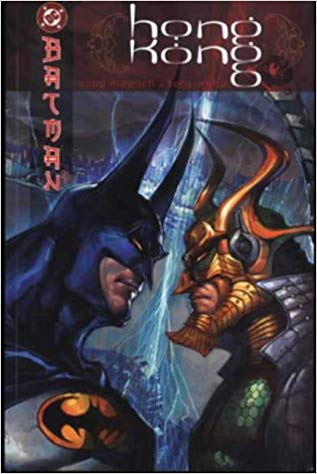
Batman: Hong Kong


By Doug Moench, & Tony Wong (DC Comics)
ISBN 978-1-4012-0057-2 (HB)                     978-1-4012-0101-2 (TPB)

This Batman outreach project is a surprisingly engaging piece of Hong Kong cinema in comic form by veteran scribe Doug Moench and the anonymous horde of illustrators used by Comics Supremo Tony Wong to churn out literally thousands of lavishly executed Kung Fu comics that have earned him the title “the Stan Lee of Hong Kong”.

The story itself is fairly unsurprising tosh. A serial killer who webcasts his murders as real-time snuff movies leads Batman to the former British colony and a civil war between a Triad leader and his brother: a cop determined to bring him to book.

Add to the mix a dashing young nephew who loves his family but thirsts for justice and you have all the elements for the next Johnny To, Kazuya Shiraishi or Park Hoon-jung blockbuster nerve-jangler.

Although a touch stiff in places and a little disorienting if you’re unused to the rapid art-style transitions of Hong Kong comics (artists and even forms of representation – paint, black line wash, crayon etc. can vary from panel to panel) this has a lot of pace and fairly rattles along. In this anniversary year, Batman: Hong Kong is still loads better and more accessible than many outings for the caped crusader of recent years and well worth the time and effort of any diehard Dark Knight aficionado in sech of a rarer flavour.
© 2004 DC Comics. All Rights Reserved.

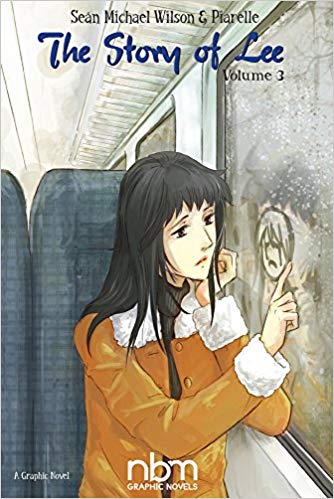
The Story of Lee volume 3


By Seán Michael Wilson & Piarelle (NBM)
ISBN: 978-1-68112-195-6

Just in time to make my St. Valentines’ day perfect comes the concluding volume of an engaging romance that’s kept fans on charmed tenterhooks for almost a decade now.

After far too long, the final instalment of the endearing confection which began delighting readers in 2011 brings some painful tension to a bittersweet transatlantic/transpacific shojo manga, which like its subject matter and stars was the happy product of more than one country…

As written by Scottish author Seán Michael Wilson (Breaking the Ten, Sweeney Todd, Portraits of Violence – An Illustrated History of Radical Thinking), The Story of Lee details the growth and relationships of a restless Hong Kong girl who falls for a young Scots poet and teacher.

Lee endured frustrated dreams dutifully working in her father’s shop. The situation was uncomfortable: although he meant well, the traditionally-minded parent disapproved of almost everything Lee did and never stinted in telling her so. His disparagement and constant pushing for her to achieve something (becoming a dentist) whilst staying true to his old-fashioned ideas was tearing her apart, and Wang, the nice, proper Chinese boy he perpetually forced upon her, was a really creepy turn-off…

What they never realised was that Lee was a closet poet and pop music junkie besotted with western culture, particularly myth-laden London. In those unwelcome fascinations she was clandestinely supported by her frail, aging grandmother and unconventional Uncle Jun, a globe-trotting playboy who long ago abandoned convention and tradition to follow his own dreams to America…

At 24 Lee was being gradually eroded away until she met gorgeous teaching temp Matt MacDonald. Exotically Scottish, polite and charming, he was also a sensitive, talented poet…

Lee quietly defied her father and her relationship with Matt deepened, but when tragedy struck and grandmother was no longer a factor, further upheaval occurred after Matt announced that he was returning to his home thousands of miles away.

He dropped his bombshell and asked her to go with him…

Against all odds and family sentiment and via a memorable stopover in London, the lovers make it to Edinburgh – Matt’s home town – and Lee enrols in college on a one-year student visa. Matt too goes back into full-time study…

The city is a revelation: so many old and beautiful buildings, unlike HK where everything is always being torn down and rebuilt, and perhaps it’s just that dizzying cultural adjustment which makes her feel Matt is acting a little differently now that he’s in his on his own turf again…

Or maybe it’s the oddly intimate relationship he has with the old college chum they’re crashing with? Richard is warm, welcoming and coolly into all the right music, but she can’t shake the feeling that his relationship with her man might go beyond the normal bonds of friendship…

Over following days Lee’s apprehensions increase as Matt gleefully shows her around the nostalgic landmarks of his past and apparent proofs of Richard’s feelings begin to emerge. Moreover, her charming man seems to be changing too: his gentle patience evaporates; he’s snappish and even reacts jealously when other students – and even the local musicians she slavishly seeks out – pay attention to her. One thing she cannot adjust to is the undercurrent of hostility and casual aggression expressed by the young men in Scotland…

Lee has never felt more vulnerable. She is a world away from home and security and increasingly wonders if she’s made the biggest mistake of her life. As tensions rise and the nurturing warmth the lovers shared deteriorates further, unexpected aid appears in the form of Uncle Jun who pops up for a visit and offers some startling advice…

The tale resumes here as Lee thrives academically and makes friends among the students – particularly Chinese classmate Bo – but Matt is changing more rapidly as he falls further under the sway of Richard and begins neglecting his studies to hang with his band…

Meeting his parents is an uncomfortable moment for the sensitive Lee and the mounting tensions come to an ironic head when news comes from Hong Kong.

Increased political unrest has led to an assault on her father. He cannot work and Lee feels compelled to cut her studies short and return to run the shop. No one has asked her to, but she understands duty and responsibilities even if Matt has seemingly forgotten them…

With excellent art from much-lauded London-based debutante Piarelle (AKA Pamela Lokhun) taking over from previous illustrators Chie Kutsuwada (volume 1) and Nami Tamura (volume 2), the age-old story unfolds with understated power as the lovers make decisions that will that will affect everybody and satisfy no one…

Supplemented by a copious Glossary and Notes section defining the specific vagaries of accent and slang whilst offering geographical and historical perspective on the many actual locations depicted, this is a deliciously compelling drama playing with well-established conventions and idioms of romantic fiction and teen soap opera.

With beguiling subtlety, The Story of Lee explores themes of cultural difference, mixed-race-relationships, family and friendship pressures and the often-insurmountable barrier of different childhood experiences and expectations to weave an enchanting tale of independence, interdependence and isolation.

Moving and memorable, this is a timeless tale for modern lovers that you really should enjoy. And now that’s it’s all over, surely a bumper compendium can’t be far away…
© 2019 Seán Michael Wilson & Piarelle.

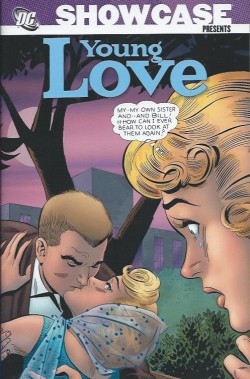
Showcase Presents Young Love


By Robert Kanigher, Julius Schwartz, John Romita, Bernard Sachs, John Rosenberger, Werner Roth, Bill Draut, Mike Sekowsky, Win Mortimer, John Giunta, Tony Abruzzo, Arthur Peddy, Dick Giordano, Jay Scott Pike Gene Colan & various (DC Comics)
ISBN: 978-1-4012-3438-6

As the escapist popularity of flamboyant superheroes waned after World War II, newer genres such as Romance and Horror came to the fore and older forms regained their audiences. Some, like Westerns and Funny Animal comics, had hardly changed at all but crime and detective tales were utterly radicalised by the temperament of the times.

Stark, uncompromising, cynically ironic novels and socially aware, mature-themed movies that would become categorised as Film Noir offered post-war society a bleakly antiheroic worldview that often hit too close to home and set fearful, repressive, middleclass parent groups and political ideologues howling for blood.

Naturally, these new sensibilities seeped into comics, transforming two-fisted gumshoe and Thud-&-Blunder cop strips of yore into darkly beguiling, even frightening tales of seductive dames, big pay-offs and glamorous thugs. Sensing imminent Armageddon, America’s moral junkyard dogs bayed even louder as they saw their precious children’s minds under seditious attack…

Concurrent to the demise of masked mystery-men, industry giants Joe Simon & Jack Kirby famously invented the love genre for comicbooks with mature, beguiling, explosively contemporary social dramas equally focussed on the changing cultural scene and adult themed relationships. They began with semi-comedic prototype My Date in early 1947 before plunging into the torrid real deal with Young Romance #1 in September of that year.

Not since the invention of Superman had a single comicbook generated such a frantic rush of imitation and flagrant cashing-in. It was a monumental hit and the team quickly expanded: releasing spin-offs such as Young Love (February 1949), Young Brides and In Love.

Simon & Kirby presaged and ushered in the first American age of mature comics – not only with their creation of the Romance genre, but with challenging modern tales of real people in extraordinary situations – before seeing it all disappear again in less than eight years.

Their small stable of magazines produced for the loose association of companies known as Prize/Crestwood/Pines blossomed and wilted as the industry contracted throughout the 1950s.

All through that turbulent period, comicbooks suffered impossibly biased oversight and hostile scrutiny from hidebound and panicked old guard institutions such as church groups, media outlets and ambitious politicians. A number of tales and titles garnered especial notoriety from those social doom-smiths, and hopeful celebration and anticipation amongst tragic, forward-thinking if psychologically scarred comics-collecting victims was quashed when the industry introduced a ferocious Comics Code that castrated the creative form just when it most needed boldness and imagination.

We lost and comics endured more than a decade and a half of savagely doctrinaire, self-imposed censorship.

Those tales from a simpler time, exposing a society in meltdown and suffering cultural PTSD, are mild by modern standards of behaviour, but the quality of art and writing make those pivotal years a creative highpoint long overdue for a thorough reassessment.

The first Young Love ran for 73 issues (1949-1956) before folding and re-launching in a far more anodyne, Comics-Code-approved form as All For Love in Spring 1957.

Unable to find an iota of its previous and hoped-for audience it disappeared after 17 issues in March 1959 before resurrecting as Young Love again a year later with #18. It then ran steadily but unremarkably until June 1963 when the experiment and the company died with #38.

Crestwood sold up its few remaining landmark, groundbreaking titles and properties – Young Romance, Young Love and Black Magic being the most notable – to National/DC and faded from the business…

The new bosses released their first edition in the autumn of 1963 as part of their own small, shy and unassuming romance ring: carrying on with it and a coterie of similar titles targeting teenaged girls (for which, read aspirational and imaginative 8 to 12-year olds) over the next fifteen years.

The savage decline in overall comicbook sales during the 1970s finally killed the genre off. Young Love was one of the last; dying with #126, cover-dated July 1977.

This quirky mammoth monochrome compilation gathers the first 18 DC issues (#39-56 spanning September/October 1963 through July/August 1966) but, although beautiful to look upon, it is sadly plagued with twin tragedies.

The first is that the stories quickly become fearfully formulaic – although flashes of narrative brilliance do crop up with comforting regularity – whilst the second is an appallingly inaccurate listing of creator credits.

Many fans have commented and suggested corrections online, and I’m adding my own surmises and deductions about artists whenever I’m reasonably sure, but other than the unmistakable, declamatorily florid flavour of Robert Kanigher, none of us in fandom are that certain just who was responsible for the scripting of these amatory sagas. However, research continues and sites like the Grand Comicbook Database and Lambiek are continually fixing history for us…

Here, likely contenders include Barbara Friedlander, Dorothy Woolfolk, George Kashdan, Jack Miller, Phyllis Reed, E. Nelson Bridwell and Morris Waldinger but I’m afraid we may never really know.

C’est l’amour…

On these anthological pages, the heartbreak and tears begin with the introduction of a soap-opera serial undoubtedly inspired by the romantic antics of television physicians such as Dr. Kildare (1961-1966) and Ben Casey (1962-1966). Written in an uncomfortably macho “me Doctor Tarzan, you Nurse Jane” style by Kanigher and illustrated with staggering beauty by John Romita, ‘The Private Diary of Mary Robin R.N.’ follows the painful journey and regular heartache of a nurse dedicated to her patients whilst fighting her inbuilt need to “settle down” with the man of her dreams, whoever he is… It’s usually a big-headed, know-it-all medic who has no time to waste on “settling down”…

The serial opened with ‘No Cure for Love’, a 2-part novelette in which a newly-qualified Registered Nurse starts her career at County General Hospital in the OR; instantly arousing the ire of surly surgeon Will Ames whose apparent nastiness is only a mask for his moody man-concern over his poor benighted patients – but never their billables…

However, even as he romances Mary and she dares to dream, the good doctor soon proves that medicine will always be his first and only Love…

I’m not sure of the inker but the pencils on stand-alone back-up ‘You’ve Always Been Nice!’ look like Werner Roth in a novel yarn of modern Texans in love that pretty much sets the tone for the title: Modern Miss gets enamoured of the wrong guy or flashy newcomer until the quiet one who waited for her finally gets motivated…

‘The Eve of His Wedding’ – by Bernard Sachs – goes with the other favourite option: a smug, flashy girl who loses out to the quiet heroine waiting patiently for true love to lead her man back to her…

In #40 Kanigher & Romita ask ‘Which Way, My Heart?‘ of Mary Robin and she answers by letting Dr. Ames walk all over her before transferring to Pediatrics. She still found time to fall in love with a thankfully adult patient – but only until he got better…

Filling out the issue are ‘Someone to Remember’ (illustrated by Bill Draut) which sees sensible Judy utterly transform herself into a sophisticated floozy for a boy who actually prefers the old her, and ‘The Power of Love’ (incorrectly attributed to Don Heck but perhaps Morris Waldinger or John Rosenberger heavily inked by Sachs?) in which Linda competes with her own sister over new boy Bill…

Although retaining the cover spot, the medical drama was relegated to the end of the comic from #41 on and complete stories led, starting on ‘End With A Kiss’ by Mike Sekowsky & Sachs, wherein calculating Anna almost marries wrong guy Steve until good old Neil puts his foot down, whilst for a girl who dates two men at the same time, ‘Heartbreak Came Twice!’: a tale that was almost a tragedy…

Mary Robin then cries – she cried a lot – ‘No Tomorrow for My Heart!’ as Will Ames continues to call when he feels like it and she somehow finds herself competing with best friend Tess for both him and a hunky patient in their care. She even briefly quits her job for this man of her dreams…

The superb John Rosenberger inking himself – mistakenly credited throughout as Jay Scott Pike – opens #42 with ‘Boys are Fools!’ wherein young Phyllis is temporarily eclipsed by her cynical, worldly older sister Jayne… until a decent man shows them the error of their ways. Vile Marty then uses unwitting Linda as a pawn in a battle of romantic rivals for ‘A Deal with Love!’ (Rosenberger or maybe Win Mortimer & Sachs?). I don’t have any corroborating proof, but a custom of the era was for artists to trade pages or anonymously collaborate on some stories; making visual identification a real expert’s game…

With a ‘Fearful Heart!’, Mary Robin closes up the issue by accidentally stealing the love of a blinded patient nursed by her plain associate. When the hunk’s sight returned, he just naturally assumes the pretty one was his devoted carer…

Young Love #43 opened with the excellent ‘Remember Yesterday’ (looking like Gil Kane layouts over Sachs) in which Gloria relives her jilting by fiancé Grant before embarking on a journey of self-discovery and finding her way back to love… Then the Sekowsky/Sachs influenced ‘A Day Like Any Other’ and ‘Before it’s Too Late’ disclose the difficulties of being a working woman and the temptations of being left at home all alone…

After that, Kanigher & Romita end the affairs by showing the childhood days of Mary Robin and just why she turned to nursing when her childhood sweetheart becomes her latest patient in ‘Shadow of Love!’

Issue #44 declares ‘It’s You I Love!’ (Kane or Frank Giacoia with Sachs?) as wilful Chris foolishly sets her cap for the college’s biggest hunk, whilst in ‘Unattainable’ Lorna learns that she just isn’t that special to playboy Gary before Mary Robin endures ‘Double Heartbreak!’ when her own sister Naomi sweeps in and swoops off with on-again, off-again Dr. Ames…

Sekowsky & Sachs opened #45 with ‘As Long as a Lifetime!’ wherein poor April finds herself torn between and tearing apart best friends Tommy and Jamie, whilst ‘Laugh Today, Weep Tomorrow!’ (which looks like Jay Scott Pike & Jack Abel) has tragic Janet see her best friend Margot‘s seductive allure steal away another man she might have loved…

‘One Kiss for Always’ then shows Mary Robin as the patient after a bus crash costs her the use of her legs.

During her battle back to health, and loss of the only man she might have been happy with, the melodrama finally achieves the heights it always aspired to in a tale of genuine depth and passion.

The captivating Rosenberger leads in #46 as Maria and Mark conspire together to win back their respective intendeds and discover exactly ‘Where Love Belongs’, after which Mortimer reveals ‘It’s All Over Now’ for Merrill who only gets Cliff because Addie went away to finishing school.

But then she came back…

This surprisingly mature and sophisticated fable is followed by ‘Veil of Silence!’ in which Nurse Robin takes her duties to extraordinary lengths: allowing a patient to take her latest boyfriend in order to aid her full recovery…

In #47 ‘Merry Christmas’ (Rosenberger) shows astonishing seasonal spirit as Thea cautiously welcomes back sister Laurie – and gives her a second chance to steal her husband – after which secretary Vicky eavesdrops on her boss and boyfriend: almost finishing her marriage before it begins in ‘Every Beat of his Heart!’(Mortimer).

Mary Robin’s ‘Cry for Love’ starts in another pointless fling with the gadabout Ames and ends with her almost stealing another nurse’s man in a disappointingly shallow but action-packed effort, after which – in #48 – ‘Call it a Day’ (Mortimer) finds an entire clan of women united to secure a man for little Alice, before Rosenberger limns ‘Trust Him!’ wherein bitter sister Marta‘s harsh advice to love-sick sibling Jill is happily ignored. Kanigher & Romita then explore Mary Robin’s ‘Two-Sided Heart!’ after Ames again refuses to consider moving beyond their casually intimate relationship.

Of course, that shouldn’t excuse what she then does with the gorgeous amnesia patient who has a grieving girlfriend…

Young Love #49 opened with Rosenberger’s ‘Give Me Something to Remember You By!’ with Marge praying that her latest summer romance turns into a something more. Waiting is a torment but ‘Your Man is Mine!’ (Roth) shows what’s worse when sisters clash and Clea again tries taking what Pat has – a fiancé…

‘Someone… Hear my Heart!’ then unselfconsciously dips into the world of TV as Mary Robin dumps Dr. Ames for an actor and a new career on a medical show. It doesn’t end well and she’s soon back where she belongs with the man who can’t or won’t appreciate her…

Roth opened #50 with ‘Second Hand Love’ as Debbie dreads that the return of vivacious Vicky will lead to her taking back the man she left behind, whilst ‘Come into My Arms!’ (Ogden Whitney or Ric Estrada perhaps?) sees Mary Grant visit Paris in search of one man only to fall for another…

Mary Robin then finds herself pulled in many directions as she falls for another doctor and one more hunky patient before yet again rededicating herself to professional care over ‘The Love I Never Held!’

She jumps back to the front in #51 and discovers ‘All Men are Children!’ (still Kanigher & Romita) when an unruly shut-in vindictively uses her to make another nurse jealous, after which Rosenberger delivers a stunning turn with ‘Afraid of Love!’ Here, after years of obsessive yearning, Lois finally goes for it with the man of her dreams.

Romita then took a turn at an anthology solo story with ‘No Easy Lessons in Love’ as Gwen and Peter travel the world and make many mistakes before finally finding each other again.

The nurse finally got her man – and her marching orders – in #52’s ‘Don’t Let it Stop!’, but dashing intern Dan Swift only makes his move on Mary after being hypnotised! Hopefully, she lived happily ever after because, despite being advertised for the next issue, she didn’t appear again…

The abrupt departure was followed by vintage reprint ‘Wonder Women of History: Mary Kingsbury Simkhovitch’ (by Julius Schwartz & John Giunta from Wonder Woman #55, September/October 1952), detailing the life of a crusading social campaigner before Roth – possibly inked by Sheldon Moldoff – details how a flighty girl stops chasing husky lifeguards and finds a faithful adoring ‘Young Man for Me!’

‘The Day I Looked Like This!’ (by Dick Giordano, not Gene Colan) celebrates the day tomboy Judi finally starts gussying up like a proper girl and unhappily discovers she is the spitting image of a hot starlet…

Issue #53 opens with ‘A Heart Full of Pride!’ (Sachs) as naïve Mib proves to herself that, just like in school, determination and perseverance pay off in romance, before Mortimer details how standoffish Cynthia learns how she needs to play the field to win her man in ‘I Wanted My Share of Love’.

Romita describes the designs of Kathy who discovers the pitfalls of her frivolous lifestyle in ‘Everybody Likes Me… but Nobody Loves Me!’ before Draut illustrates the lead feature in #54 as ‘False Love!’ exposes a case of painfully mistaken intentions when a gang of kids all go out with the wrong partners… until bold Nan finally speaks her mind.

‘Love Against Time’ by Tony Abruzzo & Sachs shows schoolteacher Lisa that patience isn’t everything, after which ‘Too Much in Love!’(Romita) hints at a truly abusive relationship until Mandy‘s rival tells her just why beloved Van acts that way…

‘An Empty Heart!’ (Arthur Peddy & Sachs or possibly Mortimer again) opens #55, revealing how insecure Mindy needs to date other boys just to be sure she can wait for beloved Sam to come back from the army, whilst Sachs’ ‘Heart-Shy’ Della takes took her own sweet time realising self-effacing Lon is the boy for her, after which the original and genuine Jay Scott Pike limns the tale of Janie who at last defies her snobbish, controlling mother and picks ‘Someone of My Own to Love’.

The romance dance concludes here with #56 and ‘A Visit to a Lost Love’ (actually Gene Colan): a bittersweet winter’s tale of paradise lost and regained, after which perpetually fighting Richy and Cindy realise ‘Believe it or Not… It’s Love’ (Abruzzo & Sachs), and ‘I’ll Make Him Love Me!’ (Sachs) show how scary Liz stalks Perry until she falls for her destined soul-mate Bud…

As I’ve described, the listed credits are full of errors and whilst I’ve corrected those I know to be wrong I’ve also made a few guesses which might be just as wild and egregious (I’m still not unconvinced that many tales were simply rendered by a committee of artists working in desperate jam-sessions), so I can only apologise to all those it concerns, as well as fans who thrive on these details for the less-than-satisfactory job of celebrating the dedicated creators who worked on these all-but-forgotten items.

As for the tales themselves: they’re dated, outlandish and frequently borderline offensive in their treatment of women.

So were the times in which they were created, but that’s not an excuse.

However, there are many moments of true narrative brilliance to equal the astonishing quality of the artwork on show here, and by the end of this titanic torrid tome the tone of the turbulent times was definitely beginning to change as the Swinging part of the Sixties began and hippies, free love, flower power and female emancipation began scaring the pants off the old guard and reactionary traditionalists…

Not for wimps or sissies but certainly an unmissable temptation for all lovers of great comic art…
© 1963, 1964, 1965, 1966, 2012 DC Comics. All Rights Reserved.

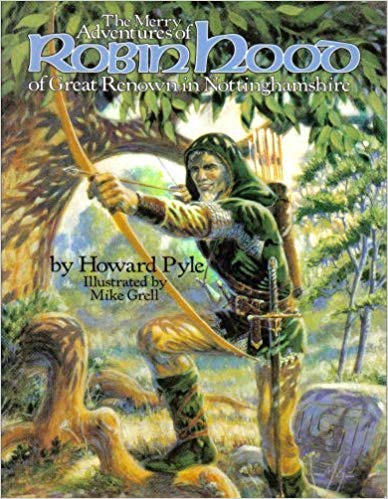
The Merry Adventures of Robin Hood of Great Renown in Nottinghamshire


By Howard Pyle, illustrated by Mike Grell (Donning/Starblaze edition)
ISBN: 978-0-89865-602-2 (TPB)

People who work in comics adore their earliest influences, and will spout for hours about them. Not only did they initially fire the young imagination and spark the drive to create but they always provide the creative yardstick by which a writer or artist measures their own achievements and worth.

Books, comics, posters, even gum cards (which mysteriously mutated into “Trading Cards” in the 1990s) all fed the colossal hungry Art-sponge which was the developing brain of the kids who make comics.

But by the 1970s an odd phenomenon was increasingly apparent. New talent coming into the industry was increasingly and overwhelmingly only aware of only comicbooks as a source of pictorial fuel. The great illustrators and storytellers who had inspired the likes of Howard Chaykin, Bernie Wrightson, Mike Kaluta, P. Craig Russell, Charles Vess, Mike Grell, and a host of other top professionals were virtually unknown to many youngsters and aspirants.

I suspect the reason for this was the decline of illustrated fiction in magazines – and of magazines in general. Photographs became a cheaper option than artwork in the late 1960s and generally populations read less and less each year from that time onwards.

In the late 1980s publisher Donning created a line of oversized deluxe editions reprinting “lost” classics of fantasy, illustrated by major comics talents who felt an affinity for the selected texts. Vess illustrated Shakespeare’s A Midsummer Night’s Dream, Kaluta did likewise with the script for the silent movie Metropolis, P. Craig Russell created magic for The Thief of Bagdad and Grell took the biggest risk of his career by providing new illustrations (6 in colour and 15 monochrome) for a fantasy masterpiece beloved by generations of youngsters – and still today an incredibly popular reissue in loads of different formats…

The Merry Adventures of Robin Hood was first published in 1883; the first work of art prodigy and father of modern illustration Howard Pyle. A jobbing magazine illustrator, Pyle (1853-1911) gathered together many of the stories and legends about the bowman of Sherwood Forest, translating them into a captivating ripping yarn for youngsters. He furnished his book with 23 spellbinding pictures that created a mythic past for millions of readers.

It became the definitive work on the character: all iterations since has been working from or in reaction to this immensely readable and influential book. If you’d care to see the wondrous original illustrations you should track down The Merry Adventures of Robin Hood, a signet paperback (ISBN: 978-0451522849) which accurately reproduces the 1883 edition complete with Pyle’s drawings.

Pyle was a master storyteller and an incomparable artist who produced many other books illustrated in his unmistakable pen and ink flourish: both adaptations of heroic stories and wholly original material. These include: Otto of the Silver Hand, Pepper and Salt, The Wonder Clock, Men of Iron, The Garden Behind the Moon, plus a quartet of tomes that delineated the life of King Arthur: The Story of King Arthur and His Knights, The Story of the Champions of the Round Table, The Story of Lancelot and His Companions, and The Story of the Grail and the Passing of Arthur.

Believe it or not though, these books are not his greatest legacy and achievement. Pyle was a dedicated teacher also. In 1896 he took a position at the Drexel Institute of Arts and Sciences in Philadelphia where the first students included Violet Oakley, Maxfield Parrish, and Jessie Willcox Smith.

He held summer classes at Chadd’s Ford, Pennsylvania where the initial attendees included Stanley Arthurs, W.J. Aylward, Ida Daugherty, Harvey Dunn, George Harding, Percy Ivory, Thornton Oakley, Frank Schoonover and the just-as-legendary N.C. Wyeth (Dunn caught the bug here – becoming another dedicated educator, passing on the spark and the drive unto the next generation).

In 1903 Pyle founded his own art school in Wilmington, Virginia, and his dedicated, passionate and immensely talented followers became known as The Brandywine School. Why were they so successful and influential?

In a word: Action.

Before Howard Pyle, illustration was formal, staged, lovingly rendered but utterly static. There was no more life than in a posed photograph of the period with all elements locked in paralysis. Pyle introduced flowing, dynamic motion to illustrated art. He created “Life”.

All of which is a long way of saying that this is a great book with sumptuous Grell illustrations – especially the six paintings (a luxury most publisher’s budgets wouldn’t permit very often in Pyle’s lifetime) – and if you’re a fan of his work you should own it. However, you might also want to track down a reproduction of the original (as I said, there are many) with those groundbreaking original drawings and enjoy the pictorial component which inspired Grell fully as much as that stirring prose.
Art © 1989 Mike Grell.

Adventures of Tintin: The Secret of the Unicorn and Red Rackham’s Treasure


By Hergé & various; translated by Leslie Lonsdale-Cooper & Michael Turner (Egmont)
ISBN: 978-1-40520-810-9 (HB Unicorn) 978-1-40520-622-8 (PB Unicorn)
ISBN: 978-1-40520-811-6 (HB Rackham) 978-1-40520-623-5 (PB Rackham)

Georges Prosper Remi – AKA Hergé – created a true masterpiece of graphic literature with his astounding yarns tales of a plucky boy reporter and his entourage of iconic associates. Singly, and later with assistants including Edgar P. Jacobs, Bob de Moor and the Hergé Studio, Remi completed 23 splendid volumes (originally produced in brief instalments for a variety of periodicals) that have grown beyond their popular culture roots and attained the status of High Art.

It’s only fair, though, to ascribe a substantial proportion of credit to the many translators whose diligent contributions have enabled the series to be understood and beloved in 38 languages. The subtle, canny, witty and slyly funny English versions are the work of Leslie Lonsdale-Cooper & Michael Turner.

On leaving school in 1925, Remi worked for Catholic newspaper Le Vingtiéme Siécle where he fell under the influence of its Svengali-like editor Abbot Norbert Wallez. The following year, the young artist – a passionate and dedicated boy scout produced his first series: The Adventures of Totor for monthly Boy Scouts of Belgium magazine.

By 1928 Remi was in charge of producing the contents of the parent paper’s children’s weekly supplement Le Petit Vingtiéme and unhappily illustrating The Adventures of Flup, Nénesse, Poussette and Cochonette when Abbot Wallez urged the artist to create an adventure series. Perhaps a young reporter who would travel the world, doing good whilst displaying solid Catholic values and virtues?

And also, perhaps, highlight and expose some the Faith’s greatest enemies and threats…?

Having recently discovered the word balloon in imported newspaper strips, Remi decided to incorporate this simple yet effective innovation into his own work. He would produce a strip both modernistic and action-packed.

Beginning in early January 1929, Tintin in the Land of the Soviets appeared in weekly instalments, running until May 8th 1930. Accompanied by his garrulous dog Milou (Snowy to us Brits), the clean-cut, no-nonsense boy-hero – a combination of Ideal Good Scout and Remi’s own brother Paul (a soldier in the Belgian Army) – would report back all the inequities of the world, since the strip’s prime conceit was that Tintin was an actual foreign correspondent for Le Petit Vingtiéme…

The odyssey was a huge success, assuring further – albeit less politically-charged and controversial – exploits to follow. At least that was the plan…

During the Nazi Occupation of Belgium, Le Petit Vingtiéme was closed down and Hergé was compelled to move the popular strip to the occupiers’ preferred daily newspaper Le Soir. He diligently continued producing stories for the duration, but in the period following Belgium’s liberation was accused of being a collaborator and even a Nazi sympathiser.

It took the intervention of Resistance hero Raymond Leblanc to dispel the cloud over Hergé, which he did by simply vouching for the cartoonist and by providing the cash to create a new magazine – Le Journal de Tintin – which Leblanc published and managed. The anthology comic swiftly achieved a weekly circulation in the hundreds of thousands.

These adventures come from the Golden Age of an iconic creator’s work. Despite being produced whilst Belgium was under the control of Nazi Occupation Forces during World War II, the qualitative leap in all aspects of Hergé’s creativity is potent and remarkable.

After his homeland fell to the invaders in 1940, Georges Remi’s brief military career was over. He was a reserve Lieutenant, working on The Land of Black Gold when called up, but the collapse of Belgium meant that he was back at his drawing board before year’s end, albeit working for a new paper on a brand-new adventure. He would not return to Black Gold, with its highly anti-fascistic subtext, until 1949.

Le Secret de La Licorne ran from June 11th 1942 to January 14th 1943: a rip-roaring adventure mystery of light-hearted, escapist thrills, to create a haven of delight from the daily horrors of everyday life. It and its continuation remain a legacy of joyous adventure to this day. It’s also the first co-created with cartoonist, journalist and full-time ghost writer Jacques Van Melkebeke (AKA George Jacquet) who silently collaborated on Blake & Mortimer, Hassan et Kaddour, Corentin, Les Farces de l’Empereur and many others.

On completion it was collected as a full-colour book in 1943, re-mastered in 1946 and serialised in French newspaper Coeurs Vaillants from Mach 19th 1944.

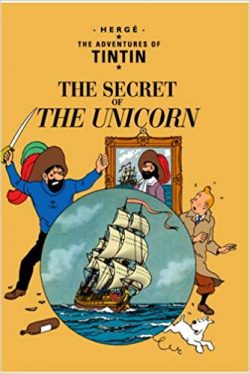
After the dramatic and fanciful far-fetched exploits of The Shooting Star, Hergé returned to less fantastical fare with The Secret of the Unicorn which begins as Tintin buys an antique model galleon at a street market. He intends presenting it to Captain Haddock, but even before he can pay for it an increasingly desperate number of people try to buy, and even steal it from him.

Resisting all efforts and entreaties, he tells his effulgent friend of the purchase, ‘though not that a minor accident has broken one of the masts. The Captain is flabbergasted to hear of the model! He has a portrait of his ancestor Sir Francis Haddock, painted in the reign of King Charles II, in which the exact same ship features!

On returning home Tintin finds the model has been stolen, but on visiting the first and most strident of the collectors who tried to buy it from him finds that the man already has an exact duplicate of the missing model.

After much hurly-burly Tintin and Haddock discover that Sir Francis was once a prisoner of infamous pirate Red Rackham, but escaped with the location of the villain’s treasure horde. Subsequently making three models of his vessel “The Unicorn”, the sea dog placed part of a map in each and gave them to his three sons…

Someone else obviously has divined the secret of the ships and that mysterious mastermind becomes ever more devious and ruthless in his attempts to obtain the complete map. Events come to a head when Tintin is kidnapped, which is a big mistake, as the intrepid lad brilliantly turns the tables on his abductors and solves the mystery. With the adventure suitably concluded, the volume ends with our heroes ready to embark on the no-doubt perilous voyage to recover Red Rackham’s Treasure…

For which we must turn to the next volume in this glorious repackaging of one of the World’s greatest comic strip treasures… Hergé’s Adventures of Tintin!
The Secret of the Unicorn: artwork © 1946, 1974 Editions Casterman, Paris & Tournai.
Text © 1959 Egmont UK Limited. All Rights Reserved.

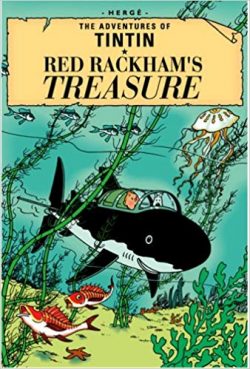
The concluding tome of an epic saga, Le Trésor de Rackham le Rouge ran in Le Soir from February 9th to September 23rd 1943 and topped that thrilling mystery chase to secure three sections of a pirate map with a glorious all-out, all-action romp in search of the loot itself. During that period the artist met Edgar P. Jacobs, who became his assistant on the daily strip…

Tintin and Haddock are quietly assembling the requirements for their proposed treasure hunt. However, when a loose-lipped sailor is overheard by an enterprising reporter, the endeavour becomes a cause celebré with a horde of opportunists claiming descent from Red Rackham.

A more persistent but innocently intentioned distraction is a deaf and daffy Professor named Cuthbert Calculus who wants to use the expedition to test his new invention. He continually accosts Tintin and Haddock. Although his offer is rejected the Professor is not a man to be easily dissuaded. Mostly because he can’t hear the word “no” – or any others…

With the detectives Thompson and Thomson aboard (in case of criminal activity) the small team sets sail on their grand adventure…

This is a rich and absorbing yarn in the classic manner, full of exotic islands, nautical drama, mystery and travail, brilliantly timed comedy pieces and even a surprise ending. The restrictions of Belgium’s occupation necessitated Hergé’s curtailment of political commentary and satire in his work, but it apparently freed his Sense of Wonder to explore classic adventure themes with spectacular and memorable results. Although not the greatest of stand-alone Tintin tales, in conjunction with The Secret of the Unicorn this story becomes one of the best action sagas in the entire Hergé canon.

These ripping yarns for all ages are an unparalleled highpoint in the history of graphic narrative. Their unflagging popularity proves them to be a worthy addition to the list of world classics of literature, and stories you and your entire clan should know.
Red Rackham’s Treasure: artwork © 1945, 1973 Editions Casterman, Paris & Tournai.
Text © 1975 Egmont UK Limited. All Rights Reserved.

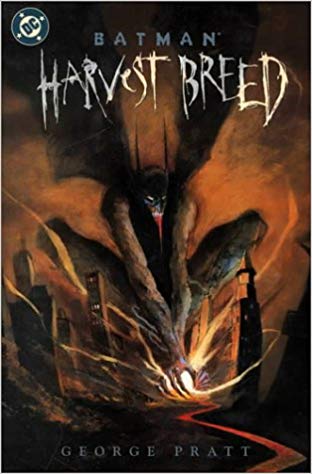
Batman: Harvest Breed


By George Pratt & various (DC Comics)
ISBN: 978-1-56389-692-7 (HC)        978-1-84023-701-6 (Titan Books UK edition HC)

Sometimes even the best of intentions and greatest of artisans don’t quite produce the best result. Master illustrator George Pratt returned tangentially to the Vietnam War for the backstory of this memorable supernatural thriller starring the Dark Knight, but the overall results fall short of his superb par, as established with the landmark Enemy Ace: War Idyll. Even so…

Bruce Wayne is tortured by bloody nightmares of devils and sacrifices as a mysterious killer seeks to re-enact a murder-ritual based on the points of a cross.

Such ritual has been attempted many times throughout history, but on this particular occasion the stakes seem much higher – and far more personal.

Only a girl named Luci Boudreaux, escapee and survivor of the Hell on Earth that was Viet Nam seems to have any answers to the dilemma…

Although painted with astounding passion and skill, and frequently offering unforgettable imagery, the story seems to have been sadly neglected and is – quite frankly – a bit of a mess, with war veterans, voodoo priests, faith-healers, demons and an uncomfortable misunderstanding of the relationship between Batman and Police Commissioner Jim Gordon muddying a rather tired old plot.

Even so, there are plenty of movie blockbusters that have got away with far less to great acclaim and for richer rewards.

If you love bleak and moody style over content, or can always find room for the blackest crannies infested by the darkest of knights, you might want to hunt this down and give it a shot.

So, even if you’re not a Bat-completist, in this anniversary year, there’s still a reason to step out of the light into forgotten realms with the world’s most popular superhero.
© 2000 DC Comics. All Rights Reserved.
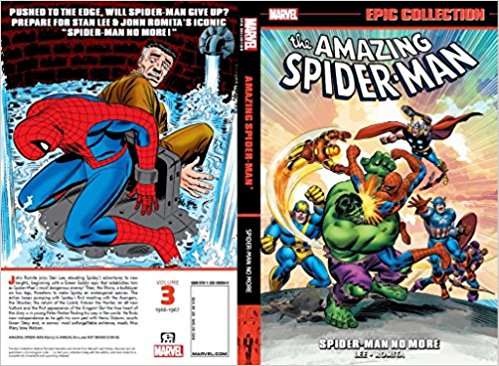
Amazing Spider-Man Epic Collection volume 3 1966-1967: Spider-Man No More


By Stan Lee, John Romita, Larry Lieber, Don Heck, Marie Severin & various (Marvel)
ISBN: 978-1-3029-1023-5 (TPB)

Outcast, geeky high school kid Peter Parker was bitten by a radioactive spider and, after attempting to cash-in on the astonishing abilities he’d developed, suffered an irreconcilable personal tragedy. Due to the teenager’s arrogant neglect, his beloved guardian Uncle Ben was murdered and the traumatised boy determined henceforward to always use his powers to help those in dire need.

For years the brilliant young hero suffered privation and travail in his domestic situation, whilst his heroic alter ego endured public condemnation and mistrust as he valiantly battled all manner of threat and foe…

Spanning August 1966 to September 1967, this fulsome, titanic, full-colour Epic Collection (available as massive paperback or ephemeral eBook) gathers the gems from Amazing Spider-Man #39-52 plus Annuals #3-4 and a deliciously daft snippet from spoof mag Not Brand Echh #2, heralding the start of a brand new era for the Astonishing Arachnid with Peter and his ever-expanding cast of cohorts well on the way to being household names as well as the darlings of college campuses and the media intelligentsia.

By 1966 Stan Lee and Steve Ditko could no longer work together on their greatest creation. After increasingly fraught months the artist simply resigned, leaving Spider-Man without an illustrator.

In the coincidental meantime John Romita had been lured away from DC’s romance line and given odd assignments before assuming the artistic reins of Daredevil, the Man Without Fear. Before long, he was co-piloting the company’s biggest property and expected to run with it.

After a period where old-fashioned crime and gangsterism predominated, science fiction themes and costumed crazies began to predominate as the world went gaga for superheroes and creators experimented with longer storylines and protracted subplots…

When Ditko abruptly left, the company feared a drastic loss in quality and sales but it didn’t happen. John Romita (senior) considered himself a mere “safe pair of hands” keeping the momentum going until a better artist could be found but instead blossomed into a major talent in his own right. The wallcrawler continued his unstoppable rise at an accelerated pace…

When Amazing Spider-Man #39 appeared with the first of a 2-part adventure declaiming the ultimate victory of the hero’s greatest foe, no reader knew what had happened – and no one told them…

‘How Green Was My Goblin!’ and ‘Spidey Saves the Day! (“Featuring the End of the Green Goblin!”)’ calamitously changed everything whilst describing how the arch-foes learned each other’s true identities before the Goblin “perished” in a climactic showdown. It would have been memorable even if the tale didn’t feature the debut of a new artist & a whole new manner of story-telling…

The issues were a turning point in many ways, and – inked by old DC colleague Mike Esposito (under the pseudonym Mickey Demeo) – they still stand as one of the greatest Spider-Man yarns of all time, heralding a run of classic tales from the Lee/Romita team that saw sales rise and rise, even without the seemingly irreplaceable Ditko.

With #41 and ‘The Horns of the Rhino!’, Romita began inking his own pencils and although the debuting super-strong criminal spy proved a mere diversion, his intended target, J. Jonah Jameson‘s astronaut son, was a far harder proposition in the next issue.

Amazing Spider-Man #42 heralded ‘The Birth of a Super-Hero!’, wherein John Jameson is mutated by space-spores and goes on a Manhattan rampage: a solid, entertaining yarn that is only really remembered for the last panel of the final page.

Mary Jane Watson had been a running gag in the series for years: a prospective blind-date arranged by Aunt May who Peter had avoided – and Ditko skilfully not depicted – for the duration of time that our hero had been involved with Betty Brant, Liz Allen, and latterly Gwen Stacy.

Now, in that last frame the gobsmacked young man finally realises that for two years he’s been ducking the hottest chick in New York!

‘Rhino on the Rampage!’ gave the villain one more crack at Jameson and Spidey, but the emphasis was solidly on foreshadowing future foes and building Pete and MJ’s relationship. Next comes Amazing Spider-Man Annual # 3 and ‘…To Become an Avenger!’ as the World’s Mightiest Heroes offer the webspinner membership if he can capture the Hulk. As usual, all is not as it seems but the action-drenched epic, courtesy of Lee, Romita (on layouts), Don Heck, & Esposito is the kind of guest-heavy power-punching package that made these summer specials a child’s delight.

The monthly Marvel merriment resumes with the return of a tragedy-drenched old foe as Lee & Romita reintroduce biologist Curt Conners in #44’s ‘Where Crawls the Lizard!’ The deadly reptilian marauder threatens Humanity itself and it takes all of the wallcrawler’s resourcefulness to stop him in the concluding ‘Spidey Smashes Out!’

Issue #46 introduced an all-new menace in the form of seismic super-thief ‘The Sinister Shocker!’ whilst ‘In the Hands of the Hunter!’ brought back a fighting-mad Kraven the Hunter to menace the family of Parker’s pal Harry Osborn. Apparently, the obsessive big-game hunter had entered into a contract with Harry’s father (Green Goblin, until a psychotic break turned him into a traumatised amnesiac). Now, though, the hunter wants paying off…

Luckily, Spider-Man is on hand to dissuade him, but it’s interesting to note that at this time the student life and soap-opera sub-plots became increasingly important to the mix, with glamour girls Mary Jane and Gwen Stacy (both superbly delineated by the masterful Romita) as well as former bully Flash Thompson and the Osborns getting as much – or more – “page-time” as Aunt May or the Daily Bugle staff, who had previously monopolised the non-costumed portions of the ongoing saga.

Amazing Spider-Man #48 launched Blackie Drago; a ruthless thug who shared a prison cell with one of the wall-crawler’s oldest foes. At death’s door, the ailing and elderly super-villain reveals his technological secrets, enabling Drago to escape and master ‘The Wings of the Vulture!’

Younger, faster, tougher, the new Vulture defeats Spider-Man and in #49’s ‘From the Depths of Defeat!’ battles Kraven until a reinvigorated arachnid can step in to thrash them both.

Issue #50 featured the debut of one of Marvel’s greatest villains in the first of a 3-part yarn that saw the beginnings of romance between Parker and Gwen. It also contained the death of a cast regular, re-established Spidey’s war on cheap thugs and common criminals (a key component of the hero’s appeal was that no criminal was too small for him to bother with) and saw a crisis of conscience force him to quit in ‘Spider-Man No More!’.

Life being what it is, Peter’s sense of responsibility forces his return before he is trapped ‘In the Clutches of… the Kingpin!’ until he ultimately and tragically triumphs in ‘To Die a Hero!’ This gang-busting triptych saw Romita relinquish the inking of his art to Esposito.

Amazing Spider-Man Annual #4 follows as Lee – with his brother Larry Lieber & Esposito handling the art chores – crafts an epic battle-saga wherein Spidey and the Human Torch are tricked into appearing in a movie.

Sadly ‘The Web and the Flame!’ is just a deviously diabolical scheme to kill them, devilishly orchestrated by old enemies The Wizard and Mysterio, but the titanic teens are up to the task of trashing their attackers…

From the same issue – and all courtesy of Lieber – come pictorial fact-features ‘The Coffee Bean Barn!‘ – face-checking the then-current Spider-Man regulars – while sartorial secrets exposed in ‘What the Well-Dressed Spider-Man Will Wear’ and superpowers are scrutinised in ‘Spidey’s Greatest Talent’.

Also included are big pin-ups of our hero testing his strength against Marvel’s mightiest good guys, a double-page spread ‘Say Hello to Spidey’s Favorite Foes!’ plus another 2-page treat as we enjoy ‘A Visit to Peter’s Pad!’

With the action over there’s still time for a hearty ha ha as Not Brand Echh #2 shares an outrageous comedy caper from Lee, Marie Severin & Frank Giacoia starring the Aging Spidey-Man! Here ‘Peter Pooper vs. Gnatman and Rotten’ reveals how rival comics icons duke it out for the hearts and minds of fandom in a wry jab at the madness of the era’s Batmania craze.

Also on view are gems of original art – including unused pages – and Romita’s first sketch of Mary Jane, plus a painted cover repro from Romita & Dean White.

After a shaky start The Amazing Spider-Man quickly became a popular sensation with kids of all ages. Before long the quirky, charming, thrillingly action-packed comics soap-opera was the model for an entire generation of younger heroes impatiently elbowing aside the staid, (relatively) old thirty-something mystery-men of previous publications and hallowed tradition.

This book is Marvel and Spider-Man at their peak. You really should read it.
© 1966, 1967, 2018 Marvel Characters, Inc. All rights reserved.

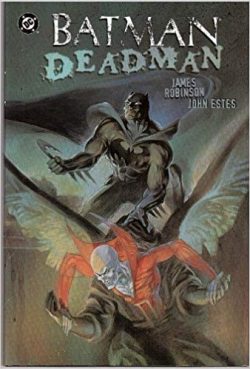
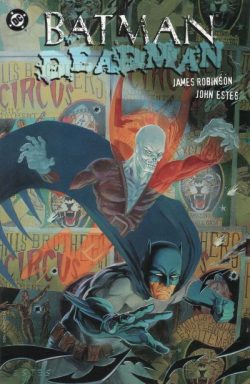
Batman/Deadman: Death and Glory


By James Robinson & John Estes (DC Comics)
ISBN: 978-1-84856-213-4 (HB)                    978-1-56389-228-8 (TPB)

Everybody thinks they know Batman but to only a select few are the secrets of assassinated trapeze artist Boston Brand also revealed. An ordinary man in a brutal, cynical world, Brand was a soul in balance until killed as part of a pointless initiation for a trainee assassin.

When the unlucky aerialist died, instead of going to whatever reward awaited him, Rama Kushna, spirit of the universe, offered him the chance to solve his own murder. That opportunity evolved into an unending mission to balance the scales between good and evil in the world. The ghost is intangible and invisible to all mortals, but has the ability to “walk into” living beings, possessing and controlling them.

Gotham City: Batman gradually regains consciousness, realising he is facing a squad of armed, trigger-happy police and holding a knife to the throat of a hostage. The scene is a nightclub-turned-charnel house and all evidence before the hero’s widened eyes indicates that he is the murderous culprit…

Suddenly clear-headed and rational, he drops his victim and escapes the SWAT teams, determined to find out what has happened since he lost consciousness. Stepping broadly out of character, Batman uses magical items taken from villainous sorcerer Felix Faust to perform an eldritch rite and snags his prime suspect, Boston Brand. Unfortunately, old comrade Deadman is not the guilty party, but does reveal that a rich man who has sold his soul to the devil is responsible for all the Dark Knight’s woes.

Meanwhile, Albert Yeats, terminally ill and imminently dying, is running for what’s left of his life, hunted by things he doesn’t know and can’t understand…

Determined to renege, Frederick Chaplin has offered another’s soul in exchange for his hellbound one, and the devil has accepted. Yeats had been chosen by the universe to reincarnate as the Messiah in his extremely imminent next life, but that can’t happen if he’s paying Chaplin’s tab in the Inferno.

Deadman has been watching over Yeats until he safely passes, but when Batman is first possessed and subsequently distracts the Ghostly Guardian with his spell, Yeats is left alone and unprotected…

Now the kid is in the wind and the heroes must find and shield him long enough to die safely: a task complicated by an entire city hunting what they still think is a murderous Bat-Maniac, whilst the real possession-killer – a phantom, satanic counterpart to Deadman called the Clown who has spread terror and death for 70 years – is loose to spread his own unholy kind of havoc…

Intriguing and pretty, but lacking much of the emotional punch of earlier Batman/Deadman pairings, Death and Glory looks great even if it feels rather dispirited and glib in its attempts to blend urban horror, all-out chase action, cod-religion and hidden histories with a millennial feel-good factor. The result is a top-rate outing for Boston Brand but a rather forced and unlikely performance from the Dark Knight.

Nevertheless, fans of both heroes will find lots to love here and Estes’ painted illustration will win the approval of most comic art lovers. This book is still available through physical and online outlets, in both paperback and hardcover editions but not yet as digital delight…
© 1996 DC Comics. All Rights Reserved.
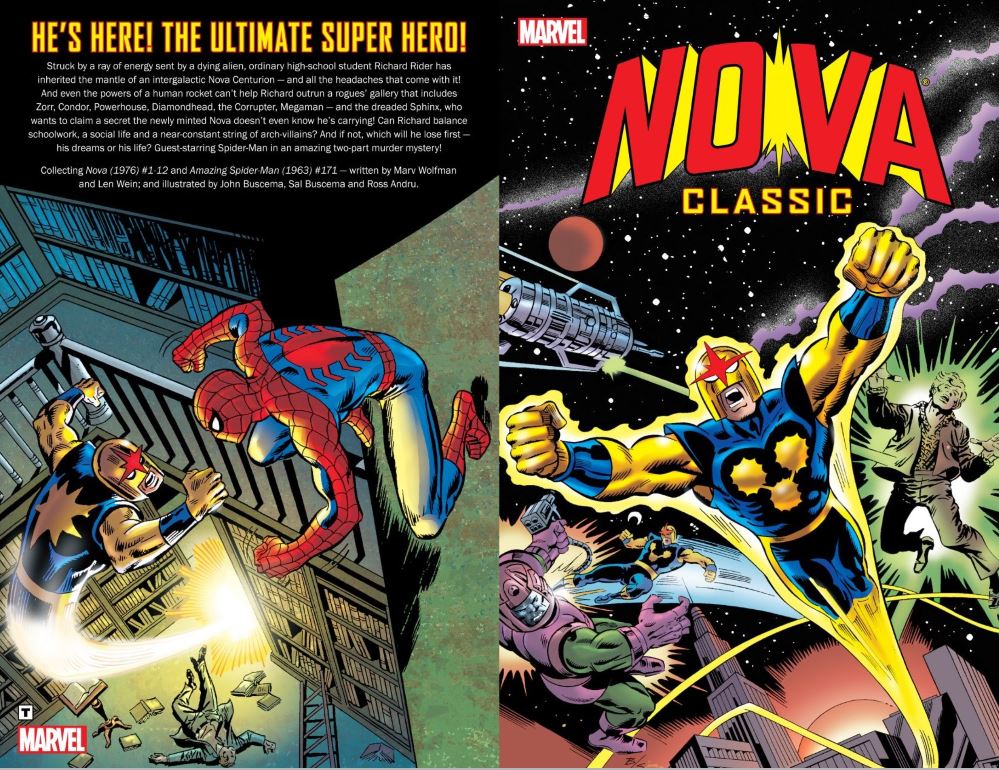
Nova Classic volume 1


By Marv Wolfman, Len Wein, John Buscema, Sal Buscema, Ross Andru, Carmine Infantino Joe Sinnott & various (Marvel)
ISBN: 978-0-7851-6028-1 (TPB)

By 1975 the first wave of fans-turned-writers were well ensconced at all the major American comic-book companies. Two fanzine graduates, Len Wein and Marv Wolfman, had achieved stellar successes early on, and then risen to the ranks of writer/editors at Marvel, a company in trouble both creatively and in terms of sales.

After a meteoric rise and a virtual root-&-branch overhaul of the industry in the 1960s, the House of Ideas – and every other comics publisher except Archie – were suffering from a mass desertion of fans who had simply found other uses for their mad-money.

Whereas Charlton and Gold Key dwindled and eventually died and DC vigorously explored new genres to bolster their flagging sales, Marvel chose to exploit their record with superheroes: fostering new titles within a universe it was increasingly impossible to buy only a portion of…

As seen in this no-nonsense compilation collecting the first dozen issues plus a crossover with Amazing Spider-Man #171 (September 1976-August 1977), The Man Called Nova was in fact a boy named Richard Rider. The new kid was a working-class teen nebbish in the tradition of Peter Parker – except he was good at sports and bad at learning – who attended Harry S. Truman High School, where his strict dad was the principal.

His mom worked as a police dispatcher and he had a younger brother, Robert, who was a bit of a genius. Other superficial differences to the Spider-Man canon included girlfriend Ginger and best friends Bernie and Caps, but he did have his own school bully, Mike Burley…

An earlier version, “Black Nova” had apparently appeared in the Wolfman/Wein fan mag Super Adventures in 1966, but with a few revisions and an artistic make-over by the legendary John Romita (Senior), the “Human Rocket” was launched into the Marvel Universe in his own title, beginning in September 1976, ably supported by the illustration A-Team of John Buscema & Joe Sinnott.

‘Nova’ – which borrowed as heavily from Green Lantern as the wallcrawler’s origin – was structured like a classic four-chapter Lee/Kirby early Fantastic Four tale, and rapidly introduced its large cast before quickly zipping to the life-changing moment in Rider’s life when a colossal star-ship with a dying alien aboard transfers to the lad all the mighty powers of an extraterrestrial peacekeeper and warrior.

Centurion Rhomann Dey was tracking a deadly marauder to Earth. Zorr had already destroyed the warior’s idyllic homeworld Xandar, but the severely wounded, vengeance-seeking Nova Prime was too near death and could not avenge the genocide.

Trusting to fate, Dey beams his powers and abilities towards the planet below where Rich is struck by an energy bolt and plunged into a coma. On awakening, the boy realises he has gained awesome powers… and the responsibilities of the last Nova Centurion.

The tale is standard origin fare beautifully rendered by Buscema & Sinnott, but the story really begins – after text feature Nova Newsline! – with #2’s ‘The First Night of… The Condor!’ as Wolfman, playing to his own strengths, introduces an extended storyline featuring a host of new villains whilst concentrating on filling out the lives of the supporting cast.

There’s still plenty of action as the neophyte hero learns to use his new powers (one thing the energy transfer didn’t provide was an instruction manual) but battles against winged criminal mastermind Condor and his enigmatic, reluctant pawn Powerhouse only lead the green hero into a trap…

Nova #3 debuts another brutal super-thug in ‘…The Deadly Diamondhead is Ready to Strike!’ (illustrated by new art-team Sal Buscema & Tom Palmer), but the battles are clearly not as important as laying plot-threads for a big event to come. The next issue

features the first of many guest-star appearances – and the first of three covers by the inimitable Jack Kirby.

‘Nova Against the Mighty Thor’ introduces The Corruptor: a bestial being who transforms the Thunder God – with one magic touch – into a raging berserker whom only the new kid on the block can stop, before ‘Evil is the Earth-Shaker!’ pits the lad against subterranean despot Tyrannus and his latest engine of destruction, although a slick sub-plot concerning the Human Rocket’s attempt to become a comicbook star still delivers some tongue-in-cheek chuckles to this day…

Issue #6 saw those long-laid evil mastermind plans begin to mature as Condor, Diamondhead and Powerhouse return to capture Nova, whilst their hidden foe is revealed in the Frank Giacoia inked ‘And So… The Sphinx!’

The Egyptian-themed bad guy is another world-class, immortal impatiently awaiting his turn to conquer the world…

Meanwhile, young Caps has been abducted by another new nasty who would eventually make big waves for the Human Rocket….

‘War in Space!’ sees Nova a brainwashed ally of his former foes in an invasion of Rhomann Dey’s still orbiting star-ship. The awesome craft will be an invaluable weapon in the encroaching war with the Sphinx, but the boarding raid results in Nova being marooned in deep space once his mind clears.

On narrowly escaping, Rider finds himself initially outmatched and outfought by Caps’ kidnapper in ‘When Megaman Comes Calling… Don’t Answer!’: a tumultuous, time-bending epic that concludes in #9’s ‘Fear in the Funhouse!’

Nova #10 began the final (yeah, right) battle in ‘Four Against the Sphinx!’ with Condor, Diamondhead and Powerhouse in all-out battle against the immortal mage whilst the hapless Human Rocket is caught in the crossfire, after which ‘Nova No More’ focuses on the hero’s short-term memories being removed to take him out of the game. The tactic only partially works since he’s back for the next issue’s classy crossover with the Spectacular Spider-Man.

Closing out this collection ‘Who is the Man Called Photon?’ is by Wolfman, Sal Buscema & Giacoia: teaming the neophyte hero with the much more experienced webslinger in a fair-play murder mystery, after Rich Rider’s uncle is killed by a costumed thief.

However, there are ploys within ploys occurring and after the mandatory hero head-butting session, the kids join forces and the mystery is dramatically resolved in Amazing Spider-Man #171’s ‘Photon is Another Name For…?’ courtesy of Len Wein, Ross Andru & Mike Esposito.

Enthusiastic and action packed, this tome offers lots of competent, solid entertainment and beautiful superhero art and Nova has proved his intrinsic value by returning again and again. If simple, uncomplicated Fights ‘n’ Tights fiction is what you want, look no further.
© 1976, 1977, 2013 Marvel Characters, Inc. All rights reserved.

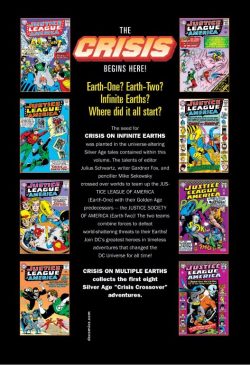
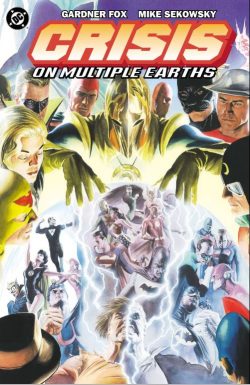
Crisis on Multiple Earths volume 1


By Gardner Fox, Mike Sekowsky, Bernard Sachs & Sid Greene (DC Comics)
ISBN: 978-1-56389-895-2

As I’ve frequently mentioned before, I was one of the “Baby Boomer” crowd which grew up with Julie Schwartz, Gardner Fox and John Broome’s tantalisingly slow reintroduction of Golden Age superheroes during the halcyon, eternally summery days of the early 1960s. To me those fascinating counterpart crusaders from Earth-Two weren’t vague and distant memories rubber-stamped by parents or older brothers – they were cool, fascinating and enigmatically new.

…And for some reason the “proper” heroes of Earth-One held them in high regard and treated them with obvious deference…

The transcendent wonderment began, naturally enough, in The Flash; pioneering trendsetter of the Silver Age Revolution. After successfully ushering in the triumphant return of the superhero concept, the Scarlet Speedster – with Fox & Broome at the writing reins – set an unbelievably high standard for costumed adventure in sharp, witty tales of science and imagination, always illustrated with captivating style and clean simplicity by Carmine Infantino.

The epochal epic that literally changed the scope of American comics forever was Fox’s ‘Flash of Two Worlds’ (Flash #123 September 1961, and reprinted in loads of places, but not here): introducing the concept of alternate Earths to the continuity and by extension the multiversal structure of the future DCU as well as all the succeeding cosmos-shaking yearly “Crisis” sagas that grew from it.

Moreover, where DC led, others followed…

Received with tumultuous acclaim, the concept was revisited months later in Flash #129 which also teasingly reintroduced evergreen stalwarts – Wonder Woman, the Atom, Hawkman, Green Lantern, Doctor Mid-Nite and Black Canary: venerable members of the fabled Justice Society of America. Clearly Editor Schwartz had something in mind…

That tale directly led into the veteran team’s first meeting with the Justice League of America and the start of an annual tradition. When ‘Flash of Two Worlds’ brought us the notion of Infinite Earths and multiple iterations of costumed crusaders, public pressure had begun almost instantly to agitate for the return of the Greats of the “Golden Age”. The Editorial powers-that-be were hesitant, fearing too many heroes would be silly and unmanageable, or worse yet, put readers off. If they could see us now…

These innovative adventures generated an avalanche of popular and critical approval (big sales figures, too) so inevitably the trans-dimensional tests led to the ultimate team-up in the summer of 1963.

This gloriously enthralling volume – available in trade paperback and digital incarnations – is the first of a glorious sequence of collections celebrating Infinite Diversity in Infinite Costumes (extra fanboy kudos if you get where I filched that from!) and re-presents the first four JLA/JSA convocations: stunning superhero wonderments which never fail to astound and delight. It also comes with context-conveying Introduction ‘1 & 2 = Crisis’ from wonder-scribe Mark Waid detailing even more cool facts behind the phenomenon…

The comic book catharsis commences with the landmark ‘Crisis on Earth-One’ and ‘Crisis on Earth-Two’ (from Justice League of America #21-22, August & September 1963) combining to form one of the most important stories in DC history and arguably one of the most crucial tales in American literature: at least the stuff with pictures in it.

Written by Fox and compellingly illustrated by Mike Sekowsky & Bernard Sachs, the yarn finds a coalition of assorted villains from each Earth plundering at will, meeting and defeating the mighty Justice League before insufferably imprisoning them in their own secret mountain HQ…

Temporarily helpless, “our” heroes contrive a desperate plan to combine forces with the champions of another Earth to save the world – both of it – and the result is pure Fights ‘n’ Tights majesty.

It’s impossible for me to be totally objective about this saga. I was a drooling kid in short trousers when I first read it and the thrills haven’t diminished with this umpty-first re-reading.

This is what superhero comics are all about!

The buying public clearly agreed and one year later ‘Crisis on Earth-Three’ and ‘The Most Dangerous Earth of All!’ (Justice League of America #29-30) reprised the team-up of the Justice League and Justice Society, when the super-beings of a third alternate Earth discover the secret of trans-universal travel.

Unfortunately, Ultraman, Owlman, Superwoman, Johnny Quick and Power Ring are villains on a world without heroes who see the costumed crime-busters of the JLA/JSA as living practise dummies to sharpen their evil skills upon.

With this cracking thriller the annual summer get-together became solidly entrenched in heroic lore, giving fans endless entertainment for years to come and making the approaching end of school holidays less gloomy than they could have been.

(A little note: although the comic cover-date in America was the month by which unsold copies had to be returned – the “off-sale” deadline – export copies to Britain travelled as ballast in freighters. Thus, they usually went on to those cool, spinning comic-racks in the actual month printed on the front. You can unglaze your eyes and return to the review proper now, and thank you for your patient indulgence of an old and misty-eyed man…)

The third annual event was a touch different; a largely forgotten and rather experimental tale wherein the educationally-challenged and extremely larcenous Johnny Thunder of Earth-1 wrests control of the genie-like Thunderbolt from his otherworld counterpart: employing its magical powers to change the events which created of all Earth-1’s superheroes.

With Earth-1 catastrophically altered in #37’s ‘Earth – Without a Justice League’, it’s suddenly up to the JSA to save the day in a gripping battle of wits and power before Reality is re-established in #38’s concluding chapter ‘Crisis on Earth-A!’.

Veteran inker Bernard Sachs retired before the fourth team-up, leaving the amazing Sid Greene to embellish the gloriously whacky saga that closes this tome: one springing out of the global “Batmania” craze engendered by the Batman television series…

A wise-cracking campy tone was fully in play, acknowledging the changing audience profile and this time the stakes are raised to encompass the destruction of both planets in ‘Crisis Between Earth-One and Earth-Two’ and ‘The Bridge Between Earths’ (Justice League of America #46-47, August & September 1966).

Here a bold – if rash – continuum warping experiment drags the twin sidereal worlds towards an inexorable hyper-space collision. Meanwhile, making matters worse, an awesome anti-matter being uses the opportunity to break into and explore our positive-matter universe whilst the heroes of both worlds are distracted by the destructive rampages of monster-men Blockbuster and Solomon Grundy.

Peppered with wisecracks and “hip” dialogue, it’s sometimes difficult to discern what a cracking yarn this actually is, but if you’re able to forgive or swallow the dated patter, this is one of the very best plotted and illustrated stories in the entire JLA/JSA canon. Furthermore, the vastly talented Greene’s expressive subtlety, beguiling textures and whimsical humour add unheard-of depth to Sekowsky’s pencils and the light and frothy comedic scripts of Fox.

These titanic tales won’t suit everybody and I’m as aware as any that in terms of the “super-powered” genre the work here can be boiled down to two bunches of heroes formulaically getting together to deal with extra-extraordinary problems. In mature hindsight, it’s obviously also about sales and the attempted revival of more sellable super characters during a period of intense commercial competition between DC Comics and Marvel.

But I don’t have to be mature in my off-hours and for those who love costumed dramas, who crave these cunningly constructed modern mythologies and actually care, this is simply a grand parade of straightforward action, great causes and momentous victories.

…And since I wouldn’t have it any other way, why should you?
© 1963, 1964, 1965, 1966, 2002 DC Comics. All Rights Reserved.