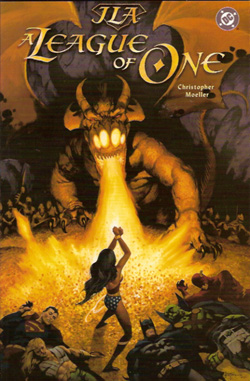
By Christopher Moeller (DC Comics)
ISBN 1-84023-575-6
This slight but satisfying fantasy romp is actually a Wonder Woman vehicle with the rest of the World’s Greatest Superheroes reduced to the roles of bit-players and hostages for the body of the action but is still nonetheless a pretty good blend of angst and adventure, and well leavened with some fine tongue-in-cheek comedy touches.
In 1348AD the last Dragon is defeated by Christian Knights and the modern Age of Man begins. But the Queen Wyrm is not dead, and sleeps beneath the Swiss Alps until awakened by Gnomes, whom she subjects to her will as she plans to devastate the Earth.
After a busy tour of duty with her fellow Justice Leaguers, Princess Diana returns to Greece for a break and hears a prophecy from the Oracle of Delphi. The mystic seer declares the menace of the last Dragon and warns that it will be defeated by the JLA – but only at the inevitable cost of their lives. Although the Oracle is never wrong, she can be open to interpretation, so if the team only has one member only one member has to die…
Beautifully painted art and a solid, if not too fresh plot makes this a plain-and-simple fun book to read and the themes, light touches and deft avoidance of continuity means that new readers and old fans can enjoy this modern fairy tale equally.
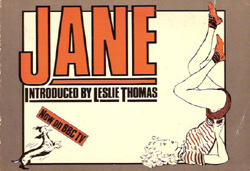
Jane is one of the most important and well-regarded comic strips in British, if not World, history. It began on December 5th 1932 as Jane’s Journal: Or The Diary of a Bright Young Thing, a frothy, frivolous gag-a-day strip in the Daily Mirror, created by the cartoonist Norman Pett. Originally a series of panels with cursive script embedded to simulate a diary page it switched to the more formal strip frames and balloons in late 1938, around the time scripter Don Freeman came on board.
Jane’s secret was skin. Even before war broke out there were torn skirts and lost blouses aplenty, but once the shooting started and Jane became an operative for British Intelligence her clothes came off with terrifying ease. She even went topless when the Blitz was at its worst.
Pett drew the strip, famously using first his wife and then actress and model Christabel Leighton-Porter until May 1948 when his assistant Michael Hubbard assumed full control of the feature (prior to that he had drawn backgrounds and male characters). Hubbard carried the series, increasingly a safe soap-opera and less a racy glamour strip to its conclusion on October 10th 1959.
Jane’s war record is frankly astounding. As a morale booster she was reckoned worth more than divisions of infantry and her exploits were cited in Parliament and discussed by Eisenhower and Churchill. Legend has it that The Mirror‘s Editor was among the few who knew the date of “D-Day†so as to co-ordinate her exploits with the Normandy landings. In 1944, on the day she went full frontal, the American Service newspaper Roundup (provided to US soldiers) went with the headline “JANE GIVES ALL†and the sub-heading “YOU CAN ALL GO HOME NOWâ€. Christabel Leighton-Porter toured as Jane in a services revue – she stripped for the boys – during the war and in 1949 starred in the film The Adventures of Jane.
Although the product of simpler, if more perilous times, the innocently saucy adventures of Jane, patient but dedicated beau Georgie-Porgie and especially her intrepid Dachshund Count Fritz Von Pumpernickel are landmarks of our artform, not simply for their impact but also for the plain and simple reason that they are superbly drawn and great to read. Let’s hope that one day that fact will be acknowledged with a definitive reprinting.
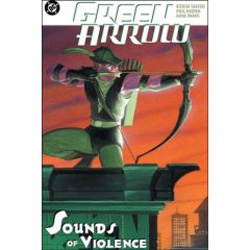
By Kevin Smith, Phil Hester & Ande Parks (DC Comics)
ISBN 1-56389-976-0 (hardcover) ISBN 1-4012-0045-1 (softcover)
After returning from the dead (see Green Arrow: Quiver – ISBN: 1-84023-509-8) our reinvigorated hero tries to re-establish himself both as a do-gooder and more importantly with his extended family – especially Mia Dearden, a street kid he saved from prostitution and took into his home. But as he resists the pressure to make her his next sidekick (from both her and his son Connor) The Riddler comes to town intent on mischief, and a new bizarre serial killer stalks the streets hunting costumed heroes.
Onomatopoeia only speaks in sound effects and is a ruthless, flamboyantly sadistic, seemingly unstoppable force. So when he fails to kill the junior Green Arrow he invades the hospital where the critically wounded Connor is undergoing emergency surgery to finish the job, leaving a trail of corpses in his wake.
Sharp, darkly funny and chilling by turns this tale (collected from issues #11-15 of the monthly comicbook) breaks out of the usual mould in many ways, perhaps as much due to writer Kevin Smith’s other commitments as from any sense of narrative novelty, but it certainly doesn’t harm the result. Particularly delicious are the scenes with on-again, off-again lover Black Canary and heroic polar opposite Hawkman.
A little more mature in both themes and the treatment of interpersonal relationships (and surely no bad thing for that?) this is a superior superhero saga and a strong advocate for the argument that costume dramas don’t have to be all Fights and Tights.
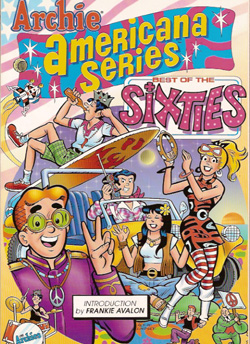
The monolith of wholesome fun that is Archie Comics really hit its stride in the 1960s. In an era that saw the commercial orientation of the world shift permanently to the Youth Market, the red-haired archetype finally broke into the TV arena with the first of many animated shows, scored a world-wide pop hit with the single “Sugar, Sugar†and utterly dominated the comicbook humour market.
This volume collects a scant few of the stories from that decade, concentrating on fashions, fads, Flower-Power, Pop-Art and even the growing divide between rebellious teens and oppressive adults. It also delightfully shows the overwhelming power of good writing and brilliant art to captivate an audience of any age.
Archie is a still that good-hearted, well-meaning boy lacking common sense. Betty is still the pretty, sensible girl next door, and glamorous Veronica is as rich, exotic and quixotic as ever, whilst the school and leisure antics of the broader cast are as hip and engaging as ever.
This eternal triangle has been the basis of more than sixty-five years of charming, raucous, gentle, frenetic, chiding and even heart-rending comedy ranging from surreal wit to frantic slapstick, and has never been better depicted by such wonderful talents as Frank Doyle, George Gladir, Bob Montana, Bob Bolling, Dan DeCarlo, Joe Edwards, Samm Schwartz, Bill Vigoda and Harry Lucey than in the era when everything changed and – at least on paper – the Kids took over.
These charming and comfortable yarns are a gentle delight and a much neglected area of cartoon and graphic narrative. It would benefit us all to take another long look at what they have to offer.
By Paul Dini & various (DC Comics)
ISBN13: 978-1-84576-673-3
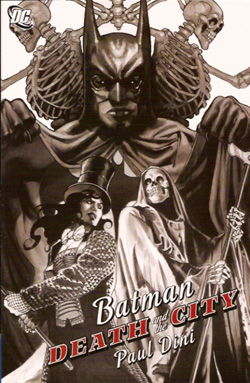
The second collection of post-Infinite Crisis Batman adventures from Detective Comics (issues #827-834) presents another fine crop of tales of the Not-Quite-So Dark Knight righting wrongs in the urban sewer of Gotham City, courtesy of Paul Dini and a stalwart team of associates.
‘Double Talk’, illustrated by Don Kramer and Wayne Faucher, introduces a new and nasty Ventriloquist as the mouthpiece of the murderous Scarface, whilst ‘Sharkbite’ is an old-fashioned murder “whodunit†with reformed villain-turned-consulting-detective The Riddler racing Batman to the killer’s identity.
Stuart Moore and artist Andy Clarke combine for the excellent two-parter ‘Siege’ as a human bomb captures the entire Wayne Tower skyscraper during a peace conference, and Dini, Kramer and Faucher return for ‘Kind of Like Family’ wherein Harley Quinn struggles with her decision to go straight when Scarface and the new Ventriloquist make her an offer she just can’t refuse.
‘Triage’, by Royal McGraw and Andy Clarke brings back Silver Age villains Fox, Shark and Vulture in a chilling psycho-drama before the volume concludes with the superb ‘Trust’ as warped stage magician Ivar Loxias returns in a chilling tale of slaughter and trickery guest-starring the bewitching Zatanna by the first team of Dini, Kramer and Faucher. And wait ’til you see the twist…
These tales of a renewed and determined crime-fighter look well set to overturn the Grim Sociopath image that has dogged Batman for too long. They are fresh, thrilling and powerfully compelling adventures that will astonish long-time fans and casual browsers equally. This is the best Batman in years.
By Bob Haney & Dick Dillin (DC Comics)
ISBN13: 978-1-84576-672-6
Are you old enough to yearn for simpler times?
The brilliant expediency of the 52 concept lends the daftest tale from DC’s back catalogue credibility and contemporary resonance since there’s now a chance that even the hippest and most happening of the modern pantheon can visit/interact with the most outrageous world or concept in DC’s long history. So this collection of well told tales from the 1970s, supplemented by tales from more self-conscious times, can be reprinted with a clear continuity-conscience without even the most strident fan complaining.
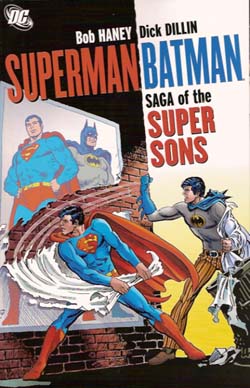
Written by Bob Haney and drawn mostly by Dick Dillin, the Super-Sons appeared with no fanfare in World’s Finest Comics #215, 1972; a bad time for superhero comics, but a great era for teen rebels. The free-wheeling, easy-rider, end of the flower-power days saw a huge focus on “teen consciousness†and the “Generation Gap†was a phrase on many lips. The editors clearly saw a way to make arch-establishment characters instantly pertinent and relevant, and being mercifully oblivious to the constraints of continuity (some would say logic) simply produced tales of the rebellious teen sons of the World’s Greatest Heroes out of whole cloth.
And well constructed, well told tales they are. In “Saga of the Super Sons†(inked by Henry Scarpelli) the young heroes run away from home – on the inevitable motorcycle, natch! – and encounter a scurrilous gang-lord. But worry not, the paternalistic parents are keeping a wary eye on the lads! Speaking as someone who was the target market for this experiment, I can admit that the parental overview grated then and still does, but as there were so many sequels somebody must have liked it.
“Little Town With a Big Secret†appeared in the very next issue, another human-scale human interest tale, but with a science-fiction twist and the superb inking of Murphy Anderson. WF # 221 featured “Cry Not For My Forsaken Son!†by the same team, which showed a troubled son the difference between value and worth, and the value of a father as opposed to a biological parent. Issue #222 “Evil in Paradise†(inked by Vince Colletta) took the young heroes to an undiscovered Eden to resolve the ancient question of whether Man was intrinsically Good or Evil.
“The Shocking Switch of the Super-Sons†(WF #224, and also inked by Colletta) took teen rebellion to its most logical conclusion as a psychologist convinces the boys to trade fathers! “Crown For a New Batman!†is a definite change of pace as Bruce Jr. inherits the Mantle and the Mission when his father is murdered! But never fear, all was not as it seemed, fans! This thriller first appeared in WF #228, and was inked by Tex Blaisdell, who also inked Curt Swan, artist for the more traditional Lost Civilisation yarn “The Girl That Time Forgotâ€, from WF #230.
The Relevancy Era was well over by the time Haney, Dillin and Blaisdell crafted “Hero is a Dirty Name†(WF #231), wherein the Sons question the motivation for heroism, and in #233’s “World Without Men†(inked by John Calnan) they tackle sexual equality and unravelled a plot to supplant human males. “The Angel With a Dirty Nameâ€, by the same team (WF #238) is a villains ‘n’ monsters slug-fest indistinguishable from any other super tale, and the original series ends with WF #242’s “Town of the Timeless Killersâ€, illustrated by Ernie Chua and John Calnan, wherein the kids are trapped in a haunted ghost-town and stalked by immortal gunslingers; an ignominious close to a bold experiment.
The kids made a one-stop return in “Final Secret of the Super-Sons†by Denny O’Neil, Rich Buckler and Dick Giordano (WF #263) when it was revealed that they were a simulation running on Superman’s giant Computer. In a grim indication of how much of a chokehold shared continuity had grown into, they then escaped into “reality†anyway…
The collection concludes with a short tale by Haney and Kieron Dwyer that appeared in Elseworlds 80-Page Giant. “Superman Jr. is No More!†is a charming and fitting conclusion to this odd, charming and idiosyncratic mini-saga.
If you’re not chained to continuity why not take a look at a few gems (and one or two duds) from a era where everybody read comics and nobody took them too seriously?
By Darwyn Cooke with J. Bone and Dave Stewart (DC Comics)
ISBN13: 978-1-84576-687-0
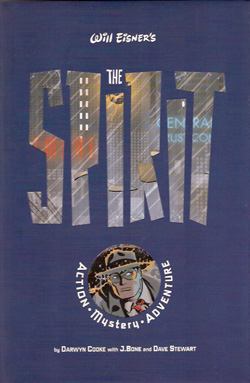
Some people are just hard to please. The Spirit is one of the greatest and most influential comics creations of all time and Darwyn Cooke is unarguably one of the best writer/artists in the industry today, but I still find it difficult to wholeheartedly praise his first efforts on DC’s acquisition and revival of the character, as seen in this compilation collecting the first six issues of comic book and the one-shot Batman/The Spirit.
Although I’m sure the impending movie has had a lot to do with this enterprise, The Spirit has always been a fundamentally Graphic and Design icon and Cooke has maintained the visual innovations as well as the racy, tongue-in-cheek comedy and breathtaking action. Perhaps my objections stem mostly from the facts that it’s set in a more-or-less contemporary world rather than the fabled forties and fifties. The ingenuous, camouflaged sexuality of Will Eisner’s work is missing from modern “in-your-face†liberated relationships, and that passionate tension is sorely missed. Or perhaps I’m just too churlish to accept anybody else’s interpretation of the character.
I certainly can’t fault the work on its own terms. Starting at full tilt with “Ice Ginger Coffeeâ€, which introduces the masked vigilante-detective who fights crime in Central City with the covert approval of Police Commissioner Dolan in a barn-storming tale of abduction, extortion and gangsterism, Cooke tells captivating adventure stories that will appeal to much wider audiences than the average super-hero comic. “The Maneater†introduces P’Gell, – a sultry vixen whose greatest weapon is ruthless allure – and the mostly comedic bit-player Hussein to the cast, as well as filling in some blanks from the hero’s past, when he was merely Private Eye Denny Colt, and the boyfriend of Dolan’s daughter Ellen.
A bloody gang-massacre is only the beginning in “Resurrectionâ€, which reveals the origin of The Spirit and introduces the gruesome Alvarro Mortez, who will return to bedevil Central City in future issues. “Hard like Satin†pits the outlaw detective against the indomitable CIA agent Silk Satin in a gruelling test of wills that brings Eisner’s ultimate villain The Octopus into the modern continuity, and the hysterically funny and chilling “Media Man†reintroduces Mister Carrion and his beloved vulture Miss Julia. The final solo adventure “Almost Blue†is a fantastical tale of rock ‘n ‘roll excess and extraterrestrial addiction with a poignant undercurrent which sits a little uncomfortably with the book’s final chapter.
“Crime Convention†adds Jeph Loeb to the regular team of Cooke, inker J. Bone and colourist Dave Stewart, to recount a frantic, funny tale of The Spirit and Batman’s first meeting whilst safeguarding a Police Commissioners convention from the amassed hordes of their respective Rogues Galleries. Originally released as a prelude to the ongoing Spirit series, this is oddly out of place both stylistically and thematically but is enjoyable nevertheless.
This is by any standard a truly great comics read and you shouldn’t let my reluctance influence you. If you haven’t seen Eisner’s originals you must read them, no argument there. But even though this volume isn’t MY Spirit, it is a damned good one. Go on, read them both. Please yourselves…
By Michael Jan Friedman, Peter David & Pablo Marcos (Titan Books)
ISBN: 1-85286-457-5
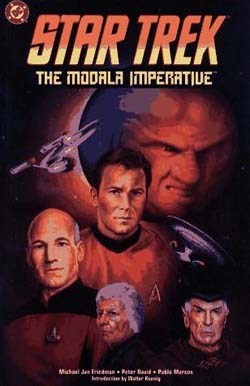
This is an interesting concept that doesn’t quite resolve into a winning piece of fiction, but should still please fans of the TV show and avid graphic novel readers. Originally released as two separate miniseries (Star Trek: The Modala Imperative #1-4 and Star Trek: The Next Generation: The Modala Imperative #1-4) it is less a team-up of the two Enterprise crews but rather more an shared mission separated by a century of change.
The story begins with Captain Kirk’s return to the planet Modala ten years after his first visit, when he was a lowly Lieutenant serving under the legendary Christopher Pike. As part of the survey team he recommended the world for membership in the Federation and has been sent back to assess their development and determine if the Modalans are ready to join the Interstellar Community. He decides on a small covert landing party consisting of himself and new Ensign Pavel Chekov. This will be the lad’s first Away Mission.
On beaming down they find a world run by a totalitarian government with weapons and technology far beyond their current level of development. Without further ado they become embroiled in a revolutionary movement, with Kirk once again stretching the definitions and spirit of the Prime Directive of absolute non-interference in non-Federation Cultures. After much ducking and weaving the crew escape, leaving the planet in isolation for another century, a dictatorship that must solve its own problems before it can join the greater universe.
One Hundred years later Captain Jean-Luc Picard’s Enterprise returns to Modala to assess the situation. A free world celebrating its Centennial of Liberation, it eagerly awaits an invitation to join the Federation of Planets, and looks forward to seeing again the survivors of that momentous second visitation. Dr McCoy and Mr. Spock are welcome guests at the festivities but when the mysterious arms-dealers also return demanding payment for the weapons they provided to the previous government, the planet-wide party swiftly descends into bloody chaos.
This is a very readable, if light, yarn that has lots to recommend it, although art-lovers might bristle at a somewhat lacklustre effort from artist Pablo Marcos. To leaven that, however, they can luxuriate in the absolute joy of Adam Hughes’ original comic book covers, which are worth the price of admission all by themselves.
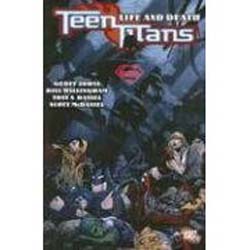
By Johns, Willingham, Daniel & McDaniel (DC Comics)
ISBN 1-84576-297-5
As DC’s Infinite Crisis loomed, it impacted on all the titles then being published by the company. As well as being a little hard and unforgiving for new readers it also played hob with narrative structure when simply trying to tell a story in a collected edition, but if you’re willing to read ’em then I’m game to try and explain the mess.
Collecting Teen Titans #29-33, Teen Titans Annual #1, Robin #146-147 and more-or-less pertinent extracts from Infinite Crisis #5-6, this fraught and angst-ridden story begins with the return of previously dead members of the team who reveal that the doors between Life and Death are breaking down. When deceased villain Brother Blood turns up leading an army of corpses including a team of dead Titans, it takes a desperate trip to the Great Beyond to set things right.
But this is mere prelude to the catastrophic battle between the recuperating modern Superboy (see Teen Titans/Outsiders: The Insiders, ISBN: 1-84576-247-9) and the deranged Superboy Prime, one of the survivors of the 1985 Crisis on Infinite Earths and a key instigator of the even greater Infinite Crisis. In a cataclysmic battle that involves an army of super-folk the young hero is grievously injured, and Robin leads a team to Luthor’s Lair in search of a cure for his injuries (this sequence, scripted by Bill Willingham, is a beacon of quality in an otherwise pedestrian and workmanlike affair).
Superboy recovers just in time to team up with Batman’s original sidekick Nightwing for one last Grand Hurrah before meeting a final fate which sadly is all too predictable.
Despite the best efforts of a huge number of quality creators such as writers Geoff Johns, Bill Williams, Marv Wolfman and the aforementioned Willingham, eight pencillers, sixteen inkers and five colourists, not to mention four letterers, this histrionic tale doesn’t fare well read alone, yet is actually all but lost in the greater cacophony of the main event. If you want to read this you will definitely need a large pile of other Crisis tie-in volumes for anything even approaching the full story.
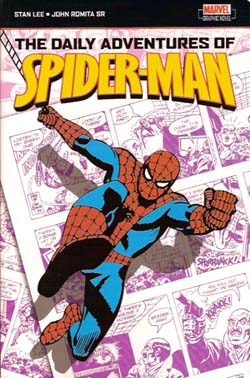
By Stan Lee & John Romita (Marvel/ Panini Publishing UK)
ISBN13: 978-1-905239-32-0
By 1977 Stan Lee had all but surrendered his role as editor and guiding light of Marvel Comics for that of a roving PR machine to hype-up the company he had turned into a powerhouse. In that year two events occurred that catapulted Marvel’s trademark character into the popular culture mainstream. One was the long anticipated release of the Amazing Spider-Man live action TV show – a mixed blessing and pyrrhic victory at best – whilst the other, and one much more in keeping with his humble origins was the launch of a syndicated newspaper strip.
Both brought the character to a wider audience but the later offered at least a promise of editorial control – a vital factor in keeping the Wallcrawler’s identity and integrity intact. But even this medium dictated some tailoring of the “Merry Marvel Madness†before the hero was a suitable fit with the grown-up world of the Funny Pages.
Which is a longwinded way of saying that completists and long-time fans will be happy with this collection of strips, as will any admirer of the black-and-white artwork of the senior John Romita (latterly inked by the great Frank Giacoia); but the stories, tame, bowdlerised and rather mediocre, struggle without the support network of a Marvel Universe, and are necessarily dumbed-down for readers not familiar with the wider cast or long history.
If the reader is steeped in the common folklore of Spider-Man, the adventures introducing Dr. Doom and Dr. Octopus are merely heavy-handed, but for newcomers they are presented as if all participants are already familiar, with no development or real explanation. A new villain The Rattler comes next, followed by the more appropriate (for strips at least) gangster The Kingpin before the strip finally gets around to a retelling of the origin, but now based on that aforementioned TV show rather than the classic Lee/Ditko masterpiece. It is safe to say that in those early years the TV series informed the strip much (too much) more than the comic-books.
A revised Kraven the Hunter came next, which presented an opportunity to remove Mary Jane Watson from the strip in favour of a string of temporary girl-friends, more in line with the TV version, and this also signalled a reining-in of super-menaces in favour of a less fantastic string of opponents such as a middle-Eastern terrorist. The launch of a Spider-Man movie took Peter Parker to Hollywood and a new version of deranged special-effects genius Mysterio, before Dr. Doom returned, attempting to derange our hero with robot pigeons and duplicates of Peter Parker’s associates.
This is followed by an exceptional run as three street thugs terrorise Aunt May for her social security money, and Spider-Man has to foil a crazed fashion-model who has discovered his identity and is blackmailing him. These human-scale threats are a perfect use of the hero in this more realistic milieu – and they are the best stories in this collection (reprinting the first two years of the feature; from January 3rd 1977 to January 28th 1979), which regrettably ends with a (feel free to shudder) protection racket story set in the Disco owned by Flash Thompson and Harry Osborn.
The wonderful art sadly can’t counteract the goofy stories that predominate in this collection, nor has time been gentle with the dialogue, which is so antiquated that it might be dug up on Time Team, but there is nonetheless a certain guilty pleasure to be derived from this volume if you don’t take your comics too seriously….