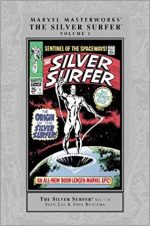
Silver Surfer Marvel Masterworks volume 1


By Stan Lee, John Buscema & various (Marvel)
ISBN: 978-0-7851-1187-0 (HB)                    978-0-7851-4282-9 (TPB)

Although pretty much a last-minute addition to Fantastic Four #48-50’s ‘Galactus Trilogy’, Jack Kirby’s scintillating creation the Silver Surfer quickly became a watchword for depth and subtext in the Marvel Universe and one Stan Lee kept as his own personal toy for many years.

Tasked with finding planets for space god Galactus to consume and, despite the best efforts of intergalactic voyeur Uatu the Watcher, one day the Silver Surfer discovers Earth, where the latent nobility of humanity reawakens his own suppressed morality; causing the shining scout to rebel against his master and help the FF save the world.

In retaliation, Galactus imprisons his one-time herald on Earth, making him the ultimate outsider on a planet remarkably ungrateful for his sacrifice.

The Galactus Saga was a creative highlight from a period where the Lee/Kirby partnership was utterly on fire. The tale has all the power and grandeur of a true epic and has never been surpassed for drama, thrills and sheer entertainment. It’s not included here: for that treat you’ll need to see an upcoming Fantastic Four Epic Collection or many other Marvel collections…

In 1968, after increasingly frequent guest-shots and even a solo adventure in the back of Fantastic Four Annual #5 (happily included here at the back; chronologically adrift but well worth the wait), the Surfer finally got his own (initially double-length) title at long last. There’s also a sassy spoof from Not Brand Echh #13 to puncture any pomposity overdose you might experience…

This stellar collection – available in deluxe hardback, sturdy trade paperback and assorted eBook formats – gathers the first six extra-length adventures from August 1968 to June 1969 and, following a fond Introductory reminiscence from author Stan Lee, begins with ‘The Origin of the Silver Surfer!’

Illustrated by John Buscema & Joe Sinnott, the drama unfolds after a prolonged flashback sequence and repeated examples of crass humanity’s brutal callousness and unthinking hostility, detailing how Norrin Radd, discontented soul from an alien paradise named Zenn-La, became the gleaming herald of a planetary scourge.

Radd had constantly chafed against a civilisation in comfortable, sybaritic stagnation, but when Galactus shattered their vaunted million years of progress in a fleeting moment, the dissident without hesitation offered himself as a sacrifice to save the world from the Devourer’s hunger.

Converted into an indestructible, gleaming human meteor, Radd agreed to scour the galaxies looking for uninhabited worlds rich in the energies Galactus needs to survive, thus saving planets with life on them from destruction. He didn’t always find them in time…

The stories in this series were highly acclaimed – if not really commercially successful – both for Buscema’s agonised, emphatic and truly beautiful artwork as well as Lee’s deeply spiritual and philosophical scripts. The tone was accusatory; with the isolated alien’s travails and social observations creating a metaphoric status akin to a Christ-figure for an audience that was maturing and rebelling against America’s creaking and unsavoury status quo.

The second 40-page adventure exposes a secret invasion by extraterrestrial lizard men ‘When Lands the Saucer!’ This forces the Surfer into battle against the sinister Brotherhood of Badoon without human aid or even awareness in ‘Let Earth be the Prize!’…

A little side-note for sad nit-picking enthusiasts like me: I suspect that the original intention was to drop the page count to regular 20-page episodes from #2, since in terms of pacing both the second and third issues divide perfectly into two-parters, with cliffhanger endings and splash page/chapter titles that are dropped from #4 onwards.

Silver Surfer #3 is pivotal in the ongoing saga as Lee & Buscema introduced Marvel’s Satan-analogue in ‘The Power and the Prize!’

Mephisto is Lord of Hell and sees the Surfer’s untarnished soul as a threat to his evil influence on Earth. To crush the anguished hero’s spirit, the demon abducts Norrin Radd’s true love Shalla Bal from still-recovering Zenn-La and torments the Sentinel of the Spaceways with her dire distress in his sulphurous nether-realm…

The concluding chapter sees mortal angel of light and devil of depravity conduct a spectacular ‘Duel in the Depths’ wherein neither base temptations nor overwhelming force are enough to stay the noble Surfer’s inevitable triumph.

Just as wicked a foe then attempted to exploit the Earth-bound alien’s heroic impulses in #4’s ‘The Good, The Bad and the Uncanny!’ (inked by new art collaborator Sal Buscema) wherein Asgardian God of Evil Loki offers lies, deceit and even escape from Galactus’ terrestrial cage to induce the Silver Stalwart to attack and destroy the mighty Thor. The net result is a staggering and bombastic clash that just builds and builds as the creative team finally let loose and fully utilise their expanded story-proportions and page count to create smooth flowing, epic action-adventures.

This magical collection continues with a powerful parable about race, prejudice and shared humanity as the Surfer is befriended by ostracised black physicist Al Harper in ‘…And Who Shall Mourn Him?’

As the two outcasts bond, the scientist realises he might have a way to free the Surfer from his Galactine incarceration, but just as they put their plan into operation, remorseless alien entity The Stranger arrives, determined to erase the potential threat mankind offers to the rest of the universe.

To stop him both, Harper and Radd must sacrifice everything they cherish most for a world that doesn’t care if they live or die…

Officially closing this volume ‘World Without End!’ from issue #6 embraces dystopian fantasy as the Surfer reasons that by breaking the time-barrier he might escape the energy shield binding him to Earth. Tragically, although the plan works, the lonely wanderer discovers that the far future harbours little life, and what there is owes fealty and its own precarious continuation to a monstrous mutant who lives simply to conquer and kill.

Appalled, overwhelmed and utterly unable to beat the horrific Overlord, all the Surfer can do to preserve all Creation is to escape back into time and seek to prevent the murderous freak from ever being born…

As foretold, this compulsive comicbook chronicle concludes with a groundbreaking vignette from Fantastic Four Annual #5 – released in November 1967 – wherein the rapidly rising star-in-the-making got his first solo shot.

‘The Peerless Power of the Silver Surfer’ (Lee, Kirby & Frank Giacoia) is a pithy fable of cruel ingratitude that reintroduced the Mad Thinker‘s lethal A.I. assassin Quasimodo…

The Quasi-Motivational Destruct Organ was a malevolent murder machine trapped in a static computer housing which dreamed of being able to move within the real world. Sadly, although its pleas initially found favour with the gullibly innocent stranger from the stars, the killer computer itself had underestimated the power and conscience of its foolish saviour and the gleaming guardian of life was explosively forced to take back the boon he had impetuously bestowed in a bombastic bravura display of Kirby action and Lee pathos…

One last sally comes with ‘The Origin of the Simple Surfer!’ – by Roy Thomas and the sublime Marie Severin from Not Brand Echh #13,May 1969 – as alien émigré Borin-Kadd ruminates on his strange fate and pines for his daftly-beloved Shallo-Gal when… well you get the idea, right?

Completing the treats are a reprint cover gallery from Fantasy Masterpieces, house ads and a stunning original art cover by Buscema & Sinnott

The Silver Surfer was always a pristine and iconic character when handled well – and sparingly – and these early forays into a more mature range of adventures, although perhaps a touch heavy-handed, showed that there was far more to comicbooks than cops and robbers or monsters and misfits.

That exploratory experience and the mystique of hero as Christ allegory made the series a critically beloved but commercially disastrous cause célèbre until eventually financial failure killed the experiment.

After the Lee/Kirby/Ditko sparks had initially fired up the imaginations of readers in the early days, the deeper, subtler overtones and undercurrents offered by stories like these kept a maturing readership enthralled, loyal and abidingly curious as to what else comics could achieve if given half a chance, and this fabulously lavish tome offers the perfect way to discover or recapture the thrill and wonder of those startlingly different days and times.
© 1968, 1969, 2018 Marvel Characters, Inc. All rights reserved.
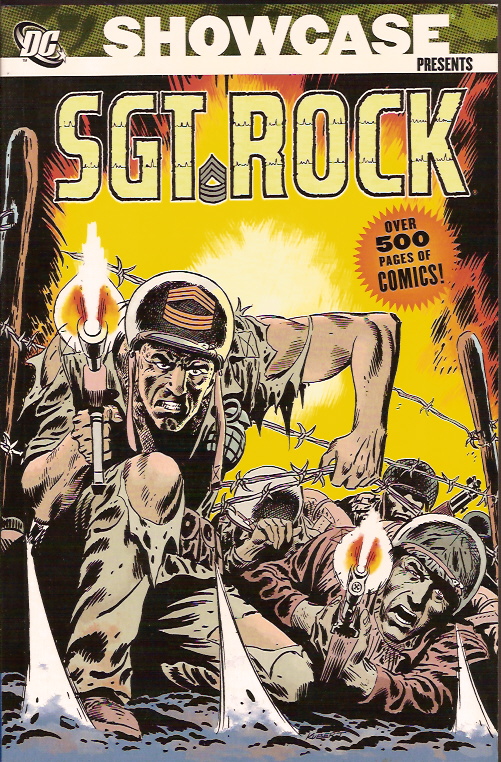
Showcase Presents Sgt. Rock volume 1


By Robert Kanigher, Joe Kubert, Bob Haney, Ross Andru, Mort Drucker, Irv Novick, Russ Heath & various (DC Comics)
ISBN: 978-1-4012-1713-6

Sgt Rock and the “combat-happy Joes” of Easy Company are one of the great and enduring creations of the American comic-book industry. The gritty meta-realism of Robert Kanigher’s ordinary guys in life-or-death situations captured the imaginations of generations of readers, young and old. So pervasive is this icon of comicbook combat, that’s it’s hard to grasp that Rock is not an immortal industry prototype like Superman, Batman and Wonder Woman – with us since the earliest moments of the industry – but is, in fact, a late addition to and child of the Silver Age of Comics.

This initial compendium collects in stunning black and white the tentative first steps in the character’s evolution from G.I. Combat #68 and Our Army at War #81-82 to the first full barrage of battle blockbusters from OAAW #83-117, covering January 1959 (and many happy returns to you, Sarge!) through April 1962: a period wherein the American comicbook market was undergoing a staggering revolution in style, theme and quality.

Behind the stunning Jerry Grandenetti cover (the first of many in this bulky and impressive monochrome paperback tome) for G.I. Combat #68 lurks a quiet, moodily unassuming story (by Kanigher & Joe Kubert) of an anonymous boxer who wasn’t particularly skilled but simply refused to be beaten. When ‘The Rock!’ enlisted in the US Army, however, that same Horatian quality attained mythic proportions as he held back an overwhelming Nazi attack by sheer grit and determination, remaining bloody but unbowed on a field littered with dead and broken men.

Dubbed “Rocky” the character returned as a sergeant in the April Our Army at War (#81) again facing superior German forces as ‘The Rock of Easy Co.!’ in a brief but telling vignette by Bob Haney, Ross Andru & Mike Esposito before finally winning a personal and extremely individualistic identity as Sgt. Rock in the next issue. This was the Mort Drucker illustrated ‘Hold Up Easy!’: another harsh and declarative mini-epic from Kanigher which saw hard-luck heroes Easy Company delayed and then saved by callow replacements who eventually came good…

Our Army at War #83 (June 1959) saw the true launch of the immortal everyman hero in Kanigher & Kubert’s ‘The Rock and the Wall!’: a tough-love, battlefield tutor shepherding his men to competence and survival amidst the constant perils of war. Here the grizzled nomcom meets a rival for his men’s admiration in the equally impressive Joe Wall…

Irv Novick illustrated ‘Laughter on Snakehead Hill!’ as the embattled dog-faces of Easy fight to take a heavily-fortified citadel before OAAW #85 introduces the first continuing cast member in the Kubert-limned ‘Ice Cream Soldier!’ Here Rock assuages a fearful replacement’s jangled nerves with tales of another hopeless “green apple” who grew into his job.

This ploy of incorporating brief past-action episodes into a baptism of fire scenario would play over and over again, and never got old…

Haney returned in #86 to script ‘Tank 711’ for Kubert as the terse top-kick educated another newbie in combat etiquette. Kanigher returned to describe the taking of “No-Return-Hill” and the initiation of four more raw recruits in ‘Calling Easy Co.!’ after which Grandenetti illustrated a brace of tales in #88 and 89: ‘The Hard Way’, in which Rock suffers a shocking crisis of confidence and ‘No Shot from Easy!’ wherein the indomitable sergeant is forced to give his toughest ever order…

Issue #90 offered classic Kubert as ‘Three Stripes Hill!’ revealed the story of how Rock won his stripes after which the traditionally anthological Our Army at War offered three complete Sgt. Rock sagas in #91, beginning with ‘No Answer From Sarge!’ as the NCO risks everything to drag a recruit out of a crippling funk; ‘Old Soldiers Never Run!’ where he has to weigh an old man’s pride against Easy’s continued existence, and the Haney-scripted tragic fable of a sole-surviving Scottish soldier in ‘The Silent Piper!’

OAAW #92 saw Kanigher & Kubert tackle battlefield superstitions in ‘Luck of Easy!’, and ‘Deliver One Airfield!’ introduces Zack Nolan, a son of privilege who has to learn teamwork the hard way before #94’s ‘Target… Easy Company’ pits the unit against a German General determined to eradicate the increasingly high-profile heroes.

Issue #95 debuted charismatic and ambitious Bulldozer Nichols who wants Rock’s rank and position in ‘Battle of the Stripes!’, after which ‘Last Stand for Easy!’ sees the still in-charge topkick compelled to relinquish his lead-from-the-front position and ‘What Makes a Sergeant Run?’ finds him again sharing his hard-earned war wisdom with the young and the hapless.

Haney penned ‘Soldiers Never Die!’ in #98, with Rock forced to overcome his team’s trauma at losing a beloved comrade whilst Kanigher described ‘Easy’s Hardest Battle!’ in #99, as the weary warrior recalls a number of instances which all qualified, before once more triumphing over insurmountable odds and adding one more clash to the list.

The Stalwart Sergeant risked everything to save a broken replacement in #100’s ‘No Exit for Easy!’ and repeated the task in ‘End of Easy!’ as a parachute drop goes tragically awry, before #102’s ‘The Big Star!’ concedes the consequences of depending on a young man utterly unsuited for combat…

‘Easy’s Had It!’ in #103 was another Haney contribution, exploring what happens when Rock is wounded and the company has to fight without their guiding light and lucky talisman, after which Kanigher assumed regular scripting duties beginning with #104 and ‘A New Kind of War!’ depicting the grizzled vet totally outgunned by a valiant nurse who refuses to retreat and never surrenders.

In #105 a ‘TNT Birthday!’ has Rock worried about the underage kid who had somehow got past all the instructors to join Easy under terrifying fire whilst ‘Meet Lt. Rock!’ (illustrated by Novick) sees the dedicated noncom forcibly promoted until he manages to undo the horrifying prospect after which #107’s ‘Doom Over Easy!’ again sees the savvy soldiers afflicted by crippling superstition…

The superb Russ Heath drew his first Rock strip in OAAW #108: ‘The Unknown Sergeant!’ has the squad passing through a French village with a statue of a WWI Yank “doughboy” bearing an uncanny resemblance to their own indomitable leader – provoking some very uncomfortable historical hallucinations – before Kubert’s return in #109’s ‘Roll Call of Heroes!’ signals a dose of grim reality when Rock recalls his own deadly baptism of fire and lost comrades, after which a green Lieutenant almost provokes mutiny and murder until he learns the rules of Combat Arithmetic in ‘That’s An Order!’

‘What’s the Price of a Dogtag?’ is painfully answered in the occupied streets and on seemingly deserted beaches in #111, whilst ‘Battle Shadow!’ focuses on the burgeoning supporting cast in a blisteringly explosive extravaganza that heralds African American soldier Jackie Johnson taking centre stage (in a bold early example of comicbook affirmative action) for a memorable last-stand moment in ‘Eyes of a Blind Gunner’ in #113 (December 1961).

The incessant toll of lost comrades hits hard in ‘Killer Sergeant!’, whilst civilian survivors and partisans who comprise ‘Rock’s Battle Family!’ help him survive the worst the war can throw at him – featuring a cameo from French Resistance star Mademoiselle Marie – before the ragged warrior finds himself all alone when he answers #116’s ‘S.O.S. Sgt. Rock!’ to save lost comrade Ice Cream Soldier…

This inaugural battle-book concludes with a dramatic tale of three hopelessly square pegs who finally find their deep, round holes in #117’s traumatic saga of ‘The Snafu Squad!’

Robert Kanigher at his worst was a declarative, heavy-handed and formulaic writer, but when writing his best stuff – as he does here – remains an imaginative, evocative, iconoclastic and heart-rending reporter and observer of the warrior’s way and the unchanging condition of the dedicated and so very human ordinary foot-slogging G.I.

With superb combat covers from Kubert, Grandenetti, and Heath fronting each episode, this battle-book is a visually perfect compendium and is a lost delight for any jaded comics fan looking for something more than flash and dazzle.

A perfect example of true Shock and Awe, these are stories every fan should see, especially as modern tastes in books and digital compilations haven’t quite remembered that star warriors and superheroes are not the only flavours…
© 1959, 1960, 1961, 1962, 2007 DC Comics. All Rights Reserved.

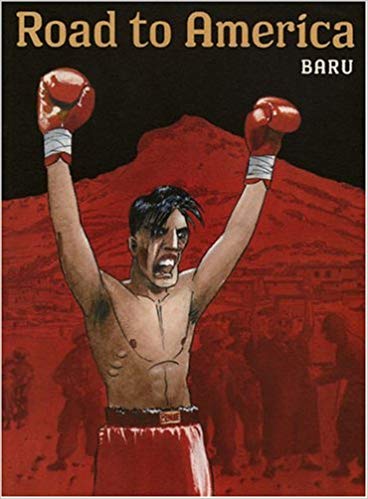
Road to America


By Baru, with colour by Daniel Ledran (Drawn & Quarterly Publications)
ISBN: 978-1-89659-752-2

We privileged ones live in a world where gratification – if not instant – is far from arduous to attain or hard to enjoy. For us the only struggle is choosing how best to indulge ourselves and, if you’re a comics nut like me, the biggest mystery in a hedonistic existence is why so many truly superb artistic efforts get sidelined or forgotten, when relative immortality is merely a matter of scanning and publishing/posting.

Here’s a lost treasure that proves my point. I’ve got this in its paperback form, but I’d happily pay again to get it digitally. That won’t feed one single starving kid, but reading it in a freely accessible form might inspire them…

Sport, despite being a world obsession, has oddly dropped out of the remit of most comics storytellers these days which is both odd and a shame. The Road to America, by Baru, uses the fervour of the immigrant’s dream and the fierce metaphor of struggle as depicted in the boxing ring to create a compelling tale of adversity against a true historical backdrop.

Set in Algeria in the 1950s – when the country was struggling to achieve independence from France – it’s the story of the bloody rise of impoverished street urchin, Said Boudiaf. Becoming a boxer, he literally smashes his way out of the slums to the glittering lights of Paris, even as his less utilisable brother turns to bombs and a more permanent form of bloodletting as a freedom fighter determined to overthrow French Colonial rule.

Said is an unstoppable force in the ring, and becomes a sporting hero, but in the real world he’s a leaf in the wind. Civilised, cultured (white) French citizens despise his ethnicity whilst capitalising on his achievements, and he’s regarded as a puppet by the Algerian resistance forces. Nevertheless, both sides want him for his propaganda value….

Said wants nothing more than personal freedom. His fights are non-political, as is all sport, but when his successes mount, and his unstoppable rise culminates in him winning the French Championship, politics claims him anyway as a race-riot between native Algerian and French spectators erupts in the stadium.

The tragic culmination occurs when Said makes it to America, and qualifies for the World title, but on returning to Paris to train for the bout he is sucked into the events of October 17th 1961 – the day when a protest march against anti-Algerian policies and heavy-handed police suppression leads to a bloody riot and a terrible massacre…

This beautifully executed tale is both blunt and subtle: weaving threads of ambition, morality, freedom, sacrifice and prejudice, both personal and social, into a compelling if sometimes chaotic narrative that is a joy to behold but often a bitter pill to swallow.

Doesn’t that sound like something we should all be reading in the current world climate?
© 2002 Baru. All rights reserved.

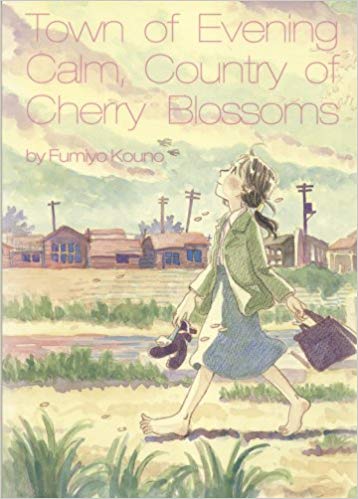
Town of Evening Calm, Country of Cherry Blossoms


By Fumiyo Kouno (jaPress/Last Gasp)
ISBN: 978-0-86719-721-1 (HB)

First published in 2003/2004 in Japan’s Weekly Manga Action YÅ«nagi no Machi, Sakura no Kuni (Town of Evening Calm, Country of Cherry Blossoms) is an award-winning (2004 Grand Prize for manga, Japan Media Arts Festival and the 2005 Tezuka Osamu Cultural Prize Creative Award) collection of interlinked, generational short stories. The compelling stories deal with the aftermath of the atom bombing of Hiroshima, and particularly the treatment of bomb-affected survivors (“hibakusha”) by a culture that has traditionally shunned imperfection and studiously ignored unpleasant truths.

The book was made into an award-winning feature film and radio serial in 2007.

The project was instigated by her editor rather than Fumiyo Kouno (or Kōno Fumiyo, if you’d like to acknowledge her actual name): a native of modern Hiroshima and manga maker (Kokko-san; In a Corner of This World), who apparently never considered herself as being affected by the ghastly events of August 6th 1945.

The first story – ‘Town of Evening Calm’ – is set in 1955 and follows teenager Minami Hirano as she goes about her daily life in the slowly-recovering city. She lives with her ailing mother and sister in a seedy shack and ruminates on those she’s lost: father and two sisters to the bomb and baby brother Asahi who was mercifully staying with rural relatives when the bomb hit.

She hasn’t seen him since that day. Her aunt thought it best to keep the healthy boy away, and subsequently adopted him. The surviving family bravely struggle as seamstresses and clerks, trying to save enough money to visit him. Minami has an admirer; a shy young man named Yutaka Uchikoshi, who tries bombarding the quietly independent girl with presents, but ten years after the bomb, the explosion is inexorably still claiming victims. As tragedy looms, Minami is unaware that her long-lost brother is coming to see her…

Follow-up ‘Country of Cherry Blossoms’ is divided into two separate tales. The first is set in Tokyo in 1987 with tomboy schoolgirl Nanami Ishikawa railing against her life. She is Asahi’s daughter – a second-generation victim – and has never met her hibakusha relatives, but when her brother Nagio is hospitalised she sneaks into his room with new friend Toko Tone and showers him with cherry blossom petals to show him the spring he’s missing, unaware that his asthmatic condition is considered by many to be the taint of the bomb…

Admonished by her grandmother, she goes on about her life but as the family moves nearer the hospital, she abruptly loses touch with Toko…

Part Two takes up the story in 2004. Asahi has recently retired and moved in with Nanami, when medical graduate Nagio mentions that he has seen Toko at the hospital where he works. Nanami has other things to worry about: Asahi is disappearing for days at a time and she thinks he might be senile…

One day she follows him, and – just as years before with Nagio – Toko, a virtual stranger, appears and shares her journey and revelations. The troubled old man is travelling to the rebuilt Hiroshima, driven by an irresistible impulse, and as they follow him Nanami discovers that real reason Toko stopped seeing her family…

Pensive, serene and deftly sensitive, almost elegiac, this book deals with uncomfortable issues by advocating tolerance, understanding and endurance rather than the bombastic unyielding defiance of Keiji Nakazawa’s landmark Barefoot Gen, and the message hits home all the harder for it.

Initially reluctant to produce a work about Hiroshima, Ms. Kōno discovered a strong voice within – and her own unrealised, unexpressed attitudes – when faced with the behaviour still directed toward hibakusha more than five decades later. As she states in the Afterword of this superb commemorative hardcover, it was “unnatural and irresponsible for me to consciously try to avoid the issue” and she decided that “drawing something is better than drawing nothing at all.”

As far as I can tell this moving portmanteau is still only available in paperback form but it’s well worth tracking down: a quietly magnificent tribute to the truism that “Life goes on” and the proposition that even polite and passive intolerance should always be resisted. This is a book every politician in the world should read. It also holds a harsh lesson every cosy, comfortable family in existence needs to absorb… and it needs to be back in print and available digitally, too.
© 2003, 2009 Fumiyo Kouno. All Rights Reserved.

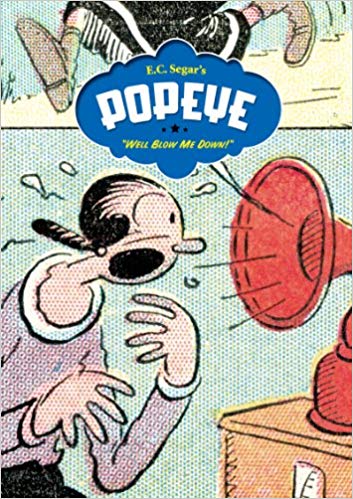
E.C. Segar’s Popeye volume 2: “Well, Blow Me Down”


By Elzie Crisler Segar (Fantagraphics Books)
ISBN: 978-1-56097-874-9 (HB)

Elzie Crisler Segar was born in Chester, Illinois on 8th December 1894.His father was a handyman, and Elzie’s early life was filled with the kinds of solid blue-collar jobs that typified his generation of cartoonists. He worked as a decorator and house-painter, and played drums, accompanying vaudeville acts at the local theatre. When the town got a movie house he played for the silent films, absorbing the staging, timing and narrative tricks from the close observation of the screen that would become his bread-and-butter as a cartoonist. He was working as the film projectionist when, aged 18, he decided to become a cartoonist and tell his own stories.

Like so many others, Segar studied art via mail, in this case W.L. Evans’ cartooning correspondence course out of Cleveland, Ohio (from where Jerry Siegel & Joe Shuster would launch Superman upon the world), before gravitating to Chicago where he was “discovered” by Richard F. Outcault – arguably the inventor of newspaper comic strips with The Yellow Kid and Buster Brown – who got him an introduction at the prestigious Chicago Herald. Still wet behind the ears, Segar’s first strip, Charley Chaplin’s Comedy Capers, debuted on 12th March 1916.

In 1918 he married Myrtle Johnson and moved to William Randolph Hearst’s Chicago Evening American to create Looping the Loop, but Managing Editor William Curley saw a big future for Segar and promptly packed the newlyweds off to New York and the King Features Syndicate.

Within a year Segar was producing Thimble Theatre – launched December 19th 1919 – in the New York Journal. A pastiche of Movie features similar to Hairbreadth Harry and Midget Movies it boasted a standardised repertory cast who acted out melodramas, comedies, crime-stories, chases and especially comedies, for huge daily audiences. The core cast included parental pillars Nana and Cole Oyl, their lanky daughter Olive, diminutive-but-pushy son Castor and Olive’s plain and simple, sometime boyfriend Horace Hamgravy (later just Ham Gravy).

In 1924 Segar followed up with second daily strip The 5:15: a surreal domestic sitcom featuring weedy commuter and would-be inventor John Sappo and his formidable wife Myrtle (obviously quite a common name, hmm?).

A born storyteller, Segar had from the start an advantage even his beloved cinema couldn’t match. His brilliant ear for dialogue and accent shone out from his admittedly average adventure plots, adding lustre to stories and gags he always felt he hadn’t drawn well enough. After a decade or so and just as cinema caught up with the invention of “talkies” he finally discovered a character whose unique sound and individual vocalisations blended with a fantastic, enthralling nature to create a literal superstar.

Popeye the sailor, brusque, incoherent, plug-ugly and stingingly sarcastic, shambled on stage midway through the adventure ‘Dice Island’, (on January 17th 1929: see E.C. Segar’s Popeye volume 1: “I Yam What I Yam!”) and once his part was played out, simply refused to leave. Within a year he was a regular, and as the strip’s circulation skyrocketed, he became the star. Eventually the strip was changed to Popeye and all of the old gang except Olive were consigned to oblivion…

Popeye inspired Segar. The near decade of funny thrillers that followed revolutionised the industry, laid the groundwork for the entire superhero genre (but sadly, usually without the leavening underpinnings of his self-aware humour) and captivated the whole wide world.

The astonishingly unique cast of characters invented during this period – Sea Hag, Toar, Poopdeck Pappy, Swee’pea, Eugene the Jeep, Alice the Goon, George W. Geezil, and especially J. Wellington Wimpy (potentially as big and innovative a star as Popeye) and even Professor O.G. Wotasnozzle in the Sappo daily strip which had evolved into the Sunday Popeye “Topper” – all individually verge on manic brilliance, and combined to make Popeye a global figure to rival Tarzan and Sherlock Holmes and, latterly, Mickey Mouse. To most of the world Popeye was real…

All the attendant peripherals of a major brand gravitated to Popeye. There were toys, games premiums, books, comics, film, radio shows, and especially those incredible animated cartoons. Tragically, Segar died at the height of his creative powers and with so much more magic still to make on 13th October 1938; sole creator of an incredible galaxy of imagination, but his legacy briefly lived on through his brilliant assistant Forrest “Bud” Sagendorf – although the syndicate appointed Doc Winner, Tom Sims, Ralph Stein and Bela Zaboly to work on the printed strip before letting Bud loose on it in 1959 – whilst the animated features increasingly became the main means of bringing Popeye to the world. It just wasn’t the same, though.

When Sagendorf returned, his loose, rangy style and breezy scripts brought the strip itself back to the forefront of popularity and made reading it cool once more. He wrote and drew Popeye until Bobby London took over in 1986.

These superb hardback collections are the perfect means of discovering or rediscovering Segar’s magical tales. The second huge and still readily-available volume (almost 14 ½ by 10½ inches) from 2007 contains a fascinating essay from historian Donald Phelps, a testimonial from Mort “Beetle Bailey” Walker – which includes the beautiful inspirational drawing Segar sent the young fan in 1934 – and another batch of incredible tales from the daily and Sunday strips.

The dailies black-&-white section (covering December 22nd 1930 to June 6th 1932) sees Popeye, Castor and Olive soar to stardom in the fabulous western spoof ‘Clint Gore, the Outlaw’ and strike a blow for the Depression-era poor by inventing a financial institution that gives money away in ‘A One-Way Bank’, before resuming their globe-trotting adventuring in ‘The Great Rough-House War’ and its immediate sequel ‘Tragedy in the Land of Saps’ wherein the very peculiar King Blozo of Nazilia seeks aid to end a war with the neighbouring kingdom of Tonsylania – although the real problem seems to be his own over-ambitious Generals and the fact that all his soldiers are cowards…

This classy screwball epic displays Segar’s trenchant skill with the sharp swift scalpel of satire as well as broad slapstick, and has glorious overtones of if not actual influences upon the Marx Brothers gem “Duck Soup.” With an initially reluctant Popeye compelled by his sense of duty to become King of the unlovable Nazilians, it’s also where the superman sailor reveals for the first time the strength inducing properties of spinach…

From there Popeye and Olive head back to the wild, wild west to visit ‘Skullyville, Toughest Town in the World’ and we’re treated (I think that’s the word) to the unforgettable yet frankly grisly vision of Olive Oyl as a bar-hall dancer in a raucous, ridiculous romp that’s jam-packed with lampooned cowboy clichés and hilariously brilliant original gags.

The full-colour Sunday pages cover March 1st 1931 to October 2nd 1932, with increasingly absurdist Sappo toppers thoroughly complimenting the whacky shenanigans of the lead feature.

May 8th is particularly noteworthy for the first appearance of insane Professor O.G. Wotasnozzle – another Segar walk-on who would usurp his host feature…

The Popeye strip continues the uproarious and exceedingly violent boxing career of the one-eyed sea-dog, who took on all exceedingly monstrous comers, including the awesome man-mountain Tinearo, Kid Klutch (a giant gorilla) and even a robot boxer as the increasingly obsessive and belligerent Mr. Kilph, crazed by his inability to beat the grizzled sailor-man, slipped slowly into utter wackadoodleness.

When not beating the stuffing out of his opponents Popeye pursues his flighty, vacillating and irresolute Olive with desperate verve, if little success, but his life is forever changed when the ever-so-corruptible and adorably contemptible J. Wellington Wimpy makes his debut.

The engaging Mr. Micawber-like coward, moocher and conman debuted on 3rd May 1931 as an unnamed referee in the bombastic month-long bout against Tinearo, but he obviously struck a chord with Segar who gradually made him a (usually unwelcome) fixture. Always ravenous, ever happy and eager to take a bribe, we learned his name in the May 24th instalment and he utters the first of his many immortal catchphrases a month later.

It was June 21st – but “I would gladly pay you Tuesday for a hamburger today”, like most phrases everybody knows, actually started as ‘Cook me up a hamburger, I’ll pay you Thursday’…

There’s far more of Wimpy’s incredible presence in volume 3, but for now another aspect of Popeye’s complex character is revealed in an extended sequence running from May 29th 1932 through July 17th, one that quickly secured his place in reader’s hearts.

The sailor was a rough-hewn orphan, who loved to gamble and fight, not too smart and superhumanly powerful, but he was a big-hearted man with an innate sense of decency who hated injustice – even if he couldn’t pronounce it. When Mary Ann, a starving little girl, tries to sell him a flower he adopts her, taking her from the brutal couple who use her in a begging racket. He grows to love her and there’s a genuine sense of happy tragedy when he finds her real parents and gives her up. That such a rambunctious, action-packed comedy adventure serial could so easily turn an audience into sobbing, sentimental pantywaists is a measure of just how great a spellbinder Segar was…

These tales are as vibrant and compelling now as they’ve ever been and comprise a world classic of graphic literature that only a handful of creators have ever matched. Despite some astounding successors in the drawing seat, no one has ever bettered Segar’s Popeye and these superb volumes are books you’ll treasure for the rest of your life. Don’t miss them.
© 2006 Fantagraphics Books Inc. All comics and drawings © 2006 King Features Inc. All rights reserved.

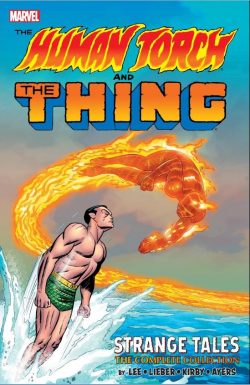
The Human Torch and the Thing: Strange Tales – the Complete Collection


By Stan Lee, Larry Lieber, Robert Bernstein, Ernie Hart, Jerry Siegel, Larry Ivie, Jack Kirby, Dick Ayers, Bob Powell, Steve Ditko, Carl Burgos, Wallace Wood & various (Marvel)
ISBN: 978-1-3029-1334-2 (TPB)

Hot on the heels of the runaway success of Fantastic Four, Stan Lee & Jack Kirby spun the most colourful and youngest member of the team into his own series, hoping to recapture the glory of the 1940s when the Human Torch was one of the company’s “Big Three” superstars.

This captivating, esoteric and economical collection of pure 1960s superhero shenanigans gathers those eclectic but crucial yarns – no less than five major Marvel villains debuted in blistering battle against the Flaming Kid – between Strange Tales #101 – 134, as well as the lead tale from Strange Tales Annual #2 (spanning October 1962-July 1965).

Filled with fabulous classics of old school Marvel Fights ‘n’ Tights mayhem and mirth, this particular compendium (available in trade paperback and assorted eBook formats) also finally acknowledges that for a large part of that run his rocky companion and elder gadfly Ben “the Thing” Grimm was an equal player and partner in crime-busting.

Within a year of FF #1, the magic-&-monsters anthology title Strange Tales became the home for the hot-headed hero. In issue #101, teenager Johnny Storm started his ancillary solo career in the eponymous ‘The Human Torch’.

Scripted by Larry Lieber (over a plot by his brother Stan) and sublimely illustrated by Jack Kirby & Dick Ayers, here the plucky lad investigates sabotage at a new seaside amusement park and promptly discovers Commie-conniving thanks to a Red spy called the Destroyer. Kirby would pencil the first few adventures before moving on, after which inker Ayers would assume control of the series’ look for most of its run – although The King would generate some of the best covers of his Marvel career throughout the Torch’s tenure in Strange Tales.

An odd inconsistency or, more likely, tension- and drama-inducing gimmick did crop up here. Although public figures in the Fantastic Four, Johnny and his sister Sue live part-time in Long Island hamlet of Glenville and, despite the townsfolk being fully aware of her as the glamorous and heroic Invisible Girl, they seem oblivious to the fact that her baby brother is the equally famous Torch. Many daft-but-ingenious pages of Johnny protecting his secret identity would ensue before the situation was brilliantly resolved…

Although something of a hit-or-miss proposition in itself, the strip was the origin point for many of Marvel’s greatest villains. The first of these appeared in the very next issue. ‘Prisoner of the Wizard’ (Lee, Lieber, Kirby & Ayers) sees a spiteful and publicity-hungry intellectual giant determined to crush the Torch to prove his superiority to the callow kid who steals all the newspaper headlines…

The same creative team then produced captivating classic ‘Prisoner of the 5th Dimension’, as Johnny defeats an imminent invasion and frees a captive populace from tyranny before easily trashing adhesive-toting adversary ‘Paste-Pot Pete!’ (later revamped as the terrifying Trapster), before teaming with sister Sue to tackle the perilous ‘Return of the Wizard’.

When Kirby moved on to engineer and design a host of new characters and concepts (occasionally returning as necessity or special events warranted), Ayers assumed full art duties beginning with Strange Tales#106 (March 1963). This Lee & Lieber yarn was notable in that it revealed that the entire town of Glenville had always known the Torch’s secret identity but were just playing along to keep him happy…

When Acrobat Carl Zante knocks on Johnny’s door and offers him a better-paying gig in ‘The Threat of the Torrid Twosome’, the kid’s head is swelled and swayed, but he soon learns he’s been played by a master conman and diabolical bandit…

This first hint of tongue-in-cheek whimsy presaged an increasing lightness of touch which would come to characterise the Marvel style as much as the infighting between team-mates. The villainous Zante would return for another milestone in issue #114…

Issue #107 was Lieber’s last as Ayers drew a splendid punch-up with the ‘Sub-Mariner’ – a tale reminiscent of the spectacular and immensely popular Golden Age battles of their publishing forebears. Veteran writer Robert “Berns” Bernstein scripted the next two – frankly daft – sagas over Lee’s plots, but the saving grace of both ‘The Painter of a Thousand Perils!’ (empowered by an alien art kit which brought illustrations to life in ST #108) and ‘The Sorcerer and Pandora’s Box’ (#109, with monstrous demons attacking humanity) was the brief return of Kirby to the pencilling.

H.E. Huntley (Ernie Hart) typed the words for Ayers to illumine in ‘The Human Torch vs. the Wizard and Paste-Pot Pete!’: a cunning clash presaging the villains’ eventual evolution into FF’s evil counterparts the Frightful Four.

In #111 the Torch made short work of ‘Fighting to the Death with the Asbestos Man!’ – yet another demented scientist experiencing the travails and tragedies of simpler times.

Strange Tales #112 (scripted by Jerry Siegel under pen-name Joe Carter) introduced murderous electrical marauder the Eel who accidentally swiped and activated a miniature A-Bomb in tense, multifaceted thriller ‘The Human Torch Faces the Threat of the Living Bomb!‘, after which1963’s Strange Tales Annual #2, featured ‘The Human Torch on the Trail of the Amazing Spider-Man!’

This terrific romp by Lee, Kirby & Steve Ditko details how the wallcrawler is framed by international art thief The Fox, whilst back in regular comicbook Strange Tales #113, “Carter” created another long-term always-employed baddie in ‘The Coming of the Plantman!’

November’s Strange Tales #114 then changed the face of the Marvel Firmament forever…

Written by Lee himself and illustrated by Kirby & Ayers, it featured the return of the third of Timely Comics’ Golden Age Big Three – or at least an impersonation of him by the insidious Acrobat – in a blockbusting battle entitled ‘The Human Torch meets…Captain America!

Here’s a quote from the last panel…

“You guessed it! This story was really a test! To see if you too would like Captain America to Return! As usual, your letters will give us the answer!” I wonder how that all turned out?

Lee took over as scripter with ST #115’s ‘The Sandman Strikes!’ wherein Johnny impersonates Spider-Man to defeat the granular gangster Flint Marko, after which the Torrid Teen and team-mate Ben Grimm battle each other while ‘In the Clutches of the Puppet Master!’ (#116, with Ayers inked by George Roussos in his own secret identity of George Bell).

‘The Return of the Eel! proved far more of a challenge in #117, after which the Wizard has another go as ‘The Man Who Became the Torch!’, consequently nearly killing the Thing and Reed Richards besides.

A first brush with Marvel’s soon-to-be core readership came in #119. ‘The Torch Goes Wild!’ details how Commie Agent the Rabble Rouser mesmerises decent citizens, making them surly and rebellious, after which Kirby stepped back in for #120 as ‘The Torch Meets Iceman!’: a terrific action-extravaganza that pretty much ended the glory days of this strip. From then on, despite every gimmick and occasional burst of sheer inspiration, the Bullpen could muster, a slow decline set in as quirky back-up strip Doctor Strange grew in popularity – and cover space…

ST #121 saw Johnny as ‘Prisoner of the Plantman!’ (Lee & Ayers) and #122 found a thug, a conman and a yogi all augmented by Dr. Doom and mustered as the woefully lame Terrible Trio ordered to launch an ill-conceived attack in ‘3 Against the Torch!’

Strange Tales #123 has a creepy inventor build himself an impressive insectoid exo-suit to get rich the easy way, as – in an effort to boost ratings – The Thing becomes a permanent fixture in ‘The Birth of the Beetle!’

This so-so saga was most notable for the pencil job by Golden Age Torch creator Carl Burgos, after which Johnny and Ben tackle a fully re-designed ‘Paste-Pot Pete’ (inked by Paul Reinman) before going after another old adversary in ‘The Sub-Mariner Must Be Stopped!’

‘Pawns of the Deadly Duo!’ sees Puppet Master return, allied to the Mad Thinker in a clever but shallow yarn whilst #127 pits Ben and Johnny against a bizarre puzzle and ‘The Mystery Villain!’

After a stunning Kirby pin-up of the Thing, the Fantastic Two then unwillingly battle ‘Quicksilver and the Scarlet Witch’ in #128 (this one inked by Frankie Ray, AKA Frank Giacoia), as the Homo Superior siblings make an abortive first attempt to quit Magneto’s Brotherhood of Evil Mutants, after which ‘The Terrible Trio!’ once more fail to impress or assassinate our heroes…

Pop culture reeled and staggered with #130 in ‘Meet the Beatles’ (not villains, but actually some sort of popular musical combo of the times, and they actually didn’t meet them at all), although brilliant Golden Age artist Bob Powell (with inking from Chic Stone) did take over the art chores for the comedy of errors/crime caper.

Ayers returned to ink #131, the dire ‘Bouncing Ball of Doom!’ with the Mad Thinker siccing a cybernetic bowling bowl on the pair before Larry Ivie scripts a capable Space Race thriller in ‘The Sinister Space Trap!’ (inked by Mike Esposito under his Mickey DeMeo alias).

Stan Lee returned for the last two tales in ST #133 and #134; ‘The Terrible Toys’ wherein Puppet Master tries a new modus operandi and ‘The Challenge of… The Watcher!’ (inked by the majestic Wally Wood) wherein Torch and Thing are transported to legendary Camelot to battle time-reaver Kang the Conqueror, but it was clear the writer’s mind was elsewhere, most likely with the new Nick Fury, Agent of S.H.I.E.L.D. strip that would replace the FF pair from Strange Tales #135 onwards.

Wrapping up this memory lane meander are a marvellous melange of original art pages by Kirby and/or Ayers, nostalgia-invoking House Ads and a cover gallery from the 1974-75 reprint series of Golden and Silver Age Torch Tales, rendered by John Romita, Joe Sinnott, Larry Lieber, Ron Wilson, Frank Giacoia, Gil Kane, Al Milgrom &Vince Colletta, plus the Kirby/Richard Isanove paint cover from Marvel Masterworks: The Human Torch #1.

It’s interesting to note that as the parent Fantastic Four title grew in scope and quality the Human Torch’s own series diminished. Perhaps there is something to be said for concentrating one’s efforts or not overexposing your stars. What was originally a spin-off for the younger audience faded as Marvel found its voice and its marketplace, although there would be periodic efforts to reinvigorate the Torch.

Sadly, the historic value often supersedes the quality of most of these strange tales, but there’s still a good deal that’s great about this series and Costumed Drama devotees with a sense of tradition and love of fun will find this book irresistible and unmissable.
© 1962, 1963, 1964, 1965, 2018 Marvel Characters, Inc. All rights reserved.
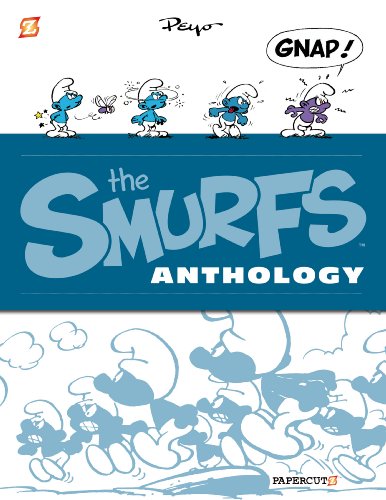
The Smurfs Anthology volume 1


By Yvan Delporte & Peyo, smurflated by Joe Johnson (Papercutz/NBM)
ISBN: 978-1-59707-417-9

Pierre Culliford was born in Belgium in 1928 to a family of British origin living in the Schaerbeek district of Brussels. An admirer of the works of Hergé and American comics in Mickey, Robinson and Hurrah!, he developed his own artistic skills but the war and family bereavement forced him to forgo further education and find work.

After toiling as a cinema projectionist, in 1945 the eager teen joined C.B.A. animation studios, where he met André Franquin, Morris and Eddy Paape. When the studio closed, Pierre briefly studied at the Brussels Academy of Fine Arts before moving full-time into graphic advertising.

In his off hours he began submitting comic strips to the burgeoning post-war comics publishers. His first sale was in April 1946: Pied-Tendre, a tale of American Indians in Riquet, the comics supplement to the daily L’Occident newspaper. Further sales to other venues followed and in 1952 his bold young knight Johan found a permanent spot in Le Journal de Spirou. Retitled Johan et Pirlouit – after the inclusion of a scene-stealing comedy foil – the strip prospered and, in 1958 introduced a strange bunch of blue woodland gnomes called Les Schtroumpfs.

Culliford – now using the childhood nom de plume Peyo – would gradually succumb to popular demand and turn those adorable little mites (known to us and most of the world as The Smurfs) into an all-encompassing global empire, but before being sucked onto that relentless treadmill, he still found time to create a few other noteworthy strips such as titanic tyke Benoît Brisefer (translated recently as Benny Breakiron), and also stuck with Johan until 1977 (13 albums-full) when the pressure of creating more Smurf stuff grew too much. Even then his son Thierry with artist Alain Maury revived the series, bring the count to 17 albums

Yvan Delporte (24th June 1928-5th March 2007) was a Belgian comics writer whose greatest gift was an invisible one. He was editor of Le Journal de Spirou between 1955 and 1968: shaping strips and creator’s during Europe’s golden age of excellence. One feature he did script was Peyo’s spin-off fantasy Les Schtroumpfs, and he also found a bit of time to write René Follet’s Steve Severin and co-create Franquin’s Gaston Lagaffe and Idées noires.

We English-speakers mostly have visions of the Smurfs fostered and shaped by the animated shows, films and toys, but the comics – although aimed at an all-ages audience – were packed with social commentary and sly satire that can still take the breath away if you’re a parent reared on anodyne censored US cartoon fodder.

Thanks to the efforts of US publisher Papercutz, those gloriously outrageous medieval masterworks are available to discerning fans, both as individual albums and in superb, anthologically robust, full-colour hardback (and eBook) compilations, kitted out and filled with little extras such historical essays and all presented in the original publication order Peyo dictated. A huge bonus as far as I’m concerned is the inclusion of original artwork and (French) covers of the period…

First album ‘The Purple Smurfs’ comes with a comprehensive Introduction by Smurfologist Matt. Murray explaining the tone of those distant times and how we post-PC patrons got here from original 1959 solo saga ‘Les Schtroumpfs noirs‘…

Full of fun, action, slapstick and frenetic thrills, the eponymous lead tale – by Delporte & Peyo; as are all the entries here – reveals how the idyllic hidden mushroom-styled village of the little blue folk falls to a rapidly-spreading plague. The horrific ailment is transmitted by irresistible biting and characterised by a radical shift in colouration and behaviour. Soon, only wise wizardly patriarch Papa Smurf is left to combat the Smurfie Apocalypse, and he’s running out of options…

Two shorter yarns follow as ‘The Flying Smurf’ finds one little slacker absconding from walnut-gathering duties to pursue ever more complex and obsessive ways to soar like a bird in the sky after which ‘The Smurfnapper’ finds archenemy sorcerer Gargamel and his cat Azrael hunting for the last crucial ingredient to create a Philosopher’s stone. It’s a Smurf, of course, but catching and keeping one of the little blue perishers are two entirely different things…

The second album is quite infamous in certain circles and very much a product of its era: one generation since WWII ended and right in the midst of escalating Cold War tensions. Following another Matt. Murray Introduction, discussing the heavy political and social implications of Le Schtroumpfissime, ‘The Smurf King’ details how, when Papa Smurf goes on an extended provisions hunt, his decision not to leave anyone in charge leads to rapid and radical political unrest. A half-assed and wholly inept attempt to elect a new boss goes typically awry until one bright spark realizes he can get others to vote for him by lying, making promises he can’t keep and applying heavy doses of flattery.

Soon, he’s living in a palace built by the suckers and indulging in all the perks of totalitarianism, but some Smurfs are muttering discontent and forming a rebel army…

Social satire gives way to surreal whimsy ‘The Smurfony’ then details the formation of an orchestra. One poor Smurf though has plenty of enthusiasm but no talent and his efforts make him extremely unwelcome… until Gargamel returns with soporific sound sorcery and only a bit of discord can save the day…

As previously stated, the Smurfs debuted in La Flûte à six trous, a 1958 tale of feudal comedy-adventurers Johan and Peewit. The little guys were phenomenally popular and reappeared many times before winning their own series, and when that finally happened the origin tale was rushed into album form as the third Schtroumpfs book release, suitably reimagined as La Flûte à six Schtroumpfs.

In ‘The Smurfs and the Magic Flute’ court jester Peewit – another would-be musician whose melodies induce pain and hysteria – gets hold of a flute with six holes that forces all who hear it to dance uncontrollably until they pass out. His pranks are disruptive enough but the instrument is then stolen by vile villain Matthew Oilycreep, who goes on a plundering spree, amassing stolen wealth to buy an army of mercenaries to take over the kingdom.

Young knight Johan and Peewit re at a loss to stop the usurper until they are approached by little blue men who tell them an incredible tale and invite them back to their mystical home.

They have all the answers and a plan but there’s no time to waste if disaster is to be avoided…

Wrapping up with ‘The Aftersmurf’ from Papercutz Smurf-in-Chief Jim Salicrup, this stunning collection of fun and fantasy is a magnificent example of all-ages comics wonderment no serious aficionado could do without.

Go on, You Smurf you want to…
© Peyoâ„¢ 2013 – licensed through Lafig Belgium. English translation © 2013 by Papercutz. All rights reserved.

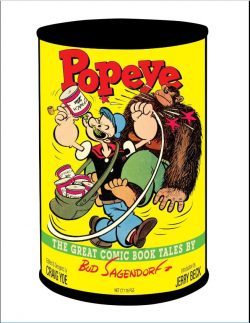
Popeye: The Great Comic Book Tales by Bud Sagendorf


By Bud Sagendorf, edited and designed by Craig Yoe (Yoe Books/IDW)
ISBN: 978-1-60010-747-4 (HB)                eISBN: 978-1-68406-381-9

There are few comic characters that have entered communal world consciousness, but a grizzled, bluff, uneducated, visually impaired old sailor with a speech impediment is possibly the most well-known of that select bunch.

Elzie Segar had been producing Thimble Theatre since December 19th 1919, but when he introduced a coarse, brusque “sailor man” into the saga of vaudevillian archetypes Ham Gravy and Castor Oyl on January 17th 1929, nobody suspected the giddy heights that walk-on would reach…

Yes, folks, its’s Happy 90th Anniversary for the old swab, who’s still going strong under the aegis of veteran cartoonist Hy Eisman (Kerry Drake, Little Iodine, Bunny, The Katzenjammer Kids, Little Lulu). Parent strip Thimble Theatre turns one hundred this year too, so there’s that to celebrate as well…

In 1924 Segar created a second daily strip The 5:15: a surreal domestic comedy featuring weedy commuter and would-be inventor John Sappo and his formidable wife Myrtle which endured – in one form or another – as a topper/footer-feature accompanying the main Sunday page throughout the author’s career.

It even survived his untimely death, eventually becoming the trainee-playground of Popeye’s second great stylist Bud Sagendorf…

After Segar’s tragic and far too premature death in 1938, Doc Winner, Tom Sims, Ralph Stein and Bela Zambouly all worked on the printed strip even as animated short features brought Popeye to the entire world via the magic of movies. Sadly, none of them had the eccentric flair and raw inventiveness that had put Thimble Theatre at the forefront of cartoon entertainments…

Born in 1915, Forrest “Bud” Sagendorf was barely 17 when his sister – who worked in the Santa Monica art store where Segar bought his supplies – introduced the kid to the master who became his teacher and employer as well as a father-figure. In 1958, Sagendorf took over the strip and all the merchandise design, becoming Popeye’s prime originator…

When Sagendorf took over, his loose, rangy style and breezy scripts brought the strip itself back to the forefront of popularity and made reading it cool and fun all over again. He wrote and drew Popeye in every graphic arena – including the majority of licensed merchandise – for 24 years. Sagendorf retired in 1986 after which “Underground” cartoonist Bobby London took over the Sailorman’s voyages and died in 1994.

Bud had been Segar’s assistant and apprentice, and from 1948 onwards he wrote and drew Popeye’s comicbook adventures in a regular monthly title published by America’s king of licensed periodicals, Dell Comics.

When Popeye first appeared, he was a rude, crude brawler: a gambling, cheating, uncivilised ne’er-do-well. He was soon exposed as the ultimate working-class hero: raw and rough-hewn, practical, but with an innate, unshakable sense of what’s fair and what’s not, a joker who wanted kids to be themselves – but not necessarily “good” – and someone who took no guff from anyone.

Naturally, as his popularity grew, Popeye mellowed somewhat. He was still ready to defend the weak and had absolutely no pretensions or aspirations to rise above his fellows but the shocking sense of dangerous unpredictability and comedic anarchy he initially provided was sorely missed… but not in Sagendorf’s comicbook yarns…

Collected in this enchanting full-colour hardback (also available in a digital edition) is an admittedly arbitrary and far from definitive selection of the Young Master’s compelling funnybook canon from Dell, spanning February/April 1948 to September 1957. Other yarns are readily available in IDW’s Popeye Classics series and I’ll be plugging those in the fullness of time.

The stunning, seemingly stream-of-consciousness stories are preceded here by an effusively appreciative Introduction from Jerry Beck before ‘Ahoy, Ya Swabs!’ relates history and recollection from inspired aficionado and historian/publisher Craig Yoe augmented by a fabulous collation of candid photos, original comicbook art, more.

Especial gems are Bud’s 1956 lessons on backgrounds from the Famous Artists Cartoon Course, series of postcards and the Red Cross booklet produced for sailors.

Popeye‘s fantastic first issue launched in February 1948, with no ads and duo-coloured (black and red) single page strips on the inside front and back covers. From that premiere issue a full-coloured crisis comes as ‘Shame on You! or Gentlemen Do Not Fight! or You’re a Ruffian, Sir!’ sees our salty swab earning a lucrative living as an occasional prize-fighter. That all ends when upcoming contender Kid Kabagge and his cunning manager Mr. Tillbox use a barrage of psychological tricks to put Popeye off his game. The key component is electing his sweetie Olive Oyl President of the fictitious Anti-Fisticuff Society to convince her man to stop being a beastly ruffian and abandon violence. It only works until the fiery frail learns she’s been gulled…

Next up is the lead tale from #9, (October/November) as ‘Misermites! or I’d Rather Have Termites!’ details how the peaceful coastal town of Seawet is plagued by an invasion of plundering dwarves. When the petty pilferers vanish back to their island with “orphink kid” Swee’ Pea as part of their spoils, Popeye and Wimpy give chase and end up battling a really, really big secret weapon…

‘Witch Whistle’ comes from Popeye #12 (April/May 1950) and sees the sailor revisit the embattled kingdom of Spinachovia where old King Blozo is plagued by a rash of vanishing farmers. The cause is sinister old nemesis the Sea Witch whose army of giant vultures seem unbeatable until Popeye intervenes…

‘Interplanetary Battle’ comes from Popeye #21 (July-September 1952) and taps into the growing fascination with UFOs as Wimpy innocently seeks to aid his old pal. When no prize fighter on Earth will box with Popeye, the helpful vagabond broadcasts a message to the universe and what answers the call is a bizarre shapeshifting swab with sneaky magic powers…

An engaging Micawber-like coward, cad and conman, the insatiable J. Wellington Wimpy debuted on in the Newspaper strip on May 3rd 1931 as an unnamed and decidedly partisan referee in one of Popeye’s pugilistic bouts. The scurrilous but polite oaf struck a chord and Segar gradually made him a fixture. Always hungry, keen to solicit bribes and a cunning coiner of many immortal catchphrases – such as “I would gladly pay you Tuesday for a hamburger today” and ‘Let’s you and him fight’ – Wimpy was the perfect foil for a simple action hero and increasingly stole the entire show… and anything else unless it was extremely well nailed down…

From Popeye #25 (July-September 1953), ‘Shrink Weed’ then details how some “wild spinach” reduces the old salt and baby Swee’ Pea to the size of insects with potentially dire and outrageous consequences before the entire cast visit ‘The Happy Little Island’ (Popeye #27, January-March 1954) and confront subsurface creatures doing their darndest to spoil that jolly atmosphere.

An epic thrill-fest manifests in ‘Alone! or Hey! Where is Everybody? or Peoples is All Gone!’ (#32, April-June 1955) as humans are abducted from all over the coast, leading Popeye into another ferocious battle with evil machines and his most persistent enemy, after which another family sea-voyage results in the cast being castaway on an island of irascible invisible folk in ‘Nothing!’ (#34, October-December 1955) before the fun concludes in sheer surreal strife as Popeye #41 (July-September 1957) displays capitalism at its finest when Olive gets a new boyfriend: one with a regular job and prospects. Stung to retaliate, Popeye devises ‘Spinach Soap!’ to secure his own fortune, but being un-ejjikated, rough-and-ready appoints Wimpy as his boss. Big mistake…

There is more than one Popeye. Most of them are pretty good, and some are truly excellent. The one in this book is definitely one of the latter and if you love lunacy, laughter and rollicking adventure you must now read this.
Popeye: The Great Comic Book Tales by Bud Sagendorf © 2018 Gussoni-Yoe Studio, Inc. All Rights Reserved. Popeye © 2018 King Features Syndicate. ™ Heart Holdings Inc.

Philip K. Dick – A Comics Biography


By Laurent Queyssi & Mauro Marchesi, translated by Edward Gauvin (NBM)
ISBN: 978-1-68112-170-3

Publisher NBM expand their fabulous line of European-created dramatized graphic biographies with this latest gem originally released as PHIL: Une vie de Philip K. Dick.

This compelling luxury hardcover (also available in digital formats) investigates one of the most intriguing characters of the 20th century: a man who could arguably be thought of as the John the Baptist of modern existential civilisation and a futurist seer of human interaction and competition.

Philip Kindred Dick (16th December 1928 – 2nd March 1982) explored political, social and philosophical themes through science fiction stories created during the most innovative period of the genre’s entire history. Despite personal feelings of failure, his genre work -incorporating and predicting monopolistic corporate capitalism, alternate realities, the blurry edges of artificial intelligence and altered states of consciousness – changed the way the world thinks and provided road maps for how we meat-minds think in an increasingly digital age.

However, as this superb graphic treatise shows, although he was driven to excel in its creation, he had no respect for his own “non-literary” canon and never realised he was the right man at just the right time…

Dick was demon-driven, charismatic, paranoid, inspired, drug-and-approval dependent, a serial lothario and usually deeply unhappy. Hardly a likable or even sympathetic character -even as seen through the lens of author, screenwriter and translator Laurent Queyssi (Neurotwistin’, Allison, Blackline) who clearly adores his subject’s oeuvre – this is nevertheless an incredibly enticing peek into the world of the legend, deftly and seductively pieced together in moving morsels of emotional highs and lows.

Much of the success must be attributed to artist, illustrator and educator Mauro Marchesi (enerazione M, Magico Mondiale, Mamba) whose graceful, understated art beguiles the reader every step of the way. I’m loathe to froth – or use made-up words I haven’t actually coined myself – but this book was literally unputdownable. I started late on the night my review copy arrived, intending to scan the opening and get a feel for it, and the next thing I know it’s 02:30 and I’m wondering why the house is so dark and quiet…

Accompanied by an adroit and incisive Postscript from the author and a fulsome Biography, this is another visual masterpiece honouring a major force in the history and culture of our complex world, and one you should track down as soon as you can, if not sooner …
© Blue Lotus Prod. Paris, 2017 by Goetzinger. © 2018 NBM for the English translation.

Philip K. Dick – A Comics Biography is scheduled for release January 30th, 2019 and is available for pre-order now.
For more information and other great reads go to NBM Publishing.

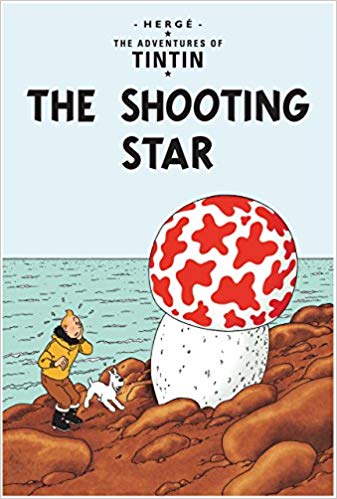
Adventures of Tintin: The Shooting Star


By Hergé & various; translated by Leslie Lonsdale-Cooper & Michael Turner (Egmont)
ISBN: 978-1-40520-621-1 (PB)

Georges Prosper Remi – AKA Hergé – created a true masterpiece of graphic literature with his astounding yarns tales of a plucky boy reporter and his entourage of iconic associates. Singly, and later with assistants including Edgar P. Jacobs, Bob de Moor and the Hergé Studio, Remi completed 23 splendid volumes (originally produced in brief instalments for a variety of periodicals) that have grown beyond their popular culture roots and attained the status of High Art.

It’s only fair, though, to ascribe a substantial proportion of credit to the many translators whose diligent contributions have enabled the series to be understood and beloved in 38 languages. The subtle, canny, witty and slyly funny English versions are the work of Leslie Lonsdale-Cooper & Michael Turner.

On leaving school in 1925, Remi worked for Catholic newspaper Le Vingtiéme Siécle where he fell under the influence of its Svengali-like editor Abbot Norbert Wallez. The following year, the young artist – a passionate and dedicated boy scout – produced his first series: The Adventures of Totor for monthly Boy Scouts of Belgium magazine.

By 1928 Remi was in charge of producing the contents of the parent paper’s children’s weekly supplement Le Petit Vingtiéme and unhappily illustrating The Adventures of Flup, Nénesse, Poussette and Cochonette when Abbot Wallez urged the artist to create an adventure series. Perhaps a young reporter who would travel the world, doing good whilst displaying solid Catholic values and virtues?

And also, perhaps, highlight and expose some the Faith’s greatest enemies and threats…?

Having recently discovered the word balloon in imported newspaper strips, Remi decided to incorporate this simple yet effective innovation into his own work. He would produce a strip both modernistic and action-packed.

Beginning January 10th 1929, Tintin in the Land of the Soviets appeared in weekly instalments, running until May 8th 1930.

Accompanied by his garrulous dog Milou (Snowy to us Brits), the clean-cut, no-nonsense boy-hero – a combination of Ideal Good Scout and Remi’s own brother Paul (a soldier in the Belgian Army) – would report back all the inequities of the world, since the strip’s prime conceit was that Tintin was an actual foreign correspondent for Le Petit Vingtiéme…

The odyssey was a huge success, assuring further – albeit less politically-charged and controversial – exploits to follow. At least that was the plan…

During the Nazi Occupation of Belgium, Le Petit Vingtiéme was closed down and Hergé was compelled to move the popular strip to the occupiers’ preferred daily newspaper Le Soir. He diligently continued producing strips for the duration, but in the period following Belgium’s liberation was accused of being a collaborator and even a Nazi sympathiser.

It took the intervention of Resistance hero Raymond Leblanc to dispel the cloud over Hergé, which he did by simply vouching for the cartoonist and by providing the cash to create a new magazine – Le Journal de Tintin – which Leblanc published and managed. The anthology comic swiftly achieved a weekly circulation in the hundreds of thousands.

With this tale we enter the Golden Age of an iconic creator’s work. Despite being produced whilst Belgium was under the control of Nazi Occupation Forces during World War II, the qualitative leap in all aspects of Hergé’s creativity is potent and remarkable.

After his homeland fell to the invaders in 1940, Georges Remi’s brief military career was over. He was a reserve Lieutenant, working on The Land of Black Gold when called up, but the swift fall of Belgium meant that he was back at his drawing board before year’s end, albeit working for a new paper on a brand-new adventure. He would not return to the unfinished Black Gold, with its highly anti-fascistic subtext, until 1949.

L’Étoile mystérieuse ran in Le Soir (the little nation’s premiere French-language newspaper and a crucial tool for the Germans to control minds, if not hearts) from October 20th 1941 to May 21st 1942: the second of six extraordinary tales of light-hearted, escapist thrills, blending strong plots and deep characterisation to create a haven of delight from the daily horrors of everyday life then and remain a legacy of joyous adventure to this day.

On completion it was collected as a full-colour book in 1942 and later serialised in French newspaper Coeurs Vaillants (from June 6th 1943). It was among a flurry of reissues of earlier albums – all but Tintin in America and The Black Island, both set in countries Germany was still at war with…

In 1954 it was remastered by Studio Hergé, to remove certain anti-Semitic and anti-American passages and imagery he had been forced to include by the paper’s controllers, and comes to us as a stunning piece of apocalyptic, sci-fi flavoured adventure…

The remastered edition of The Shooting Star was one of the first tales re-issued after World War II, due no doubt to its relatively escapist plot… it’s practically an old-fashioned pulp thriller.

It begins with the world gripped in terror as a fiery meteor is detected hurtling towards Earth. The end times are narrowly averted only by the sheerest chance, as the heavenly body narrowly misses our frail planet, although when a relatively small chunk breaks off, scientists find that it contains an unknown metal of immense potential value. And so begins a fantastic race to find and claim the fallen meteorite…

A party of European scientists charters the survey ship “Aurora”, with boozy stalwart Captain Haddock commanding and Tintin aboard as official Press representative. Frantically sailing north to the Pole, they discover that they are in competition with the unscrupulous forces of the evil capitalists of the Bohlwinkel Bank, whose rival expedition uses every dirty trick imaginable to sabotage or delay the scientists.

After a truly Herculean effort and by sheer dint of willpower – not to say spectacular bravery – Tintin is the first to claim their floating prize and successfully defends it from the villainous Bohlwinkel crew, but the fallen star itself is a far greater menace, as its mysterious and exotic composition induces monstrous gigantism in earthly organisms. Tintin and Snowy must survive assaults by mutated insects and plants before the breathtaking conclusion of this splendid tale.

Manifestly as the world experienced a new Dark Age, Hergé was concentrating on the next -Golden – one…

These ripping yarns for all ages are an unparalleled highpoint in the history of graphic narrative. Their unflagging popularity proves them to be a worthy addition to the list of world classics of literature, and stories you and your entire clan should know.
The Shooting Star: artwork © 1946, 1974 Editions Casterman, Paris & Tournai. Text © 1961 Egmont UK Limited. All rights reserved.