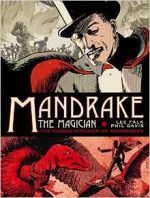
Mandrake the Magician: The Hidden Kingdom of Murderers – Sundays 1935-1937


By Lee Falk & Phil Davis (Titan Books)
ISBN: 978-0-85768-572-8

Win’s Christmas Gift Recommendation: Because We Believe in Magic… 9/10

Considered by many as the first superhero, Mandrake the Magician debuted as a daily newspaper strip on 11th June 1934. An instant hit, it was soon supplemented by a full-colour Sunday companion page which launched on February 3rd 1935.

Creator Lee Falk actually sold the strip to King Features Syndicate years earlier as a 19-year old college student, but asked the monolithic company to let him finish his studies before dedicating himself to the strip full time. With his schooling done, the 23 year old master raconteur settled in to begin his life’s work: entertaining millions with his astounding tales.

Falk – who also created the first costumed superhero in the moodily magnificent Phantom – spawned an actual comicbook subgenre with his first creation. Most publishers of the Golden Age boasted at least one (and usually many more) nattily attired wonder wizards amongst their gaudily-garbed pantheons; all roaming the world making miracles and defeating injustice with varying degrees of stage legerdemain or actually sorcery.

Characters such Mr. Mystic, Ibis the Invincible, Sargon the Sorcerer, and an assortment of “…the Magician” such as Zanzibar, Zatara, Kardak and so many, many more all borrowed heavily and shamelessly from the uncanny exploits of the elegant, enigmatic man of mystery who graced the pages of the world’s newspapers and magazines.

In the Antipodes Mandrake was a stalwart regular of the Australian Women’s Weekly, and also became a cherished star in the UK, Italy and Scandinavia.

Over the years he has been a star of radio, movie chapter-serials, a theatrical play, television and animation as part of the cartoon series Defenders of the Earth. With that has come the usual merchandising bonanza of games, toys (including magic trick kits), books, comics and more…

Falk worked on Mandrake and “The Ghost who Walks” until his death in 1999 (even on his deathbed he was laying out one last story) but he also found time to become a playwright, theatre producer and impresario, as well as an inveterate world-traveller.

A man of many talents, Falk drew the first few weeks himself before uniting with the sublimely imaginative cartoonist Phil Davis whose sleekly understated renditions took the daily strip – and especially these expansive full-page Sunday offerings – to unparalleled heights of sophistication; his steady assured realism the perfect tool to render the Magician’s mounting catalogue of wondrous miracles…

Those in the know are well aware that Mandrake was educated at the fabled College of Magic in Tibet, thereafter becoming a suave globe-trotting troubleshooter, always accompanied by his faithful African friend Lothar and beautiful companion (eventually, in 1997, his bride) Princess Narda of Cockaigne, solving crimes and fighting evil. Those days, however, are still to come as the comics section opens in this splendidly oversized (315 x 236 mm) full-colour luxury hardback with ‘The Hidden Kingdom of Murderers’ (which ran from February 3rd to June 2nd 1935) as the urbane Prince of Prestidigitation and his herculean man-servant are approached by members of the international police to help expose a secret society of criminals and killers acting against the civilised world from their own hidden country.

After officer Duval is assassinated, Mandrake and Lothar – accompanied by panther woman Rheeta and surviving cop Pierce – embark upon a multi-continental search which after many adventures eventually takes them a desolate desert region where they are confronted by bloody-handed Bull Ganton, King of Killers.

With the master murderer distracted by Rheeta, Mandrake easily infiltrates the odious organisation and quickly begins dismantling the secret society of two million murderers. By the time Ganton wises up and begins a succession of schemes to end Mandrake, it’s too late…

That deadly drama concluded, Mandrake and Lothar head to India to revisit old haunts and end up playing both peacemaker and cupid in the ‘Land of the Fakirs’ (running from June 9th to October 6th).

When Princess Jana, daughter of Mandrake’s old acquaintance Jehol Khan is abducted by rival ruler Rajah Indus of Lapore, the Magician ends his mischievous baiting of the street fakirs to intervene. In the meantime Captain Jorga – who loves Jana despite being of a lower caste – sets off from the Khan’s palace to save her or die in the trying…

After many terrific and protracted struggles, Mandrake, Lothar and Jorga finally unite to defeat the devious and duplicitous Rajah before the westerners set about their most difficult and important feat; overturning centuries of tradition so that Jorga and Jana might marry…

Heading north, the peripatetic performers stumble into amazing fantasy after entering the ‘Land of the Little People’ (13th October 1935 to March 1st 1936), encountering a lost race of tiny people embroiled in a centuries-long war with brutal cannibalistic adversaries. After saving the proud warriors from obliteration, Mandrake again plays matchmaker, allowing valiant Prince Dano to wed brave and formidable commoner Derina who fought so bravely beside them…

With this sequence illustrator Davis seemed to shake off all prior influences and truly blossomed into an artist with a unique and mesmerising style all his own. That was perfectly showcased in the loosely knit sequence (spanning 8th March to 23rd August 1936) which followed, as Mandrake and Lothar returned to civilisation only to narrowly escape death in an horrific train wreck.

Crawling from the wreckage, our heroes help ‘The Circus People’ recapture and calm the animals freed by the crash and subsequently stick around as the close-knit family of nomadic outcasts rebuild. Mighty Lothar has many clashes with jealous bully Zaro the Strongman, culminating in thwarting attempted murder, whilst Mandrake uses his hypnotic hoodoo to teach sadistic animal trainer Almado lessons in how to behave, but primarily the newcomers act as a catalyst, making three slow-burning romances finally burst into roaring passionate life…

Absolutely the best tale in this tome and an imaginative tour de force which inspired many soon-to-be legendary comicbook stars, ‘The Chamber into the X Dimension’ (30th August 1936 to March 7th 1937) is a breathtaking, mind-bending saga which begins when Mandrake and Lothar go searching for the missing daughter of a scientist whose experiments have sent her literally out of this world.

Professor Theobold has discovered a way to pierce the walls between worlds but his beloved Fran never returned from the first live test. Eager to help – and addicted to adventure – Mandrake and Lothar volunteer to go in search of her and soon find themselves in a bizarre timeless world where the rules of science are warped and races of sentient vegetation, living metal, crystal and even flame war with fleshly humanoids for dominance and survival.

After months of captivity, slavery, exploration and struggle our human heroes finally lead a rebellion of the downtrodden fleshlings and bring the professor the happiest news of his long-missing child…

Concluding this initial conjuror’s compilation is a whimsical tale of judgement and redemption as Mandrake uses his gifts to challenge the mad antics of ‘Prince Paulo the Tyrant’ 14th (March 14th – 29th August 1937).

The unhappy usurper stole the throne of Ruritanian Dementor and promptly turned the idyllic kingdom into a scientifically created madhouse. Sadly, Paulo had no conception of what true chaos and terror were until the magician exercised his mesmeric talents…

This epic celebration also offers a fulsome, picture-packed and informative introduction to the character – thanks to Magnus Magnuson’s compelling essay ‘Mandrake the Magician Wonder of a Generation’ – plus details on the lives of the creators (Lee Falk’ and ‘Phil Davis Biography’ features) and a marvellous Davis pin-up of the cast to complete an immaculate confection of nostalgic strip wonderment for young and old alike.
Mandrake the Magician © 2016 King Features Syndicate. All Rights Reserved. “Mandrake the Magician Wonder of a Generation” © 2016 by Magnus Magnuson.

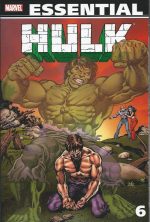
Essential Hulk volume 6


By Len Wein, Roger Stern, David Anthony Kraft, Gerry Conway, Chris Claremont, Sal Buscema, Herb Trimpe, George Tuska, Keith Pollard, Jim Starlin & various (Marvel)
ISBN: 978-1-7851-4540-0

Bruce Banner was a military scientist accidentally caught in a gamma bomb blast of his own devising. As a result, stress and other factors cause him to transform into a giant green monster of unstoppable strength and fury. He was one of Marvel’s earliest innovations and first failure but after an initially troubled few years finally found his size-700 feet and a format that worked, becoming one of the company’s premiere antiheroes and most popular features.

During the 1960s, artist Herb Trimpe had made the character his own; the Jack Kirby-based “house” art-style he initially employed quickly evolving into often startlingly abstract mannerism, augmented by an unmatched facility for drawing technology – especially honking great ordnance and vehicles – and, crucially, who could possibly deny the sheer cathartic reader-release rush of those spectacular “Hulk Smash!” moments…

However, by the time of the tales in chronologically complete monochrome mammoth (re-presenting Incredible Hulk #201-225 and Incredible Hulk King Size Annual #6, July 1976-July 1978) the artistic reins had passed to another illustrator who would become inextricably associated with the Jade Juggernaut whilst writer Len Wein continued to insert fresh ideas and characters, redefining the man-monster for the modern age…

The blockbusting battle-action starts with ‘The Sword and the Sorcerer!’ (illustrated by regular art-team Sal Buscema & Joe Staton) wherein the Hulk found himself in a perilously primitive world.

He had been miniaturised and inserted into the brain of Major Glen Talbot by former pursuers Dr. Leonard Samson and General Thaddeus Ross to restore the mind of Banner’s comatose rival for Betty Ross-Talbot‘s affections. The radical psycho-surgery was not without complications, however, and at the moment of his greatest triumph and sacrifice the Man-Monster began uncontrollably shrinking beyond the ability of Samson’s team to reach him…

He stabilised on a sub-atomic world long enough to liberate a primitive people from the domination of a brutal despot (and demon-possessed pawn) Kronak the Barbarian before starting to diminish once more. His last stop was the promised land of his beloved and long-lost alien queen Jarella…

Sadly ‘Havoc at the Heart of the Atom’ revealed how his last visit had rendered the world tectonically unstable and shattered the civilisation which once had the power to blend Banner’s mind with the Hulk’s body. Moreover the once-gentle population had turned on the queen they held responsible…

Reunited with his beloved, the simplistic brute swore to fix the problem and was soon embroiled with the antediluvian horror who first hijacked him to the Microverse and who still craved bloody revenge…

Once again evil was defeated as the ‘Assault on Psyklop!’ led to another crushing defeat for the vile insectoid and a guardedly happy ending for the man-brute as a rescue attempt from Earth brought the Hulk home, carrying the astounded Jarella with him…

Herb Trimpe returned in #204 to pencil a tale of time-bending might-have-beens as brilliant theoretician Kerwin Kronus offered to eradicate Banner’s problems by turning back time and undoing the accident which created the Hulk. Sadly, the experiment succeeded all too well: briefly forming an alternate timeline where original sidekick Rick Jones died and the time-master became an even greater menace to reality. Banner/Hulk made a heartbreaking sacrifice to close that ‘Vicious Circle’…

The evergreen artist – aided by inkers Frank Giacoia & Mike Esposito – remained to illustrate David Anthony Kraft’s ‘Beware the Beehive!’ from Incredible Hulk King Size Annual #6, wherein a band of mad scientists attempted to recreate their greatest success and failure.

Morlak, Hamilton, Shinsky and Zota were a rogue science collective known as the Enclave and from their hidden “Beehive” had spawned puissant artificial man Him (latterly Adam Warlock). Here and now, three of them reunite for another go at building a god they can control, but when they abduct Dr. Stephen Strange to replace their missing fourth, the magician summons the Jade Juggernaut to save him from the experiment’s inevitable consequences: a marauding, compassionless super-slave dubbed Paragon whose first tasks are to eradicate Strange and subdue mankind.

Happily, after a border-shattering, army-crunching global rampage, that’s when the Hulk kicks the wall in and goes to work…

‘Do Not Forsake Me!’ in Hulk #205 saw Wein, Buscema & Staton back to depict the most tragic moment in the Green Goliath’s tortured life as Jarella sacrifices herself to save a child from rampaging robbery robot Crypto-Man, leaving the bereft Hulk ‘A Man-Brute Berserk!’

His grief-stricken trail of destruction leads from Gamma Base, New Mexico all the way to New York City where even his friends and allies are unable to calm the green gargantuan, leading to a brutal battle ‘Alone Against the Defenders!’ who finally realise compassion is the only method that will work against their traumatised foe…

Hulk #208 finds ‘A Monster in Our Midst!’ as Bruce finally rejects ending his pain-wracked existence and begins a new and hopefully stress-free life where his alter ego will never be seen again. That resolve only lasts as long as it takes the maniacal Crusher Creel – freed as a consequence of the Jade Juggernaut’s most recent rampage – to accept a commission from a triumvirate of hooded schemers who want the Hulk dead…

However, even though ‘The Absorbing Man is Out for Blood!’ the super-thug is no match for Hulk’s unfettered fury, but his well-deserved defeat results in Banner collapsing unconscious in alley where he is eventually found by a mystic do-gooder in search of an ally…

With #210, Ernie Chan became new regular inker as ‘And Call the Doctor… Druid!’ sees both Banner and the Hulk crucial to a plan to stop immortal mutant Maha Yogi, his vast mercenary army and alien bodyguard Mongu before they complete their preparations for world domination…

Although the battles of ‘The Monster and the Mystic!’ are a close-run thing, virtue is eventually victorious, but that makes little difference to the Hulk’s once-companion Jim Wilson as he hitch-hikes across America, utterly unaware that he is the target of a vicious criminal conspiracy…

The plots hatch once Jim reaches New York where his hidden tormentors decide that he must be ‘Crushed by… the Constrictor!’ but neither they nor their ruthless high-tech hitman expected the Hulk to intervene…

With a friend and confidante who knows all his secrets, you’d expect Banner’s life to get a little easier, but the authorities will never stop hunting the Hulk, who initially realises ‘You Just Don’t Quarrel with the Quintronic Man!’ (inked by Tom Palmer) before bouncing back to trash the formidable five-man mecha suit.

As Chan returns this battle leads to a frenzied clash with a new hyper-powered hero determined to make his name by defeating America’s most terrifying monster in ‘The Jack of Hearts is Wild!’

Macabre old enemy the Bi-Beast is resurrected in #215; still hungry to eradicate humanity in ‘Home is Where the Hurt Is’ and close to succeeding after seizing control of SHIELD’s Helicarrier. Only desperate action by General Ross can save the day and the old soldier uses the carrier’s tech to shanghai Banner, letting nature take its course and hoping that the right monster wins the inevitable earthshaking battle before a ‘Countdown to Catastrophe!’ leaves the planet a smoking ruin…

A moodily poignant change of pace graces #217 as ‘The Circus of Lost Souls!’ sees the shell-shocked Hulk lost somewhere in Europe, defending a band of carnival freaks from the crooked depredations of the Ringmaster and his Circus of Crime: a solid demarcation as Wein moves away from scripting in favour of simple co-plotting, allowing Roger Stern to find his own big green feet to guide the Green Goliath’s future…

It all begins with ‘The Rhino Doesn’t Stop Here Anymore’ (#218 by Wein, Stern, George Tuska, Keith Pollard & Chan) as super-strong psychologist Doc Samson takes centre stage battling the ruthless Rhino whilst in #219 Banner learns ‘No Man is an Island!’ (Wein, Stern, Buscema & Chan) after hiring on as a deck hand on a freighter, only to have it sunk from under him by submarine-based pirate Cap’n Barracuda.

Washed ashore on a desert atoll, Hulk is befriended by a deluded individual who believes himself to be Robinson Crusoe, but as events unfold an even stranger truth is revealed. After Barracuda captures the madman, it is to pluck the secret of making monsters from his broken mind but the cruel corsair has completely underestimated the ferocious loyalty and compassion of the Hulk, who unleashes devastating catastrophic ‘Fury at 5000 Fathoms!’

With Stern in complete authorial control, Sal Buscema is joined by Alfredo Alcala for #221’s ‘Show Me the Way to Go Home’ as the still all-at-sea Banner is rescued from drowning by marine explorer Walt Newell who ferries his exhausted passenger back to New York where he is recognised as Bruce Banner. Realising he has unleashed the Hulk on a major population centre, Newell exposes his own secret identity as sub-sea superhero Stingray and pursues his former guest. The battle is painfully one-sided and Stingray is near death when Jim Wilson intervenes, saving the marine crusader’s life but only at the cost of Hulk’s trust…

Wein returned for one last hurrah in #222, aided and abetted by Jim Starlin & Alcala for a creepy horror yarn as the Green Goliath tears through another unfortunate army unit before being gassed into unconsciousness. Banner awakens in the care of two children living in a cave, but they’re not surprised by the fugitive’s transformations: not since the radioactive stuff changed their little brother.

Of course now people have started disappearing and although they haven’t grasped the truth of it yet, Bruce instantly grasps what is involved in ‘Feeding Billy’ and what his intended role is…

Now firmly established, Stern began an ambitious storyline in Incredible Hulk #223 as ‘The Curing of Dr. Banner!’ (illustrated by Sal Buscema & Josef Rubinstein) saw the monster’s human half spontaneously purged of the gamma radiation that triggered the changes.

Heading for Gamma Base to verify his findings, Bruce discovers the entire facility has been taken over: mind-controlled by his ultimate archenemy…

As the crowing villain makes everyone ‘Follow the Leader!’, Doc Samson and General Ross escape and beg Banner to again sacrifice his humanity for the sake of mankind. Only the Hulk has ever defeated the Leader and their only hope is to recall and harness the beast’s unstoppable fury. Tragically, the halfway measures fail at the final moment and the villain has cause to ask ‘Is There Hulk after Death?’

With Banner seemingly deceased, his compatriots tried to jump start his system with another overwhelming dose of gamma rays and soon have cause to regret the resurrection of the original Gamma Goliath…

To Be Continued…

This catastrophically cathartic tome also includes pages taken from the Marvel Universe Handbook giving the lowdown on Jarella and the Constrictor plus an alternative cover to Hulk #206.

The Incredible Hulk is one of the most well-known comic characters on Earth, and these stories, as much as the movies, cartoons, TV shows, games, toys and action figures are the reason why. For an uncomplicated, earnestly vicarious experience of Might actually being Right, you can’t do better than these exciting episodes, so why not Go Green – even if it’s only in monochrome and in your own delirious head?

1976, 1977, 1978, 2010 Marvel Characters, Inc. All rights reserved.

Star Trek Archives volume 5: Best of Captain Kirk


By Peter David, James Fry, Gordon Purcell, Arne Starr & various (IDW)
ISBN: 978-1-60010-571-5

The stellar Star Trek brand is one of probably the biggest franchise engines on Earth, permeating every merchandisable sector imaginable. You can find daily live-action and animated screen appearances constantly screening somewhere on the planet, toys, games, conventions, merchandise, various comics iterations generated in a host of nations and languages and a reboot of the movie division proceeding apace even as I type this. There’s even a new rebooted TV series beginning in 2017…

Many companies have published comicbook adventures based on the exploits of Gene Roddenberry’s immortal brainchild. Currently IDW have the treasured funnybook license and are combining great new tales with a choice selection of older examples from other publishers.

A particularly fine extended exploit can be found in this epic sequence taken from a splendid run produced under the DC badge during the 1980s and early 1990s. Never flashy or sensational, those tales assiduously and scrupulously referenced the TV and movie canon whilst embracing the same storytelling values and concentrating on stories simultaneously character-led and plot-driven.

Here Federation history blends seamlessly with suspenseful drama and spectacular action, subtle character interplay, boisterous humour and good old fashioned thrills as scripter Peter David and his artistic allies concoct a tense, politically-tinged saga first seen in issues #7-12 of DC’s monthly Star Trek comicbook (spanning April to September 1990).

Previously: a number of hostile alien races – the Klingons – just prior to their grand rapprochement with the Federation – and a now-uncomfortably un-PC fundamentalist species called Nasguls (based on then-contemporary bugbear Iran under the Ayatollahs) have recently fallen foul of James T. Kirk’s unconventional problem-solving methods.

Having had enough of the human’s impious interference, the holy Salla of the Nasguls placed a planet-sized bounty on the Enterprise’s Captain.

Kirk doesn’t care: he has bigger problems. Finally fed up with his interstellar shenanigans, Starfleet has appointed civilian protocol officer R. J. Blaise to the Enterprise to make sure Kirk behaves properly, but somehow this beautiful woman is completely immune to our hero’s amatory charms…

The astral action opens on Earth where Starfleet Vice-Admiral Tomlinson and the Federation President are enduring a fractious and tiresome meeting with the Klingon ambassador and the august Salla himself.

The tyrannical aliens have temporarily suspended their disdain for each other and are now (relatively) united in pursuing quasi-legal avenues; seeking to have Kirk cashiered from the service, tried in a Federation court and then – naturally – executed…

Events take a most unwelcome turn in ‘Not… Sweeney!’ (by David, James W. Fry & Arne Starr) as news comes that the most dreaded bounty hunter in the universe has decided to collect the price on Kirk’s head.

Caring little for the death-sentence dogging him, the starship captain is utterly incensed when it adversely affects his job. Despatched to Tau Gamma II to rescue a human colony before the geologically unstable planet shakes itself to bits, Kirk is flabbergasted to find the survivors demanding another ship or to be left to the world’s erratic mercies, rather than endure certain doom when Sweeney comes for the Enterprise’s captain…

Their anxiety proves well-founded when hours later the infallible stalker arrives with a fleet of ships and attacks…

After a tremendous struggle in ‘Going, Going…’, Kirk – with Spock and Blaise as collateral captives – is confined aboard the disturbingly effete bounty hunter’s flagship and made the star of an impromptu auction.

Kirk has made many enemies in his career and a ferocious bidding war begins, but Sweeney’s attentions are soon diverted by Spock. The scrupulously polite and terrifyingly brilliant manhunter has never met a captive like the Vulcan, and his distracting new fascination eventually leads to Sweeney’s first defeat as Kirk and Blaise break out of the Brig just as competing Klingon and Nasgul forces warp in to claim the prize lot in Sweeney’s auction…

Things come to a head when the situation deteriorates into a petulant shooting war in ‘…Gone!’, leaving Kirk to pull off yet another hairsbreadth escape and even save the colonists on Tau Gamma II…

However, no longer willing to tolerate the political machinations, he then forces the issue to a head by surrendering himself to Federation authorities on Earth and demanding his day in court to clear his name once and for all…

Given the chance for a show trial, the Salla and his Klingons antagonists revel in the chance to destroy the greatest hindrance to their plans as ‘The Trial of James T. Kirk’ opens with ‘The First Thing We Do…’

This story-within-a-story is stuffed with hilarious cameos and vignettes from many old TV episodes (but in an easily accessible manner for newcomers unfamiliar with lore) and sees Kirk’s attorneys Samuel T. Cogsley and Areel Shaw (look them up if you need to) deftly manoeuvre to remove most of the charges whilst rolling out many fan-favourites from old episodes to act as “character witnesses”…

Despite making some telling points, an Enterprise crewman turning to the Dark Side and the frank sworn testimony of R. J. Blaise, the is case is clearly going against the Klingons and Nasgul. Thus they individually and clandestinely resort to their respective “Plan Bs” in ‘…Lets Kill All the Lawyers!’

The bellicose warrior race fly in their Emperor to give personal testimony and demand Kirk’s destruction whilst the fundamentalist tyrant of the Nasgul opts for a far more hands-on and devastatingly final solution…

Pencilled by Gordon Purcell, the saga explosively concludes in ‘Trial and Error!’ as deft work by Spock and the Bridge Crew uncover a plot to eradicate the courtroom and everyone in it, leading to a cessation of hostilities between the Federation and the Klingons and Kirk’s full exoneration.

Sadly, those efforts completely failed to expose the treacherous mole high in Star Fleet Command who was crucial to instigating the entire affair…

This tale is pure classic Trek. The fans loved it then and you will now. It’s also a very good example of how to do a licensed property in comic form, and readers and wannabe creators should buy and take note. Balancing the action and drama are captivating moments of interpersonal byplay filling out the roles of beloved characters such as Uhura and Sulu and – as you’d expect from Peter David – the story is packed with outrageously hilarious quotable moments…

These yarns are magical romps of fun and thrills that fully embrace and enhance the canonical Star Trek for the dedicated fan, provide memorable comicbook adventure for followers of our art-form and, most importantly, provide an important bridge between the insular world of fans and the wider mainstream. Stories like these about such famous characters can only bring more people into comics and isn’t that what we all want?
Star Trek ® and © 2009 CBS Studios, Inc. All Rights Reserved. Star Trek and related marks are trademarks of CBS Studios, Inc.

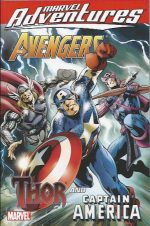
Marvel Adventures Avengers: Thor and Captain America


By Paul Tobin, Scott Gray, Todd Dezago, Ronan Cliquet, Ron Lim, Lou Kang & various (Marvel)
ISBN: 978-0-7851-5584-3

Since its earliest days Marvel has always courted young comicbook consumers. In 2003 the company instituted the Marvel Age imprint to update and reframe classic original tales by Stan Lee, Jack Kirby, Steve Ditko and others for a fresh-faced 21st century readership.

The experiment was tweaked in 2005, becoming Marvel Adventures. The tone was very much that of the company’s burgeoning TV cartoon franchises, in execution if not name. Titles bearing the Marvel Adventures brand included Spider-Man, Fantastic Four, Super Heroes, The Avengers and Hulk. These iterations ran until 2010 when they were cancelled and replaced by new volumes of Marvel Adventures: Super Heroes and Marvel Adventures: Spider-Man.

Almost all of those yarns have been collected in digest-sized compilations such as this one which gathers a selection of fantastic feats starring the God of Thunder or Sentinel of Liberty and their friends, comprising four all-ages tales from the second volume of Marvel Adventures Super Heroes #13-16 (spanning June-September 2011).

The action opens with a mythological masterpiece by Paul Tobin, Ronan Cliquet & Amilton Santos wherein plucky novice hero Nova is invited by Avenging comrades Thor and Valkyrie to accompany them on an annual errand for Odin the All-Father.

In the distant past when Asgardians warred with Trolls, a godling messenger named Glane failed in his mission and was banished to the ghastly Fields of the Fallen to pay penance by continually battling the Golden Realm’s vilest enemies.

Periodically Thor has been sent to add new tasks to the sinning failure’s heavy burden, and this year as the Thunderer and Valkyrie ready themselves for the trip, they invite the starstruck Nova to tag along.

However, as the trio battle their way through horrific monsters and overwhelming odds, Nova finds himself increasingly uncomfortable with the sentence meted out to Glane and even begins to doubt the motives of his immortal mentors. All that changes once he meets and battles beside the convicted penitent…

Originating in MASH #14, ‘Out of Time!’ is by Todd Dezago, Ron Lim & Scott Koblish (inspired by Gerry Conway & Ross Andru’s tale from the original Marvel Team-Up #7) and sees the Lord of Storm intercepting Spider-Man after the wall-crawler is blasted high into the sky whilst battling raving maniac the Looter.

That happy coincidence occurs just a bizarre force freezes time around them. When the heroes discover that only they have escaped a devastating weapon deployed by Trollish tyrant Kryllk the Conqueror to paralyze and overwhelm both Asgard and the mortal plane, they must divide their strength to simultaneously smash the conqueror in both Manhattan and Asgard if they are to set time running free again…

Captain America takes the spotlight in #15 as ‘Back in Time’ (Tobin, Cliquet & Santos) finds the Star-Spangled Avenger battling Neanderthals with ray-guns in a National Forest after tracking down rogue geneticists who have stolen a huge amount of plutonium.

A mere mile away, Peter Parker‘s girlfriend Sophia Sanduval is getting back to nature and chilling with her furry, scaly and feathered friends. As Chat, the mutant teen’s power to communicate with animals makes her a crucial component of the mystery-solving Blonde Phantom Detective Agency, but even she has never seen anything like the wave of extinct creatures which appear after Cap begins battling the tooled-up cavemen.

Soon she has been briefed on the deadly experiments of rogue technologist Jerrick Brogg – whose ambition is to build an army out of revived extinct creatures – and swears to help Cap put the maniac away and save all the beasts he has recreated from short painful lives of terror and brutal exploitation…

Wrapping up the action comes ‘Stars, Stripes and Spiders!’ by Dezago, Lou Kang & Pat Davidson (based on Len Wein & Gil Kane’s tale from Marvel Team-Up #13).

When a certain wall-crawling high-school student and occasional masked hero stumbles into Captain America tackling an AIM cadre stealing super-soldier serum, the nervous lad learns a few things about the hero game from the legendary guy who wrote the book. Sadly, not making that lesson any easier is petrifying super-villain Grey Gargoyle, whose deadly touch almost ends Spidey’s homework worries – and continued existence – forever…

Never the success the company hoped, the Marvel Adventures project was superseded in 2012 by specific comics tied to those Disney XD television shows designated as “Marvel Universe cartoons”, but these collected stories are still an intriguing, amazingly entertaining and superbly accessible means of introducing characters and concepts to kids born sometimes three generations or more away from the originating events.

Fast, furious, funny and enthralling, these riotous mini-epics are extremely enjoyable yarns, although parents should note that some of the themes and certainly the level of violence might not be what everybody considers “All-Ages Super Hero Action”…
© 2011 Marvel Characters, Inc. All rights reserved.

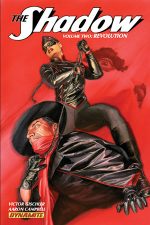
The Shadow volume 2: Revolution


By Victor Gischler, Jack Herbert, Aaron Campbell, Giovanni Timpano & various (Dynamite Entertainment)
ISBN: 978-1-60690-361-2

In the early 1930s, The Shadow gave thrill-starved readers their measured doses of extraordinary excitement via cheaply produced pulp periodical novels, and over the mood-drenched airwaves, through his own radio show.

“Pulps” were published in every style and genre in their hundreds every month, ranging from the truly excellent to the pitifully dire, but for exotic or esoteric adventure-lovers there were two star who outshone all others. The Superman of his day was Doc Savage, whilst the premier dark, relentless creature of the night dispensing terrifying grim justice was the putative hero under discussion here.

Radio series Detective Story Hour – based on stand-alone yarns from the Street & Smith publication Detective Story Magazine – used a spooky voiced narrator (variously Orson Welles, James LaCurto or Frank Readick Jr.) to introduce each tale. He was dubbed “the Shadow” and from the very start on July 31st 1930, he was more popular than the stories he highlighted.

The Shadow evolved into a proactive hero solving instead of narrating mysteries and, on April 1st 1931, began starring in his own printed pulp series, written by the incredibly prolific Walter Gibson under the house pseudonym Maxwell Grant. On September 26th 1937 the radio show officially became The Shadow with the eerie motto “Who knows what evil lurks in the hearts of Men? The Shadow knows!” ringing out unforgettably over the nation’s airwaves.

Over the next eighteen years 325 novels were published, usually at the rate of two a month. The uncanny crusader spawned comicbooks, seven movies, a newspaper strip and all the merchandising paraphernalia you’d expect of a superstar brand.

The pulp series officially ended in 1949 although Gibson and others added to the canon during the 1960s when a pulp/fantasy revival gripped America, generating reprinted classic stories and a run of new adventures as paperback novels.

In graphic terms The Shadow was a major player. His national newspaper strip – by Vernon Greene – launched on June 17th 1940 and when comicbooks really took off the Man of Mystery had his own four-colour title; running from March 1940 to September 1949.

Archie Comics published a controversial contemporary comicbook in 1964-1965 under their Radio/Mighty Comics imprint, by Robert Bernstein, Jerry Siegel, John Rosenberger and latterly Paul Reinman; and in 1973 DC acquired the rights to produce a captivating, brief and definitive series of classic comic adventures unlike any other superhero title then on the stands.

DC periodically revived the venerable vigilante. After the runaway success of Crisis on Infinite Earths, The Dark Knight Returns and Watchman, Howard Chaykin was allowed to utterly overhaul the vintage feature. This led to further, adult-oriented iterations (and even one cracking outing from Marvel) before Dark Horse assumed the license of the quintessential grim avenger for the latter half of the 1990s and beyond.

Dynamite Entertainment picked up the option in 2011 and, whilst republishing many of those other publisher’s earlier efforts, began a series of new monthly Shadow comics.

Set in the turbulent 1930s and war years that followed, these were crafted by some of the top writers in the industry, each taking their shot at the immortal legend, and all winningly depicted by a succession of extremely gifted illustrators.

This second volume – collecting #7-12 of the monthly comicbook from 2013 – comes courtesy of Victor Gischler (Gun Monkeys, Deadpool: Merc with a Mouth, Kiss Me Satan), again throwing a spotlight on the increasing deadly geopolitics of a civilisation sliding inexorably into another World War….

His scripts were variously realised by Jack Herbert, Aaron Campbell, Giovanni Timpano, Ivan Nunes & Carlos Lopez, and the action opens with a self-contained prelude that begins with the Master of the Macabre suffering from uncharacteristic bad dreams…

Very few people know that the black-cloaked fist of final retribution known as The Shadow masquerades by day as abrasive, indolent playboy Lamont Cranston. Most are agents in his employ and they are all aware of his semi-mystical abilities to detect thoughts and cloud the minds of men, but not that in the past few days those abilities have seemingly waned and led to the death of an innocent…

Engaging veteran Great War pilot Miles Crofton, Cranston embarks on a journey to the Himalayan region where he long ago studied under august adepts of the arcane. However, his voyage is interrupted in Nepal when he encounters a brutal bandit leader dubbed Red Raja. This thuggish crimelord seems to have powers and abilities similar and equal to his own…

Eschewing immediate confrontation, Cranston delves deep into the past and eventually learns the Raja also studied with the esoteric “Masters”. Tragically, when his innate evil nature forced them to expel him, the student returned with men and guns; wiping out the entire enclave of puissant accumulated knowledge…

Armed with information and fuelled by righteous fury, The Shadow then assaults Red Raja’s fortress, single-handedly eradicating his army of rogues before enacting final judgement…

Weeks later, vacationing in Paris whilst Miles has their plane repaired, the restless Shadow passes his time hunting down human predators and becomes emotionally embroiled in a missing persons case.

The trail leads to a grand soiree at the Spanish Embassy where Cranston makes a particular splash with the assorted dignitaries and persons of wealth and high station, particularly after loudly declaring that he is an arms dealer with product to sell.

It is 1937 and the civil war in Spain has all but stalled, with both sides afflicted by attrition and exhaustion…

Horrified Ambassador Ramirez is only too happy to fob off the tiresome Cranston on his military attaché. As soon as he sees the devastating Major Esmeralda Aguilar, the Shadow knows she is no ordinary woman…

The swaggering millionaire is only too eager to ditch the stuffy party with the exotic spy, but their intimate drive through the City of Lights is almost ended by a machine gun attack. Then Cranston discovers just how dangerous his companion truly is…

The next day Miles resurfaces with news on a freighter full of munitions headed for Spain and the final clue to the disappearances the Shadow has been investigating. Even with mental faculties and powers diminished and compromised, the Dark Avenger is clear on where his next destination lies…

Intercepting the gunrunners as they seek to offload their illicit cargo at a Spanish port, the Shadow dispenses his brand of justice before vanishing, and twelve hours later Lamont Cranston arrives in Barcelona, unsure of what trick of fate or his own subconscious has brought him there.

His mystically-attuned senses go into overdrive once he meets an inoffensive British volunteer in the Socialist Brigade calling himself “George Orwell”…

After befriending the oddly magnetic militiaman, Cranston excuses himself and resumes his trail of guns whilst Orwell returns to his unit in Aragon. Diligent hunting takes the Shadow to a warehouse where a gang led by a masked woman named Black Sparrow are attempting to sell the munitions to representatives of the underworld.

When the crooks try a double-cross they are savagely wiped out by the Sparrow as her men stand idly by, and from his hidden vantage point the Shadow realises just how extraordinary Major Aguilar truly is…

Soon the Avenger is risking spectacular airborne death; chasing her back to an ancient castle in the Aragon Region where he uncovers a bold scheme by an international cabal to place a third ruler on the throne of Spain. Of course, when he blazes in to end the conspiracy, Cranston finds more than he bargained for.

“El Rey” is far from the dominating despot he appears, and the true mastermind behind the plot is far more of a match for the Shadow than the grim guardian could possibly have anticipated.

And that’s when fate reveals the potential value of a certain nondescript British soldier of ideology and fortune…

This historically-flavoured jaunt then concludes with one last hurrah as Miles and Cranston belatedly return to New York just in time for the Shadow to fixate on a gang of ruthless bank robbers terrorising the city with their bold and lethal raids.

Broaching his contacts on the police force and rampaging through the ranks of the underworld, the Shadow turns the city upside down until at last a grudging tip takes him to a certain Chinatown whorehouse where a most exotic creature provides all the details he need to exact his vengeance on the guilty.

Now all that remains is to trigger the bloody end…

Dynamite publish periodicals with a vast array of cover variants and here a vast gallery features dozens of iconic alternate visions from Alex Ross, John Cassaday, Darwyn Cooke, Francesco Francavilla, Tim Bradstreet, Mike Mayhew, Michael Golden, Jack Herbert and Sean Chen to delight any art lover’s eyes and heart.

Sardonic, uncompromising and packed with subtle nuance, Revolution is a superb addition to the annals of the quintessential Dark Knight, and one no one addicted to action and mystery should be without.
The Shadow ® & © 2013 Advance Magazine Publishers Inc. d/b/a Conde Nast. All Rights Reserved.

Growing Up in Public


By Ezequiel García (Fantagraphics Books)
ISBN: 978-1-60699-936-3

With the acceptance of graphic novels as a valid and worthy form of entertainment and mature expression has come a welcome flowering of personal stories and authorial voices blending unique – and literal – visions with perspectives far removed from our cosy own.

After all, potent and evocative as they might be, the graphic observations and conclusions of a Harvey Pekar or Eddie Campbell still resonate with shared concerns, experiences and ideologies for most English-speaking, western-reared readers from Britain, the USA, Canada, New Zealand or Australia.

Such a view just can’t be taken when absorbing the pictorial ruminations of equally brilliant and driven artisans from countries with differing historical, socio-cultural, linguistic and even artistic world views.

That kind of revelatory exotic intimacy can be found in Growing up in Public, the latest cartoon epistle from Argentinean artist and cartoonist Ezequiel García as he contemplates his achievements, total lack of success or celebrity and place in the world following his thirtieth birthday…

Born in 1975, García studied under Argentinean comics legend Alberto Breccia whilst co-editing several comics anthologies and trying his hands at other forms of artistic expression. Growing up in troubled times in a country that has always taken culture, heritage and the arts seriously, he has had short works appear in comics magazines in Europe and South America.

He won the comics award at Brazil’s Salon del Humor de Piracicaba in 2000, and his first graphic novel Turning 30 was released in Argentina in 2007. In recent years, Garcia has served as a comics teacher, art gallery curator, and co-organizer of the Festival Increible de Historietas, Fanzines y Afines whilst labouring on this eclectic, far-ranging, intimate, polemical and engaging reminiscence.

In a free-wheeling, affectingly immersive, starkly black-&-white outpouring, Ezequiel introduces us to his world at a certain point in his life. A struggling artist, the author derives much of his inspiration from the history, music and architectural heritage of Buenos Aires. Here, however, as he struggles to find a publisher for his comics, galleries to exhibit his other art, women to sleep with and someone special to love, his attentions are increasingly distracted by the ongoing destruction of all he cherishes as big banks and foreign businesses take over, rebuild and desecrate the magnificent dance palaces, film theatres and civic buildings which were the landmarks and milestones of his childhood…

In truth the entire city is under threat of losing its identity as money and encroaching corporate globalisation seeps in, buying off officials and easily circumventing the legal protections supposedly safeguarding these edifices for the nation…

Most galling of all is Ezequiel’s quest for creative acceptance. He’s getting some traction, but as he and his friends visit show after show, he’s starting to feel that the art world only wants to reward shallow charlatans regurgitating old or devalued concepts and no longer has room or respect for toil, craftsmanship and honest searches for truth…

He feels equally powerless to change his personal situation. Ezequiel has no trouble meeting women, but really wants a girlfriend and just can’t decide on which one to get serious with…

The most potent temptation of autobiographical comics is the total autonomy the exercise grants. In the midst of his collation of linked episodes and hope-filled introspections highlighting the aggravating, mundane or personally significant, García takes the opportunity to radically depart from his prescribed path to interweave a psychedelic, emotionally overcharged diversion.

As he is drawn into a late-night church meeting after reading Moby Dick, he is transported to mind-boggling flights of fancy as the firebrand cleric ranting conflates Melville’s tale with the biblical example of Jonah; resulting in a stunning visual tornado of iconic idolatrous revelation…

And then reality returns and he goes back to his catalogue of disaffection. As he endures more and more of the same the increasingly uncomfortable thirty-someone reaches a crisis in his romantic stalemates and decides it’s time to make decisions and changes in his life…

As previously stated, music plays a great part in the author’s life, and song lyrics – in Spanish – are woven into almost every page of García’s fiercely expressionistic art like street art or a graffiti Greek Chorus. Don’t fret however, as a full compliment of ‘Song Translations’ featuring all those mood-enhancing lines is included in the Bonus Section, which also includes a page of the artists ‘Inspiration’ sources as well as ‘Notes’ offering context and commentary on the story.

Powerful, uncompromising, mesmerising and unforgettable, this is a superb peek at life’s unchanging verities through fresh and expressive eyes and one all lovers of comics as art should seek out.
© 2016 Ezequiel García. Design © 2016 Fantagraphics. Translation © 2016 Ezequiel García. All rights reserved.

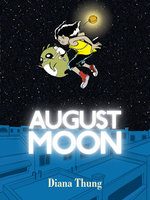
August Moon


By Diana Thung (Top Shelf)
ISBN: 978-1-60309-069-8

Diana Thung was born in Jakarta, and grew up in Singapore before eventually settling in Australia. She is a natural storyteller, cartoonist and comics creator of sublime wit and imagination who seems to have a direct hotline to the limitless thought-scapes of childhood. Every single thing populating her astonishingly unique worlds is honed to razor sharpness and pinpoint logical clarity, no matter how weird or whimsical it might initially seem.

The sentiment is pure and unrefined, the scenarios are perfectly constructed and effectively, authentically realised. …And when things get tense and scary they are excessively tense and really, really scary…

After a few tentative dabblings, Thung catapulted to (relative) fame in 2012 following the release of her first graphic novel: a superb blending of eastern and western comics influences that remixed a few standard elements of fantasy into a superbly fresh conjunction for young and old alike.

Rendered in stunning, organically enticing black and white, the scene opens in the Asian township of Callico: an isolated little metropolis in the midst of lush jungle verdure and a place with a few strange secrets…

Reachable only by one solitary bridge, generally cut off from the wider world by dense surrounding forests and innate unchanging dullness, the town moves at its own pace. Life is slow, existence is bucolic and the biggest deal for the people is the perennial debate over whether the strange dancing lights seen in the trees at night are actually Soul Fire – dead ancestors watching over the town – or just some unexplained scientific phenomenon…

Answers start coming for a select few folk after ugly, business-suited strangers begin buying up empty shops for a company named Mon & Key. Some of the older street vendors are understandably anxious but only Grandma and her peculiar little associate Jaden know the appalling threat the interlopers pose…

Events start to spiral out of control when the newcomers murder a hitherto unknown “animal” and news of the bizarre beast’s corpse leaks out into the wider world. The amazing discovery brings college biologist Dr. Gan back to the town his dead wife grew up in for the first time in years, dragging teenaged daughter Fiona with him.

Reluctant to be there, Fi keeps to herself; spending time snapping photos with her instamatic camera. The dull old backwater suddenly becomes more intriguing after she captures a candid shot of a boy leaping like a grasshopper over the rooftops…

When she finally meets the incomprehensibly enigmatic Jaden, Fi is quickly drawn into his bizarre struggle against the ape-like invaders. After meeting the clandestine forest creatures who are the true source of Soul Fire, she makes their struggle her own…

The cruel and cunning interlopers of Mon & Key worship commerce and progress. Their agenda involves destroying the forests to build factories. Ruthless and multi-resourced, they retaliate by killing all objectors in the know, whilst attempting to dissuade and eventually assassinate Fi’s father.

However, with the aid of Callico’s street children – and a few clued-in, sympathetic adults like her Uncle Simon – Fi and super-powered, magic moon-boy Jaden lead a spirited secret war to destroy the rapacious deforestation machines of Mon & Key.

As the holiday season nears its end and the town prepares for its annual Soul Fire Festival and parade, Mon & Key’s forces assemble for one final deforesting assault, but they have totally underestimated Jaden’s resolve, Fi’s ingenuity and Callico’s desire to remain unchanged and unchanging…

A funny, scary, magical and thrilling modern fable, August Moon seamlessly blends ecological themes with beguiling myth to tell a captivating tale of child empowerment and rebellious wonder. This is a truly enticing young reader’s epic every lover of comics and storytelling should take to their hearts.
© 2011 Diana Thung.

Black River


By Josh Simmons (Fantagraphics Books)
ISBN: 978-1-60699-833-5

After far too long way, cartoonist Josh Simmons (House, Jessica Farm, The Furry Trap) returns with another masterfully monochrome comics epic: a poetically potent, visually enthralling, ferociously challenging tale some might reasonably call a horror story.

However, despite its post-apocalyptic setting and milieu and constantly rising death-toll, Black River has more in common with the arduous privations and torturous trials of endurance and personal choice typical of a Jack London adventure novel than a slasher flick, serial killer slaughter or even last ditch stand against the zombie horde du jour.

Sacrificing plot to concentrate on character and experience, the story details how a band of people roam the wastes of Earth after the world ends.

Incessantly moving forward, the motley mixed-up band of strangers hunt for scarce supplies in wrecked cities and outpost; staying one step ahead of whatever destroyed civilisation. Of course, even as they wearily trudge the length of the continent, scavenging for necessities – and even occasional, instantly abused luxuries like booze and drugs – they cannot stop madness finding them or death from picking them off one by one.

Their years-long nomadic perambulation takes an even darker turn after they are all captured by a marauding band led by a charismatic sociopath called Benji. These brutes have reverted to little more than true beasts, but solitary, traumatised Shauna endures the worst atrocities they can commit before lethally turning the tables on them and leading the now solely female group back out into the wilds again.

Years pass, battles are fought and the group thins as life winnows them down to nothing…

Simmons doesn’t offer answers or explanations: this epic trek of unrelieved toil and raw survivalism is truly all about the journey and what happens next as the ever-shifting cast of desperately determined humans take life one day at a time, one step after another until the inescapable end comes…

Black River is bleak, unrelenting and morbid, but Simmons is a fantastically perceptive creator and realises that even in such an existence, there must be moments of rude hilarity or short-lived contentment and even unexpected joy to balance the constant fight for one more day…

A saga of grim attrition in a world without hope, Black River perfectly displays the best and worst of human nature and is a tale which, once read, will never be forgotten…
© 2015 Josh Simmons. This edition © 2015 Fantagraphics Books, Inc.

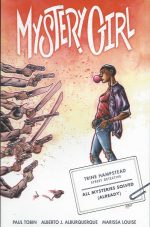
Mystery Girl volume 1


By Paul Tobin, Alberto J. Albuquerque, Marissa Louise & Marshall Dillon (Dark Horse Books)
ISBN: 978-1-61655-959-5

There’s a fabulous wave of smart, entertaining stand-alone comics on the market these days, offering readers a single uncomplicated hit of graphic entertainment without the grief of buying into massive back-history or infinite cross-continuity.

One of the best I’ve seen recently is the compilation of a fierce, frenetic and funny debut 4-issue miniseries from 2015, starring the most infallible detective of all time.

As crafted by Paul Tobin (Marvel Adventures Spider-Man, Plants vs. Zombies, Bandette, Colder) and Alberto J. Albuquerque (Letter 44) – with colours by Marissa Louise and letters from Marshall Dillon – this slim, sleek, slick yarn seems certain to lead to more enigmas excitingly unravelled in our immediate future…

Like any ancient city, London has its fair share of unique characters and unsolved mysteries, but that’s never the case whenever Trine Dorothy Hampstead sets up her “office” on the pavements and begins chatting…

The effusive, ebullient young woman has an incredible gift. She knows the answer to any question she’s asked. Instantly and infallibly. “Where are my keys?” “Did Dad leave a will?” “Where is my son’s body?”

All inquiries get an instant response and every answer is correct…

Trine is a local celebrity in her community, not only for the fact that she’s never judgemental or exploits her gift, but also because everyone knows there’s only one mystery the poor lass can’t solve: how she got her uncanny power…

Trine has an immense taste for life at full throttle and abiding desire to help those in need: regularly consulting with local private eye Alfie and aiding her perpetually sceptical boyfriend – and Metropolitan police constable – Ken Bloke in his work, even though he refuses to believe in her gift…

Her already extraordinary life takes a big step into the unknown when ancient DNA specialist Jovie Ghislain comes to Trine with a fascinating query. The biologist has been researching a 1930’s expedition to the wild Sakha region of Siberia. In the notes of the fabled Weimar-Steinberg trek, the explorers detail how they uncovered a frozen mammoth carcass so perfectly preserved that the meat was still fresh and edible.

The records are tragically incomplete and Ghislain – desperate to secure viable DNA from the deceased giant – wants to know where the rest of the body is now…

The answer is not immediately forthcoming. In fact Trine refuses to say anything unless she can join Jovie’s excursion and personally show the scientists where it is.

Trine thrives on new experiences and this time her gift has paid a huge dividend. As preparations are made, she shrugs off all questions from friends and acquaintances but does confide in her pet budgie Candide. The reason that mammoth meat was so fresh is obvious. It hadn’t been dead long. Now she’s off to see its kin in the only place on earth where the mighty beasts still live…

Sadly, the original expedition and its journals are also the subject of a search by wealthy and far less friendly folk. However, when a mystery billionaire commissions a psychopathic hitman to find all the original journals and stop the new expedition, even the deadly Linford is taken with Trine. Foregoing his usual callous efficiency, the murdering mercenary takes his time, insinuating himself into the life of all her friends. It’s all working out fine until the Mystery Girl is asked about her pal’s latest boyfriend and suddenly she knows all about the new beau, including his real profession…

Hampstead’s plan to deal with him is shockingly effective, but doesn’t go nearly far enough…

Believing the coast clear, Trine and Jovie head for the Arctic Circle, blissfully unaware that their trail is being dogged by Linford’s sinister paymaster and that the killer himself is down but not out. Instead he has devised a cunning method to turn his opponent’s gift against her…

Yet again, however, the obsessive hitman has underestimated Trine’s power, ingenuity and ruthless resolve but when finesse fails at least he can always fall back on overwhelming firepower and direct action…

With the explorers nearing their frozen El Dorado, the bad guys make their move, revealing what’s actually behind all the death and destruction. Now it no longer matters if Trine is asked the right question or not…

As the ghastly true story of the Weimar-Steinberg expedition is exposed, their heirs and inheritors will prove willing to commit mass murder to keep the bloody secret covered up, but Trine asks herself a different question and a life-saving solution pops into her head…

Fast-paced, spectacularly action-packed, witty and superbly balanced as hero and villain play cat-&-mouse around the world, Mystery Girl is a funny, imaginative, brutally uncompromising introduction to a potent and engaging new female character who seems destined for greatness.

Also included are fascinating bonus features including a copious and heavily annotated Sketchbook section with commentary from Tobin and Albuquerque, concept to finished art examples, cover roughs and designs and unused cover art, revealing the masses of effort that went into making this one of the best character debuts of the year.

Don’t ask why you weren’t in at the beginning of her climb to stardom: get Mystery Girl and become someone with (some of) the answers…
Mystery Girl™ & © 2015, 2016 Paul Tobin and Alberto J. Albuquerque. Mystery Girl™ and all prominently featured characters are trademarks of Paul Tobin and Alberto J. Albuquerque.

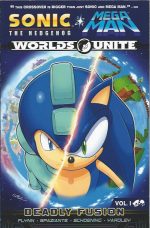
Sonic the Hedgehog/Mega Man Worlds Unite Book 1: Deadly Fusion


By Ian Flynn, Joel Enos, Dan Schoening, Tracy Yardley, Terry Austin, Luis Antonio Delgado, Matt Herms, Ben Bates, Jack Morelli & various (Archie Comics)
ISBN: 978-1-62738-998-3

From the earliest days of comicbooks, the periodical pamphlets have been a cheap and effective way to augment brands and franchises: offering stopgap and interim “extra” adventures and experiences for stars like John Wayne, Roy Rogers or Alan Ladd, TV, movie and kids cartoon dynasties such as Star Trek, Tom & Jerry or Bugs Bunny and an almost infinite number of games, toys and even sugar-packed edibles.

It’s solid business sense and mutually advantageous: publishers get to sell comics, maintain space on shop shelves and cross-sell to new audiences whilst licensees get a relatively inexpensive method of keeping their properties active in at least part of the public consciousness in the long periods between blockbuster releases or off-season doldrums.

Since its 1991 release, Sega’s video game Sonic the Hedgehog has become a fully entrenched global phenomenon. Soon after the initial game release the speedy beast and his crime-busting animal associates became comicbook stars in Britain, America and all over the world.

In the USA, family friendly Archie Comics won the rights to publish an ever-expanding cast of characters beginning with a brace of miniseries in 1992 and 1993. Sonic the Hedgehog volume 3 debuted in July 1993 and has continued continuously ever since, becoming the longest-running game/toy based comicbook in American history at 283 issues and counting. With demand remaining high, the Hedgehog quickly generated a raft of spin-off titles such as Knuckles the Echidna and Sonic X to fill out a whole boutique universe of similarly-themed titles.

Decades later Capcom also picked Archie as publisher for their own complex, complicated and heavily cross-marketed video game franchise Rockman. You probably know it as Mega Man. An expanding line of comics started in April 2011 as the time-bending, dimension-hopping sci fi exploits of the plucky robot warrior and his worthy allies became another genuine funnybook phenomenon.

Last year the world – especially the corporate fantasy-scape shared by kids and game-playing adults – grew closer and overlapped when these two separate but intellectual properties clashed in a spectacular, monolithically successful team-up called Worlds Collide wherein the universes of Sonic and Mega Man were explosively thrown together, creating fresh worlds, a new kind of excitement and better villains to battle…

Nothing screams “sequel” like record-breaking sales and a legion of strident, thrill-starved fans, so that breakthrough meeting was swiftly revisited in an even more ambitious follow-up. The Worlds Unite event reunites the heroes and villains, encompassing all the disparate titles of both pantheons and will eventually fill three graphic novel compilations.

Deadly Fusions – gathering material from Sonic Universe #76, Sonic Boom #8, Sonic the Hedgehog #273, Mega Man #50, Sonic the Hedgehog: Worlds Unite Battles #1 and Mega Man: Worlds Unite Battles #1 – sets the ball rolling; filled with a frankly bewildering array of heroes and villains in constant (family-friendly) conflict, but that’s merely a tantalising, appetite-whetting prelude to cataclysmic and universe altering events yet to come…

Cooperatively crafted by scripters Ian Flynn & Joel Enos with art by Dan Schoening, Ben Bates, Tracy Yardley, Terry Austin, Luis Antonio Delgado, Matt Herms, Ben Bates, Jack Morelli & Rachel Deering, the drama begins when über-menace Sigma comes back from a furious future in the realm of Mega Man X to ally with contemporary master-menace Zavok and crazed terrorist Xander Payne. In his spare time Sigma also kidnaps Mega Man and Sonic’s respective arch-nemeses Dr. Wily and Dr. Eggman to create a legion of baddies dubbed the Deadly Six of Lost Hex…

From his pocket dimension he then declares war on Mega Man’s world and that of Sonic and his animal allies. Sigma seems unstoppable after both heroes are defeated and “disappeared”, even though their friends the Robot Masters and Freedom Fighters valiantly take up the struggle.

However, as the tomorrow tyrant’s schemes inexorably near fruition, he is unaware that his captive scientific renegades are scurrilously working their own agendas: preparing to each become sole survivor and singular conqueror of all the varied realms of creation…

To Be Continued…

A non-stop, manic fight-fest to delight youngsters – and everybody with bulging thumbs who steadfastly hone their competitive natures on a console every chance they get – Deadly Fusion is an uncomplicated and relentless avalanche of non-stop rollercoaster action, packed with visually potent extras.

These include a handy prequel recap feature, a brace of ‘Bonus Battles’ vignettes, a series of gag-strips (by Bill Freiberger, Jonathan H. Gray, Lamar Wells, Rick Bryant & Aleah Baker), a copious sketch and design section detailing the development of the new characters and a truly vast gallery of covers and variants by Patrick “SPAZ” Spaziante, Rafa Knight, Ben Bates, Evan Stanley, Jamal Peppers, Phyllis Novin, Ben Hunzeker, Ryan Jampole, Gary Martin, Steve Downer, T. Rex, Roger & Idalia Robinson, Ed Huang, Irvin Rodriguez and Patrick Thomas Parnell.

Breathtaking and compulsive game-based fun –all that’s missing is the electronic beeping and explosion sounds, and I’m sure someone will be happy to provide those as the pages oh-so-swiftly turn…
© Sega. All rights reserved. CAPCOM, Mega Man and all related characters © CAPCOM. Published by Archie Comics Publications, Ltd under license.