Time Clock


By Leslie Stein (Fantagraphics Books)
ISBN: 978-1-60699-930-1

Help Wanted: Girl cartoonist seeks meaning of contemporary existence and like-minded individuals to share bewilderment and revelations with.

Interests/Hobbies include: drinking, counting sand, growing stuff, antiquing for pop culture “trash”, drinking, meaningful conversations with musical instruments, playing board games with same, recreational herbal intoxicants, reminiscing about wild-times with gal-pals and old cronies, drinking, visiting difficult relatives.

Employment: unwanted but regrettably necessary. Although not native to the Big City, is extremely adaptable and will do anything – unless it’s hard, boring or she sucks at it…

After graduating from the New York School of Visual Arts, Leslie Stein began producing astonishingly addictive cartoon strips in the self-published Yeah, It Is. Winning a Xeric Grant for her efforts, she then started an even better comicbook entitled Eye of the Majestic Creature: blending autobiographical self-discovery, surreal free-association, philosophical ruminations, nostalgic reminiscences and devastatingly dry wit to describe modern life as filtered through her seductive meta-fictional interior landscape. She is a creator who sees things as they really aren’t, but makes them authentic and even desirable to anyone willing to pay attention…

This long-awaited third volume resumes Stein’s airy, eccentric and engaging pictorial mood-music as her mythologized autobiography continues to reveal the history and ambitions (for want of a better term) of Larrybear – a girl deliberately and determinedly on her own, trying to establish her uniquely singular way of getting by.

Eschewing chronological narrative for an easy, breezy raconteur’s epigrammatic delivery, illustrated in loose, free-flowing line-work, detailed stippling, hypnotic pattern-building or even honest-to-gosh representational line-drawing, Stein operates under the credo of “whatever works, works” – and she’s not wrong…

Larrybear makes friends easily: bums, winos, weirdoes, dropouts, misfits, non-English-speaking co-workers and especially inanimate objects. Her bestest buddy is her talking guitar/flatmate Marshmallow, one of the many odd fellow travellers who all aggregate around her, briefly sharing her outré interests and latest dreams.

However Larrybear doesn’t want an average life, just more experiences, less hassle and affable companions to share it all with.

This latest graphic dinner party starts with another Friday at work. After scrupulously completing her wage-slave tasks, she heads off to show her latest creation at the long-awaited Sand Counters Convention.

The guy at the next table next is annoying but okay, and she’s touched when venerable old Sand Counter Henry Peet admires her work but, after seeing über-stylist Tim Heerling swanking and lapping up the adulation of the audience, she is mysteriously moved and decides that now she has a new nemesis…

And in the meantime, stay-at-home stringed instrument Marshmallow – feeling unfulfilled – takes up baking to shorten the incessant loneliness…

A second untitled segment then finds Larrybear hanging out with old pal Boris, sharing stories and intoxicants, but still blithely unaware of how he feels about her…

After months of prevaricating, and whilst still enduring dreams about that Heerling guy, our aimless star finally relocates to the countryside where she, Marshmallow and the rest of her animated instrument collection enjoy a life of bucolic fulfilment and idle contemplation until they can’t stand it any more…

This superbly quirky diversion then concludes with ‘Boy’ as Larrybear learns that living miles from the nearest bar and being unable to drive is severely impacting her drinking time, whilst having competition-quality sand delivered is a huge mistake…

All too soon however, she’s back in her natural environment, dealing booze to drunks and sharing their buzz, just as the biggest storm in living memory threatens to close up the city…

All delivered in a mesmerising, oversized (292 x 204 mm) monochrome package, these incisive, absurdist, whimsically charming and visually intoxicating invitations into a singularly creative mind and fabulous alternative reality offer truly memorable walks on the wild side. For a gloriously rewarding and exceptionally enticing cartoon experience – one no serious fan of fun and narrative art can afford to miss – you simply must spend a few hours with a Time Clock.
© 2016 Leslie Stein. All rights reserved.

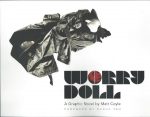
Worry Doll


By Matt Coyle (Dover Comics & Graphic Novels)
ISBN: 978-0-486-80616-7

In the comics biz it’s not too often that something truly different, graphically outstanding and able to subvert or redirect the medium’s established forms comes along.

Sadly, when it does we usually ignore it whilst whining that there’s nothing fresh or new in view.

That’s pretty much what happened with Matt Coyle’s astounding Worry Doll when, after six years of work on the dark epic, it was published by Mam Tor in 2007 and sank from the collective audience’s sight after causing but the barest of ripples.

To be fair, British-born, Australia-based Coyle (see also, if you can, his mordant, socio-political satire Registry of Death) did win the 2007 Rue Morgue award for Best Comic Book Artist for his incredible photo-realistic line-art on Worry Doll, but the innovative delivery of one of the creepiest tales in comics history never garnered the acclaim it deserved in our superhero-saturated toy, TV and film license-loaded entertainment arena.

Now, thanks once again to Dover Books’ Comics & Graphic Novels division, another lost classic of the art form has a second chance to shine, so let’s show some proper respect and make this edition the popular success it should be…

A soft-cover monochrome landscape affair; enigmatic observations and conversations are delivered in the oldest format of pictorial narrative, with blocks of text on one page balanced by an illustrated panel or sequence of images on the facing folio, as a most distressing story unfolds…

A happy home becomes a charnel scene of slaughter and in the aftermath, amidst the bloody remains of a recently-despatched family, a trio of beloved mannequins intended to assuage anxiety take on ghastly animation and leave in search of answers – or is it actually just different questions?

Making their way across familiarly picturesque and simultaneously terrifying country, the dolls increasingly depend on the kindness of strangers, until their nightmare road-trip is eventually subsumed in someone’s story. As our perspective shifts, we get clues that other hands are working these puppets and the story is not as it seems nor quite done yet…  

Spooky and subversive, blending classic noir mood and tone with storybook quests and psychologically daunting introspection, Worry Doll operates on multiple layers of revelation, both in the staggeringly detailed illustration and the prose accompaniment; constantly offering hints and forebodings if not answers…

With a new Foreword from comics author and filmmaker Shaun Tan (The Lost Thing, The Red Tree, The Arrival) who sagely deconstructs the journey and Coyle’s virtuosity with line and form, this is a complex, engaging and ominously beautiful masterwork no true lover of comics or addict of sinister suspense can afford to miss.
© 2007 by Matthew Coyle. Foreword © 2016 by Shaun Tan. All rights reserved.

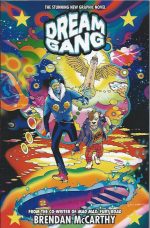
Dream Gang


By Brendan McCarthy & various (Dark Horse Books)
ISBN: 978-1-50670-000-7

London-born Brendan McCarthy came to funnybook prominence in 2000AD before finding international comics stardom whilst pursuing a parallel career in film, television, music videos and design.

Forward-looking, iconoclastic yet simultaneously deeply reverential of comics’ great innovators, his most notable graphic works include Strange Days and Paradax, Judge Dredd, Zenith, Sooner or Later, Skin, Rogan Gosh, Spider-Man: Fever and innumerable stunning covers. His moving-media credits are equally singular and impressive, having produced scripts and/or design work for The Storyteller, Highlander, Lost in Space, pioneering CGI animation series Reboot, Mad Max 4: Fury Road and so much more.

Originally seen as scintillating segments of a occluded whole in Dark Horse Presents volume 3 #1-4, #7-10 and #14-17 in 2014-2015, McCarthy’s latest magnum opus has been completely remastered here: a digitally-psychedelic, intoxicatingly intriguing yarn (with lettering from Nate Piekos of Blambot® and additional colouring from Len O’Grady) which begins with a tedious worn-down wage slave enduring his greyly monochrome mind-numbing existence.

Everything changes – but not necessarily for the better – when his head hits the pillow and he is transported to an incredible, overwhelming wonderworld where dreams are made manifest and the id and subconscious roam free and wild…

However the dreamscape is in the midst of a terrifying civil war with a marauding entity dubbed Zeirio ripping apart the fantastical strata and recondite regions of the Dreamscape in his lust to acquire a hidden ultimate weapon and break out into the real world.

Instantly attacked by a passing Hate-Wraith, our reluctant wanderer is only saved by the swift intervention of quirkily charismatic Sheriff Chumhartley who then presses him into service by activating his Dream Avatar…

Now submerged within the masked super-heroic frame of the Dream Voyager, the baffled, bemused and partially amnesiac real-worlder is subjected to a parade of mind-blasting sights as he reluctantly joins the imaginary brotherhood of the Dream Gang in a last-ditch pursuit of Zeirio.

However, with his new allies losing ground – and, too often, their lives – the imported champion is further baulked and distracted by the appearance of a beloved and long-lost friend from his past, who distracts his dream-fuelled attention and might well be their adversary’s greatest and cruellest counter-weapon…

An astounding visual voyage of discovery to a region of tantalisingly phantasmagorical, thought-bending phenomena to endure Horatian struggles against insurmountable odds, this is a moody, moving and creepily compelling psychological escapade to delight all lovers of the life fantastic.

Devotees of McCarthy’s unique artistic visions will be further rewarded by a copious bonus section which includes an informative Afterword and a large gallery of art pieces: sketches, production notes, concept development and character designs from the decades in which this story moved from enchanting idea to finished ethereal epic.
Dream Gang™ © 2014, 2015, 2016 Brendan McCarthy. All rights reserved.

Pandora’s Box volume 2: Sloth


By Radovanović & Alcante, coloured by Usagi and translated by Jerome Saincantin (Cinebook)
ISBN: 978-1-84918-006-1

Pandora’s Box is the impressive conception of Belgian author Didier Swysen under his nom de plume Alcante (Jason Brice, Rani, La Conjuration de Cluny). The format is a sequence of eight stand-alone stories, all informed by burgeoning ethical issues we’re daily dealing with and each revealing the ultimate cost of succumbing to one of the “Seven Deadly Sins” that have afflicted humanity since that fabled box was first breached…

Each headline haunted epic blends Cassandra-toned contemporary societal concerns with technological extrapolation, framed in modern terms and images against a backdrop of a tale from classical mythology offered as foreboding metaphorical prognostications to the political and plutocratic powers-that-be…

Utilising disturbingly familiar yet widely disparate hot-button topics, the stories are linked only by the fact that each individual protagonist is accosted and warned by an arcane and peculiar bag-lady prior to the denouement…

Each tale is illustrated by one of a truly international pantheon of different artists. Second saga Pandora Box – La pareses references the fall of Troy and was deftly delineated by Serbian illustrator Vujadin “Vuja” Radovanović (ÄŒuvari zaboravljenog vremena, Džo XX, Candide ou l’optimisme, de Voltaire) and coloured by Usagi, recounting how a magnificent hero responds to the passing of time, the failure of his powers and fading of his cherished glory…

Paris Troy has been the fastest man alive for a decade: a multi-gold medal winning Olympian and pristine example of all that is honourable and magical about sporting endeavour. Now as the sprinter recovers from a thigh injury in preparation for the next Great Games, an obnoxious rival is all over the media, baiting the runner and winning races, edging ever closer to Troy’s cherished world record.

The thought of someone like Ace Achean stealing his place in the world disgusts Paris, but is it the only reason he finally listens to his brother’s loathsome suggestions?

Hector Troy might well have been even faster than his sibling, but since he was caught doping and barred from competition, no one will ever know for sure. Now, with his confidence ebbing due to the injury or perhaps some psychological block, and Achean baiting him and threatening to take his sponsorship deals, Paris turns his back on a lifetime of proudly clean living and succumbs to Hector’s temptations.

It doesn’t hurt so much after he learns that his supplier is also helping Ace keep his edge…

And then, with the Olympics open and Troy doped to the gills, the once noble sportsman discovers he’s been lured into a moral maze and inescapable trap by someone who has hated him for years…

With his life, fortune, reputation and legacy all at stake and nothing but shame, humiliation and disdain in his future, Paris seems to have no way out…

Stark, powerful and expressive, this tale of great temptation not resisted shows how a good man can be pushed to despicable extremes and is a potent metaphor for so much that’s wrong with the modern word of intoxicating celebrity and quick fixes…

A powerful fable with an uncompromising message, Pandora’s Box – Sloth is as much a salutary warning to ponder as a story to enjoy.
© Dupuis, 2005 by Radovanovic & Alcante. All rights reserved. English translation: © 2009 Cinebook Ltd.

Memetic


By James Tynion IV & Eryk Donovan (Boom Entertainment)
ISBN: 978-1-60886-743-1

Even people who love to be scared can get a bit jaded. Terror tales come in many forms and formats, from Sophisticated Suspense to J-Horror to no-holds-barred graphic splatter and torture-porn, but at the heart of them all is the power to connect with an audience and make them nervously wonder. Thankfully, thus far creators are keeping just ahead of consumers and still seem able to enact new notions with great style and captivating facility whenever we need a little extra anxiety in our lives…

Embracing all the old adages whilst thinking far outside the box, in 2014 writer James Tynion IV (The Eighth Seal, Batman Eternal) partnered with old associate Eryk Donovan (The House in the Wall), colourist Adam Guzowski and letterer Steve Wands to put a fresh, clever and thoroughly post-modern spin on the overused doomsday scenario of the Zombie Apocalypse with 3-issue miniseries Memetic.

If you need a little definition here: A meme is an idea that starts with individual, spreads to many and potentially is taken up by entire communities or societies, like not eating yellow snow, washing behind the ears or voting for the worst possible candidate in any given election…

Aaron Sumner had a bad start in life but simply persevered. Despite the congenital illness which messed up his eyes and left him needing hearing aids and daily medication, he made friends, worked hard and now leads a relatively normal life at Jefferson State College.

He even had a boyfriend until recently, but was totally unprepared for the role he was about to play in the last act of humanity…

Aaron is still fretting about recently gone-but-not-forgotten beloved Ryan Nowak, and petulantly surfing the web when someone forwards an image that promises to “change everything”…

Intrigued, he opens the file and agrees that it’s a pretty picture, unaware that he is one of the few humans on the planet immune to its secret power…

Everybody else who sees the image is immediately besotted and cannot stop looking at it, but baffled Aaron soon tires of not getting it and goes to sleep. He’s woken up by best friend Sarah Bentley who totally feels the tingle of friendly companionship the picture generates. Together they reason that it’s Aaron’s medical deficits which are preventing him from sharing the togetherness.

In mere hours the image has gone beyond viral. It has been copied and pasted on walls and even made it onto regular news channels. Nobody can grasp just why it has such a feelgood factor, but it looks like before the day is over everybody on Earth will be sharing the joy…

That’s disturbing news for Marcus Shaw. The former military specialist was one of the Pentagon’s biggest military brains until macular degeneration rendered him practically sightless, and the effect he hears of on the news and from speaking to his increasingly distracted friends reminds him of an old project proposed by Weird Science specialist Dr. Barbara Xiang.

When he contacts his old bosses he quickly realises it’s too late. Someone has succeeded where they failed and created a weaponised Meme…

All over the world progress pauses as people see the picture, disseminate the picture and perpetually stare at the picture.

Aaron is baffled and growing concerned. That turns to total terror when the second-stage kicks in. Twelve hours after initial exposure, the image addicts begin bleeding from the eyes and take to the streets in lemming-like mass marches. Screaming mindlessly, they surge through the streets ripping apart anyone not sharing their mindless union and converging in towering masses of melting flesh…

Elsewhere, last-ditch action is being taken. Dr. Xiang has managed to avoid seeing the image and linked up with Marcus. She knows full well the potential threat and wants him to lead a reconnaissance mission to find the originator of the meme and, if possible, create a counter-measure.

Aaron’s world is crumbling. Sarah stays with him until she starts to feel the scream building inside her, and even a last-minute reunion with Ryan is doomed to end badly…

Using now-abandoned government and military resources, Marcus and Xiang locate the origin point of the meme and a team heads off to confront their hidden enemy. They cannot help but speculate on who – or what – could have created such a complex thought weapon: one which is clearly evolving and forcing humanity into its final moments…

The answer, when it comes, is beyond anything they could possibly have imagined…

And Aaron ostracised, alone and again an outsider makes one final act of free will…

Engaging, engrossing, fearsomely believable and utterly compelling, Memetic also offers behind the scenes bonuses including sketches, model sheets, a feature showing the creative process from ‘Script to Page’, commentary and ‘Afterwords’ from author and artist, plus a cover and variants gallery by Donovan.

Unfolding at a frenetic pace – 72 hours from start to a doom-drenched finish – this a yarn to chill the hearts of blasé Generation Tech and the most timid of silver surfer alike: one you also will have extreme difficulty turning away from…
™ & © 2015 James Tynion IV. All rights reserved.

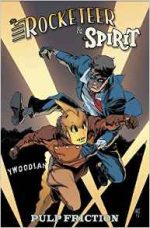
The Rocketeer & The Spirit: Pulp Friction


By Mark Waid, Paul Smith, Loston Wallace, J Bone, Bob Wiacek & various (IDW)
ISBN: 978-1-61377-881-4

The American comics industry has generated its fair share of immortal heroes. However, whilst everyone is familiar with household names such as Flash Gordon, Superman, Dick Tracy or Popeye, there are also timeless champions who pretty much remain hallowed names known only to the in-crowd and cognoscenti: characters who have had their shot at global mega-stardom but for some reason never caught on with the masses. Characters like The Spirit and The Rocketeer…

Will Eisner was a pivotal creative force who helped shaped the entire medium of comics. From 1936 to 1938 he worked as a jobbing cartoonist in the studio-stable known as the “Eisner-Eiger Shop”, creating strips for both domestic and foreign markets.

As Willis B. Rensie he created and drew the opening instalments of a huge variety of characters ranging from funny animal to historical sagas, Westerns, Detectives, aviation action thrillers… and superheroes… lots of superheroes…

In 1940 Everett “Busy” Arnold, head honcho of Quality Comics, invited Eisner to take on a new challenge. The Register-Tribune newspaper syndicate wanted a 16-page weekly comicbook insert to be given away with the Sunday editions. Eisner created three strips which would initially be handled by him before two were handed off to his talented assistants.

Bob Powell inherited Mr. Mystic and distaff detective Lady Luck first fell into the capable hands of Nick Cardy (née Nicholas Viscardi) and later the inimitable Klaus Nordling.

Eisner kept the lead strip for himself, and over the next twelve years masked detective The Spirit grew into the most impressive, innovative, imitated and talked-about strip in the business. In 1952 the venture folded and Eisner moved into commercial, instructional and educational strips, working extensively for the US military in manuals and magazines like P*S, the Preventative Maintenance Monthly, generally leaving comics books behind.

In the wake of “Batmania” and the 1960s superhero craze, Harvey Comics released two giant-sized reprint editions with some new material from Eisner, which lead to a brace of underground compilations and a slow but inexorable rediscovery and revival of the Spirit’s fame and fortune via black and white newsstand reprint magazines.

Warren Publishing collected old stories, occasionally adding painted colour from such contemporary luminaries as Rich Corben, but from #17 the title reverted to Kitchen Sink, who had produced those first two underground collections.

Eisner found himself re-enamoured with graphic narrative and discerned that there now existed a willing audience eager for new works. From producing new Spirit covers for the magazine (something the original newspaper insert had never needed) he became increasingly inspired. American comics were evolving into an art-form and the restless creator finally saw a place for the kind of stories he had always wanted to tell.

He subsequently began crafting some of the most telling and impressive work the industry had ever seen: first in limited collector portfolios and eventually, in 1978, with the groundbreaking sequential narrative A Contract With God and thereby jumpstarting our modern comics phenomenon of graphic novels…

Although his output was far smaller and life far shorter, Dave Stevens had an equally revolutionary effect on the industry: his lush and lavish illustration style influencing a generation of artists as his signature retro-futurist character The Rocketeer became the first breakout star of the Independent Comics movement which stemmed from the creation of the Comicbook Direct Sales Market.

Due to Stevens’s legendarily uncompromising artistic vision – and consequent slow page rate – very few of The Rocketeer’s period exploits appeared before the artist’s death from Hairy Cell Leukaemia in 2008. Since then, however, diverse other hands have added to the canon, as with the miniseries collected in this slim but stunning hardcover edition.

Just in case these vintage adventurers are new to you, The Spirit used to be Denny Colt: Central City’s greatest detective and criminologist. After apparently dying in battle with a vile master-villain, Colt opted to remain officially dearly departed and battle evil in a semi-official capacity as a masked enigma, aided by girlfriend Ellen Dolan and her father the crime-ridden metropolis’ Police Commissioner.

Cliff Secord is an itinerant West Coast pilot who – circa 1938 – found a fantastic jetpack outfit and ever thereafter stumbled into a succession of criminal plots and capers. With the eventual permission of the flight engine’s inventor – one of the greatest heroes of that or any other era – Cliff still finds himself regularly battling bad guys as The Rocketeer. When that’s not occupying his time, he’s busy looking for work or being given the run-around by his star-struck, fame-obsessed, trouble-magnet girl Betty…

Team-ups are part-and-parcel of comics extravaganzas and both heroes have had their share of cataclysmic and catastrophic clashes with the valiant giants of the period and the industry.

This yarn however – collecting a 4-issue miniseries by Mark Waid which ran from July to December 2013 – concentrates as much on humour as bombastic action and begins on the East Coast in February 1941 where business executives and government meet to decide the future of the Next Big Thing…

Alderman Cunningham is stridently opposed to letting business cartels control the new medium and argues that, just like with radio, public airwaves must not be owned by any individual or corporation seeking to monopolise recently invented Television…

Mere hours later an early morning fashion shoot on a California beach is ruined when beautiful Betty finds the idealistic politician’s mangled corpse…

When the stiff is identified as Cunningham, Commissioner Dolan and Spirit are baffled. How could the victim have travelled more than 3000 miles in one night? Determined to investigate, they book passage on a trans-continental plane, having reluctantly crumbled before the forceful Ellen who demands to join them and see Hollywood…

In Los Angeles, Cliff Secord is again being ignored by the traumatised Betty. He mopes dejectedly until his grizzled old mechanic Peevy points out that whoever killed the Alderman might also want to silence the girl who found the body…

Nearby, a very wealthy entrepreneur places a coast-to-coast call to The Spirit’s greatest enemy to discuss his incredible new invention, the pursuance of their plans and how to stop a certain masked interloper from interfering…

Said hero – still wearing his mask – is stiffly staggering off a plane at Chaplin Field with his equally exhausted cross-country companions. In a weary, unguarded moment he mentions Betty. Learning of the “slip”, an already paranoid Cliff panics and, assuming the masked killer has come for his girl, dons his rocket-man suit to attack…

After a spectacular battle, Ellen finally manages to convince the two testosterone-soaked mutton heads they are on the same side, and a tentative alliance is formed… at least until Spirit interviews Betty and the flighty starlet finds she’s in love or thereabouts with the hunky masked cop…

Illustrator Paul Smith gives way to Loston Wallace & Bob Wiacek as the second chapter opens with the fractious, clueless allies heading for the LA Morgue to examine Cunningham’s body, even as television wizard Benedict Trask and The Octopus discuss how best to get Betty out of the picture and deal with the interlopers meddling in their affairs. Their solution is unique indeed and everything would have worked out swell if not for inveterate tinkerer Peevy who has built his own prototype TV receiver and intercepted something he shouldn’t have…

The villains respond in typical manner but their big mistake is believing the planes sent to strafe Peevy’s hangar are enough to stop Rocketeer and The Spirit…

With J Bone stepping in to limn the final two chapters the high-octane tale ramps up into top gear as Cliff travels back to Central City with Spirit and the Dolans to find Betty, expose the sinister scheme of Trask and the Octopus, uncover the crooks’ treacherous connections to a certain Fascist foreign power, prevent America’s airwaves from being subverted and even save President Roosevelt from being assassinated by television in a rocket-paced, breathtaking rollercoaster ride that delivers non-stop thrills and chills…

Accompanied with an Introduction from Denis Kitchen, filling in all the necessary back-story on the iconic characters, and visually embellished by sketches and a large cover gallery by Darwyn Cooke, Smith, Jordie Bellaire, Bone and Chris Samnee, Pulp Friction is a no-nonsense fun-filled action frolic to delight lovers of the good old days of Thud and Blunder…
© 2014 The Rocketeer Trust and Will Eisner Studios, Inc. The Rocketeer is a registered trademark of, and all related characters, their distinctive likenesses and indicia are trademarks of The Rocketeer Trust. All Rights Reserved. The Spirit © 2014 Will Eisner Studios, Inc. The Spirit and Will Eisner™ Will Eisner Studios, Inc. ® in the US Patent and Trademark Office. All Rights Reserved.

Star Trek Gold Key Archives volume 2


By Dick Wood, Len Wein, Alfredo Giolitti & various (IDW)
ISBN: 978-1-63140-108-4

Star Trek debuted on American televisions on September 8th 1966, running until June 3rd 1969: three seasons comprising 79 episodes. A moderate success, the series only really became popular after going into syndication, running constantly in American local TV regions throughout the 1970s. It was also sold all over the world, popping up seemingly everywhere and developing quite a devoted fanbase.

There was some merchandising, and an inevitable comicbook – from Gold Key – which ran for almost a decade beyond the show’s cancellation. However, at the start neither authenticity nor immediacy were paramount. Only six issues were released during the show’s entire 3-season run: published between July 1967 and December 1968, those quirkily enticing yarns are all gathered in the first Star Trek: Gold Key archive collection.

The reason for the inaccuracies between screen and page was simple and probably a clear indicator of the attitude both studio and publisher held about science fiction material. Scripter Dick Wood (a veteran comics writer with credits ranging from on hundreds of series from Batman to Crime Does Not Pay to Doctor Solar, Man of the Atom) had never seen any episodes when commissioned to write the comic, with he and Italian artists Nevio Zaccara – and later Alberto Giolitti – receiving only the briefest of outlines and scant reference materials from the show’s producers. The comics craftsmen were working almost utterly in a vacuum…

Nevertheless, by the time of these interstellar exploits – reprinting Star Trek #7-12 from March 1970 to November 1971 – the well-intentioned contradictions to now-firmly established Trek lore were slowly fading as better reference and familiarity with the actual show steered the printed Enterprise incidents towards canonical parity with the TV phenomenon.

Following a revelatory Introduction ‘The Adventure Continues…’ from licensed-character specialists/authors Scott and David Tipton, another stunning photo-collage cover – a rarity at the time outside Gold Key titles – leads into an eerie cosmic quest as Kirk and his crew discovers ‘The Voodoo Planet’ (Wood & Giolitti, #7).

In an unexplored region of space, Enterprise discovers an uninhabited doppelganger of Earth, complete with monuments and landmarks. When a hidden mastermind then causes the Eiffel Tower to crumble, word comes that the original back home has also come tumbling down…

As the seemingly magical destruction continues, Enterprise tracks a transmission and travels to a planet almost obscured by debris and space junk and finds there a primitive race practising voodoo…

Shock follows shock as a landing party finds escaped Earth war-criminal Count Dressler has subjugated the natives and adapted their abilities to launch devastating attacks on the world that exiled him…

The villain’s arrogance soon proves his undoing as Dressler underestimates the ingenuity of Mr. Spock and sheer bloody-mindedness of James T. Kirk…

‘The Youth Trap’ was released with a September 1970 cover-date and sees assorted members of the crew transformed into children by a manic alien explorer who has turned a fantastic survival technology into an irresistible weapon.

Whilst Kooba‘s appalled comrades only want to get home, the madman believes his chronal ray will win him a universe. Once again the combination of Spock’s brains and Kirk’s brawn win the day…

From the February 1971 ninth issue, Wood was replaced by dedicated Trek viewer Len Wein (Swamp Thing, Batman, Spider-Man, Hulk) who joined the astounding Alberto Giolitti to explore ‘The Legacy of Lazarus’ wherein the ever outward-bound Enterprise fetched up to a remote planet and found it populated with all the great figures of humanity’s past.

When Spock vanishes his trail leads to a hidden cavern where Earth’s greatest historian Alexander Lazarus has combined robotics and recovered alien technology to gather in the actual brainwaves of history’s giants to create the most astounding resource for knowledge ever conceived.

Sadly, the great feat has only whetted the savant’s appetite and Lazarus wants to perform the same feat with the great and good of Vulcan’s past. To get started, he needs the brain of a native and Spock is the nearest and therefore only logical candidate…

Luckily for the beleaguered Science Officer, Kirk and his comrades can call on the wisdom and courage of Earth’s greatest heroes to aid in their rescue attempt…

With Star Trek #10 (May 1971) stills from Paramount were no longer forthcoming and George Wilson began his series of captivating painted covers. Meanwhile, on the pages inside, mystery and imagination hold sway as the starship is plucked out of the void by a cosmic genie whilst Kirk, Spock, Dr. Leonard McCoy and Chief Engineer Montgomery Scott are dumped at the feet of a storybook tyrant who demands they steal for him the awesome ‘Sceptre of the Sun’…

All too soon however the doughty space-farers unravel the lies underpinning the seeming omnipotence of Chang the Sorcerer to find his true origins stem from a long-lost expedition from Earth in ages past…

From August 1971, ‘The Brain Shockers’ details how neophyte Yeoman Pandora Trask is tricked by a marauding alien into opening a hatch she wasn’t meant to; unleashing a wave of malignant emotions hidden aboard the Enterprise.

The deadly feelings were originally extracted and bottled at the time Vulcans first sought to abandon passion for logic and were being transported to a secret destination, but now their rampage through the ship and the assailant’s world will wreak havoc unless Spock can outthink both them and immortal, seemingly suicidal Malok…

Closing this bombastic treasure-trove is ‘The Flight of the Buccaneer’ (#12, November 1971) with Kirk, McCoy, Scott and Spock ordered undercover to infiltrate a nest of interstellar pirates and recover Star Fleet’s stolen store of Dilithium crystals in a fast-paced, all-guns-blazing romp homaging Treasure Island…

Packed with photo-covers, promotional photos and a complete Cover Gallery this is another fabulously enticing, expansive and epic compendium of thrills: truly engaging stories to delight young and old alike and well worthy of your rapt attentions.
® and © 2014 CBS Studios, Inc. Star Trek and related marks are trademarks of CBS Studios, Inc. All Rights Reserved.

Pandora’s Box volume 1: Pride


By Pagot & Alcante, coloured by Christophe Araldi and translated by Jerome Saincantin (Cinebook)
ISBN: 978-1-905460-81-6

European comics have never been afraid of progressive ventures or ruffling feathers and have a wonderful way of confronting headline-grabbing issues in a manner certain to keep a broad assortment of readers intrigued and engaged.

Pandora’s Box is the ambitious brainchild of Belgian author Didier Swysen – under his nom de plume Alcante (Jason Brice, Rani, La Conjuration de Cluny) – and boldly blends Doomwatch-style contemporary scientific, imminent society-changing concerns and carefully calculated technological extrapolation. These are then framed against a metaphorical backdrop of classical mythology and delivered as foreboding warnings to the political and plutocratic powers-that-be…

Couched in evocatively near-to-now science fiction terms, the series comprises eight self-contained tales, all informed by burgeoning ethical issues we’re daily dealing with and each revealing the ultimate cost of succumbing to one of the “Seven Deadly Sins” that have afflicted humanity since that fabled box was first breached…

Each tale features a different illustrator. Initial tome Pandora Box – L’orgueil was deftly and subversively rendered in the superbly understated line-work of Didier Pagot (La Dame qui est une Rivière, Les Traine-Ténèbres, Transgénèse) and coloured by Christophe Araldi, recounting how a man with a mission compromises his ethics and endangers his soul for the sake of a putative legacy…

In a secret location a heavily-pregnant woman is rushed into the emergency room and delivers a very special baby. After checking the newborn boy, Dr. Mathias Turpin dismisses the attending staff so that they never learn what becomes of the exhausted mother…

It’s election year in America and incumbent President Narcissus Shimmer is in the fight of his life for a second term. His reforming programs, the American People and his immortal legacy depend on another four years to finish his grand work…

Less than a week before the crucial vote, polls have finally put Shimmer ahead of his ruthless opponent Costner and the challenger has resorted to desperate tactics: hiring private detective Ron Grubb to dig up dirt which will end the President’s campaign…

Although less than keen, the money offered is irresistible and Grubb quickly uses his formidable intellect, infallible instincts and vast network of resources to uncover a potential scandal. For some reasons Shimmer has been given billions in campaign contributions from the biotechnology industries. A potential bribe…?

Moreover, even in these crucial final days, POTUS keeps slipping his Secret Service detail and fanatical, brilliant campaign manager Claire Dale to visit Geo-Center: a small, expensively discreet gynaecology and maternity hospital.

The first thought is that Shimmer has fathered a child on a mistress: a tempting possibility for a straight-laced straight-shooter famously estranged from his drug-addict son and standoffish wife…

Further digging reveals Geo-Center is run by Mathias Turpin: a maternity specialist whose real life’s work is cloning. Of course, human cloning is illegal but…

With an horrific notion forming, certainty comes after Grubb secures a clandestine blood sample from Shimmer and has it tested.

The President has been sterile for decades and is dying. Only a bone marrow donation can save him. Has his drive to complete his life’s work pushed the dedicated humanitarian into compromising all his principles and breaking the law? If so, how much further will he go to achieve victory and keep his secrets?

Rather than reporting his latest suspicions to the vile Costner, Grubb opts to get his own hands dirty and infiltrate Geo-Center, but events there are already spiralling out of control and a bloody confrontation leads to a horrific conflagration and one final test of all the key players’ moral fibre…

Dark, bleak, painfully astute and fearfully prophetic, this examination of the depths men will stoop to in pursuit of their “destinies” also shows how heroes come in many guises and, that for almost everyone, there is an ethical Rubicon they cannot cross…
© Dupuis, 2005 by Pagot & Alcante. All rights reserved. English translation: © 2008 Cinebook Ltd.

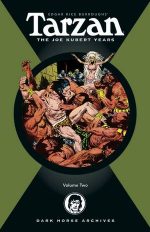
Tarzan Archives: The Joe Kubert Years volume 2


By Joe Kubert with Hal Foster, Frank Thorne & various (Dark Horse Comics)
ISBN: 978-1-59307-416-6

The early 1970s were the last real glory days of National (now DC) Comics. As they slowly lost market-share to Marvel they responded by producing controversial and landmark superhero material, but their greatest strength lay, as it always has, in the variety and quality of its genre divisions. Mystery and Supernatural thrillers, Science Fiction, Romance, War and Kids’ titles remained powerful attractions and the company’s eye for a strong licensed brand was as keen as ever.

A global multi-media phenomenon, Edgar Rice Burroughs’ Tarzan had long been a comicbook mainstay of Dell/Gold Key/Whitman, and when DC acquired the title they rightly trumpeted it out, putting one of their top Artist/Editors, Joe Kubert, in charge of the immortal Ape-man’s monthly exploits.

After decades as Whitman staples, total licensing of ERB properties was transferred to DC – not just Tarzan and his extended family, but also the author’s pioneering science fantasy characters – with DC wisely continuing the original numbering.

Tarzan #207 was the first: an April 1972 cover-date, and the series stormed on until #258 in February 1977. Thereafter Marvel, Malibu, Dark Horse and Dynamite extended the Jungle Lord’s comicbook canon in sporadic sorties to recapture the sales and popularity of the 1950s…

The latter days of the Gold Key run had suffered ever since Russ Manning left the title to draw the syndicated newspaper strip, and even the likes of Doug Wildey were unable to revive the comic’s success in the face of constantly rising costs and a general downturn in sales across the market. DC’s continuation of the franchise premiered in a blaze of publicity at the height of a nostalgia boom and was generally well-received by fans.

DC pushed the title in many places and formats (such as bookstore digest collections and the gloriously oversized Tabloid Editions) and adapted other properties such as John Carter of Mars, Pellucidar and Carson of Venus in their own features and titles

This second superb hardcover archive collection (also available in digital formats) re-presents material from Tarzan #215-224 (December 1972 to October 1973) and opens with fond reminiscences and grateful thanks to fellow artist Frank Thorne in Kubert’s Introduction.

The pictorial wonderment kicks off with a classic visual treat as ‘The Mine!’ incorporates material originally seen in classic 1930s Sunday newspaper strips (by Hal Foster & George Carlin) embedded in an original tale by Kubert.

Joe’s intent was to adapt all 24 Tarzan novels – writing, illustrating and even lettering the stories, with the brilliant Tatjana Wood handling the colours – interspersing them with new and original tales. However the workload, coupled with his other editorial duties, was crippling.

As with Tarzan #211, here he was again compelled to combine original with vintage to detail how the Ape-Man is captured by slavers and pressed into toil deep in the bowels of the earth for a sadistic mine owner.

Naturally, Tarzan soon chafes at enforced servitude and quickly leads a savage workers’ revolt to overturn and end the corporate bondage…

Issue #216 took another route to beating deadlines with old pal Frank Thorne pencilling Kubert’s script for ‘The Renegades’, leaving hard-pressed Joe to ink and complete the story of a murderous raid which wipes out a Red Cross mission.

Investigating the atrocity, Tarzan discovers the “maddened savages” responsible are actually white men masquerading as natives; stealing supplies for a proposed expedition to plunder a lost treasure vault. When he catches the culprits, Tarzan’s vengeance is terrible indeed…

‘The Black Queen!’ is an all-Kubert affair wherein the Jungle Lord almost saves a man from crocodiles. Acceding to the ravaged victim’s last wish, Tarzan then travels to his distant homeland and overturns the brutal regime of tyrannical Queen Kyra who rules her multicultural kingdom with whimsy, ingrained prejudice and casual cruelty…

The equally selfish choices of American millionaire tycoon Darryl T. Hanson blights his family as his search for ‘The Trophy’ decimates the fauna of Tarzan’s home and leads to a clash of wills and ideologies which can only end in tragedy…

With Tarzan #219, Kubert began an epic 5-issue adaptation of ERB’s sequel novel The Return of Tarzan. It opens in Paris as the unacknowledged son of vanished Lord Greystoke tries to adapt to his new life as a civilised man of leisure.

One night his natural gallantry draws him to the side of a woman screaming for help and he is attacked by a gang of thugs. After easily thrashing the brigands he is astounded to find her accusing him of assault and simply bounds effortlessly away from the gendarmes called to the disturbance.

This entire trap has been engineered by a new enemy; Russian spy and émigré Nikolas Rokoff and his duplicitous toady Paulvitch…

The rightful heir to the Greystoke lands and titles silently stood aside and let his apparently unaware cousin William Cecil Clayton claim both them and the American Jane Porter, after Tarzan rescued her from attacking apes in the jungle. Missing her terribly, Tarzan then chose to make his own way in the human world beside new friend and French Naval Officer Paul D’Arnot.

(You could catch up by reading our review of Tarzan Archives: The Joe Kubert Years Volume One, but I’m sure you’d far rather see the book itself or even the original novel…).

In the course of his urbane progression, Tarzan had exposed the Russian cheating at cards to blackmail French diplomat Count De Coude and had earned himself a relentless, implacable foe forever. When Rokoff subsequently tried to murder Tarzan, the vile miscreant agonisingly learned how powerful his jungle-bred enemy was…

With physical force clearly of no use, Rokoff’s latest plan is to put the Ape-Man through a ‘Trial by Treachery’; manufacturing “evidence” that Tarzan is having an affair with the Comte’s wife. Once more, however, the civilised monster underestimates his target’s forthright manner of dealing with problems and is savagely beaten until he admits to the plot and clears the innocent woman’s name…

With news of Jane’s impending marriage to William Clayton, Tarzan seeks to ease his tortured mind with action and the next chapter sees him travel to Algeria where, sponsored by the grateful, ashamed Count, he begins working for the Secret Service in Sidi Bel Abbes, ferreting out a traitor in the turbulently volatile French colony…

His hunt soon leads him to a likely traitor and brutal battle with Arab agent provocateurs, but things start to turn his way after he liberates a dancing slave who is the daughter of a local sheik.

When word of Jane comes from D’Arnot, Tarzan throws himself even more deeply into his tasks and falls into another ambush organised by Rokoff. This time his ‘Fury in the Desert’ seems insufficient to his needs until his newfound friend the Sheik rides to his rescue…

The intrigue continues to unfold in ‘Return of the Primitive’ as Tarzan finally uncovers a link between Rokoff and the espionage at Sidi Bel Abbes. Job done he is then posted to Capetown and aboard ship meets voyager Hazel Strong, a close friend of Jane’s who reveals the heiress had never forgotten her tryst with the Ape-Man.

Unable to watch Jane enter into a loveless marriage, Hazel took off on an ocean cruise…

The story rocks Tarzan’s mind, but not so completely that he fails to notice Rokoff is also aboard and murderously dogging his footsteps. This time however the Russian is properly prepared and that night the Ape-Man vanishes from the ship…

Rokoff’s act of assassination is a purely pyrrhic victory. Soon after reaching Capetown the villain insinuated himself into the Clayton wedding party but when their yacht’s boilers explode next morning, he, Hazel, William Clayton, Jane and her father are left adrift in a lifeboat…

Tarzan meanwhile, has survived being tumbled overboard and spent days swimming hundreds of miles. He now washes up on the same beach his parents were left upon decades ago. Staggering inland, he finds himself in the cabin his father built before being stolen and adopted by Kala the She-Ape.

John Clayton is forgotten, for fate has brought Tarzan home…

A man changed by his time amongst other men, the Jungle Lord instinctively saves a native warrior from certain death and is astonished to find himself declared chieftain of the noble Waziri tribe.

…And off the coast, a lifeboat filled with dying travellers spots land and wearily sculls towards a welcoming beach in the heart of primeval forests…

Revelling in his newfound status, popularity and freedom, Tarzan enquires about the fabulous jewelled ornaments of his new friends and learns of an incredible lost metropolis. Soon he is curiously journeying to ‘The City of Gold’ where he encounters debased, degenerate beast-men led by a gloriously beautiful Queen.

La is high priestess of forgotten Atlantean outpost Opar, but can barely control her subjects enough to allow the perfect specimen of manhood to escape to safety. Both she and Tarzan know they are destined to meet again…

Refusing to be cheated of their sacrifice, the bloodthirsty Oparian males search far into the jungle and soon encounter the Clayton yacht survivors. When the primitives attack the human strangers and carry off Jane, Rokoff shows his true colours, leaving William to die. This callous act also inadvertently clears the path for Tarzan to finally claim his inheritance and reunite with Jane…

All the Jungle Lord has to do is break back into Opar, save his one true love from ‘The Pit of Doom!’ and escape the wrath of jealous Queen La…

That mission accomplished, he and Jane return to the beach in time to witness William’s dying confession and accept the succession to the estates and title of Lord Greystoke…

This captivating compilation concludes with an original adventure seeing Tarzan rescue a beautiful maiden from attacking apes and discovering she is a messenger from La, who is in peril of her life…

In Opar another insurrection by the Beast Men has left the Queen imperilled by her subjects and threatened by a gigantic mutant whom she tearfully reveals is her sibling in ‘Death is My Brother!’ With no choice Tarzan regretfully battles the dim brute and proves to the insurgents that his wrath is greater than their malice…

Supplemented by Creator Biographies of Burroughs and Kubert, this tome is another masterpiece of comics creation and total adventure triumph which no lover of the medium or fantasy fan can afford to be without.
Edgar Rice Burroughs’ Tarzan ® The Joe Kubert Years Volume Two © 1972, 1973, 2006 Edgar Rice Burroughs, Inc. All rights reserved. Tarzan ® is owned by Edgar Rice Burroughs Inc., and used by permission.

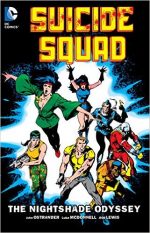
Suicide Squad volume 2: The Nightshade Odyssey


By John Ostrander, Keith Giffen, J. M. DeMatteis, Paul Kupperberg, Robert Greenberger, Luke McDonnell, Erik Larsen, Rob Liefeld & various (DC Comics)
ISBN: 978-1-4012-5833-7

In 1986, mega-monster continuity reboot Crisis on Infinite Earths led to DC Comics overwriting fifty years of continuity and revamping their major properties. The massive spring-cleaning exercise led to a swarm of boldly innovative titles and a fresh look at how comicbooks could be done.

One of the most unconventional – despite crossing genres and having roots leading back to the very dawn of the Silver Age – was Suicide Squad by John Ostrander and artist Luke McDonnell.

Previously during a psychological attack on the very concept of heroism (as seen in the miniseries Legends and its many tie-ins and crossovers) President Ronald Reagan outlawed costumed crimebusters and sanctioned an ultra-covert governmental black-bag operation to press super-powered criminals into (secret) service…

John Ostrander was new to DC; lured with Editor Mike Gold from Chicago’s First Comics where their work on Starslayer, Munden’s Bar and especially Grimjack had made those independent minnows some of the most popular series of the decade. Spinning out of Legends, Ostrander hit the ground running with a superbly compelling reinterpretation of the long-neglected Suicide Squad: a boldly controversial revaluation of meta-humanity and the role of government in a world far more dangerous than the placid public believed…

As originally conceived by Robert Kanigher, the Suicide Squad first saw action in The War that Time Forgot (Star Spangled War Stories #90, April-May 1960). Paratroops and tanks of “Question Mark Patrol” dropped onto Mystery Island from whence no American soldiers ever returned. The crack warriors discovered why when the operation was overrun by dinosaurs and worse…

Re-imagined for The Brave and the Bold #25 (September 1959) as a quartet of combat specialists, Colonel Rick Flag, medic Karin Grace plus boffins Hugh Evans and Jess Price were officially convened as Suicide Squad/Task Force X by the US government to investigate uncanny mysteries and tackle unnatural threats.

The gung ho gang (another Kanigher, Andru & Esposito invention) appeared in six issues but never really caught the public’s attention – perhaps because they weren’t costumed heroes – and quickly faded from memory.

Then, in April 1967 Our Fighting Forces #106 began the exploits of homicide detective Ben Hunter; recruited by the army during WWII to run roughshod over a penal battalion of prisoners who had grievously broken regulations.

Facing imprisonment or execution, the individually lethal military malcontents were given a chance to earn a pardon by undertaking missions deemed too tough or hopeless for proper soldiers. Hunter’s Hellcats – inarguably “inspired” by the movie The Dirty Dozen – ran until December 1969, in increasingly nasty and occasionally fatal sorties, before being replaced without fanfare or preamble by The Losers and similarly lost to posterity.

Ostrander tied together all these disparate strands and linked obscure comics events to provide a shocking secret history of America: a time when superheroes were forced into retirement after World War II with the military and Task Force X used to (unobtrusively) take out the monsters, spies, aliens and super-criminals who didn’t conveniently pack up with them.

Now substituting super-villains for simple criminals, history was made…

This second collection was designed to tie-in to both the TV and movie incarnations of the Suicide Squad. Reprinting Suicide Squad #9-16, plus a crossover from Justice League International #13, material from Secret Origins #28 and team-up one-shot Doom Patrol/Suicide Squad #1(spanning January-August 1988) – it resumes the story of strident political insider Amanda Waller who convinced President Reagan to sponsor her scheme to make bad guys do good deeds.

He agreed, but only as long as he had complete deniability…

Waller didn’t want society to depend on capricious super do-gooders and recruited Flag’s damaged, driven son to run a new penal battalion working “off the books”, using state-sanctioned metahuman force for the greater good. Knowing criminals can’t be trusted, her devious set-up involves not just bribery – reduced sentences, financial favours and pardons – but coercion.

Field missions are led by traumatised, obsessively patriotic Flag Jr., assisted by amnesiac martial artist Bronze Tiger who ensures everybody stays honest and on-mission. Convict-operatives are picked as necessity demands, but some operatives are in regular use, such as Deadshot, Captain Boomerang and schizophrenic sorceress Enchantress. They are, however, wired with remote-detonation explosive devices just in case…

Backed by a support team which includes Flag’s former lover Karin Grace and Briscoe, a bizarre mystery pilot who has a rather unusual relationship with his seemingly sentient helicopter gunship, the ever-fluctuating team seem ready for anything…

The stories here come from a period when publishers were first developing the marketing strategies of the “Braided Mega-Crossover Event.” This hard-on-the-pockets innovation dictated really big stories involving every publication in a company’s output, for a limited time period – so a compilation like this perforce includes adventures that seem confusing because they are essentially “middles” with no beginnings or endings.

In this instance the unfolding epic is Millennium which saw writer Steve Englehart expand on an iconic tale from Justice League of America #140-141 as well as his run on the Green Lantern Corps…

Billions of years ago the robotic peacekeepers called Manhunters rebelled against their creators. The immortal Guardians of the Universe desired a rational, emotionless cosmos – a view challenged by their own women. The Zamarons eventually abandoned the Guardians at the inception of the grand scheme, but after eons apart the two factions finally reconciled and left our reality together.

Here and now they have returned with a plan to midwife a new race of immortals on Earth, but the mechanoid Manhunters – who had in the meantime infiltrated all aspects of every society throughout the cosmos – resolved to thwart the plan, whether by seduction, connivance or just plain brute force.

The heroes of Earth gathered to protect the project and confront the Manhunters in their own private lives… and their own comics…

Thus Suicide Squad #9 (by Ostrander, Luke McDonnell & Bob Lewis) sees a team assembled to destroy a Manhunter Temple deep in the Louisiana swamps surrounding the team’s secret Belle Reve base. However, as they battle their way in with a monolithic bomb – despite interference from Captain Atom, Firestorm and too-good-to-be-true reformed Manhunter Mark Shaw – Flag discovers the person he most trusted is a Manhunter mole…

An unlikely hero then pays ‘The Final Price’ to complete the mission before, unconventionally, the squad pick up a new recruit in the bellicose form of mystery warrior Duchess just as they flee the cataclysmic results of their latest covert triumph…

As counsellor/chaplain Reverend Cramer sets up shop in Belle Reve, a grievous security breach occupies Waller’s attention. Somehow Batman has penetrated the top-secret project and indignantly announces that he will expose the whole sordid show.

When neither Flag nor the squad are able to stop the Dark Knight, Amanda finds a unique way to make the intransigent hero back down in ‘Up Against the Wall’…

More politically astute action unfolds in ‘Red Pawn’ (plotted by Ostrander, scripted by Paul Kupperberg with art by Erik Larsen & Lewis from Doom Patrol/Suicide Squad #1) as reactionary right-wing hero Hawk is captured whilst running guns to anti-communist Contras in Nicaragua.

His plight quickly becomes the focus of a humiliating media circus, and, still smarting from his last press roasting for such illicit activities, Reagan orders Waller to rescue or kill the wayward freedom fighter.

Typically, this move angers the NSA advisors of the Leader of the Free World, who take matters into their own hands to fatally embarrass “the Wall” by inveigling recent Soviet defector Valentina Vostok to deploy her comrades in the Doom Patrol to save the tragic, well-meaning patriotic Hawk from the evil Sandanistas…

Already shaping up as a SNAFU of biblical proportions, neither American faction is aware that rival cabals in reformist Russian Premier Mikhail Gorbachev‘s vast espionage apparatus are also implementing their own undercutting agendas…

Soon the entire country is at war as the Squad battle the undercover Doom Patrol (Celsius, Robotman, Negative Woman and Tempest) until a brigade of armoured Rocket Reds invades the nation. With uncontrolled destruction at maximum, the pointless clash escalates even further as a fourth force comprising Soviet super-soldier Stalnoivolk and KGB master schemer Major Zastrow work their own malignant way towards an acceptable solution to restore the status quo …

Barely surviving the political fallout, Waller’s Wonders are next deployed to destroy a drug-cartel in Suicide Squad #11 as ex-Justice Leaguer Vixen seeks vengeance after her friends are gunned down during a smuggling operation. ‘Blood and Snow Part One’ sees her volunteer for the penal team which is starting to feel the pressure of its own success.

Flag is on the edge of a breakdown and nobody has noticed that incorrigible felon Boomerang is impersonating another super-villain to rob banks in his spare time…

With no time to assess and her best assets still in Nicaragua, Waller assembles a team heavy with government-affiliated heroes such as Black Orchid, Nightshade and Speedy to augment remaining regular players Captain Boomerang, Enchantress and Briscoe. With great misgivings she tasks them with infiltrating the inner circle of Medellin Cartel boss Xavier Cujo to destroy his jungle fortress and vast stores of cocaine.

None of them are particularly bothered by the fact that this is an official assassination mission…

Naturally, the plan is perfect up until the moment it begins and soon the undercover stalwarts are battling for their lives in the blistering conclusion ‘Blood and Snow Part Two’. In the ghastly aftermath, however, Vixen no longer counts herself as a hero of any description…

A crucial crossover began in Justice League International #13. ‘Collision Course’ (inked by Al Gordon, drawn by Keith Giffen and co-written with partner in comedic crime J. M. DeMatteis) revealed how US agent and Suicide Squad point-man Nemesis was being tortured in a Soviet jail: a fact proudly leaked by the State’s media…

He had languished there ever since Waller abandoned him at the end of a disastrous attempt to rescue Russian dissenter Zoya Trigorin, but when Batman learns his old ally is a political prisoner he determines to break him out with or without the help of his JLI associates…

At Belle Reve, Flag – unable to convince The Wall (who is being stonewalled by Reagan) that something must be done – has begun his own illegal attempt to free the American hostage. However, once again unseen Soviet machinations are in play and an ambitious plotter has gulled Russian hero Starfire to inject himself into the growing crisis to bait a devious trap…

Flag’s team then stumbles into and brutally clashes with Batman’s Leaguers who are eventually forced into the uncomfortable position of having to – at least ostensibly – fight to keep Nemesis in Russian custody as ‘Battle Lines’ (Suicide Squad #13 by Ostrander, McDonnell & Lewis) are drawn. With violence peaking everybody gets a grim lesson in superpower Realpolitik before a solution is found…

Dimension-hopping super-agent Nightshade has been working for the Suicide Squad in return for the promise of assistance in a personal task. Secret Origins #28 revealed her hidden history in ‘A Princess’ Story’ (Robert Greenberger, Rob Liefeld & Lewis), detailing how little Eve Eden escaped from her own arcane realm after it was conquered by a marauding mystic entity dubbed the Incubus, leaving her brother behind…

All her life she has trained; as a spy, a superhero and a warrior, readying herself for the moment when she would return to save her sibling and liberate her homeland…

These revelations lead into the eponymous story arc ‘Nightshade Odyssey’ which opens with the moment Waller always dreaded. A criminally corrupt senator has discovered the facts of the Suicide Squad and threatens to destroy Reagan’s legacy unless the team is used to end investigations into his malfeasance and get him re-elected.

A man of resolute convictions, the President immediately caves and orders Waller to get it done…

With The Wall seemingly broken and contemplating resignation, the beleaguered director tells Nightshade to complete her personal mission immediately. With barely a pause for thought Nightshade, Boomerang, Bronze Tiger, Deadshot, Duchess, Enchantress and Vixen are ‘Slipping into Darkness’ to materialise in a place of malign horror concealing a trap decades in the making…

From the mouth of her eternally corrupted brother, Eve learns the truth of the situation, the mystic history of the universes and the Incubus’ diabolical connection to the Succubus force which possesses Enchantress. Then she hears their repellent plans for her…

However the satanic corruptor has never met a fighter like the enigmatic Duchess, who provides a ferocious and world-shaking distraction, allowing Eve to free her comrades and effect an uncontrolled escape from the hellish dimension leaving the ‘Devil to Pay’…

Sadly, the pell-mell exit dumps the fleeing fugitives into an otherworldly ‘Deathzone’ (Suicide Squad #13, inked by Malcolm Jones III) between universes where they are doomed to madness and worse, until rescued by a mysterious alien nomad calling himself Rac Shade.

Holding information of a long-extant alien incursion on Earth, “the Changing Man” makes the jump back to Belle Reve where Amanda Waller has come to a momentous decision…

To Be Continued

With covers by Jerry Bingham, Larsen & Lewis, Steve Leialoha & Gordon and Jim Valentino, Keith Wilson & William Messner-Loebs, this is a timeless collection of gritty gripping, hard-edged Fights ‘n’ Tights forays to delight action fans: a still magnificent mission statement for the DC Universe, offering witty cohesive and contemporary stories that appealed not just to superhero lovers but also devotees of spy and crime capers. As such they remain fine fodder for today’s so-sophisticated, informed and thrill-hungry readers.
© 1988, 2015 DC Comics. All Rights Reserved.