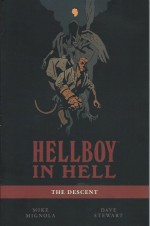
Hellboy in Hell: The Descent


By Mike Mignola with Dave Stewart (Dark Horse Books)
ISBN: 978-1-61655-444-6

Hellboy is a creature of vast depth and innate mystery; an apparently demonic baby summoned to Earth by Nazi occultists at the end of Word War II but subsequently reared by parapsychologist Professor Trevor “Broom” Bruttenholm to destroy unnatural threats and supernatural monsters as the lead agent for the Bureau for Paranormal Research and Defense.

After decades of unfailing, faithful service he became mortally tired and resigned. Itinerantly roaming the world, he still managed to encounter weird happenstances but could never escape trouble or his sense of duty.

After discovering he was the last in a line descended from Arthur Pendragon and Morgana le Fay – and therefore the Rightful King of England – he moved to the old country and died fighting a dragon…

After launching in 1993 Hellboy was swiftly attributed the status of ‘legend’ in the comics world, starting as the particular vision of a single creator and, by judicious selection of assistants and deputies, cementing a solid hold on the character in the hearts of the public.

And that’s just how it worked for Superman, Batman and Spider-Man…

Since the initial run of tales many creators have contributed to the arcane canon but at the end of 2012 Mignola assumed complete creative control once more for an ongoing – if irregularly – released series entitled Hellboy in Hell.

This initial compilation of those superb comics yarns gathers the first four-issue story arc and the beguiling notional one-shot The Three Gold Whips, which followed it.

The final fall from grace begins with ‘The Baba Yaga’ as the regal hero plunges into The Pit, willingly followed by an enigmatic robed figure. As the shade tells the ever-watching witch queen Baba Yaga, he believes he still has a chance to rescue and redeem the hell-bound hero…

Falling through a region of unspeakable horror and colossal monsters, Hellboy is saved from imminent consumption by the cloaked shade who reveals that he has stores of great mystic power and an intimate knowledge of the Nether Realms. He is even effective against furious Eligos, an old enemy of the B.R.P.D. agent who has been waiting a long time to take revenge for his earthly defeat at Hellboy’s mismatched hands…

The underworld is filled with appalling perils, dark wonders and unfolding vignettes or playlets where sinners endlessly relive the turning points of their lives, but it also holds the answers to the many mysteries of the dead hero’s life. Here a ghost warns him that he will be “haunted by three spirits”…

The journey continues in ‘Pandemonium’ as Hellboy and the shade explore the now abandoned City of Demons, utterly deserted except for the dolorous figure of Satan – Hellboy’s father. They are joined by a devilish guide who provides many answers to the questions that have plagued the hero all his life… when he was alive…

The tempter – his infernal uncle – also offers Hellboy another chance at grasping ultimate power before showing him the tortures being inflicted upon his human witch mother and revealing his own connection and identity in ‘Family Ties’…

The truth about Hellboy’s birth, the mighty magic stone right hand he wears and the fate that befell Hell after he was born is told and the lost boy meets his older brothers Gamon and Lusk, who act as brothers always do when told they aren’t the favourite one…

The family squabble escalates and is only ended by an even more terrifying horror…

In the aftermath Hellboy converses with a minor imp who tells him Hell is almost empty. All the grand Dukes and Generals and Princes are dead or gone, leaving a mere blue collar kind of devil in situ. It also reveals that someone has murdered Satan in Pandemonium, sparking a wave of unwelcome memories in Hellboy…

The first travail concludes with ‘Death Riding an Elephant’ as, in the cold and silent abyss, the redemptive revenant returns and at last introduces himself as former Victorian ghostbreaker and psychic detective Sir Edward Grey (the star of another series of Mignola macabre adventures), disclosing a few salient, if unpalatable, facts about Satan’s murder and the truth of his own current unholy situation…

Mignola is a sublime and canny raconteur and seamlessly combines tales where his star is the full focus of the action and alternately little more than a guide or witness to unfolding events. The latter is very much the case with ‘The Three Gold Whips’ which sees Hellboy wandering the deserted byways of the underworld and encountering an unquiet spirit who relates his own tale of a deal with a devil.

Once upon a time Captain Dulot and two soldierly comrades deserted Napoleon’s army and made a pact with a fiend: Seven years of living life like kings plus a whip each that, when cracked, would create a never-ending supply of gold coins. He even gave them an “out”: a means by which they could escape their fate once the seven years were up.

However, when a devil is generous, that’s the time to truly beware…

And so now, ever-helpful Hellboy offers to assist the damned fool…

This superbly absorbing, chilling chronicle also comes with a treasure trove of extras beginning with a graphic faux biography of ‘Walter Edmond Heap’ (a significant figure in the origins of Death Riding an Elphant), an extensive – 19 page – Hellboy Sketchbook section with annotations and commentary by Mignola and a glorious covers-&-variants gallery section.

Hellboy is classic of modern comics creation who has never provided anything but first rate entertainment value for fans. If you’re not one of them yet, this book will certainly change your stubborn mind…
™ & © 2012, 2013, 2014 Mike Mignola.

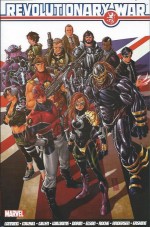
Revolutionary War


By Alan Cowsill, Andy Lanning, Kieron Gillen, Rob Williams, Glenn Dakin, Richard Elson, Dietrich Smith, Nick Roche, Brent Eric Anderson, Ronan Cliquet de Oliveira, Gary Erskine & Thomas Palmer (Marvel/Panini UK)
ISBN: 978-1-84653-598-7

Marvel UK set up shop in 1972, reprinting the company’s earliest US successes in the traditional British weekly format, and quickly carved out a solid slice of the market – even though the works of Lee, Kirby, Ditko et al had already been appearing in other British comics (Smash!, Wham!, Pow!, Eagle, Fantastic!, Terrific!) for years.

The characters and stories had also been seen in paperbacks, Christmas Annuals and the ubiquitous anthologies of Alan Class Publications (which re-packaged a mesmerising plethora of American comics from Marvel, Charlton, Tower, Archie/Radio Comics and ACG amongst others in comforting, cheap black and white) as well as in the their original imported form since their inception thanks to the aggressive marketing and licensing policies of Stan and the gang.

In 1976 Marvel decided to augment their output with an original British hero in a new weekly – albeit in that parochial, US style and manner so well-beloved by English comics readers. Yes, that was sarcasm…

Although the new title included Fantastic Four and Nick Fury, Agent of S.H.I.E.L.D. reprints to fill out the issues, one bold departure was the addition of full colour printing up front for the new hero, and the equivalent back quarter of each issue. Captain Britain Weekly lasted 39 weeks before being absorbed into the far more popular Super-Spiderman title…

He later returned in new material in Hulk Weekly – guest-starring in Arthurian fantasy strip the Black Knight. Other original material included British-created Hulk stories based on the TV show, new Nick Fury stories and a stunning period noir crimebuster named Night Raven…

In 1979 Marvel UK – still primarily a reprint arm for the American parent company – started to stretch itself. Besides new material generated for Hulk Comic and licensed titles such as Transformers, My Little Pony and Dr Who Weekly/Monthly and many others, the lads and lasses were ready to produce US-style full comic books.

The world was a rapidly changing place in the 1980s and fledgling offshoot Marvel UK was (critically at least) rising high, thanks to an immensely impressive run of original Captain Britain material being created by Dave Thorpe, Alan Davis and Alan Moore.

Yet rather than dive in with full-blown costumed cut-ups like the still commercially disappointing Flag-clad hero, they wisely looked for a premise that would also resonate with established comics tastes. Thus was born The Dragon’s Teeth (which due to an unforgiving Intellectual Rights clash became Dragon’s Claws). On a roll, the company then attempted to expand its line with creator-owned sci-fi detective spoof The Sleeze Brothers and an ongoing title once more combining Arthurian fantasy with tried and true Marvel action.

Or so everybody thought…

Knights of Pendragon prominently featured Captain Britain on the covers but the epic tale which unfolded over the following months was far more a supernatural horror story (in the manner of prophetic TV show “Doomwatch”) than traditional Fights ‘n’ Tights slugfests – even by the often outré British standards.

Steeped in ecological hot-button topics, it starred, initially at least, a podgy, over-the-hill Welsh copper who had begun life as an authoritarian gadfly before becoming a solid, stolid comrade to Brian Braddock (Cap’s aristocratic alter ego).

KoP followed Chief Inspector Dai Thomas as he seemingly went off the deep end, plagued by horrific premonitions of grisly massacres all seemingly linked to environmental crimes perpetrated by globe-girdling conglomerate the Omni Corporation. However as the months passed a pattern slowly unfolded that indicated something far older and more dangerous than money was flexing long dormant fangs and sinews…

The publishing floodgates opened and from 1992-1994 the British annexe generated a vast number of ongoing titles and miniseries (nearly 40), many with big-name American guest-stars to goose the interest of fans.

Underpinning the entire line was a sinister cabal of undying wizards who were trading stolen souls to the demonic Mephisto in return for continued life and power. As the overweening Mys-Tech Corporation they had been feeding the beast for a thousand years and were now trying to find ways to get out of their Faustian pact without paying the horrific penalty clause which increasingly brought them into conflict with superheroes, assorted villains and dangerous folk a lot harder to pigeonhole…

For a brief period the UK titles were a meteoric success in the USA, regularly outselling the competition but also – crucially – Marvel’s American output. At the height of a speculator-fed comics boom, the House of Ideas unceremoniously pulled the plug on the British invasion during the fast-approaching climax of the Mys-Tech saga and hunkered down for bad times to come.

Due to poor sales and the junk bond manipulations of Marvel’s new owner Ron Perelman/Andrews Group, Marvel filed for Chapter 11 Bankruptcy Protection at the end of 1996.

They got out and got better…

At the beginning of 2014 the twentieth anniversary of those heady days when the UK’s angelic upstarts outsold their parent company – and everybody else – was celebrated with a semi-reunion and wrapping up exercise in the form of a stylish mini-event. That interlinked tale, as seen in thematic bookends Revolutionary War: Alpha #1 and Omega#1, bracketing the Revolutionary War prefixed one-shots Dark Angel, Knights of Pendragon, Death’s Head II, Supersoldiers, Motor-Mouth and Warheads (all released between January and March), is now available in a single wondrous – and, if you’re a Brit, nostalgia-evoking – tome which combines the best of the old with the thrill of the new…

Before the unfinished symphony resumes writer/editor Alan Cowsill supplies all the background and narrative colour you could possibly want in ‘Unfinished Business’ after which the heady (re)introductions commence in Revolutionary War: Alpha #1 ‘Tramp The Dirt Down’ by Cowsill, Andy Lanning & Richard Elson…

A Crossrail Extension excavation beneath Canary Wharf brings Captain Britain and MI-13 operative Peter Wisdom into conflict with Mys-Tech’s demonic Psycho-Wraiths unearthed during the digging.

The monstrous myrmidons haven’t been seen since the Battle of London Bridge when a motley collection of super-powered individuals became unlikely allies to finally finish off the fiendish world-wrecking cabal. Of course these days nobody – including the mutant superspy – seems able to remember that horrific clash at all…

Now with this new eldritch eruption Wisdom discovers that the “bloody Yanks” of S.H.I.E.L.D. have been keeping secrets – as well as most of the wizards’ confiscated weaponry and artefacts – and are only now sharing the fact that old Mys-Tech bases and enclaves are suddenly waking up all over Britain…

With unknown forces in motion, Nick Fury and British opposite number Commodore Lance Hunter want Wisdom and the Captain to seek out the survivors of that forgotten Armageddon: especially the turncoat mercenary who betrayed the cabal who employed him to save the world at the cost of all he held dear…

The years have not been kind to Colonel Liger. It took years of drinking to drown the memories of the moment all his comrades and innocent child super-warrior Killpower were sucked into Hell, sealing a breach to the Inferno with their bodies and souls, and he’s not happy to be picked up, unwillingly detoxed and dumped into the fire again.

The only consolation is that he’s reunited at last with his sentient alien supergun Clementine, but even that dubiously unwholesome reunion is soured when the cabal’s long-dormant global prognosticator the UnEarth Chasm flares into arcane life, predicting doom and destruction for a select band of his fellow long-scattered survivors… and the entire planet…

Soon after, as Captain Britain rushes to warn one of the depicted endangered paladins, he is treacherously ambushed by another of them…

The tale continues in Revolutionary War: Dark Angel where Kieron Gillen & Dietrich Smith focus on Shevaun Haldane whose father was once a Mys-Tech mover-&-shaker whose evil she swore to amend and atone for. Now however she is stuck paying off his karmic debt to Mephisto. She is also close friends with Captain Britain and when he is abducted she sets out to save him. Instead she interrupts another Psycho-Wraith incursion which leaves her ‘Girlfriend in a Coma’ and stupidly agrees to accept assistance from that selfsame satanic loan shark who doomed her dad…

The epic revival resumes in Revolutionary War: Knights of Pendragon (Rob Williams & Simon Coleby), where former mystical avatars Dai Thomas and Kate McClellan travel to the Lake District. Their investigation into an Omni Corporation fracking operation uncovers an attempt to mystically taint and suborn the heart of the nation…

Wisdom meanwhile has joined with Union Jack – another ex-Pendragon knight – and translated to the realm of Avalon only to find the totemic Green Knight overrun by evil growths. They are just in time to witness England’s WWI Superman Albion awaken from a daytime TV-induced stupor and rush them all to Earth where Kate and Dai have unleashed the corrupted, voracious Zombie King Arthur and his Zombie Knights of the Zombie Round Table…

With the land imperilled by a corrupted prophecy, the assorted Pendragons are re-empowered to stop them in ‘Swords of a Thousand Men’ but it’s Wisdom’s 21st century cynicism and nous that really save the day…

Marvel UK had very few long-term successes in its decades as a semi-autonomous company, but the time-travelling robotic bounty hunter – sorry, free-lance peace-keeping agent – Death’s Head was certainly one of their most eccentric and long-lasting main contenders.

Starting out as a bit player in Transformers and Dr. Who he graduated to his own short-lived series and a number of guest shots in American titles like Fantastic Four.

In 1991 he was drastically retooled when AIM savant Dr. Evelyn Necker created the Minion warbot. Minion was sent through time and space to kill and absorb more than a hundred of the universe’s greatest killers – including Death’s Head – but after the murder machine succeeded the bounty hunter’s personality took over his killer’s perfect body…

Now in ‘Synchronicity II’ (Lanning, Cowsill & Nick Roche from Revolutionary War: Death’s Head II), the autonomous amalgam is betrayed by Mys-Tech after carrying out a profitable commission for them.

Targeted by an army of Psycho-Wraiths, he is only saved after sidekick Tuck hires the original Death’s Head from the depths of the time-stream to go save him…

Revolutionary War: Supersoldiers then reveals how the top secret warriors designed to be Britain’s Captain America are handling being put out to pasture. ‘Stop the Cavalry’ (by Williams, Brent Anderson & Tom Palmer) finds Hauer, Guvnor, Dalton and Gog in a small Scottish village watching a biopic of their careers being filmed.

Watching idiots bowdlerise their reputations is so awful they’re almost glad when Wisdom turns up with a warning of real action in store, but when a legion of Psycho-Wraiths begin slaughtering the locals they barely have time to regret their rash dream of one last glorious battle…

The emotional core of the saga comes in Revolutionary War: Motormouth (by Glen Dakin & Ronan Cliquet de Oliveira) which reveals how reality and two kids caught up with the most free-spirited and anarchic of the old anti Mys-Tech brigade.

Although Harley Davis is stuck in poverty on a council estate and crushed by guilt over the fate of simpleminded partner Killpower, she is not beyond the reach of the rampant Psycho-Wraiths.

Unfortunately for them, though, she kept some of the tools and weapons picked up from every corner of time and space and still has a few friends who are a bit handy with their fists (knives, guns, baseball bats, ray blasters etc etc)…

Liger stars in Revolutionary War: Warheads (Lanning, Cowsill & Gary Erskine) as the true story of that last battle emerges and Dai Thomas gets an inkling that not all the bad guys are on Mys-Tech’s side. Even though a traitor is exposed and the true scheme revealed, it’s too late and the entire Earth is overrun by demonic horrors.

As every superhero everywhere engages in a furious holding action, the tattered remnants of the British brigade of champions unites to battle one of their own and all the hordes of Hell in Revolutionary War: Omega#1 (Lanning, Cowsill & Elson) in a burning place where there are ‘No More Heroes’…

This engaging epistle also includes a host of covers-&-variants by Mark Brooks, Barry Kitson, Salvador Larroca, Neil Edwards, Liam Sharp, Dave Gibbons, Declan Shalvey, Erskine and Jamie McKelvie, a ‘Behind the Scenes’ glimpse at the original series proposal, page after page of original art, pencils, roughs, character designs and sketches plus incisive afterthoughts from Dakin and Gillen in ‘The Final Word’.

Grim, explosively action-packed, slyly sardonic and deliciously satirically tongue-in-cheek, Revolutionary War is a delight for old-timers that will spark a lot of interest from neophyte readers in search of a different take on Fights ‘n’ Tights adventure.
™ & © 2014 Marvel & Subs. Licensed by Marvel Characters B.V. through Panini S.p.A. All rights reserved. A British Edition published by Panini Publishing, a division of Panini UK, Ltd.

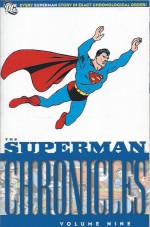
Superman Chronicles volume 9


By Jerry Siegel & Joe Shuster, John Sikela, Leo Nowak, Ed Dobrotka & Fred Ray (DC Comics)
ISBN: 978-1-4012-3122-4

I sometimes think – like many others I know – that superhero comics were never more apt or effective than when they were whole-heartedly combating global fascism with explosive, improbable excitement courtesy of a myriad of mysterious, masked marvel men.

All the most evocatively visceral moments of the genre seem to come when gaudy gladiators soundly thrashed – and I hope you’ll please forgive the offensive contemporary colloquialism – “Nips and Nazis”.  However, even in those long-ago dark days, comics creators were wise enough to offset their tales of espionage and imminent invasion with a barrage of home-grown threats and gentler or even more whimsical four-colour fare…

This ninth astounding Superman compendium – collecting #16-17 of his solo title, his adventures from flagship anthology Action Comics #48-52 and an episode from World’s Finest Comics #6 (encompassing May to September 1942) – sees the World’s Premier Superhero predominant at the height of those war years: an indomitable Man of Tomorrow who was always a thrilling, vibrant, vital role-model and whose sensational exploits spawned a host of imitators, a genre and an industry.

Behind the stunning covers by Fred Ray – depicting Superman trouncing scurrilous Axis War-mongers and reminding readers what we were all fighting for – scripter Jerry Siegel was producing some of the best stories of his career, showing the Action Ace in all his morale-boosting glory; thrashing thugs, spies and masters of bad science whilst America kicked the Axis fascists in the pants…

Co-creator Joe Shuster, although plagued by punishing deadlines for the Superman newspaper strip and his rapidly failing eyesight, was still fully involved in the process, overseeing the stories and drawing character faces whenever possible, but as the months passed the talent pool of the “Superman Studio” increasingly took the lead in the comicbooks as the demands of the media superstar grew and grew.

Thus most of the stories in this volume were drawn by John Sikela with occasional support from others…

The magic begins with ‘The Merchant of Murder!’ from Action Comics #48 which saw the hero toppling an insidious gang of killers led by The Top who used wartime restrictions to sell used cars with deadly faults and defects until reporter Lois Lane – and her titanic leg-man – got involved…

Sikela also flew solo on all of Superman #16, beginning with ‘The World’s Meanest Man’ as the Caped Kryptonian crushed a mobster attempting to plunder a social program to give deprived slum-kids a holiday in the countryside, before moving on to battle an astrologer prepared to murder his clients to prove his predictions in ‘Terror from the Stars’.

‘The Case of the Runaway Skyscrapers’ pitted the Metropolis Marvel against Mister Sinister, a trans-dimensional tyrant who could make buildings vanish, after which the power-packed perilous periodical concluded with a deeply satisfying and classic campaign against organised crime as Superman crushed the ‘Racket on Delivery’.

Action Comics #49 then introduced The Puzzler;a despicable, deadly and obsessive criminal maniac who was hated losing and never played fair in ‘The Wizard of Chance’ (inked by Ed Dobrotka).

The debut of Superman had propelled National Comics to the forefront of their fledgling industry and in 1939 the company collaborated with the organisers of the New York World’s Fair: producing a commemorative comicbook celebrating the opening. The Man of Tomorrow prominently featured on the appropriately titled New York World’s Fair Comics beside such four-colour stars as Zatara, Gingersnap and The Sandman.

He starred again a year later in the second issue with the newly launched Batman and Robin team in another epochal mass-market premium – Worlds Fair 1940. The spectacular card-cover 96 page anthologies were a huge hit and convinced National’s owner and editors that such an over-sized package of their pantheon of characters, with Superman and Batman prominently featured, would be a worthwhile proposition.

The bountiful format was retained for a wholly company-owned quarterly which retailed for the then-hefty price of 15¢. Launching as World’s Best Comics #1 (Spring 1941), the book transformed into World’s Finest Comics from #2, beginning a stellar 45 year run which only ended as part of the massive decluttering exercise that was Crisis on Infinite Earths.

From issue #6 (Summer 1942) ‘The Man of Steel vs. the Man of Metal’ by Siegel, Leo Nowak & Sikela pits our hero and newsboy Jimmy Olsen against Metalo, a mad scientist whose discoveries made him every inch Superman’s physical match…

Back in Action Comics #50, Clark Kent and Lois were despatched to Florida to scope out sporting skulduggery in ‘Play Ball!’ a light-hearted baseball tale illustrated by Nowak & Ed Dobrotka.

Superman #17 asked ‘Man or Superman?’ (illustrated by Shuster & Sikela), wherein Loisfirst began to put snippets of evidence together, at last sensing that klutzy Clark Kent might be hiding a Super-secret even as the subject of her researches tangled with sinister saboteur The Talon. Following that, ‘The Human Bomb’ (art by Nowak) saw a criminal hypnotist turn innocent citizens into walking landmines until the tireless Action Ace scotched his wicked racket.

Sikela handled the last two tales in the issue beginning with ‘Muscles for Sale!’ in which Superman’s Fortress of Solitude and Trophy Room debuted and the Man of Steel battled another mad mesmerist who turned ordinary men into dangerously overconfident louts, bullies and thieves, whilst ‘When Titans Clash!‘ offered a frantic and spectacular duel of wits and incredible super-strength when Luthor regained the mystic Power Stone and became Superman’s physical – but never intellectual – master …

Action Comics #51 then introduced the canny faux-madness of practical-joking homicidal bandit The Prankster in the rollercoaster romp ‘The Case of the Crimeless Crimes’ and this cavalcade of comics creativity and glorious indulgence concludes with the ‘The Emperor of America!’ from Action Comics #52, wherein an invading army were welcomed with open arms by all Americans except the indignantly suspicious Man of Steel who single-handedly liberated the nation in a blistering, rousing call-to-arms classic…

As the war progressed the raw passion and sly wit of Siegel’s stories and the rip-roaring energy of Shuster and his team were galvanised by the parlous state of the planet and Superman simply became better and more flamboyant to deal with it all.

His startling abilities and take-charge, can-do attitude won the hearts of the public at home and he was embraced as a patriotic tonic for the troops across the war-torn world.

The rise was meteoric, inexorable and unprecedented. He was the indisputable star of Action, World’s Finest Comics and his own dedicated title whilst a daily newspaper strip (begun on 16th January 1939, with a separate Sunday strip following from 5th November of that year) garnered millions of new fans.

A thrice-weekly radio serial had been running since February 12th 1940 and, with a movie cartoon series, games, toys, apparel and a growing international media presence, Superman was swiftly becoming the entire Earth’s hero…

Although the gaudy burlesque of evil aliens, marauding monsters and slick super-villains still lay years ahead of our hero, these captivating tales of villainy, criminality, corruption and disaster are just as engrossing and speak powerfully of the tenor of the times, and are all dealt with in a direct and captivating manner by our relentlessly entertaining champion in summarily swift and decisive fashion.

No “To Be Continueds” here!

As fresh, thrilling and compelling now as they ever were, these endlessly re-readable epics are perfectly presented in these glorious paperback collections where the graphic magic defined what being a Super Hero means and concocted the basic iconography of the genre for all others to follow.

Such Golden Age tales are priceless enjoyment at an absurdly affordable price and in a durable, comfortingly approachable format. What dedicated comics fan could possibly resist them?
© 1942, 2011 DC Comics. All Rights Reserved.

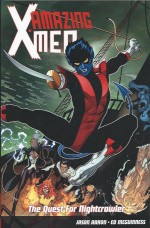
Amazing X-Men: The Quest for Nightcrawler


By Jason Aaron, Ed McGuinness, Cameron Stuart & Dexter Vines (Marvel/Panini UK)
ISBN: 978-1-84653-591-8

Amidst all the constant existential angst and apocalyptic Stürm und Drang of the average X-Men saga over the years, there was still the occasional moment of lighter-hearted, boldly dashing, fun-filled exuberant derring-do – and it generally gravitated towards or sprang from the general vicinity of German swashbuckler Kurt Wagner: Nightcrawler.

However even he eventually succumbed to the bleak tone of the times and, after increasingly dark dire deeds, he died in the X-Event Second Coming.

Now after the team’s dalliances with doppelgangers and alternate Earth iterations, the original and genuine article has returned for the first story-arc of new ongoing title Amazing X-Men. Collecting the first six issues (cover-dated January-May 2014), this metaphysical merry-go-round of magic and mutant mayhem by Jason Aaron & Ed McGuiness (aided and abetted by Cameron Stewart and Dexter Vines) opens in Heaven, where the devout, deceased Christian mutant is strangely listless and ill-at-ease.

He perks up, however, when a quartet of demon pirates invade the Promised Land looking for souls to shanghai, and gives the invaders the sound thrashing they so richly deserve. The situation suddenly becomes seriously serious when his father appears.

Demon mutant Azazel had maintained his connection to Earth for millennia by mating with human women, but Kurt had always been the most disappointing of his progeny. Now the moribund mutant realises he would do anything to thwart his sinister sire’s schemes – including foregoing forever his hard-earned eternal rest…

On Earth The Jean Grey School for Higher Learning is “welcoming” its newest teacher. Angelica Jones (AKA Firestar) is already nervous about her job and terrified to be in the “Big Leagues” amongst the X-Men, but her first day too soon takes a giant step into pure weirdness when the Beast blazes by her, chasing teleporting imps – known as “Bamfs” – who have been stealing his technology. Now, by purloining his coffeemaker, they have finally gone too far…

Caught up in the chase, she is astonished to discover the little blue packrats have constructed a bizarre glowing portal in the basement. When Iceman, Angel, Northstar, Rachel Grey, Wolverine and Storm join her, the Beast and the Bamfs, they are all attacked by malicious red Bamfs and sucked through the gateway into the afterlife where Azazel is attempting to conquer the eternal realms in flying pirate galleons…

The journey has divided the team. Transported to the golden fields of Elysium, Wolverine and Northstar are soon boldly battling Azazel’s demonic buccaneers but Storm, Iceman and Firestar are having the devil’s own time surviving the very Pit of Hell they have materialised in…

The war in heaven is starting to go badly until the sprit of Charles Xavier turns up to offer some sage advice, sending Wolverine plunging from Paradise to find and save Nightcrawler, who is set on stopping his devilish daddy at any cost…

The Beast has meanwhile landed on Azazel’s flagship, far beyond the Realm of the Flesh, and found himself severely overmatched against the hellish hordes aboard. He looks to be doomed, as is Storm who has “escaped” onto another of the perfidious black freighters, but when the situation is at its most dire, in a crack of brimstone sound and fury, Nightcrawler arrives, sword swinging…

With Wolverine and Northstar now trapped in a frozen perdition whilst Firestar and Iceman languish in the Inferno, Kurt leads the missions to rescue them all and, whilst revealing the incredible truth about the perpetually proliferating Bamfs, finally takes the fight to his fiendish father.

The struggle takes everybody back to Earth but, by defeating the demon-lord and manifesting once more on the physical plane, has Nightcrawler forever lost his place in Heaven and locked the lethal, lascivious Lord of Lies in the land of the living?

Peppered with telling and trenchant flashbacks showing why Wagner was so beloved by his fellow X-Men, the dauntless drama concludes with ‘All in the Family’ (illustrated by Cameron Stewart) which sees the majority of the surviving X-Men – now split into warring ideological camps – turn up at Kurt’s Welcome Home party to pay their respects.

The only one missing is Nightcrawler himself, occupied as he is with confronting his malign mother (evil mutant Mystique) and subsequently spectacularly failing to prevent her breaking recently incarcerated Daddy Dearest out of super-villain jail…

This bright and breezy tale of light-hearted triumph and tragedy comes with a legion of covers-&-variants (15 actually) by McGuinness & Vines, Milo Manara, Moore, Kevin Nowlan, Dale Keown, Skottie Young and Salvador Larroca, and is one of the most enjoyable X-epics of recent years: a boundless buccaneering romp trading angst for boundless action and nihilistic gloom for thrills and frolics.

™ & © 2013, 2014 Marvel & Subs. Licensed by Marvel Characters B.V. through Panini S.p.A. All rights reserved. A British Edition published by Panini Publishing, a division of Panini UK, Ltd.
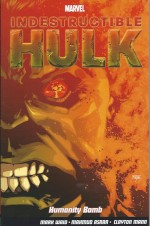
Indestructible Hulk volume 4: Humanity Bomb


By Mark Waid, Mahmud Asrar, Clayton Mann & various (Marvel/Panini UK)
ISBN: 978-1-84653-620-5

Once upon a time, Bruce Banner was merely a military scientist accidentally caught in a Gamma-bomb blast of his own devising. As a result, any undue stress could cause him to transform into a gigantic green monster of unimaginable strength and fury.

As both occasional hero and bombastic brute he rampaged across the landscape for decades, becoming one of comics’ most popular characters and most enduring multi-media titans.

Over the years he has undergone numerous radical changes in scope, character and format to keep his stories fresh and his exploits explosively compelling whilst the number of Gamma-galvanised grotesqueries crashing about the Marvel Universe has proliferated to inconceivable proportions.

The days of Bruce going green with anger at the drop of a hat are long gone, so anybody taking their cues from TV or movie incarnations would be wise to anticipate a smidgen of unavoidable confusion…

In a world of numerous Hulks, She-Hulks, Abominations and every kind of ancillary colour-swatched atomic berserker, the MarvelNOW! event saw the Jade Giant reinvented in a stripped-down, back-to-basics but startlingly original manner which energised new and old fans alike.

The big change in his fortunes occurred after S.H.I.E.L.D. Director Maria Hill was persuaded to provide perennial fugitive Banner with resources and funding in order to sanitise his devastated scientific reputation. In return Hill could call on the Hulk as a living weapon of last resort…

One of the smartest men on Earth, Banner had lost years of success, progress and peer renown whilst trying to cure himself of the Hulk. Concerned about his legacy, the fugitive genius had at last decided to make his future headlines as a scientist, not a shattering force of nature – for as long as he could possible manage – rather than fruitlessly seek to cure his affliction. Additionally, in return for S.H.I.E.L.D. science labs and trained assistants, the beleaguered boffin would give the spy agency first use of his discoveries and inventions…

This volume details the final days of this cataclysmic chapter in the ever-eventful life of Dr. Banner and his angry green alter ego (collecting Indestructible Hulk #16, 17.INH, 18.INH, 19.INH, 20 and Indestructible Hulk Annual #1, spanning January-March 2014) with scripter Mark Waid going out on a unforgettable high.

These days comics are all about the next Big Publishing Event and this latest Hulk collection capitalises on the tide of Inhumanity to bring this particular iteration to a spectacular climax …

During earlier mega-blockbuster Infinity, mad Titan Thanos invaded Earth and battled the Inhumans’ ruler Black Bolt to a standstill. As a last resort the embattled king released the Hidden People’s mutagenic Terrigen Mist into the atmosphere where it triggered mutation in millions, proving that human and Inhuman were not necessarily different races…

After being marooned in mystical ice-hell Jotunheim and then having to outwit Zarrko the Tomorrow Man and repair the fracturing time-stream, Banner and his team are way behind the greenly envious genius’ schedule to prove himself smarter than Reed Richards, Tony Stark, Hank Pym and all the other assorted big-brains who have outshone and pitied him over the years of his affliction…

Thus in ‘Humanity Bomb: Prelude’ (by Waid & Mahmud Asrar)Banner is prepared to go to extraordinary lengths to get back on track. After blackmailing the Military-Industrial complex for “black bag” funds, the inventor goes on a spree of tinkering only to be beaten to the patent office post over and over again by his oblivious intellectual rivals.

With his temper fraying, only calm, cool assistant Randall Jessup seems able to keep him from “Hulking Out”, so it’s with some relief that Banner hears of a rushed – and highly suspect – S.H.I.E.L.D. mission to an ancient Meso-American pyramid in Mexico where he can exorcise some pent-up frustration…

They only want Renewable Energy expert Jessup on-site, but Banner is not a man to take “no” for an answer anymore – which is lucky considering the original purpose of the monolith and the things waiting inside…

Indestructible Hulk Annual #1 then offers a look into Banner’s – and Tony Stark’s – boyhood via a ‘Journey into Science’ (Jeff Parker & Asrar) as Dr. Derenik Zadian – the charismatic but mercenary scientific genius who taught and then advised the two prodigies to go into weapons research – returns as a threat to the entire world. Iron Man and the Hulk must reluctantly invade the monster-stuffed island their renegade mentor is now literally part-and-parcel of…

‘Humanity Bomb’ (by Waid, Clay Mann, Seth Mann, Miguel Sepulveda, Jheremy Raapack, Tom Grummett, Joe Bennett, Karl Kesel, Ruy José, Andrew Hennessy & Scott Hanna) then opens as Stark and Pym meddle with Banner’s proposed solution for the still-propagating clouds of airborne Terrigen Mist…

Already under relentless, self-induced pressure to succeed, the unwelcome intervention stresses Banner, but not as much as the S.H.I.E.L.D. edict that his entire research team are to be held in “lock-down” since one of them has tested positive for the genes that react to Terrigen exposure…

Thus, when Iron Man, Giant-Man and The Beast arrive, insultingly demanding to check his work before proceeding, Banner goes ballistic. To be fair though, his quick fix is a bomb and everybody is painfully aware of how well his last radical radioactive explosive device turned out…

When the physicist goes green and crazy the assembled Avengers are unable to stop him stealing the bomb and escaping into the unsuspecting world…

The resulting chase and cataclysmic clash causes the bomb to detonate over Tulsa, Oklahoma with horrific and astounding results. In the aftermath the now pacified physicist’s solution is deconstructed and the reason for its failure to end the spread of “Terrigenesis” determined.

Banner is blithely unaware that his team have broken out of custody and flown after him. They are unaware that the cure hasn’t worked – until one of them suddenly turns into a monster that feeds on rage…

Inevitably the fresh new travesty of nature clashes spectacularly with the Hulk but, even after a seeming solution reverses the Terrigen transformation, the danger is not over. Elsewhere, maverick scientist Ted Goodrich has rebuilt and reactivated the rogue think tank dubbed The Enclave (which numbered growing the first artificial godling Him/Adam Warlock amongst its numerous wonders and breakthroughs) and has targeted Banner’s recently reverted aide…

That bombastic battle apparently goes the Good Guys’ way but after reporting back to Maria Hill one more shock and another impossible tragedy awaits the understandably at-the-end-of-his tether Bruce Banner…

Sporting a stack of AR icons (Marvel’s Augmented Reality App featuring printed portals to online story bonuses and extras for everyone who downloaded the free software from marvel.com onto a smart-phone or Android-enabled tablet) and a stunning cover gallery by Asrar & Dave McCaig, this sharp, action-packed and astonishingly compelling read offers a fun-filled, fury-fuelled shocking end to the epic which brilliantly mixes incredible adventure with clever characterisation and an addictive excess of furious Fights ‘n’ Tights action that no comics fan could possibly resist.

™ & © 2014 Marvel & Subs. Licensed by Marvel Characters B.V. through Panini S.p.A. All rights reserved. A British Edition published by Panini Publishing, a division of Panini UK, Ltd.
Violent Cases Hardcover


By Neil Gaiman & Dave McKean (Titan Books)
ISBN: 978-1-78329-360-5

Do you remember…?

Since its first release in 1987 Violent Cases has gone back into print many times, but regrettably remains a comics connoisseur’s secret. Now Titan Books have released a big, bold, lush and lavish commemorative oversized full-colour hardback (302 x 235mm), complete with extras culled from previous editions and new art material, in another sincere and sterling effort to give this tale the audience and acclaim it deserves.

There’s actually very little I feel happy saying about this enigmatic and compelling little teaser other than the basic facts. Too much detail or analysis will spoil the magic if you’ve never seen it – and if you have it’s probably not what you recall it being…

Initially published by the sorely missed publisher Escape – in association with Titan Books – in 1987, it marks the first collaboration of two then largely unknown creators who shared a more literary aspiration for comics than traditional newcomers to the craft, married to a novel approach and impassioned – if raw and hungry – storytelling talent.

It’s short, sweet, disturbing, utterly absorbing and probably impossible to translate into any other medium… and that is, of course, a Very Good Thing.

There’s this guy see, and he’s idly reminiscing about his childhood in the 1960s…

Years ago in Portsmouth a little lad hurt his arm rather badly whilst exchanging words about bedtime with his father. To fix the problem daddy took the 4-year old to see an osteopath. The elderly gentleman was an interesting fellow with an odd accent who told great yarns and mentioned that he had once treated somebody famous…

As the narrator tries to sort out the half-forgotten details – fragments of life and films and games congealed now with clearly conflated circumstances – the facts, fictions and shadily obscured and occulted misunderstandings concerning his perhaps difficult childhood, growing maturity and awareness and those hours with Al Capone’s bone-bender begin to emerge and coalesce… or do they?

Flickering back and forth, the narrative proffers a miasma of mixed memories and misapprehensions involving a memorably troubled old man, Mysterious Men in Dark Suits, a party, a scary magician, unexplained appearances and subsequent disappearances, unforgettable physical discomfort as a young arm was coaxed back into correctitude, tales of tailors and gangsters and Tommy Guns… which were always carried in Violent Cases…

Most of all it deals with unresolvable mysteries – because even the things we recall, we don’t always remember…

This entire book is all about stories, memories, perception, mis-perception and self-deception, painted by Dave McKean in a muted but cleverly targeted tonal colour-palette of blues, greys and browns, with splashes of electric vibrancy where appropriate (all reduced to straight monochrome for the very first edition, restored for those subsequent releases, and remastered here)…

This volume also includes Introductions by Paul Gravett, Alan Moore and the story’s author Neil Gaiman (from the 1997, 1987 and 1991 editions) as well as his Afterword from 2003, plus assorted covers and other art works by McKean and an illustrated Biographies section which is a marvel and joy to behold…

Despite being one of the key books in the 1980s’ war to prove that comics were an art form and valid mode of mature creative expression, Violent Cases remains a largely unknown artefact, seldom cropping up in the same discussions as contemporaries like A Contract With God, Maus, Watchmen, Love and Rockets, The Dark Knight Returns and V for Vendetta, let alone later acclaimed breakthroughs such as Ghost World, Black Hole, From Hell, Persepolis or even Sandman.

It is also an unforgettable pictorial memento mori – or is that topica tragoedia? – which beguiles and enchants, tests and subtly distresses in ways no lover of the comics medium could possibly resist.

If you haven’t read it, you must. If you have, read it again – it’s not at all what you remember…

™ & © 1987, 2003, 2013 Neil Gaiman & Dave McKean. All rights reserved. All other material © its respective author or creator.

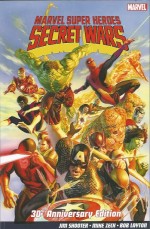
Marvel Super Heroes Secret Wars: 30th Anniversary Edition


By Jim Shooter, Mike Zeck, Bob Layton, John Beatty & various (Marvel/Panini UK)
ISBN: 978-1-84653-589-5

Has it been thirty years? Cripes!: stir the Horlicks and break out the Zimmer frames…

The “maxi-series” which started the seemingly insatiable modern passion for vast, braided mega-crossover publishing events originally came about because of an impending action figures licensing deal with toy manufacturing monolith Mattel.

Marvel Editor-in-Chief Jim Shooter, a great advocate of tales accessible to new, younger readers as well as the dedicated fan-base, apparently concocted the rather simplistic but amazingly engaging saga starring the House of Ideas’ top characters as a result of urgings from a potential major licensor. He then built his tale around a torrent of unsolicited, inspirational mail from readers, all begging for one huge dust-up between all the heroes and villains…

The 12-issue Limited Series launched with a May 1984 cover-date and closed (April 1985) with a double-sized blockbusting battle that left many characters changed forever – or as least as “Forever” as comics get…

The premise of the secret saga was that an all-powerful force calling itself The Beyonder abducted an army of Earth heroes and villains – and the most dreaded destroyer in the universe – in its quest to understand the emotion of desire…

The enigmatic, almighty entity dumped them all on a colossal purpose-built Battleworld created from and populated with fragments of other planets as a vast arena in which to prove which was better – self-gratification or sacrifice…

In his introductory reminiscence ‘The War to End All Wars’, Shooter recounts the concatenation of circumstances which led to the creation of the series, after which an tantalising page clipped from the Daily Bugle outlines the mounting mystery of a seemingly unconnected legion of missing heroes before the furious Fights ‘n’ Tights epic opens…

As crafted by Shooter, Mike Zeck & John Beatty, ‘The War Begins’ found the Avengers, X-Men and Fantastic Four, Magneto, the Hulk and utterly out-of-his-depth Spider-Man all teleported into the deep unknown to see a galaxy destroyed and a world constructed before their astounded eyes. This was achieved purely so that a cosmic force could determine which of two philosophies was correct.

Arrayed against them were Doctor Doom, Molecule Man, Ultron, Dr. Octopus, the Lizard, the Enchantress, Absorbing Man, Kang the Conqueror, the Wrecking Crew and Galactus, all of whom had no problem with a disembodied voice telling them “slay your enemies and all you desire shall be yours”…

Whilst the villains instantly turn on each other, the Devourer of Worlds doesn’t care for the offer and attacks the disembodied force, only to be smashed casually and unceremoniously onto the brand new world below. The heroes too touch ground but dissent starts to split them into suspicious factions. The mere presence of mutant supremacist Magneto on their “team” divides the champions along human and mutant lines…

Elsewhere Doctor Doom tries to explain the underlying threat to his fellow villains in the huge super-scientific citadel they have commandeered, but the rogues refuse to listen.

Exasperated, the Monarch of Latveria decides to swallow his pride and consult with despised rival Mr. Fantastic but is blasted out of the skies by his greedy, treacherous companions before he finds the heroes’ camp. The bushwhackers then rashly go on to attack the gathered Good Guys… and The War begins…

‘Prisoners of War!’ sees the first of many pitched battles, but as the cataclysmic conflict proceeds, elsewhere Doom, having survived the sneak attack, is on site to see Galactus revive and ominously repair to a mountain top to begin his own unique response…

Leaving the cosmic glutton to his own devices, the Iron Tyrant returns to the fortress of evil; dubbing it Doombase as he reprograms the dormant AI Ultron to be his slave.

He is waiting when the thoroughly trounced malefactors limp home, having lost the Lizard, Enchantress, Kang and Thunderball, Bulldozer and Piledriver of the Wrecking Crew to the heroes.

The triumphant yet troubled victors have occupied their own city-sized futuristic castle-complex where, after imprisoning their captives, they soon return to bickering with each other. The suspicions of some human heroes quickly drives Magneto away – taking the Wasp as a hostage – but even as the remaining mutants begin to feel the weight of prejudice, bigger problems manifest.

As the rocky Thing unexpectedly reverts to merely mortal Ben Grimm, on his distant mountain top Galactus is preparing to consume Battleworld…

The suspense builds in ‘Tempest Without, Crisis Within!’

As the master of magnetism discusses a truce with the Wasp, in the hero citadel Spider-Man misconstrues an overheard conversation and accidentally sparks a schism between human and mutants.

Whilst the webslinger and Hulk remain with Reed Richards, The Thing, Human Torch, Captain America, Thor, Iron Man (unknown to all Jim Rhodes not Tony Stark), Hawkeye, Captain Marvel and She-Hulk, the much-aggrieved X-Men Storm, Cyclops, Rogue, Nightcrawler, Colossus, Wolverine and diminutive space-dragon Lockheed follow increasingly doctrinaire Charles Xavier’s demands to separate from the assemblage and join Magneto…

Doom meanwhile has used his fortress’ alien technology to turn two mysteriously-arrived earth girls into super-powered allies. When his remaining forces attack the heroes at dawn, the power of Volcana and Titania tips the balance against the defenders, deprived as they are of the might of the now-missing mutants…

Thor too is gone. Having journeyed with the captive Enchantress to a pocket dimension – hoping to persuade her to switch sides – he returns too late to stop the felons freeing their comrades and crippling the Torch and Captain Marvel…

Bob Layton stepped in to pencil the next two chapters, beginning with ‘Situation: Hopeless!’ wherein the resurgent rogues move to end the war by having Molecule Man drop an entire mountain range on the already-reeling heroes. Trapped under 50 billion tons of rock – only barely held up by the Atlas-like Hulk – the heroes are rallied to hold on by Captain America whilst Reed and Iron Man devise a technological solution to their dilemma.

Outside, Thor’s unexpected return almost overwhelms the exultant evildoers, but he too is eventually destroyed…

As the dust settles, Doom kills the newly liberated Kang (for shooting him down as he flew to confer with Richards), blithely unaware that Thor has survived and escaped to rescue his buried comrades…

In another quadrant, as the X-Men arrive at Magneto’s bastion – giving the Wasp a chance to escape – the recently disinterred heroes find an alien village in the shadow of Galactus’ peak where a comely healer named Zsaji uses her empathic abilities to heal the battered, wounded warriors from Earth…

However even as Ben unpredictably becomes the Thing again, Galactus makes his next move…

Above the skies of Battleworld, the Devourer’s solar system sized starship materialises, signalling ‘The Battle of Four Armies!’ At Doombase meek, socially inept Molecule Man Owen Reece is starting to blossom under the romantic attentions of Marsha Rosenberg AKA Volcana and, after being teased and bullied by the Wrecking Crew, smashes them all and flies off to be alone with her.

Whilst Magneto and Xavier attempt to communicate with the disdainfully oblivious Galactus, the X-Men speed to assist the human heroes against an outlaw assault on Zsaji’s village. In the melee Colossus is gravely injured and only saved by the healer’s intervention.

For him it is true love at first sight…

Oblivious to the conflict Doom, meanwhile, has again accomplished the impossible and invaded Galactus’ ship…

Zeck returned for ‘A Little Death…’ in which the Wasp, frantically making her way back to her friends, encounters and befriends the savage, confused Lizard.

Thousand of miles above her, Doom’s explorations have led him to find and restore sonic scourge Klaw. The malign, sentient sound wave had been trapped in the system-ship for months but although reconstituted in a solid-vibrational body construct, the Master of Sound is completely crazy….

Xavier’s confrontational leadership style is causing contention amongst his students and Colossus is having his heart broken every time he sees Zsaji fawn and simper over the shallow, lustful – human – Torch…

As Captain America and the big brains strategise ways to stop Galactus, Cyclops, Wolverine and Rogue unexpectedly rout a pack of bad guys on a mission for Doom which leaves the nigh-omnipotent Molecule bleeding out. Elsewhere, however, the fates are less kind when the Wasp, still cosying up to the Lizard, is ambushed and murdered by the Wrecking Crew.

The primordial predator is unable to save her, but his vengeance is terrible to behold…

And back at the Healer’s village a new player is about to enter the fray…

‘Berserker!’ introduces a new Spider-Woman and reveals where Titania and Volcana came from. Whilst assembling his war world The Beyonder appropriated segments of many other planets, including an entire suburb of Denver, Colorado from Earth…

Before the enigmatic arachnid can explain further the Wreckers blaze in to dump the Wasp’s corpse and gloat, but the Star Spangled Avenger refuses to let his enraged comrades pursue the killers. He needs everyone to stay ready for the moment when Galactus starts to eat the planet and the billions of kidnapped innocents unhappily inhabiting it…

As the villains retreat with the wounded Molecule Man they are ambushed by the rest of the X-Men and Magneto, resulting in another savage yet inconclusive battle, whilst high above them all Doom continues to plunder Galactus’ home. When the World Eater finally notices him, the Master of Latveria is casually expelled and sent crashing like a bug to the planet below …

Back at Doombase She-Hulk, filled with righteous rage and ignoring Cap’s orders, attacks the amassed murderers alone. After a ferocious fight she eventually succumbs to their greater force and ruthless brutality…

So when Xavier informs the heroes that his mutants will stand guard over Galactus, the Sentinel of Liberty at last lets his enraged comrades loose to take on the killers and live up to the name “Avengers”…

She-Hulk is near death when ‘Invasion!’ (inked by Beatty & Jack Abel) opens, as the champions of justice thrash their enemies with great enthusiasm, especially the enigmatic new Spider-Woman. In the course of the spectacular melee, Spider-Man single-handedly beats the impossibly strong Titania and his costume is destroyed.

As they imprison the crushed criminals, Captain America finds Doom, slumped in defeat and despair. Whilst the triumphant heroes use matter-shaping machines to repair their clothing and uniforms, the Wall-crawler accidentally uses a different device and receives a new all-black costume similar to Spider-Woman’s…

His, however, can change shape, colour and design, is thought-activated and somehow produces an inexhaustible supply of webbing. In the days to come on Earth he will learn to deeply regret his error…

Back in the village Zsaji has pulled out all the stops and resurrected the seemingly dead Wasp, but any joy the victors might feel is instantly erased as Professor X broadcasts a desperate telepathic alarm: Galactus is at last beginning to consume the planet…

As the X-Men begin their ‘Assault on Galactus!’ the human heroes rush back to assist them, but Reed Richards – the greatest intellect on Earth – suddenly has a flash of insight and vanishes as the Devourer teleports him to a private conference.

At that moment Doom rouses himself from his despondent funk, having conceived a grand plan of his own to conquer both Galactus and The Beyonder, erasing forever the humiliation of his ignominious defeat…

Due in part to his discussion with Reed, the Cosmic Carnivore abandons Battleworld and instead absorbs his own system-ship…

In the confusion Doom makes his move, using a hastily constructed device to absorb all the omnipotent instigator’s power and deal out ‘Death to the Beyonder!’

Despite being all but incinerated in the struggle, the Iron Tyrant uses the stolen energies to rebuild himself and declare the Secret War over with Doom the sole victor…

In ‘…And Dust to Dust!’, having successfully stolen the Beyonder’s power, he exults in the joys of becoming omnipotent. However the troubled new god finds it hard to hang on to lust for conquest, or even personal ambition after achieving all-consuming divinity, and his benign acts and vapid indolence betray a certain lack of drive and ambition…

With heroes and villains nervously awaiting the new supreme one’s next move, events take a subtly disturbing turn as a strange energy wisp begins to possess a succession of heroes as it makes its way ever closer to the Doom Deity…

The other do-gooders remain deep in conference, debating their response to the self-proclaimed saviour of the universe. At the moment they finally decide to oppose him they are all vaporised by a bolt of energy…

Of course it doesn’t end there as the resurgent Beyonder battles through heroic and villainous proxies to reclaim his purloined power and put everything to rights – sort of – in the blockbusting finale ‘…Nothing to Fear!’

Although perhaps a little dated and rather straightforward – although peppered with plenty of convoluted and clever plot twists – this bombastic box of delights still reads exceedingly well (especially for younger readers) and this commemorative edition also includes a couple of added extras.

‘The Toys’ features many of the action figures, packaging and ads for all us kids to salivate over and the whole show concludes with scholarly overview ‘The Birth and Legacy of Marvel Super Heroes Secret Wars’ which rounds off the cosmic nostalgia-fest by discussing the secret origins of mega-crossovers from crucial prototype Marvel Super Hero Contest of Champions to a few of the more memorable descendants such as Civil War, Age of Ultron and Infinity…

Fast-paced, pretty-looking and impressively action-packed, Marvel Super Heroes Secret Wars was – and still is – sheer comicbook magic that no true aficionado of Fights ‘n’ Tights fiction can do without.

™ & © 1984, 1985, and 2014 Marvel & Subs. Licensed by Marvel Characters B.V. through Panini S.p.A. All rights reserved. A British Edition published by Panini Publishing, a division of Panini UK, Ltd.
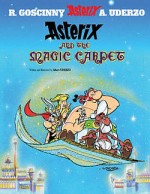
Asterix and the Magic Carpet


By Uderzo, translated by Anthea Bell & Derek Hockridge (Orion Books)
ISBN: 978-0-75284-776-4

The son of Italian immigrants, Alberto Aleandro Uderzo was born on April 25th 1927, in Fismes, on the Marne. As a child reading Mickey Mouse in Le Pétit Parisien he showed artistic flair from an early age but dreamed of becoming an aircraft mechanic. Albert became a French citizen when he was seven and found employment at 13, apprenticed to the Paris Publishing Society, where he learned design, typography, calligraphy and photo retouching.

When World War II broke out he spent time with farming relatives in Brittany and joined his father’s furniture-making business. Brittany beguiled and fascinated Uderzo: when a location for Asterix‘s idyllic village was being mooted, the region was the only choice.

In the post-war rebuilding of France, Uderzo returned to Paris and became a successful artist in the recovering nation’s burgeoning comics industry.

His first published work, a pastiche of Aesop’s Fables, appeared in Junior and in 1945 he was introduced to industry giant Edmond-François Calvo (whose own masterpiece The Beast is Dead is far too long overdue for a commemorative reissue…).

The tireless Uderzo’s subsequent creations included the indomitable eccentric Clopinard, Belloy, l’Invulnérable, Prince Rollin and Arys Buck. He illustrated Em-Ré-Vil’s novel Flamberge, worked in animation, as a journalist and illustrator for France Dimanche, and created the vertical comicstrip ‘Le Crime ne Paie pas’ for France-Soir.

In 1950 he illustrated a few episodes of the franchised European version of Fawcett’s Captain Marvel Jr. for Bravo!

An inveterate traveller, the artistic prodigy met Rene Goscinny in 1951. Soon becoming fast friends, they decided to work together at the new Paris office of Belgian Publishing giant World Press. Their first collaboration was in November of that year; a feature piece on savoir vivre (how to live right or gracious living) for women’s weekly Bonnes Soirée, following which an avalanche of splendid strips and serials poured forth.

Jehan Pistolet and Luc Junior were created for La Libre Junior and they produced a western starring a “Red Indian” who eventually evolved into the delightfully infamous Oumpah-Pah. In 1955, with the formation of Édifrance/Édipresse, Uderzo drew Bill Blanchart for La Libre Junior, replaced Christian Godard on Benjamin et Benjamine and in 1957 added Charlier’s Clairette to his portfolio.

The following year, he made his debut in Tintin, as Oumpah-Pah finally found a home and a rapturous audience. Uderzo also drew Poussin et Poussif, La Famille Moutonet and La Famille Cokalane.

When Pilote launched in 1959 Uderzo was a major creative force for the new magazine collaborating with Charlier on Tanguy et Laverdure and launching – with Goscinny – a little something called Asterix…

Although the gallant Gaul was a massive hit from the start, Uderzo continued working on Les Aventures de Tanguy et Laverdure, but once the first hilarious historical romp was collected in an album as Astérix le gaulois in 1961 it became clear that the series would demand most of his time – especially since the incredible Goscinny never seemed to require rest or run out of ideas.

By 1967 Asterix occupied all Uderzo’s time and attention, so in 1974 the partners formed Idéfix Studios to fully exploit their inimitable creation. When Goscinny passed away three years later, Uderzo had to be convinced to continue the adventures as writer and artist, producing a further ten volumes until 2010 when he retired.

After nearly 15 years as a weekly comic serial subsequently collected into book-length compilations, in 1974 the 21st (Asterix and Caesar’s Gift) was the first published as a complete original album before serialisation.

Thereafter each new release was a long anticipated, eagerly awaited treat for the strip’s millions of fans…

According to UNESCO’s Index Translationum, Uderzo is the tenth most-often translated French-language author in the world and the third most-translated French language comics author – right after his old mate René Goscinny and the medium’s grand master Hergé.

More than 325 million copies of 35 Asterix books have sold worldwide, making his joint creators France’s best-selling international authors. Now the torch has been passed and new sagas of the indomitable are being created by Jean-Yves Ferri and Didier Conrad…

One of the most popular comics features on Earth, the collected chronicles of Asterix the Gaul have been translated into more than 100 languages since his debut, with twelve animated and live-action movies, TV series, assorted games, toys, merchandise and even a theme park outside Paris (Parc Astérix, naturellement)…

Like all the best stories the narrative premise works on more than one level: read it as an action-packed comedic romp of sneaky and bullying baddies coming a cropper if you want or as a punfully sly and witty satire for older, wiser heads. We Brits are further blessed by the brilliantly light touch of master translators Anthea Bell & Derek Hockridge who played no small part in making the indomitable little Gaul so very palatable to English tongues.

More than half of the canon takes place in Uderzo’s beloved Brittany, where, circa 50 B.C., a little hamlet of cantankerous, proudly defiant warriors and their families resisted every effort of the mighty Roman Empire to complete the conquest of Gaul. The land is divided by the notional conquerors into provinces of Celtica, Aquitania and Amorica, but the very tip of the last just refuses to be pacified…

The remaining epics occur in various locales throughout the Ancient World, with the Garrulous Gallic Gentlemen often quizzical tourists and bemused commentators in every fantastic land and corner of the civilisations that proliferated in that fabled era…

Whenever the heroes were playing at home, the Romans, unable to defeat the last bastion of Gallic insouciance, futilely resorted to a policy of absolute containment. Thus the little seaside hamlet was permanently hemmed in by the heavily fortified garrisons of Totorum, Aquarium, Laudanum and Compendium.

The Gauls couldn’t care less, daily defying and frustrating the world’s greatest military machine simply by going about their everyday affairs, protected by the miraculous magic potion of resident druid Getafix and the shrewd wits of the diminutive dynamo and his simplistic, supercharged best friend Obelix…

Firmly established as a global brand and premium French export by the mid-1960s, Asterix the Gaul continued to grow in quality as Goscinny & Uderzo toiled ever onward, crafting further fabulous sagas; building a stunning legacy of graphic excellence and storytelling gold.

By the time this edition was released Goscinny had been gone for a decade and Uderzo was slowly but surely finding his own authorial voice…

Asterix and the Magic Carpet (originally and quite ponderously entitled Astérix chez Rahàzade ou Le compte des mille et une heures – which translates as Asterix meets Orinjade or the 1001 Hours Countdown) was released in 1987 and once again saw Asterix and Obelix undertake a long voyage into the unknown: one packed with exotic climes, odd people and bold adventure, all deliciously underpinned by topical lampooning and timeless swingeing satire.

Before the Arabian adventure begins, a delightful in-character portrait of Goscinny and Uderzo as their greatest creations Asterix and Obelix whets the appetite for the fun to come, after which the 28th saga begins with a friendly feast, suddenly ruined twice over by the singing of the Bard Cacofonix.

Firstly there’s the plain fact that he is singing at all, but the real problem is that his newly discovered vocal style summons up storms and creates violent downpours.

The thunderous deluge also brings a surprised visitor to the village. Watziznehm the Fakir was passing by far above on his flying carpet when the tempest tossed him to earth. It was a painful but happy accident since the Indian wise man was on a mission to find some miraculous Gauls and a certified rainmaker…

Soon Asterix, Obelix and canine wonder Dogmatix are heading Due East to save beautiful princess Orinjade from the machinations of Guru Hoodunnit, who wants to sacrifice her to end a terrible drought and seize the reins of power from her father Rajah Watzit. When the flying wizard left it was with a countdown of 1001 hours to doom…

Our heroes are only accompanying the real star of the Fakir’s quest: with a deadline looming to execute the princess, Watziznehm needs to get Cacofonix there in time to sing up a storm – or rather a monsoon…

Travel aboard the flying carpet is swift and comfortable but ever-hungry Obelix is continually holding up proceedings with many pit-stops to refuel his cavernous stomach, whilst the Bard’s practising frequently leads to stormy weather and unnecessary diversions…

After the usual dalliance with pirates, a bird’s eye tour of Rome and a brief voyage on a Greek trading ship, the tourists soar over Athens and get shot at above Tyre before a natural storm sets the carpet alight and they crash-land in Persia.

Despite being in the land of carpets, the travellers are unable to secure a replacement until a band of Scythian raiders attack the village and Asterix and Obelix negotiate a trade deal: hundreds of pummelled plunderers for a freshly unbeatable new rug…

As the heroes plunge ever eastward, in the Valley of the Ganges Hoodunnit and his creepy mystic crony Owzat gloat at their impending takeover, even as poor Orinjade’s stout defiance begins to weaken.

When the Gauls and their Fakir chauffeur arrive with only a day to spare, it all seems over for the ghastly guru, but as the Bard begins his song he discovers that the arduous journey has given him laryngitis.

For the first time ever somebody wants him to sing and he has lost his voice…

With time running out the Rajah’s doctors’ diagnosis seems crazy: immersion in various unwholesome by-products of sacred elephants. Rather than settle for half-measures the Gauls decide to take Cacofonix to the jungle abode of Howdoo the Elephant Trainer and bury him in the curative well away from civilised senses…

This only gives the villains the opportunity they have been waiting for. When Watziznehm and the Gauls go to collect the Bard in the morning, Owzat engages the Fakir in a magical duel. Leaving them to their tricks Asterix and Obelix press on and find that the storm-singer has been kidnapped…

Happily, dashing Dogmatix is on hand to track down the Bard, an especially easy task as he now smells like he sings…

Hoodunnit is mirthfully preparing the stage for Orinjade’s sacrifice when, after the usual Gallic fisticuffs from our heroes, Cacofonix makes his Asian debut and sets everything – including the skies – to rights in the very nick of time…

Stuffed with light-hearted action, good-natured joshing, raucous, bombastic, bellicose hi-jinks and a torrent of punishing puns to astound and bemuse youngsters of all ages, this tale again celebrates the spectacular illustrative ability of Uderzo and proves that the potion-powered paragon of Gallic Pride is in safe and steady hands.

Full of Eastern Promise, this sublime slice of French polish and graphic élan is all you need to make any holiday excursion or comfy staycation unforgettable.

© 1987 Les Editions Albert René, Goscinny/Uderzo. Revised English translations © 1988, 2003 Hachette. All rights reserved.

The Chimpanzee Complex volume 3: Civilisation


By Richard Marazano & Jean-Michel Ponzio, translated by Jerome Saincantin (Cinebook)
ISBN: 978-1-84918-043-6

French comics creators excel at challenging, mind-blowing, compelling science fiction. Whether boisterous, mind-boggling space opera like Valerian and Laureline, surreal meta-spiritual exploration such as Moebius’ Airtight Garage or the tense, tech-heavy veritas of Orbital, our Gallic cousins always got it: the genre is not about tech or monsters; it’s about people encountering new and uncanny ideas…

Prolific, multi-award winning Richard Marazano was born in Fontenay-aux-Roses in 1971. He initially pursued a career in science before switching to Fine Arts courses in Angoulême and debuted in bande dessinée in the mid 1990s. Although an extremely impressive artist and colourist when illustrating his own stories (Le Bataillon des Lâches, Le Syndrome d’Abel), he is best known for his collaborations with other artists such as Michel Durand (Cuervos), Marcelo Frusin (L’Expédition) and Xavier Delaporte (Chaabi) to name but a few.

His partnerships with artist Jean-Michel Ponzio are especially fruitful and rewarding. As well as Le Complexe du Chimpanzé – the trilogy under discussion here – the daring duo have also produced the taut, intricate social futurism of Genetiksâ„¢ and high-flying paranoiac cautionary tale Le Protocole Pélican.

Jean-Michel Ponzio was born in Marignane and, after a period of scholastic pick-&-mix during the 1980s, began working as a filmmaker and animator for the advertising industry. He moved into movies, designing backgrounds and settings; listing Fight Club and Batman and Robin among his many subtle successes.

In 2000 he started moonlighting as an illustrator of book covers and edged into comics four years later, creating the art for Laurent Genfort’s T’ien Keou, before writing and illustrating Kybrilon for publisher Soliel in 2005.

This led to a tidal wave of bande dessinée assignments before he began his association with Marazano in 2007. He’s still very, very busy and his stunning combination of photorealist painting, 3D design and rotoscoping techniques grace and enhance a multitude of comics from authors as varied as Richard Malka to Janhel.

Perhaps still the very best of these talented individuals’ joint efforts is The Chimpanzee Complex trilogy which concludes its English translation here with Civilisation…

When, six and a half decades after it first returned, the Apollo 11 Command Module splashed down in the Indian Ocean in February 2035, redundant NASA astronaut Helen Freeman was pressed into the top-secret investigation of the incredible passengers, deserting once again her troubled and too-often neglected daughter Sofia.

Neil Armstrong and Buzz Aldrin were the first men to walk on the moon, and nobody – including them – had any idea where they’d been for sixty-five years. For the baffled spacers it was only days since their mission began…

On learning how history had already recorded their triumphant return and unremarkable deaths years later, the legends went ballistic: exhibiting what Freeman knew as the traumatic shock response peculiar to space voyagers categorised by NASA as “the Chimpanzee Complex”…

They had no knowledge of “their” missing third astronaut Michael Collins (if he ever existed). Nobody could explain what they might be and no test science could devise was able to disprove or corroborate their incredible story…

Compelled to work under Military Spook Konrad Stealberg, Freeman’s subsequent interviews uncovered even more questions but no answers. Then one day the enigma-nauts began exhibiting memory gaps.

Whilst her best friend – NASA bureaucrat Robert Conway – left to look after her increasingly intransigent daughter, Helen and Konrad’s team were presented with another insoluble mystery when the astronauts suddenly expired: becoming decades-old corpses overnight…

Soon Helen was reluctantly piloting a mission to the moon in the mothballed but hastily reconditioned shuttle originally designed for Mars – until budget cuts scotched the project. Her trusted comrades and fellow unemployed astronauts Kurt, Alex and Aleksa were just as delighted to be back in space, but as apprehensive as Helen over the military presence and top-secret paraphernalia piled aboard.

They were even less sanguine when Stealberg and his creepy elite commandos replaced the regular crew.

En route they discovered the secret history of the 1960s Space Race: America’s black ops space program and the USSR’s clandestine and apparently failed mission to Mars.

Even bigger shocks materialised on the moon when they found the pressure-suited corpses of Aldrin and Armstrong deep in a concealed fissure. In orbit above them a vintage Command Module was intercepted by their own shuttle.

The relic contained Collins’ corpse and a decades-old Russian distress call the pilot had recorded. The message had been sent by Commies from Mars…

NASA never had an American monopoly on spaceflight: the military had run a covert, parallel program from the very start, funded by pirating portions of NASA’s budget at the personal instigation of ex-Nazi rocket pioneer Werner von Braun…

Moreover, the 66-year old Russian distress message in the capsule’s primitive computers proved the Soviets had also been far more committed to space exploration than history recorded – and just as secretive as the USA…

Mid-flight Stealberg took over, unveiling interplanetary hibernation chambers and turning the now-militarised mission towards the Red Planet. Amidst fears of what awaited them, Helen fell into cold sleep, agonising that she had again abandoned and betrayed Sophia …

When they arrived they only found greater mysteries. The Soviet attempt had been a success and a thriving base at the pole welcomed the Americans. Nothing made sense though. The Russians believed they had been there for twelve years – not six and a half decades – and mission commander Yuri Gagarin (whose death in had been faked in 1968 to facilitate his smooth transition to commander of their Mars-shot) was obsessed with a bizarre scientific hoodoo he called “probability of presence”.

His ruminations on Heisenberg’s Uncertainty Principle and whether such a subatomic phenomenon could apply to larger constructs (like human beings) in a constant and simultaneous state of being and non-being was a truly disturbing idea, but Helen had no time to debate it or their shared regrets about their abandoned Earthbound children as the other Cosmonauts had insanely decide to destroy their own base…

As she returned to the greenhouse module, Konrad presented an even more pressing problem. He had discovered Gagarin’s sixty-years-dead corpse…

As colonists Vladimir and Borislav set fire to the base modules, the Americans retreated to their vehicle, dragging the hysterical Helen, who had promised her very much alive Yuri a ride home…

The tension peaked when they got back to the orbiting Shuttle: Paul had vanished without a trace. Thoroughly rattled, Konrad ordered an immediate return to Earth, with increased watches for every day of the trip.

By May 2036, on Earth Cooper and Sophia both eagerly await Helen’s return at Cape Canaveral. However as the Shuttle approached it suddenly vanished from the tracking systems. Aboard ship Helen and Kurt saw their home planet disappear. Helpless, unable to brake and with no world in view, they rejoined the others in cold-sleep, not knowing when they would reawaken or if they’d still be in the solar system when they did.

Helen’s last conscious thoughts were of the daughter she might never see again…

The epic conclusion picks up in the Great Unknown as hibernation ends after seventy years. Only Helen and Aleksa are still alive; all the other cryo-capsules having failed at some indeterminate time.

With only finite resources and dwindling power, Helen consoles herself by catching up on messages beamed in hope and anticipation by Robbie Cooper, but is roused from her fatalistic depression by Aleksa who has made a shocking discovery.

Seeing one of the EVA suits missing, he at first believed their comrade Alex had committed suicide by walking out of the airlock. Then he saw the impossibly huge unidentified space vessel and called Helen…

Suiting up and arming themselves, they cross to the ship, Helen further encumbered by a laptop with all the messages – read and unread – from Robert stored on it. They have no idea when Alex left, or if she even tried to reach the UFO.

However as it is their only hope of survival, they make a leap into the void and after great struggle find themselves in a vast and terrifying mechanical chamber of disturbing proportions.

Alex’s abandoned gear is on the floor. She had clearly camped there for some time before vanishing into the dark, dusty cavernous interior…

Whilst they rest and consider their next move, Helen watches the last message Robbie sent from Earth. It is sixty-seven years old…

Later, Helen freaks out when they find Alex’s empty suit until Aleksa does the unthinkable and opens his own EVA garb. The enigma ship has warmth and a breathable atmosphere…

And then something pushes part of the vessel over on them…

The pair narrowly escape harm and cautiously explore the vessel, but after splitting up Aleksa is attacked again. When terrified Helen finds him he is hugging the crazed, decrepit, wizened but still alive Alex.

Mute but still vital she leads them through vaulting passageways to what they can only assume is a skeleton. A really, really big one…

Outside a viewing portal, Mars spins by above them. It’s as if they’ve come home …

However fast or far or forward humanity travels, their fears and foibles go with them and before long distrust and dread spark a final confrontation in the uncanny construct. Thus only one person makes an implausible, inexplicable escape back to Earth…

It’s 2097 and as a long-missing craft splashes down in the ocean to begin the circle anew, it becomes clear that some mysteries, like some philosophies and some family bonds, remain ineffably beyond the sphere of rational thinking…

Bold, challenging and enticingly human, this astonishing science mystery dances and darts adroitly between beguiling metaphysics and hard-wired mortal passions, easily encompassing our species’ inbuilt inescapable isolation, wide-eyed wonderment, hunger to know more and the terror of finding out, with Marazano’s pared-to-the-bone script brought to hyper-life with stunning clarity by Ponzio to produce a timeless fusion of passion, paranoia and familial fulfilment.

Do you read me? Do read The Chimpanzee Complex.

© Darguad, Paris, 2008 by Marazano& Ponzio. All rights reserved. English translation © 2010 Cinebook Ltd.

Batman Chronicles volume 10


By Bob Kane, Bill Finger, Don Cameron, Joseph Greene, Joe Samachson, Dick Sprang, Jack Burnley, Jerry Robinson, Norman Fallon, George Roussos, Fred Ray & various (DC Comics)
ISBN: 978-1-4012-2895-8

Debuting twelve months after Superman, “The Bat-Man” (joined within a year by Robin, the Boy Wonder) cemented DC/National Comics as the market and conceptual leader of the burgeoning comicbook industry. Having established the scope and parameters of the metahuman in their Man of Tomorrow, the magnificently mortal physical perfection and dashing derring-do of strictly human-scaled adventures starring the Dynamic Duo rapidly became the swashbuckling benchmark by which all four-colour crimebusters were judged.

This tenth volume of chronologically re-presented Batman yarns from the dawn of his incredible career covers Batman #18-19, Detective Comics #78-81 and World’s Finest Comics #11 (spanning August to November 1943), once again featuring adventures produced during the scary days of World War II.

It’s certainly no coincidence that many of these Golden Age treasures are also some of the best and most reprinted tales in the Batman canon, as lead writer Bill Finger was increasingly supplemented by the talents of Don Cameron, Joe Samachson, Joe Green and others, whilst graphic genius Dick Sprang was slowly growing into his role as major creative force for the feature: transforming the Dynamic Duo into another hugely successful franchise.

The war seemed to stimulate a peak of creativity and production, with everybody on the Home Front keen to do their bit – even if that was simply making kids of all ages forget their troubles for a brief while – and these tales were created just as the dark tide was turning and an odour of hopeful optimism was creeping into the escapist, crime-busting yarns and especially the stunning covers: seen here in the work of Jack Burnley, Sprang & Stan Kaye, Jerry Robinson and Kane…

The compelling dramas open with ‘The Bond Wagon’ (by Greene, Burnley & George Roussos from Detective Comics #78) which pushed the patriotic agenda when Robin’s efforts to raise war funds through a parade of historical look-alikes is targeted by Nazi spies and sympathisers, after which Batman #18 opens with a spectacular and visually stunning crime-caper wherein the Gotham Gangbusters clash again with rascally rotund rogues Tweedledum and Tweedledee whilst solving ‘The Secret of Hunter’s Inn!’ by Samachson & Robinson.

Then ‘Robin Studies his Lessons!’ (Samachson, Kane & Robinson) sees the Boy Wonder grounded from all crime-busting duties until his school work improved – even if it means Batman dying for want of his astounding assistance!

Bill Finger and Burnley brothers Jack and Ray crafted ‘The Good Samaritan Cops’: another brilliant and absorbing human interest drama focused on the tense but unglamorous work of the Police Emergency Squad before the action temporarily ends with a shocking and powerful final engagement for manic physician and felonious mastermind Matthew Thorne: ‘The Crime Surgeon!’ (Finger, Kane & Robinson), who tries his deft and devilish hand at masterminding other crooks’ capers…

Over in Detective Comics #79 ‘Destiny’s Auction’, by Cameron & Robinson, offers another sterling human interest melodrama as a fortune teller’s prognostications lead to fame, fortune and deadly danger for a failed actress, has-been actor and superstitious gangster…

The creation of Superman propelled National Comics to the forefront of their fledgling industry and in 1939 the company was licensed to produce a commemorative comicbook celebrating the start of the New York World’s Fair, with the Man of Tomorrow prominently featured among the four-colour stars of the appropriately titled New York World’s Fair Comics.

A year later, following the birth of Batman and Robin, National combined Dark Knight, Boy Wonder and Action Ace on the cover of the follow-up New York World’s Fair 1940.The spectacular 96-page anthology was a tremendous success and the oversized bonanza format was established, becoming Spring 1941’s World’s Best Comics #1, before finally settling on the now-legendary title World’s Finest Comics from the second issue, beginning a stellar 45-year run which only ended as part of the massive clear-out and de-cluttering exercise that was Crisis on Infinite Earths.

Until 1954 and the swingeing axe-blows of rising print costs, the only place Superman and Batman ever met was on the stunning covers by the likes of Burnley, Fred Ray and others. Between those sturdy card covers, the heroes maintained a strict non-collaboration policy and #11’s (Fall 1943) Batman episode revealed ‘A Thief in Time!’ (Finger & Robinson inked by Fred Ray) which pitted the Gotham Gangbusters against future-felon Rob Callender, who fell through a time-warp and thought he’d found the perfect way to get rich.

Detective #80 saw the turbulent tragedy of deranged, double-edged threat Harvey Kent finally resolved after a typically terrific tussle with ‘The End of Two-Face!’ by Finger, Kane, Robinson & Roussos, after which Batman #19 unleashes another quartet of compelling crime-busting cases.

There’s no mistaking the magnificent artwork of rising star Dick Sprang who pencilled every tale in this astounding issue, beginning with Cameron’s ‘Batman Makes a Deadline!’ wherein the Dark Knight investigated skulduggery and attempted murder at the City’s biggest newspaper. He also scripted the breathtaking fantasy masterpiece ‘Atlantis Goes to War!’ with the Dynamic Duo rescuing that fabled submerged city from overwhelming Nazi assault.

The Joker reared his garish head again in the anonymously penned thriller ‘The Case of the Timid Lion!’ (perhaps William Woolfolk or Jack Schiff?) with the Clown Prince of Crime enraged and lethal whilst tracking down an impostor committing crazy capers in his name before Samachson, Sprang and inker Norman Fallon unmasked the ‘Collector of Millionaires’ with Dick Grayson covertly investigating his wealthy mentor’s bewildering abduction and subsequent replacement by a cunning doppelganger…

This fabulous foray into timeless wonder concludes with ‘The Cavalier of Crime!’ (Detective #81, by Cameron, Kane & Roussos) which introduced another bizarre and baroque costumed crazy who pitted his rapacious wits and sharp edged weapons against the Dynamic Duo – naturally and ultimately to no avail…

This stuff set the standard for comic superheroes. Whatever you like now, you owe it to these tales. Superman gave us the idea, and writers like Finger and Cameron refined and defined the meta-structure of the costumed crime-fighter. Where the Man of Steel was as much social force and wish fulfilment as hero, Batman and Robin did what we ordinary mortals wanted to do.

They taught bad people the lesson they deserved.

The history of the American comicbook industry in almost every major aspect stems from the raw, vital and still powerfully compelling tales of DC’s twin icons: Superman and Batman.

It’s only fair and fitting that both those characters are still going strong and that their earliest adventures can be relived in chronological order in a variety of formats from relatively economical newsprint paperbacks to deluxe hardcover commemorative Archive editions.

However, to my mind, such tales of elemental power and joyful exuberance, brimming with deep mood and addictive action are best enjoyed in these pulp-textured, four-colour facsimiles – as close to the originals in feel and tone as we can get these days.

Comic book heroics simply don’t come any better.
© 1943, 2010 DC Comics. All Rights Reserved.