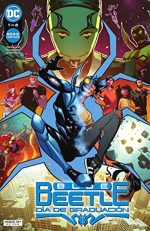
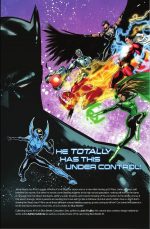
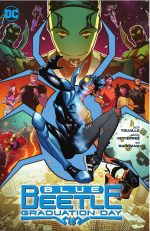
Blue Beetle Graduation Day


By Josh Trujillo & Adrián Gutiérrez, with Wil Quintana, Lucas Gattoni & various (DC Comics)
ISBN: 978-1-7795-2324-2 (TPB/Digital edition)

As the most recent incarnation of the vintage and venerable Blue Beetle brand at last makes the jump from comic book limbo and kids’ animation into live action movie madness, the event sparked a new comics miniseries bridging the teen hero’s old life and new comic book series. Here that is…

The Blue Beetle first appeared in Mystery Men Comics #1, published by Fox Comics and cover-dated August 1939. The eponymous lead character was created by Charles Nicholas (AKA Charles Wojtkowski) as a pulp-styled mystery man and born nomad. Over years and crafted by a Who’s Who of extremely talented creators, the Beetle was also inexplicably popular and hard to kill: surviving the collapse of numerous publishers before ending up as a Charlton Comics property in the mid-1950s.

After a few issues sporadically published, the company shelved him until the superhero revival of the early 1960s when Joe Gill, Roy Thomas, Bill Fraccio & Tony Tallarico revised and revived the character in a 10-issue run (June 1964, February 1966). Cop-turned-adventurer Dan Garrett was reinvented an archaeologist, educator and scientist who gained super-powers whenever he activated a magic scarab with the trigger phrase “Khaji Da!”

Some months later, Steve Ditko (with scripter Gary Friedrich) utterly reimagined the Blue Beetle. Ted Kord was an earnest and brilliant young researcher who had been a student and friend of Professor Garrett and when his mentor seemingly died in action, Kord trained himself to replace him: a purely human inventor/combat acrobat, bolstered by ingenious technology. This latter version joined DC’s pantheon during Crisis on Infinite Earths, earning a solo series and quirky immortality partnered with Booster Gold in Justice League International and beyond…

When Kord was murdered in the run up to Infinite Crisis, it led to all-out war across realities and at the height of the linked catastrophes El Paso high-schooler Jaime Reyes found a weird blue jewel shaped like a bug. That night, as he slept, it invaded him and turned him into a bizarre insectoid warrior. suddenly gifted with great powers, and revealed how some heroes are remade, not born – especially when a sentient scarab jewel affixes itself to your spine and transforms you into an armoured bio-weapon. Almost instantly, he was swept up in the chaos, joining Batman and other heroes in a climactic space battle.

Inexplicably returned home, Jaime revealed his secret to his family and tried to do some good in his hometown but had to rapidly adjust to huge changes. Best bud Paco had joined a gang of super-powered freaks, he learned the local crime mastermind was the foster-mom of his other best bud Brenda, and scary military dude named Christopher Smith (The Peacemaker) started hanging around. He claimed the thing in Jaime was malfunctioning alien tech, not life-affirming Egyptian magic that he also had an unwelcome and involuntary connection to…

That led to a secret war against an alien collective of conquerors called the Reach whose shady dealings and defeat have been covered in Blue Beetle: Jaime Reyes volumes One & Two. You should get those also.

Gathering Blue Beetle: Graduation Day #1-6 (cover-dated January to June 2022), and including an excerpt from the new Blue Beetle series it leads into, this collection is also quite rightly available in a Spanish language edition.

In an effort to maximise your fun and save time let’s briefly hit the high notes here.

Crafted by scripter Josh Trujillo (Adventure Time, Captain America, Rick & Morty), illustrator Adrián Gutiérrez (Batman, The Flash), colourist Wil Quintana and letterer Lucas Gattoni, ‘Graduation Day’ is set following recent DC megaevent Dark Crisis on Infinite Earths with our neophyte champion at long last getting a handle on his other life. He’s even become pals with his sentient passenger bug Khaji Da, allowing them to seamlessly work together.

With school days practically done, as the story opens Jaime is currently wrecking downtown El Paso battling magical thief Fadeaway and worrying about his non-superhero future. After almost missing his own graduation ceremony, Reyes suddenly finds it all going wrong again when he receives a terrifying vision of The Reach and loses control, uncontrollably shifting to his blue battle form…

His family share his secret, but aren’t happy about it and when he returns to his own party hours later, the festivities are long over and his furious mother wants to know what he’s doing with his life. So does Superman, who “just” popped by to see if the alien conquerors had regained control of their greatest weapon…

Intel confirms that The Reach are coming back and the (adult) superhero community feels it might be prudent if Jaime doesn’t use his powers for the foreseeable future…

Benched, grounded, jobless and not destined for college any time soon, the frustrated lad is summarily packed off to toil in his aunts’ diner in Palmera City, but fate has other plans. Repeatedly targeted by extremely Reach-like and savage Beetle-morphs Dynastes and Nitida, BB is forced to fight back until the Justice League shut him down again…

Some salvation comes when mentor Ted and his terrifying older smarter sister Victoria Kord offer him an (unpaid!) internship at Kord Industries. Ted is laid back and cool but Jaime can’t stop thinking how Victoria has the largest collection of alien tech on Earth and keeps looking at him funny…

As Beetle catastrophes keep coming, Reyes and still-on-the-fritz Khaji Da encounter a splinter faction of The Reach. Unable to trust The Horizon, they instead put themselves in the hands of Teen Titans Starfire, Cyborg and their allies. At least they can keep Batman and his private superhero goon squad off their collective shiny blue buggy back. Or Not…

And that’s when Paco and Brenda show up, begging Jaime to help their new best buddy Fadeaway. That does not go well…

With imminent doom encroaching and everybody telling him what” they” should do, Jaime and Khaji Da finally unlock the root problem that’s been jamming them up, consequently evolving into whole new Blue Beetle able and ready to fix their own problems…

And that’s when the aliens all come screaming into Earth’s atmosphere…

An enticing extra offers an extract and sneak peek from the new Blue Beetle #1 (‘Scarab War!’) due for release in September 2023, before a gallery of covers and variants by Cully Hamner, Rafael Albuquerque, David Marquez & Alejandro Sánchez, Ramon Villalobos, Gutiérrez & Quintana, Joe Quinones, Chokoo!, Danny Miki & Ivan Plascencia, Serg Acuña, Ricardo López Ortiz, Baldemar Rivas, Daniel Sampere & Alejandro Sánchez, Bruno Redondo, Jorge Corona & Sarah Stern segue into an extensive and expansive sketch gallery from Gutiérrez.

Here’s another smart, fast and joyous fun ride to delight fans of comics and other, lesser, media forms. So few series combine action and adventure with all-out fun and genuine wit, or can evoke shattering tragedy and poignant loss on command. Now read this even before you wallow in film fun…
© 2022, 2023 DC Comics. All Rights Reserved.
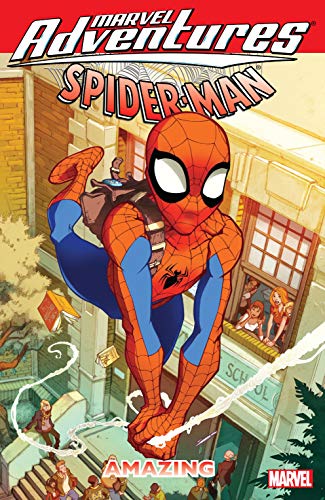
Marvel Adventures Spider-Man volume 1: Amazing


By Paul Tobin, Matteo Lolli, Scott Koblish & various (Marvel)
ISBN: 978-0-7851-4118-1 (Digest PB/Digital edition)

Since its earliest days Marvel always courted the youngest audiences. Whether animated tie-ins such as Terrytoons Comics, Mighty Mouse, Super Rabbit Comics, Duckula, assorted Hanna-Barbera and Disney licenses and a myriad others, or original creations such as Tessie the Typist, Millie the Model, Homer the Happy Ghost, Li’l Kids or Calvin, the House of Ideas always understood the necessity of cultivating the next generation of readers.

These days, however, general kids’ interest titles are on the wane and with Marvel’s proprietary characters all over screens large, small, and even portable, the company prefers to create child-friendly versions of its own pantheon, making an eventual hoped-for transition to more mature comics as painless as possible.

In 2003 the company established a Marvel Age line which updated and retold classic original tales by Stan Lee, Jack Kirby & Steve Ditko all mixed in with remnants of their manga-based Tsunami imprint, also intended for a younger readership. The experiment was tweaked in 2005, becoming Marvel Adventures with the core titles transformed in Marvel Adventures: Fantastic Four and Marvel Adventures: Spider-Man with reconstituted classics replaced by all new stories. Additional series included Marvel Adventures series Super Heroes, The Avengers and Hulk. These ran until 2010 when all were cancelled and replaced by new – continuity-continuing -volumes of Marvel Adventures: Super Heroes and Marvel Adventures: Spider-Man.

This digest-sized collection gathers the first four stories from the 2010 iteration and actually starts in the middle of the action – although writer Paul Tobin and artists Matteo Lolli and Scott Koblish (with inkers Christian Dalla Vecchia, Terry Pallot Koblish & Andrew Hennessy) take great pains to keep the stories as clear as possible.

Sixteen year old Peter Parker has been the mysterious Spider-Man for about six months. In that time he has constantly prowled the streets and skyscrapers of New York, driven to fight injustice. However, as a kid just learning the ropes, he’s pretty much always in over his head…

The opening tale finds him on a crusade against the all-pervasive Torino crime-family, attempting to expose their bought-and-paid-for Judge Clive Baraby, whilst ex-girlfriend and wannabe journalist Gwen dogs his webbed heels and her father Police Captain George Stacy – who knows the boy’s secret but allows him to continue his vigilante antics – picks up all the well-thumped thugs the incensed wall-crawler leaves in his wake.

Even though Spidey can’t touch corrupt Baraby, his campaign of attrition has the Torinos on the ropes, so the Mafioso engage the services of super-assassin Bullseye to kill the Web-spinner. However, the Man who Never Misses is infuriatingly slow to act and soon there’s an open contract on the kid crusader…

Peter’s civilian life is pretty complicated too. Since he and Gwen split, the lad has taken up with schoolmate Sophia Sanduval – an extremely talented lass nicknamed Chat – who also knows Pete’s secret, can communicate with animals and has a part-time job with the Blonde Phantom Detective Agency

She also pays attention in class and suggests how what they learned in history can be used to trap the untouchable Baraby.

The second story opens with a brutal dognapping and leads inexorably to a clash with merciless mercenary Midnight when the villain invades Peter’s school during a martial arts exhibition by Shang Chi, Master of Kung Fu. Along the way, Chat introduces Pete to new buddy Flapper – a very wise owl indeed – and new kid Carter Torino enrols at the school. How does this troubled new boy know the constantly watching Bullseye?

Before the subplots get too intens,e however, Midnight and his ninjas attack Shang-Chi and Spider-Man joins the fracas, subsequently learning some things from the combat expert – including who to return that stolen dog to…

Whilst close-mouthed gang-prince Carter gets closer to Gwen, Wolverine guest-stars in an third untitled tale as Chat asks her bug-boy beau to help hunt down the wild-haired mutant for a client who wants Logan to model their hair gel. Typically, whenever the Clawed Canadian appears trouble isn’t far behind, and when a gang of Torino goons jumps Wolverine, Spidey is forced to join the carnage. And that’s when Bullseye makes his move…

As conflicted Carter Torino confronts his criminal family, the volume concludes with a savage showdown between Bullseye and the sorely outmatched Spider-Man …and sees the death of one of the supporting cast…

Never the success the company hoped, the Marvel Adventures project was superseded in 2012 by specific comics tied to those Disney XD television shows designated as Marvel Universe Cartoons, but these tales are still an intriguing and more culturally accessible means of introducing character and concepts to kids born generations away from the originating events.

Fast-paced and impressive, these Spidey tales are extremely enjoyable yarns but parents should note that some of the themes and certainly the violence might not be what everybody considers “All-Ages Super Hero Action”…
© 2010 Marvel Characters, Inc. All rights reserved.

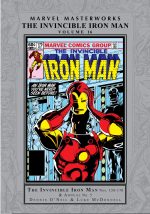
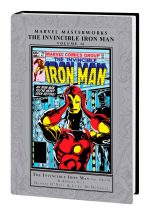
Iron Man Masterworks volume 16


By Denny O’Neil, Roger McKenzie, Peter B. Gillis, Ralph Macchio, Luke McDonnell, Carmine Infantino, Paul Smith, Steve Ditko, Marie Severin, Mike Vosburg, Jerry Bingham, Michael Golden & various (MARVEL)
ISBN: 978-1-3029-4920-4- (HB/Digital edition)

One of Marvel’s biggest global successes thanks to the film franchise, Iron Man celebrated his 60th anniversary in March 2023, so let’s again acknowledge that landmark and all who wear the suits offering more of the same…

Tony Stark is a super-rich supergenius inventor who moonlights as a superhero: wearing a formidable, ever-evolving suit of armour stuffed with his own ingenious creations. The supreme technologist hates to lose and constantly upgrades his gear, making Iron Man one of the most powerful characters in the Marvel Universe. However, in Iron Man #120-128 (March to November 1979), the unrelenting pressure of running a multinational corporation and saving the world on a daily basis resulted in the weary warrior succumbing to the constant temptations of his (originally sham) sybaritic lifestyle. Thus, he helplessly slipped into a glittering world drenched with excessive partying and drinking.

That dereliction was compounded by his armour being usurped by rival Justin Hammer: used to murder an innocent. The ensuing psychological crisis forced Stark to confront the hard fact that he was an alcoholic …and probably an adrenaline junkie too. Landmark story ‘Demon in a Bottle’ saw the traumatised hero plumb the depths of grief and guilt, bury himself in pity, and alienate all his friends and allies before an unlikely intervention forced him to take a long, hard look at his life and actions…

A more cautious, level-headed and wiser man, Stark resumed his high-pressure lives, but he could not let up and the craving never went away. Then in 1982 author/editor Denny O’Neil made him do it again, with the result that Marvel gained another black superhero at long last…

It was the dawn of a period of legacy heroes inheriting mantles, established roles and combat identities from white, mostly male champions, and was certainly a move in the right direction…

This grand and gleaming chronological compendium navigates that transitional period, re-presenting Iron Man #158-170 and material from Iron Man Annual #5 and Marvel Fanfare #4: episodically spanning cover-dates May 1982-May 1983. It’s accompanied by an Introduction from Luke McDonnell at the front and house ads and Direct Sale promo poster by him at the end, as the title experienced many creative personnel shuffles before settling on a stalwart team to tackle the biggest of changes. Also on show are covers by Bob Layton, Smith, Jim Starlin, Ed Hannigan & Al Milgrom, Jerry Bingham & Brett Breeding, McDonnell, Brent Anderson & Steve Mitchell.

Opening with Iron Man #158, O’Neil, Carmine Infantino, Dan Green & Al Milgrom breeze through the motions as a deranged junior genius attacks modern technology from his literal man-cave by tapping the latent psychic power of his ‘Moms’ after which Roger McKenzie, rising art star Paul Smith & inking collective “Diverse Hands” step in to relate what occurs ‘When Strikes Diablo’. Here the Fantastic Four’s alchemical nemesis infiltrates Stark International to steal the techno-wizard’s resources and obsolete suits, only to unleash a mystic menace beyond all control…

With pressure mounting and threats everywhere, the craving for booze painfully manifests in ‘A Cry of Beasts’ – by O’Neil, Steve Ditko, Marie Severin & Green – as Stark’s party-persona collides with hot, willing babes… until an attack on his factory by the sinister Serpent Squad reminds him of his priorities.

Preceding Iron Man Annual #5 – and by O’Neil, McDonnell, Mike Esposito & Steve Mitchell – a brief encounter with new hero Moon Knight sees Stark at odds with rival rich man Steven Grant (one of four people comprising the edgy crusader) in ‘If the Moonman Should Fail!’

Frenemies at first sight, the Golden Avenger and Fist of Khonshu swallow their rich-boy differences to save mutual friends held hostage by Advanced Idea Mechanics, after which the extra-length Annual extravaganza sees Iron Man in Wakanda where The Black Panther must defeat mysteriously resurrected nemesis and determined usurper Eric Killmonger

Crafted by Peter B. Gillis, Ralph Macchio, Jerry & Bingham & Green, the action-packed ‘War and Remembrance!’ exposes an old foe methodically manoeuvring Stark and Iron Man into an inescapable trap, which closes tighter in Iron Man #162 as O’Neil, Mike Vosburg & Mitchell expose ‘The Menace Within!’ when a trusted employee sabotages S.I.…

There seems to be more than one campaign to crush Stark, and – as O’Neil, McDonnell & Mitchell become the regular creative team – ‘Knight’s Errand!’ opens an extended gambit with another hidden plotter turning ruthless capitalism, corporate raiding, advanced weaponry and an obsession with chess into a war for control of the company.

Up first is fast-flying tech terror The Knight who makes short work of Tony’s bodyguard, pilot, friend and confidante James Rhodes, but the real threat comes from a new acquaintance and future companion, covertly hollowing out Stark at close hand. Rising in the rankings after defeating the hovering horseman, Iron Man barely survives ‘Deadly Blessing’ of The Bishop after his security team digs up leads to the plot in Scotland…

In IM #165, the trail leads to Jamie, Laird of Glen Travail and another deadly duel of devices, where the true purpose is to destabilise Stark by abducting Rhodey in an effort to coerce his capitulation. The resultant ‘Endgame’ seemingly goes Stark’s way, but the battle is fought on many levels by a distanced player secretly commanding the Laird: one with a cruel emotional counterpunch long-prepared to destroy the hero from within…

On ‘One of Those Days…’ old foe The Melter attacks Stark’s New York facility whilst Rhodey still recuperates in Scotland. As Stark yet again faces enforced inactivity in the land of sublime alcoholic beverages, he abruptly abandons his friend to jet home to stop the supervillain. He also learns his brilliant security chief Vic Martinelli has uncovered the identity of one of the hidden players attacking the company: chess grandmaster turned armaments entrepreneur Obadiah Stane

As Rhodey goes missing again, the newcomer wants all Stark’s creations and, in the most hostile of takeovers, uses every trick in the book – from honey traps to guided missiles and abduction to intoxication – to seize the advantage. ‘The Empty Shell’ sees that nefarious plan bear evil fruit as Stark finally cracks under interminable pressure and one last betrayal, leading to a crushing fall “off the wagon” and into the gutter in ‘The Iron Scream’.

Permanently drunk and deprived of all judgement, Stark dons his armour to clash with Machine Man, even as far away, Rhodey makes his own life-threatening break for freedom and home…

As chaos ensues at Stark’s plant, a major player debuts in the form of junior employee and minor boffin Morley Erwin: on hand for Stark’s reunion with Rhodey and an aghast witness to one of the smartest men alive crawling into a bottle and trying to drown away his pain…

That process begins in #169 as ‘Blackout!’ sees Stark simply give up when confronted by volcanic B-list villain Magma, and sleep through the moment Jim Rhodes steps up – and into – the role and armour of Iron Man

The new era properly begins in #170’s ‘And Who Shall Clothe Himself in Iron?’ (cover-dated May 1983) as the former military airman promotes Erwin to tech support adviser to help him pilot the most complex weapon he’s ever used to defeat Magma and save a far from grateful Tony Stark…

The Beginning…

Rounding off the wonderment is a short tale by Michael Golden as originally seen in Marvel Fanfare #4 (September 1982) wherein Stark battles his dreams, inner demons and incalculable pride…

As comics companies sought to course correct old attitudes and adapt their wares to a far wider and more diverse readership than they had previously acknowledged, some rash rushed decisions were made that did not suit all the fans. Thankfully, that never stopped the editors and publishers from trying and the wonderful results are here and everywhere in comics because of it. Go read and enjoy and see how it all began to change.
© 2023 MARVEL.

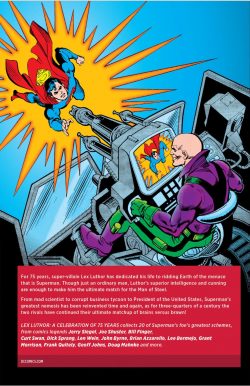
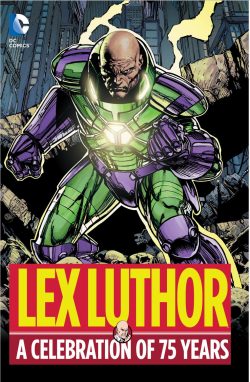
Lex Luthor: A Celebration of 75 Years


By Jerry Siegel & Joe Shuster, Bill Finger, Edmund Hamilton, Len Wein, Cary Bates, Elliot S. Maggin, John Byrne, Roger Stern, Grant Morrison, Greg Rucka, Brian Azzarello, Paul Cornell, Geoff Johns, John Sikela, Wayne Boring, Curt Swan, Jackson Guice, Howard Porter, Matthew Clark, Lee Bermejo, Frank Quitely, Pete Woods, Doug Mahnke & various (DC Comics)
ISBN: 978-1-4012-6207-5 (HB/Digital edition) 978-1- (TPB)

We’re all celebrating the anniversary of the ultimate superhero this year, but who’s thinking of his archenemy – the world’s first true supervillain? Time to address the balance, even if it’s actually two years until the mogul of menace is actually due his bit of candle-covered cake…

Closely paralleling the evolution of the groundbreaking Man of Steel, the exploits of the mercurial Lex Luthor are a vital aspect of comics’ very fabric. In whatever era you choose, the prototypical and ultimate mad scientist epitomises the eternal feud between Brains and Brawn and over eight decades has become the Metropolis Marvel’s true antithesis and nemesis. He’s also evolved into a social barometer and ideal perfect indicator of what different generations deem evil.

This stunning compilation – part of a dedicated series reintroducing and exploiting the comics pedigree of venerable DC icons – comes in Hardback, Trade Paperback and digital formats, sharing a sequence of snapshots detailing what Luthor is at key moments in his never-ending battle with Superman. Groundbreaking appearances are preceded by brief critical analyses of the significant stages in the villain’s development, beginning with Part I: 1940-1969 The Making of a Mastermind.

After history and deconstruction comes sinister adventure as the grim genius debuts in ‘Europe at War Part 2’ (Action Comics #23 April 1940 by Jerry Siegel & Joe Shuster). Although not included here, Action #22 had loudly declared ‘Europe at War’ – a tense, thinly-disguised call to arms for the still-neutral USA, and as the Man of Tomorrow sought to stem the bloodshed, the saga became a continued story (almost unheard of in the early days of funny-book publishing).

Spectacularly concluding in #23, Clark Kent’s European investigations revealed a red-headed fiend employing outlandish science to foment war for profit: intent on conquering the survivors as a modern-day Genghis Khan. The Man of Steel strenuously objected…

Next is ‘The Challenge of Luthor’ (Superman #4, Spring/March1940) and produced at almost the same time: a landmark clash with the rogue scientist who, back then, was still a roguish red-head with a bald and pudgy henchman.

Somehow in the heat of burgeoning deadlines, master got confused with servant in later adventures, and public perception of the villain irrevocably crystalized as the sinister slap-headed super-threat we know today. The fact that Superman was also a star of newspapers – which operated under a different inworld continuity – is widely considered the root cause of that confusion…

Siegel & Shuster’s story involves an earthquake machine and ends with Luthor exhausting his entire arsenal of death-dealing devices attempting to destroy his enemy… with negligible effect.

From Superman #17 (July 1942), ‘When Titans Clash’, by Siegel & John Sikela, depicts how the burly bald bandit uses a mystic “powerstone” to survive his justly earned execution by stealing Superman’s abilities. However, the Action Ace retains his wily intellect and outsmarts his titanically-empowered foe…

Jumping ahead 10 years, ‘Superman’s Super Hold-Up’ (by Bill Finger, Wayne Boring & Stan Kaye from World’s Finest Comics #59 July 1952) is a supremely typical duel of wits in which the Einstein of Evil renders the Metropolis Marvel helpless with the application of a devilish height- and pressure-sensitive mega explosive device… if only for a little while…

WFC #88 (June 1957 by Edmond Hamilton, Dick Sprang & Kaye) offers ‘Superman and Batman’s Greatest Foes!’ wherein “reformed” master criminals Lex and The Joker ostensibly set up in the commercial robot business. Nobody really believes them… as it happens, quite correctly!

As the mythology grew and Luthor became a crucial component of Superman’s story, the bad boy was retroactively inserted into the hero’s childhood. ‘How Luthor Met Superboy!’ (Siegel & Al Plastino in Adventure Comics #271, April 1960) details how Boy of Steel and budding genius were pals until a lab accident burned off Lex’s hair. In his prideful fury Lex blamed the Kryptonian and swore revenge…

In Finger, Curt Swan & John Forte’s ‘The Conquest of Superman’ (Action Comics #277, June 1961) the authorities parole Lex to help with an imminent crisis, only to have the double-dealer escape as soon as the problem is fixed. By the time Superman returns to Earth, Luthor is ready for him…

For October 1963, Superman #164 featured ‘The Showdown between Luthor and Superman’ (Hamilton, Swan & George Klein). The ultimate Silver Age confrontation between the Caped Kryptonian and ultimate antithesis pitted them in an unforgettable clash on devastated planet Lexor – a lost world of forgotten science and fantastic beasts – resulting in ‘The Super-Duel!’ and displayed a whole new side to the often two-dimensional arch-enemy.

Part II: 1970-1986 Luthor Unleashed previews how a more sophisticated readership demanded greater depth in their reading matter and how creators responded by adding a human dimension to the avaricious mad scientist. ‘The Man Who Murdered the Earth’ from Superman #248 (cover-dated February 1972, by Len Wein, Swan & Murphy Anderson). Here Luthor dictates his final testament after creating a Galactic Golem to destroy his sworn enemy, and ponders how his obsession caused the demise of humanity.

For Action Comics’ 45th anniversary, Superman’s two greatest foes – the other being Brainiac – were radically re-imagined for an increasingly harder, harsher world. ‘Luthor Unleashed’ in #544 (June 1983, by Cary Bates, Swan & Anderson) saw the eternal enmity between Lex and Superman lead to Lexor’s destruction and death of Luthor’s new family after the techno-terror once more chose vengeance over love.

Crushed by guilt and hatred, the maniacal genius reinvents himself as an implacable human engine of terror and destruction…

Elliot S. Maggin, Swan & Al Williamson offer a glimpse into the other motivating force in Luthor’s life, exposing ‘The Einstein Connection’ (Superman #416, February 1986) wherein a trawl through the outlaw’s life reveals a hidden link to the greatest physicist in history…

The Silver Age of comic books utterly revolutionised a flagging medium, bringing a modicum of sophistication to the returning sub-genre of masked mystery men. However, after decades of cosy wonderment, Crisis on Infinite Earths transformed the entire DC Universe, leading to a harder, tougher Superman. John Byrne’s radical re-imagining was most potently manifested in Luthor, who morphed from brilliant, obsessed bandit to ruthless billionaire capitalist as seen in the introduction to Part III: 1986-2000 Captain of Industry

The tensions erupt in ‘The Secret Revealed’ (Superman volume 2 #2, February 1987 by Byrne, Terry Austin & Keith Williams) as the pitiless tycoon kidnaps everyone Superman loves to learn his secret. After collating all the data obtained by torture and other means, the corporate colossus jumps to the most mistaken conclusion of his misbegotten life…

‘Metropolis – 900 Miles’ (Superman vol. 2 #9, September 1987 by Byrne & Karl Kesel) then explores the sordid cruelty of the oligarch who cruelly torments a pretty waitress with a loathsome offer and promise of a new life…

‘Talking Heads’ appeared in Action Comics #678 (June 1992, by Roger Stern, Jackson Guice & Ande Parks), set after Luthor – riddled with cancer from wearing a green Kryptonite ring to keep Superman at arms’ length – secretly returned to Metropolis as his own son in a cloned (young and handsome) body. Acting as a philanthropist and with Supergirl as his girlfriend/arm candy, young Luthor has everybody fooled, Sadly, everything looks like falling apart when rogue geneticist Dabney Donovan is arrested and threatens to tell an incredible secret he knows about the richest man in town…

‘Hostile Takeover’ comes from JLA #11 1997) wherein Grant Morrison, Howard Porter & John Dell opened interstellar saga ‘Rock of Ages’ with the Justice League facing a newly-assembled, corporately-inspired Injustice Gang organised by Lex and run on his ruthlessly efficient business model.

Superman, Batman, Wonder Woman, Martian Manhunter, Flash, Green Lantern and Aquaman are targeted by a coalition of arch-enemies comprising Chairman-of-the-Board Lex, Joker, Circe, Mirror Master, Ocean Master and Doctor Light, with ghastly doppelgangers of the World’s Greatest Heroes raining destruction down all over the globe.

Even with new members Aztek and second-generation Green Arrow Connor Hawke on board, the enemy are running the heroes ragged, but the stakes change radically when telepath J’onn J’onzz detects an extinction-level entity heading to Earth from deep space…

The action and tension intensify when the cabal press their advantage whilst New God Metron materialises, warning the JLA that the end of everything is approaching.

As ever, these snippets of a greater saga are more frustrating than fulfilling, so be prepared to hunt down the complete saga. You won’t regret it…

A true Teflon businessman, Lex met the millennium running for President and Part IV: 2000-Present 21st Century Man follows a prose appraisal with ‘The Why’ from President Luthor Secret Files and Origins #1 (2000, by Greg Rucka, Matthew Clark & Ray Snyder). Here the blueprint to power and road to the White House is deconstructed, with daily frustrations and provocations revealing what inspired the nefarious oligarch to throw his hat into the truly evil political ring…

The next (frustratingly incomplete) snippet comes from a miniseries where the antagonist was the star. ‘Lex Luthor Man of Steel Part 3’ by Brian Azzarello & Lee Bermejo offers a dark and brooding look into the heart and soul of Superman’s ultimate eternal foe: adding gravitas to villainy by explaining Lex’s actions in terms of his belief that the heroic Kryptonian is a real and permanent danger to the spirit of humanity.

Luthor – still believed by the world at large to be nothing more than a sharp and philanthropic industrial mogul – allows us a peek into his psyche: viewing the business and social (not to say criminal) machinations undertaken to get a monolithic skyscraper built in Metropolis. The necessary depths sunk to whilst achieving his ambition, and manipulating Superman into clashing with Batman, are powerful metaphors, but the semi-philosophical mutterings – so reminiscent of Ayn Rand’s The Fountainhead – although flavoursome, don’t really add anything to Luthor’s character and even serve to dilute much of the pure evil force of his character.

Flawed characters truly make more believable reading, especially in today’s cynical and sophisticated world, but such renovations shouldn’t be undertaken at the expense of the character’s heart. At the end Luthor is again defeated; diminished without travail and nothing has been risked, won or lost. The order restored is of an unsatisfactory and unstable kind, and our look into the villain’s soul has made him smaller, not more understandable.

Lee Bermejo’s art, however, is astoundingly lovely and fans of drawing should consider buying this simply to stare in wonder at the pages of beauty and power that he’s produced here. Or read the entire story in its own collected edition…

Rather more comprehensive and satisfying is ‘The Gospel According to Lex Luthor’ as first seen in All-Star Superman #5. Crafted by Morrison, Frank Quitely & Jamie Grant from September 2006, here an unrepentant Luthor on Death Row grants Clark Kent the interview of his career and scoop of a lifetime, after which ‘The Black Ring Part 5’ (Action Comics #894, December 2010 by Paul Cornell & Pete Woods) confirms his personal world view as Death of the Endless stops the universe just so she can have a little chat with Lex and see what he’s really like…

This epic trawl through the villain’s career concludes with a startling tale from Justice League volume 2, #31 (August 2014) as, post-Flashpoint, a radically-rebooted New 52 DCU again remade Lex into a villain for the latest generation: brilliant, super-rich, conflicted and hungry for public acclaim and approval. In ‘Injustice League Part 2: Power Players’ by Geoff Johns, Doug Mahnke, Keith Champagne & Christian Alamy, bad-guy Luthor has helped Earth from extradimensional invaders and now wants to be a hero. His solution? Make real superheroes invite him into the Justice League, which can be accomplished by ferreting out Batman’s secret identity and blackmailing the Dark Knight into championing his admission…

Lex Luthor is the most recognizable villain in comics and can justifiably claim that title in whatever era you choose to concentrate on; goggle-eyed Golden Age, sanitised Silver Age or malignant modern/Post-Modern milieux. This book captures just a fraction of all those superb stories and offers a delicious peek into the dark, unhealthy side of rivalry and competition…

This monolithic testament to the inestimable value of a good bad-guy is a true delight for fans of all ages and vintage.
© 1940, 1942, 1952, 1954, 1957, 1960, 1961, 1963, 1972, 1983, 1986, 1987, 1992, 1997, 2001, 2005, 2006, 2007, 2010, 2014, 2015 DC Comics. All Rights Reserved

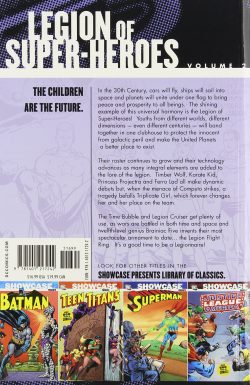
Showcase Presents Legion of Super-Heroes volume 2


By Otto Binder, Jerry Siegel, Edmond Hamilton, Jim Shooter, Curt Swan, John Forte & various (DC Comics)
ISBN: 978-1- 4012-1724-2 (TPB)

Once upon a time, in the far future, a band of super-powered kids from a multitude of worlds took inspiration from the greatest legend of all time and formed a club of heroes. One day those Children of Tomorrow came back in time and invited their inspiration to join them…

And thus began the vast and epic saga of the Legion of Super-Heroes, as first envisioned by writer Otto Binder and artist Al Plastino in early 1958, just as the revived comicbook genre of superheroes was gathering an inexorable head of steam. Since that time the fortunes and popularity of the Legion have perpetually waxed and waned, with their future history tweaked and rebooted, retconned and overwritten over and again to comply with editorial diktat and popular whim. Happy 65th Anniversary, teams!

This splendid, charm-soaked, action packed second monochrome collection continues to re-present those early tales from assorted Superman Family titles in chronological order: the sagas from their own feature spanning Adventure Comics #316, 322-348, and 365 with guest-shots from Superboy #117, 124-125 and pertinent portions of Superman Annual #4, covering July 1964 to September 1966.

From Adventure #322 the fun-filled futurism opens with ‘The Super-Tests of the Super-Pets!’ by Edmond Hamilton, John Forte & Sheldon Moldoff, wherein the Legion’s mighty animal companions – Krypto, Streaky the Super Cat, Beppo, the monkey from Krypton and magical Super-horse Comet – are left to guard Earth as the humanoid players continue to pursue the elusive Time Trapper. When Chameleon Boy’s pet Proty II applies to join the bestial bunch, they give him a series of extremely difficult qualification tasks…

‘The Eight Impossible Missions!’ (#323 by Jerry Siegel, Forte & George Klein) see the incomprehensibly smart Proty setting the human Legionnaires a set of challenges to determine their next leader, after which the tone switches to deadly danger for ‘The Legion of Super-Outlaws!’ (Hamilton & Forte), as a grudge-bearing mad scientist manipulates a super-team from far distant Lallor into attacking the United Planets champions…

Issue #325 reveals how ‘Lex Luthor Meets the Legion of Super-Heroes!’ (Siegel & Forte) in a cunning tale of deadly deception whilst a ‘Revolt of the Girl Legionnaires!’ (Siegel, Forte & Klein) finds the female heroes attempting to eradicate their male comrades. Of course, they don’t mean it and a sinister mastermind is behind it all…

Superboy #117 (cover-dated December 1964) offers a classy thriller wherein Chameleon Boy, Invisible Kid, Ultra Boy, Element Lad and Brainiac 5 seemingly travel back 1000 years to attack the Boy of Steel in Siegel, Curt Swan & Klein’s ‘Superboy and the Five Legion Traitors!’ whilst over in Adventure #327 ‘The Lone Wolf Legionnaire!’ introduces bad boy Brin Londo in a clever thriller from Hamilton, Forte, Klein & Moldoff. This troubled teen is framed for appalling crimes but will one day become a valued member of the team…

Siegel & Jim Mooney began an engaging run of tales in #328, opening with ‘The Lad who Wrecked the Legion!’ as insidious Command Kid joins the superhero squad to dismantle it from within.

Narrowly escaping that fate, the heroes confront the topsy-turvy threat of their own imperfect doppelgangers in #329’s ‘The Bizarro Legion!’ after which another evil juvenile infiltrates the organisation, intent on destroying them all in ‘Secret of the Mystery Legionnaire!’. The dastardly plan proceeds without a hitch until victorious Dynamo-Boy recruited malevolent Lightning Lord, Cosmic King and Saturn Queen and falls victim to ‘The Triumph of the Legion of Super-Villains!’ in #331.

Rescued and restored, the good kids are back in Adventure #332, facing ‘The Super-Moby Dick of Space!’ (Hamilton & Forte) as recently resurrected Lightning Lad suffers crippling injuries and an imminent nervous breakdown…

‘The War Between Krypton and Earth!’ (#333, by Hamilton, Forte & Klein), has the time travelling wonders flung back into Earth’s antediluvian past and split into internecine factions on opposite sides of a conflict forgotten by history, after which Hamilton, Forte & Moldoff’s ‘The Unknown Legionnaire!’ poses a perilous puzzle with an oppressed race’s future at stake.

The same creative team introduce sinister super-villain ‘Starfinger!’ in #335, framing one luckless Legionnaire for incredible crimes before ‘The True Identity of Starfinger!’ (inked by Klein) reveals the real culprit.

Superboy #124 (October 1965, Otto Binder & George Papp) features Lana Lang as ‘The Insect Queen of Smallville!’: rewarded with a shape-changing ring after rescuing a trapped alien. Naturally, she uses her new abilities to ferret out Clark Kent’s secrets…

Adventure #337 highlights ‘The Weddings that Wrecked the Legion!’ (Hamilton, Forte & Moldoff) as two couples resign to marry. However, there’s serious method in the seeming marital madness…

Long absent Bête Noir Time Trapper at last returns in #338, as Siegel & Forte expose ‘The Menace of the Sinister Super-Babies!’, with sultry siren Glorith of Baaldur using the Chronal Conqueror’s devices to turn everybody but Superboy and Brainiac 5 into mewling infants. When they turn the tables on the villains a new era dawns for the valiant Tomorrow Teens…

Cover-dated November 1965 and by Binder & Papp, Superboy #125 signals darker days ahead by introducing a legion reservist with a tragic secret in ‘The Sacrifice of Kid Psycho!’, after which Hamilton, Forte & Moldoff tell a bittersweet tale of disaffected, tormented Lallorian hero Beast Boy who turns against humanity in Adventure Comics #339’s ‘Hunters of the Super-Beasts!’

The slow death of whimsy and light-hearted escapades culminates in #340 when Brainiac 5’s latest invention goes berserk, with ‘Computo the Conqueror!’ (Siegel, Swan & Klein): attacking humanity and killing one of the superheroes before ‘The Weirdo Legionnaire!’ (inked by Moldoff) begins the team’s fight-back and eventual triumph.

‘The Legionnaire who Killed!’ (#342, Hamilton, Swan, Moldoff & Klein) sees Star Boy forced to take a life and facing the harshest of consequences, whilst ‘The Evil Hand of the Luck Lords!’ (Hamilton, Swan & Klein) finds the bold band of heroes assaulting the stronghold of a sinister cult claiming to control chance and destiny.

The same creative team ramps up tensions in Adventure #344 in ‘The Super-Stalag of Space!’, wherein the Legion – and many other planetary champions – are incarcerated by malicious alien overlord Nardo; an epic thriller completed in #345 with ‘The Execution of Matter-Eater Lad!’

With Adventure #346 (July 1966) the dramatic revolution culminated in ‘One of Us is a Traitor!’ as Jim Shooter – barely a teenager – sold script and layouts (finished and inked by veteran Sheldon Moldoff) for a spectacular Earth invasion yarn. Here the sinister Khunds attack the UP, and the depleted Legion inducts four new members to bolster their strength. Sadly, although Princess Projectra, Nemesis Kid, Ferro Lad and Karate Kid are all capable fighters, it is soon apparent that one is an enemy agent…

With Earth all but fallen, ‘The Traitor’s Triumph!’ (Shooter, Swan & Klein) seems assured, but there’s one last surprise to come in a spectacular debut yarn from one of the industry’s most innovative creators…

This superb second compendium concludes with a tense thriller by Shooter & Papp from Adventure #348, as the secret origin of Sun Boy is revealed when radioactive rogue Dr. Regulus attempts unjustified vengeance in ‘Target-21 Legionnaires!’

But wait! There’s more!

Before the end, an expanded illustrated pictorial check-list and informational guide to the entire team by Swan, Klein & Al Plastino, culled from Superman Annual #4 (1961), Adventure Comics #316 and #365 (January 1964 & February 1968, respectively) reveals all you need to know about the youthful champions.

The Legion is one of the most beloved and bewildering creations in comic book history and largely responsible for the growth of the groundswell movement that became American Comics Fandom. Moreover, these sparkling, simplistic and devastatingly addictive stories as much as the legendary Julie Schwartz’s Justice League fired up the interest and imaginations of a generation of young readers and built the industry we all know today.

These naive, silly, joyous, stirring and utterly compelling yarns are precious and fun beyond any ability to explain – even if we old lags gently mock them to ourselves and one another. If you love comics and haven’t read this stuff, you are the poorer for it and need to enrich your future life as soon as possible.
© 1961, 1964, 1965, 1966, 2008 DC Comics. All Rights Reserved.

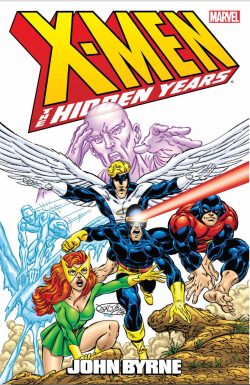
X-Men: The Hidden Years volume 1 (of 2)


By John Byrne, Tom Palmer, Joe Sinnott & various (Marvel)
ISBN: 978-0-7851-9048-6 (TPB/Digital edition)

During its initial 1960s run, X-Men was never one of young Marvel’s top titles, but it did secure a devout and dedicated following. Launching with moody, manic creative energy, dripping with Jack Kirby’s inspired heroic dynamism, the series comfortably transited into the slick, sleek illumination of Werner Roth, even as the blunt tension of alienated outsider-kids settled into a pastiche of college and school scenarios familiar to the students who were the series’ main audience.

The core team comprised tragic Scott Summers/Cyclops, ebullient Bobby Drake/Iceman, golden rich boy Warren Worthington/Angel and erudite, brutish genius Henry McCoy/Beast, in constant heart- and back- breaking training with Professor Charles Xavier. The wheelchair-bound (and even temporarily deceased) telepath was dedicated to brokering peace and fostering integration between the masses of humanity and emergent mutant race Homo Superior.

After a brief time trying to fit in the normal world, Jean Grey/Marvel Girl returned to the team, which was also occasionally supplemented by Scott’s brother Alex – a cosmic ray fuelled powerhouse codenamed Havok – and mysterious magnetic minx eventually dubbed Polaris, although she was usually referred to as Lorna Dane.

Nobody knew it at the time – and sales certainly didn’t reflect it – but with X-Men #56 superhero comics changed forever. A few years previously Neal Adams had stunned the comics-buying public with his horror anthology work and revolutionary superhero stylings on Green Lantern/Green Arrow and Batman. Now, on this relatively minor title – aided and abetted by writer Thomas in iconoclastic form and inker Tom Palmer producing some of the finest work of his career – the artist expanded the horizons of graphic narrative through boldly innovative, intensely paranoid dramas pitting mutants against an increasingly hostile world.

Subtly – and bravely – pitched at an older audience, the succession of gripping, addictively beautiful epics captivated and enchanted a small band of amazed readers – and completely escaped the attention of the greater mass of the buying public. Without those tales the modern X-phenomenon could not have existed, but back then they couldn’t save the series from cancellation. The cruellest phrase in comics is “ahead of its time…”

The series died despite every radical innovation devised by a succession of supremely talented creators. The last published original tale saw the mutants hunting The Hulk – or rather Bruce Banner – in an attempt to save Professor X from a coma induced by his psychic war against merciless, marauding extraterrestrials the Z’nox.

Adams ended his artistic tenure in grand style in that astounding alien invasion epic, but had moved on by the final outing (X-Men #66, cover-dated March 1970).

Although gone, the mutants were far from forgotten. Standard policy at that time to revive defunct characters was to pile on guest-shots and release reprints. Cover-dated December 1970, X-Men #67 saw them return, reliving early classics whilst a campaign of cameos carried them until the “All-New” team debuted in 1975.

One of the many kids utterly beguiled by the series’ transformation under Thomas & Adams was John Byrne. In 1999 he created a retroactive series in-filling untold events and exploits in the days between cancellation and the birth of the modern team. Pencilling in a passable blend of Adams and his own unique style, with Palmer triumphantly back on inks, Byrne took up where Thomas had left off, detailing untold secret adventures crafted with the advantage of 20-20 hindsight in respect to the decades of continuity that had since passed…

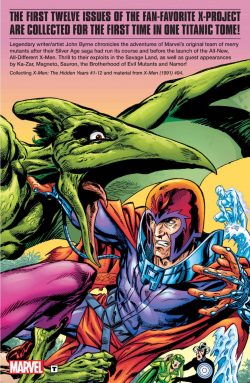
This first of two compilations collects X-Men: The Hidden Years #1-12 (originally published between December 1999- November 2000), and opens with a short teaser/prologue used to promote the series in other Marvel releases.

Featuring a younger, headstrong team far more fractious, aggressive and uncertain than ever seen in contemporary times, the uncanny action sees ‘Test to Destruction’ find the weary mutant heroes seemingly battling an ambush of old foes, only to discover that their peril is a cruel workplace assessment by their surprisingly militant and harsh “resurrected” tutor.

Continuity completists should note this mini-saga occurs between panels of X-Men: The Hidden Years #1, which launched a month later and – whilst recapping all those 1960s classics – dictated that the team revisit ‘Once More the Savage Land’’. This they do without Iceman, who had hot-headedly quit over Xavier’s callous tests and patronising attitude. If he was honest, though, the fact Alex was monopolising Drake’s dream girl Lorna didn’t help…

The team’s voyage south is to confirm the death of archenemy Magneto, but the disgruntled disenchanted heroes quickly fall foul of the steadfast principle dictating that somehow no modern vehicle reaches the primordial preserve without crashing. Narrowly surviving disaster, Angel, Beast and Cyclops are ministering to comatose Jean when they are ambushed by savages, and upon awakening learn Marvel Girl is dead and has been despatched to the Land of the Dead…

The shock is somewhat ameliorated in #2’s ‘The Ghost and the Darkness’ when erudite scholar Henry McCoy deduces exactly what that means here, before saving despondent Scott from suicide-by-T-Rex, and leading his chums in search of her.

Meanwhile in America, Bobby learns of the mission’s failure and that Xavier has sent X-novices Alex and Lorna after them, even as a continent away, Angel’s ultra-wealthy girlfriend Candace Southern buys herself into the crisis…

In a hidden city of freaks at the bottom of the world, the apparent corpse of Marvel Girl has been harvested by eerie priests of an exploitative cult able to raise the dead and rejuvenate the aged and decrepit. The Keepers of the Way have been exploiting the outer tribes’ practice of abandoning their old and sick for centuries, covertly building a monumental forced-labour camp of grateful slaves in an artificially extended underclass. Now, however, that dark paradise and the unstable radioactive volcano it’s built on is nearing its end.

Moreover – as quietly recovering Marvel Girl overhears – the secret rulers have recently started taking survival advice from what appears to be the ghost of Magneto…

Breaking into the citadel, the male X-Men dispel one ancient myth when Cyclops is killed and spontaneously resurrects without the actions of Keepers, leading to the exposure of another factor sustaining the priest-caste’s autonomy…

With enemies all around, Warren is separated from his teammates in ‘On Wings of Angels’ meeting another avian outcast even as Alex and Lorna beat the odds and land mostly in one piece. Even greater fortune blesses them when jungle wonders Ka-Zar and his sabretooth Zabu spot them and take charge of the rescue mission…

In the Keeper city, as Jean is overcome by Magneto, the truth of its imminent explosive doom is uncovered by her fellow X-Men. Angel and mute ally Avia reunite with the other guys in the hangar of a truly unique survival vehicle designed by the Keepers, just as the kingdom is engulfed in boiling lava. Their rush to escape latterly extends to and includes a fully alive master of magnetism in #4’s ‘Escape to Oblivion’

As the reunited mutants are carried every way the wind blows, Iceman has made his own way to the Savage Land and Candy Southern breaks into the X-Mansion for a ferocious confrontation with Professor X. Unaware that Ka-Zar, Alex and Lorna are still trekking through the green hell of the Savage Land, the X-Men and Magneto’s mob of mutant minions are helpless ‘Riders of the Storm’, with the escape vehicle disintegrating around them. When the maelstrom intensifies and the fragmenting vessel is blown thousands of miles adrift, McCoy falls overboard…

Some of that aforementioned hindsight then manifests in issue #6 as ‘Behold a Goddess Rising…!’ reveals how The Beast’s plummet to earth lands him in rural Kenya at the feet of a young weather goddess called Ororo

As Professor X and Candy come to an “arrangement” in Westchester County, on the outskirts of the dinosaur-infested Savage Land, Iceman – battered, bruised and briefly amnesiac – is saved from Pteranodons by energy-leach Karl Lykos. In Africa, McCoy is in earnest conference with the weather-warper. She had created a storm to serve her followers, but somehow the event was usurped by some mystery force, expanding to lethal, continent-spanning dimensions.

Having landed but separated but safely, Jean searches for her teammates, unaware Scott is helpless before the culprit, another mutant who has learned to predate on other Homo Superior…

When the other X-Men – past and future – converge on monstrous Deluge, they are easily overcome whilst back in the Savage Land, Ka-Zar, Alex and Lorna aid the survivors of the resurrection volcano, whilst hundred of miles distant, under that now-diminishing storm in the South Atlantic, the trawler “Sigurd Jarlson” pulls a couple of winged freaks out of its nets…

‘Power Play’ in #7 finds the defeated Kenyan contingent rally, escape certain death and apply all their wits, strength and a venerable old tactic to defeat Deluge, whilst under Antarctica, Lykos and Drake bond with the hero utterly oblivious to who Lykos is and what he did to Iceman when they first met. At sea, Angel and Avia learn that their saviours plan to sell them to a unique freak show just as the main X-team reach home in time to be pressured into another manic mission.

With additional inking by Joe Sinnott, #8 reveals a ‘Shadow on the Stars’ as the Fantastic Four of that era (Mr. Fantastic, The Thing, Human Torch and Inhuman princess Crystal) accompany Xavier and the X-Men after the Z’Nox. Although his epic psionic endeavours saved Earth from the marauding space parasites, it only served to unleash them upon other civilisations and now the Professor and Reed Richards intend to rectify that callous dereliction of duty. However, as the star trek unfolds something ancient, cosmic and fiery waits in anticipation for Jean Grey…

And in the Savage Land, the last remnants of the scattered X-Men reunite when Ka-Zar leads Alex and Lorna to Iceman… and Lykos…

X-Men: The Hidden Years #9 anticipates calamities and tragedies to come as ‘Dark Destiny’ finds Marvel Girl test-driven by the Phoenix Force, before being driven off, leading to a spectacular final confrontation with the Z’Nox.

Back on Earth, another plot thread is attached as in suburban Illinois, a little girl discovers a new trick she can play with her dolls…

As Xavier and McCoy investigate a potential New Mutant and learn that ‘Home is Where the Hurt is…’. the remaining team hunt for missing Warren and walk into a trap laid by the Brotherhood of Evil Mutants (Mastermind, Unus the Untouchable, The Blob and evil Professor X analogue Kreuger).

Happily, in ‘Destroy All Mutants’, Candy provides a very human X-factor to tip the scales, but nothing can help the Illinois embassage as little Ashley Martin is corrupted by her power and loses control of the Sentinel she’s “befriended”, forcing Xavier into a pragmatic but cruel sanction…

In the Savage Land, the illusory period of peace ends for the heroes when Magneto and his Mutates attack, sparking the return of Bobby’s memories and triggering the transformation of repentant Lykos into rapacious monster Sauron. ‘And Death Alone Shall Know My Name’ wraps up the first year of untold tales as the scattered mutants reunite to rescue Iceman, Havoc and Lorna, bombastically battling Magneto’s minions and closing with a cameo by Sub-Mariner that segues neatly into the classic saga told decades ago in Fantastic Four #101-104 (That’s not included here. You’ll need another collection for that slice of magnificence.).

Closing this fan-friendly compilation is a cover and variant gallery sans text for all art lovers.

Fast and furious, but ridiculously convoluted, this is a huge thrill for anyone drenched in X-lore and superbly illustrated in prime Fights ‘n’ Tights mode, but I fear might be a stretch for casual readers or newcomers to the many worlds of X.
© 2017 Marvel Characters, Inc. All rights reserved.

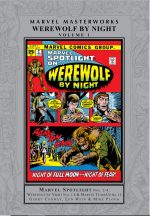
Werewolf by Night Marvel Masterworks volume 1


By Gerry Conway, Len Wein, Roy & Jean Thomas, Mike Ploog, Werner Roth, Ross Andru, & various (MARVEL)
ISBN: 978-1-3029-3346-3 (HB/Digital edition)

Now a star of page and screen, Werewolf by Night could be described as the true start of the Marvel Age of Horror. Now technically supplanted by modern Hopi/Latino lycanthrope Jake Gomez – who’s shared the designation since 2020 – these trials of a turbulent teen wolf opened the floodgates to a stream of Marvel monster stars and horror antiheroes.

Inspiration isn’t everything. In 1970, as Marvel consolidated its new position of market dominance – even after losing their two most innovative and inspirational creators, Steve Ditko and Jack Kirby – they did so employing a wave of new young talent, but less by experimentation and more by expanding proven concepts and properties. The only real exception to this was a mass-move into horror titles (or more accurately “monster titles” – the CCA still vetoed “horror”): a response to an industry down-turn in superhero sales, and a move expedited by a rapid revision in the wordings of the increasingly ineffectual Comics Code Authority rules.

Almost overnight scary monsters became again acceptable fare on four-colour pages and whilst a parade of 1950s pre-code reprints made sound business sense (so they repackaged a bunch of those too), the creative aspect of the revived fascination in supernatural themes was catered to by adapting popular cultural icons before risking whole new concepts on an untested public.

As always, the watchword was fashion: what was hitting big outside comics would be incorporated into the print mix and shared universe mix as readily as possible. When proto-monster Morbius, the Living Vampire debuted in Amazing Spider-Man #101 (October 1971) and the sky failed to fall in, Marvel launched a line of sinister superstars – beginning with a werewolf and a vampire…

Werewolf by Night debuted in Marvel Spotlight #2 (preceded by western-era hero Red Wolf in #1, and followed by Ghost Rider). In actuality, the series title, if not the actual character, was recycled from a classic pre-Comics Code short suspense-thriller from Marvel Tales #116, July 1953. Marvel always favoured using old (presumably already copyrighted) names and titles when creating new series and characters. The Hulk, Thor, Magneto, Doctor Strange and many others all got nominal starts as hairy underpants monsters or throwaways in some anthology or other.

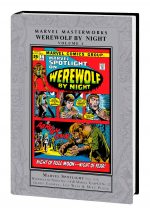
Accompanied by an introductory reminiscence from Roy Thomas, this copious compendium collects the early adventures of a young West Coast wild one by re-presenting the contents of Marvel Spotlight #2-4, Werewolf by Night volume 1 #1-8 and a guest-shot from Marvel Team-Up #12 cumulatively covering February 1972 to August 1973.

The moonlit madness begins with that landmark first appearance, introducing teenager Jack Russell, who is suffering some sleepless nights…

Cover-dated February 1972 and on sale as 1971 closed, ‘Werewolf by Night!’ (Marvel Spotlight #2) was written by Gerry Conway and moodily, magnificently illustrated by Mike Ploog in the manner of his old mentor Will Eisner. The character concept came from an outline by Roy & Jeanie Thomas, describing the worst day of Jack’s life – his 18th birthday – which began with nightmares and ends in something far worse.

Jack’s mother and little sister Lissa are everything a fatherless boy could hope for, but new stepdad Philip and creepy chauffeur Grant are another matter. Try as he might, Jack can’t help but see them as self-serving and with hidden agendas…

At his party that evening, Jack has an agonising seizure and flees into the Malibu night, transforming for the first time into a ravening vulpine man-beast. At dawn, he awakes wasted on a beach to learn his mother has been gravely injured in a car crash. Something had happened to her brakes…

Sneaking into her hospital room, the distraught teen hears her relate the story of his birth-father: an Eastern European noble who loved her deeply, but locked himself away three nights every month…

The Russoff line is cursed by the taint of Lycanthropy: every child doomed to become a wolf-thing under the full-moon from the moment they reach 18 years of age. Jack is horrified on realising how soon his sister will reach her own majority…

With her dying breath Laura Russell makes her son promise never to harm his stepfather, no matter what…

Scenario set, with the traumatised wolf-boy uncontrollably transforming three nights every month, the weird, wild wonderment begins in earnest with the beast attacking the creepy chauffeur – who had doctored those car-brakes – but refraining – even in vulpine form – from attacking Philip Russell…

The second chapter sees the reluctant nocturnal predator rescue Lissa from a rowdy biker gang (they were everywhere back then) and narrowly escape the cops, only to be abducted by a sinister dowager seeking knowledge of a magical tome dubbed the Darkhold. This legendary spell-book is the apparent basis of the Russoff curse, but when Jack can’t produce the goods, he’s left to the mercies of ‘The Thing in the Cellar!’

Surviving more by luck than power, Jack’s third try-out issue fetches him up on an ‘Island of the Damned!’: introducing aging Hollywood screenwriter Buck Cowan, who will become Jack’s best friend and affirming father-figure as they jointly investigate the wolf-boy’s evil stepdad.

Russell had apparently sold off Jack’s inheritance, leaving the kid nothing but an old book. Following a paper trail to find proof Philip had Laura Russell killed leads them to an offshore fortress, a dungeon full of horrors and a ruthless mutant seductress…

The episode ended on a cliffhanger, presumably as an added incentive to buy Werewolf by Night #1 (cover-dated September 1972), wherein Frank Chiaramonte assumed inking duties with ‘Eye of the Beholder!…

Merciless biological freak Marlene Blackgar and her monstrous posse abduct the entire Russell family whilst looking for the Book of Sins, until – once more – a fearsome force of supernature awakes to accidentally save the day as night falls…

With ‘The Hunter… and the Hunted!’ Jack and Buck deposit the trouble-magnet grimoire with Father Joquez, a Christian monk and scholar of ancient texts, but are still hunted because of it. Jack quits the rural wastes of Malibu for a new home in Los Angeles, trading forests and surf for concrete canyons but life is no easier.

In #2, dying scientist Cephalos seeks to harness Jack’s feral life-force to extend his own existence, living just long enough to regret it. Meanwhile, Joquez successfully translates the Darkhold: an accomplishment allowing an ancient horror to possess him in WbN #3, in ‘The Mystery of the Mad Monk!’

Whilst the werewolf is saddened to end such a noble life, he feels far happier dealing with millionaire sportsman Joshua Kane, who craves a truly unique head mounted on the wall of his den in the Franke Bolle inked ‘The Danger Game’. Half-naked, exhausted and soaked to his now hairless skin, Jack must then deal with Kane’s deranged brother, who wants the werewolf for his pet assassin in ‘A Life for a Death!’ (by Len Wein & Ploog) after which ‘Carnival of Fear!’ (Bolle inks again) finds the beast – and Jack, once the sun rises – a pitiful captive of seedy mystic Swami Calliope and his deadly circus of freaks.

The wolf was now the subject of an obsessive police detective too. “Old-school cop” Lou Hackett is an old buddy of trophy-hunter Joshua Kane – and every bit as cruelly savage – but his off-the-books investigation hardly begins before the Swami’s plans fall apart in concluding part ‘Ritual of Blood!’ (inked by Jim Mooney).

The beast is safely(?) roaming loose in the backwoods for #8’s quirky and penultimate monster-mash when an ancient demon possesses a cute little bunny in Wein, Werner Roth & Paul Reinman’s ‘The Lurker Behind the Door!’, after we which we pause for now with a slight but stirring engagement in Marvel Team-Up #12, where Wein, Conway, Ross Andru & Don Perlin expose a ‘Wolf at Bay!’

As webspinning wallcrawler meets wily werewolf, they initially battle each other – and ultimately malevolent mage Moondark – in foggy, fearful San Francisco before Jack heads back to LA for more feral fury in a future issue…

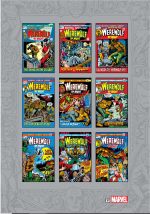
With covers by Neal Adams& Tom Palmer, Ploog, Gil Kane and John Romita, this collection is supplemented with an unused Ploog cover for Marvel Spotlight#4; a gallery of original Ploog art pages and a previous collection cover by Arthur Adams & Jason Keith. A moody masterpiece of macabre menace and all-out animal action, this tome shares some of the most under-appreciated magic moments in Marvel history: tense, suspenseful and solidly compelling chillers to delight any fear fan or drama addict. If you crave a few fun frightmares, go get your paws on this.
© 2022 MARVEL.

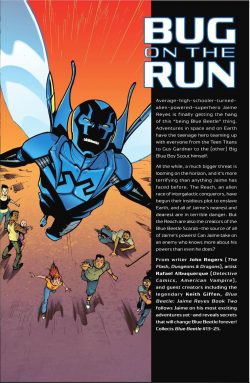
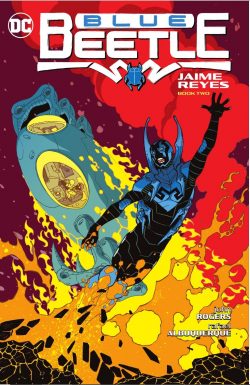
Blue Beetle: Jaime Reyes Book Two


By John Rogers, J. Torres, Keith Giffen, Justin Peniston, Rafael Albuquerque, Freddie E. Williams II, Andy Kuhn, David Baldeón, Dan Davis, Steve Bird & various (DC Comics)
ISBN: 978-1-7795-2027-2 (TPB/Digital edition)

As the most recent incarnation of the venerable Blue Beetle brand makes the jump from comic book limbo and kids’ animation reruns into live action movie madness, here’s a recent collection from the superb 36-issue run that began in 2006: one of the most delightfully light-hearted and compelling iterations of the Golden Age stalwart and still pure joy to behold…

The Blue Beetle first appeared in Mystery Men Comics #1, published by Fox Comics and cover-dated August 1939. The eponymous lead character was created by Charles Nicholas (AKA Charles Wojtkowski): a pulp-styled mystery man who was a born nomad. Over the years and crafted by a Who’s Who of extremely talented creators, he was also inexplicably popular and hard to kill: surviving the failure of numerous publishers before ending up as a Charlton Comics property in the mid-1950s.

After releasing a few issues sporadically, the company eventually shelved him until the superhero revival of the early 1960s when Joe Gill, Roy Thomas, Bill Fraccio & Tony Tallarico revised and revived the character in a 10-issue run (June 1964, February 1966). Cop-turned-adventurer Dan Garrett was reinvented an archaeologist, educator and scientist who gained super-powers whenever he activated a magic scarab with the trigger phrase “Khaji Da!”

Later that year, Steve Ditko (with scripter Gary Friedrich) utterly reimagined the Blue Beetle. Ted Kord was an earnest and brilliant young researcher who had been a student and friend of Professor Garrett. When his mentor seemingly died in action, Kord trained himself to replace him: a purely human inventor/combat acrobat, bolstered by ingenious technology. This latter version joined DC’s pantheon during Crisis on Infinite Earths, earning a solo series and quirky immortality partnered with Booster Gold in Justice League International and beyond…

Collecting Blue Beetle (volume 7) #13-25 and spanning June 2007 to May 2008 – the saga follows the hallowed formula of a teenager suddenly gifted with great powers, and reveals how some heroes are remade, not born – especially when a sentient scarab jewel affixes itself to your spine and transforms you into an armoured bio-weapon.

At the height of the Infinite Crisis, El Paso high-schooler Jaime Reyes found a weird blue jewel shaped like a bug. That night, as he slept, it invaded him and turned him into a bizarre insectoid warrior.

Almost instantly, he was swept up in the chaos, joining Batman and other heroes in a climactic space battle. Inexplicably returned home, Jaime revealed his secret to his family and tried to do some good in his hometown of El Paso but had to rapidly adjust to huge changes. Best bud Paco had joined a gang of super-powered freaks, he learned that the local crime mastermind was his other best bud Brenda’s foster-mom, and a really scary military dude named Christopher Smith AKA Peacemaker started hanging around. He claimed the thing in Jaime’s back was malfunctioning alien tech, not life-affirming Egyptian magic and that he also had an unwelcome and involuntary connection to it…

We resume this cinematically-inspired return engagement with John Rogers, Rafael Albuquerque, David Baldeón & colourist Dan Davis’ ‘Defective’. Here a benevolent (seeming) alien from an interstellar collective named The Reach introduces himself and reveals that the scarab is an invitation used to prepare endangered worlds like Earth for trade and commerce as part of a greater pan-galactic civilisation. Unfortunately the one attached to Jaime has been damaged over the centuries it was here and isn’t working properly.

The Reach envoy is a big fat liar…

The Scarab should have paved the way for a full invasion and once they discover this, Jaime and Peacemaker grasp that The Reach are the worst kind of alien invaders; patient, subtle, deceptive and stocked with plenty of space-tech to sell to Earth’s greedy governments. The only hope of defeating the marauders is to expose their real scheme to the public – which is currently too dazzled by the intergalactic newcomers’ media blitz to listen…

‘Mister Nice Guy’ (Rogers & Albuquerque) finds the Beetle teamed again with erratic Guy Gardner: a Green Lantern who knows all about The Reach and their Trojan Agenda. Here the unhappy allies must defeat the macabre Ultra-Humanite who has sold his telepathic services to the prospective new overlords.

Seeking allies and solutions, Jaime meets Superman in guest creators J. Torres & Freddie Williams Jr.’s ‘Someone to Watch Over Me’: battling electrical anti-villain Livewire before one of the DCU’s gravest menaces manifests in Rogers & Albuquerque’s startlingly powerful change of pace tale ‘Total Eclipso: the Heart’.

‘Something in the Water’ sees elemental menace Typhoon employed by The Reach to endanger a coastal city – and Bruce Wayne’s off-shore oil wells – in a clever, insightful tale packing plenty of punch, before ‘Away Game’ – with contributions from Baldeón & Davis – finds the Beetle and Teen Titans in pitched and pithy battle against the unbeatable alien biker-punk Lobo.

Weirdly whimsical Keith Giffen joins Rogers & Albuquerque next, focusing on Brenda, who has blithely lived her entire life unaware that her surrogate parental unit is El Paso’s crime boss supreme. La Dama is also a hoarder and supplier of alien, futuristic and magical weaponry. The distraught lass learns ‘Hard Truths’ when rival mob Intergang declare war: sending 50-foot woman Giganta to smash La Dama’s family to gooey pulp… until the Beetle buzzes in…

The previous tales were first collected in 2008 as Blue Beetle: Reach for the Stars and are accompanied here by most of sequel volume End Game, which finds the blue boy fighting a very secret war against the seemingly saintly visitors from the stars.

What the Green Lantern Corps already know is that The Reach are rapacious conquerors who follow near-sacrosanct ancient “strategies” to increase their empire. First a scarab converts an indigenous inhabitant into a pathfinder – a devastating marauding bug warrior – before the undetectably orbiting Reach “arrive”, offering weapons and planet-changing technologies to any who want them. And in the interim, the benefactors build world-ripper engines to eventually tear planet and remaining resources into manageable, marketable portions…

Rogers & Albuquerque set up the climactic counterstrike to Armageddon in ‘Fear to Live’, as Peacemaker is selected by a Sinestro Corps power ring due to his ability to “instil great fear”, just as Reach’s Chief Negotiator seeks to take him out. The silent invaders are terrified: desperate to learn why after countless millennia a scarab has rebelled against their infallible programming and created a disobedient, destructive maverick in Reyes.

Having finally deduced the part Peacemaker plays in the rebellion of his strategic weapon, the Negotiator infects Smith with a fully-obedient scarab and transforms him into a monstrous killer-drone. However, the terrifying “Infiltrator” is still no match for Jaime and his now sentient and liberated inner bug, especially after the yellow ring and alien Green Lantern Brik join the struggle…

Before Jaime’s meticulously constructed masterplan to save Earth gets underway, Justin Penniston & Andy Kuhn step in with a powerful tale of mistakes and consequences in #21’s ‘Ghost of a Chance’. Stepping in to quell a riot at a Federal Correctional facility, The Beetle finds the latest incarnation of The Spectre impatiently executing murderers the authorities haven’t got around to yet. Severely outmatched and deeply emotionally conflicted, Jaime needs the sage advice of his father and sorceress girlfriend Traci 13 to a get a handle on the Why as much as the How and Who of this crisis…

After almost a year of preparation, the fate of Earth is resolved in End Game parts one to four, by Rogers, Albuquerque & Majors, starting out ‘Under Pressure’ as Earth’s leaders get deeper in debt to the so-amenable Reach, whilst the Beetle and his allies – his parents, Peacemaker, Paco, Brenda and Danni Garrett (granddaughter of the first Blue Beetle) – try to expose the hidden world-ripper stations and uncover a hidden race who are far from what they seem…

The unravelling eternal strategies have sown discord amongst the Reach with Chief Negotiator’s subordinate openly displaying defiance and advocating abandoning the texts and a century of invisible sedition for total savage warfare right now. Pushed into rash action, the big boss targets the Reyes family, but too late…

‘World Tour’ reveals how Blue Beetle has already invaded their orbiting cloaked base, using a tactic and weapon the scarabs have never before used…

All too soon the boy is defeated, captured, tortured and deprived of the malfunctioning scarab designated Khaji Da. As the Negotiator sadistically gloats, he’s unaware that this was the plan: to strike from ‘Outside-In’

With Traci 13 shielding the Reyes from retaliation, Jaime and his now-sentient symbiotic scarab are methodically taking the Reach apart, provoking a rash public attack on El Paso, the abrupt exposure of the formerly-shielded Reach legions and bases and a gathering of heroes. Can it be merely coincidence that the first responders in concluding clash ‘A Little Help From…’ are Ted Kord’s closest friends and allies, Fire, Ice, Guy Gardner and Booster Gold, or that Jaime has outwitted the perfidious purveyors of illicit high technology with the most primitive methods ever devised by humanity?

… And as Jaime and Khaji Da are plucked from certain death, the rebels leave behind something that will have devastating repercussions for The Reach…

To Be Continued

With covers by Cully Hamner, and Albuquerque this is a smart, fast and joyous thrill ride to delight fans of comics and other, lesser, media forms. There are so few series combining action and adventure with all-out fun and genuine wit, or which can evoke shattering tragedy and poignant loss on command. John Rogers and his stand-ins excel in this innovative and impossibly readable saga and the art is always top notch. With the climactic final battle against the Reach only setting the scene for more and better to come, this is a second chance you probably don’t deserve but should reach out and grab onto with all you’ve got.
© 2007, 2008, 2023 DC Comics. All Rights Reserved.
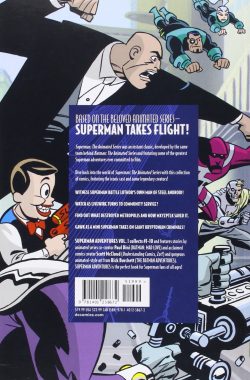
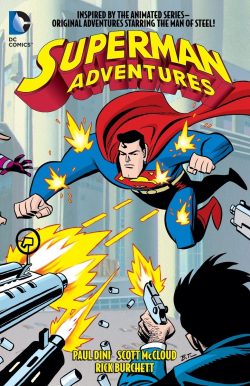
Superman Adventures volumes 1


By Paul Dini, Scott McCloud, Rick Burchett, Bret Blevins, Mike Manley & various (DC Comics)
ISBN: 978-1-4012-5867-2 (TPB/Digital edition)

At their primal hearts heroes like Batman and Superman appeal directly and powerfully to the little kids in us all, who helplessly rail at forces that boss us around and don’t let us be ourselves. Maybe that’s why the versions ostensibly and specifically made for youngsters are so often the most vivid and rewarding…

Almost a decade after John Byrne re-galvanised, reinvigorated and reinvented the look and feel of the Man of Steel, animator Bruce Timm returned to comicbook country to meld modern sensibility and classic mythology with Superman: The Animated Series.

With Paul Dini, he had already designed and overseen Batman: The Animated Series: a 1993 TV show which captivated young and old alike, breathing vibrant new life into an old concept. In 1996 lightning struck a second time. The show was another masterpiece and led to a tranche of sequels and spin-off including The New Batman/Superman Adventures, Justice League and Justice League Unlimited.

Although the Superman cartoon show (originally airing in the USA from September 6th 1996 to February 12th 2000) never got the airplay it deserved in Britain, it remains a highpoint in the character’s long, long animation history, second only to 17 astounding, groundbreaking shorts produced by the Max Fleischer Studio in the 1940s.

These stylish modern visualisations became the norm, extending to the Teen Titans, Legion of Super Heroes, Young Justice and Brave and the Bold animation series that so successfully followed.

The broad stylisation – dubbed “Ocean Liner Art Deco” – also worked magnificently in static two dimensions for the spin-off comic book produced by DC as seen in this first of four compilations, curating Superman Adventures #1-10 (November 1996-August 1997).

With no further ado, the all-ages action opens with ‘Men of Steel’ by show writer Paul Dini, illustrated with dash and verve by Rick Burchett & Terry Austin. Because they know their audience, the editors wisely treated prior animated episodes and comic releases as equally canonical, and here shady mega-billionaire Lex Luthor is a public hero even whilst covertly organising clandestine criminal deals, international coups and a secret war against the Man of Tomorrow.

The devil’s brew of dark deeds culminates here in the oligarch’s creation of a new secret weapon: a hyper-powerful robot-duplicate of Superman, which he uses to initially discredit and ultimately attack the Caped Kryptonian. If it manages to kill him, Lex can mass-produce them and sell them to warlords around the world…

Comics grand master Scott McCloud came aboard as regular scripter with the second issue as ‘Be Careful What You Wish For…’ sees the return of Kryptonite-powered cyborg Metallo. The mechanical maniac – like the rest of Metropolis – erroneously believes lonely, attention-seeking Kelly to be Superman’s girlfriend, but his sadistic revenge scheme hasn’t factored in how Lois Lane might react to the fraudulent claim…

Computerised Kryptonian relic Brainiac resurfaces in ‘Distant Thunder’, having placed its malign consciousness into Earth artefacts (such as robot cats!) before building a new body to facilitate a renewed assault on the Metropolis Marvel. As ever, Brainiac’s end goal is assimilating data, but Superman quickly realises how to turn that programmed compulsion into a weapon ensuring the computer tyrant’s defeat…

Apprentice photo-journalist Jimmy Olsen’s dreams of success and stardom get a big boost in issue #4’s ‘Eye to Eye’. After Luthor orchestrates another lethal attack on Superman – with an enhanced gravity-weapon – the cub reporter learns his job is as much about grit and guts as being in the right place at the right time…

Bret Blevins pencils ‘Balance of Power’ as electrical villain Livewire awakes from a coma and sets about equalizing gender inequality by taking over the world’s broadcast airwaves. With all male presences edited out thanks to her galvanic gifts, the sparky ideologue returns to her original agenda and attempts to eradicate too-powerful men like Superman and Luthor…

McCloud, Burchett & Austin reunite for the astoundingly gripping ‘Seonimod’ wherein Superman utterly fails to save Metropolis from complete annihilation. All is not lost, however, as Fifth Dimensional imp Mr. Mxyzptlk has trapped the hero in a backwards-spiralling time-loop, allowing the Man of Tomorrow one last chance to track a concatenation of disasters back to the inconsequential event that initially triggered the string of accidents which wiped out everything he cherishes…

‘All Creatures Great and Small part 1’ opens a titanic 2-part tale which sees Krypton’s Phantom Zone villains General Zod and Mala escape a miniaturised prison Superman had incarcerated them in. In the process they also shrink our hero to a few centimetres in height, but the endgame is far more devilish that that.

When scientific savant Professor Hamilton and top cop Dan “Terrible” Turpin join Lois in using a growth ray to restore Superman, Zod intercepts them and transforms himself into a towering colossus of chaos and carnage. Utterly overmatched and without options, the tiny Man of Tomorrow is forced into the most disgusting and risky manoeuvre of his career to bring the gigantic General low in the concluding ‘All Creatures Great and Small part 2’

Mike Manley pencils Superman Adventures #9 as ‘Return of the Hero’ focuses on an idealistic boy whose two heroes are Superman and Lex Luthor. However, as a series of arson attacks plagues his neighbourhood, Francisco Torres learns some unpleasant truths about the billionaire that shatter his worldview and almost destroy his family. Happily, the Caped Kryptonian proves to be a far more reliable role model…

Wrapping up this first cartoon collection is a classic clash between indomitable hero and deadly maniac, as a twisted techno-terrorist y returns, peddling Superman action figures designed to plunder and rob their owners’ parents. ‘Don’t Try This at Home!’ – by McCloud, Burchett & Austin – once again proves that no amount of devious deviltry can long deter the champion of Truth, Justice and the American Way…

Breathtakingly written and spectacularly illustrated, these stripped-down, hyper-charged rollercoaster-romps are pure, irresistible examples of the most primal kind of comics storytelling, capturing the idealised essence of what every Superman story should be. It’s a treasury every fan of any age and vintage will adore.
© 1996, 1997, 2015 DC Comics. All Rights Reserved.
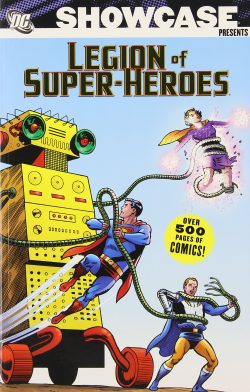
Captain Marvel Mighty Marvel Masterworks volume 1


By Stan Lee, Roy Thomas, Arnold Drake, Gene Colan, Don Heck & various (MARVEL)
ISBN: 978-1-3029-4889-4 (PB/Digital edition)

It’s a year of many anniversaries for Marvel, and 1968 marks a couple of truly significant ones. It was the year the company finally broke free of a restrictive distribution deal and began an explosive expansion that led to market dominance. The other was more symbolic and seminal: the company secured the rights to an evocative and legendary name which it has successfully exploited ever since. Moreover, that name led to the soft introduction of a character who has become one of the faces of the modern Marvel Age.

Happy birthday Mar-Vell and Carol…

The stories re-presented here are timeless and have been gathered many times before but today we’re enjoying another example of The Mighty Marvel Masterworks line: designed with economy in mind and newcomers as target audience. These books are far cheaper, on lower quality paper and smaller – like a paperback novel. Your eyesight might be failing and your hands too big and shaky, but at 152 x 227mm, they’re perfect for kids. If you opt for digital editions, that’s no issue at all.

After years as an also-ran and up-&-comer, by 1968 Marvel Comics was in the ascendant. Their sales were catching up with industry leaders National/DC Comics and Gold Key, and they had finally secured a distribution deal that would allow them to expand their list of titles exponentially. Once the stars of “split-books” Tales of Suspense (Iron Man & Captain America), Tales to Astonish (The Hulk & Sub-Mariner) and Strange Tales (Doctor Strange & Nick Fury, Agent of S.H.I.E.L.D.) all won their own titles, the House of Ideas just kept on creating. One dead-cert idea was a hero named after the company – and one bringing popular cachet and nostalgic pedigree as well.

After the notorious decade long DC/Fawcett court case that began in 1940, the title Captain Marvel disappeared from newsstands. In 1967, during the superhero boom and “camp” craze generated by the Batman TV show, publisher MLF seemingly secured rights to the name and produced a number of giant-sized comics. Their star was an intelligent alien robot who could fly, divide his body into segments and shoot lasers from his eyes.

Despite a certain quirky charm, and being devised by comics veteran Carl (Human Torch) Burgos, the feature failed to attract a large following. On its demise, the name was quickly snapped up by expansionist Marvel Comics Group.

Marvel Super-Heroes was a brand-new title: it had been giant-sized reprint comic book Fantasy Masterpieces: combining monster and mystery tales with Golden Age Timely Comics classics, but with the 12th issue it added an all-new experimental section for characters without homes. These included Inhuman Medusa, Ka-Zar, Black Knight and Doctor Doom, along with new concepts like Guardians of the Galaxy, Phantom Eagle and, to start the ball rolling, a troubled alien spy sent to Earth from the Kree Galaxy. He held a Captain’s rank and his name was Mar-Vell.

This cosmically conceived, kid-friendly collection offers that origin adventure from Marvel Super-Heroes #12-13, the contents of Captain Marvel #1-7 plus a humorous take from Not Brand Echh #9: collectively spanning cover-dates December 1967 to August 1968.

Crafted by Stan Lee, Gene Colan & Frank Giacoia, the initial MS-H 15 page-instalment ‘The Coming of Captain Marvel!’ The tale derived directly from Fantastic Four #64-65, wherein the quartet defeated a super-advanced Sentry robot marooned on Earth by a mythical and primordial alien race, only to be attacked by a high official of those long-lost extraterrestrials in the very next issue!

After defeating Ronan the Accuser, the FF heard no more from the far from extinct Kree, but the millennia-old empire became once again interested in Earth. Dispatching a surveillance mission, the Kree wanted to know everything about us. Unfortunately, the agent they chose was a man of conscience, whilst his commanding officer Colonel Yon-Rogg was his ruthless rival for the love of the ship’s medical officer Una.

No sooner has the dutiful operative made a tentative planet-fall and clashed with the US Army from a local missile base (frequently hinted at as being Cape Kennedy) than the instalment ends. Stan & Gene had set the ball rolling leaving Roy Thomas to establish the basic ground-rules in the next episode.

Colan remained, this time with Paul Reinman inking. ‘Where Stalks the Sentry!’ sees the spy improving his fantastic weaponry before a blatant attempt by Yon-Rogg to kill him collaterally destroys a light aircraft carrying scientist Walter Lawson to that military base.

Assuming Lawson’s identity, Mar-Vell infiltrates “The Cape” but arouses the suspicions of security Chief Carol Danvers. He is horrified to discover the Earthlings are storing the Sentry (defeated by the FF) on site. Yon-Rogg, sensing an opportunity, reactivates the deadly mechanoid. As it goes on a rampage, only Mar-Vell stands in its path…

That’s a lot of material for 20 pages but Thomas & Colan were on a roll. With Vince Colletta inking, the third chapter was not in Marvel Super-Heroes but in the premiere issue of the Captain’s own title – released for May 1968. ‘Out of the Holocaust… A Hero!’ is an all-action thriller, detailing the Kree-man’s victorious clash with the superbot, but which still found space to establish twin sub-plots. Succeeding issues would focus on “Lawson’s” credibility and Mar-Vell’s inner doubts as the faithful Kree soldier rapidly loses faith in his own race and falls under the spell of the strangely beguiling humans…

The Captain’s first foray against a super-villain comes in the next two issues as we learn the Kree and Skrull Empire have been intergalactic rivals for eons, and the shapeshifters now need to know why there’s an enemy soldier stationed on neutral Earth.

Despatching their own top agent, ‘From the Void of Space Comes the Super Skrull!’ and the resultant battle almost levels the entire state before bombastically concluding with the Kree beaten, captured and interrogated. A month later he rallies ‘From the Ashes of Defeat!’ and spectacularly triumphs, whilst on the orbiting home front the romantic triangle sub-plot intensified as Yonn-Rogg looked for ways to send Mar-Vell to a justifiable death…

Issue #4 saw the secret invader clashing with fellow anti-hero Prince Namor the Sub-Mariner in ‘The Alien and the Amphibian!’ even as Mar-Vell’s superiors make increasingly ruthless demands of their reluctant agent.

Captain Marvel #5 saw Arnold Drake & Don Heck assume the creative chores (with John Tartaglione on inks) in cold-war monster-mash clash ‘The Mark of the Metazoid’, wherein a mutated Soviet dissident is forced by his militaristic masters to kidnap Walter Lawson (that’s narrative symmetry, that is).I ssue #6 then places the Captain ‘In the Path of Solam!’: battling a marauding sun-creature even as Carol Danvers gets ever-closer to proving that something’s not right with the enigmatic consultant Lawson. Meanwhile, the man impersonating him is forced to prove his loyalty to his species by unleashing a Kree bio-weapon on an Earth community in ‘Die, Town, Die!’ However, all is not as it seems because murderous animate Quasimodo, the Living Computer is also involved…

To Be Continued…

Wrapping up this first volume is a burst of light relief from Marvel’s sixties parody comic Not Brand Echh From # 9, ‘Captain Marvin: Where Stomps the Scent-ry! or Out of the Holocaust… Hoo-Boy!!’ finds Thomas, Colan & Frank Giacoia wickedly reimagining the origin. It’s either funny or painful depending on your attitude…

Mar-Vell and Carol Danvers have both been Captain Marvel and starred in some our art form’s most momentous and entertaining adventures. Today’s multimedia madness all started with these iconic and evergreen Marvel tales, and it’s never too late for you to join the ranks of the cosmic cognoscenti…
© 2023 MARVEL.