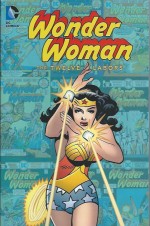
Wonder Woman: The Twelve Labors


By Martin Pasko, Elliot S. Maggin, Cary Bates, Len Wein, Curt Swan, John Rosenberger, Irv Novick, Dick Dillin, Kurt Schaffenberger, Dick Giordano, Jose Delbo & various (DC Comics)
ISBN: 978-1-4012-3494-2

The Princess of Paradise Island originally debuted as a special feature in All Star Comics #8 (December 1941), conceived by polygraph pioneer William Moulton Marston and illustrated by Harry G. Peter, in a calculated attempt to offer girls a positive and forceful role model and, on forward thinking Editor M.C. Gaines’ part, sell more funnybooks.

She catapulted into her own series and the cover-spot of new anthology title Sensation Comics a month later. An instant hit, the Amazing Amazon won her own eponymous supplemental title a few months later, cover-dated Summer 1942.

Once upon a time on a hidden island of immortal super-women, American aviator Steve Trevor of US Army Intelligence crashed to Earth. Near death, he was nursed back to health by young, impressionable Princess Diana.

Fearful of her besotted child’s growing obsession with the creature from a long-forgotten and madly violent world, Diana’s mother Queen Hippolyte revealed the hidden history of the Amazons: how they were seduced and betrayed by men but rescued by the goddess Aphrodite on condition that they forever isolated themselves from the mortal world and devoted their eternal lives to becoming ideal, perfect creatures.

However with the planet in crisis, goddesses Athena and Aphrodite instructed Hippolyte to send an Amazon back with the American to fight for global freedom and liberty and, although forbidden to compete, Diana clandestinely overcame all other candidates to become their emissary Wonder Woman.

On arriving in the Land of the Free she purchased the identity and credentials of lovelorn Army nurse Diana Prince, which elegantly allowed the Amazing Amazon to stay close to Steve whilst enabling the heartsick care-worker to join her own fiancé in South America. Diana soon gained a position with Army Intelligence as secretary to General Darnell, further ensuring she would always be able to watch over her beloved. She little suspected that, although the painfully shallow Steve only had eyes for the dazzling Amazon superwoman, the General had fallen for the mousy but supremely competent Lieutenant Prince…

That set up enabled the Star Spangled Siren to weather the vicissitudes of the notoriously transient comicbook marketplace and survive the end of the Golden Age of costumed heroes along with Superman, Batman and a few lucky hangers-on who inhabited the backs of their titles.

She soldiered on well into the Silver Age revival under the canny auspices of Robert Kanigher, Ross Andru & Mike Esposito, but by 1968 superhero comics were in decline again and publishers sought new ways to keep audiences interested as tastes – and American society – changed.

Back then, the entire industry depended on newsstand sales and if you weren’t popular, you died.

Editor Jack Miller and Mike Sekowsky stepped up with a radical proposal and made a little bit of comic book history with the only female superhero to still have her own title that marketplace.

The superbly eccentric art of Sekowsky had been a DC mainstay for nearly two decades, and he had also scored big with fans at Gold Key with Man from Uncle and at Tower Comics in T.H.U.N.D.E.R. Agents and on war title Fight The Enemy!

His unique take on the Justice League of America had cemented its overwhelming success, and now in 1968 he began stretching himself further with a number of experimental, young-adult oriented projects.

Tapping into the teen zeitgeist with Easy Rider style drama Jason’s Quest proved ultimately unsuccessful, but with the Metal Men and the hopelessly moribund Wonder Woman he had much greater impact. He would subsequently work the same magic with Supergirl.

The big change came when the Amazons were forced to leave our dimension, taking with them all their magic – including Wonder Woman’s powers and all her weapons. Now no more or less than human, she opted to stay on Earth permanently, assuming her own secret identity of Diana Prince, dedicated to fighting injustice as a mortal, very much in the manner of Emma Peel and Modesty Blaise.

Blind Buddhist monk I Ching trained her as a martial artist, and she quickly became embroiled in the schemes of would-be world-conqueror Doctor Cyber. Most shockingly her beloved Steve was branded a traitor and murdered…

Sekowsky’s root and branch overhaul offered a whole new kind of Wonder Woman (and can be seen in the magical quartet of full-colour collections entitled Diana Prince: Wonder Woman) but as I’ve already said fashion ruled and in a few years, without any fanfare or warning, everything that had happened since Wonder Woman lost her powers was unwritten.

Her mythical origins were revised and re-established as she returned to a world of immortals, gods, mythical monster and super-villains with a new nemesis, an African (Greek?) American half-sister named Nubia…

Such an abrupt reversal had tongues wagging and heads spinning in fan circles. Had the series offended some shady “higher-ups” who didn’t want controversy or a shake-up of the status quo?

Probably not.

Sales were never great even on the Sekowsky run and the most logical reason is probably Television.

The Amazon had been optioned as a series since the days of the Batman TV show in 1967, and by this time (1973) production work had begun on the original 1974 pilot featuring Cathy Lee Crosby. An abrupt return to the character most viewers would be familiar with from their own childhoods seems perfectly logical to me… By the time Linda Carter made the concept live in 1975 Wonder Woman was once again “Stronger than Hercules, swifter than Mercury and more beautiful than Aphrodite”…

But as Diana returned to mainstream DC continuity the fans expected her to fully reintegrate, leading to this early and impressive example of a comics miniseries which ran in Wonder Woman #212 to 222 (cover-dated July 1974 – March 1976) and detailed how the Amazing Amazon rejoined the JLA.

Scripter Len Wein and artists Curt Swan & Tex Blaisdell got the ball rolling with ‘The Man Who Mastered Women!’ as the Hellenic Heroine thwarted a terrorist attack at New York’s United Nations building where Diana Prince worked as a translator. In the aftermath she surprisingly met old friend Clark Kent.

Over the course of the conversation she realised her memories had been tampered with and suddenly understood why her JLA colleagues hadn’t called her to any meetings… she had resigned years ago…

Although her former comrades begged her to re-enlist, she declined, fearing that her memory lapses might endanger the team and the world. After much insistent pleading she relented enough to suggest that the League should covertly monitor her next dozen major cases – in the manner of Hercules’ twelve legendary tests – as she proved herself competent and worthy, for her own peace of mind if not the JLA’s…

Once they grudgingly agreed she left and Superman began the surveillance, observing her flying to Paradise Island in her Invisible Plane. Correctly deducing that she had been subject to Amazonian selective memory manipulation, she confronted her mother and learned of her time as a mere mortal and of Steve’s death.

Although the past had been removed by her well-meaning Amazon sisters, Diana now demanded that every recollection excised be returned…

Back in Man’s World a crisis was already brewing as costumed crazy The Cavalier began exerting his uncanny influence over women to controlling female Heads of State, but his powers proved ultimately ineffectual over Wonder Woman…

As a result of that case Diana Prince changed jobs, going to work as a troubleshooter for dashing Morgan Tracy at the UN Crisis Bureau, and her first mission wasn’t long in coming…

Wonder Woman #213 was crafted by Cary Bates, Irv Novick & Blaisdell as an alien robot landed and removed all aggression from humanity in one stroke. As the Flash helplessly observed however ‘The War-No-More Machine!’ also quashed all bravery, determination, confidence and capability and the species faced imminent – if long and drawn out – extinction.

Happily Diana, a teenaged girl and a murderous criminal were all somehow immune to the invader’s influence…

Elliot S. Maggin, Swan & Phil Zupa then disclosed Green Lantern Hal Jordan‘s undercover observations after a lost Amazon gem in unwitting, unscrupulous hands almost started World War III and the Princess of Power had to avert a nuclear holocaust triggered by a ‘Wish Upon a Star!’

The superb and vastly undervalued John Rosenberger pencilled Cary Bates’ tale of the ‘Amazon Attack Against Atlantis’ (inked by Vince Colletta) as Aquaman watched Wonder Woman unravel a baroque and barbaric plot by Mars, God of War to set Earth’s two most advanced nations at each throats, after which #216 found Black Canary uncovering the Amazon Sisterhood’s greatest secret in ‘Paradise in Peril!’ by Maggin, Rosenberger & Colletta.

The tale concerned an obsessed multi-millionaire risking everything – including possibly the collapse of civilisation – to uncover exactly what would happen if a man set foot upon the hidden Island of the Amazons…

One of Wonder Woman’s oldest foes resurfaced in ‘The Day Time Broke Loose!’ (by Maggin, Dick Dillin & Colletta) and Green Arrow was caught in the crossfire as the Duke of Deception attacked the UN with temporally torturous images and hallucinations designed to create madness and death on a global scale.

Issue #218 was produced by Martin Pasko & Kurt Schaffenberger and offered two short complete tales. Firstly Red Tornado reported on the ‘Revolt of the Wonder Weapons’ as an influential astrologer used mind-control techniques to gain power and accidentally undermined Diana’s arsenal, after which The Phantom Stranger stealthily observed her foiling a mystic plot by sorcerer Felix Faust which animated and enraged the Statue of Liberty in ‘Give Her Liberty – and Give Her Death!’

This was a time when feminism was finally making inroads into American culture and Pasko, Swan & Colletta slyly tipped their hats to the burgeoning movement in a wry and fanciful sci-fi thriller.

Thus issue  #219 found Diana preventing a vile incursion by the dominating males of Xro, a ‘World of Enslaved Women!’ with stretchable sleuth Elongated Man secretly traversing the parallel dimensions in Wonder Woman’s wake.

With the epic endeavour almost ended, regular scripter Pasko added a patina of mystery to the affair as the Atom watched Diana tackle ‘The Man Who Wiped Out Time!’ Illustrated by Dick Giordano, Wonder Woman #220 found temporal obsessive Chronos eradicating New York’s ability to discern time and time pieces: a plot foiled with style and brilliance by the on-form, in-time Power Princess.

The only problem was that during that entire exacting episode Hawkman had been watching Diana tackling another potential disaster hundreds of miles away…

The Feathered Fury’s report detailed how Crisis Bureau operative Diana Prince had been targeted by Dr. Cyber and Professor Moon – old enemies from her powerless period – who combined a hunger for vengeance with a plan to steal a UN-controlled chemical weapon in ‘The Fiend with the Face of Glass’ (illustrated by Swan & Colletta).

How she could be in two places simultaneously was revealed by Batman, who wrapped up the twelve trials in ‘Will the Real Wonder Woman Please… Stand Up Drop Dead!’ (art by Jose Delbo & Blaisdell), detailing how a beloved children’s entertainment icon had been subverted into a monster feeding off people and replacing them with perfect duplicates…

With covers by Bob Oksner, Nick Cardy, Mike Grell, Dick Giordano & Ernie Chan, this is a spectacular slice of pure, uncomplicated, all ages superhero action/adventure starring one of comics’ true all stars.

Stuffed with stunning art and witty, beguiling stories, this is Wonder Woman at her most welcoming in a timeless, pivotal classic of the medium: one that still provides astounding amounts of fun and thrills for anyone interested in a grand old time.
© 1974, 1975, 1976, 2012 DC Comics. All Rights Reserved.

566 Frames


By Dennis Wojda (Borderline Press)
ISBN: 978-0-99269-720-4

Every now and then – but typically, not nearly often enough – the global comics scene throws out a project with the potential to redefine the industry.

Tintin, A Contract with God, Ghost World, Fun Home, Watchmen, Love and Rockets, Lone Wolf and Cub, From Hell, Fax from Sarajevo, Persepolis, Maus and some few others reached vast non comics-reading audiences in their time, serving to justify and legitimise a narrative discipline that had claimed since its creation to be an actual Art Form.

By all accounts author Dennis Wojda – already an established star of the Polish comics establishment – one day decided to do something to creatively stretch himself and opted to turn snippets of his family history into a daily cartoon on his web-page, scheduled to run for the classically significant “a year and a day”.

It proved immensely popular, so much so that publishers expressed interest in a book, but 366 panels weren’t really enough.

No problem: families always have plenty more history…

As you’ll see when you read the book, Wojda was actually born in Stockholm on March 13th 1973, before returning to Poland to become a writer, designer and graphic artist.

He’s appeared in Gazeta Wyborcza, AktiviÅ›cie, Exklusiv, Bravo, Skate, Ha! Arcie, Arena Comics and Jabber, winning plenty of praise and a few awards for such series as Mikropolis (with artist Krzysztof Gawronkiewicz: collected in two volumes as The Tourist Guide and Mohair Dreams), Chair in Hell, The Supernaturals: Miss Hofmokl’s Shoe (with Krzysztof Ostrowski), A European on the Road (written by J. Sanecka) and Ghost Kids: the Ribbon (illustrated by Sebastian Skrobol) amongst others.

At the end of 2013 British publisher Borderline Press sagely added the now expanded 566 Frames to its burgeoning stable of titles, giving English readers the opportunity to see one of the most beguiling and lyrical examples of comics autobiography ever produced…

Mixing time frames and viewpoints – including many wise pronouncements and predictions from his own time as a foetus in the womb – the tale begins and ends with the birth of the author.

In between then Dennis smoothly skips up and down the family tree, describing his pregnant mother’s drive to Sweden so that he could be born with his absent-and-working-abroad father (who was hedonistically trapped being a wandering, semi- failed pop star in Swinging Scandinavia), and the sort-of psychic grandmother who knew how, when and where to meet her…

There are memories – his and his ancestors’ – of little moments and huge crises, parties and pogroms and many, many conquests – both romantic and geopolitical – as an odd assortment of branches and buds thrive and survive under a variety of invaders and overlords from Tsarist Russians to Hitler’s Nazis to Soviet Russians: always finding that whatever may happen, the music of life plays on…

Don’t be fooled, however. This is no idle panegyric about the good old days. There’s a formidable amount of sex, death, struggle, fear, privation, terror, envy and heartbreak to season the surreal whimsy, diverted daydreams, folksy philosophy and chatty monologue…

And music: everything from Polkas to Jazz to Jimi Hendrix…

With only 566 Frames Wojda has worked his own brand of visual Magic Realism (as previously best expressed in English language comics by Gilbert Hernandez) and this wondrous, mesmerising, intoxicating invitation to share a slice of other lives and times is a book no lover of the medium or citizen of the world should miss.
© Dennis Wojda. All rights reserved.

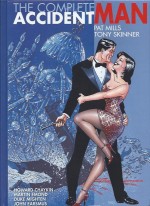
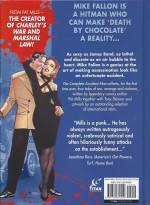
The Complete Accident Man


By Pat Mills, Tony Skinner, Martin Emond, Duke Mighten & John Erasmus (Titan Comics)
ISBN: 978-1-78276-055-9

We have our share of true blue heroes in Britain, but what we really do best are rakish rogues and cast-iron bastards – both in dull old fact and the much safer realm of fiction.

A fair few of the comics kind have stemmed from the febrile mind of Pat Mills, a man whose singular vision has scarred many an impressionable reader’s psyche…

Now one of his most stylish and far-ranging creations – co-crafted with writing partner Tony Skinner – has been awarded some-long delayed and much-deserved star treatment in the form of a lavish oversized colour hardback compilation from Titan Comics.

In many ways Michael Fallon is a product of his times (the 1990s): a ruthless, flashy, grasping Yuppie who thinks he cares about nothing but his job, instant gratification and the gaudy in-your-face trappings of his success.

That’s unpleasant enough if the antagonist is a Banker, a Broker or Hedge Fund Manager, but Mike is a dedicated proud artisan. He makes human impediments go away – and always makes it look like mischance, not murder…

Accident Man debuted in short-lived, creator-owned British independent comic Toxic! (which ran for 31 full-colour issues between March and October 1991). Easily the most popular feature, he also starred in a reprint special – Apocalypse Presents: Accident Man – and in 1993 crossed The Pond for an all-new 3-part monochrome miniseries from American publisher Dark Horse Comics.

This chilling compendium commences with Mills’ Introduction ‘Rhubarb! Rhubarb! Rhubarb!’ describing the convoluted history of the character and teasingly discussing the still-not-made movie, before the cartoon carnage calamitously starts to unfold in the Martin Emond illustrated introductory saga (from Toxic! #1-6) wherein hubristic hitman Fallon explains and simultaneously demonstrates his particular skill-set whilst evoking the golden rules of the job “Never Get Angry. Never Get Involved. Never Get Caught”…

A successful – for which read undetectable – intervention usually fills him with PMT (Post Murder Tension) most successfully expunged through lavish spending and extreme gratuitous physical violence, but these days something’s not right.

The shallow Fashionista didn’t really care when his wife Jill left him to shack up with another woman and join those loony save-the-planet eco nuts in Women Against the Rape of the Planet, but for some strange reason he can’t stop thinking about her now that she’s been killed in a burglary…

He carries on arranging fatal improbabilities but the joie de vivre has gone, and when he finally works out that Jill’s break-in is the M.O. of fellow assassins Chris and Jim it sets him on a bizarre course that leads to an alliance with Hilary – the “Other Woman” – to take profitless vengeance on the corporate scum really responsible…

More or less his old self again Fallon returned in ‘Death Touch’ (Toxic! #10-16, illustrated by Duke Mighten), drowning in natty threads and conspicuous consumption whilst pursuing his craft and studying with a martial arts master who had promised to teach him the legendary art of killing with a time-delayed kung fu punch…

After scooping his fourth consecutive gong for Most Hits in a Year at the annual Golden Coffin Awards, he begins his next commission – a particularly nasty drug dealer with no respect for animals but a sick, devoted and unforgiving family- utterly unaware that his Sensei Sifu Lo has discovered his profession and deemed him unworthy…

John Erasmus took over the art for ‘The Messiah Sting’ (from Toxic! #17-24) as the woman who seduced Jill away cons the Accident Man into doing worse than murder to David Dake – the Junior Minister for the Environment… and for free!

Hilary is a fanatic in the service of WARP and has a baroque plan to punish the ostensibly “Green” Tory politician who actually protects animal torturers and destroys the countryside he’s supposed to be fighting for, but when Mike gets involved it soon devolves into an explosive confrontation with obnoxious American agents, hookers, rival hitmen, a burgeoning criminal turf war, kung fu killers, drug dealers and the destruction of scenic downtown Amsterdam.

And there’s even a sneaky glimpse at out antihero’s early days…

Iconoclastic Howard Chaykin created the risqué and raucous colour covers for the aforementioned Dark Horse miniseries and they seditiously precede the final saga in this magnificent murder file as Mike Fallon takes his particular brand of Olde Worlde charm across the pond – via Concorde, of course – for a job commissioned by a clandestine Government agency: the Special Assassinations Bureau (limned in stark monochrome by Mighten)…

In the Accident Man’s line of business it’s best to be adaptable and always assume everybody is a liar. After an unexpected and exotic liaison with CIA insider Mirror Morgan, Mike hits the Big Apple’s most outrageous sex club and learns his target is a corrupt Senator…

Arranging the improbable with his usual élan, Mike is only seconds away from unknowingly eradicating the chief of the CIA when he spots Mirror with his soon to be tragically deceased mark, and is forced to spectacularly avert his programmed mishap.

CIA boss John Archer is perfectly reasonable and understanding. He knows how easy it is to be duped in the murky world of espionage and international crime. He’s also happy to let Mike go… but only after the misfortune magnate works his magic on the untouchable Capo di Tutti Capo of the Mafia…

And naturally it’s another bloody freebie…

The glitzy sex and shocking violence mounts exponentially as Fallon infiltrates the Mob, winning more enemies than friends along the grisly way, and even after that job’s sorted he still has a bone to pick with the far-from-fair Broker from SAB…

Overwhelmingly violent, manically inventive and ridiculously addictive, this is a lost gem of anarchic, swingeing satire from Mills and Co, and well worthy of this splendid definitive collection. Also included here is a copious Accident Man Sketchbook section featuring cover roughs, page layouts and character designs as well as the now obligatory lowdown on the creative Usual Suspects.

Highly sexed, infallibly capable and ruthless style obsessed, the flashily fashionable assassin is James Bond on the wrong side – his own – and delivers action, intrigue and bold, black humour in astounding amounts…

Don’t leave anything to chance: check him out…
Accident Man is ™ & © 2014 Pat Mills and Tony Skinner. Accident Man Book One © 2014 Pat Mills, Tony Skinner & Martin Emond. Accident Man Death Touch © 2014 Pat Mills, Tony Skinner & Duke Mighten. Accident Man Book Three © 2014 Pat Mills, Tony Skinner & John Erasmus. Accident Man (Dark Horse) Pat Mills, Tony Skinner & Duke Mighten.

Zombies Can’t Swim


By Kim Herbst (Borderline Press)
ISBN: 978-0-99269-726-6

It’s pretty certain now that we can’t escape the oncoming Zombie Apocalypse, since dealing with the shambling horrors has even been added to the “What Would You Do…?” topic list of idle pub chatter and polite dinner party conversation, right below “… if you had a million dollars?” and “…if you had a month to live” but still above “…if you were irresistible to the opposite sex?”…

Now British publishing house Borderline Press has taken those idle musings and given them concrete form in a deliciously wry and whimsical horror fantasy that is sublimely enchanting and gloriously engaging.

Kim Herbst was born in Taipei and taught to toddle in Tokyo before learning how to slaughter the Undead growing up tough in New Jersey.

After graduating the Illustration course at the Maryland Institute College of Art she moved to San Francisco and pursued a commercial art career, with various illustrations in children’s educational books, magazines like GamesTM and Rhode Island Monthly and covers for Boom! Studios, all whilst pursuing the day-job drawing for mobile games company Juicebox Games.

Her first full comics extravaganza, Zombies Can’t Swim developed out of a casual conversation with her fiancé whilst sitting on a hill in idyllic rural Japan, and that’s where this mordantly gripping, breakneck-paced visualisation of that idle chat begins as big hulking him and cute little her are compelled to continue their debate on the run.

That’s because assorted apparitions and rampaging reanimated revenants are trying to make the couple the next appetiser in an orgy of unending consumption…

In a country where guns are scarce, motor cars can be stolen on every street corner and fantastically lethal exotic medieval weaponry can be found in any museum, the fantasy within a fantasy follows our philosophical debaters in a gruesomely gory two-player re-enactment of every Walking Dead flick you seen in the last decade as the famished Dead keep Walking towards them and the young romantics make their way towards some sort of safe haven.

Amidst frantic combat, abortive rescues, crashed copters and incipient immolation the frantic morsels make a decision. Japan is an island so if they head for the harbour and steal a boat they’ll be safe.

After all everybody knows Zombies Can’t Swim…

This wild and witty two colour tome is a brief and vivid vignette all horror fans will adore: captivating cathartic, violently vicarious fun against a foe everybody knows it’s okay to kill (kill again? Put an end to? Render finally harmless?) but sharp enough to blur the lines between fearful frenzy and frantic frolic.

© Kim Herbst 2014.
Borderline Press Books are available from selected retail outlets or direct from http://borderline-press.com/Shop

Batman: Bruce Wayne – The Road Home


By Fabian Nicieza, Mike W. Barr, Bryan Q. Miller, Derek Fridolfs, Adam Beechen, Marc Andreyko & various (DC Comics)
ISBN: 978-1-4012-3081-4

At the climax of a harrowing and sustained campaign of terror by insidious cabal The Black Hand and following an all-out invasion by the New Gods of Apokolips, the original Batman was apparently killed.

The world at large was unaware of the loss, leaving the superhero community to mourn in secret whilst a small, dedicated army of assistants, protégés and allies – trained over years by the contingency-obsessed Dark Knight – formed the Network to police Gotham City in the days which followed: marking time until a successor could be found or the original restored…

Most of the Bat-schooled battalion refused to believe their inspirational mentor dead. On the understanding that he was merely lost, they eventually accepted Dick Grayson (the first Robin and latterly Nightwing) as a stand-in until Bruce Wayne could find his way back to them…

This companion volume to Batman: The Return of Bruce Wayne features eight one-shot specials depicting how after the original Dark Knight (marooned in the corridors of history by Darkseid) got back, he created a new identity to scrutinise just how his absence had affected the friends and deputies who soldiered on without him in the urban hell-pit he called home.

Collecting the outrageously tongue-twisting octet Batman: Bruce Wayne: Batman & Robin #1, Batman: Bruce Wayne: Red Robin #1, Batman: Bruce Wayne: Outsiders #1, Batman: Bruce Wayne: Batgirl #1, Batman: Bruce Wayne: Catwoman #1, Batman: Bruce Wayne: Commissioner Gordon #1, Batman: Bruce Wayne: Oracle #1 and Batman: Bruce Wayne: Ra’s Al Ghul #1 from December 2010, the drama begins with ‘Outside Looking In’ by Fabian Nicieza & Cliff Richards and a covert scrutiny of Bruce’s son Damien Wayne and Grayson – the triumphantly innovative new Batman & Robin…

As these Partners in Peril are foiling an attack on Mayor Hady by super-assassins the Hangmen, former star reporter Vicki Vale is nailing down the story of her life.

She has spent months assiduously gathering snippets of information, following hunches and piecing vague suspicions together and is now convinced that she has identified the secret identities of all Gotham’s Bat guardians – and that her old boyfriend Bruce is Batman.

All she needs is proof, and when she finds a bat-bug placed on her by Dick, she has it…

As the Dynamic Duo follow the last Hangman, they are unaware that they are in turn being tracked by an enigmatic armoured figure whose all-encompassing bodysuit mimics the many powers of the Justice League…

Elsewhere caretaker patriarch Alfred Pennyworth enacts a desperate plan to deceive Vicki, blackmailing Tommy Elliot – the villain Hush, who had turned himself into a perfect duplicate of Bruce – into again impersonating the missing playboy, but the canny journalist is not fooled…

Elsewhere the enigmatic Insider rendezvous with Tim Drake AKA Red Robin.

The third Boy Wonder already knows who is inside the super-suit and tentatively acknowledges the necessity of keeping the return a secret, but comes bearing critical new information. He has discovered the abortive scheme to murder Hady was only part of a concerted international effort by cadres of assassins to eradicate city leaders across the globe…

With a live case going global Bruce is forced to adapt his reconnaissance assessment mission on the fly…

The saga continues in Batman: Bruce Wayne: Red Robin #1, where ‘The Insider’ (Nicieza Ramon Bachs & John Lucas) sees Tim head for Amsterdam and a confrontation with killer cabal The Council of Spiders. The battle leads to a reunion with unpredictable erstwhile companion Prudence, a former member of the League of Assassins and devout follower of immortal conqueror Ra’s Al Ghul.

She claims to serve Tim now but the lad has his doubts…

Even together they are barely a match for the arachnoid assassins, but then the Insider appears…

In Gotham Alfred plays his final card and tells Vicki everything she’s compiled and deduced is true. While she’s reeling he then swipes her only piece of evidence…

Back in Holland Insider, having infiltrated the Spiders, uses their initiation assignment to test Tim’s combat skills in a no-holds barred rooftop battle, having discovered the planet-wide contract on city leaders is part of a mystery manipulator’s vast, inexplicable Tournament of Death…

When Batman’s methods clashed with the JLA’s scruples, the Dark Knight formed his own superteam. Eventually he dumped them, only occasionally reuniting with Geo-Force, Halo, Looker, Katana and the rest.

Now in Batman: Bruce Wayne: Outsiders #1, (‘Inside Interference’ by Mike W. Barr, Javier Saltares, Rebecca Buchman & Walden Wong) the returned crusader travels to European kingdom Markovia to find his former followers in the midst of civil unrest with their current leader targeted for death…

Having sorted that crisis with a little inside help, Bruce confronts his forth sidekick Stephanie Brown…

Daughter of C-list bad-guy Cluemaster, she began her costumed crime-busting career as the Spoiler, secretly scotching Daddy Dearest’s schemes before graduating to a more general campaign against the city’s underworld.

Eventually, she undertook a disastrous stint as the fourth Robin: a tenure which provoked a brutal gang war which devastated Gotham and ostensibly caused her own demise under torture at the red hands of psychopathic mob boss Black Mask.

When Stephanie returned to Gotham after months in self-imposed exile, she overcame incredible obstacles – the greatest of which was the Bat-family’s deep mistrust – and inherited the role of Batgirl from Cassandra Cain, a former assassin who had revived the role after her own predecessor was crippled and forced to retire…

Batman: Bruce Wayne: Batgirl #1, ‘Batgirl’ by Bryan Q. Miller & Pere Perez sees the Insider directly assault the flamboyant, cocky teen tornado, simultaneously testing her fighting skills and deductive abilities even as elsewhere the undaunted Vicki Vale attempts to push original Batgirl Barbara Gordon into an unguarded admission…

Selina Kyle had taken Bruce’s death hard, aligning herself with known felons Harley Quinn and Poison Ivy. In Batman: Bruce Wayne: Catwoman #1, ‘Lifting the Vale’ by Derek Fridolfs, Peter Nguyen & Ryan Winn, the former thief and her new gal-pals save Vicki from disaster when she invades an underworld auction. It’s all a scam however as the feline fury only wants to copy all the journalist’s findings for Bruce…

The most impressive chapter here is the stark and shocking ‘Gotham’s Finest’ (Adam Beechen & Szymon Kudranski) from Batman: Bruce Wayne: Commissioner Gordon #1. In it the Tournament of Death takes a personal turn when Vicki becomes the target of The Penguin‘s metahuman mercenaries and Gotham’s top cop has to fight his way out of his own HQ with her, whilst every bent officer on the force tries to kill them.

With the Insider almost too late Jim Gordon proves just why he’s the man Batman respects and trusts the most…

Police Commissioner’s daughter Barbara became computer crusader Oracle after her career as Batgirl ended when the Joker blew out her spine during one of his manic kill sprees. Although trapped in a wheelchair, she still hungered for justice and found new ways to make a difference in a very bad world.

Reinventing herself as a cyber-world information gatherer for Batman, she became an invaluable resource for the entire superhero community, before putting together her own fluctuating squad of crimefighters – the Birds of Prey.

With the grudging acceptance of stand-in Dark Knight Dick Grayson, she mentored Stephanie as the troublesome teen attempted to combine undergraduate studies with her compulsive mission to save lives and help the helpless…

In ‘Oracle’ by Mark Andreyko & Agustin Padilla (Batman: Bruce Wayne: Oracle #1) Babs makes the missing connections and works out who’s behind the massed assassin squads around the world… and how it impacts the entire Bat Network.

However with the legendary Seven Men of Death moving to silence Vicki – now revealed as the ultimate target – Oracle sets the Insider to guard the journalist while she activates all her available Birds (Man-Bat, Hawk & Dove, Ragman, Manhunter and Batgirl), but even their massed might is insufficient to prevent the reporter being abducted by Batman’s hidden foe: a man who will let nothing sully the pristine reputation and myth of the only person on Earth worthy of his respect…

With a cover gallery by Shane Davis & Barbara Ciardo, the sprawling, explosively absorbing saga concludes with the inevitable confrontation between the resurgent Bruce and his polar opposite as Batman: Bruce Wayne: Ra’s Al Ghul #1, (by Nicieza, Scott McDaniel & Andy Owens) details the final fate of Vicki in ‘A Life Worth Saving’…

Fast, furious, complex and enticing, this is a spectacular and accessible yarn that stands on its own merits, so even the freshest newcomers and the very antithesis of Batmaniacs can enjoy the helter-skelter thrill-ride in perfect confidence of a great read.
© 2010, 2011 DC Comics. All Rights Reserved.
The Plain Janes


By Cecil Castellucci & Jim Rugg (Minx Books/DC Comics)
ISBN: 978-1-4012-1115-8

In 2007 DC comics had an honest go at building new markets by creating the Minx imprint. Dedicated to producing comics material for the teen/young adult audience and especially the ever-elusive girl readership, the intent was to tailor material for readers who had previously embraced foreign material such as manga and momentous global comics successes like Maus and Persepolis and the abundant market for prose serials/pop phenomena as Roswell High, Twilight and even Harry Potter.

Sadly after only a dozen immensely impressive and decidedly different black-&-white graphic novels, Minx shut up shop in October 2008, magnanimously NOT citing publishing partner Random House’s failure to get the books onto the appropriate shelves of major bookstore chains as the reason.

Nevertheless the tomes that did reach the bookshelves are still out there and most of them are well worth tracking down – either in the US originals or the British editions published by Titan Books.

One of the most impressive – and the title selected to launch the line – was The Plain Janes, written by Young Adult fiction author Cecil Castellucci (Boy Proof, The Queen of Cool) and illustrated by Jim Rugg (Street Angel, Afrodisiac, One Model Nation).

Their impressive collaboration captivatingly turned the hoary new-kid-in-town trope on its head, wittily blending loss, crushing on the wrong guy and teen rebellion into a tale of dogged determination to overcome all obstacles and establish your own place in the world…

When the bomb went off in Metro City young Jane Beckles was one of the lucky survivors. Her near-death experience obsessed her parents, however, so they closed their successful hairdressing business and headed across country to the somnolent safe suburb of Kent Waters.

Jane didn’t want to go but wasn’t consulted. The introspective aspiring young artist was most upset about deserting the man she called John Doe: the still unidentified victim who was found near her, and remained in a coma to this day.

Jane used to visit and talk to him, and when her family moved she took his sketchbook, promising to fill up the pages in his honour and bring it back to him…

Pokey provincial Buzz Aldrin High School was everything she dreaded, but after doggedly declining the entreaties of the Cool Girls’ Clique, the displaced person found solace in the gruff and initially hostile company of three other self-identifying outcasts: aspiring actress Jane, science nerd Jayne and sporty girl-jock Polly Jane…

Main Jane describes her concerted efforts to unite and join the trio of loners in her letters to sleeping John, and slowly assimilates – at least at the fringes – into the school social hierarchy.

Whilst watching how her new comrades were daily frustrated in their efforts to succeed in their chosen areas of endeavour, and doodling in John’s sketchbook, Jane conceives a notion and enlists the assistance of her namesake outsiders in a bold and subversive new undertaking…

One morning sleepy Kent Waters wakens to find a guerrilla art project in their ordered tidy environs: the site of a proposed strip mall has been transformed into a pyramidal playground – one signed by “People Loving Art In Neighborhoods”.

The mysterious operatives of P.L.A.I.N. follow up with bolder and more baroque projects – filling the town fountain with bubbles, inundating the animal shelter with cuddly toys – and soon the sleepy hamlet is abuzz with only one topic…

However the campaign quickly polarises the populace along generational lines, with the high schoolers avidly following the cool pranks, and adults like Jane’s increasingly paranoid and PTSD-wracked mom seeing it all as the start of more serious, terrorist-inspired anarchy…

And then one night everything gets more complicated when surly transfer student Damon catches the guerrilla girls setting up another of their inspired installations. Although he says nothing the P.L.A.I.N. Janes are rattled, and the situation worsens next day when overzealous Police Officer Sanchez addresses the entire school, accusing students of causing the disorder and delivering ranting, thinly veiled threats…

After initials qualms the Janes retaliate by turning his police station into a garden gnome sanctuary. The war of wills escalates…

Main Jane meanwhile is developing feelings for Damon, and thinks it’s mutual (but who can tell with boys?)…

The campaign is now enticing all the kids in town to perform meaningless acts of unified and unqualified self-expression and Sanchez has all after-school clubs and activities suspended. When that doesn’t break the student body’s spirit, with the full support of the parents he imposes a mandatory after-dark curfew on all teenagers.

Jane has bigger problems: when her latest letter to John comes back unopened she fears the worst and convinces Damon to drive her to MetroCity in a stolen car…

And in Kent Waters, with New Year’s Eve approaching, the Janes and the entire teenage population gather to plan the greatest art attack of all…

Don’t be fooled by seeming plot similarities to Footloose; The Plain Janes is a clever, warm and beguiling tale of self-expression, personal ambitions, friendship and growing up which confronts and counteracts the hackneyed and stereotypical Stifling-Parents versus Right-On Rebel Kids genre to tell a compassionate, moving story with no easy answers condescendingly served up but plenty of questions and passion on show…

This gloriously understated marriage of smart narrative and sublime cartooning is a perfect vehicle for attracting new and youthful readers with no abiding interest in outlandish power-fantasies or vicarious vengeance-gratification (yes, that does mean girls) to our medium, and whilst Minx may be gone, the stories the company released changed comics for good and for ever.

Why not track them all down and enjoy a genuinely different kind of graphic reading experience?
© 2007 Cecil Castellucci & Jim Rugg. All rights reserved.

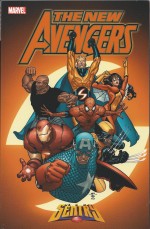
The New Avengers volume 1: Sentry


By Brian Michael Bendis, Steve McNiven, Mark Morales & various (Marvel)
ISBN: 978-0-7851-1672-1

During Marvel’s rebirth in the early 1960’s Stan Lee & Jack Kirby took their lead from a small but growing band of costumed characters debuting or reviving at the Distinguished Competition.

Julie Schwartz’ retooling of DC Comics’ Golden Age mystery-men had paid big dividends for the industry leader in recent years, and Editor Lee’s boss (publisher Martin Goodman) insisted that his company should get in on the act too.

Although National/DC had achieved incredible success with revised and updated versions of the company’s old stable, the natural gambit of trying the same revivification process on characters that had dominated Timely/Atlas in those halcyon days didn’t go quite so well.

The Justice League of America-inspired Fantastic Four featured a new Human Torch but his subsequent solo series began to founder almost as soon as Kirby stopped drawing it. Sub-Mariner was back too, but as a villain, as yet incapable of carrying his own title…

So a procession of new costumed heroes began, with Lee, Kirby and Steve Ditko churning out numerous inventive and inspired “super-characters”.

Not all caught on: The Hulk folded after six issues and even Spider-Man would have failed if writer/editor Lee hadn’t really, really pushed his uncle, the publisher…

Even so, after nearly 18 months during which the fledgling House of Ideas had created a small stable of leading men (but only a sidekick woman), Lee & Kirby finally had enough players to stock an “all-star” group – a format which had made the JLA a commercial winner – and assembled a handful of them into a force for justice and even higher sales…

Cover-dated September 1963, The Avengers #1 launched as part of an expansion programme which also included Sgt. Fury and his Howling Commandos and The X-Men and, despite a few rocky patches, the series soon grew into one of the company’s perennial top sellers.

However times and tastes always change and after four decades, during the latter part of 2004, the “World’s Mightiest Heroes” were shut down and rebooted in a highly publicised event known as Avengers Disassembled.

Of course it was only to replace them with both The New and The Young Avengers. Affiliated comic-books Thor, Iron Man, Spectacular Spider-Man, Captain America, and Fantastic Four ran parallel, quasi-interconnected story-arcs to accompany the Big Show.

The entire tale revealed the worst day in the team’s history as staunch Avenging veteran the Scarlet Witch was discovered to have gone crazy, attacking the team who had been her family and causing the destruction of everything they held dear.

With several members dead, Captain America and Iron Man disbanded the team and turned out the lights.

The most important development from that epic ending was The New Avengers, and this second collection gathers issues #7-10 from that celebrated revamp (covering July to September 2005) with additional fact pages culled from New Avengers: Most Wanted Handbook as scripter Brian Michael Bendis, with artists Steve McNiven & Mark Morales, further redefined the nature of group heroics for a darker, more complex century.

Following an orchestrated breakout of a lethal legion of super-villains from floating ultra penitentiary The Raft, Captain America had convinced metahuman first responders Luke Cage, S.H.I.E.L.D. agent Jessica (Spider-Woman) Drew, Spider-Man and Iron Man to join a new iteration of Avengers. On the Raft they had been assisted by Matt Murdock, (recently “outed” as Daredevil by the media) and a mystery prisoner named Bob Reynolds who nobody seemed to know anything about…

Reynolds or Sentry – the most powerful being on Earth – had in fact volunteered to be incarcerated for the murder of his own wife… who was still alive…

Tentatively united, the team – sans Bob who had vanished – rocketed to the Antarctic Savage Land (a sub-surface wonderland of cavemen, dinosaurs and even stranger things, left in splendid isolation as a UN Protectorate) to recapture Karl Lykos, who fed on mutant energy to become reptilian monster Sauron. Apparently he was the actual target of the orchestrated breakout…

The impromptu mission was an unmitigated disaster with the disparate champions marooned, mauled by dinosaurs and captured by mutant mega-genius Brainchild and his Mutates.

Lykos’ escape had been engineered by the evil experimenter, who considered humans as guinea pigs and wanted to eradicate them all. Happily the neo-Avengers’ mission overlapped with the intentions of Wolverine, who had independently resolved to end the threat of Sauron forever, no matter who got in the way…

Uneasy allies, the heroes then discovered that an apparently rogue faction of S.H.I.E.L.D. had enslaved indigenous peoples of the region, using them to mine the miracle element Vibranium.

There were even scarier discoveries to come. The mass-escape had exposed the fact that many of the criminals held on the Raft had been officially dead for years and Cap’s new recruits had to face the prospect that the Free World’s greatest peacekeeping force might be partly – or even completely – corrupt. After all they were demonstrably stockpiling super-weapons, exotic elements and even metahumans for what could not possibly be any good reason…

Volume two opens with part one of 4-chapter saga ‘The Sentry’ as Tony Stark begins a report to fellow over-achieving, high-minded individuals Reed Richards, Charles Xavier, Prince Namor, Doctor Strange and Black Bolt (later revealed as elitist heroic clandestine cabal The Illuminati) about the reformation of the Avengers and the menace of the 46 still-at-large Raft escapees. Eventually the discussion turns to the potentially world-shattering mystery of Bob Reynolds…

On Long Island, Stark’s new comrades Spider-Woman, Cage, Spider-Man and Wolverine are trying to arrest Asgardian-powered street-thug The Wrecker, whilst under the Nevada Desert Director Maria Hill leads a S.H.I.E.L.D. team trying to re-arrest the despondent, semi-catatonic Sentry who never returned after helping to quell the breakout.

She is unhappy that Iron Man and Captain America have invited themselves along, but far more upset that Reynolds seems to be completely insane; terrified of some nebulous, evil other self he calls “The Void”…

Stark has done his homework. The only references to the Sentry on the entire planet are from some old forgotten comicbooks, so he found and brought along the writer of the pamphlets and another tangentially linked individual.

The scribe doesn’t upset the cowering powerhouse nearly as much as Lindy Reynolds, the wife Bob clearly remembers killing…

Following ‘Alien Agenda’ (an extract from an old Sentry comicbook craftily scripted by Paul Jenkins and classily rendered by Sal Buscema), the mystery in the Nevada cave deepens as, confronted with conflicting truths, Bob Reynolds vanishes in a slash of energy…

An emergency meeting of the Illuminati then dredges up a disquieting fact. Even these most puissant forces for good have never heard of Sentry, but shockingly Reed’s personal computer has. As it reels off a tidal wave of records and files it becomes apparent that the mightiest minds on Earth have all been tampered with…

Soon happy suburbanite Bob wakes up on a sunny morning to discover almost every superhero in America on his front lawn and in stunned disbelief then watches them fall to the malignant power of The Void…

The heroes have not come unprepared. The first prong of their assault is a collection of record tapes Sentry made for Mr. Fantastic, detailing how he was having periodic memory lapses where he kept forgetting who he was and suppositions about the true psychic nature of The Void.

Sadly, thanks to telepath Emma Frost, all these revelations are only occurring within his mind whilst his almighty body is occupied smashing the largest assemblage of metahuman power on Earth, but it’s all merely a preamble to Reynolds psychically curing himself…

When the breakthrough finally comes and the villains behind brainwashing Sentry and mindwiping the world are exposed, the psionic backlash instantly transforms the Avengers’ monumental and far distant New York skyscraper, creating an eerie ebony Watchtower above it in the blink of an eye…

The apparently healed hero then joins the team, but only, as Stark advises his Illuminati brethren, to keep him closely monitored…

Plot-light and blockbustingly all-action, this volume also includes the 50-page New Avengers: Most Wanted Handbook, which provides information and a list of various metahuman prisons in the MU and detailed data and threat-assessment reports by the costumed champions on the Raft fugitives they missed; specifically Armadillo, Barbarus, Blackout, Blood Brothers, Brothers Grimm, Bushwacker, Carnage, Centurious, Chemistro, Constrictor, Controller, Corruptor, Count Nefaria, Crossbones, Crossfire, Crusader, Cutthroat, Deathwatch, Dr. Demonicus, Foolkiller, Graviton, Grey Gargoyle, Griffin, Hydro-Man, Jigsaw, King Kobra, Mandrill, Mentallo, Mr. Fear, Mr. Hyde, Molecule Man, Nitro, Purple Man, Rampage, Razor-Fist, Sauron, Scarecrow, Shockwave, Silver Samurai, Slug, Tiger Shark, Typhoid Mary, U-Foes, Vermin, Wrecking Crew and Zzzaxx…

With covers-&-variants by David Finch, Steve McNiven, Neal Adams, John Romita Sr., Herb Trimpe & Sal Buscema this is a deliciously plain and simple Fights ‘n’ Tights fiesta for the devoted fanbase and another terrific  jumping-on point for readers familiar with the TV animation series and movie franchises of the World’s Greatest Superheroes.
© 2005, 2006, 2011 Marvel Characters, Inc. All rights reserved.

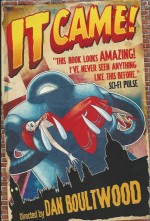
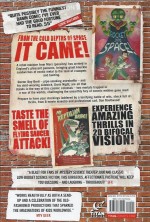
It Came!


By Dan Boultwood, Esq. (Titan Comics)
ISBN: 978-1-78276-005-4

Once upon a time “retro” only meant rockets, with all those thrilling chilling connotations of clunky spaceships, cardboard robots and men in Baco-foil suits shambling about and terrifying avid children who had stayed up late to watch B-movie sci-fi yarns on black-&-white TV sets.

Jeepers, I miss those days, and so, apparently, does multi-talented, forward-thinking nostalgeologist Dan Boultwood.

In 2013, his 4-issue miniseries offered a tantalising tribute to the fantastic fantasy movies which fuelled the imaginations of British Baby-Boomers: simultaneously recapturing the wide-eyed wonder of the period whilst adding layers of archly post-modern humour to the mix…

This stirring monochrome graphic-novelisation of a faux-classic effort from the rightly almost-forgotten Pinetree Studios outfit now allows modern film fans to experience (or revisit) the quirky delights which wowed their grandparents – and all from the comfort of their own homes – or even whilst out riding in a open-topped omnibus…

Packed to bursting with and supplemented by oodles of outrageous, hilarious, mood-setting ads for everything from Smoke & Choke’um Cigarettes to Johnny Foreigner Engine Oil, the story is a loving but irreverent paean of praise not only to those inspirational filmic marvels but also to the small repertory of actors and producers who made the late 1950s and early 1960s such a cornucopia of movie madness.

Like all such matinee marvels, the main feature here is preceded by a short trailer (for The Lost Valley of the Lost) which serves to introduce our cast, specifically He-Man Lead Dick Claymore as the sexist, pipe-chewing, tweed draped boffin Dr. Boy Brett and strident starlet Fanny Flaunders as his long-suffering, infinitely patient, glamorous-whilst-screaming assistant/secretary Doris Night.

The vintage supporting cast includes Bertrum Cumberbund, Spencer Lacey and Joan Fetlock, stalwart Pinetree thespians all…

It’s 1958 and in a beautiful bit of rural, ill-educated England a colossal robot rampages…

Two days later Dr. Brett from SpaceUniversity is treating working class ingénue Doris to a ride in his Morris Minor. He decides they should stop for a Ploughman’s Lunch in a strangely quiet and quaint village, blithely unaware that the reason it’s so still is because the aforementioned alien automaton has depopulated the shire…

Its subsequent surprise attempt to trap the tourists founders only when it stumbles into a cloying web of obfuscating, celebratory bunting…

After their spectacular close call the harried humans reach the next village over, but despite the boffin’s Old Boy Network connections, it’s the Devil’s own job to get the Ministry to mobilise the Military.

Nevertheless, Boy persists and soon a squad of veterans arrive to take control of the situation (a superb pastiche of the venerable icons of the “Carry-On” film franchise), only to vanish as the rapacious robot strikes again…

Undaunted, Boy drags Doris into more trouble and soon they find themselves aboard a vast Flying Saucer, uncovering the nature of the invaders’ appalling assault. The creepy, apparently unstoppable horrors are imprisoning salt-of-the-earth British citizens and somehow extracting their Stiff Upper Lips…

Following a necessary Intermission for the purchase and consumption of gin and fags, the cartoon/celluloid calamity continues as our hero – and the girl – escape and head for London to warn the authorities, but not before accidentally dropping a handy but unlucky army division on exercises right in the UFO’s marauding sights.

Dr. Brett arrives barely ahead of the indestructible, unbeatable Saucer and, as the World’s Smoggiest Capital burns and founders, he is compelled to stop running and turn his mighty, college-honed intellect to the task of destroying the threat to civilisation…

This collection is also augmented by the original full-colour covers, hysterical background “information pages” on and intimate photos of stars Claymore and Flaunders, blueprints and design sketches for the alien Grurk and Flying Saucer, a selection from the infamous It Came! Cigarette Cards and colour posters for other Pinetree Studio releases such as ‘My Reptilian Bride!’, ‘Rocket Into Space!’, ‘The Lost Valley of the Lost’ and ‘Myopic Moon Men from the Moon’…

More revelations are forthcoming in the ‘Metropolitan Police Incident Report on Mr. Claymore’s “eccentric” Drinking Habits’, and Director Boultwood’s photo-feature exposing his Special Effects magic in animating the Saucer for celluloid.

It Came! is a brilliant and sublime masterpiece of loving parody, perfectly executed and astoundingly effective. It is also the funniest – both visually and verbally – book I’ve read in years, blending slapstick with satire, outrageous ideas with infamous characterisations, and spit-taking puns, single entendres and innuendoes that would do Sid James, Charles Hawtrey or Kenneth Williams proud.

Miss it at your peril, Chaps (and Ladies too…).
It Came! ™ and © 2014 Dan Boultwood.

It Came! is published on March 11th.

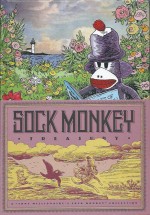
Sock Monkey Treasury – A Tony Millionaire’s Sock Monkey Collection


By Tony Millionaire (Fantagraphics Books)
ISBN: 978-1-60699-696-6

It’s a fact sad but true that we can’t always be in the right place at the right time. No matter how scrupulous or diligent one might in the pursuit of a passion or hobby, things get missed. I, for example, missed the first comicbook releases of Dark Horse’s Sock Monkey by Tony Millionaire in 1998.

Sure, thanks to the miracles of back issue comic-shops I wasn’t deprived for long, but still, it was a close thing…

You, happily, don’t have any such worries, especially as Fantagraphics have just released a huge (286 x 203mm) and sumptuous 336 page hardback – 80 in full colour – collecting and commemorating all twelve uniquely dark and fanciful monochrome, multiple award-winning, all-ages adventures originally published as occasional miniseries between 1998 and 2007. Also included are the two colour hardcover storybooks Millionaire created in 2002 and 2004.

Tony Millionaire clearly loves to draw and does it very, very well; referencing classical art, timeless children’s book illustration and an eclectic mix of pioneering comic strip draughtsmen like George McManus, Rudolph Dirks, Cliff Sterrett, Frank Willard, Harold Gray, Elzie Segar and George Herriman: seamlessly blending their styles and sensibilities with European engravings masters from the “legitimate” side of the pictorial storytelling racket.

Born Scott Richardson, he especially cites Johnny (Raggedy Ann and Andy) Gruelle and English illustrator Ernest H. Shepard (The Wind in the Willows, Winnie the Pooh) as definitive formative influences.

With a variety of graphical strings to his bow such as his own coterie of books for children (particularly the superbly stirring Billy Hazelnuts series), animation and the brilliant if disturbing weekly strip Maakies – which describes the riotously vulgar and absurdly surreal adventures of an Irish monkey called Uncle Gabby and his fellow über-alcoholic and nautical adventurer Drinky Crow. They are abetted but never aided by a peculiarly twisted, off-kilter cast of reprobates, antagonists and confrontational well-wishers.

Those guys are the mirror universe equivalents of the stars of these sublime confections…

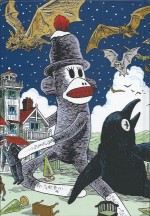
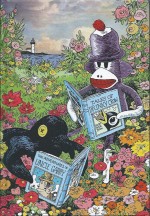
In a Victorian House – of variable shape and size – by the sea, an old Sock Monkey named Uncle Gabby has great adventures and ponders the working of a wonderful yet often scary world. His constant companion is a small cuddly-toy bird with button eyes called Mr. Crow, who doesn’t understand why he cannot fly and sometimes eases his sorrow with strong spirits.

Their guardian is a small girl named Ann-Louise, and many other creatures living and artificial share the imposing edifice…

The gloriously imaginative forays into the fantastic begin as the material monkey is chased through the house by marauding toy pirates in their brigantine. In his flight he espies a gleaming, glittering glass concoction hanging from the ceiling. Convinced something so beautiful must be the Promised Land he enlists his artificial avian pal to help him enter ‘Heaven’. However the pirates have not given up and the chaos soon escalates…

‘Borneo’ describes the pair’s discovery of a shrunken human head and subsequent heroic oceanic odyssey to return the decapitated talisman home. Of course, if they had thought to unseal the sewn-shut lips he could have told them they were going in the wrong direction…

The next tale is a macabre all-action thriller which begins when a lost bat gets stuck in the attic ‘Dollhouse’. Mr. Crow meanwhile is attempting to console the freshly widowed Mrs. Smalls in the cellar. Things go even more savagely awry when the faux crow and well-meaning matchmaker Uncle Gabby try to introduce the grieving mouse to the strapping, winged stranger, utterly unaware of his pedigree as a South American Rodent-Eating Bat…

Knick-knacks, trinkets and ornaments have been going missing in the next tale and Ann-Louise attributes the thefts to ‘The Trumbernick’ who lives in the Grandfather clock. Having mislaid his hipflask, Mr. Crow investigates and finds the horde of goodies, in truth purloined by a capricious Blue Jay.

Disillusioned by the death of a beloved myth and disheartened by the antics of a venal – and extremely violent – bird, they are subsequently stunned to see an actual Trumbernick return, righteously enraged at the blow to his spotless reputation…

In ‘The Hunters’, stuffed bird and Sock Monkey, inspired by a room full of trophies and stuffed beasts, decide to take up the sport of slaughter, only to find that their size, relative ineffectuality and squeamishness – not to mention the loquacity and affability of their intended prey – prove a great impediment to their ambitions…

Millionaire proves the immense power of his storytelling in ‘A Baby Bird’, as Uncle Gabby’s foolish meddling with a nest – after being specifically told not to – results in tragedy, and brutal self-immolating repercussions that would make King Lear quail…

The author abandoned his masterful pen-&-ink etching style for soft mutable charcoal rendering in ‘The Oceanic Society’, wherein excitable doll Inches unknowingly performs an act of accidental cruelty at the shore and invites the vengeance of many outraged sea creatures against the tot inhabitants of Ann-Louise’s house…

An innocent attempt by the little girl and Mr. Crow to find Uncle Gabby a romantic companion goes hideous wrong and results in monstrous ‘Heartbreak’ when they throw away his actual true love and replace her with a ghastly mechanical monkey horror. The bereft puppet can then only find surcease in escalating acts of hideous destruction…

In 2002 Millionaire took his characters into a whimsical watercolour wonderland with “a Populare Pictonovelette” hardback entitled ‘The Glass Doorknob’. The beguiling tale is included here a series of full-colour plates supplanted by blocks of text, describing how the house dwellers once saw an indoor rainbow beneath a doorknob and spent all summer trying to recreate the glorious spectacle by acquiring and aligning every other item of glass, crystal or pellucid material they could find or steal…

The return to stark, inky monochrome augurs the onset of the terrifying 4-part epic ‘The Inches Incident’ which begins off the coast of Cape Ann when grizzled mariner Oyster Joe discovers thieving stowaways plundering his sailing ship.

Amidst spectacular hunts for sea monsters the villains Uncle Gabby and Mr. Crow explain how their former friend Inches mysteriously shanghaied and dumped them at sea…

Their new ally returns them home, but upon arrival they discover that the doll has become Evil! Boldly braving the house they discover the poor creature has been possessed by an inconceivable horror which drives them off and provokes a fantastic sea voyage to find the devil’s only nemesis…

This staggering, bleakly charming compendium closes with an existential treat from 2004. ‘Uncle Gabby’, coloured by Jim Campbell, was another one-shot hardback – albeit in standard comics format – which offered a few revelatory indulgences on the puppet heroes’ poignant origins, all wrapped up in a baroque bestiary and imaginative travelogue as the Sock Monkey discloses his shocking ability to un-name things and thereby end their existences…

Visually intoxicating, astoundingly innovative and stunningly surreal, Sock Monkey yarns judiciously leaven wonder with heartbreak and gleeful innocence with sheer terror. Millionaire describes them as for “adults who love children’s stories” and these tall tales all offer enchanting pictorial vistas and skewed views of the art of storytelling that no fan of comics or fantasy could ever resist.
Sock Monkey Treasury © 2014 Tony Millionaire. This edition © 2014 Fantagraphics Books.

The Simon & Kirby Library: Horror!


By Joe Simon, Jack Kirby, Mort Meskin and various (Titan Books)
ISBN13: 978-1-84856-959-1

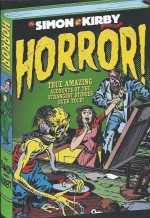
After too many years left languishing, there’s some magnificent vintage Jack Kirby material around these days, and the latest in Titan Books’ splendidly sumptuous Simon & Kirby Library gathers that iconic coupling’s groundbreaking contributions to the genre of mystery, suspense and the supernatural.

His collaborations with fellow industry pioneer Joe Simon always produced dynamite concepts, unforgettable characters, astounding stories and huge sales no matter what genre avenues they pursued (they actually invented the Romance comicbook), blazing trails for so many others to follow and always reshaping the very nature of American comics with their innovations and sheer quality.

Comicbooks started slowly in 1933, until the creation of superheroes like Superman unleashed a torrent of creative imitation and invented a new genre. Implacably vested in the Second World War, the masked mystery man swept all before him (very occasionally her or it) until the troops came home and older genres supplanted the Fights ‘n’ Tights crowd.

Although new kids kept up the buying, much of the previous generation also retained their four-colour habit but increasingly sought more mature themes in the reading matter. The war years altered the psychology of society and a more world-weary, cynical reading public came to see that all the fighting and dying hadn’t really changed anything. Their chosen forms of entertainment – film and prose as well as comics – increasingly reflected this.

Western, War and Crime comics, madcap teen comedy and anthropomorphic funny animal features were immediately resurgent, the aforementioned love comics appeared in 1947 and pulp-style Science Fiction began to spread, but gradually another global revival of spiritualism and interest in the supernatural (possibly provoked by the monstrous losses of the recent conflict, just as had happened in the 1920s following WWI) led to a wave of increasingly impressive, evocative and even shocking horror comics.

There were grisly, gory and supernatural stars before, including a pantheon of ghosts, monsters and wizards draped in costumed hero trappings (the Spectre, Mr. Justice, The Heap, Frankenstein, Sargon the Sorcerer, Zatara, Dr. Fate and dozens of others), but these had been victims of circumstance: the Unknown as power source for super-heroics.

Now the focus shifted to ordinary mortals thrown into a world beyond their ken with the intention of unsettling, not vicariously empowering, the reader.

Almost every publisher jumped on the monumentally popular juggernaut, but B & I (which became the magical one-man-band Richard E. Hughes’ American Comics Group) launched the first regularly published horror comic in the Autumn of 1948, although Adventures Into the Unknown was technically pipped by Avon whose impressive single issue release Eerie debuted and closed in January 1947. They wised up late and launched a regular series in 1951.

By this time Classics Illustrated had already long milked the literary end of the medium with adaptations of the Headless Horseman, Dr. Jekyll and Mr. Hyde (both 1943), The Hunchback of Notre Dame (1944) and Frankenstein (1945) among others.

It was at this time that Joe Simon and Jack Kirby identified another “mature market” gap for the line of magazines they autonomously packaged for publishers Crestwood-Prize-Essenkay to supplement Headline Comics, Justice Traps the Guilty, Police Trap, Young Romance and their other anthologies. They too saw the sales potential for spooky material, resulting in the superb and eerily seminal Black Magic (launched with an October-November 1950 cover-date) and the boldly obscure psychological drama anthology Strange World of Your Dreams in1952.

Marvel had jumped on the bloody bandwagon early but National/DC Comics only reluctantly bowed to the inevitable, launching a comparatively straight-laced short story title that nevertheless became one of their longest-running and most influential titles with the December 1951/January 1952 launch of The House of Mystery.

Soon after, however, a hysterical censorship scandal led to witch-hunt Hearings (feel free to type Senate Subcommittee on Juvenile Delinquency, April-June 1954 into your search engine at any time) which panicked most comics publishers into adopting a castrating straitjacket of self regulatory rules…

Just like today, America back then cast about wildly looking for external contaminants rather than internal causes for a perceived shift in social attitudes and youthful rebellion, happily settling on bloodthirsty comics about crime or horror, drenched in unwholesome salacious sex, as the reason their children were talking back, acting up and staying out.

S&K didn’t do those kinds of comicbooks but they got tarred – and metaphorically feathered too – in the media-fuelled frenzy…

This striking full-colour hardback begins with the essay ‘That Old Black Magic’ by series editor Steve Saffel, delineating the history of the title and tone of the times whilst ‘Simon and Kirby’s Little Shop of Horror’ describes the working of the small but prolific studio of rotating artists who augmented the output of the named stars: creators such as Mort Meskin, Bill Draut, Martin Stein, Ben Oda, George Roussos, Vic Donahue, Bill Walton, Jim Infantino, Bruno Premiani, John Prentice, Jerry Grandenetti and more…

With a vast output across many titles, S&K simply couldn’t produce every story and many yarns here are ghosted by other hands, although each and every one does begin with a stunning Kirby splash panel.

As with all their titles, Simon & Kirby offered genre material tweaked by their own special sensibilities. Black Magic – and the Mort Meskin-inspired The Strange World of Your Dreams – eschewed cheap shocks, mindless gore and goofy pun-inspired twist-ending yarns in favour of dark, oppressive suspense soaked in psychological unease and inexplicable unease: tension over teasing…

The stories presented fantastic situations and too frequently for comfort there were no happy endings, pat cosmic justice or calming explanations: sometimes the Unknown just blew up in your face and you survived or didn’t… and never whole or unchanged.

The compendium of black cartoon cavortings commences with ‘Last Second of Life!’ (from volume 1 #1, October-November 1950) wherein a rich man obsessed over what the dying see at the final breath, but learned to regret the unsavoury lengths he went to finding out, after which ‘The Scorn of the Faceless People!’ (#2 December 1950-January 1951) relates the meaning behind a chilling nightmare. It’s not hard to believe this one must have prompted the creation of the spin-off Strange World of Your Dreams. Issue #2 also provided a chilling report on a satanic vestment dubbed ‘The Cloak!’ whilst an impossible love in the icy wastes of Canada ended with ‘A Silver Bullet for Your Heart!’ in #3 (February-March 1951).

Issue #4 provided ‘Voodoo on Tenth Avenue’ as a disgruntled wife went too far in her quest to get rid of her man, whilst in #5 ‘The World of Spirits’ recounted the uncanny predictions of Emanuel Swedenborg in a brief fact feature before #6 described psychic connection and a ‘Union with the Dead!’ and a ravaged mariner survived meeting ‘The Thing in the Fog!’ (#7) – an encounter with the legendary Flying Dutchman…

Black Magic #8 (December 1951-January 1952) detailed the sacrifice a woman made to save her man from ‘Donovan’s Demon!’ (mostly illustrated by Bob McCarty) whilst ‘Dead Man’s Lode!’ (#10 March 1952 – the series now being monthly) related a ghostly experience in an old mine and ‘The Girl Who Walked on Water!’ in #11 showed the immense but fragile power of self-belief…

Meskin & Roussos illustrated #12’s ‘A Giant Walks the Earth!’ as a downed pilot lost his best friend to a roving colossus in India, after which the utterly chilling and unforgettable ‘Up There!’ kicks off three stories from the landmark 13th issue…

That saga of a beguiling siren of the upper stratosphere is followed by ‘A Rag – a Bone and a Hank of Hair!’ (Meskin) and a pile of trash that learned to love, whilst ‘Visions of Nostradamus!’ (by Al Eadeh) tracked and interpreted the prognosticator’s predictions.

‘The Angel of Death!’ in #15 detailed a horrific medical mystery and ‘Freak!’ (#17, possibly by Bill Draut) exposed a country doctor’s deepest shame.

Black Magic #18 (November 1952) is another multi-threat issue. ‘Nasty Little Man!’ gets my vote for scariest horror art job of all time and saw three hobos discover to their everlasting regret why you shouldn’t pick on short old men with Irish accents.

Then ‘Come Claim My Corpse’ (Martin Stein?) offers a short, sharp, shocker wherein a convict discovers too late the flaw in his infallible escape plan, before an investigator tracing truck-wreckers learns of ‘Detour Lorelei on Highway 52’ (McCarty)…

‘Sammy’s Wonderful Glass!’ in #19 (December 1952) outlined the tragic outcome of a retarded lummox whose favourite toy could expose men’s souls, after which two shorts from #20 (January 1953) follow.

‘Birth After Death’ retold the true story of how Sir Walter Scott‘s mother survived premature burial, whilst ‘Oddities in Miniature: The Strangest Stories Ever Told!’ offered half a dozen uncanny tales on one page.

Issue #21 provided ‘The Feathered Serpent’ in which an American archaeologist uncovers the truth about an ancient god, #22 (March 1953) slipped into sci-fi morality play mode with the UFO yarn ‘The Monsters on the Lake!’, and ‘Those Who Are About to Die!’ from #23 sketched out the tale of a painter who could predict imminent doom…

A brace of tales from #24 – May 1953 – begin with a scholar who attempts to contact the living ‘After I’m Gone!’, complemented by the half page fact feature ‘Strange Predictions’ (Harry Lazarus) after which ‘Strange Old Bird!’ is the first of three stories from the (again bimonthly) Black Magic #25 (June-July 1953).

In this gently eerie thriller a little old lady gets the gift of life from her tatty old feathered friend, whilst ‘The Human Cork!’ precis’ the life of the literally unsinkable Angelo Faticoni , before a man without a soul escapes the morgue to become ‘A Beast in the Streets!’

There’s a similar surfeit of sinister riches from #26, beginning with ‘Fool’s Paradise!’ wherein a cheap bag-snatcher makes a deal with the devil, after which ‘The Sting of Scorpio!’ sees a rude sceptic wish she’d never taunted a fortune teller, whilst ‘The Strange Antics of the Mystic Mirror!’ terrified nurses in a major metropolitan hospital and ‘Demon Wind!’ (Kirby inked by Premiani) finds a brash Yankee learn not to mock the justice system of primitive native peoples…

‘The Cat People’ (#27) mesmerised and forever marked an unwary tourist in rural Spain, and the same issue exposed a seductive Scottish supernatural shindig hosted by ‘The Merry Ghosts of Campbell Castle’, whilst #28 saw an unwilling organ donor return to take back his property in ‘An Eye For an Eye!’ after which the same issue revealed with mordant wit how a mummy returned to make his truly beloved ‘Alive After Five Thousand Years!’…

From an issue actually cited during the anti-comicbook Senate Hearings, ‘The Greatest Horror of Them All!’ (#29 March-April 1954) told a tragic tale of a freak hidden amongst freaks, before Black Magic #30 revealed the appalling secret of ‘The Head of the Family!’ (Kirby & Premiani) whilst #31 provided both alien invasion horror ‘Slaughter-House!’ and the cautionary tale of a child raised by beasts in ‘Hungry as a Wolf!’ (Ernie Schroeder).

‘Maniac!’ from #32 is another artistic tour de force and a tale much “homaged” in later years, detailing how a loving brother stops villagers taking his simple-minded sibling away, and the Black Magic section concludes with a terrifying fable of atomic radiation and mutated sea creatures in ‘Lone Shark’ from #33 November-December 1954.

With the sagacious, industry-hip, quality-conscious Simon & Kirby undoubtedly seeing the writing on the wall, their uniquely macabre title was wisely cancelled in 1954, not long before the Comics Code came into effect. A bowdlerised version was relaunched in 1957, long after they had dissolved their partnership and moved into different areas of the industry.

However the eerie treats don’t end as a short but sublime sampling from their other mystery title is appended here.

We Will Buy Your Dreams‘ discusses the features and stories from abortive and revolutionary title The Strange World of Your Dreams, a title inspired by studio-mate Mort Meskin’s vivid night terrors. The premise involved parapsychologist Richard Temple explaining and analysing storied nightmares and pictorially dramatising dreams sent in by readers.

The too short comics section then begins with ‘Send Us Your Dreams’ from #1 (August 1952), a “typical” insecurity nightmare and the chilling ‘I Talked with my Dead Wife!’, whilst #2 (September-October) provided a trio of traumen tales: ‘The Girl in the Grave!’ a scary wedding scenario in ‘You Sent Us This Dream!’ and ‘Send Us Your Dreams’ in which Dr. Tempe describes the extent of self preservation imagery…

‘The Woman in the Tower!’ came from #3 (November-December) and detailed typical symbolism whilst ‘You Sent Us this Dream’ from the same issue explains away a nightmare climb up an unending tower…

Capping off everything is a spectacular Cover Gallery reprinting Black Magic #1 through #33 plus a stunning unpublished cover, and performs the same service for The Strange World of Your Dreams #1-4, and includes the unpublished #5 just to make our lives utterly complete.

The Simon & Kirby Library: Horror! is a gigantic compendium of classic dark delights that perfectly illustrates the depth and scope of their influence and innovation and readily displays the sheer bombastic panache and artistic virtuosity they brought to everything they did.

This tremendous hardcover is a worthy, welcome introduction to their unique comics contributions, but there’s loads left still to see so let’s have some more please…

© 2014 Joseph H. Simon and the Estate of Jack Kirby. All Rights Reserved.