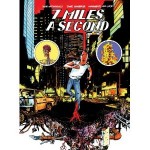
Seven Miles a Second


By David Wojnarowicz, James Romberger & Marguerite van Cook (Fantagraphics Books)
ISBN: 978-1-60699-614-0

Every so often an outsider dabbles in the comics medium and brings something new to the tried-and-trusted mix which forces insiders to re-evaluate the way and the why of their preferred medium. Such a case was the collaboration between iconoclastic multi-media artist David Wojnarowicz, cartoonist and occasional comics pro James Romberger and painter Marguerite van Cook.

During the 1980s and until his death in 1992 Wojnarowicz was a public fireball: a restless and prolific author, poet, musician, painter, filmmaker, photographer, performance artist, advocate for Artist’s Rights, anti-censorship champion and political activist, driven and inspired to constantly create by his appallingly deprived and corrupted younger days as a teen runaway, street prostitute and AIDS sufferer.

Linked by surreal and iconic visual observations, the visual thesis consists of three interlinked episodes from the author’s life, threaded and embellished with reminiscences, observations, dreams and poetry to form a discourse with the world which made Wojnarowicz the compulsive, questing, wonderingly politicised rebel that he was.

With ‘Thirst’, we follow a worldly-wise, street-smart kid as he dodges Vice Cops and cruises for “Johns” on the 1970’s hustling, bustling corners of 42nd Street, before encountering just one more sad guy in search of negotiable warmth and temporary affection…

‘Stray Dogs’ takes place some years later as David and his latest dangerous boyfriend Willy struggle to feed themselves and trawl the soup kitchens, halfway houses and shelters in search of food and a safe place to sleep. Their nightmare journey through the dregs and gutters of the city would enrage a saint and make the Devil weep…

The disturbingly forensic inner narrative ends with a contemplative and breathtakingly introspective marshalling of ideas and experiences in the eponymous fantasy masterpiece ‘Seven Miles a Second’ (“the minimum velocity necessary to escape the gravitational pull of the Earth”). This explosively excessive tour of culture’s conjoined imagination was begun during Wojnarowicz’s final months and left uncompleted until Romberger, himself a renowned cartoonist and exhibition artist – particularly in his scenes of urban and inner city life – returned to the author’s incomplete notes and his own memories of the man to pull everything together.

This final painfully intense and intimate graphic narrative was initiated in 1989 and only completed after Wojnarowicz died from AIDS-related complications. The collaboration was posthumously released in 1996 as a Vertigo Prestige Format Publication – a slim 64-page comicbook-sized album which became a cult classic of the newborn “Literary Comics” movement.

Wojnarowicz’s lost masterpiece of graphic narrative has now been rescued by Fantagraphics: re-mastered, extended, expanded, augmented and repackaged in a lavish hardback oversized (298x229mm) edition that magnificently gifts this telling testament with the physical gravitas and presence it always deserved.

Illustrator Romberger and his wife Van Cook – whose original watercolour hues have been lovingly restored for this edition – have also included five new pages distilled from their intimate knowledge of Wojnarowicz for this breathtakingly evocative, challenging, terrifying, hallucinogenic, appallingly revelatory condemnation of a society that happily eats its weak and different,

Hard to take, frighteningly beautiful and staggeringly honest, this is a book that will – and must – upset all the right people, but is one that no mature, clear thinking devotee of graphic narrative should miss.

© 2012 James Romberger, Marguerite Van Cook and the Estate of David Wojnarowicz. This Edition © 2012 Fantagraphics Books, Inc. All rights reserved.

Spider-Man and the Fantastic Four


By Christos Gage & Mario Alberti with Bill Mantlo, Mike Zeck, John Byrne & various (Marvel)
ISBN: 978-0-7851-4423-6

After a shaky start in 1962, The Amazing Spider-Man quickly became a popular sensation with kids of all ages, rivalling the groundbreaking creative powerhouse that was Lee & Kirby’s Fantastic Four. Eventually the quirky, charming action-packed comics soap-opera became the model for an entire generation of younger heroes who imperceptibly began elbowing aside the staid, more mature costumed-crimebusters of previous publications and eras.

Since the 1970s the Astounding Arachnid and his hard-luck alter ego Peter Parker have become full-blown multimedia icons and survived every manner of seemingly insane reboot and upgrade to become globally real in the manner of Sherlock Holmes, Mickey Mouse, Tarzan, Superman, Batman and Harry Potter.

The Fantastic Four are – more often than not – maverick genius Reed Richards, his fiancée (later wife) Sue Storm, their trusty friend Ben Grimm and Sue’s teenaged brother Johnny, driven survivors of a independently-funded space-shot which went horribly wrong after Cosmic Rays penetrated their ship’s inadequate shielding.

When they crashed back to Earth, the quartet found that they had all been hideously mutated into outlandish freaks. Richards’ body became elastic, Sue gained the power to turn invisible and, eventually, project force-fields, Johnny could turn into living flame, and poor, tormented Ben was mutated into a horrifying brute who, unlike his comrades, could not return to a semblance of normality on command.

A core element of superhero comics is the “team-up” wherein costumed champions unite to tackle a greater than usual threat, or even each other; a sales-generating tactic taken to its logical extreme at Marvel wherein most early encounters between masked mystery men were generally prompted by jurisdictional disputes resulting in usually spectacular punch-ups before the heroes finally got on with allying to confront the real menace…

Combining Marvel’s biggest franchise and most creatively influential series, this slim, slick tome collects the 4-issue miniseries Spider-Man/Fantastic Four (from August to September 2010) by scripter Christos Gage and artist Mario Alberti, reprising their earlier trawl through key points of Marvel history affecting the wall-crawler and assorted iterations of X-Men.

Also focussing on the long, convoluted, inextricably interwoven relationship of the solitary web-spinner and the First Family of Superheroics, this compilation also offers an earlier crossover of the icons first seen in Peter Parker, the Sensational Spider-Man #42 and Fantastic Four #218 (both from May 1980).

The first chapter of the main story is set just after stuffy Mr. Fantastic and Sue Storm announced their engagement, a time when Peter Parker had just started college at Empire State University.

A ‘Crisis on Campus’ was triggered when the institution hosted a secret conference of world leaders and Victor Von Doom, absolute monarch of Balkan kingdom Latveria, demanded his arch-foes the FF should be his bodyguards. With the State Department pushing all the patriotism buttons the furious foursome had no choice but to reluctantly comply…

Intended merely as a means to aggravate and humiliate his enemies, the ploy became deadly serious when enraged Atlantean Prince Namor and his sub-sea legions attacked the meeting seeking vengeance on Doom.

Events escalated when the Iron Dictator refused to stay locked in a super-secure Panic Room and possessed the body of the Human Torch to personally rebuke the Sub-Mariner‘s insults. Total catastrophe seemed unavoidable until the physically overmatched web-spinner proffered a brilliantly sneaky way to break up the cataclysmic fight…

Unknown to all participants, however, a clandestine time-travelling foe was the chaos as cover to acquire elements necessary to bring about the downfall of his greatest foes and the very rewriting of history…

‘Symbiosis’ skips forward a few years to the time after the first Secret Wars, when Spider-Man discovered that his new smart-tech black costume was in fact an alien parasite. The uniform had attempted to bond permanently to Peter and had to be forcibly removed and contained by Reed and the FF.

The strange invader (see Spider-Man vs. Venom and Amazing Spider-Man: the Saga of the Alien Costume for further details) would eventually bond with deranged, disgraced reporter Eddie Brock, becoming Venom, a savage, shape-changing dark-side version of the Astounding Arachnid, but in this untold aside the cosmic creature broke free almost immediately, seizing control of Richards, temporary replacement She-Hulk and eventually Reed’s son Franklin.

The boy possessed dormant power on a level to reshape the universe and, as Spider-Man selflessly attempted to lure the Symbiote away by offering himself as a sacrifice, the mysterious time-thief again surreptitiously stepped in to purloin another artefact crucial to his plan…

Once the heroes had at last repelled and incarcerated the parasite peril, the saga shifted forward to the time when Skrull outlaw De’Lila invaded Earth, with her own people hot on her viridian high heels.

Evading heavy pursuit she attacked the FF and seemingly killed them. Disguised as a grieving Sue Richards she then recruited four heroes – The Hulk, Wolverine, Ghost Rider and Spider-Man – to hunt down the murderers.

Their quest took them deep into the bowels of the Earth and battle with the Mole Man and his legion of monsters, before she was exposed and defeated. The shapeshifting psionic siren had been seeking a semi-sentient ultimate weapon called a Technotroid and ‘Bizarre Love Triangle’ occurs minutes after the close of the original story (for which see Fantastic Four: Monsters Unleashed) as the temporal raider frees De’Lila from her Skrull captors as a deadly diversion whilst he takes the essence of the Technotroid for himself

Deprived of her trademark duplicity but with her telepathic abilities augmented, the temptress simply makes most of the men and Skrull cops her love-slaves and sets them upon Sue, new temp Sharon “She-Thing” Ventura and Spider-Man, forcing the irrepressible wall-crawler to use the most shocking of tactics to free the males from their murderous stupors…

The decade-long scheme of the mystery time-bandit is finally revealed in the concluding chapter ‘Family Values’ as – in the present – Spider-Man is lured to the Fantastic Four’s HQ and attacked with the rest of the team by one they had long considered to be part of their exotic extended family, lost in combat years ago…

Armoured with ultimate power and sporting a colossal chip on his shoulder, the prodigal intends to destroy Dr. Doom and offers the astounded gathering a chance to prove their loyalty by joining him…

When they try to humour the clearly disturbed assailant he cracks and all hell breaks loose…

However not all the heroes’ power can affect the attacker but Spider-Man, child of misuse, ill-fortune and isolation thinks he sees a kindred damaged spirit in the maniacal marauder…

Wry, witty, explosively action-packed, bombastic and genuinely moving, this clever re-evaluation of the bonds between the First Family and the solitary Spider-Man is a delightful celebration of everything that made Marvel such a force for change in the industry, and it’s a real shame that new readers won’t be able to pick up on the historical continuity scholarship that underpins a great fun yarn. That being said, this is still a funnybook frolic the freshest newbie to comics can easily follow…

Following the fearsome festivities is a section of sketches, pencils, unused and working drawings from Alberti, before the compilation concludes with an old-school saga from Peter Parker, the Sensational Spider-Man #42 and Fantastic Four #218.

The action begins when ESU student Peter Parker goes on a class jaunt on a party boat  and is lured into a trap by the Frightful Four in ‘Give Me Liberty of Give Me Death’ by Bill Mantlo, Mike Zeck & Jim Mooney.

The villains had broadsided the wall-crawler after new recruit Electro impersonated the Human Torch and, in the concluding ‘When a Spider-Man Comes Calling!’ (FF #218 by Mantlo, John Byrne & Joe Sinnott, the Trapster repeats the tactic to ambush the crime-busting quartet, allowing his comrades the Wizard and Sandman to take over the Baxter Building citadel of the heroes.

…At least until the fighting-mad web-spinner finally breaks free to launch an unstoppable counter attack…

Most people who read comics have a passing familiarity with all these characters, and even occasional consumers won’t have too much trouble following the backstory in this magnificently compelling Costumed Drama, so if you’re looking for some fun-friendly Fights ‘n’ Tights fantasy this could well be the one for you…
© 1980, 2010 and 2011 Marvel Characters, Inc. All Rights Reserved.

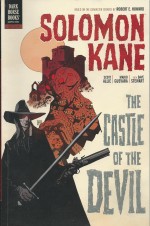
Solomon Kane volume 1: the Castle of the Devil


By Scott Allie, Mario Guevara, Dave Stewart & various (Dark Horse Books)
ISBN: 978-1-59582-282-6

Following on from their revitalisation – if not actual creation – of the comicbook Sword and Sorcery genre in the early 1970s with their magnificent adaptation of pulp superstar Conan the Barbarian, Marvel Comics quite naturally looked for more of the same, and found ample material in Robert Ervin Howard’s other warrior heroes such as King Kull, Bran Mac Morn and dour Puritan Avenger Solomon Kane.

The fantasy genre had undergone a global prose revival in the paperback marketplace since the release of soft-cover editions of Lord of the Rings (first published in 1954), and the 1960s resurgence of two-fisted action extravaganzas by such pioneer writers as Edgar Rice Burroughs, Otis Adelbert Kline and Fritz Lieber. This led to a generation of modern writers such as Michael Moorcock and Lin Carter kick-starting their careers with contemporary interpretations of man, monster and mage. Without doubt, though, nobody did it better than the tragic Texan whose other red-handed stalwarts and tough guys such as El Borak, Steve Costigan, Dark Agnes and Red Sonya of Rogatino excelled in a host of associated genres and like milieus.

Solomon Kane debuted in the August 1928 issue of Weird Tales in a gripping tale of vengeance entitled “Red Shadows”, making seven more appearances before vanishing in 1932 as his creator concentrated on the far more successful Conan. Three more tales, some epic poems and a few unfinished ideas and passages remained unpublished until 1968 when renewed interest in the author’s work prompted publishers to disinter and complete the yarns.

Apart from two noteworthy 4-colour exceptions, during the 1970s and 1980s, Marvel was content to leave Solomon Kane to monochrome adaptations of canonical Howard stories in Dracula Lives, Savage Sword of Conan, Monsters Unleashed and other older-reader magazines, but with his transfer to the Dark Horse stable the Holy Terror has recently flourished in broader, lavishly-hued interpretations of the unfinished snippets left when the prolific Howard took his life in 1936.

Beginning in 2008 and released as a succession of miniseries, these almost-new adventures offer the modern fan a far darker and more moody glimpse at the driven, doom-laden wanderer.

Kane is a disenfranchised English soldier of fortune in the 16th century on a self-appointed mission to roam the Earth doing God’s Work: punishing the wicked and destroying devils and monsters. With no seeming plan, the devout Puritan lets fate guide his footsteps ever towards trouble…

Expanded upon and scripted by Scott Allie from the tantalisingly unfinished fragment The Castle of the Devil, this initial paperback volume collects the 5-issue story-arc from September 2008-February 2009 and also includes a short piece which originally featured online in the digital MySpace Dark Horse Presents site in June 2008.

The drama opens as the surly pilgrim bloodily encounters bandits and an horrific wolf-beast in Germany’s Black Forest, losing his horse in the attack. Proceeding on foot he finds a boy hanging from a gibbet and cuts the near-dead body down. Soon after, he meets mercenary John Silent, another Englishman in search of fortune…

From his new companion, Kane learns that local lord, Baron von Staler, has an evil reputation and will not be happy to have his affairs meddled with. The puritan doesn’t care: he wants harsh words with the kind of man who would execute children…

Despite genuine misgivings the insufferably jolly Silent insists on accompanying his clearly suicidal countryman and soon the pair are admitted to a bleak and terrifying Schloss built on the remains of an old abbey…

Von Staler is not the mad tyrant they had been warned of. The gracious, pious old warrior with devoted servants and a beautiful young Moorish wife welcomes them in, offers them the hospitality of his hearth and charms them with his easy manner. The lord is appalled by the tale of the hanged boy, denying any knowledge of the atrocity and swearing to bring the culprits to justice.

Over supper he and his bride Mahasti explain that their ill-repute is unjustly earned. The simple peasants have unfairly conflated him with the manse’s previous accursed inhabitants: a chapter of monks who murdered their own Prior two centuries past.

Vater Stuttman had been a holy man until he sold himself to Satan and his desperate brethren had been forced to entomb and starve him to contain his evil. With the church determinedly ignoring their plight the chapter faded from the sight of Man and eventually Staler’s family had purchased the lands, building their ancestral seat upon the ruins.

The peasants however, still called it “the Church of the Devil”…

Gratified to find a man as devoted to God as himself, Kane relaxes for the first time in months, thankful to spend a night in a warm bed with people as devout as he…

The truth begins to out in ‘The Dead of Night’ as Silent goes prowling within the castle and kills one of the Baron’s retainers, even as Kane’s rest is disturbed by the shameless Mahasti offering herself to him…

Spurning her advances, the furious puritan leaves the citadel to wander the forest, again encountering the colossal wolf thing. Back in his bed Silent, nursing a deep wound, dreams of beleaguered old monks and their apostate Prior…

In ‘Offerings’ the truth slowly begins to dawn on the melancholy wanderer as he discourses with the strangely ill-tempered Silent. Something is badly amiss in the household, but when Kane and the Baron ride out that morning all suspicions are stayed by the discovery of another gibbet and another boy. This one however is nothing but ragged scraps for the crows that festoon his corpse, and Kane’s rage is dwarfed by the ghastly uncomprehending shock and disbelief of the Baron…

The servants however are not so flustered and something about their muted conversations with their master jars with the morose Englishman. And in the castle, Mahasti finds Silent a far more amenable prospect, happy to listen to the secrets she wants to share…

‘Sound Reasons and Evil Dictates’ offer more insights into the incredible truth about von Staler, as Kane takes his fellow Englishman into his full confidence before Silent and Mahasti ride out into the wild woods and meet a ghost who reveals the terrifying truth about the Vater Stuttman and the appalling thing the monks uncovered two hundred years past…

That demonic cadaver has whispered unknowable secrets to one of that long-gone congregation and has continued for all the days and years since. Now the man who was Father Albrecht is ready to welcome it and its appalling kin back to full, ravening life in these benighted grounds…

Von Staler and Kane are arguing and, as accusations become blows, the secret of ‘The Wolf’ is at last revealed, even as faithful retainers capture Mahasti and Silent, leaving them on the gibbets as fodder for a quartet of horrors returning for their fleshly tribute in ‘His Angels of the Four Winds’. Spectacularly battling his way free of the castle, Kane is only in time to save one of the monsters’ victims, but more than ready to avenge the centuries of slaughter and blasphemy in ‘The Chapel of the Devil’ and grimly cleansing the tainted lands in the ‘Epilogue: Wanderers on the Face of the Earth’…

The art is beguiling and emphatically evocative with Mario Guevara’s pencils astonishingly augmented by a painted palette courtesy of colourist Dave Stewart, and the book is packed with artistic extras and behind-the-scenes bonuses such as a gallery of covers and variants and ‘The Art of Solomon Kane’ with sketches and designs by the penciller, architectural shaper Guy Davis and illustrators John Cassaday, Stewart, Laura Martin & Joe Kubert before the tome terminates with that aforementioned digital vignette wherein Kane applies his own savage wisdom of Solomon to a troubled village of ghost-bedevilled souls in ‘The Nightcomers’…

Powerful, engaging and satisfactorily spooky, this fantasy fear-fest will delight both fans of the original canon and lovers of darkly dreaming, ghost-busting thrillers.
© 2009 Solomon Kane Inc. (“SKI”). Solomon Kane and all related characters, names and logos are ™ and ® SKI.

Plastic Man Archives volume 3


By Jack Cole (DC Comics)
ISBN: 1-56389-847-0

As recounted by Playboy‘s Cartoon Editor Michelle Urry in her Foreword to this third beguiling Deluxe Archive collection, Jack Cole was one of the most uniquely gifted talents of America’s Golden Age of Comics.

Before moving into the magazine and gag markets he originated landmark tales in horror, true crime, war, adventure and especially superhero comicbooks, and his incredible humour-hero Plastic Man remains an unsurpassed benchmark of screwball costumed hi-jinks: frequently copied but never equalled.

In 1954 Cole quit comics for mature cartooning, becoming a household name when his brilliant watercolour gags and stunningly saucy pictures began running in Playboy from the fifth edition. Cole eventually moved into the lofty realms of newspaper strips and, in May 1958, achieved his life-long ambition by launching a syndicated newspaper strip, the domestic comedy Betsy and Me.

On August 13th 1958, at the moment of his greatest success he took his own life. The reasons remain unknown.

Without doubt – and despite other triumphal comicbook innovations such as Silver Streak, Daredevil, The Claw, Death Patrol, Midnight, Quicksilver, The Barker, The Comet and a uniquely twisted take on the crime and horror genres – Cole’s greatest creation and contribution was the zany Malleable Marvel who quickly grew from a minor back-up character into one of the most memorable and popular heroes of the era. “Plas” was the wondrously perfect fantastic embodiment of the sheer energy, verve and creativity of an era when anything went and comics-makers were prepared to try out every outlandish idea…

Eel O’Brian was a brilliant career criminal wounded during a factory robbery, soaked by a vat of spilled acid and callously abandoned by his thieving buddies. Left for dead, he was saved by a monk who nursed him back to health and proved to the hardened thug that the world was not just filled with brutes and vicious chisellers after a fast buck.

His entire outlook altered and now blessed with incredible malleability, Eel resolved to put his new powers to use: cleaning up the scum he used to run with.

Creating a costumed alter ego he began a stormy association with the New York City cops before being recruited as a most special agent of the FBI…

He soon picked up the most unforgettable comedy sidekick in comics history. Woozy Winks was a dopey indolent slob and utterly amoral pickpocket who accidentally saved a wizard’s life and was gifted in return with a gift of invulnerability: all the forces of nature would henceforth protect him from injury or death – if said forces felt like it.

After failing to halt the unlikely superman’s impossible crime spree, Plas appealed to his sentimentality and better nature and, once Woozy tearfully repented, was compelled to keep him around in case he strayed again. The oaf was slavishly loyal but perpetually sliding back into his old habits…

Equal parts Artful Dodger and Mr. Micawber, with the verbal skills and intellect of Lou Costello’s screen persona or the over-filled potato sack he resembled, Winks was the perfect foil for Plastic Man: a lazy, greedy, ethically challenged reprobate with perennially sticky fingers who got all the best lines, possessed an inexplicable charm and had a habit of finding trouble. It was the ideal marriage of inconvenience…

This lavish, full-colour hardback barely contains the exuberant exploits of the premier polymorph from Police Comics #31-39 and Plastic Man #2 stretching from June 1944 to February 1945, and opens with an outrageous examination of current affairs as the chameleonic cop investigated ‘The Mangler’s Slaughter Clinic’ wherein fit and healthy draft-dodgers could go to get brutalised, broken and guaranteed unfit for active duty. The biggest mistake these canny crooks made was kidnapping Woozy and trying their limb-busting procedures on a man(ish) protected by the forces of nature …

Police Comics #32 then detailed ‘The La Cucaracha Caper’ wherein ultra-efficient Plas was forcibly sent on vacation to give the cops and FBI a break and some time to process all the crooks the Ductile Detective had corralled. What no-one expected was that the last gangsters left un-nabbed would also head south of the border to escape their nemesis and Plas and Woozy found far more than Sun, Senoritas and Bullfights in the sleepy Mexican resort…

In #33’s ‘Deathtrap for Plastic Man’ a crazed saboteur stretched our hero’s resources and reason in his mad mission destroy a vital prototype plane for the most implausible of reasons before Plastic Man #2 (August 1944) offered a quartet of brilliant yarns, beginning with ‘The Gay Nineties Nightmare’, wherein Plas and Woozy trailed the worst rats in the underworld to a hidden corner of America where they couldn’t be touched.

No Place, USA, due to clerical errors, had been left off all official maps and withdrawn from the Union in a huff in the 1890s. The FBI couldn’t enforce justice there but maybe two good men – or one and Woozy – could…

Satire was replaced by outrageous slapstick as mild-mannered Elmer Body became ‘The Man Who Could Switch Bodies’, using his newfound gift to experience all the joys and thrills his dull life had denied him. When Plas realised he couldn’t catch or hold the identity thief, all he could do was offer better candidates for possession…

In hot pursuit of Fargo Freddie the stretchable sleuth accidentally chased the killer into a Mexican volcano. Thinking the case closed the hero headed home but was unaware that a miraculous circumstance had transformed his target into The Lava Man’, whose resultant revenge rampage set the nation ablaze until Plas resorted to brains and not bouncy brawn. The issue closed with tale of urban horror as Plas and Woozy were dispatched to a quiet little town where everybody had been driven crazy – even the medics and FBI agents sent in to investigate ‘Coroner’s Corners’…

Police Comics #34 introduce a well-meaning if screwball campaigner determined to end Plas’ maltreatment of malefactors by organising ‘Serena Sloop’s Society for the Prevention of Cruelty to Criminals’, although the old biddy’s philanthropy took a big hit after she actually met some of the crooks she championed, whilst ‘The Confession of Froggy Fink’ in #35 threatened to tear the entire underworld apart, if Plas got hold of it before the many concerned members of the mastermind’s gang did. Cue frantic chases, and lots of double-dealing back-stabbing violence…

In #36 a gang of brutal thieves hid out in the isolated, idyllic paradise of ‘Dr. Brann’s Health Clinic’ turning the unprofitable resort into a citadel of crime until Plas and Woozy decided to take a rest cure themselves, after which ‘Love Comes to Woozy’ offered the unlikely sight of a sultry seductive siren falling for the wildly unappealing Mr. Winks just as the corpulent crime-crusher and his boss were closing in on a gang stealing widows’ and veterans’ welfare cheques…

The big bosses of criminality had finally had enough by #38, offering ‘One Million Dollars for Plastic Man’s Death’. They also included top criminologist Professor Zwerling on their shopping list but even he was too much for the horde of would-be assassins and even diminutive murder mastermind Rocky Goober soon found his reach far exceeded his grasp…

This classic collection then concludes with a riotous rollercoaster romp as ‘His Lordship Woozy Winks’ is improbably tapped as the lost heir to a fancy British estate. Of course Bladau Castle boasts a murderous ghost and rather more prosaic elements determined to ensure the owlish oaf doesn’t inherit…

Always exciting, breathtakingly original, thrilling, funny, scary and still visually intoxicating over seventy years later, Jack Cole’s Plastic Man is a truly unique creation that has only grown in stature and appeal. This is a magical comics experience fans would be crazy to deny themselves.
© 1944, 1945, 2001 DC Comics. All Rights Reserved.

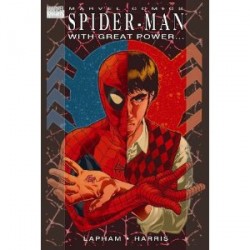
Spider-Man: With Great Power…


By David Lapham & Tony Harris, with Jim Clark, Stefano Gaudiano and Matt Milla (Marvel)
ISBN: 978-0-7851-1968-5

One of the most astounding comicbook stories ever began with the sublime origin tale of ‘Spider-Man!’ by Stan Lee & Steve Ditko in the last issue of  Amazing Fantasy #15 (cover-dated September 1962); describing in 11 captivating pages the parable of Peter Parker, a smart but alienated kid bitten by a radioactive spider on a High School science trip.

Discovering he had developed arachnid abilities – which he augmented with his own natural genius in the fields of chemistry, physics and engineering – the boy did what any lonely, geeky nerd would do when given such a gift…  he tried to milk for all it was worth in the hormone-fuelled determination to get girls, prestige, fame, money and girls.

Making a costume to hide his identity in case he made a fool of himself, Parker became a minor celebrity – and a criminally self-important one.

To his eternal regret, when a thief fled past him one night after a TV interview, the self-aggrandized Peter didn’t lift a finger to stop the felon, only to find when he returned home that his guardian and uncle Ben Parker had been murdered.

Crazy with a need for vengeance, Peter hunted the assailant who had made his beloved Aunt May a widow and killed the only father he had ever known, and tragically realised that it was the crook he couldn’t be bothered to stop.

His social irresponsibility had led to the death of the man who raised him and the boy swore to always use his powers to help others…

It wasn’t a new story, but the setting was one familiar to every kid reading it and the artwork was downright spooky. This wasn’t the gleaming high-tech world of moon-rockets, giant monsters and flying cars – this stuff could happen to anybody…

From that tortuous beginning Spider-Man swiftly evolved into one of the world’s most popular heroic characters with generations of writers returning to, mining and refining that simple tale for every possible nuance.

In 2008 star creators David Lapham and Tony Harris (with inkers Jim Clark and Stefano Gaudiano and colourist Matt Milla) took a hard look at the origin and came up with an impressive fresh avenue previously unexplored: what exactly happened during Parker’s brief fling with showbiz celebrity?

The result was a 5-issue miniseries under the elite Marvel Knights imprint that impressively added an even greater edge of tragedy and recrimination to the lad’s subsequent campaign and injustice…

Opening with the key page from the Lee/Ditko classic, most of this turbulent tale is set pretty much between those two panels and finds “the Spider-Man” signed up with a cheesy wrestling federation. The masked and obsessively secretive kid is obnoxiously revelling in his newfound power amongst these shady adult characters yet still being bullied in his “normal” life at High School: continually harassed by jock Flash Thompson whilst fruitlessly lusting after queen of the popular kids Liz Allen…

Uncle Ben and Aunt May are increasingly concerned by their sweet, clever boy. He’s become secretive, argumentative and unnaturally rebellious. Although they’ve been expecting it for years, the “Troubled Teen” phase is still a bit of shock and the solicitously understanding seniors combat it by giving the boy a clunky old car to show they accept his growing independence…

With the kid being taught all the tricks of show-fighting by the welcoming but jaded older wrestlers in the fight-stable, promoter Monty Caabash sees his compulsively anonymous new find as his ticket to the big time – and so do his gangster backers. With a lucrative West Coast TV sport show in the offing, they just can’t afford to lose their mysterious cash-cow, but the adulation and ready money is turning Peter’s head.

He dumps Uncle Ben’s gift in favour of a sports car only to wreck in a crazy drag race with Flash: an incident which puts him in an E.R., although his worried guardians have no idea since the unruly kid is frequently staying out all night these days…

As Monty invests more time and money in his prize fighter, the boy becomes a New York sensation and the promoter’s worldly-wise associate Tiffany LeBeck sees a way to use her own mature charms to win a piece of the millions Spider-Man could generate.

Before long the sex-starved kid is beguiled and besotted by the older woman’s charms and she becomes his manager; promising an inevitably clash with Monty’s ruthless backers.

At school Parker’s increased confidence has enabled him to make real headway with Liz too. With everything going right the ebullient boy spends some time back in his lab inventing a way to increase his cachet by inventing webbing and web-shooters: tricks that will make him even more spectacular in the ring and on the screen…

New York loves the mysterious celebrity and goes into media frenzy mode – all except the contrary publisher of the Daily Bugle. Inexplicably incensed, J. Jonah Jameson wants to know the truth about this Amazing Spider-Man and begins a highly provocative campaign against the wrestler and his management…

There are bigger stories. The first team of superheroes since WWII has emerged, battling monsters and villains with shining valour and full public disclosure. Spider-Man even watched the Fantastic Four in action once, battling the horrific spawn of the Miracle Man.

The kid was sitting in a safe skyscraper perch with one of his groupies nestled safely in his arms…

Peter doesn’t care about bad publicity and unfair comparisons: he’s a celebrity sportsman, not a crime-busting crusader. Even when a thief runs right past him after a TV interview, he does nothing. That’s the police’s job…

Ditching school, chasing girls, falling further under Tiffany’s slowly seductive influence, Peter gets a huge reality check when, during a confrontation with Uncle Ben outside a nightclub where he’s spent all night dancing with Liz, a colossal monster attacks the city, raining death and destruction upon hundreds of helpless citizens. Despite himself the boy explodes into action, saving Ben and his traumatised date, but horrifically failing to rescue a trapped stranger, even after the impressive man-monster dubbed The Thing comes to his assistance…

Shocked, confused and deeply upset in the aftermath, Parker gets blind drunk and returns to Tiffany’s boudoir, only to pass out too soon… Waking up face to face with Monty’s extremely unsavoury bosses he discovers the kind of people’s he’s involved with as chief hood Mr. Angel explains the facts of life.

Hollywood means big, legitimate money and Jameson’s smear campaign is making the TV execs nervous. So if everybody wants heroes like the FF, Spider-Man is going to be one – even if the mob has to set up kittens to rescue and slobs to save…

Peter complies but his heart isn’t in it: it’s only by sheer luck that he doesn’t cause the deaths of dozens of people and when that doesn’t placate Angel the racketeer opts to end his problems by shutting up Jameson for good…

Even Tiffany can’t handle that however and when she drunkenly reveals the scheme to her besotted boy Peter, he puts his mask back on and heads out to change his destiny forever…

With Jameson saved and his life back on track, Peter heads home to reconcile with Aunt May and Uncle Ben, only to find he house surrounded by police cars…

Dark, gritty, subtly sophisticated and rationally reasonable, this clever exploration of the in-between moments adds those layers of meaning to the tragic tale that modern, mature readers seem to dote on and, child of the simplistic Sixties though I am, even I found this extension of the classic story to be both beguiling and exceptionally entertaining.

This might not appeal to all readers but fans of the movie franchise will definitely find this a book worth pursuing.
© 2008 Marvel Characters, Inc. All Rights Reserved.

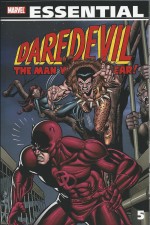
Essential Daredevil volume 5


By Steve Gerber, Tony Isabella, Bob Brown, Don Heck, Gene Colan & various (Marvel)
ISBN: 978-0-7851-2762-3

Matt Murdock is a blind lawyer whose remaining senses hyper-compensate, making him an astonishing acrobat, formidable fighter and living lie-detector. Very much a second-string hero for much of his early years, Daredevil was nonetheless a striking and popular one, due in large part to the captivatingly humanistic art of Gene Colan. He fought gangsters, a variety of super-villains and even the occasional monster or alien invasion, quipping and wisecracking his way through life and life-threatening combat, utterly unlike the grim, moody, quasi-religious metaphor he’s been seen as in latter years.

After spending years in a disastrous on-again, off-again relationship with his secretary Karen Page Murdock took up with former client and Russian émigré Natasha Romanoff, the infamous and notorious spy dubbed The Black Widow.

She was railroaded and framed for murder and prosecuted by Matt’s best friend and law partner Foggy Nelson before the blind legal eagle cleared her. Subsequently leaving New York with her for the wild wacky and West Coast, Matt joined the prestigious San Francisco law firm of Broderick & Sloan but adventure, disaster and intrigue seemed capable of finding the Sightless Swashbuckler anywhere…

This fifth Essential collection re-presents Daredevil #102-125, covering August 1973 to September 1975, and also includes Marvel Two-in-One #3 wherein twin storylines converged, and the action opens with DD searching for recently escaped psychedelic assassin Angar the Screamer.

However Hornhead’s diligent quest instead brought him into conflict with a merciless and similarly displaced old foe when ‘Stilt-Man Stalks the City’ (by Chris Claremont, Syd Shores & Frank Giacoia). The skyscraping scoundrel had first kidnapped the daughter of an inventor in order to extort enhanced weaponry out of the traumatised tinkerer but wasn’t expecting interference from his oldest adversary or his new utterly ruthless paramour….

No sooner had DD and the Widow ended the miscreant’s rampage than #103 saw a team-up with Spider-Man as a merciless cyborg attacked the odd couple whilst they posed for roving photojournalist Peter Parker in ‘…Then Came Ramrod!’ by Steve Gerber, Don Heck & Sal Trapani.

The barely-human brute was after files in Murdock’s safe and hinted of a hidden master, but ultimately his blockbusting strength was of little real use against the far faster veteran heroes…

Even whilst the distracted Murdock was realising that his own boss was sabotaging the attorney’s cases, the mystery manipulator was hiring warped mercenary Sergei Kravinoff to make Daredevil ‘Prey of the Hunter!’ Matt’s priorities changed when Kraven abducted Natasha, and even after the hero had rescued her, explosively returned to defeat them both, throwing the hero to his death over a cliff…

Daredevil #105 saw Natasha brutally avenge her man’s murder, but Murdock was far from dead, having being teleported from the jaws of doom by a ‘Menace from the Moons of Saturn!’ (inked by Don Perlin). In a short sequence pencilled by Jim Starlin, the earthborn Priestess of Titan Moondragon was introduced, and revealed how she had been dispatched to Earth to counter the schemes of death-worshipping proto-god Thanos. She also inadvertently disclosed how she had allied with a respected man of power and authority, providing him with a variety of augmented agents such as Dark Messiah, Ramrod and Angar…

Gerber, Heck & Trapani then brought the expansive extended epic closer to culmination as the manipulator was unmasked in ‘Life Be Not Proud!’ but not before the wily plotter had redeployed all his past minions,  shot his misguided ally Moondragon, usurped a Titanian ultimate weapon and unleashed a life-leeching horror dubbed Terrex upon the world.

With all Earth endangered, DD, the Widow and guest-star Captain Marvel were forced to pull out all the stops to defeat the threat, and only then after a last-minute defection by the worst of their enemies and a desperate ‘Blind Man’s Life!’ courtesy of Gerber, Bob Brown & Sal Buscema.

A new direction began in #108 when DD noticed Natasha using increasingly excessive force on the thugs they stalked. Their heated arguments were forcibly curtailed when Matt’s oldest friend – and current New York DA Foggy Nelson – was shot and she refused to rush to his side with Murdock…

Back in the Big Apple, Matt meets Foggy’s radical student sister Candace and learns of a plot by a mysterious organisation called Black Spectre to steal government printing plates. En route to stop the raid the Scarlet Swashbuckler is intercepted by a larcenous third party whose brutal interference allows the sinister plotters to abscond with the money making plates in ‘Cry… Beetle!’ illustrated by Brown & Paul Gulacy.

Even the arrival of the cops can’t slow the bludgeoning battle against the Beetle in ‘Dying for Dollar$!’ (Brown & Heck), but even as the exo-skeletoned skell breaks away in NYC, in San Francisco Natasha is attacked by a terrifying albino mutant called Nekra Priestess of Darkness, who wants to recruit her into Black Spectre.

After tracking down and defeating the Beetle, Daredevil meets Africa-based adventuress Shanna the She-Devil, unaware that the fiery American ex-pat is back seeking bloody vengeance against the same enemies who have attacked Foggy, Natasha and the entire US economy…

The next chapter appeared in Marvel Two-in-One #3 (May 1974, by Gerber, Sal Buscema & Joe Sinnott) and offered a peek ‘Inside Black Spectre!’ as destabilising attacks on US prosperity and culture fomented riot in the streets of the beleaguered nation.

Following separate clue trails the Thing linked up with the Man Without Fear to invade the cabal’s flying HQ but they were impossibly overcome soon after discovering that the Black Widow had defected to the rebels…

Issue #110 saw the return of Gene Colan – inked by Frank Chiaramonte – as the plot further developed in ‘Birthright!’ revealing that Black Spectre was an exclusively female and minorities staffed organisation, led by a pheromone-fuelled male mutant called Mandrill.

One of the first “Children of the Atom”, the ape-like creature had suffered appalling abuse and rejection until he found the equally ostracised Nekra, but once they met and realised their combined power, they swore to make America pay…

‘Sword of the Samurai!’ (Brown & Jim Mooney) in Daredevil #111 opened with DD and Shanna attacked by a monstrous Japanese warrior even as the She-Devil at last disclosed her own tragic reasons for hunting Nekra and Mandrill. When she too is taken by Black Spectre – who want to dissect her to discover how she can resist Mandrill’s influence – DD is again attacked by the outrageously powerful Silver Samurai…

Triumphing over impossible odds DD then infiltrates the flying fortress in #112 before the spectacular conclusion ‘Death of a Nation?’ (with art by Colan & Giacoia) finds the mutant duo seemingly achieving their ultimate goal by desecrating the White House and temporarily taking symbolic control of America.

…But only until Shanna, the freshly-liberated Natasha and the fighting mad Man without Fear marshal their utmost resources…

Even with the epic over Gerber still kept popping away at contemporary issues as with #113 ‘When Strikes the Gladiator!’ – illustrated by Brown & Vince Colletta – which began with the Black Widow calling it a day, continued with Candace Nelson being arrested by for treason, teased with the girl being kidnapped by one of DD’s most bloodthirsty foes and culminated with the creation of a new major villain and an attack by Marvel’s most controversial monster heroes…

Ted Sallis was a government scientist hired to recreate the Super-Soldier serum that turned a puny volunteer into Captain America. Due to corporate interference and what we today call “mission creep”, the project metamorphosed into a fall-back plan to turn humans into monstrous beings that could thrive in the most polluted of toxic environments.

When Sallis was subsequently captured by spies and consumed his serum to stop them from stealing it, he was transformed into a horrific mindless Man-Thing and lost in the swamps of Florida…

Candace, an idealistic journalism student, had later uncovered illicit links between Big Business, her own university and the Military’s misuse of public funds in regard to the Sallis Project but when she attempted to blow the whistle the government decided to shut her up. More worryingly, scientific mastermind Death-Stalker could think of far more profitable uses for a solution that made unkillable monsters…

Trailing Candy’s abductors to Citrusville, Florida, Daredevil was ambushed by Gladiator and his macabre senior partner, but saved after a furious fracas by the mysterious Man-Thing in #114’s ironically entitled ‘A Quiet Night in the Swamp!’ (Brown & Colletta). The mastermind managed to escape however and returned to New York where he tried to kill Foggy and track down the clandestine, still operating continuation of the Sallis Project. Even though DD arrived in time to foil the maniac in #115’s ‘Death Stalks the City!’ the staggering duel ended inconclusively and the potential mass-murderer’s body could not be found.

Colan & Colletta reunited for ‘Two Flew Over the Owl’s Nest!’ as Daredevil returned to San Francisco in search of reconciliation with Natasha only to blunder into the latest criminal enterprise of one of his oldest enemies.

This time however The Owl isn’t waiting to be found and launches an all-out attack on the unsuspecting DD and the Widow.

Claremont scripted the conclusion over Gerber’s plot, with Brown & Colletta back on the art as Natasha and Shanna desperately hunt for the missing Man without Fear before the avian arch-criminal can add him to the pile of purloined personalities trapped in the diabolical ‘Mind Tap!’…

With Gerber moving on, a little messy creative shuffling resulted in ‘Circus Spelled Sideways is Death!’ (#118 by Gerry Conway, Heck & Colletta) as Daredevil left Natasha, resettled in New York and promptly battled the infamous Circus of Crime and their latest star turn – a bat-controlling masked nut called Blackwing – after which Tony Isabella took the authorial reins with a clever piece of sentimental back-writing in ‘They’re Tearing Down Fogwell’s Gym!’ rendered by Brown & Heck.

As Murdock negotiates a plea deal for Candace, the man who trained his boxer father comes by with a little problem. It seems a crazy crooked doctor is offering an impossible muscle and density boosting treatment that can turn ordinary pugilists into unstoppable monsters…

Daredevil #120 then began an extended story-arc which focussed on the re-emergence of the world’s most powerful secret society.

‘…And a Hydra New Year!’ (Isabella, Brown & Colletta) saw the Black Widow hit New York for one last attempt to make the relationship work only to find herself – with Matt and Foggy – knee-deep in Hydra soldiers at a Christmas party.

The resurgent terrorist tribe has learned that America’s greatest security agency needs to recruit a legal expert as one of their Board of Directors and, determined to prevent the accession of ‘Foggy Nelson, Agent of S.H.I.E.L.D’ at all costs, have dispatched the formidable El Jaguar and an army of thugs to stop him before he can start.

Thankfully Nick Fury and his crack commandos arrive in time to drive off the attackers but the rumour is true and Foggy is now a marked man…

Both issues #120 and 121 were supplemented by text pages outlining the convoluted history of Hydra and they’re reprinted here too to keep us all in the arcane espionage loop…

The new organisation has scoured the ranks of the criminal classes – and Marvel’s back catalogue – for its return and the likes of Dreadnought, Commander Kraken, Man-Killer, Mentallo, The Fixer, Blackwing and many other golden oldies happily toil for the enigmatic new Supreme Hydra as he continually strives to take out the increasingly harried Foggy. Eventually they succeed in capturing the portly DA and Natasha goes off the deep end in #122’s ‘Hydra-and-Seek’, turning New York into an active war-zone as she hunts for clues, culminating in a brutal showdown and ‘Holocaust in the Halls of Hydra!’

The times and mood were changing however and the last two issues comprise a turn to darker, more gothic dramas beginning with #124 and the advent of a vigilante killer patterned on an old pulp fiction hero.

‘In the Coils of the Copperhead!’ by Len Wein, Marv Wolfman, Colan & Klaus Janson courted the controversial gritty realism then remaking Batman over at DC Comics as the Widow finally really and truly walked out on DD, leaving the frustrated hero to bury himself in the mystery of a murdering madman overreacting to petty crime and leaving a trail of bodies behind him…

Foggy meanwhile was up for re-election and losing on all counts to the too-good-to-be true Blake Tower but Matt couldn’t offer any help as he had tracked down the secret of the vigilante. The resultant clash didn’t go the Scarlet Swashbuckler’s way, however, and he started issue #125 with the terrifying realisation that ‘Vengeance is the Copperhead!’ (Wolfman, Brown & Janson) before achieving a last-minute skin-of-the-teeth hollow victory…

The marvellous monochrome tome also includes unseen preliminary covers to issues #104, 107 & 115 by Gil Kane and Jim Starlin plus Marvel Universe Handbook pages giving the low-down on the Man without Fear, technical specs on his handy Billy-Club and the convoluted official intelligence on the Black Widow.

As the social upheaval of the 1960sand early 1970s receded, the impressively earnest material was gradually being replaced by fabulous fantasy tales which strongly suggested the true potential of Daredevil was in reach. These beautifully illustrated yarns may still occasionally jar with their heartfelt stridency, naivety and often-outdated attitudes but the narrative energy and sheer exuberant excitement of these classic adventures are delights no action fan will care to miss.

…And the next volume heads even further into dark shadows and the grimmest of territory…
© 1973, 1974, 1974, 2010 Marvel Characters, Inc. All rights reserved.

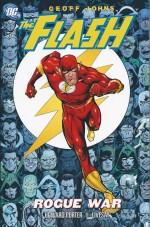
The Flash: Rogue War


By Geoff Johns, Steve Cummings, Peter Snejbjerg, Justiniano, Howard Porter & various (DC Comics)
ISBN: 978-1-4012-0924-7

The innovative fledgling company that became DC published the first comicbook super-speedster and over the decades has constantly added more to its pantheon of stars. Created by Gardner Fox and Harry Lampert, Jay Garrick debuted as the very first Scarlet Speedster in Flash Comics #1 (January 1940). “The Fastest Man Alive” wowed readers for over a decade before changing tastes benched him in 1951. Other early Fast Furies there included Johnny Quick and Snurtle McTurtle, the Terrific Whatzit…

The concept of speedsters and the superhero genre in general was revived in 1956 by Julie Schwartz in Showcase #4 when police scientist Barry Allen became the second hero to run with the concept.

The Silver Age Flash, whose creation ushered in a new and seemingly unstoppable era of costumed crusaders, died heroically during Crisis on Infinite Earths (1985-1986) and was promptly succeeded by his sidekick Kid Flash. Of course Allen later returned from the dead – but doesn’t everyone?

Initially Wally West struggled to fill the boots of his predecessor, both in sheer ability and, more tellingly, in confidence. Feeling a fraud, he nonetheless persevered and eventually overcame, becoming the greatest to carry the name. In recent history he and other hurtling hyper-heroes have congregated in and around the conjoined metropolis of Keystone and Central Cities.

Wally lived there with his true love Linda Park, his Aunt Iris West-Allen and semi-retired pioneering human rocket Jay Garrick, whilst his juvenile nephew from the Future Bart “Impulse” Allen and tutor/keeper Max Mercury, the Zen Master of hyper-velocity, resided only an eye-blink away. Bart eventually succeeded to the vacant role of Kid Flash…

This volume, entirely scripted by the departing Geoff Johns, collects issues #212, 218, 220-225 and the Wizard Comics premium special #½ of Wally’s long-gone-and-much-missed monthly comicbook; featuring the staggering finale of a years-long saga as much about the unique band of villains associated with the Twin Cities as the ever-imperilled Fastest Men Alive…

This closing compendium opens in the aftermath of many blockbusting battles which tore the Keystone/Central City and the extended Flash Family apart. During that period the hero and his nearest and dearest were targeted by time-bending sociopath Hunter Zoloman who patterned himself on the greatest Flash-villain of all. “Zoom” wanted to make Wally a better hero through the white-hot crucible of personal tragedy…

To that end he targeted Linda and killed the unborn twins she was carrying. Within days the Scarlet Speedster had disappeared and – thanks to the intervention of nigh-omnipotent spirit The Spectre – everyone who knew Wally was the Flash forgot the secret.

The supernatural intervention was meant as a stopgap measure and means to restore the shield of anonymity to the Scarlet Speedster’s loved ones and prepare the harried couple for what was to come…

This end begins with ‘Mirror, Mirror on the Wall’ illustrated by Steve Cummings & Wayne Faucher, offering insights into the troubled history of the second Mirror Master and revealing how a troubled Scottish orphan found his true calling in life. Evan McCulloch notched up his first kill at age eight, efficiently removing an abusive older boy from the orphanage he brutally dominated.

A generally trouble-free period, where he fruitlessly searched for the parents who abandoned him, nevertheless drew him into petty crime, drugs and eventually the life of a hitman – and a superlative one at that.

When his gifts inevitably led him to the greatest mistake of his life, he was preparing to end it all when he was arrested and “renditioned” by a maverick wing of the FBI, who needed an anonymous, untraceable assassin they could use to kill high-profile annoyances – like whistleblowers and uncontrollable superheroes…

They equipped Evan with technology taken from the original Mirror Master’s corpse, but completely underestimated McCulloch’s dislike of authority figures and abiding, self-destructive love of crime and mischief…

By comparison, #218’s ‘Rogue Profile: Heat Wave’ (with art from Peter Snejbjerg) detailed how obsessive pyromaniac Mick Rory had battled every day to quell the need to see things blaze – a struggle that had begun after he burned his family to death.

His troubled path had taken him from circus performer to super-villain and founding member of  Flash’s Rogues Gallery, but now he was reformed and working with the FBI to bring in his former associates.

He still fought every moment against the urge to light things up, though…

‘Rogue Wars Prologue: Tricksters’ by Justiniano, Walden Wong & John Livesay, from Wizard Comics Flash Special #½, then finished the graphic history lessons and build-up to the final conflagration as the fully restored Vizier of Velocity discovered that Mirror Master McCulloch was liberating Rogues as fast as the Flash could catch them…

FBI Special Agent James Jesse – the original Trickster – was a poacher-turned-gamekeeper who had gathered a taskforce of similarly reformed Rogues to capture his former criminal comrades. However with the bad-guys making his operatives Heat Wave, Pied Piper and magnetic mutant Magenta look like idiots, Jesse decided to at last get back into the field and take personal charge…

The villains, already reeling from revelations that their heroic enemies had been systematically indulging in illegal brain-wiping and behaviour modification of criminals in their custody (see Flash: the Secret of Barry Allen and Identity Crisis), had united in a furious, vengeful alliance and were determined to exact retribution. Their prolonged assaults had devastated the Cities but the dire situation was further worsened after the psionic ghost of Roscoe Dillon came back from the grave.

The Top had been “adjusted” by Barry Allen and Zatanna, becoming a driven man compelled to Do Good. He had used his abilities to forcibly save a number of Rogues but now, possessing a stolen body and his old inclinations, Dillon was resolved to punish the dynasty of Flashes by undoing all his previous good deeds…

And now, immune to the Spectre’s spell, Zoom reappeared to stalk Linda once more…

The cataclysmic, epic 6-chapter Rogue War – illustrated by Howard Porter & John Livesay – then begins in earnest when Captain Cold leads the senior Rogues in a spree of theft and destruction, culminating in a futile attempt to recover the body of deceased colleague Captain Boomerang from FBI custody.

Later whilst Jay Garrick is ambushed by Zoom, the exultant criminal cohort are attacked by Jesse’s squad even as, in a secret location, the maniac’s wife Ashley Zolomon is reluctantly participating in an FBI experiment to temporarily resurrect Boomerang and probe his mind for the secrets of the Rogues…

The blockbusting battle between the Rogue factions is interrupted by the sudden appearance of the utterly out-of-control Top. By the time Flash arrives, his beloved Twin Cities are a shattered war-zone…

With events already spinning into total chaos, the Top deploys the kill-crazy upstart new Rogues Plunder, Double-Down, Tarpit, Girder and Murmur to increase the anarchic carnage and the tumult is only thwarted by the most unlikely of saviours who ends Dillon’s rampages forever…

When a splinter faction of the crime combine track down Ashley, however, they incur the wrath of Zoom and open the floodgates for an incredible last act…

With Wally in overdrive to defeat the army of old foes, Kid Flash rockets to his rescue in time to counter the attacks of elemental mage Dr. Alchemy and super-gorilla Grodd, only to fall in his turn to the raging, unchecked power of Zoom who has finally decided to clear the field of all Rogues and heroic distractions in order to enact his own ultimate master-plan…

This involves snatching the original Professor Zoom, the Reverse-Flash, out of the time stream moments before he was killed by Barry Allen and letting him loose on the despised friends and heirs of the Flash…

In a climax that involves the entire dynasty of Scarlet Speedsters, the most reprehensible villains in all creation and the rewriting of time itself, Johns signed off on his magnificent opus by pulling out all the stops, burning all his bridges and spectacularly pulling off the happiest ending of the series’ decades-long history…

Fast, furious and fabulous, the numerous Scarlet Speedsters have always epitomised the very best in costumed comic thrills and the astounding tenure of Johns resulted in some of the best Fights ‘n’ Tights fiction of modern times.

For more than seven decades, the adventures of the Flash have been the very acme of superhero storytelling, with successive generations of inventive creators producing the very best of high-speed action and superlative drama. This is one of the greatest of those supremely readable classics and a show that you’d be crazy to ignore
© 2004, 2005, 2006 DC Comics. All Rights Reserved.

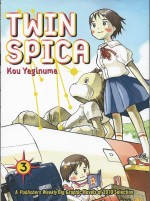
Twin Spica volume 3


By Kou Yaginuma (Vertical)
ISBN: 978-1-934287-90-3

The hungry fascination, hopeful imagination and fevered anticipation of space travel which was an integral component of post-World War II society is the driving narrative engine for this inspiring manga epic from Kou Yaginuma, who began capturing questing imaginations with his poignant short story ‘2015 Nen no Uchiage Hanabi’ (‘2015: Fireworks’), published in Gekkan Comics Flapper magazine in June 2000.

The author subsequently expanded and enhanced the subject, themes and characters into an all-consuming narrative epic combining hard science and humanist fiction with lyrical mysticism and traditional tales of school-days and growing up.

Diminutive teenager Asumi Kamogawa has always dreamed of going into space. From her earliest moments the lonely child had gazed with intense longing up at the stars, her only companion and confidante her imaginary friend Mr. Lion.

When Asumi was a year old, the first Japanese space-launch ended in utter catastrophe when rocket-ship Shishigō (“The Lion”), exploded: crashing back to earth on the city ofYuigahama where the Kamogawas lived. Hundreds were killed and so many more injured, including Asumi’s mother.

Maimed and comatose, the matron took years to die and the long-drawn-out tragedy utterly traumatised the tiny uncomprehending daughter. The shock also crushed her grieving husband who had worked as a designer on the rockets for Japan’s Space Program.

In the wake of the disaster, Tomoro Kamogawa was assigned by the corporation who built the ship to head the reparations committee. Guilt-wracked and personally bereaved, the devastated technologist had to visit and formally apologise to each and every survivor or victim’s grieving family. The experience completely destroyed the man.

He was certainly no fan of the space program, having lost his wife, his beloved engineering career, and his pride to the race for the stars. He has raised his daughter alone by working two and often three menial jobs at a time for over a decade and cannot countenance losing the very last of his loved ones to the cold black heavens…

In response to the disaster,Japanset up an Astronautics and Space Sciences Academy. After years of passionate struggle and in defiance of her father’s wishes, in 2024 Asumi – an isolated, solitary, serious but determinedly star-bound teenager – was accepted to theTokyoNationalSpaceSchool. She reluctantly left Yuigahama and joined the new class.

Amongst the year’s fresh intake were surly, abrasive Shinnosuke Fuchuya (an elementary school classmate who used to bully her as a child back in Yuigahama), jolly Kei Oumi, chilly Marika Ukita and spooky, ultra-cool style-icon and fashion victim Shu Suzuki who became the shy introvert’s closest acquaintances.

Every day Asumi nudged inexorably towards her goal: the stars. Ever since the crashing rocket had shattered her family, she had drawn comfort from the firmament, with Mr. Lion staring up at the heavens at her wide – especially drawn to the twinkling glow of Virgo and the alluring binary star Spica. And now she was so tantalisingly close…

Small, poor, physically weak but resolutely capable, Asumi endures and triumphs over every obstacle… and she still talks with Mr. Lion – who might just be the ghost of one of the astronauts who died on the Shishigō…

All the students can think of is going to space, but they are constantly reminded of the fact that most of them won’t even finish their schooling…

Asumi – barely four feet, eight inches tall – is constantly struggling to meet the arduous physical requirements dictated by the Academy but has more immediate problems. She is only slowly adjusting to life in Tokyo, sleeps in tawdry communal women’s dorm “The Seagull”, struggles with many of her classes and subsists on meagre funds, supplemented by part-time jobs.

Moreover she has inexplicably incurred the obsessive hostility of astrophysics lecturer Professor Sano. Unbeknownst to Asumi, Sano has a long-hidden grievance with her father and has thus determined to kick her out of the school at all costs…

He has already tried to have her removed because her small size dictates that she needs a customised pressure suit – offering Sano an opportunity to force her out by citing budget restrictions…

The individual stories are broken up into “Missions” and this particularly moving and moody third volume covers numbers 9-13, plus a revealing sidebar tale and another autobiographical vignette about the author’s own school days.

‘Mission: 09’ begins with Asumi returning to her father’s home, pondering if she should ask Mr. Lion if the disgraced engineer was actually responsible for the rocketship crash all those years ago. Meanwhile inTokyo her classmates are trying to intervene in Sano’s obvious vendetta against their friend…

Mr. Lion is there too, but has been drawn to the wedding of Asumi’s old teacher Miss Yuko Suzinari. Although she still desperately misses her fiancé, who piloted The Lion and died in the tragic explosion five years previously, she is getting married today… a fact Asumi discovers from an invitation left in an unopened pile of mail she finds in her father’s empty house…

Having missed another day of school, Asumi again incurs Sano’s wrath as ‘Mission: 10’ begins, but the astrophysicist and his mysterious superior are in for a rude awakening. Meanwhile the determinedly upbeat Miss Kamogawa is having an oddly unifying effect on her fiercely independent classmates, turning rivals into comrades. All, that is, except the chilly, acerbic, mysteriously aloof Marika Ukita…

Undeterred, Asumi probes deeper, and with her phantom mentor’s spiritual advice finally finds a way to crack the ice-queen’s brittle exterior. Valiant, protective Kei Oumi meanwhile openly challenges Sano over his unfair treatment and is soundly reminded by the teacher that the course is a process of elimination. Would she surrender her own chances of success to ensure Asumi remained…?

‘Mission: 11’ continues the deliberation of the completion for final places, but Mr. Lion again offers sage and calming words as, in the upper echelons, Sano’s words and actions have drawn unfavourable criticism, leading to some further surprising revelations about Asumi’s dad, hints of a concealed scandal regarding the construction of the doomed Shishigō and the disappearance of the conniving astrophysicist from the faculty…

With Sano abruptly replaced by the far more amenable and encouraging Mr. Shiomi, Asumi and the gang decide to take a short camping vacation to the Cosmic Communications Center atChiba, but not before Asumi has one last moving confrontation with her former nemesis…

‘Mission: 12’ finds them readying for the trip – all but the stand-offish Ukita who flatly refuses to join them – when an incident in the Multi-Axis Trainer (that’s the cool-looking. spinning ball thingy astronauts sit in) results in the ice-queen collapsing. When she gets out of the infirmary Asumi and Kei follow Ukita home and discover she lives in a palatial mansion…

When they see her being brutalised and abused by a shouting man – presumably her father – Asumi sees red and attacks. Suzuki and Fuchuya are astounded when without any explanation Ukita gets on the bus to Chiba with them and the smiling girls…

At their destination the cash-strapped kids walk until Marika again collapses.

Belligerent Fuchuya picks up the moody girl with the badly bleeding feet and carries her to their destination as ‘Mission: 13’, through dreamy flashbacks and a near-fatal hiking incident, discloses some of the incredible, uncomfortable secrets of Marika Ukita and how her own abiding love affair with the cosmos began…

To Be Continued…

Although the ongoing saga pauses here, there’s even more affecting revelations to come in the complete tale ‘Asumi’s Cherry Blossom’ which harks back to her school days in Yuigahama. A weird, distracted child, she is bullied by many classmates and even a few teachers, but is championed by a boy who seems very interested in her. Takashi Shimazu is a talented artist who won’t let Asumi see what he’s constantly drawing, and he’s absent from school quite a lot, but they strike up a friendship anyway. Asumi really likes the boy, but wishes he wouldn’t joke about being able to see Mr. Lion…

This bittersweet tragedy is followed by a beguiling and introspective ‘Another Spica’ episode in which Yaginuma details his shiftless, ambition-free teens and shared moment of clarity with a girl in his classroom…

These powerfully unforgettable tales originally appeared in 2001-2002 as Futatsu no Supika and in the Seinen manga magazine Gekkan Comics Flapper, targeted at male readers aged 18-30, but this ongoing, unfolding beguiling saga is perfect for any older kid with stars in their eyes…

Twin Spica filled sixteen collected volumes from September 2001 to August 2009, tracing the trajectories of Asumi and friends from callow students to competent astronauts and the series has spawned both anime and live action TV series.

This delightful serial has everything: plenty of hard science to back up the informed extrapolation, an engaging cast, mystery and frustrated passion, alienation, angst and true friendships; all welded seamlessly into a joyous coming-of-age drama with supernatural overtones and masses of sheer sentiment.

Rekindling the magical spark of the Wild Black Yonder for a new generation, this is a treat no imagineer with head firmly in the clouds can afford to miss…

This book is printed in the Japanese right to left, back to front format.
© 2010 by Kou Yaginuma. Translation © 2010 Vertical, Inc. All Rights Reserved.

Secret Warriors volume 1: Nick Fury, Agent of Nothing


By Brian Michael Bendis, Jonathan Hickman, Stefano Caselli (Marvel)
ISBN: 978-0-7851- 3864-8

Just as the 1960s espionage fad was taking off, inspired by the James Bond films and TV shows like Danger Man, Nick Fury the spy debuted in Fantastic Four #21 (December 1963 – between #4 and 5 of his own blistering battle mag), a grizzled and cunning CIA Colonel lurking at the periphery of big adventures, craftily manipulating the First Family of Marvel superheroes.

He was already the star of the little company’s only war comic: Sgt. Fury and his Howling Commandos, an improbable and decidedly over-the-top, raucous and wild WWII series similar in tone to later movies such as The Magnificent Seven, Wild Bunch or The Dirty Dozen.

When spy stories went global in the wake of The Man from U.N.C.L.E. the elder iteration was given a second series (in Strange Tales #135, August 1965) set in the then-present. Nick Fury, Agent of S.H.I.E.L.D. combined Cold War tension and sinister schemes of World Conquest by hidden, subversive all-encompassing enemy organisation Hydra – all gift-wrapped with captivating Kirby-designed super-science gadgets and explosive high energy.

Once iconic imagineer Jim Steranko took charge, layering in a sleek, ultra-sophisticated edge of trend-setting drama, the series became one of the best and most visually innovative strips in America – if not the world.

When the writer/artist left and the spy-fad faded, the whole concept simply withdrew into the background architecture of the Marvel Universe, occasionally resurfacing in new series but increasingly uncomfortable to read as the role of spooks “on our side” became ever more debased in a world where covert agencies were continually exposed as manipulative, out-of-control tools of subversion and oppression.

In 1989 a six issue prestige format miniseries reinvigorated the concept. As a company targeting the youth-oriented markets, Marvel had experienced problems with their in-house clandestine organisation. In most of their other titles, US agents and “the Feds” were now usually the bad guys and author Bob Harras used this theme as well as the oddly quirky self-referential fact that nobody aged in comic continuity to play games with the readers.

Fury had discovered that everybody in his organisation had been “turned” and was now an actual threat to freedom and democracy. His core beliefs and principles about leading “the Good Guys” betrayed and destroyed, he went on the run, hunted by the world’s most powerful covert agency with all the resources he’d devised and utilised now turned against him.

After that story was resolved S.H.I.E.L.D. was reinvented for the 1990s: a new leaner organisation, nominally acting under UN mandate, soon pervaded the Marvel Universe. The taste of betrayal and those seeds of doubt and mistrust never went away though…

Following a number of global crises – including a superhero Civil War – Fury was replaced as S.H.I.E.L.D. director. His successor Tony Stark proved to be a huge mistake and after an alien invasion by Skrulls, the organisation was mothballed: replaced by the manically dynamic Norman Osborn and his cultishly loyal H.A.M.M.E.R. outfit.

Osborn’s ascent was an even bigger error. As America’s Director of National Security the former Green Goblin and recovering psychopath instituted a draconian “Dark Reign” of oppressive, aggressive policies which turned the nation into a paranoid tinderbox. AsAmerica’s top Fed he was specifically tasked with curbing the unchecked power and threat of the burgeoning metahuman community.

This spectacularly poor choice was, however, also directing a cabal of the world’s greatest criminals and conquerors intent on divvying up the planet between them. The repercussions of Osborn’s rise and fall were felt throughout and featured in many series and collections throughout the entire fictive universe. His brief rule also drastically shook up the entrenched secret powers of the planet and his ultimate defeat destabilised many previously unassailable empires…

Fury, a man driven by duty, fuelled by suspicion and powered by a serum which kept him vital far beyond his years, didn’t go away. He just went deep undercover and continued doing what he’d always done – saving the world, one battle at a time. Even after Osborn was gone, Fury stayed buried, preferring to fight battles his way and with assets and resources he’d personally acquired and built…

This beguiling and complex superspy thriller collects material from Dark Reign, New Nation and Secret Warriors #1-6 from 2008, beginning with a short recap of the current global crises, a gathering of heroic strangers and a reaffirmation of Captain America’s maxim that a few good men can change the world in ‘I Will Be the One Man’…

Fury had long known that to do the job properly he needed his own resources and no political constraints. Thus he had clandestinely built up his own formidable and unimpeachable resources. Decades in charge at S.H.I.E.L.D. provided him with mountains of data on metahumans from which he compiled “Caterpillar Files” on a host of unknown, unexploited, untainted potential operatives who might metamorphose into powerful assets…

With the nations and covert organisations in disarray he moved to fix the mess with a squad of dedicated super-human operatives. But it was a truly dangerous game, as evidenced by the fact that one of Fury’s most valued but volatile assets is the 12-year old son of Grecian war-god Ares. Phobos is destined to become the new god of Fear…

Yo Yo Rodriguez AKA Slingshot, Sebastian Druid, Jerry “Stonewall” Sledge, J.T. “Hellfire” James and Daisy Johnson, codenamed Quake, were his first picks, dubbed Team White and activated whilst Osborn was still in power.

Simultaneously battling both Hydra and H.A.M.M.E.R. forces whilst rendering a defunct S.H.I.E.L.D. facility useless to both agencies, the squad picked up valuable intelligence in ‘Come with Me and Save the World’, prompting Fury to break into the White House and apprise the new President of his intentions and the current status quo.

At no stage did he ask for permission or approval…

He kept the worst of the intel to himself. For most of his career S.H.I.E.L.D. had been no more than a deeply submerged asset of Hydra and all his victories nothing more acceptable losses for a secret society reaching back to ancientEgyptand which had been secretly steering the world for millennia.

Now Osborn and the Skrull invasion had shaken things up so much, Fury had an honest chance to truly wipe out the perfidious organisation forever…

‘Autofac’ then provides all the maps, data files and diagrams any conspiracy nut could ever need to untangle the web of assorted secret agencies, before ‘My Desire is Eternal’ shifts focus to the recent past when current Hydra supremo Baron Wolfgang von Strucker battled Skrull infiltrators.

In the months that followed, Hydra too was attacked, seemingly destroyed, but now Strucker sought to capitalise on the chaos and regenerate the cult in his own image, necessitating seizing all fallow assets, technology and even experienced operatives abandoned by friends and enemies alike…

As Team White slowly grew closer Strucker was recruiting breakaway factions of Hydra, unhappily marrying super-science and generational cabals with ancient magic. This rabid rapid expansion did however give Fury an opportunity to place one of his own deep within the organisation…

Now as Strucker creates a new hierarchy of deadly lieutenants – Viper, Madame Hydra, Kraken, Silver Samurai, The Hive and resurrected mutant ninja the Gorgon – Fury cautiously expands his own organisation, reaching out to old S.H.I.E.L.D. comrades he feels worthy of trust. It’s too little and too late. In ‘After a While You Simply Are What You Are’ finds Team White taking their first casualty and experiencing their biggest defeat when Daisy leads the squad against Gorgon as his forces attempt to kidnap an entire division of forcibly “retired” S.H.I.E.L.D. telepaths from the defunct and discredited Esper Agent section.

With the situation escalating, Druid and field-leader Daisy are sent to the Australian Outback to recruit a replacement for Team White from Fury’s Caterpillar Files. Meanwhile the old man himself goes to his oldest surviving friends for help and Phobos and J.T. rashly snoop in the secretive leader’s office and find something quite incredible in ‘It’s the World That’s Changed: I Haven’t Not One Bit’.

When S.H.I.E.L.D. was shut down, second-in-command Dum-Dum Dugan gathered up his most trusted fellow agents and veterans and went private, founding the Howling Commandos Private Military Company. Warriors to the last, they’ve been looking for one last good war and a proper way to die.

As they are reacquainting themselves with their old boss, in Australia Daisy and Druid find unexpected success with the extraordinarily powerful but oddly naïve mystical teleporter and reality shaper Eden Fesi but realise that’s only because his mentor Gateway wouldn’t let him go with the guys from Hydra…

As Strucker’s cabal laid their plans and continued to accrue men and materiel, Fury and the Howling Commandos moved to secure some heavy armaments of their own, sneak attacking The Dock – a H.A.M.M.E.R. base where the mothballed fleet of colossal flying fortresses known as Heli-Carriers were stored.

Sadly Hydra knew they were coming and took the opportunity to lay an ambush of their own. With Fury swiftly losing beloved comrades and the three-way battle going against his veteran forces, things looked bad until Team White chose to disobey orders and teleported in for a blockbusting rescue mission in ‘Summon the Horde Wake the Beast’…

As the surviving Commandos escaped with three Heli-Carriers, the Secret Warrior put Daisy through a terse debrief, and she ferociously defended herself, claiming Team White only broke protocol and disobeyed orders because Fury pressed his Panic Button… Something he claims didn’t happen…

To Be Continued…

This excellent exercise in tense suspense and Machiavellian manipulation also includes a stunning ‘Cover gallery’ by Jim Cheung to supplement the wry, engagingly cynical, blackly comical and gloriously excessive cloak-and-dagger conflicts: employing enough intrigue to bamboozle even the most ardent espionage aficionado, although I fear that a thorough grounding in Marvel continuity might be necessary to fully appreciate this intense and engaging effort to the full.
© 2008, 2009 Marvel Characters, Inc. All rights reserved.
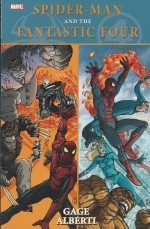
Black Canary Archives volume 1


By Bob Kanigher, Gardner Fox, Denny O’Neil, Carmine Infantino & Joe Giella, Murphy Anderson, Alex Toth & various (DC Comics)
ISBN: 1-56389-743-2

Black Canary was one of the first of the relatively few female furies to hold a star spot in the DC universe, following Wonder Woman, Liberty Belle and Red Tornado (who actually masqueraded as a man to comedically crush crime – with a couple of kids in tow, too!) and predating Merry, the Gimmick Girl. She disappeared with most of the other super-doers at the end of the Golden Age, to be revived with the Justice Society of America in 1963.

She was created by Bob Kanigher and Carmine Infantino in 1947, echoing the worldly, dangerous women cropping up in the burgeoning wave of crime novels and on the silver screen in film noir tales more suited to the wiser, more cynical Americans who had just endured a blazing World War and were even then gearing up for a paranoiac Cold one…

Clad in a revealing bolero jacket, shorts, fishnet stockings and high-heeled pirate boots, the devastating shady lady who looked like Veronica Lake even began life as a thief…

This superb full-colour hardback collection was released in 2001 to capitalise on the character’s small screen debut in the Birds of Prey TV series and represents her admittedly short run of tales in Flash Comics (#86-104, August 1947 – February 1949), Comics Cavalcade #25 (February/March 1948) plus two adventures that went unused when the comicbook folded: one of the earliest casualties in the wave of changing tastes which decimated the superhero genre until the late 1950s.

Those last only resurfaced at the end of the Second Great Superhero Winnowing and were subsequently published in DC Special #3 and Adventure Comics #399 (June 1969 and November 1970 respectively).

Also intriguingly included are her two stellar appearances in Brave and the Bold #61-62, (September and November 1965), therein teamed up with JSA team-mate Starman as part of a concerted but ultimately vain editorial effort by Julius Schwartz to revive the Golden Age squad of champions situated on parallel world Earth-2.

Best of all is the re-presentation of a two-part solo thriller from Adventure Comics #418-419 (April and May 1972) after the heroine successfully migrated to “our” world and replaced Wonder Woman in the Justice League of America.

In those heady, desperate days continuity was meagre and nobody cared at all about origins. All that mattered was pace, plot, action and spectacle. As we’ll see, even when the Black Bird got her own strip, where she came from was never as important as who she faced…

Flash Comics #86 was just another superhero anthology publication, suffering a slow downturn in sales and the perennial back-up feature Johnny Thunder had long since passed its sell-by date. Although a member of the JSA, Johnny was an idiot, a genuine simpleton who just happened to control a genie-like Thunderbolt.

His affable good-hearted bumbling had carried him through the war, but those changing fashions had no room for a hapless hero anymore and when he encountered a masked female Robin Hood who stole from crooks, the writing was on the wall. In this introductory yarn, ‘The Black Canary’ tricked him and the T-Bolt into acquiring an invitation to a crime-lord’s party, lifted the ill-gotten loot and left Johnny to mop up the hoods. It was lust at first sight…

Nothing much was expected from these complete-in-one-episode filler strips. Hawkman and The Flash still hogged all the covers and the glory, and although young artists Carmine Infantino & Joe Giella gave it their all as they learned their craft on the job, writer/editor Robert Kanigher was often clearly making it up as he went along…

The next Johnny Thunder instalment in #87 featured the immediate return of the Blonde Bombshell as she again made the big goof her patsy leaving ‘The Package of Peril’ in his inept hands. When mobsters retrieved the purloined parcel and the secret documents it contained Johnny followed and, more by luck than design, rescued the Canary from a deadly trap.

She was back in #88 – sans domino-mask now – and using trained black canaries to deliver messages as she again found herself in over her head and forced to use the big sap and his magic pal to extricate herself before retrieving ‘The Map that Wasn’t There’ from a pack of human jackals.

Flash Comics #89 featured the last Johnny Thunder solo tale as ‘Produce the Crime!’ found the cheerful chump accidentally busting a gem smuggling scheme without any help from the Girl Gladiator – but she did return in full force for #90 as ‘Johnny Thunder and the Black Canary’ officially teamed up to thwart a photographic frame-up and blackmail plot in ‘Triple Exposure!’

They resumed the partnership in #91 as gangsters used rockets and ‘The Tumbling Trees!’ in their efforts to trap the svelte nemesis of evil – and just to be clear: that’s her, not Johnny…

The strip became Black Canary with the next issue and she got to appear on the Lee Elias cover with Flash and Hawkman. Johnny simply vanished without trace or mention and his name was peremptorily applied elsewhere to a new cowboy hero as the rise of genre material like westerns relentlessly rolled on…

In ‘The Huntress of the Highway!’ feisty florist Dinah Drake was being pestered by arrogant, obnoxious but so very manly private eye Larry Lance, only to realise that the wreath she was working on was for him. Doffing her dowdy duds to investigate as the Blonde Bombshell, she was just in time to save him from a wily gang of truck hijackers.

And that’s all the set-up we got.

The new status quo was established and a pattern for fast-paced but inconsequential rollercoaster action romps set…

To celebrate her arrival, Black Canary also appeared in catch-all anthology Comics Cavalcade #25 (February/March 1948) flamboyantly finishing a ‘Tune of Terror!’ inflicted on a rural hick trying to claim an inheritance but encountering nothing but music-themed menace.

A word of warning: Kanigher was a superbly gifted and wildly imaginative writer, but he never let sense come between him and a memorable visual. The manic Deus ex Machina moment where a carpet of black canaries snatch the eponymous avenger and the victim out of a death-plunge is, indeed, utter idiocy, but in those days anything went…

Back in a more rational milieu and mood for Flash Comics #93, the ‘Mystery of the Crimson Crystal!’ found the Canary tracking down a conman who had bamboozled many gullible women into parting with their fortunes for spurious immortality. On the home front, the utterly oblivious Larry had pressured shy Dinah into letting him use her shop as his detective office. Of course the oaf had no idea his mousy landlady was the lethal object of his crime-busting desires…

The rather pedestrian ‘Corsage of Death!’ in #94 saw them save a scientist’s ultimate weapon from canny crooks, whilst ‘An Orchid for the Deceased!’ spectacularly found the Avian Avenger framed for murder in an extremely classy Noir murder mystery before #96 combined equestrian robbery with aerial combat as gem thieves risked innocent lives to solve ‘The Riddle of the Topaz Brooch!’

Finally finding a formula that worked, Kanigher then had Larry and the Canary investigate the textile thieving thugs involved in ‘The Mystery of the Stolen Cloth!’ and murdering stamp-stealers in #98’s ‘The Byzantine Black’ as Infantino’s art became ever more efficient and boldly effective.

‘Time Runs Out!’ in #99 upped the drama as ruthless radium-stealing gangsters trapped the pair in a giant hourglass, and #100 again introduced baroque props and plots as they tracked down a model-making gang of burglars and were unexpectedly caught in ‘The Circle of Terror!’

Just as the stories were building momentum and finding a unique voice, the curtains were beginning to draw closed. ‘The Day that Wouldn’t End!’ in #101 saw the Canary and the gumshoe uncover a sinister scheme to drive a rich man mad, Dinah’s shop became an unsuspected tool of crafty crooks in ‘The Riddle of the Roses!’, and ‘Mystery on Ice!’ found the capable crime-crushers suckered by a pack of thieves determined to steal a formula vital to America’s security.

Flash Comics disappeared with #104, making way for new titles and less fantastic thrills. ‘Crime on Her Hands’ ended the Canary’s crusade on a high, however, with an absorbing murder-mystery involving a college class of criminologists. She wouldn’t be seen again until the return of the Justice Society as part of the Silver Age revival of costumed mystery men, when awestruck readers learned that there were infinite Earths and untold wonders to see…

Nevertheless the sudden cancellation had meant that two months’ worth of material was in various stages of preparation when the axe fell. The “All-Girl Issue” of reprint series DC Special (#3) subsequently printed one of the Canary yarns in 1969, with Bernard Sachs inking Infantino as ‘Special Delivery Death!’ found Larry framed for murder and both Dinah and Black Canary using their particular gifts to clear him. Adventure Comics #399 printed the last story as ‘Television Told the Tale!’ revealed how a live broadcast tipped off the Blonde Bombshell to a crime in the making…

Once the Silver Age revival took hold superheroes were simply everywhere and the response to Earth-2 appearances prompted the publisher to try-out a number of impressive permutations designed to bring back the World’s team of costumed Adventurers.

Try-out comic The Brave and the Bold #61 offered a brace of truly titanic tales by Gardner Fox & Murphy Anderson, pairing the Canary with Ted Knight, the Sentinel of Super-Science known as Starman. The deliriously cool cases began with ‘Mastermind of Menaces’ as wicked techno-wizard The Mist returned, using doctored flowers to hypnotise his victims into voluntarily surrendering their wealth. But when he utilised Dinah’s flower shop to source his souped-up blooms, she, husband Larry and visiting pal Ted were soon on the villain’s trail…

Mystery and intrigue gave way to all-out action in #62’s ‘The Great Superhero Hunt!’ when husband-and-wife criminals Sportsmaster and Huntress began stalking superheroes for kicks and profit. By the time Feline Fury Wildcat became their first victim Ted and Dinah were on the case and ready for anything…

These latter classic tales alone are worth the price of purchase but this splendid tome still has the very best to come as Adventure Comics #418 and 419 provide a scintillating 2-part graphic extravaganza by Dennis O’Neil & the legendary Alex Toth.

Originally an Earth-2 crime-fighter, Dinah was transplanted to our world by the wonders of trans-dimensional vibration after husband Larry was killed (see Justice League of America #73-75 or Showcase Presents Justice League of America volume 4). Beginning a romance with Green Arrow she struggled to find her feet on a strangely different yet familiar world and in ‘The Canary and the Cat! Parts 1 & 2’ accepted a job teaching self-defence tricks to women.

The still-traumatised Blonde Bombshell had no idea that her pupils were hired by Catwoman and those martial arts moves she was sharing would lead to the Canary’s certain death and the liberation of a deadly menace…

Augmented by a fond remembrance from co-creator Carmine Infantino in his Foreword and detailed biographies of the many people who worked on the character, this admittedly erratic collection starts slow but builds in quality until it ranks amongst the very best examples of Fights ‘n’ Tights fantasy.
© 1947-1949, 1965, 1969, 1970, 1972, 2001 DC Comics. All Rights Reserved.