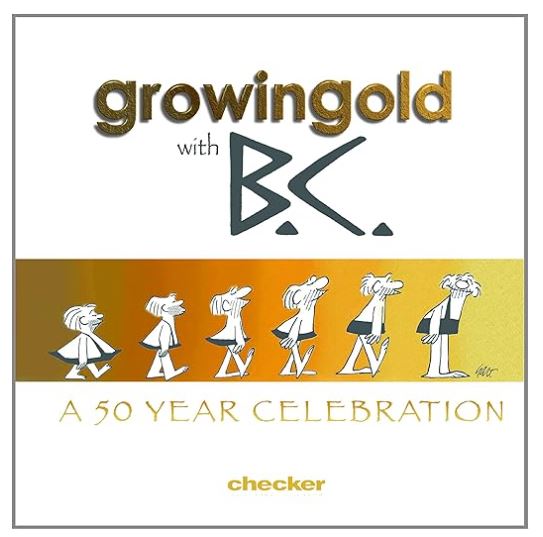
Growing Old with B.C. – A 50 Year Celebration


By Johnny Hart (Checker BPG)
ISBN: 978-1-905239-63-4 (HB) 978-1-933160-68-9 (PB/Digital edition)

This book includes Discriminatory Content produced in less enlightened times.

John Lewis Hart was born in Endicott, New York in 1931, and his first published cartoons appeared in military newspaper Stars and Stripes while he served with the US Air Force during the Korean War. On returning to Civvy Street in 1953, he sold a few gags to The Saturday Evening Post, Colliers Weekly and elsewhere, but had to earn a living as a general designer.

In 1958, for some inexplicable reason, caveman jokes were everywhere in magazines and comics (even latterly creeping onto TV and into movies). Despite all the dawn-age foofaraw, General Electric draughtsman and still-wannabe cartoonist Johnny Hart hadn’t sold a single one. He also desperately wanted to create a syndicated newspaper strip but couldn’t think of an idea.

And then one of his co-workers said why not do a strip feature one about Cavemen? Just like Alley Oop, but different…

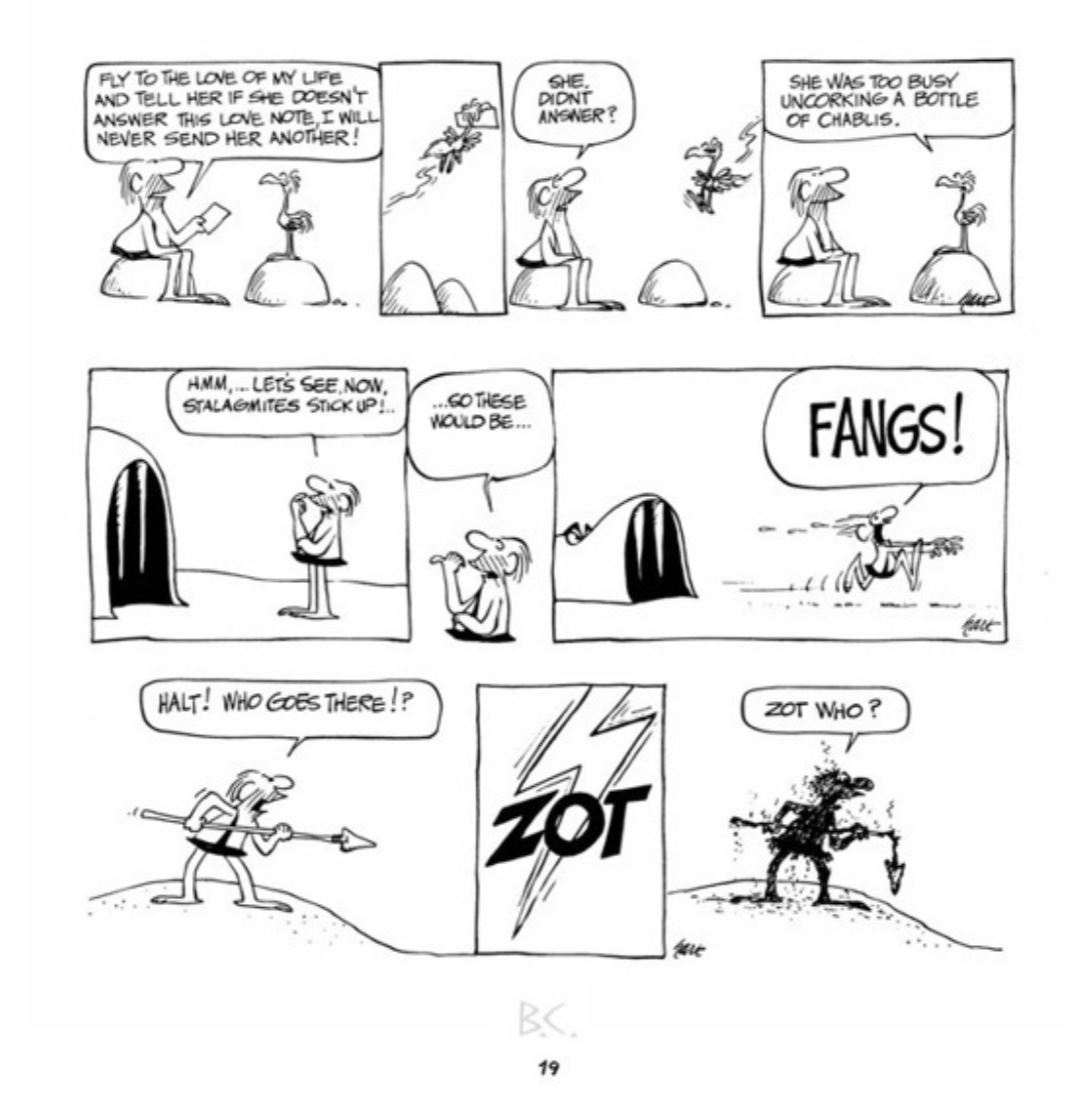
Hart took a good look at the state of the world, and especially the people around him, and the wryly outrageous social commentarians supporting and harassing our hapless nebbish leading man B.C. quickly took shape…

The concept sold instantly to the New York Herald-Tribune Syndicate and the strip – starting today in 1958 – rapidly became a global hit, with the first of 41 collected editions (Hey! B.C.) released in 1959. In 1964 Hart started collaborating with fellow cartoonist Brant Parker on a new strip. The Wizard of Id also became a monster hit. The features won Hart an astounding hoard of awards over the years: making him one of only 4 American cartoonists to produce two strips appearing contiguously in more than 1000 newspapers.

Hart died of a stroke on April 7th 2007. He was working at his drawing board. Brant Parker passed away eight days later.

Hart became a devout Christian during the mid-1980s – something which increasingly and controversially manifested in later strips – but his urgent need to preach and share took a long time to impact the trenchant, whimsically surreal wit and primal byplay of his primordial playpen.

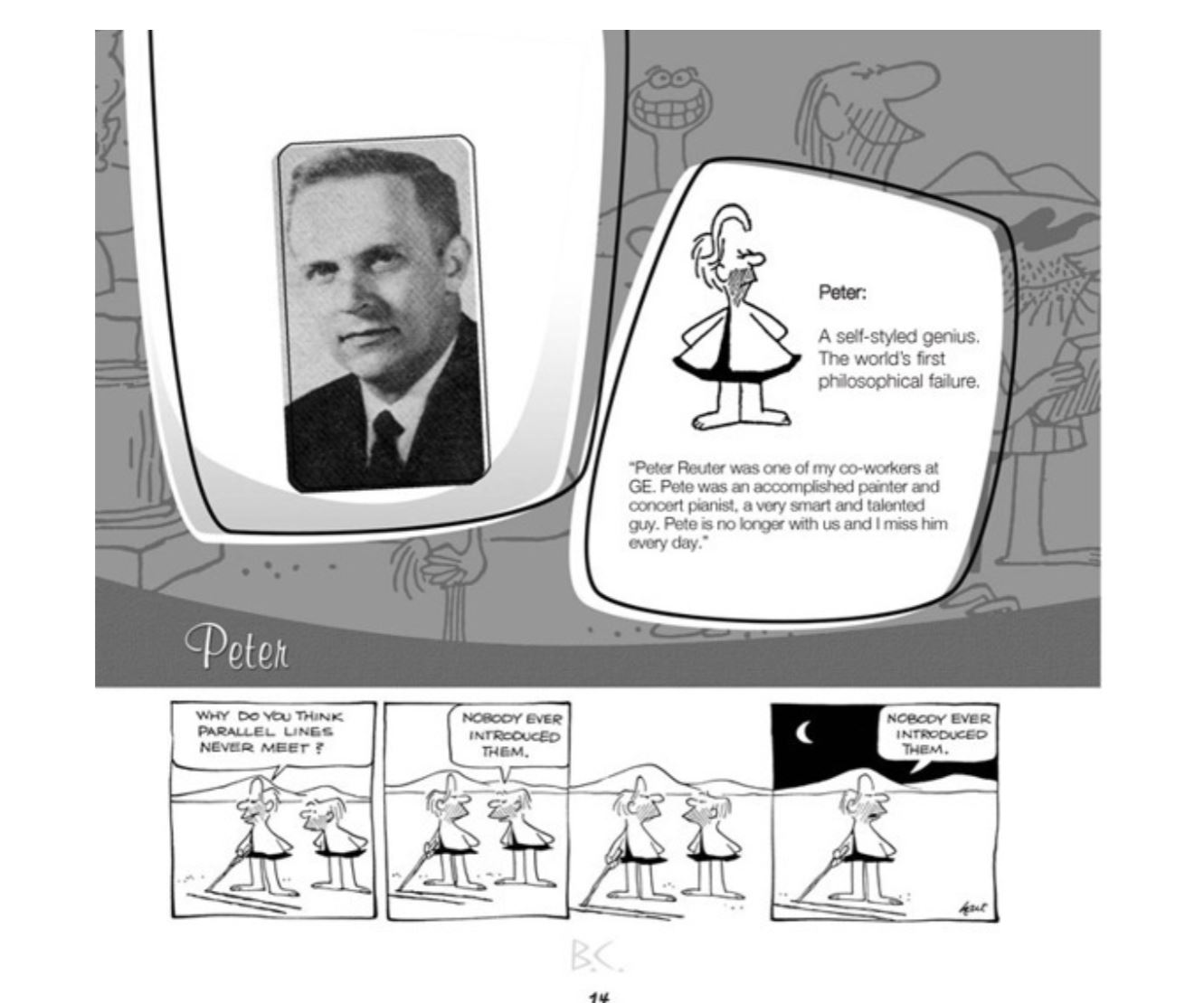
B.C. is a modern everyday kind of guy: a general purpose ordinary slob just getting by, but he has some odd and interesting friends breaking up the monotony of the pre-civilised world. These include self-proclaimed genius Peter, superstitious misogynist Wiley, proto-prime nerd Clumsy Carp, pre-human missing-link Grog, uber-sarcastic Curls and rakish lady-killer Thor.

Apparently, all of them are based on actual people – life-long friends of Hart’s – and their candid reminiscences provide a charming and poignant insight into the life of one of the most revered and successful cartoonists of modern times.

Other materialised regulars include a variety of talking beasts and inanimate objects: chatty, snappy dinosaurs; ants and ant-eaters; clams, snakes; turtles; birds and an apteryx – but I’m guessing they never had analogues with day-jobs in Eisenhower’s America…

This magnificent tome – available in hardcover, paperback and digital editions – offers a decade-by-decade selection of the best and most memorable B.C. strips, supplemented by a listing of its many awards, and comes stuffed with photographs and observations. It is a most delightful commemoration of a truly great and very funny strip.

Hart died during the finishing stages of this book’s creation, making this the best way to celebrate his achievements. His legacy of brain-tickling, absurdist lunacy will never date, and creative anachronism has never been better used to raise a smile or an eyebrow in this lush collection of timely and timeless fun.
B.C. © 2007 Creators Syndicate Inc. B.C. © 1958-2006 John L. Hart Family Limited Partnership.

Today in 1914 writer Leo Dorman was born, as was fellow Superman stalwart Curt Swan in 1920. In 1929 Alejandro Jodorowsky came along, with today also greeting modern myth makers Nelson De Castro/“Nelson” in 1969 and Leah Williams in 1988.

Big day for strip launches too. As well as BC, we all started loving Richard F. Outcault’s The Yellow Kid in 1985, Lee Falk’s The Phantom in 1936 and Jack Williamson & Lee EliasBeyond Mars in 1952.

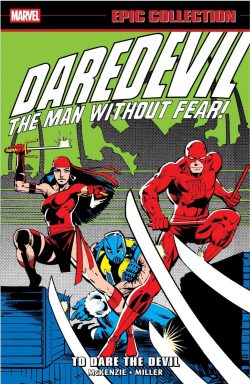
Daredevil Epic Collection volume 8: To Dare the Devil (1978-1981)


By Roger McKenzie, Frank Miller, David Micheline, Jo Duffy, Michael Fleischer, Mike W. Barr, Frank Robbins, Gene Colan, Steve Ditko, Klaus Janson, Frank Springer, Josef Rubinstein & various (MARVEL)
ISBN: 978-1-3029-60537 (TPB/Digital edition)

This book contains Discriminatory Content included for dramatic effect.

Matt Murdock is a blind lawyer whose remaining senses hyper-compensate, making him an astonishing acrobat, formidable fighter and living lie-detector. He also developed a kind of biological radar, granting him complete awareness of his immediate environment. A second-string hero for much of his early career, Daredevil was nonetheless a striking and popular one, due mostly to the captivatingly humanistic art of Gene Colan. DD fought gangsters, super-villains and even the occasional monster or alien invasion, quipping his way through life and life-threatening combat, utterly unlike the grim, moody, quasi-religious metaphor of justice and retribution that he became.

Under the auspices of Jim Shooter, Roger McKenzie and finally Frank Miller & Klaus Janson, the character transformed into a grimly modern figure, but here we find him navigating choppy relationship waters. After a disastrous on-again, off-again relationship with his secretary Karen Page, Murdock took up with Russian émigré Natasha Romanoff, infamous and notorious former soviet spy Black Widow, but their similarities and incompatibilities led to her leaving and Matt taking up with flighty, fun-loving trouble-magnet heiress Heather Glenn

Spanning cover-dates November 1978 to October 1981, this crucial compilation comprises relevant material from Daredevil #155-176, plus spin-off material generated for a readership that simply could not get enough of their newly darkened avenging devil and his secret paramour, as first seen in What If? #28 & Bizarre Adventures #28. The visual tumult and tension begin sans any delay or debate…
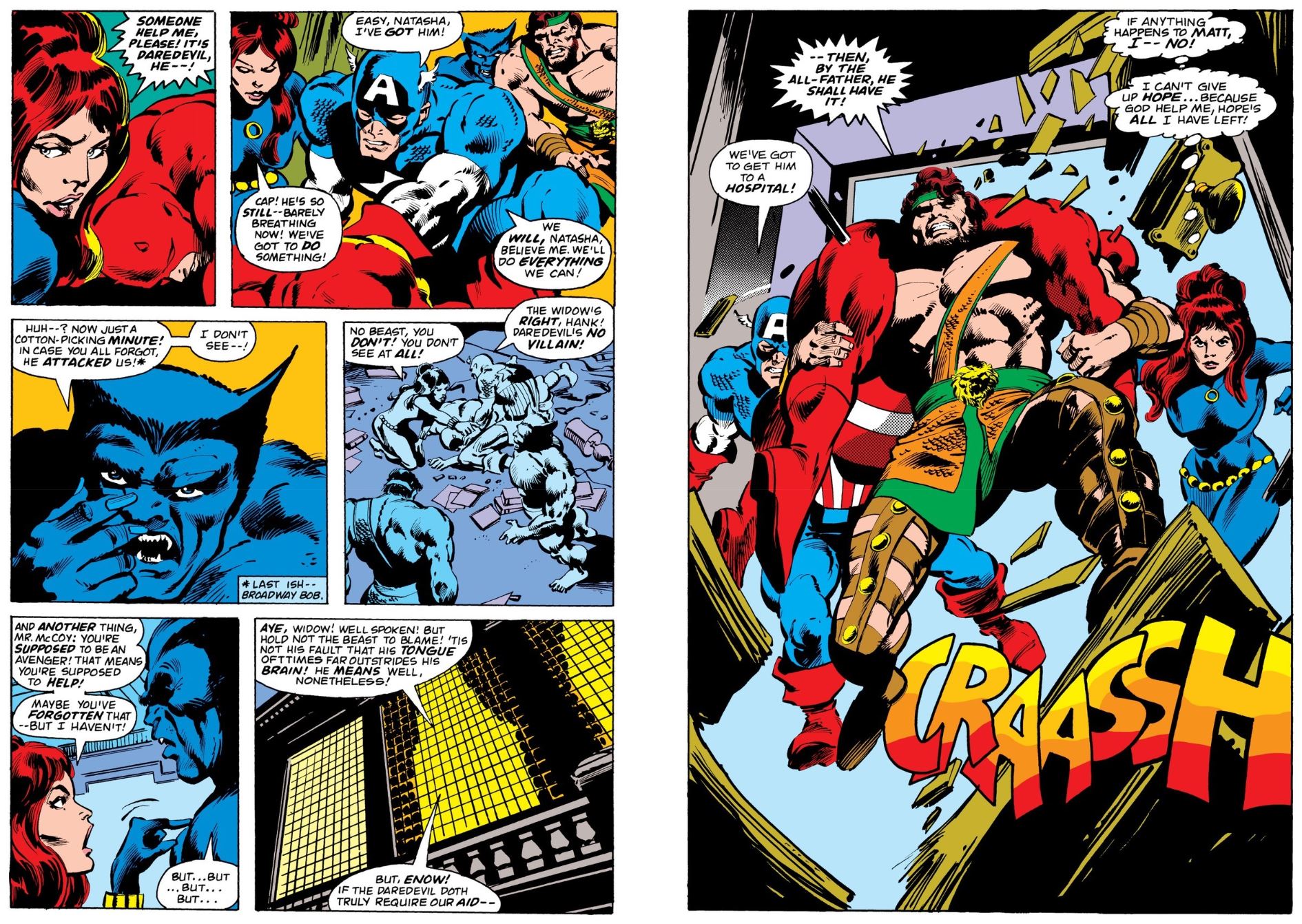
Heroic endeavours resume with writer Roger McKenzie describing the repercussions of a massive ambush on the hero by his worst enemies. Guest-starring Black Widow, Hercules and The Avengers, aftermath episode ‘The Man Without Fear?’ is illustrated by Frank Robbins & Frank Springer, wherein a brain-damaged Murdock repeatedly attacks innocent bystanders and his allies before collapsing. Keenly observing, macabre mystery menace Death-Stalker spots an opportunity and follows the hospitalised hero into #156’s ‘Ring of Death!’ (McKenzie, Colan & Klaus Janson). As DD undergoes surgery and suffers deadly delusions of fighting himself, the teleporting terror with a death-touch seeks to end the scarlet swashbuckler’s meddling forever, but finds the Avengers almost too much to handle…

The assault ends in DD #157’s ‘The Ungrateful Dead’, with Mary Jo Duffy scripting from McKenzie’s plot. Now, after frustrating the vanishing villain, Matt is cruelly kidnapped by a new squad of the Ani-Men (Ape-Man, Cat-Man & Bird-Man) all leading to Miller’s debut as penciller in #158’s ‘A Grave Mistake!’ With McKenzie writing and Janson inking, all plot threads regarding Death-Stalker spectacularly conclude as the monster gloatingly shares his true origins and reasons for haunting the Sightless Swashbuckler for so long. As always, Villain underestimates Hero and the stunning final fight in a graveyard became one of the most iconic duels in superhero history…

From this point on, Daredevil was increasingly repositioned as an outcast urban defender and compulsive vengeance-taker: a tortured demon dipped in blood. The character makeover was carried on initially by McKenzie from his predecessor Jim Shooter, and fully manifested in collaboration with Miller until the latter fully took control to deliver audacious, shocking, groundbreakingly compelling dark delights, making Daredevil one of comics’ most momentous, unmissable, “must-read” series.

That revitalisation resumes with ‘Marked for Murder!’ (McKenzie, Miller & Janson) wherein infallible assassin-broker Eric Slaughter comes out of retirement for a very special hit on the hero of Hell’s Kitchen. Meanwhile elsewhere, veteran Daily Bugle reporter Ben Urich works a nagging hunch: slowly piecing together dusty news snippets that indicate a certain sight-impaired attorney might be far more than he seems……

The spectacular showdown between the Crimson Crimebuster and Slaughter’s hit-man army inevitably compels his covert client to eventually do his own dirty work: brutally ambushing and abducting former flame Natasha Romanoff, aka The Black Widow…

After a single-page fact-feature on ‘Daredevil’s Billy Club!’, the saga continues in #160 with our hero having no choice but to place himself ‘In the Hands of Bullseye!’ – a stratagem culminating in a devastating duel and shocking defeat for the villain in cataclysmic conclusion ‘To Dare the Devil!’

Next issue offered a fill-in tale by Michael Fleisher & Steve Ditko wherein another radiation accident impairs our hero’s abilities and induces amnesia just as a figure from his father’s pugilistic past resurfaces. Becoming a boxer for crooked promoter Mr. Hyle, Murdock unknowingly relives his murdered dad’s last days in ‘Requiem for a Pug!’… until his own memories return and justice is served…

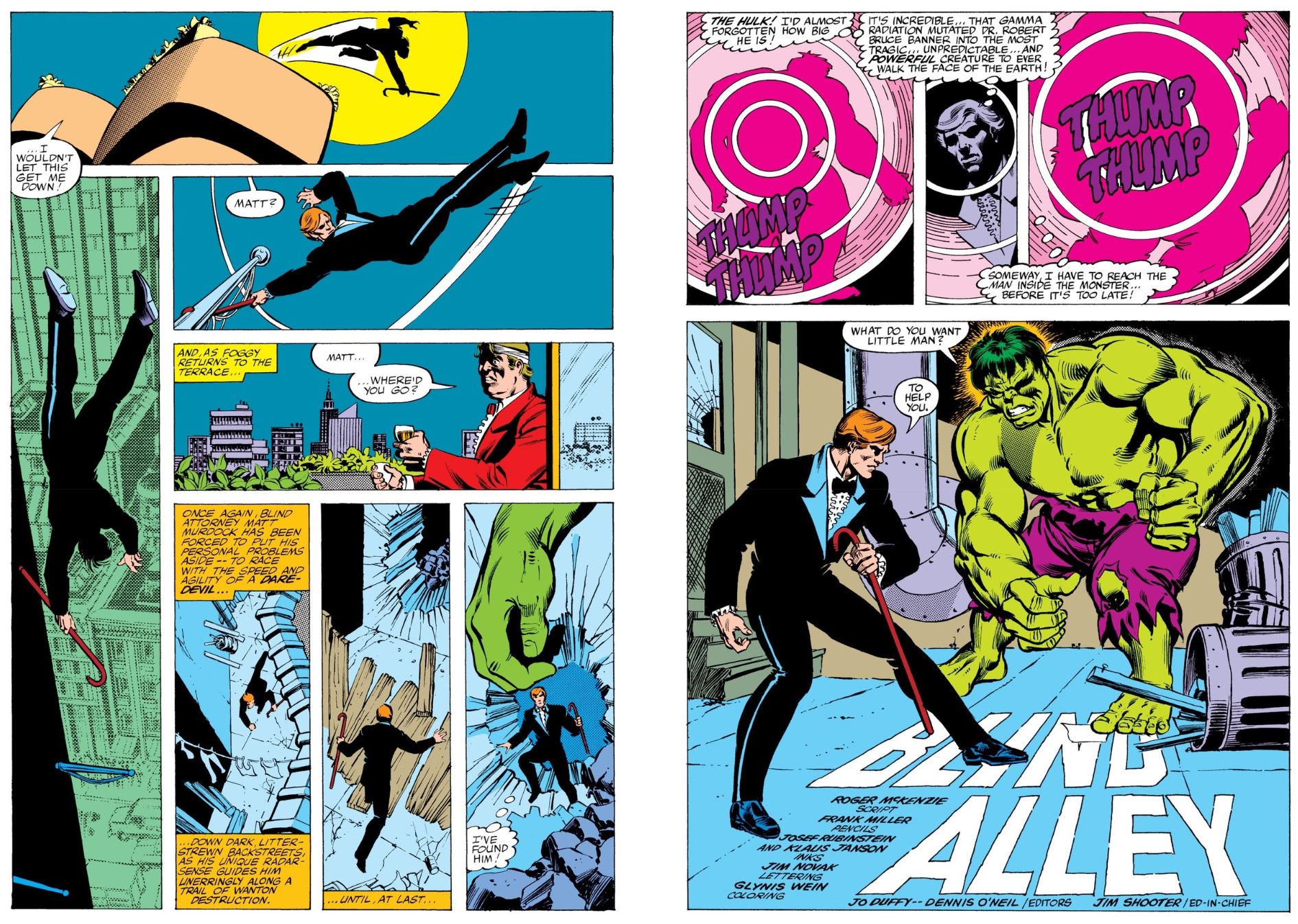
Stunning David & Goliath action belatedly comes in #163 as the merely mortal Man Without Fear battles The Incredible Hulk in ‘Blind Alley’ (McKenzie & Miller, inked by Josef Rubenstein & Janson) wherein Murdock’s innate compassion for hounded Bruce Banner inadvertently endangers Manhattan and triggers a desperate, bone-breaking, but ultimately doomed attempt to save his beloved city…
In #164 McKenzie, Miller & Janson deliver an evocative ‘Exposé’, retelling the origin saga as meticulous, dogged Urich confronts the hospitalised hero with inescapable conclusions from his diligent research and a turning point is reached…

The landmark tale is followed by accompanied by Miller’s unused cover for Ditko’s fill-in yarn, and precedes a mean-&-moody modern makeover for a moribund and over-exposed Spider-Man villain. DD #165 finds the Scarlet Swashbuckler in the ‘Arms of the Octopus’ when Murdock’s millionaire girlfriend Heather is kidnapped by Dr. Otto Octavius. Her company can – and do – rebuild his mechanical tentacles with Adamantium, but “Doc Ock” stupidly underestimates both his hostage and the seemingly powerless Man Without Fear…

A long-running plot thread of Matt’s best pal Foggy Nelson’s oft-delayed wedding finally culminates with some much-needed comedy in #166’s ‘Till Death Do Us Part!’, with true tragedy coming along too as old enemy Gladiator has a breakdown and kidnaps his parole officer. With visions of Roman arenas driving him, tormented killer Melvin Potter only needs to see Daredevil to go completely over the top…

David Michelinie wrote #167 for Miller & Janson, with a cruelly wronged employee of tech company the Cord Conglomerate stealing super-armour to become ‘…The Mauler!’ and exact personal justice. Constantly drawn into the conflict, DD finds his sense of justice and respect for the law at odds when another avoidable tragedy results…

The tale is backed up by an info feature revealing the ‘Dark Secrets’ of DD’s everyday life before segueing neatly into the story that changed everything.

With Daredevil #168 Miller took over the writing and with Janson’s art contributions increasing in each issue, rewired the history of Matt Murdock to open an era of noir-tinged, pulp-fuelled, Eisner-inspired innovation. It begins when Daredevil encounters a new bounty hunter in town which prompts recall of lost college-days first love. Back then, diplomat’s daughter Elektra Natchios shared his secrets – until her father was kidnapped and murdered before her eyes, partly due to Matt’s hasty actions. She left him and vanished, apparently becoming a ninja assassin, but is now tearing up the town hunting Eric Slaughter. Matt cannot help but get involved…

When Daredevil last defeated Bullseye, the psycho-killer was diagnosed with a brain tumour, and in #169 escapes from hospital to enact another murder spree. He is deep in a delusional state where everyone he sees are horn-headed scarlet-draped ‘Devils’. A frenetic chase and brutal battle results in countless civilian casualties and great anxiety as Daredevil has a chance to let the manic die… but doesn’t.

Yet another landmark resurrection of a tired villain begins in DD #170 as Miller & Janson decree ‘The Kingpin Must Die’. The former crimelord of New York had faded into serene retirement in Japan by impassioned request of his wife Vanessa, until this triptych of terror sees him return, more powerful and resourceful than ever. It all begins when the Devil of Hell’s Kitchen hears rumours the syndicate that replaced Wilson Fisk are trying to kill their old boss. Apparently, he has offered all his old records to the Feds…

When Vanessa hires Nelson & Murdock to broker the deal, all hell breaks loose, assassins attack and Mrs Fisk goes missing. Further complicating matters, having survived brain surgery, Bullseye now offers his services to the syndicate, mercenary killer Elektra senses a big business opportunity and a murderously resolute Kingpin sneaks back into the country resolved to save his Vanessa at any cost…
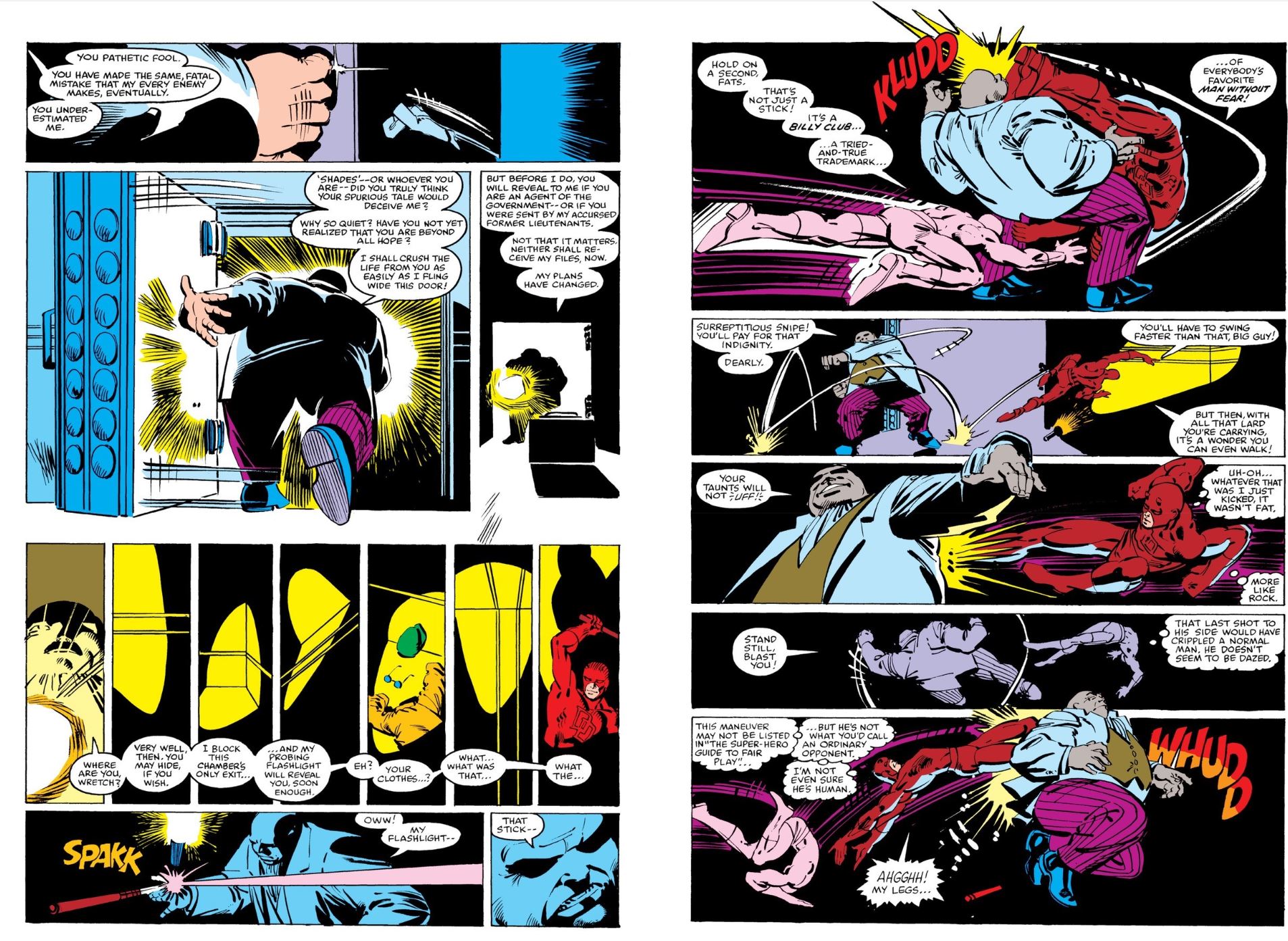
The title at last returned to monthly schedule with #171 as the city erupted into sporadic violence with civilians caught in the crossfire. DD dons a disguise and goes undercover but is soon ‘In the Kingpin’s Clutches’, and seemingly sent to a watery grave prior to Fisk gambling and losing everything.

The saga ends in all-out ‘Gangwar!’ as, with Vanessa lost and presumed dead, Wilson Fisk destroys the in situ Syndicate and takes back control of New York’s underworld. At least Daredevil scores a small-yet-toxic victory by apprehending the Kingpin’s assassin, all the while aware that every death since Bullseye’s operation has been because Murdock was not strong enough to let the monster die…

… And deep in the bowels of the city, an amnesiac woman wanders, a future trigger for much death and destruction to come…

With the city increasingly awash in mobsters, monsters, assassins and deviants, Daredevil 173 returns to the difficult, painful redemption of mentally-ill former foe The Gladiator. Having suffered an emotional crisis Melvin Potter prays his violent old life is over, but when a woman is brutalised in the streets, she identifies the anxious supervillain as her attacker. Murdock begins a stout defence of the ‘Lady Killer’, but despite his truth-sensing abilities, even his confidence takes a battering when his own assistant Becky Blake reveals Potter is the man who put her in a wheelchair years previously. Shocked and betrayed on all sides, Matt lets DD take charge and exposes a world of horror and abuse while tracking down a cunning, opportunistic human beast who tortures women just for kicks…

Elektra co-stars in #174 as her former master The Jonin demands ‘The Assassination of Matt Murdock’, introducing resurrecting zombie ninja cult The Hand just when the Potter trial is going badly and faithful partner Foggy Nelson has abandoned him. The cult’s expansion into America is lethally and effectively countered by Elektra, but when Daredevil joins the fight he is wounded and loses his greatest supersense, leaving him to depend on her and Melvin reluctantly returned to his Gladiator persona…

Now targeted by immortal super ninja Kirigi, Elektra goes after Jonin in ‘Gantlet’ and leaves DD to his own devices prior to ‘Hunters’, showing severely impaired Matt hunting for the old guy who first taught him to use his super senses. He rattles his old foes and street sources so badly that even Z-grade thugs Turk and Grotto are scared enough to steal a super-armour suit and settle with the Scarlet Swashbuckler for good…

To Be Continued…

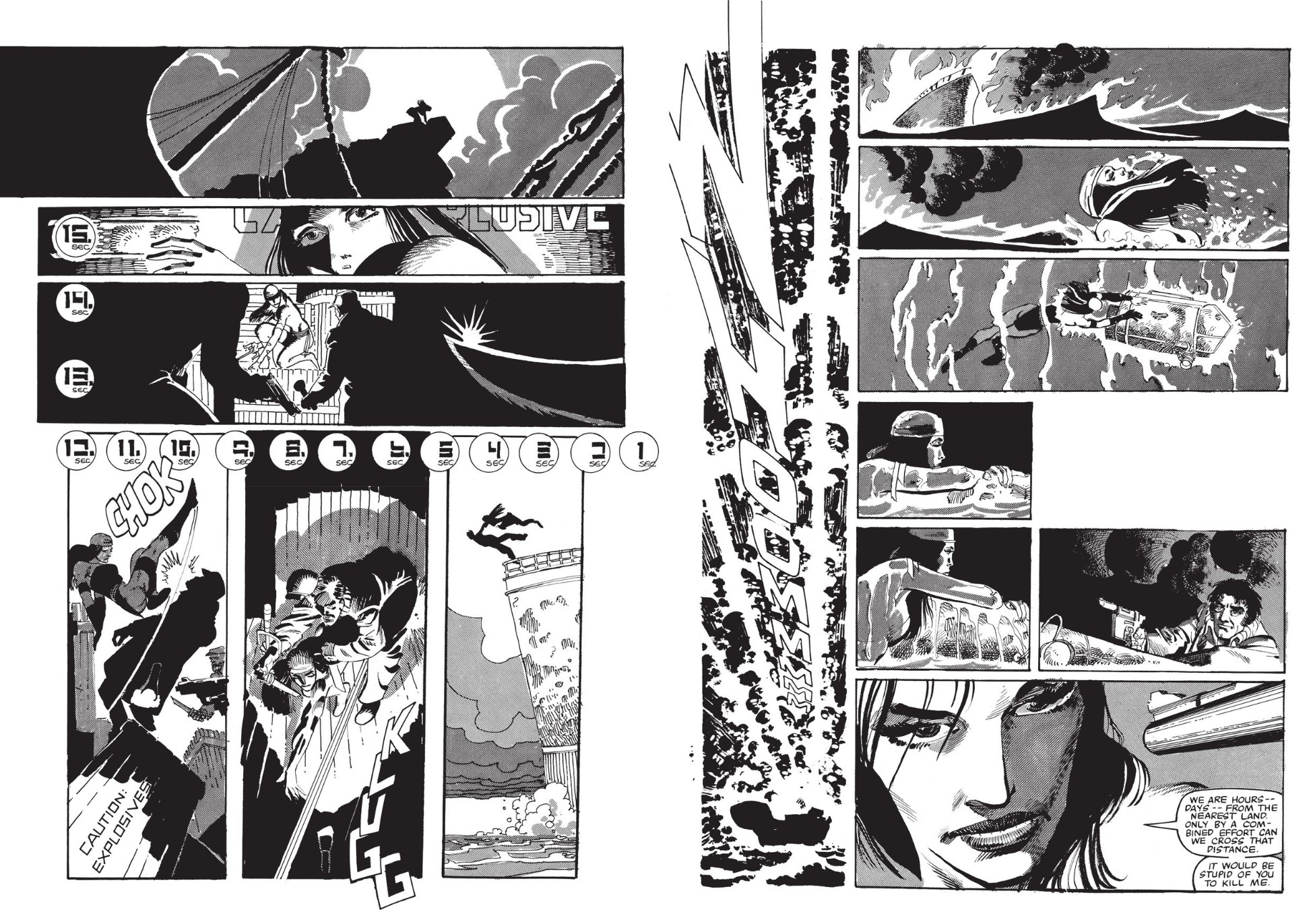
Here, however, the events sparked a number of ancillary delights represented here by What If? #28’s ‘Matt Murdock, Agent of S.H.I.E.L.D.’ (by Mike W. Barr, Miller & Janson, and cover-dated August 1981), seeing what might have been had Anthony Stark and Nick Fury been nearby when young Matt was hit by that senses-altering radioactive cannister. That’s followed by spectacular monochrome prequel ‘Elektra’, crafted by Miller for Bizarre Adventures #28 (October 1981) with the hired killer going off-book after she finds out an unsavoury truth about her client.
Supplementing throughout with the covers by Colan, Springer, Janson, Rubinstein, Al Milgrom, Miller, Ditko, Bob McLeod, George Roussos and Bob Larkin, this roster depicting the resurgent rise in comics form is further bedecked and bedazzled with contemporary house ads; the Marvel Bullpen Bulletins page heralding Miller’s debut; original art and Miller’s full Daredevil character bible, written in 1980 as he prepared to take over the writing. Also on view are Miller & Janson’s pages from Marvel Comics 20th Anniversary Calendar 1981 (June) and their Spider-Man vs DD plate from Marvel Team-Up Portfolio One. Those are supplemented by Miller covers & frontispieces for Daredevil Visionaries: Frank Miller volume 1 & 2 (with Steve Buccellato) before closing with M&J’s iconic Amazing Heroes #4 cover from September 1981.

As the decade closed, these gritty tales set the scene for truly mature forthcoming dramas, promising the true potential of Daredevil was finally in reach. Their narrative energy and exuberant excitement are dashing delights no action fan will care to miss.

… And the next volume heads full on into darker shadows, the grimmest of territory and the breaking of many more boundaries…
© MARVEL 2025.

In 1958 horror artist John Totleben was born, as was Italy’s Antonio Serra (Nathan Never) in 1963, Tim Bradstreet in 1967 and Warren Ellis one year later.

We lost letterer/colourist/comics artist/animator Frank Engli in 1977 but we can still enjoy Popeye, Betty Boop, Terry and the Pirates, Male Call, Steve Canyon, Scorchy Smith and his own creations On the Wing and Rocky the Stone Age Kid. Don’t you want to go look him up now?

In 1963 UK standby Knockout finally lay down after 24 years and in1980 Nutty launched with the debut of Bananaman. And in 2017 dutchman designer Dick Bruna died, having introduced us all to his bunny star Miffy way back in 1955.

HM Bateman: The Man Who… and Other Drawings


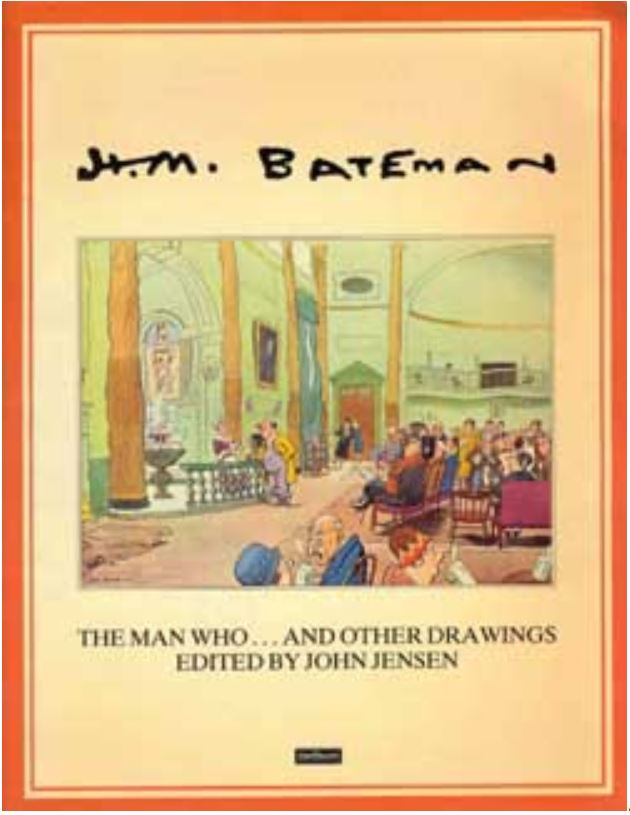
By H.M. Bateman; edited by John Jensen (Methuen 1983)
ISBN: 978-0-41332-360-9 (Album PB)

This book includes Discriminatory Content produced in less enlightened times but also emphasised for comedic effect.

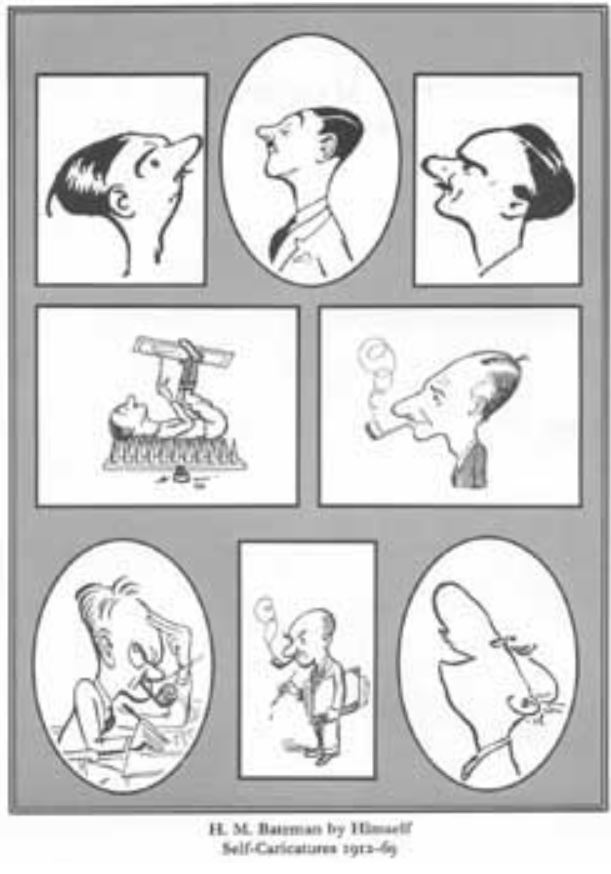
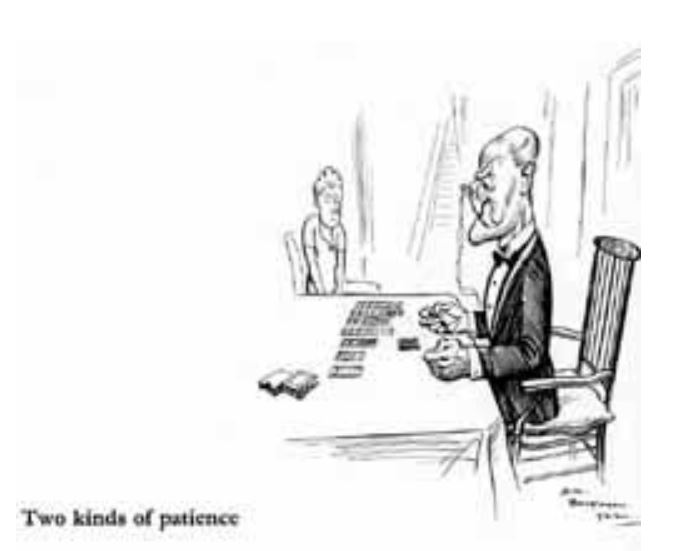
On February 15th in 1887, Henry Mayo Bateman was born in New South Wales. He was however, raised in England, attending Forest Hill House School and Goldsmith’s College (Institute, as was). He also studied with John Hassall and later at the Charles Van Havenmaet Studio from 1904-07. He was a great fan of Comic Cuts and Ally Sloper’s Half Holiday, and his first cartoons were published in 1903 in Scraps. Bateman was skilled and gifted in both illustrative and comedic drawing and agonised over his career path before choosing humour. Mercifully, he was too frail for military service in 1914 and so his gifts were preserved for us all to share. He died in Gozo, Malta on February 11th 1970, having spent his final years in steadfast (often hilarious) battle with the Inland Revenue…

Bateman’s most memorable series of cartoons was ‘The Man Who…’ These were lavish set pieces, published as full colour double-page spreads in The Tatler, perpetually lampooning the English Manner by way of frenzied character reactions to a gaffe or inappropriate action from a blithely oblivious central participant. Bateman’s unique strength came from extending his training as a caricaturist into all his humorous work, a working philosophy that the artist equated with drawing people as they felt rather than how they looked.

He was also a British pioneer of cartoons without text, depending on beautifully rendered yet powerfully energetic and vivacious interpretations of people and environment to make his always funny point. He was a master of presenting a complete narrative in a single image.

In reviewing the 14 collections published during his lifetime and such collections as the volume at hand, or the excellent The Best Of H M Bateman 1922-1926: The Tatler Cartoons (1987), I was particularly struck by the topicality of the work as well as the sheer wonder of the draughtsmanship. Find if you can ‘The Man Who asked for a second helping at a City Company Dinner’, wherein 107 fully realised Diners and waiters, all in full view, have 107 different and recognizable reactions to that gauche request. It is an absolute masterpiece of comic art – as are all the rest. In a world where the next fad is always the most important, it is vital that creators such as Bateman remain unforgettable and unforgotten. I pray to the cartoon gods that somewhere soon some museum retrospective on British culture will rescue this genius from ill-deserved (temporary) obscurity and generate one last curated collection for us to revel in…
Text ©.1983 John Jensen/Methuen. Illustrations © 1982, 2007 Estate of H M Bateman.

For further explorations and illumination please check out HM Bateman – Official Cartoons & Artwork.

Also today, Golden Age comics artist Nina Albright (Miss Victory, Black Venus) was born, as was Belgian star Willy Vandersteen (Spike and Suzy) in 1913 and Disney Duck artist William Van Horn in 1939.

Art Spiegelman was born in 1948, and Marc Hansen (Ralph Snart, Weird Melvin, Doctor Gorpon) in 1963, whilst in 1965, Morrie Turner launched Wee Pals, America’s first strip with a racially diverse cast. In 1987, Walt Disney’s Treasury of Classic Tales ended a run begun in the early 1950s. We also lost today veteran Canadian artist Jack Sparling in 1997, and two Italian Bonelli/Tex Willer stalwarts: Vincenzo Monti in 2002 and Fabrizio Busticchi in 2017.

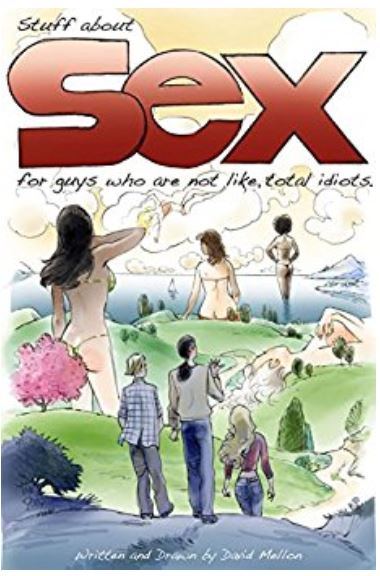
Stuff about Sex for Guys Who Are Not Like, Total Idiots


By David Mellon (Top Shelf Productions)
No ISBN ASIN: B01BMV519A (pamphlet)

Utterly unavailable – and how like most men today is THAT? – here’s a tiny treat that’s educational and well worth tracking down. You might even agitate for its revival and expansion and return…

Whilst not actually a graphic novel, I couldn’t resist adding this outrageous little comic book essay to my St. Valentines Day celebrations, and wholeheartedly recommend it to any oldster who likes a gentle, knowing laugh or any young man in need of an understanding non-judgemental pep talk before setting out to find a mate… either for a night, a little while or a lifetime.

In the manner of a relatively non-judgemental older sibling, David Mellon (The Boogieman, Silent) expresses, frankly and in the most simple of terms, how to start having sex. He covers the onset of adult relationships; dispelling myths, addressing if not positively coddling neuroses and especially bestowing actual useful advice (yes, really! Wash often and wear clean clothes!) to help nervous neophytes meet women (or consensual alternatives) and not nauseate them.

Beautifully rendered in accessible monochrome cartoons, Mellon takes us through the initial obstacle of ‘Shame!’, arguing that ‘It’s the Same for Everybody’ and claiming ‘Everybody Wants to Drop that Mask!’

Nothing is held back as the author sensibly deals with ‘Personal Hygiene’ and tackles issues such as ‘Premature Ejaculation’ and ‘Masturbation’, the pros and cons of ‘Virginity’ and even asks the big question…‘What’s Love Got to Do With It?’

Even the great imponderables get a look in as we examine ‘Normal’ and discuss ‘What Women Want’

Smart, sensible, unflinching but never harsh or mean, Mellon’s mature approach to an age-old traumatic experience and rite of passage should be mandatory reading in schools (but won’t be because of all the naked men and women he’s drawn here) as a serious and earnest contrition to sex education.
Stuff about Sex™ & © 2012 David Mellon. All rights reserved.

Today in 1865 Henry creator Carl Thomas Anderson was born, and so was civil rights champion/political cartoonist Oliver Harrington in 1912, followed four years later by writer/editor/MLJ and Archie Comics co-founder John Goldwater. In 1967 the world became a better place with the birth of New Zealand’s greatest comic export Roger Langridge.

In 1962 we lost Korky the Cat creator James Crighton, the world bid adieu to comics star turned Hanna-Barbera animator Alex Lovyin 1992 and in 2007 Germany said farewell to artist/animator Willy Moese.

In 1904, Jimmy Swinnerton’s strip Little Jimmy debuted while UK comics changed forever in 1976 when Fleetway’s astoundingly controversial weekly Action launched.

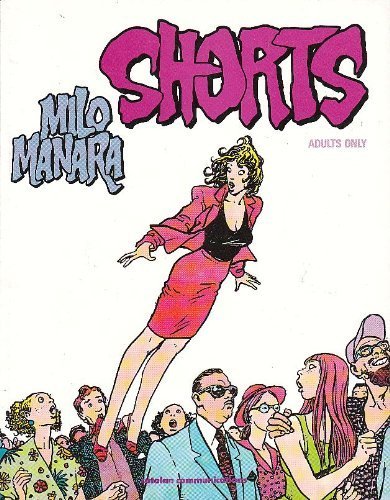
Shorts


By Milo Manara, translated by Tom Leighton (Catalan Communications)
ISBN: 978-087416-060-4 (HB)

For some folks the graphic novel under review here will be unacceptably lewd, even “dirty”. If that’s you, please stop here and come back tomorrow when there will something you’ll approve of but which will surely offend somebody else.

It’s another amatory Final Countdown moment and possibly a last chance to impress that significant one this year so let’s maturely and contemplatively review a rather quirky, philosophical – and typically unattainable – tome by one of the world’s greatest graphic eroticists. Originally translated into English from the French edition Courts Métrages by Catalan in 1989, it’s another inexplicably Out-of-Print graphic gem desperately in need of an English language release.

Maurilio “Milo” Manara (born September 12th 1945) has always been a puckish intellectual and whimsical craftsman with a dazzling array of artistic skills ranging from architecture, product design, filmmaking & animation, painting and of course an elegant, refined, clear-clean line style with pen and ink. He is best known for his wry, controversial and generally sexually explicit material – although that’s more an indicator of our comics market than any artistic obsession. He’s even drawn the X-Men – but mostly the women…

After studying painting and architecture he began crafting comics for money in 1969, beginning with Fumetti Neri series Genius, and thereafter working on the magazine Terror. His life’s goal came in 1971 as he began his “adult” career (see what I did there?) illustrating Francisco Rubino’s Jolanda de Almaviva which led, four years later, to his first major work and success. Originally released as Lo Scimmiotto, The Ape was a bold, bawdy reworking of the Chinese tales of the Monkey King.

By the end of the seventies he was working for the vast Franco-Belgian market where he is still regarded as an A-list creator. It was while creating material for Charlie Mensuel, Pilote and L’Écho des savanes that he created his signature series HP and Giuseppe Bergman for A Suivre.

As the 80’s staggered to a close he wrote and drew, in his characteristic blend of raunchy burlesque and saucy slapstick, the eccentric selection of satirical, baroque tales gathered here as a barbed and penetrating assault on modern media and bastardized popular cultural, which were increasingly being used to cloak capitalist intrusions and commercial seductions.

In these absurdist, voyeuristic, fourth-wall breaking, intellectually-challenging, exceedingly sexy monochrome vignettes, Manara highlights the diminishing divisions between Art and Selling, with tales intended to make your head throb as much as your nethers.

The sensorial incursion commences with ‘Commercial’, as a typical couch-potato is inexorably drawn into the Casanovan drama he’s watching. However, the drama’s TV-contained characters are impeded in their roles by the intrusive presence of the sponsor’s unsavoury product: adult diapers…

All of these yarns are visually influenced by iconography of the Great Arts, like Luciano Pavarotti and Fellini, and ‘Blue Period’ details the ruthless nature of commercialism as a photographic director goes to extraordinary lengths to reproduce a Picasso painting for an album cover. Sadly, under normal conditions, the human body just don’t bend that way…

‘X3’ offers to reveal your sex-portrait with a brief questionnaire survey carried out by aliens well-versed in the techniques of abduction and probing whilst ‘John Lennon’ delightfully describes what happened after the master musician got to Heaven before ‘Acherontia Atropos’ plays a very dark prank on a cameraman who signs up to film a genuine snuff-movie…

‘Untitled’ returns to the role of unsatisfied Casanova as the legendary lover suffers an unquantifiable loss and surreal challenge to his life-style, whilst ‘The Last Tragic Day of Gori Bau & the Callipygian Sister’ sinisterly shows the dark side of “underage” explorations and pubescent curiosity when a trio of kids invoke feelings and powers they are not equipped to cope with. This comes from a far less sensitive time and might well be the most emotionally triggering tale here, so please read with care and your eyes and conscience open…

Our allegorical ambuscade concludes with the calamitously comedic surreal science fiction yarn ‘And’ as an Earthman and an Arcturian escape from a dying planet thanks to the power of a book which writes itself and predicts the future. If only the incredible chronicle had a spell-checker too…

Delineated in Manara’s beautifully rendered, lavish linework this explicit, daringly deep and sexually charged selection makes intriguing points of social and creative commentary in an utterly seductive and fascinating manner, but even at its most raunchy, funny and challenging this tome is first and foremost a work of sublime pictorial entertainment desperately worthy of a new edition.
© 1989 Milo Manara/Staletti, agent, Paris. English Language edition © 1989 Catalan Communications. All rights reserved.

Today in 1877 strip cartoonist SidneyThe GumpsSmith was born as was Bud Blake (Tiger) in 1918 and letterer Danny Crespi in 1926. We lost The New Yorker stalwart Gluyas Williams in 1982 and the astounding Ron Embleton (Wrath of the Gods, Stingray, Biggles, Look and Learn, World of Wonder, Oh Wicked Wanda, those images in the closing credits of Captain Scarlet and the Mysterons).

The day also saw the beginning of Hal Foster’s Prince Valiant in 1937, Leo Baxendale’s The Bash Street Kids in The Beano in 1954 and the last Peanuts strip by Charles M. Schulz in 2000.

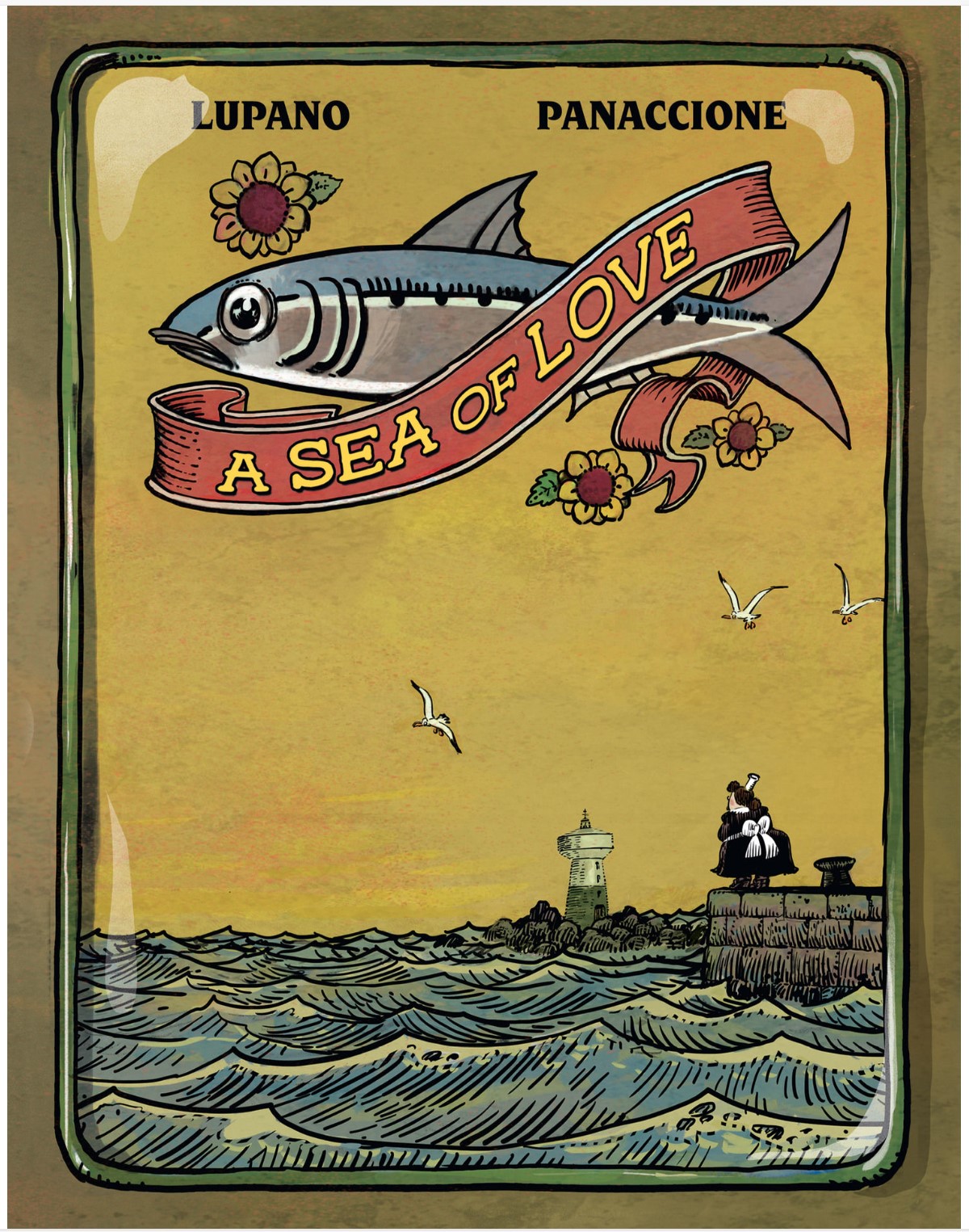
A Sea of Love


By Wilfrid Lupano & Grégory Panaccione (Lion Forge/The Magnetic Collection)
ISBN: 978-1-942367-45-1 (HB/Digital edition)

The sheer breadth, variety and creative ambition of comics regularly renders me breathless. It feels like there’s no subject or blend thereof; no tone or trope; no limits and absolutely no style or admixture that talented individuals can’t turn into heartrending, hilarious, thrilling, educational, evocative, uplifting and/or infuriating stories.

This completely silent saga from prolific French writer Wilfrid Lupano (Old Geezers; Azimut; Blanc Autour; Le Loup; Valerian spin-off Shingouzlooz Inc. and so many more) with illustrator Grégory Panaccione (Someone to Talk To; Toby Mon Ami; Match; Âme) somehow offers all of those in one delicious hardback or digital package.

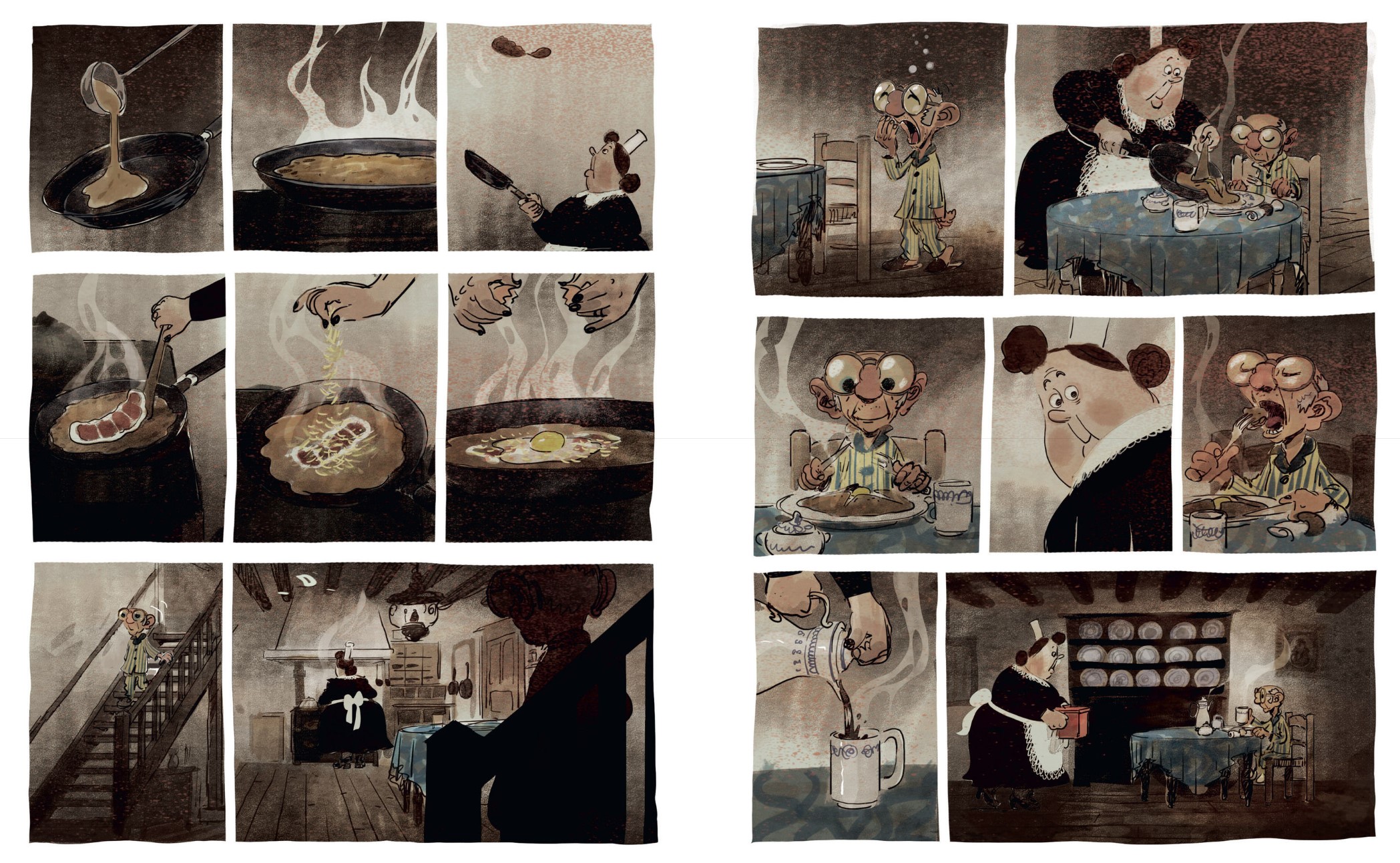
Originally seen au continent as Un Océan d’amour in 2014, this wordless yet universally comprehensible pantomime is an unforgettable saga celebrating the timeless resilience of mature love. Here it is craftily concealed yet constantly displayed in a tale of tetchy devotion between an aged diminutive fisherman and his quiet, timid, overly-flappable but formidably indomitable wife.

Every morning before the sun lights their rustic hovel, she makes him a wonderful breakfast before he heads out into the big ocean in a little boat. They have their fractious moments and he can be a trial sometimes, but their relationship is rock solid and never-ending.

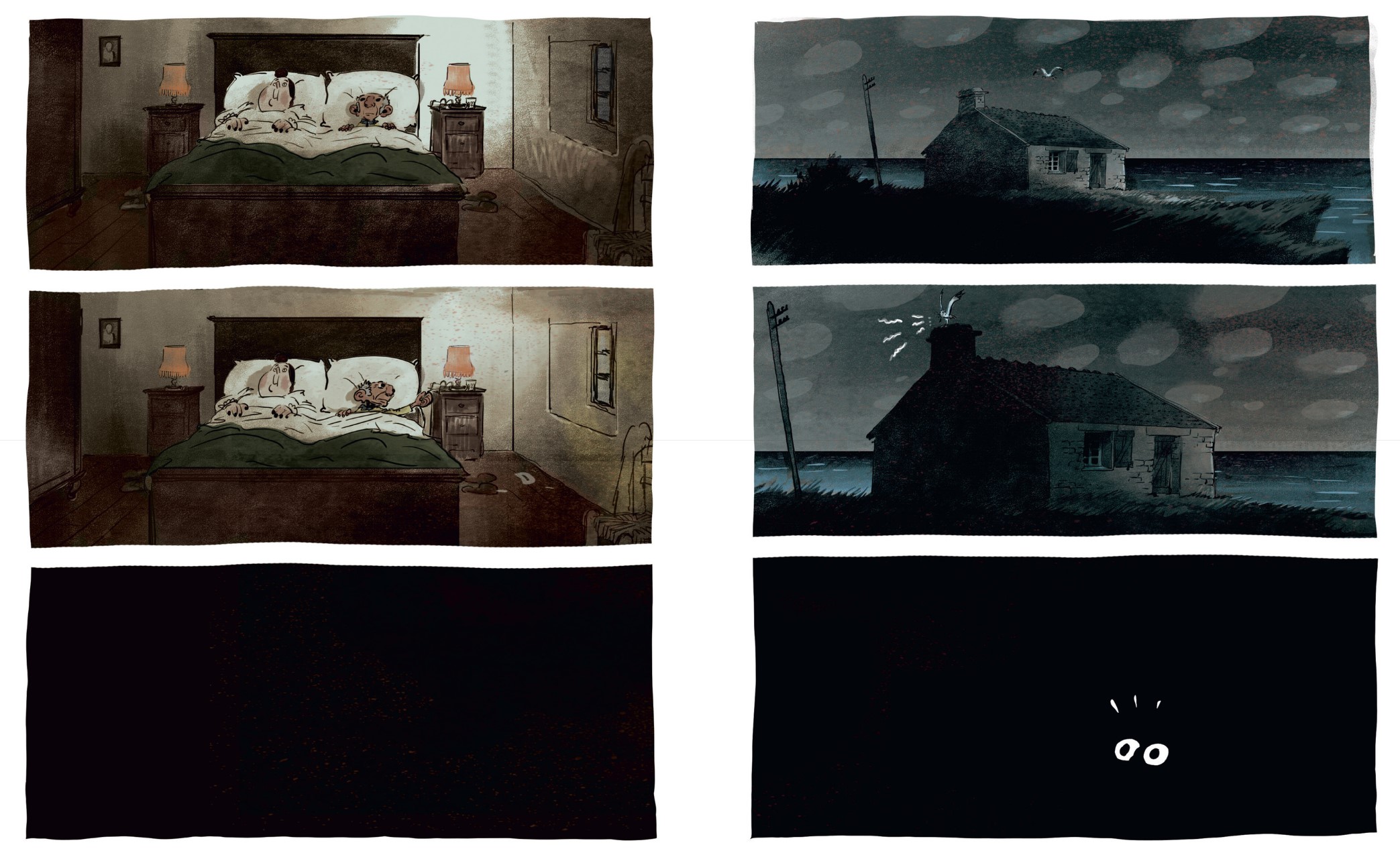
This particular morning, however, the old coot finally falls foul of a changing world, when his little vessel is snagged in the nets of a vast trawler factory ship. Saving his idiot apprentice, the old git is soon swallowed up and gone…

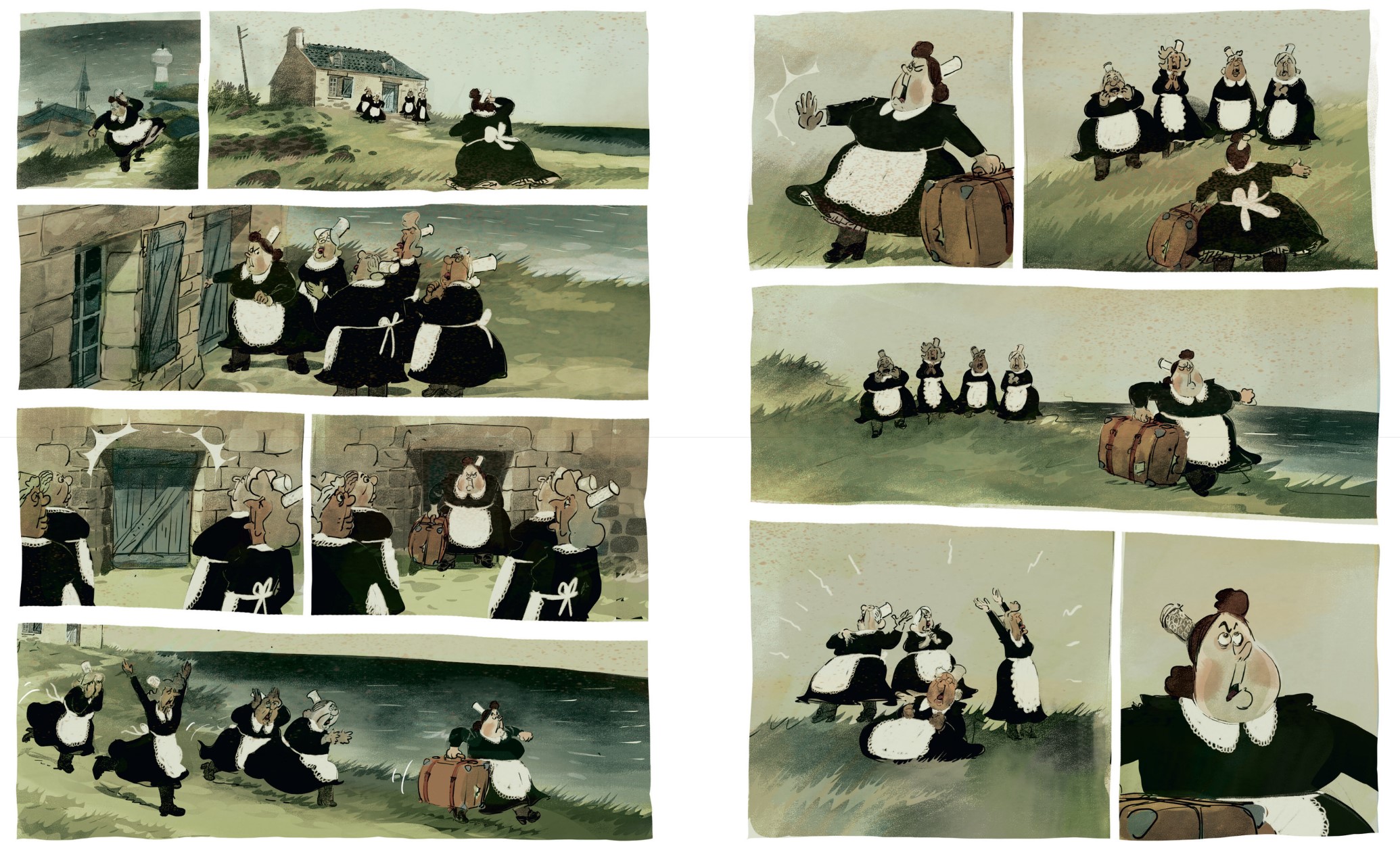
At least, that’s what the sole survivor believes when he washes up ashore. However, the matronly new widow refuses to accept that and – disregarding decades of homey domestic programming – goes looking for him.

Oh, the incredible adventures she has and the people she meets…

He, meanwhile, is still very much alive. Stranded on his little tub, with nothing but tinned sardines and memories to sustain him, he is washed uncontrollably across the world. Befriended by a sardine-loving gull, he experiences first hand and close up the way we’ve befouled the seas and meets a wide variety of people he’s casually misjudged all his life, before eventually fighting his way back to his little cottage and the faithful one who’s waiting for him. At least, he complacently assumed she is…

Epic, hilarious, terrifying, shocking and sublimely satisfying, this is masterpiece of graphic narrative with so very much to say. Why not give your eyes a treat and have a good listen?
A Sea of Love © 2018 Editions Delcourt. All rights reserved.

Today in 1917 Sidney Smith’s landmark strip The Gumps began, as in his own way did Belgian narrative artist Even (Balthazar de groene steenvreter) Meulen/Eddy Vermeulen in 1946.

In 1962 cartoonist and pioneering conservationist Jay NorwoodDingDarling died, as did Charles M. Schulz (no clues from me here!) in 2000. Master illustrator, war comics wonder and funny, funny cartoon guy John Severin left it to 2012 to leave us for the last time.

Bluecoats volume 19 Drummer Boy


By Willy Lambil & Raoul Cauvin, with Leonardo; translated by Jerome Saincantin (Cinebook)
ISBN: 978-1-80044-177-4 (Album PB/Digital edition)

This book includes Discriminatory Content produced in less enlightened times but also emphasised for dramatic and comedic effect.

Devised by Louis “Salvé” Salvérius & Raoul Cauvin – who scripted the first 64 volumes until retirement in 2020 – Les Tuniques Bleues (or Dutch iteration De Blauwbloezen) began as the 1960s ended: created to soften the blow of losing Lucky Luke when that mild-mannered maverick megastar defected from Le Journal de Spirou to arch-rival periodical Pilote. From the start, the substitute strip was popular: swiftly becoming one of the most-consumed bande dessinée series in Europe. After stints by the Jose-Luis Munuera/BeKa writing partnership, it is now scribed by Kris and up to 68 volumes…

Salvé was a cartoonist in the Gallic big-foot/big-nose humour manner, and after his sudden death in 1972, successor Willy “Lambil” Lambillotte gradually moved towards a more realistic – but still overtly comedic – tone and look. Born in 1936, Lambil is Belgian and, after studying Fine Art in college, joined publishing giant Dupuis in 1952 as a letterer. Arriving on Earth two years later, scripter Cauvin was also Belgian and (prior to joining Dupuis’ animation department in 1960) studied Lithography. He soon discovered his true calling was comedy and began a glittering, prolific writing career at LJdS. In addition, he scripted dozens of long-running, award winning series including Cédric, Les Femmes en Blanc and Agent 212: clocking up more than 240 separate albums. Les Tuniques Bleues alone has sold over 15 million copies… and counting.

Cauvin died on August 19th 2021, but his vast legacy of barbed laughter remains and – as of ten minutes ago – Lambril, at 87, is still drawing the Boys in Blue…

The Bluecoats are long-suffering protagonists Sergeant Cornelius Chesterfield and Corporal Blutch: worthy, honest fools in the manner of Laurel & Hardy; ill-starred US cavalrymen defending a vision of a unified America during the War Between the States – well, at least one of them is…

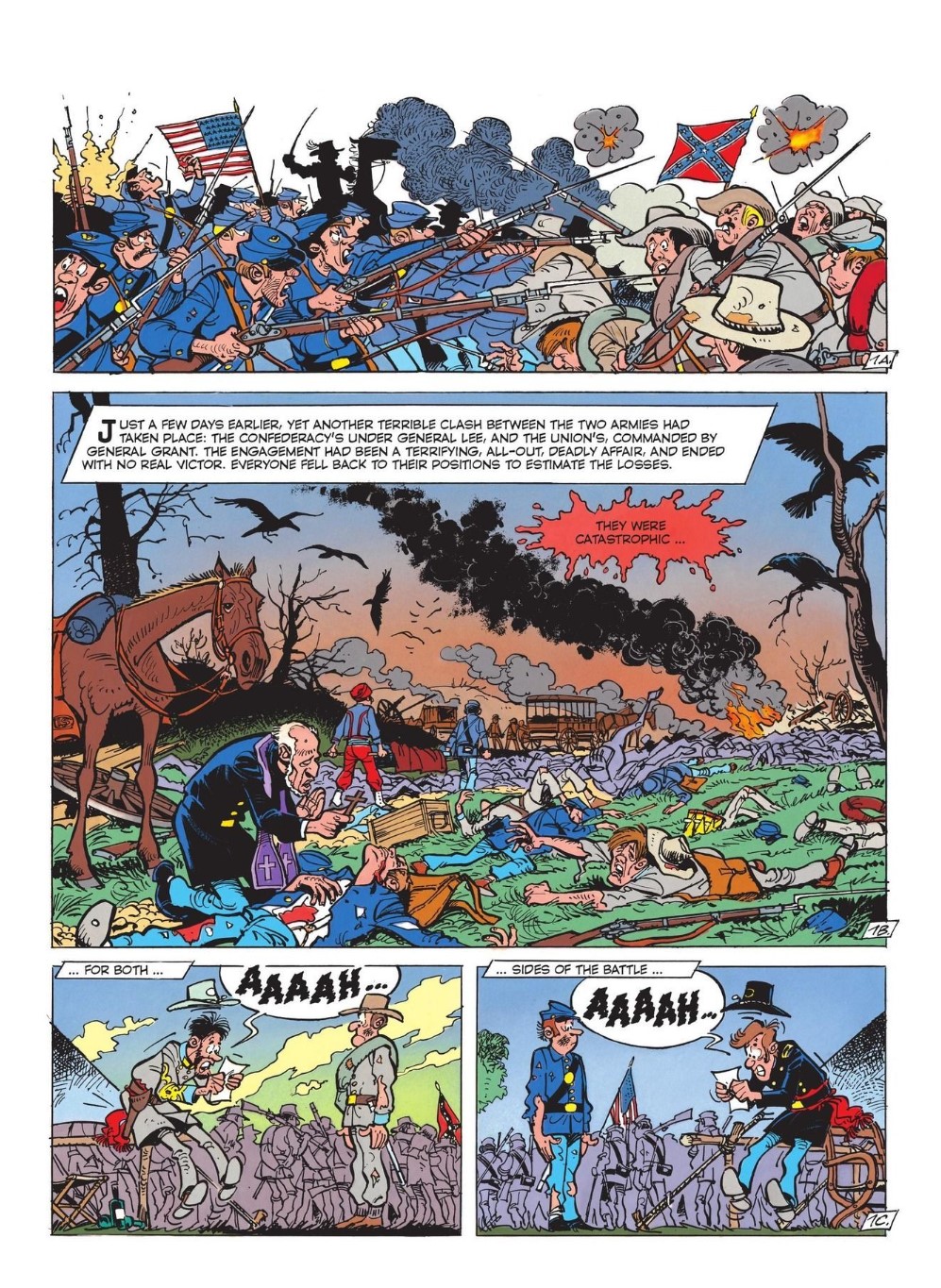
The original format offered single-page gags set around an Indian-plagued Wild West fort, but from second volume Du Nord au Sud, the sad-sack soldiers were situated back East, perpetually fighting in the American Civil War. Subsequent exploits are set within the scant timeframe of the Secession conflict, but – like today’s tale – occasionally range far beyond the traditional environs of the sundered USA, dipping into and embracing actual events (also like today’s tale), tackling genuine, thoroughly researched moments of history…

Blutch is an everyday, whinging little-man-in-the street: work-shy, mouthy, devious and ferociously critical of the army and its inept orchestrators and commanders. Ducking, diving, deserting at every opportunity, he’s you or me – except at his core he’s smart, principled, loyal and even heroic… if no easier option presents itself. Chesterfield is a big, burly professional fighting man: a proud career soldier of the 22nd Cavalry who devoutly believes in patriotism and esprit-de-corps of The Army. Brave, bold, never shirking his duty and hungry to be a medal-wearing hero, he’s quite naïve and also loves his cynical little pal. Naturally, they quarrel like a married couple, fight like brothers and simply cannot agree on the point and purpose of the horrendous war they are trapped in. That situation again stretches their friendship to breaking point in this cunningly conceived instalment, in which both find themselves pretty much fish out of water…

On offer this time is a rather more straightforward and trenchant outing with characters rather than settings providing most of the humour. Coloured as ever by Vittorio Leonardo, Les Tuniques Bleues – Drummer Boy was serialised continentally in Le Journal de Spirou #2720-2730, before becoming the 31st album in 1990, and now Cinebook’s 19th translated Bluecoats book.

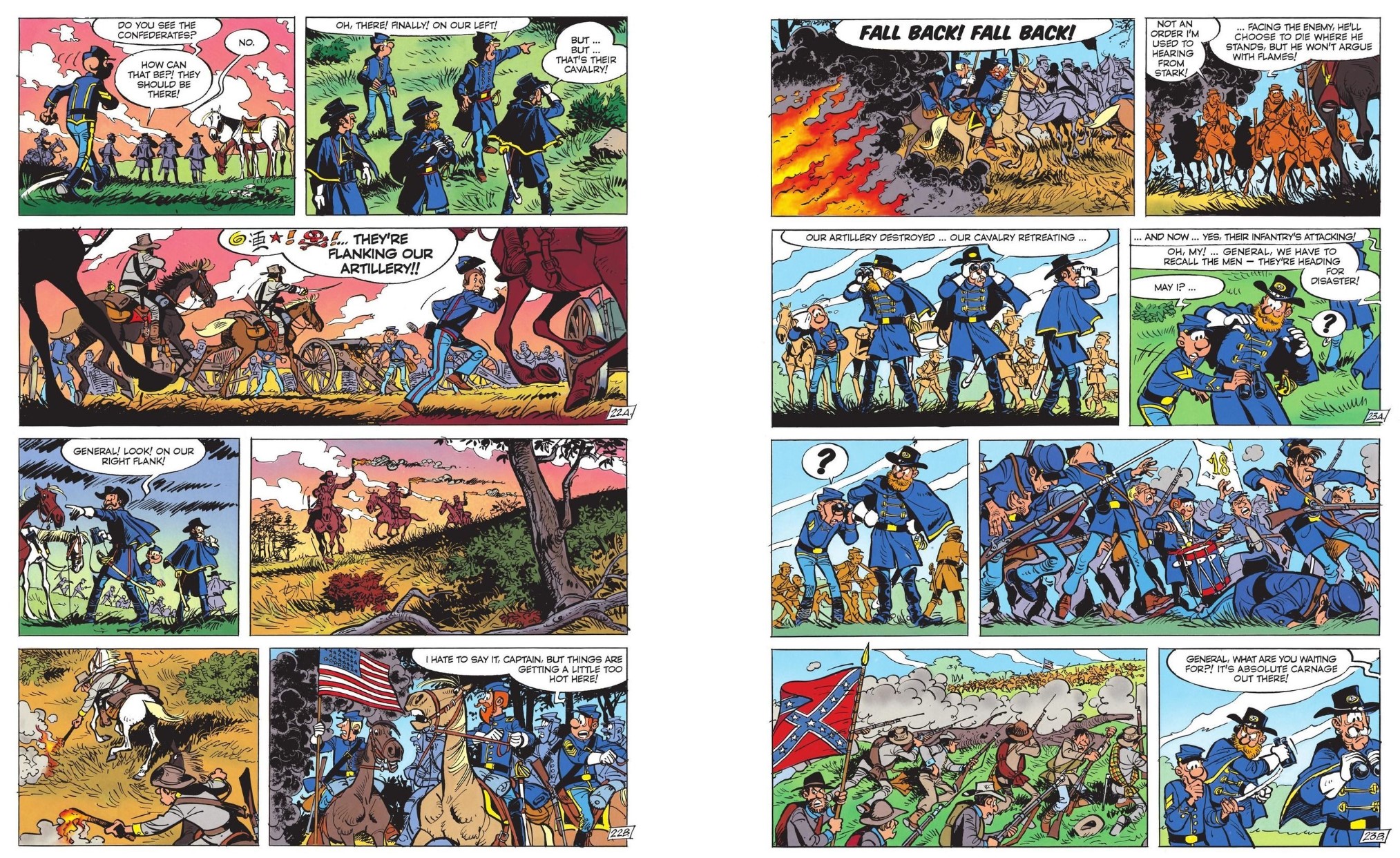
As already hinted, it differs somewhat from the majority of tales, which tread a fine line between comedy and righteous anger, so if you share these books with younger kids, best read it first. However, biting wit and sardonic comedy are curbed for a mostly moving message here as a battlefield policy decision divides the old comrades and unleashes calamity and catastrophe. It begins in polemical mode as the aftermath of another battle leaves corpses and cripples underfoot (on both sides) and colonels and generals (ditto) unable to ascertain why their great plans and bold strategies just don’t work.

As always the casualty lists provoke a drive for new recruits, the one area where Union forces can outdo the Confederacy. As Chesterfield & Blutch indulge a rare quiet moment in a nearby town, they dispassionately watch the hundreds of poor folk, recent immigrants, unemployed men and thirsty ne’er-do-wells signing up, but only until Blutch spots a very young boy in the queue. Chesterfield cannot understand his pal’s towering outrage as Blutch tries everything to get the so-determined kid out of the line and away from the meatgrinder of imminent slaughter. What lands the little rebel in the guardhouse, however, is the patriotic Sergeant “taking care” of the problem by rushing the waif to the front of the line and personally signing him up.

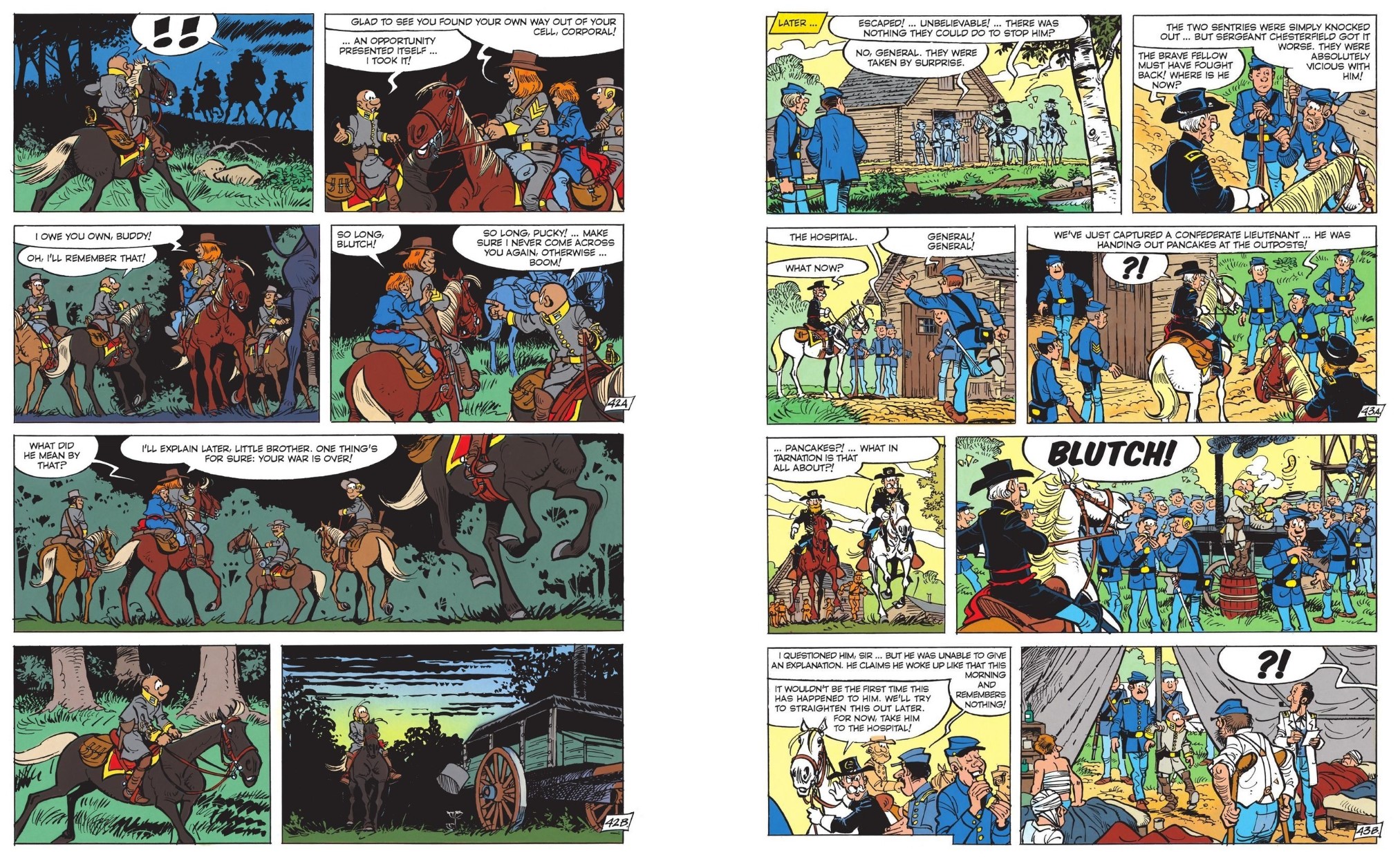
At war with each other for the rest of the tale, Blutch – as chuck wagon commissary server – provides most of the laughs from this point on, as even the madmen running the 22nd Cavalry and Union top brass can find no suitably bellicose role for the plucky orphan in their ranks. Thus little Pucky Potts is made company drummer boy as both sides build up for the next – deciding – pitched battle.

Only that’s not quite how things work out, as the Rebs somehow anticipate every move and stratagem before delivering a stinging defeat. It keeps happening and eventually even the Generals work out what Blutch has already deduced. Pucky is a spy for the other side…

Refusing to let any child be killed for this stupidity, the corporal pulls out all the stops and even makes up with his old ally to ensure that the travesty of an underage execution will not happen. First, though, he has to stop being thrown in the guardhouse and get Chesterfield to talk to him…

Again highlighting not only divisions and disparities of officers and enlisted men but also of the American class structure – particularly the inherent racism driving rich and poor players on all sides – Drummer Boy is another disturbingly edgy epic that makes fun from the very worst of human endeavour. Shocking, powerful and hard-hitting as well as funny, thrilling, beautifully realised and eminently readable, this is one of finest Bluecoats yarns in the entire canon and best kind of war-story/Western. it appeals to the best, not worst, of the human spirit and hopefully that means you. © Dupuis 1990 by Lambil & Cauvin. All rights reserved. English translation © 2025 Cinebook Ltd.

Today in 1912 Mexican cartoonist German Butze (The Supersabios) was born, with Bringing up Father follow-up artist Zeke Zekley arriving three years later, and Danish multi-talented Peter Snejbjerg not joining us until 1963.

In 1977 Us cartoonist Ben Batsford (Billy’s Uncle; Doings of the Duffs; Little Annie Rooney; Frankie Doodle; Mortimer and Charlie) died, as did gekiga mangaka Jiro Taniguchi (Icaro; A Distant Neighorhood; The Summit of the Gods; A Journal of My Father) in 2017.

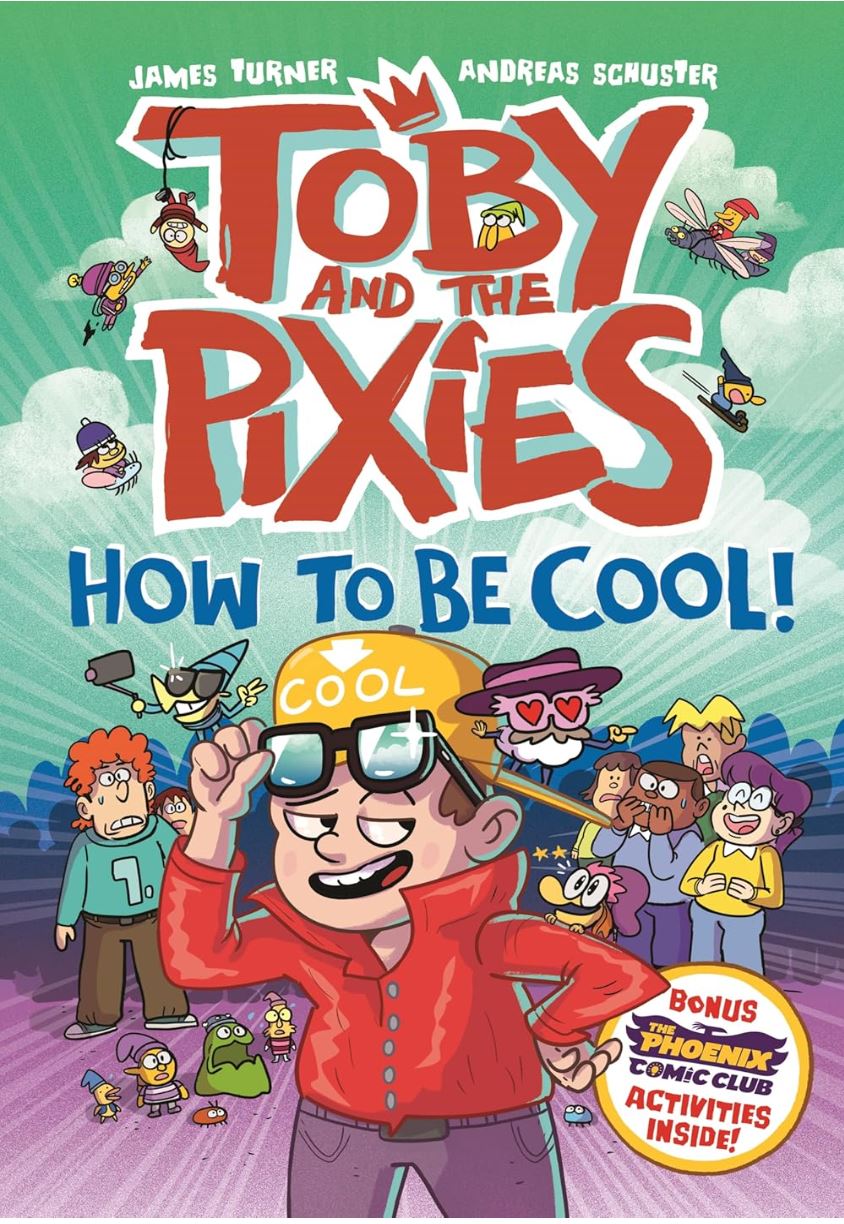
Toby and the Pixies volume 4 How to Be Cool!


By James Turner & Andreas Schuster, with Emily Kimball & Leanne Daphne (David Fickling Books)
ISBN: 978-1-788453-77-6 (TPB)

Way back in January 2012, Oxford-based David Fickling Books made a rather radical move by launching a traditional anthology comics weekly aimed at under-12s. It revelled in reviving the good old days of picture-story entertainment intent whilst embracing the full force of modernity in style and content.

To this day each issue features humour, adventure, quizzes, puzzles and educational material in a joyous parade of cartoon fun and fantasy. The Phoenix has successfully established itself as a potent source of children’s entertainment because, like Beano and Dandy, it is equally at home to boys and girls, and HAS mastered the magical trick of mixing amazingly action-packed adventure series with hilarious humour strip serials such as this one. Most of the strips have also become graphic collections; just like this one…

Crafted by James Turner (Star Cat, Super Animal Adventure Squad, Mameshiba, The Unfeasible Adventures of Beaver and Steve) and Canadian cartoonist/designer/animator Andreas Schuster (KLARA AND ANTON in PRIMAX Magazine), Toby and the Pixies began in January 2020 as I Hate Pixies and, once out of the compost bag of creative wonders, just wouldn’t stop. Those first forays were remastered and released as Toby and the Pixies: Worst King Ever! and follow-up fester forays Best Frenemies & Pixie Pandemonium!, charting the course of a nerdy boy at a nice school… until it all goes wrong…

Unappreciated, anxious 12-year-old Toby Cauldwell was resigned to and content with his meagre, second-rate friends, dedicated personal bullies, negative charisma levels and functional classroom invisibility at Suburbiton High School, but began rapidly shedding his appallingly uncool reputation the day after his electric-toaster-obsessed Dad ordered him to sort out their unruly, out-of-control back garden…

That’s when Toby discovered that wild, jungle-like urban wilderness was – unbeknownst to any mortal – the camouflaging screen for a fabulous fey realm. The ethereal, moist and rather mucky enclave had endured unseen in the green shambles of the Cauldwell backyard for countless ages. Now, thanks to an inept and inadvertent act of emancipation triggered by Toby kicking an unfortunately placed plaster garden gnome, the status quo forever altered. A tool of fate, the reluctant lad was instantly elevated to the position of supreme overlord, by dint of accidently yet totally obliterating the sitting tyrant. It was only for a hidden kingdom of magical morons, but they were really happy to be shot of their previous mad, mean, magical master…

As interpreted by the former King’s advisors – Royal Druid Mouldwarp, wise(ish) Lore Keeper/Potion Master Gatherwool and Toadflax (she eats stuff) – deliberately or otherwise, despatching King Thornpickle made Toby new absolute monarch. Pixie law also stated said ruler could do anything they wanted… a prospect so laden with responsibility that it made Toby weep with terror…

Just coming to terms with MAGIC actually existing, and that the ever-present freaky, anarchic imps can do it whilst still being absolute idiots and morons was awful enough, without also still having to survive school’s normal horrors. Thankfully, as the little odds and sods increasingly impinged and impacted on Toby’s life, education and prospects, they also turned school upside on a daily basis, and Toby’s fellow outcast Mo soon discovered the shocking secret of their existence. And he thought it was BRILLIANT!

In the short term it actually made things worse but now, apart from constant teasing and perpetual whining pleas to visit the magic kingdom, there is a fellow human King Toby can moan at. Two, actually, as snarky bully Steph also soon discovered the secret and has since proved to not be quite as awful as she might be…

That’s good because knowledge is a dangerous, trouble-causing thing, particularly as the Pixies are now everywhere and Toby’s succession triggered many problems: especially when magic-slime wielding Princess Sugarsnap – daughter of Thornpickle and rightful heir to a job Toby really, really doesn’t want – started a war to take back the throne Toby absolutely doesn’t want…

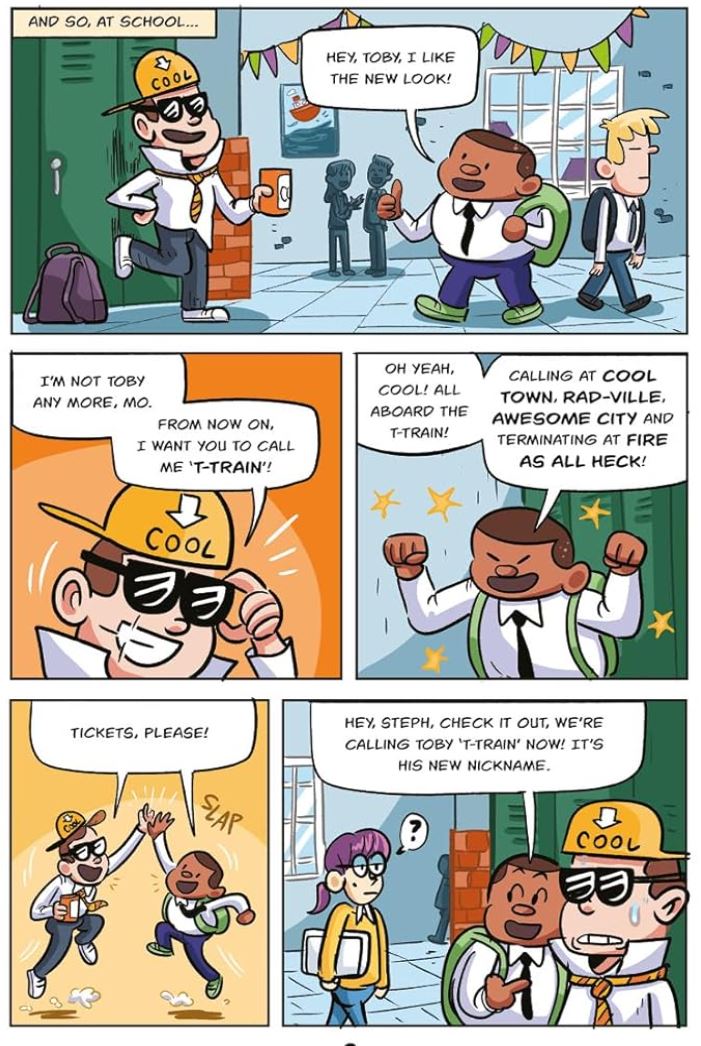
This fourth folio of foolishly foetid foofaraw opens with a fresh chance to get reacquainted with musty regulars Toby, Mo, Steph, Sugarsnap, Toadflax, Gatherwool & Mouldwarp in a comprehensive triple page intro. Then it’s back to school and off the deep end (or is it?) in ‘Chapter 1: T Train’ as Toby – under the Advisors’ suggestions and fed up with his old nickname (“Trousers”) – decides to reboot his image. Sadly, using magic to remove everyone’s memories of old Toby to make room for supercool “T-Train” is a complete disaster… as usual.

‘Chapter 2: Pet Project’ sees the rickety ruler granted extra responsibility – looking after the class goldfish – before disaster immediately strikes when it dies. No appreciable use (as usual!) the pixies take away the wrong message from Toby’s humiliating tragedy and over-explore the fascinating human notion of “pets” by concentrating on “can anybody be one…?”

Pixies are willing, compliant slaves to their King, so only chaos can result from Steph finally making overburdened Mouldwarp understand the concepts of consent and refusal in ‘Chapter 3: The More You “No”’. Rebellion can be an ugly thing to witness…

Social horror blends with the squishy icky kind in ‘Chapter 4: Spot On’ when Toby allows his advisors to “treat” the unsightly blemish on his forehead. Soon, the unsightly pimple is not only bigger than his original head, but far smarter and more erudite, too. Of course, it cannot last…

The young king hates grooming and his much-deferred barber appointments finally come home to roost in ‘Chapter 5: Hair Today, Gone Tomorrow’, paying dank, dandruffy dividends after the Advisors’ first suggestion (hungry goat) is superseded by manic tonsorial magic and grows well beyond anyone’s control. Sadly, that catastrophe is rapidly eclipsed in ‘Chapter 6: Penguin Peril’ when an impending appearance on TV show “That’s Sciency” becomes just the latest way his Advisors cannot help. Here an ecology project involving papier mache penguins and global climate crises suddenly becomes a disaster of cosmic proportions when the pixies soup it up. Now, only devious Princess Sugarsnap seems able to assist… and only for a most outrageous price…

In ‘Chapter 7: Lore Unto Themselves’ a dose of school library cleaning results in the fetid fey folk experiencing sugar-stoked culture shock after seeing in something called “a book” what proper Pixies are…

After realising the King is constantly being saved by his loyal Champion Mo, Sugarsnap bounces back with her most wicked plan yet in ‘Chapter 8: Getting the Hump’. To succeed, all she has to do is break up their friendship, and what better way than by exploiting their shared passion for video games? And THAT is best accomplished by entering the game itself via magic, yes? Well, no, actually…

Writing is hard even if you have great ideas like scholastic King Toby, but if you let your Advisors remove the Self Doubt Critter in your head via a Magical Brain Beret, all manner of plots, schemes and characters are able to unstoppably manifest. Thus, in ‘Chapter 9: Critical Thinking’ as Toby generates a torrent of unwanted essay pages, his freedom of thought increasingly and dangerously impacts on his actions. The solution is to put the SDC back in the king’s head, but it’s perfectly happy squatting in Mouldwarp’s bonce and not keen on being evicted, so it’s a happy thing that when it goes on a rampage Toby has few ideas…

When Toadflax discovers advertising and psychology it soon spawns sheer anarchic trouble in ‘Chapter 10: Choco Crisis’ as the Advisors’ addiction to sugar leads them to magically manifest idols and monsters only a hasty human ad campaign can counter…

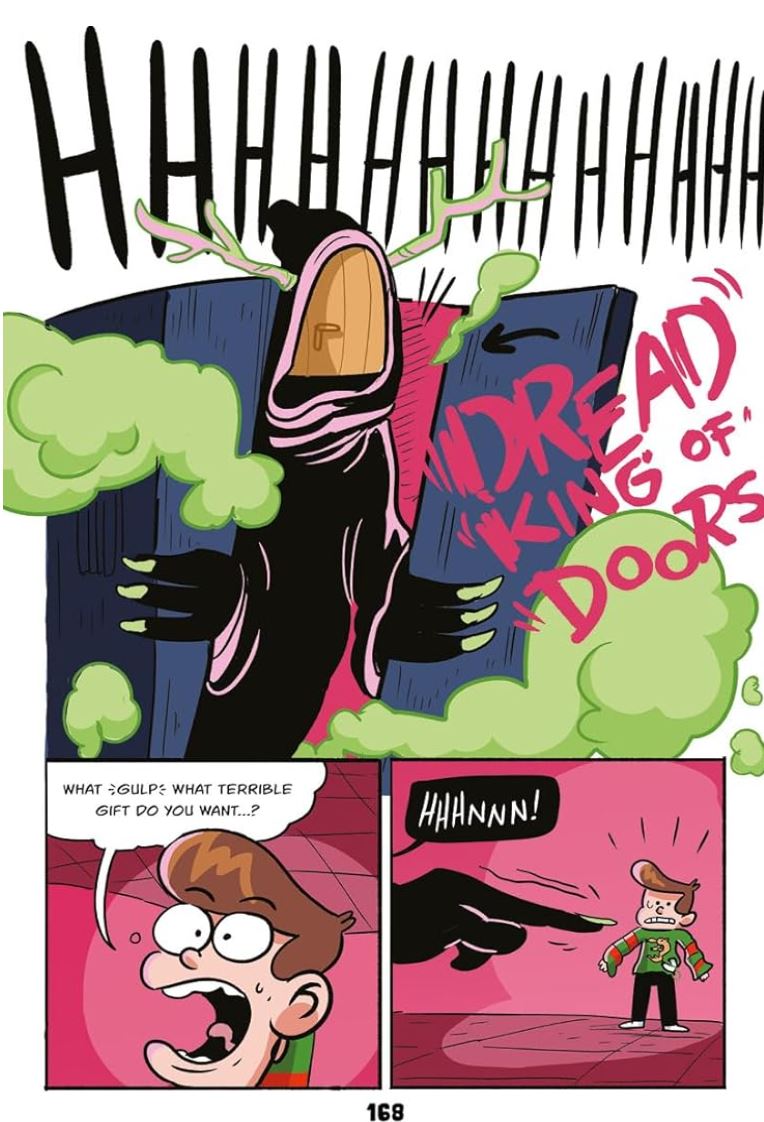
Echoes of that encounter reverberate as Christmas rolls around again and ‘Chapter 11: Advent Adventure’ finds Mo, Steph and Toby confronting the Pixies’ newfound love of doors that open onto presents and the ultimate terror that leads to…

The storytelling terminates with one more trial as Sugarsnap returns with her ultimate gambit: suing Toby for the Kingdom of Pixies. However, nobody can win when the law is such an ass that it allows Gatherwool to be judge and book-eating Toadflax and Mouldwarp to be defence counsel. As chaos mounts in ‘Chapter 12: Court Out’, Toby has never been more happy to have Stepha and Mo acting as his behind the scenes advocates…

Ordinary school interactions can be a nightmare, but with the reading done for now, keen types can learn useful stuff from pages of related activities grouped under the banner of the Phoenix Comics Club. Bring paper, pencils and you to a selection of items from the compact online course detailing all aspects of comic strip creation supervised by Andreas Schuster.

Here that includes ‘Let’s Draw a Pixie! Castle’; ‘Pixie Magic!’; ‘Character class: Ducks!’; ‘Duckification!’ and ‘By the Power of Art, COMBINE!’ backed up by an extensive peek at other Fickling books and treats plus a plug for the Phoenix Comics Club website complete with instant access via a QR code.

Toby and the Pixies is a fabulous fabrication of festery fun and nonsense no lover of laughs and lunacy should deprive themselves and which all kids will gleefully consume. What are we all waiting for?
Text and illustrations © The Phoenix Comic 2026. All rights reserved.

Toby and the Pixies: volume 4: How to Be Cool! is published on 12th February 2026 and available for preorder now.

Today in 1898 the previous Frank Miller (who produced aviation strip Barney Baxter in the Air) was born, as was eternal letterer Irv Watanabe in 1919. In 1957 Leonard Starr’s Mary Perkins on Stage opened, but strips lost to us on this day include DC’s The World’s Greatest Superheroes in 1985 and Secret Agent X-9 in 1996.

Crucially and painfully, in 1987 Diabolik co-creator Angela Giussani died, as did the uniquely irreplaceable Steve Gerber in 2008.

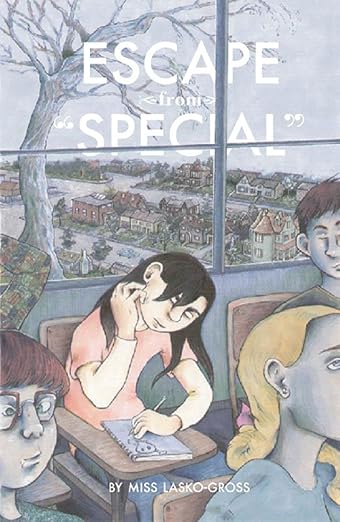
Escape from Special


By Miss Lasko-Gross (Fantagraphics Books)
ISBN: 978-1-56097-804-6 (TPB/Digital edition)

Little Melissa is a very difficult child: smart and constantly questioning her unconventional parents (easy-going hippie-types) as well as the guards and inmates at her elementary school (both intransigent teachers and status-obsessed kids). Even at six years old, she’s a fiercely independent thinker – the kind of kid modern parents usually dope with Ritalin.

She flounders in all the arenas of childhood, consequently being moved from school to school. She has a child-therapist and like many smart, creative kids has problems with reading. Painfully self-aware but ultimately adamantine, Melissa must endure the social horrors of Special Education.

But please don’t think this is a book about the crushing of a spirit. Whether on a tour-bus with her so-very-hip ‘n’ cool folks, fumbling with classmates or fighting off nightmares, this is a series of skits and sketches that affirm Melissa’s vibrant character: one which can adapt but will never buckle. Illustrated in a powerful primitivist – almost naivest – illustrative style and symbology, the little girl endures and overcomes in tales that are charming, sad, funny, reassuring and just plain strange.

Miss (that’s her name now – she changed it) Lasko-Gross has produced graphic narrative for most of her life, editing the Pratt Institute’s Static Fish comic book, working in Mauled, House of Twelve 2.0, Legal Action Comics, Aim and others whilst generally living the kind of life that finds its way onto the pages of fabulous books like this one. This book was followed by notional sequel A Mess of Everything and in 2015 macabre religious funny animal opus Henni which should also be on the must-see list of every thinking comics consumer.

The powerfully direct stories in Escape from “Special” are of such a high calibre that they’re far beyond some new or trendy genre and demand to be seen by a greater audience who don’t even care if their reading matter has pictures or not. These tales are in the same category as American Splendor, Maus and Persepolis with words wedded to pictures that you’ll revel in for years to come.
© 2006 Miss Lasko-Gross. All Rights Reserved.

Today in 1902 Red Ryder co-creator Fred Harman was born, as was Spirou originator “Rob-Vel” (François Robert Velter) in 1909. In 1928 Frank Frazetta joined the party, with Scots script wizard Alan Grant popping along in 1942, just like Jo Duffy in 1954. Two years later Timothy Truman was born, as was French star David B. in 1959. Somehow all that doesn’t really balance the scales as today in 1989 Osamu Tezuka laid down his pens and brushes for the last time.

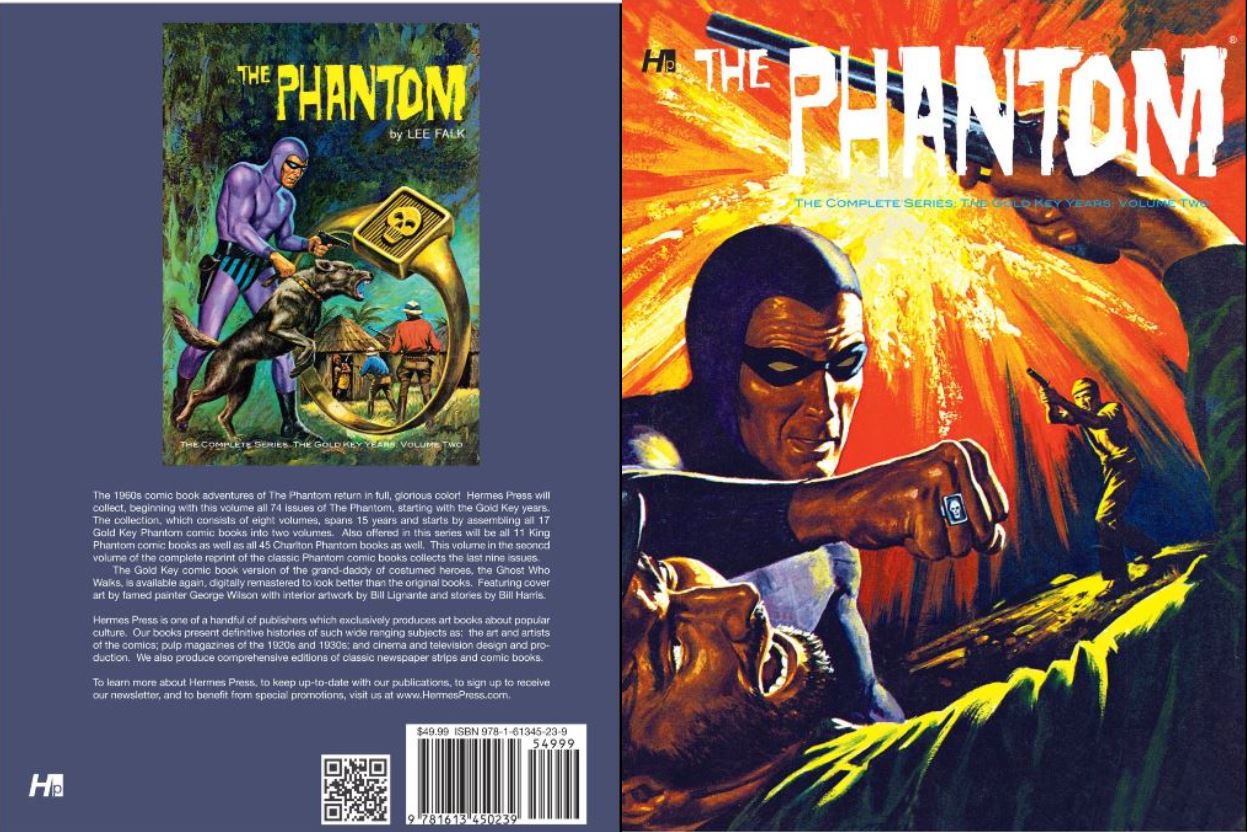
The Phantom – The Complete Series: The Gold Key Years volume 2


By Bill Harris & Bill Lignante, with Joe Certa, Sparky Moore, George Wilson & various (Hermes Press)
ISBN: 978-1-61345-023-9 (HB?/Digital edition)

This book includes Discriminatory Content produced in less enlightened times.

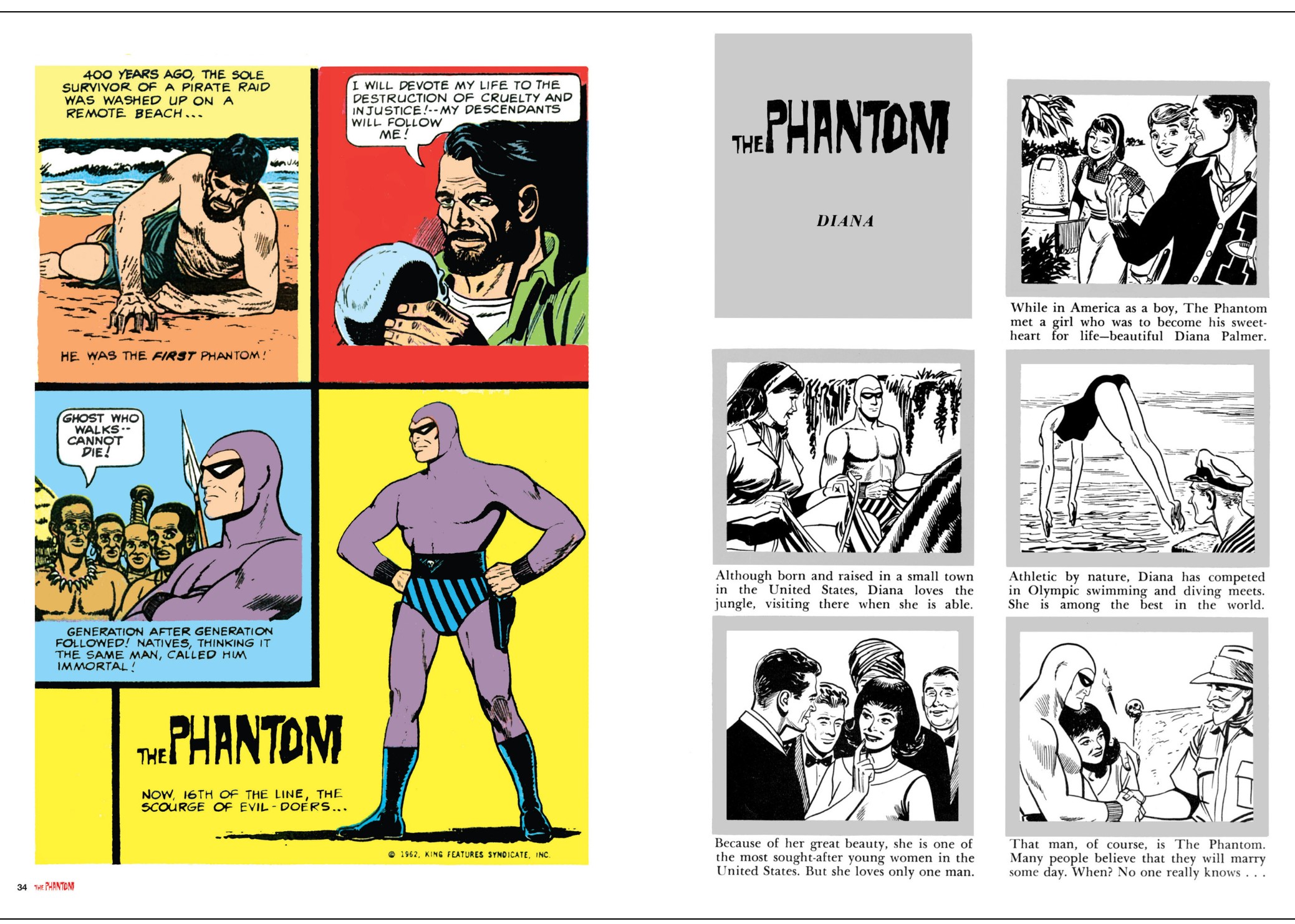
In the 17th century a British sailor survived an attack by pirates, and, washing ashore in Africa, swore on the skull of his murdered father to dedicate his life and that of all his descendants to destroying all pirates and criminals. The Phantom fights crime and injustice from a fabulous lair deep in the jungles of Bengali, and is known throughout Africa as “the Ghost Who Walks”. His unchanging appearance and unswerving quest for justice have led to him being regarded as an immortal avenger by the credulous and the wicked. Down the decades one hero after another has fought and died in an unbroken line, and the latest wearer of the mask, indistinguishable from the first, continues the never-ending battle…

Lee Falk created the Jungle Avenger at the request of his syndicate employers who were already making history, public headway and loads of money with his first strip sensation Mandrake the Magician

Although technically not the first ever costumed hero in comics, The Phantom was the prototype paladin to wear a skintight bodystocking, and the first to have a mask with opaque eye-slits. He debuted on February 17th 1936 in an extended sequence pitting him against a global confederation of pirates called the Singh Brotherhood. Falk wrote and drew the daily strip for the first two weeks before handing over the illustration side to artist Ray Moore. The Sunday feature began in May 1939.

For such a successful, long-lived and influential series, in terms of compendia or graphic novel collections, The Phantom has been poorly served by the English language market. Various small companies have tried to collect the strips – one of the longest continually running adventure serials in publishing history – but in no systematic or chronological order and never with any sustained success. But, even if it were only of historical value (or just printed for Australians, who have long been manic devotees of the implacable champion) surely “Kit Walker” is worthy of a definitive chronological compendium series?

Happily, his comic book adventures have fared slightly better – especially in recent times.

In the 1960’s King Features Syndicate dabbled with a comic book line of their biggest stars – Flash Gordon, Popeye, Blondie, Mandrake and The Phantom – but immediately prior to that, the Ghost Who Walks helmed a solo-starring vehicle under the broad and effective aegis of veteran licensed properties publisher Gold Key Comics. Each issue was fronted by a stunning painted cover by George Wilson. The Phantom was no stranger to funnybooks, having been featured since the Golden Age in titles such as Feature Book and Harvey Hits, but only as straight strip reprints. These Gold Key exploits were tailored to a big page and a younger readership.

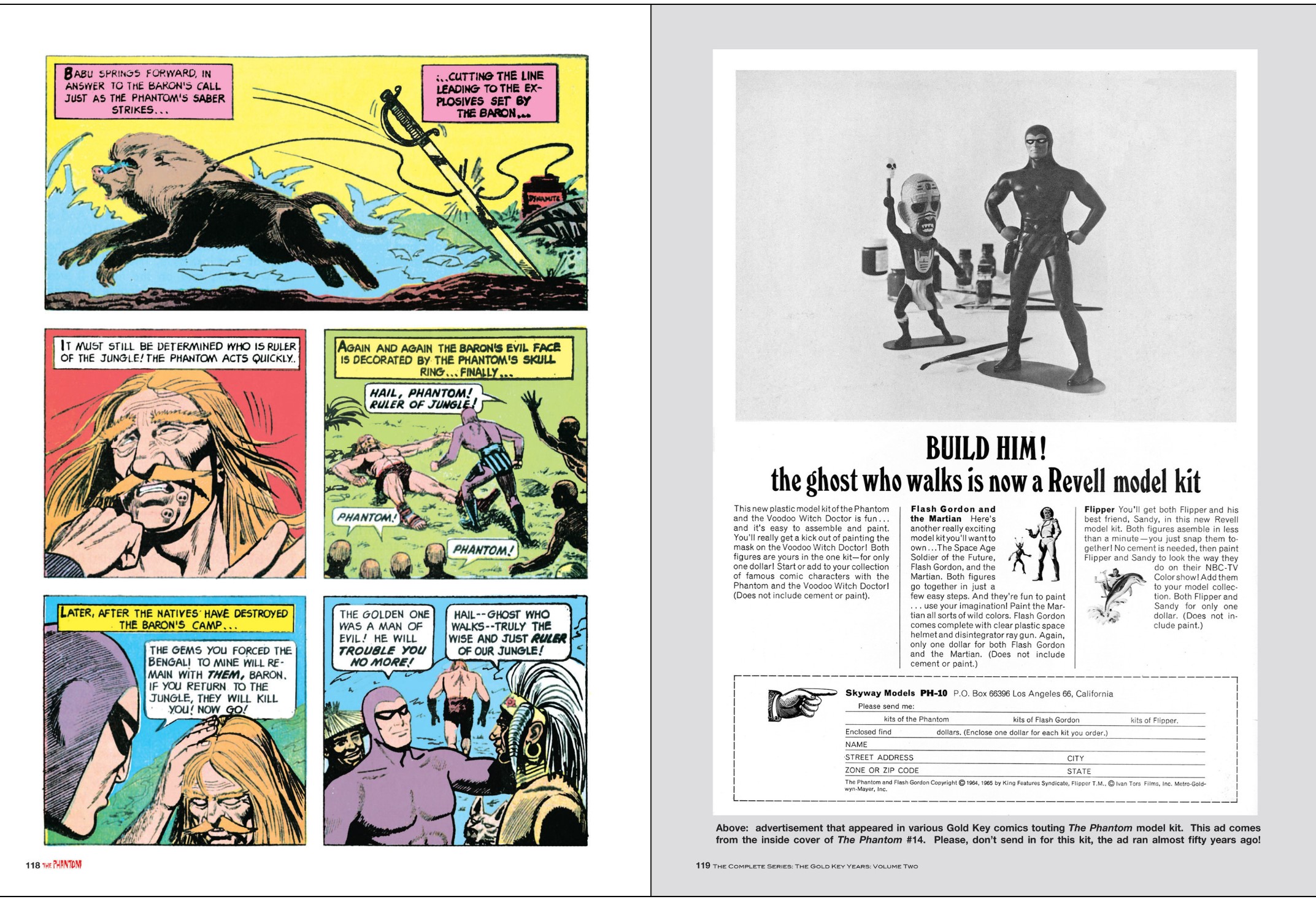
This second superb full-colour hardcover – with equivalent eBook editions for the modern minded – gathers The Phantom #9-17 (originally released between November 1964 and July 1966) and opens with fan and scholar Pete Klaus’ Introduction ‘The Gold Key Phantom’ offering original art panels (many by Sy Barry) and a welcoming overview of the immortal strip star.

Scripted by Bill Harris and drawn in comic book format by Bill Lignante, the illustrated adventures resume with full-length epic ‘The Sixth Man’ from #9 as the Ghost Who Walks takes a rare trip into modern civilisation only to be shanghaied by crooks. All too soon the miscreants realise that they have made the biggest mistake of their shady lives. Determined to discover what’s behind the nefarious scheme, Kit Walker allows himself to be taken to a remote island ruled by bored, cruel queen Sansamor who thrives on making powerful men duel to the death.

Once the hero sees the kind of creature she is, her downfall is assured…

The issue is concluded by a single-page historical recap of the legend of ‘The Phantom’ and equally brief monochrome rundown of the mystery man’s intended bride ‘Diana’ (Palmer).

Cover-dated February 1965, #10 opens with devious action thriller ‘The Sleeping Giant’ wherein the long-peaceful tribe of Itongo headhunters take up the old ways after ancestral idol Tuamotu comes to life.

Thankfully, the Phantom is on hand to stem potential carnage and expose crooked diamond prospector Joe Gagnon (and his oversized circus performer pal) inciting the tribesmen to war and conquest. All he has to do is defeat the giant warrior in unarmed combat…

Assisting the masked peacekeeper in policing tribes and criminals of the region is ‘The Patrol’. These worthy soldiers have no idea who their mysterious “Commander” actually is, so when the latest raw recruit tries to find out, he receives a startling shock in this wry vignette.

Issue #11 (April 1965) features ‘Blind Man’s Bluff’ with two brutal convicts breaking out of the Bengal Penal Colony to terrorise native communities by masquerading as demonic spirits. When the Phantom apprehends them as they link up with pirates, he is struck sightless by a flare gun, but not even blindness can stop the resourceful champion from dispensing justice…

Closing the issue is a one-page tour of ‘The Skull Cave’ by Joe Certa, after which #12 (June, with art by Sparky Moore & Lignante) introduces ‘The Beast of Bengali’. Here a golden giant capable of seeming miracles subjugates the locality until the masked marvel exposes his magical feats for the tricks they really are. Then, following a mouth-watering period ad for the Phantom Revell model kit, #13 (August) opens ‘The Phantom Chronicles’ as the Jungle Sentinel consults his ancestor’s meticulous records for tips on defeating seemingly immortal bandit Rachamond

October cover-dated, The Phantom #14 opens with ‘The Historian’ as scholar Dr. Heg consults with the Jungle Patrol on a book chronicling their achievements. His ulterior motive is to destroy the only law for hundreds of miles, but he has not reckoned on the true identity of their enigmatic leader…

‘Grandpa’ switches locales to America where Diana Palmer’s doting ancestor is playing unwelcome matchmaker. Eventually, after violent incidents involving bears and robbers, the old man warms to African mystery man Kit Walker…

Closing 1966, TP #15 (December) details the downfall of ‘The River Pirates’ who ravage the mighty waterways of the region. Their modern weapons prove little use against the cunning and bravery of the Deep Woods Guardian. ‘The Tournament’ then focuses on an unlucky prison escapee who finds the Phantom’s clothes and is stuck fighting a native gladiator in a centuries-old grudge match. Sadly, if he loses, the prestige lost means chaos will return to the tribes benefitting from The Phantom’s Peace…

‘The Chain’ opens #16 (April 1966) as a world-weary Phantom considers quitting after an interminable period negotiating peace between warring tribes. Even Diana cannot change his mind, but then ancient wise man Wuru appears, relating a story of the hero’s father, who endured hardship, mockery and even slavery in a quest to rescue a woman from vile bondage. Her name was Maude, and she was to be the Phantom’s mother…

A brace of single-pagers follow, revealing Kit Walker’s unrecorded boxing bout against ‘The Champ’ and a battle in a bar won by ‘The Milk Drinker’ before ‘The Crescent Cult’ sees the Jungle Ghost crushing an assassination gang determined to murder their country’s new Maharani. The comic concludes with another 1-page yarn as ‘The Diggers’ examine old ruins and discover proof that the Phantom has lived and fought evil for centuries!

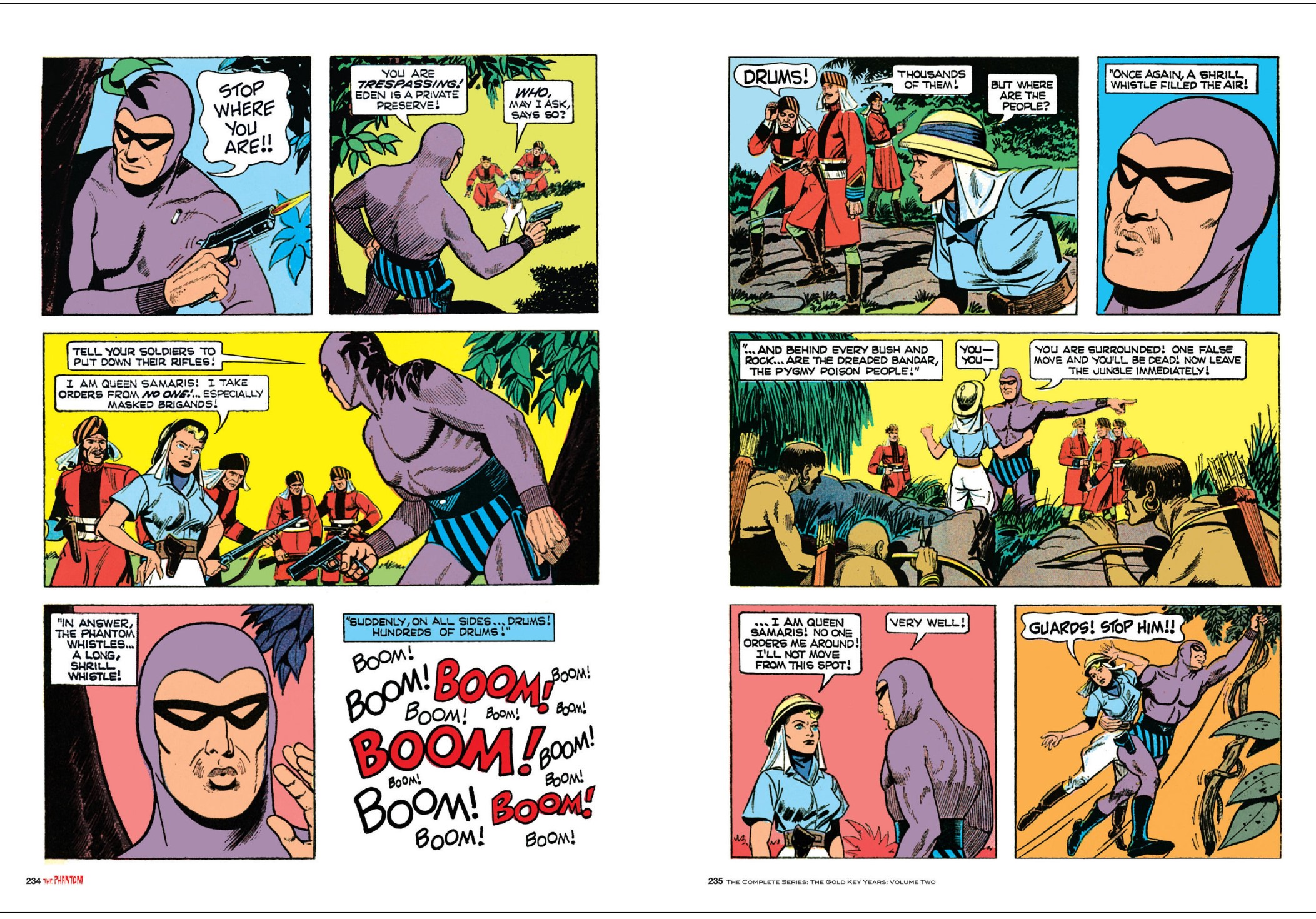
This second volume closes on a truly supernatural note as The Phantom #17 (July 1966) discloses how undying witch ‘Samaris’ has preyed on male suitors for centuries, and believes she has last found another cursed to live forever…

Following one-pager ‘The Waterfall’, detailing the secrets of the entrance to the fabled Skull Cave, ‘Samaris Part II’ finds the Ghost Who Walks captive of the Queen but resisting her every wile until justice, fate and an avalanche of deferred years catch up to her at last…

Wrapping up is a monochrome vignette detailing the secrets of The Phantom’s devout helpers ‘The Bandar’ Poison Pygmy People and a sumptuous cover gallery by painter George Wilson.

Straightforward, captivating rollicking action-adventure has always been the staple diet of The Phantom. If that sounds like a good time to you, this is a traditional nostalgia-fest you won’t want to miss…
The Phantom® © 1964-1966 and 2012 King Features Syndicate, Inc. ® Hearst Holdings, Inc. Reprinted with permission. All rights reserved.

Today in 1828 genre-founding author Jules Verne was born, so maybe go read a book soon? In comics, unsung wonder Bill Finger was born in 1914, as was Filipino inking legend Danny Bulanadi in 1946. On the debit side we lost the iconic Julius Schwartz today in 2004 and Li’l Jinx originator and Archie stalwart Joe Edwards in 2007.