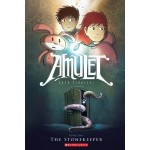
Amulet Book 1: The Stonekeeper


By Kazu Kibuishi (Scholastic)
ISBN: 978-0-439-84681-3

Picture books and illustrated stories for children have been a staple of the publishing game since the Victorians, so the modern trend towards actual graphic narratives was an inevitable but nonetheless welcome accomplishment. However the wholesome and comfortable adventures of Babar, Tim All Alone, Captain Pugwash and their like have new rivals these days, thanks mostly to the cultural invasion of Japanese anime to our TV screens and a long-overdue Western acceptance of manga-style storytelling.

For example this delightful little strip saga, cut fully from the same cloth as The Spiderwick Chronicles and spookily touching base with darkest Narnia and the best of Alan Garner, joins a growing library of trans-Atlantic, pan-Pacific fantasy thrillers for younger readers, albeit with lush, glossy colours to lure in European consumers still uncomfortable with the linear purity and monochrome aesthetic of traditional Eastern comics.

Amulet is the first in a sequence of junior graphic novels, and opens with a horrific personal tragedy as little Emily sees her father die in a ghastly car crash. Two years later she and her little brother Navin are taken to live in their great grandfather’s ramshackle, spooky old house. Still grieving, the family are making a go of it, but the dilapidated pile is just not right: there are eerie voices, odd noises and happenings – and far too often the kids are seeing something moving at the furthest corners of their eyes…

Great Grandpa Silas vanished one night never to be seen again, and Emily is convinced that she can see cloudy phantoms just when and where she isn’t looking. Whilst helping mom clean, the kids happen upon an ingeniously hidden necklace which Emily swiftly appropriates. She begins to think twice when its ornate stone starts talking to – or rather lecturing – her…

Soon the house goes into full-on haunted mode and when mom investigates the cellar she is consumed by a monster and stored for later digestion. Emily and Navin give chase and soon are lost in a fantastic subterranean world where they encounter incredible beasts, dark elves and a giant figure who turns out to be Miskit, a cute helpmate built by the missing Silas.

Long ago the solitary inventor crossed over to this land of Alledia and learned the secrets of The Stones; mighty mystical artifacts that could be more curse than blessing. Building himself a small army of companions he decided to stay, but the land was a place in turmoil. Whoever holds the Stones could rule this entire world and do anything they wanted. That’s good to know since Emily’s Amulet is becoming more bossy than helpful, and the more she uses its incredible forces the more it needs her to…

This time Emily has the ability to save her mother: even if she might have to fully embrace the power of the amulet, and take on a destiny she doesn’t want…

This is a dark and compelling adventure blending traditional children’s story elements such as fairies and magic with contemporary kids-scape paraphernalia like giant robots, cartoon animals, rocket-ships, bug-eyed monsters, cute-eyed bugs and alternate Earths in a zippy rollercoaster ride of laughter, tears and terrors. This volume is a self-contained tale but the ending of this adventure leads directly to the next…

And you will want to see them all. Stirring stuff for older readers and any fantasy fan with a tinge of darkness in their collector’s souls…
© 2008 Kazu Kibuishi. All Rights Reserved.

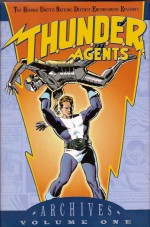
Thunder Agents Archives volume 1


By Wally Wood & various (DC Comics)
ISBN: 1-56389-903-5

The history of Wally Wood’s immortal comics masterpiece is convoluted, and once the mayfly-like lifetime of the Tower Comics line ended, not especially pretty: wrapped up in legal wrangling and not a little petty back-biting, but that doesn’t diminish the fact that the far-too brief careers of The Higher United Nations Defense Enforcement Reserves was a benchmark of quality and sheer bravura fun for fans of both the still-reawakening superhero genre and the popular media’s spy-chic obsession.

In the early 1960s the Bond movie franchise was going from strength to strength, with action and glamour utterly transforming the formerly understated espionage vehicle. The buzz was infectious: soon Men like Flint and Matt Helm were carving out their own piece of the action as television shanghaied the entire bandwagon with the irresistible Man From U.N.C.L.E. (premiering in September 1964), bringing the whole genre inescapably into living rooms across the world.

Wildly creative maverick Wally Wood was approached by veteran MLJ/Archie Comics editor Harry Shorten to create a line of characters for a new distribution-chain funded publishing outfit – Tower Comics. Woody called on some of the biggest names in the industry to produce material in the broad range of genres the company wanted (as well as T.H.U.N.D.E.R. Agents and its spin-offs Undersea Agent, Dynamo and NoMan there was the magnificent war-comic Fight the Enemy and the youth-comedy Tippy Teen).

Samm Schwartz and Dan DeCarlo handled the funny book – which outlasted all the others – whilst Wood, Larry Ivie, Len Brown, Bill Pearson, Steve Skeates, Dan Adkins, Russ Jones Gil Kane and Ralph Reese all contributed scripts for themselves and the industry’s  top talents to illustrate on the adventure series.

With such a ravenous public appetite for super-spies and costumed heroes steadily rising in comic-book popularity the idea of blending the two concepts seems a no-brainer now, but those were far more conservative times, so when T.H.U.N.D.E.R. Agents #1 appeared with no fanfare or pre-publicity on newsstands in August 1965 (with a cover off-sale date of November) thrill-hungry readers like little me were blown away. It didn’t hurt either that all Tower titles were in the beloved-but-rarely-seen 80 Page Giant format: there was a huge amount to read in every issue!

All that being said the tales would not be so beloved of we baby-boomer fans if they hadn’t been so superbly crafted. As well as Wood, the art accompanying the compelling, far more mature stories was by some of the greatest talents in comics: Reed Crandall, Gil Kane, George Tuska, Mike Sekowsky, Dick Ayers, Joe Orlando, Frank Giacoia, John Giunta, Steve Ditko and others.

This initial lush and lustrous compilation collects issues #1-4 and covers the first golden year of the series. It all starts with a simple four page tale ‘First Encounter’ by Ivie & Wood, wherein UN commandos failed to save brilliant scientist Professor Emil Jennings from the attack of the mysterious Warlord, but at least rescued some of his greatest inventions, including a belt that can increase the density of the wearer’s body until it becomes as hard as steel, a cloak of invisibility and an enigmatic brain-amplifier helmet.

These prototypes were to be divided between several agents to create a unit of superior fighting men and counter the increasingly bold attacks of many global terror threats such as the aforementioned Warlord.

First chosen was affable file clerk Len Brown who was, to everyone’s surprise, assigned the belt and the codename Dynamo in a delightfully light-hearted adventure ‘Menace of the Iron Fog’ (written by Len Brown, who had no idea illustrator/editor Wood had prankishly changed the hero’s civilian name as a last-minute gag) which gloriously pandered to every kid’s dream as the nice guy got the power to smash stuff. This cathartic fun-fest also introduced the Iron Maiden, a sultry villainess clad in figure-hugging steel who was the probable puberty trigger for an entire generation of boys…

‘T.H.U.N.D.E.R. Agent NoMan’ came next, the eerie saga of aged Dr. Anthony Dunn who chose to have his mind transferred into a specialised android body, then equipped with the invisibility cape. The author’s name is unknown but the incredible Reed Crandall (with supplemental Wood inks) drew the first episode which also found time and space to include a captivating clash with sinister mastermind Demo and his sultry associate Satana who had unleashed a wave of bestial sub-men on a modern metropolis. NoMan had one final advantage: if his artificial body was destroyed his consciousness could transfer to another android body. As long as he had a spare ready, he could never die…

Larry Ivie filled in some useful background on the war against the Warlord in the prose adventure ‘Face to Face’ before the third agent was chosen in ‘The Enemy Within’ (also with no script credit and illustrated by Gil Kane, Mike Esposito and George Tuska). However here is where the creators stepped well outside the comic-book conventions. John Janus was the perfect UN employee: a mental and physical marvel who easily passed all the tests necessary to wear the Jennings helmet. Sadly he was also a deep cover mole for the Warlord, poised to betray T.H.U.N.D.E.R. at the earliest opportunity…

All plans went awry once he donned the helmet and became Menthor. The device awakened the potential of his mind, granting him telepathy, telekinesis and mid-reading powers – and also drove all evil from his mind whilst he wore it. When the warlord attacked with a small army and a giant monster, Menthor was compelled by his own costume to defeat the assault. What a dilemma for a traitor to be in…

‘T.H.U.N.D.E.R. Squad’ by Ivie, Mike Sekowsky & Frank Giacoia, is a rip-roaring yarn featuring an elite team of non-powered specialist operatives – which predated TV’s Mission: Impossible outfit by almost two years – who tackled cases the super-agents were too busy or unsuited for. In this initial outing the Squad rushed to defend their Weapons Development Center from a full paramilitary assault only to discover that it’s a feint and Dynamo had been captured by the Warlord…

The first issue ended with a big old-fashioned team-up as all the forces of T.H.U.N.D.E.R. converged to rescue their prime agent who was ‘At the Mercy of the Iron Maiden’ (by Brown, Wood & Dan Adkins) a spectacular battle blockbuster that still takes the breath away…

Issue #2 led again with their strongman star when ‘Dynamo Battles Dynavac’ (Brown, Wood & Richard Bassford) another colossal combat classic as the hapless hero got a severe kicking from a deadly automaton. Once again a narrative thread stretched through the disparate tales as the hero’s girlfriend and fellow agent Alice was kidnapped…

NoMan was ‘In the Warlord’s Power’ (Bill Pearson, Dick Ayers, Joe Orlando and Wood) when an army of Zombie-men attacked a Missile Base and Menthor again defied his master to defeat a Warlord scheme to destroy T.H.U.N.D.E.R. HQ (again no script credit but amazingly illustrated by Sekowsky & Giacoia) before ‘D-Day for Dynamo’ (with art from Wood, Adkins & Tony Coleman) pitted the assembled heroes, reunited to rescue Alice, against Demo, the Dynavac and the Warlord in an all-out war with atomic consequences.

The series took a fantastic turn as the Warlord was revealed to be an agent of a subterranean race of conquerors, but before that the second issue still held another prose piece, ‘Junior T.H.U.N.D.E.R. Agents’, whilst the T.H.U.N.D.E.R. Squad responded ‘On the Double’ to a South American crisis, involving mutant monsters, Communist insurgents and bloody revolution in a classy thriller illustrated t Sekowsky/Giacoia team.

‘Dynamo Battles the Subterraneans’ drawn by Adkins, Wood & Coleman opened the third issue, as the Warlord’s macabre mole-men masters attacked Washington DC, whilst

‘NoMan Faces the Threat of the Amazing Vibraman’ (Pearson, John Giunta, Wood & Coleman) saw a far more plebian but no less deadly menace ended by the undying agent, before Dynamo almost became a propaganda victim of Communist agitator ‘The Red Dragon’ (Adkins, Wood & Coleman) and the T.H.U.N.D.E.R. Squad battled a madman who manufactured his own ‘Invaders from the Deep’ (another uncredited script pictured by Sekowsky & Giacoia) before the main event ‘Dynamo vs. Menthor’ (Wood, Adkins & Coleman) posed a terrifying mystery as a trusted agent almost destroyed the entire organisation. With captivating pin-ups by Wood & Adkins featuring Dynamo, NoMan, the Thunderbelt, T.H.U.N.D.E.R. Squad and Menthor the visual excitement in this issue is beyond price.

The Dynamo tale ‘Master of Evolution’ (written by Brown, illustrated by Wood, Adkins & Coleman) opened the fourth issue with a dinosaur bashing extravaganza, whilst the fiendish Mastermind arrayed his own android armies against the Artificial Agent in ‘The Synthetic Stand-Ins’ by Steve Skeates, Sekowsky & Giacoia, and the same art team debuted the latest super-agent in the T.H.U.N.D.E.R. Squad saga ‘The Deadly Dust’ wherein a Nazi scientist used his time-retarding dust for evil and the heroes responded with a super-speed suit.  This first case for hyper-fast Lightning was followed by a Dynamo milestone ‘The Return of the Iron Maiden’ (drawn by Crandall, Wood & Adkins) which saw the Armoured Amorata betray her latest employer Dr. Death for the man sent to arrest her.

Finally the mystery of Menthor was partially resolved in the fast-paced thriller ‘The Great Hypno’ (illustrated by Giunta, Wood & Coleman), and of course there were more fantastic art extras in the form of NoMan and The Origin of T.H.U.N.D.E.R. pin-up pages.

These are truly timeless comic tales that improve with every reading, and there’s never been a better time to add these landmark superhero sagas to your collection of favourites.

© 1965 John Carbonaro. All rights reserved. This edition © 2002 DC Comics.

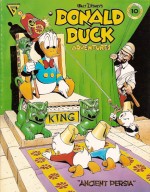
Walt Disney’s Donald Duck Adventures: Ancient Persia


By Carl Barks (Gladstone Comic Album #10)
No ISBN: 0-944599-08-7

Carl Barks was the greatest armchair (or at least drawing board) explorer of his generation. A voracious researcher who loved adventure and exploration, when he worked, history, geography and the natural world were as much his tools as pen and brush. All his fabulous tales were screened through a captivating lens of wonder and excitement and carried on a riotous wave of outrageous comedy that appealed equally to fun-starved fans of all ages. They still do.

From the 1940’s to the1960s Barks worked in productive seclusion writing and drawing a brilliantly timeless treasure trove of golden yarns ostensibly for kids, creating a Duck Universe of memorable and highly bankable characters like Uncle Scrooge McDuck, Gladstone Gander, the Beagle Boys, Gyro Gearloose, and Magica De Spell to augment the stable of cartoon properties from the Disney Studio, but his most exciting works inevitably involved the rowdy, know-it-all nephews of Donald Duck: Huey, Dewey and Louie.

Their usual assigned roles was as sensible, precocious and a little bit snotty kid-counterfoils to their “unca” whose irascible nature caused him to act like a overgrown brat most of the time, but they too often fell prey to a perpetual temptation to raise a ruckus…

Gladstone Publishing began re-releasing Barks material and a selection of other Disney comics strips in the late 1980s and this album is another of the very best. Whilst producing all that landmark material Barks was just a working guy, drawing eye-catching covers, illustrating other people’s scripts when necessary and yet, still setting the bar for his compatriots with utterly perfect comics tales that added to the burgeoning canon of Donald Duck and other Disney properties. His output was incredible both in terms of quantity and especially in its unfailingly high quality.

Printed in the large European oversized format (278mm x 223mm) this wild ride reprints one of his earliest masterpieces with the lead tale from Dell Four Color Comics Series II #275 (from May 1949) and sees the author accessing contemporary mores in an eerie epic that sampled the sinister delights of horror movies – albeit seductively tempered with Barks’ winningly absurd humour…

Donald and his nephews – mostly the nephews – are troubled by the haunting presence of a lurking stranger in the neighbourhood, but when the kids begin spying on him they all end up shanghaied – Donald too – to Iraq, where the sinister villain forces them to dig in the trackless desert.

He might be crazy but he’s not uninformed and soon the Duck’s have uncovered the lost city of Itsa Faka, but the sinister scientist won’t stop yet. Archaeology isn’t his only speciality: the city holds the secret of raising the dead and he wants it badly. As usual there’s a moral and it’s “be careful what you wish for” as the ancient Persians revive and the luckless Donald is mistaken for the rascally Prince Cad Ali Cad, who jilted the daughter of King Nevvawaza millennia ago.

Thinking the Cad has returned the undead family prepares to conclude the thwarted nuptials – and they won’t take no for an answer…

Fast paced and wildly over-the-top, this sharp tale skates perilously close to being really scary, but as ever, the madcap humour keeps everything addictively comforting and compelling.

Also included here are two short fantasy fables featuring Donald and the boys, beginning with ‘Super Snooper’ a brilliant spoof of costumed comicbook crime-busters from Walt Disney Comics & Stories #107 (September 1949) and a fabulous untitled science-fictional yarn (Walt Disney Comics & Stories #199 April 1957)where the gang are hooked up to Gyro Gearloose’s Imagining Machine for a startling tour of familiar places made new again by dint of the fact that the spectators have been reduced to the size of bugs. Shades of the Incredible Shrinking Ducks!

With another single-page gag (from Dell Four Color Comics #263 February 1950) to round off the madcap merriment this is another superlative treat for fans of comics in their purest and most enticing form.

Even if you can’t find this specific volume (and trust me, you’ll be glad if you do) Barks’ work is readily accessible through a number of publications and outlets and everything he’s ever done is well worth reading. No matter what your age or temperament if you’ve never experienced his captivating magic, you can discover “the Hans Christian Andersen of Comics” simply by applying yourself and your credit cards to any search engine.
© 1988, 1957, 1950, 1949 The Walt Disney Company. All Rights Reserved.

Recipe For Disaster and other Stories


By Penny Van Horn (Fantagraphics Books)
ISBN: 0-56097-330-7

Raised in Rye, New York, Penny (Moran) Van Horn worked in publishing before moving to Austin, Texas to begin her inexplicably low-key career as a cartoonist and storyteller. After years producing some of the most evocative and memorable graphic narratives of the 1990’s independent comics scene for magazines such as Weirdo, Wimmen’s Commix, Snake Eyes, Twisted Sisters and Zero Zero she now primarily works in newspaper illustration and produces a weekly strip for the Austin American-Statesman. She is also adept at painting, lettering and design and recently began experimenting with animation.

Recipe For Destruction is a collection of her early strips: deep, intense concoctions, more black than white, many crafted in her immensely labour-intensive scraperboard illustration style (see also the wonderfully mordant supernatural dark romance The Librarian), and all dwelling in the hazardous borderland between autobiography and bleakly comedic self-exploratory fantasy.

Latterly citing inspiration from such varied sources as Lucille Ball, Dick Van Dyke and Carol Burnett, Van Horn’s introspective retrospective begins with the eponymous ‘Recipe for Disaster’, which describes with harrowing aloofness her brief period of mental instability – her original title for the tale was “Mystical Experience or Nervous Breakdown” – before the book moves on to shorter but no less challenging fare.

‘Ten Dollars for Two Minutes’ details an unpleasant experience with her landlord, ‘Molested’ takes a slightly different glance at modern drama’s favourite plot device and ‘Catholic School’ is for anybody educated by nuns (Big ‘Hi’ to anybody else who survived Sacred Heart Convent Primary School without paying for therapy…) an utterly understandable slice of pictorial vitriol…

‘There’s No Such Thing as a Pregnant Silence’ outlines with frank and memorable humour some clear downsides to the Happy Event, ‘Binge and Purge’ reveals a different manner of addiction, ‘Domestic Bliss’ is a gloriously excessive examination of wedded bliss and ‘A Revealing Dream’ confirms that men’s suspicions of “what women want” has never been more wrong…

‘The Psycho Drifter’ is a remarkably unsettling account of modern dating, whilst ‘Texas Characters’ is plain laugh-out-loud whacky and ‘A Bird in the Beard’ returns to the subject of looking for love with more salutary comic reminiscences. The volume ends with a deeply moving cautionary tale about the heart ruling the head in ‘Mid-Life Crisis’, as well as the inclusion of some entrancingly unlovely pin-ups.

Van Horn’s work is astonishing in its captivating power and subtle influence. Her stories aren’t pretty but they are beautiful, and this collection, still in print and readily available, is one of the best grown-up comics collection around. If you believe that there’s more to strips than fights, tights and honking big guns, this book is all the proof you need.

© 1998 Penny Van Horn. All rights reserved.

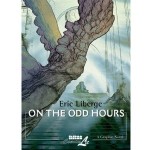
On the Odd Hours


By Eric Liberge translated by Joe Johnson (NBM ComicsLit/Louvre: Musée du Louvre Éditions)
ISBN: 978-1-56163-577-1

This is the first time I’ve encountered this series of translated graphic novels so this review is off the cuff and without any previous prejudice and preconception. That sounded pretty poncey and imposing but all it means is: even with all the high tech info systems in the world, occasionally something rather cool can slip by the most avid fan or collector.

In this case it’s the first two books in a patently fascinating collaboration between one of the greatest museums in the world and the, until so recently, scurrilous world of comics. So I’m diving right in with immediate reactions to the third in a series of superior translated bande dessinée courtesy of those fine fellows and folks at NBM.

These tales are produced in close collaboration with the forward-looking authorities of the Louvre, but this is no gosh-wow, “Night-at-the-Museum”, thinly-concealed catalogue of contents from a stuffy edifice of public culture. Rather, here is a startling, beautiful, gloriously compelling adult horror thriller that cleverly incorporates the history, geography, icons and artifacts of the Louvre into the plot and makes the historic building and its contents a vital character in the supernatural drama.

Amongst the history and information pieces at the back of the book is an article on the services for the deaf such as signed tours, and the hearing-impaired guides and lecturers who are part of the staff. This is done to complement the tale of Bastien, an angry young deaf man who turns up at the museum to begin an internship, but somehow becomes a Night Guard, with special responsibilities for The Odd Hours of the clock: those moments when the 200 year old museum slips the shackles of reality and the exhibits escape their bounds, coming to terrifying, chaotic life…

The art is stunning in this extremely adult tome, and the creeping obsessions of Bastien as he struggles to keep his daylight life alive whilst striving to resolve the mystery of the exhibits is both poignant and enthralling.

Why was he selected for the position? Why are the animated beauties and horrors of the museum so much more enticing that his increasingly strident and difficult girlfriend? Most importantly, how can animated artworks be so much more communicative than the flesh and blood inhabitants of his “normal” life?

On the Odd Hours is utterly engrossing and darkly lovely, and despite being the third in the series reads easily as a stand-alone tale. I’m definitely going to track down the preceding volumes and I strongly recommend that you all do likewise.

© 2008 Futuropolis/Musée du Louvre Éditions. English Edition © 2010 NBM. All rights reserved.

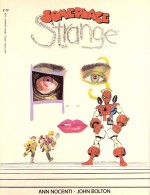
Someplace Strange – An Epic Graphic Novel


By Anne Nocenti & JohnBolton (Marvel)
ISBN: 0-87135-439-X

Once upon a time Marvel led the publishing pack in the development of high quality original graphic novels: mixing creator-owned properties, licensed assets like Conan, special Marvel Universe tales and even new series launches in extravagant over-sized packages (a standard 285 x 220mm rather than the now customary 258 x 168mm) that felt and looked like more than an average comicbook no matter how good, bad or incomprehensible (a polite way of saying outside the average Marvel Zombie’s comfort zone) the contents might be.

This terrifically appetizing tale, developed under the company’s creator-owned Epic imprint, applies the psychic tensions and apprehensions of the Cold War era to Alice in Wonderland territory and features a punky heroine and two sterling young boys who all take an inadvertent side-step into a graphic and ephemeral twilight zone with some long-lasting repercussions.

James or “Spike” is a rather nervous lad, dwelling far too much on the perilous state of the world, terrified of germs and war and atom bombs whilst his little brother Edward (“Captain Zebra” to you) is far more fun-loving, but still overly-impressionable. The birds tell Edward not to worry, but Spike is always afraid and he’s very convincing…

One night scary dreams prompt them to end their night-terrors by getting the Bogeyman first. Setting out for the nearest spooky old house, the lads are prepared for the worst and find it in Joy, a foul-tempered punkette runaway crashing in the old dump. Together they explore the deserted domicile and accidentally fall into a surreal otherplace of familiar monsters and cuddly weirdness.

Although it seems a dangerous and unwelcoming land the true threat is Joy, who draws a picture of her own self-loathing which comes to horrifying life and gives frantic chase…

Combining Bolton’s hyper-real and exceedingly lush painting with Nocenti’s barbed and challenging sense of whimsy, this slight but hugely entertaining fable is a treat for those adults who sometimes wish they weren’t, and a lovely reminder of why kids like to be safely scared sometimes.
© 1988 Anne Nocenti and John Bolton. All Rights Reserved.

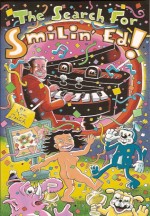
The Search for Smilin’ Ed!


By Kim Deitch (Fantagraphics Books)
ISBN: 978-1-60699-324-8

Kim Deitch has been one of the leading lights of America’s Comix Underground since its earliest days, although as with Harvey Pekar and American Splendor, it is only in recent years that he has won wider acclaim: in his case with 2002’s Boulevard of Broken Dreams. For the past two decades Deitch has been producing occasional short stories about a down-at-heel carnival the shabby, eccentric no-hopers that have populated it through-out the 150 years, the eerie aliens who have preserved its posterity and of course, the immortal Waldo the Cat, star of the graphic novel under review here.

In The Search for Smilin’ Ed! we have a formalised, recognisable Kim Deitch Universe – gloriously captured for your delight and delectation in a fabulous full-colour fold-out bonus feature within this comfortingly eccentric and incredibly accessible chronicle – as the author returns, albeit tangentially, to the outré characters of his fabulous Shadowland collection, expanding his ever-growing cast and still tellingly concerned with an absurdist examination of American popular culture scenarios.

With this surreal historiography of the hunt for a childhood landmark of misspent youth, the author once more shares the intoxicating joys of living in the past and dwelling in shared memories. This reassuringly weighty, mostly black and white tome leads with a terrific potted history and incisive essay, ‘Auguries of Brilliance: The Kim Deitch Universe’ by Comics scholar and educator Bill Kartapoulos, followed by the aforementioned universal crib-sheet fold-out, before the narrative wonderment unfolds in a progression of serialised episodes culled from the hallowed pages of famed alternative comics anthology Zero Zero.

One of Deitch’s most enduring characters is the irascible animated cartoon cat Waldo, who here returns to converse with the author himself as they reminisce, revel and ultimately reveal the hidden history of Smilin’ Ed, a pioneer of children’s television who mysteriously disappeared from public gaze in 1954, and was found dead on his yacht. But was he…?

Deitch’s stories are about stories – and particularly storytellers. As his authorial counterpart and the devilish Waldo converse, a cascade of mysteries are revealed when the monochrome moggy unburdens himself of his role in the vanishment, which in turn leads to a convoluted saga of fame, kidnapped boys, murdered children, fortune, a frog and demons, extraterrestrial cultural anthropologists – or voyeurs (?) – immortal pygmies and a social call to the Drawing Rooms of Hell…

Combining the utterly irresistible power of nostalgia and insatiable curiosity with science-fiction, conspiracy theory, urban history, fact and legend, show-biz razzmatazz, supernatural horror, Film Noir and a highly developed sense of the meta-real, Deitch once more weaves an irresistible spell that charms, thrills and disturbs whilst his meticulous drawing holds the reader in a deceptively fluffy, yet inescapable grip.

This volume further breaks down the thin walls of perceived reality by adding a lithograph ‘Ignacio the Bullfighter’ which was part of the narrative to the extra-textual content and also contains an all-new sequel and 21st century update, ‘Consider the Beaver’, which brings us up to date on the world of Waldo whilst delineating the forced evolution of Mankind’s potential successor. As always fact and fiction are seamlessly blended together until only a hyper-cranked search engine could discern truth from fable…

Follow the saga of the World According to Deitch in this wonderful compendium and you too could join the unfolding cartoon parade of the “Americana Way”. In Fact – or Fiction – you might already be there, but you’ll never know unless you look…

Characters, stories and artwork © 2010 Kim Deitch. All Rights Reserved.

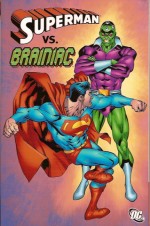
Superman vs. Brainiac


By various (DC Comics)
ISBN: 978-1-4012-1940-6

Superman is the comicbook crusader who started the whole genre and in the decades since his debut in 1938 has probably undertaken every kind of adventure imaginable. With this in mind it’s tempting and very rewarding to gather up whole swathes of his inventory and periodically re-present them in specific themed collections, such as this calculated confection of cosmic clashes with alien arch-foe Brainiac, originally a mere marauding alien but continually refitted over the decades until he now stands as the ultimate artificial nemesis, a thing of cogs, clockwork and computer code.

This superb collection represents appearances both landmark and rare from the many brilliant writers and artists who have contributed to the Kryptonian canon over the years and naturally this terrific tome opens with the extremely impressive introduction ‘The Super-Duel in Space’ by Otto Binder and Al Plastino, from Action Comics #242 (July, 1958) wherein an evil alien scientist attempts to add Metropolis to his collection of miniaturised cities in bottles.

As well as a titanic tussle in its own right, this tale completely changed the mythology of the Man of Steel, by introducing Kandor, a city full of Kryptonians who had escaped the planet’s destruction when Brainiac captured them. Although Superman rescued his fellow survivors, the villain escaped to strike again, and it would be years before the hero could restore the Kandorians to their true size.

Next is a lovely and clever yarn from Superman’s Girl Friend, Lois Lane #17 (May 1960), by Jerry Siegel, illustrated by the exceptional fine art team of Curt Swan and George Klein. ‘Lana Lang, Superwoman’ saw the Man of Tomorrow temporarily imbue both Lana and Lois with superpowers to foil a blackmail/murder plot by the viridian villain, whilst the novel-length saga ‘The Team of Luthor and Brainiac’ by Edmund Hamilton, Swan & Klein (from Superman #167, February 1964) not only teamed the hero’s greatest foes in an uneasy alliance but also revealed that the alien antagonist was actually a malevolent mechanism in humanoid form, designed by the computer-tyrants of the planet Colu to infiltrate and destroy organic civilisations and cultures.

There’s a big jump to the end of the 1970s for the next story, an epic three-part clash that first appeared in Action Comics #489-491 (November 1978-January 1979) scripted by the hugely undervalued Cary Bates and illustrated by Swan & Frank Chiaramonte.

‘Krypton Dies Again’ sees Superman once more battling Brainiac when the light from the decades gone explosion of his homeworld finally reaches Earth. The resultant flash supercharges his Kryptonian cells leaving the Man of Steel helpless. ‘No Tomorrow for Superman!’ finds an increasingly berserk hero unable to cope until joined by Hawkman to finally resolve ‘A Matter of Light and Death!’

In Action Comics #544 (June 1983) both Luthor and Brainiac were given radical makeovers to make them more apposite menaces for the World’s Greatest Superhero. Marv Wolfman and Gil Kane amped up the computer conqueror’s threat-level with ‘Rebirth!’ as cosmic forces reshaped the humanoid horror into a mechanistic angel of death.

When DC Comics decided to rationalise and reconstruct their continuity with Crisis on Infinite Earths in 1985 they used the event to regenerate their key properties at the same time. The biggest gun they had was Superman and it’s hard to argue that the change was not before time. The new, back-to-basics Man of Steel was a sensation and members of his decades-old rogue’s gallery were suitably retooled to match the new, grittier sensibility.

In this continuity ‘The Amazing Brainiac’ was Vril Dox, a monolithic disembodied intellect from the planet Colu who inhabited and transformed the body of showbiz mentalist Milton Moses Fine, (Adventures of Superman #438, March 1988, written by John Byrne& Jerry Ordway, illustrated by Ordway & John Beatty), until it grew beyond physical limits in ‘Man and Machine’ (Action Comics #649, January 1990, by Roger Stern, George Pérez, Kerry Gammill & Brett Breeding) to eventually become a time-travelling ball of malignant computer code, constructing or co-opting ever-more formidable physical forms in its self-appointed mission to eradicate Superman.

By the time of ‘Sacrifice for Tomorrow’ from Action Comics #763 (March 2000), by Joe Kelly, German Garcia, Kano & Mario Alquiza, the fiend had transformed into its 13th iteration and converted Metropolis into an automated City of the Future. It had also learned how to possess human infants – including Lana Lang’s newborn son and Luthor’s daughter Lena… – a chilling thriller to end on, but only a taste of the monstrous horror Brainiac is capable of.

With a pin-up page of Brainiac 13 by Scott Beatty, Steve Kim & Tommy Yune (from Superman: Metropolis Secret Files #1, March 2000) this comprehensive collection is a compelling introduction and overview of the undying enemy alien and a superb treat for fans of every vintage.

© 1958, 1960, 1964, 1978, 1979, 1983, 1988, 1990, 2000, 2008 DC Comics.  All Rights Reserved.

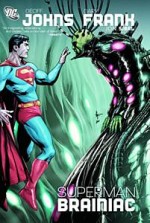
Superman: Brainiac


By Geoff Johns, Gary Frank & Jon Sibal (DC Comics)
ISBN: 978-1-84856-230-1

Since his first appearance in Action Comics #242 (July 1958) the alien reaver Brainiac has been a perennial favourite foe of the Man of Steel, and has remained so even through being subsequently “retooled” many times. Brilliant and relentless, the one thing he/it has never been is really scary – until this latest re-imagining from Geoff Johns and Gary Frank.

In modern DC continuity the raider was a computerised intellect from the planet Colu who inhabited and transformed the body of showbiz mentalist Milton Fine, until it grew beyond physical limits to become a time-travelling ball of malignant computer code, constructing or co-opting ever-more formidable physical forms in its self-appointed mission to eradicate Superman.

Now, in this slim but evocative graphic novel, collecting Action Comics #886-870 and Superman: New Krypton Special #1, the truth is finally revealed. Long ago, an alien invader attacked the planet Krypton: merciless robotic berserkers slaughtered hundreds of citizens before physically removing the entire city of Kandor. Decades later one of those robots lands on Earth only to promptly fall before the Man of Tomorrow’s shattering fists.

This ‘First Contact’ leads to a revelatory conversation with Supergirl, a fortunate survivor of the Kandor Incident, in ‘Hide and Seek’. Every Brainiac Superman has ever faced has only been a pale shadow of the true villain: autonomous automatic probes and programming ghosts of a malevolent entity that has stalked the stars for centuries, stealing representative cities before destroying the redundant worlds they once thrived upon. And now the real Brainiac has found Earth…

What nobody realises is that the Cosmic Kidnapper has been searching the universe ever since Krypton died. He actually wants to possess every last son and daughter of that long-dead world…

Superman rockets into space to find the monster, unaware that the marauder is already en route to Earth, and as the Metropolis Marvel confronts his old foe for the very first time in a titanic, horrific clash, ‘Greetings’ sees Supergirl lead the defence of an embattled planet Earth from the monster’s diabolical mechanical marauders.

The war on two fronts continues in ‘Mind Over Matter’, concluding in an overwhelming tale of ‘Triumph and Tragedy’ as Superman defeats Brainiac and frees an entire city of fellow Kryptonians he never knew still existed, only to lose one of the most important people in his life, ending the adventure on an uncharacteristically sombre, low key note in ‘Epilogue’.

Johns is at the forefront of the creative movement to restore much of DC’s Pre-Crisis on Infinite Earths mythology, and by combining a modern sensibility with much of the visual flavour of Ridley Scott’s Alien movies has added a tangible aura of terror to the wide-eyed imagination and wonder of those old and much-loved tales. The visceral, gloriously hyper-realistic art of Gary Franks and John Sibal adds to the unease, and their deft touch with the welcome tension-breaking comedic breaks is a sheer delight.

This is a Superman yarn that anybody can pick up, irrespective of their familiarity – or lack of – with the character: fast, thrilling, spooky and deeply moving, for all that it’s also the introduction to the major story event New Krypton – but that’s a tale and review for another time…

© 2008, 2009 DC Comics.  All Rights Reserved.

The Best of Marvel Comics volume 1


By various (Marvel)
No ISBN

Here’s a little oddity that might appeal to the collectors amongst you; as well as actually living up to its somewhat hyperbolic title its lush look presaged the high quality, big ticket sensibilities of the modern graphic novel market.

With no particular fanfare this terrific tome leads with a single page recap of the origin of the Fantastic Four (by John Byrne and Pablo Marcos I think) before launching into the origin of the company’s (if not the entire industry’s) first black superhero and Klaw, murderous Master of Sound, in ‘The Black Panther’ and ‘The Way it Began’ from Fantastic Four #52-53, by Stan Lee, Jack Kirby and Joe Sinnott.

This tremendous two-parter comes from that incredibly productive mid 1960s period that resulted in the creation of Galactus, Silver Surfer and the Inhumans along with so many others, and the tale has lost none of its force or impact since.

Next follows a far more modern tale, also preceded by a one-page origin (from Sal Buscema and Sinnott). ‘Sasquatch!’ written by Roger Stern and John Byrne, with art from Sal Buscema and Alfredo Alcala, first appeared in Hulk Annual #8, a colossal clash between the Jade Giant and the shaggy beast-man from Canadian super-squad Alpha Flight.

The company’s Astounding Arachnid mascot and corporate figurehead features heavily here in a bevy of landmark tales, beginning with the poignantly powerful short story ‘The Kid Who Collects Spider-Man!’ (Amazing Spider-Man #248 January 1984) by Stern, Ron Frenz & Terry Austin, and complemented by possibly the Wall-Crawler’s greatest comic book moment in the three-part clash with Doctor Octopus from issues #31-33.

I’ve reviewed ‘If This Be My Destiny…!’, ‘Man on a Rampage!’ and ‘The Final Chapter’ scripted by Lee, plotted and illustrated by the increasingly disaffected by still brilliant Steve Ditko, in a variety of different graphic novel formats (everything from Marvel Masterworks: Amazing Spider-Man 1965 to Essential Spider-Man volume 2) but I can honestly say it has never looked better than here with good old fashioned offset printing and reproduced in the 144-colour palette Ditko intended it for.

Stern and Byrne return with what was for decades the definitive origin of the Sentinel of Liberty in ‘The Living Legend’ from issue #255, the last of their breathtaking run on Captain America. If you’re hungry for more, this tale and all their others can be found in Captain America: War & Remembrance.

There’s more Lee/Kirby magic next with two classic sagas of the Mighty Thor, beginning with ‘The Answer at Last!’ (Thor #159, inked by Vince Colletta) as the secret of the Thunder God’s relationship to feeble mortal Don Blake is revealed, whilst the great Bill Everett provided the embellishment for the bombastic battle-fest ‘The Wrath of the Wrecker!’ (#171).

Doctor Strange gives Roger Stern his last outing of this book in ‘A Mystic Reborn!’, a classy and beautifully illustrated origin and adventure tale pictured by Paul Smith and Terry Austin that first saw the light of Day in issue #56.

No “best of Marvel” would be complete without an X factor, and there’s a wealth of mutant mayhem to end this collection, including one that didn’t even make it onto the contents page. After the single-page “previously on” by Dave Cockrum, ‘He’ll Never Make Me Cry’ by Chris Claremont, John Romita Jr. & Dan Green (Uncanny X-Men #183) re-presents the romantic break-up of Colossus and little Kitty Pryde which resulted in a cathartic clash with the unstoppable Juggernaut.

As an added enticement this book also included an all-new, unpublished Wolverine story set in Triad-infested Japan. ‘The Hunter’ by Claremont & Marshall Rogers is a tasty treat on which to end this impressive and thoroughly delicious concoction. This is a wonderful way to sample the triumphs of a major publishing player: judiciously selected material, well edited and presented. This is what we want and it’s just what the kind of publication the industry needs to lure in new fans…
© 1987 Marvel Entertainment Group, Inc. All Rights Reserved.