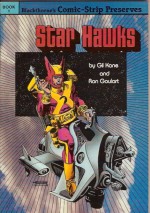
Star Hawks volumes 1-4


By Ron Goulart & Gil Kane, with Archie Goodwin and various (Blackthorne)
ISBN’s: 0-932629-21-0, 0-932629-46-6, 0-932629-55-5, 0-932629-80-6

By the 1970s the era of the adventure comic strip in newspapers was all but over, but there were still a few dynamic holdouts, and even a new masterpiece or two still to come. One such was this unbelievably addictive space opera/cop procedural which debuted on October 3rd 1977.

Created by novelist, comics scripter and strip historian Ron Goulart (and later carried on by the legendary Archie Goodwin who sewed up the sci-fi strip genre by also writing the Star Wars newspaper serial which premiered in 1979) the feature was blessed with the overwhelmingly dynamic art of Gil Kane and an innovative format for strips: a double tier layout that allowed far bigger, bolder graphics than the traditional single bank of frames.

The premise is magically simple: in our future man has spread throughout the galaxy and inhabits many worlds, moons and satellites. And wherever man goes there’s a need for policemen and peacekeepers…

As Goulart explains in his introductory notes the working title was “Space Cops” but that was eventually replaced with the more dashingly euphonious Star Hawks. In 2004 a wonderful collectors edition of this last great adventure strip was released, but is now, naturally, out-of-print and hard to acquire, so I’m concentrating here on the much more accessible four paperback collections published by Blackthorne in the mid 1980s, and which neatly cover Goulart’s tenure.

If you can’t find or afford the classy Hermes Press edition, these cheap and cheerful volumes are almost as good, and, who knows, perhaps somebody will re-release the complete volume sooner rather than later…

Book 1 steams straight in by introducing the villainous Raker and his sultry, sinister boss Ilka, hunting through the slums and ruins of alien world Esmeralda for a desperate girl plagued by dark, dangerous visions…

Enter Rex Jaxan and the ladykiller Latino Chavez, two-fisted Star Hawks on the lookout for trouble, who save the lass from slavers only to become embroiled in a dastardly plot to overthrow the local Emperor by scurrilous arms merchants. Also debuting in that initial tale is the cops’ sexy boss Alice K. Benyon (far more than just a romantic foil for the He-Hunk Jaxan), the floating space station “Hoosegow” and Sniffer, the snarkiest, sulkiest, snappiest robo-dog in the galaxy. The mechanical mutt gets all the best lines…

Barely pausing for breath the star-born Starsky and Hutch (that’s Goulart’s take on them, not mine) are in pursuit of an appalling new weapons system developed to topple the military dictatorship of Empire 13 – the “Dustman” process. Before long however the search for the illegal WMD develops into a full-on involvement in what should have stayed a local matter – civil war…
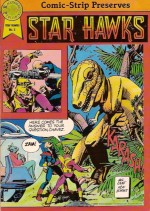
Book 2 finds the pair investigating stupendous resort satellite Hotel Maximus, with Alice K. along to bolster their undercover image. On Maximus every floor holds a different daring delight – from dancing to dinosaur wrangling to Alpine adventure – but the return of the malevolent Raker heralds a whole new type of trouble as he is revealed to be an agent of a pan-galactic cartel of criminals: The Brotherhood.

Moreover, the Maximus is the site of their greatest coup – a plot to mind-control the universe’s richest and most powerful citizens. So pernicious are these villains that the Brotherhood can even infiltrate and assault Hoosegow itself…

Foiling the raiders the Star Hawks quickly go on the offensive, hunting the organisation to the pesthole planet Selva, a degraded world of warring tribes and monstrous mutations, where new recruit Kass distinguishes himself, but the Brotherhood is deadly and persistent and new leader Master Jigsaw has a plan to destroy the Star Hawks from within…
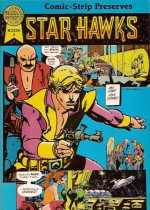
With Book 3 Kane took on some impressive, if uncredited, assistants to help with the punishing deadlines of what was basically two strips per day and a Sunday supplement every week. The incarcerated Raker escapes, to be hunted by both cops and robbers, and even after he dies he has no peace since, with his memories transferred into a robot head by the science wizard Doc Ajax (a delightful rogue based on Isaac Asimov), the deceased arch-villain is more dangerous than ever…

As brainwashed Star Hawk agents sabotage the Hoosegow, Raker’s new brain is purloined, sparking a hunt across a dozen systems and leading at last to the hellish planet Empire 99: lawless refuge of criminals and monsters. Allying themselves with the super-powered mutants known as the Kwark Clan, Jaxan and Chavez are nearly overmatched until a ghastly, tragic rad-beast proves that looks can be deceiving…

Returning to Hoosegow the Star Hawks are greeted with another mystery: Doc Ajax has vanished, but at least as this volume ends on a cliffhanger, fans can revel in the unsung assistance of artists Howard Chaykin and Ernie Colon working their individualistic magic over Kane’s pencils…
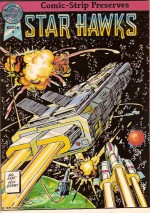
The final volume of this series opens with Colon and Chaykin still adding their distinctive inks to the saga as Rex and Chavez return to planet Esmeralda hunting the missing Doc Ajax, finding him in the less-than-tender clutches of the deadly Ilka, who has forced him to build a new body for Raker. A deadly duel in arctic climes ensues but at its end a far greater threat materialises in the portly form of pencil-pushing Superior Agent Stamms; an imperious, officious Star Hawk auditor come to investigate improprieties and lapses in protocol. He’s come to take names and tick boxes and isn’t the sort of problem a swift punch can resolve…

Next is Goulart’s final yarn; an unsavoury investigation into Star Hawk legend Miles Hardway, friend and mentor to our indomitable space cops. Is he just past his prime, corrupt or crazy? Or perhaps it’s something far, far worse…

This book ends with an uncompleted tale that begins to explore Jaxan’s chequered past, as Archie Goodwin assumes the writer’s reins. A cryptic message at last reaches Rex, relayed from a distant, off-limits and almost forgotten planet: a world called “Earth” – the lost world upon which Rex Jaxan grew to manhood and where somebody waits to kill or be killed by him …

Regrettably you will need the aforementioned special edition to see how that epic ends… Star Hawks ran until 1981, garnering a huge and devoted audience, critical acclaim and a National Cartoonists Society Award for Kane (Story Comic Strip Award for 1977). It is, quite simply one of the most visually exciting, rip-roaring, all-out fabulous sci-fi sagas in comics history and should be part of every fan’s permanent collection. In whatever format you can find this is a “must-have” item.
© 1977, 1978, 1979, 1986, 1987 NEA, Newspaper Enterprise Association. All rights reserved.
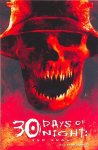
30 Days of Night: Red Snow


By Ben Templesmith (IDW)
ISBN: 978-1-6001-0149-6

Although I wasn’t a great a fan of the first 30 Days of Night graphic novel it didn’t stop it becoming a comics and movie sensation, but with this sequel (or to be exact, narrative prequel), writer artist Ben Templesmith finally struck a cord with this jaded old reviewer…

That first tale detailed the last days of Barrow, Alaska: a contemporary American town near the Arctic Circle where the sun sets for an entire month at a time. What happens when a posse of roving vampires came for an extended overnight stay one sundown is a simplistic but highly effective exercise in visceral slasher-thrills. No real depth or explanation, just easily explained motivations (eat and/or kill vs. run and/or fight) and lots of evocative action. A perfect, uncomplicated video game of a tale…

Now, in Red Snow a little glimpse into the history of that nomadic band of Nosferatu is offered…

Russia 1941: bleak black bitter winter is decimating both the Nazi invaders and the hard-hearted vengeful Russian troops in the hinterlands beyond Murmansk. The German-Finnish Operation: Silver Fox has collapsed (a bold, doomed attempt by the Nazis to capture the port and end Allied aid into Russia), and roving bands of Germans are freezing and starving in the permanent blizzard-bedeviled arctic night. Equally hard-pressed are the Soviet and Cossack patrols hunting the surviving invaders.

Among the pursuers is Charlie Keating, British Naval observer, military liaison and war-weary polyglot. As the Soviets are slowly advancing despite the deadly temperatures, they come across a vast underground storage compound where a family of peasants has been hoarding food, ammunition and fuel “for the War Effort”. At the same time the Nazis have made their own discovery – a small band of blood-stained travesties, immune to the cold and dark, ravenously hungry for human flesh and hot red blood…

Old animosities are soon forgotten as the surviving Nazis are invited into the subterranean citadel, but the unstoppable bloodsuckers besiege and rapidly deplete the defenders’ numbers and resources. Soon it’s clear that the only possible chance lies in outrunning them in the one remaining truck…

Templesmith’s first outing as scripter is clear-cut and a little short on sophistication, but wickedly effective as the vampires relentlessly attack, and even though the team-up of human enemies, complete with inevitable betrayals, is nothing new in this genre it is extremely well-executed and graphically enticing.

Although many British readers might compare this unfavourably to the similar scenario of the classic 1980 2000AD strip Fiends of the Eastern Front – and in terms of sheer suspense the Gerry Finley-Day/Carlos Ezquerra serial is certainly superior – (note to self: must review some 2000AD collections soonest…) there is a splendidly visceral brevity to the blood-soaked events of Red Snow that carries the tale along at a breakneck pace and always delivers its promised punch.

Templesmith is an accomplished illustrator and works well in his painterly manner, blending Kent Williams or Jon J Muth’s watercolour vivacity s with Ted McKeever’s angular, expressionistic figure work. Of course there’s also heaping helpings of splashy reds against the cool icy blues – and remarkable amounts of gruesome violence which is, of course, exactly what the target audience expects…

This collection of the three-part miniseries also includes an interview with Templesmith and an extensive gory gallery section of art-pieces.

™ & © 2008 Steve Niles, Ben Templesmith and Ideas and Design Works, LCC. All Rights Reserved.

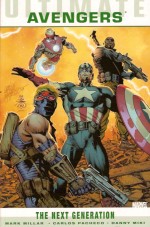
Ultimate Avengers: The Next Generation


By Mark Millar, Carlos Pacheco & various (Marvel/Panini UK)
ISBN: 978-1-84653-442-3

The Marvel Ultimates project began in 2000 with a thoroughly modernizing refit of key characters and concepts to bring them into line with contemporary “ki-dults” – perceived to be a potentially separate buying public to we baby-boomers and our declining descendents, who seemed content to stick with the various efforts that devolved from the fantastic originating talents of Kirby, Ditko and Lee. Eventually this streamlined new universe became as crowded and continuity-constricted as its predecessor and in 2008 the cleansing publishing event “Ultimatum” culminated in a reign of terror which apparently (this is comics, after all) killed three dozen odd heroes and villains and millions of lesser mortals.

Although a good seller (in contemporary terms, at least) the saga was largely trashed by the fans who bought it, and the ongoing new “Ultimatum Comics” line is quietly back-pedalling on its declared intentions…

The key and era-ending event was a colossal tsunami that drowned the superhero-heavy island of Manhattan and this post-tidal wave collection (assembling issues #1-6 of Ultimate Comics Avengers: The Next Generation) picks up the story of the survivors as well as the new world readjusting to their altered state. In this dangerous new world global order has yet to be fully re-established and, just like after World War II, Princes and Powers are constantly jostling for position.

Before the Deluge Nick Fury ran an American Black Ops team of super-humans called the Avengers, but he was eventually toppled from his position for sundry rule-bending liberties – and being caught doing them. Now, in the aftermath of the disaster he’s back:  attempting to put another team together – and get his old job back.

Captain America was one of America’s first super-soldiers – a key factor in the Allies beating Hitler and one of the deadliest men alive. Just as in the Marvel Universe Proper, he survived into our era. Whilst fighting terrorists in the sky over Chicago he is soundly thrashed by a man with no face: an incredible assassin with a red skull, who easily overwhelms him and throws him to what would have been certain death, if not for the intervention of master marksman Hawkeye.

All through his second career secrets have been kept from Captain America by his superiors. He had no idea that when he was “lost in action” his girlfriend was already pregnant with his son and that whilst he was dormant the American government confiscated the child to train as another human weapon. On awakening in a new era Cap could not be told how warped and malevolent that boy became or how, on reaching maturity, the lad had murdered everyone who had trained him, embarking on a decades-wide path of horrendous nihilistic slaughter in all the world’s most troubled hotspots: Vietnam, Cambodia, Uganda, Chechnya, Dallas…

Now Cap knows the truth and goes rogue just as the Red Skull allies with the intellectual terrorist sect Advanced Idea Mechanics to build a Cosmic Cube, capable of restructuring reality itself. Only Fury and his new team of Avengers have any chance to stop them, but his motley crew of heroes all have their own plans…

As well as Hawkeye, this next generation includes James Rhodes: an angry soldier wearing devastating War Machine battle armour; Gregory Stark, Iron Man’s smarter, utterly immoral older brother, Nerd Hulk, a cloned gamma-monster with all the original’s power but implanted with Banner’s brain and milksop character; ruthless super-spy Black Widow and paroled assassin Red Wasp, who has history of her own with the Skull…

As the catastrophe-clock ticks down, Fury inexplicably sets his dogs to capture Captain America rather than tackle the Skull, but in this deep, dark, and superbly compelling thriller there are games within games and everybody is working to their own agendas…

Once removed from the market hype and frantic, relentless immediacy of the sales arena there’s a far better chance to honestly assess these tales on merit alone, and given such an opportunity you’d be foolish not to take a good hard look at this spectacular, beautifully cynical and engrossing thriller from Mark Millar and Carlos Pacheco, ably assisted by inkers Dexter Vimes, Danny Miki, Thomas Palmer, Allen Martiniez, Victor Olazaba & Crime Lab Studios.

This is a breathtaking, sinisterly effective yarn that could only be told outside the Marvel Universe, but it’s also one that should solidly resonate with older fans and especially casual readers who love the darker side of superheroes.

™ and © 2010 Marvel Entertainment LCC and its subsidiaries. All Rights Reserved. A British edition released by Panini UK Ltd.

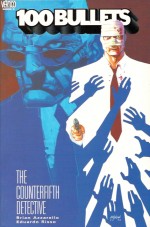
100 Bullets volume 5: The Counterfifth Detective


By Brian Azzarello & Eduardo Risso (Vertigo)
ISBN: 978-1-84023-467-1

All societies have policemen and the kind of cop absolutely depends on the kind of society. When that society is utterly secret and consists of thirteen ruthless criminal dynasties that have covertly controlled America since Columbus landed, the kind of peacekeeper needed to keep them honest and actively cooperating has to be a man uniquely honest, smart and remorseless.

Such a man is Agent Graves…

Beginning as one of the best crime-comics in decades, 100 Bullets gradually, cunningly transformed itself into a startlingly imaginative conspiracy thriller of vast scope and intricate intimate detail. With this fifth volume (collecting issues #31-36 of the much missed adult comic book) close followers might assume they finally have a handle on what’s going on, and how the characters are shaping up but once more Azzarello and Risso have plenty of surprises to unleash and chairs to kick out from under us…

Milo Garrett is trouble: brooding, violent and always looking for a fight. That’s not the best résumé for a private investigator, but it gets Milo through the nights and through the week. However his soul-deadened life a takes a decidedly strange turn when he wakes up in a hospital bed with his face bandaged like a mummy. Being a tough guy doesn’t help much when you’re catapulted through a speeding car windscreen…

He has a visitor: a sleek old gentleman named Graves who offers him a briefcase with an untraceable gun, 100 bullets and a dossier on just how he got there. What Graves doesn’t offer is any answers…

Psychotically independent, ever-suspicious and always spoiling for another drink and another fight Garrett revisits the case he was working on. He was hired to recover a stolen painting, but when his client is murdered he knows he’s stepped into something big and dirty. Unable to let go he digs deeper and finds the ultra-rich Megan Dietrich (see 100 Bullets: First Shot, Last Call) up to her neck in something that clearly terrifies her: something that scares everybody connected to this case…

As the body-count mounts Graves’ reawakened “Minutemen” surface, and although Garrett doesn’t know it yet he is caught between a centuries-old criminal cabal and the squad of paramilitary peacekeepers they betrayed and (they believed) destroyed.

Events spiral as monstrously ambiguous hitman Lono stalks his next – unspecified – target and once Milo finally sees the mysterious painting which apparently reveals a hidden secret of the criminal Trust that runs America, the detective is pretty sure of the only way this mess can end…

Deeply unsettling yet spectacularly compelling this yarn turns the hardboiled gumshoe genre on its head as it weaves a unique web of intrigue that gradually built into a monolithic saga of institutional corruption and personal honour. The unfolding saga remains an astoundingly accessible and readable thriller as the mystery of the Trust is revealed and Agent Graves begins the final stage of a plan decades in the making: 100 Bullets promises that the best is already here, but even better is waiting…

Entertainment-starved story fans – grown-up, paid-up, immune to harsh language and unshaken by rude, nude and very violent behaviour – should make their way to their favourite purveyor of fine fiction immediately and get every one of these graphic novels – at all costs.

© 2002 Brian Azzarello, Eduardo Risso and DC Comics. All Rights Reserved.

Hotwire Comics volume 3


By various, edited by Glenn Head (Fantagraphics Books)
ISBN: 978-1-60699-288-3

The third magnificent, oversized compendium of cutting edge cartooning and alternative artistic visions has finally arrived and once more combines famed and possibly less well-known creators in a bold, brassy high-quality, giant-sized (9×12 inch or 230x304mm) full colour and black and white anthology of new tales and concoctions. There’s even a multi-page psychedelic, phantasmagorical fold-out ‘The Magnificent Pigtail Show’ from the incredible Steven Cerio.

Beginning with art-pieces – David Sandlin’s ‘Studio of Sin’ and Tim Lane’s ‘Greetings From Hotwire USA’ – the sequential narratives launch with Michael Kupperman’s ‘Meet McArf!’, a decidedly smooth shaggy dog story, the eerie childhood reminiscence ‘Car-Boy’s Family’ from Max Andersson and ‘Bottomless’ a salutary tale of excessive appetite from Eric Watkins and Chadwick Whitehead.

The first of a series of ‘Feral Spheres’ – monochrome artworks by David Paleo – is followed by ‘Denial’ and ‘The Bully’, two moody introspections from Jayr Pulga and Sam Henderson’s gross-out gag-strip ‘At a Frat Party or a Sports Game or Something Like That’, before editor Glenn Head enthrals with the cheery chiller ‘Candyland Clinic.’

After Paleo’s second ‘Feral Sphere’ the always fascinating Mary Fleener describes how and why she bought a gun in ‘The Judge’ and Rick Altergott reveals the sordid saga of a sweet young thing who was just too ‘Keen on a Clown!’, after which sordid shocks Head returns with some  ‘Psychedelic Smut’.

Onsmith’s beguiling ‘Dispossession by Tornado’ is followed by another ‘Feral Sphere’ and Mark Dean Vega reinterprets some of our most beloved comics characters in his mouth-watering ‘Popeyeconography’ before Doug Allen’s grotesquely funny ‘Hillbilly’s Dun Gawn Ta College’ and the ever offensive Johnny Ryan provides insight to life with ‘The Cockhorns’.

Following the aforementioned Cerio foldout section Tim Lane crafts a chilling tale of hobos riding the rails in ‘Spike’, Danny Hellman illustrates a truly lovely clash in ‘Alice Versus the Sandman’, R. Sikoryak retells the story of Hamlet using Hank Ketcham’s oddly appropriate cartoon cast in ‘The Menace of Denmark’ and Mack White provides a surreal and terrifying glimpse into ‘Roadside Hell.’

Another ‘Feral Sphere’ precedes, for my money, the very best piece in this collection. The darkly mannered tale entitled the ‘Passion of Atte’ by Matti Hagelberg is a complex, brooding tale of vanishment and suicide – or is it?

‘Infernal Combustion’ is a bold, old-fashioned paranoid nightmare by David Sandlin, followed by one last ‘Feral Sphere’ and Danny Hellman’s delightful ironic parable ‘Tales of the Sodom Ape Men and the Electronic God’, Stephane Blanquet provides so much more than just a ‘Drawing’, Karl Wills delivers a punchy space fable in ‘Connie Radar’ and Mats!? chills and thrills with his deeply disturbing discourse ‘Sleep Walker.’

The final tale is the classy history of an unsung hero from another, more wicked time:  Glenn Head relates the rather sad and nasty tale of ‘Vulvina, the Ventriloquist’s Dummy Daughter!’ which closes another startling, offensive, compelling and thoroughly wonderful box of cartoon delights for brave, hungry souls in search of different kicks. Strictly for those of you over voting age, this is a treat no real comics aficionado can afford to miss.

All artwork and stories © 2010 the respective creators. All rights reserved.

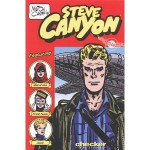
Milton Caniff’s Steve Canyon 1948


By Milton Caniff (Checker Book Publishing Group)
ISBN: 978-0-97416-641-4

By the second year of his new strip Milton Caniff was already working at the top of his game, producing material both exotic and familiar, and once again dead on the money in terms of the public zeitgeist and taste. After defeating the wily Herr Splitz, ex-war-hero and charter pilot Steve Canyon is asked to ferry Dr. Deen Wilderness to the Middle East, to set up Health Centres for American enclaves, where business interests were busy establishing themselves and becoming the multinational Corporations of today.

Back then, of course, Caniff was merely being contemporary, but he was savvy enough to realise that with the Cold War beginning any Yankee was going to be seen as a spy in such climes, so he made that a part of the narrative. Canyon was unofficially asked to “keep his eyes open” by the US Navy. When his team land (Happy Easter and Fireball Feeney tagging along for dramatic and comedic purpose), they were immediately embroiled in an espionage plot to enflame the indigenous population.

Caniff never bracketed his tales, preferring to simply keep the action rolling ever on, but for convenience the publishers have broken the saga into discrete units. ‘Medical Sabotage’ ran from November 25th 1947 to March 27th 1948 and described how the mission became the subject of competing propaganda machines and murderous skulduggery by a Communist spymaster using the pseudonym “Chief Izm”.  The climactic battle between Canyon and Izm left Steve and Happy stranded in mountain country, at the mercy of attacking nomad bandits.

Which is where the second adventure begins: ‘The Nine Maid’ started on Sunday the 28th of March, and ran until May 23rd, an exotic piece of froth with the guys trying to stay alive as captives of a mysterious masked woman playing Joan of Arc for the mountain tribes. Claiming to be descended from survivors of the Ninth Crusade the sultry, charismatic freedom fighter eventually enlisted our heroes’ aid in her struggle.

‘Operation Convoy’ began on Sunday May 24th, and saw Steve, Happy and the Nine Maid trapped in a city, futilely evading their foes and the Communist agitators who pay them. When they’re captured, a little Arab girl calling herself “Convoy” offered to free them if Canyon would marry her! Their escape was fraught and frantic but only led to more trouble when they were all picked up by the unconventional Soviet Submarine commander Captain Akoola – “the Shark”. Akoola was a beautiful and doctrinaire woman who gradually thawed not because of Canyon’s virile yumminess, but because she responded to Convoy’s orphan plight. Taking a lead from the Count of Monte Cristo, the two females conspire to liberate the Americans by dumping their supposed corpses overboard…

Adrift at sea Steve and Happy washed onto the Burma Coast for ‘Plantation Sabotage’ (September 4th – November 3rd) wherein raunchy widow Miss Fancy and the brutal, jealous ‘Rak’ – whose attempts to get rid of Canyon were prompted by a much more personal type of intrigue – interfered with the smooth running of plantation life. But even here a shadowy agitator was enflaming the native croppers, with the profiteering Rak’s tacit approval. The tense drama promptly resulted in ‘Puppy Love’ (November 4th 1948 to January 8th 1949) when Rak’s son Reed Kimberley joined the story and the extended cast.

Reaching Rangoon Steve and Happy were unaware that the boy would do anything to avoid returning to America. Reed becomes enmeshed in the snares of native bargirl and teen hellion “Cheetah” whose depredations led to a mid-air hostage crisis which ends this second collection on a tragic cliffhanger…

What Milton Caniff was developing in those post-war years is indistinguishable from the glossy, exotic soap operas and dramas that are the back-bone of modern commercial television. Fast-paced, constantly evolving dramas fed by sub-plots, charismatic characters, exotic locales, non-stop action, and even political intrigue, all wrapped up in a heady mix of sexual tension and sharply observed humour. It seems that we can reproduce the techniques but have lost most of the charm, wit and sheer élan…

Steve Canyon is comic storytelling at its best. Beautifully illustrated, mesmerising black and white, sagas of war, espionage, romance, terror, justice and cynical reality: a masterpiece of graphic narrative every serious fan and story-lover should experience.

© 2003, Checker Book Publishing Group, an authorized collection of works
© Ester Parsons Caniff Estate 1947, 1948, 1949.All characters and distinctive likenesses thereof are trademarks of the Ester Parsons Caniff Estate. All Rights Reserved.

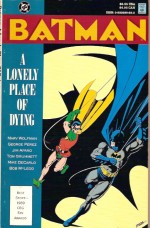
Batman: A Lonely Place of Dying


By Marv Wolfman, George Pérez, Jim Aparo, Tom Grummet, Mike DeCarlo & Bob McLeod (DC Comics)
ISBN: 978-0-9302-8963-8

Batman is in many ways the ultimate superhero: uniquely adaptable and able to work in any type or genre of story – as is clearly evident from the plethora of vintage tales collected in so many captivating volumes over the years.

One less well-mined period is the grim 1980s era when the Caped Crusader was partially re-tooled in the wake of Crisis on Infinite Earths, becoming a driven, but still level-headed, deeply rational Manhunter, rather the dark, out-of-control paranoid of later days or the costumed boy-scout of the “Camp” crazed Sixties.

Robin, the Boy Wonder debuted in Detective Comics #38 (April 1940) created by Bob Kane, Bill Finger and Jerry Robinson: a juvenile circus acrobat whose parents were murdered by a mob boss. The story of how Batman took the orphaned Dick Grayson under his scalloped wing and trained him to fight crime has been told, retold and revised many times over the decades and still regularly undergoes tweaking to this day.

Grayson fought beside Batman until 1970 when, as an indicator of those turbulent times, he flew the nest, becoming a Teen Wonder college student. His creation as a junior hero for younger readers to identify with had inspired an incomprehensible number of costumed sidekicks and kid crusaders, and Grayson continued in similar innovative vein for the older, more worldly-wise readership of America’s increasingly rebellious youth culture.

Robin even had his own solo series in Star Spangled Comics from 1947 to 1952, a solo spot in the back of Detective Comics from the end of the 1960s wherein he alternated and shared with Batgirl, and a starring feature in the anthology comic Batman Family. During the 1980s he led the New Teen Titans first as Robin but eventually in the reinvented guise of Nightwing, re-establishing a turbulent working relationship with Batman. This of course left the post of Robin open…

After Grayson’s departure Batman worked solo until he caught a streetwise urchin trying to steal the Batmobile’s tires. This lost boy was Jason Todd, whose short but stellar career as the second Boy Wonder was fatally tainted by his impetuosity and tragic links to one of the Caped Crusader’s most unpredictable foes.

Todd’s unsuspected emotional problems and his murder were controversially depicted and dealt with in Batman: a Death in the Family. In the shock and loss of losing his comrade the traumatised Dark Knight was forced to re-examine his own origins and methods, becoming darker still…

After a period of increasingly undisciplined encounters Batman was on the very edge of losing not just his focus but also his ethics and life: seemingly suicidal on his frequent forays into the Gotham nights. Interventions from his few friends and associates had proved ineffectual. Something drastic had to happen if the Dark Knight was to be salvaged.

Luckily there was an opening for a sidekick…

In this volume, collecting a crossover tale that originally appeared in Batman #440-442 and New Teen Titans #60-61 (plotted by Marv Wolfman and George Pérez, scripted by Wolfman with the Batman chapters illustrated by Jim Aparo & Mike DeCarlo, and the Titans sections handled by Pérez, Tom Grummett & Bob McLeod) a new character entered the lives of the extended Batman Family; a remarkable child who would change the shape of the DC Universe.

In ‘Suspects’ Batman is rapidly burning out, and not only his close confederates but also an enigmatic investigator and a mystery villain have noticed the deadly deterioration. Whilst the criminal mastermind embroils the wildly unpredictable Two-Face in his scheme, the apparently benevolent voyeur is hunting for Dick Grayson: a mission successfully accomplished in the second chapter, ‘Roots’.

The original Robin had become disenchanted with the adventurer’s life, quitting the Titans and returning to the circus where the happiest and most tragic days of his life occurred. Here he is confronted by a young boy who knows the secret identities of Batman and Robin…

‘Parallel Lines’ unravels the enigma of Tim Drake, who as a toddler was in the audience the night the Flying Graysons were murdered. Tim was an infant prodigy, and when, some months later he saw the new hero Robin perform the same acrobatic stunts as Dick Grayson he instantly deduced who the Boy Wonder was – and by extrapolation, the identity of Batman.

A passionate fan, Drake followed the Dynamic Duo’s exploits for a decade: noting every case and detail. He knew when Jason Todd became Robin and was moved to act when his death led to the Caped Crusader going catastrophically off the rails.

Taking it upon himself to fix his broken heroes Drake determined to convince the “retired” Grayson to became Robin once more – before Batman made an inevitable fatal mistake. It might all have been too little to late, however, as in ‘Going Home!’ Two-Face makes his murderous move against a severely sub-par Dark Knight…

Concluding with a raft of explosive and highly entertaining surprises with ‘Rebirth’ this often-overlooked Bat-saga introduces the third Robin (but who would get into costume only after years of training – and fan-teasing) whilst acknowledging both modern sentiments about child-endangerment and the classical roles of young heroes in heroic fiction. Perhaps a little slow and definitely a bit too sentimental in places, this is nevertheless an excellent, key Batman story, and one no fan should be unaware of.

Short, sweet and simply superb, here is a Batman – and Robin – much missed by many of us, and this tale, like so many others of the 1980s, is long overdue for the graphic novel treatment. To the Bat-Files, old chums…
© 1989,1990 DC Comics. All Rights Reserved.

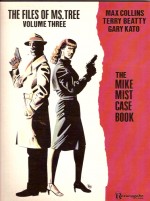
The Files of Ms. Tree volume 3: The Mike Mist Case Book


By Max Collins, Terry Beatty & Gary Kato (Renegade Press)
ISBN: 0-840031-02-7

Despite being one of the most popular genres in literature and the fact that most fiction books are bought and read by women, Private Eye yarns are desperately short of female protagonists. Marry that with the observation that “gumshoe” comics are also as rare as hen’s teeth and it’s a wonder that a series such as Ms. Tree ever got off the drawing board.

The secret – as always – was quality.

The black widow of detective fiction first appeared in 1981 as a serial in the anthology comic Eclipse Magazine, produced by Max Allan Collins (crime novelist and new writer of the Dick Tracy strip) with young humour cartoonist Terry Beatty.

She soon won her own solo title, Ms. Tree’s Thrilling Detective Stories (later simply Ms. Tree), and although the marketplace was not friendly to such a radical concept the series ran for 50 issues, and 2 specials, from three publishers (Eclipse, Aardvark-Vanaheim and Renegade Press) before finally dying in 1989. She was promptly revived as a DC comic in 1990 for another 10 magnum-sized issues as Ms. Tree Quarterly/ Ms. Tree Special; three more blood-soaked, mayhem-packed, morally challenging years of pure magic.

Astonishingly, there are no contemporary collections of her exploits – despite Collins’ status as a prolific and best-selling author of both graphic novels (Road to Perdition, CSI and prose sequences featuring his crime-creations Nathan Heller, Quarry, Nolan, Mallory and a veritable pantheon of others).

In the first volume we briefly met Mike Tree, an archetypal detective who married his secretary and partner Mike (“nobody calls me Michelle… twice”) Friday, only to be murdered on their wedding night. The Widow Tree hunted down his killer, setting herself on a path of blood-soaked vengeance. En route she uncovered a vast web of corruption and made an eternal enemy of Mob boss Dominic Muerta: locking together forever in a bloody vendetta.

This third volume, released in 1986, diverged from the chronological retelling of her adventures to re-present a selection of one-shots and specials that co-starred another Collins/Beatty shamus, one originally intended for a far more impressionable audience that gore-hardened Comic-book fans.

The Mike Mist Minute Mysteries began as a part of a tabloid section entitled The Comics Page, which was syndicated for a year or so (1979-1980) in a dozen small newspapers, and latterly in Mystery Magazine. The strip featured a cool, smooth PI who, in 12 panels or less, introduced a crime, deduced a culprit and caught the felon, in neat fair-play duels with the reader. He was generally not aided by the self-fulfilling cop Lieutenant Dimm. The feature was rife with sly in-jokes for fans of detective fiction: whether prose, TV or filmic…

Some of these little gems were collected into a comic-book by Eclipse in 1981 and a selection of those works-in-progress form the opening chapter of this red-handed collection, beginning with the very first conundrum, ‘Death Takes a Powder’, swiftly followed by ‘The Butler Didn’t’, ‘You Only Die Once’, ‘Silence Isn’t Golden’, ‘No Laughing Murder’, ‘Crime Takes a Hike’, ‘Damsel in This Dress’, ‘Too Damp Bad’ and ‘Death Has an Eerie Ring.’

When Ms. Tree launched Mist became an occasional guest: an associate and friend who handled over-spill cases, and eventually scored his own back-up strip in the monthly comic. Inevitably this led to a number of official team-ups – “Mist-Tree Tales” (the liberal use of atrocious puns as concealed and/or offensive weapons was a signature and standard M.O. of all Mist-adventures…)

‘Murder at Mohawk’, from Ms. Tree #9 found accidentally sharing a resort hotel, just a blizzard traps an unsavory cast of characters into an unsolved robbery/murder thirty years old… By this time Gary Kato had joined the team as letterer, art assistant and sometime penciller. Thus Beatty’s art took on a seductively Steve Ditko-esque appearance, especially in such Mist’ back-up teasers as ‘The Long and the Short of Death’ and ‘See no Evil…’, whilst Collins added some autobiographical verity by making Mist a comicbook and record collector in ‘Wertham Was Right’ and ‘Four Color Phony’. After the seasonal ‘Claus for Alarm’, ‘Suitable for Framing’, ‘Snow Job’, ‘Disappearing Act’, ‘Woman in White’ and ‘Blood Will Tell’ our second full-length feature begins.

‘Death, Danger and Diamonds: Dear, Dead Darling’ is a high-octane, hard-bitten hot potato which saw Mist looking to avenge a murdered client (so many of his paying customers ended up dead it became a running gag in the strip. As Tree used to teasingly point out – at least with her cases it was usually the bad-guys who ended up on slabs…) To that end the pair masqueraded as husband and wife; playing bait for a seasoned killer in the concluding ‘Hawaiian Ice.’

‘Death, Danger and Diamonds’ was released as a 3D comic during the brief revival of the form in the mid 1980s. Ray Zone’s eye-popping “separations” expertise is absent from this 2D, black and white collection, but the addition of a four page 3D thriller ‘A Pair of Eyes’ serves to keep the theme in the frame…

There’s another batch of Mist-only Minute Mysteries before the final long-playing tale. ‘Railroaded’, ‘Shattered Alibi’, ‘Staged Suicide’, ‘Blind Suspicion’, ‘No Shot in the Dark’ (with Ms. Tree in attendance), ‘Lucky Number’, ‘Overdrawn Account’ and ‘Tag! You’re It…’ all display the requisite observational antics before ‘Music to Murder By’ finds Mist and Tree hunting a murderer through the heady halls of a vinyl record convention (although to be fair this was produced in the time before CDs, let alone those infernal I-Poddy contraptions…).

The much-abused “more-valuable-dead-than-alive-rock-musician” plot gets an early but quite superior outing in this gripping, stylish thriller which closes the charming, chilling collaboration between two of the sharpest, deadliest gumshoes in the biz.

Despite the tragic scenarios, ruthless characterisations and high body-count, this is yet another clever, scathingly funny casebook steeped in the lore of detective fiction, stuffed with added asides and extras for the cognoscenti. In fiction absolutely no one can be trusted and since you get the chance to match wits with both scumbags and sleuths, these tales are simply steeped in the truly magical gratification factor that allows the reader an even chance to mete out some vicarious justice…

Ms. Tree is the closest thing the American market has ever produced to challenge our own Empress of Adventure Modesty Blaise: how she can be left to languish in graphic obscurity is a greater mystery than any described in this compelling collection. Track down all her superb exploits and pray someone has the street smarts to bring her back for good…

© 1981, 1982, 1983, 1984, 1985, 1986 Max Allan Collins and Terry Beatty. All Rights Reserved.

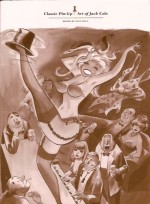
The Classic Pin-Up Art of Jack Cole


By Jack Cole, edited by Alex Chun (Fantagraphics Books)
ISBN: 978-1-60699-284-5

Jack Cole was one of the most uniquely gifted talents of American Comics’ Golden Age, crafting landmark tales in horror, true crime, war, adventure and especially superhero genres. His incredible humour-hero Plastic Man remains an unsurpassed benchmark of screwball costumed Hi-jinks: frequently copied but never equalled. As the Golden Age faded, Cole could see the writing on the wall and famously jumped into gag and glamour cartooning, becoming a household name when his brilliant watercolour saucy pictures began running in Playboy with the fifth issue.

Ever-restless, Cole eventually moved into the lofty realms of newspaper strips and in May 1958, achieved a life-long ambition by launching the syndicated domestic comedy Betsy and Me. On August 13th 1958, at the moment of his biggest break he took his own life.

The unexplained reasons for his death are not as important as the triumphs of Cole’s artistic life and this captivating paperback (reprinting a rare hardback compilation from 2004) provides a fascinating insight into a transitional moment in his artistic development.

When Cole began his move from comic-books into the “adult world” of cartooning, he adopted the nom-de-plume “Jake” whilst he honed his dormant gag-skills (sequential narrative being so far removed from the “quintessential moment” illustration needed for a single picture telling an entire story). Working in beautiful ink and wash creations he began submitting to the cheaper end men’s magazines: ubiquitous little throwaway digests with titles such as Romp, Stare, Joker, Laugh Riot and Breezy, packed with photos of saucy vixens like Betty Page and her cheesecake ilk – and lots and lots of debatably risqué gags.

Nor was he the only artist making the pilgrimage: other funnybook stars on the move included Bill Ward, Jefferson Machamer, Dan DeCarlo, Bill Wenzel and Basil Wolverton.

This charmingly innocent compendium of Lush Ladies, Willing Wantons, Savvy Sirens, Naive Nymphs (always stunningly beautiful women) collects his 100 or so published sales, divided into Line Art, Washes and an astounding selection of Originals – images shot from the actual artwork and not printed pages, revealing all the detail and unedited work a budding creator could need or desire.

This beguiling glimpse into a major artist’s processes and the sexual mores of an entire generation are an intoxicating treat and that the work is still utterly addictive is a treasure beyond compare.

© 2004, 2010 Fantagraphics Books All right reserved.

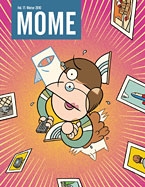
Mome volume 17: Winter 2010


By various (Fantagraphics Books)
ISBN: 978-1-60699-152-7

Mome is more magazine than book and features strips, articles, graphic artworks and occasionally interviews from and about a variety of talented, dedicated creators ranging from the internationally renowned to the soon-will-be… It is intense, occasionally hard to read and crafted to the highest production standards. Considered by many to be the successor to Art Spiegelman’s seminal Raw, it doesn’t come out nearly often enough.

This volume features the long-awaited conclusion of Paul Hornschemeier’s melancholic masterpiece ‘Life With Mr. Dangerous’; which has been an unmissable delight since the very first issue, as well another gripping instalment of T. Edward Bak’s pictorial biography of Georg Wilhelm Steller, the German naturalist who roamed the far Northern climes in the 18th century. Here with ‘Wild Man Chapter 2: A Bavarian Botanist in St. Petersburg, part 1’, things take a decidedly colourful turn as we glimpse the wild rover’s intriguing childhood.

Before that however Rick Froberg astounds with his sporadically placed monochrome visual essays ‘Foresight’, ‘Solidarity’, ‘Privacy’ and ‘Altruism’, Dash Shaw (see The Unclothed Man in the 35th Century AD) teams up with Tom Kaczynski to create a fantastic cyber-nightmare science-fiction story, ‘Resolution’ and Laura Park amuses and moves with her subtly enchanting ‘On the Bus’.

Animator and cartoonist Olivier Schrauwen concocts a stunning surreal saga in ‘Chromo Congo’ parts 1& 2, Sara Edward-Corbett delivers an astoundingly lovely aquatic escapade in ‘Zzzzz’, and Renée French continues the haunting and disturbing ‘Almost Sound’, whilst Ted Stern’s anthropomorphic sad-sacks Fuzz & Pluck return in the second part of their nautical misadventure ‘The Moolah Tree’ and the eighth part of Wolfgang’s ‘Nothing Eve’ follows them.

I’ve said this before and it bears repeating. ‘Nothing Eve’ is a fantastic, stylish, visually compelling urban drama, but the protracted storyline desperately needs a recap section. At least the inevitable future collection will allow the full power and verve of the narrative to compete fairly with the magical illustration.

Stand-alone standouts this time are the eerie war-story ‘Devil Doll’ by Michael Jada and Derek Van Gieson, the quirky ‘These Days I’m Not so Sure’,  also by Van Gieson, and the ever-excellent Josh Simmons’ salty sea-shanty ‘Head of a Dog’. The superb Hornschemeier provides the compelling covers and Kaela Graham delivers a captivating profusion of incidental illustrations to charm and alarm…

Whether you’re new to comics, new to the areas beyond the mainstream or just want something new; these strips and this publication will always offer a decidedly different read. You may not like all of it, and perhaps the serializations should provide those recaps (I’m never completely happy, me) but Mome will always have something you can’t help but respond to. Why haven’t you tried it yet?

Mome © 2010 Fantagraphics Books. Individual stories are © the respective creator. All Rights Reserved.