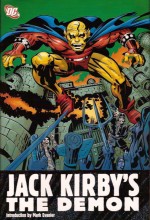
The Book of Mr. Natural (Profane Tales of that Old Mystic Madcap)


By Robert Crumb (Fantagraphics Books)
ISBN: 978-1-60699-352-1

Robert Crumb is a unique force in the world of comics and cartooning with as many foes as fans, but his idiosyncratic, unflinching, controversial but always enchanting work is impossible to ignore. This beautiful black and white hardback collects a varied and impressive selection of strips starring his most famous character produced between 1967 and 1995 and as always touches on the creator’s most intimate and disturbing idiosyncrasies regarding sex and women, both in the unsettling Abstract and the painful, side-splitting, lustful, painful and loving Concrete.

Therefore if harsh language, mild blasphemy, artfully grotesque cartoon nudity and comedic fornication are liable to upset you, stop reading this review and don’t buy the book.

For the rest of us; here’s a quick rundown of what’s in store…

Mr. Natural is a short, balding, bewhiskered, be-robed guru and engagingly vulgar huckster who began selling enlightenment and simple living in the May 5th 1967 issue of counter-culture paper Yarrowstalks. His assaults on the vapidity and venality of the modern world were reproduced and absorbed by an astoundingly broad variety of truth-seekers and laugh lovers who followed the succession of strips in an incomprehensible number of places.

The little wise guy had genuine insight and even greater powers, but peddled his wisdom for crass, material cash or other, less transferable favours. Obviously, and lucky for us all, he’s the only Holy Man or preacher ever to do such a reprehensible, unspiritual thing…

Of the twenty-seven tales gathered here, ranging from single-page strips to the epic 40 page ‘Mr. Natural and Devil Girl’ there are a number of classic yarns that seemingly everyone has seen or heard of but also one or two genuinely rare experiences -  particularly the wonderfully dense and informative ‘Origins of Mr. Natural’.

A less charitable reviewer might suspect that this book has been padded out with older material simply to give the legendary Devil Girl saga – originally serialised in Hup and never before collected into book form – a more accessible and commercially appetising home… and if so I applaud the move as that 1991 tale is one of the most wonderfully jolly and unsettling pieces of work Crumb has yet produced.

Flakey Foont was the foil of many of the earlier strips and a handy barometer of Everyman America. Over the decades the ex-disciple who was beguiled, reviled and defiled by “The Natch” eventually Turned Off, Tuned Out and Dropped back “In”, but found himself losing all self-control when confronted in his happily middle-class suburban family paradise by the returned Sage and the raw, lustful female animal that was both antithetical enemy and willing slave…

Other notable gems include Mr. Natural in Death Valley’, Mr. Natural Visits the City’, ‘It’s Workaday World’, Mr. Natural Goes to a Meeting of the Minds’, ‘Sunny Side Up’ ‘Om Sweet Om’, ‘Mr. Natural Stops Talking’, ‘A Girl in Hotpants, ‘The Girlfriend’ and the utterly perfect and fully zeitgeisted Mr. Natural’s 719th Meditation’, a plethora of revelation and confrontation that still provides merriment and queasy shock in equal proportion.

Crumb’s subtle mastery of his art-form and compulsive, uncompromising need to reveal his most hidden depths and perceived defects – in himself and the world around him – has always been a unquenchable wellspring of challenging comedy and riotous rumination. This magical, mystical tome is an ideal dipping book for occasional slices of his raucous wit and the perfect vehicle to introduce any (definitively over 18) newcomers of your acquaintance to the world of grown up comics.

© 1967, 1968, 1970, 1971, 1972, 1973, 1974, 1986, 1987, 1989, 1991, 1995, 2010 R. Crumb. All Rights Reserved. Edition © 2010 Fantagraphics Books, Inc.

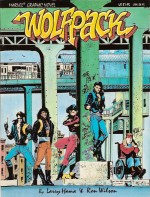
Wolfpack – A Marvel Graphic Novel


By Larry Hama, Ron Wilson, Whilce Portacio, Kyle Baker & others (Marvel)
ISBN: 0-87135-306-7

It’s been a long while since Marvel published an all-original graphic novel as opposed to a reprint collection, but not too long ago they were the market leader in the field with an entire range of “big stories” told on larger than normal pages (285 x 220mm rather than the now customary 258 x 168mm) featuring not only proprietary characters but also licensed assets like Conan and even creator-owned properties.

They also took chances on unusual and cross-genre tales such as this little oddity which falls squarely into the category of a successful “bold departure” which subsequently spawned its own twelve issue series.

Wolfpack (not to be confused with the later maverick band of costumed heroes that appeared in the Marvel crossover event House of M) is an intriguing meld of savage inner-city reportage and high fantasy Ninja conspiracy thriller set in the utterly alien streets of the South Bronx. It takes a two thousand year old, multi-generational battle between ultimate Good and Evil and sets its latest skirmish in a terrifying ghetto where hope and honour refuse to die. It would make a great Teen TV show today…

‘Rafael’ is a loner in trouble. The corridors of Horace Harding High School are every bit as dangerous as the mean streets outside, but the cocky young outsider has a secret. He’s been training with the school caretaker…

What Rafael Vega doesn’t know is that Mr. Mack is a man with a past and a plan. As a black sailor in post-war Japan he experienced intolerance and repression from his own (white) shipmates, but found acceptance from certain Japanese ancients who saw in him a chance to continue a battle that had already spanned two millennia.

The ancients trained him in all their fighting arts, requiring him to form a new “Pack” and confront an everlasting circle of wealth, power and wicked excess called “The Nine”: an ever-changing cycle of decadents who represented the forces of Evil in some indefinable Cosmic Balance.

Mack returned to New York and began his task, knowing this opposing force would find him wherever he went. Ghastly and blighted as it was, the South Bronx would have been far worse if not for the decades-long, beneficent watch of a silent guardian – but that’s all about to change…

Unknown to even his pupils, Mr. Mack had been clandestinely training kids in various fighting and philosophical arts for years, so when up-and-coming schoolboy gangster Lamarr targeted Raphael for death, Mack realised that it was time at last to introduce his young wolves to each other.

Now in ‘The Crucible’ Rafael discovers that some of his oldest associates were also singled out for a higher purpose by Mack and as he reassesses his new pack-mates, “Slag” Slagley, “Slippery Sam” Weltschmerz, wheelchair-bound “Wheels” Wolinski and even his own girlfriend Sharon, events turn ugly with startling rapidity. The new warriors organise none too soon as Lamarr graduates to attempted murder by destroying the store owned by Slippery Sam’s dad.

The Nine now make their move, recruiting Lamarr to their inner circle, but the wicked, Old-World Machiavellians have no idea how modern inner-city depravation can shape the nature of evil. As the death-toll mounts and the Pack strike back, events speed to a violent conclusion in ‘Transfiguration’ and The Nine realise that they might have made a terrible mistake with Lamarr…

Harsh and uncompromising, this introductory tale (I can’t shake the feeling this was originally scheduled as a three-part story-arc and “bumped” into a more high-profile graphic novel at the last moment) effortlessly compels with a dark mix of telling social drama, dark wit and superlative action-adventure that is far more hard-hitting than most comicbook tales even today.

The workmanlike Ron Wilson is probably nobody’s favourite artist, but he is a solid dependable illustrator with a good line in brooding brutes and inner city landscapes. Here, inked and augmented by such diverse budding stylists as Whilce Portacio and Kyle Baker his art takes on a moody realism that complements both the harsh environs of the plot and mystical martial arts elements with striking effect. The letters are provided by Joe Rosen and the somewhat hit-or miss colouring is by Petra Scotese, Max Scheele and Glynis Oliver.

Ugly, uncompromising, breathtakingly hard, this is the kind of book to show anybody who thinks that comics are all about men-in-tights and written for powerless sissy-boys…
© 1987 Marvel Entertainment Group. All Rights Reserved.

Jack Kirby’s The Demon


By Jack Kirby & Mike Royer (DC Comics)

ISBN: 978-1-4012-1916-1

There’s a magnificent abundance of Jack Kirby collections around these days (though still not all of it, so I remain a partially disgruntled fan) and this magnificent hardback compendium re-presents the complete “King’s Canon” of possibly his most enduring – although subsequently misunderstood and mishandled – DC creation after the comics landmark that was his Fourth World Cycle.

Famed for his larger than life characters and gigantic, cosmic imaginings, “King” Kirby was an astute, spiritual man who had lived though poverty, gangsterism, the Depression and World War II. He had seen Post-War optimism, Cold War paranoia, political cynicism and the birth and death of peace-seeking counter-cultures. He was open-minded and utterly wedded to the making of comics stories on every imaginable subject.

On returning from World War II, with his long-term creative partner Joe Simon, he created the genre of Romance comics for the Crestwood/Prize publishing outfit. Amongst that dynamics duo’s other concoctions for Prize was a, noir-ish, psychologically underpinned supernatural anthology Black Magic and its short-lived but fascinating companion title Strange World of Your Dreams. These titles eschewed the traditional gory, heavy-handed morality plays and simplistic cautionary tales for deeper, stranger fare, and until the EC comics line hit their peak were far and away the best mystery titles on the market.

Kirby understood the fundamentals of pleasing his audience and always strived diligently to combat the appalling state of prejudice about the comics medium – especially from industry insiders and professionals who despised the “kiddies world” they felt trapped in.

After his controversial, grandiose Fourth World titles were cancelled Kirby looked for other concepts which would stimulate his vast creativity and still appeal to an increasingly fickle market. General interest in the Supernatural was rising, with books and movies exploring the unknown in gripping and stylish new ways, and the Comics Code Authority had already released its censorious choke-hold on mystery and horror titles, thereby saving the entire industry from implosion when the superhero boom of the 1960s fizzled away.

At DC’s suggestion the King had already briefly returned to his Black Magic experimentation in a superb but poorly received and largely undistributed monochrome magazine. Spirit World #1 – and only – launched in the summer of 1971, but as before, editorial cowardice and back-sliding scuppered the project before it could get going.

Material from a second, unpublished issue eventually appeared in the colour comic-books Weird Mystery Tales and Forbidden Tales of Dark Mansion #6, but with most of his ideas misunderstood, ignored or side-lined by the company Kirby opted for more traditional fare. Never truly defeated though, he cannily blended his belief in the marketability of the supernatural with flamboyant super-heroics to create another unique and lasting mainstay for the DC universe: one that lesser talents would make a pivotal figure of the company’s continuity.

The Demon #1 launched in September 1972 and introduced a howling, leaping monstrosity (famously modelled after a 1939 sequence from Hal Foster’s Arthurian classic Prince Valiant) which battled beside its master Merlin as Camelot died in flames: a casualty of the rapacious greed of sorceress Morgaine Le Fey.

Out of that apocalyptic destruction, a man arose and wandered off into the mists of history…

In our contemporary world Jason Blood, demonologist and paranormal investigator, had a near-death experience with an aged collector of illicit arcana, which resulted in a hideous nightmare about a demonic being and the last stand of Camelot. He has no idea that Le Fey was alive and had sinister plans for him…

And in distant Moldavia, strange things were stirring in crumbling Castle Branek, wherein lay hidden the lost Tomb of Merlin…

Blood was wealthy, reclusive and partially amnesiac, but one night he agreed to host a small dinner party, entertaining acquaintances Harry Mathews, psychic UN diplomat Randu Singh, his wife Gomali and their flighty young friend Glenda Mark. It did not go well.

Firstly there was the painful small talk, and the sorcerous surveillance of Le Fey, but the real problems started when an animated stone giant arrived to “invite” Blood to visit Castle Branek. This epic journey led to Merlin’s last resting place but just as Blood thought he might find some answers to his enigmatic past Le Fey pounced. Suddenly he began to change, transforming into the horrific beast of his dreams…

Issue #2, ‘My Tomb in Castle Branek!’ opened with wary villagers observing a terrific battle between a yellow monster and Le Fey’s forces, but when the Demon was defeated and Blood arrested, only the telepathic influence of Randu in America could aid him. Le Fey was old, dying, and needed Merlin’s grimoire, the Eternity Book, to extend her life. Thus she manipulated Blood, who had lived for centuries unaware that the Demon Etrigan – Merlin’s hellish Attack Dog – was chained inside him, to regain his memories and awaken the slumbering master mage. It looked like the last mistake she would ever make…

Kirby’s tried and trusted approach was always to pepper high concepts throughout blazing, breakneck action, and #3 was one the most imaginative yet. ‘The Reincarnators’ saw Blood back in the USA, aware at last and with a small but devoted circle of friends. Adapting to a less lonely life he encountered a cult who could physically regress people to a prior life – and use those time-lost beings to commit murder…

The Demon #4-5 comprised a two-part adventure, wherein a simple witch and her macabre patron actually captured the reawakened, semi-divine Merlin. ‘The Creature from Beyond’ and ‘Merlin’s Word’s… Demon’s Wrath!’ introduced that cute little monkey, Kamara the Fear-Monster (later used with devastating effect by Alan Moore in Saga of the Swamp Thing #26-27) and featured another startling “Kirby-Kreature” – Somnanbula, the Dream Beast.

It seems odd in these blasé modern times but the Demon was a controversial book in its day – cited as providing the first post-Comics Code depiction of Hell and one where problems were regularly solved with sudden, extreme violence. ‘The Howler!’ in issue #6, was a truly spooky yarn with Blood hunting a primal entity of rage and brutal terror that transformed its victims into murderous lycanthropic killers, whilst #7 introduced a spiteful, malevolent young fugitive from a mystical otherplace.

‘Witchboy’ Klarion and his cat-familiar Teekl were utterly evil little sociopaths in an time where all comic-book politicians were honest, cops only shot to wound and “bad” kids were only misunderstood: another Kirby first…

‘Phantom of the Sewers’ skilfully combined movie and late night TV horror motifs in the dark and tragic tale of actor Farley Fairfax, cursed by the witch he once spurned. Unfortunately Glenda Mark was the spitting image of the departed Galatea, and when decades later the demented thespian kidnapped her to raise the curse, it could only end in a flurry of destruction, death and consumed souls.

This three-part thriller was followed by another extended epic (The Demon #11-13) ‘Baron von Evilstein’ a powerful parable about worth and appearance featuring the ultimate mad scientist and the tragic monster he so casually built. It’s a truth that bears repeating: ugly doesn’t equal bad…

Despite Kirby’s best efforts The Demon was not a monster hit, unlike the science-fictional disaster drama Kamandi, and by #14 it’s clear that the book was in its last days. Not because the sheer pace of imagination, excitement and passion diminished – far from it – but because the well-considered, mood-drenched stories were suddenly replaced by rocket-fast eldritch romps – with returning villains.

First back was Klarion the Witchboy who created a ‘Deadly Doppelganger’ to replace Jason Blood and kill his friends in #14-15, before the series – and this wonderful hardcover treasury of wicked delights – ended in a climactic showdown with the ‘Immortal Enemy’ Morgaine Le Fey…

Kirby continued with Kamandi, explored WWII in The Losers and created the magnificent Omac: One Man Army Corps, but still could not achieve the all-important sales the company demanded. Eventually he returned to Marvel and new challenges such as Black Panther, Captain America, 2001: A Space Odyssey, Devil Dinosaur, Machine Man and especially The Eternals.

As always in these wondrously economical collections it should be noted that the book is stuffed with un-inked Kirby pencilled pages and roughs, and Mark Evanier’s fascinating, informative introduction is, as ever, a fact-fan’s delight.

Jack Kirby was and is unique and uncompromising: his words and pictures are an unparalleled, hearts-and-minds grabbing delight no comics lover could resist. If you’re not a fan or simply not prepared to see for yourself what all the fuss has been about then no words of mine will change your mind.

That doesn’t alter the fact that Kirby’s work from 1937 to his death in 1994 shaped the entire American comics scene and indeed the entire comics planet – affecting the lives of billions of readers and thousands of creators in all areas of artistic endeavour for generations and still winning new fans and apostles every day, from the young and naive to the most cerebral of intellectuals. His work is instantly accessible, irresistibly visceral, deceptively deep and simultaneously mythic and human.

He is the King and time has shown that the star of this book is one of his most potent legacies.

© 1972, 1973, 1974, 2008 DC Comics. All Rights Reserved.

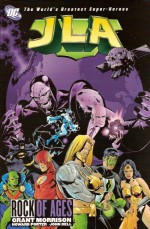
JLA: volume 3 Rock of Ages


By Grant Morrison, Howard Porter, John Dell & others (DC Comics)
ISBN: 978-1-56389-416-9

After the Silver Age’s greatest team-book died a slow, painful, embarrassing death, not once but twice, DC were taking no chances with their next revival of the Justice League of America and tapped Big Ideas wünderkind Grant Morrison to reconstruct the group and the franchise.

And the idea that clicked? Shove everybody’s favourite Big Names in the team.

Of course it worked, but that’s only because as well as star quantity there was an absolutely huge burst of creative quality. The stories were smart, compelling, dauntingly large-scale and illustrated with infectious exuberance. One glance at JLA and anybody could see all the effort undertaken to make it the best it could be.

This third collection re-presents issues #10-15 of the resurgent revival and covers a spectacular landmark tale where old-world goodies-vs.-baddies met contemporary fringe science chic for a rollercoaster ride of boggled minds which only served to set up even bigger concept clashes further down the line. That’s the magic of foreshadowing, folks…

Superman, Batman, Wonder Woman, the Martian Manhunter, Flash, Green Lantern and Aquaman are the legends who are targeted by a coalition of arch enemies comprising Lex Luthor, the Joker, Circe, Mirror Master, Ocean Master and Doctor Light, in the prologue ‘Genesis and Revelations’ wherein ghastly doppelgangers of the World’s Greatest Heroes go on a campaign of destruction all over the globe. Even with new members Aztek and Connor Hawke (the new Green Arrow), on board the new “Injustice Gang’ are running the heroes ragged, but the stakes change radically when the telepathic Martian Manhunter detects an extinction-level entity heading to Earth from deep space…

Rock of Ages proper begins with ‘Hostile Takeover’ as the legion of villains press their advantage whilst the New God Metron appears to warn the JLA that the end of everything is approaching. As Circe tries to head-hunt Aztek, Arrow and Plastic Man, Green Lantern and Flash are treated to a distressing view of the Universes beyond our own reality, as they are dispatched to recover the fabled Philosopher’s Stone in a last-ditch effort to save the worlds.

In ‘Wonderworld’ the fabled last defenders of Cosmic Reality proffer a grim warning of Mageddon, the Anti-Sun, ender of all things to the lost superheroes. Shell-shocked, they are rescued by Hourman, an artificial time-controlling intelligence, and return to our plane of existence only to find it has been conquered by the evil god Darkseid.

‘Wasteland’ is a bleak and chaotic taste of the Final Crisis, with humanity all but dead, and the surviving champions fighting their last battle against the horrors of Apokolips-on-Earth, leading to a perfect Deus-ex-Machina moment of triumph in ‘Twilight of the Gods’ as this wicked universe is un-made and “our” reality reinstated.

Unfortunately if you’ve been keeping up, that was the continuity where the Injustice Gang were beating the stuffing out of the good guys…

‘Stone of Destiny’ brings the saga to a neat and satisfying conclusion as the villains go down fighting and an approximation of order is restored in a cataclysmic combat climax. With Gary Frank, Greg Land, John Dell & Bob McLeod lending artistic assistance to the spectacular proceedings, Morrison and Porter resolve the epic and close with a perfect example of the maxim “always leave them wanting more” – shocking twist to make the reader hungry for the next instalment.

If you haven’t read this sparkling slice of fight ‘n’ tights wonderment then your fantastic comic-life just isn’t complete yet. Savvy, compelling, challenging but not afraid of nostalgia or laughing at itself, the new JLA was an all-out effort to be Smart and Fun. For that moment these were the “World’s Greatest Superheroes” and these increasingly ambitious epics reminded everybody of the fact. This is the kind of thrill that nobody ever outgrows. Got yours yet?

© 1997, 1998 DC Comics. All Rights Reserved.

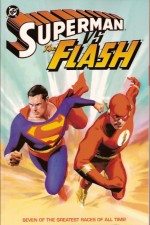
Superman vs. the Flash


By Jim Shooter, Curt Swan & various (DC Comics)
ISBN: 978-1-4012-0456-3

The comic-book experience is littered with eternal questions that can never really be satisfactorily answered. The most common and most passionately asked always begin “who would win if…” or “who’s strongest/smartest/fastest…”

Teenaged scripting wunderkind Jim Shooter knew that very well when he pitched and subsequently scripted a Superman story in 1967 that created a sub-genre of comic-plot and led inevitably and delightfully to the graphic novel under review here.

DC Editors in the 1960s generally avoided such questions as who’s best for fear of upsetting some portion of their tenuous and perhaps temporary fan-base, but as the superhero boom slowed and the upstart Marvel Comics began to make genuine inroads into their market, the notion of a definitive race between the almighty Man of Steel and the “Fastest Man Alive” became an increasingly enticing and sales-worthy proposition.

This sporty chronicle gathers together the initial contest and numerous rematches between the heroic speed-demons, but if you’re seeking a definitive answer you won’t find it here. These are splendid costumed entertainments; adventures designed to catch your breath and quicken your pulse. It not about the winning: it’s all to do with the taking part…

‘Superman’s Race With the Flash’ (Superman #199, August 1967) gets the ball rolling in a stirring saga by Shooter, Curt Swan & George Klein, wherein the two speedy champions were asked to compete in an exhibition contest by the United Nations, thereby raising money to fight World Hunger. Naturally they agreed, but the clever global handicap, circling the planet three times, was secretly subverted by rival criminal combines attempting to stage the greatest gambling coup in history…

Of course justice and charity triumphed in the end, but the stakes were catastrophically raised in the inevitable rematch from Flash #175 (December 1967). ‘Race to the End of the Universe!’ found the old rivals speeding across the cosmos when ruthless alien gamblers threatened to eradicate Central City and Metropolis unless the pair settled who was fastest. Scripter E. Nelson Bridwell added an ingenious sting in the tale, whilst Ross Andru & Mike Esposito delivered a sterling illustration job in this yarn, but once more the actual winning was deliberately fudged.

When World’s Finest Comics became a team-up vehicle for Superman the first guest star was the Flash who again found himself in speedy if contrived competition. ‘Race to Save the Universe!’ and its conclusion ‘Race to Save Time’ (WFC #198-199 November and December 1970, by Denny O’Neil, Dick Dillin & Joe Giella) once more upped the stakes as the high-speed heroes were conscripted by the Guardians of the Universe to circumnavigate the entire cosmos at their greatest velocities to undo the rampage of the mysterious anachronids, faster-than-light creatures whose pell-mell course throughout the galaxies was actually unwinding time itself. Little did anybody suspect that Superman’s oldest enemies were behind the scheme…

Chase to the End of Time!’ and ‘Race to the End of Time!’ opened the new team-up series DC Comics Presents (#1-2, July-August and September-October 1978) as Marty Pasko and the utterly superb Jose Luis Garcia-Lopez & Dan Adkins rather reprised the World’s Finest tale with warring alien races tricking Superman and Flash into speeding through the time-stream to prevent Earth’s history from being corrupted and destroyed. As if that wasn’t dangerous enough, nobody could predict the deadly intervention of the Scarlet Speedster’s most dangerous foe, Professor Zoom, the Reverse-Flash…

After the Crisis on Infinite Earths DC heroes got a sound refitting, and the frankly colossal power levels of the heroic community were downscaled to more believable levels. Some stalwarts even died, and when ‘Speed Kills!’ debuted in Adventures of Superman #463 (February 1990 by writer/artist Dan Jurgens and inker Art Thibert), touted as the first race between the fastest men on Earth, there was a new kid in the Flash’s uniform: ex-sidekick Wally West had graduated to the role.

The story itself is a delightfully whacky romp wherein 5th dimensional pest Mr. Mxyzptlk coerced the pair into running a race everybody knew was fixed from the get-go…

This collection concludes with a spectacular saga unerringly aimed at older fans. ‘Speeding Bullets’ (from one-shot DC First: Flash/Superman July 2002) is by Geoff Johns, Rich Burchett & Prentis Rollins, and features villain Abra Kadabra who challenges the Man of Steel and the 1940s Flash Jay Garrick to catch the current Vizier of Velocity who is running amok at hyper-speed and rapid-aging with every step…

If they can’t catch him then the Fastest Man Alive won’t be…

With the addition of some of the very best covers the company has ever produced to this book, readers casual or deeply devoted are guaranteed a joyous thrill-ride from some of the most entertaining stand-alone stories in DC history. On your marks… get set… Buy!

© 1970, 1972, 1973, 1978, 1990, 2002, 2005 DC Comics.  All Rights Reserved.

Dolltopia


By Abby Denson (Green Candy Press)
ISBN: 978-1-931160-70-4

Not everybody is comfortable with whom they are and most of us don’t like to be assumed one thing when we’re another. Lulu Award winner Abby Denson is a brilliant, magically subversive cartoonist and journalist with such disparate notches in her belt as the graphic novel Tough Love: High School Confidential (relating the Coming Out story of two suburban teens) and The City Sweet Tooth: a culinary cartoon column about the New York desserts scene currently running in L Magazine. She teaches and her script credits run from Scooby Doo and Power Puff Girls to Spider-Man and the Simpsons.

This entrancing shocking pink parable is an edgy, deceptively naivist fairy tale about gender, place and identity; making telling points in a clandestinely gentle manner. Kitty Ballerina is a doll who escapes from The Factory, refusing to be what her makers tell her to be. During her escape she meets Army Jim, another maverick toy who refuses to conform.

Together they make their way to the Promised Land of Dolltopia, where you can wear, and look like and be whatever you want. With the comradeship and assistance of the cat Mr. M, fashion Divas Candy X and Candy O and the slightly off-kilter, self-taught “plastic surgeon” the Doctor, the renegades make themselves at home and truly free…

However freedom demands effort, vigilance and sacrifice. Some freed individuals seem to crave their previous cultural indenture, and raids to liberate more dolls suffer when the apathetic conformists refuse to cast off their social shackles, but the real threat comes when humans threaten to take away and destroy the hard-won oasis of security the disappointed rebels strived so long and hard to win…

Charming and cleverly controversial, if a little heavy-handed at times, this eclectic black, pink and white tome – complete with cut-out-and-dress paper dolls – is a winning and culturally important addition to the world of adult cartooning. You’d be an idiot not to take a good long look – but of course you don’t have to be what I say you are…

© Abby Denson. All right reserved.

Bad Habits


By Norman Dog (Last Gasp)
ISBN: 0-86719-329-8/ ISBN-13: 978-0867193299

I haven’t reviewed a straight cartoon book in a dog’s age, so here’s a rare but still readily acquirable item from an outrageous comedy original and pen-pushing veteran who’s still making America laugh-out-loud – the cooler bits anyway – with his sly, cynical and fabulously skewed outlook and observations on the Human Condition and the Things We Don’t Know Yet..

Cultural commentator Norman Dog may or may not be Raymond Larrett (it’s complicated – that’s why better carbon-based life forms than you or I invented search engines). A West Coast cartoonist whose legendary – he would say “interminable” – strip has run in the East Bay Express since 1981, Dog has been capturing with laconic brilliance the bizarre panorama of modern life for all to see and disagree with…

Describing his slick, modern and excessively hip observations on Real Americans as “Comication”, Dog has been making us foreigners, Pinko Subversive Intellectuals and other weirdoes giggle and think with every exposed home secret or shared cultural reference and seems determined not to stop.

This early volume, collecting the budding best of the strip includes ‘Let’s all go… Dance Crazy!’, ‘I Was Satan’s Plaything!’, ‘The Enchanted Toothbrush’, ‘Celebrity Breakfasts!’, ‘Suicide Hotline’, ‘The Missing Father’, ‘Hey, Stupid!’, ‘Curse of the Mysterious Horror!’, ‘A Perfectly Typical Tuesday Evening at Home With Jane and Walter’, ‘Hints for Aliens’, ‘The Punk Romance’, ‘Giant Crawling Brain!’, ‘Modern Physics for Morons’, ‘Space Sluts’ amongst literally some others and delivers high-octane, occasionally lowbrow doses of premeditated mirth in devastating, delicious, full-page monochrome pastiches of a dozen different graphic styles.

Dog/Larrett, whose work has appeared in Raw Magazine, Spin, Nickelodeon Magazine, Weirdo, Anarchy Comics, The Nation and even some other places and publications, is long overdue for a big, bold book collection, but until then, converts can catch his latest full-colour efforts in the elucidatory The 37 Cartoons You Should Read Before You Die if they so wish.

Enough Soft-Sell: go read something funny…
© 1983, 1984, 1990 Norman Dog. All rights reserved.

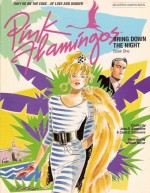
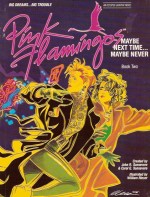
Pink Flamingos Book 1: Bring Down the Night and Pink Flamingos Book 2: Maybe Next Time… Maybe Never


By John R. & Carol Q. Sansevere, illustrated by William Rieser (Octopus)
ISBN’s: 978-0-70643-186-5 and 978-0-70643-307-4

Let’s all pop back once or even twice more to the ever-so-now 1980s with these stylish, radically different and frankly peculiar experimental graphic novels that pretty much typified and encapsulated the dichotomies of the age of Big Hair and Brash Money, and layered them lavishly over a pastel-tinted attempt to glam up the old formulas that worked so well for the Famous Five, Nancy Drew and the Hardy Boys.

The Pink Flamingos are a close clique of fashionably attractive Palm Beach teens whose taste for glamour and adventure draw them into some pretty tricky situations. These Chic Chicks are Lana the model, Carla the singer, Amber the waitress/biker babe, Jackie the TV intern and Jody the spoiled rich one…

In volume 1: Bring Down the Night the quirky quintet first get together when a mutual friend commits suicide. As with everything in that swank locale, sophisticated, connected drug-dealer Joey De Silva is at the heart of the web of temptation, corruption and death and the feisty females decide that if the cops won’t touch him then they’ll take him down in their own unique way…

The in-your-face, unashamed hedonism and seductive shoulder-padded indolence continues in Maybe Next Time… Maybe Never as the Material Girls follow Carla to New York City and her big break in the music biz, but sadly, behind the glitz and glamour, drugs and depravity are never too far way… Meanwhile as romance rears its well-coiffed hunky head for one of the Flamingos, Poor Little Rich Girl Jody discovers that for some families money never could buy love…

Originally published by Shuster & Shuster in the US these books appear to be more fashion sketches and studies than straight comics narrative and the oddly removed, if not outright distant writing style looks uncomfortably like an actual recycled unsold pitch “bible” and shooting script for a proposed TV show (and believe me I’ve worked on far too many of those to mistake the feel) but even so the overall effect is not unpleasant or lacking in entertainment value when considered as graphic novels.

Rieser’s bold and vivid storyboard-based illustrations blends well with the faux-TV script narrative captions, and despite a rather static, lifestyle-mag, fashion shoot feel to the action, if you’re a fan of Miami Vice, 21 Jump Street, Dallas, Dukes of Hazzard or even early Neighbours there’s a nostalgic buzz to be gleaned from these rather wholesome adventures for Young Adults.
™ & © 1987, 1988 Angel Entertainment, Inc. All rights reserved.

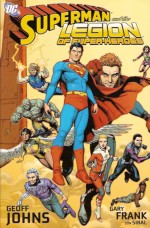
Superman and the Legion of Super-Heroes


By Geoff Johns, Gary Frank & Jon Sibal (DC Comics)
ISBN: 978-1-84856-009-9

Once upon a time, in the far future, a band of super-powered kids from dozens of alien civilisations took inspiration from the greatest legend of all time and formed a club of heroes. One day these Children of Tomorrow came back in time and invited that legend to join them…

And thus began the vast and epic saga of the Legion of Super-Heroes, as first envisioned by writer Otto Binder and artist Al Plastino in the landmark Adventure Comics #247 (April 1958). Since that time the fortunes and popularity of the Legion have perpetually waxed and waned, with their future history tweaked and rebooted, retconned and unwritten over and again to comply with editorial diktat and popular whim.

The current trend is to re-embrace the innocent, silly, joyous, stirring and utterly compelling pre-Crisis on Infinite Earths tales but to shade them with contemporary sensibilities and with this in mind Geoff Johns has been gradually reinstituting the Lore of the Legion in a number of his assignments. Beginning most notably with Justice League of America: the Lightning Saga and culminating in the ongoing New Krypton and War against Brainiac sagas the Legion are back and once more carving out a splendid niche in the DC Universe.

Along the way came this superb, nostalgia-enhanced cracker of a tale which reestablished direct contact between the futuristic paladins and the Man of Tomorrow…

Collecting Action Comics #858-863, this chronicle finds the Legion back in the 21st century, summoning Superman to save Tomorrow’s World once more. Long ago the Legion had regularly visited: spiriting the young Kryptonian to a place and time where he didn’t have to hide his true nature. However, once he began his public career, the visits ceased and his memories were suppressed to safeguard the integrity of history and the inviolability of the time-line.

Now a desperate squad of Legionnaires must reawaken those memories since the Man of Steel is the last hope for a world on the edge of destruction. In the millennium since his debut Superman has become a beacon of justice and tolerance throughout the Utopian Universe, but a radical, xenophobic anti-alien movement has swept Earth, marginalising, interning and even killing all non-Terrans. Moreover, a super-powered team of Legion rejects has formed a Justice League of Earth to lead a crusade against all extraterrestrial immigrants, claiming Superman was actually a true-born Earthling, and declaring him their spiritual leader…

Of course Kal-El of Krypton must travel to the future and not only save the day but clean the racist stain from his name – a task made infinitely more difficult because Earth-Man, psychotic xenophobe leader of the Earth-First faction, has turned our yellow sun a power-sapping red…

Bold, thrilling and absolutely enthralling, the last-ditch struggle of a few brave aliens against a racist, fascistic and completely ruthless totalitarian tomorrow is the stuff of pure comic-book dreams. Superman strives to unravel a poisonous future where all his hopes and aspirations have been twisted, with only his truest childhood friends to aid him, and the incredibly intense and hyper-realistic art of Gary Frank and Jon Sibal makes it all seem not only plausible but inevitable…

With this kind of material, the new-old may well be back for all time…

© 2007, 2008 DC Comics. All Rights Reserved.
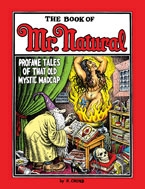
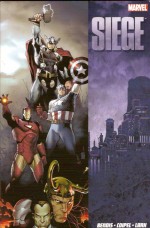
Siege


By Brian Michael Bendis, Olivier Coipel, Michael Lark & others (Marvel/Panini UK)
ISBN: 978-1-84653-452-2

The things that superhero comic-books do best are Spectacle and Cosmic Retribution: the cathartic comeuppance of someone who truly deserves it. So this collection, reprinting the Siege: Cabal one-shot and the four-issue Siege miniseries it led to (selected portions of the vast 2010 publishing event that partially re-set and restored the traditional “Stan & Jack” Marvel Universe) is an effective and welcome hint of a new dawn in the recently bleak and unfriendly world of Captain America and his costumed cohorts…

Norman Osborn, one-time Green Goblin, has through various machinations become America’s Security Czar: the “top-cop” in sole charge of the beleaguered nation’s defence and freedom. Under his meteoric rise the Superhuman Registration Act led to the Civil War, Captain America was arrested, murdered and resurrected (see Captain America Reborn), and numerous horrific assaults on mankind occurred: including the Secret Invasion and the “Dark Reign” which led up to the graphic novel under review here

As well as commanding all the covert and military resources of the USA, Osborn now has his own suit of Iron Man armour and as Iron Patriot leads a hand-picked team of ersatz Avengers. The country should by rights be beyond any possibility of threat or harm. However as the events of Siege: The Cabal (Bendis, Lark & Stefano Gaudiano) graphically depict, Osborn is playing a deadly double game. The Cabal is a Star Chamber of super-villains comprising Osborn, Asgardian God Loki, gang-boss The Hood, mutant telepath Emma Frost, Taskmaster, Sub-Mariner and Doctor Doom.

But cracks are beginning to show, both in the criminal conspiracy and Osborn himself. When Iron Patriot promises to conquer Asgard for Loki, Doom secedes from the group, prompting a disastrous battle between the Masters of Evil…

Asgard is currently displaced and floating scant metres above the soil of Oklahoma. Using his position as Chief of Homeland Security Osborn manufactures an “Asgardian incident” and launches an all-out invasion on the Gleaming City, overruling the new American President to do so.

And so begins Siege (by Bendis, Coipel & Mark Morales) a knock-down, drag-out fight pitting all the long-cultivated metahuman resources of Osborn – paramilitary strike force H.A.M.ME.R., the Dark Avengers and the villainous penal battalion of The Initiative – against the sorely pressed and time-lost Asgardians…

However Osborn has gone too far and the President fires him.

So What?

Well, now the scattered and fugitive “real” superheroes such as Captain America, Nick Fury, the original Iron Man, Spider-Man, the Vision and all the other underground and Secret Avengers are safe to act, but they had better hurry because Thor’s hard pressed people cannot stand against Osborn’s god-killing ultimate weapon…

Despite feeling a little rushed in places, this is a grand, old-fashioned Fights ‘n’ Tights cataclysmic clash of good guys and bad guys, magnificently illustrated and astonishingly compelling. After years of dark and dangerous anti-heroics it’s a splendid palate-cleanser for what Marvel promises to be a new Heroic Age…
© 2010 Marvel Entertainment LCC and its subsidiaries. All Rights Reserved. A British edition released by Panini UK Ltd.