JSA volume 5: Stealing Thunder


By Geoff Johns, David Goyer & various (DC Comics)
ISBN: 978-1-84023-667-5

The groundbreaking reinvention of the World’s first super-team continued apace with these compelling thrillers which originally appeared in JSA #32-38, beginning with a chilling peek into the life of the new Crimson Avenger: a haunted woman compelled to hunt down murderers by her own magic guns. Her irresistible compulsion has brought her to her next target – one of the Society’s greatest heroes…

‘Death Duty’ is illustrated by Peter Snejbjerg who also provided the pictures for the ‘Stealing Thunder Prologue’ wherein octogenarian hero Johnny Thunder, miraculously cured of senile dementia, reclaimed his magical Thunderbolt genie from his successor Jakeem. Unfortunately it’s all a macabre plot constructed by the body-hopping Ultra-Humanite…

The epic begins in ‘Wish Fulfillment’ (with art by Keith Giffen & Al Milgrom, Leonard Kirk & Keith Champagne), as, an unspecified time later, silicon superhero Sand awakens to discover that the Ultra-Humanite has usurped the power of the Thunderbolt and taken control of Earth. Those superbeings not directly mind-controlled and used as storm troopers are all stored in a giant body-bank.

Escaping with homicidal foe the Icicle in tow, Sand accidentally makes contact with the last free minds on the planet: Jakeem, Crimson Avenger, Power Girl, Hourman and Captain Marvel…

Kirk and Champagne continue in ‘Troublestruck’, ‘Lightning Storm’ and ‘Time-Bound’ as the desperate rebels risk everything to liberate the enslaved electric genie whilst being pursued by an murderous armada of their oldest friends before the tragic, spectacular finale returns the World to its original state in ‘Crossing Over’.

This volume ends with one of those touching “after the Apocalypse” tales: quiet, reflective and focusing on the heirs of lost heroes as Jakeem and the second Hourman contemplate their legacies and new responsibilities on ‘Father’s Day’, movingly illustrated by Stephen Sadowski and Andrew Pepoy.

By this time a fully realised superhero soap opera, Geoff Johns and the soon to depart David Goyer had made the Justice Society of America a stunning mix of old and new by blending cosmic action and human scaled drama with a memorable cast of characters. These tales are among the very best “fights and tights” adventures in contemporary comics, and should be on every old fan and potential convert’s “must-have” list.

© 2002, 2003 DC Comics. All Rights Reserved.

High Soft Lisp


By Gilbert Hernandez (Fantagraphics Books)
ISBN: 978-1-60699-318-7

Please pay attention: this book contains stories and images of an extremely adult nature, specifically designed for adult consumption and the kind of coarse and vulgar language that most kids are fluent in by the age of ten. If reading about such things is likely to offend you, please stop now and go away. Tomorrow I’ll write about something with violence and explosions, so come back then.

In addition to being part of the graphic and literary revolution that is Love and Rockets (where his astonishingly compulsive tales of Palomar and the later stories of those characters collected as Luba gained such critical acclaim) Gilbert Hernandez has produced stand-alone tales such as Sloth, Grip and Girl Crazy, all marked by his bold, instinctive, simplified line artwork and a mature, sensitive use of the literary techniques of Magical Realist writers Carlos Fuentes and Gabriel García Márquez: techniques which he has added to and made his own.

Love and Rockets is an anthology comics publication that features slick, intriguing, sci-fi-ish larks, heart-warming, terrifying, gut-wrenching soap-opera fantasy and bold experimental comic narratives that pretty much defy classification. The synthesistic Hernandez Bros still captivate with incredible stories that sample a thousand influences conceptual and actual – everything from Archie Comics and alternative music to German Expressionism and masked wrestlers.

Palomar was the conceptual and cultural playground of Gilberto, created for the extended serial Heartbreak Soup: a poor Latin-American village with a vibrant, funny and fantastically quotidian cast. Everything from life death, adultery, magic, serial killing and especially gossip could happen in the meta-fictional environs of Palomar, and did, as the artist explored his own post-punk influences, comics, music, drugs, comics, strong women, gangs, sex, family and comics, in a style that seemed informed by everything from Tarzan comics to Saturday morning cartoons and the Lucy Show.

Beto, as he signs himself, returns to Palomar constantly, usually with tales involving the formidable matriarch Luba, who ran the village’s bath house, acted as Mayor and sometimes police chief – as well as adding regularly and copiously to the general population. Her children, brought up with no acknowledged fathers in sight, are Maricela, Guadalupe, Doralis, Casimira, Socorro, Joselito and Concepcion.

Luba eventually migrated to the USA and reunited with her half-sisters Petra and the star of this volume, Rosalba “Fritz” Martinez. This collection was compiled from assorted material that first appeared in Love and Rockets volume II and Luba’s Comics and Stories, with some new pages and many others redrawn and rewritten.

Fritz is a terrifyingly complex creature, a psychiatrist, therapist, B-Movie actress, belly dancer, drunk, gun-fetishist, sexually aggressive and a manipulative serial spouse. Beautiful, enticingly damaged, with a possibly intentional speech impediment she sashays from crisis to triumph and back again, and this moving, shocking, funny chronicle uses the rambling recollections of one of her husbands, motivational speaker Mark Herrera, to follow her life from punkette outsider at High-School through her various career and family ups and downs.

Under the umbrella title of ‘Dumb Solitaire’ what purports to be the memoir of Senor Herrera reveals in scathing depth the troubled life of the woman he cannot stay away from, in an uncompromising and sexually explicit “documentary” which pulls no punches, makes no judgements and yet still manages to come off as a feel-good tale.

High Soft Lisp is the most intriguing depiction of feminine power and behaviour since Flaubert’s Madame Bovary – and probably just as controversial – with the added advantage of Beto’s intoxicating drawing adding shades of meaning that mere text just cannot impart.

Very funny, very moving, remarkable and unmissable: no mature fan of the medium can afford to miss this treat.

© 2010 Gilbert Hernandez. All Rights Reserved.

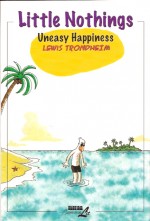
Little Nothings volume 3: Uneasy Happiness


By Lewis Trondheim, translated by Joe Johnson (NBM/ComicsLit)
ISBN: 978-1-56163-576-4

With over 35 books in just about ten years, Lewis Trondheim is one of Europe’s most prolific comics creators, a writer for many of the continent’s most popular artists – such as Fabrice Parme (‘Le Roi Catastrophe’, Vénézia’), Manu Larcenet (‘Les Cosmonautes du futur’), José Parrondo (‘Allez Raconte’ and ‘Papa Raconte’) and Thierry Robin (‘Petit Père Noël’), the originator of such global hits as the Les Formidables Aventures de Lapinot sequence and, with Joann Sfar, the ‘Donjon’ (Dungeon) series of nested fantasy epics (see the translated Dungeon: Parade, Dungeon: Monstres and Dungeon: The Early Years) and also a cartoonist of uncanny wit, piercing, gentle perspicacity, comforting affability and self-deprecating empathy.

This third collected volume of his anthropomorphic cartoon blog sees him amicably nit-picking and musing his way through the life of an old comic creator: travelling to conventions, making stories and dealing with the distressingly peculiar modern world.

Evocatively recoloured for book publication these one and two page ruminations and anti-dramas range from his inability to de-clutter (every comic maven’s weakness!), public toilet etiquette, gadgets, marriage, parenthood, mice in the bookshelves, how mad cats are, brilliant ideas that come when you’re asleep, computers and getting old, interspersed with reactions to the many wonderful places he has visited on the comics convention circuit (Venice, Portugal, Fiji, Australia and others in this volume).

I first became aware of Trondheim’s subtly enchanting vignettes in Fantagraphics’ Mome comics anthologies, and it’s a sheer delight to see his cartoon philosophy gathered into such handy tomes for constant re-reading. This is probably the most pleasing graphic novel I’ve reviewed this year, and I’m off now to get the previous two volumes.

I strongly suggest that if you need a little non-theological, un-theosophical spiritual refreshment you do the same…

© 2010 Trondheim. English translation © 2010 NBM. All Rights Reserved.

Captain Britain: the Siege of Camelot


By various (Marvel/Panini UK)
ISBN: 978-1-84653-433-1

This fourth wonderful volume collecting the complete adventures of Marvel’s Greatest British super-hero gathers together the remaining black and white episodes of The Black Knight strip from Hulk Comic (# 42-55 and 57-63, 1979) in which Captain Britain co-starred, before going on to his peripatetic wanderings through a number of UK titles beginning with Marvel Super Heroes #377-389 and continuing in The Daredevils #1-11. Eventually he got his own second short-lived title, but that’s a bunch of tales for another time and hopefully a future graphic novel review…

The Lion of Albion was in character limbo until March 1979, when a new British weekly, Hulk Comic, launched with an eclectic, if not eccentric, mix of Marvel reprints the editors felt better suited the British market. There were some all-new strips featuring Marvel characters tailored, like the reprints, to appeal to UK kids.

The Hulk was there because of his TV show, Nick Fury (drawn by the incredibly young Steve Dillon) – because Brits love their spies, and the all-original period pulp thriller Night Raven by David Lloyd, John Bolton and Steve Parkhouse. Hidden deep within and almost trying not to be noticed was The Black Knight.

The Knight was a sometime member of the super-team The Mighty Avengers but in this engrossing epic, costumed shenanigans were replaced by a classical fantasy quest which began in modern Britain but soon evolved into a desperate search through the Tolkien-esque (or perhaps Alan Garner derived) myth-scape of legendary England in a last ditch attempt to save the soul of the land by locating the spirit of our Arthurian/Celtic roots. At that time the addled wits and broken soul of Captain Britain would also be restored…

This comprehensive volume continues and concludes the quest with the discovery of Camelot, the rebirth of the legendary King (originally seen in issues #42-55 and #57 through 63 at which time Hulk Comic folded) and a cataclysmic last battle with the forces of evil. These two and three page episodes are a truly classy act executed with great panache by writer Steve Parkhouse and John Stokes (with occasional penciling from the multi-talented Paul Neary) which captured the imagination of the readership, becoming the longest-running original strip in the comic (even The Hulk itself reverted to reprints by #28) and often stole the cover spot from the lead feature.

After a brief informative afterword and some impressive colour covers – including a pin-up of Captains Britain and America by Jack Kirby – the drama resumes with the return of Captain Britain, revamped and redesigned by Editor/plotter Neary and a new creative team; neophytes writer Dave Thorpe and artist Alan Davis for the monthly reprint anthology Marvel Super-Heroes (#377, September 1981).

Lost in the gaps between alternate worlds the hero and his elf sidekick Jackdaw are drawn back to Earth but upon arrival they discover it is a hideous parody of Britain, bleak, distressed, hopeless and depressed – a potent analogue of the country Margaret Thatcher was then dismantling. Thorpe’s desire to inject some subversive social realism into the feature – and the resistance he endured – is documented in his commentary in this volume but suffice to say that although the analogies and allegories are there to be seen, pressure was exerted to keep the strip as escapist as possible, and avoid any controversy…

That’s not to say that the awkward-but-improving-with-every-page tales weren’t a dynamic, entertaining breath of fresh air, with striking superhero art delivering a far more British flavour of adventure. In short order the confused Captain met anarchic bandits The Crazy Gang, reality-warping mutant Mad Jim Jaspers, British Nazis and a truly distressed population in ‘Outcasts’ (MSH #378), an animated rubbish monster (‘The Junkheap that Walked Like a Man’ (#379), and was introduced to the pan-Reality colossus The Dimensional Development Court and its sultry, ruthless operative Opal Luna Saturnyne, who intended to compulsorily evolve the whole dimension, beginning with ‘In Support of Darwin!’, ‘Re-Birth!’, ‘Against the Realm’ and ‘Faces of Britain!’ #380-383).

‘Friends and Neighbours’ is a pretty-looking and thoroughly de-clawed examination of sectarianism and racism (see Thorpe’s commentary for clarification) which was followed in #385 by an “untold tale” by Neary and Davis. To get the saga back on track this diversion related an event that occurred in Limbo – the ‘Attack of the Binary Beings!’

Now deeply involved in Saturnyne’s plan to make humanity evolve (just like forcing Rhubarb) Captain Britain was trapped in a clash between the underclasses and the government in Thorpe’s last story ‘If the Push Should Fail?’ which heralded the beginning of Alan Moore’s landmark tenure on the character.

Marvel Super-Heroes #387 is the first of the full-colour tales in this volume (presumably thanks to the frequent reprinting of these stories in America), and instantly kicks the series into high gear with ‘A Crooked World’ as the dying dimension unleashes its greatest weapon: a relentless, unstoppable artificial killer called the Fury.

Killing Jackdaw, reintroducing Jim Jaspers and setting the scene for a monolithic epic in ‘Graveyard Shift’ by vaporising Captain Britain, the series then folded.

After a brief text interlude from Mr. Moore (from Marvel Super-Heroes #389) the saga started again in a new home, as the lead feature in The Daredevils #1, with a revelatory new origin ‘A Rag, a Bone, a Hank of Hair…’ and a rebuilt hero returned to his own Earth just in time to see that world assaulted by another reality-warping Jim Jaspers intent on destroying all superbeings in ‘An Englishman’s Home…’

In issue #3 Brian Braddock’s sister Betsy reappeared in ‘Thicker than Water’ a purple-haired telepath being hunted by an assassin destroying all the old esper-agents recruited by British covert agency S.T.R.I.K.E – and yes she is the girl who became Psylocke of the X-Men. The battle against the killer Slaymaster concluded in a spectacular in-joke clash among the shelves of the Denmark Street Forbidden Planet – in 1982 arguably the country’s best fantasy store – so any old fans might want to try identifying the real staff members who “guest-star” – in ‘Killing Ground.’

Keen on creating a cohesive Marvel UK universe the Alan’s brought back another creation for their next tale. The Special Executive was a team of time-travelling mercenaries introduced in Dr. Who Monthly #51 (April, 1981), and in ‘Target: Captain Britain – Recommendation: Executive Action’ saw the legion of super-weirdoes dispatched to Braddock Manor to forcibly bring the hero as a witness in the trial of Saturnyne by the Supreme Omniversal Tribune in ‘Judgement Day’.

Meeting a number of alternate selves such as Captains Albion and England was disturbing enough but the trial was a sham, merely rubber-stamping the accession of Saturnyne’s successor Mandragon. His first act was to destroy the tainted universe that failed to evolve in The Push. Unfortunately for everybody the Fury survived, falling into another universe where it began again to eradicate all heroes…

Issue #7 ‘Rough Justice’ found Britain and the Special Executive in the middle of a pan-dimensional brawl to save Saturnyne whilst back on (his own) Earth, a woman was plagued by dreams of the Fury and Jaspers. In ‘Rivals’ the defenders finally escape back home to find the woman – Captain UK of the recently destroyed alternate universe – waiting with a warning and a prediction…

The Daredevils #9, ‘Waiting for the End of the World’ begins the final story-arc in this volume (and starts a plot picked-up by Chris Claremont for about ten years worth of X-Men and Excalibur storylines), a fascinating compelling war against an invincible, implacable foe, which was truly shocking at the time and still carries a potent emotional punch now, as cast-members and fan-favourites were slaughtered in the Fury’s unstoppable onslaught.

‘The Sound and the Fury’ continues the murderous mayhem before a surprise hero saves the day in the epic ‘But They Never Really Die’ to perfectly wrap up the story just in time for the Captain and his surviving crew to return in his own comic.

With the inclusion of some insightful and elucidating text pieces and plenty of cover reproductions this fourth volume of the chronicles of Captain Britain sees the character finally reach the heights of his potential. Here is not only a wonderful nostalgic collection for old-timers and dedicated fans but also a book full of the best that comics can offer in terms of artistry, imagination and gripping creative energy.

Some of the very best material produced by Marvel, this is a book every reader must have…

© 1979, 1980, 1981, 1982, 1983, 2009 Marvel Entertainment, Inc. and its subsidiaries, licensed by Marvel Characters, Inc. All Rights Reserved. (A British edition from PANINI UK LTD)

Graylight


By Naomi Nowak (NBM)
ISBN13: 978-1-56163-567-2

There are a number of uncomfortable if not altogether unpleasant truisms that still dominate the narrative arts, particularly in terms of gender appeasement: most prevalent and dominant of those – after “chuck in some sex scenes” – are “males need to see mindless action as often as possible” and “women require moments of pretty, contemplative stillness in their stories.”

Mercifully these Hollywood-originated dictums are being challenged and disproved in recent years (just take a look at the frighteningly charged stillness of the “quiet bits” in such European screen gems as “Wallander”), especially in the burgeoning and still largely experimental graphic novel market, where the rules of narration are still being discovered…

In her third book, Graylight, painter and illustrator Naomi Nowak composes another dreamy, symbol-drenched inquiry into the complexities of love in a surreal, quasi-mystical tale of a troubled young woman whose complacency and bad habits get her into an unimaginable amount of difficulty.

Sasha is beautiful, affable, friendly, utterly self-absorbed and an unrepentant thief. If she sees something see likes, she simply knows it will be better off with her. Sadly that can also apply to people as well as objects…

Years ago, a man killed himself, and his widow swore to their infant son Edmund that she would always protect her baby boy from bad things – such as women who drive their husbands to their deaths…

As usual Sasha is the centre of attention in the bar when the journalist Erik spots her. She is holding court, shocking friends with her honesty about how wicked she is. She can feel no remorse for taking the things she wants. Erik is in town to interview a reclusive author, Aurora, and besotted with Sasha, brings her with him as his “photographer.”

The interview goes badly. Aurora is hostile and has a son nobody knew of: a sheltered young man called Edmund, who is protective of his mother but drawn to the moodily effervescent Sasha. Flirting with the reclusive boy as a matter of habit, Sasha is most attracted to an antique book, so she takes it.

Edmund sets out to retrieve the book but is increasingly ensnared in Sasha’s charismatic spell. Aurora, seeing Sasha to be just the kind of woman she swore to protect her son from, knows a few spells of her own, and is quite prepared to use any and every means to keep her ancient promise…

Colourful in misty pastels and shockingly bold lines, this oneiric, supernaturally-tinged drama blends the sensibilities of shōjo manga (romantic stories for young girls) with the bleak, moody naturalism of Scandinavian landscape painting and the rich, sexually charged texture of teen soap operas to produce a compellingly sinister love story of desire and consequence that is lyrical, often reflective and occasionally pretentious, but always eminently readable and totally beautiful to look upon.

And here’s my point: this quiet, contemplative breed of graphic narrative has a great deal to offer the reader looking for something a little different. As an old unrepentant heterosexual male I felt no need for a fistfight or car chase to keep my attention from wandering, and those dreamy, floaty moments greatly added to the atmosphere and mood. If the action is starting to pall, why not try a little mood magic…?

© 2007 Naomi Nowak. All Rights Reserved.

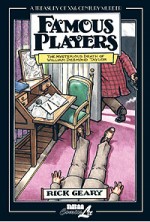
Famous Players – the Mysterious Death of William Desmond Taylor (paperback edition)


By Rick Geary (NBM/Comics Lit)
ISBN: 978-1-56163-559-7

Master cartoonist criminologist Rick Geary returns with another compelling escapade from his latest series of graphic novel crime reconstructions, soon available (May 20th) in an economical paperback edition.

Combining a superlative talent for laconic prose, incisive observation and detailed pictorial extrapolation with his fascination for the darker aspects of human history, Geary’s forensic eye scours the last hundred years or so for his ‘Treasury of XXth Century Murder’ series, here re-examining a landmark homicide that changed early Hollywood and led in large part to the punishing self-censorship of the Hays Commission Production Code.

In 1911 the first moving picture studio set up in the sunny orange groves of rural Hollywood. Within a decade the place was a burgeoning boom town of production companies and back lots, and movie stars were earning vast sums of money. As usual with Boom Towns the new community had swiftly accumulated a ubiquitous underbelly, becoming a hotbed of vice, excess and debauchery.

William Desmond Taylor was a man with a clouded past and a huge reputation as a movie director and ladies man. On the morning of Thursday, February 2nd, 1922 he was found dead in his palatial home by his valet, opening one of the most celebrated (and still unsolved) murder cases in Los Angeles’ extremely chequered history. Uncovering a background of drugs, sex, booze, celebrity and even false identity, this true crime became a template for every tale of “Hollywood Babylon” and, even more than the notorious Fatty Arbuckle sex scandal, drove the movers and shakers of Tinsel-Town to clean up their act – or at least to keep it out of the public gaze.

Geary is meticulous and logical as he dissects the crime, examines the suspects – major and minor – and dutifully pursues all the players to their recorded ends. Especially intriguing are snippets of historical minutiae and beautifully rendered maps and plans which bring all the varied locations to life (the author should seriously consider turning this book into a Cluedo special edition) and gives us all a fair crack at solving this glamorous Cold Case.

Geary presents the facts and the theories with chilling graphic precision, captivating clarity and devastating dry wit, and this saga is every bit as compelling as his Victorian forays: a perfect example of how graphic narrative can be so much more than simple fantasy entertainment. He is a unique talent in the comic industry not simply because of his manner of drawing but because of his subject matter and methodology in telling his tales.

This merrily morbid series of murder masterpieces should be mandatory reading for every mystery addict and crime collector.

© 2009 Rick Geary. All Rights Reserved.

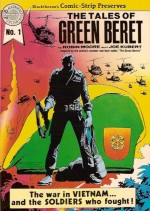
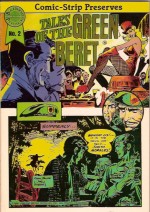
Tales of the Green Beret Books 1-3


By Robin Moore & Joe Kubert (Blackthorne/Comic Strip Preserves)
ISBNs: 0-932629-36-9, 0-932629-48-2 and 0-932629-59-8

If you’re old enough to remember the Viet Nam conflict you’ll understand when I say that it was a war that changed the World’s perception of America. It marked a growth of civil resistance, student unrest and all-pervasive questioning of previously accepted authority. People thought differently after it ended. Most had their eyes opened: many screwed them tighter shut…

It is something we should be aware of now more than ever…

In 1965 a blockbuster book by novelist Robin Moore rocketed to the top of the bestseller lists, generating a film, a hit song and a highly controversial syndicated comic strip. Moore, possibly one of the very first “Embedded Journalists”, trained with and then accompanied America’s elite combat group, the US Army Special Forces, for two years, and was clearly proud to be counted amongst “The Green Berets.”

The United States Army Special Forces is a Special Operations Force designed to carry out six specific briefs: Unconventional Warfare, Foreign Internal Defense, Special Reconnaissance, Direct Military Action, Hostage Rescue and Counter-Terrorism. Units usually carry out these missions with foreign troops on foreign soil, and their remit also includes Search and Rescue, Peacekeeping and Humanitarian Assistance. In later years they have also specialized in Landmine Removal, Counter-Proliferation, Psychological Operations, Manhunting, and Counter-Drug operations.

The unit was formed in 1952 as part of the US Army Psychological Warfare Division, designated the 10th Special Forces Group at the new Psychological Warfare School (which became the John F. Special Warfare Center and School just before these strips premiered).

During the 1960s they were mostly employed in Southeast Asia, South America and Europe in their Unconventional Warfare capacity. The group motto is “De Oppresso Liber” – To Liberate the Oppressed – and relates to their most frequent function: training and advising foreign indigenous forces.

Oddly, the Green Beret itself is a Scottish tradition dating from World War II, when American OSS agents and US Army Rangers (their equivalent to our Commandos) were trained by the Royal Marines and awarded the prestigious headgear for successfully completing the terrifying Commando Training course.

The hats were banned by the US military, but worn clandestinely – and illegally – until 1961, when President Kennedy personally authorized them as a signal of the caliber of soldier able to win one: “a symbol of excellence, a badge of courage, a mark of distinction in the fight for freedom.”

This gesture forever bound the Green Berets to the memory of the murdered President, as the very first week of the strip stirringly affirms. Tales of the Green Berets comes from a time when the USA led the Free World (now there’s a phrase to pick apart semantically), politicians were generally considered to be open and honest and the CIA were good guys. As usual when nations go to war, idealism is always the first casualty, closely followed by young men and foreign civilians…

Fully aware of the value of favourable PR, the strip was created at the urging of Lt. General William Yarborough, who had sponsored Moore’s research and arduous training. He was the current commander of the John F. Kennedy Special Warfare Center and was keen to see the military displayed in a positive light. After a brief but abortive initial opening, the strip launched as a daily on April 4th and Sunday feature on April 10th 1966 from the Chicago Tribune Syndicate, with scripts by Howard Liss and art from the immensely talented Joe Kubert, whose work on DC’s war comic-books was swiftly making him America’s top war artist.

The tales featured a fictionalised reporter, Chris Tower, who had trained with the Green Berets for an article and was now posted to Vietnam by his newspaper magnate father to report on the war…

In the first adventure here ‘Kidnap Ksor Tonn’ Tower meets up with an old friend and becomes embroiled in an operation to abduct a prominent Viet Cong commander: an impressive tale of jeopardy and double-cross. These stories are surprisingly even-handed in their treatment of the conflict, as ‘Sucker Bait’ sees Tower visiting a jungle village of peasants caught in the middle of the war, with heartbreaking consequences…

This is followed by an exotic view of life in Sin City Saigon entitled ‘Chris Kidnapped’ but the perpetrators aren’t political, merely greedy students looking to make some quick American cash…

The first volume ends with the opening shots in a new conflict as Chris flies to Central America to join ‘Operation Oilspot’…

The saga continues in volume two as Chris becomes deeply involved in an ideological battle between the poor peasants of San Marco and Marxist insurgents. In this war for hearts and minds the Green Berets are only “observers”, teaching and training the local soldiery and helping to construct roads and a bridge, but the insurgents are determined to sabotage the project. Moreover they are not so much dedicated communists as profiteering bandits with an eye to the main chance…

This is an impressive saga full of genuine moral conflict and personal tragedy, whilst the next tale ‘Freedom Flight’, switches locales to East Berlin and genres to pure espionage as Tower and a European team warm up the Cold War to smuggle a family through Checkpoint Charlie for a new life beyond the Iron Curtain. Once more the story breaks at a critical moment, to resume in the third and final volume.

On concluding ‘Freedom Flight’ Tower returns to Southeast Asia to examine the links between South Vietnamese Generals – ostensibly the allies of the Americans – and American organised crime. ‘The Syndicate’ is a tense thriller which shows that the modern problem with Vietnamese drug lords was an open secret even in 1967, and as the spellbinding action simultaneously takes place in Asia and America, clearly reveals that the situation was in large part self-inflicted…

This final volume concludes with the somewhat truncated yet engagingly complex political drama ‘Prince Synoc’, wherein a Special Forces trained son of the King of Thailand apparently defects to a faction of the anti-American, anti-monarchist Thai Army of Liberation.

All is not as it seems though, as Tower and the local Green Berets discover… The third and final volume ends here on a rather inconclusive note with the December 31st 1967 Sunday instalment, but I’m not really surprised that these volumes never finished reprinting the entire strip…

The feature was in strange and controversial straits by this time. Although still popular, it had become an easy target for anti-war protesters, with writing campaigns and even picketing of papers that carried it. Kubert’s usually inspired and grippingly evocative textured art suffered (it looks to me like fellow DC artist Jack Abel has ghosted the inking on more than one occasion), and Joe left the strip in January 1968. His last Sunday page was January 7th and his final daily ran three days later. The series continued for a few months more with veteran Tarzan artist John Celardo as illustrator, before succumbing to the inevitable.

Now however, with the distance of decades, surely it is time for this superb and seminal series to be revisited and given the complete deluxe treatment. These cheap and cheerful Blackthorne editions are scarce, often poorly printed and incomplete. The first abortive tale ‘Viet Cong Cowboy’ was not included and since the stories are so very readable it seems only right to also include the missing Celardo strips. After all, this man was also a major artistic talent and I for one would love to review his later efforts…

One more for the graphic novel wish-list then…
© 1986 Tribune Media Services, Inc. All Rights Reserved.

JSA volume 4: Fair Play


By Geoff Johns & various (DC Comics)
ISBN: 978-1-84023-628-6

Now firmly re-established as a major force in the DC universe as well as the commercial comics market, the Justice Society of America went from strength to strength after the rebirth of the seminal, eternal hero Hawkman (see the previous volume JSA: the Return of Hawkman), with Geoff Johns writing increasingly grander epics, tinctured with intriguing soap-opera sub-plots whilst scrupulously exploring and reinventing the internal mythology that has kept the characters as beloved best friends for generations of fans.

This volume, collecting issues #26-31 of the monthly comic and pertinent selections from JSA Secret Files #2, leads off with ‘Breaking Storms’ (co-plotted by Davis S. Goyer and illustrated by Javier Saltares & Ray Kryssing) finding assorted members of the team getting reacquainted, generally carrying out day-to-day business, but beyond the rewarding view of heroes behind their masks, the groundwork for two upcoming epics were stylishly foreshadowed as a pair of old enemies made their first cautious moves…

‘Who Do You Trust?’ (with art from Rags Morales & Michael Bair) found the nominally reformed villain Black Adam making himself less than welcome with his new team-mates until magical boy-scout Captain Marvel intervened, and it was back to all-out action in ‘Upping the Ante’ (illustrated by Derec Aucoin) when extreme gambler Roulette laid plans to pressgang the JSA for her next cage-fighter gladiatorial tournament.

The plan got underway in ‘Thunderstruck’ (Morales & Bair) as the team elected a new chairman only to find themselves abducted and enslaved; forced to fight each other to the death for the edification of super-villains and evil millionaires. Throughout it all Roulette was playing a double-game: something other than greed for profit and blood was fuelling her actions…

The big climax began in a ‘Face-Off’ (by Stephen Sadowski, Christian Alamy & Dave Meikis) but the saga paused – if not digressed – for a short interlude featuring the team’s youngest members, Jakeem Thunder and Star-Spangled Kid (with art from Peter Snejbjerg), who were caught up in a battle with a “Jokerised” Solomon Grundy.

‘Kids’ was part of a braided crossover event that spanned the entire DC pantheon (see Batman: the Joker’s Last Laugh for more details and murderous high jinks) but scripter Johns also cannily used the opportunity to advance one of those aforementioned big plots by bringing back the original Johnny Thunder – who wanted his magic genie back from Jakeem…

Roulette’s motives were revealed even as her illicit fight-club went down in flames when the triumphant JSA overwhelmed her assembled hordes in ‘Fair Play’ (Sadowski & Keith Champagne) and this volume concludes with a team field trip to Gotham City and a terse encounter with the Dark Knight in ‘Making Waves’ (chillingly executed by Snejbjerg) as the assembled heroes raced to rescue a kidnapped baby…

Superhero stories simply aren’t to everybody’s tastes, but if the constant and continuous battle of gaudy costumes and flashy personas must be part of the graphic narrative arts market then high quality material like this should always be at the top of the list. If you haven’t been tempted yet these sterling stirring tales might make a convert of you yet…

© 2001, 2002 DC Comics. All Rights Reserved.

Rod Serling’s The Twilight Zone: Walking Distance


Adapted by Mark Kneece & Dove McHargue (Bloomsbury)
ISBN: 978-0-7475-8787-3

The Twilight Zone was an anthology television show created by the incredibly talented Rod Serling which ran for five seasons between 1959 and 1964. It served to introduce real science fiction, fantasy and modern horror themes to adult audiences who had thus far only experienced escapist, gung-ho space operas such as Flash Gordon and Tom Corbett: Space Cadet.

Serling’s show and the rivals and spin-offs which followed such as The Outer Limits and Night Gallery proved that such themes had both literary value and commercial potential during the turbulent “Space Age” of the 1960’s, and Twilight Zone in particular, thanks to Serling’s progressive views even addressed many social evils of the day.

There were 156 episodes of the first series – over half written by Serling – with such luminaries as Richard Matheson, George Clayton Johnson, Reginald Rose, Charles Beaumont, Earl Hamner Jr., Ray Bradbury, Damon Knight, Harlan Ellison, Lewis Padgett, Jerome Bixby and even Ambrose Bierce, also contributing episodes or tales for adaptation. It was revived twice (in 1985-1989 and 2002; a further 109 episodes) and the various incarnations ran continually in syndication from 1959-2003). Without the Twilight Zone and Rod Serling, it’s doubtful that shows like Star Trek would ever have been made…

Now Mark Kneece (see the superb Trailers, which he produced with Julie Collins-Rousseau), in conjunction with the Savannah College of Art and Design, has adapted some of those landmark early episodes as graphic novels published by Walker Books for Young Readers in America and available in the UK through Bloomsbury.

Martin Sloan is driving his expensive car. A 39 year-old ad exec at the top of his game, he is rich, busy and slowly dying inside. When his car crashes he finds himself near an old fashioned small-town just like the one he grew up in. Exactly like it. In fact, there’s a young boy over yonder who looks the spitting image of…

Illustrated with understated efficiency by Dove McHargue, a tutor at the Savannah college, ‘Walking Distance’ is a melancholic assault on the Rat-Race of Sixties America, an elegy to simpler, happier times and Serling’s most personal – almost autobiographical – story. This is a powerful shot at the relentless American Dream of success at all costs, with just the right amount of tension and terror to spice up the fable whilst keeping the message poignant and welcoming.

As Sloan confronts his past and reshapes his future, in this wonderfully enticing tale it’s easy to see and painful to admit that even though the warnings were clear fifty years ago (the episode was the fifth to air, a Halloween treat which debuted on October 30th 1959) the lesson still needs learning today.

Serling was a comics fan from his earliest days, particularly of the EC tales that shook America in the days before the Comics Code: a fact obvious to anybody who has read those challenging masterpieces and watched his magnificent continuation of them in television. This adaptation of his work is both a fitting tribute and an excellent introduction to a world of graphic narrative a little further out and deeper in than the costumed mainstream, and one any older child can – and should – happily experience.

Text © 2008 the Rod Serling Trust. Illustrations © 2008 by Design Press, a division of Savannah College of Art and Design, Inc. All Rights Reserved.

Iron Man: Enter: the Mandarin


By Joe Casey & Eric Canete (Marvel)
ISBN: 978-0-7851-2522-5

With the blockbuster sequel to the Iron Man movie imminently expected, there’s a lot of shiny glittery product out there devoted to the Golden Avenger and this impressive reworking of Tales of Suspense #50-55, which introduced his greatest foe, is still available and probably one of the most accessible to new readers as well as being a cast-iron cracker in its own right (and for a highly recommended look at those original masterpieces see Marvel Masterworks: Iron Man 1963-1964 – other reprint editions are available…).

The excellent Joe Casey has taken the events of that landmark sequence created by Stan Lee and Don Heck and first published from February to July 1964, at the height of the Cold War, and by refocusing on the villain rather than the hero has managed the tricky task of updating without radically counteracting or denying what has gone before.

Originally released as a six issue miniseries it shows how the oriental mastermind was a Chinese aristocrat who discovered ten rings in the belly of a crashed spacecraft, but due to his arrogance simply retired to await the moment when the world would eventually become his. Calling himself The Mandarin he idled away his days until the communist government provoked him into an angry life. Unfortunately, this unforeseen activity provoked American intelligence agency S.H.I.E.L.D. into action too…

Convincing weapons-technocrat Tony Stark to investigate, they are unaware that they are sending Armoured Avenger Iron Man to a meeting with destiny: his initial clash with the Chinese warlord will set the Mandarin on an obsessive, aggressive vendetta against both Stark Industries and the entire debased modern world…

As well as featuring a delightfully entertaining take on supporting cast favourites Pepper Potts and Happy Hogan this epic includes skirmishes with the deadly Scarecrow, Crimson Dynamo and the Mandarin’s own son, but the real graphic rewards come in the form of the spectacular, devastating clashes with the inimical Master of Menace that open and close this great tale, illustrated with clunky, retro-magnificence (think of Art Deco with all the nuts and bolts on show) by Eric Canete (whose sketchbook of covers is also included at the back of the book), winningly coloured by Dave Stewart.

Enter: the Mandarin is quite simply one of the best Iron Man books in years. What are you waiting for…?

© 2007, 2008 Marvel Publishing, Inc. All Rights Reserved.