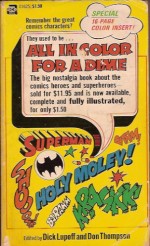
All in Color for a Dime


Edited by Dick Lupoff and Don Thompson (Ace Books)
ISBN: 01625

(Krause Edition 1997 ISBN-13: 978-0873414982)

I tend to concentrate on the worth and validity of sequential graphic narrative, both as art-form and commercial medium, and only peripherally discuss its value as a tool of nostalgia. That’s not because it is of any lesser value, but simply a facet of the fact that nostalgia is an intensely personal and mostly subjective experience. Tintin may be a world classic but the size and feel of the oversized hardback album that instantly rockets me back to 1963 and swamps me in a sea of joyous re-sensations is something I can barely describe, let alone communicate.

But comic-books do have a shared culture: a communal history and geography, part internal landscape and continuity and part acquisition memory as thousands of dedicated fans simultaneously recall how they first joined our particular cult and culture.

This is the book that really kicked it all off for comics fandom and brought criticism of the art-form into a more professional arena. Professionally produced by fans for fans it dangled the dazzling prospect of getting involved and getting paid for it: of joining those people that made the comics. It said “It’s okay to love comics, and by the way have you seen these?”

It really began in 1965 with an industry insider: Jules Feiffer had published The Great Comicbook Heroes, a compendium and essay on historic characters of the early days of the industry, but this collection of recollections and reflections by a serious assemblage of fun-seeking writers spoke less to popular culture and more to the joy and wonder their vanished subjects had caused, and openly wished for their revival and return: these guys wanted to share the fun….

Complete with 16 pages of enticing full-colour cover reproductions and dotted with dozens of monochrome illustrations, it all starts with ‘The Spawn of M.C. Gaines’ an examination of the comic-book industry’s creation and its biggest stars Superman and Batman, from music critic, author and SF editor Ted White, whilst labour-leader, political activist and retired Military Intelligence officer Dick Ellington wrote compellingly of the innocent wonders to be found in Fiction House’s more adult oriented fare in ‘Take Me to Your Leader’, paying particular attention to the iconic Planet Comics.

Editor and author Dick Lupoff remembered the original Captain Marvel in ‘The Big Red Cheese’, Comics historian Bill Blackbeard described the glory days of Popeye in ‘The First (Arf Arf) Superhero of them All’ and journalist Don Thompson (who would dedicate decades of his life to the cause as editor of the industry’s greatest periodical The Comic Buyers Guide) conjured up magical moments with his recollections of Timely heroes evolution into Marvels in ‘OK Axis, Here We Come!’

Tom Fagan organised such successful comics-related Halloween pageants that he and his town of Rutland, Vermont became a part of four-color folklore themselves. In ‘One on All and All on One’ he outlines the history of the kids and kids gangs, writer editor Jim Harmon relates the history of the Justice Society of America in ‘A Swell Bunch of Guys’ and TV producer Chris Steinbrunner described the celluloid crossovers of comics characters in ‘The Four Panelled, Sock-Bang-Powie Saturday Afternoon Screen.’

Roy Thomas investigated the influence of Fawcett Comics legendary second stringers in ‘Captain Billy’s Whiz Gang’, writer and historian Ron Goulart explored the inexplicable appeal of ‘The Second Banana Superheroes’ and Harlan Ellison concluded the affair with paeans to surreal whimsy for the very young with an discussion of the incredible George Carlson and Jingle-Jangle Comics in ‘Comics of the Absurd’

This book opened the door for serious comics fandom, and possibly preserved what credibility the medium might have left after the painful over-exposure that came with the Camp Superheroes craze and Batmania. But it’s also a heartfelt and incisive examination of what we all love about comics and a book every fan and collector should read.
© 1970 Richard A. Lupoff and Don Thompson. All rights reserved.
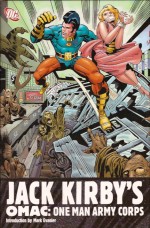
Jack Kirby’s OMAC: One Man Army Corps


By Jack Kirby with D. Bruce Berry & Mike Royer (DC Comics)
ISBN: 978-1-84576-922-2

There’s a magnificent abundance of Jack Kirby collections around these days (‘though still not all of it, so I’m not completely happy yet) and this slim hardback compendium re-presents possibly his boldest and most heartfelt creation after the comics landmark that was his Fourth World Cycle.

Famed for his larger than life characters and gigantic, cosmic imaginings, “King” Kirby was an astute, spiritual man who had lived though poverty, gangsterism, the Depression and World War II. He had seen Post-War optimism, Cold War paranoia, political cynicism and the birth and death of peace-seeking counter-cultures. He always looked to the future and he knew human nature intimately. In OMAC: One Man Army Corps, he let his darkest assumptions and prognostications have free rein, and his “World That’s Coming” was far too close to the World we’re now in…

In 1974, with his newest creations inexplicably tanking at DC, Kirby tentatively considered a return to Marvel, but ever the consummate professional he scrupulously carried out every detail of his draconian DC contract. When The Demon was cancelled he needed to find another title to maintain his Herculean (Jack was legally expected to deliver 15 completed pages of art and story per week) commitments and returned to an idea he had shelved in 1968.

That was to re-interpret Captain America into a distant future where all Kirby’s direst prognostications and fears could be made manifest. In 1974 he returned to those re-imaginings and produced a nightmare scenario that demanded not a hero but a warrior.

Dubbing his Day-After-Tomorrow dystopia “The World That’s Coming”, Kirby let his mind run free – and scared – to produce a frighteningly close appreciation of our now, where science and wealth have outstripped compassion and reason, and humanity teeters on the brink of self-inflicted global destruction.

OMAC #1 launched in September-October 1974 and introduced the Global Peace Agency, a world-wide Doomwatch police force who created a super-soldier to crisis-manage the constant threats to a species with hair-trigger fingers on nuclear stockpiles, chemical weapons of mass destruction and made-to-measure biological horrors.

Base human nature was the true threat behind this series, and that was first demonstrated by the decent young man Buddy Blank, who whilst working at Pseudo-People Inc., discovers that the euphemistically entitled Build-A-Friend division hides a far darker secret than merely pliant girls that come in kit-form.

Luckily Buddy had been singled out by the GPA and genius Professor Myron Forest for eternal linkage to the sentient satellite Brother Eye, his atoms reconstructed until he became a living God of War, and the new-born human weapon easily destroys his ruthless employers before their murderous plans can be fully realised. ‘Buddy Blank and Brother Eye’ was followed by a truly prophetic tale, wherein impossibly wealthy criminal Mister Big purchased an entire city simply to assassinate Professor Forest in ‘The Era of the Super-Rich!’

Kirby’s tried and trusted approach was always to pepper high concepts throughout blazing action, and #3 was the most spectacular yet. OMAC fought ‘One Hundred Thousand Foes!’ to get to the murderous Marshal Kafka; terrorist leader of a Rogue-State with a private army, WMDs and a solid belief that the United Nations couldn’t touch him. Sound familiar…?

That incredible clash concluded in #4’s ‘Busting of a Conqueror!’ and by #5 Kirby had moved on to other new crimes for a new world. The definition of a criminal tends to blur when you can buy anything – even justice – but rich old people cherry-picking young men and women for brain-implantation is (hopefully) always going to be a no-no. Still, you can sell or plunder some organs even now…

Busting the ‘New Bodies for Old!!’ racket took two issues, and after the One Man Army Corps smashed ‘The Body Bank!’ he embarked on his final adventure. Water shortage was the theme of the last tale, but as our hero trudged across a dry and desolate lake bottom amidst the dead and dying marine life he was horrified to discover the disaster was the work of one man. ‘The Ocean Stealers!’ (issue #7) introduced Doctor Skuba, a scientific madman who had mastered the very atomic manipulation techniques that had turned feeble Buddy Blank into an unstoppable war machine.

Joe Kubert drew the cover to OMAC #8 ‘Human Genius Vs Thinking Machine’; an epic episode that saw Brother Eye apparently destroyed as Skuba and Buddy Blank died in an incredible explosion.

But that final panel is a hasty, last-minute addition by unknown editorial hands, for the saga was never actually finished. Kirby, his contract completed, had promptly returned to Marvel and new challenges such as Black Panther, Captain America, 2001, Devil Dinosaur, Machine Man and especially The Eternals.

Hormone treatments, Virtual Reality, medical computers, satellite surveillance, genetic tampering and all the other hard-science predictions in OMAC pale into insignificance against Kirby’s terrifyingly accurate social observations in this bombastic and tragically incomplete masterpiece. OMAC is Jack Kirby’s Edwin Drood, an unfinished symphony of such power and prophecy that it informs not just the entire modern DC universe and inspires ever more incisive and intriguing tales from the King’s artistic inheritors but still presages more truly scary developments in our own mundane and inescapable reality…

As always in these wondrously economical collections it should be noted that the book is also stuffed with un-inked Kirby pencilled pages and roughs, and Mark Evanier’s fascinating, informative introduction is a fact-fan’s delight. And as ever, Jack Kirby’s words and pictures are an unparalleled, hearts-and-minds grabbing delight no comics lover could resist.

Jack Kirby is unique and uncompromising. If you’re not a fan or simply not prepared to see for yourself what all the fuss has been about then no words of mine will change your mind. That doesn’t alter the fact that Kirby’s work from 1937 to his death in 1994 shaped the entire American comics scene, affected the lives of billions of readers and thousands of creators in all areas of artistic endeavour around the world for generations and still wins new fans and apostles every day, from the young and naive to the most cerebral of intellectuals. His work is instantly accessible, irresistibly visceral, deceptively deep whilst being simultaneously mythic and human: and just plain Great.

© 1974, 1975, 2009 DC Comics. All Rights Reserved.

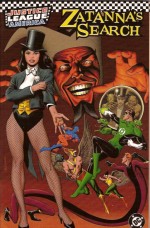
JLA: Zatanna’s Search


By Gardner Fox & various (DC Comics/Titan Books)
ISBN: 1-4012-0188-1

With Julius Schwartz and John Broome writer extraordinaire Gardner Fox built the Silver Age of comics and laid the foundations of the modern DC universe. He was also a canny innovator and one of the earliest proponents of extended storylines which have since become so familiar to us as “braided crossovers.”

A qualified lawyer, Fox began his comics career in the Golden Age on major and minor features, working in every genre and for most companies. One of the B-list strips he scripted was Zatara; a magician-hero in the Mandrake mould who had fought evil and astounded audiences in the pages of Action and World’s Finest Comics for over a decade, beginning with the very first issues (to be completely accurate the latter’s premiere performance was entitled World’s Best Comics #1, but whatever the book’s name, the top-hatted and tailed trickster was there…)

Zatara fell from favour at the end of the 1940s and faded from memory like so many outlandish crime-crushers. In 1956 Editor Schwartz reinvented the superhero genre and reintroduced costumed characters based on the company’s past pantheon. Flash, Green Lantern, Hawkman and the Atom were refitted for the sleek, scientific atomic age, and later their legendary predecessors were reincarnated and returned as denizens of an alternate Earth.

As the experiment became a trend and then inexorable policy, surviving heroes such as Superman, Batman, Green Arrow, Aquaman and Wonder Woman were retrofitted to match the new world order. The Superhero was back and the public appetite seemed inexhaustible.

For their next trick Fox and Schwartz turned to the magician and presumably found him wanting. Rather than condemn him to Earth-2 they created the first “legacy hero” by having Zatara vanish from sight and introduced his daughter, set on a far-reaching quest to find him. Zatanna debuted in Hawkman #4 (October-November 1964) illustrated by the great Murphy Anderson in a tale entitled ‘The Girl who Split in Two’.

Following a mystical trail and wearing a variation of Zatara’s garb the plucky but impatient lass had divided her body and travelled simultaneously to Ireland and China, but lapsed into paralysis until Hawkman and Hawkgirl answered her distress call.

Although nobody knew it at the time she appeared next as a villain in Detective Comics #336 (February 1965). ‘Batman’s Bewitched Nightmare’ found a broom-riding old crone attacking the Dynamic Duo at the command of mutant super-threat The Outsider in a stirring yarn drawn by Bob Kane and Joe Giella.

Current opinion is that this wasn’t originally intended as part of the epic, but when the quest was resolved in Justice League of America #51 at the height of TV inspired “Batmania” a very slick piece of back writing was necessary to bring the high-profile Caped Crusader into the storyline.

Gil Kane and Sid Greene illustrated the next two chapters in the saga; firstly in ‘World of the Magic Atom’ (Atom #19, June-July 1965), wherein the Mystic Maid and Tiny Titan battled Zatara’s old nemesis the Druid in the microversal world of Catamoore, and then with Green Lantern in an extra-dimensional realm on ‘The Other Side of the World!’ (Green Lantern #42, January 1966), as the malevolent Warlock of Ys was eventually compelled to reveal further clues in the trail.

The Elongated Man was a long-running back-up feature in Detective Comics, and from #355 (September 1966, pencilled and inked by Carmine Infantino) ‘The Tantalizing Trouble of the Tripod Thieves!’ revealed how the search for a stolen eldritch artefact brought the young sorceress closer to her goal, and the search concluded in spectacular fashion with the aforementioned JLA tale ‘Z – As in Zatanna – and Zero Hour!’ (#51, February 1967).

With art from the unmatchable team of Mike Sekowsky and Sid Greene, all the heroes who aided her are transported to another plane to fight in a classic battle of good versus evil, with plenty of cunning surprises for all and a happy ending at the end. Collected here is a triumphant long-running experiment in continuity that is one of the very best adventures of the Silver Age, featuring some of the period’s greatest creators at the peak of their powers.

This slim volume also has an encore in store: after the cover gallery is a never before reprinted 10 page tale ‘The Secret Spell!’ by Gerry Conway, Romeo Tanghal and Vince Colletta, originally seen in DC Blue Ribbon Digest #5 (November-December 1980) which revealed ‘Secret Origins of Super-Heroes’ and explores the hidden history of both father and daughter in a snappy, informative and inclusive manner.

Although a little hard to find now this is a superlative book for fans of costumed heroes and would also make a wonderful tome to introduce newcomers to the genre.

© 1964, 1965, 1966, 1967, 1980, 2004 DC Comics.  All Rights Reserved.

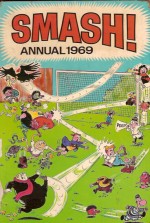
Smash Annual! 1969


By various (Odhams)
No ISBN

Following my own self-created Christmas tradition here’s another British Annual that contributed to making me what I am today, selected not just for nostalgia’s sake but because it is still eminently palatable and worthy of your attention, even under 21st century scrutiny.

Smash! was one of the “Power Comics” brand used by Odhams to differentiate those periodicals which contained resized, reprinted American superhero material from the regular blend of sports, war, western and adventure comics, and which did so much to popularise the budding Marvel characters in this country. However although the comic featured the Hulk and Batman (repackaging the 1960s newspaper strip rather than comic-books), this annual is an all British affair.

In actuality that’s not strictly true but if meat from Argentina can be “produce of Britain” if it’s processed here, then surely art commissioned in England but produced by some of the best illustrators from Europe and South America (as was increasingly the case in the late 1960s and 1970s) qualifies too…

The Annual itself consists of a plethora of short comedy strips and longer action pieces, with classic gag characters such as Grimly Feendish, Percy’s Pets, the Swots and the Blots, Bad Penny, The Man from B.U.N.G.L.E., The Nervs, Charlie’s Choice, Ronnie Rich and the promotional Mick and the Martians, by the likes of Leo Baxendale, Mike Brown, Gordon Hogg and Stan McMurty, but since my knowledge of British creators at this time is so woefully inadequate, I wouldn’t be surprised if I’ve misattributed and besmirched the good names of Graham Allen, Mike Lacey, Terry Bave and Artie Jackson.

If so I sincerely apologise, but at least my ignorance can’t detract from the manic brilliance of the strips themselves.

The action content is provided by The Rubber Man (probably by Ken Mennell and Alfredo Marculeta), two outings for time-travelling historians The Legend Testers (and I’m pretty sure neither was drawn by regular artist Jordi Bernet) a science fiction invasion tale entitled Inferno (definitely Spanish and possibly Ortiz) and a peculiar futuristic superhero strip Lieutenant Lightning and the Thog Menace which looks a lot like early Ron Smith – but I’m sure someone with greater knowledge than mine will correct me where I err.

To keep the nippers extra-engrossed and quiet there were also some games pages from Mister Knowall to supplement the food and drink fuelled frenzy: the kinds of things Dads lose patience with by the third card trick…

Christmas simply wasn’t right without a heaping helping of these garish, wonder-stuffed compendiums that offered a huge variety of stories and scenarios. Today’s celebrity, TV and media tie-in packages simple can’t compete so why not track down a selection of brand-old delights for next year…?
© 1968 Odhams Books Limited. 2006, 2007, 2008 DC Comics. All Rights Reserved.

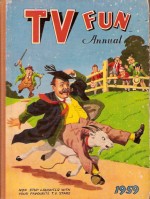
TV Fun Annual 1959


By various (the Amalgamated Press)
No ISBN

After decades when only American comics and nostalgia items were considered collectable, recent years have seen a resurgence of movement in home grown product. If you’re lucky enough to stumble across a vintage volume, I hope my words can convince you to acquire it. However, if I can also create a groundswell of publishers interest maybe a lot of magical material out there in print limbo will resurface in affordable new collections…

Great writing and art is rotting in boxes and attics or the archives of publishing houses, when it needs to be back in the hands of readers once again. On one level the tastes of the public have never been more catholic than today and a sampling of our popular heritage will always appeal to some part of the mass consumer base. Let’s make copyright owners aware that there’s money to be made from these slices of our childhood. You start the petition… I’ll certainly sign it.

TV Fun Annual 1959 was released by The Amalgamated Press just as the silver screen became a staple of every household, but as the comic it celebrated was gasping its last (dating was year-forward on these bumper, hard-backed premium editions so this edition would have been released in the Autumn of 1958).

The comic launched on 19th September 1953, presenting strips, stories and manufactured gossip and PR for a range of entertainment figures. The format had been a popular one since the times when British comics had featured silent film and radio stars, but as paper and print technology advanced and illustrators were replaced by photography only the comedic elements really kept pace.

TV Fun ran until September 1959, absorbing Jingles and Tip Top along the way before being swallowed by the rise of new style celebrity comics like Buster.

This volume doesn’t vary from the traditional format, with a preponderance of text stories, “messages” from such stars as Sally Barnes, Dickie Valentine, Pat Boone and others, plus a selection of puzzles, “Would You Believe It” fact-files, strip histories of motoring and aviation and party games on offer. There are also a number of lavish, fully painted plates inserted featuring Robinson Crusoe, The Dancing Highwayman and the latest technological marvel the Deltic – a Diesel-Electric locomotive.

The prose content comprises two to five page stories, some attributed to the likes of Ruby Murray and Winifed Atwell, recollections from Arthur Askey and Whacko! Headmaster Jimmy Edwards and there’s a ripping yarn from the Casebook of Inspector James and but The Isle of Fear, The Duel at Daybreak!, Jungle Magic, The Man from the Circus!, The Last Voyage, Hold-up in Snake Valley, The Ragged Millionaire and The Spy at the Inn are all standard, celeb-free historical, pioneering or seafaring adventures, westerns and other types of trauma-free yarns meant to thrill while encouraging a love of reading.

The strips are gentle comedies and gentler dramas starring Max Bygraves, Arthur Askey, Diana Decker (who you won’t recall as “the Cutie-Queen of the TV Screen”), Strongheart the Wonder Dog of the Woods, The Harty Family, Mick of the Mounties, Ferdy the Sly Old Fox, Our Jean, Mick and Montmorency, Sally Barnes, Derek Roy and his dog Nero, Jimmy Edwards – the Pride of St. Capers, Brownie the Pony, Sheikh Abdul and his servant Pepi, Shirley Eaton – the Modern Miss and Inventors Circle: a cornucopia of colour and monochrome tales from some of Britain’s best postwar cartoonists.

Some of the content might raise a few eyebrows these days. Popular fiction from a populist publisher will always embody some underlying assumptions unpalatable to modern readers, but good taste was always a watchword when producing work for children and a strip like Mississippi Max and his Axe, whilst visually racist, still had a black protagonist who was kind, helpful and above all not an idiot – a claim many white characters couldn’t make…

A more insidious problem was the institutionalised sexism through-out. All we can hope for is that the reader uses judgement and perspective when viewing or revisiting material this old. Just remember Thomas Jefferson kept slaves and it’s only been illegal to beat your wife since the 1980’s.

Before I go off on one let’s return to the subject at hand and say that despite all the restrictions and codicils this is a beautiful piece of children’s entertainment in a traditional mould with illustrations that would make any artist weep with envy.
© 1958 The Amalgamated Press.
Which I’m assuming is now part of IPC Ltd., so © 2009 IPC Ltd.

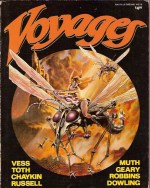
Voyages – Adventures in Fantasy


By Alex Toth, Rick Geary, Charles Vess, Trina Robbins & others (Nautilus Dreams)
ISBN: 0-913161-00-4

For comics purists and especially fans of comic art few books can match the impact and content of this delightful one-off from the early 1980s. I know nothing about its genesis or editor Howard Feltman, but at the dawn of creator owned-publishing, he managed to compile a truly staggering pool of talent for a (regrettably) single engagement that still resonates with power and charm today.

Behind the Frank Brunner cover and Terry Austin frontispiece, these crisp black and white pages contain firstly two incredible tales of Alex Toth’s Bravo For Adventure; an origin and a truly magnificent, surreal design masterpiece, wherein a blow to the head sends the dashing aviator to the furthest reaches of reality.

Toth was the undisputed god of minimalist line and his breathtaking mastery of dark and light is given full rein in these incomparable yarns. Hard on his heels is ‘Murder in the Garage’, an impressive early crime confession from Rick Geary, whose Treasury of Victorian Murder and Treasury of XXth Century Murder graphic procedurals are a constant source of delight to readers of true crime tales and cartoon aficionados everywhere.

Stardust star Charles Vess follows with the first of two brief vignettes, ‘Sugar in the Morning’ and Howard Chaykin provided an eerie psycho-thriller entitled ‘No Rest for the Weary…’ painted in glorious, psychedelic colour in a special glossy insert, after which Toren Smith and Lela Dowling contributed a whimsical and decidedly different ‘Cheshire Cat’ tale.

Barb Hawkins Karl interviewed P. Craig Russell with a liberal sprinkling of beautiful pencil studies and a stirring fantasy illustration in pen and ink, Trina Robbins brilliantly pastiched the Maltese Falcon in ‘Queenie Hart and the Andromedan Grzblch’ and John Jay Muth traded his signature watercolours for tone and pencil in the pensive picture poem ‘The Ghost’.

This enchanting collection concludes with Vess’ quirky ‘Blimp Tales’ and a Dowling unicorn endpiece. The tremendous outpouring of superlative art and stories that came from the rise of independent publishers in the 1980s seldom reached the qualitative peak of Voyages and this book is still readily available at incredibly modest prices. No true art lover or collector can afford to be without it.

All art and stories © 1983 the respective creators/copyright holders. All Rights Reserved.

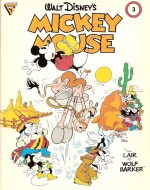
Walt Disney’s Mickey Mouse in The Lair of Wolf Barker – Gladstone Comic Album #3


By Floyd Gottfredson (Gladstone)
ISBN: 978-0-94459-903-7

Carl Barks was one of the greatest exponents of comic art the world has ever seen, and he did almost all his work with Disney characters. His work reached and affected untold millions of readers and he all too belatedly won far-reaching recognition. But he wasn’t the first unsung pencil-pushing maestro to turn silver-screen gems into polished gold.

One of his most talented associates, even more influential though certainly far less lauded, was Floyd Gottfredson, a cartooning pathfinder who started out as just another warm body in the company animation factory but became a narrative groundbreaker as influential as Herriman, McCay or Segar.

He took a wild and anarchic animated rodent from slap-stick beginnings, via some of the earliest adventure continuities in comics history as detective, explorer, aviator and cowboy, through to the gently suburbanised sitcom gags of a newly middle-class America that syndicate policy eventually forced upon him. Along the way he produced some of the most engrossing continuities the industry has ever seen.

Arthur Floyd Gottfredson was born in 1905 in Kaysville, Utah, one of eight siblings born to a Mormon family of Danish extraction. Injured in a youthful hunting accident he whiled away a long recuperation drawing and studying cartoon correspondence courses, and by the 1920s had turned professional, selling cartoons and commercial art to local trade magazines and Big City newspaper the Salt Lake City Telegram.

In 1928 he and his wife moved to California, and after a shaky start found work in April 1929 as an in-betweener at the burgeoning Walt Disney Studios. As the Great Depression hit, he was personally asked by Disney to take over the newborn and ailing Mickey Mouse newspaper strip. Gottfredson would plot, draw and often script the strip for the next forty-five-and-a-half years.

Veteran animator Ub Iwerks had initiated the feature but was swiftly replaced by Win Smith. The strip was plagued with problems and young Gottfredson was only supposed to pitch in until a regular creator could be found. His first effort saw print on May 5th 1930 (his 25th birthday) and just kept going; an uninterrupted run over the next five decades. On January 17th 1932, Gottfredson created the first colour Sunday page, which he contiguously handled until 1938, and then almost continually until his death.

At first he did everything, but in 1934 relinquished the scripting role, preferring plotting and illustrating the adventures to playing with dialogue. Collaborating scripters included Ted Osborne, Merrill De Maris, Dick Shaw, Bill Walsh, Roy Williams and Del Connell. He briefly used inkers such as Al Taliaferro, but re-assumed full art chores in 1943.

This delightful compendium collects the very first extended Sunday colour epic which originally ran from January 29th to June 18th 1933. Partially scripted by an unknown writer ‘The Lair of Wolf Barker’ is a rip-roaring comedy western featuring the full repertory cast of Mickey, Minnie, Horace Horsecollar, Clarabelle Cow, and the prototype Goofy, who used to answer to the moniker Dippy Dog.

The gang head west to look after Uncle Mortimer’s sprawling ranch and tumble into a baffling crisis since the cattle are progressively vanishing, with the unsavoury eponymous villain riding roughshod over the assorted characters and stock figures, before his ultimate and well-deserved come-uppance. This is comics on the fly, with plenty of rough and tumble action and fast-packed gags.

Rounding out the book is a selection of early Mickey gags and another landmark Sunday tale. ‘Mickey’s Nephews’ introduced the rascally Morty and Ferdie Fieldmouse in a short romp (September 18th to November 6th 1932) full of waggish behaviour and wicked japery. The sequence was inked by Al Taliaferro, who recalled the story five years later when he and scripter Ted Osborne needed a quick plot for their latest assignment. The job was the new Donald Duck strip and the answer was the infamous ‘Donald’s Nephews’ which introduced Huey, Louie and Dewey to the world…

Gottfredson’s influence on not just the Disney Canon but graphic narrative itself is inestimable: he was one of the first to produce long continuities and “straight” adventures; he pioneered team-ups and invented some of the first “super-villains” in the business. When Disney killed the continuities in 1955 dictating that henceforth strips would only contain one-off gag strips, he adapted easily, working on until retirement in 1975. His last daily appeared on November 15th and the final Sunday strip on September 19th 1976.

Like all Disney creators Gottfredson worked in utter anonymity, but in the 1960s his identity was revealed and the voluble appreciation of his previously unsuspected horde of devotees led to interviews, overviews and public appearances, with effect that subsequent reprinting in books, comics and albums carried a credit for the quiet, reserved master. Floyd Gottfredson died in July 1986.

This huge untapped well of work is only available in tiny snippets like these old Gladstone albums, but hopefully now that Disney own a major comics company some bright spark will realise the potential of the artistic treasures they’ve been sitting on and we’ll soon seen a Gottfredson Mickey Mouse Archives collection.

And since we’re wishing I’d still like that Jonny Seven toy gun I didn’t get in 1969…
© 1987, 1933, 1932 The Walt Disney Company. All Rights Reserved.

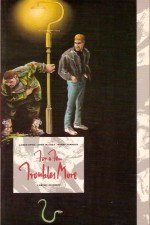
For a Few Troubles More – A Crisis Graphic Novel


By Garth Ennis & John McCrea, with Wendy Simpson (Fleetway)
ISBN: 0-85386-208-8

After the moving odyssey of Tom Boyd in Troubled Souls and chilling sardonic disillusionment of True Faith, the third Crisis epic from Garth Ennis again broke entirely new ground with a mini-masterpiece of eternal fraternal comradeship and raucous, bawdy profanity that touched all the classic keystones of masculine comedy: women, booze, toilet humour and the trouble your best mates get you into …

For a Few Troubles More shows another, more joyous side of Belfast, and features the antics of Dougie and Ivor, two peripheral characters and drinking buddies from the story of Boyd, who stole centre-stage and ran off giggling with it (think “Rosencrantz and Guildenstern are Schmucks”…)

Dougie Patterson is getting married. His fiancé’s extremely imposing father insists on it. He doesn’t actually like Dougie but no grandchild of his is going to be born out of wedlock. It’s not so bad, really. The wayward lad loves Valerie, and his fearsome father-in-law-to-be is finding him both a job and somewhere to live. All Dougie has to do is learn to think before he opens his mouth and lose the bad influences in his useless life.

Beat mate Ivor Thompson is the fleshily overabundant epitome of a bad influence. Crafty, stupid, and a fabulist far too fond of the “Brilliant Idea”, this failed terrorist (who shot himself in the foot on his first mission) is fresh out of prison and looking to make a little cash when his uncle Shuggie lets him in on a family secret: the elder Thompson runs the most diabolical Poteen still in the city. (Pronounced “Puh-Cheen,” an illicit, illegal and unwise homemade spirit made from things better left unsaid, inexplicably beloved by Sons of Erin everywhere. I tried some in 1975 and to this day my skull pounds and my vision blurs whenever I move my head too quickly).

With the wedding day looming and no-one better available, Dougie unwisely lets Ivor be his Best Man, stupidly forgetting his old pal’s passion for practical jokes, and the fact that’s he’s cursed by all the gods of good taste there have ever been.

Ivor’s a survivor. Nothing gets him down for long: not Shuggie’s sudden death, a gang of criminals who want the vast quantity of Poteen they were promised or an imminent beating by the biggest bully in Belfast. In fact it takes the return of his uncle as an entirely different kind of spirit to give him even a moment’s pause, and he’s determined that Dougie’s honeymoon will be one he’ll never forget…

This blend of viperish one-liners and classic slapstick shows all Ennis’s later themes in full display: friendship, male bonding, studied suspicion and mandatory disrespect of any authority that thinks itself sacrosanct. It is a paean of praise for the little guy, starring two of the most ordinary heroes ever seen.

Clearly the lads struck a chord, as they have periodically returned as the “stars” of the occasional series Dicks, but this first tightly disciplined slice of chaos is still, for me at least, their greatest moment – particularly because of the superbly evocative colour art of John McCrea and Wendy Simpson.

A riotous, uproarious tawdry delight for grown-ups with a sense of vulgar absurdity, these are not troubles you can do without.
© 1990 Fleetway Publications. All Rights Reserved.

Town of Evening Calm, Country of Cherry Blossoms


By Fumiyo Kouno (jaPress/Last Gasp)
ISBN: 978-0-86719-721-1

First published in 2003/2004 in Japan’s Weekly Manga Action YÅ«nagi no Machi, Sakura no Kuni (Town of Evening Calm, Country of Cherry Blossoms) is an award-winning (2004 Grand Prize for manga, Japan Media Arts Festival and the 2005 Tezuka Osamu Cultural Prize Creative Award) collection of interlinked, generational short stories dealing with the aftermath of the atom bombing of Hiroshima, and particularly the treatment of bomb-affected survivors (“hibakusha”) by a culture that has traditionally shunned imperfection and studiously ignored unpleasant truths. The tale was made into an award-winning feature film and radio serial in 2007.

The project was instigated by an editor rather than Fumiyo Kouno, who is a native of modern Hiroshima, but never considered herself as being affected by the ghastly events of August 6th 1945.

The first story ‘Town of Evening Calm is set in 1955, and follows teenager Minami Hirano as she goes about her daily life in the slowly recovering city. She lives with her ailing mother and sister in a seedy shack, and thinks of those she’s lost: father and two sisters to the bomb and baby brother Asahi who was mercifully staying with rural relatives when the bomb hit.

She hasn’t seen him since: her aunt thought it best to keep the healthy boy away, and subsequently adopted him. The surviving family bravely struggle as seamstresses and clerks, trying to save enough money to visit him. Minami has an admirer; a shy young man named Yutaka Uchikoshi, who tries to shower the quietly independent girl with presents, but ten years after the bomb, the explosion is inexorably still claiming victims. As tragedy looms Minami is unaware that her long-lost brother is coming to see her…

The follow-up ‘Country of Cherry Blossoms’ is divided into two separate tales. The first is set in Tokyo in 1987 with tomboy schoolgirl Nanami Ishikawa railing against her life. She is Asahi’s daughter – a second generation victim – and has never met her hibakusha relatives, but when her brother Nagio is hospitalised she sneaks into his room with new friend Toko Tone and showers him with cherry blossom petals to show him the spring he’s missing, unaware that his asthmatic condition is considered by many to be the taint of the bomb…

Admonished by her grandmother she goes on about her life, but as the family moves nearer the hospital she abruptly loses touch with Toko…

Part two takes up the story in 2004. Asahi has recently retired and moved in with Nanami, when medical graduate Nagio mentions that he has seen Toko at the hospital where he works. Nanami has other things to worry about: Asahi is disappearing for days at a time and she thinks he might be senile…

One day she follows him, and just as years before with Nagio, Toko, a virtual stranger, appears and shares her journey and revelations. The troubled old man is travelling to the rebuilt Hiroshima, driven by an irresistible impulse, and as they follow him Nanami discovers that real reason Toko stopped seeing her family…

Pensive, serene and deftly sensitive, almost elegiac, this book deals with uncomfortable issues by advocating tolerance, understanding and endurance rather than the bombastic unyielding defiance of Keiji Nakazawa’s landmark Barefoot Gen, and the message hits home all the harder for it.

Initially reluctant to produce a work about Hiroshima, Fumiyo Kouno found a strong voice within – and her own unrealised, unexpressed attitudes – when faced with the behaviour still directed toward hibakusha more than five decades later. As she states in the afterword of this superb commemorative hardcover it was “unnatural and irresponsible for me to consciously try to avoid the issue” and she decided that “drawing something is better than drawing nothing at all.”

This quietly magnificent tribute to the truism that “Life goes on” and the proposition that even polite and passive intolerance should always be resisted is a book every politician in the world should read. It also holds a harsh lesson every cosy, comfortable family in existence needs to absorb.
© 2003 Fumiyo Kouno. All Rights Reserved.

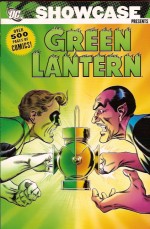
Showcase presents Green Lantern volume 3


By John Broome, Gardner Fox, Gil Kane, Sid Greene & Carmine Infantino (DC Comics)

ISBN13: 978-1-84576-853-9

Firmly established as a major star of the company firmament, Green Lantern increasingly became a series which provided conceptual highpoints and “big picture” foundations that successive creators would use to build the tight-knit history and continuity of the DC universe. At this time there was also a turning away from the simple imaginative wonder of a ring that could do anything in favour of a hero who preferred to use his fists first and ignore easy solutions.

What a happy coincidence that at this time artist Gil Kane was just reaching his artistic peak, his dynamic full-body anatomical triumphs bursting with energy and crashing out of every page…

Green Lantern #39 (September 1965) featured two tales by John Broome, Kane and master inker Sid Green; a return engagement for Black Hand, the Cliché Criminal entitled ‘Practice Makes the Perfect Crime!’ and a bombastic slugfest with an alien prize fighter named Bru Tusfors, ‘The Fight for the Championship of the Universe!’ They were mere warm-ups for the next issue.

‘The Secret Origin of the Guardians!’ was a landmark second only to ‘Flash of Two Worlds’ (see Showcase Presents the Flash volume 2 or Crisis on Multiple Earths: the Team-ups volume 1) as Broome teamed the Emerald Gladiator with his Earth-2 counterpart Alan Scott to stop Krona, an obsessed Oan scientist whose misguided attempts to discover the origins of the universe had introduced evil into our reality billions of years ago and forced his immortal brethren to become protectors of life and civilisation in an unending act of group contrition.

Simultaneously high concept and action packed, this tale became the accepted keystone of DC cosmology and the springboard for all those mega-apocalyptic publishing events such as Crisis on Infinite Earths. It has seldom been equalled and never bettered…

Issue #41 featured twisted romance in ‘The Double Life of Star Sapphire!’ as an alien power-gem once more compelled Carol Ferris to subjugate and marry her sometime paramour Green Lantern, and Gardner Fox wrote another cracking magical mystery as the extraterrestrial wizard Myrwhydden posed ‘The Challenge of the Coin Creatures!’

In ‘The Other Side of the World!’ Fox continued a long-running experiment in continuity with a superb tale of time-lost civilisations and an extra-dimensional invasion by the Warlock of Ys that co-starred the peripatetic Zatanna the Magician.

The top-hatted, fish-netted, comely young sorceress had appeared in a number of Julie Schwartz-edited titles hunting her long-missing father Zatarra: a magician-hero in the Mandrake mould who had fought evil in the pages of Action Comics for over a decade beginning with the very first issue. In true Silver Age “refit” style Fox created his young and equally gifted daughter, and popularised her by guest-teaming her with a selection of superheroes he was currently scripting (if you’re counting, these tales appeared in Hawkman #4, Atom #19, Green Lantern #42, and the Elongated Man back-up strip in Detective Comics #355 as well as a very slick piece of back writing to include the high-profile Caped Crusader via Detective #336 – ‘Batman’s Bewitched Nightmare’, before concluding after the GL segment in Justice League of America #51).

The Flash guest-starred in a high-powered tussle with a new nemesis in the ‘Catastrophic Crimes of Major Disaster!’ in #43 and the next issue provide two tales – a rarity as book-length epics increasing became the action-packed norm. Oddly, second-class postage discounts had for years dictated the format of comic-books: to qualify for cheaper rates periodicals had to contain more than one feature, but when the rules were revised single, complete tales not divided into “chapters” soon proliferated. Here though are two reasons to bemoan the switch; Fox’s ‘Evil Star’s Death-Duel Summons’ and Broome’s Jordan Brothers adventure ‘Saga of the Millionaire Schemer!’, offering high-intensity super-villain action and heady, witty mystery.

The Earth-2 Green Lantern returned for another team-up in #45’s fantasy romp ‘Prince Peril’s Power Play’ by Broome, who raised the dramatic stakes with the hero’s first continued adventure in the following issue. Before that, though Green Lantern #56 opened with a delightfully grounded crime-thriller ‘The Jailing of Hal Jordan’ from Fox, before ‘The End of a Gladiator!’ detailed the murder of GL by old foe Dr. Polaris and concluded with his funeral on Oa, home of the Guardians!

Broome was on fire at this time: the following issue found the hero’s corpse snatched to the 58th century and revived in time to save his occasional future home from a biological infection of pure evil in the spectacular conclusion ‘Green Lantern Lives Again!’

Bizarrely garbed goodies and baddies were common currency at this time of “Batmania” so when gold-plated mad scientist Keith Kenyon returned it was as a dyed-in-the-wool costumed crazy in Fox’s ‘Goldface’s Grudge Fight Against Green Lantern!’, although Broome’s showbiz scoundrel Dazzler didn’t quite set the world afire in #49’s ‘The Spectacular Robberies of TV’s Master Villain!’ The story was still a shocker however as Hal Jordan quit his job as a Coast City test Pilot and went on the first of his vagabond quests across America…

With Green Lantern #50 Gil Kane began inking his own art, lending the proceedings a raw, savage appeal. The fight content in the stories was also ramped up, as seen in Broome’s murder-mystery treasure hunt ‘The Quest for the Wicked Queen of Hearts!’ which was complimented by an extragalactic smack-fest in Fox’s ‘Thraxton the Powerful vs Green Lantern the Powerless’ before Broome took the Emerald Crusader back to the 58th century to battle ‘Green Lantern’s Evil Alter Ego!’ in #52.

Alan Scott and comedy sidekick Doiby Dickles popped over from Earth-2 to aid against the return of arch nemesis Sinestro in the frankly peculiar ‘Our Mastermind, the Car!’ by Broome and Kane, but found a much less outré plot or memorable foe in #53’s ‘Captive of the Evil Eye!’ whilst artists Carmine Infantino and Sid Greene stepped in to illustrate Broome’s thrillingly comedic Jordan Brothers back-up ‘Two Green Lanterns in the Family!’ as Hal took a job as a county-spanning investigator for the Evergreen Insurance company.

Broome and Kane were reunited for the positively surreal, super-scientific ‘Menace in the Iron Lung!’ (#54), and all-out attack on the Guardians in ‘Cosmic Enemy Number One’, which concluded in ‘The Green Lanterns’ Fight for Survival!’ and the appointment of a second Earthling to the Corps.

Fox scripted a sparkling Fights ‘n’ Tights duel in ‘The Catastrophic Weapons of Major Disaster!’ (#57) and a gripping psycho-thriller in #58’s ‘Peril of the Powerless Green Lantern’ wherein the hero seemingly suffered from debilitating combat fatigue. Sid Greene returned with this latter and stayed to ink the last tale in this volume, another continuity landmark.

In issue #59 (March 1968) Broome introduced Guy Gardner ‘Earth’s Other Green Lantern!’ in a rip-roaring cosmic epic of what-might-have-been. When dying GL Abin Sur had ordered his ring to select a worthy successor Hal Jordan hadn’t been the only candidate, but the closest of two. What if the ring had chosen his alternative instead…?

With a superb double page pin-up from GL #46 to end on this book gathers the imaginative and creative peak of Broome, Fox and Kane, a plot driven plethora of adventure sagas and masterful thrillers that literally reshaped the DC Universe. Action lovers and fans of fantasy fiction couldn’t find a better example of everything that defines superhero comics.
© 1965, 1966, 1967, 1968, 2008 DC Comics. All Rights Reserved.