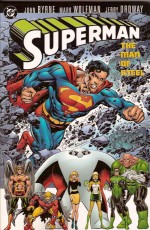
Superman: The Man of Steel volume 3


By various (DC Comics)
ISBN: 1-4012-0246-2

With John Byrne’s controversial reboot of the world’s first superhero a solid hit, the collaborative teams tasked with ensuring his continued success really hit their stride with the tales collected in this third volume. Re-presenting Superman #4-6, Action #587-589 and Adventures of Superman #427-429 the drama began with an all-out battle against the deranged gunman ‘Bloodsport!’ courtesy of Byrne and Karl Kesel, before Marv Wolfman and Jerry Ordway concocted a longer yarn taking the Man of Tomorrow on a punishing visit to the rogue state of Qurac and a hidden race of alien telepaths called the Circle, in a visceral and beautiful tale of un-realpolitik.

‘Mind Games’ and ‘Personal Best’ (Adventures of Superman #427-428) combined a much more relevant, realistic slant with lots of character sub-plots featuring the staff of the Daily Planet whilst Byrne in Action Comics concentrated on spectacle and reader appeal. ‘Cityscape!’ in #587, teamed the Metropolis Marvel with Jack Kirby’s Etrigan the Demon as sorceress Morgaine Le Fay attempted to gain immortality by warping time itself.

‘The Mummy Strikes’ and ‘The Last Five Hundred’ (Byrne and Kesel, Superman #5-6) introduced the first hint of a romance between the Man of Steel and Wonder Woman before Lois and Clark became embroiled in an extraterrestrial invasion drama that all started half a million years ago, and in ‘Old Ties’ (Superman #6) Wolfman and Ordway revealed the catastrophic results of the Circle transferring their attentions to Metropolis.

This book concludes with a cosmic saga from Action Comics #588-589 as Byrne and Dick Giordano teamed the Caped Kryptonian with Hawkman and Hawkwoman in ‘All Wars Must End’, an epic battle against Thanagarian invaders before the Green Lantern Corps rescued the star-lost Superman in ‘Green on Green’ just in time to join forces with him to destroy an unstoppable planet-eating beast.

The back-to-basics approach lured many readers to – and back to – the Superman franchise, but the sheer quality of the stories and art are certainly what convinced them to stay. Such cracking superhero tales are a high point in the Man of Tomorrow’s decades-long career, and these chronological-release collections are certainly the easiest way to enjoy this impressive reinvention of the ultimate comic-book icon.

© 1987, 2004 DC Comics. All Rights Reserved.

Walt Disney’s Mickey Mouse in The World of Tomorrow – Gladstone Comic Album #17


By Floyd Gottfredson, Bill Walsh & Dick Moores (Gladstone)
ISBN: 978-0944599174

Arthur Floyd Gottfredson was born in 1905 in Kaysville, Utah, one of eight siblings born to a Mormon family of Danish extraction. Injured in a youthful hunting accident he whiled away a long recuperation drawing and studying cartoon correspondence courses, and by the 1920s had turned professional, selling cartoons and commercial art to local trade magazines and Big City newspaper the Salt Lake City Telegram.

In 1928 he and his wife moved to California, and in April 1929 after a shaky start wherein he had to resume his boyhood job as a movie projectionist, found work as an animation  in-betweener at the burgeoning Walt Disney Studios. As the Great Depression began, he was personally asked by Disney to take over the fledgling and ailing Mickey Mouse newspaper strip. Gottfredson would plot, draw and occasionally script the strip for the next forty-five-and-a-half years.

Veteran animator Ub Iwerks had initiated the daily gag sequences but was swiftly replaced by Win Smith. The strip was plagued with problems and young Gottfredson was only stepping in until a regular creator could be found. His first effort saw print on his 25th birthday: May 5th 1930, and he worked on the strip for the next five decades. On January 17th 1932, Gottfredson created the first colour Sunday page, which he contiguously handled until 1938.

At first he did everything, but in 1934 relinquished the scripting role, preferring plotting and illustrating the adventures to playing with dialogue. Collaborating scripters included Ted Osborne, Merrill De Maris, Dick Shaw, Bill Walsh, Roy Williams and Del Connell. He often used inkers such as Dick Moores and the great Al Taliaferro, but occasionally assumed full art chores.

His influence on graphic narrative is inestimable: he was one of the very first to move from daily gags to continuity and extend adventures, created Mickey’s nephews, pioneered team-ups and invented some of the first “super-villains” in the business. In 1955 Disney killed the continuities; dictating that henceforth strips would only contain one-off gag strips. Gottfredson adapted easily, working on until retirement in 1975. His last daily appeared on November 15th and the final Sunday on September 19th 1976.

After D-Day and the Allied push into Occupied Europe the home-front morale machine soon started pumping out conceptions of what the glorious happy future would be like. A strip as popular as Mickey Mouse couldn’t help but join the melee and new scripter Bill Walsh produced a delightfully surreal, tongue-in-cheek parable in ‘The World of Tomorrow’ full of brilliant, incisive sight gags and startling whimsy whilst pitting the Mouse against arch-enemy Peg Leg Pete, who was in extreme danger of conquering the entire planet, using the double-edged advances in modern science! This superbly funny thriller originally ran from July 31st to November 11th 1944.

Walsh, Gottfredson and inker Dick Moores also produced the remainder of this delightful book for kids of all ages, which comprise a dozen one-off gag dailies from 1944 and 1945, and a cracking sea yarn ‘The Pirate Ghost Ship’ (April 17th to July 15th 1944) that found Mickey and Pluto searching for treasure, defying black magic and battling sinister buccaneers in a rollicking rollercoaster of fun and frights.

Walsh (September 30th 1913 – January 27th 1975) loved working on the strip and scripted it until 1964 when his increasingly successful film career forced him to give it up. Like all Disney comics creators they worked in utter anonymity, but thanks to the efforts of devout fans efforts were eventually revealed and due acclaim accorded. Gottfredson died in July 1986 and Walsh did achieve a modicum of fame in his lifetime as producer of Disney’s Davy Crockett movies, and writer/producer of The (original) Absent-Minded Professor, Son of Flubber, That Darn Cat!, The Love Bug, Bedknobs and Broomsticks and many others. He was Oscarâ„¢ nominated for his Mary Poppins Screenplay.

Nowadays anthropomorphic comics are often derided as kids stuff – and indeed there’s nothing here a child wouldn’t adore – but these magical works were produced for consumers of ALL AGES and the sheer quality of Gottfredson and Walsh’s work is astounding to behold. That so much of it has remained unseen and unsung is a genuine scandal. Mercifully most of the Gladstone Mickey Mouse albums are still readily available, but surely such stories should be preserved in deluxe collections, and remain permanently in print?
© 1989, 1945, 1944 The Walt Disney Company. All Rights Reserved.

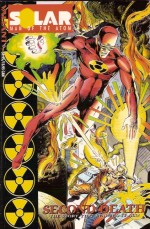
Solar, Man of the Atom: Second Death


By Jim Shooter, Don Perlin, Barry Windsor-Smith, Bob Layton & Tom Ryder (Valiant)
No ISBN

During the market-led, gimmick-crazed frenzy of the 1990s amongst the interminable spin-offs, fads, shiny multiple-cover events a new comics company revived some old characters and proved once more that good story-telling never goes out of fashion. As Editor-in-Chief, Jim Shooter had made Marvel the most profitable and high-profile they had ever been, and after his departure he used that writing skill and business acumen to transform some almost forgotten Silver-Age characters into contemporary gold.

Western Publishing had been a major player since comics’ earliest days, blending a huge tranche of licensed titles such as TV and Disney titles, Tarzan, or the Lone Ranger with homegrown hits like Turok, Son of Stone and Space Family Robinson. In the 1960s during the camp/superhero boom these original adventure titles expanded to include, Brain Boy, M.A.R.S. Patrol Total War (created by Wally Wood), Magnus, Robot Fighter (by the incredible Russ Manning) and in deference to the atomic age of heroes, Nukla and the brilliant Dr. Solar, Man of the Atom. Despite supremely high quality and passionate fan-bases, they never captured the media spotlight of DC or Marvel’s costumed cut-ups. Western shut up their comics division in 1984.

With an agreement to revive some, any or all of these four-colour veterans, Shooter and co-conspirator Bob Layton came to a bold decision and made those earlier adventures part-and-parcel of their refit: acutely aware that old fans don’t like having their childhood favourites bastardized, and that revivals need all the support they can get. Thus the old days were canonical: they “happened.”

Although the company launched with a classy reinterpretation of Magnus, the key title to the new universe they were building was the only broadly super-heroic character in the bunch, and they had big plans for him. Solar, Man of the Atom was launched with an eye to all the gimmicks of the era, but was cleverly realised and realistically drawn.

Second Death collects the first four issues of the revived Solar and follows brilliant nuclear physicist Phil Seleski, designer of the new Muskogee fusion reactor in the fraught days before it finally goes online. Faced with indifferent colleagues and inept superiors, pining for a woman who doesn’t seem to know he exists, Seleski is under a lot of pressure. So when he meets a god-like version of himself he simply puts it down to stress…

Solar, the atomic god who was Seleski, is freshly arrived on Earth, and with his new sensibilities goes about meeting the kind of people and doing the kind of things his mortal self would never have dreamed of. As if godhood had made him finally appreciate humanity Solar befriends bums, saves kids and fixes disasters like the heroes in the comic-books he collected as a boy.

His energized matter and troubled soul even further divide into a hero and “villain”, but things take a truly bizarre turn when he falls foul of a genuine super-foe; discovering that the “normal” world is anything but, and that he is far from unique. The superhuman individuals of Toyo Harada’s Harbinger Foundation prove that the world has always been a fantastical place, and Solar’s belief that he has traveled back in time to prevent his own creation gives way to the realisation that something even stranger has occurred…

This is a cool and knowing revision of the so clichéd “atomic blast turns schmuck into hero” plot, brimful of sharp observation, plausible characters and frighteningly convincing pseudo-science. The understated art from the hugely under-appreciated Don Perlin is a terrifying delight and adds even more shades of veracity to the mix, as do the colours of Kathryn Bolinger and Jorge Gonzãlez.

Moreover the original comics had a special inserted component in the first ten issues (by Shooter, Barry Windsor-Smith and Layton) which revealed the epic events that made Seleski into a god – collected as Solar, Man of the Atom: Alpha and Omega – designed to be read only after the initial story arc had introduced the readers to Seleski’s new world. Together these tales combine to form one of the most impressive and cohesive superhero origin sagas ever concocted and one desperately in need of reprinting.

Until then you can still hunt these down via your usual internet and comic retailers, and trust me, you should…
© 1994 Voyager Communications Inc. and Western Publishing Company, Inc. All rights reserved.

Solar, Man of the Atom: Alpha and Omega (Slipcase Edition)


By Jim Shooter, Barry Windsor-Smith & Bob Layton with Kathryn Bolinger (Valiant)
No ISBN

The 1990s were a slow period for comics creativity: the industry had become market-led, with spin-offs, fad-chasing, shiny gimmicks and multiple-covers events replacing innovation and good story-telling in far too many places. One notable exception was a little outfit with some big names that clearly prized the merits of well-told stories illustrated by artists immune to the latest mis-proportioned, scratchy poseur style, and one with enough business sense to play the industry at its own game…

As Editor-in-Chief, Jim Shooter had made Marvel the most profitable, high-profile comics company around, and after his departure he used that savvy to pick up the rights to a series of characters with Silver-Age appeal and turn them into contemporary gold.

Western Publishing had been an industry player since the earliest days, mixing a plethora of licensed titles such as Disney titles, Tarzan, or the Lone Ranger with the occasional homegrown hit like Turok, Son of Stone. In the 1960s during the camp/superhero boom these latter expanded to included Space Family Robinson, Brain Boy, Magnus, Robot Fighter (by the incredible Russ Manning) and in deference to the age of the nuclear hero, Dr. Solar, Man of the Atom. All of supremely high quality, they won huge fan-bases, but never captured the media spotlight of DC or Marvel’s costumed cut-ups.

With an agreement to revive some, any or all of these four-colour veterans, Shooter and co-conspirator Bob Layton came to a bold decision and decided to incorporate those earlier adventures into their refits: acutely aware that old fans don’t like having their childhood favourites bastardized, and that revivals need all the support they can get. Thus the old days were canonical: they did “happen.”

Although the company launched with a classy reinterpretation of Magnus, the key title to the new universe they were building was the only broadly super-heroic character in the bunch, and they had big plans for him. Solar, Man of the Atom was launched with an eye to all the gimmicks of the era, but was cleverly realised and realistically drawn. However, that not what this book is about.

The main text of the series followed comic fan and nuclear physicist Phil Seleski, designer of the new Muskogee fusion reactor as he dealt with its imminent activation. Inserted into the first ten issues was a short extra chapter by Shooter, Windsor-Smith and Layton that described that self-same Seleski as he came to accept the horrific nuclear meltdown he had caused and the incredible abilities it had given him. As the world went to hell Seleski – or Solar – believed he had found one chance to put it right…

That sounds pretty vague – and it should – because the compiled ten chapters that form Alpha and Omega are a prequel, an issue #0, designed to be read only after the initial story arc had introduced the readers to Seleski’s new world. That it reads so well in isolation is a testament to the skill of all the creators involved, and when I review the accompanying collection Solar, Man of the Atom: Second Death hopefully that will convince you to seek out both these outstanding epics of science-hero-super-fiction.

Conversely you could take my word for it and start hunting now: and just by way of a friendly tip – each insert culminated with a two-page spread that was a segment of “the worlds largest comic panel”, and the slipcase edition I’m reviewing includes a poster that combines those spreads into a terrifyingly detailed depiction of the end of the tale…
© 1994 Voyager Communications and Western Publishing Company, Inc. All rights reserved.

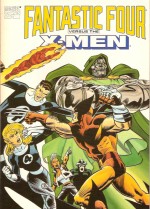
Fantastic Four versus the X-Men


By Chris Claremont, John Bogdanove & Terry Austin (Marvel)
ISBN: 0-87135-650-3

Here’s a good solid yarn from simpler times which serves as the perfect introduction to two fully developed franchises, but still won’t leave you reeling under an avalanche of new names and concepts. Originally released as a four issue miniseries in 1987, this intriguing mystery looks deep into the character of possibly the oldest character in the Marvel universe and turns its most trusted hero into a potential monster.

Everybody knows that Reed Richards is the smartest man on the planet, and how he took his three most trusted companions on a trip into space. Once there the ever-present cosmic rays mutated the quartet into the super-powered freaks now known as the Fantastic Four. How could such a colossal intellect forget something as basic as radiation shielding?

This tale takes place at a time when the mutant heroes and public fugitives called X-Men are being led by Magneto, and is the culmination to a story-arc where young Kitty Pryde is dying: her ability to pass through matter out of control and her body gradually drifting to unconnected atoms.

When Sue Richards finds an old journal belonging to her husband the trust and loyalty that bind the FF together is shattered. The book reveals that the younger Reed had in fact deduced the transformative power of cosmic rays and manufactured the entire incident to create a team of super-warriors. All the years of misery and danger have been a deliberate, calculated scheme by a ruthless mind that could only see life in terms of goals and outcomes.

When the X-Men bring their medical emergency to the FF, Reed, protesting his innocence to a family and team who no longer trust him and with his confidence shattered, falters. He knows that he didn’t plan to mutate his team, but he did make a mistake that altered their lives forever. What if he makes another blunder with Pryde’s cure?

And then Doctor Doom steps in…

This is a superb adventure stuffed with guest-stars that moves beyond gaudy costumes and powers to display the core humanity of Reed Richards and the true depths of evil his greatest enemy can sink to. As an example of sensitive character writing it has few equals and the stylish illustration of Jon Bogdanove is captivating to behold. Long overdue for reprinting this is a tale for all drama lovers, not just the fights ‘n’ tights crowd.
© 1987, 1990 Marvel Entertainment Group, Inc. All Rights Reserved.

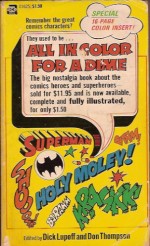
All in Color for a Dime


Edited by Dick Lupoff and Don Thompson (Ace Books)
ISBN: 01625

(Krause Edition 1997 ISBN-13: 978-0873414982)

I tend to concentrate on the worth and validity of sequential graphic narrative, both as art-form and commercial medium, and only peripherally discuss its value as a tool of nostalgia. That’s not because it is of any lesser value, but simply a facet of the fact that nostalgia is an intensely personal and mostly subjective experience. Tintin may be a world classic but the size and feel of the oversized hardback album that instantly rockets me back to 1963 and swamps me in a sea of joyous re-sensations is something I can barely describe, let alone communicate.

But comic-books do have a shared culture: a communal history and geography, part internal landscape and continuity and part acquisition memory as thousands of dedicated fans simultaneously recall how they first joined our particular cult and culture.

This is the book that really kicked it all off for comics fandom and brought criticism of the art-form into a more professional arena. Professionally produced by fans for fans it dangled the dazzling prospect of getting involved and getting paid for it: of joining those people that made the comics. It said “It’s okay to love comics, and by the way have you seen these?”

It really began in 1965 with an industry insider: Jules Feiffer had published The Great Comicbook Heroes, a compendium and essay on historic characters of the early days of the industry, but this collection of recollections and reflections by a serious assemblage of fun-seeking writers spoke less to popular culture and more to the joy and wonder their vanished subjects had caused, and openly wished for their revival and return: these guys wanted to share the fun….

Complete with 16 pages of enticing full-colour cover reproductions and dotted with dozens of monochrome illustrations, it all starts with ‘The Spawn of M.C. Gaines’ an examination of the comic-book industry’s creation and its biggest stars Superman and Batman, from music critic, author and SF editor Ted White, whilst labour-leader, political activist and retired Military Intelligence officer Dick Ellington wrote compellingly of the innocent wonders to be found in Fiction House’s more adult oriented fare in ‘Take Me to Your Leader’, paying particular attention to the iconic Planet Comics.

Editor and author Dick Lupoff remembered the original Captain Marvel in ‘The Big Red Cheese’, Comics historian Bill Blackbeard described the glory days of Popeye in ‘The First (Arf Arf) Superhero of them All’ and journalist Don Thompson (who would dedicate decades of his life to the cause as editor of the industry’s greatest periodical The Comic Buyers Guide) conjured up magical moments with his recollections of Timely heroes evolution into Marvels in ‘OK Axis, Here We Come!’

Tom Fagan organised such successful comics-related Halloween pageants that he and his town of Rutland, Vermont became a part of four-color folklore themselves. In ‘One on All and All on One’ he outlines the history of the kids and kids gangs, writer editor Jim Harmon relates the history of the Justice Society of America in ‘A Swell Bunch of Guys’ and TV producer Chris Steinbrunner described the celluloid crossovers of comics characters in ‘The Four Panelled, Sock-Bang-Powie Saturday Afternoon Screen.’

Roy Thomas investigated the influence of Fawcett Comics legendary second stringers in ‘Captain Billy’s Whiz Gang’, writer and historian Ron Goulart explored the inexplicable appeal of ‘The Second Banana Superheroes’ and Harlan Ellison concluded the affair with paeans to surreal whimsy for the very young with an discussion of the incredible George Carlson and Jingle-Jangle Comics in ‘Comics of the Absurd’

This book opened the door for serious comics fandom, and possibly preserved what credibility the medium might have left after the painful over-exposure that came with the Camp Superheroes craze and Batmania. But it’s also a heartfelt and incisive examination of what we all love about comics and a book every fan and collector should read.
© 1970 Richard A. Lupoff and Don Thompson. All rights reserved.

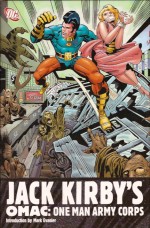
Jack Kirby’s OMAC: One Man Army Corps


By Jack Kirby with D. Bruce Berry & Mike Royer (DC Comics)
ISBN: 978-1-84576-922-2

There’s a magnificent abundance of Jack Kirby collections around these days (‘though still not all of it, so I’m not completely happy yet) and this slim hardback compendium re-presents possibly his boldest and most heartfelt creation after the comics landmark that was his Fourth World Cycle.

Famed for his larger than life characters and gigantic, cosmic imaginings, “King” Kirby was an astute, spiritual man who had lived though poverty, gangsterism, the Depression and World War II. He had seen Post-War optimism, Cold War paranoia, political cynicism and the birth and death of peace-seeking counter-cultures. He always looked to the future and he knew human nature intimately. In OMAC: One Man Army Corps, he let his darkest assumptions and prognostications have free rein, and his “World That’s Coming” was far too close to the World we’re now in…

In 1974, with his newest creations inexplicably tanking at DC, Kirby tentatively considered a return to Marvel, but ever the consummate professional he scrupulously carried out every detail of his draconian DC contract. When The Demon was cancelled he needed to find another title to maintain his Herculean (Jack was legally expected to deliver 15 completed pages of art and story per week) commitments and returned to an idea he had shelved in 1968.

That was to re-interpret Captain America into a distant future where all Kirby’s direst prognostications and fears could be made manifest. In 1974 he returned to those re-imaginings and produced a nightmare scenario that demanded not a hero but a warrior.

Dubbing his Day-After-Tomorrow dystopia “The World That’s Coming”, Kirby let his mind run free – and scared – to produce a frighteningly close appreciation of our now, where science and wealth have outstripped compassion and reason, and humanity teeters on the brink of self-inflicted global destruction.

OMAC #1 launched in September-October 1974 and introduced the Global Peace Agency, a world-wide Doomwatch police force who created a super-soldier to crisis-manage the constant threats to a species with hair-trigger fingers on nuclear stockpiles, chemical weapons of mass destruction and made-to-measure biological horrors.

Base human nature was the true threat behind this series, and that was first demonstrated by the decent young man Buddy Blank, who whilst working at Pseudo-People Inc., discovers that the euphemistically entitled Build-A-Friend division hides a far darker secret than merely pliant girls that come in kit-form.

Luckily Buddy had been singled out by the GPA and genius Professor Myron Forest for eternal linkage to the sentient satellite Brother Eye, his atoms reconstructed until he became a living God of War, and the new-born human weapon easily destroys his ruthless employers before their murderous plans can be fully realised. ‘Buddy Blank and Brother Eye’ was followed by a truly prophetic tale, wherein impossibly wealthy criminal Mister Big purchased an entire city simply to assassinate Professor Forest in ‘The Era of the Super-Rich!’

Kirby’s tried and trusted approach was always to pepper high concepts throughout blazing action, and #3 was the most spectacular yet. OMAC fought ‘One Hundred Thousand Foes!’ to get to the murderous Marshal Kafka; terrorist leader of a Rogue-State with a private army, WMDs and a solid belief that the United Nations couldn’t touch him. Sound familiar…?

That incredible clash concluded in #4’s ‘Busting of a Conqueror!’ and by #5 Kirby had moved on to other new crimes for a new world. The definition of a criminal tends to blur when you can buy anything – even justice – but rich old people cherry-picking young men and women for brain-implantation is (hopefully) always going to be a no-no. Still, you can sell or plunder some organs even now…

Busting the ‘New Bodies for Old!!’ racket took two issues, and after the One Man Army Corps smashed ‘The Body Bank!’ he embarked on his final adventure. Water shortage was the theme of the last tale, but as our hero trudged across a dry and desolate lake bottom amidst the dead and dying marine life he was horrified to discover the disaster was the work of one man. ‘The Ocean Stealers!’ (issue #7) introduced Doctor Skuba, a scientific madman who had mastered the very atomic manipulation techniques that had turned feeble Buddy Blank into an unstoppable war machine.

Joe Kubert drew the cover to OMAC #8 ‘Human Genius Vs Thinking Machine’; an epic episode that saw Brother Eye apparently destroyed as Skuba and Buddy Blank died in an incredible explosion.

But that final panel is a hasty, last-minute addition by unknown editorial hands, for the saga was never actually finished. Kirby, his contract completed, had promptly returned to Marvel and new challenges such as Black Panther, Captain America, 2001, Devil Dinosaur, Machine Man and especially The Eternals.

Hormone treatments, Virtual Reality, medical computers, satellite surveillance, genetic tampering and all the other hard-science predictions in OMAC pale into insignificance against Kirby’s terrifyingly accurate social observations in this bombastic and tragically incomplete masterpiece. OMAC is Jack Kirby’s Edwin Drood, an unfinished symphony of such power and prophecy that it informs not just the entire modern DC universe and inspires ever more incisive and intriguing tales from the King’s artistic inheritors but still presages more truly scary developments in our own mundane and inescapable reality…

As always in these wondrously economical collections it should be noted that the book is also stuffed with un-inked Kirby pencilled pages and roughs, and Mark Evanier’s fascinating, informative introduction is a fact-fan’s delight. And as ever, Jack Kirby’s words and pictures are an unparalleled, hearts-and-minds grabbing delight no comics lover could resist.

Jack Kirby is unique and uncompromising. If you’re not a fan or simply not prepared to see for yourself what all the fuss has been about then no words of mine will change your mind. That doesn’t alter the fact that Kirby’s work from 1937 to his death in 1994 shaped the entire American comics scene, affected the lives of billions of readers and thousands of creators in all areas of artistic endeavour around the world for generations and still wins new fans and apostles every day, from the young and naive to the most cerebral of intellectuals. His work is instantly accessible, irresistibly visceral, deceptively deep whilst being simultaneously mythic and human: and just plain Great.

© 1974, 1975, 2009 DC Comics. All Rights Reserved.

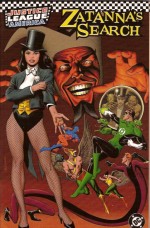
JLA: Zatanna’s Search


By Gardner Fox & various (DC Comics/Titan Books)
ISBN: 1-4012-0188-1

With Julius Schwartz and John Broome writer extraordinaire Gardner Fox built the Silver Age of comics and laid the foundations of the modern DC universe. He was also a canny innovator and one of the earliest proponents of extended storylines which have since become so familiar to us as “braided crossovers.”

A qualified lawyer, Fox began his comics career in the Golden Age on major and minor features, working in every genre and for most companies. One of the B-list strips he scripted was Zatara; a magician-hero in the Mandrake mould who had fought evil and astounded audiences in the pages of Action and World’s Finest Comics for over a decade, beginning with the very first issues (to be completely accurate the latter’s premiere performance was entitled World’s Best Comics #1, but whatever the book’s name, the top-hatted and tailed trickster was there…)

Zatara fell from favour at the end of the 1940s and faded from memory like so many outlandish crime-crushers. In 1956 Editor Schwartz reinvented the superhero genre and reintroduced costumed characters based on the company’s past pantheon. Flash, Green Lantern, Hawkman and the Atom were refitted for the sleek, scientific atomic age, and later their legendary predecessors were reincarnated and returned as denizens of an alternate Earth.

As the experiment became a trend and then inexorable policy, surviving heroes such as Superman, Batman, Green Arrow, Aquaman and Wonder Woman were retrofitted to match the new world order. The Superhero was back and the public appetite seemed inexhaustible.

For their next trick Fox and Schwartz turned to the magician and presumably found him wanting. Rather than condemn him to Earth-2 they created the first “legacy hero” by having Zatara vanish from sight and introduced his daughter, set on a far-reaching quest to find him. Zatanna debuted in Hawkman #4 (October-November 1964) illustrated by the great Murphy Anderson in a tale entitled ‘The Girl who Split in Two’.

Following a mystical trail and wearing a variation of Zatara’s garb the plucky but impatient lass had divided her body and travelled simultaneously to Ireland and China, but lapsed into paralysis until Hawkman and Hawkgirl answered her distress call.

Although nobody knew it at the time she appeared next as a villain in Detective Comics #336 (February 1965). ‘Batman’s Bewitched Nightmare’ found a broom-riding old crone attacking the Dynamic Duo at the command of mutant super-threat The Outsider in a stirring yarn drawn by Bob Kane and Joe Giella.

Current opinion is that this wasn’t originally intended as part of the epic, but when the quest was resolved in Justice League of America #51 at the height of TV inspired “Batmania” a very slick piece of back writing was necessary to bring the high-profile Caped Crusader into the storyline.

Gil Kane and Sid Greene illustrated the next two chapters in the saga; firstly in ‘World of the Magic Atom’ (Atom #19, June-July 1965), wherein the Mystic Maid and Tiny Titan battled Zatara’s old nemesis the Druid in the microversal world of Catamoore, and then with Green Lantern in an extra-dimensional realm on ‘The Other Side of the World!’ (Green Lantern #42, January 1966), as the malevolent Warlock of Ys was eventually compelled to reveal further clues in the trail.

The Elongated Man was a long-running back-up feature in Detective Comics, and from #355 (September 1966, pencilled and inked by Carmine Infantino) ‘The Tantalizing Trouble of the Tripod Thieves!’ revealed how the search for a stolen eldritch artefact brought the young sorceress closer to her goal, and the search concluded in spectacular fashion with the aforementioned JLA tale ‘Z – As in Zatanna – and Zero Hour!’ (#51, February 1967).

With art from the unmatchable team of Mike Sekowsky and Sid Greene, all the heroes who aided her are transported to another plane to fight in a classic battle of good versus evil, with plenty of cunning surprises for all and a happy ending at the end. Collected here is a triumphant long-running experiment in continuity that is one of the very best adventures of the Silver Age, featuring some of the period’s greatest creators at the peak of their powers.

This slim volume also has an encore in store: after the cover gallery is a never before reprinted 10 page tale ‘The Secret Spell!’ by Gerry Conway, Romeo Tanghal and Vince Colletta, originally seen in DC Blue Ribbon Digest #5 (November-December 1980) which revealed ‘Secret Origins of Super-Heroes’ and explores the hidden history of both father and daughter in a snappy, informative and inclusive manner.

Although a little hard to find now this is a superlative book for fans of costumed heroes and would also make a wonderful tome to introduce newcomers to the genre.

© 1964, 1965, 1966, 1967, 1980, 2004 DC Comics.  All Rights Reserved.
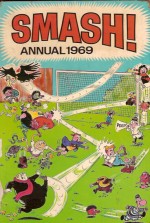
Smash Annual! 1969


By various (Odhams)
No ISBN

Following my own self-created Christmas tradition here’s another British Annual that contributed to making me what I am today, selected not just for nostalgia’s sake but because it is still eminently palatable and worthy of your attention, even under 21st century scrutiny.

Smash! was one of the “Power Comics” brand used by Odhams to differentiate those periodicals which contained resized, reprinted American superhero material from the regular blend of sports, war, western and adventure comics, and which did so much to popularise the budding Marvel characters in this country. However although the comic featured the Hulk and Batman (repackaging the 1960s newspaper strip rather than comic-books), this annual is an all British affair.

In actuality that’s not strictly true but if meat from Argentina can be “produce of Britain” if it’s processed here, then surely art commissioned in England but produced by some of the best illustrators from Europe and South America (as was increasingly the case in the late 1960s and 1970s) qualifies too…

The Annual itself consists of a plethora of short comedy strips and longer action pieces, with classic gag characters such as Grimly Feendish, Percy’s Pets, the Swots and the Blots, Bad Penny, The Man from B.U.N.G.L.E., The Nervs, Charlie’s Choice, Ronnie Rich and the promotional Mick and the Martians, by the likes of Leo Baxendale, Mike Brown, Gordon Hogg and Stan McMurty, but since my knowledge of British creators at this time is so woefully inadequate, I wouldn’t be surprised if I’ve misattributed and besmirched the good names of Graham Allen, Mike Lacey, Terry Bave and Artie Jackson.

If so I sincerely apologise, but at least my ignorance can’t detract from the manic brilliance of the strips themselves.

The action content is provided by The Rubber Man (probably by Ken Mennell and Alfredo Marculeta), two outings for time-travelling historians The Legend Testers (and I’m pretty sure neither was drawn by regular artist Jordi Bernet) a science fiction invasion tale entitled Inferno (definitely Spanish and possibly Ortiz) and a peculiar futuristic superhero strip Lieutenant Lightning and the Thog Menace which looks a lot like early Ron Smith – but I’m sure someone with greater knowledge than mine will correct me where I err.

To keep the nippers extra-engrossed and quiet there were also some games pages from Mister Knowall to supplement the food and drink fuelled frenzy: the kinds of things Dads lose patience with by the third card trick…

Christmas simply wasn’t right without a heaping helping of these garish, wonder-stuffed compendiums that offered a huge variety of stories and scenarios. Today’s celebrity, TV and media tie-in packages simple can’t compete so why not track down a selection of brand-old delights for next year…?
© 1968 Odhams Books Limited. 2006, 2007, 2008 DC Comics. All Rights Reserved.
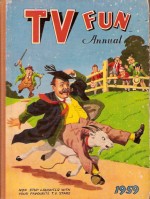
TV Fun Annual 1959


By various (the Amalgamated Press)
No ISBN

After decades when only American comics and nostalgia items were considered collectable, recent years have seen a resurgence of movement in home grown product. If you’re lucky enough to stumble across a vintage volume, I hope my words can convince you to acquire it. However, if I can also create a groundswell of publishers interest maybe a lot of magical material out there in print limbo will resurface in affordable new collections…

Great writing and art is rotting in boxes and attics or the archives of publishing houses, when it needs to be back in the hands of readers once again. On one level the tastes of the public have never been more catholic than today and a sampling of our popular heritage will always appeal to some part of the mass consumer base. Let’s make copyright owners aware that there’s money to be made from these slices of our childhood. You start the petition… I’ll certainly sign it.

TV Fun Annual 1959 was released by The Amalgamated Press just as the silver screen became a staple of every household, but as the comic it celebrated was gasping its last (dating was year-forward on these bumper, hard-backed premium editions so this edition would have been released in the Autumn of 1958).

The comic launched on 19th September 1953, presenting strips, stories and manufactured gossip and PR for a range of entertainment figures. The format had been a popular one since the times when British comics had featured silent film and radio stars, but as paper and print technology advanced and illustrators were replaced by photography only the comedic elements really kept pace.

TV Fun ran until September 1959, absorbing Jingles and Tip Top along the way before being swallowed by the rise of new style celebrity comics like Buster.

This volume doesn’t vary from the traditional format, with a preponderance of text stories, “messages” from such stars as Sally Barnes, Dickie Valentine, Pat Boone and others, plus a selection of puzzles, “Would You Believe It” fact-files, strip histories of motoring and aviation and party games on offer. There are also a number of lavish, fully painted plates inserted featuring Robinson Crusoe, The Dancing Highwayman and the latest technological marvel the Deltic – a Diesel-Electric locomotive.

The prose content comprises two to five page stories, some attributed to the likes of Ruby Murray and Winifed Atwell, recollections from Arthur Askey and Whacko! Headmaster Jimmy Edwards and there’s a ripping yarn from the Casebook of Inspector James and but The Isle of Fear, The Duel at Daybreak!, Jungle Magic, The Man from the Circus!, The Last Voyage, Hold-up in Snake Valley, The Ragged Millionaire and The Spy at the Inn are all standard, celeb-free historical, pioneering or seafaring adventures, westerns and other types of trauma-free yarns meant to thrill while encouraging a love of reading.

The strips are gentle comedies and gentler dramas starring Max Bygraves, Arthur Askey, Diana Decker (who you won’t recall as “the Cutie-Queen of the TV Screen”), Strongheart the Wonder Dog of the Woods, The Harty Family, Mick of the Mounties, Ferdy the Sly Old Fox, Our Jean, Mick and Montmorency, Sally Barnes, Derek Roy and his dog Nero, Jimmy Edwards – the Pride of St. Capers, Brownie the Pony, Sheikh Abdul and his servant Pepi, Shirley Eaton – the Modern Miss and Inventors Circle: a cornucopia of colour and monochrome tales from some of Britain’s best postwar cartoonists.

Some of the content might raise a few eyebrows these days. Popular fiction from a populist publisher will always embody some underlying assumptions unpalatable to modern readers, but good taste was always a watchword when producing work for children and a strip like Mississippi Max and his Axe, whilst visually racist, still had a black protagonist who was kind, helpful and above all not an idiot – a claim many white characters couldn’t make…

A more insidious problem was the institutionalised sexism through-out. All we can hope for is that the reader uses judgement and perspective when viewing or revisiting material this old. Just remember Thomas Jefferson kept slaves and it’s only been illegal to beat your wife since the 1980’s.

Before I go off on one let’s return to the subject at hand and say that despite all the restrictions and codicils this is a beautiful piece of children’s entertainment in a traditional mould with illustrations that would make any artist weep with envy.
© 1958 The Amalgamated Press.
Which I’m assuming is now part of IPC Ltd., so © 2009 IPC Ltd.