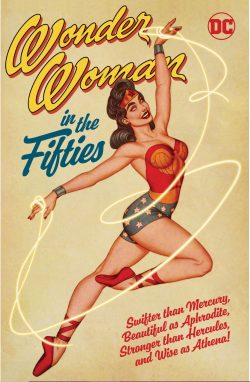
Wonder Woman in the Fifties


By Robert Kanigher, John Broome, Harry G. Peter, Ross Andru & Mike Esposito, Frank Giacoia, Arthur Peddy & Bernard Sachs & various (DC Comics)
ISBN: 978-1-779507-624-6 (TPB/Digital edition)

In the early years of this century, DC launched a series of graphic archives intended to define DC’s top heroes through the decades: delivering magnificent past comic book magic from the Forties to the Seventies via a tantalisingly nostalgic taste of other – arguably better, but certainly different – times. The collections carried the cream of the creative crop, divided into subsections, partitioned by cover galleries, and supplemented by short commentaries; a thoroughly enjoyable introductory reading experience. I prayed for more but was frustrated… until now…

Part of a trade paperback trilogy – the others being Superman and Batman (thus far, but hopefully Aquaman, Green Arrow and Martian Manhunter are in contention too, as they have become such big shot screen stars these days) – the experiment was recently re-run, with even more inviting samples from the company’s vintage, family-friendly canon.

Gathered here is a menu of deliciously dated delights starring Earth’s most recognisable Female Heroic Ideal, heralded by a time-&-tone-setting Introduction from historian, author and columnist Andy Mangels augmenting each context-stuffed chapter text piece.

With Robert Kanigher as primary writer of record throughout the book, the contents here originated in Sensation Comics #97, 100; Wonder Woman #45, 50, 60, 66, 72, 76, 80, 90, 94-95, 98-105, 107, 108, 750; and All-Star Comics #56, 57 spanning the entire decade whilst attempting to reconcile an indomitable symbol of female emancipation and independence with a post-war world determined to turn them back into docile brood mares and passive uber-consumers…

Wonder Woman was created by polygraph pioneer William Moulton Marston – apparently at the behest of his remarkable wife Elizabeth and their life partner Olive Byrne. The vast majority of the outlandish early adventures were limned by illustrator Harry G. Peter.

The Astounding Amazon debuted in All Star Comics #8 (cover-dated December 1941, and top-selling home of the Justice Society of America) just before launching in her own solo series and cover-spot of new anthology Sensation Comics the following month. She was an instant hit, and gained her own eponymous title in late Spring of that year (Summer 1942).

Using the nom de plume Charles Moulton, Marston & Co scripted all her many and fabulous exploits until his death in 1947, whereupon Kanigher officially took over the writer and editor’s role. The venerable Peter continued until his own death in 1958. Wonder Woman #97 – in April of that year – was his last hurrah and the end of an era.

Supported by a factual briefing, the comics classics commence with The (Many) Origins of Wonder Woman, and the first adjustments to the classic origin tale…

For purposes of comparison, the 1940s saga stated that on a hidden island of immortal super-women, American aviator Steve Trevor of US Army Intelligence crashed to Earth. Near death, he was nursed back to health by young, impressionable Princess Diana.

Fearing her growing obsession with the creature from a long-forgotten, madly violent world, her mother Queen Hippolyte shared the hidden history of the Amazons: how they were seduced and betrayed by men, but rescued by goddess Aphrodite on condition they isolated themselves from the world, devoting their eternal lives to becoming ideal, perfect creatures.

However, when Athena and Aphrodite subsequently instructed Hippolyte to despatch an Amazon with the American to fight for global freedom and liberty and against oppression and barbarism, Diana overcame all other candidates in a brutal open competition to became their emissary – Wonder Woman.

On arriving in America, she purchased the identity and credentials of lovelorn Army nurse Diana Prince, elegantly allowing the Amazon to be close to Steve and the heartsick medic to wed her own fiancé in South America. Diana also joined Army Intelligence as secretary to General Darnell, ensuring she would always be able to watch over her beloved. She little suspected that, although painfully shallow Steve only had eyes for the dazzling Amazon superwoman, the General had fallen for mousy yet superbly competent Lieutenant Prince…

As the decade turned it was deemed time for a refurbished origin and – illustrated by Harry G. Peter – WW #45 (cover-dated January/February 1951) delivered ‘The Wonder Woman Story!’

This found childhood rivals vying for the journalistic kudos of publishing the Amazon’s backstory. However, after a hard-won trip to Paradise Island led to Mary Ellen learning the details of it all – Hercules’s ancient ‘Act of Treachery!’ and how the Princess defied authority for love – all manner of trouble emerged…

Cunning competitor John Lane had bugged Mary’s jewellery and craftily followed her to the Amazon homeland, causing a major upset…

Back then Wonder Woman’s artists were astonishingly faithful and true, staying with her for pretty long hauls. Peter and his uncredited team of female assistants served nearly 20 years before he was let go mere weeks before dying. His replacements Ross Andru & Mike Esposito drew her adventures from 1958 to the middle of 1967 (#98 – 171), and limned this breakthrough tale from WW #105 (April 1959)

The issue debuted Wonder Girl in the ‘‘The Secret Origin of Wonder Woman’, revealing how centuries ago Olympian divinities bestowed unique powers on the daughter of Queen Hippolyta and how – as a mere teenager – the indomitable Diana brought the Amazons to Paradise Island. Continuity – let alone consistency or rationality – were never as important to Kanigher as strong story or breathtaking visuals, and this eclectic odyssey is a great yarn that simply annoyed the heck out of a lot of fans – but not as much as the junior Amazon would in years to come after these teen tales spawned an actual junior Amazon as sidekick to Diana…

That ball started rolling in #107 (July 1959) and proved that the high fantasy exploits of the minor had clearly caught somebody’s editorial fancy. Follow-ups came thick and fast after ‘Wonder Woman Amazon Teen-Ager!’ saw the youngster ensnare an unwanted romantic interest in merboy Ronno, whilst dutifully undergoing a quest to win herself a superhero costume…

Fronted by an article on her legendary kit and illustrated throughout by H.G. Peter, Fashion as Armor: The Equipment List shares some of Kanigher’s frequent and often contradictory exposés on the source and powers of Wonder Woman’s combat gear. It begins with ‘The Secret Story of Wonder Woman’s Lasso!’ (WW #50, November/December 1951), depicting how the princess undertakes three divine tasks to ensure the rope gains magical traits of unbreakability, infinite elasticity and truthful compulsion. Along the way she uses it against crooks, spies, other Amazons, submarines, dinosaurs and a Roc…

That mythological bird, another dinosaur and aliens play a major role in ‘The Talking Tiara!’ (#66, May 1954) as Steve learns how Diana belatedly won possession of her headpiece, a “Linguagraph Tiara” capable of translating any language past present or future, whilst ‘The Secret of Wonder Woman’s Sandals’ (#72, February 1955) reveals some odd characteristics of the footwear as she performs incredible feats (sorry!) to confirm her worthiness…

Cover-dated February 1956 ‘The Origin of the Amazon Plane!’ featured in Wonder Woman #80, recalling a trio of tasks undertaken to collect separated sections of her faithful, invisible robot conveyance before #95 (January 1958) offered ‘The Secret of Wonder Woman’s Tiara!’: this time in the form of a tale told to toddlers, revealing how the hat was a gift from aliens given in thanks for saving them from marauding Phenegs…

Moving on to highlight the Amazon’s noteworthy collaborations, One of the Team offers a trio of tales. The section is a somewhat “Marmite” moment that fans will either love or hate…

The majority of the chapter is devoted to a brace of tales starring the Justice Society of America and, whilst I’m never going to complain about seeing such classics where new readers can discover them, it’s a lot of pages to hand over to a group who had Wonder Woman serving coffee and taking notes as “Club Secretary” for years. At least here, in the last of the original run, she’s graduated to being an leading participant in their adventures…

After the actual invention of the superhero via the 1938 Action Comics debut of Superman, the most significant event in our industry’s history was the combination of individual stars into a like-minded group. Thus, what seems blindingly obvious to us with the benefit of four-colour hindsight was proven: consumers can’t get enough of garishly-hued mystery men, and combining a multitude of characters inevitably increases readership. Plus, of course, a mob of superheroes is just so much cooler than one…or one-and-a-half if there’s a sidekick involved…

The creation of the Justice Society of America in 1941 utterly changed the shape of the budding industry. Following the runaway success of Superman and Batman, both National Comics and its separate-but-equal publishing partner All-American Comics went looking for the next big thing whilst frantically concentrating on getting anthology packages into the hands of a hungry readership. Thus All Star Comics: conceived as a joint venture affording characters already in their respective stables an extra push towards winning elusive but lucrative solo titles.

Technically, All Star Comics #3 (cover-dated Winter 1940-1941 and released in December 1940) was the kick-off, but the mystery men merely had dinner and recounted recent cases and didn’t actually go on a mission together until #4, which had an April 1941 cover-date.

The merits of the marketing project would never be proved: rather than a runaway favourite graduating to their own starring vehicle as a result of the poll, something radically different evolved. For the third issue, prolific scribe Gardner Fox apparently had the bright idea of linking all the solo stories through a framing sequence with the heroes gathering to chat about their latest exploits. With that simple notion that mighty mystery men hung out together, history was made and it wasn’t long before they started working together…

However, after WWII ended, superheroes gradually declined, and most companies had shelved them by 1950. Their plummet in popularity led to a revival in genre-themed titles and characters, and it was a stripped-down team (Flash, Green Lantern, Hawkman, The Atom, Black Canary, Dr. Mid-Nite and Wonder Woman) in contemporarily tailored crime and science fiction sagas before the title abruptly changed into All Star Western with #58.

Both JSA stories were written by John Broome and illustrated via alternating chapters by Frank Giacoia and Arthur Peddy & Bernard Sachs. Leading off is All-Star Comics #56 (December 1950/January 1951) and ‘The Day the World Ended!’ wherein a future scientist goes to extraordinary lengths to recruit the 20th century stalwarts to save Tomorrow’s World from shapeshifting invaders. Issue #57 was the JSA’s last hurrah with ‘The Mystery of the Vanishing Detectives!’ pitting them against criminal mastermind The Key after he abducts Earth’s greatest criminologists in advance of a spectacular robbery spree. Both are great yarns that deserve their own archival volume, but the Amazon’s contributions are barely visible in both…

Of more interest is the Kanigher & Peter tale from Wonder Woman #72 (November 1957). ‘The Channel of Time’ begins as an unashamed plug for The Adventures of Superman TV show, with the Amazon eagerly enjoying the latest episode when interference turns the screen into an SOS through time, displaying old ally Robin Hood in existential peril…

An initial iteration of the legendary archer had debuted in New Adventure Comics #23 (January 1938), and National/DC also acquired Quality Comics’ Robin Hood Tales title. That version had begun in February 1956, with DC continuing the run from #7 (cover-dated February 1957) as well as featuring the hero in Kanigher’s The Brave and the Bold from #5 (May 1956). That was (coincidentally?) the same month The Amazing Amazon first met the Sentinel of Sherwood Forest, who here requires assistance against a dragon, wicked foemen and a shark-infested moat safeguarding evil Prince John…

Seeing Double then highlights the hero’s tendency to encounter copies of herself – everything from evil doppelgangers from parallel universes to weirdly exact robot facsimiles…

When Showcase #4 rekindled the readership’s imagination and zest for masked mystery-men with a second, brand-new iteration of The Flash in 1956, the fanciful floodgates opened wide once more. As well as re-inventing Golden Age stars like Green Lantern and Hawkman, the company consequently updated many hoary survivors like Green Arrow and Aquaman. Also included in the revitalising agenda were the High Trinity: Man of Steel, Caped Crusader and the ever-resilient Princess of Power…

Andru & Esposito had debuted as cover artists 3 issues earlier, but with Wonder Woman #98 they took over the entire comic book as Kanigher reinvented much of the old mythology and tinkered with her origins in The Million Dollar Penny!’ After Athena visits an island of super-scientific immortal women, informing Queen Hippolyta that she must send an emissary and champion of justice to crime-ridden “Man’s World”, the sovereign declares an open competition for the job.

She isn’t surprised when her daughter wins and is given the task of turning a penny into a million dollars in one day – all profits going to children’s charities, of course…

Just as the new Wonder Woman begins her coin chore, American airman Steve Trevor bails out of his malfunctioning jet high above the magically hidden isle, unaware that should any male set foot on Amazon soil the immortals would lose all their powers. Promptly thwarting impending disaster, Diana and Steve then team up to accomplish her task, encountering along the way The Undersea Menace’ before building The Impossible Bridge!’

Following that epic comes the lead from landmark issue #100 (August 1958): a spectacular battle saga commencing with The Challenge of Dimension X!’ as an alternate Earth Wonder Woman competes with the Amazing Amazon for sole rights to the title: all culminating with a deciding bout in The Forest of Giants!’

No celebration of the fifties could be complete without an exploration of the outdated concept of gainful female employment. With art by Peter, Working 9 to 5: The Careers of Wonder Woman offers a quick peek of typical opportunities beginning with Sensation Comics #97 (May 1950). ‘Wonder Woman, Romance Editor’ sees the Amazon agree to a task no male journalist can handle, solving the woes of lovelorn women seeking husbands, whilst her own duties prevent her giving in to Steve’s increasingly urgent demands to settle down… Cover-dated November 1950, Sensation Comics #100 showcases ‘Wonder Woman, Hollywood Star!’ as the Amazon and Steve endure peerless perils making a movie one crazed glamour queen is determined only she should star in, after which two millionaires make a bet that propels the Amazon into a string of crazy roles culminating in her shepherding an infant T-Rex as ‘Wonder Woman, Amazon Baby Sitter!’ (WW #90, May 1957)…

As you’ve probably ascertained, much of Kanigher’s oeuvre depended on the Princess of Paradise undergoing tasks and tests for a variety of reasons and this voyage of rediscovery concludes with some of the most noteworthy, gathered as The Trials of Wonder Woman

Leading off is Peter-rendered classic ‘The Secret Olympics!’ (WW #60, July 1953) as Diana justifies her legendary brief as “beautiful as Aphrodite, wise as Athena, swifter than Mercury (sic) and stronger than Hercules”…

 Issue #76 (August 1955) introduces ‘The Bird Who Revealed Wonder Woman’s Identity!’ before Diana devises a way to undermine a gabby Mynah’s proclamations before Andru & Esposito assume the art duties for the remainder of the book, beginning with Top Secret!’ from Wonder Woman #99 (July 1958).

Introducing the Hellenic Hero’s new covert identity as Air Force Intelligence officer Lt. Diana Prince the tale opens a decade of tales with Steve perpetually attempting to uncover her identity and make the most powerful woman on Earth his blushing bride, whilst his bespectacled, glorified secretary stands unnoticed, exasperated and ignored right beside – or slightly behind – him…

Here that means attempting to trick her into marriage with a rigged bet – a tactic the creep tried a lot back then – after which ‘Wonder Woman’s 100th Anniversary!’ (WW #100 again) deals with the impossibility of capturing the far-too-fast and furious Amazon’s exploits on film for Paradise Island’s archives…

In #101 (October 1958), ‘Undersea Trap!’ sees Steve tricking his “Angel” into agreeing to marry him if she has to rescue him three times in 24 hours (just chalk it up to simpler times, or you’ll pop a blood vessel, OK?) after which January 1959 and WW #103 spotlight ‘The Wonder Woman Album!’ returning to the previously explored “impossible-to-photograph” theme, before we close on Wanted… Wonder Woman’ (#108, August 1959), as Flying Saucer aliens frame her for heinous crimes as a precursor to a planetary invasion but are not smart enough to realise when they are being played…

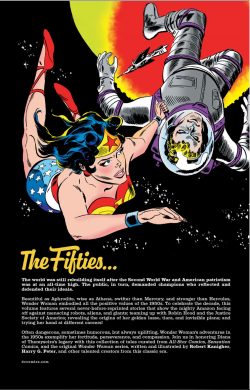
Also including a selection of breathtaking covers by Irwin Hasen & Sachs, Irv Novick, Peddy and Andru & Esposito plus a Bonus Cover Gallery by the latter pair, this is a fascinating but potentially charged tome. By modern standards these exuberant, effulgent fantasies are all-out crazy, but as examples of the days when less attention was paid to continuity and concepts of shared universes and adventure in the moment were paramount, these outrageous romps simply sparkle with fun, thrills and sheer spectacle -a s long as you keep in mind the outrageous undercurrent of blatant sexism underpinning it all. This was a period when – officially – only men could tell the tales of the Amazing Amazon…

Wonder Woman is rightly revered as a focal point of female strength, independence and empowerment, but the welcoming nostalgia and easy familiarity of these costumed fairy tales remain a delight for all open-minded readers with the true value of these exploits being the incredible quality of entertainment they provide.
© 1950, 1951, 1953, 1954, 1955, 1956, 1957, 1958, 1959, 2020, DC Comics. All Rights Reserved.
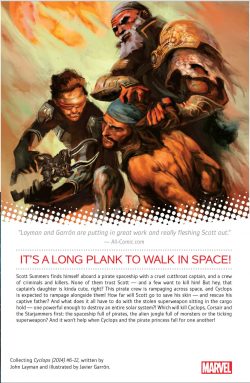
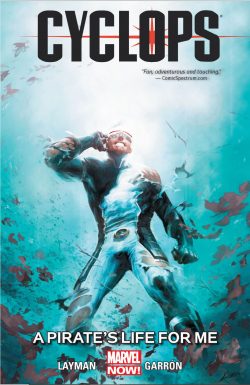
Cyclops volume 2: A Pirate’s Life for Me


By John Layman, Javier Garrón, Chris Sotomayor, & various (Marvel)
ISBN: 978-0-7851-9076-9 (TPB/Digital edition)

When mutant genius Henry McCoy learned he was dying, he used time-travel tech in a last-ditch attempt to give his life meaning. Seeking to prevent an inter-species war, he brought the young, naïve X-Men of his own youth into the future to reason with his radicalised former comrade Scott Summers, praying the still idealistic and hopeful teens could divert Mutant Enemy Terrorist No. 1 from his path of doctrinaire madness…

The gamble paid off in all the wrong ways. Rather than shocking modern day Cyclops back to his senses, the confrontation hardened the renegade’s heart and strengthened his resolve. Moreover, after McCoy the younger somehow cured his older self, he and the rest of the X-Kids were trapped in their own future and began gradually defecting to the fundamentalist team…

Eventually, the temporally-misplaced First Class ended up living with the elder Cyclops’ crew, but everything changed after Gladiator of the Shi’ar realised Jean Grey AKA Marvel Girl – and future host of the cosmic force known as the Phoenix – was back. The alien emperor rashly attempted to abduct and execute her for the crimes of her older self, but his insane pre-emptive punishment plan was foiled by an assembly of X-Men, Guardians of the Galaxy and intergalactic buccaneers Hepzibah, Ch’od, Raza Longknife, Korvus and insectoid medical wizard Sikorsky – collectively known as The Starjammers.

During the sideral shenanigans, 16-year-old Scott met his long-believed-dead dad. Now going by Corsair and undisputed leader of the cosmic privateers, Christopher Summers invited his boy to stay behind when the mutant heroes returned to Earth…

Enduring and barely surviving a steep learning curve to become a full-blooded galactic buccaneer whilst forging bonds of comradeship with the exotic crew, Scott eventually takes off with his dad for some true father-son time only to discover Corsair’s darkest secret whilst being marooned on a desolate planetoid.

Facing slow death, Cyclops devises a way off but it’s possibly worse than being eaten by the mudball world’s predatory lifeforms…

Scripted by John Layman, illustrated by Javier Garrón and coloured by Chris Sotomayor, this compendium collects issues #6-12 of Cyclops: (December 2014-June 2015), following the chronal castaway into emotional typhoons and universe-shredding crises before making safe harbour back on Earth…

It begins with the Summers family back aboard the Starjammer with the kid geekily seeking to impress his crewmates. His eagerness leads to disaster and the ship’s ambush by master star pirate Captain Malafect of the mighty vessel Desolation. Outgunned, outnumbered and seemingly helpless, Corsair savagely turns on his son, beating and denouncing him…

When the triumphant villain maroons the Starjammers to die a slow death in a lifepod, he keeps Scott as his newest recruit and Corsair just so’s he can torment and torture his old shipmate…

Soon the kid is learning the darkest sides of space pillaging, and it’s all he can do to keep the bodycount low. His squeamishness and eagerness to please doesn’t initially endear him to his new shipmates either, but he gradually befriends some of them. Pretending to torture Corsair helps his standing but the real turnabout comes after Captain’s daughter Vileena decides she really likes the “Pirate Boy”…

The X-Man Cyclops was regarded as one of the most brilliant tacticians ever born and now his timeslipped junior self proves that gift came early as the complex long game he initiated when the Starjammer was first taken begins to pay off.

As his marooned former shipmates are picked up by slavers, he leads a (relatively bloodless) raid and acquires a Shi’ar super-weapon dubbed a “starcracker”, endearing him further to Malefect and Vileena whilst losing forever the leader of the crew faction intent on killing him…

Riding high in the buccaneer’s regard, Scott leads an away mission whilst the Captain seeks to sell the ultimate weapon leading to the liberation of his father and an all-out war that pits his new friends against his old crew. In the end, it can only end in disaster and tragedy…

Rightly, the tale should end here, but also included is the final issue which was the tenth instalment of publishing event Black Vortex (Cyclops #12; June 2015). The story detailed how many of Marvel’s space-based heroes and villains became embroiled in the quest to possess a cosmic mirror that bestowed infinite power on any who used it.  Prior to this chapter, Scott reunited with his X-Men as a mystery opponent named Mr. Knife out-manoeuvred the Guardians of the Galaxy, Nova, Captain Marvel and many more…

Now reunited with his school chums and on the run again Scott sacrifices himself – as do Iceman and Groot – to the Black Vortex, hoping the resultant power-hike will help their friends before ultimately corrupting them…

Unfortunately, readers won’t learn the answer here, as we conclude with a feature on Garrón & Sotomayor’s process for turning drawings into full colour art , leaving us to the seas of fate and another collection for answers and culmination…

With covers & variants gallery by Alexander Lozano and Andrea Sorrentino, this is – despite my cavils and quibbles – a thrilling, heart-warming, funny and astoundingly action-packed romp. Cyclops: A Pirate’s Life For Me combines cosmic intrigue and dashing derring-do with solid characterisation and wild blue yonder wonderment, and will delight any fan of cosmically light-hearted Marvel Movies like Guardians of the Galaxy or Thor: Love and Thunder. What more could any wide-eyed, entertainment-starved child of the wondering stars want?
© 2014 Marvel Characters, Inc. All rights reserved. 2021 MARVEL

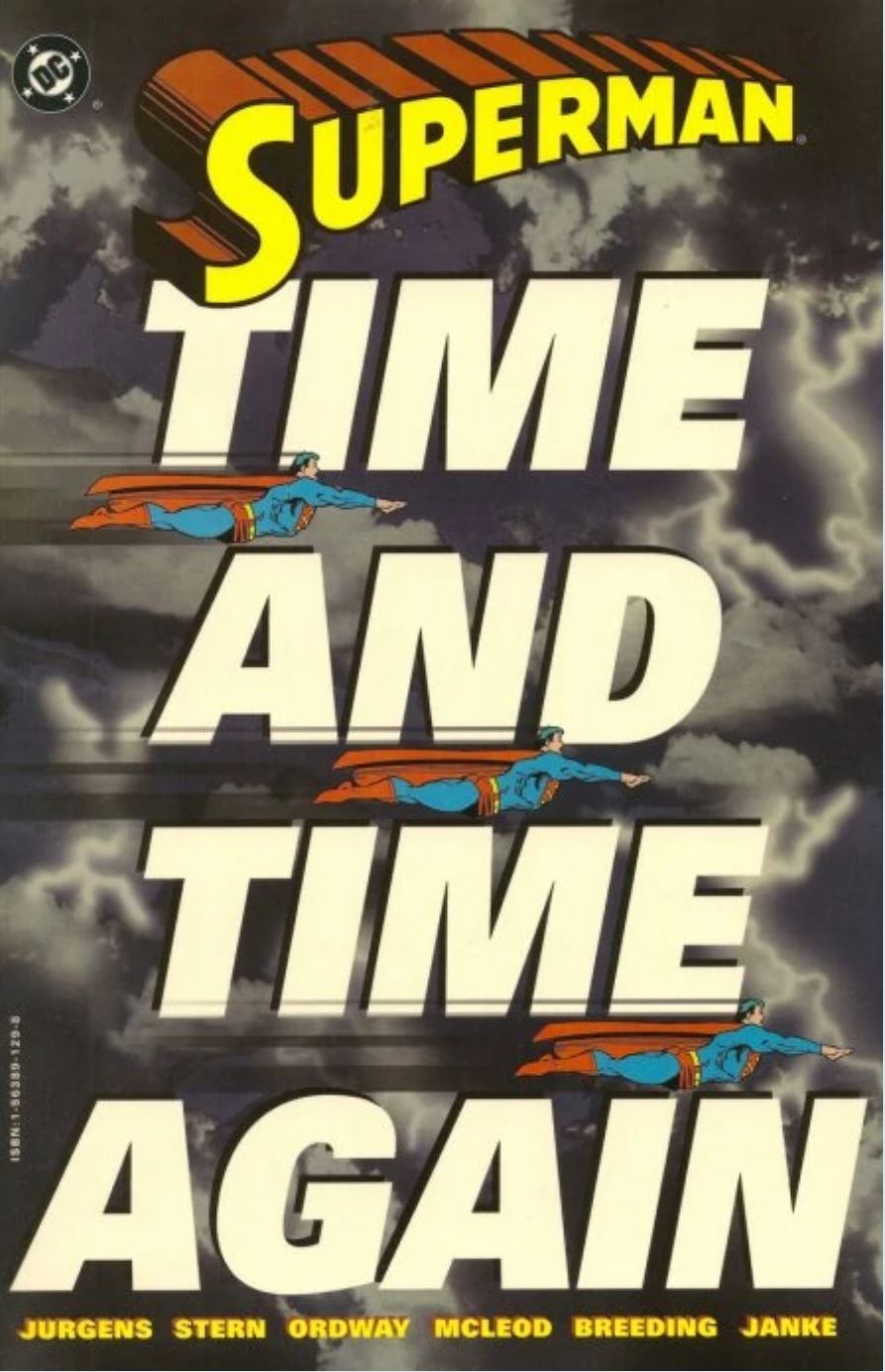
Superman: Time and Time Again


By Dan Jurgens, Jerry Ordway, Roger Stern, Bob McLeod, Brett Breeding, Dennis Janke, Tom Grummett, Jose Marzan & various (DC Comics)
ISBN: 978-1852865702 (TPB)

When Superman was re-imagined after Crisis on Infinite Earths, many of his more omnipotent abilities were discarded. Like his earliest days, he was a far from omnipotent hero, more in touch with humanity because he wasn’t so far above it. One thing that was abandoned was his casual ability to travel through time.

Indeed, rather than being able to navigate the chronal corridors with ease, in this splendid epic from 1991 (originally published serially in Action Comics #663-665, Adventures of Superman #476-478, and Superman (volume 2) #54-55 -with epilogues from #61 & 73 – the Man of Tomorrow is trapped in a cataclysmic and volatile temporal warp, bounced around from era to era with his abilities constantly diminishing and utterly unable to regain his home and loved ones.

That specifically means co-worker and girlfriend Lois Lane, to whom he has just divulged his greatest secret… his real identity…

It all begins in Adventures of Superman #476 as Dan Jurgens & Brett Breeding’s ‘The Linear Man’ sees a rogue (self-appointed) guardian of the Time Stream attempt to forcibly return chronal refugee-turned superhero Booster Gold to the 25th century he originated from. When Superman intervenes, the battle sparks a tremendous explosion, causing the Caped Kryptonian to careen through time. Each “landing” leaves him in a significant period of Earth’s history such as Roger Stern & Bob McLeod’s ‘Lost in the ‘40s Tonight’ (Action Comics #663) precipitating a meeting with that era’s first mystery men before almighty wraith the Spectre transports him not home but to ‘The Warsaw Ghetto!’ to act as temporary savour in an iconic battle saga by Jerry Ordway & Dennis Janke from Superman #54.

Apparently only gigantic explosions can launch him back into the time stream, such as occurs in in ‘Death Rekindled’ (Adventures of Superman #477 Jurgens & Brett Breeding) when a trip to the future introduces him to an iteration of the Legion of Super-Heroes needing help to destroy a monstrous Sun Eater… ‘

That climactic detonation deposits him ‘Many Long Years Ago’ (Action Comics #664, Stern & McLeod) to end up a Jurassic castaway until a clash with marooned time thief Chronos propels him into the Pleistocene and a chronologically adrift encounter with primordial alien race the H’v’ler’ni (AKA the Host)…

That tussle tosses him forward to ‘Camelot’ just as the Dark Ages begin, battling valiantly but in vain beside eventual All-Star Squadron champion and Seventh Soldier of Victory Sir Justin the Shining Knight in Superman #55 (Ordway) before landing again with another LSH for blockbusting finale ‘Moon Rocked’ (Adventures of Superman #478 Jurgens & Breeding) and resolution and reunion with Lois via a 5-page excerpt from Action Comics #665’s ‘Wake the Dead’

Also included are the contents of Superman #61’s ‘Time and Time Again Again!’ and #73’s ‘Time Ryders’ – both by Jurgens & Breeding – as the Man of Tomorrow has further dealings with the Linear Men Matthew Ryder, Waverider, Liri Lee and Hunter

As Superman is gradually depowered whilst seeking to get home without wrecking reality, he enjoys incredible memorable moments – such as walking with dinosaurs, cathartically crushing Nazis, tussling with a mammoth and fighting Etrigan the Demon during the fall of civilisation. He also meets many milestone characters from DC history including the WWII Justice Society of America, and encounters the Legion of Super-Heroes at three critical points of their long and varied career: making this tale a significant marker for establishing the key points of post-Crisis on Infinite Earths continuity…

This hugely enjoyable epic is highly readable and cheerfully accessible for both returning and first time fans so it’s a true shame it’s currently out of print and still unavailable as a digital edition. Hopefully with Superman’s 85th anniversary impending there are moves afoot to rectify that…
© 1991, 1992, 1994 DC Comics. All Rights Reserved.
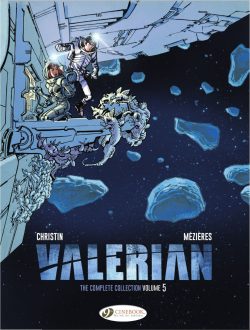
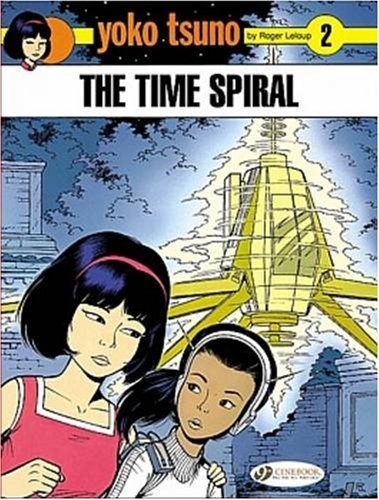
Yoko Tsuno volume 2: The Time Spiral


By Roger Leloup translated by Luke Spear (Cinebook)
ISBN: 978-1-905460-43-4 (Album PB)

In 1970, indomitable intellectual adventurer and “electronics engineer” Yoko Tsuno began her career in Le Journal de Spirou. She is still delighting readers and making new fans to this day in astounding, all-action, excessively accessible adventures which are amongst the most intoxicating, absorbing and broad-ranging comics thrillers ever created.

The globe-girdling, space-&-time-spanning episodic epics starring the Japanese investigator were devised by monumentally multi-talented Belgian maestro Roger Leloup, who began his own solo career after working as a studio assistant and technical artist on Hergé’s timeless Adventures of Tintin.

Compellingly told, superbly imaginative and – no matter how implausible the premise of any individual yarn may appear – always firmly grounded in hyper-realistic settings underpinned by authentic, unshakably believable technology and scientific principles, Leloup’s illustrated escapades were at the vanguard of a wave of strips revolutionising European comics.

That long-overdue sea-change heralded the rise of competent, clever, brave and formidably capable female protagonists taking their rightful places as heroic ideals; elevating Continental comics in the process. These endeavours are as engaging and empowering now as they ever were, and none more so than the trials and tribulations of Miss Tsuno.

Her very first outings (the still unavailable Hold-up en hi-fi, La belle et la bête and Cap 351) were mere introductory vignettes before the superbly capable troubleshooter and her valiant if less able male comrades Pol Paris and Vic Van Steen properly hit their stride with premier full-length saga Le trio de l’étrange in 1971 (Le Journal de Spirou’s May 13th edition)…

Yoko’s journeys include explosive exploits in exotic corners of our world, sinister deep-space sagas and even time-travelling jaunts like this one. There are 30 European albums to date but only 16 translated into English thus far. This one was first serialised in 1980 (Spirou #2189-2210 before being released the following year as compellingly gripping thriller album La Spirale du temps. Chronologically the 11th album, due to the quirks of publishing it reached us Brits as her second English-language Cinebook outing, offering enigma and mystery and three shots of global Armageddon…

Miss Tsuno is visiting a cousin and enjoying old childhood haunts in Borneo, with Vic and Pol along for the ride: as ever scouting film footage for another of their documentary projects. As the boys take to the skies in a helicopter, their companion is befriending elephants and exploring an ancient, ramshackle and beloved temple. She is particularly taken with the bas-relief of a beautiful dancer on the wall of the crumbling edifice which has fascinated her since her earliest years…

This night, however, her bucolic routine is shattered by bizarre events. Staying out later than usual, Yoko observes a weird machine appear out of thin air near the temple. When a young girl steps out of the contraption, she is barracked by two men, one of whom then shoots her.

Instantly Yoko intervenes, but when she decks the shooter he vanishes in an explosive swirl of light. Incredible explanations follow as “Monya” introduces herself as a time traveller from the 39th century. It’s hard to believe, but she does have a gadget which closes and repairs her wound in seconds…

Monya has voyaged back in time to prevent a contemporary scientific experiment running in the area causing Earth’s destruction in her era. In fact, the visitor from 3872 saw her own father die and the planet turn to a cinder relative moments before arriving. Now she is intent on finding scientist Stephen Webbs and stopping his imminent test of an antimatter bomb…

At her cousin Izumi’s home, Yoko confers with Vic and Pol, who hear with astonishment a tale of future war, a devastated ecology planetary destruction and how the 14-year old has been tasked with ensuring that her reality never comes to pass.

Monya’s attacker had been a man named Stamford: a fellow time-traveller who had gone off-mission and died because of it. Chrononauts cannot exist outside their own time without biological regulators to attune them to foreign times, and he must have damaged his when he tried to kill her…

A lucky chance then points them to a remote area where an Australian named Webbs has set up a site for an international telecoms company. The next morning our heroes are heading for the Dragon Mountain in two helicopters, although they are not sure what they will do when they get there. It certainly won’t be to kill Webbs like Stamford wanted…

Bluffing their way in, Yoko and Monya leave the boys in the air as back-up and quickly discover the site has precious little to do with radio communications. It’s an old Japanese fortress from WWII, reconditioned to be utterly impregnable and manned by a private army. They even have a particle accelerator!

Whatever the researchers are up to, they don’t discount Monya’s story. Too many strange things have occurred lately. Webbs was acquainted with Stamford; another colleague – Leyton – has gone missing and a rash of strange events still plagues the project. Before suspicious Webbs can explain further, and as if to underscore the point, a massive piece of machinery flies across the room and almost kills the nosy girls…

Webbs is at his wits end, but Monya’s futuristic tech detects a strange energy field and leads Yoko to another fantastic discovery. On a tunnel wall sealed for decades she reads a military warning inscription. It is signed by her uncle, Toshio Ishida. An engineer and part of the occupation forces, he stayed and married a local after the war. Yoko is staying in his home with the colonel’s son Izumi…

Webbs is desperate to talk. Taking the girls aside he reveals what Monya already knows: he has isolated antimatter. What she didn’t know, however, is that this revelation was given to him by some unknown manipulator and only he can handle the material. Everybody else is held back by the kind of force causing objects to fly about and explode. Most terrifying of all, Webbs has uncovered evidence that the Japanese also had antimatter. But if so, why didn’t they win the war with it?

With no other option available, Yoko decides she and Monya must travel back to 1943 to solve the mystery…

What they discover is a viper’s nest of criminality and intrigue, a scheme to unleash hell on Japan’s democratic enemies and an arcane horror which tests Yoko’s guts and ingenuity to the limit. Moreover, even after spectacularly defeating the threat in 1943, the alien menace remembers its enemies once they return to the present…

Complex, devious and superbly fast-paced, this mesmerising thriller is an onion-skinned marvel of ingenious plotting: a fabulous monster-hunting yarn which reveals more of Yoko’s past as she tackles a threat to today and saves a distant tomorrow.

Building to a thundering climax and uplifting conclusion, it again confirms Yoko Tsuno as an ultimate hero, at home in every kind of scenario and easily able to hold her own against the likes of James Bond, Modesty Blaise, Tintin or other genre-busting super-stars: as coolly capable facing spies and madmen as alien invaders, weird science or unchecked forces of nature…

As always the most effective asset in these breathtaking tales is the astonishingly authentic and staggeringly detailed draughtsmanship and storytelling, which superbly benefits from Leloup’s diligent research and meticulous attention to detail. The Time Spiral is a magnificently wide-screen thriller, tense and satisfying, and will appeal to any fan of blockbuster action fantasy or devious derring-do.
Original edition © Dupuis, 1981 by Roger Leloup. All rights reserved. English translation 2007 © Cinebook Ltd.

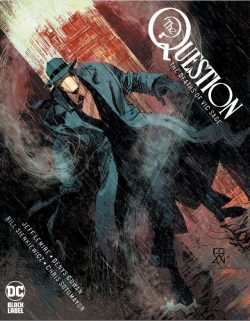
The Question: The Deaths of Vic Sage


By Jeff Lemire, Denys Cowan, Bill Sienkiewicz, Chris Sotomayor, Willie Schubert & various (DC Comics)
ISBN: 978-1-7795-0558-3 (HB/Digital edition)

One of DC’s best 1980s comics series was – for the longest time – out of print and unavailable digitally. It more or less still is, except for a prohibitively expensive Omnibus edition, and if you have strong arms and a big budget you should really track those stories down, whilst the rest of us wait for more reasonable trade paperbacks and eBook editions…

As devised and delivered by Steve Ditko in the 1960s – as he sank ever more deeply into the Objectivist philosophy of Ayn Rand – The Question was Vic Sage: a driven, implacable, justice-obsessed journalist seeking out crime and corruption uncaring of the consequences.

The Charlton “Action-Line Hero” was acquired by DC when the Connecticut outfit folded and was the template for compulsive vigilante Rorschach when Alan Moore & Dave Gibbons first drafted the miniseries that would become the groundbreaking Watchmen.

The contemporary rumour-mill had it that since the creators couldn’t be persuaded to produce a spin-off Rorschach comic, DC went with a reworking of the Ditko original…

As revised by writer Denny O’Neil and illustrators Denys Cowan & Rick Magyar, Vic Sage was an ordinary man pushed to the edge by his obsessions, using his fists and a mask that made him look utterly faceless to get answers (and justice) whenever standard journalistic methods failed. After a few minor appearances around the DC universe, Sage got a job in the town where he grew up and resumed his campaign for answers…

Always more cult hero than classic crusader, The Question revival carved a unique niche for itself as “comics grew up” post Crisis on Infinite Earths and Watchmen. The character was periodically radically rebooted and reimagined, but here scripter Jeff Lemire (Sweet Tooth, The Underwater Welder, Trillium, Black Hammer, Descender, Ascender, Gideon Falls, Essex County) returns to O’Neil’s canon to tell a revelatory tale of reincarnation, zen mystery and undying evil. The project was part of DC’s latest high end mature reader imprint Black Label: released as four single issues before becoming a spiffy hardback with a digital equivalent…

Hub City is a hell-hole, the most corrupt and morally bankrupt municipality in America. Mayor Wesley Fermin is a slick, degenerate crook, but real power resides in his Special Counsel Holden Malick, political cronies, a hand-picked gang of “heavies” and the largely corrupt and racist police force…

Originally, Sage was supported by college lecturer Aristotle “Tot” Rodor: the philosopher-scientist who created his faceless mask and other gimmicks as well as being a sounding board for theories and plans and ethical bellwether. He remains so here but is also increasingly challenging his former pupil’s motives and methods…

After being killed by Fermin’s forces The Question was revived and retrained by O’Neil’s other legendary martial arts creation, Richard Dragon, Kung Fu Fighter . A year passed and a reenergised, faceless avenger began cleaning up Hub City…

The saga opens with the city rushing into chaos and the Question busting a brothel trafficking children to city officials. Later, when reporting the raid on his TV show, Sage ambushes former lover Myra Fermin (the mayor’s sister and oblivious City Alderman) with the fact that the Councilman he left for the cops has mysteriously been erased from all official reports. Shocked and outraged, Fermin continues deluding herself about her brother and the administration, but the damage has been done and she starts looking where she shouldn’t…

When Malick arrives to clean up the mess, Sage notices a ring the politico wears: something old and somehow deeply disturbing…

Tot is no help, but the ring sticks in Sage’s mind and eventually he uncovers a historical organisation called the Hub City Elder Society that all wore such symbols and draws some telling conclusions to today’s political elite…

Hot on the trail he moves, unaware that events are converging into a dark miracle. At the exact moment The Question uncovers an ancient den of occult ceremony, an innocent black man is gunned down by a racist cop and Myra Fermin bursts in on her beloved brother committing savage atrocities on a bound captive. The concatenation of blood climaxes as The Question finds an old faceless mask with a bullet hole through the forehead in a cavern under the city. It’s not one of his, but he is assaulted by a wave of memories and images of supernal evil when he holds it…

Barely conscious, he retreats from the underground lair into streets awash with blood as a protest march becomes a race riot. Urged by Tot to go on TV to calm the tide, all Sage can think of is finding Dragon and getting some metaphysical first aid…

What he gets is doped, as the hermit applies zen hoodoo and drugged tea, despatching the unwilling rationalist sceptic on a vision quest into the past…

Sage awakens in the wilderness that will one day be his home town, bare-footed and wearing a faceless mask…

In Hub City 1886, Viktor Szasz is a blacksmith desperately seeking to escape the vile acts he committed as a soldier fighting the Comanche, in a frontier outpost well on its way to becoming truly civilised. Silent and solitary Viktor intervenes when negro settler Irving Booker and his family are repeatedly harassed and ultimately murdered by the local priest and his devout flock. Szasz reverts to his gun-toting ways to save or avenge them but is outmatched until rescued by a red-headed Indian woman. She shares some secrets about true evil, most notably that a mystical “Man with a Thousand Faces” can only be killed by someone named “Charlie”.

Delirious and experiencing hallucinations of himself in different times, agnostic Szasz still refuses to believe in devils, which is probably why the thing in pit under the town gets the drop on him…

In 1941, Hub City private eye Charlie Sage groggily looks at his notebook, where someone has written “Man with no face” and “man with a thousand faces???”. Blaming too much booze, he cleans himself up whilst glimpsing flashes of unknown dead people and adds “red-haired woman” to the page for no reason he can think of…

When red-haired walk-in client Maggie Fuller hires him to investigate her brother Jacob’s disappearance, he has no idea it will be his last case. They are both union organisers and prime targets for the bosses and the city officials they own, and before long the shamus has annoyed all the wrong people, ending up attacked by thugs wearing fancy rings…

Even his one pal on the Police Force – veteran patrolman “Tot” – can’t help him. But does reluctantly pass him a file full of juicy potential prospects for Fuller’s absence. Still enduring staggering western visions and brutal flashforwards, Charlie becomes lost in civil violence in three eras, and succumbs to another ring-wearer ambush.

The PI awakes in a subterranean chapel in the middle of some kind of crazy black mass, meets a devil and is never seen again…

Awaking from his vision-quest, present-day Sage leaves Dragon, set on sorting his city’s real world distress: braving riot and savage, premeditated retaliation by the administration and cops hungry to put the rabble back in their place. Unable to stop the carnage with his fists, The Question instead uses mass media to deliver a stunning counterstroke, turning the tables and critically destabilising Firmin and Malick.

He also has Tot build a permanent solution to the thing in the pit under Hub City, but has gravely underestimated the horror and indeed his own childhood connection to it…

Even after overcoming the odds, the illusion of victory is tenuous and insubstantial, leaving The Question still looking for answers in all the wrong places…

This book also offers covers and a gallery of variants by Cowan, Sienkiewicz & Sotomayor, Lemire & Marcelo Maiolo; Eduardo Risso; Howard Chaykin & Gustavo Yen, Andrea Sorrentino plus Cowan & Sienkiewicz’s sketchbook section ‘Questionable Practises’ with roughs, finished pencils pages and covers, portraits, finished pre-colour inks, unused cover art and creator bios.

Combating Western dystopia with Eastern Thought and martial arts action is not a new concept, but here the problems of a society so utterly debased that the apocalypse seems like an improvement are also lensed though a core of absolutism. Is man good? Is there such a thing as True Evil? What can one man do?

Who’s asking..?

Although the creators keep the tale focused on dysfunction – social, societal, civil, political, emotional, familial and even methodological – the core motivation for today’s readers has shifted, with the horror show that is and always has been Hub City now arguably attributed to an eternal supernatural presence. Regulation masked avenger tactics don’t work in such a world, and some solutions require better Questions…
© 2019, 2020 DC Comics. All Rights Reserved.
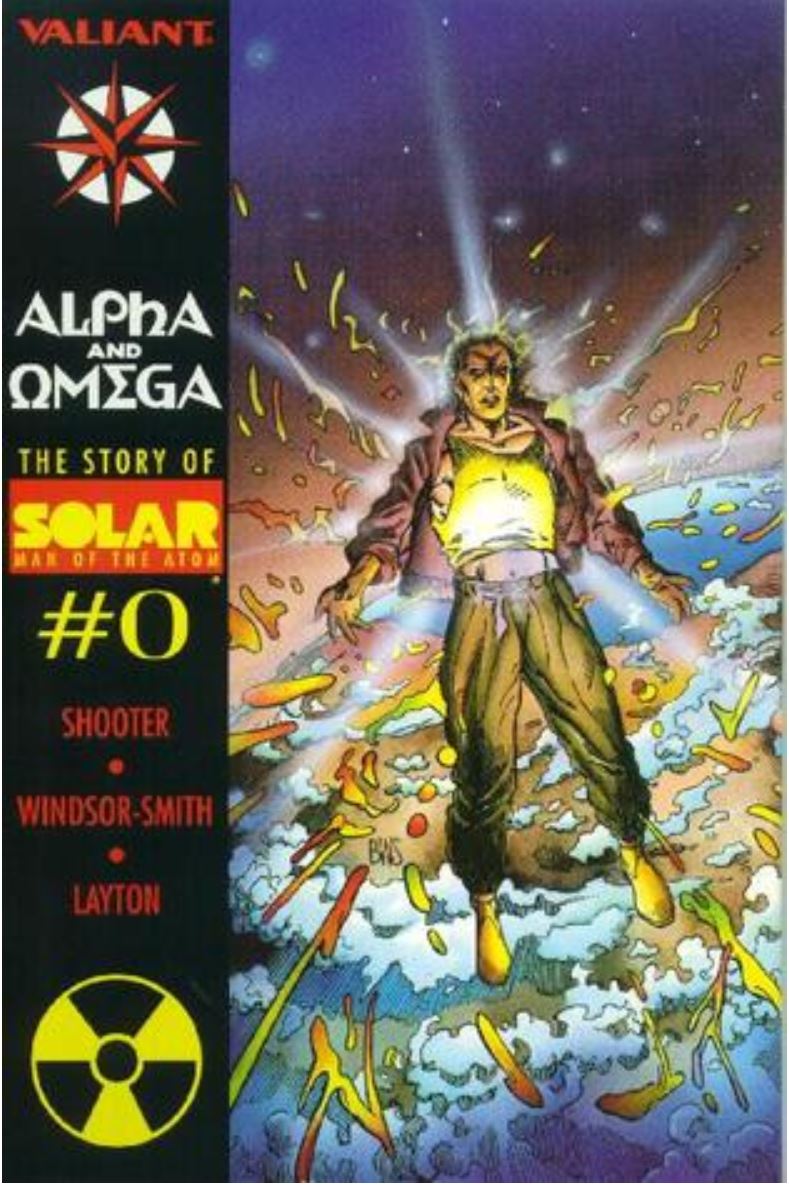
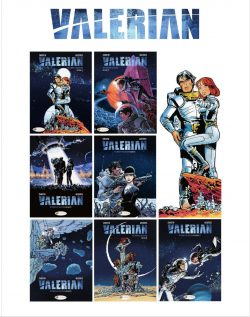
Valerian – The Complete Collection volume 5


By J-C Méziéres & P Christin with colours by E. Tranlé: translated by Jerome Saincantin (Cinebook)
ISBN: 978-1-84918-400-7 (Album HB/Digital edition)

Valérian: Spatio-Temporal Agent first took to the skies and timestream in 1967: gracing the November 9th edition of Pilote (#420) in an introductory serial which ran until February 15th 1968. Although an instant hit, album compilations only began with second tale – The City of Shifting Waters – as the creators considered their first yarn as a work-in-progress, not quite up to their preferred standard.

You can judge for yourself by getting hold of the first hardcover compilation volume in this sequence of compilations Or you can consider yourself suitably forward-looking and acquire an eBook edition…

The groundbreaking fantasy series followed a Franco-Belgian boom in science fiction comics sparked by Jean-Claude Forest’s 1962 creation Barbarella. Other notable hits of that era include Greg & Eddy Paape’s Luc Orient and the cosmic excursions of Philippe Druillet’s Lone Sloane, which all – with Valérian in the vanguard – boosted public reception of the genre. It all led, in 1977, to the creation of dedicated fantasy periodical Métal Hurlant

Valérian and Laureline (as the series became) was light-hearted and wildly imaginative: a time-travel action-adventure romp drenched in wry, satirical, humanist and political social commentary. The star was – at least initially – an affable, capably unimaginative, by-the-book cop tasked with protecting universal timelines and counteracting paradoxes caused by casual, incautious or criminally-minded chrononauts…

In the course of that debut escapade, Valerian picked up impetuous, sharp-witted peasant lass Laureline, who was born in the 11th century before becoming our star’s assistant and deputy. In gratitude for her truly invaluable assistance, the he-man hero brought her back to Galaxity, the 28th century super-citadel administrative capital where the feisty firebrand took a crash course in spatiotemporal ops before accompanying him on his cases…. luckily for all existence.

The series is not only immensely popular but also astoundingly influential.

This fabulous fifth oversized hardback – also available digitally – re-presents 1988’s On the Frontiers, 1990’s The Living Weapons and 1994’s The Circles of Power, and again offers a treasure trove of text features, beginning with critical appraisals ‘Valerian and Laureline: The Stuff of Heroes’; ‘Valerian, the Accidental Hero’; ‘Laureline, Bewitching and Wise’ and ‘The Heroes’ Metamorphosis’ by Stan Barets. Accompanying them are clip-art photo features ‘The Secret Charms of Laureline’, ‘The Colours of Laureline’ and essay ‘And Meanwhile…’ (detailing the creative duo’s other occupations at the time of creation).

A flurry of photos, sketches, designs and reference material detail the connections between comic album The Circles of Power and movie epic The Fifth Element in ‘A Taxi for Two’, and rounding out the extras is a selection of reportage comics by inveterate traveller Christin, illustrated by Philippe Aylmond, Alain Mounier, Enki Bilal, Méziéres, Olivier Balez and Max Cabanes.

Then, following a retrospective overview of the albums, it’s time to blast-off…

Valerian is arguably the most influential science fiction series ever drawn – and yes, I am including both Buck Rogers and Flash Gordon in that undoubtedly contentious statement. Although to a large extent those venerable newspaper strips formed the medium’s foundations, anybody who has seen a Star Wars movie has seen some of Jean-Claude Méziéres & Pierre Christin’s brilliant imaginings which the filmic franchise has shamelessly plundered for decades: everything from the look of the Millennium Falcon to military uniforms to Leia’s Slave Girl outfit…

Simply put, more carbon-based lifeforms have experienced and marvelled at the uniquely innovative, grungy, lived-in tech realism and light-hearted, socially-critical swashbuckling of Méziéres & Christin’s co-creation than any other cartoon spacer ever imagined. Now having scored their own big budget movie, that surely unjust situation is finally addressed and rectified…

Packed with cunningly satirical humanist action, challenging philosophy and astute political commentary, the mind-bending yarns always struck a chord with the public and especially other creators who have been swiping, “homaging” and riffing off the series ever since.

Sur les frontiers (On the Frontiers to English-speakers) was the 13th tale and marked a landmark moment in the series’ evolution.

When first conceived, every adventure started life as a serial in Pilote before being collected in album editions, but with this adventure from 1988, the publishing environment changed. This subtly harder-edged saga debuted as an all-new, complete graphic novel with magazine serialisation relegated to minor and secondary function. The switch in dissemination affected all top characters in French comics and almost spelled the end of periodical publication on the continent…

In the previous storyline the immensity of Galaxity had been erased from reality and our Spatio-Temporal Agents – with a few trusted allies – were stranded in time and stuck on late 20th century Earth…

Here, and now, we open in the depths of space as a fantastic and fabulous luxury liner affords the wealthy of many cultures and civilisations the delights of an interstellar Grand Tour. Paramount amongst guests are two god-like creatures amusing themselves by slumming amongst lower lifeforms whilst performing an ages old, languidly slow-moving mating ritual of their kind…

Sadly, puissant, magnificent Kistna has been utterly deceived by her new intended Jal. He actually has no interest in her or propagating the species: he intends stealing her probability-warping powers…

Jal is a disguised Terran and once he has completed his despicable charade, compels the ship’s captain to leave him on the nearest world: a place its indigenes call Earth…

Stranded on that world since Galaxity vanished, partners-in-peril Valerian and Laureline have been using their training and a few futuristic gadgets they had with them to become freelance secret agents. At this moment they’re in Soviet Russia where Val has just concluded that the recent catastrophic meltdown of the Chernobyl nuclear reactor was deliberately sparked by persons unknown…

As officials on site absorb the news, Val is extracted from the radioactive hotspot and ferried by laborious means across the frozen wastes to Finland and a belated reunion with Laureline and Mr. Albert: previously Galaxity’s jolly, infuriatingly unflappable 20th information gatherer/sleeper agent. The topic of discussion is tense and baffling: who could possibly profit from sparking Earth’s political tinderbox into atomic conflagration?

Far away in a plush hotel, a man with extraordinary luck discusses a certain plan with his awed co-conspirators, unaware that in the Tunisian Sahara near the frontier with Libya, three time-travelling troubleshooters are following his operatives…

That trail leads to a nuclear mine counting down to detonation, but happily the agents are well-versed in tackling primitive weaponry and the close call allows Albert to deduce why Libya and an unknown mastermind are working to instigate nuclear conflict in Africa…

After another near-miss on the US-Mexican border, investigators finally get a break, isolating the enigma behind these many almost-Armageddon moments. However, when Laureline approaches the super-gambler financing global nuclear terrorism through his bank-breaking casino sprees, she is astounded to realise the deadly disaster capitalist knows Galaxity tech…

As Valerian hurtles to her rescue, he discovers the enemy is an old comrade. For what possible reason could a fellow Galaxity survivor orchestrate Earth’s destruction? After all, isn’t it the home and foundation of the time-travelling Terran Empire they are all sworn to protect and restore?

This stunning caper was Christin & Méziéres deft re-rationalisation and clarification of their original drowned Earth storyline (as seen in 1968’s The City of Shifting Waters): adjusting it to the contemporary period that they were working in, with the added benefit of sending Valerian and Laureline into uncharted creative waters. Thus the agents’ solution to the problem of their deranged, broken – and god-powered – comrade was both impressively humane and winningly conclusive…

It was followed by 1990’s Les Armes Vivantes, with Valerian and Laureline forced to expend their last assets – a damaged astroship, some leftover alien gadgets and their own training – to eke out a perilous existence as intergalactic trans-temporal mercenaries.

Despite the misbehaviour of fractious inter-dimensional circuits in the much-travelled ship, our celestial voyagers are bound for distant, disreputable planet Blopik where Val has agreed to hand-deliver some livestock-improvement supplies. Moralistic Laureline is deeply suspicious of the way her man is behaving: it’s as if he’s doing something he knows she will disapprove of…

After a pretty hairy landing, she exits the ship to explore the burned-out pest-hole on her own. making the acquaintance of a trio of unique individuals: intergalactic performers stranded in their worst nightmare – a world without theatres and an absentee manager…

Before long they are all travelling together. The showbiz trio – malodorous metamorphic artiste Britibrit from Chab, indestructible rock-eater Doum A’goum and the indescribable Yfysania are seeking a venue to play in and appreciative audience to admire them, whilst taciturn Valerian is simply hunting the proposed purchaser of the wares in his case.

Laureline is, by now, frankly baffled. The centaurs who inhabit Blopik only understand and appreciate one thing – combat – and the planet’s cindered state is due to them setting fire to everything during the annual war between rival tribes. She can’t imagine what such folk would want with “farming gear”. For that matter, she also can’t imagine why Valerian keeps arguing with whatever he has in his travel-case…

Eventually, however, the alien Argonauts reach a grassy plain to be met by a bombastic centaur general. For “met”, read attacked without warning, but the natural abilities of the astounding performers soon gives pause to the hooved hellions and warlord Rompf agrees to parlay. He’s a centaur with a Homeric dream and Shakespearean leanings as well as the proposed purchaser of the bio-weapon in Valerian’s case. That thing has come direct from Katubian arms dealers and Laureline is appalled that Val has sunk so low and been devious enough to keep her out of the loop…

Rompf has declared War on War. He seeks to unify the tribes of Blopik by beating them all into submission and desperately needs the flame-spitting, foul-mouthed Schniafer couriered by the shamefaced former Spatio-Temporal peacekeeper to seal the deal. However, now that he’s seen what the offworld clowns can do, Rompf wants them too…

The various vaudevillians are not averse to the idea, but pride demands they put on a show too! They even have ideas how Laureline can be part of the fun.

…And that gives Valerian a chance to redeem himself too…

This tesseract of timely tales close here for now with The Circles of Power (released continentally in 1994 as Les Cercles du pouvoir). The hard-ridden, worn-out brutally battered astroship has finally given up the ghost after reaching planet Rubanis: an advanced but violently volatile and dangerous world divided into five nested rings of influence and specialism. Leaving the ship for some extremely costly repairs in the anarchic, technological boomtown of the First Circle, the Spatio-Temporal Agents start looking for some way of earning enough cash to pay for it all…

Worryingly, their occasional allies the Shingouz have already found a profitable prospect (and naturally factored in their own cut): sending the humans to meet old acquaintance and current planetary Chief of Police Colonel Tlocq in his palatial, low-orbit, high security citadel. That means taking a flying taxi and learning more than they wanted to as their highly excitable, enthusiastic and informative cabbie briefs them on the planet. He is also a young man with strong beliefs, big ideas and an often expressed violent streak…

Tlocq is a venal, casually violent but extremely efficient being policing a brutal, callous rogue world with permanently conflicting interests. Moreover, he has adopted mistrust, deception and institutional corruption as the most effective methodology to keep everything on an even keel. His policy seems to be “keep your enemies close and your allies and subordinates close enough to stab in the back”…

His chief deputy Krupachov holds the exalted rank of “Informer” and they maintain a constant atmosphere of productive, self-limiting disorder in and between the ringed regions…

However, even Tlocq has realised that something extra nasty is unfolding below him: not just in the always-explosive Heavy Industry First Circle but also in the Second (Business) Circle; the Trade/Entertainments/Arts morass of the Third Circle and even the elitist, crime-free and off-limits Fourth Circle reserved for Religion, Administration, Finance and Aristocracy. This rarefied region generates what passes for Tlocq’s directives, orders and operating rules, but he hasn’t received anything from them for some time now…

In the past he received direction via one of the ubiquitous enigmatic “machines” dotted around the cities, but is utterly opposed to letting the humans poke around inside them. He believes the machines are somehow connected to the sporadically spreading, microcephaly-inducing Scunindar virus cropping up all over Rubanis. In fact, the last time Valerian and Laureline saw him (in The Ghosts of Inverloch), Tlocq was dying from it, but he seems to have fully recovered now…

To ensure they do things his way, Tlocq doubles their fee and, knowing exactly how his world works, also gives an advance: a Grumpy Transmuter from Bluxte, able to spontaneously generate any kind of cash to buy their way out of trouble…

What he wants is not clearcut or straightforward. Although the Colonel still controls the utterly mercenary, self-serving forces under him, he has lost faith in and contact with those above who issue his orders. He wants the outsiders to bypass them and invade the ineffable Fifth Circle and find out who or what truly governs this world…

Valerian and Laureline begin by heading for the Third Circle in the flying cab, but are immediately targeted by a hidden foe. Attacked by a by a mystery woman in a tricked-up luxury vehicle that could only come from the richer echelons, they are forced down, but thanks to the cabbie’s combat skills, bring the war-limousine down with them. Go-getting taxi pilot S’traks also leads them to shelter in a seedy club in the region of entertainment…

The Shingouz are already there, haggling with a seedy mechanic who claims to know a secret way into the Last Circle…

All dickering and bargains are put on hold when their attacker bursts in, leading a squad of Vlago-Vlago mercenaries and wielding a “moroniser” whip that paralyzes, pauses cognition and wipes short-term memory. Helpless and hidden, Val and the cabbie watch merciless crime lord Na-Zultra cart off stupefied Laureline, much to the anger and frustration of her incorrigible, besotted new admirer S’traks…

It’s his idea for the undeclared love rivals to conceal themselves in the crashed limo and wait for vicious virago Na-Zultra to reclaim her highly exclusive property, and it almost works, but when they emerge from the vehicle thy are deep in unknown territory, covertly watching a procession of High Priests, business moguls and assorted aristopatrons attend a secret ceremony. They all have preternaturally shrunken heads…

Regaining consciousness a prisoner, Laureline resists all Na-Zultra’s entireties and threats of torture whilst extracting the schemer’s intentions. She learns that the ambitious criminal was hired by some faction in the Fourth Circle to secure control of Rubanis for them, but now intends to seize power for herself. When Valerian and S’Traks are discovered, Na-Zultra goes after them with the majority of her forces and Laureline makes her move…

After recuing the men and having exposed a web of conspiracies as well as the deliberate pointless of their commission, the heroes split up with Valerian confronting Tlocq about his true intent whilst Laureline seeks out the Shingouz to finally expose the mystery of the Last Circle, with go-getting S’traks using the deteriorating situation and his cabbie connections to mobilise the lower classes in an armed uprising…

Ultimately the shocking truth is exposed, triggering planetary revolution with Tlocq, Na-Zultra and S’Traks leading separate factions. Before the dust at last settles, he is well on his way to controlling Rubanis via a popular revolution across all the Circles…

Smartly subtle, sophisticated, complex and hilarious, the exploits of Valerian and Laureline mix outrageous satire with blistering action, stirring the mix with wryly punishing, allegorically critical social commentary: challenging contemporary cultural trends to forge one of the most thrilling sci fi strips ever seen.

These stories are some of the most influential comics in the world, timeless, dynamic, funny and just too good to be ignored. The time is now and there’s no space large enough to contain the sheer joy of Valerian and Laureline, so go see what all the fuss is about right now…
© Dargaud Paris, 2017 Christin, Méziéres & Tran-L?. All rights reserved. English translation © 2018 Cinebook Ltd.

Solar, Man of the Atom: Alpha and Omega (Slipcase Edition)


By Jim Shooter, Barry Windsor-Smith & Bob Layton with Kathryn Bolinger (Valiant)
No ISBN

The 1990s were a grim period for comics creativity. In far too many places, the industry had become market-led by speculators, with spin-offs, fad-chasing, shiny gimmicks and multiple-covers events replacing innovation and good story-telling. One notable exception was a little outfit with some big names that clearly prized the merits of well-told stories illustrated by artists immune to the latest mis-proportioned, scratchy poseur style, and one with enough business sense to play the industry at its own game…

As Editor-in-Chief, Jim Shooter had made Marvel the most profitable, high-profile comics company in America, and following his departure, he used that savvy to pick up the rights to a series of characters with Silver-Age appeal and turn them into contemporary gold.

Western Publishing had been an industry player since the earliest days, mixing major licensed brands such as Disney titles, Star Trek and Loony Tunes with in-house original stars like Turok, Son of Stone, Space Family Robinson, Magnus, Robot Fighter and – in deference to the age of the nuclear hero –Dr. Solar, Man of the Atom.

With an agreement to revive some, any or all of these four-colour veterans, Shooter and co-conspirator Bob Layton came to a bold decision and opted to incorporate all those 1960s adventures into their refits: acutely aware that older fans don’t like having their childhood favourites bastardized, and that revivals need all the support they can get. Thus the old days were canonical: they did “happen ” and would impact the new material being created for a brasher, more critical audience.

Although the company launched with a classy and classic reinterpretation of Magnus, the lynchpin title for the new universe they were building was the only broadly super-heroic character in the bunch. They had big plans for Solar, Man of the Atom who was launched with an eye to exploiting all the new printing gimmicks of the era, but was cleverly rationalised and realistically rendered. However, that’s not what this book is about.

The thrust of the regular series followed comic fan/nuclear physicist Phil Seleski – designer of the new Muskogee fusion reactor – as he dealt with its imminent activation. Inserted into the first ten issues was a brief extra chapter by Shooter, Windsor-Smith & Layton describing that self-same Seleski as he came to accept the horrific nuclear meltdown he had caused and the incredible abilities it had given him. As the world went to atomic hell, Seleski – AKA Solar – believed he had found his one chance to put things right…

That sounds pretty vague – and it should – because the compiled 10 chapters that form Alpha and Omega are a prequel, an issue #0, designed to be read only after the initial story arc had introduced readers to Seleski’s new world. That it reads so well in isolation is a testament to the talents of all those involved, and in combination with accompanying collection Solar, Man of the Atom: Second Death the saga forms a high point in 1990s comics creation. I will not be happy until this epic is generally available again – in all formats – but until that happens, I’ll take any opportunity to convince you all to seek out both these outstanding epics of science-hero-super-fiction.

You should take my word for it and start hunting now: and just by way of a friendly tip: each insert culminated with a two-page spread comprising a segment of “the world’s largest comic panel”, and the treasured slipcase edition I’m reviewing includes a poster combining those spreads into a terrifyingly detailed depiction of the end of the event…

By the way: one of those aforementioned trendy gimmicks was black-on-black printing, and the slipcase edition replicates that technique for the case cover. If you find an edition as seen in our attached cover illo, that’s the actual front of the interior book. There should also be that great big poster too. It’s still worth having without the extras, but it’s not the complete package…

Seek and enjoy, fans…
© 1994 Voyager Communications and Western Publishing Company, Inc. All rights reserved.

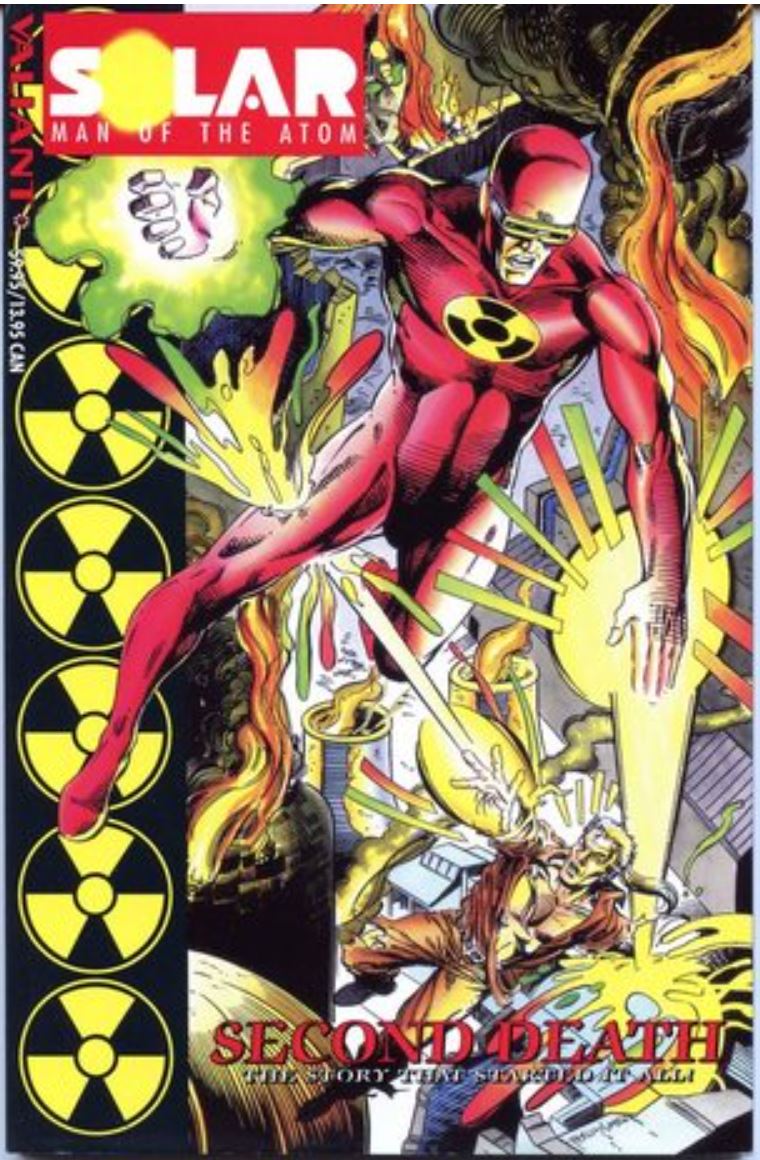
Solar, Man of the Atom: Second Death


By Jim Shooter, Don Perlin, Barry Windsor-Smith, Bob Layton & Tom Ryder (Valiant)
No ISBN:

Quarterly title Doctor Solar, Man of the Atom #1 hit newsstands on June 28th1962 sporting an October cover-date. My arithmetic isn’t good enough to decipher Gold Key’s arcane system but is advanced enough to realise that’s another 60th Anniversary occurring right about now. Happy birthday, Doc!

During the market-led, gimmick-crazed frenzy of the 1990s, amongst the interminable spin-offs, fads, shiny multiple-cover events a new comics company revived some old characters and proved once more that good story-telling never goes out of fashion. As Editor-in-Chief, Jim Shooter had made Marvel the most profitable and high-profile they had ever been, and after his departure he used that writing skill and business acumen to transform some almost forgotten Silver-Age characters into contemporary gold.

Western Publishing had been a major player since comics’ earliest days, blending a huge tranche of licensed publications such as TV, movie and Disney titles; properties like Tarzan and The Lone Ranger with homegrown hits like Turok, Son of Stone and Space Family Robinson.

In the 1960s, during the second superhero boom, these original adventure titles expanded to include Brain Boy, M.A.R.S. Patrol Total War (created by Wally Wood), Magnus, Robot Fighter (by the incredible Russ Manning) and in deference to the atomic age of heroes, Nukla and the brilliantly lowkey but explosively high concept Dr. Solar, Man of the Atom. Despite supremely high quality and passionate fan-bases, they never captured the media spotlight of DC or Marvel’s costumed cut-ups. Western shut their comics division in 1984.

With an agreement to revive some, any or all of these four-colour veterans, Shooter and co-conspirator Bob Layton came to a bold decision and made those earlier adventures part-and-parcel of their refit: acutely aware that old fans don’t like having their childhood favourites bastardized, and that revivals need all the support they can get. Thus the old days were canonical: they “happened.”

Although the company launched with a classy reinterpretation of Magnus, the key title to the new universe they were building was the only broadly super-heroic character in the bunch, and they had big plans for him. Solar, Man of the Atom was launched with an eye to all the gimmicks of the era, but was cleverly realised and realistically drawn.

Second Death collects the first four issues of the revived Solar and follows brilliant nuclear physicist Phil Seleski, designer of the new Muskogee fusion reactor in the fraught days before it finally goes online. Faced with indifferent colleagues and inept superiors, pining for a woman who doesn’t seem to know he exists, Seleski is under a lot of pressure. So when he meets a god-like version of himself. he simply puts it down to stress-induced delusion…

Solar, the atomic god who was Seleski, is freshly arrived on Earth, and with his new sensibilities goes about meeting the kind of people and doing the kind of things his mortal self would never have dreamed of. As if godhood had made him finally appreciate humanity, Solar befriends bums, saves kids and fixes disasters like the heroes in the comic books he collected as a boy.

His energized matter and troubled soul even further divide into a hero and “villain”, but things take a truly bizarre turn when he falls foul of a genuine super-foe: discovering that the “normal” world is anything but, and that he is far from unique. The superhuman individuals employed and mentored in Toyo Harada’s Harbinger Foundation prove that the world has always been a fantastical place, and Solar’s belief that he has travelled back in time to prevent his own creation gives way to realisation that something even stranger has occurred…

This is a cool and knowing revision of the hallowed if not clichéd “atomic blast turns schmuck into hero” plot: brimming with sharp observation, plausible characters and frighteningly convincing pseudo-science. The understated but compelling art by hugely under-appreciated Don Perlin is a terrifying delight and adds even more shades of veracity to the mix, as do the colours of Kathryn Bolinger & Jorge Gonzãlez.

Moreover, the original comics had a special inserted component in the first 10 issues (by Shooter, Barry Windsor-Smith & Layton) revealing the epic events that made Seleski into a god. Designed to be best read only after the initial story arc had introduced readers to Seleski’s new world, these were collected as Solar, Man of the Atom: Alpha and Omega. Together they combine to form one of the most impressive and cohesive superhero origin sagas ever concocted and one desperately in need of reprinting …if whoever currently controls the licensing rights to the stories could only get their act together…

Until then you can try hunting these down via your usual internet and comic retailers, and trust me, you should…
© 1994 Voyager Communications Inc. and Western Publishing Company, Inc. All rights reserved.

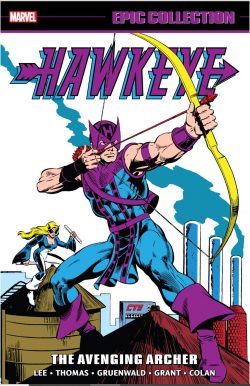
Hawkeye Epic Collection volume 1: The Avenging Archer 1964-1988


By Stan Lee & Don Heck, Roy Thomas, Len Wein, Steven Grant,  Mark Gruenwald, David Michelinie, Mike Friedrich, J.M. DeMatteis, Scott Edelman, Roger Stern, Charlie Boatner, Jack Kirby, Gene Colan, Sal Buscema, John Byrne, Carmine Infantino, Greg LaRoque, George Evans, Jimmy Janes, Paul Neary, Joe Staton, Dick Ayers, Mike Netzer, Trevor Von Eeden, Eliot R. Brown & various (MARVEL)
ISBN: 978-0-7851-3723-8 (TPB/Digital edition)

Clint Barton is probably the world’s greatest archer: swift, bold, unerringly accurate and augmented by a fantastic selection of multi-purpose high-tech arrows. Other masked bow persons are available… including a young, female Hawkeye…

Following an early brush with the law and as a reluctant Iron Man villain, Barton reformed to join the Mighty Avengers, serving with honour and distinction, despite always feeling overshadowed by his more glamorous, super-powered comrades.

Long a mainstay of Marvel continuity and probably Marvel’s most popular B-list hero, the Battling Bowman has risen to great prominence in recent years, boosted by his film and television incarnation.

This brash and bombastic collection – available in paperback and digital formats – re-presents breakthrough miniseries Hawkeye #1-4, the major early appearances from Tales of Suspense #57, 60, 64 and momentous moments from The Avengers #16, 63-65, 189, 223: supplemented by outings in Marvel Team-Up #22, 92, 95; Captain America #317 and pertinent material from Marvel Tales #100; Marvel Fanfare #3, 39 and Marvel Super Action #1, all chronologically covering September 1964 to August 1988. It should be noted that some of these tales feature his occasional wife and partner Mockingbird

It naturally begins with a blockbusting debut from Tales of Suspense #57. In ‘Hawkeye, the Marksman!’ by Stan Lee & Don Heck – as the villainous Black Widow resurfaces to beguile an ambitious and frustrated former carnival performer-turned-neophyte-costumed vigilante. She convinces him to attack her archenemy Iron Man and, despite a clear power-imbalance, the amazing ingenious archer comes awfully close to beating the Golden Avenger…

Natasha Romanoff (sometimes Natalia Romanova) was a Soviet Russian spy who came in from the cold to become one of Marvel’s earliest female stars. She started life as a svelte, sultry honey-trap during Marvel’s early “Commie-busting” days, periodically targeting Tony Stark and battling Iron Man. She was subsequently redesigned as a torrid, tights-&-tech super-villain before defecting to the USA, falling for an assortment of Yankee superheroes – including Hawkeye, Daredevil and Hercules – and enlisted as an agent of S.H.I.E.L.D., setting up as a freelance do-gooder before joining (and occasionally leading) The Avengers.

Tales of Suspense #60 (December 1964, by Lee, Heck & Dick Ayers) featured an extended plotline with Stark’s “disappearance” leading to Iron Man being ‘Suspected of Murder!’. Capitalizing on the chaos, lovestruck Hawkeye and the Widow again attacked the Armoured Avenger, but another failure led to her being recaptured and re-educated by enemy agents…

Abruptly transformed from fur-draped seductress into gadget-laden costumed villain, she resurfaced in #64 (April 1965 by Lee, Heck & Chic Stone), again steering the bewitched bowman into attacking her enemy. Her final failure led to huge changes…

Most importantly, one month later, Avengers #16 saw the superstar team split up following climactic battles against Zemo and the Masters of Evil. Laid out by Jack Kirby & embellished by Ayers, ‘The Old Order Changeth!’ introduced a dramatic change of concept for the series. As Lee increasingly wrote to the Marvel’s unique strengths – tight continuity and strongly individualistic characterisation – he found juggling individual stars in their own titles in addition to a combined team episode every month was almost impossible…

As Captain America and substitute sidekick Rick Jones fight their way back to civilisation, the Avengers institute changes and seek out their own replacements. The big-name stars resigned making way for three erstwhile villains: Quicksilver, the Scarlet Witch and Hawkeye, all reformed, reenergised and hungry for redemption…

The Straightshooter became a mainstay and backbone of the team, but in Avengers #63, survived a battle epiphany that triggered a big change after returning from a mission in Wakanda.

Beginning a 3-part tale illustrated by Gene Colan & George Klein ‘And in this Corner… Goliath! saw Barton abandon the arrow schtick in favour of true super-powers as Roy Thomas finally gave the enigmatic Avenger an origin.

The first chapter was part of a broader tale: an early crossover experiment intersecting with the 14th issue of both Sub-Mariner and Captain Marvel, wherein a coterie of cerebral second-string villains combined to conquer the world by stealth…

Within the Avengers portion of proceedings, Hawkeye revealed his civilian identity for the first time. He was ex-circus performer Clint Barton and shared his origins before forsaking bow and trick-arrows to become a size-changing hero using Pym particles. He then adopted the now-vacant name Goliath to save the Black Widow.

In #64’s ‘Like a Death Ray from the Sky!he reluctantly reunited with his mobster brother Barney Barton and led the team against a terror satellite scheme cooked up by Egghead before #65 (inked by Sam Grainger) saw him attacked by his old enemy/mercenary mentor the Swordsman in ‘Mightier than the Sword?

Jumping to June 1974 – a time when the archer pursued a solo career – Marvel Team-Up #22 (by Len Wein, Sal Buscema & Frank Giacoia) unleashes ‘The Messiah Machine!’ as Battling Bowman and Amazing Spider-Man frustrate deranged computer Quasimodo’s ambitious if absurd mechanoid invasion of Earth.

Cover-dated February 1979, reprint title Marvel Tales #100 concealed ‘Killers of a Purple Rage!’: a new short tale by Scott Edelman, Michael Netzer & Terry Austin which finds time-displaced Two-Gun Kid and Hawkeye battling each other and then mind controlling menace Killgrave the Controller

Avengers #189 (November 1979, by Steven Grant, John Byrne & Dan Green) then reveals how official reservist Hawkeye get a day job at Cross Technological Enterprises in ‘Wings and Arrows!’ Before long, he’s earning every penny as the new security chief by battling alien avian interloper Deathbird

For Marvel Team-Up #92 (April 1980) Grant, Carmine Infantino & Pablo Marcos reunite Archer and Arachnid after a new iteration of Mr. Fear steals CTE technology and almost cripples the heroes with ‘Fear!’ after which vigilante activist El Águila raids the corporate citadel in a tight tale from Marvel Fanfare #3 (July 1982). Crafted by Charlie Boatner, Trevor Von Eeden & Josef Rubinstein, ‘Swashbucklers’ at last opens Hawk’s eyes to what his bosses are truly like and what they do with their discoveries…

Cover-dated September 1982, Avengers #223 talked ‘Of Robin Hoods and Roustabouts’. Devised by David Michelinie, Greg LaRocque, Brett Breeding & Crew, it saw reinstated Avenger Clint Barton join Ant-Man Scott Lang, when he and daughter Cassie attend a circus and stumble into a clash with skills-mimic Taskmaster to extricate an old friend from the maniac’s clutches and influence.

Hawkeye was always a team player and unlucky in love, but that was all about to change. In the interests of complete clarity, this collection pops briefly back to 1976 for some classy comics context and the first (costumed) appearance of occasional wife and frequent paramour Bobbi “Mockingbird” Morse as first seen in January 1976.

Preceded by a Howard Chaykin frontispiece from monochrome Marvel Super Action #1, former Ka-Zar romantic interest Dr. Barbera Morse was reinvented by Mike Friedrich, George Evans & Frank Springer in ‘Red-Eyed Jack is Wild!’ Adopting unwieldy nomme de guerre Huntress, skilled combat operative Morse devotes herself to cleaning up corruption inside S.H.I.E.L.D., no matter what the cost…

Huntress became Mockingbird in Marvel Team-Up #95 (July) in a smart thriller by Grant, Jimmy Janes & Bruce Patterson. ‘…And No Birds Sing!’ ended the long-extant S.H.I.E.L.D. corruption storyline as Morse invited Spider-Man to join forces and expose the true cancer at the heart of America’s top spy agency…

All this was laying the groundwork for something truly game-changing…

Written and drawn by the hugely underrated and much-missed Mark Gruenwald, assisted by inkers Brett Breeding & Danny Bulanadi and running from September-December 1983, Hawkeye #1-4 was one of Marvel’s earliest miniseries and remains one of the very best and most eventful adventures of the Ace Archer. Much like the character himself, this project was seriously underestimated when first released. Most industry pundits and the more voluble fans expected very little from a second-string hero drawn by a professional writer. Guess again, suckers!

 ‘Listen to the Mockingbird’ sees Clint still moonlighting as security chief for electronics corporation CTE when he captures a renegade S.H.I.E.L.D. agent. She reveals that his bosses are all crooks, secretly involved in shady mind-control experiments.

After some initial doubts, in ‘Point Blank’ Barton teams with the svelte and sexy super-agent to foil the plot, gaining in the process a new costume and an instant rogues’ gallery of archfoes such as Silence, Oddball and Bombshell by third chapter ‘Beating the Odds’

As the constant hunt and struggle wears on, Barton succumbs to – but is not defeated by – a life-changing physical injury leading to permanent disability. He also impetuously marries in explosive conclusion ‘Till Death us do Part…’ wherein the sinister mastermind behind everything is finally revealed and summarily dealt with.

In those faraway days both Gruenwald and Marvel Top Gun Jim Shooter maintained that a miniseries had to deal with significant events in a character’s life, and this bright and breezy, no-nonsense, compelling and immensely enjoyable yarn certainly kicked out the deadwood and re-launched Hawkeye’s career.

In short order from here the bowman went on to create and lead his own team: The West Coast Avengers, gained a regular series in Solo Avengers/Avengers Spotlight and his own titles, consequently becoming one of the most vibrant and popular characters of the period and today as well as a modern-day action movie icon…

However, there are still treats to share

Next here is fun foray from Captain America 317 (May 1986) by Gruenwald, Paul Neary & Dennis Janke. In ‘Death-Throws’ Hawkeye and Mockingbird hunt circus-themed villains and their boss Crossfire with the Sentinel of Liberty reduced almost to a spectator and proud dad watching the kids grow up…

The comics wonderment concludes with a little-seen story from Marvel Fanfare #39 (August 1988). Courtesy of J.M. DeMatteis, Joe Staton & Kim DeMulder, ‘The Cat’s Tale’ finds the Ace Archer seriously off his game until taken on a vision-quest by Navajo shaman Jesse Black Crow to confront the predatory feline spirit that is poisoning his existence…

Packed with terrific tales of old-fashioned romance, skulduggery and derring-do, this book comes with extras including the Gil Kane cover to Marvel Triple Action #10, text articles on the Hawkeye miniseries from Marvel Age #6; the event’s 1983 house ad by Gruenwald & Brett Breeding and the covers and introduction from the 1988 TPB collection (and three subsequent re-releases), plus text pieces from Archie Goodwin, & Gruenwald.

Also on view are contemporaneous info pages from the Official Handbook of the Marvel Universe, about Hawkeye, Mockingbird, Death-Throws, Ringleader, Oddball, Bombshell, Tenpin and KnickKnack, plus diagrammatic cutaways by Eliot R. Brown, detailing the secrets of ‘Hawkeye’s Skymobile’, ‘Hawkeye’s Quiver and Bows’ and ‘Mockingbird’s Battle-Staves’.

This is a no-nonsense example of the straightforward action-adventure yarns that cemented Marvel’s reputation and success and a collection to enhance any Fights ‘n’ Tights fans’ place of honour on the bookshelf.
© 2021 MARVEL.

Mighty Marvel Masterworks volume 2: The Invasion of Asgard


By Stan Lee & Jack Kirby, with Chic Stone, George Roussos, Vince Colletta, Paul Reinman, Don Heck & various (MARVEL)
ISBN: 978-1-3029-3442-2 (PB/Digital edition)

These stories are timeless and have been gathered many times before, but today I’m once again focussing on format. The Mighty Marvel Masterworks line launched with economy in mind: classic tales of Marvel’s key creators and characters re-presented in chronological publishing order. It’s been a staple since the 1990s, but always in lavish, hardback collectors editions. These editions are cheaper, on lower quality paper and – crucially – smaller, about the dimensions of a paperback book. Your eyesight might be failing and your hands too big and shaky, but at 152 x 227mm, they’re perfect for kids. If you opt for the digital editions, that’s no issue at all…

Even more than The Fantastic Four, The Mighty Thor was the arena in which Jack Kirby’s boundless fascination with all things Cosmic was honed and refined through his dazzling graphics and captivating concepts. The King’s plethora of power-packed signature pantheons began in a modest little fantasy/monster title called Journey into Mystery where – in the summer of 1962 – a tried-and-true comicbook concept (feeble mortal transformed into god-like hero) was revived by the rapidly resurgent company who were not yet Marvel Comics: adding a Superman analogue to their growing roster of costumed adventurers.

Cover-dated August 1962, Journey into Mystery #83 saw a bold costumed Adonis jostling aside the regular fare of monsters, aliens and sinister scientists in a brash, vivid explosion of verve and vigour. The initial exploit followed disabled American doctor Donald Blake who took a vacation in Norway and encountered the vanguard of an alien invasion. Fleeing, he was trapped in a cave where he found an old, gnarled walking stick. When, in frustration, he smashed the stick into the huge boulder blocking his escape, his puny frame was transformed into the Norse God of Thunder!

Plotted by Stan Lee, scripted by his brother Larry Lieber and illustrated by Kirby and inker Joe Sinnott (at this juncture a full illustrator, Sinnott would become Kirby’s primary inker for most of his Marvel career), that introduction was pure primal Marvel: bombastic, fast-paced, gloriously illogical and captivatingly action-packed. It was the start of a new kind of legend and style of comics’ storytelling…

Spanning February to October 1964, this gloriously economical full-colour paperback tome – also available in eFormats – revisits pioneering Asgardian exploits from JiM #101-109 in a blur of innovation and seat-of-the-pants myth-revising and universe-building…

Lee had taken over scripting with Journey into Mystery #97, the issue that launched a spectacular back-up series. Tales of Asgard – Home of the Mighty Norse Gods gave Kirby a vehicle to indulge his fascination with legends and began by adapting classic traditional tales before eventually switching to all-new material shaped for Marvel’s pantheon. Here, Kirby built his own cosmos and mythology, which would underpin the company’s entire continuity.

Journey into Mystery #101 featured ‘The Return of Zarrko, the Tomorrow Man!’ and sees Odin halve Thor’s powers for wilful disobedience, just as the futuristic felon abducts the Thunder God to help him conquer the 23rd century. A two-parter (with the first chapter inked by George Roussos), it was balanced by another exuberant tale of the boy Thor.

‘The Invasion of Asgard!’ sees the valiant lad fight a heroic rearguard action whilst introducing a host of future villainous mainstays such as the Rime Giants, King Geirrodur and Trolls.

‘Slave of Zarrko, the Tomorrow Man!’ is a tour de force epic conclusion most notable for the introduction of Chic Stone as inker. To many of us oldsters, his clean, full brush lines make him The King’s best embellisher ever. This triumphant futuristic thriller is counterbalanced by brooding short  from ancient history. ‘Death Comes to Thor!’ has the teen hero face his greatest challenge yet, with two women who would play huge roles in his life introduced in this brief 5-pager; young goddess Sif and Hela, Queen of the Dead.

On a creative roll, Lee, Kirby & Stone next introduced ‘The Enchantress and the Executioner’ ruthless renegade Asgardians determined to respectively seduce or destroy the warrior prince at the front of JiM #103 whilst the rear detailed ‘Thor’s Mission to Mirmir!’, disclosing how the gods created humanity. That led one month later to a revolutionary saga in the present day lead feature when ‘Giants Walk the Earth!’

For the first time, Kirby’s imagination was given full rein after Loki tricks Odin into visiting Earth, only to release in his absence, ancient elemental enemies Surtur and Skagg, the Storm Giant from eternal Asgardian bondage.

This cosmic clash depicted noble gods battling demonic evil in a new Heroic Age, and the greater role of the Norse supporting cast – especially noble warrior Balder – was reinforced by a new Tales of Asgard strand focussing on individual Gods and Heroes. Inked by Don Heck, ‘Heimdall: Guardian of the Mystic Rainbow Bridge!’ was first, highlighting the mighty sentinel’s uncanny senses and crucial role in defending the realm from its foes…

JiM #105-106 saw the teaming of two old foes in ‘The Cobra and Mr, Hyde!’ and ‘The Thunder God Strikes Back!’: another continued story packed with tension and spectacular action, and proving Thor was swiftly growing beyond the constraints of traditional single issue adventures. The respective back-ups ‘When Heimdall Failed!’ (Lee, Kirby & Roussos) and ‘Balder the Brave’ (inked by Vince Colletta) further fleshed out the back-story of an Asgardian pantheon deviating more and more from those classical Eddas and Sagas kids had to plough through in schools.

A petrifying villain premiered ‘When the Grey Gargoyle Strikes!’ in Journey into Mystery #107: a rare yarn highlighting the fortitude of Dr. Blake rather than the power of the Thunder God, who was increasingly reducing his own alter-ego to an inconsequentiality. Closing the issue, the Norn Queen debuted in a quirky reinterpretation of the classic myth in ‘Balder Must Die!’ illustrated by Kirby & Colletta.

After months of manipulation, the God of Evil once again attempted direct confrontation with his despised step-sibling in ‘At the Mercy of Loki, Prince of Evil!’ With Jane Foster a helpless victim of Asgardian magic, the willing assistance of new Marvel star Doctor Strange made this a captivating team-up read, whilst ‘Trapped by the Trolls!’ (Colletta inks) showed the power and promise of tales set solely on the other side of the Rainbow Bridge as Thor liberates enslaved Asgardians from subterranean bondage.

Bringing down the curtain on this increasingly cosmic carnival, Journey into Mystery #109 was another superb adventure masquerading as a plug for recent addition to the Marvel roster.

‘When Magneto Strikes!’ pits Thor against the X-Men’s archfoe in a cataclysmic clash of fundamental powers, although you could hardly call it a team-up since the heroic mutants are never actually seen. The tantalising hints and cropped glimpses are fascinating teasers now, but the kid I then was felt annoyed not to have seen these new heroes… oh, wait… maybe that was the point?

The Young Thor feature ‘Banished from Asgard’ is an uncharacteristically lacklustre effort to end on, with Odin and Thor enacting a devious plan to trap a traitor in Asgard’s ranks, but the vignette hinted at much greater thrills to follow…

Rounding off the increasingly spectacular shenanigans are a gallery of original art pages and a rousing landmark house ad for the entire Marvel Comics line.

These foundational tales of the God of Thunder show the development not only of one of Marvel’s core narrative concepts but, more importantly, the creative evolution of perhaps the greatest imagination in comics. Set your common sense on pause and simply wallow in the glorious imagery and power of these matchless adventures to discover the true secret of what makes comic book superheroes such a unique experience.
© 2022 MARVEL.