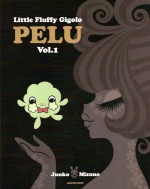
Little Fluffy Gigolo Pelu volume 1


By Junko Mizuno (jaPress/Last Gasp)
ISBN: 978-0-85719-700-6

If you’re over a certain age or have eclectic tastes in art and music you might feel a pang of nostalgia at the work in this intriguing and coyly adult collection, featuring Manga sensation Junko Mizuno’s latest subversively compelling creation.

Since her emergence in 1995, the author has become renowned for combining the appearance of childish innocence or “cuteness” with dark, gory action and unwholesome or stridently clashing and inappropriate content in a sub-genre now dubbed Gothic or Noir kawaii (where kawaii describes cutely drawn protagonists and subjects).

Moreover the skewed sensibilities of her work in such Manga as Cinderalla, Hansel & Gretel, Princess Mermaid and Pure Trance (all available in English language editions) and the as-yet-untranslated Momongo no Isshō (the Life of Momongo) has exploded out of the comics ghetto and been taken up by the larger populace with art exhibitions (Heart Throbs and Tender Succubus), art-books (Hell Babies, Collector File and Flare) and high-end designer toys for adults including plush animals, vinyl figures, stationery, postcards, stickers, original art T-shirts and even a line of erotic products and condoms.

She is scheduled to produce a limited edition My Little Pony figure for a Hasbro charity event and by the time you read this Marvel should have released her first Spider-Man and Mary Jane adventure in the re-launched Strange Tales.

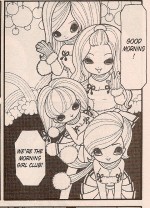
Her self-confessed shojo (“stories for girls”) influenced style also borrows heavily from the imagery of the 1960s and early 1970s, particularly the Graphic Psychedelia that grew out of Pop Art, with huge eyed (admittedly not uncommon in Manga), large-headed girls, drawn to look young – no, not young, but actively, innocently, illicitly under-aged: living in simplified, reduced detail environments.

As previously stated her content is always sharply at odds with her drawing style, like cartoons for toddlers but involving unpleasant visits to the gynaecologist or being eaten by cannibals. Much of her work is in full colour despite the overwhelming preponderance of black and white material in Japan, and this volume (mostly monochrome but with a magically lush colour section) breaks another tradition by using a huge 254 x 201mm page size rather than the usual 188 x 126mm to relate its tales of lonely hearts.

Little Fluffy Gigolo Pelu is another conceptual shocker with a subtle subtext and an overt narrative underpinning, redolent of the naively “Swinging Sixties”. The cute pink planet Princess Kotobuki smells delightful but is invisible to human eyes. On its charming surface dwell nothing but beautiful naked young women and one very lovely, placid purple space hippo: but beware because Space Hippos are carnivorous!

And then there’s Pelu: a fluffy excitable ball of fuzz who questions this idyllic existence. From the hippo Pelu learns of Earth where there are two sexes, not one, and when Pelu learns its own origins (the first chapter is entitled ‘Sex Education on a Fantastic Planet’) it determines to go to the planet of humans and father a baby so it won’t be alone any more…

So begins the charmingly unsettling saga of Gigolo Pelu whose adventures in ‘The Naked Enka Singer’, ‘The Sassy Girl and the Bad Boy’, ‘Beach Maidens’ and ‘The Mysterious High School’ mirror the venerable tale of an Innocent’s road to enlightenment (complete with the loss of the aforementioned innocence), given extra punch by the overwhelming accoutrements of perfect childhood that permeate every atom of the tale.

On Earth the fluffy creature observes human interactions whilst always politely asking if anyone would like to be made pregnant – but love, hate, jealousy, pride, ambition, self-loathing and even murder are hard to grasp until Pelu discovers and befriends a hobo who becomes a valued comrade and teacher.

Everything, especially the many beautiful girls, are drawn in the style of late 1960s Playboy icons, the cartoon stylisations that featured in many movie blockbuster title sequences and especially the psychedelic works of Alan Aldridge and the animated film Yellow Submarine. Anybody British out there who remembers the kids show Crystal Tipps and Alistair, or the hippo from Rainbow, will feel a frisson of nostalgia – which is of course the point. The art is a beautiful velvet trap designed to put the reader in a receptive state so that the author can make her telling points about today’s world.
pelu-pic-2

By co-opting the form of children’s entertainment the author can address fundamental aspects of society in a form intended to shock, subvert, upset and most importantly provoke: hopefully some thought on the readers’ part will be generated beyond the modern shock-reaction to nude young girls and the pre-pubescent idealism and purity that used to be associated with such imagery.

This is a deceptively edgy fantasy with a lot to say about society and relationships – similar to and completely different from Robert Heinlein’s groundbreaking social satire Stranger in a Strange Land, and if enough of the right people read it could have as much impact.
© 2003 Junko Mizuno. All Rights Reserved.
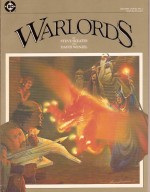
Warlords – DC Graphic Novel #2


By Steve Skeates & Dave Wenzel (DC Comics)
ISBN: 0-930289-04-8

Being nothing but a bunch of banana-fingers with stubby thumbs and utterly immune to the specious allure of computer and video games, I can’t admit to much knowledge of the antecedents of this intriguing fantasy book. Still that means that I can dispassionately comment on the package as a read unswayed by its origins.

In the mid-1980s all the major comics companies were exploring the European concept of albums and graphic novels: enlarged and expanded narratives produced on better paper stock using more expensive printing techniques. Coincidentally, at this time DC had entered into a financial arrangement with video-gaming giant Atari resulting in such superb comics spin-offs as Atari Force (a comic still screaming out for a definitive collection) and Star Raiders.

Another Atari property that made the leap to the printed page was Warlords; at first glance one more Tolkienesque derivative comprised of fairies and elves, wizards and giants, with general blade-based mayhem aplenty. But on closer examination this colourful little epic has hidden charms: for a start it’s written for sly knowing laughs, isn’t afraid to poke fun at itself and even the genre it owes its existence to.

The other big plus is the creative team. The sharp and witty script by the hugely underrated Steve Skeates is illustrated by fantasy master (and honorary Hobbit) David Wenzel and together they produced this impressive and engaging tale of an underachieving troll “Just Plain Dwayne” who reluctantly finds himself holding a magic amulet that everybody wants in the middle of an eternal cold war between the four Warlords who control the world.

Unfortunately now that the scurrilous Dwayne has the mystic bauble that war’s going to heat up pretty quickly…

It’s relatively easy to parody a genre, but to be funny within the internal logic of one is a master’s trick: so when I tell you Dwayne’s little quest is still ripe with climactic battles, fabulous beasts, glorious creatures, hair-raising tension and incredible action you know its something you just have to see.

Trust me, I’m a Scholar…
© 1983 Atari Inc. All Rights Reserved.

Arthur Spiderwick’s Field Guide to the Fantastical World Around You


By Tony DiTerlizzi & Holly Black (Simon & Shuster UK)
ISBN: 978-1-41690-136-5

One of the most charming and readable children’s stories of recent vintage (the first volume was published in 2003 and I’ll get to them one day…) recounts the adventures of three American kids who stumble into a forgotten and dangerous world of unseen Fairy Magic. The adventures of the Grace children even emerged relatively unscathed from the transition to the big screen in a winning adaptation entitled The Spiderwick Chronicles.

Modern marketing being what it is, a lot of peripheral material has been generated to accompany the books and it’s one of these I want to bring to your attention. Arthur Spiderwick’s Field Guide to the Fantastical World Around You is a fabulous confection, purporting to be the actual tome created by an inquisitive naturalist nearly a century ago, listing in magnificent taxonomical detail and gloriously illustrative manner all the unnatural and supernormal creatures that live beyond the range of normal human sight.

Although Tony DiTerlizzi and Holly Black are deliberately vague as to who does what to craft these tales the former is credited as illustrator, so I’m assuming the Manticore’s share of the superb paintings and drawings in this volume are his and the explanatory notes Ms Black’s – and frankly astonishing it all is.

Divided into Around the House and Yard, In Fields and Forests, In Lakes, Streams and the Sea, In the Hills and Mountains, In the Sky and Outside at Night this beautiful bestiary covers every invisible wonder from Banshees to Will-o’-the Wisps, Dragons to Unicorns and all European ethereals in between.

This is a book to inspire dreaming and creativity in kids of any age, produced with all the tricks and magic of 21st century printing and paper-technology. A true and total delight.
© 2005 Tony DiTerlizzi & Holly Black. All Rights Reserved.

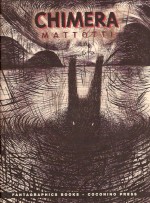
Chimera


By Mattotti (Fantagraphics Books and Coconino Press)
ISBN-13: 978-1-56097-763-6

The sixth release (I hesitate to call it a volume, as the format, though bold and wonderful, is far more than a magazine but not quite a book) from the eclectic European publications imprint designated the Ignatz Collection features an uncharacteristic and unforgettable look at the monochrome work of one of the world’s most talented colour artists.

Lorenzo Mattotti was born in Brescia, Italy and studied at the Faculty for Architecture in Venice before beginning a career as a comics storyteller in 1975 in the French magazine Circus. Whether alone or with long-time collaborator Fabrizio Ostani (AKA Jerry Kramsky – they often used the single pen-name “Kleidebistro”) Mattotti’s incredible, nigh-abstract designs and pictorial narratives have won him a huge following, with work appearing in Métal Hurlant, L’Écho des Savanes (France), Rumbo Sur (Spain), Frigidaire, Secondamano and Alter Alter (Italy), Raw (USA) and The Face (UK) among many others.

In 2002 Mattotti and Kramsky produced Docteur Jekyll & Mister Hyde (based on the Robert Louis Stevenson classic) for Casterman, and the English translation won Mattotti an Eisner Award the following year. As an illustrator, Mattotti has worked for Vanity Fair, the New Yorker, Cosmopolitan, Vogue and Le Monde, and has produced a number of startling and beautiful children’s books. His absolute masterpiece thus far is – to my mind at least – Fires (and I think I’ll just add that to my “review real soon” pile).

Behind a deeply unsettling gate-fold wraparound cover, but printed throughout on reassuringly solid cream-coloured card-stock, lurks a startling journey from idyllic cloud-gazing through vaguely erotic musings on gods and giants to the depths of a terrifying and oppressive forested hell. Rendered in a bravura line-and-dry-brush style that ranges from seductive and cajoling, through airy tumult to raw, fierce, bestial rage and horror, Mattotti uses the reader’s eyes to pull the viewer on a chaotic descent reminiscent of Mussorgsky’s “A Night on Bald Mountain” from Walt Disney’s Fantasia, with just a hint of Watership Down thrown in.

Comics aficionados might also recognize a touch of the panning-in technique used by the great André Barbe where small pictorial changes lead to a total transformation, not only to the graphic representations but also to the mental or spiritual state of the object and observer. But where Barbe wanted to languidly surprise and seduce you, Mattotti is here to make you squirm…

Even if the “how” isn’t your major concern, the whole pictorial experience of Chimera is one headlong rush, and a supreme lesson in the power and virtuosity of dark lines against the light. This is probably the only white knuckle ride you can put on a bookshelf… so why don’t you?

Story and art © 2005 Lorenzo Mattotti. Book edition © 2005 Fantagraphics Books and Coconino Press.

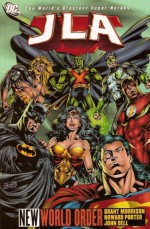
JLA volume 1: New World Order


By Grant Morrison, Howard Porter & John Dell (DC Comics)
ISBN: 978-1-56389-369-8

After the Silver Age’s greatest team-book died a slow, painful, wasting death, not once but twice, DC were taking no chances with their next revival of the Justice League of America and tapped Big Ideas wünderkind Grant Morrison to reconstruct the group and the franchise.

And the idea that clicked? Put everybody’s favourite Name superheroes in the team.

Of course it worked, but that’s only because as well as star quantity there was a huge input of creative quality. The stories were smart, compelling, challengingly large-scale and drawn with desperate vitality. With JLA one could see all the work undertaken to make it the best it could be.

This slim album collects the first four issues of the revival and covers a spectacular landmark tale that altered the continuity landscape of the DC Universe by introducing a family of alien superbeings called the Hyperclan whose arrival on Earth could have ushered in a new Golden Age – a least by their standards.

Superman, Batman, Wonder Woman, the Martian Manhunter, Flash, Green Lantern and Aquaman are the legends who see their methods and careers questioned only to uncover a deadly secret that threatens to doom the planet they’re pledged to protect in a splendid old-fashioned goodies ‘n’ baddies romp that re-sparked fan interest in the “World’s Greatest Superheroes”.

If you haven’t read this sparkling slice of fight ‘n’ tights wonderment then your fantastic life just isn’t complete yet…

© 1997, 1998 DC Comics. All Rights Reserved.

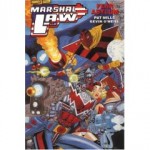
Marshal Law: Fear Asylum


By Pat Mills & Kevin O’Neill with Mark A. Nelson (Titan Books)
ISBN: 978-1-84023-699-6

In 1987 Marvel’s creator-owned imprint, Epic Comics, published a six-issue miniseries starring a hero superficially very much in the vein of Judge Dredd, but one who took the hallowed American creation of the superhero genre and gave it a thorough duffing-up, Brit-boy style, in the tale of a costumed cop who did the Right Thing and did it His Way…

San Futuro is a Metropolitan urban dystopia built on the Post- Big Quake remnants of San Francisco. America is recovering from another stupid, exploitative war in somebody else’s country, and as usual the discharged and brain-fried veterans are clogging the streets and menacing decent society. Unfortunately this war was fought with artificially manufactured superheroes: now they’re home and a very dangerous embarrassment.

Marshal Law was one of them, but now he’s a cop; angry and disillusioned. His job is to put away masks and capes. This establishing series was collected as Marshal Law: Fear and Loathing.

Being a creator-owned property, old zipper-face went with Mills and O’Neill to the British independent outfit Apocalypse, publishers of the talent-heavy 2000AD rival Toxic, which ran from March to October 1991. But before that a final Epic one-shot ‘Marshal Law takes Manhattanwas released in 1989, and forms the first part of this final collection.

With some art assistance from Mark A. Nelson and Mark Chiarello, the Hero-Hunter was dispatched to New York to extradite a war criminal (and Law’s old army trainer) The Persecutor. Unfortunately (for them) the perp has hidden himself amongst the inmates of “The Institute” – a colossal Manhattan skyscraper housing all the Big Apple’s native superheroes; each and every one a brilliant, barmy, bile-filled parody of Marvel’s Mightiest.

Naturally carnage and mayhem are the result, but not before author Mills slips a few well-aimed pops at US covert practices and policies in South America under the door.

Less contentious – unless you’re a fan of the movie “Alien” or the Legion of Super Heroes – is ‘Secret Tribunal’ wherein the Marshal is sent to an orbiting Space Station where the government grows its manufactured superbeings just as a nasty incursion of fast-breeding carnivorous space-beasts starts ripping the immature supermen and wonder women to gory gobbets…

The book closes with the decidedly odd pairing of ‘The Mask/Marshal Law’ which finds the militant cape-crusher on the verge of resigning just as the magical mask that made mucho moolah for Dark Horse and a star out of Jim Carrey resurfaces in San Futuro… Cue chaos, carnage and lots of deadly silliness…

Although still fiercely polemical and strident, this is probably the least effective of the Marshal Law books. The feeling that Mills has said all he wanted or needed to say is ominously prevalent and although O’Neill’s art seemingly improves with every page – and the sketch and unseen art sections are engrossing and powerful – the overall feeling is one of tired duty rather than passionate verve.

Although still tremendously entertaining it’s clear than the Marshal hung up his barbed wire and boots just in time. Hero-Harriers Pat Mills and Kevin O’Neill produced a wonderful edgy parody, but until the industry annoys them enough to come back with all Honking Great Guns blazing, fans should just content themselves with this one last hurrah.

© 2003 Pat Mills & Kevin O’Neill. Art © 1993 Kevin O’Neill. The Mask is © 2003 Dark Horse Comics, Inc. All Rights Reserved.

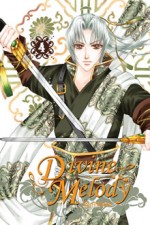
Divine Melody Volume 4


By I-Huan, translated and adapted by Lobelia Cheng & Sue Yang (DrMaster)
ISBN: 978-1-59796-176-9

Time is running out for the Celestial Fox-Demons. Only vixens remain and if they wish to advance their status, let alone survive as a race, they must propagate their kind at all costs. To add to their woes their beloved leader, the Shifu (teacher/leader) who devised the plan to steal the baby girl deity Cai-Sheng and train her to transform into a male and father another generation is fading; her energies and lifespan are almost exhausted.

Her plan was necessarily a very long-ranging one. Over the centuries the Fox Demons had grown impatient. Some, like Hui-Niang, renounced their powers in order to marry mortals, whilst bold Yu-Niang turned to the darkest paths and began to steal little boys as “offerings”…

Little Cai-Sheng was a lonely child. On the day she escaped from her lessons and met two village children she formed an eternal bond with them. The girl Xiao-Que and boy Duo Xi saved the divine toddler from a dog attack (canines are the mortal enemies of foxes), suffering bloody wounds in her defence. Just in time guardian Hui-Niang appeared and killed the hound, and to thank the humans marked the boy’s torn forehead and the girl’s bitten hand with mystic tattoos. No matter how long, nor how many incarnations passed, their sacrifice would be rewarded.

Promising to meet again tomorrow, the children parted, but time is different for celestial beings and the humans never saw their new friend again.

Two centuries passed. Cai-Sheng completed her training and gained the ability to become a beautiful man at will, but the Chosen One had never forgotten her joyous day with mortal children, where she learned of freedom from duty and destiny. Reunited now with their current reincarnations – wealthy Su Ping and apprentice exorcist Han Yun-Sh – she had determined to repay their kindness by acting as matchmaker for the pair.

Unfortunately Ping had seen Cai-Sheng’s male form Qin Cai-Sheng, and become enamoured with “him” whilst Yun-Shi had become smitten with Su Ping – but he also held inexplicable feelings for the “weird girl” Cai-Sheng.

The debased fox-demon Yu-Niang had haunted Cai-Sheng, grown strong on centuries of stolen blood. She also wants the power of Cai-Sheng’s male form and preys relentlessly on the humans of the city. Even though Yu-Niang’s cat familiar is torn between serving Yu-Niang and Cai-Sheng, and is playing a double-game, the wicked fox-demon’s schemes are nearing fruition.

To further complicate her life a Heavenly Envoy named Wei Zi-Qiu has been sent to retrieve and purify Cai-Sheng, or if she has shed mortal blood, to kill her. He too has fallen for her, and tries to cover up the fact that she has slain the exorcist that killed her childhood guardian Hui-Niang…

With volume 4 the plot rapidly advances when Yun-Shi finds a new and decidedly nastier Shifu to train him as an exorcist-priest, Su Ping is possessed by the evil of Yu-Niang, and is in danger of becoming her next murderous familiar, whilst Wei Zi-Qiu and Yun-Shi face-off as rivals and one of them proposes marriage to the bewildered Cai-Sheng…

As an aura of inescapable tragedy falls over this enchanting shōjo tale of legendary China, I-Huan’s flawless blend of mythology and soap-opera moves into high-gear. How this web of intrigue and passion could ever resolve into a happy ending is beyond me. Perhaps it won’t…

This easy combination of passion, comedy and action examines the big issue of Predestination and Free Will, with family expectation always at odds with personal desire. The beautiful, lyrical art perfectly captures a forgotten age as the eternal triangle enlarges to admit another victim of love and their worlds spiral towards a painful, disastrous collision. A lovely series for the fanciful and romantic, this latest volume seems to hint that not all Ever Afters are Happy…

This book is produced in the traditional Japanese format and should be read from back to front and right to left.

© 2003 I-Huan/Tong Li Publishing Co. Ltd. English translation © 2009 DrMaster Publications, Inc. All Rights Reserved.

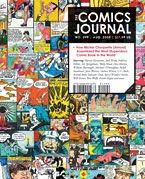
Comics Journal #299


By various (Fantagraphics Books)
ISBN: 978-1-60699-147-3

As I reviewed the last Comics Journal and nobody complained I think I’ll do it again.

The Journal is the foremost English-language publication dedicated to the Art of graphic narrative, covering comics and related events domestic and global, interviewing creators, disseminating the facts and even advertising the best and most challenging product. They’ve done it competently, passionately and proudly for decades. You may not always agree with the opinions expressed – editorial or from the many insiders who have been featured – but you’d be an idiot to ignore or dismiss them if you care at all about the industry or the medium.

This latest offering, another substantial square-bound format, black and white with lots of colour where necessary (and not just as a glossy, shiny lure for the easily distracted) features a short cartooned interview (this time with John “King-Cat” Porcellino) rendered in cartoon form by Noah Van Sciver, lots of industry information on events and publications and some genuinely heartbreaking obituaries including unsung giants Frank Springer, Ric Estrada and our own Adrian Kermode.

The feature article relates the incredible story of one of those all-too-frequent, tragically missed moments that could have re-shaped our industry. Canadian Michel Choquette is a brilliant man and has always been fascinated by the creative arts – all of them. Among his many achievements: he was a key part in the birth of the incredibly influential National Lampoon. He had this idea in 1971 to produce the greatest comic in the world.

Just how close he got to putting Harvey Kurtzman, Jack Kirby, Federico Fellini, Art Spiegelman, Wally Wood, Abbie Hoffman, Neal Adams, the Buscemas, Gene Colan, William Burroughs, Ralph Steadman, Gahan Wilson, Moebius, Barry Windsor-Smith, Will Eisner, Archie Goodwin, Goscinny and Uderzo, Gray Morrow, CC Beck, Frank Zappa, Salvador Dali and many more between four-colour covers and how it all fell apart makes for incredible reading…

But wait: there’s more! Following a fabulous Josh (Skyscrapers of the Midwest) Cotter interview, there’s hordes of scintillating reviews for such disparate gems as Kramers Ergot #7, American Flagg!: the Definitive Collection, Diana Prince: Wonder Woman Volumes 1-4, Jockie Ormes: The First African-American Woman Cartoonist and many more. There’s an extended look at Jiro Taniguchi and Natsuo Sekikawa’s astounding manga series ‘The Times of Botchan’ and a superb retrospective on animator Myron Waldman and his truly unique creation Eve, (running to 41 glorious picture-packed pages) and challenging articles on Gender and Comics in Chicago and comics dealing with Autism (Circling Autism by Kevin Greenlee) plus regular columnist RC Harvey contributes another unmissable piece with his appraisal of cartoonist Kirk Anderson in The Banana Republic in the Mirror.

French Comics festival Angoulême stars in the Continental Drift section ‘Hicksville 2009′, whilst Donald Phelps analyses the Prophetic Romances of MP Shiel in Cosmic Vagrant and Kenneth Smith continues his New Logic of the Psyche with part 3: The Secret Language of the Ineffable Self.

Content this intriguing and challenging can only whet the appetite for the great big celebratory issue #300 looming on the horizon. I can’t wait…
www.tcj.com
© 2009 Fantagraphics Books, Inc. All images/photos/text © their respective copyright holders.

The Casebook of Sexton Blake


By various, edited by David Stuart Davies (Wordsworth Editions)
ISBN: 978-1-84022-170-1

Here’s a welcome blast from the past: a mainstay of magazines and children’s comics since the end of the 19th century and yet one who’s comics appearances are – as yet – comprehensively uncollected. So we’ll just have to make do with these selected prose adventures of the most prodigious and prolific crimebuster in British fiction: Sexton Blake.

Back in the days when even the shabbiest waif and ragamuffin could read, story periodicals for young and old ruled. Just as The Strand Magazine published the “last Sherlock Holmes story” ‘The Adventure of the Final Problem’ in1893, (it nearly was: Conan Doyle held out against incredible pressure from fans, editors and bankers until 1901 when ‘The Hound of the Baskervilles’ began serialisation) another British criminologist was beginning his even more spectacular – if less well celebrated career.

Sexton Blake was created by freelance journalist Harry Blyth, writing as Hal Meredeth, for the powerful Populist – if cut-rate – publisher Alfred Harmsworth, whose monolithic Amalgamated Press would eventually grow and swallow most other British publishers becoming today’s colossus IPC. In the same Christmas week that Holmes bowed out in the Strand a new star (if only “in the making” at this stage) strode in, solving the mystery of ‘The Missing Millionaire’ in The Halfpenny Marvel (#6, 20th December, 1893). It was a frankly inauspicious start, and Meredeth’s lacklustre prose and dull plots won no fans. He was replaced after his seventh script and other hands took over.

The detective moved to Union Jack in 1902 with that story-paper’s second issue, but Blake still had no true character or individuality even though the pace and logic of the adventures improved. He soldiered on as a workhorse property with scripts by William de Montmorency, William Shaw Rae, Percy Bishop and Alec Pearson, but the first real improvement came in 1904 when W.J. Lomax invented the role of Boy Sidekick by introducing cockney sparrow and indefatigable problem-solver Tinker, a young feisty street orphan with the heart of a lion. Tinker first met and assisted “The Guv’nor” in ‘Cunning Against Skill’ (Union Jack #53) and became both lab assistant and archivist for the great man.

Even though securely ensconced in the Union Jack story paper (large but flimsy pamphlets brightly coloured with lots of prose and a few illustrations: comics without strips), he could often be found in other Amalgamated titles such as Boys’ Friend Weekly (from 1905) with much longer tales; often upwards of 60,000 words as well as Penny Pictorial from 1907-1913.

In 1915 The Sexton Blake Library began, running for five volumes until 1968. The first issue, dated 20th September, ‘The Yellow Tiger’ by G.H. Teed introduced Wu Ling and Baron de Beauremon, initiating a classic period of incredible confrontations with literary super-baddies that would shape the aesthetics of criminal masterminds from Bond Villains to Lex Luthor.

Blake also got a new home in 1905 (Baker Street no less!) and an imposing landlady/cook, Mrs. Bardell. To perfect the formula in that same year he also acquired Pedro, the world’s smartest Bloodhound (‘The Dog Detective’ Union Jack #100, 9th September 1905). Another of Blake’s groundbreaking and much copied innovations was his penchant for labeled gadgets. He had both a cool car – a bullet-proof Rolls-Royce named the Grey Panther – and even a similarly themed customised Moth monoplane. Union Jack evolved into the racier Detective Weekly in 1933, with Blake as cover star and only World War II’s paper shortages stopped him – if only temporarily.

Continuously published from December 1893 to the end of 1978, more than 4,000 complete stories have been written by over 200 different authors – and that just the prose material.

A global sensation, translated into numerous languages throughout the Empire and the World, with several stage plays (from 1907), 20 silent movies (1909-1928) plus three “talkies”, vast amounts of toys and merchandise, a radio show on the BBC (from January 1939 to 1940), another in 1967 on Radio 4, and (although played too much for laughs for my taste) more in 2006 and again this year (the collected audio-book is scheduled for release on September 10th so will probably be out by the time you read this). A successful TV series ran from 1967-1971, with its own tie-in comic strip, one of many over the years, beginning with a prominent cartoon feature in the legendary Knockout Comic, beginning with issue #1 (4th March, 1939). Comic strips starring the unstoppable Blake appeared in The Knock-Out through its many amalgamations such as Knock-Out Comic & Magnet and, to finally, just plain Knockout from 1939 to 1960.

Written by Edward Holmes and illustrated by Jos Walker, successive artists included Alfred Taylor, Eric Parker (who painted most of the superb Sexton Blake Library covers and indeed the cover of this very book as seen at the top of this review), Robert MacGillivray, Reginald Heade, Frank Plashley, Graham Coton, George Parlett, and William Bryce Hamilton. Modern writers, although not necessarily of the strip, include John Creasy, Jack Trevor Story and Michael Moorcock.

From there Blake and his team appeared in Valiant, (1968-70, and tying-in to the TV series) and, more-or-less, Tornado. A seven-part adventure was drawn up but inexplicably retitled and re-lettered as Victor Drago.

Sexton Blake is a thinker, but he’s also a man of constant, instant action. His reasoning skills and intuitive manner, his “have-a-go” nature and world girdling exploits have made him the earliest and greatest epitome of crime-busting Renaissance Man.

The Casebook of Sexton Blake is a hefty but remarkably inexpensive tome gathering some of the very best exploits of the archetypical “Brains and Brawn” hero. Often described as “the poor man’s Sherlock Holmes” – most notably by Professor Jeffrey Richards on the BBC in ‘The Radio Detectives’ in 2003 – in fact he almost immediately grew beyond those commercial expedient origins to become so very much his own man.

This initial volume reprints some of the very best tales from the Golden Age of Sexton Blake beginning with The Slave Market! by Cecil Hayter (1907) which finds the detective and Tinker in darkest Africa rescuing an old friend in tumultuous Allen Quartemain Style, This is followed by the delightfully whimsical A Football Mystery (by W.J. Lomax, 1907). Blake and Tinker play for England and invent training shoes almost as an afterthought.

The Man from Scotland Yard by (Ernest Sempill writing as Michael Storm, 1908) tells the tale of a bent copper and introduces the hero’s greatest super-foe George Marden Plummer, whilst The Law of the Sea (1912) mirrors the incredible saga of the Titanic in a dynamic tale released within months of the event. Perhaps it was the result of swift opportunism, but it appears that writer William Murray Graydon may have anticipated the tragedy in his plot!

The Brotherhood of the Yellow Beetle by G.H. Teed (1913) is Blake’s own version of the prevalent “Yellow Peril” fad, introducing Oriental Mastermind Wu Ling whilst Robert Murray Graydon followed in his dad’s authorial footsteps with A Case of Arson (1917), a brilliant mystery pitting the team against the Raffles-like super-thief Dirk Dolland the Bat!

The book concludes with the unforgettable revenge-thriller The Black Eagle (by G.H. Teed, 1923) inspired by the cause celebré Dreyfus-Affaire wherein a man wrongly sent to Devil’s Island escapes to seek revenge on those who wronged him…

These are classic adventures from an age where people held different views on race, class, religion and just about everything. To that extent (and I’m not sure I’m particularly comfortable with the decision) certain words have been amended to conform with contemporary sensibilities.

Nonetheless, as a society we’re not at a stage yet where a sticker saying “Warning! Not Written Recently! Contains views WE don’t actually hold, believe, endorse or condone!” is enough to forestall controversy, so if old prejudices can still tick you off, maybe you should skip this chance to enjoy some rousing, rip-roaring fun and thrills. It’s your call…

© 2009 Wordsworth Editions, Limited. All Rights Reserved.

Kelly Green volume 3: The Million Dollar Hit


By Stan Drake & Leonard Starr (Dargaud International Publishing)
ISBN: 2-205-06576-9

After the murder of her cop husband by his own superiors (Kelly Green: The Go-Between) Dan Green’s grieving and furious widow began a dubious new career in the twilight world between the law-abiding and the criminal aided by three of her husband’s reformed “cases”: con-man Spats Cavendish, thief Jimmy Delocke and pugnacious leg-breaker “Meathooks.”

With her life slowly getting back on track – although still not without moments of exotic glamour and extreme tension – the widow Green agrees to courier a large sum of cash to a conman who has already absconded with five million dollars of an oil company’s money. So why does OkalCo want Kelly to bring him more?

This sharp, wry thriller has plenty of surprises in store. The gorgeous go-between is dispatched to Alaska to deliver a hush-money payment and to bring back the secret method by which Cyrus Worthing – AKA Gus Arakian – managed to siphon away all that loot without anybody noticing. In the wilds of Big Snow country, can she even find him let alone prevent the conman selling his million-buck grift to others?

Further complicating matters is an unwise, unwelcome yet seemingly unstoppable fling with a US senator hiding some dark secrets of his own, a pair of hit-men with their own agenda dogging her heels and the small matter of a plane crash during the worst blizzard in recent memory…

These spectacular thrillers are intensely powerful, uncompromising stories, strictly for adults and not just because of the casual nudity; there’s a touch of chilling violence here that’s all the more distressing because it’s so skilfully underplayed. This series still works so well because it falls into a too rare category of crime-story where character not plot drives the narrative and it’s delivered with all the skill and artistry that two of the best storytellers comics have ever produced can command. The crash scenes in the mountains are alone worth every penny you might pay for this book.

For over three decades Stan Drake and Leonard Starr worked individually on some of the most successful family strips in the world. After years of critical and commercial rewards the pair teamed with French publisher Dargaud to flex their creativity unrestrained, producing a no-holds-barred contemporary crime-thriller that remains to this day one of the most exciting, vibrant and powerful in all strip history.

Copies of all volumes are still readily available (if a little pricey), but true quality has no upper limit and there are still rumours of a full revival of the character soon. Perhaps you could wait, but I wouldn’t…
© 1983 Dargaud Editeur. All Right Reserved.