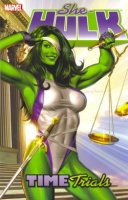
She Hulk: Time Trials


By Dan Slott, Juan Babillo & Marcelo Sosa and various (Marvel)
ISBN: 978-0-78511-795-7

Let’s re-cap: She Hulk is the cousin of the Incredible Hulk. Her alter-ego, lawyer Jennifer Walters, got a blood transfusion from Bruce Banner and the inevitable result was a super-powerful, ample-bosomed, seven foot tall green Valkyrie who is the poster-child for “As If…”

For most of her comics career she’s been played slightly skewed to the rest of the Marvel Universe. For a good deal of it she was the only character to refer to her life in comic-book terms, with all the fourth wall comedy that could be wrung out of that situation. In this incarnation (reprinting her five issue miniseries from 2005 – in which #3 is celebrated as her 100th full issue) she returns to the prestigious Manhattan law-firm which specialises in the fledgling legal grey area known as Superhuman Law (see also Single Green Female).

This volume is marginally less tongue-in-cheek, but still follows the delightfully accessible formula, albeit with a slightly darker overtone as the human Jennifer needs artificial methods to transform into her seven foot glamazon form due to psychological traumas incurred as a result of the Avengers: Disassembled storyline and her rampaging destruction of the city of Bone, Idaho.

Nonetheless she is soon back at work on a time-travel murder case with a fascinating underlying idea. As everybody in the potential jury pool has been prejudiced by constant media coverage of the attempted murder (the victim isn’t dead yet at time of trial) Jen’s defence team comes up with the brilliant notion of calling jurors from the recent past – courtesy of the multiversal temporal police force the Time Variance Authority…

It’s all going so well until Clint Barton is selected as a jury member: how can Jen work when one of the twelve is secretly Hawkeye – a fellow Avenger she feels responsible for killing!? Guilt-racked and conflicted, Jen decides to break her oath and the rules of time-travel to warn the Ace Archer of the doom that awaits his return to his own time…

The Time Variance Authority is infallible however and when Jen is accused of the capital offence of time-tampering she faces having her entire existence erased from the annals of reality.

This third chapter is also her 100th anniversary issue and features guest art from Paul Pelletier & Rick Magyar, Scott Kolins, Mike Vosburg, Amanda Conner & Jimmy Palmiotti, Ron Frenz, Joe Sinnott & Sal Buscema, Mike Mayhew, Don Simpson, Lee Weeks and Eric Powell as well as dozens of costumed guest-stars from her jaded career as a hero/villain, whilst #4 is a brief interlude in the greater story (illustrated by Scott Kolins) as She Hulk explores the aftermath of her Idaho rampage with the poignant and rewarding ‘Back to Bone’ before the jurisprudence and chronal carnage concludes with the rescue and return of a dead hero…

This is a priceless, clever romp with devastatingly sharp wit and low, vulgar slapstick in equal amounts plus loads of the mandatory angst-free action: a great read and possibly the Best Whacky Legal Drama since Boston Legal. But don’t listen to me: catch this book and judge for yourself…

© 2006 Marvel Characters, Inc. All Rights Reserved.
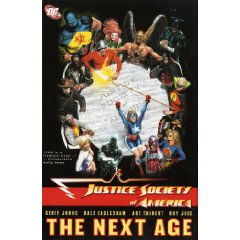
Justice Society of America: the Next Age


By Geoff Johns, Dale Eaglesham, Art Thibert & Ruy Jose (DC Comics)
ISBN: 978-1-84576-606-1

The World’s first Superhero team reboots itself once more after the interminable series of universal Crises (specifically World War III) and in conjunction with the Justice League of America returns as an organisation of heroic veterans working with and training the next generation of young heroes in this new interpretation of the JSA.

Originally published as issues #1-4 of the latest monthly comicbook series, this gripping thriller sees Elder Statesmen Flash, Green Lantern and Wildcat begin a recruitment drive that leads them to the heirs and inheritors of a number of older mystery men just as the corpse of one of the very first costumed heroes comes crashing through their HQ’s skylight, alerting them to a vicious plot by their oldest foe to wipe out “legacy heroes” forever…

Fast paced, tense and eerily gratifying, the venerable, journeyman and apprentice heroes cut loose against modern super-Nazis and the most evil man alive as they gather Cyclone, a new (or perhaps not) Starman, Citizen Steel, Liberty Bell, Damage and another Wildcat into their burgeoning fold just in time for the incipient JLA/JSA crossover The Lightning Saga and the unfolding Countdown to Final Crisis.

Steeped in DC lore and continuity this won’t be accessible to every reader, but it is still a compelling and enjoyable new chapter for the Justice Society and a worthwhile endeavour for fans of big plots and bold costumed crusaders.

© 2007 DC Comics. All Rights Reserved.

Rork 3: the Graveyard of Cathedrals/Starlight


By Andreas (NBM)
ISBN: 978-1-56163-150-6

To me a great comic strip begins with the simple line. The greatest drawing is always about the power of black against white. Colour enhances but it seldom creates. For my money, one of the best line artists in the business is the modern fantasist Andreas.

Andreas Martens is an incredibly versatile artist born in East Germany (from a time when that meant another country not a different location), trained at the Academy of Fine Arts in Düsseldorf and the Saint-Luc Institute in Brussels. His work has appeared in Le 9e Rêve, and Tintin where in conjunction with his teacher Eddie Paape he created the seminal Udolfo.

Andreas has adapted the works of Francois Rivière (collected as Révélations Posthumes in 1980) and produced a graphic edition of Charlotte Brontë’s Jane Eyre for Je Bouquine. Among his many original efforts are Raffington Detective, Cyrrus, Arq and a host of others. All his works are steeped in classical style, draped in period glamour and drenched in visual tension. Many are thematically linked. But before all these he created one of the most stylish and memorable “challengers of The Unknown” in horror fiction with the introduction and continuing adventures of the enigmatic psychic savant Rork.

His pale and moody hero, (who debuted in Pilote in 1978) draws on the tone and sometimes content of dark-fantasists August Derleth, H. P. Lovecraft and especially the Carnacki stories of William Hope Hodgson; traveling the world and the great beyond unraveling great mysteries and discovering startling wonders not for fame or glory but because he must…

In the early 1990s Dark Horse Comics serialized his adventures in their superb anthology of European comics Cheval Noir, and those translations formed the basis of a little seen or remarked upon series of albums from NBM. This volume is a particular favourite of mine (even if the spine and binding are less than robust), featuring two tales in a continuing story arc as the ethereal knowledge-seeker is returned to Earth from a Transcendent Realm to intervene in the inevitably grisly fate of a scientific expedition in the wilds of Central America.

Douglas Holbein was obsessed with the story of The Chavesians, an order of architectural mystics declared heretical by the Spanish Inquisition and banished to the New World by Queen Isabella. The centuries-old sect, which built the great churches of Christendom, did not die in the harsh jungles, but continued the craft, erecting monolithic buildings in the lush wilderness, ever-seeking to learn the secrets of God through their vast stone Faith Machines.

Now Holbein’s team have found the site of the ‘Graveyard of Cathedrals’ they accidentally disrupt a centuries-old truce between the sect’s last adherents with potentially catastrophic consequences and only the reality-shocked Rork can save them…

Following his harrowing return Rork is summoned to the deserts of Mexico by mysterious means to aid an old friend atoning for her past sins in an isolated and ancient pueblo. Increasingly endangered by a jealous Medicine Man, the woman called Low Valley cares for the Indians of the settlement as she awaits a certain lunar conjunction. The swift-approaching night when ‘Starlight’ again rains down on the people promises – or perhaps warns of – radical transformation when the heavens flare again. But the impoverished and desperate people must be made to remember that not all change is good…

Exotic, chilling and lyrically beguiling, the classical mysticism and otherwordly dread of these tales is a continuously heady and captivating brew, especially with the intense, linear illustration and stark design of Andreas to mesmerize and shock your widened eyes. This series should be at the top of the publisher’s list of books to re-release…

© 1996 Le Lombard. English translation © 1992 Dark Horse.

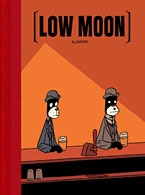
[Low Moon]

lowmoon
By Jason, translated by Kim Thompson (Fantagraphics Books)
ISBN: 978-1-84023-268-4

John Arne Saeterrøy, who works under the pen-name Jason, was born in Molde, Norway in 1965, and exploded onto the international cartoonists scene at age 30 with his first graphic novel Lomma full ay regn (Pocket Full of Rain) which won that year’s Sproing Award (Norway’s biggest comics prize). He followed with the series Mjau Mjau (winning another Sproing in 2001) and in 2002 turned almost exclusively to producing graphic novels. He has now achieved international fame and critical status, winning seven major awards as far afield as France, Slovakia and the USA and all areas in-between.

His stories utilise a small cast of anthropomorphic animal characters (and occasional movie and pop culture monsters), delivered in highly formal page layouts telling dark, wry and sardonically bleak tales – often pastiches, if not outright parodies – in a coldly austere and Spartan manner. This seemingly oppressive format somehow allows a simply vast range of emotionally telling tales on a wide spectrum of themes and genres to hit home like rockets whether the author’s intention was to make the reader smile or cry like a baby.

Drawing in a minimalist evolution of Hergé’s Claire Ligne style, Jason’s work bores right into the reader’s core, and this movie-based collection of short tales is possibly his best work yet.

Redolent of quintessential Film Noir and especially the writing of Jim Thompson, the poignant tale of vengeance ‘Emily Says Hello’ precedes what is billed as the World’s “first and only Chess Western”. The eponymous ‘Low Moon’ was originally serialized in The New York Times Sunday Magazine in 2008, a surreal spoof of Fred Zinnemann’s 1952 classic High Noon as an old menace returns to terrorise the town until the Sheriff capitulates to his incessant demands for one final return match…

‘&’ is a tragic anecdote of love, loss and marital persistence related in the terms and stylings of a Hal Roach silent comedy and ‘Proto Film Noir’ owes an inspirational tip of the thermally insulated hat to Tay Garnett’s The Postman Always Rings Twice (the 1946 version with John Garfield and Lana Turner) by way of the Flintstones and Groundhog Day, whilst the concluding tale of love, family and abandonment assumes science-fictional trappings to relate the soap-opera, generational tale of a mother kidnapped by aliens and the effects it inflicts on the husband and son she left behind. ‘You Are Here’ is bemusing, evocative and moving yet manages never to fall off the tightrope into mawkishness or buffoonery.

Jason’s comic tales are strictly for adults but allow us all to look at the world through wide-open childish eyes. He is a taste instantly acquired and a creator any true fan of the medium should move to the top of the “Must-Have” list. This superb little hardback could be your entry into a brave, old world, so get it while you can because stuff this good never lasts long…

© 2009 Jason. All right reserved.

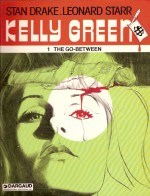
Kelly Green Book 1: The Go-Between


By Leonard Starr & Stan Drake (Dargaud International)
ISBN: 2-205-06574-2

After years of superb – if thematically anodyne – wholesome family comic strips, two of America’s most gifted graphic storytellers were given the chance to work on a more adult and potentially controversial feature with no creative restrictions; and the result was the second best female adventurer series in comics history.

Leonard Starr was born in 1925 and began his long and illustrious creative career in the Golden Age of American comic-books, before working in advertising and settling in the challenging arena of newspaper strips. He worked on Sub-Mariner, the Human Torch and the immensely popular but now all-but forgotten Don Winslow of the Navy during the 1940s, drew love stories for Simon and Kirby’s landmark Romance line and crime stories for EC, and freelanced extensively for ACG and DC Comics until he left the industry for Madison Avenue. He returned to graphic narrative in 1955 when he ghosted Flash Gordon.

In 1957 he created ‘On Stage’, a soap-opera strip starring aspiring actress Mary Perkins for the Chicago Tribune. He left the globally syndicated feature in 1979 to revive Harold Gray’s legendary Little Orphan Annie (which he continued until his retirement in 2000), simultaneously creating the series ‘Cannonball Carmody’ for Belgium’s Tintin magazine. An experienced TV scripter since 1970 Starr worked as head writer on Thundercats, and briefly returned to comic-books in the 1980s. He received the National Cartoonist’s Society Story Comic Strip Award for On Stage in 1960 and 1963, and their Reuben Award in 1965.

Stan Drake (1921-1997) was another vastly experienced cartoonist who began work in the 1940s. His two most famous series are the superbly compelling romantic drama-strip ‘The Heart of Juliet Jones’ (co-created in 1953 and initially written by Elliot Caplin) and the iconic ‘Blondie’ which he took over illustrating in 1984. He began his drawing career in the pulps, specifically Popular Detective and Popular Sports, before moving on to newly formed Timely Comics and The Black Widow. In 1941 he enlisted in the US Army. After the war he too worked in advertising until 1953 and Juliet Jones. In 1956 he narrowly survived the road accident that took the life of Alex Raymond, and was quickly back to work.

In the late 1970s he began Pop Idols – a syndicated series of celebrity biographies – whilst still working on Juliet Jones (which he left in 1989) and Blondie (which he drew until his death in 1997). During that incredibly productive time he still found the odd moment to work on Kelly Green – from 1982-1988 – and do the occasional job for Marvel Comics. To relax, he painted portraits of his cartoonist friends (now on display in the Comic Artist’s Museum in Sarasota, Florida). He received the National Cartoonists Society Story Comic Strip Award for 1969, 1970, and 1972 for The Heart of Juliet Jones.

Brave, competent, sexy, and divinely human, Kelly Green debuted in 1981 as a black and white serial in the legendary French magazine Pilote; a boldly contemporary antiheroic drama, with a deft, light tone and grimly mature themes. Within a year colour albums were flying off shelves across Europe, and eventually in the English speaking world, too.

Kelly Green is a stunning red-head who escaped a traumatic and mysterious past when she married Dan Green, a respected New York cop. But her comfortable world comes crashing down when he’s set-up by one of his own superiors and killed during a high-profile raid. Devastated, Kelly is pulled out of a suicidal depression by Spats Cavendish, Jimmy Delocke and the man-mountain called “Meathooks”; three career felons the straight-shooting cop had not only busted but then successfully rehabilitated.

Owing their new lives to the dead hero, the trio of honourable rogues take the widow under their collective wing, teaching her all the tricks of survival in a dirty world and even finding her a new occupation.

Hating the criminals that Dan fought and who finally got him, but despising more the corrupt police force that orchestrated his death, the grieving woman becomes a professional “Go-Between”, a paid intercessionary liaising between crooks and victims who don’t want police involvement. Apparently the job is completely legal and there’s never a shortage of clients…

This first case involves paying off a blackmailer and safely retrieving his damaging “evidence” for a prominent Miami millionaire, but in a dazzling blur of twists and counter-twists the job leads to the murderer of her beloved husband in a tense, terse thriller full of drama and action, and brimming with humour and good old fashioned style.

This beautifully executed crime thriller is still powerful, gritty stuff, and strictly for adults (it was made for France so there’s lots of lovingly rendered nakedness and nudity and even some unclothing), with copies of all volumes still readily available (if fetching rather high prices), so the persistent rumours of a full revival of the character next year are most welcome – and eagerly anticipated.
© 1982 Dargaud Editeur. All Right Reserved.

Hi-Fructose Collected Edition


Edited by Annie Owens & Attaboy (Last Gasp)
ISBN: 978-0-86719-713-6

If you’re au fait with such terms as Designer Vinyl, Softies, Plushies, Big Eye, Indy Toy, Constructions, Installations and other buzz-terms that define and compartmentalise the modern art scene then you may already be aware of the magazine Hi-Fructose which spotlights in a cool, hip and wonderfully accessible manner the eye-popping creations of modern artists working in every area of creativity from comic strips to photography, street art to customised toy-building, dress-making to performance.

Cutting Edge is a term I’m always uneasy applying to art of any kind but as a general term for “not your grandfather’s painting or sculpture” it will do as a guide to the literally stunning visual content in this book which collects and enthusiastically expands upon the first four issues of the contemporary arts review.

With forty or so artists displayed and/or interviewed, this quality full-colour hardback explores surreal toy photography, the French company Royal de Luxe (who I think created the giant spider that attacked downtown Liverpool during their recent City of Culture celebration), digital collage, animation, caricature, various styles of painting, a life-sized working version of the old children’s board-game Mousetrap, X-Ray photography, all disciplines of illustration, toy design/customisation, and whole bunches of things I don’t really have handy pigeon-holes for.

Art is not in the eye of the beholder: it is in all the processes of society.

If there is a prevailing theme or fascination linking many (never, never all) of the talented makers gathered here it might well be old views of the future and retro-imagery and co-opted popular cultural nostalgia of childhood. Many creators have also worked in the comics biz (Dave Copper, Chris Ware and Jim Woodring among others), but the overwhelming appeal of this book is the sheer, compulsive breadth and variety of the work.

If your eyes and brain are open to stimulation (and your ethical centre can handle the occasional sexually uncompromising image) this is a book that will stir your creative juices and make your arts and craft mouth water. (Painful metaphors can be ignored at will, other descriptive passages can be applied at readers’ request, and the relative value of critical opinion can go up as well as too far…)

All artwork, photos and writing © 2008 respective artists, photographers and authors. Book © 2008 Ouch Factory Yum Club and Last Gasp. All rights reserved.

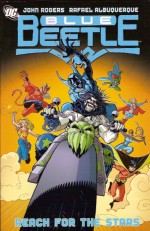
Blue Beetle: Reach for the Stars


John Rogers, Rafael Albuquerque & various (DC Comics)
ISBN: 978-1-4012-1642-9

Although long-gone as a monthly series the latest incarnation of the venerable Blue Beetle still survives in trade paperback collections where you can – and should – experience the frantic, fun and thrill-packed exploits of young Jaime Reyes, an El Paso teenager who was catapulted into the world of high-level super-heroics when a sentient scarab jewel affixed itself to his spine and transformed him into an armoured bio-weapon.

The third volume (collecting issues #13-19 of the monthly comic-book) begins with ‘Defective’ by Rogers, Albuquerque, David Baldeon and Dan Davis, wherein a benevolent seeming alien from an interstellar collective named The Reach introduces himself and reveals that the scarab is a invitation used to prepare endangered worlds like Earth for trade and commerce as part of a greater pan-galactic civilisation.

Unfortunately the one attached to Jaime has been damaged over the centuries it was here and isn’t working properly.

But the Reach envoy is a big, fat liar…

The Scarab should have paved the way for a full invasion and once they discover this, Jaime and militaristic superhero Peacemaker soon realise that The Reach are the worst kind of alien invaders; patient, subtle, deceptive and stocked with plenty of space-tech to sell to Earth’s greedy governments. The only hope of defeating the marauders is to expose their real scheme to the public – which is too dazzled by the intergalactic newcomers’ media blitz to listen…

‘Mister Nice Guy’ (Rogers & Albuquerque) finds the Beetle teamed again with the erratic Guy Gardner – a Green Lantern who knows all about The Reach and their Trojan Agenda – to defeat the macabre Ultra-Humanite who has sold his telepathic services to the invaders. Still looking for allies and a solution Jaime meets Superman in ‘Someone to Watch Over Me’ by J. Torres & Freddie Williams Jr. and battles one of the DC Universe’s gravest menaces in the startlingly powerful change of pace tale ‘Total Eclipso: the Heart’ by Rogers & Albuquerque.

The same creative team produced ‘Something in the Water’ as the elemental menace Typhoon joins with The Reach to endanger an entire city – and Bruce Wayne’s off-shore oil wells – in a clever and insightful tale with plenty of punch whilst ‘Away Game’ (Rogers, Albuquerque, Baldeon & Davis) finds the Beetle and the Teen Titans in pitched and pithy battle against the unbeatable alien biker-punk Lobo.

Rogers and Albuquerque are joined by the weirdly whimsical Keith Giffen for the final tale in this collection which focuses on Jaime’s best friend Brenda, who has blithely lived her entire life unaware that her foster-mother is La Dama, El Paso’s crime boss supreme. The distraught girl only learns the dreadful ‘Hard Truths’ when the rival mob Intergang declares war and sends the fifty foot woman Giganta to smash her and her family to gooey pulp…

There are so few series that combine action and adventure with fun and wit, and can even evoke tragedy and poignant loss on command. John Rogers excels in this innovative and impossibly readable saga and the art is always top notch. And with the climactic final battle against the Reach still to come, this is a series any adventure fan will want to read over and over again.

© 2007, 2008 DC Comics.  All Rights Reserved.

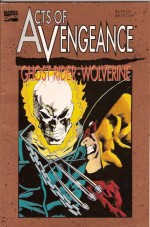
Wolverine/Ghost Rider: In Acts of Vengeance


By Howard Mackie, Mark Texeira & Harry Candelario (Marvel)
ISBN: 0-7851-0022-9

From that dubious period of “Grim ‘n’ Gritty” super-heroics in the early 1990s comes this slight but entertaining fast-paced pairing of Marvel’s (then) most savage champions which originally ran as the lead series in the fortnightly anthology Marvel Comics Presents #64-70, although dyed-in-the-wool continuity buffs should be warned that the connection to the company’s crossover event Acts of Vengeance is oblique – if not downright tenuous.

From his insalubrious bar on the pirate stronghold of Madripoor the globe-trotting mutant Wolverine is lured back to New York by a blatantly inept attack carried out by ninjas belonging to vampiric super-villain Deathwatch. Meanwhile Dan Ketch, human host of the fearsome Ghost Rider, finds one of his oldest friends also the target of similar ninjas.

The heroes’ paths cross with a karate instructor whose family also has a grudge against the criminal mastermind and all converge on the life-leech’s skyscraper headquarters for a surprise or two and a climactic showdown…

This yarn is just a stylish excuse for a big chase and huge fight – and that’s not necessarily a bad thing – so on those terms, this is a visceral, vicarious, effective use of the creators’ talents, with the added bonus of the introduction of yet another mutant superstar-in-waiting (I think he’s still waiting, even now) in the form of the unstoppable martial arts manhunter code-named Brass.

Sometimes no-frills cathartic comics combat is all you want from graphic narrative, and if you ever get that feeling this might be the book to buy…
© 1990, 1991, 1993 Marvel Entertainment Group. All rights reserved.

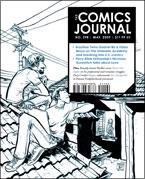
The Comics Journal 298


By various (Fantagraphics Books)
ISBN: 978-1-60699-146-6

This is a bit of a departure for me as I’m usually banging on about all aspects of sequential and graphic narrative in assorted book forms, and tend to shy away from actual periodicals, but this just arrived and on the principle that if it looks like a book (quacks like a book, floats like a book…?)

The Comics Journal is without doubt the foremost English-language publication dedicated to the capital A art of comics; highlighting events domestic and global, interviewing creators, disseminating facts and even advertising product. They’ve done it competently, passionately and proudly for decades. You may not always agree with the opinions expressed – editorial or from the many insiders who have been featured – but you’d be an idiot to ignore or dismiss them if you care at all about the industry or the medium.

This latest offering, in a comfortingly substantial square-bound format, black and white with lots of colour (where necessary and not just as a glossy, shiny lure for the easily distracted) features a short chat with Peter Bagge delivered in cartoon form by Noah Van Sciver, and an extensive interview (wrangled by Diego Assis) with Fábio Moon and Gabriel Bá; Brazilian artists most notable here thus far for the superbly innovative The Umbrella Academy.

Web-comics maestro Nicholas Gurewitch talks at length to Shaenon Garrity about his life and astonishingly impressive body of work whilst Michel Fiffe lets the hugely underrated Trevor Von Eeden tell his story his way as he describes where he’s been and what he’s now up to (and very tempting it looks, too), whilst Bill Randall previews Jiro Taniguchi’s upcoming manga A Distant Neighborhood (including a beautiful 12 page translated extract.

Also included are reviews of Jules Feiffer’s Explainers (and for our take just click here: Explainers), The Umbrella Academy: Apocalypse Suite, Gilbert Hernandez’s Speak of the Devil, Jim Woodring’s The Portable Frank, The United States Constitution: A Graphic Adaptation by Jonathan Hennessey & Aaron McConnell and Ron Regé Jr.’s Against Pain as well as mini-reviews of Seth Tobocman’s Disaster and Resistance: Comics and Landscapes for the 21st Century and Alex Bones/Chris Bones’ Waldo’s Hawaiian Holiday.

The highlight (at least for this old coot) is Jared Gardner’s retrospective Percy Crosby and Skippy, a copiously illustrated examination of the seminal newspaper cartoonist and illustrator which includes 31 pages of rollicking, rambunctious hi-jinks from the Great Depression era strip itself, although R.C. Harvey’s fascinating exploration of the quandary facing America’s political cartoonists, The Inevitable Racism: Obama and Caricature and Freedom of Speech comes close by confronting an issue that many journalists and commentators seemingly won’t: does the President’s ethnicity buy him an easy time in the press and especially from the politico/satirical media?

With features on foreign publications, cultural overviews, coming comics and the ever-entrancing news section Journal Datebook this is a cracking edition that will inform and enflame every serious devotee.

Heck, even the adverts are entertaining and compellingly readable…
www.tcj.com
© 2009 Fantagraphics Books, Inc. All images/photos/text © their respective copyright holders.

John Ryan 1921-2009

I’m saddened to learn of the death of master story-teller John Ryan.  For my own potted biography of this gentle genius you can check out our review of Eagle Classics: Harris Tweed although I’m sure the papers and news services will be full of fulsome obituaries for a man who was a pioneer of British comics, children’s books and television animation.

Typically, I’ve been intending to review his Captain Pugwash children’s books for some time now but never quite got around to it.

I first met him whilst teaching at the London Cartoon Centre where he was a rapturously received guest-speaker one evening. Afterwards, while chatting with the delighted fans of four generations who had come to see and hear him, he very kindly showed me the actual cut-out and props (painted in black and white wash tones) he had produced for the very first 1950s Pugwash TV episodes, whilst simultaneously drawing a freehand biro sketch of Mary, Mungo and Midge for my bemused and overwhelmed wife.

He was a prince among men and we’re all the poorer for his passing, but at least his unique accomplishments will live in the legacy of brilliant tales he leaves behind.