By various (Marvel/Panini UK)
ISBN: 987-1-905239-84-9
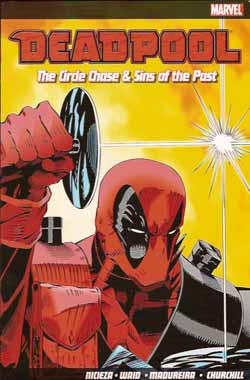
With the Wolverine movie looming and rumours of a spin-off for featured bad-guy Deadpool this timely collection of the unkillable assassin’s first two miniseries was inevitable and will hopefully lead to collections of the sterling run by scripter Joe Kelly that followed these tales. That’s not to disparage the fine efforts of Fabian Nicieza and Joe Madureira or Mark Waid, Ian Churchill, Lee Weeks, Ken Lashley and assorted inkers Mark Farmer, Harry Candelario, Jason Minor, Bob McLeod, Bob LaRosa and Tom Wegryzn, however.
What does it say about our industry that bloodthirsty – if stylish – killers and mercenaries make for such popular antagonists? Well, they certainly lead more interesting lives than your average plumber. Deadpool is Wade Wilson (and yes he is a thinly disguised knockoff of DC’s Slade Wilson AKA Terminator: Get over it – DC did) a hired killer and survivor of a genetics experiment that has left him capable of regenerating from any wound.
The wisecracking high-tech “merc with a mouth†was created by Rob Liefeld and Fabian Nicieza and first appeared in New Mutants #97, another product of the Canadian project that created Wolverine and the second Weapon X. He got his first shot at stardom with The Circle Chase miniseries in 1993.
This fast-paced if cluttered thriller sees Wade pursuing an ultimate weapon as one of a large crowd of mutants and ne’er-do-wells trying to secure the fabled legacy of arms dealer and fugitive from the future Mr. Tolliver. Among the other worthies after the boodle are Black Tom and the Juggernaut, the aforementioned Weapon X, shape-shifter Copycat and a host of half-cyborg loons with odd names like Commcast and Slayback. If you can swallow any nausea associated with the dreadful trappings of this low point in Marvel’s tempestuous history, there is a sharp little thriller underneath.
The second story (from 1994) revolves around Black Tom and Juggernaut. During the previous yarn it was revealed that the Irish arch-villain was slowly turning into a tree. Desperate to save his life they manipulate Wilson by exploiting the mercenary’s relationship with Siryn (a sonic mutant and Tom’s niece). Believing that Deadpool’s regenerating factor holds a cure, the villains cause a bucket-load of carnage at a time when Wade Wilson is at his lowest ebb. Fast paced, action-packed and full of mutant guest stars, this is a shallow but hugely immensely readable piece of eye-candy.
When the movie breaks, everyone is going to be an expert on Deadpool. Get this now and you’ll be one step ahead of the pack.
A MARVEL GRAPHIC NOVEL
By Jim Starlin, Bill Reinhold & Linda Lessman (Marvel)
ISBN: 0- 87135-855-7
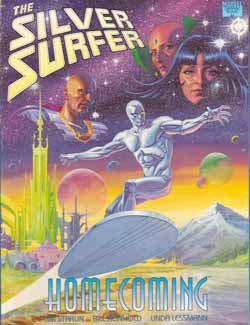
The Silver Surfer was a popular star of Marvel’s Graphic Novel line, his elevated pedigree and the nature and location of his adventures obviously offering an appealing number of opportunities to many creators. This tale from 1991 teams “Mr. Cosmic Storyline†Jim Starlin with the hugely undervalued Bill Reinhold to tell a rather lacklustre saga of granted wishes and thwarted dreams.
Norrin Radd allowed himself to be transformed into the Silver Surfer to save his homeworld Zenn-La from planet-devouring cosmic entity Galactus. His eventual emancipation never gave him the opportunity to permanently return to his place of birth, nor settle down with his lost love Shalla Bal, whom he had forsaken for a life of service to the Great Destroyer. Years later whilst on his solitary wanderings he finds Zenn-La missing; removed from reality by a galactic hyper-being.
Coming to the rescue the Surfer discovers not a tyrant but a benefactor who is preserving many words from the horrors of a violent universe, and decides to remain in this paradise. Unfortunately this dream come true is only for the invited…
An interesting premise, and well-handled visually, Homecoming nevertheless falls short of its aim due to a heavy-handed script that lacks any real punch or insight. Another one best left for the dedicated fan and collectors, I’m afraid.
By Gardner Fox, Mike Sekowsky, Carmine Infantino & various (DC Comics)
ISBN: 978-1-4012-1313-8
For many of us the Silver Age of comics is the ideal era. Varnished by nostalgia (because that’s when most of us caught this crazy childhood bug), the clean-cut, uncomplicated optimism of the late 1950s and early 1960s produced captivating heroes and villains who were still far less terrifying than the Cold War baddies which troubled the grown-ups. The sheer talent and professionalism of the creators working in that too-briefly revitalised comics world resulted in triumph after triumph which brightened our young lives and still glow today with quality and achievement.
One of the most compelling stars of those days was an ordinary Earthman who regularly travelled to another world for spectacular adventures, armed with nothing more than a ray-gun, a jetpack and his own ingenuity. His name was Adam Strange, and like so many of that era’s triumphs he was the brainchild of Julius Schwartz and his close team of creative stars.
Showcase was a try-out comic designed to launch new series and concepts with minimal commitment of publishing resources. If a new character sold well initially a regular series would follow. The process had already worked with great success. Frogmen, Flash, Challengers of the Unknown and Lois Lane had all won their own titles or feature spots and Editorial Director Irwin Donenfeld now wanted his two Showcase editors to create science fiction heroes to capitalise on the twin zeitgeists of the Space Race and the popular fascination with movie monsters and aliens.
Jack Schiff came up with the futuristic crime fighter Space Ranger (who debuted in issues #15-16) and Schwartz went to Gardner Fox, Mike Sekowsky and Bernard Sachs to craft the saga of a modern-day explorer in the most uncharted territory yet imagined.
Showcase #17 (cover-dated November-December 1958) launched ‘Adventures on Other Worlds’, and told of an archaeologist who, whilst fleeing from enraged natives in Peru, jumps a 25 ft chasm only to be hit by a stray teleport beam from a planet orbiting Alpha Centauri. He materialises in another world, filled with giant plants and monsters and is rescued by a beautiful woman named Alanna who teaches him her language.
‘Secret of the Eternal City!’ reveals that Rann is a planet recovering from an atomic war, and the beam was in fact a simple flare, one of many sent in an attempt to communicate with other races. In the four years (speed of light, right? As You Know, Bob… Alpha Centauri is about 4.3 light-years from Sol) the Zeta-Flare travelled through space cosmic radiation converted it into a teleportation beam. Until the radiation drains from his body Strange would be a very willing prisoner on a fantastic new world.
And an incredibly unlucky one apparently, as no sooner has Adam started acclimatising than an alien race named The Eternals invade, seeking a mineral that will grant them immortality. His courage and sharp wits enable him to defeat the invaders only to have the radiation finally fade, drawing him home before the adoring Alanna can administer a hero’s reward. And thus was established the principles of this beguiling series. Adam would intercept a Zeta-beam hoping for some time with his alien sweetheart only to be confronted with a planet-menacing crisis.
The very next of these, ‘The Planet and the Pendulum’ saw him obtain the crimson spacesuit and weaponry that became his distinctive trademark in a tale of alien invaders which also introduced the subplot of Rann’s warring city-states, all desperate to progress and all at different stages of recovery and development. This tale also appeared in Showcase #17.
The next issue featured the self-explanatory ‘Invaders from the Atom Universe’ and ‘The Dozen Dooms of Adam Strange’ wherein the hero must outwit the dictator of Dys who planned to invade Alanna’s city of Rannagar. With this story Sachs was replaced by Joe Giella as inker, although he would return as soon as #19’s Gil Kane cover, the first to feature the title ‘Adam Strange’ over the unwieldy ‘Adventures on Other Worlds’.
‘Challenge of the Star-Hunter’ and ‘Mystery of the Mental Menace’ are classic puzzle tales where the Earthman must outwit a shape-changing alien and an all-powerful energy-being. These were the last in Showcase (cover-dated March-April1959), as with the August issue Adam Strange took over the lead spot and cover of the anthology comic Mystery in Space.
As well as a new home, the series also found a new artist. Carmine Infantino, who had worked such magic with The Flash, applied his clean, classical line and superb design sense to create a stark, pristine, sleekly beautiful universe that was spellbinding in its cool but deeply humanistic manner, and genuinely thrilling in its imaginative wonders. MIS #53 began an immaculate run of exotic high adventures with ‘Menace of the Robot Raiders!’ by Fox, Infantino and Sachs, followed in glorious succession by ‘Invaders of the Underground World’ and ‘The Beast from the Runaway World!’
With #56 Murphy Anderson became the semi-regular inker, and his precision brush and pen made the art a thing of unparalleled beauty. ‘The Menace of the Super-Atom’ and ‘Mystery of the Giant Footprints’ are sheer visual poetry, but even ‘Chariot in the Sky’, ‘The Duel of the Two Adam Stranges’ (MIS #58 and #59, inked by Giella) and ‘The Attack of the Tentacle World’, ‘Threat of the Tornado Tyrant’ and ‘Beast with the Sizzling Blue Eyes’ (MIS #60-62, inked by Sachs) were – and still are – streets ahead of the competition in terms of thrills, spectacle and imagination.
Anderson returned with #63, which introduced some much-needed recurring villains who employed ‘The Weapon That Swallowed Men!’, #64’s chilling ‘The Radio-active Menace!’ and, ending this volume, ‘The Mechanical Masters of Rann’, all superb short-story marvels that appealed to their young readers’ every sense – especially that burgeoning sense of wonder.
The far-flung fantasy continued with ‘Space Island of Peril’ by Gardner Fox, Carmine Infantino and Joe Giella, a duel with an alien super-being who planned to throw Rann into its sun, followed in #67 by the sly ‘Challenge of the Giant Fireflies’ when Adam’s adopted home is menaced by thrill-seeking creatures who live on the surface of our sun.
Murphy Anderson returned as inker-in-residence for ‘The Fadeaway Doom’ wherein Rannian General Kaskor made a unique attempt to seize power by co-opting the Zeta Beam itself. ‘Menace of the Aqua-ray Weapon!’ had a race from Rann’s primeval past return to take possession of their old world, whilst #70 saw ‘The Vengeance of the Dust Devil’ threaten not just Rann but also Earth itself.
‘The Challenge of the Crystal Conquerors’ (inked by Giella) was a sharp game of bluff and double-bluff with the planet at stake but #72 was a radical departure from the tried and true formula. ‘The Multiple Menace Weapon’ found Adam diverted to Rann in the year 101,961AD to save his descendents before dealing with the threat to his own time and place. This was followed by the action-packed mystery thriller ‘The Invisible Raiders of Rann!’
The puzzles continued with #74’s complex thriller ‘The Spaceman who Fought Himself!’, inked by back-for-good Murphy Anderson, leading to MIS #75 and a legendary team-up with the freshly-minted Justice League of America against the despicable Kanjar Ro in ‘Planet that came to a Standstill’, indisputably one of the best tales of DC’s Silver Age and a key moment in the development of cross-series continuity.
After that 25 page extravaganza it was back to 14 pages for #76’s ‘Challenge of the Rival Starman!’ as Adam became the involuntary tutor and stalking-horse for an alien hero. ‘Ray-Gun in the Sky!’ is an invasion mystery which invited readers to solve the puzzle before our hero did, and ‘Shadow People of the Eclipse’ pitted the Earthman against a bored alien thrill-seeker. Issue #79’s ‘The Metal Conqueror of Rann’ saw Adam fighting a more personal battle to bring Alanna back from the brink of death, and ‘The Deadly Shadows of Adam Strange’ saw an old enemy return to wreak a bizarre personal revenge on the Champion of Rann.
MIS #81 tested our hero to his limits as the lost dictator who caused Rann’s devastating atomic war returned after a thousand years to threaten both of Adam’s beloved home-planets in ‘the Cloud-Creature that Menaced Two Worlds’, and a terrestrial criminal’s scheme to conquer our world was thwarted as a result of Adam stopping ‘World War on Earth and Rann!’. Issue #83 pitted him against the desperate ‘Emotion Master of Space!’ and this first volume concludes with the return of a truly relentless foe as Jakarta the Dust-Devil shrugs off ‘the Powerless Weapons of Adam Strange!’
For me, Adam Strange, more than any other character, epitomises the Silver Age of Comics. Witty, sophisticated, gloriously illustrated and fantastically imaginative: And always the woman named Alanna, beautiful, but somehow unattainable. The happy-ever-after was always just in reach, but only after one last adventure…
These thrillers from a distant time still hold great appeal and power for the wide-eyed and far-seeing. The sheer value of the huge black-and-white “phonebook†format makes a universe of wonder and excitement supremely accessible for the extraordinary exploits of Adam Strange: by far and away some of the best written and drawn science fiction comics ever produced. Whether for nostalgia’s sake, for your own entertainment or even to get your own impressionable ones properly indoctrinated, you really need these books on your shelves.
By Vittorio Giardino (Catalan Communications)
ISBN: 0-87416-033-2
After ten years, Italian graphic novelist Vittorio Giardino recently completed a trilogy of albums featuring his reluctant spy Max Fridman (transliterated into Max Friedman for the English speaking world), who was called back to the “Great Game†in the years of uneasy peace just before the outbreak of World War II.
No Pasarán! Volume 3 completed a tale of Republican Spain in the dying days of the Civil War which revealed many clues into the life of a diffident and unassuming hero who has charmed and enthralled word-wide audiences since the early 1980s, so in the earnest hope that this landmark will convince current publisher NBM (or anybody) to re-release the earlier books that are out of print I’m going to review them here over the next few months. If I make an impatient convert out of anyone, fear not. All but No Pasarán! Volume 1 are available from assorted internet retailers at reasonable prices and NBM do have copies of most of the other albums.
Born on Christmas Eve 1946 Vittorio Giardino was an electrician who switched careers at age 30. He worked for a number of comics magazines initially and his first collection Pax Romana was released in 1978. He has worked, slowly but consistently, on both feature characters such as the detective Sam Pezzo, the saucy Winsor McKay homage Little Ego and the cold-war drama Jonas Fink as well as general fiction tales producing over 35 albums to date.
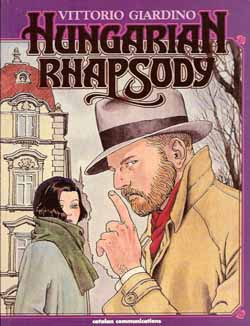
In 1982 he began the tale of a quiet, bearded fellow recalled by the Deuxieme Bureau (the French Secret Service) to investigate the slaughter of almost every agent in the cosmopolitan paradise of Budapest. The series ran in four parts in the magazine Orient Express before being collected as Rhapsodie Hongroise – Giardino’s thirteenth book and in no way unlucky for him.
Friedman is a troubled, cautious man with a daughter he adores and a troubled past that somehow stems from undisclosed experiences in the Spanish Civil War where he fought as a Republican in the International Brigades against Franco’s Nationalists. Yet he is convinced – call it blackmailed – to leave his home in Switzerland and investigate the plague of assassinations.
Max Friedman is one of espionage literature’s greatest characters. Giardino’s work is like honey for the eyes and mind. Hungarian Rhapsody is a graphic novel any fan of comics or the Intelligence Game should know.
By Joe Kelly, Doug Mankhe & Tom Nguyen (DC Comics)
ISBN13: 978-1-84023-609-5
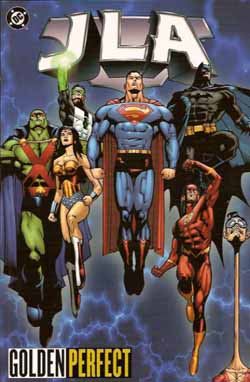
Joe Kelly’s run on the World’s Greatest Superheroes has some notable highs and lows. This slim volume collecting issues # 61-65 of the monthly comicbook happily falls into the former category. The title comes from the three-part tale that forms the bulk of the book, but before that the wonderment kicks off with the stand-alone tale ‘Two-Minute Warning’, one of the best “day-in-the-life†type stories I’ve ever seen, with sharp dialogue, spectacular art and a novel format that elevates it beyond the many other attempts to show what everyday means for such god-like beings.
‘Golden Perfect’ is a tale which examines the nature of Truth itself. When Wonder Woman leads the team to the hidden kingdom of Jarhanpur to rescue a baby from a life of hereditary slavery she encounters a despot whose philosophy counters her belief in objective or absolute truth. The dispute shatters her magical golden lasso of Hestia…
Soon however this defeat has astounding repercussions for the entire universe. The broken lasso has destroyed objective truth completely. What people believe becomes the only arbiter of Reality. The moon is made of green cheese, the world is flat, Earth is the centre of the universe… As it all unravels a devastated Wonder Woman must find a way to reconcile her beliefs within the new Reality while the team battle desperately to keep the cosmos alive.
A dynamic end-of-everything tale that challenges the mind as well as stirring the blood, the patented Kelly one-liners, especially from Plastic Man, leaven the tension and heighten the enjoyment in this cracking little epic.
Ending the volume is ‘Bouncing Baby Boy’, a wistful and funny team-up of the mismatched Batman and Plastic Man. This small story looks at the sad side of the eternal clown, seen through the “cold and emotionless†eyes of the Dark Knight, and provides a welcome change from the Big Stories that are increasingly all Super-team books consist of.
Golden Perfect is well written and superbly illustrated, but not a typical JLA collection: It’s much, much better than that…
By Warren Ellis & JH Williams III (WildStorm)
ISBN 1-84576-400-5
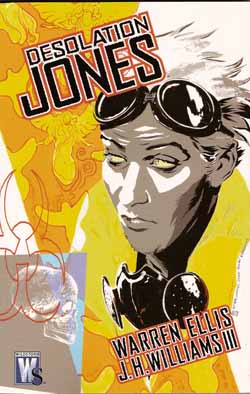
Los Angeles is a dump and a dumping ground. Personal opinions aside, that’s the premise of this deep, dark espionage thriller from comics wunderscribe Warren Ellis. When MI6 screw-up Michael Jones is no longer capable of doing his job he’s offered a comfy testing job as his ticket out. No-one in their right mind should ever trust security service types but that’s the point – the burnt out, alcoholic agent just wasn’t.
After years of unspeakable atrocities ostensibly intended to create better operatives up to and including the bizarre and inexplicable Desolation Test, the ravaged remains of Michael Jones is consigned to the reservation provided by the West’s Intelligence Agencies for retired, rejected and discarded agents plus all the experiments that didn’t measure up: Los Angeles, USA.
There they can live out their lives as they see fit, but they can never, ever leave the city. There’s no pension scheme but the dregs can do whatever they need to make a living as long as it’s within the city limits.
Jones is a mess, both physically and mentally. He can’t drink, won’t sleep and takes too many drugs. He avoids daylight, regularly hallucinates and is numb to all sensation and emotion. In “the Community†he freelances as a private eye-come-fixer, sorting out problems that can’t be resolved by legitimate methods.
In this first compilation (collecting issues #1-6 of the occasional WildStorm comicbook) that problem is a retired NSA spook who’s being blackmailed by new members of the Community who have stolen the Holy Grail of pornography. The ravaged Colonel Nigh wants Hitler’s homemade porno back and will do anything to get it. Unfortunately so will the other filthy rich deviants who populate Tinseltown.
But something isn’t right. Jones may not feel but something deeper is hiding behind all the subterfuge and depravity…
Sardonic and rather bleak, this caustic caper on the nasty side of the espionage genre is a thriller with plenty of twists and a solid mystery to intrigue the most jaded reader. The content is strictly adults only – by that I mean that the subtext of duty, love and honour are assaults on the traditions of the hero-spy in as brutal a manner as the sex and violence underscore the dark side of the American Dream-town. This is a story for cynical adults not horny kids with appropriate IDs. Great stuff beautifully executed by Ellis and magically illustrated by JH Williams III.
By Ed Brubaker & Sean Phillips (Titan Books)
ISBN13: 978-1-84856-151-9
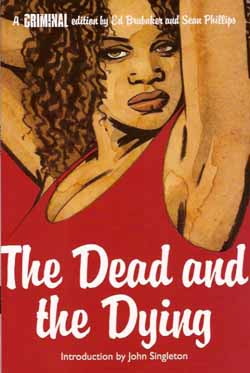
The third captivating collection of Brubaker and Phillips’s addictive modern Noir thriller (see Criminal: Coward ISBN: 1-84576-610-5 and Criminal: Lawless ISBN13: 978-1-84576-611-5) takes an unexpected turn by travelling back to the 1970s and recounting via three interconnected stories the history of the dark characters who inhabit those first two books.
Collecting volume 2, issues #1-3, of the comic book series, we meet the son of a black gangster who teamed with white Wise Guy Walter Hyde to take over the city’s rackets in 1954. Hyde became the Big Man and Clevon Brown became his invisible second. After all, there’s only so much progress even bad guys will let a black man enjoy in 1950s America.
1972 and Hyde’s kid Sebastian is making his way in his dad’s business but Jake Brown has chosen another route. They grew up friends but Jake chose boxing as a way to out, leaving the rackets to Hyde. Their closeness was soured over a woman but his once-friend still drags him back to the gutters whenever he needs a favour. And then one day he sees her: The girl who got between them.
1972 and the second chapter finds a revenge-hungry Danica involved with returning Vietnam vet Teeg Lawless in a plan to steal from the Hyde’s. But when Lawless discovers just who he’s robbed he knows his method of making amends must be spectacular if he and his two baby boys are to live. His bloody mission to return the money and punish his confederates ensures his fearsome reputation for decades to come…
1972: Danica Briggs is making her way back to the city where her life ended. She wants money. She wants revenge. She wants to see Sebastian and Jake again. She wants it all to end…
‘Second Chance in Hell’, ‘A Wolf Among Wolves’ and ‘Female of the Species’ tell three tragic stories which combine into a brutal, foredoomed spiral of hopelessness which only violence can end. Oddly reminiscent of Christopher Nolan’s film Memento the story unfolds by taking us further back into each character’s past with each beginning but, nihilistically, at no stage does there ever appear to be a instant when a different path taken could have saved anyone. These trapped souls are doomed from the moment they met…
Dark, brutal and fearfully compelling, these tales of the other side of society are an irresistible view of raw humanity. These are stories that can’t be ignored… so don’t.
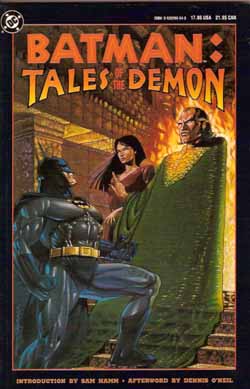
This themed collection re-presents some of the key clashes between the Gotham Guardian and the immortal mastermind and eco-activist Ra’s Al Ghul – a contemporary and more acceptable visual embodiment of the classic inscrutable foreign devil as typified in a less forgiving age as the Yellow Peril or Dr. Fu Manchu. This kind of alien archetype permeates fiction and is an overwhelmingly powerful villain symbol, although the character’s Arabic origins, neutral at the time, seem to embody a different kind of ethnic bogeyman in today’s post 9/11 world.
The concept of a villain who has the best interests of the planet at heart is not a new one, but Ra’s Al Ghul, whose avowed intent is to reduce teeming humanity to viable levels and save the world from our poison, hit a chord in the 1970s – a period where ecological issues first came to the attention of the young. It was a rare kid who didn’t find a note of sense in what the Demon’s Head planned.
Although the character is best remembered for the O’Neil/Adams collaborations, this book kicks off with a seminal story from Detective Comics #411 that featured the sinister League of Assassins (introduced in #405 I believe) and the exotic Talia. ‘Into the Den of the Death Dealers’ was written by Denny O’Neil and illustrated by the great Bob Brown, and inked by Dick Giordano.
‘Daughter of the Demon’ from Batman #232 by O’Neil and Neal Adams (with Giordano inking) is one of the signature high-points of the entire Batman canon, an exotic mystery yarn that draws the increasingly Dark Knight from Gotham’s concrete canyons to the Himalayas in search of hostages Robin and Talia. If you’re one of the few who hasn’t read this much reprinted tale I’m not going to spoil the joy that awaits you.
From Batman #235, with penciller Irv Novick joining regulars O’Neil and Giordano comes ‘Swamp Sinister’ a mystery tale and bio-hazard drama that gives some early insights into the true character of Talia and her ruthless sire. ‘Vengeance for a Dead Man’ (Batman #240) by the same creative team sets the scene for the groundbreaking “series-within-a-series†soon to follow as Batman uncovers one of Ra’s Al Ghul’s less worthy and far more grisly projects. As a result there was open war between Batman and the Demon…
Batman #242-244 and the epilogue from #245 (not included in this volume) formed an extended saga taken out of normal DC continuity, relating what was to be the final confrontation between two opposing ideals. Novick penciled the first part ‘Bruce Wayne – Rest in Peace!’ which saw Batman gather a small team of allies, including the still active today Matches Malone, to destroy the Demon forever, and Neal Adams returned with the second part ‘The Lazarus Pit’ which seemed to we consumers of the day a brilliant conclusion to the epic. But with the last three pages the rug was pulled out from under us and the saga continued!
How sad for modern fans with so many sources of information today: the chances of creators genuinely surprising their devoted readers are almost nonexistent but in the faraway 1970s, we had no idea what to expect from #244 when ‘The Demon Lives Again!’ hit the shops and news-stands. In a classic confrontation Batman triumphed and Ra’s Al Ghul disappeared for many years. He was considered by DC as a special villain and not one to be diluted through overuse. How times change…
In 1978 the company was experimenting with formats and genres in a time of poor comic sales. Part of that drive and was an irregular anthology entitled DC Special Series. From the all-Batman 15th issue comes an oddly enticing little gem scripted by Denny O’Neil and drawn by a talented young newcomer called Michael Golden, inked by the ubiquitous Dick Giordano. ‘I Now Pronounce you Batman and Wife’ is a stylish, pacy thriller that anticipates the 1980s sea-change in comics storytelling, but the most interesting aspect of the tale is the plot maguffin that inspired a trilogy of graphic novels in the 1990s and today’s Batman and Son (ISBN13: 978-1-84576-429-6) serial.
The volume concludes with another key multi-part epic, this time from Detective Comics #485, 489 and 490. Although picky me still wishes that all parts were included the truncated version here has no significant loss of narrative flow as Batman becomes involved in a civil war for leadership of the Al Ghul organization between the Demon and the aged oriental super-assassin the Sensei – who older fans will know as the villain behind the murder of Deadman.
It all begins with ‘The Vengeance Vow!’ as a long-standing member of the Batman Family is murdered, drawing the Caped Crimebuster into battle with the deadly martial artist Bronze Tiger. The concluding parts ‘Where Strike the Assassins!’ and ‘Requiem for a Martyr!’ whilst perhaps not as powerful as the O’Neil/Novick/Adams/Giordano run are nevertheless a stirring thriller with a satisfactory denouement, elevated to dizzy heights by the magnificent artwork of Don Newton. Inked here by Dan Adkins, Newton’s Batman could well have become the definitive 1980s look, but the artist’s tragically early death in 1984 cut short what should have been a superlative career.
Ra’s Al Ghul has become just another Bat-Foe in recent years, familiarity indeed breeding mediocrity if not contempt. But these unique tales from a unique era are comics at there very best and this book is well overdue for a definitive re-issue.
By Dennis O’Neil, Denys Cowan & Rick Magyar (DC Comics)
ISBN13: 978-1-84576-839-3
In the “real†world, some solutions require better Questions…
An ordinary man pushed to the edge by his obsessions, Vic Sage uses his fists and a mask that makes him look utterly faceless to get answers (and justice) whenever normal journalistic methods fail. After a few successes around the DC universe Sage got a TV reporting job in the town where he grew up.
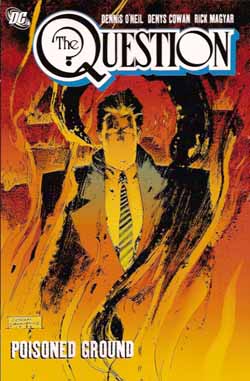
This second collection (reprinting issues #7-12 of the highly regarded 1980s series) of the seminal reinterpretation of Steve Ditko’s faceless seeker of Truth finds the obsessively driven reporter back on the streets of Hub City – probably the Worst City in America – and encountering a succession of highly conflicted and complex characters.
In ‘Survivor’ it’s aging vulpine racketeer Volk, who finds himself in the way of lesser, but more venal thugs, whereas ‘Mikado’ is a good man driven by the daily horrors of the city to take action, making his punishments fit the crime. Formerly corrupt cop Izzy O’Toole continues his struggle for redemption in ‘Watchers’ as the Question searches for his missing mentor and confidante Professor Rodor, a hunt that takes him to the Tropical hell-hole of ‘Santa Prisca’ and a confrontation with a sadist who wants to be a Saint in ‘Transformation’.
The Halloween celebration ‘Poisoned Ground’ closes this volume as a contaminated housing project provides a backdrop for another killing spree for Baby Gun, the mentally impaired gunman who killed Sage in The Question: Zen and Violence (ISBN13: 978-1-84576-690-0).
These are tales that probe the very mature of the struggle between Good and Evil, using Eastern philosophy and very human prowess to challenge, crime corruption, abuse, neglect and complacency.
Combating Western dystopia with Eastern Thought and martial arts action is not a new concept but the author’s spotlight on cultural problems rather than super-heroics make this series O’Neil’s most philosophical work, and Cowan’s raw, edgy art imbues this darkly adult, powerfully sophisticated thriller with a maturity that is simply breathtaking.
The Question’s direct sales series was one of DC’s best efforts from a hugely creative period, so it’s up to you to make it the popular hit it always should have been via these superb trade paperback collections, available at last due to the hero’s major role in the weekly comic maxi-series 52.
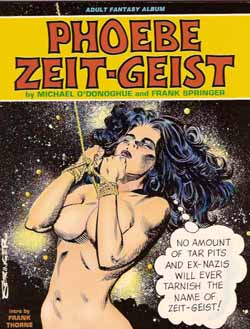
By Michael O’Donoghue & Frank Springer (Ken Pierce Books)
ISBN: 0-912277-34-3
The 1960s satire boom left many unforgettable classics in film and television, but precious little in the form of comic-strips. One notable exception is this cerebral and innocently smutty masterpiece from Michael O’Donoghue – a brilliant writer and performer who was a co-founder of National Lampoon, as well as an involved citizen in the right place at the right time. His later jobs included working with Woody Allen and being the first head writer on the groundbreaking Saturday Night Live.
In a period of immense upheaval he was in a position to say something about Everything and chose methods that people couldn’t ignore – biting commentary, bizarre sexual practices and naked ladies.
His perfect partner in this endeavour was veteran comics stripper, cartoonist and animation artist Frank Springer, who began his career by assisting George Wunder on Terry and the Pirates before branching out into comic books for practically every company in America.
In 1965 they produced for the Evergreen Review a tongue-in-cheek, subversive assault on old America in the form of a parody of silent movie serials such as the Perils of Pauline. And like contemporary cartoon commentaries Little Annie Fanny and The Adventures of Pussycat they used tactics America couldn’t ignore – politics, sexual themes and the aforementioned naked ladies.
Evergreen Review was an eclectic literary magazine which began in the late 1950s. Despite being a “literary†periodical it was always heavily illustrated and carried many cartoons – often of a controversial, sophisticated or sexually charged nature.
The Review debuted pivotal works by Edward Albee, Samuel Beckett, Jorge Luis Borges, Bertolt Brecht, Charles Bukowski, William Burroughs, Albert Camus, Marguerite Duras, Lawrence Ferlinghetti, Jean Genet, Allen Ginsberg, Gunter Grass, LeRoi Jones, Jack Kerouac, Norman Mailer, Henry Miller, Pablo Neruda, Vladimir Nabokov, Frank O’Hara, Kenzaburo Oe, Octavio Paz, Harold Pinter, Susan Sontag, Tom Stoppard, Derek Walcott and Malcolm X.
It closed in 1973, but returned in 1998 as an online magazine edited by founder Barney Rosset and Astrid Meyer. The new Review features flashbacks to classic editions, and new material by contemporary dissident poets such as Dennis Nurkse, Giannina Braschi and Regina Dereiva.
Evergreen Review ran thirteen instalments of Phoebe, ranging from four to eight pages with such chapter titles as ‘Peril Diver’, ‘Liquidated Assets’ and ‘Pain and Ink’ but the jocularity of the titles mask a very dark and instructive comedy. Many images and scenes involve brutality, humiliation, Nazism and bondage: not out of prurience but to make an antithetical statement.
This is clever, worthy stuff, but if you’re looking for a cheap thrill or can’t see past the surface, leave this book alone. The Review’s publisher Grove Press collected the series as a hardback book in 1968, and this paperback from 1986 reprints that edition.
This is a great lost gem, a powerful example of what comics can contribute to the adult world of debate and reason and a clever read. It’s about time for a third edition…