By Mizuho Kusanagi (TokyoPop)
ISBN: 978-1-5981-6829-7
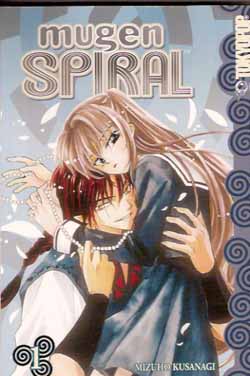
This unassuming blend of romantic comedy and high fantasy sees young and cute Yayoi Suzuka assume her hereditary mantle as Earth’s pre-eminent mystic guardian and demon hunter (the 78th in her family line) just in time to bind Ura, a demon prince into the form of a cat (also cute) and make him her pet.
Despite her awesome powers and the 108 spirits that she controls, she’s still little more than a girl and as the forces of darkness line up to challenge her, she finds herself developing an unwanted relationship with Ura’s humanoid form (yeah, also cute). He reveals that demons are attracted to magical humans because they need to consume their energy, and swears that all he wants to do is eat her. But inside he’s conflicted…
As her demon-vanquishing career proceeds Yayoi discovers that there is civil war in the demon realm and that Ura has a sound reason for wanting her power. Moreover she still finds herself fighting demons but is it for Humanity’s sake or for her pet demon prince…?
A gentle RomCom, Mugen Spiral is very easy on the eye, but rather predictable, which won’t deter dedicated fans of the genre, but might disappoint a more casual or critical reader. This book is printed in the ‘read-from-back-to-front’ manga format.
By David S. Goyer, Geoff Johns & various (DC Comics)
ISBN: 1-56389-937-X
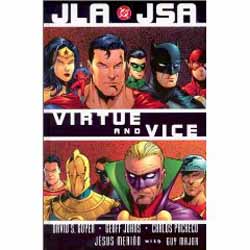
Some books you can talk about, but with others it’s simply a waste of time. This is one of the latter. If you’re aware that the Justice Society of America was the industry’s first super-team formed to fight in World War II, and are now an organisation who regularly save the world whilst mentoring the next generation of superheroes, whilst the Justice League of America are the World’s Greatest Superheroes (and have all the characters who’ve appeared on TV and in movies) then you have all the background you need to read this wonderful example of fights ‘n’ tights fiction.
The JLA and JSA have gotten together to celebrate Thanksgiving when the alien conqueror Despero attacks them and the entire world by releasing the Seven Deadly Sins who promptly possess Batman, Power Girl, Mr. Terrific, Dr. Fate, Green Lantern, Plastic Man and Captain Marvel.
Can the remaining heroes defeat the sins without killing their friends, and save the world from total destruction? Of course they can, that’s the point. But seldom have they done it in such a spectacularly well written and beautifully illustrated manner.
This is a piece of pure, iconic genre narrative that hits every target and pushes every button it should. If you love superhero comics you should own this lovely book.
By Jim Starlin & Berni Wrightson (Marvel)
ISBN: 0- 87135-299-0
I can’t recall the last time Marvel published an all-original graphic novel as opposed to a collection, but not so very long ago they were a market leader in the field with an entire range of “big stories†told on larger than normal pages (285 x 220 mm rather than the now customary 258 x 168 mm) featuring not only proprietary characters but also licensed assets like Conan and even creator-owned properties like Jim Starlin’s Dreadstar.
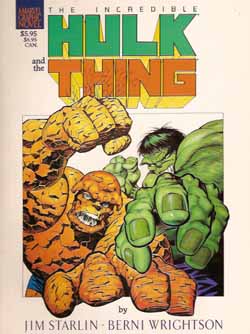
This one is full-on Marvel Madness and a wonderfully comedic outing for two of the industry’s biggest names. Released in 1987 it teamed old friends and young turks Jim Starlin and Berni Wrightson on a big kids dream project as Marvel’s top monstrous strongmen the Hulk and the Thing are abducted by a cosmic civil servant of the Federation of Matriculon. He needs a couple of tough guys for a bit of Repo work.
Promised two wishes, good for anything their hearts desire, our bellicose heroes are tasked with recovering a fabulous new product (“Mall Addy’s Nutritional Big Changeâ€) from the worst monster on a world full of monsters.
Beautifully painted art and wicked, tongue-in-cheek humour garnish what is basically one great big fight comic. In the immortal words of Tiswas, “this is what they want!â€
Fast. Furious. Funny. This proves that – at least in comics – violence does solve some things! Fabulous!
By Mike Baron, Jeff Butler, Bill Reinhold & various (IDW Publishing)
ISBN: 978-1-6001-0129-8
During the huge creative outburst of the early 1980s a number of independent publishers sprang up with an impressive variety of high quality concepts and packages. One of the very best of these was Mike Baron’s captivating psycho-warrior The Badger. Originally part of the superb Capital Comics line (other class acts included Baron and Steve Rude’s Nexus and Steven Grant & Rich Larson’s Whisper) the series – all of them – were snatched up by highly perspicacious First Comics when Capital closed its publishing division to concentrate on distribution.
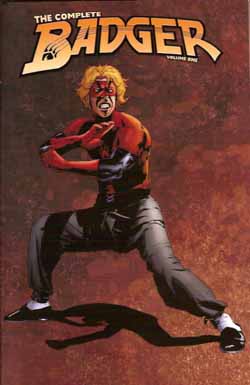
Norbert Sykes is a Vietnam veteran and expert in many forms of martial arts. On his return to Madison, Wisconsin after his tour of duty he is institutionalised for maiming some frat boys he caught torturing ducks in a park. In the asylum he meets an immortal Celtic wizard named Ham (full name Hammaglystwythkbrngxxaxolotl – and I only typed that to teach my spellchecker a lesson) and case worker Daisy Fields. Norbert has at least seven distinct personalities and can communicate with animals; Ham likes to cause trouble and Daisy… Daisy hates being patronised by imbeciles in positions of authority…
Recently awoken from a fifteen hundred year coma, Ham engineers his and Norbert’s release, hires Daisy as his assistant and uses his magic to amass real 20th century power – vast wealth. Deep down though the wizard is still the anarchic, amoral druid who plays with weather systems by spilling innocent blood…
And thus begins one of the strangest superhero comics ever crafted. Raw, rebellious, rambunctious and never conventional, this is an engaging and unique take on men in tights best described by the series own tag line ‘Put on a costume and fight crime? You’d have to be Crazy!’
This collection assembles the four Capital issues and the next two from pick-up publisher First and although there are few problems with the early colour reproduction, it’s a delight to see Madison’s Finest back on the shelves. Mike Baron has a profound love for Hong Kong cinema with its spectacular fights and impenetrable internal logic, and that “go with the flow†attitude is evident in this glorious, manic riot of comedy, sly commentary, frank character-play and all-out action.
After the necessary introductions of the first issue the narrative rockets along as the new associates set up house in the ugliest mansion in Wisconsin. Norbert resumes his career as a street vigilante, Ham plays nasty games with the eco-system and, from Tibet, agents from the ancient Society to Obliterate Sorcery come a-calling…
The second issue also featured a couple of vignettes – more shaggy-dog stories than actual adventures – by Baron, Rick Burchett, Charles Truog and Butler, and these provide some fine insights into the cast and characters.
The third issue ‘The Day the Comics Fell’ (pencilled by Burchett and inked by Dennis Wolf) is an action extravaganza that devolves into high satire when the Reverend Leopold Grabbitt hits town determined to save the “Chillun of Amercuh†from the sinful horrors of comic books. Would that his fate at the hands of Ham could be reproduced in the real world…
That issue was topped off by a further delving into the 4th Century origins of the weather wizard by Baron and Butler, and the last Capital issue deals with the repugnant world of dog-fighting in salutary and satisfactory fashion. The creators frequently used the comic as vehicle for satisfying scores – and more power to them!
At the end of the issue Badger was literally banished to Limbo and when First Comics picked up the series months later they first guested Norbert in the already established Nexus (issues #6-7). Unfortunately that tale isn’t reprinted here, but the action does pick up with issue #5. The Badger’s return to Earth coincides with Ham’s battle to save a 1600 year old tree from an energy conglomerate that plans to turn rural Wisconsin into an experimental Uranium refinery.
That battle takes the remaining two issues in this first volume (crafted by the new creative team of Baron, Bill Reinhold and Jeff Dee) and grippingly escalates into one of the strangest environmental campaigns of all time, but the resolution isn’t a comfortable ending and this volume ends on something of a cliffhanger, but that’s only a minor annoyance, isn’t it?
This is another big box of comics delight: frantic, captivating and deliciously habit-forming. If you crave angst-free, full-on fun and excitement The Badger is well worth tracking down.
Illustrated by Craig Cameron (Egmont)
ISBN: 978-1-4052-3750-5
One of the absolute best bits about being a comics fan – or any kind of collecting hobbyist – is the semi-obsessive thrill that comes from chasing a set. We’re all suckers for the thrill of hunting a missing number and that’s all the better if the book in question is a great read and visually memorable.
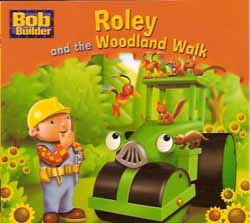
And it’s never too early to start. Roley and the Woodland Walk is a surprisingly well written book for the very young based on the popular TV series featuring the affable steamroller and all the animals in Sunflower Valley in a delightful comedy of errors, with sensible Bob once again having to come to the rescue.
Designed for small hands, the book is 34 pages plus covers and has 13 lavish, eye-catching full-page illustrations. It is number #5 in the Bob the Builder Story Library, cunningly enumerated on the spine, and has ads for the other titles in the back, just like all the best comics do (eight to collect, so far, kids!).
In our electronic, post-literate culture, kids need every aid and inducement to pick up the reading bug, and these lush little pictorials are a perfect primer for a life of reading comics and books. They’re also superbly well crafted and re-readable if you’re the adult having to narrate them at bedtime.
Edited by Marcus Morris (Mermaid Books)
ISBN: 0-7181-22119 (trade paperback) ISBN:0-7181-1566X (hardback)
A little hard to find but well worth the effort is this upbeat pictorial memoir from the conceptual creator of arguably Britain’s greatest comic. Eagle was the most influential comic of post-war Britain, and launched on April 14th 1950, running until 26th April 1969.
It was the brainchild of a Southport vicar, The Reverend Marcus Morris, who was worried about the detrimental effects of American comic-books on British children, and wanted a good, solid, Christian antidote. Seeking out like-minded creators he jobbed around a dummy to many British publishers for over a year with little success until he found an unlikely home at Hulton Press, a company that produced general interest magazines such as Lilliput and Picture Post.
The result was a huge hit spawning clones Swift, Robin and Girl which targeted other demographic sectors of the children’s market, as well as radio series, books, toys and all other sorts of merchandising.
A huge number of soon-to-be prominent creative figures worked on the weekly, and although Dan Dare is deservedly revered as the star, many other strips were as popular at the time, and many even rivalled the lead in quality and entertainment value.
At its peak Eagle sold close to a million copies a week, but eventually changing tastes and a game of “musical owners†killed the title. In 1960 Hulton sold out to Odhams, who became Longacre Press. A year later they were bought by The Daily Mirror Group who evolved into IPC. In cost cutting exercises many later issues carried cheap Marvel Comics reprints rather than British originated material. It took time but the Yankee cultural Invaders won out in the end…
With the April 26th 1969 issue Eagle was merged into Lion, eventually disappearing altogether. Successive generations have revived the title, but never the success.
Here Morris has selected a wonderfully representative sampling of the comic strips that graced those pages of a Golden Age to accompany his recollection of events. Being a much cleverer time, with smarter kids than ours, the Eagle had a large proportion of scientific, historical and sporting articles as well as prose fiction.
Included here are over 30 pages reprinting short text stories, cut-away paintings (including the Eagle spaceship), hobby and event pages, sporting, science and general interest features – and it should be remembered that the company produced six Eagle Novels and various sporting, science and history books as spin-offs between 1956 and 1960. Also on show are many candid photographs of the times and the creators behind the pages.
Of course though, the comic strips are the real gold here. Morris has selected 130 pages from his tenure on Eagle that typify the sheer quality of the enterprise. Alongside the inevitable but always welcome Hampson Dan Dare are selections from his The Great Adventurer and Tommy Walls strips.
Other gems include The Adventures of PC. 49 by Alan Stranks and John Worsley, Jeff Arnold in Riders of the Range, by Charles Chilton & Frank Humphris, Chicko by Norman Thelwell, Professor Brittain Explains…, Harris Tweed and Captain Pugwash by John Ryan, Cortez, Conqueror of Mexico by William Stobbs, Luck of the Legion by Geoffrey Bond & Martin Aitchison, Storm Nelson by Edward Trice & E. Jennings and Mark Question (The Boy with a Future – But No Past!) by Stranks & Harry Lindfield.
There are selections from some of the other glorious gravure strips that graced the title: Jack o’Lantern by George Beardmore & Robert Ayton, Lincoln of America by Alan Jason & Norman Williams, The Travels of Marco Polo by Chad Varah & Frank Bellamy, The Great Charlemagne and Alfred the Great (both by Varah & Williams).
Extracts from Bellamy & Clifford Makin’s legendary Happy Warrior and the less well known The Shepherd King (King David), run beside The Great Sailor (Nelson) by Christopher Keyes, as well as The Baden Powell story (Jason & Williams) and even David Livingstone, the Great Explorer (Varah & Peter Jackson), and the monochrome They Showed the Way: The Conquest of Everest by Peter Simpson & Pat Williams makes an appearance.
The book is peppered with nostalgic memorabilia and such joys as George Cansdale’s beautiful nature pages plus a host of cartoon shorts including the wonderful Professor Puff and his Dog Wuff by prolific Punch cartoonist David Langdon. Also included is The Editor’s Christmas Nightmare by Hampson, a full colour strip featuring every Eagle character in a seasonal adventure that is fondly remembered by all who ever saw it…
These may not all resonate with modern audiences but the sheer variety of the material should sound a warning note to contemporary publishers about the fearfully limited range of comics output they’re responsible for. But for us, it’s enough to see and wish that this book, like so many others, was back in print again.
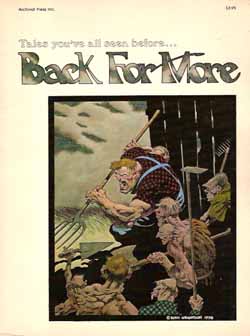
By Berni Wrightson (Archival Press)
ISBN: 0-93158-22-30-X
I was reviewing the first Un-Men collection (Get Your Freak On! – ISBN: 978-1-84576-748-8) when I decided to simultaneously – and gratuitously – revisit the classic 1970s Swamp Thing, which led me to The Mutants (ISBN: 0-937848-00-X) …and that led me here.
Towards the end of the turbulent 1960s a lot of fresh talent was trying to break into the comics industry at a time when a number of publishers were experimenting with cheaper black and white magazines rather than four-colour comic books. Companies like Warren, Skywald and a small host of imitators were hiring kids who then honed their craft in public.
A respectable number of those neophytes, such as Bruce Jones, Mike Kaluta and Jeff Jones, Al Weiss, as well as Wrightson, grew into major talents after drawing pastiches of the EC Comics they had loved as kids – and they paved the way when the comics market again turned to shock, mystery and black comedy to sell funny-books.
The seven tales collected here are garnered from such varied sources: horror, fantasy and Sci Fi tales, showing Wrightson’s absolute mastery of black and white line and tones, and mostly, as far as I know, self-penned.
Visually King of the Mountain, Man! is vintage Wrightson, but again his devilishly wicked sense of humour is the real star. Ain’t she Sweet? and Uncle Bill’s Barrel, which close this volume, are indistinguishable from his professional horror work at DC, which surely shows that he was ready for the big time by this stage – even it wasn’t necessarily ready for him…
As a chronology of the development of one of the industry’s finest talents this is an indispensable package, but this book can stand on its own as a vastly entertaining fantasy anthology. Someone, somewhere please take note and republish this book (and The Mutants, too)!
By Walt Kelly (Fantagraphics Books)
ISBN: 978-1-56097-920-3
Our Gang (also known as the Li’l Rascals) movie shorts were one of the most popular series in American Film history. From 1922 onwards they featured the fun and folksy humour of a bunch of “typical kids†(atypically though, there was full racial equality and mingling – but the little girls were still always smarter than the boys) having wholesome adventures in times safer and more simple.
The rotating kid cast and slapstick shenanigans were the brainchild of film genius Hal Roach (who worked with Harold Lloyd, Charley Chase and Laurel and Hardy amongst others) and these brief cinematic paeans to a Golden Age of childhood entered the “household name†category of Americana in amazingly swift order.
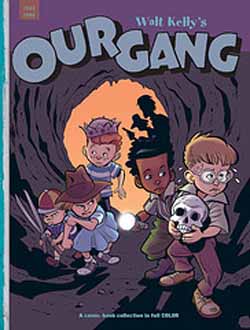
From 1942 Dell released an Our Gang comic book written and drawn by the legendary Walt Kelly, who, consummate craftsman that he was, resorted to wit, verve and charm to concoct a progression of stories that elevated an American childhood of the War Years to the mythical levels of Baum and Twain.
This third collection, re-presenting the tales from issues #16 to #23, take the eternal scamps from the dog-ends of World War II to the shaky beginnings of a new world (April 1945 – June 1946), but the themes and schemes are as comfortingly familiar as ever, with Froggy, Buckwheat (eventually plain Bucky), Janet, Red and Baxter (not to mention Julep the Goat) foiling crooks, raising cash, lazing around and rushing about in a pictorial utopia of childhood aspiration and unsullied joy.
As always the tales are lovingly reproduced in a gloriously luxurious collection, this time sporting a Jeff Smith cover and an informative introduction by Walt Kelly historian Steve Thompson.
This idyllic paean to long-lost days of games and dares, excursions, adventures, get-rich-quick-schemes, battles with rivals and especially plucky victories is a fabulous window into a better universe. If the eternal struggle palls, here is a beautiful tonic from a master of comics that has truly universal appeal.
By Larry Hama, Andrew Wildman, Art Nichols & Joe Rubinstein (Marvel)
ISBN: 978-0-7851-0199-4
There was a period in the mid 1990s where, to all intents and purposes, the corporate behemoth known as Marvel Comics had completely lost the plot. An awful lot of stories from that period will probably never be reprinted, but some of them weren’t completely beyond redemption.
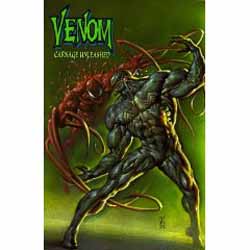
At one stage the symbiote went into breeding mode, creating a junior version of itself that merged with Cletus Kasady, a totally amoral and completely deranged psycho-killer. Calling him/itself Carnage, it tore a bloody swathe through New York before an army of superheroes caught him and his equally noisome “familyâ€.
There is no love lost between Venom and Carnage.
This collected four-issue miniseries (perhaps the best of a truly lackluster series of self-contained Venom stories released by Marvel) sees the Lethal Protector return to New York just as Kasady, who has sold the rights to his life to an online gaming company, uses a complimentary computer terminal to escape from the Ultra-High Security Ravencroft Hospital for the criminally insane.
That’s about it for plot. Larry Hama is an absolute master of hell-for-leather, gung-ho action, with a dry black wit and sharp ears for a good line, and the art is competent and frenetic, with inker Rubinstein mercifully blunting the worst excesses of the artists, who were fully immersed in the infernally annoying scratchy-line “Image style†penciling of the time.
Shallow and with no discernible lasting merit, this is nevertheless and full-on hoot of superheroic excess and could just be the solution to a dull, wet afternoon.
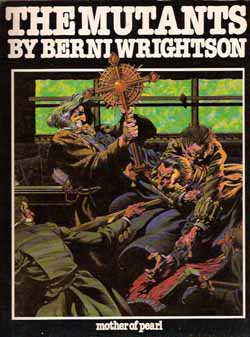
By Berni Wrightson & various (Mother of Pearl)
ISBN: 0-937848-00-X
I was reviewing the first Un-Men collection (Get Your Freak On!- ISBN: 978-1-84576-748-8) when I decided to simultaneously – and gratuitously – revisit the classic Swamp Thing: it’s odd how your day will take you because I then thought about the rarer stuff that Wrightson did when he was just breaking into the business…
Towards the end of the turbulent 1960s a lot of fresh talent was trying to break into the comics industry in America. Moreover at that time a number of publishers were experimenting with cheaper black and white magazines rather than four-colour comic books. Companies like Warren, Skywald and a small host of imitators were hiring kids who then honed their craft in public.
Some of those neophytes, Bruce Jones, Mike Kaluta and Jeff Jones, as well as Wrightson, all got a chance to grow, and more importantly, by actually drawing pastiches of the EC Comics they had revelled in as youngsters – a market that the comics mainstream scorned. At least at that moment in time…
Culled from various sources this book reprints a number of those fledgling horror, Sci Fi and fantasy tales, showing the sheer skill and virtuosity of the artist. With occasional scripts from Terry Bisson, Dick Kenson, Virgil North and David Izzo, these are primarily self-penned as well as illustrated novelettes. Mother Toad, The Task, the assorted adventures of Limstrel, The Game That Plays You, A Case of Conscience, The Legend of Sleepy Hollow, Stake Out, The Reaper of Love, Out on a Limb, Conjure Woman, Maudlin Love Comix, Nosferatu, Ghastly Horror Comix, and a delightful untitled pantomimic horror spoof all conclusively display the astounding talent of the young Wrightson, and most importantly his devilishly wicked sense of humour.
Also included is an incredible 17 page portfolio section which even has a selection from his seminal Frankenstein adaptation. Simply as a casual read this would be a fine book to own, but as a chronology of the development of one of the industry’s finest talents it is indispensable. Someone, somewhere take note and republish this book!