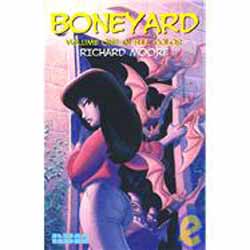
Young Paris – don’t call him Michael, he hates it – may finally have had a turn of good luck. Not only has he inherited some property from his reclusive grandfather, but the residents of picturesque little hamlet Raven Hollow are desperate to buy it from him, sight unseen. Nonetheless he makes his way their and finds that it’s not all so cut and dried.
The property is a cemetery named The Boneyard and not everything within its walls is content to play dead. There’s Abby, a beautiful vampire chick, a foul-mouthed skeleton, a demon with delusions of grandeur, a werewolf who thinks he’s a cross between James Dean and the Fonz, a witch, a hulking Frankensteinian monster and even talking gargoyles over the gate. Most worrying of all: There’s even a voluptuous (married) amphibian who adds worlds of meaning to the phrase “predatory man-eater.â€
The place is a veritable refuge for the restless dead and every sort of Halloween horror, but somehow they all seem more human and friendly than the increasingly off-kilter townsfolk whose desperate measures to make Paris sell show that not all monsters haunt graveyards.
Reprinting issues #1-4 of the independent comic book in full process colour, this is a charming, sly and irresistibly addictive book, a warm-hearted comedy of terrors that is one the best humour series to come out of the States since Charles Addams first started reporting from that spooky old house in the 1940s.
This is a must-have for Horrorists, Humorists and especially Romantics with an open mind, which can even be read by younger teenagers.
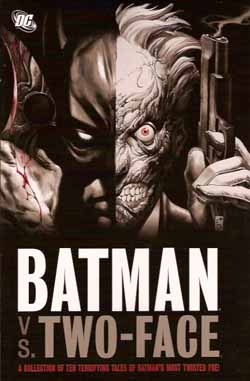
This themed collection re-presents some of the best clashes between the Gotham Guardian and the tragic lawyer-turned-criminal Harvey Dent – the visual embodiment of Dr. Jekyll and Mr. Hyde known as Two-Face.
To get you up to speed, the book starts with the most recent interpretation of the character’s origin, an impressive two-page recap by the Marks Waid and Chiarello, first seen in Countdown #27 (December 2007), before the book proper begins with the classic original trilogy of tales from Detective Comics #66, 68 and 80 (August and October 1941, and October 1943).
Written by the inimitable Bill Finger, and illustrated by Bob Kane, Jerry Robinson and George Roussos they told the tragic tale of Harvey Kent (yes that’s right, his name was only altered to Dent in the 1950s) a brilliant and fearless District Attorney driven insane when a mobster destroyed the left side of his gorgeous face with vitriol (that’s Sulfuric Acid, if you weren’t staying awake in Chemistry).
His life destroyed in the very courtroom of his greatest triumphs, Kent embarked on a crime-spree throughout Gotham City, taking the number “2†as his inspiration and using the toss of a double-headed coin to make all his key moral decisions for him. It took all of the dynamic Duo’s efforts to stop him, but he kept turning up like a bad penny until the fledgling science of plastic surgery cured his uniquely visual form of split personality.
He more or less returned in Detective #187 (September 1952). ‘The Double Crimes of Two-Face’ (by Don Cameron, Dick Sprang and Charles Paris) is a classic “fair-play†mystery featuring the character’s return so I’ll say nothing about it and let you solve it yourselves, but he returned for keeps in ‘Two-Face Strikes Again!’ (Batman #81, February-March 1954), by David Vern and the immaculate art team of Sprang and Paris.
As comics become increasingly more anodyne in the 1950s Two-Face faded from view, but with the return of a grimmer, moodier hero in the early 1970s the scene was set for a revival of Batman’s more warped villains. ‘Half an Evil’ (Batman #234, August 1971) is a spectacular action packed mystery, one the absolute best collaborations of Denny O’Neil, Neal Adams and Dick Giordano.
By 1989 a revitalized post-Crisis on Infinite Earths DC were busily revising their internal history and from Secret Origins Special #1 Mark Verheiden, Pat Broderick and Giordano produced a new take on the tragedy of Harvey Dent, which served as a basis for the following 1996 two-part tale from Batman #527 and 528. ‘The Face Schism’ and ‘Schismed Faces’, by Doug Moench, Kelly Jones and John Beatty is a slick and ghoulish carnival tale of twists, turns and double crosses, but in all that cleverness it rather forgets to be clear and entertaining.
The penultimate yarn is also rather disappointing, but not for any storytelling deficiencies. ‘Face the Ecaf’ is from Batman #653, and is by James Robinson, Don Kramer and Wayne Faucher. It’s set in the “One Year Later†period following the Infinite Crisis event when all the Bat heroes abandoned Gotham and Two-Face was given the job of protecting the city by the Dark Knight.
It’s part Six of Eight.
Surely such a major storyline should be left to its own collection and not simply truncated and shoved in any old how? It’s not as if there isn’t plenty of other fine material around to fill those twenty odd pages. Or was the temptation of one more major name on the package too much for Marketing to resist?
Rant over: the book does end with possibly the best modern Two-Face tale yet produced. ‘Two of a Kind’ is a short piece of Noir perfection by Bruce Timm that first appeared in Batman: Black and White #1 in 1996. Rendered in the style of the Batman Animated TV show it is suave, sultry, steamy and shocking. You’ll love it!
All the tales have been lavishly recoloured (except that last one, of course) and quibbles notwithstanding, this is a great book stuffed with quality reading entertainment. As an introduction to one of Batman’s best baddies, or simply as a wonderful way to spend some downtime, this is highly recommended.
By Archie Goodwin & Howard Chaykin (Marvel)
ISBN: 0-87135-577-9
I can’t recall the last time Marvel published an all-original graphic novel as opposed to a collection, but not so very long ago they were a market leader in the field with an entire range of “big stories†told on larger than normal pages (285 x 220 mm rather than the now customary 258 x 168 mm) featuring not only proprietary characters but also licensed assets like Conan and even creator-owned properties like Jim Starlin’s Dreadstar.
The Scorpio Connection should have been one of their very best productions, scripted by the supremely talented Archie Goodwin and painted by the versatile Howard Chaykin, it featured arguably their most popular character, Wolverine, and the immortal super-spy Nick Fury in a twisty espionage/revenge thriller, full of action set-pieces and even a plot maguffin straight out of Greek Tragedy, but this is sadly one of those times when the whole is less than the sum of its parts.
It is still an immensely readable adventure as aging warrior Fury hunts down the assassin Scorpio who may or may not be his brother Jake, long presumed dead, encountering and joining the revenge-driven Wolverine who wants the Zodiac killer who butchered his oldest friend. There is glamour, intrigue, exotic locales and enough action to satisfy the most devoted Bond-fan, but somehow it all seems forced and never seems to gel.
Pretty, engaging but tragically insubstantial, this won’t appeal to much more than the already converted.
By Jeph Loeb, Carlos Pacheco & Jesus Merino (DC Comics)
Hardcover ISBN: 978-1-84576-741-9
This cosmic saga is taken from the high profile but often disappointing comic series highlighting DC’s twin top guns, specifically issues #37-42, with the usually excellent Alan Burnett scripting and the very classy Dustin Nguyen and Derek Fridolfs providing the pictures.
A seemingly mundane robbery leads the World’s Finest Team to the ends of the universe as Superman is targeted by the worst monsters on Apokolips to provide the ultimate tyrant Darkseid with yet another ultimate weapon. Quite where all these shenanigans lead is pretty much a foregone conclusion even for the casual reader, and as all the character ramifications are negated by the events of Final Crisis, Death of the New Gods and the sundry other mega-crossovers DC seems permanently embroiled in, it’s very hard to summon enough energy to connect to the events here.
Full of contemporary Sturm und Drang, this is fast, flashy and furious, but not particularly challenging or memorable fare, good for a wet afternoon, but sadly, not a classic nor a keeper.
By Gardner Fox, Mike Sekowsky & Bernard Sachs (DC Comics)
ISBN13: 978-1-4012-1203-2
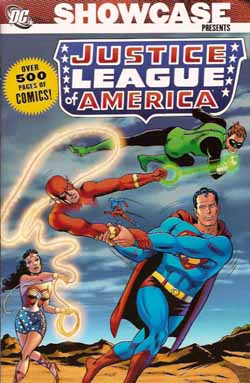
I love these cheap ‘n’ cheerful black and white compendiums of past classics! This second volume collecting the entire run of adventures of “The World’s Greatest Superheroes†comprises issues #17-36, t(he February, 1963 to June 1965 instalments) which bring the readers chronologically to the point where superhero comics would explode across the public consciousness.
‘Triumph of the Tornado Tyrant’ saw a sentient cyclone that had once battled the indomitable Adam Strange (in Mystery in Space #61- or Adam Strange Archives volume 1, ISBN: 1-4012-0148-2) set up housekeeping on an desolate world and ponder the very nature of Good and Evil, before realising that it needed the help of the Justice League to reach a survivable conclusion. Teaser Alert: As well being a cracking yarn, this story is pivotal in the development of the android hero Red Tornado…
Issue #18 saw the team summoned to a subatomic world by three planetary champions whose continued existence threatened to destroy the very world they were designed to protect. ‘Journey to the Micro-World’ found our heroes compelled to defeat opponents that were literally unbeatable. Another perplexing riddle was posed in ‘The Super-Exiles of Earth’ when unstoppable duplicates of the team go on a crime-spree and force the world’s governments to banish the heroes into space.
‘The Mystery of Spaceman X’ was an interplanetary adventure and a cunning brainteaser, with lots of action that serves to whet the appetite for the genuine pivotal classic that followed.
‘Crisis on Earth-One’ (Justice League of America #21) and ‘Crisis on Earth-Two’ (#22) combine to become one of the most important stories in DC history and arguably one of the most important tales in American comics. When ‘Flash of Two Worlds’ introduced the concept of Infinite Earths and multiple heroes to the public, pressure began almost instantly to bring back the lost heroes of the “Golden Ageâ€. The editorial powers-that-be were hesitant, though, fearing that too many heroes would be silly and unmanageable, or worse yet put readers off. If only they knew what we know now!
The plot sees a team-up of assorted villains from each Earth plundering at will and trapping our heroes in their own HQ. Temporarily helpless the JLA contrive a desperate plan to combine forces with the champions of a bygone era! It’s impossible for me to be totally objective about this saga. I was a drooling kid in short trousers when I first read this story and the thrills haven’t diminished with this umpty-first re-reading. This is what superhero comics are all about!
Faced with the impossible task of topping that, creative team Gardner Fox, Mike Sekowsky and Bernard Sachs rose to the challenge with the eccentric outer-space thriller ‘Drones of the Queen Bee’. As the team escaped enslavement to the alien seductress, the continuity bug was growing, and the mention of the individual cases of members would become a mainstay of most future issues.
Alien despot Kanjar Ro returned in ‘Decoy Missions of the Justice League’ a sinister world conquest plot that featured another guest-shot for off-world adventurer Adam Strange and a perplexing mystery with planet-shaking consequences temporarily baffled the team in the rousing romp ‘Outcasts of Infinity!’ Issue #26, ‘Four Worlds to Conquer’ dealt with an insidious revenge plot of the three-eyed alien Despero whilst a much more metaphysical menace assaulted the team in ‘The “I†Who Defeated the Justice League’. Although the deadly android Amazo was also on hand to add some solid threat to the proceedings.
The charmingly naff Head-Mastermind and a bunch of second-string super-villains tried to outfox the League in #28’s ‘Case of the Forbidden Super-Powers’, but not so easily defeated or forgotten are the next two tales. ‘Crisis on Earth-Three’ and ‘The Most Dangerous Earth of All!’ reprised the team-up of the Justice League and Justice Society, when the super-beings of yet another alternate Earth discovered the secret of multiversal travel. Unfortunately Ultraman, Owlman, Superwoman, Johnny Quick and Power Ring are villains on a world without heroes, and see the costumed crusaders of the JLA and JSA as living practise dummies to sharpen their evil skills upon. With this cracking two-part thriller the annual summer team-up became solidly entrenched in heroic lore, giving fans endless joys for years to come and making the approaching end of school holidays less gloomy than they could have been.
(A little note: although the comic cover-date in America was the month by which unsold copies had to be returned – the off-sale date – export copies to Britain travelled as ballast in freighters. Thus they usually went on to those cool, spinning comic-racks the actual month printed on the front. You can unglaze your eyes and return to the review proper now, and thank you for your patient indulgence.)
JLA #31 saw the induction into the team of Hawkman, who would be the last successful inductee until Black Canary joined the team in #75. ‘Riddle of the Runaway Room’ found an alien wish-granting machine in the hands of second-rate thug Joe Parry, who nonetheless made life pretty tough for the team before their eventual victory. The visually impressive Hawkman must have been popular with the creators, if not the fans, as he was prominently featured in all but one of the next half-dozen adventures. ‘Attack of the Star-Bolt Warrior!’ introduced the uncanny villain Brain Storm who attacked the League to avenge his brother who had been murdered by one of their number!
The universe was again at stake in the time-travelling thriller ‘Enemy from the Timeless World’ and a persistent old foe had another go in #34’s ‘The Deadly Dreams of Doctor Destiny!’, a thriller packed with an army of guest-villains. The team were attacked by their own clothes in the supernatural adventure ‘Battle Against the Bodiless Uniforms’, a fall-back plan by the demons Abnegazar, Rath and Ghast, which had been slowly percolating since the end of JLA #11.
This volume closes with a heart-warming and poignant fable. ‘The Case of the Disabled Justice League’ saw the team raise the morale of despondent kids with disabilities by overcoming physical handicaps to defeat the returning Brain Storm. This tale was in fact inspired by ‘A Place in the World’, a Justice Society adventure from 1945 (All Star Comics #27) produced at a time when returning servicemen disabled in combat were becoming an increasingly common sight on the streets of America.
These inexpensive compendiums are an absolute gift for modern fans desperate to catch up without going bankrupt. They’re also the perfect gift for youngsters needing an introduction to a fabulous world of adventure and magic. Of all the various reprint editions and formats available for such classic material, these monochrome tomes are my very favourite.
By J. F. Charles (Michel Deligne Co)
ISBN: 2-87135-020-5
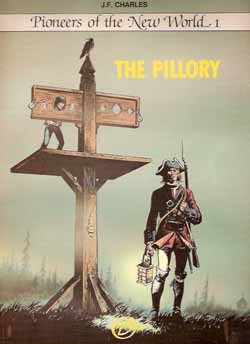
European comics are different. Despite the notable exceptions of Tintin and Asterix, a huge number of classy and wonderful strips and characters have flown over the heads of the English speaking public and foundered. This tragically hard-to-find (but worth the effort) album is an entry from 1985, when America briefly looked elsewhere for graphic entertainment and the publisher Editions Michel Deligne rushed a rather poorly translated version of Jean-François Charles’ (also known as Bof) utterly magical 1982 adventure serial ‘Les Pionniers du Nouveau Monde’ into production.
Set in America and Canada in 1755 it follows the life of Parisian wastrel Benjamin Graindall, a hothead whose predilection for dueling has made France too small for him. Sent to Montreal to make his fortune and keep out of trouble he joins his uncle at the New France Company, bitter trading rival of England’s Hudson Bay Company.
War is brewing, and feuding native tribes have allied themselves to each Imperial nation, dividing along ancient tribal lines as bitter and hate filled as Britain and France’s. Thus when Graindall and the experienced trapper Billy the Nantese go deep inland trading furs they find that the cold war has turned hot and bloody.
Rescuing a number of French settlers including a beautiful aristocrat’s daughter, they make their way towards Fort Niagara, but are captured by the British whose Ox River Fort lies directly opposite the French bastion at the great falls. Prisoners, they must ensure that their enemies do not realize that the girl Louise is in fact the daughter of Fort Niagara’s commanding officer…
I’d imagine this book is impossible to find nowadays, and to be honest the translation and relettering are quite disappointing and distracting. But since so much European material is once again being tried here via new company Cinebook, I’d thought I’d mention this series as being one that is crying out for a decent shot from a considerate and dedicated publisher. Cross your finger, mes braves…
Illustrations by Dick Bruna (Egmont)
ISBN: 978-1-4052-4062-8
Fewer and fewer people read these days. Especially kids. My wife told me a story of a friend (no kids yet) who recently bought a little girl a book for her birthday. The other mothers frowned and tutted. One kind soul offered to let her go halves on her own gift: nightmare-inducing, giant-headed fashion dolls wearing salacious outfits and hooker make-up. They were all tragically correct. The book, a golden classic of childhood, lay all but unwrapped, a single torn corner of shiny paper revealing it to be words on paper, not plastic or metal or electronic.
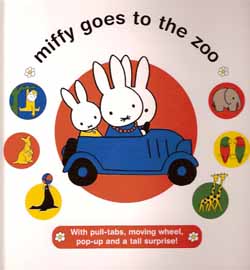
In a world with so many flashing distractions children now need to be seduced into reading – and that as soon as possible. Miffy Goes to the Zoo is a pop-up book for the very young based on Dick Bruna’s classic little girl-rabbit character.
When the first book Miffy Goes to the Zoo was published in 1955 Miffy (or Nijntje as she is in the original Dutch) was rendered much more realistically, but Bruna, a relentless perfectionist, refined his creation continually and by 1963 the almost abstract minimalist version we all know was finalised and the book was reissued with the artwork altered. It is this version that the pop-up book is based on.
Bruna has produced over 100 books with sales of over 80 million world-wide, Nijntje has more than thirty titles across the planet in 40 languages and the little rabbit is a global brand with toys, games, TV shows, and everything else you’d expect from such a household name.
The book themselves are 16 pages of verse and primary coloured illustration, designed small to fit the hands of children (the target audience is 4-8 year olds) and with topics children know or might experience such as schools, hospitals or shopping. In the award winning Dear Grandma Bunny (1997) Bruna even tackled loss and bereavement in a tale where Miffy’s grandmother passes away. Of especially interest here, some books such as Miffy’s Dream have no text at all, using pictures alone to carry the narrative – a perfect training ground for future comics readers.
This version has all the charm and simple beauty of the 1963 book, and the physical animations are absolutely amazing, pop-up, fold-outs, rotating images and hidden surprises and, mercifully, no electronic voices, bleeps or sound effects to distract from what is still essentially a reading device for contemplation. This kind of traditional innovation wedded to a trusted character brand is vital to getting kids hooked on books.
Perhaps if that well-meaning but naive lady had taken this along instead there might have been a less embarrassing outcome at the birthday party.
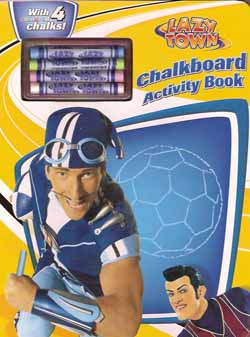
I love to include both visually intriguing children’s material and articles which promote or hone creative skills as well as volumes of and about comics, and this activity book – based on the exploits of exercise superhero Sportacus on the kid’s TV show LazyTown – is something I wish I’d had when I was teaching youngsters (and even the teenagers) at the London Cartoon Centre or London College of Printing all those years ago.
This sturdy little tome is based on a successful Icelandic show which uses all the high tech beguilery of modern television to induce kids to eat well and rush about more. It is incredibly popular around the world.
Here, each page is game or puzzle with a (washable!) screen to draw and write upon with the four drawing chalks included. By combining favourite characters, basic storytelling principles and a literal hands-on approach to drawing this book could do more to make young comic creators than any number of classes and art teachers. Creating is fun and this book actively encourages that whilst enhancing the reading process. Magic!
By Mitchel Scanlon & The Sharp Brothers (Black Library)
ISBN: 978-1- 84416-079-2
Sometimes we cognoscenti forget that for many people comics are merely a pastime, not a faith, and on those terms often what a browser wants is a read that resonates with their other interests.
At the beginning of this century role-playing company Games Workshop began publishing a short story magazine and monthly comicbook to augment the novels set in the fantasy worlds of their game packages. Warhammer (high fantasy in a Germano-feudal world), Warhammer 40,000 (total future war) and Necromunda (dystopian future city) scenarios were related in these periodicals and although the magazines are no longer with us the creators they fostered still are, and in the case of the many graphic novels compiled, the work is still fully available and excellent.
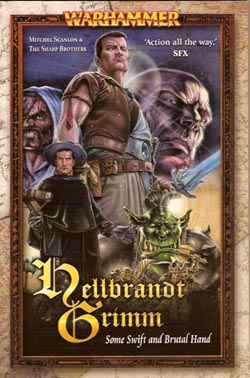
Some Swift and Brutal Hand by Mitchel Scanlon and Australian illustrators The Sharp Brothers is actually the second collection of the scar-faced soldier of fortune Hellbrandt Grimm; an archetypal loner-hero with a hidden past and killer’s eyes, totally unbeatable by either man, goblin or demon. You’ve seen the character in a hundred different places from The Outlaw Josie Wales to The Lone Wolf (but without the baby carriage) to Solomon Kane, and as the tales are instantly accessible no back story knowledge is necessary
In the eight short yarns collected here Grimm travels across the human lands righting wrongs his way, often accompanied by a Templar Witch-Hunter (don’t trouble yourself – think of him as the cop-buddy) exacting some private revenge against brigands and supernaturals everywhere.
Reminiscent of classic 2000AD strips (the art is black and white with tints and tones), these are stripped down, sleek accessible action romps, doused with irony and dry wit and designed to be read like a summer blockbuster – entertainment for its own sake!
If you’re a fantasy fan looking for a swift read and not a lifetime’s commitment this is the stuff for you. But beware: this much fun is potentially addictive…
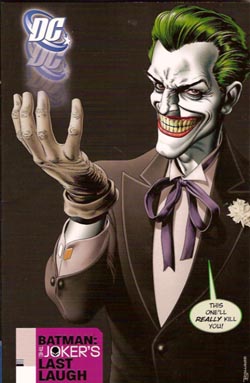
This is one of those good news/bad news situations that can make reading comic book collections such a trial. This six part miniseries was released at the close of 2001 and is probably one of the better tales of the Batman’s greatest nemesis, so the good news is that it’s finally assembled in one handy little tome for your perusal.
The bad news is that like with so many other company-wide events, most of DC’s regular publications (such as the Bat titles, Birds of Prey #36 or Wonder Woman #175) took some part in the extended narrative, and none of those sidebar stories are included. Mercifully, the sense of dislocation caused by incidents occurring “off-camera†is minimal here, but some choice moments of graphic zaniness are sadly lost.
The Joker is the maddest, baddest psycho-killer on Earth, but when a routine prison medical reveals that he has only weeks to live, the Clown Prince decides he’s taking the rest of the world with him and really ramps up the creative body-count. Releasing a new form of his Joker toxin that turns victims into versions of himself he’s determined to turn the entire planet into a giggling funeral pyre. With every “Jokerised†crook in the world on a killing spree it looks like we’re all going to die, and when he even contaminates the rain clouds its certain that we’ll die laughing!
Compellingly written by Chuck Dixon and Scott Beatty, with art by Pete Woods, Marcos Martin, Walter McDaniel, Andy Kuhn, Ron Randall, Rich Burchett, Andrew Pepoy, Mark Farmer, Alvaro Lopez, Mark Lipka and Dan Davis, this is a cracking yarn, sardonic, fun and thrilling – even without the whole story on offer. Perhaps if it sells unexpectedly well DC will issue a companion volume…