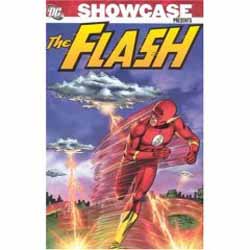
By various (DC Comics)
ISBN13: 978-1-4012-1327-5
No matter which way you look at it, the Silver Age of the American comic book began with The Flash. It’s an unjust but true fact that being first is not enough; it also helps to be best and people have to notice. The Shield beat Captain America to the news-stands by over a year yet the former is all but forgotten today.
The industry had never really stopped trying to revive the superhero genre when Showcase #4 was released in late summer of 1956, with such precursors as The Avenger (February-September 1955), Captain Flash (November 1954-July 1955), Marvel’s Human Torch, Sub-Mariner and the aforementioned Sentinel of Liberty (December 1953 – October 1955) and even DC’s own Captain Comet (December 1953 – October 1955) and Manhunter from Mars (November 1955 until the end of the 1960’s and almost the end of superheroes again!) still turning up in second-hand-stores and “Five-and-Dime†half-price bins. What made the new Fastest Man Alive stand out and stick was … well, everything!
Once the DC powers-that-be decided to try superheroes once more, they moved pretty fast themselves. Editor Julie Schwartz asked office partner and Golden-Age Flash scripter Robert Kanigher to recreate a speedster for the Space Age, aided and abetted by Carmine Infantino and Joe Kubert, who had also worked on the previous incarnation. The new Flash was Barry Allen, a forensic scientist simultaneously struck by lightning and bathed in the exploding chemicals of his lab. Supercharged by the accident, Barry took his superhero identity from a comic book featuring his predecessor (a scientist named Jay Garrick who was exposed to the mutagenic fumes of “Hard Waterâ€). Designing a sleek, streamlined bodysuit (courtesy of Infantino – a major talent who was approaching his artistic and creative pinnacle) Barry Allen became the point man for the spectacular revival of a genre and an entire industry.
This gloriously economical, vast black and white tome superbly compliments Infantino’s talents, collecting not only all four Showcase tryout issues and the first full fifteen issues of his own title, but also kicks off with the very last Golden Age adventure from Flash Comics #104 (February 1949). In ‘The Rival Flash’ Kanigher, Infantino and inker Frank Giacoia re-examine the first Flash’s origin when an evil scientist recreates the secret of his speed. Exuberant, avuncular and hugely entertaining in its own right, it’s nonetheless a dated, clunky tale in comparison to what follows.
In sharp counter-point ‘Mystery of the Human Thunderbolt’ (scripted by Kanigher) and ‘The Man Who Broke the Time Barrier’ (written by the superb John Broome) are polished, coolly sophisticated short stories that introduce the comfortingly suburban new superhero and firmly establish the broad parameters of his universe. Whether defeating bizarre criminal masterminds such as The Turtle or returning the criminal exile Mazdan to his own century the new Flash was a protagonist of keen insight and sharp wits as well as overwhelming power.
Showcase #8 (June 1957) led with another Kanigher tale. ‘The Secret of the Empty Box’, a perplexing but pedestrian mystery, saw Frank Giacoia return as inker, but the real landmark is the Broome thriller ‘The Coldest Man on Earth’. With this yarn the author confirmed and consolidated the new phenomenon by introducing the first of a Rogues Gallery of outlandish super-villains. Unlike the Golden Age the new super-heroes would face predominantly costumed foes rather than thugs and spies. Bad guys would henceforth be as memorable as the champions of justice. Captain Cold would return time and again. Broome would go on to create every single member of Flash’s pantheon of super-foes.
Joe Giella inked the two adventures in Showcase #13 (April 1958) ‘Around the World in 80 Minutes’, written by Kanigher and Broome’s ‘Master of the Elements’ which introduced the outlandish Mr. Element, who returned in Showcase#14 (June 1958) with a new M.O. and identity – Doctor Alchemy. ‘The Man who Changed the Earth!’ is a great crime-caper, but Kanigher’s eerie ‘Giants of the Time-World!’ is a masterful fantasy thriller and a worthy effort to bow out on. When the Scarlet Speedster graduated to his own title John Broome was the lead writer, supplemented eventually by Gardner Fox. Kanigher would return briefly in the mid-1960s and would later write a number of tales during DC’s ‘Relevancy’ period.
The Flash #105 launched with a February-March 1959 cover-date (so it was out for Christmas 1958) and featured Broome, Infantino and Giella’s sci-fi chiller ‘Conqueror From 8 Million B.C.!’ and introduced yet another super-villain in ‘The Master of Mirrors!’. ‘The Pied Piper of Peril!’ in #106 introduced another criminal menace, whilst the second story introduced one of the most charismatic and memorable baddies in comics history. Gorilla Grodd and his hidden race of super-simians debuted in ‘Menace of the Super-Gorilla!’, promptly returning for the next two issues,
Presumably this early confidence was fuelled by DC’s inexplicable but commercially sound pro-Gorilla editorial stance (for some reason any comic with a big monkey in it markedly outsold those that didn’t in those far-ago days) but these tales are also packed with tension, action and engagingly challenging fantasy concepts.
Issue #107 lead with the ‘Return of the Super-Gorilla!’ by the regular team of Broome Infantino and Giella, a multi-layered fantasy thriller that took our hero from the African (invisible) city of the Super-Gorillas to the subterranean citadel of antediluvian Ornitho-Men, and ‘The Amazing Race Against Time’ featured an amnesiac who could outrun the Fastest Man Alive in a desperate race against time to save creation. With every issue the stakes got higher and the quality and narrative ingenuity got better!
Frank Giacoia inked #108’s high-tech death-trap thriller ‘The Speed of Doom!’ featuring trans-dimensional raiders but Giella was back for ‘The Super-Gorilla’s Secret Identity!’ wherein Grodd devises a scheme to outwit evolution itself. The next issue brought ‘The Return of the Mirror-Master’ with the first in a series of bizarre physical transformations that would increasingly become a signature device for Flash stories, whilst the Space Race provided a evocative maguffin for a fantastic undersea adventure in the ‘Secret of the Sunken Satellite’.
The Flash #110 was a huge landmark, not so much for the debut of another worthy candidate to the burgeoning Rogues Gallery in ‘The Challenge of the Weather Wizard’ (inked by Schwartz’s artistic top-gun Murphy Anderson) but rather for the introduction of Wally West, who in a bizarre and suspicious replay of the lightning strike that created the Scarlet Speedster became a junior version of the Fastest Man Alive. Inked by Giella, ‘Meet Kid Flash!’ introduced the first sidekick of the Silver Age (cover dated December 1959-January 1960 and just pipping Aqualad who premiered in Adventure Comics #269 which had a February off-sale date).
Not only would Kid Flash begin his own series of back-up tales from the very next issue (a sure sign of the confidence the creators had in the character) but he would eventually inherit the mantle of the Flash himself – one of the few occasions in comics where the torch-passing actually stuck.
Anderson also inked ‘The Invasion of the Cloud Creatures’ in # 111, which successfully overcomes its frankly daft premise to produce a tense sci-fi thriller and nicely counterpoints the first solo outing for Kid Flash in ‘The Challenge of the Crimson Crows!’ This folksy parable has small-town kid Wally West use his new powers to rescue a bunch of kids on the slippery slope to juvenile delinquency. Perhaps a tad paternalistic and heavy-handed by today’s standards, in the opening months of 1960 this was a strip about a little boy heroically dealing with a kid’s real dilemmas, and the strip would remain concerned with human scaled problems, leaving super-menaces and world saving for team-ups with his mentor.
In #112 ‘The Mystery of the Elongated Man’ introduced that super stretchable character to the DC universe in an intriguing puzzler whilst Kid Flash tackled juvenile Go-Carters and corrupt school-contractors in the surprisingly gripping ‘Danger on Wheels!’ The Trickster launched his crime career in #113’s lead tale ‘Danger in the Air!’ and the Kid took a break so that his senior partner could defeat ‘The Man Who Claimed the Earth!’ a full-on cosmic epic wherein the alien Po-Siden attempts to bring the lost colony of our world back into the Empire of Zus.
Captain Cold and Murphy Anderson returned for ‘The Big Freeze’, where the smitten villain turns Central City into a glacier just to impress Flash’s girlfriend Iris West. Meanwhile her nephew Wally saved a boy unjustly accused of cheating from a life of crime when he falls under the influence of the ‘King of the Beatniks!’ The Flash #115 featured another bizarre transformation, courtesy of Gorilla Grodd in ‘The Day Flash Weighed 1000 Pounds!’, and when aliens attempted to conquer the Earth he needed ‘The Elongated Man’s Secret Weapon’ as well as the guest-star himself to save the day. Once again Murphy Anderson’s inking gave the over-taxed Joe Giella a breather whilst taking art-lovers’ breath away in this beautiful, pacy thriller.
‘The Man Who Stole Central City’ had a seemingly fool-proof way of killing the Flash in #116, which took some outwitting, and Kid Flash returned in ‘The Race to Thunder Hill’, a father-son tale of rally driving, but with car-stealing bandits and a young love interest for Wally to complicate the proceedings. ‘Here Comes Captain Boomerang’ by Broome, Infantino and Anderson introduced the Australian super-criminal in what is still one of the most original origin tales ever concocted, whilst ‘The Madcap Inventors of Central City’ saw Gardner Fox (creator of the Golden Age Flash) join the writing team with an ill-considered attempt to reintroduce the comedy relief trio of Winky, Blinky and Noddy to the modern Flash Fans. The fact that you’ve never heard of them should indicate how well that went, although the yarn, illustrated by Infantino and Giella is a fast, witty and enjoyably silly change of pace.
Issue #118 highlighted the period’s (and DC’s) fascination with Hollywood in ‘The Doomed Scarecrow!’ (inked by Anderson), a sharp thriller featuring a villain with a unique reason to get rid of our hero whilst Wally and a friend had to spend the night in a “haunted house†in the Kid Flash chiller ‘The Midnight Peril!’
This wonderful first volume ends with The Flash #119, in which Broome, Infantino and Anderson relate the adventure of ‘The Mirror-Master’s Magic Bullet’, which our hero narrowly evades only to join an old friend in ‘The Elongated Man’s Undersea Trap’ which introduced the vivacious Sue Dibny (as a newly wed “Mrs Elongated Manâ€) in a mysterious and stirring tale of sub-sea slavers.
These earliest tales were historically vital to the development of our industry, but, quite frankly, so what? The first exploits The Flash should be judged solely on their merit, and on those terms they are punchy, awe-inspiring, beautifully illustrated and captivating thrillers that amuse, amaze and enthral both new readers and old devotees. This lovely collection is a must-read item for anybody in love with our art-form
© 1949, 1956-1961, 2007 DC Comics. All Rights Reserved.