El Diablo

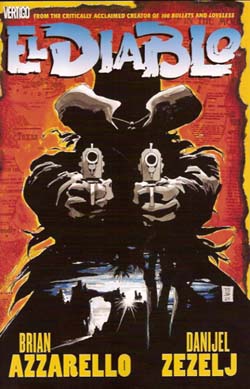
El Diablo

By Brian Azzarello & Danijel Zezelj (Vertigo)
ISBN: 978-1-4012-1625-2

This Vertigo interpretation of the classic DC Western avenger dates from a 2001 4-issue miniseries, and is an early precursor to the superb Loveless (for which see Loveless: A Kin Of Homecoming ISBN: 1-84576-337-8 and Thicker Than Blackwater ISBN: 1-84576-453-6). Moses Stone is a gunman turned sheriff in the frontier town of Bollas Raton. His awesome reputation, as much as his actions, serves to keep the town peaceful, and he’s perfectly content not shooting anybody.

Then one night the awesome and terrifying El Diablo comes to town and exacts a gruesome vengeance on a band of outlaws yet inexplicably refuses to kill Stone when he tries to halt the carnage. Unable to understand or let it lie, sheriff and posse trail the vigilante to the town of Halo, New Mexico where the bloodshed continues and a ghastly secret is revealed.

Although a deep, brooding mystery with supernatural overtones, fans of the original western avenger (created by Robert Kanigher and Gray Morrow for Weird Western Tales in 1970) will be disappointed to find that tragic Lazarus Lane – brutalised by thieves, struck by lightning and only able to wake from his permanent coma at the behest of an Indian Shaman – is all but absent from this darkly philosophical drama. There’s an awful lot of talking and suspense-building but thanks to the moody graphics of Danijel Zezelj the tension and horror remain intense and when the action comes it is powerful.

The star is a force but not a presence in El Diablo, but the tale of Moses Stone is nonetheless a gripping mystery-thriller that will chill and intrigue all but the most devoutly traditional cowboy fans.

© 2001, 2008 DC Comics. All Rights Reserved.

Batman: Digital Justice

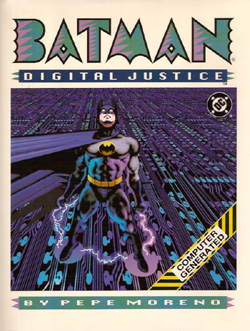
Batman: Digital Justice

By Pepe Moreno, with dialogue by Doug Murray (DC Comics)
ISBN13: 978-1-9302-8987-4

It’s hard to credit now but not so long ago computers were a really big deal in comics. Not like today when digital colours, lettering and even drawing enhancement packages are part and parcel of the daily process of production, but simply for being the newest sort of pencil in town. Along with such products as Shatter from First Comics, and Marvel’s Iron Man: Crash (I’ll get to them another day), DC entered the market with a tale from Spanish wunderkind Pepe Moreno and their biggest gun, then riding high on the coattails of the Tim Burton Movie. So from the safe perspective of a few decades distance let’s take a look at Batman: Digital Justice.

Pepe Moreno moved America in 1977, briefly worked for Jim Warren’s Creepy, Eerie and Vampirella titles and gravitated to Heavy Metal where his short, uncompromising post-punk strips (collected in the album Zeppelin) caught the attention of Epic Illustrated editor Archie Goodwin. Generation Zero led to the graphic novels Rebel, Joe’s Air Force and Gene Kong. His growing fascination with technology led him into animation (Tiger Sharks, Thunder Cats and Silver Hawks) and eventually back to comics with this futuristic Bat-thriller.

The mid-21st Century: Gotham City has become Megatropolis, a sprawling, corrupt dystopia. Jim Gordon, honest cop and grandson of the Police Commissioner who worked with The Batman, loves his job but knows that something is very wrong with his city. The graft seems to go all the way to the top and even the ubiquitous flying robotic enforcers get more respect than the flesh and blood Force.

When his partner Lena is murdered he discovers that a computer program/virus based on the Joker’s brain patterns is the de facto ruler of the city. He adopts the identity and tactics of the fabled Caped Crusader but is still outmatched until the long-dormant Bat-Computer awakes and takes him under its digitised wing. Now with a new Robin and Catwoman he is ready for a final confrontation with The Batman’s greatest foe…

By our standards the artwork is pretty clunky, although I recall being quite impressed with it at the time, yet the real problem here is the story. This is a terribly ordinary premise that depended too much on the novelty of delivery rather than strong plot or characters, and doesn’t stand up well to the tests of time. This didn’t stop much of that premise resurfacing in the animated feature Batman Beyond: The Return of the Joker though.

© 1990 DC Comics. All Rights Reserved.

Star Wars: Knights of the Old Republic, Vol 3: Days of Fear, Nights of Anger

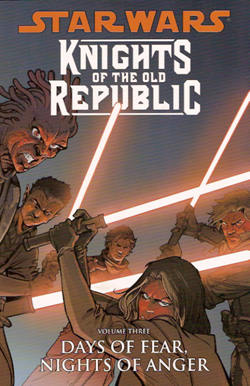
Star Wars: Knights of the Old Republic, Vol 3: Days of Fear, Nights of Anger

By John Jackson Miller, Dustin Weaver, Brian Ching & Harvey Tolibao (Dark Horse Books)
ISBN13: 978-1-84576-740-2

Apprentice Jedi Zayne Carrick was framed for a hideous crime by his own teachers, whose visions of the future saw him as a threat to The Republic. On the run from both his ex-masters and the honest authorities the young hero has taken up with a gang of outlaws and outcasts that include an unscrupulous con-man named Gryph, a rogue Mandalorian warrior, Camper, a seemingly senile technical wizard and the hot-and-feisty Bad-Girl Jarael.

In this volume (reprinting issues #13-18 of the comic book series Star Wars: Knights of The Old Republic) the first tale finds the gang trapped on a rural planet in the direct path of a genocidal Mandalorian invasion fleet whilst the next tale – which ends the book on a cliffhanger, so be prepared to wait or be frustrated – sees Jarael take Camper to his homeworld in a desperate attempt to stave off his increasing dementia. Once there she discovers just why he fled in the first place, and in no way coincidentally, a monstrous threat to the entire galaxy.

Magnificently illustrated, these rip-roaring tales of heroic outlawry and derring-do are the perfect antidote to cold, dark, dull winters and a splendid example of a licensed comic done right.

© 2008 Lucasfilm Ltd. & ™. All Rights Reserved.

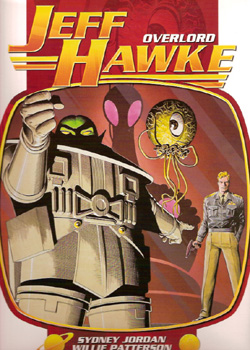
Jeff Hawke: Overlord

Jeff Hawke: Overlord

By Sydney Jordan & Willie Patterson (Titan Books)
ISBN: 978-1-84576-597-2

Finally back in print – and in Titan’s spiffy Deluxe hardback format – is this superb collection of strips from the only serious rival to Dan Dare in either popularity or quality, not just in Britain but in the entire world.

Sydney Jordan began his saga of the thinking man’s hero in the Daily Express on February 2nd 1954, writing the first few adventures himself. In 1956 his old school friend and associate Willie Patterson moved from Scotland to London and helped out with the fifth adventure ‘Sanctuary’, and scripted the next one ‘Unquiet Island’, whilst sorting out his own career as a freelance scripter for such titles as Amalgamated Press’s Children’s Encyclopaedia, Caroline Baker – Barrister at Law and eventually Fleetway’s War Picture Library series.

He continued to supplement and assist the artist intermittently (Jordan was never comfortable scripting, preferring to plot and draw the strips – another confederate of the time was Harry Harrison who wrote the ninth tale ‘Out of Touch’, which ran from October 10th 1957 – April 5th 1958) until, with the fourteenth tale, he assumed the writing chores on a full-time basis and began the strip’s Golden Age. He would remain until 1969.

‘Overlord’ began on February 10th 1960. In it, British Space Scientist Jeff Hawke meets for the first time a character who would become one of the greatest villains in pictorial fiction: Chalcedon, galactic criminal and would-be Overlord of Space.

When an alien ship crashes into the Egyptian desert, it reveals that two huge fleets of spaceships are engaged in a running battle within the Solar System, and the Earth is directly in their path. After interminable babble and shilly-shallying at the UN, Hawke convinces the authorities to let him take a party to the warring factions in the hope of diverting them from our poor, endangered world. What he finds is not only terrifying and fantastic but, thanks to Jordan’s magical illustration and Patterson’s thrilling, devastatingly wry writing, incredibly sophisticated and very, very funny.

Running until June 20th, it was followed by a much more traditional and solemn yarn. ‘Survival’ (21-June to December 12th 1960) follows the events of an interplanetary prang that severely injures Hawke’s assistant Mac Maclean. Repaired – and “improved” by the penitent extraterrestrials that caused the accident – Mac rejoins the Earth crew, but is no longer one of them. Moreover they are all still marooned on a desolate asteroid with no hope of rescue, and must use all their meagre resources to save themselves. This gritty tale of endurance and integrity was mostly illustrated by fellow Scot Colin Andrew as Sydney Jordan was busily preparing art for a proposed Jeff Hawke Sunday page, which never materialised, although that art was recycled as the eighteenth adventure ‘Pastmaster’.

It was a return to Earth and satirical commentary with the next tale ‘Wondrous Lamp’. Running from 13th September 1960 to 11th March 1961 it begins in second century Arabia when an alien survey scout crashed at the feet of wandering merchant Ala Eddin, briefly granting him great powers before his timely comeuppance. Nearly two thousand years later the ship – which looks a bit like a lamp – precipitates a crisis when its teleportation circuits lead to an invasion by a couple of million of the universe’s toughest warriors…

This brilliantly quirky tale, like all the best science-fiction, is a commentary on its time of creation, and the satirical view of Whitehall bureaucracy and venality, earthbound and pan-galactic, is a dry and cynical delight, which is as telling now as it was in the days before the Profumo Affair.

Chalcedon returns for the final tale in this volume. ‘Counsel For The Defence’ (13th March -2nd August 1961) sees Hawke and Maclean press-ganged into the depths of Intergalactic Jurisprudence as the Overlord, brought to Justice at last, chooses the Earthman as his advocate in the upcoming trial. Naturally he has a sinister motive and naturally nothing turns out as anybody planned or expected it to, but the art is breathtaking, the adventure captivating and the humour timeless.

Jeff Hawke is a revered and respected milestone of graphic achievement almost everywhere except its country of origin. Hopefully this latest attempt to reprint these gems will find a more receptive audience this time, and perhaps we’ll even get to see those earlier stories as well.

© 2007 Express Newspapers Ltd.

Nothing But Max

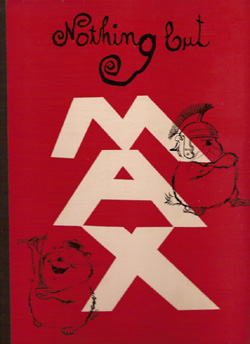
Nothing But Max

By Pericle Luigi Giovannetti (Macmillan)
ASIN: B0000CKEHG

Pericle Luigi Giovanetti was a huge star in the cartoon firmament in the years following World War II, and one look at his work will instantly show you why.

Born in 1916 in Basel, he launched his most famous character in Punch in April 1953. Max is a small, round furry creature most likened to a hamster, whose wordless pantomimes were both cute and whimsical and trenchantly self-deprecating. Don’t ask me how a beautifully rendered little puff-ball could stand for pride and pomposity punctured, but he did. It was also blissfully free of mawkish sentimentality, a funny animal for adults.

Max was syndicated across the world, (known as Mr. Makkusu-san in Japan) numbering such diverse luminaries as Jason Robards and Charles Schulz as fans and even lending its star to the British Navy and Swiss Air Force as mascot and figurehead. There were four collections between 1954 and 1961: Max, Max Presents, this volume (from 1959) and the Penguin Max. Like these, two other collections, Beware of the Dog and Birds without Words, are also criminally out of print.

The sheer artistic virtuosity of Giovanetti is astounding to see. That his work should be forgotten is a travesty. If you ever, ever see a collection of his work do yourself the biggest favour of your life and grab it with both hands!

© 1959 P. L. Giovannetti. All Rights Reserved.

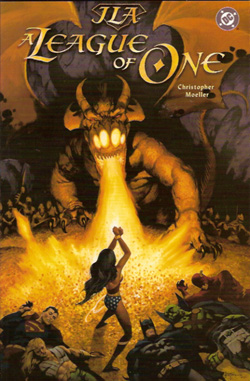
JLA: A League of One

JLA: A League of One

By Christopher Moeller (DC Comics)
ISBN 1-84023-575-6

This slight but satisfying fantasy romp is actually a Wonder Woman vehicle with the rest of the World’s Greatest Superheroes reduced to the roles of bit-players and hostages for the body of the action but is still nonetheless a pretty good blend of angst and adventure, and well leavened with some fine tongue-in-cheek comedy touches.

In 1348AD the last Dragon is defeated by Christian Knights and the modern Age of Man begins. But the Queen Wyrm is not dead, and sleeps beneath the Swiss Alps until awakened by Gnomes, whom she subjects to her will as she plans to devastate the Earth.

After a busy tour of duty with her fellow Justice Leaguers, Princess Diana returns to Greece for a break and hears a prophecy from the Oracle of Delphi. The mystic seer declares the menace of the last Dragon and warns that it will be defeated by the JLA – but only at the inevitable cost of their lives. Although the Oracle is never wrong, she can be open to interpretation, so if the team only has one member only one member has to die…

Beautifully painted art and a solid, if not too fresh plot makes this a plain-and-simple fun book to read and the themes, light touches and deft avoidance of continuity means that new readers and old fans can enjoy this modern fairy tale equally.

© 2000 DC Comics. All Rights Reserved.

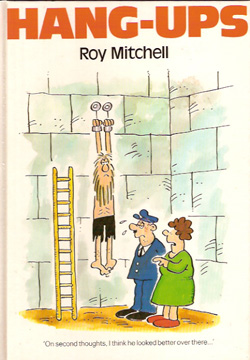
Hang-Ups

Hang-Ups

By Roy Mitchell (Ward Lock)
ISBN: 0-7063-6423-6

Not every book has to be great. Sometimes it’s enough simply to be fit for purpose. Like this plain and simple non-political, non-editorial cartoon book in the traditional “variations on a theme” manner.

Comedy often has venerable subjects, and cartooning doubly so. The comic greats and the merely adequate alike have all worked on the same set-ups, with mixed and unpredictable results. Possibly as commonplace as the Desert Island with a single Palm Tree or the Mother-in-Law Arrives is the bearded geezer suspended on a wall in a dungeon. The variations on this pictorial theme are endless and the punch-lines are nigh infinite.

The eighty cartoons here, like most gags, will be uproarious to some and soporific to others. The drawing isn’t the best you’ll ever see. But still, this type of thing was the backbone of the newspaper cartoon feature page, with collections like this sometimes selling in the millions, and quite frankly I miss them. Most modern magazines and periodicals would benefit from a few extra gag-panels to brighten up our days.

You might not be able to track this book down, but there are lots of others in similar veins, lurking in charity shops and at car-boot sales, so why not treat yourself to a bit of undemanding, old-fashioned frivolity for a change?

© 1985 Ward Lock Limited. All Rights Reserved.

Jane

jane

By (Pelham Books/Rainbird)
ISBN: 0-72071-456-7

Jane is one of the most important and well-regarded comic strips in British, if not World, history. It began on December 5th 1932 as Jane’s Journal: Or The Diary of a Bright Young Thing, a frothy, frivolous gag-a-day strip in the Daily Mirror, created by the cartoonist Norman Pett. Originally a series of panels with cursive script embedded to simulate a diary page it switched to the more formal strip frames and balloons in late 1938, around the time scripter Don Freeman came on board.

Jane’s secret was skin. Even before war broke out there were torn skirts and lost blouses aplenty, but once the shooting started and Jane became an operative for British Intelligence her clothes came off with terrifying ease. She even went topless when the Blitz was at its worst.

Pett drew the strip, famously using first his wife and then actress and model Christabel Leighton-Porter until May 1948 when his assistant Michael Hubbard assumed full control of the feature (prior to that he had drawn backgrounds and male characters). Hubbard carried the series, increasingly a safe soap-opera and less a racy glamour strip to its conclusion on October 10th 1959.

Jane’s war record is frankly astounding. As a morale booster she was reckoned worth more than divisions of infantry and her exploits were cited in Parliament and discussed by Eisenhower and Churchill. Legend has it that The Mirror‘s Editor was among the few who knew the date of “D-Day” so as to co-ordinate her exploits with the Normandy landings. In 1944, on the day she went full frontal, the American Service newspaper Roundup (provided to US soldiers) went with the headline “JANE GIVES ALL” and the sub-heading “YOU CAN ALL GO HOME NOW”. Christabel Leighton-Porter toured as Jane in a services revue – she stripped for the boys – during the war and in 1949 starred in the film The Adventures of Jane.

Since there still isn’t a definitive collection of this fabulous strip (although the occasional brief tome has slipped out over the years) I’ve chosen to review this slim gem that was originally released in 1983 to tie-in with a BBC TV series starring Glynis Barber. It features “Hush-Hush House” from 1940 (incidentally the adventure adapted as the aforementioned TV show) wherein the simple ingénue becomes a British agent and is sent to a code-breaking site where a spy is causing havoc, and also “Nature in the Raw”, a gentle mystery with genteelly salacious artwork from 1951, drawn by the criminally underrated Hubbard.

Although the product of simpler, if more perilous times, the innocently saucy adventures of Jane, patient but dedicated beau Georgie-Porgie and especially her intrepid Dachshund Count Fritz Von Pumpernickel are landmarks of our artform, not simply for their impact but also for the plain and simple reason that they are superbly drawn and great to read. Let’s hope that one day that fact will be acknowledged with a definitive reprinting.

© 1983 Mirror Group Newspapers Ltd. All Rights Reserved.

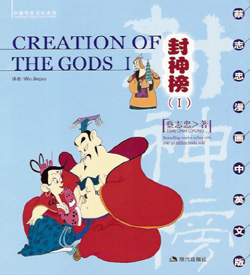
Creation of the Gods, Book 1

Creation of the Gods, Book 1

By Wu Jingyu, adapted by Tsai Chih Chung (Foreign Languages Press, Peking 1976)
ISBN: 7-80028-905-2

As well as the more respectful graphic adaptations of the great literary classics of China, you can find much more ebullient and jolly interpretations to inform, elucidate and amuse. This collection of broad and breezy gags strips are by cartoonist and animated film-maker Tsai Chih Chung where, in a style very similar to Sergio Aragones, he repackages the history, philosophy and wisdom of China’s mythical and Imperial past in funny, exuberant and contemporary daily instalments.

This first volume recounts the lives of the immortal Ne Zha, the mystical Jiang Ziya, Evil King Zhou of Shang and the great King Wen of Zhou in broad slapstick snippets made contemporaneous by the adaptor’s pertinent use of creative anachronism.

One word of warning: Although the cartoons are translated into English (with Chinese subtitles – Mandarin) and copiously footnoted to explain points of detail and literary style, the English captions are plagued with spelling and grammatical mistakes. If you’re particularly picky about copy-errors this might drive you mad, but if you can go with the flow this is a fun and fascinating look into the exotic past and vibrant present of a cultural powerhouse.

Available from Guanghwa Company Ltd. Email: info@guanghwabooks.co.uk
Presumably © 2006 – Tsai Chih Chung my computer can’t reproduce the Mandarin symbols, I’m sure they know who they are. If anyone can tell us we’ll happy correct this oversight. All Rights Reserved, I suspect.

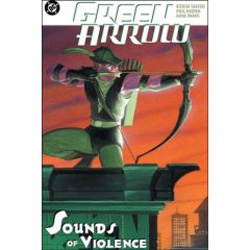
Green Arrow: Sounds of Violence

Green Arrow: Sounds of Violence

By Kevin Smith, Phil Hester & Ande Parks (DC Comics)
ISBN 1-56389-976-0 (hardcover) ISBN 1-4012-0045-1 (softcover)

After returning from the dead (see Green Arrow: Quiver – ISBN: 1-84023-509-8) our reinvigorated hero tries to re-establish himself both as a do-gooder and more importantly with his extended family – especially Mia Dearden, a street kid he saved from prostitution and took into his home. But as he resists the pressure to make her his next sidekick (from both her and his son Connor) The Riddler comes to town intent on mischief, and a new bizarre serial killer stalks the streets hunting costumed heroes.

Onomatopoeia only speaks in sound effects and is a ruthless, flamboyantly sadistic, seemingly unstoppable force. So when he fails to kill the junior Green Arrow he invades the hospital where the critically wounded Connor is undergoing emergency surgery to finish the job, leaving a trail of corpses in his wake.

Sharp, darkly funny and chilling by turns this tale (collected from issues #11-15 of the monthly comicbook) breaks out of the usual mould in many ways, perhaps as much due to writer Kevin Smith’s other commitments as from any sense of narrative novelty, but it certainly doesn’t harm the result. Particularly delicious are the scenes with on-again, off-again lover Black Canary and heroic polar opposite Hawkman.

A little more mature in both themes and the treatment of interpersonal relationships (and surely no bad thing for that?) this is a superior superhero saga and a strong advocate for the argument that costume dramas don’t have to be all Fights and Tights.

© 2002 DC Comics. All Rights Reserved.