The Shield

AMERICA’S 1ST PATRIOTIC HERO

The Shield

By Irving Norvick, Harry Shorten & various (Archie Comics)
ISBN 1-879794-08-X

In the dawning days of the comic book business, just after Superman and Batman had ushered in a new genre of storytelling, many publishers jumped onto the bandwagon and made their own bids for cash and glory. Many thrived and many more didn’t, remembered only as trivia by sad blokes like me. Some few made it to an amorphous middle-ground: Not forgotten, but certainly not household names either…

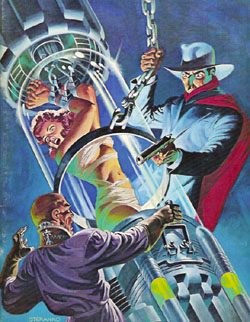
The Shield was an FBI scientist named Joe Higgins who wore a suit which gave him enhanced strength, speed and durability, which he used to battle America’s enemies in the days before the USA entered World War II. Latterly he also devised a Shield Formula that increased his powers. Beginning with the first issue of Pep Comics (January 1940) he battled spies, saboteurs, subversive organisations and every threat to American security and well-being, and was a minor sensation. He is credited with being the industry’s very first Patriotic Hero, predating Marvel’s iconic Captain America in the “wearing the Flag” field.

Collected here in this Golden-Age fan-boy’s dream are the lead stories from Pep Comics #1-5 and the three adventures from the spin-off Shield-Wizard Comics #1 (Summer 1940). Raw, primitive and a little juvenile perhaps, but these are still unadorned, glorious romps from the industry’s exuberant, uncomplicated dawning days: Plain-and-simple fun-packed thrills from the gravely under-appreciated Irving Novick, Harry Shorten and others whose names are now lost to history.

Despite not being to everyone’s taste these guilty pleasures are worth a look for any dyed-in-the-woollen-tights super-hero freak and a rapturous tribute to a less complicated time.

© 1940, 2002 Archie Publications In. All Rights Reserved.

William the Backwards Skunk

William the Backwards Skunk

By Chuck Jones (Crown Publishers Inc.)
ISBN: 0-517-56063-1

There have been a few modern geniuses who wield a pencil and paintbrush. We tend not to notice them in the world of comics, which I suppose would explain why so many of our contemporary artists work in animation these days. I don’t know if Charles Martin Jones ever worked in comics – or even if he ever wanted to – but as ‘Chuck’ he produced some of the greatest and funniest animated cartoons the world has ever seen.

During WWII he worked with Theodore Geisel – who left cartooning for a career in kid’s books and found fame as Dr. Seuss – on a series of educational cartoons for the US Army featuring ‘Private Snafu’. That relationship would eventually lead to the animated TV classic How the Grinch Stole Christmas.

And in 1986 Chuck Jones produced this picture-book for the very young. William is a skunk with a little problem. The Usual Skunk not only has that potent chemical weapon we all know and dread, but they also have a beautiful bold stripe on their backs so as to give any big animal sneaking up on them a fair chance to change their minds. Sadly, William’s stripe is on his front, which causes problems for every animal in the forest.

This charming little fable about cooperation is a sweet delight and the art is utterly joyous. This is a man who knows “Cute” and how to milk it, and more importantly, when to lampoon it. His critters positively drip with Attitude, and any child’s delight could only be marred if the adult reading this aloud is unable to stifle their own knowing chortles.

Jones’ work informed generations of kids and creators in comics as well as cartoons. His legacy can be found in titles as varied as Dell’s Looney Tunes and Merrie Melodies, Bugs Bunny and Daffy Duck to the current Kids WB comic-books including the current incarnation of Looney Tunes.

Get this book and you could be carrying on that tradition to the next generation.

© 1986 Chuck Jones Enterprises. All rights reserved.

Tom Strong Book 3

Tom Strong Book 3

By various (America’s Best Comics)
ISBN 1-84576-148-0

A light touch is something sadly scarce in super-hero comics these days, so the third compilation of Science’s Ultimate Hero (collecting issues # 15-19 of the monthly comic-book) is a welcome distraction as it features a few old friends and foes – and plots. ‘Ring of Fire’ by Moore and Sprouse with inking by Karl Story sees the living volcano-man Val Var Garm entice the strong Family into his under-Earth city before joining them on a more formal basis as Tesla’s live-in boyfriend (see Tom Strong Book 2 for more information and thrills).

A three eyed galactic drifter then turns up just ahead of a three part Alien Invasion in a tale first hinted at in ‘Lost Mesa’ (Book 2 again). Summoning all the help they can the heroes head for interplanetary space to destroy an armada of giant ants in ‘Some Call Him the Space Cowboy’ and ‘The Weird Rider: Gone to Croatoan’, ‘Ant Fugue’ and ‘The Last Round-up’ all by Moore, Sprouse and Story.

The follow-up was another short-stories issue with Howard Chaykin illustrating Moore’s adventure of Sexual Impolitics in ‘Electric Ladyland!’, Leah Moore, Shawn McManus and Steve Mitchell reviewed the last moments of arch-villain Paul Saveen in ‘Bad to the Bone’ and Alan, Chris and Karl close the book with surreal fourth-wall-ery as Tom and Tesla become trapped inside a comic-book in ‘The Hero-Hoard of Horatio Hogg!’

With an extended section of pin-ups, this knowing, clever pastiche of a simpler time in comics is a fine way to reminisce with some thing new.

© 2005 America’s Best Comics, LLC. All Rights Reserved.

Simpsons Comics A Go-Go

Simpsons Comics A Go-Go

By Various (Titan Books)
ISBN: 1-84023-151-3

Here’s another knowing laugh-fest culled from the pages of the Simpsons comic book (featuring material originally printed in issues# 10 and #32-35). ‘Rhymes and Misdemeanours’ (by Jeff Rosenthal, Tim Bavington, Stephanie Gladden, Phil Ortiz, Bill Morrison, Jeannine Black and Nathan Kane) is a sly and sarcastic pastiche of Beat Poets and Young Love as Lisa and portly intellectual Martin Prince are gripped in a savage war of sonnets and odes when poetry becomes a spectator sport at McBeans Coffee House.

Scott M. Gimple scripts the wonderful alternate unreality tale ‘The Great Springfield Frink-Out’ as the outlandish Professor Frink screws up the multiverse in a tale drawn, inked, lettered and coloured by Ortiz, Bavington, Black and Kane. ‘Burnsie on Board’ by Rob Hammersley, Gladden, Eric Tran, Tim Harkins, Black and Kane reveals how the parsimonious Mr. Burns develops some sporting spirit when he buys the Winter Olympics, and ‘To Live and Diaper in Springfield’ is the saga of how the monumental “Krusty’s Kids DayKare” monopoly was challenged by Mrs. Simpson’s homely little “Marge’s Charges”. The reckless baby-endangerment gags are courtesy of Billy Rubenstein, Ortiz, Bavington, Black and Kane.

The last long story is a tasteless tale of smuggling, tax-evasion and cheap gratification as Homer and family “win” a holiday from Mr. Burns. ‘Fan-Tasty Island’ is by Rosenthal, Luis Escobar, Bavington, Morrison, Robert Kramer, David Mowry, Richard Starkings Comicraft, Nathan Kane and Electric Crayon. Also included are the short features ‘Principal Skinner’s Bottom 40’, ‘Tiger-Teen’ (a magazine feature on those Barbershop heavyweights the Be Sharps) and the ‘Simpsons Supporters’ Suggestion Spin Cycle’ with Ian Boothby, Dan Studley, Jim Lincoln and Chris Ungar accompanying previous culprits in the creative mayhem. As ever Matt Groening takes the final blame for all the hilarity and offence in this sharp, funny and thoroughly enjoyable spin-off book.

© 1992, 1995, 1997, 1998, 2000 Bongo Entertainment, Inc. All rights reserved.

Ultimate Spider-Man, Vol 2: Learning Curve

Ultimate Spider-Man, Vol 2: Learning Curve

By Brian M. Bendis, Mark Bagley & Art Thibert (Marvel)
ISBN: 0-7851-0820-3

After Marvel’s problems of the mid 1990s, the company came back swinging, and one new concept was the remodelling and modernising of their core characters for the new youth culture. The ‘Ultimate’ imprint abandoned the monumental continuity that had been Marvel’s greatest asset and the company’s major characters were given a separate universe to play in and makeovers to appeal to a contemporary, 21st century audience.

Puberty is hard enough for anybody, but if you’re the high school science geek, every bully’s target of choice, suddenly the man-of-the-house and soon-to-be-breadwinner, life is horrible. Compound that with the suspicion that the Most Beautiful Girl in the World might have the hots for you – or might not – and that you’re a superhero driven by overwhelming guilt to risk your life fighting monsters and super-villains every chance you get, and what you have is the second collection of the other, newer Peter Parker: Spider-Man.

Highlights in this highly readable tome include Peter getting a job at the Daily Bugle, Aunt May’s attempt at the “Birds and Bees” talk with her hapless nephew, Mary Jane’s reaction to learning one of Peter’s secrets and of course the Die Hard-inspired assault on the overlord of crime’s skyscraper fortress as Spiderman tries to destroy the Kingpin of Crime.

The early incorporation of old Spidey foes such as The Enforcers and Kingpin into the new mythos was a canny move. Neither is as outlandish as many old villains and at the start establishing the hero as the most uncanny element was important. Even the inclusion of Electro was low key, and his costuming restrained. Using Crime rather than World Conquest kept the fantasy realism intact. But soon enough the baroque nature of superheroes will be straining at sensibilities and credibilities again…

This is a sharp, credible effort to make a teen icon relevant again and a funny, thrilling read for the old and jaundiced.

© 2000, 2001 Marvel Characters, Inc. All Rights Reserved.

Tramps Like Us, Vol 2

Tramps Like Us, Vol 2

By Yayoi Ogawa (Tokyopop)
ISBN 1-59532-140-3

The exploration of modern relationships continues to oh, so slowly unfold in the second volume of Yayoi Ogawa’s beguiling modern romance. Sumire Iwaya is a thoroughly modern woman, a hard-bitten, hard-headed journalist, who can’t allow her softer side to weaken the armour she uses to survive in the male-dominated workplace.

Her romantic life is still complex. There is a man, a fellow journalist and he seems perfect. But somehow Sumire just can’t be herself with him. At least she still has her best friend to confide in, and the unconditional love of her dog Momo.

But is Momo’s love still uncomplicated and unconditional? After all, he’s not a real dog. He’s actually a rather beautiful young man she found living in a dumpster. He seems to be a complete innocent, vital, energetic and without guile – or manners. So she adopts him; feeding, cleaning and training him in return for companionship, warmth and the kind of love that only an animal can provide.

But Momo, a talented, if flaky, dancer is human, and Only Human. Isn’t it impossible for his innocent adoration not too deepen into something stronger, perhaps more selfish? Sumire feels the pressure too, occasionally, but she’s still got more urgent issues to deal with first, such as whether to finally have sex with her current- and unbelievably patient – boy-friend, and what to do with her ‘ex’ now that he’s squirmed back into the picture…

This sophisticated spin on a classic When Harry Met Sally dilemma continues to delight. By expanding the intimate circle affected by the strange relationship the author has intensified the tension without resorting to melodrama. As Sumire and Momo battle their own natures and to strive to break the deadlock of their relationship, they are continually reminded of just how much they could lose by precipitate action. Is the chance of deeper happiness worth the potential loss of their only emotional refuge?

This tale is a revelation. The progress is so cautious and hesitant you often feel like shouting at the pages but nonetheless the story does move subtly on. Sharp, charming and strikingly drawn, this is a book for grown-ups that depict maturity whilst still being decorous. More, Please!

© 2000, 2004 Yayoi Ogawa. All Rights Reserved.

Somerset Holmes

Somerset Holmes

By Bruce Jones, April Campbell & Brent Anderson (Eclipse)
ISBN: 0-913035-10-6 (softcover) ISBN: 0-913035-11-4 (hardcover)

During the intense period of creativity in the latter 1980s a lot of old and new formats and genres jostled alongside the superhero and licensed property comic-books. One of the best despite its chequered publishing history was Somerset Holmes. A six part miniseries, this stylish mystery thriller was commissioned by Pacific Comics who went bankrupt after the fourth issue. Eclipse picked up the option and completed the series, but it was as a graphic compilation (Eclipse is one strong competitor for originator of the Graphic Novel with the release of Sabre in 1978) that the tale garnered most attention.

Written in the manner of a Hitchcock film, Brent Anderson’s humanistic drawing was augmented by a starkly cinematic layout and pacing that perfectly suited the subject matter.

On a dark country road a lovely woman is struck by a speeding car. Waking, she has no memory, and staggers to a lonely house where she collapses into the arms of an old gentleman. By chance he’s the local doctor, and he ushers her into his surgery. When he doesn’t come back she searches and finds him with a knife in his back. Dying, he gasps out a cryptic single word “Nickels”.

Horrified, realising that there is someone hiding behind the drapes, she dives through the window and starts running…

Fast paced, this is a classic whodunit, a why-dunnit and a desperate search for identity, both in terms of facts and in a deeper sense of moral and ethical standpoint. The plot has lots of twists and turns and great action sequences, rendered all the more effective as they never leave the realm of the possible for the dubious heights of super-nature. You are never left in doubt that this is just a person and one in a huge amount of trouble.

At time of printing the story had been optioned as a movie, although I suspect it’s still in development hell, but the graphic novel itself is well worth your attention. Hopefully someone will re-release it. If they do, let’s hope they fix the colouring which is mediocre in the softcover and frankly appalling in the high-priced hardback. Back issue hunters take note…

Story © 1987 Bruce Jones Associates. Art © 1987 Brent Anderson.

Scalped, Vol 1: Indian Country

Scalped, Vol 1: Indian Country

By Jason Aaron & R.M. Guéra (Vertigo)
ISBN 1-84576-561-3

Not so long ago “grim and gritty” comics meant good guys in tights savagely killing really bad guys instead of arresting them. But now the grime of realism is back where it belongs – in crime comics – and this new series from Jason Aaron combines the familiar and exotic in a dark, vicious and heady brew.

The Native American has had a pretty hard time since the white man came. In recent years lip-service and guilt have been turned into some concessions to the most disadvantaged ethnicity in the USA, and the contemporary Federal mandates that allow gambling on Indian territories have meant a cash bonanza for the various tribes on reservations throughout the country. The Indians are getting rich. Well, some of them are…

Son of a 1970s Native American activist, Dashiell Bad Horse ran away from the desolate squalor of the Prairie Rose Indian Reservation when he turned fifteen. Now he’s back and although there’s a glitzty new casino the Rez is still a hell-hole and a demilitarized Zone. Reluctantly he takes a sheriff’s job, but he knows he’s really just another leg-breaker for the Tribal Leader and crime boss Lincoln Red Crow. Whilst wiping out rival drug and booze gangs Bad Horse is getting closer to the all powerful Indian Godfather, who was once his mother’s closest ally in the freedom Movement. And that’s good. After all, that’s why the FBI planted him there in the first place…

Seedy, violent, overtly sexual, this dark brutal Crime Noir is an uncompromising thriller that hits hard, hits often and hit home. The oddly familiar yet foreign locale and painfully unchanging foibles of people on the edge make this tale an instant classic. Hold on to your hat and jump right in.

© 2007 Jason Aaron & Rajko Milosevich. All Rights Reserved.

Playing the Game

Playing the Game

By Doris Lessing & Charlie Adlard (HarperCollins Publications 1995)
ISBN 10: 0-58621-689-8 ISBN 13: 978-58621-689-7

Nobel Laureate and literary big gun Doris Lessing has been doing the unexpected for her entire career, writing about what’s personally important and effectively damning her critics by ignoring them. Her ‘Canopus in Argos: Archives’ series was a major blow to literary snobs who sneered at science fiction as anything other than a degraded form, and she was just as insensible to hidebound criticism when she wrote the slim graphic novella Playing the Game.

With art by Charlie Adlard, this simple, harsh yet lyrical tale describes the rise – and the philosophy – of Spacer Joe Magnifico, whose mighty self-confidence and risk-everything nature takes him out of the desperate slums of a dystopic future city-slum to within spitting distances of the vault of Heaven, whether it be seen as freedom, wealth, security or fantastic love.

Does he flee or free himself from the true, dirty, real world and the physically limited carnality of Bella-Rose, to join with the sublime Francesca Bird? Can he keep what his determination has won him? Which is stronger: Will or Chance?

Undoubtedly a major boost in credibility for graphic narrative, this is a work largely ignored by the comics community itself. We desperately want the big world to take us seriously, but the instances we cite still tend to be couched in terms of the movies our best stuff spawns rather than in the magic of word and pictures on paper, and that in itself limits us. I haven’t yet seen a big-budget blockbuster of Spiegelman’s Maus or James Joyce’s Ulysses…

The scope of content needn’t overwhelm the depth of intent and this is a parable with as much unsaid and un-drawn as shown and told. This is not a case of less than meets the eye… as you will find if you try it.

© 1995 Doris Lessing. Art © 1995 Charlie Adlard. All Rights Reserved.

High Command

The stories of Sir Winston Churchill and General Montgomery

High Command

By Frank Bellamy, scripts by Clifford Makins (Dragon’s Dream)
ISBN: 90-6332-901-6

Another shamefully neglected classic of British Comic Strip art is this wonderful biographical series that ran in Eagle from October 4th 1957 until September1958. Originally titled ‘The Happy Warrior,’ the prestigious full-page back cover feature was Bellamy’s first full colour strip. He followed with ‘Montgomery of Alamein’, delivering twice the punch and more revelatory design in two-page colour-spreads.

Churchill himself approved the early strips and was rumoured to have been consulted before the artist began the experimental layouts that transformed him from being merely a highly skilled representational draughtsman into the trailblazing innovator who revolutionized the comic page. He also began the explorations of the use of local and expressionistic colour palettes that would result in the extraordinary ‘Fraser of Africa’ (Eagle Classics: Fraser of Africa ISBN: 0-948248-32-7), ‘Heros the Spartan’ and the legendary ‘Thunderbirds’ strips.

The Churchill story, scripted by Clifford Makins, follows the great man from his early days at Eton through military service in Cuba as a war correspondent, and into politics. Although a large proportion deals with World War II – and in a spectacular, tense and thrilling manner, the subtler skill Bellamy displays in depicting the transition of dynamic, handsome man of action into burly political heavyweight over the weeks is impressive and astonishing. It should be mentioned, though, that this collection doesn’t reproduce the climactic, triumphal last page, a portrait that is half-pin-up, half summation.

Bernard Law Montgomery’s graphic biography benefited from Bellamy’s newfound expertise in two ways. Firstly the page count was doubled, and the artist capitalized on this by producing groundbreaking double page spreads that worked across gutters (the white spaces that divide the pictures) and allowed him to craft even more startling page and panel designs. Secondly, Bellamy had now become extremely proficient in both staging the script and creating mood with colour. This strip is pictorial poetry in motion.

Makins doesn’t hang about either. Taking only three episodes to get from school days in Hammersmith, army service in India and promotion to Brigade Major by the end of the Great War, Monty’s WWII achievements are given full play, allowing Bellamy to create an awesome display of action-packed war comics over the remaining fifteen double paged episodes. There really hasn’t been anything to match this level of quality and sophistication in combat comics before or since.

If you strain you might detect a tinge of post-war triumphalism in the scripts, but these accounts are historically accurate and phenomenally stirring to look at. If you love comic art you should hunt these down, or at least pray that somebody, somewhere has the sense to reprint this work.

©1981 Dragon’s Dream B.V. ©1981 I.P.C. Magazines Ltd.