Batman: Black and White, Vol 2

Batman: Black and White, Vol 2

By various (DC Comics)
ISBN 1-56389-828-4

This second collection of Dark Knight adventures in monochrome is gathered from the back of the first sixteen issues of the Batman anthology title Gotham Knights, a showcase feature that derived from the success of the original miniseries collected in Volume 1 (ISBN 1-85286-987-9). Also included are five never before printed mini classics.

Kicking off proceedings is the incongruous ‘Case Study’, with Paul Dini’s Joker origin oddly over-rendered by Alex Ross. Much more satisfying is the hilarious ‘Bats, Man’ by Ty Templeton and Marie Severin, one of the most under-rated cartoon humorists of all time, which is followed by the charming and insightful ‘A Matter of Trust’ by Chris Claremont, Steve Rude and Mark Buckingham. The powerful reverie ‘Night After Night’ by Kelley Puckett and Tim Sale is followed by a classic duel of detective wits in ‘Fortunes’ by Steven T. Seagle and Daniel Torres.

Warren Ellis’ cynical procedural ‘To Become the Bat’ is sparsely illustrated by Jim Lee, whilst John Byrne returns to a simpler time in nostalgic ‘Batman with Robin, the Boy Wonder’. ‘Broken Nose’ is a sharp and visceral Paul Pope memory poem, and John Arcudi and Tony Salmons’ ‘Greetings from… Gotham City’ is an engaging caper yarn.

‘Hide and Seek’ is a moody tale with a twist, courtesy of Paul Levitz and Paul Rivoche, and an obvious arch foe comes off second best in Walter Simonson and John Paul Leon’s ‘The Riddle’. Arcudi returns to script the sadly lack-lustre ‘A Game of Bat and Rat’ for John Buscema to draw, but Brian Azzarello and Eduardo Risso are on top form with the dark and sinister ‘Scars’. Howard Chaykin returns Batman to a wartime era for some Bund-busting with Catwoman in the superbly illustrated ‘Blackout’, drawn with glorious dash by Jordi Bernet, and José Luis García-López does the same with Eisenhower’s mythical America in ‘Guardian’, as Alan Brennert scripts the first meeting between the Caped Crusader and Gotham’s first protector, the original Green Lantern.

Bob Kanigher and Kyle Baker unwisely resurrect the Batman Junior concept in ‘Snow Job’, Dave Gibbons graphically recalls simpler times in ‘The Black and White Bandit’ and Harlan Ellison and Gene Ha combine brains with brawn in ‘Funny Money’. Tom Peyer reunites Gene Colan and Tom Palmer for the pocket horror story ‘Stormy Nether’, while the runaway best tales are the utterly brilliant story of a wager between Harley Quinn and Poison Ivy, and the chilling psycho-drama duel of will between Batman and the Scarecrow. ‘The Bat No More’ is by Alan Grant and the astonishing Enrique Breccia, whilst ‘The Bet’ is written by Paul Dini and captivatingly depicted by the hugely under-rated Ronnie Del Carmen.

Batman is a character of seemingly unlimited flexibility and gifted with enough discrete history to provide apparently endless reinterpretation. These short tales, ignoring their gimmick of colour, show what Batman needs more than anything else is a venue for brief, complete tales as well as convoluted, over-long sagas.

© 2000, 2001 DC Comics. All Rights Reserved.

The Real and Fake Monkey

The Real and Fake Monkey

Adapted by Zhang Cheng, art by Zheng Jiasheng (Zhaohua Publishing House, Beijing)
No ISBN

The exploits of the Immortal Monkey-King have long been a main-stay of Chinese popular culture, and the tales of this self-made god have delighted untold billions since first written down in Xiyouji (“The Journey to the West”) by the sixteenth century scholar and novelist Wu Cheng’en.

This particular adventure occurs after The Buddhist Monk Tripitaka has begun his mission to India to obtain sacred scriptures on behalf of the Emperor of the Tang Dynasty. The wilful and arrogant Monkey has been ordered by the Gods to accompany and protect the Monk, in the desperate hope that responsibility will better him. Also travelling are the monk’s disciples Pigsy and Sandy.

When Monkey’s impatience causes Tripitaka to fall into the hands of bandits, he uses unnecessary force whilst rescuing the monk, killing two of them. The furious monk banishes Monkey, but when he leaves a demon duplicates our hero’s appearance, attacking the pilgrims and stealing their supplies.

So perfect is the substitution that not even the Gods themselves can tell the difference or indeed stop the carnage the real and fake Monkey cause by trying to kill each other. It takes the direct intervention of the Tathagata Buddha himself to resolve the crisis.

Although often at odds with the Western narrative convention the exhilaration and low comedy of the Monkey King and, of course, the fantastic, glorious battles are always a delight to see and the light touch of an illustrative master like Zheng Jiasheng imparts an thrilling exoticism to the mix.

Brilliant stuff, and in a refreshingly different manner.

© 1983 Shanghai People’s Fine Arts Publishing House.

The Art of Yasushi Suzuki

The Art of Yasushi Suzuki

By Yasushi Suzuki (DrMaster Publications)
ISBN 13: 978-1-59796-069-4

Powerfully impressive picture making from one of the design world’s most respected young illustrators. This collection is launched on the eve of the release of the artist’s first foray into the field of graphic narrative. If you don’t play computer games (I’m sure I can’t be the only one) he might not be that familiar a name, but fans of ‘Ikaruga’, ‘Sin & Punishment’ and ‘Radiant Silver Gun’, not to mention his many book jackets, can attest to his sublime skill with colour and line. And now so can I.

With the impending release of Purgatory Kabuki, one of the most eagerly anticipated debuts in manga history, publisher DrMaster have produced this glorious commemorative artbook, utilising the most modern of print techniques and processes to highlight Suzuki’s personal favourite works from the last decade, as well as ten new pieces and a lot of informational extras such as sketches, a checklist, and interviews.

This is lovely work from a major artistic talent, and a good omen for his entry into the world of graphic narrative.

© 2007 Yasushi Suzuki. © 2007 DGN Production Inc.

The Rime of the Ancient Mariner

The Rime of the Ancient Mariner

By Samuel Taylor Coleridge & Hunt Emerson (Knockabout)
ISBN 0-86166-065-X

Hunt Emerson’s tactic of using Literature’s (please note the Big ‘L’) most despised form – the comic strip – to popularise some of literature’s greatest works once again scores a palpable hit in his manic and surreal adaptation of the 18th century poem penned by that imaginative old lotus-eater and opium addict Samuel Taylor Coleridge.

Like Gilbert Shelton recounts in his informative introduction, I too had to study the poem in school, and although some of the thing seemed pretty cool a lot of it slid past the nascent proto-punk rocker that was I, but the verve and glee, the mind-bending terror, and of course, the side-splitting visual gags that Emerson customises the text with make his adaptation an absolute joy to read and reread.

Now in its fifth edition this joyous delight which informs without undermining the text is an absolute necessity for fans and desperate English teachers alike. I hope that there are some brave and wise enough to use it.

© 1989, 2007 Knockabout Comics. All Rights Reserved.

Superman in Action Comics, Vol 2

Complete Covers of the Second 25 Years

Superman in Action Comics, Vol 2

by Mark Waid (Author) and various (Abbeville Press Inc.1994)
ISBN: 1-5585-9609-7

This second quarter century of alluring covers from Action Comics (featuring #301, June 1963 to #600, May 1988) is a microcosmic representation of the comic industry itself, as the changing mores of society and the rise of fan culture take hold. From a cheap mass-market entertainment medium for kids, comic-books gradually became a relatively high-cost niche industry pandering to and dictated by the ever more vocal desires of a core fan-base.

The charm, humour and whimsy that sat side by side with wonderment, adventure, mystery and conflict slowly disappeared from the stories as well as the covers in favour of threat and even covert sexuality, and innocent thrills became a minor consideration. This was not necessarily a bad thing, just a sad thing and a practical thing. Adults read comics too and even kids weren’t as innocent as they apparently used to be.

So it’s no small relief to see that at least the quality of art and design of those shiny attention grabbers never diminished or altered. For that we can thank Editors like Mort Weisinger and Julius Schwartz and of course the artists.

Curt Swan, Jack Abel, Neal Adams, Murphy Anderson, Ross Andru, Eduardo Barreto, Howard Bender, Brian Bolland, Wayne Boring, Pat Broderick, Rich Buckler, John Byrne, Nick Cardy, Ernie Chua, Denys Cowan, Mike DeCarlo, Mike Esposito, John Forte, José Luis García-López, Frank Giacoia, Keith Giffen, Dick Giordano, Mike Grell, Ed Hannigan, Carmine Infantino, Klaus Janson, Gil Kane, Karl Kesel, George Klein, Mike Mignola, Sheldon Moldoff, Jim Mooney, Bob Oksner, Jerry Ordway, George Pérez, Marshall Rogers, Alex Saviuk and Kurt Schaffenberger were – and are – indelibly imprinted on my life and probably yours too.

This little book is true childhood dream and a gloriously guilty pleasure.

© 1994 DC Comics. All Rights Reserved.

Superman: Camelot Falls

Superman: Camelot Falls

By Kurt Busiek, Carlos Pacheco & Jesus Merino (DC Comics)
ISBN 1-84576-434-X

After the never-ending calamity of DC Comics’ Infinite Crisis event, the company re-set the time line of all their publications to begin one year later. This enabled them to refit their characters as they saw fit, provide a jumping on point for new converts and also give themselves some narrative wiggle-room.

The first major story-line for the Man of Steel (collecting Superman #654-658) in the post-Infinite Crisis world has him confronted by the morally ambivalent magician Arion, survivor of Ancient Atlantis (when it was above the waves and not filled with mermaids). The mighty mage informs him that his never-ending battle for Truth and Justice will incontrovertibly lead to the destruction of the Earth, and that he should cease his hero-ing immediately. And all this whilst the Man of Tomorrow has to sort out high-tech mobsters Intergang, a Soviet Superman-analogue called Subjekt 17 and brewing domestic strife with wife Lois and childhood sweetheart Lana Lang.

The “Superman is bad for Humanity” plot is one that older fans have lived through before, although the mechanics of it this time does offer a few little twists; but it still devolves into another yet “last-stand” in a dystopian alternate future, with lots of heroic noble deaths that haven’t really happened and never will.

I loathe this narrative trick. Whether it’s on Star Trek, or X-Men or where-ever, if you haven’t got the guts or the clout to actually kill off important characters, stop playing stupid, lazy mind-games with your audience. You insult our intelligence with glorious demises that are purely for show and can be unmade with a handy application of “And then we woke up”.

Beautifully illustrated, this is nevertheless a disappointing adventure, all style but displaying very little content. It also ends mid-story, which does nothing to sweeten the distaste. Surely the editors could have waited for the complete package before rushing out these slim 128 pages?

© 2006 DC Comics. All Rights Reserved.

JSA Presents Stars and S.T.R.I.P.E.

JSA Presents Stars and S.T.R.I.P.E.

By Geoff Johns, Lee Moder & Dan Davis (DC Comics)
ISBN: 1-84576-595-8

Before hitting it big Geoff Johns started his DC career by revamping the Star Spangled Kid for the 21st century. The original Kid and sidekick Stripesy (an adult) fought crime in the 1940’s, both as a duo and as part of the original Seven Soldiers of Victory. The gimmick was that the sidekick was an adult whilst the literal Kid was the boss and gave the orders. It seemed like a natural development to thrill the children who bought comics and that idea hasn’t been lost here.

Stripesy is Pat Dugan, that same stalwart who battled in the 1940s. He’s still the same guy, more or less (time travel paradox plot – don’t ask – just go with it) and has just remarried. His new wife has a teen-aged daughter, Courtney, who is something of a handful, and is resentful that the new family has upped sticks and moved out of Beverly Hills to relocate to Blue Valley, Nebraska.

We all know what a spoiled brat can be like, but Courtney surprises everybody when her snooping uncovers Pat’s secret and, more importantly, his mementoes. When blackmailing him elicits no results, she steals the Star Spangled uniform to bait him at a party. The costume’s belt is a cosmic power source, which is fortunate, as Blue Valley is the secret base for an evil organisation bent on world conquest.

When the dance is attacked by masked terrorists Courtney manifests super powers and deals with them, but not before step-dad reveals a secret of his own – he’s built a robot battle suit to carry on crime-fighting. Forced to team-up, she learns to be less selfish and he finds that he’s destined to be the “and” part of any partnership.

A light-hearted romp, Stars and S.T.R.I.P.E (the first eight comicbook issues of which are collected here) has a lovely light touch and a terrific spin on the derring-duo theme. The character dynamic as over-protective adult and wilful child discover each other is very often as touching as it is funny and the angst-light action featuring such DC icons as Starman, Teen Titans/Young Justice, Captain Marvel and eventually the JLA and JSA plus a host of villains, aliens and the truly evil denizens of your average American High School make this a very youth friendly series.

© 1999-2000, 2007 DC Comics. All Rights Reserved.

Superman in Action Comics, Vol 1

Complete Covers of the First 25 Years

 Superman in Action Comics, Vol 1

By Mark Waid (Author) and various (Abbeville Press Inc. 1993)
ISBN: 1-5585-9595-3

Another pocket art-gallery for fans of comics and exuberant graphics in general, this time showcasing the first 300 covers of the most important title in comics history. In the same format as the previously plugged Batman in Detective Comics digests (a fist-sized 11.4 x 9.9 x 2.3 cm, 320 pages) this edition reproduces every cover from June 1938 to May 1963, even those that didn’t feature the incredible Man of Tomorrow.

It’s accepted comicbook folklore that editor Vincent Sullivan ignored his boss, publisher Harry Donenfeld, not only by cover featuring Superman on Action #1, but by purchasing the strip at all, and wiser editorial heads prevailed to keep him off covers #2-6, 8-9, 11, 12, 14, 16 and 18, by which time everybody had to agree that the guy in the tights was what sold the comic. With issue #19 the front cover became Superman’s permanent home and the industry never looked back.

These powerful, evocative, charming, funny, thrilling and occasionally daft images are controversial these days. Many people consider them Art with a capital ‘A’ and close-minded, reactionary, unimaginative, bigoted die-hard poltroons don’t.

But the works of Joe Shuster, Wayne Boring, Jack and Ray Burnley, Ed Dobrotka, Fred Guardineer, Stan Kaye, George Klein, Sheldon Moldoff, Win Mortimer, Leo O’Mealia, Al Plastino, Fred Ray, Kurt Schaffenberger, John Sikela, Ira Yarbrough and Curt Swan shaped many worlds and provided captivating joy and excitement for millions.

In this book you can step back in time and see just how, and possibly, why.

© 1993 DC Comics. All Rights Reserved.

Star Wars: Chewbacca

Star Wars: Chewbacca

By Darko Macan & various (Dark Horse/TitanBooks)
ISBN 1-84023-274-9

There’s nothing to keep the fans hopping like a popular licensed property that co-ordinates its various side-ventures. Still, I suppose it shows that the owners have faith in the fidelity of their fan base. Here’s good example that – luckily for us – still manages to be an excellent example of comic book magic.

In the Star Wars novel (all words, no pictures or sound effects!) Vector Prime, Chewbacca the Wookie was killed. This caused ructions throughout the extended Star Wars community. And unlike comic-books where death is seldom final, the big hairy galoot stayed dead. So Dark Horse were able to produce a delightful four issue miniseries that featured many talented artists illustrating short episodes from the hirsute hero’s life, under the plot device of a memorial tribute with the people who knew him contributing their thoughts and favoured memories.

Despite its downbeat approach the concept is powerfully effective and this collection is a warm and evocative delight. Darko Macan blends loss, heroism, wit, humour and sentiment in a telling way. The art from Brent Anderson & Willie Blyberg, Igor Kordey, Jan Duursema, Dave Gibbons, Dusty Abell & Jim Royal, John Nadeau & Jordi Ensign, Martin Egeland, Kilian Plunkett and Rafael Kayanan although disconcertingly varied in style is uniformly gripping and effective.

All too often these books are about the winning and losing. It’s genuinely nice to see so readable a tale about being left behind.

Star Wars © 2001, 2007 Lucasfilm Ltd. & ™. All Rights Reserved.

JLA: Year One

JLA: Year One

By Mark Waid, Brian Augustyn & Barry Kitson (DC Comics)
ISBN 1-84023-082-7

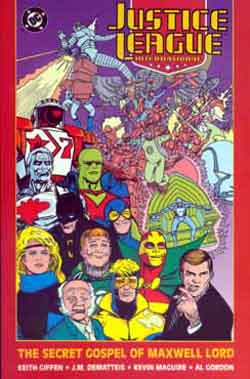
If the chop-and-change continuity gymnastics DC have undergone in recent years gives you a headache, but you still love reading excellent super-hero team stories, you could just take my word that this is one of the best of that breed and move on to the next review. If you’re okay with the confusion or still need convincing, though, read on.

DC published the Justice Society of America in All-Star Comics in the 1940s. They were the first super-hero team in comics. In 1960 the publisher revived the concept as the Justice League of America, eventually reintroducing their JSA ‘ancestors’ as the heroes of an alternative Earth. By 1985 the continuity was overcrowded with heroic multiples which the editorial Powers-That-Be deemed too confusing, and a deterrent to new readers, resulting in the maxi-series Crisis on Infinite Earths, the events of which led to a winnowing and restructuring of the DC universe.

With all the best bits from stories past (for which one could read ‘least charming or daft’) having now occurred on one Earth, and with many major heroes re-launched (Superman, Wonder Woman, Flash etc.), one of the newest curses to readers – and writers – was keeping definitive track of what was now DC ‘History’ and what had never actually happened. Thus the twelve issue maxi-series JLA: Year One presented the absolute, definitive, real story of the Justice League, the World’s Greatest Superheroes.

Of course since Infinite Crisis and the subsequent publishing extravaganzas such as 52 and Countdown it’s not strictly true anymore. Still. Again…

None of which impacts upon the superb quality of the tale told. Mark Waid, Brian Augustyn and artist Barry Kitson produced a superb version of the team’s earliest days. It’s set “ten years ago”, when an alien invasion initially brings Flash, Green Lantern, Black Canary (daughter of the JSA heroine), Aquaman and the Martian Manhunter together to save the Earth from colonisation.

The main action occurs after that victory, as the heroes – novices all – decide to band together as a team. The story of their bonding and feuding, under the extended threat of rogue geneticists who plan to remake the planet, the mystery of who is actually bankrolling their team, as well as the usual everyday threats in a superhero’s life, is both enchanting and gripping.

In-the-know fans will delight at the clever incorporation of classic comics moments, in-jokes and guest-shots from beloved contemporaneous heroes and villains such as the Blackhawks, Doom Patrol, original Blue Beetle and such, but the creators never forget their new audience and nothing is unclear for first-timers to the concept.

The finale is a fanboy’s action-packed dream as every hero on Earth unites to combat an all-out, alien invasion when their first foes return and even succeed in taking our planet! Of course the JLA save the day again in glorious style. The brilliantly addictive plot, superb dialogue and wonderfully underplayed art suck the reader into an enthralling climax that makes you proud to be human – or at least terrestrially based.

When it’s done right there’s nothing wrong with being made – and allowed to be feel – ten years old again.

© 1998 DC Comics. All Rights Reserved.