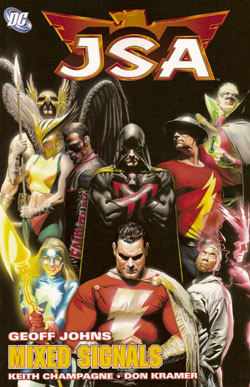
JSA: Mixed Signals

JSA: Mixed Signals

By Geoff Johns, Keith Champagne & Don Kramer (DC Comics)
ISBN 1-84576-347-5

As the company readied itself for the massive shake-up generated by the Infinite Crisis crossover, some DC titles experienced an unfortunate decline in quality, and none more so than the once excellent JSA. Although initially a worthy continuation of that landmark concept which was the foundation of all superhero teams, by the time of this collection (reprinting issues #76-81 of the monthly comic) the glorious history and triumphs had been diluted by a kind of thematic “burn-out” as the original world-savers became over-mired in interpersonal dramas. But the real killer wasn’t a lack of story balance: It was that the threatened changes elsewhere seemed to leech the life out of this venerable superhero team by pulling the team in too many directions.

The legal fate of wayward member and accused international criminal Atom Smasher is finally resolved in the first tale, but that’s merely an excuse to introduce the cyborg Omacs (see also The Omac Project ISBN 1-84576-229-0) and the new Suicide Squad into this series, and when the energy based hero Airwave crashes into their HQ seeking reinforcements for a universe shaking catastrophe, the team are alerted to the cosmic component of the Infinite Crisis.

Meanwhile Earth’s magic users are under assault and a small team are dispatched to the Fifth Dimension to rescue Jakeem Thunder and his mystical Thunderbolt, only to become embroiled in a titanic civil war, whilst their own magic members face destruction from super-wizard Mordru in a prelude to Day of Vengeance (ISBN 1-84576-230-4).

This volume concludes with a small personal story of the type that so well counterpoints cosmic epics, as the teenaged Stargirl reconsiders her life with her semi-retired superhero stepfather Pat (Stripesy) Duggan as the Crisis builds around them all.

Despite feeling a bit rushed and convoluted, this is still credible and competent work from writers Geoff Johns and Keith Champagne, and artists Don Kramer, Dale Eaglesham, Jim Fern, David Lopez, Art Thibert, Mick Gray, and Fernando Blanco, although perhaps the piecemeal nature of this beast might deter all but the dedicated fan.

© 2006 DC Comics. All Rights Reserved.
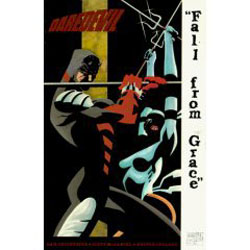
Daredevil: Fall From Grace

Daredevil: Fall From Grace

By D.G. Chichester, Scott McDaniel & Hector Collazo (Marvel)
ISBN 0-7851-0024-5

Daredevil is a lawyer in his civilian identity, and as a crime fighter his blindness is compensated for by his hyped-up remaining senses and a sixth “radar” sense that gives him a supernatural awareness of events and objects around him. It’s safe to say that none of these talents are available to we mere mortals, and they’d probably be of little use to the Man Without Fear in unravelling the unnecessary convolutions of this overly complex thriller.

Collecting issues #319-325 of the monthly comicbook, this tale is a good example of everything good and bad about 1990’s Marvel comics. In 1963 (this storyline was designed to celebrate Daredevil’s 30th anniversary so there’s lots of in-jokes and pictorial markers for veteran fans) telepathic secret agent Eddie Passim was distributing vials of a super viral weapon throughout the New York Subway system when an accident occurs and he loses one. Thirty years later Daredevil subdues a deranged bum who screams that someone named Eddie has put pictures into his head. He’s the twelfth person to claim so…

Meanwhile, in the Louisiana Bayou a voodoo ceremony is enthralling Hellspawn; a magical evil doppelganger of Daredevil…

Meanwhile the insane Cyborg SHIELD agent John Garrett recalls the surreal adventure he had with the ninja assassin Elektra…

Meanwhile Daily Bugle reporter Ben Urich is reviewing the case of US General Kenkoy who admitted in 1975 that the military were testing nerve gas on unwitting metropolitan commuters in the ’60s…

Meanwhile a Snakeroot ninja is breaking into the Pentagon and stealing the file on an old project, a viral agent called “About Face”…

Meanwhile millionaire Harry Kenkoy has hired Super-mercenary Silver Sable to find a man missing for thirty years. His name is Eddie…

All these threads are ambitiously but bewilderingly drawn together in an action-packed hunt for the lost agent and last vial, involving not only DD and Elektra, but loads of then-hot guest-stars (such as Venom and Morbius), and every modern bogeyman from Ninjas to gangsters to the Government.

Scott McDaniel’s art is phenomenally good but looks oddly crushed; crowded, small even, but the real problem here is narrative clarity. There’s simply too much going on in the mix, and the tale is desperately in need of a savage editing.

Despite – or perhaps because of – a number of attention-grabbing stunts such as revealing DD’s secret identity to the world, a new costume, and the apparent death of Matt Murdock, this is a floundering beast of a tale which was so nearly another masterpiece. Pictorially powerful, this is a little too much everything for all but the most dedicated Fan Without Fear.

© 1993, 1994, 2005 Marvel Characters, Inc. All Rights Reserved.

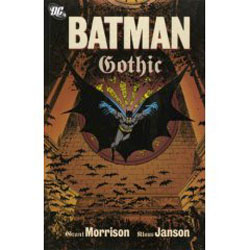
Batman: Gothic

Batman: Gothic

By Grant Morrison & Klaus Janson (DC Comics)
ISBN13: 978-1-84576-671-9

As with most of the “British Invaders” that made the jump to American comic-books, Grant Morrison was offered a shot at Batman sooner rather than later in his career. At this time, with popularity at an all-time high because of the Tim Burton movie, DC had launched a new Bat-title that was designed to present multi-part epics refining and infilling the history of the post-Crisis on Infinite Earths hero and his venerable cast. The added fillip was a fluid cast of premiere and up-and-coming creators.

Batman: Legends of the Dark Knight was a fascinating experiment even if the overall quality was haphazard. Most of the early story arcs were collected as trade paperbacks, helping to jump-start the graphic novel sector of the comics industry, and the re-imagining of the hero’s early career gave fans a wholly modern insight into the ancient if highly malleable concept.

This current edition is the second story-arc, (issues # 6-10), and features the rising star Morrison paired with relative veteran Klaus Janson in an interesting if slight supernatural thriller full of the author’s signature fascinations, and illustrated in the rough and visually dynamic post-Frank Miller manner.

Batman is still relatively new to the streets and shadows of Gotham when the city’s criminal hierarchy start dying in spectacular and rapid succession. Desperate, the surviving Ganglords try to establish an armistice with the caped vigilante so they can deal with the murderous and terrifying Mr. Whisper.

When Batman discovers that the monstrous murderer is not only a 300 year old monk but also a serial child-killer and one of the teachers at Bruce Wayne’s own prep school twenty years previously, he finds a potential connection to his own father which leads him into a world of ghosts, devils, arcane architecture, sacred geometry, and a plot to destroy Gotham with a centuries old Plague-bomb.

Fast-paced if a little over-egged, this modern horror-romp is a solid but uninspiring thriller. Bat-fans will be comfortable with the formula, but Morrison’s contemporary fan-base might find it a little insubstantial.

© 1990 DC Comics. All Rights Reserved.
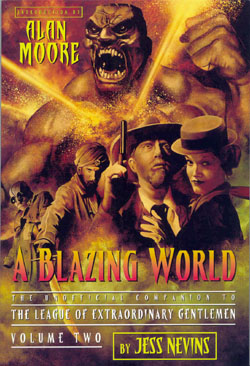
A Blazing World

The Unofficial Companion to The League of Extraordinary Gentlemen Volume Two

A Blazing World

By Jess Nevins (Titan Books)
ISBN 1-84576-317-3

Close on the heels of the first volume (Heroes & Monsters, ISBN 1-84576-316-5) was Jess Nevins’s follow-up tome revealing all the secrets and factoids that went into the back-story of and literary antecedents for the sequel to The League of Extraordinary Gentlemen.

Volume Two of Alan Moore and Kevin O’Neill’s steampunk masterpiece, although using HG Wells’ War of the Worlds as its primary narrative engine, draws from a vast spring of fantastic literature to pit the protagonists of the League against an unstoppable invasion that devastates the earth – and most especially Woking.

As with Heroes and Monsters the research and deductions are mind-boggling, and often the conclusions drawn are fanciful or erroneous – as defined by the annotations from Messrs Moore and O’Neill – but the text in the main is extensive and gratifying if a deeper reading is what you’re after. Also included in this volume are in-depth interviews with both creators.

© 2003 Jess Nevins. All Rights Reserved.
The League of Extraordinary Gentlemen â„¢ & © 2006 Alan Moore & Kevin O’Neill.

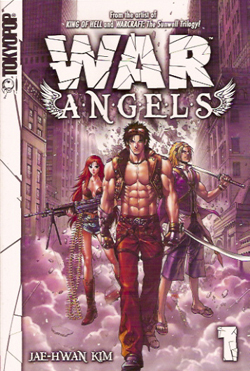
War Angels, Vol 1

War Angels, Vol 1

By Jae-Hwan Kim (TOKYOPOP)
ISBN: 978-1-4278-0188-3

This visually impressive if traditional sci-fi action thriller from the Korean end of the manga world is set in a post-apocalyptic future. 2504 AD: Genetic engineering has created a society where people are second class citizens, playthings of the hybridized animal/human ‘Beasterians’, bred to be our warriors but now occupying the top of the evolutionary food-chain.

This semi-feudal world is a battleground for rival hybrid clans, and humanity is poised to join the Dodo, but there is still The Prophecy. The Post-Testament Bible offers the slim hope of salvation for Mankind, and the militant arm of The Church has its own hybrid super-warriors, known as Angels.

When the Holy Mother – destined to be the mother of the new Messiah – is abducted by the Overlord Tyron’s unstoppable third-generation hybrids, a ragtag band of Angels must retrieve her at all costs…

This is nothing new, and older manga fans might recognise a lot of Buronson and Hara Tetsuo’s ‘Fist of the North Star’ in this fast and furious battle extravaganza, but they probably won’t care. This is the kind of plot-light, adrenaline-party blockbuster that guys drag girls to every summer, and on those disposable terms it excels. Exciting, excessive, entertaining eye-candy.

© 2007 Jae-Hwan Kim and TOKYOPOP Inc. All Rights Reserved.

Wildcat: Health Service Wildcat

Wildcat: Health Service Wildcat

By Donald Rooum & “Victoria N. Furmurry” (Freedom Press)
ISBN: 0-900384-73-5

The truly amazing – and most depressing – thing about Donald Rooum’s Anarchist cartoon strip is not the superb drawing talent displayed nor even the range of subjects that fall under the bellicose scrutiny of his team of lampooning and lambasting characters. It is that the issues he and his occasional collaborators highlight and skewer never go away. The names and faces of the political and industrial scoundrels and mountebanks may change but the mistakes and problems they create just keep going.

Take this particular collection of strips, originally released in 1994 and dedicated to “the daft doctrine that people trained in making profits can provide a better health service than people trained in caring for the sick” as a particularly telling case in point.

Victoria N. Furmurry was a long serving Health Service worker. She spent decades doing her job and even managed to have a rather successful sideline as a professional comic book writer. She was eventually compelled to combine her two jobs here in a desperate attempt to highlight the problems that beset the new management structure and system.

The obvious pseudonym was also necessary. Among the new crimes in the service were “bringing the service into disrepute” for which read ‘complaining or disagreeing’ and the truly Orwellian “causing the management to lose confidence in you as an employee”, both of which constituted “Gross Misconduct” and were grounds for instant dismissal. Understandably, she took the advice offered and kept her head down whilst delivering the fusillade of brickbats and jabs featured here.

Thirteen years later and nothing has really changed. Market principles still rule the Health Service, the wrong people still give impossible orders and profit handsomely from their ineptitude, the workers at the sharp end are still ignored and blamed, and ultimately it’s all Our fault for letting ourselves be ill or injured.

So why not pick up this slim book of scathing and deadly funny indictments and at least give an alternative treatment a shot. After all, isn’t laughter the best medicine?

© 1994, 2007 Donald Rooum and “Victoria N. Furmurry”. All Rights Reserved.

The Velveteen Rabbit

The Velveteen Rabbit — or How Toys Become Real

By Margery Williams, illustrated by William Nicholson (Egmont Books)
ISBN 10: 1-40522-228-X ISBN 13: 978-140522-228-0

Could you name the Top Twenty children’s books of all time? How about the Best Ten? What about the most influential? Or perhaps best illustrated?

Stop counting on your fingers, these are rhetorical questions. The point I want to make is that in any of those categories the book under discussion here will appear, and near the top, too.

Originally published in 1922 it tells the story of a cheap, poorly made toy rabbit given to a young boy as Christmas present, and the deep yearning the toy has to experience what it is to be real. Other toys explain but it is not the same as knowing.

As the simple, dutiful toy learns to be loved, experiences the terror of personal loss and eventually the heartbreak of being forgotten, the clear evocative illustrations of William Nicholson intensify the gently wistful inevitability of the mesmerising prose.

This elegaically simple tale of losing magic to gain maturity has a happy ending that sensitive readers can only yearn for, and briefly rekindle, by reading this story again and again and again. Even if you have no children, it is worth reading this story aloud…

This slim masterpiece has moved millions of readers over the decades, and the subtextual message that it’s okay to feel sad sometimes is one we should all remember. At once warm, sad and happy, this marvel is a book no child should ever be denied.

Illustrations © 1922 Elizabeth Banks.

Top 10: Book 1

Top 10: Book 1

By Alan Moore, Gene Ha & Zander Cannon (America’s Best Comics)
ISBN 1-84576-1491-6

Alan Moore blends super-team comics with the modern fascination with Police procedural dramas in this series based on the premise of everyday life in a universe where Super-Nature is accepted and common place. Neopolis is a city entirely populated by super-beings. Heroes, villains, gods, robots and monsters, the city is a vast dumping ground for copyright confounding analogues of everything that ever appeared in a comicbook since the genre and industry began.

Such a city needs really special policing and the beat cops are based at Precinct Ten – or Top 10 to you and me. In the mid 1980s this city joined a pan-dimensional league of worlds and came under the jurisdiction of the security organisation based on “Grand Central”. This small fact will play a large part in the overarching storyline, but the nature of this fascinating team-book is to build a longer narrative by seeming disconnected snippets and increments of daily drudgery.

Robyn Slinger is the new rookie at Top 10 and we start on her first day as a “real Police”. Her dad was a respected officer, but her own talent – controlling tiny robotic toys – doesn’t instil her with any great confidence as she is gently ushered into the routine by the affable desk-sergeant Kemlo Caesar, who is a talking dog. Adapting to the banter, routine and teasing of her brother officers is daunting, but not as much as being partnered with the surly, invulnerable blue giant Smax.

In short order, whilst going about their regular duties, which include sorting out super-powered “domestics” (no, not housekeepers – spousal confrontations), crowd control at robotic murder scenes, rousting hookers and generally keeping the peace, they become embroiled in an ongoing serial killer case and a drug investigation that will eventually reach to the highest levels of their own organisation.

By adopting the “day-in-the-life” approach, Moore and the astounding Gene Ha cover a lot of character ground and fill in back-story history whilst showing us “The Job”. As the method is used so effectively in TV Cop shows, readers not only get the same benefits of tone, texture and information value, but the added bonus of making the super-heroic elements more “real” and authentic seeming: A huge advantage when your protagonists deal every day with the most outlandish concepts comics have devised in the last seventy years.

For example: When a reptilian gang-member is arrested his dad wants to bust him out, and even the cops have to think twice when the 300 foot tall drunken lizard comes calling… Or how do you bust up a rave-party when all the revellers are dancing so fast they can’t be seen? Perhaps your apartment has been invaded by hyper-intelligent Ultra-Mice?

The serial killer case breaks towards the end of this first volume, revealing an alien monster whose real identity will bring nothing but trouble for the cops in the next book, and the fun concludes with a superbly sardonic tale of a murder in a bar frequented by the gods of Asgard…

A blend of low-key action and horror coupled with dark, ironic and occasionally surreal humour, drawn in the super-realistic style of Gene Ha, leavened by the solid inks of Zander Cannon, this is a gem of a collection (reprinting issues #1-7 of the monthly comic book).

© 2005 America’s Best Comics LLC. All Rights Reserved.

Marvel Platinum: The Definitive Silver Surfer

UK EDITION

 Marvel Platinum: The Definitive Silver Surfer

By various (Panini Publishing UK)
ISBN: 978-1-905239-67-2

This celebratory compilation collects a selection of obvious — and not so well known – tales featuring the fabled Sentinel of the Spaceways. The volume opens with the deservedly lauded and legendary introductory story. Although pretty much a last minute addition to Lee’s plot for Fantastic Four #48-50’s ‘Galactus Trilogy’, Jack Kirby’s gleaming creation became a watchword for depth and subtext in the Marvel Universe, and one Stan Lee kept as his own personal toy for many years.

Sent to find planets for Galactus to consume, the Silver Surfer discovers Earth, but the latent nobility of humanity reawakens his own suppressed morality and he rebels against his master and helps the FF save the planet. In retaliation, Galactus imprisons the Surfer on Earth, the ultimate outsider on a planet remarkably ungrateful for his sacrifice. The Galactus Saga was a creative highlight of a period where the Lee/Kirby partnership was utterly on fire. This tale has all the power and grandeur of a true epic and has never been surpassed for drama, thrills and sheer entertainment.

Following that is a two-parter from the anthology comic Tales to Astonish, which sees the Hulk meet the Surfer – although only on the very last page of ‘Turning Point’ (#92). The concluding ‘He Who Strikes the Silver Surfer,’ from TTA #93, made up for this deficit by cramming a huge amount of cosmic mayhem and misunderstanding into its ten pages, and the vastly underrated art of Marie Severin and Frank Giacoia is always a joy to see.

In 1968 the Surfer got his own title at last. ‘The Origin of the Silver Surfer!’ is by Lee, John Buscema and Joe Sinnott, the inker of the original Kirby FF trilogy, and detailed how Norrin Radd, last brave soul of a civilisation in comfortable stagnation, offers himself as a sacrifice to save his world from Galactus’s hunger. The stories in this series were highly acclaimed both for Buscema’s truly beautiful artwork and Lee’s deeply spiritual scripts, with the alien’s travails and observations creating a metaphoric status akin to a Christ-figure for an audience that was maturing and rebelling against America’s status quo.

The next story, from Tomb of Dracula #50 (1976) was one of the few not scripted by Lee, but Marv Wolfman kept the messianic overtones when the Devil tricks the Surfer into attacking the Lord of Vampires, in an attempt to prevent the birth of Dracula’s son. Whether the baby was truly destined to be the new Messiah is a tale for another time and place, but ‘Where Soars the Silver Surfer,’ drawn by Gene Colan and inked by Tom Palmer is certainly a magnificent art-job, capturing the eerie unworldly nature of the character.

Lee returned to script John Byrne’s 1982 one-shot. ‘Escape… to Terror’ was plotted and pencilled by Byrne, and Palmer again inked the Skyrider in a pretty but sadly vacuous yarn wherein the Surfer escapes Earth and returns to his devastated homeworld only to find he’s been manipulated by the demonic Mephisto. The only way to thwart the corrupter is to forsake his greatest love and return to his earthly prison.

The volume concludes with the two part ‘Parable’, released as a Epic Comics micro-series in 1988-1989, featuring an all-new interpretation of Galactus’s first attack on Earth, illustrated by legendary French artist Jean Giraud/Moebius. As with the 1978 Silver Surfer book by Lee and Kirby ((Fireside Books/Simon & Schuster 1978, ISBN: 0-6712-4225-3) the saga is removed from the normal Marvel continuity allowing Lee and the artist to focus on the unique nature of the Surfer and his ravenous master without the added distraction of hundreds of super-heroes.

Prompted, I’m sure, by the second Fantastic Four film, this is nonetheless a useful and entertaining primer to the character, and if there are some glaring omissions in content, the rarities should somewhat compensate for that, and still leave great material for new converts to seek out.

© 1966-1968, 1976, 1982, 1988-1989, 2007 Marvel Characters Inc. All Rights Reserved.

The Snowman — 20th Anniversary Edition

The Snowman — 20th Anniversary Edition

By Raymond Briggs (Hamish Hamilton)
ISBN 10: 0-24113-938-4 ISBN 13: 978-0-24113-938-7

This edition was released to commemorate twenty years since the release of the perennial children’s favourite in 1978, so with the 30th anniversary swiftly bearing down on us it’s a good time to re-examine this wonderful book, free of the huge ancillary industry that’s grown around it, strictly in terms of graphic narrative.

Despite being repackaged as numerous book spin-offs, the animated film and even a stage musical, The Snowman started as a slim (32 pages) picture book: A lyrical tale of forgotten winter joy. I can’t remember seeing enough snow to even confuse my cat (if you’ve never seen the pampered house-moggy’s first response to solid-seeming-cold- wet-white-stuff then you’ve never laughed so hard the cocoa came out of your nose) let alone coat the world in a clean blanket of wonder, but that’s what happens here.

This is a subtle and compelling story. A young boy awakens to a heavy snowfall. Dressing, he dashes outside and romps among the falling flakes. He spends all day building a snowman, and even when he he’s snugly back inside, he can’t stop looking at his magnificent creation. Happy and exhausted he goes to bed.

When everybody’s asleep he invites the now animate snowman indoors where they play, share a meal, and naturally, do the washing up when they’ve finished. Outside the skies are clear and the white flakes no longer fill the heavens. Having seen the boy’s world, the Snowman offers to show his own, and the pair soar aloft on a wondrous voyage over land and sea where the snows are falling still.

Returning home they say goodnight. The boy goes reluctantly back to bed and the frosty sentinel takes up his abandoned position in the garden. In the morning the boy dashes out, but only heartbreak and disappointment await, for the new morning has melted his midnight companion.

This truly beautiful tale is no cheery, mawkish fantasy; it is an examination of the intense nature of a child’s life and the poignancy of change. We never know if the adventure was simply a dream or an actuality, but the knowledge that such all-encompassing wonder is fleeting is a lesson we all learn as we grow. The ability to recapture such a lesson – both its joys and its pains – is a rare and awesome thing, and what a tribute to Raymond Brigg’s abilities that we don’t hate him for making us enjoy re-experiencing it.

Utterly wordless, in panels without dark borders and hard edges, Briggs spins a delicate web of magic. Using the child’s own creative tools of pencil and crayon he crafts lyrical pastel picture-poems that are truly evocative and spellbinding. Despite being co-opted by the Christmas Industry this isn’t merely a seasonal tale but a timeless one. There’s no Bright Red or Holly Green to dazzle and break this charm: Briggs, as always uses presentiment and understatement as his basic tools.

Our industry seems to wilfully neglect this creator whose graphic narratives have reached more hearts and minds than Spider-Man, The Spirit or Hellblazer ever will, yet his works remain among the most powerful and important in the entire field. The Snowman, despite my pompous pontificating, remains a work of sublime and simple universal beauty. Get it for your kids, get it for yourself, but when the cartoon comes on again this Christmas, don’t watch that, Read This.

© 1978 Raymond Briggs. All Rights Reserved.