Marvel Presents The X-Men Collector’s Edition (1982 Annual)


By Roy Thomas, Neal Adams, Tom Palmer & various (Grandreams/Marvel Comics International)
ISBN: 0-86227-038-3 (HB Annual)

When Stan Lee stormed the American comic-book industry in the early 1960s, his greatest weapon wasn’t the compact and brilliant talent pool available nor even the proverbial idea whose time had come, but rather his canny hucksterism and grasp of marketing and promotion. DC, Dell/Gold Key and Charlton all had limited overseas licenses (usually in black-and-white reprint anthologies) but Lee went further, reselling Marvel’s revolutionary early efforts all over the world.

In Britain, the material appeared in Class Comics and reformatted in weeklies like Pow!, Wham!, Smash! and even the venerable Eagle. There were also two almost wholly Marvel-ised papers, Fantastic and Terrific, which ran from 1967 to 1968 with only one UK originated strip in each. These slick format comics mimicked Marvel’s US “split-books” and originally featured three key Marvel properties in each. However, appearing every seven days quickly exhausted the company’s back catalogue.

After years of guesting in other publications, Marvel secured their own UK Annuals at the end of the 1960s through the publishing arm of World Distributors and – after launching their own British-based subsidiary – began a line of hardback premium reprints which made Christmas a special treat for growing Marvelites across the Kingdom and the House of Ideas a mainstay of the Yuletide season…

This particular oddment stems from 1982: a slim, sleekly repackaged but brutally trimmed down tome abridging a classic but somewhat tale from the end of the Silver Age: specifically, X-Men volume 1, #56-59, courtesy of Roy Thomas, Neal Adams & Tom Palmer.

It begins by asking ‘What is… the Power?’ and reveals an uncanny connection between the villainous Living Pharaoh and emergent mutant Alex Summers younger brother of team leader Cyclops.

By imprisoning Alex the Egyptian mastermind transforms into a colossal Living Monolith, but when he breaks free the terrified boy’s mutant energies are unleashed with catastrophic results. Savagely edited together with issue #57 the story jumps to reveal the team’s most relentless adversaries have returned and a public witch-hunt prompts the mutant-hunting Sentinels to capture X-Men and other Homo superior across the globe.

Chapter 2, ‘Mission: Murder!’ ramps up the tension as the toll of fallen mutants increases, with Iceman, the Pharaoh, Angel and Mesmero all falling to the murderous mechanoids, but when their human controller discovers an unsuspected secret the automatons strike out on their own…

With most mutants in the Marvel universe captured, Cyclops, Marvel Girl and Beast are reduced to a suicidal frontal assault, pulling off a spectacular victory, but only at great cost…

Gone are the text stories, quizzes and game pages which traditionally padded out most British Christmas books, replaced with cover-to-cover superhero action produced by the House of Ideas at the very peak of its creativity. Moreover, it’s in full colour throughout – an almost unheard-of largesse at the time.

More a sign of changing attitudes than a celebration of good old days, this is still a quirky nostalgic treat for all concerned.
© MARVEL COMICS INTERNATIONAL LTD. All rights reserved

Ka-Zar Marvel Masterworks volume 1


By Arnold Drake, Steve Parkhouse, Stan Lee, Roy Thomas, Gerry Conway, Gary Friedrich, Len Wein, Mike Friedrich, George Tuska, Barry Windsor-Smith, Herb Trimpe, John Buscema, Gil Kane, Neal Adams, Rich Buckler, Dan Adkins & various (Marvel)
ISBN: 978-0-7851-5957-5 (HB)

Win’s Christmas Gift Recommendation: A Fabulous Feast of Fantastic Forest Fun and Fury… 9/10

Beginning as a Tarzan tribute act relocated to a lost world in a sub-polar realm of swamp-men and dinosaurs, Ka-Zar eventually evolved into one of Marvel’s more complex – if variable – characters. Wealthy heir to one of Britain’s oldest noble families, his best friend is Zabu the sabretooth tiger, his wife is feisty environmental-crusader Shanna the She-Devil and his brother is a homicidal super-scientific bandit. Kevin Reginald, Lord Plunder is perpetually torn between the clean life-or-death simplicity of the jungle and the bewildering constant compromises of modern civilisation.

The primordial paragon is arguably Marvel’s oldest star, having begun life as a prose pulp star, boasting three issues of his own magazine between October 1936 and June 1937. They were authored by Bob Byrd – a pseudonym for publisher Martin Goodman or one of a fleet of writers on staff – who latterly had him shoehorned into his speculative new-fangled comic book venture Marvel Comics #1 (October 1939), beside The Angel (another pulp line graduate), Masked Raider, Human Torch and Sub-Mariner…

In 1965, when he reappeared all rowdy and renovated in X-Men #10, it was clear the uncrowned Sovereign of the Savage Land was destined for bigger and better things, but for years all we got was guest shots as a misunderstood foe du jour for Daredevil, Sub-Mariner, Spider-Man, and the Hulk.

Eventually in 1969 he got his shot at a solo saga in Marvel Super-Heroes and later that year – after Roy Thomas & Neal Adams used him so effectively in their X-Men run (#62-63) – he was awarded a giant-sized solo title reprinting all his previous appearances but strangely offering all-new stories of Hercules and the Angel. That same month, his first regular series began in a new split book entitled Astonishing Tales…

Gathering material from Marvel Super-Heroes #19; Savage Tales volume 1 #1 and Astonishing Tales #1-16, spanning March 1969 to February 1973, this initial hardback and digital volume traces Lord Plunder’s path from misjudged superhero to barbaric fantasy star. Following a revelatory Introduction by Roy Thomas, we plunge straight in to ‘My Father, My Enemy’ from Marvel Super-Heroes #19 March 1969. Scripted by Arnold Drake and Steve Parkhouse with art from George Tuska & Sid Greene it gathers scraps from previous stories to forge an origin for Ka-Zar the Jungle Master!, revealing a murky web of deceit and intrigue as Kevin Plunder quits British High Society in search of the truth about the father who apparently abandoned him and his unsavoury super-villain brother Parnival years earlier in search of a lost continent and mystery anti-metal.

At the behest of Parnival – AKA The Plunderer – Ka-Zar’s return to his spiritual home soon descends into a brutal clash with tribesmen of the Golden People safeguarding the menacing mineral and another painful half-victory for the his scurrilous sibling…

August 1970 saw the launch of Astonishing Tales with the Jungle Lord sharing space with Latverian Liege Doctor Doom. Stan Lee, Jack Kirby & Sam Grainger displayed ‘The Power of Ka-Zar!’ as crazed “sportsman” Kraven the Hunter sets his sights on Zabu’s pelt. A successful ambush in Antarctica sees the toothy tiger trapped and dragged back to “civilisation”. However, his human brother survives the assault and grimly follows the villain, leading to ‘Frenzy on the Fortieth Floor!’ as the second issue sees our hero – retitled Ka-Zar, Lord of the Jungle! – track his prey to Manhattan and score a stunning rescue and victory. Thomas replaced Lee here, but gave way to Gerry Conway, with Barry (Windsor) Smith joining Grainger to detail the hero’s first meeting with living god Garokk the Petrified Man urgently demanding his help in getting ‘Back to the Savage Land!’ where his ambitious Queen Priestess Zaladane has begun a war of conquest against the many tribes of the hidden continent. After sharing his all-too human origins and connection to the primordial domain, the constantly-mutating stranger is brought home just in time to become ‘The Sun God!’ in thought and deed as well as appearance; going on a destructive ‘Rampage!’ (inked by Frank Giacoia) and forcing harsh choices from Ka-Zar and his comrade Tongah of the Fall People…

AT #6 sees a stunning art job from Smith & Bill Everett as Conway’s ‘Ware the Winds of Death!’ pits the war’s survivors against reawakened alien god Damon, returned after centuries to destroy the world that took his lover Lelania, even as in faraway England a mysterious woman seeks to warn Lord Plunder of impending doom…

Thomas returns to script with Herb Trimpe illustrating concluding chapter ‘Deluge!’ as Damon is repelled – but only at tragic cost to Tongah – before Edgar Rice Burroughs’ Caspak and Caprona (with hints of Romeo and Juliet) tales inform #8’s ‘The Battle of New Britannia!’ by Thomas, Gary Friedrich, Trimpe & Tom Sutton, as Ka-Zar and Zabu explore a new region of the vast under-ice region, discovering warring colonies populated by the remnants of British and German soldiers still fighting WWII. Into this mass mess of monsters, man-apes and secret pacts and lies, parachutes the mystery girl from England, a formidable force who will eventually be superspy/Avenger Bobbi “Mockingbird” Morse…

Astonishing Tales #8 was an experiment with increased page count and included an origin tale by Len Wein, George Tuska & Mike Esposito. ‘This Badge Bedeviled!’ reveals how twins Damian and Joshua Link – one a cop, the other a crook – are changed by an abortive experiment. The result was that they could combine their physicality and abilities into one body as Gemini, but sadly only one personality could dominate…

The next issue was normal-sized but now only Ka-Zar was in situ, retitled Ka-Zar, Lord of the Hidden Jungle. Moreover, thanks to scheduling problems it was as a fill-in: a pure barbarian fantasy in the manner of Conan. ‘The Legend of the Lizard Men!’ by Lee & John Buscema pitted the outraged savage against a conquering witch-queen enslaving tribes and hiding a big secret…

The ongoing storyline continues and concludes with #10 (February 1972) as Thomas, Conway, Windsor-Smith & Sal Buscema usher in a minor Götterdämmerung with an horrific secret exposed in ‘To End in Flame!’

A newish direction beckons as #11’s ‘A Day of Tigers!’ revisits, clarifies and expands upon Ka-Zar’s origin in superb tale by Thomas, Gil Kane & Giacoia detailing how a young boy lost in Savage Land forms a primal bond with a sabretooth tiger, gains a lifelong enemy in Maa-Gor the Man-Ape becomes unwilling custodian to the most dangerous element on Earth…

Astonishing Tales #12 abruptly relocates the entire cast to Florida for ‘Terror Stalks the Everglades!’ with Thomas, John Buscema & Dan Adkins recasting the Jungle King as a consultant for S.H.I.E.L.D. assisting aging biologist Dr. WilmaCalvin – who just happens to be Morse’s mentor – in tracking down missing scientist Ted Sallis…

What Ka-Zar doesn’t know is that the project all of them are working on is the recreation of the super-soldier serum that created Captain America and what nobody living knows is that Sallis succeeded. However, when Advanced Idea Mechanic agents tried to steal it, Sallis injected himself and the chemicals reacted with the swamp’s magical energies to create a mindless shambling monster.

Readers are clued in thanks to an unused interlude intended for Savage Tales #2, with Wein & Neal Adams providing a chilling recap sequence detailing the macabre Man-Thing‘s previous relationship with Calvin, before we slip back to now with AIM attacking and trapping Ka-Zar with the bog-beast…

AT #13 sees Thomas, J. Buscema, Rich Buckler & Adkins expand the mystery as the Jungle Lord escapes the ‘Man-Thing!’ to focus on the real monsters, subsequently routing out a traitor and defeating AIM… for now…

Scheduling continued to be tricky and #14 featured Lee & John Buscema’s ‘The Night of the Looter’: a bowdlerised, colourised version of a rather racy thriller first seen in Savage Tales #1 wherein Ka-Zar scorns the temptations and dodges the perils brought by destructive treasure hunters from civilisation invading his hidden home, before continuity returned with #15 as Mike Friedrich, Kane & Sutton ask ‘And Who Will Call Him Savage?’

Increasingly enamoured of Barbra Morse, Ka-Zar opts to give the modern world another go, but quickly comes to despise the greed, the dirt, the greed, the callous brutality and the sheer greed of petty people, especially after encountering the drug crisis first hand and clashing with dope peddler The Pusher…

When his vile schemes almost end Wilma Calvin’s life, Ka-Zar goes wild in ‘To Stalk a City!’ (Friedrich, Buckler & Chic Stone) rampaging through the concrete jungle of New York City and delivering a king’s justice in an edgy action packed conclusion.

Also included here is the original, unedited monochrome version of Lee & Buscema’s ‘The Night of the Looter’ as seen in May 1971’s Savage Tales (volume 1 #1) lush with grey-tone washes with some gratuitous female nudity to keep readers attention high. Also on display is a pertinent text ‘Bullpen Bulletins’ page, and house ads, and the covers from aforementioned 1970 reprint series Ka-Zar volume 1, #1-3, rendered by Marie Severin and John Romita (Sr.)

Boldly bombastic, brilliantly escapist and crafted by some of the biggest and best in comics, these wild rides and riotous romps are timeless fun from the borderlands of Marvel’s endless universe: a fabulous excursion in to forgotten worlds you’ll want to treasure forever…
© 2017 Marvel Characters, Inc. All rights reserved.

Mighty Marvel  Masterworks The X-Men volume 1: The Strangest Super-Heroes of All


By Stan Lee & Jack Kirby & various (Marvel)
ISBN: 978-1-3029-2980-0 (TPB)

Win’s Christmas Gift Recommendation: Utterly X-traordinary Entertainment… 10/10

These stories are timeless and have been gathered many times before so I’m once more digressing to talk about format first. The Mighty Marvel Masterworks line has been designed with economy in mind. Classic tales of Marvel’s key creators and characters re-presented in chronological order have been a staple since the 1990s, but always in lavish, expensive hardback collectors editions. These new books are far cheaper, on lower quality paper and – crucially – are smaller, about the dimensions of a paperback book. Your eyesight might be failing and your hands too big and shaky, but at 152 x 227mm, they’re perfect for kids. If you opt for the digital editions, that’s no issue at all…

Way back in 1963 things really took off for the budding Marvel Comics as Stan Lee & Jack Kirby expanded their diminutive line of action titles, putting a bunch of relatively new super-heroes (including hot-off-the-presses Iron Man) together as The Avengers; launching a decidedly different war comic in Sgt. Fury and his Howling Commandos and creating a group of alienated heroic teenagers who gathered together to fight a rather specific, previously unperceived threat to humanity.

Those halcyon days are revisited in this splendid trade paperback and eBook compilation: gathering from September 1963 to March 1965, the contents of X-Men #1-10.

Issue #1 introduced Cyclops, Iceman, Angel and the Beast: extremely special students of Professor Charles Xavier, a wheelchair-bound telepath dedicated to brokering peace and integration between the masses of humanity and the emergent off-shoot race of mutants dubbed Homo Superior. The story opens as the students welcome their newest classmate, Jean Grey, aka Marvel Girl: a young woman with the ability to move objects with her mind.

No sooner has the Professor explained their mission than an actual Evil Mutant – Magneto – singlehandedly takes over American missile base Cape Citadel. A seemingly unbeatable threat, the master of magnetism is nonetheless driven off in under 15 minutes by the young heroes on their first mission …

It doesn’t sound like much, but the gritty dynamic power of Kirby’s art, solidly inked by veteran Paul Reinman, imparted a raw energy to the tale which carried the bi-monthly book irresistibly forward. With issue #2, a Federal connection was established in the form of FBI Special Agent Fred Duncan, who requests the teen team’s assistance in capturing a mutant threatening to steal US military secrets in ‘No One Can Stop the Vanisher!’.

These days, young heroes are ten-a-penny, but it should be noted that these kids were among Marvel’s first juvenile super-doers (unless you count Spider-Man or Human Torch Johnny Storm) since the end of the Golden Age, so it’s perhaps unsurprising that in this tale of a terrifying teleporter the outmatched youngsters needed a little adult supervision…

Issue #3’s ‘Beware of the Blob!’ displays a rare lapse of judgement when proselytising Professor X invites a sideshow freak into the team, only to be rebuffed by the felonious mutant. Impervious to mortal harm, The Blob incites his carnival cronies to attack the hidden heroes before they can come after him, and once again it’s up to teacher to save the day…

With X-Men #4 (March 1964) a thematic sea-change occurs as Magneto returns, heading ‘The Brotherhood of Evil Mutants!’ Intent on conquering a South American country and establishing a political powerbase, he ruthlessly dominates Mastermind, Toad, Quicksilver and the Scarlet Witch: all very much his unwilling thralls in the bombastic struggle that follows. From then on, the callow champions-in-training are the prey of many malevolent mutants…

‘Trapped: One X-Man!’ in issue #5 sees early results in that covert hunt as Angel is abducted to Magneto’s orbiting satellite base Asteroid M, and only a desperate battle at the edge of space eventually saves him…

‘Sub-Mariner Joins the Evil Mutants!’ is a self-explanatory tale of gripping intensity elevated to magical levels of artistic quality as superb Chic Stone replaced Reinman as inker for the rest of Kirby’s tenure. The issue also incorporates a stunning ‘Special Pin-up page’ starring “Cyclops”.

Genuine narrative progress is made with ‘The Return of the Blob!’ as their mentor leaves on a secret mission, but not before appointing Cyclops acting team leader. Comedy relief comes as Lee & Kirby introduce Beast and Iceman to the Beatnik-inspired “youth scene” whilst the high action quotient is maintained courtesy of a troubled teaming of the Blob and Magneto’s malign brood…

Another and very different invulnerable mutant debuted in ‘Unus the Untouchable!’: a wrestler with an invisible force field who attempts to enlist in the Brotherhood by offering to bring them an X-Man. Also notable is the first real incident of “anti-mutant hysteria” (a shaded reference to civil rights struggle being waged in America at that time) after a mob attacks Beast. The theme that would become the cornerstone of the X-Men mythos. The issue ends with a ‘Special Pin-up page’ featuring ‘The Beast’.

X-Men #9 (January 1965) is the first true masterpiece of this celebrated title. ‘Enter, the Avengers!’ reunites the mutants with Professor X in the wilds of Balkan Europe, as lethal, lurking Lucifer seeks to destroy Earth with a super-bomb, subsequently manipulating the teens into an all-out battle with the World’s Mightiest heroes. This month’s extra treat is a‘Marvel Masterwork Pin-up’ of ‘Marvel Girl’

This is still a perfect Marvel comic story today, as is its follow-up ‘The Coming of Ka-Zar!’: an incredible excursion to Antarctica, featuring the discovery of the Antediluvian Savage Land and the modern incarnation of one of Marvel/Timely’s oldest heroes. Kazar the Great was a pulp Tarzan knock-off who migrated to the comics page, with in October/November 1939’s Marvel Comics #1.

Dinosaurs, lost cities, spectacular locations, mystery and all-out action: it doesn’t get better than this…

Sadly, this would be King Kirby’s penultimate outing with the “strangest teens of all time”…

To Be Continued…

Supplemented by a house ad and gloriously unused cover for X-Men #10 by Kirby & Stone, these quirky tales are a million miles removed from today’s angst-ridden, breast-beating, cripplingly convoluted X-brand, and in many ways are all the better for it. Superbly rendered, highly readable adventures are never unwelcome or out of favour, and it must be remembered that everything here informs so very much of the mutant monolith. These are tales for dedicated fans and rawest converts alike  Everyone should have these stories.
© 2021 MARVEL

Conan the Barbarian Epic Collection volume 3 1973-1974: The Curse of the Golden Skull


By Roy Thomas, John Buscema, Neal Adams, Rich Buckler, Ernie Chan & various (Marvel)
ISBN: 978-1-3029-2655-7 (TPB)

Win’s Christmas Gift Recommendation: Savagely Sensational Sagas for All Seasons… 8/10

During the 1970’s the American comic book industry opened up after more than 15 years of calcified publishing practises in response to the censorious, self-inflicted Comics Code Authority: created to police product after the industry suffered its very own McCarthy-style 1950s Witch-hunt.

One of the first genres revisited was Horror/Mystery comics and from that sprang translated pulp star Conan the Cimmerian; initially crafted by Roy Thomas & Barry Windsor-Smith. Despite some early teething problems – including being cancelled and reinstated in the same month – the comic adventures of Robert E. Howard’s wandering warrior quickly became as big a success as the revived prose paperbacks which had heralded a world resurgence in tales of fantasy and the supernatural.

After decades away, the brawny brute recently returned to the Aegis of Marvel, who’s first bite of the cherry was retroactively subtitled “the Original Marvel Years” due to the character’s sojourn with other publishers and intellectual properties rights holders.

This third compendium of action fantasy reprints Conan the Barbarian #27-42 plus material from the first Annual and spans June1973 to May 1973 – a period when he was becoming the darling of the Comics world and when artist John Buscema made the hero his very own.

Story content was evermore redolent of pulp-oriented episodic action – much of it based on Thomas’ adaptations of Howard’s (and sometimes, other writers) “heroic” rather than fantasy fiction. Also on show is the inking of long-time Conan illustrator Ernie Chan, using at this time for reasons unimportant now the pen-name “Ernie Chua”.

First up is ‘Blood of Bel-Hissar’: a tight, taut tale of banditry, treacherous hill-chieftains and jinxed gems set in the aftermath of the recently ended War of the Tarim, followed by a gripping jungle-set horror story. ‘Moon of Zembabwei’sees the Cimmerian battling rival thief Thutmekri, witch-dancers and a golden monster ape before ‘Two Against Turan’has the sell-sword joining the army of Howard’s analogue of an Arabic super-state (and how prescient was that?).

Effete and ineffectual King Yildiz – father of Conan’s greatest human enemy, Yezdigerd – features in a tale displaying all of the barbarian’s most compelling qualities as he rescues agitator and new drinking buddy Ormraxes from the city’s torturers: a mistake that almost costs him his life…

Closely following is ‘Hand of Nergal’: another mystic adventure and one not taken directly from a Howard original, although it is derived from a Lin Carter novelette based on Howard’s notes. When Yildiz’s legions clash with the armies of a rebel satrap, sole survivor Conan is eventually pitted against the sorcery-possessed revolutionary and trapped at ground-zero of a clash between elder gods/demons…

Sporting a stunning Windsor-Smith cover, Conan the Barbarian Annual #1 was a reprint vehicle. It’s represented here by the aforementioned pic and text feature ‘The Hyborian Page’ before we head back to the monthly mag where #31 sees Thomas, Buscema & Chan at their brutal best. ‘Shadow in the Tomb’ has become an iconic Conan scenario due to the movies, but it’s a fairly standard monster and mayhem yarn where the allure of sudden wealth awakens something old, arcane and angry…

Further deviating from the prose canon, what follows is a 3-chapter epic based on the novel Flame Winds by Norvell W. Page – author of most of the 1930s pulp adventures of The Spider – with Thomas substituting Conan for wandering crusader Prester John, and setting the tale in Howard’s fabulous and fabled analogue of ancient China: ‘Khitai’.

Beginning in ‘Flame Winds of Lost Khitai’ with the unwelcome Barbarian caught in a war between the seven ruling sorcerers of the city of Wan Tengri, expanding ferociously into urban unrest and eldritch carnage in ‘Death and 7 Wizards’ and cataclysmically concluding with Conan confronting ‘The Temptress in the Tower of Flame!’ and overturning millennia of oppressive civilisation, this roaring romp deals out politics, magic and greed for Conan to overcome before he decides the Orient is not for him…

Heading towards the middle east with aggravating new flunky Bortai, he is driven by desert raiders into trackless wastes to discover a shattered abandoned city. A skeleton grasping an azure gem should be warning enough, but greed overwhelms common sense and before long ‘The Hell-Spawn of Kara-Shehr’ is loosed on the Barbarian and those who still pursue him. That yarn was freely adapted from Howard’s The Fires of Assurbanipal, but ‘Beware the Hykranians Bearing Gifts…’ is all-original: finding Conan finally back in Aghraphur and reporting to King Yildiz, just in time to save the impotentate from mystic assassination, after which Neal Adams steps in to spectacularly limn ‘The Curse of the Golden Skull’ with Conan and new comrade Juma captured by a mad wizard keen on creating a dynasty with the princess they’re bodyguarding.

His Lemurian arts and monsters eventually prove no match for brawny thews and determination after which Buscema and Chan return for Thomas’ spin on Howard’s The House of Arabu. ‘The Warrior and the Were-Woman’, sees the barbarian involved in petty palace politics and targeted by the mate of a monster he recently despatched, and is followed by epic all-original yarn ‘Dragon from the Inland Sea’ wherein Conan sets out to rescue a sacrificial maid from a very determined, very big lizard: a tale with mythological antecedents graced with Buscema inking his own pencils …

Chan is back in in #40 inking Rich Buckler’s pinch-hitter pencilling on ‘The Fiend from the Forgotten City’. Plotted by Michael Resnick, it sadly suffers a notable lack of panache and verve but still provides a solid tale of treachery and tomb-raiders, after which Buscema, Chan & Thomas reunite for new tale ‘The Garden of Death and Life’, as the nomadic mercenary lands in a nameless desert village sustained by a monstrous predatory tree…

We close for now on the ‘Night of the Gargoyle’ – adapted from Howard’s The Purple Heart of Erlik – bringing the action to a halt to a close on a spooky note as Conan returns to thieving and attracts the extremely unwanted attention of mystic adept Lun-Faar and his menagerie of horrors…

These classic tales are burnished by more behind the scenes extras such as a picture feature on the 1974 Conan commemorative coin and Marvel Value Stamp, plus contemporary house ads, 4 Buscema pencil pages and a previous Omnibus Collection cover by Dale Keown & Jason Keith.

Stirring, evocative, and deeply satisfying on a primal level, this is one of the best volumes in a superb series of a paragon of adventurers. What more does any red-blooded, action-starved fan need to know?
© 2021 Conan Properties International, LLC (“CPI”)

Green Arrow: 80 Years of the Emerald Archer – The Deluxe Edition


By Mort Weisinger, Ed Herron, Denny O’Neil, Mike Grell, Chuck Dixon, Grant Morrison, Kevin Smith, Brad Meltzer, Judd Winick, Jeff Lemire, Marc Guggenheim, Benjamin Percy, George Papp, Lee Elias, Neal Adams, Jim Aparo, Rodolfo Damaggio, Oscar Jimenez, Phil Hester, Scott McDaniel, Cliff Chiang, Denys Cowan, Joe Bennett,Otto Schmidt & various (DC Comics)
ISBN: 978-1-7795-0914-7 (HB)

Win’s Christmas Gift Recommendation: Superb All-Ages Entertainment and Adventure… 9/10

Green Arrow is one of DC’s Golden All-Stars. He’s been a company fixture – in many instances for no discernible reason – more or less continually since his 1941 debut in More Fun Comics #73. Many Happy Returns, Emerald Archer!

In those distant heady days, origins weren’t as important as image or storytelling, so creators Mort Weisinger & George Papp never bothered. The first inkling of formative motivations came in More Fun Comics #89 (March 1943) wherein Joe Samachson & Cliff Young detailed ‘The Birth of the Battling Bowman‘ (and a tip of the feathered hat to Scott McCullar for bringing the tale to my belated attention).

With the secret revealed, it was promptly ignored for years, leaving later workmen France “Ed” Herron, Jack Kirby and his wife Roz to fill in the blanks again with ‘The Green Arrow’s First Case’ at the start of the Silver Age superhero revival. It appeared in Adventure Comics #256, coved-dated January 1959. This time the story stuck, becoming – with numerous tweaks over successive years – the basis of the modern Amazing Archer on page and screen.

This hardback and digital celebration offers another quick survey of the Battling Bowman’s epic career, gathering material from More Fun Comics #73, Adventure Comics #246, 259, Green Lantern/Green Arrow #85-86, Green Arrow: The Longbow Hunters #1, Green Arrow volume 2 #100-101, JLA ‘8-9, Green Arrow volume 3 #1, 17, 75, Green Arrow and Black Canary #4, Secret Origins volume 3 #4, Arrow Season 2.5 #1, Green Arrow: Rebirth #1 and opens with the first of a series of brief prose ruminations ad reminiscences. Former editor Mike Gold details the heritage and legacy of ‘The Octogenarian Green Arrow’ before we meet the stars in November 1941’s More Fun Comics#73 solving the ‘Case of the Namesake Murders’ (Weisinger & Papp). Skipping unchanged to March 1958 and Adventure Comics #246, Herron & Papp detail how a counterfeiter redesigns himself as toxophilist terrorist ‘The Rainbow Archer’ whilst issue #259 (April 1959 by an anonymous author and Lee Elias) introduces ‘The Green Arrow’s Mystery Pupil’: exposing ulterior and sinister motives for his studies…

The turbulent 1960s saw Oliver Queen utterly reinvented. Deprived of his fortune he became a strident advocate of liberal issues in a bold experiment which created a fad for socially relevant, ecologically aware, mature stories which spread throughout DC’s costumed hero comics and beyond; totally revolutionising the industry and nigh-radicalising many readers.

Tapping relatively youthful superstars-in-waiting Denny O’Neil & Neal Adams to produce the revolutionary fare, editor Julie Schwartz watched in fascinated disbelief as the resultant thirteen groundbreaking, landmark issues captured the tone of the times, garnering critical praise, awards and valuable publicity from the outside world, whilst simultaneously registering such poor sales that the series was cancelled anyway: the heroes unceremoniously packed off to the back of marginally less-endangered comic book The Flash.

America at his time was a bubbling cauldron of social turmoil and experimentation. Everyone and everything were challenged on principle, and O’Neil & Adams utterly redefined super-heroism with “Issues”-driven stories transforming complacent establishment masked boy-scouts into uncertain, questioning champions and strident explorers of the enigma of America.

Probably the most notably of the run was 2-part saga ‘Snowbirds Don’t Fly’ and ‘They Say It’ll Kill Me…But They Won’t Say When!’ in Green Lantern/Green Arrow #85-86 (September – November 1972???)

Depiction of drug abuse had been strictly proscribed in comic books since the advent of the Comics Code Authority, but by 1971 the elephant in the room was too big to ignore and both Marvel and DC addressed the issue in startlingly powerful tales that opened Pandora’s dirty box forever. When the Green Gladiators are drawn into conflict with a vicious heroin-smuggling gang, Oliver Queen is horrified to discover his own sidekick had become an addict…

This sordid, nasty tale did more than merely preach or condemn, but actively sought to explain why young people turned to drugs, just what the consequences could be and even hinted at solutions older people and parents might not want to consider. It might all seem a little naïve now, but the earnest drive to do something and the sheer dark power and visual elan of the story still deliver a stunning punch…

Following Mike Grell writing about ‘My Favorite Hero’ comes the first chapter of the tale he crafted to radically reinvent the Archer for the post-Vietnam generation: setting out a new path that would quickly lead to the hero becoming a major player at long last and, ultimately, a 21st century TV sensation.

Green Arrow is one of the very few superheroes to be continuously published (more or less) since the Golden Age. On first look, the combination of Batman and Robin Hood seems to have very little going for him, but he has always managed to keep himself in vogue and in sight.

Probably the most telling of his many, many makeovers came in 1987, when – hot on the heels of Frank Miller’s The Dark Knight Returns – Grell was given the green light to make the Emerald Archer the star of DC’s second Prestige Format Mini-Series.

Grell was considered a major creator at the time, having practically saved the company with his Edgar Rice Burroughs inspired fantasy series Warlord. He had illustrated many of GA’s most recent tales (in Green Lantern/Green Arrow, Action Comics and elsewhere), and was a firm fan-favourite after well-received runs on Legion of Super-Heroes, Aquaman, Phantom Stranger, Batman and others. During the early 1980s, he had also worked on the prestigious Tarzan newspaper strip and created successful genre series Starslayer and Jon Sable, Freelance for pioneering indie publisher First Comics.

By the middle of the grim ‘n’ gritty Eighties, it was certainly time for another overhaul. Exploding arrows yes, maybe even net or rope arrows, but arrows with boxing gloves on them just don’t work (trust me – I know this from experience!). Moreover, for his 1960s makeover, the hero had evolved into a tempestuous, social reformer using his gifts to battle for the little guy. Now, in a new era of corrupt government, drug cartels and serial killers, this emerald survivor adapted again and thrived once more.

The plot was brilliantly logical and controversial, concerning the superhero’s mid-life crisis. Weary and aging, Oliver Queen relocates to Seattle, struggling to come to terms with the fact that since his former sidekick Speedy is now a dad, he is technically a grandfather. With long-time ‘significant other’ Dinah Lance/Black Canary, he starts simplifying his life, but the drive to fight injustice hasn’t dimmed for either of them.

As she goes undercover to stamp out a pervasive drug ring, the Arrow hunts the hunt for a psycho-killer dubbed “The Seattle Slasher”. Tracking a prolific beast slaughtering prostitutes, he learns of a second, cross-country slayer murdering people with arrows – the “Robin-Hood Killer”…

Eschewing his gaudy costume and gimmicks, Queen is an urban hunter stalking unglamorous hidden monsters, but stumbles into a complex mystery leading back to WWII, involving the Yakuza, CIA, corporate America and even Viet Nam war secrets that eventually change the course of the Archer’s life…

Intricate and effortless, the plot weaves around the destabilized champion, Dinah and new character Shado: exploring and echoing themes of vengeance and family in a subtle blending of three stories that are in fact one, delivering a shocking punch even now. This yarn, its narrative quality and sophistication, is arguably the first truly mature superhero yarn in the DCU.

Grell produced a gripping, mystery adventure pushing all the right buttons, conveyed by artwork – in collaboration with Lurene Haynes & Julia Lacquement – that was and remains a revelation. Beautifully demure yet edgily sharp when required, these painterly visuals and watercolour tones perfectly complement a terse, sparse script, and compelling ride.

It’s shame you’ll need another book to see the body and end of this snapping dragon…

The miniseries led to a lengthy and noteworthy run but – as ever – fashions changed and Oliver’s run apparently ended forever in Green Arrow volume 2 #100-101 (September & October 1995).

‘The Trap’ and ‘Run of the Arrow’ – by Chuck Dixon, Jim Aparo, Rodolfo DaMaggio, Gerry Fernandez & Robert Campanella  saw a weary, radicalised aging hero make the ultimate sacrifice to save Metropolis from eco-terrorist Hyraxwhilst his new-found, ashram-trained son Connor Hawke reluctantly assumed his legacy. The Buddhist-trained martial artist reluctantly took up his estranged father’s role and mission and was impressive enough to be summoned to the moon for a try-out in the  reinvented Justice League.

Grant Morrison, Oscar Jimenez, Chip Wallace, Hanibal Rodriguez supervised the secret son’s invitation to join the bright and shiny, no-nonsense team in August and September 1997’s JLA #8-9, with Jimenez & Wallace rendering ‘Imaginary Stories’ as mind-bending villain The Key attempts to conquer the universe by trapping individual Leaguers in perfect dreams, before the art was augmented by Anibal Rodriguez for the tense conclusion ‘Elseworlds’ This sees the Zen Archer saving the day in his own unique style…

Recent scribe Anne Nocenti describes ‘Hitting the Ground Running’ about her tenure on the Emerald Archer before we cover the return of the irascible original Oliver Queen as seen in Green Arrow volume 3 #1 from April 2001. This revival, by unconventional Kevin Smith (yes, Silent Bob!) and the wonderful art-team of Phil Hester & Ande Parks, brings him back from Heaven in the most refreshing manner I’ve seen in nearly five decades of comic reading. . ‘Quiver: Chapter One: The Queen is Dead (Long Live the Queen)’ starts a gloriously enjoyable refining of Green Arrow embracing the fundamental daftness of superhero comics to revitalise them. Replete with guest-stars, jam-packed with action and intrigue and wallowing in fun thanks to the sly, snappy dialogue of Smith, this is a costume-drama in a thousand and I’m certainly not going to spoil your fun by giving away any details. Just revel in the smart combination of the old and the new to create the best yet…

The renewed energy and impetus caried on building as Green Arrow volume 3 #17, November 2002 – ‘The Archer’s Tale: Chapter Two: Grays of Shade’ by Brad Meltzer, Hester & Parks – highlighted a long-overdue reconciliation between the Arrow and Speedy, triggered by the mistimed activation of a contingency plan to hide all their secrets in the event of the hero’s death, after which Green Arrow volume 3 #75 (August 2007) sees ‘Jericho, Conclusion: And the Walls Came Tumbling Down’ by Judd Winick, Scott McDaniel Andy Owens. Here the now-much extended Arrow family unite to save Star City from Deathstroke the Terminator‘s deranged vengeance scheme and witness a marriage proposal everybody knew was inevitable…

Writer, Producer and Director Greg Berlanti discusses ‘Arrow: Origins’ before Green Arrow and Black Canary #4 (March 2008) depicts Judd Winick & Cliff Chiang’s ‘Dead Again, Conclusion: Please Play Where Daddy Can See You.’Detailing the loss of a beloved “team-arrow” member, it as powerful downbeat tale about duty and repercussions that segues neatly into a new motivational start for Oliver, created as part of the New 52 company-wide reboot.

For Secret Origins volume 3 #4 (September 2014) Jeff Lemire, Denys Cowan & Bill Sienkiewicz detailed what makes a hero in ‘Secret Origins: Green Arrow’ whilst essay ‘I’m Not Batman, Dammit’ by Oliver Queen (as told to Mark Guggenheim)’ uses a faux interview to tell some real truths before we enjoy the fruits of the hero’s TV success.

Like any proper comics to screen venture, the show generated a comic book extending the on-screen adventures and here Arrow Season 2.5 #1 (December 2014) sees Guggenheim, Joe Bennett, Jack Jadson & Craig Yeung craft a tense, terse thriller in ‘Blood: Descent’ with the Arrow vigilante’s team save their city from airborne death and settle in for the fight against a new Brother Blood after which the on-point action ends with a return to basics and the end of the New 52 experiment in ‘Rebirth’ by Benjamin Percy & Otto Schmidt. Returning to Seattle, middle age and liberal crusading, the one-shot Green Arrow: Rebirth #1 (August 2016) details a first meeting with Black Canary and the hunt for urban predators “the Underground Men” abducting and selling the city’s poor into slavery…

Capped off with ‘Cover Highlights’ from the Golden, Silver, Bronze, Dark and Modern Ages, pencil art by Jim Lee and full ‘Biographies’ of the army of creators crafting green dreams over 8 decades, this is a striking reminder of the tenacity of the heroic principle and an uncomplicated core concept. Ideal Fights ‘n’ Tights fun for all…
© 1941, 1958, 1959, 1971, 1987, 1995, 1997, 2001, 2002, 2007, 2008, 2014, 2016, 2021 DC Comics. All Rights Reserved.
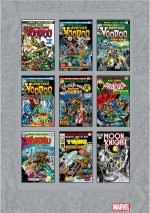
Star Wars – The New Republic Epic Collection volume 5: Dark Empire


By Tom Veitch, Peet Janes, Scott Allie, Jason Hall, Henry Gilroy, Joe Casey, Cam Kennedy, Jim Baikie, Paul Lee, Brian Horton, John McCrea, Dario Brizuela, Francisco Paronzini, Arthur Adams, Edvin Biuković, Steve Crespo, Rodolfo DaMaggio, Doug Mahnke, John Nadeau, Jordi Ensign, Stan Manoukian, Vince Roucher, Isaac Buckminster Owens, Dusty Abell, Jim Royal, Jan Duursema, Pop Mhan, Andrew Robinson & various (Marvel)
ISBN: 978-1-3029-2698-4 (TPB)

Win’s Christmas Gift Recommendation: Epic Entertainment and Adventure… 9/10

I’m sure we’re all familiar with the mythology of Star Wars. What you might not know is that the first sight future fanatics got of its breathtakingly expansive continuity and the mythology-in-the-making way back in 1977 was the premier issue of the Marvel comic book adaptation. It hit shelves two weeks before the film launched in cinemas, setting the scene for a legion of kids and beginning a mini-phenomenon which encompassed the initial movie trilogy and expanded those already vast imaginative horizons.

Marvel had an illustrious run with the franchise – nine years’ worth of comics, specials and paperback collections – before the option was left to die. Comic book exploits were reinstated in 1991 by Dark Horse Comics who built on the film legacy with numerous superb titles and tales until Disney acquired the rights to Star Wars in 2012. Around the same time, the home of Donald & Mickey also bought Marvel Comics and before long the original magic was being rekindled…

When Marvel relaunched the enterprise, they included not just a core title but also solo books for the lead stars. Moreover, rather than ignore what had passed between their two bites of the cherry, Disney/Marvel began reissuing the Dark Horse material too. Amongst the very best of it was a tryptic of miniseries released as one grand adventure under their Star Wars Legend imprint.

Scripted primarily by Tom Veitch, this fifth paperback/digital Epic Collection gathers Star Wars: Dark Empire #1-6; Dark Empire II #1-6; Empire’s End #1-2, plus material from Star Wars Tales #8, 11, 16, 17 and Star Wars Handbook volume one: X-Wing Rogue Squadron & Star Wars Handbook volume three: Dark Empire: originally seen between December 1991 and September 2003.

Set after the movie Return of the Jedi and now relegated conceptually to an alternate universe in light of later cinematic releases, Dark Horse kicked off its Star Wars franchise with a supremely moody, action-packed thriller. Illustrator Cam Kennedy (reuniting with scripter Veitch after previously collaborating on the excellent and peculiar Light and Darkness War), rendered the alien universe and familiar characters in his own unique and magnificent manner, delivering quirky but reassuringly authentic settings and scenarios for a space opera romp that satisfyingly captures the feel and pace of the cinema versions, whilst building on the canon for Force-starved fanatics everywhere.

Star Wars: Dark Empire opened in December 1991 with ‘The Destiny of a Jedi’: unfolding about ten years after the Battle of Endor and the death and redemption of Darth Vader. Although the Emperor is gone, the war continues. The militaristic remnants of the Empire are still battling for every inch of the galaxy. The New Republic is desperately hard-pressed. Han Solo and his wife Leia, although new parents, are as deeply involved as ever, and Luke Skywalker is pushed to ever-more desperate measures as he attempts to destroy the pervasive unleashed evil corrupting the universe. His solution to rebalance the Force is to revive and rebuild the fabled Jedi Knights…

A mysterious new leader employing ingenious new super-weapons is winning the war for the Empire in ‘Devastator of Worlds’ and the heroes must separate to succeed. The Alliance is being picked off world by world and as ‘The Battle for Calamari’ rages, Han and Leia pursue the strategic aspects of the conflict resulting in a ‘Confrontation on the Smugglers Moon’ whilst Luke heads directly to the source and succumbs to the Dark Side when a dead foe returns thanks to he horrors of cloning in ‘Emperor Reborn’.

‘The Fate of a Galaxy’ is decided with closing 6th issue (October 1992) with Leia’s newly conceived child destined to become the greatest threat the galaxy has ever faced…

Can the heroes reunite to avert the tragedy before all is lost?

No need to guess as December 1994 saw the start of sequel series Star Wars: Dark Empire II with ‘Operation Shadow Hand’.

Veitch & Kennedy returned in a blaze of glory after the runaway success of Dark Empire with a superb continuation featuring the further battles of Luke, Leia, Han Solo and all the other movie favourites…

Deprived of clone bodies he was incubating to ensure a return to physicality, the ghost of Emperor Palpatine is intent on possessing the unborn child in Leia’s belly even as his Dark Side lieutenants struggle to become his successor. The Empire’s last infrastructure remnants are producing more diabolical planet-killing weapons to terrorise and subdue the battered, war-weary galaxy and the monster expects success thanks to his last resort weapon: Seven Dark Jedi fanatically executing his contingency plans, whilst his nemesis Skywalker pursues a cosmic wild goose chase sparked by Jedi database the Holochron. It has set him in pursuit of scattered Jedi survivors who might have escaped the purge…

‘Duel on Nar Shaddaa’, ‘World of the Ancient Sith’ and ‘Battle on Byss’ unite old favourites with new Star Warriors – such as Ysanna tribe adepts Rayf and Jem – in a desperate struggle for survival even as reborn, young Palpatine readies ‘The Galaxy Weapon’ to deliver total victory.

Han and Leia have been hiding their Force-rich twins Jacen and Jaina from the Emperor for years, but are now fearful that their imminent third child will be the spectral horror’s new target for possession. When news comes that Palpatine has eradicated the entire Alliance leadership, Luke and his new Jedi disciples arrive in time to rally the last survivors in a last-ditch attempt to push back the swiftly-closing ‘Hand of Darkness’ (#6, May 1995). Tragically, the Dark Jedi are hot on their trail and a deadly confrontation looms…

This big bombastic blockbuster rockets along, packed with tension and invention, with action aplenty and spectacular set pieces for the fans – although it might be a tad bewildering if your Star Wars IQ is limited.

The trilogy concluded later that year in Star Wars: Empire’s End (October & November 1995) with Jim Baikie replacing Kennedy as artist for a much shorter adventure wrapping up all the plot-threads in a fittingly spectacular fashion. Issue #1’s ‘Triumph of the Empire’ sees the regrowth and expansion of a new rebel alliance and next generation of Jedi Knights when Palpatine discovers his clone-body is breaking down. The ‘Rage of the Emperor’ compels him to attempt a precipitous possession of new-born Anakin Solo leading to one final, sacrifice soaked confrontation…

Accompanying the colossal star-shaking events are a tranche of short stories taken from anthological series Star Wars Tales, beginning with ‘Tall Tales’ by Scott Allie, Paul Lee & Brian Horton from #11 (March 2002). Here, gossip among patrons in a cantina about a ship called the Millennium Falcon leads to another brawl by some very familiar strangers, after which ‘The Other’ (#16, June 2003 by Jason Hall & John McCrea) sees Luke and Leia on Coruscant, debating her future and provoking some awful memories of when they were constantly at war…

Star Wars Tales #8 (June 2001 by Henry Gilroy & Dario Brizuela & Francisco Paronzini) shares ‘The Secret Tales of Luke’s Hand’ as 4-year old Anakin Solo hears bedtime stories of his uncle’s prosthetic paw before Joe Casey & Francisco Paronzini expose ‘Phantom Menaces’ (#17, September 2003) when Ambassador Luke Skywalker encounters a seemingly spectral Sith Lord haunting a candidate planet of the New Republic …

After all that, true Jedi adepts and prospective Padawans can enhance their SWIQ through studying a veritable avalanche of new friends and foes whilst also reacquainting themselves with old favourites in data-drenched Star Wars Handbook volume one: X-Wing Rogue Squadron by Peet Janes, Arthur Adams, Edvin Biuković, Steve Crespo, Rodolfo DaMaggio, Doug Mahnke, John Nadeau, Jordi Ensign, Stan Manoukian, Vince Roucher and Star Wars Handbook volume three: Dark Empire by Janes, Nadeau, Ensign, Isaac Buckminster Owens, Dusty Abell, Jim Royal, Jan Duursema, Pop Mhan & Andrew Robinson.

These catalogues detail everybody and everything from Wedge Antilles and Boba Fett to World Devastators and the Jedi Holocron and segue efficiently into a trove of extras including a gallery of covers – movie photos and painted works from Dave Dorman, Ashley Wood, Kia Asamiya, John Nadeau – plus previous collection covers by Dorman, Mark Zug and Tsuneo Sanda.

There’s also Dark Empire painted promo art, character roughs and equipment sketches, and pencilled pages all by Cam Kennedy; text End-pieces and Introductions from the original comics as well as art Prints and Plates by Kennedy and Dorman.

Exceptional fun, in strong stories with beautiful pictures, this is an utter delight for devotees of a galaxy not so very far, far away and anyone hungry for good old fashioned action entertainment.
STAR WARS and related text and illustrations are trademarks and/or copyrights in the United States and other countries of Lucasfilm Ltd. and/or its affiliates. © & ™ Lucasfilm Ltd. All rights reserved.

Mighty Marvel Masterworks – The Amazing Spider-Man: With Great Power…


By Stan Lee & Steve Ditko, with Jack Kirby & various (Marvel)
ISBN: 978-1-3029-2977-0 (PB)

Win’s Christmas Gift Recommendation: An Immaculate Confection… 10/10

As any fule kno, Spider-Man turns 60 in 2022. In advance of that, here’s a little preliminary stocking-stuffer to start next year’s party early. I’m celebrating it here and now… and in a rather controversial new format.

These stories are timeless and have been gathered many times before so I’m digressing to talk about format first. The Mighty Marvel Masterworks line has been designed with economy in mind. Classic tales of Marvel’s key creators and characters re-presented in chronological order have been a staple since the 1990s, but always in lavish, expensive hardback collectors editions. These new books are far cheaper, on lower quality paper and – crucially – are smaller, about the dimensions of a paperback book. Your eyesight might be failing and your hands too big and shaky, but at 152 x 227mm, they’re perfect for kids. If you opt for the digital editions, that’s no issue at all…

Marvel is often termed “the House that Jack Built” and King Kirby’s contributions are undeniable and inescapable in the creation of a new kind of comic book storytelling, but there was another unique visionary toiling at Atlas-Comics-as-was, one whose creativity and even philosophy seemed diametrically opposed to the bludgeoning power, vast imaginative scope and clean, broad lines of Kirby’s ever-expanding search for the external and infinite.

Steve Ditko was quiet and unassuming, voluntarily diffident to the point of invisibility, but his work was both subtle and striking: innovative and meticulously polished. Always questing for detail, he ever explored the man within. He saw heroism and humour and ultimate evil all contained within the frail but noble confines of humanity. His drawing could be oddly disquieting… and, when he wanted, decidedly creepy.

Crafting extremely well-received monster and mystery tales for and with Stan Lee, Ditko had been rewarded with his own title. Amazing Adventures/Amazing Adult Fantasy featured a subtler brand of yarn than Rampaging Aliens and Furry Underpants Monsters: an ilk which, though individually entertaining, had been slowly losing traction in the world of comics ever since National/DC had successfully reintroduced costumed heroes.

Lee & Kirby had responded with Fantastic Four and the ahead-of-its-time Incredible Hulk but there was no indication of the renaissance ahead when officially just-cancelled Amazing Fantasy featured a brand new and rather eerie adventure character.

This compelling and economical full-colour paperback/digital compilation re-presents that auspicious tale from Amazing Fantasy #15 and Amazing Spider-Man #1-10, (spanning cover-dates August 1962-March 1964): allowing newcomers and veteran readers to relive some of the greatest moments in sequential narrative.

The initial burst of wonderment came and concluded in 11 captivating pages. ‘Spider-Man!’ offers the parable of Peter Parker: a smart but alienated kid bitten by a radioactive spider on a high school science trip. Discovering he’s developed arachnid abilities – which he augments with his own ingenuity and engineering genius – Peter does what any lonely, geeky nerd would do when given such a gift… he tries to cash in for girls, fame and money.

Creating a costume to hide his identity in case he makes a fool of himself, Parker becomes a minor celebrity – and a vain, self-important one. To his eternal regret, when a thief flees past him, he doesn’t lift a finger to stop the thug, and days later returns home to find that his Uncle Ben has been murdered.

Crazy for vengeance, Parker stalks the assailant who made his beloved Aunt May a widow and killed the only father he had ever known, only to find that it is the felon he couldn’t be bothered with. Since his social irresponsibility led to the death of the man who raised him, the boy swears to always use his powers to help others…

It wasn’t a new story, but the setting was familiar to every kid reading it and the artwork was downright spooky. This wasn’t the gleaming high-tech world of moon-rockets, mammoth monsters and flying cars… this stuff could happen to anybody…

Amazing Fantasy #15 came out the same month as Tales to Astonish #35 – the first to feature the Astonishing Ant-Man in costume, but it was the last issue of Ditko’s Amazing playground. In this volume you’ll find the ‘Fan Page – Important Announcement from the Editor!’ that completely misled fans as to what would happen next…

However, the tragic last-ditch tale struck a chord with the public and by year’s end a new comic book superstar was ready to launch in his own title, with Ditko eager to show what he could do with his first returning character since the demise of Charlton’s Captain Atom…

Holding on to the “Amazing” prefix to jog reader’s memories, the bi-monthly Amazing Spider-Man #1 arrived with a March 1963 cover-date and two complete stories. It also prominently featured the Fantastic Four and took the readership by storm. The opening tale, again simply entitled ‘Spider-Man!’, recapitulated the origin whilst adding a brilliant twist to the conventional mix…

By now the wall-crawling hero was feared and reviled by the general public thanks mostly to J. Jonah Jameson, a newspaper magnate who pilloried the adventurer from spite and for profit. With time-honoured comic book irony, Spider-Man then had to save Jameson’s astronaut son John from a defective space capsule in extremely low orbit…

Second yarn ‘Vs the Chameleon!’ finds the cash-strapped kid trying to force his way onto the roster – and payroll – of the FF whilst elsewhere a spy perfectly impersonates the webspinner to steal military secrets. This is a stunning example of the high-strung, antagonistic cameos and crossovers that so energised the jaded kids of the early 1960s. Heroes just didn’t act like that and they certainly didn’t speak directly to the fans as in the editorial ‘A Personal Message from Spider-Man’ page reprinted here…

With #2, our new champion began a meteoric rise in quality and innovative storytelling. ‘Duel to the Death with the Vulture!’ catches Parker chasing a flying thief as much for profit as justice. Desperate to help his aunt make ends meet, Spider-Man starts taking photos of his cases to sell to Jameson’s Daily Bugle, making the gadfly his sole means of support.

Matching his deft comedy and moody soap-operatic melodrama, Ditko’s action sequences were imaginative and magnificently visceral, with odd angle shots and quirky, mis-balanced poses adding a vertiginous sense of unease to fight scenes. But crime wasn’t the only threat to the world and Spider-Man was just as (un)comfortable battling “aliens” in ‘The Uncanny Threat of the Terrible Tinkerer!’

Amazing Spider-Man #3 introduced possibly the apprentice hero’s greatest enemy in ‘Versus Doctor Octopus’: a full-length saga wherein a dedicated scientist survives an atomic accident only to find his self-designed mechanical tentacles have permanently grafted to his body. Power-mad, Otto Octavius initially thrashes Spider-Man, sending the lad into a depression until an impromptu pep-talk from Human Torch Johnny Storm galvanises Spider-Man to one of his greatest victories. Rounding out the tense drama is a stunning ‘Special Surprise Bonus Spider-Man Pin-up Page!’…

‘Nothing Can Stop… the Sandman!’ was another instant classic wherein a common thug who gains the power to transform to sand – another pesky nuclear snafu – invades Parker’s school, and must be stopped at all costs, whilst #5 finds the webspinner ‘Marked for Destruction by Dr. Doom!’ – not so much winning as surviving his battle against the deadliest man on Earth.

Presumably he didn’t mind too much, as this marked the series’ transition from bi-monthly to monthly status. Here Parker’s social nemesis, jock bully Flash Thompson, first displays depths beyond the usual in contemporary comic books, beginning one of the most enduring love/hate buddy relationships in popular literature…

Sometime mentor Dr. Curtis Connors debuts in #6 when Spidey comes ‘Face-to-face with… The Lizard!’ with the wallcrawler fighting far from the concrete canyons and comfort zone of New York – specifically in the murky Florida Everglades. Parker was back in the Big Apple for #7 to breathtakingly tackle ‘The Return of the Vulture’ in a full-length masterpiece.

Fun and puckish hi-jinks were a signature feature of the series, as was Parker’s budding romance with “older woman” Betty Brant – Jameson’s secretary/PA at the Daily Bugle. Youthful exuberance was the underlying drive in #8′s lead tale‘The Living Brain!’ wherein an ambulatory robot calculator threatens to expose Spider-Man’s secret identity before running amok at beleaguered Midtown High, just as Parker is finally beating the stuffings out of school bully Flash.

This 17-page triumph is accompanied by ‘Spiderman Tackles the Torch!’: a 6-page vignette drawn by Jack Kirby and inked by Ditko, wherein a boisterous wall-crawler gate-crashes a beach party thrown by the flaming hero’s girlfriend… with suitably explosive consequences.

Amazing Spider-Man #9 is a qualitative step-up in dramatic terms, as Aunt May is revealed to be chronically ill – adding to Parker’s financial woes – with the action supplied by ‘The Man Called Electro!’ – an accidental super-criminal with grand aspirations.

The wallcrawler was always a loner, never far from the streets and small-scale-crime, and with this tale – wherein he also quells a prison riot single handed – Ditko’s preference for tales of human-scaled lawbreakers starts to show through: a predilection confirmed in #10’s ‘The Enforcers!’

This is a classy mystery with a masked mastermind known as the Big Man using a position of trust at the Bugle to organise all New York mobs into one unbeatable army against decency.

Longer plot-strands are also introduced as Betty mysteriously vanishes, although most fans remember this one for the spectacularly climactic 7-page fight scene in an underworld chop-shop that has still never been beaten for action-choreography.

And more and even better is yet to come…

The jumbo-economy selection is supplemented by an early 1960s monochrome promotional pin-up, unused covers, and house ads – including one from Fantastic Four #14 (May 1963) that announced the company’s new branding and name… the Marvel Comics Group!

These immortal epics are something no fan can be without, and will make the ideal gift for any curious newcomer.

Happy birthday Spidey and many, many more please…
© 2021 MARVEL

Yakari volume 18: The Wall of Fire


By Derib & Job, coloured by Dominique and translated by Jerome Saincantin (Cinebook)
ISBN: 978-1-84918-591-2 (Album PB)

Win’s Christmas Gift Recommendation: Superb All-Ages Entertainment and Adventure… 9/10

Children’s magazine Le Crapaud à lunettes was founded in 1964 by Swiss journalist André Jobin who then wrote for it under the pseudonym Job. Three years later he hired fellow French-Swiss artist Claude de Ribaupierre AKA “Derib”. The illustrator had launched his own career as an assistant at Studio Peyo (home of Les Schtroumpfs), working on The Smurfs strips for venerable weekly Le Journal de Spirou. Together, they created the splendid Adventures of the Owl Pythagore before striking pure comics gold a few years later with their next collaboration.

Derib – equally au fait with enticing, comically dynamic “Marcinelle” cartoon style yarns and devastatingly compelling meta-realistic action illustrated action epics – went on to become one of the Continent’s most prolific and revered creators. It’s a crime that groundbreaking strips such as Celui-qui-est-né-deux-fois, Jo (the first comic ever published dealing with AIDS), Pour toi, Sandra and La Grande Saga Indienne) haven’t been translated into English yet, but we still patiently wait in hope and anticipation…

Many of Derib’s stunning works over the decades feature his cherished Western themes; magnificent geographical backdrops and epic landscapes. Yakari is considered by fans and critics to be the strip which first led him to deserved mega-stardom.

Debuting in 1969, Yakari follows the life of a young Oglala Lakota boy on the Great Plains and is set sometime after the introduction of horses by the Conquistadores but before the coming of modern Europeans.

The series – which has generated two separate animated TV series and a movie release last year – has achieved 40 albums thus far: a testament to the strip’s evergreen vitality and the brilliance of its creators, even though originator Job has moved on and Frenchman Joris Chamblain assumed the writer’s role in 2016.

Overflowing with gentle whimsy and heady compassion, young Yakari enjoys a largely bucolic existence: at one with nature and generally free from privation or strife. For the sake of our delectation, however, the ever-changing seasons are punctuated with the odd crisis, generally resolved without fuss, fame or fanfare by a little lad who is smart, brave… and can – thanks to a boon of his totem guide the Great Eagle converse with all animals …

Originally released in 1993, la barrière de feu was the 19th European album, but – as always with the best books – the content and set-up are both stunningly simple and effectively timeless, affording new readers total enjoyment with a minimum of familiarity or foreknowledge required…

This time, the little wonder is embroiled in uncharacteristically dark deeds as a raiding party led by Wild Mane results in the loss of all the horses – except valiant pony Little Thunder who not only escapes but also raises the alarm and rouses the sleeping tribe.

As the adults set out on foot to recover their steeds and reclaim their honour, little Yakari tracks his equine friend and is amazed to find Little Thunder is trailing his stolen herdmates. As he follows, the loquacious lad meets a flying squirrel who kindly offers to act as an advance scout…

While the grown-ups are stymied by their cunning quarry’s tactics, the tiny tree-hugger rapidly reunites the boy with his horse and the trio set off together after the thieves. All too soon they have located the raiders, but instead of useless heroic gestures they sagely seek out Yakari’s father and lead his team to the thieves.

Dauntingly, it’s a nomadic convocation of thousands, and a retaliatory raid seems impossible. Moreover, something is shadowing the stalkers themselves, ever unseen but even getting close enough to steal supplies while they’re being carried! The adults are seriously considering swallowing their shame and retreating, but Yakari cannot let go of the notion that something is smarter than he is…

Ultimately, with help from his bestial buddies, the mystery is solved and the boy meets a new friend: a wounded lynx. The beautiful, cunning creature shows the curious kid a new trick: a sticky black liquid that oozes out of the ground and is ideal for sealing wounds.

When the shaman sees it he recognises it for all its many properties, including a tendency to burn, which gives Yakari’s father an inspired idea for countering the raiders’ superior numbers and getting back the tribe’s most treasured possessions…

Exotically enticing, deviously educational and wildly entertaining, this boldly action-packed and splendidly spectacular yarn sees Yakari’s gifts not only used to benefit his people and animal friends but also with the full acknowledgement of the adults he’s previously been unknowingly slighted by. Is our boy finally on the path to being a man?

Once again, Derib & Job display their astounding and compelling narrative virtuosity in another glorious graphic tour de force capturing the appealing courage of our diminutive heroes, and a visually stunning, seductively smart saga to delight young and old alike.

Yakari is one of the most unfailingly absorbing all-ages strips ever conceived and should be in every home, right beside Tintin, Uncle Scrooge, Asterix and The Moomins.
Original edition © Derib + Job – Editions du Lombard (Dargaud- Lombard s. a.) 1993. All rights reserved. English translation 2020 © Cinebook Ltd.

Justice Society of America: A Celebration of 75 Years


By Gardner Fox, Robert Kanigher, John Broome, Denny O’Neil, Paul Levitz, Roy Thomas, Len Strazewski, James Robinson, David Goyer, Geoff Johns, Mike Sekowsky, Dick Dillin, Joe Staton, Rich Buckler, Jerry Ordway, Arvell Jones, Mike Parobeck, William Rosado, Stephen Sadowski, Alex Ross, Dale Eaglesham & various (DC Comics)
ISBN: 978-1-4012-5531-2 (HB)

Win’s Christmas Gift Recommendation: Stunning Super Sagas Whatever the Season… 8/10

After the actual invention of the comicbook superhero – via the Action Comics debut of Superman in June 1938 – the most significant event in our industry’s history was the combination of individual stars into a like-minded group. Thus, what seems blindingly obvious to us with the benefit of four-colour hindsight was proven: consumers couldn’t get enough of garishly-hued mystery men, and combining a multitude of characters inevitably increases readership. Plus, of course, a mob of superheroes is just so much cooler than one…or one-and-a-half if there’s a sidekick involved…

The creation of the Justice Society of America in 1941 utterly changed the shape of the budding industry.

Following the runaway success of Superman and Batman, both National Comics and its separate-but-equal publishing partner All American Comics went looking for the next big thing in funnybooks whilst frantically concentrating on getting anthology packages into the hands of a hungry readership. Thus All Star Comics: conceived as a joint venture affording characters already in their respective stables an extra push towards winning elusive but lucrative solo titles.

Technically, All Star Comics #3 (cover-dated Winter 1940-1941 and released in December 1940) was the kick-off, but the mystery men merely had dinner and recounted recent cases and didn’t actually go on a mission together until #4, which had an April 1941 cover-date.

This superb hardcover and/or eBook commemoration comes from five years ago, gathering significant adventures of the pioneering paragons: specifically All Star Comics #4, 37, 55; Justice League of America #21, 22, 30, 47, 82, 83, 193; Adventure Comics #466; All-Star Squadron #67; Justice Society of America #10; JSA Returns: AllStar Comics #2; JSA #25; Justice Society of America vol. 2 #10 and Earth 2 #6, and – like all these generational tomes – follows a fixed pattern by dividing into chapters curated by contextual essays.

Here Roy Thomas’s history-packed treatise describes how leading characters from National-DC’s Adventure Comics and More Fun Comics and All-Star Publishing’s Flash Comics and All-American Comics were first bundled together in an anthological quarterly. Back then ‘A Message from the Editors’ asked readers to vote on the most popular…

The merits of the marketing project would never be proved: rather than a runaway favourite graduating to their own starring vehicle as a result of the poll, something radically different evolved. For the third issue, prolific scribe Gardner Fox apparently had the bright idea of linking all the solo stories through a framing sequence with the heroes gathering to chat about their latest exploits. With that simple notion that mighty mystery men hung out together, history was made and it wasn’t long before they started working together…

The anniversary amazement opens with Part I 1941-1950: For America and Democracy which hones in on those early moments, as All Star #4 eventually unites the costumed community ‘For America and Democracy’ with Fox and illustrators EE Hibbard, Martin Nodell, Bernard Baily, Howard Sherman, Chad Grothkopf, Sheldon Moldoff & Ben Flinton detailing individual cases for The Flash, Green Lantern, The Spectre, Hourman, Doctor Fate, The Sandman, Hawkman, The Atom and Johnny Thunder which coincide and result in a concerted attack on Nazi espionage master Fritz Klaver…

Pattern set, the heroes marched on against all foes from petty criminals to social injustice; aliens, mobsters and magical invaders until post-war tastes began shifting the formula…

All Star Comics #37 (1947) introduced ‘The Injustice Society of the World’ (November 1947) in a yarn by Robert Kanigher, Irwin Hasen, Joe Kubert, Alex Toth, Carmine Infantino & John Belfi. This sinister saga sees America almost entirely conquered by a coalition of super-villains before the on-the-ropes mystery men counterattack and ultimately triumph.

As superheroes plunged in popularity, genre themes predominated and it was a stripped-down team (Flash, GL, Wonder Woman, Black Canary, Hawkman, Atom and Dr. Mid-Nite) who faced a flying saucer scare in #55 and scoured outer space for ‘The Man Who Conquered the Solar System!’ (October/November 1955 by John Broome, Frank Giacoia, Arthur F. Peddy & Bernard Sachs).

Thomas returns for another educational chat as Part II 1963-1970: The Silver Age of Crisis focuses on the era that changed comics forever.

As I’ve frequently stated, I was one of the lucky “Baby Boomer” crowd who grew up with Julie Schwartz, Fox & Broome’s tantalisingly slow reintroduction of Golden Age superheroes during the halcyon, eternally summery days of the early 1960s. To me those fascinating counterpart crusaders from Earth-Two weren’t vague and distant memories rubber-stamped by parents or older brothers – they were cool, beguiling and enigmatically new.

…And for some reason the “proper” heroes of Earth-One held them in high regard and treated them with obvious deference…

It all began, naturally enough, in The Flash; pioneering trendsetter of the Silver Age Revolution. After successfully ushering in the return of the superheroes, the Scarlet Speedster – with Fox & Broome at the writing reins – set an unbelievably high standard for costumed adventure in sharp, witty tales of science and imagination, illustrated with captivating style and clean simplicity by Carmine Infantino.

The epochal epic that literally changed the scope of American comics forever was Fox’s ‘Flash of Two Worlds’ (Flash #123 September 1961 and not included here), establishing the existence of Infinite alternate Earths, multiple versions of costumed crusaders, and – by extension – the multiversal structure of the DCU. Every succeeding, cosmos-shaking annual summer “Crisis” saga grew from it.

Fan pressure almost instantly agitated for the return of more “Golden Age Greats” but Editorial bigwigs were hesitant, fearing too many heroes would be silly and unmanageable, or worse yet, put readers off. If they could see us now…

These innovative crossover yarns generated an avalanche of popular and critical approval (big sales figures, too) so inevitably these trans-dimensional tests led to the ultimate team-up in the summer of 1963.

A gloriously enthralling string of JLA/JSA convocations and  stunning superhero wonderments begin with landmark opening salvoes ‘Crisis on Earth-One’ and ‘Crisis on Earth-Two’ (Justice League of America #21-22, August to September). In combination they comprise one of the most important stories in DC history and arguably one of the most crucial tales in American comics.

Written by Fox and compellingly illustrated by Mike Sekowsky & Bernard Sachs, the yarn sees a team of villains from each Earth plundering at will; meeting and defeating the mighty Justice League before imprisoning them in their own secret mountain HQ.

Temporarily helpless “our” heroes contrive a desperate plan to combine forces with the champions of another Earth to save the world – both of them – and the result is pure comic book majesty. It’s impossible for me to be totally objective about this saga. I was a drooling kid in short trousers when I first read it and the thrills haven’t diminished with this umpty-first re-reading.

This is what superhero comics are all about!

The second team-up is only represented by the concluding chapter ‘The Most Dangerous Earth of All!’ Justice League of America #30 (September 1964) reprised the team-up of the Justice League and Justice Society, after (evil) versions of our heroic champions-beings from third alternate Earth discover the secret of trans-universal travel.

Unfortunately, Ultraman, Owlman, Superwoman, Johnny Quick and Power Ring come from a world without heroes and see the crimebusting JLA and JSA as living practice dummies to sharpen their evil skills upon. With this cracking thriller the annual summer get-together became solidly entrenched in heroic lore, giving fans endless entertainment for years to come and making the approaching end of school holidays less gloomy than they could have been.

The fourth annual event was a touch different: flavoured by self-indulgent humour as a TV show drove the wider world bats. Veteran inker Bernard Sachs retired before the fourth team-up, leaving the amazing Sid Greene to embellish a gloriously whacky saga that sprang out of the global “Batmania” craze engendered by the twice-weekly Batman series…

A wise-cracking campy tone was fully in play, acknowledging the changing audience profile and this time the stakes were raised to encompass the destruction of both planets in ‘Crisis Between Earth-One and Earth-Two’ (not reprinted here) and ‘The Bridge Between Earths’ (Justice League of America #47, September 1966), wherein a bold but rash continuum-warping experiment drags two Earths towards an inexorable hyper-space collision. Meanwhile, making matters worse, an awesome anti-matter being uses the opportunity to break into and explore our positive matter universe whilst the heroes of two worlds are distracted by destructive rampages of monster-men Blockbuster and Solomon Grundy.

Peppered with wisecracking “hip” dialogue, it’s sometimes difficult to discern what a superb yarn this actually is, but if you can forgive or swallow the dated patter, this is one of the best plotted and illustrated stories in the entire canon.

Furthermore, the vastly talented Greene’s expressive subtlety, beguiling texture and whimsical humour added unheard-of depth to Sekowsky’s pencils and the light and frothy comedic scripts of Gardner Fox.

This exercise in fantastic nostalgia continues with both chapters of a saga wherein alien property speculators seek to simultaneously raze Earths One and Two in ‘Peril of the Paired Planets’ (#82 August 1970 by O’Neil, Dillin & Joe Giella) and only the ultimate sacrifice by a true hero can avert trans-dimensional disaster in ‘Where Valor Fails… Will Magic Triumph?’ (#83 September)

Part III: Bronze Age and Beyond 1971-1986 returns to independent status and stories as – following another pertinent briefing from Thomas – we next focus on a time when the team was on its second career after decades in retirement.

Set on parallel world Earth-2, the veterans were leavened with teen heroes combined into a contentious, generation-gap fuelled “Super Squad”. Those youngsters included a grown up Robin, Sylvester Pemberton, the Star-Spangled Kid (a 1940s teen superhero who had been lost in time for decades) and a busty young thing who quickly became the feisty favourite of a generation of growing boys: Kara Zor-L – AKA Power Girl.

It starts with a little history lesson as Paul Levitz & Joe Staton reveal how and why the JSA went away. In ‘The Defeat of the Justice Society’ (Adventure Comics #466 December, 1979) they expose the reason why the team vanished at the beginning of the 1950s as the American Government cravenly betrays its greatest champions during the McCarthy witch-hunts: provoking the mystery men into voluntarily withdrawing from public, heroic life for over a decade – until the costumed stalwarts of Earth-One started the whole Fights ‘n’ Tights scene all over again…

When Roy Thomas left Marvel for DC, he made a lifetime dream come true by writing his dream team… sort of. Justice League of America #193 (August 1981) featured a “Prevue” insert mini-comic featuring the ‘All-Star Squadron’. Thomas, Rich Buckler & Jerry Ordway  launched a series of new stories set in the immediate aftermath of the attack on Pearl Harbor, told in real time and integrating published tales from the Golden Age into an overarching continuity. Here the JSA were augmented by contemporaries from other companies acquired by DC over the years – such as Plastic Man, Firebrand and Uncle Sam – and minor DC stalwarts like Liberty Belle, Johnny Quick and Robot Man. This prequel tells of December 6th 1941 and how the JSA heroes are attacked by villains from their own future as a mastermind seeks to alter history, leaving President Franklin Delano Roosevelt to issue a clarion call to all of Democracy’s other champions…

After an impressive and entertaining 5 year run that skilfully negotiated the rewriting of continuity during Crisis on Infinite Earths, the series ended with All-Star Squadron #67 (March 1987) as Thomas, Arvell Jones & Tony DeZuñiga recondition ‘The First Case of the Justice Society of America’ from All Star #4 and reveal how Nazi Fritz Klaver met justice…

Industry insider Ivan Cohen then reveals how things changed after the Crisis as a taster for Part IV: The JSA Returns 1992-2007 which opens with the last issue of Justice Society of America volume 1 (#10, May 1993). The series had concentrated on adventures of the aging heroes in modern times and ‘J.S.A. No More?’ by Len Strazewski, Mike Parobeck & Mike Machlan closed a superb and joyously fun run with the geriatric wonders polishing off ancient wizard Kulak and saving humanity from an army of unquiet ghosts and zombies…

The heroes were again rebooted six years later via a series of one-shots bracketed by a 2 issue miniseries and here James Robinson, David Goyer, William Rosado, John Dell & Ray Kryssing conclude the WWII-set battle against mystic marauder Stalker with ‘The JSA Returns, Conclusion: Time’s Arrow’ in JSA Returns: All-Star Comics #2 (Late May 1999).

All that attention led to a spectacular new series, which gained new fans for the old soldiers by turning the team into a mentoring service for new heroes. It must have been hard to select a sample from that era but the editors here went for ‘The Return of Hawkman: Seven Devils’ (JSA #25, August  2001 by Goyer, Geoff Johns, Stephen Sadowski, Michael Bair, Dave Meikis, Paul Neary & Rob Leigh).

But first, a slight digression…

Hawkman is one of the oldest and most revered heroes of all time, premiering in Flash Comics #1 (January 1940). Although created by Gardner Fox & Dennis Neville, the most celebrated artists to have drawn the Winged Wonder are Sheldon Moldoff and Joe Kubert, whilst a young Robert Kanigher was justly proud of his later run as writer.

Carter Hall was a playboy archaeologist until he uncovered a crystal knife that unlocked his memories. He realised that once he was Prince Khufu of ancient Egypt, and that he and his lover Shiera had been murdered by High Priest Hath-Set. Moreover, with his returned memories came the knowledge that his love and his killer were also nearby.

Using his past life knowledge, he fashioned a costume and flying harness, hunting his killer as the Hawkman. Once his aim was achieved he and Shiera maintained their “Mystery-Man” roles to fight modern crime and tyranny with weapons of the past.

Disappearing as the Golden Age ended, they were revived by Julie Schwartz’s crack creative team in the 1960s, but after a long career involving numerous revamps and retcons, the Pinioned Paladin “died” during the Zero Hour crisis.

The interconnection between all those iterations is resolved after time-lost Jay The Flash Garrick awakens in ancient Egypt, and learns from that era’s superheroes – Nabu, the Lord of Order who created Doctor Fate, Black Adam and Khufu himself – the true origins of Hawkman whilst in the 21st century, the modern Hawkgirl discovers his connection to alien cop Katar Hol, the Hawkworld Thanagar and true power of empowering Nth Metal.

When Hawkgirl is abducted to the aforementioned Thanagar by its last survivors, desperate to thwart the schemes of the insane death-demon Onimar Synn, the JSA frantically follow and Carter Hall makes his dramatic return from beyond to save the day in typical fashion before leading the team to magnificent victory in this concluding chapter…

There have been many attempts to formally revive the team’s fortunes but it wasn’t until 1999, on the back of both the highly successful rebooting of the JLA by Grant Morrison & Howard Porter and the seminal but critically favoured modern Starman by James Robinson, that the multi-generational team found a new mission and fan-base big enough to support them. As the century ended the original super-team returned and have been with us in one form or another ever since.

Called to order after Infinite Crisis and Identity Crisis, this JSA saw the surviving heroes from WWII as teachers for the latest generation of young champions and metahuman “legacy-heroes”: a large, cumbersome but nevertheless captivating assembly of raw talent, uneasy exuberance and weary hard-earned experience.

Taken from truly epic storyline ‘Thy Kingdom Come’, Geoff Johns, Alex Ross, Dale Eaglesham, Ruy Jose & Drew Geraci’s ‘What a Wonderful World’ comes from Justice Society of America vol. 2 #10 (November 2007): expanding, clarifying and building on heroes introduced in the landmark 1996 Mark Waid & Alex Ross miniseries Kingdom Come, and its belated sequel The Kingdom.

The elder Kal-El from that tragic future dystopia has crossed time and dimensions to stop his world ever forming and not even awakened god Gog or his new allies will stop him. ‘What a Wonderful World’ sees Tomorrow’s Man of Steel disclose how the heroes and their successors almost destroyed the planet (with flashback sequences painted by Alex Ross) before (another) Starman explains his own connection to all the realms of the multiverse. Initially suspicious, the JLA come to accept the elder Man of Steel, but elsewhere, a deadly predator begins to eradicate demi-gods and pretenders to divinity throughout the globe…

Having grown too large and unwieldy again, DC’s continuity was again pruned and repatterned in 2011, leading to a New 52 as sampled here in concluding segment Part IV: Revamp 2012. Accompanied by another Cohen text briefing, ‘End Times’ by Robinson, Nicola Scott & Trevor Scott comes from Earth 2 #6 (January 2012) with a recreated JSA operating on a restored alternate Earth, but one where an attack from Apokolips has created a living hell for the survivors of humanity, and a small group of metahumans such as Flash, Hawkgirl and Green Lantern struggles to keep humanity alive and free…

With covers by Hibbard, Irwin Hasen, Arthur F. Peddy & Bernard Sachs, Sekowsky, Murphy Anderson, Joe Giella, Neal Adams, Dick Dillin, George Pérez, Tom Grindberg & Tony DeZuñiga, Mike Parobeck, Dave Johnson, Andrew Robinson, Alex Ross, Ivan Reis & Joe Prado, this magnificent celebration of the premiere super-team is a glorious march down memory lane no fan can be without. Whether in sturdy hardback or approachable electronic format, this titanic tome must be yours…
© 1941, 1947, 1950, 1963, 1964, 1966, 1970, 1979, 1981, 1986, 1992, 1999, 2001, 2007, 2012, 2015, DC Comics. All Rights Reserved.
Black Widow Epic Collection volume 2: The Coldest War 1981-1998


By Ralph Macchio, Gerry Conway, D.G. Chichester, Jim Starlin, Cefn Ridout, Mindy Newell, Scott Lobdell, Paul Gulacy, George Pérez, George Freeman, Larry Stroman, Joe Chiodo, Charlie Adlard, Bob Layton, Butch Guice, John Stanisci, Sergio Cariello, Randy Green & various (Marvel)
ISBN: 978-1-3029-2126-2 (TPB)

Win’s Christmas Gift Recommendation: All-Out Action Adventure to Rival Any Cinema Classic… 8/10

Natasha Romanoff (sometimes Natalia Romanova) is a Soviet Russian spy who came in from the cold and stuck around to become one of Marvel’s earliest female stars, using a nomme de guerre first coined for a golden age supernatural superstar. Today’s Black Widow started life as a svelte, sultry honey-trap during Marvel’s early “Commie-busting” days, targeting Tony Stark and battling Iron Man in her debut (Tales of Suspense #52, April, 1964).

She was subsequently redesigned as a torrid tights-&-tech super-villain before defecting to the USA, falling for an assortment of Yankee superheroes – including Hawkeye and Daredevil – before finally enlisting as an agent of S.H.I.E.L.D., setting up as a freelance do-gooder and joining (occasionally leading) The Champions and The Avengers.

Throughout her career, she has always been considered ultra-efficient, coldly competent, deadly dangerous and yet somehow cursed to bring doom and disaster to her paramours. As her backstory evolved, it was disclosed that Natasha had undergone experimental processes which enhanced her physical capabilities and lengthened her lifespan, as well as assorted psychological procedures which had messed up her mind and memories…

Traditionally a minor fan favourite, the Widow only really hit the big time after Marvel’s cinematic franchise was established, but for us unregenerate comics-addicts, her print escapades have always offered a cool, sinister frisson of delight.

This expansive trade paperback and digital compilation gathers the contents of Bizarre Adventures #25, Marvel Fanfare #10-13; Solo Avengers #7; Black Widow: The Coldest War; Punisher/Black Widow: Spinning Doomsday’s Web; Daredevil/Black Widow: Abattoir; Marvel Comics Presents #135; Daredevil Annual #10; Fury/Black Widow:Death Duty and Journey into Mystery #517-519, cumulatively covering March 1981 to April 1998.

Preceded by prose  recaps ‘The Black Widow and Daredevil’ and ‘We are The Champions’, the action opens with an iconic appearance from 1981, first seen in monochrome mature-reader magazine Bizarre Adventures #25, featuring short tales starring female heroes.

Here Ralph Macchio scripted a far more devious spy yarn of double and triple cross with agents betraying each other while trying to ascertain who might be working for “the other side”…

‘I Got the Yo-Yo… You Got the String’ sees the Widow despatched by S.H.I.E.L.D. to assassinate her former tutor Irma Klausvichnova in an African political hot spot. However, as the mission proceeds, Natasha learns that she can’t trust anybody and everything she knows is either a lie or a test with fatal consequences…

The chilling, twist-ridden tale is elevated to excellence by the powerful tonal art of Paul Gulacy who fills the piece with sly tributes to numerous movie spies and the actors – such as Michael Caine and Humphry Bogart – who first made the genre so compelling.

Next up is a saga seen in Marvel Fanfare #10-13 (August 1983-March 1984), wherein Macchio and George Pérez – with inkers Brett Breeding, Jack Abel, Joe Sinnott, Al Milgrom & John Beatty – depict the spy in extreme peril as ‘Widow’finds her tapped again by S.H.I.E.L.D. to extract an abducted asset – her beloved mentor Ivan Petrovich.

As she tracks and trashes assorted killers and crazies, we get a potted rundown of her complex origins before she arrives ‘Back in the U.S.S.R.’: infiltrating a top-secret science project and facing the assembled killer elite of a mystery mastermind with a grudge…

As mercenary assassins close in, ‘The Web Tightens!‘ until a last-minute rescue by agent Jimmy Woo and frenzied clash with mad killer Snapdragon at last leads to revelation and full disclosure after ‘The Widow… Alone!’ faces a foe long believed dead and spectacularly triumphs…

A short from Solo Avengers #7 (June 1988) by Bob Layton & Jackson “Butch” Guice) sees the Widow brave unimaginable peril to return to her old dancing teacher ‘The Token’ she no longer feels worthy of before intriguing superhero spy Original Graphic Novel The Coldest War unfolds.

Set in the last days of the US/Soviet face-off – with what looks to be an epilogue added to address the collapse of the Soviet State – the tale was clearly meant as a contemporary thriller (probably for fortnightly anthology Marvel Comics Presents) before events overtook the time-consuming process of printing a comic.

The afterword – set after the fall of the Berlin Wall – doesn’t jar too much and must have lent an air of imminent urgency to the mix at the time.

Gerry Conway provides a typically complex, double-dealing tale set in the dog-days of Mikhail Gorbachev’s “Perestroika” (“openness”) government, where ambitious KGB upstarts undertake a plan to subvert Natasha  and return her to Soviet control. Their leverage and bait is husband Alexei Shostokoff – whom she has believed dead for years. Naturally, nothing is as it seems, nobody can be trusted and only the last spy standing can be called the winner…

Low key and high-tech go hand in hand in this sort of tale, and although there’s much reference to earlier Marvel classics, it can be easily enjoyed by the casual reader or movie convert.

And what art! George Freeman is a supreme stylist, whose drawing work – although infrequent – is always top rate. Starting out on Captain Canuck, he has excelled on Jack of Hearts, Green Lantern, Avengers, Batman Annual #11 (with Alan Moore), Wasteland, Elric, Nexus and The X-Files (for which he won an Eisner Award). Here, inked by Ernie Colon, Mark Farmer, Mike Harris, Val Mayerik & Joe Rubinstein, with colours from Lovern Kindzierski, he renders a subtle and sophisticated blend of costumed chic and espionage glamour to make this tale a “must-have” item all by itself.

It’s followed by 1992’s OGN Punisher/Black Widow: Spinning Doomsday’s Web by D.G. Chichester, Larry Stroman & Mark Farmer. Action-packed and plot-lite, it sees Frank Castle clash with the super-agent as she tracks rogue killer Peter Malum: an atomic scientist with a taste for slaughter and an insatiable thirst to test the deadliest weapon he’s ever built…

Presumably her spicy spy cachet wasn’t deemed enough to garner a regular series but warranted plenty of guest shots. In 1993, Jim Starlin & Joe Chiodo reunited her with an old lover for OGN Daredevil/Black Widow: Abattoir as a duo of depraved psionic predators inflict the tortures of the damned upon the Widow until the Man Without Fear saves her… and she subsequently rescues him…

Released in Late August 1993, ‘Legacy’ by Mindy Newell, John Stanisci & Sergio Cariello, was one quarter of Marvel Comics Presents #135 and sees Natasha touch base with her roots in New York’s Russian enclave only to find prejudice, murder and hidden KGB agents, before 1994’s Daredevil Annual #10 ‘Dead End’ offers a kind of sequel by Newell, Cariello & Rich Rankin as Natasha retrieves a lost bio-agent and is unexpectedly forced into reviewing her own defection to find a supposedly long-deceased old enemy…

Presumably crafted under the aegis of the much-missed Marvel UK sub-division, 1995 OGN Fury/Black Widow: Death Duty is by Cefn Ridout & Charlie Adlard and is a bit of a misnomer.

Don’t be fooled by the title and brace yourself for a disappointment if you’re a huge fan of the World War II Howling Commando and irascible erstwhile leader of the planet’s most advanced espionage agency. Although he gets top billing, Nick Fury is largely absent from the post-Cold War proceedings in this pacy thriller that is in actuality the spiritual conclusion to the saga of the mysterious Night Raven.

The enigmatic wanderer was a masked vigilante who fought crime in New York and Chicago s between World Wars I and II. In later years, he was locked in a bloody, pitiless vendetta with immortal villainess Yi Yang, Queen of the Dragon Tong.

Here, when a S.H.I.E.L.D. asset is murdered inside Moscow’s US embassy soon after the fall of the Soviet system, expatriate Russian super-agent/Avenger Natasha Romanoff is dispatched to unravel the secrets the new rulers don’t want revealed.

What she discovers is the incredible fate of the fearsome urban legend now known as Black Bird as he slaughters his way through bureaucrats and Russian Mafia alike in his single-minded mission to destroy the woman who kept him from a peaceful grave.

Superbly illustrated and tightly scripted, this is nonetheless an uncomfortable blending of genres, with a strange pace to it: as if a propose serial was savagely trimmed and pruned with no thought to narrative cohesion.

Closing the file this time around is a 3-part exploit by Scott Lobdell, Randy Green & Rick Ketcham from Journey into Mystery #517-519 (February to April 1998). ‘The Fire Next Time… parts 1-3’ offers a convoluted hunt for a Far Right terror group’s hidden leader whose scheme to simultaneously murder every S.H.I.E.L.D. agent on Earth revolves around a hidden traitor. But as the plot unfolds, it’s clear to the beleaguered Widow that absolutely nobody is who or what they seem…

Supplemented by Gulacy’s stunning 1982 Black Widow Portfolio (six monochrome plates and the cover image); info pages from the Official Handbook of the Marvel Universe and pin-ups and posters by Al Milgrom, Kevin Nowlan, Terry Austin, June Brigman & Jim Lee and Joe Chiodo, this monumental collection also contains original art pages from Chiodo, Stroman & Farmer and covers by Yancy LaBat, Mark Morales, Pérez & Layton from previous collections of Black Widow: Web of Intrigue combining to create a suspenseful dossier of devious delights no fan should miss.
© 2020 MARVEL.