Lola – a Ghost Story


By J. Torres & Elbert Or (Oni Press)
ISBN: 978-1-934964-33-0 (HB/Digital edition) 978-1-93266-424-9 (PB)

These days young kids are far more likely to find their formative strip narrative experiences online or between the card-covers of specially tailored graphic novels rather than the comics and periodicals of my long-dead youth.

In times past the commercial comics industry thrived by producing copious amounts of gaudy, flimsy pamphlets subdivided into a range of successfully, self-propagating, seamlessly self-perpetuating age-specific publications.

Such eye-catching items generated innumerable tales and delights intended to entertain, inform and educate such well-defined target demographics as Toddler/Kindergarten, Younger and Older Juvenile, General, Girls, Boys and even Young Teens, but today the English-speaking world can only afford to maintain a few paltry out-industry licensed tie-ins and spin-offs for a dwindling younger readership.

Where once cheap and prolific, comics periodicals in the 21st century are extremely cost-intensive and manufactured for a highly specific – and dwindling – niche market, whilst the beguiling and bombastic genres that originally fed and nurtured them are more immediately disseminated via TV, movies and assorted interactive games, media or streaming services.

Happily, old-school prose publishers and the graphic novel industry still have a different business model and more sustainable long-term goals, so magazine makers’ surrender became their window, as solid, reassuringly sturdy Comic Books bucked the pamphlet/papers trend.

Some of the old-fashioned publishers even evolved and joined the revolution…

Independent comics mainstay Oni made the switch to sturdy stand-alone one-offs at the end of the last century, publishing a succession of superbly illustrated tales splendidly pushing the creative envelope whilst providing memorable yarns irresistibly luring young potential fans of the form into our world.

That looks quite creepy in type-form but that’s okay – this is a beguilingly spooky story and you should be on your guard.

Aimed at readers of seven and above, Lola – a Ghost Story follows young Canadian Jesse as he returns to the rural Philippines farm where his parents grew up. It’s not his first visit, but it is the saddest. They’re going back for the funeral of his grandmother…

In the Tagalog language Lola means “grandmother” and Jesse’s was pretty scary. She was old and ugly, had a hump on her back and – he thinks – she tried to drown him when he was a baby. Grandma Lola also saw dead things and monsters and the future… just like Jesse does. Despite all this he loved her very much and really doesn’t want to accept that she’s gone forever.

After hours of exhausting travel into the forbidding wild regions, Jesse and his folks at last arrive at the old farmhouse which has witnessed so much tragedy. The little visitor fulsomely greets his uncle and cousin Maritess, but won’t acknowledge her brother JonJon. That kid’s acting like a jerk as usual, and besides he’s been dead for over a year and no-one else can see him…

Soon the family are gathered together: eating, memorialising the departed and telling stories of Lola – like the time she saw the giant devil-pig and saved the entire family from financial ruin. Despite a convivial atmosphere, Jesse is still ill at ease. Even though everyone here believes grandmother had second sight and blessed gifts, the sensibly modern boy can’t bring himself to believe the things he sees are real. Maritess believes though, and she suspects what Jesse won’t admit even to himself…

After JonJon teases him some more and taunts him with the giant bestial, cigar-smoking Kapre lurking at the window, Jesse finally drops into an exhausted, nervous slumber. The funeral next day is horrible. Everybody is sad, the church is filled with so many shockingly damaged spirits and Jesse is afflicted with a vision of being trapped and burning which makes him run screaming from the ceremony.

Still traumatised that evening, he finds JonJon’s old toybox on his bed and Maritess guesses what has happened. She tells her cousin the story of the bloodsucking Manananggal which attacked Lola’s mother, causing her unborn daughter’s hump back and magical sight. Such gifts and curses usually skip a generation and Maritess always assumed she’d be the one to get the sight, but now that it’s clear Jesse is the one to inherit the power, she’s determined to give him all the help he needs.

The recovered box is full of JonJon’s toy cars, and, after playing with them, Jesse and the dead boy romp over by the farm wall… the one where nobody is allowed to go anymore…

Jesse’s uncle isn’t doing very well: all the tragedies have made him very sad and he’s drinking an awful lot. There are other problems bothering Jesse too. The entire family have stories about grandmother and it’s clear she was brave and determined and fought monsters all her life: is that, then, why she tried to drown him when he was a baby?

Maritess tells her Canadian cousin about the time little Lola saved her school friends from a predatory Tiyanak – a baby-shaped carnivorous monster – and he readies himself to ask her if she thinks he might be evil. Just then her father comes in very drunk and shouts at him for leaving JonJon’s cars in the garden.

They are all he has left to remember his son and the boy’s favourite one is already missing. Jesse knows which one it is… the striped one JonJon calls “Zebra” which he wouldn’t share with him last night by the wall…

Uncle Tim hates the wall. It had something to do with his son’s death and Jesse knows he’ll get into trouble if he goes over it. But Uncle is so sad. He misses his boy and really wanted to bury Zebra with JonJon, but it’s gone and the man is so drunk and angry all the time now…

Jesse’s fear that Lola saw something evil in him is calmed by Maritess, who thinks he should use his gift to help people – just like just their grandmother used to. So, when JonJon appears again, Jesse climbs the despised wall and vanishes into the wild unknown beyond…

With Jesse’s first good deed successfully accomplished, JonJon can rest and Uncle Tim is at peace. The troubled psychic is even a little less disturbed by his power and apparent destiny. Sadly, that all changes on the trip back to the airport when Jesse sees something utterly horrifying…

Evocative, compelling, gently enthralling and with a genuinely scary shock ending, this superb child’s chiller is filled with a fascinating new bestiary of monsters and bogey-men to bedazzle Western eyes and imaginations, but mostly relies on captivating art and top-notch storytelling to draw readers in.

I loved it and so will you…
Lola is ™ & © 2009 J. Torres. All other material © 2009 Oni Press, Inc. All Rights Reserved.

The Golden Age Spectre Archives


By Jerry Siegel & Bernard Baily with Gardner F. Fox & various (DC Comics)
ISBN: 978-1-5638-9955-3 (HB)

This book includes Discriminatory Content produced in less enlightened times.

Win’s Christmas Gift Recommendation: Masterpieces for all Comics Addicts… 9/10

Ola! Happy Día de (los) Muertos!

There were and still are a lot of comics anniversaries this year: many rightly celebrated, but a lot were unjustly ignored. As a feverish fanboy wedged firmly in the past, I’m abusing my privileges here to kvetch again about another brilliant vintage book, criminally out of print and not slated for revival either physically or in digital formats. That means occasionally recommending items that might be a bit hard to find. At least you might be buying from those poor beleaguered comics shops and specialists desperately in need of your support now, rather than some faceless corporate internet emporium..,

In fact, considering the state of the market, how come DC doesn’t just convert its entire old Archive line into eBooks and win back a few veteran fans? Don’t ask me, I only imitate working here…

Created by Jerry Siegel & Bernard Baily in 1939, The Spectre is one of the oldest characters in DC’s vast character stable. He debuted with a 2-part origin epic in More Fun Comics #52 and 53 (cover-dated February & March 1940 and on sale from December 28th 1939 and February 2nd 1940 respectively). He was the first superhero to star in that previously all-genres anthology, and reigned supreme in the title with flamboyant, eerily eccentric supernatural thrillers. He gradually slipped from popularity as firstly Dr. Fate and then Johnny Quick, Aquaman, Green Arrow and finally Superboy showed up to steal the limelight.

By the time of his last appearance in More Fun #101 February 1945, the Ghostly Guardian had been reduced to a foil for his own comedic sidekick Percival Popp, the Super-Cop

Just like Siegel’s other iconic creation, the Dark Man suffered from a basic design flaw: he was just too darn powerful. Unlike that vigorously vital and earthy early Superman, however, the ethereal champion of justice was already dead, so he couldn’t be logically or dramatically imperilled. Of course, in those far-off early days that wasn’t nearly as important as sheer spectacle: grabbing the reader’s utter attention and keeping it stoked to a fantastic fever pitch. This the Grim Ghost could do with ease and ever-increasing intensity.

Re-presenting the first 19 eerie episodes and following a fulsome Foreword detailing the state of play within the budding marketplace during those last months of the 1930s – courtesy of preeminent Comics historian Dr. Jerry Bails – the arcane action in this astoundingly enticing collection commences with ‘The Spectre: Introduction’ as first espied in More Fun Comics #52. This wasn’t the actual title: like so many strips of those early days, most stories didn’t have individual descriptors and have been retroactively entitled for compilations such as this.

The Astral Avenger was only barely glimpsed in this initial instalment. Instead, focus rests on hard-bitten police detective Jim Corrigan, who is about to wed rich heiress Clarice Winston when they are abducted by mobster Gat Benson. Stuffed into a barrel of cement and pitched off a pier, Corrigan dies and goes to his eternal reward.

Almost…

Rather than finding Paradise and peace, Corrigan’s spirit is accosted by a glowing light and disembodied voice which, over his strident protests, orders him return to Earth to fight crime and evil until all vestiges of them are gone. Standing on the seabed and looking at his own corpse, Corrigan began his mission by going after his own killers…

MFC #53 details how ‘The Spectre Strikes’ as the outraged revenant swiftly, mercilessly and horrifically ends his murderers before saving Clarice. Naturally “Corrigan” calls off the engagement and moves out of the digs he shares with fellow cop and best friend Wayne Grant. A cold, dead man has no need for the living. The origin ends with Corrigan implausibly sewing himself a green & white costume and swearing to eradicate all crime…

Splendidly daft and intensely enthralling, this 2-part yarn comprises one of the darkest and most memorable origins in comic book annals and the feature only got better with each issue as the bitter, increasingly isolated lawman swiftly grows into the most overwhelmingly powerful hero of the Golden Age.

In MFC #54 the Supernatural Sentinel tackles ‘The Spiritualist’, a murderous medium and unscrupulous charlatan who almost kills Clarice and forever ends the Spectre’s hopes for eternal rest, after which #55 introduces worthy opposition in ‘Zor’: a ghost of far greater vintage and power, dedicated to promulgating evil on Earth. He too menaces Clarice and only the intervention of the Heavenly Voice and a quick upgrade in phantasmal power enables Spectre to overcome this malign menace.

More Fun Comics #56 was the first to feature Howard Sherman’s Dr. Fate on the cover, but the Spectre was still the big attraction, even if merely mundane bandits and blackmailers instigating ‘Terror at Lytell’s’ were no match for the ever-inventive wrathful wraith. Far more serious was ‘The Return of Zor’ in #57, as the horrific haunt escapes from beyond to frame Corrigan for murder and again endanger the girl Jim dare not love…

An embezzler turns to murder as ‘The Arsonist’ in #58, but is no match for the cop – let alone his eldritch alter ego – whilst ‘The Fur Hi-Jackers’ actually succeed in “killing” the cop, yet still suffer the Spectre’s unique brand of justice. In #60, ‘The Menace of Xnon’ sees a super-scientist utilising incredible inventions to frame the ghost and even menace his ethereal existence – prompting The Voice to again increase its servant’s power. This means giving The Spectre the all-powerful Ring of Life – but not before the Ghostly Guardian has been branded Public Enemy No. 1.

With Corrigan now ordered to arrest his spectral other self on sight, #61 (another Dr. Fate cover) features ‘The Golden Curse Deaths’ wherein prominent citizens perish from a tech terror with a deadly Midas Touch, prior to ‘The Mad Creation of Professor Fenton’ pitting the Phantom Protector against a roving, ravaging, disembodied mutant super-brain. In #63, a kill-crazy racketeer gets his just deserts in the electric chair only to return and personally inflict ‘Trigger Daniels’ Death Curse’ upon all who opposed him in life. Happily, The Spectre is more than his match whereas ‘The Ghost of Elmer Watson’ is a far harder foe to face. Murdered by mobsters who also nearly kill Wayne Grant, the remnant of the vengeful dead man refuses to listen to The Spectre’s brand of reason. Thus, its dreadful depredations must be dealt with in fearsome fashion…

‘Dr. Mephisto’ was a real-deal spiritualist who used an uncanny blue flame for crime in MFC #65, after which the Ghostly Guardian battles horrendous monsters called forth from ‘The World Within the Paintings’ (probably written by the series’ first guest writer Gardner Fox), whilst Siegel scribes ‘The Incredible Robberies’, putting the phantom policeman into fearful combat to the death and beyond with diabolical mystic Deeja Kathoon. From #68 on The Spectre finally acknowledged someone’s superiority after losing his protracted cover battle to Dr. Fate even though, inside, the ‘Menace of the Dark Planet’ features a fabulously telling tale of Earthbound Spirit against alien invasion by life-leeching Little Green Men. In his next exploit ‘The Strangler’ murders lead Corrigan into an improbable case with an impossible killer…

This terrifying titanic but far-too-short tome terminates on issue #70 and ‘The Crimson Circle Mystery Society’ in which a sinister cult employs merciless phantasmal psychic agent Bandar to carry out its deadly schemes and desires…

Although still a mighty force of fun and fearful entertainment, The Spectre’s Glory Days and Nights were waning, with more credible champions coming to the fore. He would be one of the first casualties of the post-War decline in mystery men and not be seen again until the Silver Age of 1960’s. His path to his own title was tough then too and also led to an early retirement…

Moreover, when he did finally return to comics full-time, the previously omnipotent phantasm was curtailed by strict limits and as he continued to evolve through various returns, refits and reboots The Spectre was finally transmogrified: being bound to a tormented mortal soul inescapably attached to the actual embodiment of the biblical Wrath of God. Revamped and revived in perpetuity, revealed as the Spirit of Vengeance wedded to a human conscience, Jim Corrigan was finally laid to rest in the 1990s and Hal (Green Lantern) Jordan replaced him. Returning to basics in more recent years, the next host was murdered Gotham City cop Crispus Allen.

They’re all worth tracking down and exhuming: spooky comic champions who have never failed to deliver an enthralling, haunted hero rollercoaster – or is that Ghost Train? – of thrills and chills.
© 1940, 1941, 2003 DC Comics. All Rights Reserved.

Today in 1942 writer Michael Fleischer was born. We’ve covered far too many of his books like Jonah Hex and the Spectre to list here so just use the search box, OK? One year later Roy CranesBuz Sawyer began. Do yourself a huge favour by diving into Buz Sawyer: The War in the Pacific.

DC Finest Horror – The Devil’s Doorway


By Alex Toth, Gil Kane, Mike Friedrich, Gerry Conway, Sergio Aragonés, Dave Wood, Joe Orlando, Marv Wolfman, Len Wein, Steve Skeates, John Costanza, Otto Binder, D.J. Arneson, John Albano, Julius Schwartz, E. Nelson Bridwell, Joe Gill, Robert Kanigher, Jack Oleck, Cliff Rhodes, Bob Haney, George Kashdan, Jack Miller, Carl Wessler, Dennis O’Neil, Alan Riefe, Dave Kaler, Jack Phillips, Murray Boltinoff, Curt Swan, Jerry Grandenetti, Bill Draut, Werner Roth, Jack Sparling, Morris Waldinger, Tom Nicolosi, Bernard Baily, Jack Abel, George Roussos, Eddie Robbins, Wayne Howard, Stanley Pitt, Bruno Premiani, Dick Giordano, Dick Dillin, Murphy Anderson, Pat Boyette, Neal Adams, Nick Cardy, Mike Sekowsky, Sid Greene, Mike Roy, Mike Peppe, Don Heck, Wally Wood, Ralph Reese, George Tuska, Gray Morrow, John Celardo, Art Saaf, José Delbo, Vince Colletta, Frank Giacoia, Al Williamson & many & various (DC Comics)
ISBN: 978-1-79950-280-7 (TPB)

Sadly this masterful mystery megamix is not yet available digitally, but we live in hope…

This book includes Discriminatory Content produced in less enlightened times.

Win’s Christmas Gift Recommendation: Splendid Slice of Spectral Shock & Awe… 9/10

It’s the time for sweet indulgence, shocking over-eating and spooky stories, so let’s pay a visit to a much-neglected old favourite in a fresh new costume…

US comic books started slowly until the coming of superheroes unleashed a torrent of creative imitation and sparked a new genre. Implacably vested in World War II, the Overman swept all before him (and very occasionally her or it) until the troops came home and the more traditional genres resurfaced and eventually supplanted the Fights ‘n’ Tights crowd. Although new kids kept on buying, much of the previous generation of consumers also retained their four-colour habit but increasingly sought older themes in the reading matter. The war years altered global psychological landscapes and as a more world-weary, cynical young public came to see that all the fighting and dying hadn’t really changed anything, their chosen forms of entertainment (film and prose as well as comics) reflected this.

As well as Westerns, War and Crime comics, celebrity tie-ins, madcap escapist comedy and anthropomorphic funny animal features were immediately resurgent, but gradually another of the cyclical revivals of spiritualism and public fascination with all things occult, eldritch and arcane led to them being outshone and outsold by a wave of increasingly impressive, evocative and shocking horror comics.

There had been grisly, gory and supernatural stars before, including a pantheon of ghosts, monsters and wizards draped in mystery-man garb and trappings (The Spectre, Mr. Justice, Sgt. Spook, Frankenstein, The Heap, Sargon the Sorcerer, Zatara, Monako, Zambini the Miracle Man, Kardak the Mystic, Dr. Fate and dozens more), but these had been victims of circumstance: The Unknown as a “narrativium” power source for super-heroics.

Now the focus shifted to ordinary mortals thrown into a world beyond their ken with the intention of unsettling, not vicariously empowering, the reader. Almost every publisher jumped on the increasingly popular bandwagon, with B & I (which became magical one-man-band Richard E. Hughes’ American Comics Group) launching the first regularly published horror comic in the Autumn of 1948. Technically, though, Adventures Into the Unknown was actually pipped by Avon who had released an impressive single issue entitled Eerie in January 1947 before finally committing to a regular series in 1951. By this time, and following the filmic horror heyday of Universal Pictures’ fright films franchises, worthy comic book monolith Classics Illustrated had already long milked the literary end of the medium with adaptations of The Headless Horseman, Dr. Jekyll and Mr. Hyde (both 1943), The Hunchback of Notre Dame (1944) and Frankenstein (1945) among others.

If we’re keeping score, this was also the period in which Joe Simon & Jack Kirby identified another “mature market” gap by inventing the Romance comic (Young Romance #1, cover-dated September 1947) but they too saw sales potential in macabre mood material, resulting in seminal anthologies Black Magic (launched in 1950) and boldly obscure psychological drama vehicle Strange World of Your Dreams (1952). Around that time the staid cautious company that would become DC Comics bowed to the commercial inevitable and launched a comparatively straightlaced anthology that became one of their longest-running and most influential titles with the December 1951/January 1952 opening of The House of Mystery.

When the hysterical censorship scandal which led to witch-hunting hearings was at its height, the mobs with pitchforks furore was adroitly curtailed by the industry adopting a castrating straitjacket of self-regulatory rules. Horror titles produced under the aegis of the Comics Code Authority were sanitised, anodyne affairs in terms of Shock ‘n’ Gore.

However, since appetite for suspenseful short stories remained high, in 1956 National DC introduced sister title House of Secrets (a November/December cover-date). Plots were dialled back into superbly illustrated, rationalistic, fantasy-adventure vehicles which would dominate the market until the 1960s when superheroes (which began sneaking back in 1956 after Julius Schwartz reintroduced The Flash in Showcase #4), finally overtook them.

Green Lantern, Hawkman, The Atom and a slew of other costumed cavorters generated a gaudy global bubble of masked mavens which even forced the dedicated anthology suspense titles to transform into super-character split-books, with Martian Manhunter and Dial H for Hero monopolising House of Mystery whilst Mark Merlin – later Prince Ra-Man – sharing space with Eclipso in House of Secrets. When caped crusader craziness peaked and popped, HoS was one of the first casualties, folding with #80, the September/October 1966 issue.

However, nothing combats censorship better than falling profits and by the end of the 1960s the Silver Age superhero boom was over, with many titles gone and some of the industry’s most prestigious series circling the drain. This real-world Crisis prompted surviving publishers to loosen self-imposed restraints against crime and horror comics. Nobody much cared about gangster titles at that juncture, but liberalisation coincided with another bump in public interest for all things Worlds Beyond-ey, so resurrection of scary stories was a foregone conclusion and obvious no-brainer…

Even ultra-wholesome Archie Comics re-entered the field with a rather tasty line of Red Circle Chillers: a minor substrate they regularly return to with style and potency to this day.

Thus, with absolutely no fanfare at all House of Mystery #174 (cover dated May/June 1968), confirmed the downturn in superhero stories eveywhere as it hit newstands everywhere presenting a bold banner asking Do You Dare Enter The House of Mystery? Inside it reprinted admittedly excellent short fantastic thrillers originally seen in House of Secrets from those heady days when it was okay to scare kids…

It was a slow but unstoppable hit which just kept spreading…

This DC Finest collection gathers a year’s worth of scary stuff snapshotted from House of Secrets #81-85; House of Mystery #180-185; The Witching Hour #3-7; The Unexpected #113-117 and includes a short back-up yarn from Phantom Stranger volume 2 #5, which cumulatively filled dank evenings from May 1969-April 1970. It all starts – with absolutely no fanfare at all – in HoM #180…

Going from strength to strength, the fear flagship was increasingly drawing on DC’s major artistic resources. Astounding opener ‘Comes a Warrior’ is a chilling faux Sword & Sorcery classic written and drawn by da Vinci of Dynamism Gil Kane, and inked by incomparable Wally Wood, before they illustrate Mike Friedrich’s fourth-wall-demolishing ‘His Name is Cain Kane!’

A Sergio Aragonés gag page in the long-running ‘Cain’s Game Room’ roaming sequence then cleanses palates for Cliff Rhodes & Joe Orlando’s text-terror ‘Oscar Horns In!’ before Marv Wolfman & Bernie Wrightson proffer prophetic vignette ‘Scared to Life’. A double-page ‘Cain’s Game Room’ precedes an uncredited forensic history lesson drawn by Morris Waldinger and recycled as‘Cain’s True Case Files’ to close proceedings for that title. Meanwhile over in long-running, recently remodelled fantasy anthology The Unexpected, the former sci fi vehicle was retooling as a gritty, weird thriller venue with George Kashdan, Jack Sparling & Vince Colletta detailing ‘The Shriek of Vengeance’. Here, Golden Age troubleshooter Johnny Peril is accused of heinous crimes and then abducted by maniac justice dispenser The Executioner. His gladiatorial tests are no problem for an ordinary guy who’d been facing the incomprehensible unknown since Comics Cavalcade #19 (February 1947) and soon the true motive is exposed and the scheme crushed…

Dave Wood & recent Charlton Comics émigré Pat Boyette then glare into ‘The Eyes of Death’, revealing the fate of an actual criminal who gains the power to see iminent fatalities before Wood, Curt Swan & Mike Esposito ride ‘The Tunnel of Love Fear!’ to introduce potential host narrator Judge Gallows, discussing one of his stranger cases…

With Tales of the Unexpected #105 and House of Mystery #174, National/DC had gambled heavily that anthology horror material was back and wouldn’t call the wrath of the gods – and parents – down upon them. Now that they had a boutique mystery stable, they put lots of thought and effort into creating an all-new title to further exploit our morbid fascination with all thingies fearsome and spooky. They would also resurrect House of Secrets (cancelled in late 1969. Apparently in those heady days it was okay – and profitable – to scare the heck out of little kids if you also made them laugh.

Edited until #14 by Dick Giordano, The Witching Hour first struck with a February/March 1969 cover-date (actually on-sale from December 19th 1968). From the outset it was an extremely experimental and intriguing beast. Here however we begin with #3 (cover-dated July 1969). In this graphic grimoire, cool & creepy horror-hosts traditionally introducing the entertainments are replaced by three witches. Based as much on a common American misapprehension of Macbeth as the ancient concept of Maiden, Mother & Crone, this torrid trio constantly strove to outdo (and outgross) each other in telling of terror tales.

Crucially, Cynthia, Mildred & Mordred – as well as shy monster man-servant minion Egor – were designed by and initially delineated by master illustrator Alex Toth, making framing sequences between yarns as good as and frequently more enthralling than the stories they brazenly bracketed. Following intro ‘You Be Our Judge’ from Toth & Giordano, the graphic genius & Colletta illustrate Don Arneson’s medieval mood masterpiece ‘The Turn of the Wheel!’ before Alan Riefe & Sparling tell a decidedly different ghost-story in ‘The Death Watch’. Steve Skeates & Bernie Wrightson then debut a decidedly alterative fantasy hero in ‘…And in a Far-Off Land!’, followed by the first in a series of short prose vignettes: anonymous fright-comedy ‘Potion of Love’ and Mike Sekowsky & Giordano deliver the sisters’ farewell epilogue…

Back at House of Mystery #181, scripted by Otto Binder and drawn by quirkily capable Sparling, ‘Sir Greeley’s Revenge!’ offers a heart-warmingly genteel spook story, albeit jump-cut interrupted by new comedy featire Page 13 (from Aragonés) after which Wrightson’s first long tale is fantastical reincarnation saga ‘The Siren of Satan’ (scripted by Bob Kanigher) before we get to the next big thing – and an actual resurrection…

House of Secrets returned with #81 (August/September 1969) just as big sister HoM had done a year previously. Under a bold banner declaiming “There’s No Escape From… The House of Secrets”, Mike Friedrich, Jerry Grandenetti & George Roussos introduced a ramshackle, sentient old pile in ‘Don’t Move It!’, after which Bill Draut limned the introduction of bumbling caretaker Abel (with a guest-shot by his murderous older brother Cain) in eponymous intro set-up fable ‘House of Secrets’. A prose yarn by Gerry Conway ‘Burn this House!’ gave the portly porter a pause before he kicked off his storytelling career with Conway & Sparling’s‘Aaron Philip’s Photo Finish!’ before the inaugural issue is put to bed with a Draut limned ‘Epilogue’

The Unexpected #114 led with Kashdan, Ed Robbins & Colletta’s ‘Johnny Peril – My Self… My Enemy!’ as a modern day alchemist unleashes a lifeforce-stealing golem on the doughty P.I., after Dave Wood & Art Saaf premier a new host regaling readers with ‘Tales of the Mad, Mod Witch’ and opening with a warning about magic fountains and poorly aimed coins in ‘The Well of Second Chances’. Thematically on safe ground, we switch to Witching Hour #4 as Toth renders a ‘Witching Hour Welcome Wagon’ after which Conway scripts spectral saga ‘A Matter of Conscience’ for Sparling & George Roussos. Anonymous prose piece ‘If You Have Ghosts?’ then segues into smashing yarn ‘Disaster in a Jar’ (Riefe & Boyette) before Conway turns in period witchfinder thriller ‘A Fistful of Fire’ for José Delbo – a vastly underrated artist who was on the best form of his career at this time.

Toth’s Weird Sisters close out that issue as we move on to HoM #182 which opens with one of the most impressive tales of the entire decade. Jack Oleck’s take on the old cursed mirror plot is elevated to high art with his script for ‘The Devil’s Doorway’ illustrated by incredible Alex Toth. Marv Wolfman & Wayne Howard follow with ‘Cain’s True Case Files: Grave Results!’, and an expose of the Barbadian sugar trade, after which an Aragonés Game Room break leads to nightmarish Gothic revenge tale ‘The Hound of Night!’ from Kanigher & Grandenetti. HoS #82 was a largely Conway scripted affair with Draut drawing both ‘Welcome to the House of Secrets’ and ‘Epilogue’, whilst cinema shocker ‘Realer Than Real’ was illustrated by Werner Roth & Vince Colletta. Prose poser ‘His Last Resting Place!’ leads to Wolfman & Giordano’s short sci fi saga ‘Sudden Madness’ prior to Conway & Sparling regaling us with salutary tale of murder and revenge ‘The Little Old Winemaker’. Finally, as realised by Dick Dillin & Neal Adams ‘The One and Only, Fully-Guaranteed, Super-Permanent, 100%’ presents a darkly comedic eerily unsettling tale of domestic bliss and how to get it…

Carl Wessler & Ed Robbins open Unexpected #115 with Blitz- survivor Maude Waltham unwisely accessing the ‘Diary of a Madman’ and being drawn into a world she could not comprehend or cope with, after which Dave Wood, Swan & Jack Abel reveal how an opportunistic showman appropriates an old abndined house and discovers ‘Abrakadabra – You’re Dead!’ A classic plot gets a sixties makeover as ‘The Day Nobody Died!’ (by Wood as D.W. Holz, Werner Roth & Frank Giacoia) details the repercussions of a wise man unwisely caging the angel of death…

In Witching Hour #5 the sisters are at their most outrageously, eerily hilarious introducing an anonymous yarn lavishly embellished by Wrightson – a nifty nautical nightmare of loneliness and ‘The Sole Survivor!’, before text-teaser ‘The Non-Believer! and Boyette’s stunning, clownish creep-feature ‘A Guy Can Die Laughing!’ set the scene for Steve Skeates, Stanley Pitt & Giordano’s dating dilemma ‘The Computer Game’ I think this was one of the first to explore that now-hoary plot, and it neatly anticipates Toth’s sign off for the witches and added single-page black-comedy bonus ‘My! How You’ve Grown!’ from Sid Greene…

For #183, Joe Orlando offers Cain introductory chuckle ‘Welcome to the House of Mystery’ before, in collaboration with Oleck, Grandenetti reveals the misery of ‘The Haunting!’ Following more mirth in Cain’s Game Room (by John Albano) and vintage Bernard Baily ‘Odds and Ends from Cain’s Cellar’, ‘Curse of the Blankenship’s’ and ‘Superstitions About Spiders’, Wolfman & Wrightson contribute ‘Cain’s True Case Files: The Dead Can Kill!’ A bonanza of Aragonés comprising a comedic horroscope on Page 13 and two pages of Cain’s Game Room precedes a canny teaming of Kanigher with Grandenetti & Wally Wood that results in the truly bizarre ‘Secret of the Whale’s Vengeance’

After Draut & Giordano’s ‘Welcome to the House of Secrets’ piece, superstar Toth made his modern HoS debut with Wolfman-written fantasy ‘The Stuff That Dreams are Made Of’, before Mikes Royer & Peppe visualise sinister love-story ‘Bigger Than a Breadbox’, bookended by anonymous text teaser ‘Once Upon a Time in Mystery Book…’ Wrapping up, Conway & Draut revive gothic menace for chilling fable ‘The House of Endless Years’.

Modernity is briefly embraced in Unexpected #116 as thanks to Dave Wood & Art Saaf, The Mad Mod Witch escorts a group of strangers on an ‘Express Train to Nowhere!’ after which author unknown & Boyette describe a doomed Dutch peddlar’s brush with legend and ‘Steps to Disaster’, before Murphy Anderson picks out apparel ‘Mad to Order’ as Wrightson details the problems wrapped up in a ‘Ball of String!’ ‘Ashes to Ashes, Dustin to Dust?’ then closes the issue with a spectral tale of love & death from Murray “Al Case” Boltinoff & Sid Greene…

Sekowsky & Giordano limn Dave Kaler’s take on the sinister sisters’ intro for Witching Hour #6, after which far darker horror debuts as ‘A Face in the Crowd!’ (Conway, Mike Roy & Mike Peppe), wherein a Nazi war-criminal and concentration camp survivor meet in an American street. Wolfman & Delbo depict a tale of neighbourly intolerance in ‘The Doll Man!’ and ‘Treasure Hunt’ (Skeates, John Celardo & Giordano) shows why greed isn’t always good. Also included were Conway’s prose tale ‘Train to Doom’, ‘Mad Menace’ – a ½-page gag strip by John Costanza – and ‘Distortion!’: another Greene-limned one-pager.

HoM #184 features the triumphant return of Oleck & Toth for captivating Egyptian tomb raider epic ‘Turner’s Treasure’ before cartoon pauses for Page 13 (a diploma fron Aragonés & Orlando) and Orlando gag ‘The Fly’ deftly segues into epic barbarian blockbuster ‘The Eyes of the Basilisk!’ by Bridwell, Gil Kane & Wally Wood…

Closing with more Albano Cain’s Game Room giggles, next comes info short ‘The Devil’s Footprints!’ by Kanigher, Swan & Nick Cardy from The Phantom Stranger #5 (cover-dated January/February 1970) before in House of Secrets #84, Conway & Draut maintain the light-hearted bracketing of stories prior to properly beginning with ‘If I Had but World Enough and Time’ (Wein, Dillin & Peppe): a cautionary tale about too much TV. Tensions grow with Wolfman & Greene’s warning against wagering in ‘Double or Nothing!’ and Skeates, Sparling & Abel’s utterly manic parable of greed ‘The Unbelievable! The Unexplained!’, before Wein & Sparling mess with our dreams in ‘If I Should Die before I Wake…’

Johnny Peril leads in Unexpected #117, as Kashdan & Greene reveal how he becomes the patsy for a clan seeking to avoid a hereditary curse in ‘Midnight Summons the Executioner!’, after which Case, Grandenetti & Draut see a woman trick fate by accepting ‘Hands of Death’ whilst Wessler & Tuska detail the downfall of a money-mad beast in ‘The House that Hate Built!’ Wessler & Bruno Premiani then detail the uncanny ‘Death of the Man Who Never Lived!’ in a spy yarn unlike any other…

In Witching Hour #7, Toth & Mike Friedrich show spectacular form for the intro and bridging sequences, whilst Draut is compulsively effective in prison manhunt saga ‘The Big Break!’, with scripter Skeates also writing modern-art murder-mystery ‘The Captive!’ for Roussos. Friedrich & Abel advise a most individual baby to ‘Look Homeward, Angelo!’, whilst text piece ‘Who Believes Ouija?’ and Jack Miller & Michael Wm. Kaluta’s Gothically delicious ‘Trick or Treat’ round out the sinister sights in this issue. Then, House of Mystery #185 sees Cain take a more active role in all-Grandenetti yarn ‘Boom!’, with Albano, Aragones & Orlando Page13 and Cain’s Game Room, prior to Wayne Howard illustrating the sinister ‘Voice from the Dead!’ Following more Orlando Game-iness prolific Charlton scribe Joe Gill debuts with ‘The Beautiful Beast’: a lost world romance perfectly pictured by EC alumnus Al Williamson.

This monolitic montage of macabre mirth and scary sagas ceases with House of Secrets #85. Here, Cain & Abel acrimoniously open, after which Wein & Don Heck disclose what can happen to ‘People Who Live in Glass Houses…’ whilst graphic legend Ralph Reese limns Wein’s daftly ironic ‘Reggie Rabbit, Heathcliffe Hog, Archibald Aardvark, J. Benson Baboon and Bertram the Dancing Frog’, ere John Costanza contributes comedy page ‘House of Wacks’ and Conway, Kane & Adams herald the upcoming age of slickly seductive barbarian fantasy with gloriously vivid and vital ‘Second Chance’.

With iconic covers from Neal Adams, Jack Adler, Toth, Sekowsky, Cardy and Gray Morrow this (hopefully first of many) moody mystery compilations is a perfect accompaniment to dark nights in, and one you can depend on to astound and amaze in equal amounts.
© 2025 DC Comics. All Rights Reserved.

Today – or maybe even tonight – in 1939 underground cartoonist Frank Stack was born. His blasphemous antics have made us laugh for decades. Why not check out The New Adventures of Jesus: The Second Coming.

In 2011 today UK icon Mick Anglo died. He’s all over this blog if you want to see something very special but I’d advise scoping out one of his unique Annual creations, such as Batman Story Book Annual 1967 (with Robin the Boy Wonder).

Death Be Damned


By Acker, Blacker & Miller, Hannah Christenson, Juan Useche & various (Boom! Studios)
ISBN: 978-1-68415-039-7 (TPB) eISBN: 978-1-61398-716-2

This book contains Discriminatory Content included for dramatic effect.

First seen as a 4-issue miniseries in 2017 written by Ben Acker, Ben Blacker (The Thrilling Adventure Hour podcast, Deadpool, Thunderbolts. Supernatural) & Andrew Miller (Backstrom, League of Pan, The Secret Circle), spooky sagebrush saga Death Be Damned is a deft and compelling addition to the growing, cross-fertilising genre of supernatural westerns. The series was visualised by celebrated illustrator Hannah Christenson (Harrow County, Mouse Guard, Jim Henson’s Storyteller) with colours by Juan Useche and letters from Colin Bell.

In delivery the tale is stripped down, raw and utterly engaging, delivered in sweeping tributes to more than a century of high plains cinema, and begins in 1873 Wyoming after brutalised settler Miranda Coler awakes face down in the river to find her entire family have been butchered. A tough, determined survivor, she buries her husband and child and, picking up her man’s rifle, sets about tracking down the gang who killed them.

By the time she reaches South Pass City, she’s ready to accept any passing pain or humiliation if it leads to her justifiable vengeance, Sadly, righteous anger doesn’t make her good enough to kill one of the marauders in the town whorehouse and he casually puts a bullet in her brain…

Local undertaker Murray takes his job far too seriously. Since his wife passed, he’s become an expert on death rituals and is letting these studies affect his work. He keeps trying to raise the dead and now can’t believe he’s succeeded with the crazy woman just killed in the cathouse…

Events eventually prove he hasn’t, really, but perhaps his attempts to retrieve the dead have set something incredible in motion…

In Laramie City, mass killer Bickford hangs for his crimes. A little later he also gets up: drawn inexorably to South Pass where something unnatural needs to be quashed…

Miranda thinks Murray is crazy, but after he kills her and she comes back again, she finally hears him out. He wants the revenant to rescue his wife from Hell, but has no idea what the land of death is really like. Miranda still wants revenge though, and she’s quite happy to exploit the undertaker’s foolish whims if it gets her closer to her goal, no matter how many times she has to die in the doing of it…

A tale of dark obsessions played out through a nest of gradually-unfolding mysteries, this sinister saga employs all the iconography of “big sky” westerns to add mood to a blistering tale of debts incurred and accounts called due. Unstoppable Miranda even beats her devils to exact precious retribution and learns the painful truths of her life, her man and a hell of a lot of death…

Available in paperback and digital editions, Death Be Damned is graced with an expansive cover gallery by Christenson & Konstantin Tarasov, as well as character designs, and also reveals some secrets of the illustrator’s Cover Process.

A short sharp shocker, to ingest before heading out to roam your own streets in search of treats and judgement…
Death Be Damned is ™ & © 2017 Workjuice Corp. & Andrew Miller.

Today in 1976 appropriately saw the demise of UK gagfest Monster Fun after a mere year of yoks and giggles. Big bunch of birthdays though, with European giants Michel Charlier born in 1924 and Will in 1927, and US pioneer of comics fandom Don Thompson in 1935. In 1951 P. Craig Russell joined the party. Him you can adore in many books including Richard Wagner’s The Ring of the Nibelung.

Lucky Luke volume 65: Ghost Hunt


By Morris & Lo Hartog van Banda, coloured by Studio Leonardo, translated by Jerome Saincantin (Cinebook)
ISBN: 978-1-84918-353-6 (Album PB/Digital edition)

This book includes Discriminatory Content produced in less enlightened times. This book also includes Discriminatory Content added for comedic effect.

Lucky Luke was created in 1946 by Belgian animator, illustrator and cartoonist Maurice de Bévère (AKA “Morris”), riding out in Le Journal de Spirou that summer sans title or banner, and only in the French-language edition. His official launch came in Christmas Annual L’Almanach Spirou 1947, before beginning his first official serial – ‘Arizona 1880’ – in December 7th 1946’s multinational weekly issue.

Doughty, dashing, dependable cowboy “good guy” Lucky is a rangy, implacably even-tempered do-gooder able to “draw faster than his own shadow”. He amiably ambles around the mythic Old West, having light-hearted adventures on his petulant and rather sarcastic wonder-horse Jolly Jumper. Over nine decades, his exploits have made him a top-ranking global comic character, filling nearly 90 individual albums and spin-off series like Kid Lucky and Ran-Tan-Plan, with sales upwards of 300 million copies in 30 languages. That renown translated into a mountain of merchandise, toys, games, animated cartoons, TV shows and live-action movies and even commemorative exhibitions. No theme park yet, but you never know…

Lucky global dominance resulted from a decades-long, 45 volume collaboration with superstar scripter René Goscinny (spanning Des rails sur la Prairie/Rails on the Prairie beginning August 25th 1955 to La Ballade des Dalton et autres histoires/The Ballad Of The Daltons And Other Stories in 1986). On Goscinny’s death, Morris worked alone again and with others, founding a posse of legacy creators including Achdé & Laurent Gerra, Benacquista & Pennac, Xavier Fauche, Jean Léturgie, Jacques Pessis and more, all taking their own shots at the venerable vigilante.

Morris soldiered on singly and with these successors before his own passing in 2001, having drawn fully 70 adventures, plus numerous sidebar and spin-off sagebrush sagas. The first of his new pardners was a fellow low-lander and comics legend: Lo Hartog van Banda (De Wonderlijke Lamp van Professor Halowits, Iris, Arman en Ilva, Student Tijloos – Het Spiegelpaleis). He was a prolific long-lived Dutch comics scripter and screenwriter who co-created today’s tombstone tome as well as Lucky Luke Fingers & Nitroglycerine.

Our taciturn trailblazer draws on western history as much as movie mythology, regularly meeting historical and legendary figures as well as even odder fictional folk in tales drawn from key themes of classic cowboy films – as well as some uniquely European notions and interpretations. As previously hinted, the sagebrush star is not averse to being a figure of political change and Weapon of Mass Satire…

Cinebook’s 65th Lucky Luke album was officially the frontier phenomenon’s 61st European exploit, originally seen au continent in 1992 as Chasse aux fantômes. Visualised with verve by veterans Morris & van Banda it offers a guest-packed jaunty haunty jamboree blessed by the return of an extremely popular guest star…

Once again urgently requested by the Wells, Fargo & Co. Transportation Company, Lucky is luckily on hand and (barely) able to stop a human whirlwind wrecking the head office. His appointment is interrupted by an old friend as Calamity Jane storms in demanding they hand over the brand-new Winchester rifle she mail-ordered. Her brand of customer complaint almost costs lives until Luke calms her down and she discovers her problem is also his problem…

What the boss wants no one to know is that their last stage coach vanished en route, as did everyone on it, and they need a capable troubleshooter to solve the mystery. The company and national commerce are at stake, but Lucky hasn’t been told everything…

Next day – with Jolly Jumper harnessed up and disguised as a coach horse – Lucky steers the stage coach out, pondering on those passengers who have ignored ghastly rumours of kidnappers and griping of the many drivers who have suddenly called in sick…

These bold voyagers comprise young lady Melanie and her maiden aunt, pompous widow Mrs Burdonck, an inept and officious State Senator and an extremely poorly disguised, ugly old bird with the mouth of a drunken sailor on shore leave who still wants her new Winchester and don’t trust nobody to find it for her.

Following a number of failed robbery attempts – foiled by Lucky and the mean-mouthed old lady with the gun in her parasol – the coach arrives at the first staging post where Luke and Martha Jane Cannary compare notes. The Senator is clearly up to something as he’s ordered a change of route, but the largest part of the mystery is solved for them: explained by the station manager/bartender who reveals that the previous travellers were taken by a marauding spirit. The region of Phantom Valley is now an Indian reservation and Apache territory, but once upon a time the town of Doom was the home to hundreds of gold miners until the seam ran out. It was run by an awful creature: a bloodthirsty murdering harridan who killed or drove out everyone before dying in a gunfight and cursing the whole place with her last breath. Her name was Calamity Jane…

Before one passenger can (over)react the story is interrupted by a demonic coach roaring by and everyone can see it is being driven by that very spook; which is a big surprise to Luke and the baffled angry old coot beside him…

With the scene set, Luke, Jane, Jolly Jumper and the rest are reduced to a western Scooby Gang tracking the impossible carriage against impossible odds to expose the rational explanation for the sinister escapades and rescue the abducted hostages to (a golden) fortune…

Fast-paced, funny and thrillingly fulfilling, this is a gloriously riotous romp every fan and casual reader can enjoy and should. These youthful forays of an indomitable hero offer grand joys in the wry tradition of Destry Rides Again and Support Your Local Sheriff (but absolutely not the 1953 Calamity Jane flick with Doris Day!!), superbly executed by master storytellers and a wonderful introduction to this unique genre for today’s kids who might well have missed the romantic allure of the Wild West that never was…
© Dargaud Editeur Paris 1992 by Morris and Lo Hartog van Banda. © Lucky Comics. English translation © 2017 Cinebook Ltd.

Today in 1921 mythic American Good Guy Bill Mauldin was born. Check out Willie and Joe: The WWII Years to learn how that’s actually an understatement.

In 1959 French comics landmark Pilote first went on sale, coincidentally marking the official launch of Asterix & Obelix, whilst in 1999, Belgian comics legend Greg (Michel Regnier) died. His best stuff isn’t available in English but you could go enjoy Spirou & Fantasio volume 21: The Prisoner of the Buddha.

Asterix in Lusitania (Asterix volume 41)


By Fabcaro & Didier Conrad, coloured by Thierry Mébarki, translated by Adriana Hunter (Sphere)
ISBN: 978-1-4087-2499-6 (Album HB) 978-1-4087-2502-3 (Album TPB)  eISBN: 978-1-4087-2501-6

Win’s Christmas Gift Recommendation: Celebrate a Simmering Saturnalia in Classical Style… 9/10

Astérix le Gaulois debuted in 1959 and has since become part of the fabric of French life. His exploits have touched billions of people around the world ever since, and for almost all of that time his astounding adventures were the sole preserve of originators René Goscinny & Albert Uderzo.

After nearly 15 years dissemination as weekly serials (subsequently collected into book-length compilations), in 1974 21st saga Asterix and Caesar’s Gift was the first to be released as a complete, original album prior to serialisation. Thereafter each new tome was an eagerly anticipated, impatiently awaited treat for legions of devotees. The eager anxiety hasn’t diminished even now as Astérix en Lusitanie sees physicist/novelist/musician Fabrice Caro – AKA comics writer “Fabcaro” (Like a Steak Machine, Les Marseillais, Mars) rejoin in situ illustrator Didier Conrad (Les Innomables, Tatum), for a spot of traditional European travel fun in the grand manner.

Although divided by its Roman conquerors into provinces Celtica, Aquitania and Armorica, the very tip of the last-named land stubbornly refuses to be properly pacified. The otherwise supreme overlords, utterly unable to overrun this last little bastion of Gallic insouciance, are reduced to a pointless policy of absolute containment – even though the irksome Gauls come and go as they please. Thus, a tiny seaside hamlet is permanently hemmed in by heavily fortified garrisons Totorum, Aquarium, Laudanum and Compendium: packed with seasoned and terrified soldiers who would rather be anywhere else on earth than there…

Those supposedly contained couldn’t care less: daily defying and frustrating the world’s greatest military machine by going about their everyday affairs, bolstered by magic potion brewed by resident druid Getafix and the shrewd wits and strategic aplomb of diminutive dynamo Asterix and the stopping power of his simplistic, supercharged best pal Obelix

As always, action, suspense and comedy are very much in evidence. There’s much satirical lampooning of generation gaps, fads and trends as well as traditional regional/national leitmotifs. Whether as a comedic romp with sneaky, bullying baddies getting their just deserts or as a sly and wicked satire for older-if-no-wiser heads, these new yarns are just as engrossing as the established canon.

As you already know, half of the intoxicating epics take place in various exotic locales throughout the Ancient World, whilst the alternatives are set in and around Uderzo’s adored Brittany of long, long ago. This one’s another voyage away as we find it’s spring in 50 BC. It is always 50 BC…

When Phoenician trader Ekonomikrisis arrives with his fabulous sea-borne wares, he also brings an old friend not seen since the affair of The Mansion of the Gods please link to Omnibus 6: Asterix in Switzerland, The Mansions of the Gods, Asterix & the Laurel Wreath April 25th 2019. However, weary Lusitanian Randomaxess is not here for a chinwag about old times. Rather, he’s on a mission of mercy due to his keen understanding of Gaulish adventure-seeking and taste for justice. His tale of skulduggery in the billion-sesterce fish sauce market is just what bored heroes want to hear…

The entire Roman empire runs on savoury additive Garum, and the big suppliers are playing dirty now that Caesar has expressed his personal love of a small, artisanal brand made with love in very small quantities by Randomacess’ dear pal Umaminess. Now, that humble sauce-meister is condemned to be main course for the lions after being accused of poisoning the emperor with his favourite condiment…

As with so many of these yarns, the real proof of the pudding is the villains. In in this case that’s nasty 1-per-center Croesus Lupus – who wants a total monopoly for his cheap ‘n’ nasty mass-produced, Lupus Garum® and his cousin the Lusitanian Governor. Upwardlimobilus wants to be Caesar…

They cunningly employed professional traitor Fethermyness to arrange the culinary stitch-up and are already parcelling up the empire between their fellow disastrous capitalists, but never reckoned on the flavour-wizard having such dedicated friends. After all, there’s no profit in loyalty or friendship…

Mere days later, Asterix, Obelix & canny canine Dogmatix are wide-eyed, irretrievably provincial tourists again, having gone through all the rituals: pirates, food Obelix doesn’t like, shared folk-tales of old heroes and more. The big man never stops griping about the local food (nothing but cod!), but the wines are great and so are the towns and villas. Any lingering semblance of reluctance fades once he meets captive Umaminess’ delightful daughter Oxala...

With heaping helpings of sharp gags about the imaginatively dour, passionately fatalistic Lusitanians (aka Portuguese) and their poetic tongue winningly interspersed with a boatload of fresh Latin jests and grammatical tomfoolery, this is very much an old fashioned funny travelogue. As our heroes track down the taste-maker, they meet many odd folk and befriend a garrulous population always happy to take a pop at the uninvited Roman guests. Particularly useful is prison cook Bouillabess, who is delighted to spite his Roman employers…

Along the way the Gauls consider revolutions and organised labour, take a hard look at marketing and explore focus groups, but never miss an opportunity to sample the mettle of the local soldiery…

Impressionable Obelix may be distracted by trying to impress delicious Oxala, but does not falter or stir, even after having to embracing the dark side of the mission by going undercover and in disguise to expose the Governor’s plot. The job was always going to be tough, but everything goes well south when man-of-action Julius Caesar opts to personally investigate his attempted murder, culminating in a spectacular revelatory conclusion as Caesar’s state power smashes face-first into unchecked adventure capitalism during a do-or-die (possibly both) ceremonial banquet…

Thankfully, old adage in vino veritas** proves as potent as Getafix’s magic potion and all secrets are inescapably revealed, leading to a great deal of feasting, both at home and away with tasty happy endings all around…

With scathing pops at billionaire malfeasance, overstepping, rules for ruling, what you CAN’T buy, literary lunacy and ongoing challenges to AI, computer and culinary culture, Asterix in Lusitania is a fabulous look back and step forward dedicated devotees and fresh fans can share together, and another triumphant addition to the mythic canon for laugh-seekers of every age in every age.
© 2025 HACHETTE LIVRE/GOSCINNY-UDERZO. English translation: © 2025 HACHETTE LIVRE/GOSCINNY-UDERZO

** In wine there is truth. You should absolutely read more old books after you get this through this new one, OK?

Today’s a grand day for cats in comics. In 1913 George Herriman’s Krazy Kat first appeared as an independent strip. We think you might enjoy purr-rusing Krazy & Ignatz 1916-1918: The George Herriman Library volume 1, whilst in 1983 Felix the Cat cartoonist Otto Mesmer died. Oddly, other than Nine Lives to Live – A Classic Felix Celebration there’s remarkably little available on what was once a true global phenomenon…

Mermaid Saga VIZ Signature Edition volume 1


By Rumiko Takahashi, translated by Rachel Thorn & lettered by Joanna Estep (VIZ Media)
ISBN: 978-1-97471-857-3 (Tankobon TPB/Digital edition)

This book includes Discriminatory Content produced in less enlightened times.

Rumiko Takahashi is one of the most successful and globally lauded comics creators of all time and indisputably the best-selling woman in the field (as of 2017, over 200 million volumes – and always rising – of her assorted inventions in print) with countless accolades and awards to her name. That makes the recent unavailability of her works in translation – in print or pixels – utterly incomprehensible to me. At least at last that situation is being remedied…

Born in 1957, she enrolled in a manga school whilst at university and began producing Doujinshi (self-published stories) in 1975, under the tutelage of Manga genius Kazuo Koike. She sold her first professional story 3 years later: award-winning science fiction comedy Urusei Yatsura (34 volumes). Her next big series was rom-com Maison Ikkoku (15 volumes) and she continued both series simultaneously until 1987, whilst also producing a vast array of extremely popular short stories and mini-series.

In 1984, she tried something new: an occasional sequence of interlinked gothic-love horror short-stories that would become known as the Mermaid Saga – appearing at uneven intervals over the next decade. Ten years later, Viz Communications began collecting and translating the nine graphic novelettes for the English speaking world, and this volume (from 2020) re-presents and remasters the first three fishy tales in a stunning display of visual virtuosity and macabre menace as part of a paired and glorious Viz Signature Edition.

‘A Mermaid Never Smiles’ (Parts 1 & 2) begins in a remote rural village in modern Japan as beautiful maiden Mana calls out petulantly to her servants. Meanwhile miles away, a derelict young man wanders aimlessly, searching for something. His name is Yuta and there’s something odd about him…

Mana’s attendants are all women and they are waiting for something. When one performs a unique sacrifice the assembled harridans decree Mana is ready at last for her great purpose…

When Yuta stumbles into the village he is swiftly killed by the old ladies… but doesn’t stay dead for long. Escaping from his grave, Yuta confronts the women and rescues far-from-grateful Mana, who has no idea she has been farmed like a veal calf by her “servants” with but one purpose…

On the run, Yuta explains the legend of Mermaids: eating their flesh can, if one is fortunate, impart immortality and invulnerability. More common is a slow transformation into ghastly monsters, called “Lost Souls”. Most likely, though, is a swift, exceedingly painful death from the malignant meat…

Years previously, Yuta had unwittingly consumed mermaid flesh and has spent half a lonely millennium seeking a cure to his lonely un-aging existence. An old wise woman told him the only solution was to find a live mermaid and ask her for a method to end his interminable life. However, he has cause to regret his wish when he discovers that all the old women here are aged and near-decrepit mermaids and that poor Mana has been bred for years as a means by which they can regain lost youth.

Horrified and reluctantly heroic, Yuta knows he must foil the plan at all costs – but it won’t be easy or pretty…

Also divided into Parts 1 & 2, second story ‘The Village of the Fighting Fish’ takes us back centuries to Feudal Japan and two island communities at war. Eking out their harsh existence with occasional piracy, the fisher-folk of Toba are being slowly squeezed by their ruthless rivals on Sakagami Island. Moreover, the Tobans’ headman is dying and his valiant daughter O-Rin is having difficulty filling his sandals and continuing his legacy and leadership…

She thinks nothing of it when a dead body washes up: that’s just a sign of the times, but when the corpse comes back to life, the sinister, manipulative wife of the Sakagami chieftain seeks him out. It appears she, too, is hunting for a mermaid, just like un-killable stranger Yuta…

With a ruthless agenda of her own, Isago stirs the bubbling pot of tension until war is inevitable, just as restless wander Yuta dares to dream that he might risk loving again, but once more the terrible lure of mermaid flesh and supernatural longevity prove to be more curse than blessing and horrifying bloodshed is the inevitable result…

We return to more-or-less contemporary Japan as Mana & Yuta find an isolated village near deep woods and stop their incessant wandering for one night. However, the naive lass is utterly unaware of the modern world and walks into a near fatal accident. Rushed to the local cottage hospital, the severely injured girl mysteriously goes missing, and when Yuta discovers the woodland called the ‘Mermaid Forest’ he fears the worst. His frantic investigations uncover yet another tragic family destroyed by the mermaid mystique which has tainted so many lives…

Kindly old Dr. Shiina has kept a sinister secret for decades and now, through captive undying Mana, hopes to correct an ancient wrong. Sadly, no-one who has tasted mermaid flesh ever exists or even ends happily, and as Yuta hopelessly battles yet more Lost Soul horrors, our undying hero knows that this time will be no different…

In the aftermath he restless wanderers Yuta & Mana move on, only to stumble into another toxic immortality trap as ‘Dream’s End’ leaves them in the middle of a 40-year duel between a colossal monster mutated by tasting sea-siren flesh and an aging hunter maimed by the beast and rabid for revenge. To world-weary Yuta the case seems clear-cut, but when rampaging Big-eyes shows Mana a softer side, the positions of stalker and prey look far less cut and dried…

Closing this tome is two-part drama ‘Mermaid’s Promise’ as the immortal man comes again to Misaki village to find a sprawling growing metropolis. When he was last here he loved – and left – a maid in dire straits: a broken vow that still plagues him. Tragically, his betrayal turns out to be wasted tears as abandoned Nae is still alive… sort of.

As Mana & Yuta roam the bustling city dubbed Crimson Valley, they are targeted by the big boss of the region, a man with many dark secrets – and loyal thugs – who has also changed a great deal since he vied with Yuta for Nae’s hand sixty decades previously. Killing his rival, ancient Eijiro continues his project of excavating the entire surrounding hills and forests, seeking the ashes of a mermaid. They once enabled his “fiancée” to stay Nae fresh, young, vital. Hopefully another dose will stop her being soullessly, murderously psychotic…

These bleak supernatural tales of jealousy, twisted love and dark devotion are brooding and oppressive epics of understated horror, beautifully realised and movingly effective. One of the best mature manga series ever produced, it can – and should – be read by kids too, but please be aware Japanese social conventions regarding casual nudity are not the same as ours and if you don’t want them seeing naked bodies you should read something else.
TAKAHASHI RUMIKO NINGYO SERIES Vol. 1, 2 © 2003 Rumiko TAKAHASHI. All rights reserved.

Today in 1930 Leo Baxendale was born. We did him just recently, so scroll back to October 20th.

In 1948 master of horror and Swamp Thing co-creator Bernie Wrightson joined the world. You can learn all about him through Frankenstein Alive, Alive – The Complete Collection.

And in 1990 the last issue of UK laughter generator Whizzer and Chips – which had begun the fun way back in 1969 – hit the shelves and spinner racks. You can still get a taste of it all (mostly toffees, liniment, perished rubber and sweaty feet) via Whizzer and Chips Annual 1979.

Chas Addams™ Half-Baked Cookbook: Culinary Cartoons for the Humorously Famished


By Charles Addams (Simon & Schuster)
ISBN: ?978-0-7432-6775-5 (PB) eISBN: 978-1-439-10386-9

This boos includes Discriminatory Content produced in less enlightened times. It also uses Discriminatory Content included for comedic and satirical effect.

Cartoonist Charles Samuel Addams (1912-1988) was a distant descendant of two American Presidents (John Adams & John Quincy Adams). He compounded that hereditary infamy by perpetually making his real life as extraordinary as his dark, mordantly funny drawings.

Born into a successful family in Westfield, New Jersey, the precocious, prankish, constantly drawing child was educated at the town High School, Colgate University, the University of Pennsylvania, and New York City’s Grand Central School of Art, and apparently spent the entire time producing cartoons and illustrations for a raft of institutional publications.

In 1932 he became a designer for True Detective magazine – “retouching photos of corpses” – and soon after started selling drawings to The New Yorker. In 1937, at the peak of popular fascination in cinematic and literary horror stories, he began a ghoulish if not outright macabre sequence of family portraits that ultimately became his signature creation. However, during WWII, he toned down the terror and served with the US Signal Corps Photographic Center, devising animated training films for the military.

Whether Addams artfully manufactured his biography to enhance his value to feature writers or was genuinely a warped and wickedly wacky individual is irrelevant, although it makes for great reading – especially the stuff about his wives – and, as always, the internet is eager to be your informative friend…

What is important is that in all the years he drew and painted those creepily sardonic, gruesome gags and illustrations for The New Yorker, Colliers, TV Guide and so many others, he managed to beguile and enthral his audience with a devilish mind and a soft, gentle approach that made him a household name long before television turned his characters into a hit and generated a juvenile craze for monsters and grotesques that lasts to this day. That eminence was only magnified once the big screen iterations debuted. And now we have streaming fun too. He would have loved the sheer terrifying inescapability of it all…

As he worked on unto death, Addams got even wackier: marrying his third wife in a pet cemetery, spending a fortune collecting weapons and torture devices – “for reference” – and inventing… recipes…

In a legendary career dedicated to being odd, the sudden swerve into crafting and compiling an actual cookbook garnished with macabre cartoon japery is a fabulous affirmation of all the unharnessed unpredictability man stood for, and one which constantly delivers treat after tasty treat…

The compendium commences with introduction ‘Café Styx’ from culinary author Allen S. Weiss, after which a bundle of gags – many starring Addams Family stalwarts – brings us to the secrets of making mouthwatering ‘Mushrooms Fester’. Always be sure when cooking this where you sourced your fungi from – and what you need them to do…

The pattern repeats throughout in chapters divided into ‘Platters’: soundly sinister laughs and gruesomely gustatory giggles peppered with rather tasty recipes. You can see for yourself the quality of the cartooning here so I’ll be brief for a change and simply menu the other olfactory and tongue-tangling taste-bombs included.

The next is utterly self-explanatory ‘Macaroni and Oysters’, ending the first course prior to commencing the ‘Second Platter’ – specifically ‘Black Puddings’ (Yanks call them “blood puddings” and they’re not wrong) and ‘Transparent Pie’ with ‘Boiled Salad of Fiddleheads’ (that’s newly sprouted ferns)…

Pausing for a delicious ‘Intermezzo’ of home-made (for who could sell them?) ‘Dandelion Beer’ and ‘Influenza Punch’ accompanied by ‘Stewed Pigeons’, ‘Potted Woodland Squirrel’ & ‘Fried Locusts’ sagaciously catered to with helpful ‘Hints for the Ill’, we eventually come to what all gastrophiles, gastronomes (and gastrophobes!) have been waiting for: the triumphant ‘Third Platter’ and subsequent ‘Digestifs’

Here the drawings are in their prime and perfectly piquant whilst consumers are advised on how to tackle ‘Hearts Stuffed for Valentine’s Day’ (with a most special Stuffing mix); ‘Ostrich Eggs’ and ‘Reindeer Rice Curry’. Of course, as with all comedy, acquiescence and acceptance in adversity might mean modern kitchen scullions might need to replace the odd ingredient for all these GENUINE early American recipes collected by Chas and Tee Addams over decades, but what really matters is that gradually older collections of the Addams oeuvre are being unearthed and this one’s truly scrumptious; or perhaps just an acquired taste…

For clarity and pure knowledge this volume closes with a full biography of the auteur and full list of ‘Credits’ for the recipes included.

Should you not be as familiar with his actual cartoons as with the big and small screen legacy Addams unleashed, you really owe it to yourself to see the uncensored brilliance of one of America’s greatest humourists. It’s very appetising and dead funny…

© 2005 by Tee and Charles Addams Foundation. All rights reserved.

Today was a biggie for Comics. In 1764, grand master and originator of mean drawing William Hogarth died. In 1931 Stan’s brother (the one who could write AND Draw) Larry Lieber was born. Among his many unsung triumphs was Rawhide Kid, co creating Iron Man and writing most of the stories in Mighty Marvel Masterworks: The Mighty Thor volume 1: The Vengeance of Loki.

In 1941 Belgian Bob De Groot was born. You really should read one of his many light adventure gems such as Clifton volume 5: Jade.

In 1970, two US strips launched today one was Mel Lazarus’ venerable Momma, and the other was by Gary Trudeau. Go see and worship some more with the fabulous Yuge! – 30 Years of Doonesbury on Trump.

Heritage Comics Presents Spellbound: Damian Darke & I Don’t Want To Be a Witch!


By Daniel McGachey & Lauren Knight, Georgia Standen Battle, Brian Lewis,
Du Feu & Francisco Cueto, Alan Hebden & Patrick Wright, Kek W. & Jaume Forns, &Vicente Alcazar, & various (Heritage Comics/DC Thomson & Co.)

ISBN: 978-1-91743641-0 (TPB/Digital edition)

This book includes Discriminatory Content produced in less enlightened times.

DC Thomson is probably the most influential comics publisher in British history. In the 1930s The Dandy and The Beano revolutionised children’s comedy comics, whilst newspaper strips Oor Wullie and The Broons (both created by writer/Editor R. D. Low and Dudley D. Watkins) have become a genetic marker for Scottishness. The company uniquely portrayed the occasional toff, decent British blokes and working-class heroes who grew from the prose-packed pages of Adventure, Rover, Wizard, Skipper, Hotspur and latterly “strip picture papers” like Victor and Warlord. They also cannily followed wider-world trends and capitalised – as much as any tasteful, all-ages publishing house could – on global interests that filtered down to juvenile consumers.

Their Girls Papers line especially shaped successive generations and, whenever cited, examples still evoke passionate memories. Don’t take my word for it either; just ask your mum or grandmother about Judy, Bunty, Diana, Mandy and the rest…

And that goes double for the spooky sagas in Spellbound

Kids have always delighted in scary stories but the 1970s horror bubble presented lots of problems for comics publishers. With parents and watch groups always readily on hand to complain or kick up a fuss, how to cater to a genuine demand without incurring another 1950s style comics panic was uppermost in every comic editor’s mind. The answer, obviously is with style, imagination and caution…

Predating Fleetway’s fantasy icon Misty by a couple of years, Spellbound – “the all-new mystery story paper for girls”- launched from DC Thompson’s haunted mansion on September 25th 1976.

Opening in plenty of time for Halloween, it ran for 69 issues before merging in January 1978 with generally-school-&-fashion-themed title Debbie. In its time Spellbound recounted horror-tinged fantasy tales along traditional lines, mixed with school scenarios and, as always, supplemented by text features, activities, and general interest snippets. Its true rewards and achievements rested in the roster of stellar creators associated with its solo strips and serials: artisans including Brian Lewis, Estaban Maroto, Edmond Ripoll, Enrique Badía Romero, Jésus Redondo, Adolfo Usero, Jordi Franch, Norman Lee and others for material including ‘When the Mummy Walks’, ‘The Secret of Silver Star’, ‘Supercats’, ‘The Haunting of Laura Lee’, ‘Peril on Paradise Island’ and more.

DCT is constantly looking for better ways to reach fresh audiences and recently moved into digital publishing of vintage and original new stories in a big way. Backing up their Commando war stories and Starblazer science fiction reprint projects comes this initially digital-only treat: a timely compilation of supernatural sagas is an ideal way to expand their Heritage Comics imprint (expect more reviews in coming months).

This blockbuster tome collects many magnificently understated macabre moments from the periodical, focussing at first on short stories narrated by Master of Mystery Damian Darke before closing with a complete serial from Spellbound #1-15. Throughout, the monochrome lore is littered with those aforementioned prose featurettes and the occasional full colour cover reproduction, and the entire fear fest is festooned with new stuff such as informative

opening letter to the readers ‘Spellbinding Tales…’

Then comes a new introductory spooky strip by Daniel McGachey & Lauren Knight, as wayward teens Gwen & MacKenzie – who really should know better – break into an old abandoned house and discover the world is not what they thought it was…

The cover of #46 (August 6th 1977) leads to our introduction to the Man of Mystery from Spellbound #1, as Damian Darke describes the events of a judicial ‘Spectre from the Flame’ returning to punish evildoers from beyond the grave in a superb chiller limned by Brian Lewis. Next, Jenny & Denise experience a ‘Journey into Fear’ (#19) when they are lost in a storm on the Yorkshire Dales and fetch up at an old edifice that is absolutely not the youth hostel they’re looking for…

That’s augmented with prose potted ghost story ‘Spellbound Special Feature: Poor Little Rich Boy’ from #4, before Lewis strikes again with ‘The Warning’ (#46) wherein hikers Joan & Babs meet a little girl who literally isn’t there (anymore…) whilst from Spellbound #2, “biker chick” Lindsay Gordon inadvertently survives a very close encounter with Cumbrian legend the ‘Ghost Rider’ before ‘Spellbound Special Feature: Get Friendly with Your Phantom’ (#12) textually tells of how to act if one gets too close to the dead-&-not-gone…

Haunted objects ‘The Preston Figurines’ (#36) move heaven and earth to be reunited when sold separately at an antique shop, after which – from #7 – Darke details how a mean miserly usurer gets his just deserts in the ‘Swamp of Evil’: a period piece neatly bookended by text tract ‘Spinning Spectres’ from #13.

Spectral salvation and revelatory redemption come when lost voyager Judy Rose survives a snowstorm thanks to ‘The Cavalier’s Cloak’ (#37) even as in #35 horse lover Kathy King is saved from certain swampy death by ‘The Ghost of Whitefire’ – a modern myth bolstered by prose historical pointers in #17’s ‘Spellbound Special Feature: Milady Greensleeves’

From Spellbound #21, ‘Mystery at Howlen Hall’ revisits classic gothic literature as a sister searches for a lost sibling at a creaky old manse and only finds madness and worse, whilst Lewis shines in a sentimental scare-fest involving a valiant dead puppy and an ‘Echo on the Wind’ (#4) prior to prose ‘Special Feature: Mr Nobody’ taking a peep at people who aren’t there…

Murder from beyond and a most unquiet landlady garnish a florid tale of perilous ‘Poison Ivy’ (#48), whilst Victorian vignette ‘The House of Palgrave’ (#3 by Lewis) explores a Cornish dwelling that is in no way welcoming to its owner’s new bride, all before auction-going flatmates Sue & Carol get more than they bargained for after buying ‘A Spoonful of Evil…’ (#43). This brings Darke’s delightful diatribes to a halt for the present, allowing a ‘Spellbound Special Feature: The Housemaid’s Revenge’ (#28) and the cover to #8 (November 13th 1976) to usher in a classic serial…

Illustrated by Norman Lee (When the Mummy Walks, The Shop at Shudder Corner, most Spellbound covers) ‘I Don’t Want to Be a Witch!’ is reprinted from Spellbound #1-15, and blends traditional outsider-at-boarding-school comedy drama with a hefty dose of wyrd warfare. However, here, 13-year-old Celia Winters perpetually foils the many schemes of her high witch aunt Armida who strives to make the teenager her vassal and mystic acolyte, but first must get her out of the infernal normal school she loves and away from all her friends at St. Ann’s…

For three action- and imagination-packed months, Celia, best pal Anne and pet Myna bird Merlin duck & dodge & dive, craftily utilising the hidden magic grotto on school grounds (“normal life” huh?) to foil Auntie’s every incredible ploy. Constant chaos and bewildered teachers cannot quell the madness, nor will her feline familiar Lucifer and spiteful tattle-tale mean girl Ruth Narkle hold back as they seek to squash Celia’s every effort to stay nice and normal. Eventually the escalating arcane pot boiler inevitably bubbles over…

‘I Don’t Want to Be a Witch!’ may have ended but is here revived in a creepy continuance by Georgia Standen Battle & Anna Morozova who introduce a fresh new generation to close this tome…

Rounding out the nostalgia chills is a final cover gallery – seven more scary front pages – accompanied by one last yarn: another illustrated prose poser from the first issue suitably entitled ‘Nightmare’

Short sharp stories of solidly spooky standing superbly rendered make this a horror fan’s delight and a welcome doorway into more inviting times. Why not climb aboard this coachload of chillers and see what used to make our spines shudder and shake?
© DC Thomson & Co., Ltd. 2019.

Today in 1922 Maurice Dodd was born. We love him for one of the world’s greatest comedy strips. So will you if you scope out The Perishers Spectacolour.

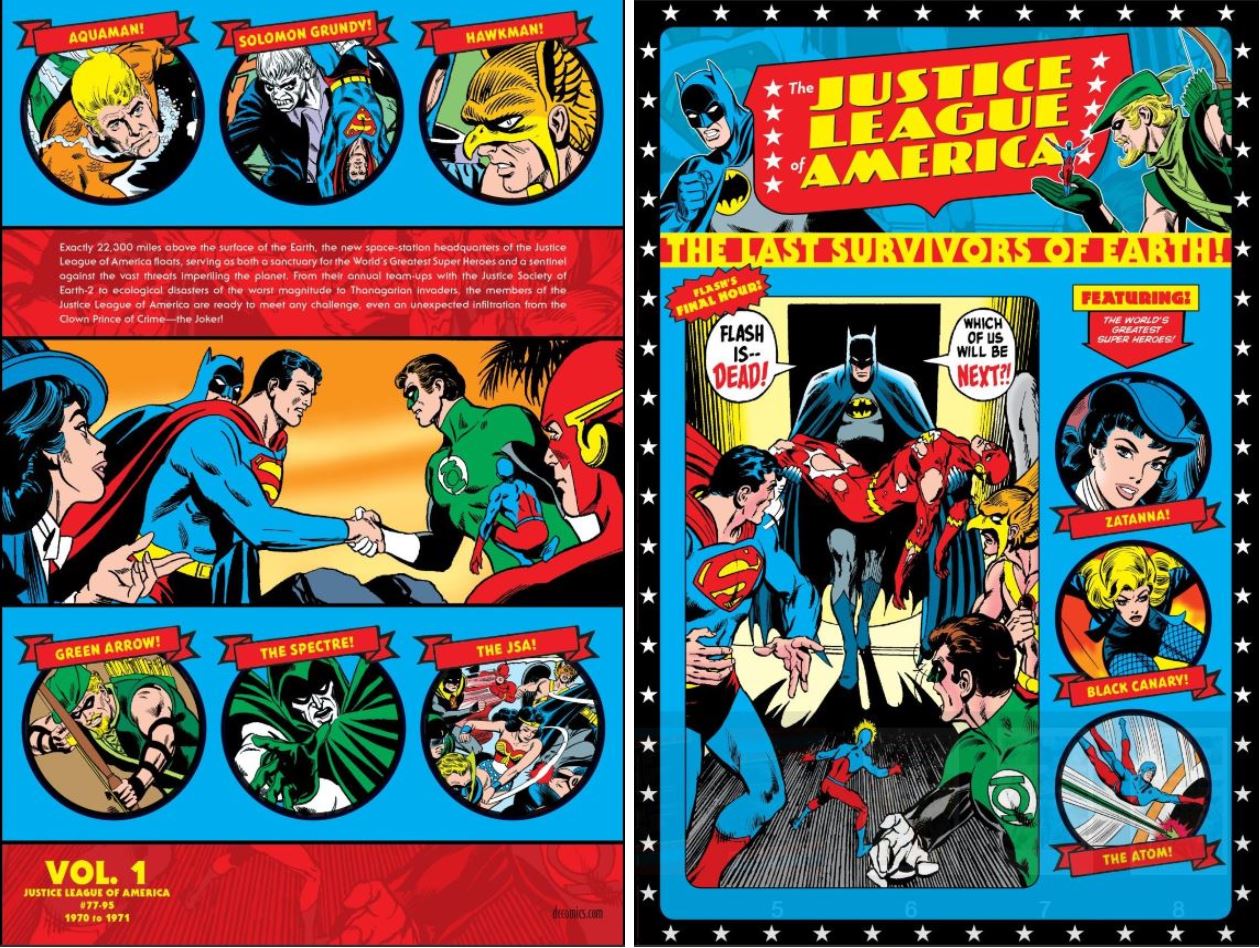
All Star Comics Archives volume 0


By Gardner Fox, Jerry Siegel, Ken Fitch, Bill Finger, John B. Wentworth, Sheldon Moldoff, Sheldon Mayer, Albert & Joseph Sulman, Creig Flessel, Jon L. Blummer, Martin Nodell, E.E. Hibbard, Chad Grothkopf, Stan Aschmeier, Bernard Baily, Howard Purcell, William Smith & various (DC Comics)
ISBN: 978-1-4012-0791-X (HB)

Win’s Christmas Gift Recommendation: Golden Moments for All… 9/10

This book includes Discriminatory Content produced in less enlightened times.

I will never stop saying it: the creation of the Justice Society of America in 1941 utterly changed the shape of the budding comicbook industry. However, before that team of All-Stars could unite, they had to become popular enough to qualify, and this slim yet superb hardcover sampler gathers a selection of individual exploits featuring many of the soon-to-be beloved champions who would populate the original big team and guarantee their immortality long after the Golden Age of American Comics ended.

Following the runaway successes of Superman and Batman, both National Comics and its wholly separate-but-equal publishing partner All-American Comics were looking for the next big thing in funnybooks whilst frantically concentrating on getting anthology packages into the hands of the hungry readership. Thus All Star Comics: conceived as a joint venture to give the characters already in their stables an extra push towards winning an elusive but lucrative solo title.

As scrupulously detailed in Roy Thomas’s history-packed Foreword, characters from Flash Comics, Adventure Comics, More Fun Comics and All-American Comics were bundled into the new (anthological) quarterly with ‘A Message from the Editors’ requesting readers vote on the most popular, and even offering free copies of forthcoming issues as prizes/bribes for participating…

The merits of the project would never be proved: rather than a runaway favourite graduating to their own starring vehicle, something different evolved. For the third issue, prolific scripter Gardner Fox apparently had the smart idea of linking the solo stories through a framing sequence as the heroes got together for dinner and a chat about their most recent cases. With the simple idea that Mystery Men hung around together, history was made and from #4 the heroes would regularly unite to battle a shared foe…

This slim sublime hardcover tome collects the stories from the first two All Star Comics (cover-dates Summer and Fall 1940) and opens with a tale of a fantastic winged warrior…

Although perhaps one of DC’s most resilient and certainly their most visually iconic character, iterations of Hawkman have always struggled to find enough of an audience to sustain a solo title.

From his beginnings as one of the B-features in Flash Comics, Carter Hall soared through assorted engaging, exciting but always short-lived reconfigurations. Over decades from ancient hero to re-imagined alien space-cop and post-Crisis on Infinite Earths freedom fighter, or the seemingly desperate but highly readable mashing together of all previous iterations into the reincarnating immortal berserker-warrior of today, the Pinioned Paladin has performed exemplary service without ever really making it to the big time.

Created by Gardner Fox & Dennis Neville, he premiered in Flash Comics #1 (cover-dated January 1940, but on sale from 20th November 1939) and stayed there, growing in quality and prestige until the title died, with the most celebrated artists to have drawn the Winged Wonder being Sheldon Moldoff and Joe Kubert, whilst a young Robert Kanigher was justly proud of his later run as writer. For over a decade, with his partner Hawkgirl/Hawkwoman, the gladiatorial mystery-man countered uncanny and fantastic arcane threats, battled modern crime and opposed tyranny with weapons of the past before vanishing with the bulk of costumed heroes as the 1950s began.

His last appearance was in All Star Comics #57 (1951) as leader of the Justice Society of America, before the husband-&-wife hellions were revived and re-imagined nine years later as Katar Hol and Shayera Thal of planet Thanagar by Julie Schwartz’s crack creative team Gardner Fox, Joe Kubert & Murphy Anderson. Their long career, numerous revamps and perpetual retcons ended during the 1994 Zero Hour crisis, but they’ve reincarnated and returned a few times since then too…

Here Fox & Sheldon Moldoff offered the eldritch saga of ‘Sorcerer Trygg’, wherein the still-bachelor hero travels to the mountains of Wales to crush a callous capitalist making zombies to work the mines he had stolen from his nephew and niece.

The Sandman premiered in either Adventure Comics #40 July 1939 (two months after Batman debuted in Detective Comics #27) or possibly two weeks earlier in New York World’s Fair Comics 1939, depending on which distribution records you choose to believe. He was originated and illustrated by multi-talented all-rounder Bert Christman with the assistance of rising scripting star Gardner F. Fox…

Head utterly obscured by a gas-mask and slouch hat; caped, business-suited millionaire adventurer Wesley Dodds was cut from the radio drama/pulp fiction mystery-man mould that had made The Shadow, Green Hornet, Black Bat and so many others household names and monster hits of early mass-entertainment and periodical publication. Wielding a sleeping-gas gun and haunting the night hunt killers, crooks and spies, he was eventually accompanied by plucky paramour Dian Belmont, before gradually losing the readers’ interest. His fortunes revived when Joe Simon & Jack Kirby took over the feature, but here, in his salad days, Fox & Chad Grothkopf spectacularly pit him against ‘The Twin Thieves’ baffling and bamboozling the hapless cops with their murderous jewel capers…

Gary Concord, the Ultra-Man premiered in All-American Comics #8 (cover-dated November 1939) the son of a 20th century scientist awoken from suspended animation in 2174AD and blessed with incredible physical abilities. His son inherited these attributes and became guardian of a troubled future and official High Moderator of the United States of North America

Created by Jon L. Blummer working as “Don Shelby” the Buck Rogers-inspired serial ran until A-AC #19 and is represented here with a then-topical threat in ‘The European War of 2240’ wherein conflict orchestrated in a foreign zone allows a scurrilous third party nation to attempt seizure of neutral America’s Uranium mines. Naturally, bombastic politico Ultra-Man quickly scotches the scheme and restored peace and prosperity to the world…

Devised, created and written by Fox and first drawn by Harry Lampert, Jay Garrick debuted as the very first Monarch of Motion in Flash Comics #1 and quickly – how else? – became a veritable sensation. He was the first AA character to win a solo title, mere months after All-Star Comics #3 hit the newsstands.
The Fastest Man Alive wowed readers in anthologies Flash Comics, Comics Cavalcade and All Star as well as All-Flash Quarterly for just over a decade before changing tastes benched him and most other Mystery Man heroes in the early1950s. His invention as a single power superhero triggered a new trend in the burgeoning action-adventure funnybook marketplace, and his particular riff was replicated many times at various companies as myriad Fast Furies sprang up. Then, he paused and only after over half a decade of interchangeable cops, robbers, horrors, cowboys and cosmic invaders, the concept of human rockets and superheroes in general was spectacularly revived in 1956 by Julie Schwartz in Showcase #4 when police scientist Barry Allen became the second hero to run with the concept.

It’s been non-stop ever since…

Here Garrick speedily solves ‘The Murder of Widow Jones’ (by Fox and signature illustrator Everett E. Hibbard) in the time it takes the cops to simply report that a crime has been committed…

The Spectre is one of the oldest characters in DC’s vast pantheon, created by Jerry Siegel & Bernard Baily in 1940 and debuting with a 2-part origin epic in More Fun Comics #52-53.

Initially the Ghostly Guardian reigned supreme in the title, in flamboyant and eerily eccentric supernatural thrillers, but gradually he slipped from popularity as firstly Dr. Fate and successively Johnny Quick, Aquaman, Green Arrow and finally Superboy turned up to steal the show. By the time of his last appearance, the Spectre had been reduced to a foil for his own comedic sidekick Percival Popp, the Super-Cop

The Astral Avenger was Jim Corrigan, a hard-bitten police detective who was about to marry rich heiress Clarice Winston when they were abducted by mobster Gat Benson. Stuffed into a barrel of cement and pitched off a pier, Corrigan died and went to his eternal reward. Almost.

Rather than finding Paradise and peace, Corrigan’s spirit was accosted by a glowing light and disembodied voice which, over his strident protests, ordered him to return to Earth to fight crime and evil until all vestiges of them were gone. Just like Siegel’s other iconic creation, the Dark Man suffered from a basic design flaw: he was just too darn powerful. Unlike the vigorously vital and earthy early Superman, however, the arcane agent of justice was already dead, so he couldn’t be logically or dramatically be imperilled.

Of course in those far-off early days that wasn’t nearly as important as sheer spectacle: grabbing a reader’s utter attention and keeping it stoked to a fantastic fever pitch. This the Grim Ghost could do with ease and always-increasing intensity. In ‘The Tenement Fires’ Siegel & Baily pulled out all the stops for a sinister struggle against merciless arsonists with the Ethereal Avenger recruiting recently murdered victims to help dispense final judgement…

Although we think of the Golden Age as a superhero wonderland, the true guiding principle was variety. Almost every comic book also offered a range of genre features from slapstick comedy to prose thrillers to he-man adventure on its four-colour pages, and More Fun Comics had its fair share of straight adventurers like freelance troubleshooter Biff Bronson, who debuted in #43 (May 1939) with sidekick Dan Druff for a near 30-issue run thrashing thugs, crushing crooks and exposing espionage. He last appeared in #67. Here the special agent exposes scurvy spy ‘The Great Remembo’ in a smart thriller deftly detailed by brothers Albert & Joseph Sulman.

At this time all comic books featured a prose story, and in All Star #1 Publisher Max Gaines’ niece Evelyn contributed a fanciful science fiction romp entitled ‘Exile to Jupiter’ that wasn’t up to much but was graced with illustrations by the wonderful Sheldon Mayer. Then the comics sagas resumed with The Hour-Man stepping in to combat ‘The Forest Fires’ in a moody drama by Ken Fitch & Bernard Baily. He’d started strongly in Adventure Comics #48 (March 1940) but slowly ran down until he faded away in #83, February 1943. ‘Tick-Tock Tyler, the Hour-Man’ began by offering his unique services through classified ads to any person in need. Chemist Rex Tyler had invented a drug he called Miraclo which super-energised him for 60 minutes at a time and here he helped beleaguered loggers enduring sabotage and murder…

The first issue closed with long-lived, much-loved, light-hearted military strip Red, White and Blue by Jerry Siegel & William Smith. Marine Sergeant Red Dugan, Whitey Smith of the US Army and Naval Rating Blooey Blue were good friends who frequently worked for military intelligence service G-2 whilst saving trouble magnet Doris West from her own dangerously inquisitive nature. The series began in All-American Comics #1 (April 1939): running there and in sundry other titles like World’s Finest Comics until 1946, with the trio turning up all over the world solving the USA’s problems.

Here they find themselves despatched to Alaska to find a missing G-2 agent, only to discover Doris already there exposing a slow infiltration by sneaky “Asiatics” of an ostensibly neutral nation in ‘The Volcano Invasion’.

All Star Comics #2 immediately follows with Hawkman (by Fox & Moldoff) fighting an Aztec cult in America and the jungles of Mexico, desperately seeking to rescue the latest kidnapped ‘Sacrifice for Yum-Chac’

Green Lantern then debuts in ‘The Robot Men’ by Bill Finger & Martin Nodell. In fact, the Emerald Gladiator was first seen All-American Comics #16 (July 1940 and practically simultaneously with this All Star appearance), devised by up-&-coming cartoonist Nodell and fully fleshed out by Finger in the same way he had with Bob Kane’s Batman.

Green Lantern was another sensation, becoming AA’s second smash hit six months after The Flash and preceding by 18 months the unprecedented success of Amazing Amazon Wonder Woman.

Engineer Alan Scott survived the sabotage and destruction of a passenger-packed train due only to the intervention of a battered old railway lantern. Bathed in its eerie verdant glow, he was regaled by a mysterious green voice with the legend of how a meteor fell in ancient China and spoke to the people: predicting Death, Life and Power. Instructing Scott to fashion a ring from its metal and draw a charge of power from the lantern every 24 hours, the ancient artefact urged the engineer to use his formidable willpower to end all evil – a mission Scott eagerly embraced. The ring made him immune to all minerals and metals, and enabled him to fly and pass through solid matter amongst many other miracles, but was powerless against certain organic materials such as wood or rubber which could penetrate his jade defences and cause him mortal harm…

He won his own solo title within a year of his launch and feature-starred in many anthologies like Comics Cavalcade for just over a decade, before he too blinked out in the early1950s, having first suffered the humiliating fate of being edged out of his own comic book by his pet, Streak the Wonder Dog

In this issue, however, he was at his mightiest and most impressive, battling a nationwide invasion of men turned into shambling monster slaves by an enemy spy…

Siegel & Baily then expose The Spectre to ‘The Curse of Kulak’, wherein an antediluvian sorcerer returns to punish mankind for desecrating his tomb: inundating the world with a plague of murderous hatred, after which The Sandman’s second stint delivers a spooky science thriller by Fox & Creig Flessel with the Man of Mystery tracking down a killer using a deadly radioactive weapon – ‘The Glowing Globe’ – to terrorise and rob.

Siegel & William Smith’s ‘Invisible Ink Gas’ pits Red, White & Blue against spies with a diabolical scheme for stealing Army documents whilst Johnny Thunderbolt’s All Star debut adds even more light-hearted shenanigans to the mix as the imbecilic genie-wielder becomes guardian of ‘The Darling Apartment’ (John B. Wentworth & Stan Aschmeier).

Johnny Thunder – as he eventually became – was an honest, well-meaning, courageous soul who was also a grade “A” idiot. However, what he lacked in smarts he made up for with sheer luck, unfailing pluck and unwitting control of an irresistible magic force. The feature always played for action-packed laughs but there was no getting away from it: Johnny was a simpleton in control of an ultimate weapon…

Decades before, the infant seventh son of a seventh son had been abducted by priests from mystic island Badhnisia and raised as the long-foretold controller of a fantastic magical weapon. This was done by voicing the eldritch command “Cei-U” – which sounds to western ears awfully like “say, you”…

Each month Johnny would look for gainful employment, stumble into a crime or crisis and his voluble temperament would result in an inexplicable unnatural phenomenon that would solve the problem but leave him no better off. It was a winning theme that lasted until 1947 – by which time the Force had resolved into a wisecracking thunderbolt-shaped genie – and Johnny was ousted from his own strip by sultry new crimebuster Black Canary

For now, though, back in America and seeking his fortune, Johnny spent lots of time trying to impress his girlfriend Daisy Darling’s dad. In this episode the irate property magnate is experiencing difficulties with a new building he’s erecting and Johnny decides to tackle head-on mobsters holding up production. After Evelyn Gaines text vignette ‘The Invisible Star’, Hour-Man crushes murderous charlatan ‘Dr. Morte, Spiritualist’ (Fitch & Baily) before the Flash closes out this stunning show in fine form, foiling thugs who kidnap an entire publishing company, by becoming ‘The One-Man Newspaper’ in a fast, furious, funny thriller from Fox & Hibbard.

With the entire Justice Society canon collected in eleven dedicated Archive Editions, this particularly impressive afterthought completed the resurrection of the rare and eccentric material which revolutionised comic books. Hopefully the new DC Finest reprint line will revive and reinvigorate the readers’ taste for these relics. These early adventures might not be to every modern fan’s taste but they certainly stand as an impressive and joyous introduction to the fantastic worlds and exploits of the World’s First Superheroes. If you have a love of the way things were, a hankering for simpler times remarkable for less complicated adventures of bold days and dark nights, this is another glorious collection you’ll cherish forever…
© 1940, 2006 DC Comics, Inc. All Rights Reserved.

Speaking of Dark Nights, today in 1915 Bob Kane was born. Whatever happened to him?

Ten years later, Al Feldstein entered the world. By the time he left it again he’d been Editor of Mad Magazine for 28 years after co-scripting and drawing the EC comics revolution, as seen in collections like Child of Tomorrow and Other Stories.