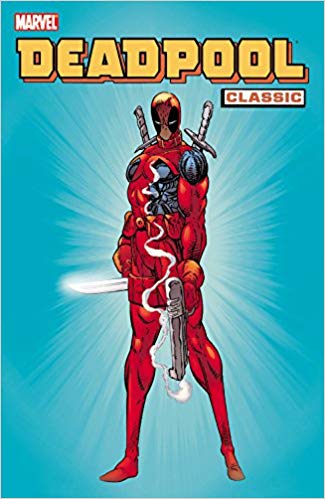
Deadpool Classic volume 1


By Fabien Nicieza, Rob Liefeld, Mark Waid, Joe Kelly, Joe Madureira, Ian Churchill, Lee Weeks, Ken Lashley, Ed McGuiness & various (Marvel)
ISBN: 978-0-7851-3124-3 (TPB)

Bloodthirsty killers and stylish mercenaries have long made for popular protagonists. Here’s one we prepared earlier. Deadpool is Wade Wilson: a survivor of genetics experiments that have left him a scarred, grotesque bundle of scabs and physical unpleasantries – but practically invulnerable and capable of regenerating from literally any wound.

In his modern incarnation he’s also either one of the few beings able to perceive the true nature of reality or a total gibbering loon…

Collecting – in paperback and digital editions – his early outrages from New Mutants #98, Deadpool: The Circle Chase, Deadpool: Sins of the Past and Deadpool #1 (spanning February 1991 to January1997), this tome is the first in a series archiving his ever more outlandish escapades…

The wisecracking high-tech “merc with a mouth” was created by Rob Liefeld & Fabian Nicieza and first appeared in the aforementioned New Mutants #98 in ‘The Beginning of the End’. A throwaway killer in a convoluted saga of mutant mayhem with little else to recommend it, he was another product of the Canadian “Weapon X” project that created Wolverine and so many other second-string mutant and cyborg super-doers. Here he fails to kill future warrior Cable and his teen acolytes (imminently rebranded as X-Force)…

His first shot at stardom came with 4-issue miniseries The Circle Chase from August to November 1993 and by Nicieza, Joe Madureira & Mark Farmer. A fast-paced if cluttered thriller sees Wade pursuing an ultimate weapon as one of a large crowd of mutants and variously enhanced ne’er-do-wells trying to secure the fabled legacy of arms dealer and fugitive from the future Mr. Tolliver.

Among the other worthies after the boodle in ‘Ducks in a Row’, ‘Rabbit Season, Duck Season’, ‘…And Quacks Like a Duck…’ and ‘Duck Soup’ are Black Tom and the Juggernaut, the then-latest iteration of Weapon X, shape-shifter Copycat and a host of disposable yet fashionable cyborg loons with odd names like Commcast and Slayback.

If you can swallow any nausea associated with the dreadful trappings of this low point in Marvel’s tempestuous history, there is a sharp and entertaining little thriller underneath…

The second miniseries (from August to November 1994) revolves around Black Tom and Juggernaut.

Collaboratively contrived by writer Mark Waid, pencillers Ian Churchill, Lee Weeks, Ken Lashley and inkers Jason Minor, Bob McLeod, Bub LaRosa, Tom Wegryzn, Philip Moy & W.C. Carani, ‘If Looks Could Kill!’, ‘Luck of the Irish’, ‘Deadpool, Sandwich’ and ‘Mano a Mano’ offer a hyperkinetic race against time heavy on explosive action.

During the previous yarn it was revealed that Irish arch-villain Black Tom was slowly turning into a tree. Desperate to save his life the bad guy and his best bud Juggernaut manipulate Wade by exploiting the mercenary’s relationship with Siryn (a sonic mutant and Tom’s niece).

Believing Deadpool’s regenerating factor holds a cure, the villains cause a bucket-load of carnage at a time when Wilson is at his lowest ebb. Packed with mutant guest stars, this is a shallow but immensely readable piece of eye-candy.

Closing this debut Classic collection is the first fun-&-fury filled issue of Deadpool by Joe Kelly, Ed McGuiness, Nathan Massengill & Norman Lee. Opting for devious, daring, near-the knuckle comedy to balance the manic action, it is the true beginning of the killer clown we all know and love…

Extra-sized spectacular ‘Hey, It’s Deadpool!’ reintroduces the mouthy malcontent, and depicts his “office” and “co-workers” at the Hellhouse where he picks up his contracts. We are also afforded a glimpse at Wade’s private life in San Francisco where he has a house and keeps an old, blind lady as a permanent hostage. This was never your regular run-of-the-mill hero comic…

The insane action part of the tale comes from the South Pole where the Canadian government has a super-secret gamma weapon project going, guarded by the Alpha Flight strongman Sasquatch. Somebody is paying good money to have it destroyed so cue merc, mouthiness, and mayhem…

Featuring a frenetic blend of light-hearted, surreal, fighting frolics and incisive, poignant relationship drama that is absolutely compulsive reading for dyed-in-the-wool superhero fans who might be feeling just a little jaded with four-colour overload, this is the real deal and promises more and better to come…
© 1993, 1994, 1996, 2012 Marvel Characters, Inc. All rights reserved.

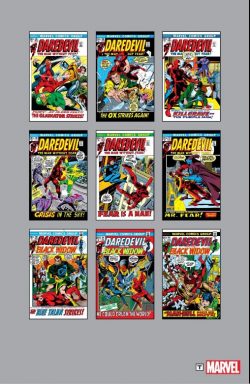
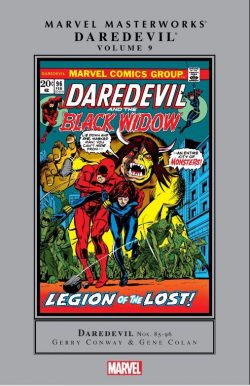
Daredevil Marvel Masterworks volume 9


By Gerry Conway & Gene Colan, with Tom Palmer, Syd Shores, Ernie Chan & various (Marvel)
ISBN: 978-0-78519-152-0 (HB)

Matt Murdock is a blind lawyer whose remaining senses hyper-compensate, making him capable of astonishing acrobatic feats, a formidable fighter and a living lie-detector.

Very much a second-string hero for most of his early years, Daredevil was nonetheless a striking and popular one, due in large part to the roster of brilliant artists who had illustrated the strip. He only really came into his own, however, after artist Gene Colan signed up for the long haul…

DD battled thugs, gangsters, mad scientists and a plethora of super-villains; quipping his way through life and life-threatening combat, utterly unlike the grim, moody quasi-religious metaphor he was seen as in later years.

Covering March 1972 to February 1973 and re-presenting Daredevil (and the Black Widow) this ninth swashbuckling compilation (available in both hardback and eBook formats) sees the once staid and so-very-Establishment Murdock cohabiting with a Russian spy and dumping New York for the sunny climes of the West Coast, the reason for which are covered in writers Gerry Conway’s Introduction ‘Matt and Natasha’s San Francisco Adventure or Wherever you go, There You Are’…

This volume opens in the aftermath of a grand cataclysmic clash against future-born hidden mastermind Mr. Kline which leaves the odd couple in Switzerland and #85 sees the couple tentatively beginning a romantic alliance and returning to America on a ‘Night Flight!’ courtesy of Conway, Gene Colan & inker Syd Shores.

Typically, the plane is hijacked by the bloodthirsty Gladiator, after which another long-forgotten foe resurfaces – for the last time – in ‘Once Upon a Time… the Ox!’ (with stunning Tom Palmer inks) before Matt and Natasha relocate from the Big Apple to San Francisco and stumble into one more ancient Daredevil enemy in #87’s ‘From Stage Left, Enter: Electro!’

The memory lane menaces continue in ‘Call Him Killgrave!’ as the mind-bending Purple Man emerges from the anonymous shadows, erroneously convinced his nemesis has tracked him down to queer his nefarious schemes.

As the origin of the Black Widow is revealed for the first time (something that has been overwritten, back-written and chucked in a plot blender interminably ever since) the sinister spellbinder attacks and is temporarily repulsed only to regroup with Electro and attack again in ‘Crisis!’ just as a mysterious man from Natasha’s sordid past resurfaces with portentous news of a long-forgotten mission…

Daredevil #90 explores ‘The Sinister Secret of Project Four!’ as Hornhead starts suffering inexplicable, incapacitating panic attacks, explained a month later in ‘Fear is the Key!’ when Mister Fear strikes again… only to be revealed as far more than he seems…

Issue #92 finally bowed to the inevitable and became Daredevil and the Black Widow, just as a new menace manifests ‘On the Eve of the Talon!’ before the Project Four saga roars to a conclusion with the introduction of industrialist and paranoid arms-dealer Damon Dran who claims ‘A Power Corrupt!’ before being transformed into a proto-Kaiju and monolithic Indestructible Man rampaging through San Francisco…

Callously, arrogantly aware that ‘He Can Crush the World!’, Dran severely underestimates the power of superhuman heroism and an ultimate sacrifice which tragically saves the day…

Ending this collection – and the trawling of the Scarlet Swashbuckler’s rogues gallery – ‘Bullfight on the Bay!’ saw the metamorphic Man-Bull break jail and start a storm of destruction to revenge himself upon Daredevil, forcing Natasha to do her very worst in the concluding chapter ‘The Widow Will Make You Pay!’(inked by Ernie Chan), a complex tale of love, obsession, revenge and mutagenic potions in the water supply….

Topped off with a far too short selection of original art pages, and despite a few bumpy, dated moments, this book highlights a period where Daredevil blossomed into a truly potent example of Marvel’s compelling formula for success: smart, contemporarily astute stories, human and fallible characters and always, always magnificent illustration. These bombastic tales are pure Fights ‘n’ Tights magic no fan of stunning super-heroics can afford to ignore.
© 1970, 1971, 2015 Marvel Characters, Inc. All rights reserved.

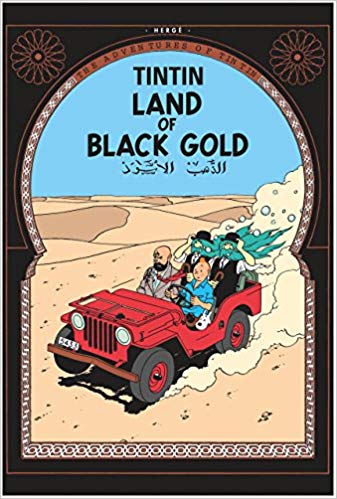
Adventures of Tintin: Land of Black Gold


By Hergé, and others, translated by Leslie Lonsdale-Cooper & Michael Turner (Egmont UK)
ISBN: 978-1-40520-814-7 (HB) 978-1-40520-626-6 (TPB)

Georges Prosper Remi, known all over the world as Hergé, created an incontrovertible masterpiece of graphic literature with his tales of a plucky boy reporter and his entourage of iconic associates.

Singly, and later with assistants including Edgar P. Jacobs, Bob de Moor and other supreme stylists of the select Hergé Studio, he created 23 splendid volumes (originally produced in brief instalments for a variety of periodicals) that have grown beyond their popular culture roots and attained the status of High Art.

On leaving school in 1925, he worked for the conservative Catholic newspaper Le Vingtiéme Siécle where he fell under the influence of its Svengali-esque editor Abbot Norbert Wallez. A devoted boy scout, Remi produced his first strip series The Adventures of Totor for the monthly Boy Scouts of Belgium magazine the following year, and by 1928 was in charge of producing the contents of the newspaper’s weekly children’s supplement Le Petit Vingtiéme.

He was illustrating The Adventures of Flup, Nénesse, Poussette and Cochonette, written by the staff sports reporter when Wallez asked Remi to create a new adventure series. Perhaps a young reporter who roamed the world, doing good whilst displaying solid Catholic values and virtues?

The rest is history…

Some of that history is quite dark: During the Nazi Occupation of Belgium, Le Vingtiéme Siécle was closed down and Hergé was compelled to move his popular strip to daily newspaper Le Soir (Brussels’ most prominent French-language periodical, and thus appropriated and controlled by the Nazis).

He diligently toiled on for the duration, but following Belgium’s liberation was accused of collaboration and even being a Nazi sympathiser. It took the intervention of Belgian Resistance war-hero Raymond Leblanc to dispel the cloud over Hergé, which he did by simply vouching for the cartoonist and by providing cash to create a new magazine – Le Journal de Tintin – which Leblanc published and managed. The anthology comic swiftly achieved a weekly circulation in the hundreds of thousands and allowed the artist and his team to remaster past tales: excising material dictated by and unwillingly added to ideologically shade the war time adventures as well as generally improving and updating great tales that were about to become a global phenomenon.

With World War II over and his reputation restored, Hergé entered the most successful period of his artistic career. He had mastered his storytelling craft, possessed a dedicated audience eager for his every effort and was finally able to say exactly what he wanted in his work, free from fear or censure. But although these freedoms seemed to guarantee a new beginning the life of the creator was far from trouble-free.

In 1949 he returned to Tintin au pays de l’or noir which had been abandoned when the Nazis invaded Belgium. The story had been commissioned by Le Vingtiéme Siécle, running from 28th September 1939 until 8th May 1940 when the paper was closed down. Set on the eve of a European war, the plot revolved around Tintin hunting seditionists and saboteurs sabotaging oil supplies in the Middle East…

Now safely able to resume the tale – with some necessary updating – the story began afresh on 16th of September 1948 and ran to its conclusion on February 23rd 1950, and was promptly collected into a full-colour album the same year. It remained problematical: and publication was suspended on August 4th 1949 until 27th October. Hergé had suffered a nervous breakdown and could not work for months. As he recuperated in Switzerland, the magazine turned disaster into a publicity stunt: declaring “Shocking News! Hergé has Disappeared!” It is a tribute to his skills and those of his studio team that the finished tale reveals none of his personal problems, but is an almost seamless and riveting yarn of political and criminal gangsterism; exotic, rocket-paced, surreal, hilarious and breathtakingly exciting.

The story concerns a plot to destabilise global peace by sabotaging petrol. All oil is somehow made more flammable, causing engines to explode when refuelled. Tintin traces the sabotage to the freighter Speedol Star, which he joins as Radio Officer. The dim-witted detectives Thomson and Thompson are also aboard, but much less discreetly, and soon all three are the targets of a numbers of attacks and assaults. When the ship reaches the Arabian port of Khemikhal they are all framed as drug smugglers and arrested.

At that moment Tintin is abducted by rebel tribesmen who believe he is a gunrunner and the now-vindicated detectives go in search of their friend in the desert. After many hardships the intrepid boy and Snowy discover villainous spymaster Doctor Müller (last seen in The Black Island) is trying to ingratiate himself with the oil-rich Emir. Mohammed Ben Kalish Ezab is wise and tolerant, but “blessed” with a wilful and spoiled son, Abdullah, who is kidnapped when he rejects the doctor’s offers. Tintin befriends the Ruler and goes undercover to find the Prince.

Tracking down Müller, Tintin attempts to rescue the prince (whose incessant practical jokes have made him a most unpopular but un-chastisable captive), only to be trapped in a brutal fire-fight in the catacombs beneath the spy’s villa. From nowhere, Captain Haddock (a supremely popular mainstay of latter adventures but unknown at the time of the first iteration) effects a rescue and the plot is revealed and thwarted. He bombastically first appeared after the original Land of Black Gold was abandoned, in The Crab with the Golden Claws and would increasingly steal the spotlight from his goody-goody juvenile partner…

Action-packed and visually delightful, this breezy mystery-thriller is full of humour and chases, with only the last-minute arrival of the dipsomaniac sea captain to slightly jar the proceedings. Presumably the original pages were recycled as much as possible with the popular Haddock inserted at a new breakpoint.

Studio Hergé was formed in 1950 to produce the adventures of Tintin as well other features and Bob De Moor became an invaluable and permanent addition to the production team, filling in backgrounds and most notably rendering the unforgettable Lunar landscapes that feature in the next extended adventure. He was also a vital component of Tintin’s gradual domination of the book market. Frequently despatched on visual fact-finding missions, De Moor revised the backgrounds of The Black Island for a British edition, and repeated the task for the definitive 1971 release of Land of Black Gold. The 1950s book was set in British-Occupied Palestine, but history and taste dictated the creation of a fictitious nation and erasure of many dated and contentious background scenes…

Surviving a troubled genesis, this short tale remains a grand adventure romp, full of epic events and hilarious moments once seen can never be forgotten. This so-modern yarn is a high point in the series, blending heroism and drama with genuine moments of irresistible emotion and side-splitting comedy.

Land of Black Gold: artwork © 1950, 1977 Editions Casterman, Paris & Tournai.
Text © 1972 Egmont UK Limited. All Rights Reserved.

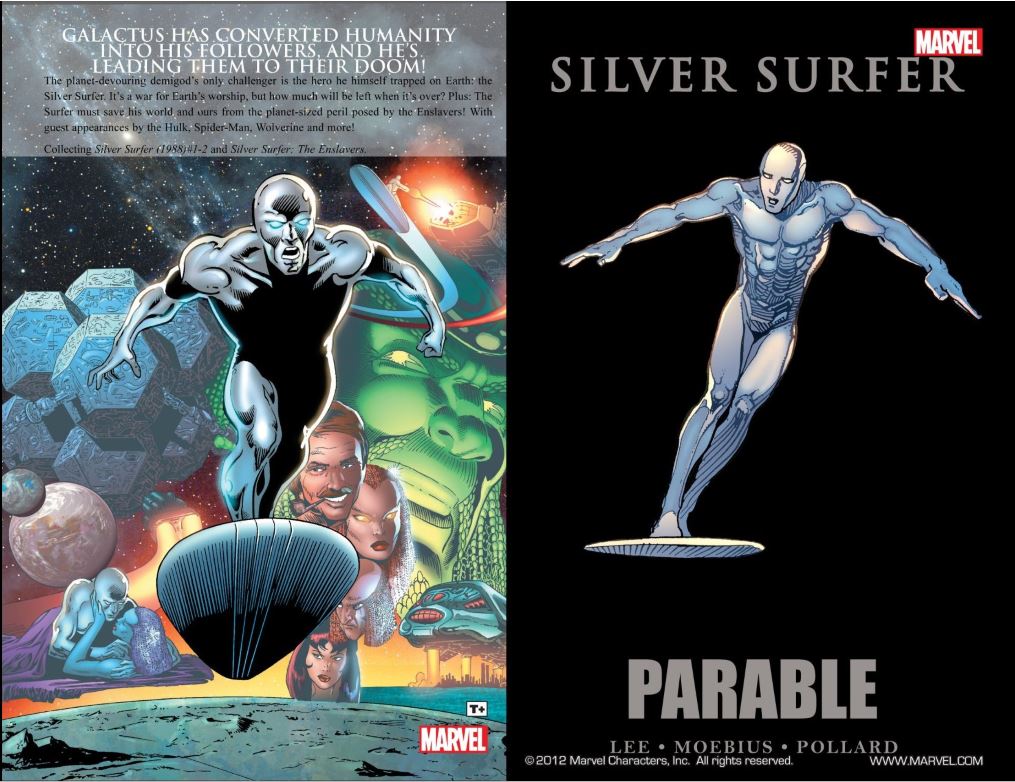
Silver Surfer: Parable


By Stan Lee & Moebius; Keith Pollard, with Tom DeFalco & various (Marvel)
ISBN: 978-0785162094 (HB) 978-0785106562 (TPB)

With a celebratory 30th Anniversary Edition due out in summer here’s a cheap look at an earlier edition, collecting a landmark reboot tale featuring the fabled Sentinel of the Spaceways (and also including one not so well known).

The most eclectic of comicbook cult figures, the Silver Surfer saga began with the deservedly lauded and legendary introductory story. Although pretty much a last-minute addition to Lee’s plot for Fantastic Four#48-50’s ‘Galactus Trilogy’, Jack Kirby’s gleaming creation became a watchword for depth and subtext in the Marvel Universe, and one Lee kept as his own personal toy for many years.

Sent to find planets for star god Galactus to consume, the Silver Surfer discovers Earth, where the latent nobility of humanity reawakens his own suppressed morality. He rebels against his master and helps the FF save the planet and in retaliation, Galactus imprisons the Surfer on Earth, the ultimate outsider on a planet remarkably ungrateful for his sacrifice.

The Galactus Saga was a creative highlight of a period where the Lee/Kirby partnership was utterly on fire: an adventure with all the power and grandeur of a true epic and one which has has never been surpassed for drama, thrills and sheer entertainment.

That’s not here but can be found in many other compilations. Sorry.

‘Parable’ was released as an Epic Comics micro-series in 1988-1989, featuring an all-new interpretation of Galactus’ initial assault on our backwards world, illustrated by legendary French artist Jean Giraud/Moebius. As with the 1978 Fireside Books/Simon & Schuster Silver Surfer book by Lee & Kirby, the story is removed from normal Marvel continuity, allowing the creators to focus on the unique philosophical nature of the Surfer and his ravenous master without the added distraction of hundreds of super-heroes.

It’s a beautiful piece of work you really should read.

Following is The Enslavers: a self-indulgent but oddly entertaining slice of intergalactic eye-candy featuring the legendary icon of the counter-culture generation. Once again it depicts the ex-herald of planet-devouring Galactus as a tragic saviour and Christ metaphor. Now however it’s not our troubled humanity but the overwhelming power of slavers from space that threatens humanity, and there’s a lot less breast-beating and soul-searching and far more cosmic action.

The story by Stan Lee (and Keith Pollard) has a rather odd genesis. Commissioned in the early 1980s by Jim Shooter, Lee’s original plot was apparently much transformed in the eight years it took to draw. By the time it was dialogued, it was a much different beast and Lee almost jokingly disowns it in his Afterword. Nevertheless, there’s lots to enjoy for the fan who doesn’t expect too much in this tale of love and death in the great beyond. It’s inked by Josef Rubinstein, José Marzan & Chris Ivy, coloured by Paul Mounts and lettered by Michael Heisler.

After a frantic rush through cosmic gulfs, Silver Surfer Norrin Radd crashes into the home of Reed and Sue Richards, just ahead of the colossal invasion craft of monstrous Mrrungo-Mu, who has been drawn to our world by the well-intentioned but naïve Nasa probe Voyager III.

The Surfer’s homeworld Zenn-La has already been depopulated by the awesome space slaver and Earth is next…

Moving swiftly, and exploiting the good intentions of an Earth scientist, the Enslavers incapacitate all our world’s superbeings and prepare to enjoy their latest conquest, but they have not accounted for the vengeful resistance of the Surfer or the debilitating power of the love Mrrungo-Mu is himself slave to: for the unbeatable alien warlord is weak and helpless before the haughty aloofness and emotional distance of his supposed chattel Tnneya…

Despite being dafter than a bag of space-weasels in far too many places, there is still an obvious love of the old, classic Marvel tales delivered at an enthusiastic pace informing these beautifully drawn pages and the action sequences are a joy to behold. If you love cosmic adventure and can swallow a lot of silliness, this might just be worth a little of your time and money.

Altogether a very strange marriage, this is a compelling tome spanning the vast divide of comics from the ethereal and worthy to the exuberant and fun: a proper twofer you can get your teeth into…
© 1988, 1989, 1990, 2012 Marvel Entertainment Group/Marvel Characters, Inc. All rights reserved.

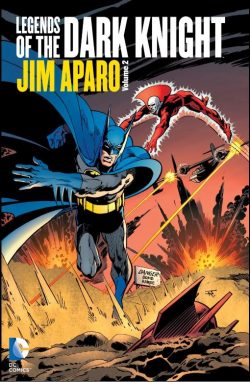
Legends of the Dark Knight: Jim Aparo volume 2


By Jim Aparo with Bob Haney, Cary Burkett, Archie Goodwin & various (DC Comics)
ISBN: 978-1-4012-4296-1 (HB)

After periods as a historical adventure and try-out vehicle, The Brave and the Bold won critical as well as commercial acclaim through old-fashioned team-ups. Pairing regular writer Bob Haney with the best artists available, a succession of DC stars joined forces before the comicbook hit its winning formula.

The said format – featuring media superstar Batman with other rotating, luminaries of the DC universe in complete stand-alone stories – paid big dividends, especially after the feature finally found a permanent artist to follow a variety of illustrators including Ramona Fradon, Neal Adams, Ross Andru & Mike Esposito, Irv Novick, Nick Cardy, Bob Brown and others…

At that time editors favoured regular – if not permanent – creative teams, feeling that a sense of visual and even narrative continuity circumvented confusion amongst younger readers. The slickly versatile Jim Aparo was a perfect match for a drawing brief that encompassed DC’s entire DC pantheon and all of time, space and relative dimensions in any single season…

James N. Aparo (August 24, 1932 – July 19, 2005) was a true quiet giant of comicbooks. Self-taught, he grew up in New Britain, Connecticut, and after failing to join EC Comics whilst in his 20s, slipped easily into advertising, newspaper and fashion illustration. Even after finally becoming a comics artist he assiduously maintained his links with his first career.

For most of his career Aparo was a triple-threat, pencilling, inking and lettering his pages. In 1963 he began drawing Ralph Kanna’s newspaper strip Stern Wheeler, and three years added a wide range of features for go-getting visionary editor Dick Giordano at Charlton Comics. Aparo especially shone on the minor company’s licensed big gun The Phantom…

When Giordano was lured away to National/DC in 1968 he brought his top stars (primarily Steve Ditko, Steve Skeates and Aparo) with him. Aparo began his lengthy, life-long association with DC, illustrating and reinvigorating moribund title Aquaman – although he continued with The Phantom until his duties increased by way of numerous short stories for the monolith’s burgeoning horror anthologies and revived 1950s supernatural hero The Phantom Stranger…

Aparo went on to be an award-winning mainstay of DC’s artistic arsenal, with stellar runs on The Spectre, The Outsiders and Green Arrow, but his star was always inescapably linked to Batman’s…

Aparo and scripter Bob Haney continue their run of enticing all-action epics in this second sturdy hardback and/or eBook compilation, gathering B&B #123-136, 138-145, and 147-151 plus the lead stories from Detective Comics #437 & 438 (cumulatively spanning December 1975 through June 1979) in a fabulous celebration that opens sans preamble.

With this collection of Batman’s pairings with other luminaries of the DC universe we find a creative team that had gelled into a perfect machine producing top-notch yarns aimed at the general readership – which would often annoy and appal the dedicated fans and continuity-obsessed reader.

B&B #123 brought back and united Plastic Man and Metamorpho with the Darknight Detective in ‘How to Make a Super-Hero’ as well as featuring a rare incidence of a returning villain: ruthless tycoon Ruby Ryder, once again playing her seductive mind-games with the pliable, gullible Elastic Ace.

Always looking for a solid narrative hook, Haney spectacularly broke the fourth wall in ‘Small War of the Super Rifles’ when Batman and Sgt. Rock needed the assistance of artist Aparo and editor Murray Boltinoff to stop a gang of ruthless terrorists. This is another one that drove many fans batty…

‘Streets of Poison’ in #125 is a solid drug-smuggler yarn with exotic locales and a lovely hostage for Batman and the Flash to deal with, after which John Calnan stepped in to ink #126’s Aquaman team-up, solving the sinister mystery of ‘What Lurks Below Buoy 13?’

It was back to basics next when Wildcat returns to help quash a people-smuggling racket in the ‘Dead Man’s Quadrangle’ whilst #128’s ‘Death by the Ounce’ finds the Caped Crusader recruiting Mister Miracle and Big Barda to help him rescue a kidnapped Shah and save a global peace treaty.

Ever keen to push the envelope, the next yarn is actually a jam-packed 2-parter with #129’s ‘Claws of the Emperor Eagle’ pitting Batman, Green Arrow and the Atom against the Joker, Two-Face and a host of bandits in a manic race to possess a statue that had doomed every great conqueror in history. The epic, globe-trotting saga concluded with an ironic bang in ‘Death at Rainbow’s End’.

The last time Wonder Woman appeared (B&B #105) she was a merely mortal martial artist but in Brave and the Bold #131 she exults in all her super-powered glory to help Batman fight Catwoman and ‘Take 7 Steps to… Wipe-Out!’

When DC cautiously dipped its editorial toe in 1970s Martial Arts craze #132 found Richard Dragon, Kung Fu Fighter joining ‘Batman… Dragon Slayer??’, as Denny O’Neil succeeded editor Boltinoff, resulting in a rather forced and silly tale of duelling fight stylists and purloined historical treasures.

Normal service resumes and Deadman steps in to deliver ‘Another Kind of Justice!’ to rum-runner Turk Bannion as his heir and murderer turns to a more modern form of smuggling before ‘Demolishment!’ (#134) sees Green Lantern defect to the soviets, a la The Manchurian Candidate with Batman’s hasty rescue attempt going badly awry…

In #135 the robotic Metal Men re-emerge to solve the mystery of a 19th century artificial intelligence in ‘More Than Human!’, but when Ruby Ryder is unmasked as behind the plot, it costs Bruce Wayne everything he owns and only the timely assistance of Green Arrow in concluding chapter ‘Legacy of the Doomed!’ is able to restore the status quo.

Mister Miracle is back in #138, tackling a ‘Mile High Tombstone!’ with Batman to save a missing geologist and thwart deranged escapologist Cosimo (and a killer computer), after which ‘Requiem for a Top Cop!’ sees Commissioner Jim Gordon targeted by alien bounty hunter Vorgan, forcing the Gotham Gangbuster to call in alien cop Hawkman…

‘Dastardly Events Aboard the Hellship!’ in B&B #140 pits Wonder Woman and Batman against circus-obsessed billionaire super-spy Dimitrios, whilst Black Canary pops in to help quash the Joker‘s byzantine extortion scheme in ‘Pay – Or Die!’

In #142, ‘Enigma of the Death-Ship!’ sees Aquaman and his wife Mera battle the Dark Knight to suppress a ghastly family secret, before the sordid trail leads to the most respected man in America and a confrontation with the Creeper in ‘Cast the First Stone’ (as Cary Burkett teams with Haney on script).

Haney solos on the magical mystery tale of ‘The Arrow of Eternity’ as Caped Crusader and Emerald Archer head back in time to Agincourt to foil a wicked plot by time-tamperer the Gargoyle after which the Phantom Stranger and Batman face ‘A Choice of Dooms!’ pursuing voodoo crimelord Kaluu…

Supergirl enjoyed her first ever B&B Bat team-up (she had paired with Wonder Woman in #63, co-starring in the ferociously-dated and indefensible ‘Revolt of the Super-Chicks!’) in issue #147 where Burkett and Aparo’s ‘Death-Scream from the Sky!’ sees her and Batman save the world from extermination by satellite and a surprise super villain…

‘The Night the Mob Stole X-Mas!’ is a piece of seasonal fluff scripted by Haney and pencilled by Joe Staton with Aparo applying his overwhelming inks to a tale of cigarette smugglers and aging mafioso with the still-itinerant Plastic Man helping the provide a Christmas miracle.

The disbanded Teen Titans briefly reform in #149 for Haney’s ‘Look Homeward, Runaway!’, hunting a kid gang moving from petty crime to the big leagues after which ‘Today Gotham… Tomorrow the World!’ celebrates a landmark anniversary with an extended tale of Bruce Wayne’s abduction by terrorists and the undercover superhero who secretly shadows him. No hints here from me…

The brave, bold portion of our entertainment comes to a close with a rather era-specific yarn co-starring the Flash as #151 features a predatory haunt feeding off patrons at the ‘Disco of Death’.

This stunning compilation concludes with a brace of gripping thrillers from Archie Goodwin, after he took over the editor’s desk from Julie Schwartz in Detective Comics #437 (November 1973). He also wrote a stunning run of experimental yarns, beginning with ‘Deathmask’: a brilliant supernatural murder-mystery featuring an Aztec curse and seemingly unstoppable killer; all magnificently depicted by Jim Aparo. Following that, Detective #438 brought forth ‘A Monster Walk Wayne Manor’ wherein the abandoned stately pile (Batman having relocated to a bunker under the Wayne Foundation building) became home to a warped and dangerous old enemy…

By taking his cues from news headlines, popular films and proven genre-sources Bob Haney continually produced gripping adventures that thrilled and enticed with no need for more than a cursory nod to an ever-more-onerous continuity. Anybody could pick up an issue and be sucked into a world of wonder. Consequently, these tales are just as fresh and welcoming today, their themes and premises are just as immediate now as then and Jim Aparo’s magnificent art is still as compelling and engrossing as it always was. This is a Bat-book literally everybody can enjoy.

These are some of the best and most entertainingly varied yarns from a period of magnificent creativity in the American comics industry. Aimed at a general readership, gloriously free of heavy, cloying continuity baggage and brought to stirring, action-packed life by one of the greatest artists of the art form, this is a Batman for all seasons and reasons with the added bonus of some of the most fabulous and engaging co-stars a fan could imagine. How could anybody resist? Seriously: in this anniversary year, how can you…?
© 1975, 1976, 1977, 1978, 1979, 2013, 2017 DC Comics. All Rights Reserved.

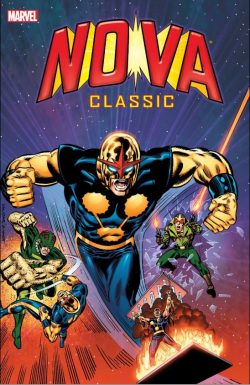
Nova Classic vol 2


By Marv Wolfman, David Anthony Kraft, Sal Buscema, Carmine Infantino, Bob Hall, Don Perlin, Keith Pollard & various (Marvel)
ISBN: 978-0-7851-8544-4 (TPB)

By 1975 the first wave of fans-turned-writers were well ensconced at all the major American comic-book companies. Two fanzine graduates – Len Wein and Marv Wolfman – had achieved stellar successes early on, and then risen to the ranks of writer/editors at Marvel, a company in trouble both creatively and in terms of sales.

After a meteoric rise and a virtual root-&-branch overhaul of the industry in the 1960s, the House of Ideas – and every other comics publisher except Archie – were suffering from a mass desertion of fans who had simply found other uses for their mad-money.

Where other companies dwindled and eventually died and DC vigorously explored new genres to bolster their flagging sales, Marvel chose to exploit their record with superheroes: fostering new titles within a universe it was increasingly impossible to buy only a portion of…

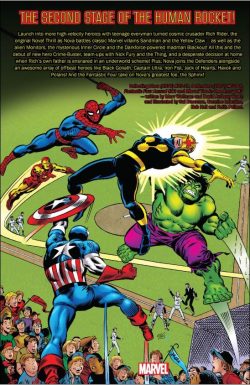
As seen in this second no-nonsense compilation collecting Nova #13-19 plus guest shots from Defenders #62-64, Fantastic Four Annual #12 and Marvel Two-In-One Annual #3, (cumulatively covering September 1977-September 1978), the neophyte learned quickly and on-the-job, earning a sterling reputation, but never quite settled on what he should be doing…

The Man Called Nova was in fact a boy named Richard Rider. The new kid was a working-class teen nebbish in the tradition of Peter Parker – except he was good at sports and bad at learning – who attended Harry S. Truman High School, where his strict dad was the principal.

His mom worked as a police dispatcher and he had a younger brother, Robert, who was a bit of a genius. Other superficial differences to the Spider-Man canon included girlfriend Ginger and best friends Bernie and Caps, but he did have his own school bully, Mike Burley…

An earlier version, “Black Nova” had apparently appeared in the Wolfman/Wein fan mag Super Adventures in 1966, but with a few revisions and an artistic make-over by the legendary John Romita (Senior), the “Human Rocket” was launched into the Marvel Universe in his own title, beginning in September 1976.

Nova borrowed heavily from Green Lantern as well as the wallcrawler’s origin, as Rider’s life changes forever when a colossal star-ship with a dying alien aboard transfers to the lad all the mighty powers of an extraterrestrial peacekeeper and warrior. Centurion Rhomann Dey was tracking a deadly marauder to Earth. Zorr had already destroyed the warrior’s idyllic homeworld Xandar, but the severely wounded, vengeance-seeking Nova Prime was too near death and could not avenge the genocide.

Trusting to fate, Dey beams his powers and abilities towards the planet below where Rich is struck by an energy bolt and plunged into a coma. On awakening, the boy realises he has gained awesome powers… and the responsibilities of the last Nova Centurion…

This compelling trade paperback and/or digitally formatted epic resumes the non-stop action courtesy of Wolfman, Sal Buscema and Joe Sinnott, Nova #13 begins another extended tale with the introduction of debutante hero Crime-Buster in ‘Watch Out World, the Sandman is Back!’

After the once-formidable villain takes a beating, he falls under the influence of a far more sinister menace. Meanwhile, Rich Rider’s dad is going through some bad times and succumbed to the blandishments fallen of a dangerous subversive organisation…

The story continues in the Dick Giordano inked ‘Massacre at Truman High!’ as Sandman attacks Nova’s school and the mystery mastermind is revealed for in-the-know older fans, before guest-star-stuffed action-riot ‘The Fury Before the Storm!’ sees veteran illustrator Carmine Infantino take over pencilling as Tom Palmer returns to the brushstrokes.

When a bunch of established heroes attack the newbie all at once, it’s even money they’re fakes, but Nick Fury of super-spy agency S.H.I.E.L.D. is real enough and deputises the fledgling fighter for #16’s ‘Death is the Yellow Claw!’ and #17’s spectacular confrontation ‘Tidal Wave!’

As the kid comes good and saves the city of New York from a soggy demise, the long-anticipated conclusion occurs in ‘The Final Showdown!’, inked – as is ‘Beginnings’ (a short side-bar story dealing with the fate of the elder Rider) – by the agglomeration of last-minute-deadline-busters dubbed “the Tribe.”

A new foe premieres in #19: ‘Blackout Means Business and his Business is Murder!’ opens the final large story-arc of the series, as an ebon-energy wielding maniac attacks Nova, but before that epic completely engages, the Human Rocket guest-stars in some other Marvel titles.

Although included here November 1977’s Fantastic Four Annual #12, isn’t one of them. It proclaims ‘The End of Inhumans… and the Fantastic Four’ (by Wolfman, pencillers Bob Hall & Keith Pollard and inker Bob Wiacek) and lacks any sight of Nova, but does involve the aforementioned heroes battling rogue Inhuman tyrant Thraxon, and his mysterious sponsor. That is old Nova foe the immortal Sphinx, who shares his origins and plans for the Human Rocket before being trounced by the assembled team…

Just slightly lightly less notional is Nova’s appearance in Defenders #62-64, (August to October 1978 by David Anthony Kraft, Sal Buscema, Don Perlin & Jim Mooney). ‘Membership Madness’, ‘Deadlier by the Dozen!’ and ‘D-Day!’ depict how a poorly-judged and unwanted TV documentary leads an army of superheroes – Nova included – to seek membership in the Defenders, leading to chaos and blockbusting battle with Zodiac and an army of villains trying to legitimise their crimes…

This side-bar saga comes with the first two pages of #65 (illustrated by Perlin & Bruce D. Berry) to complete the experience before moving on to a proper team-up from Marvel Two-In-One Annual #3 (September 1978).

Battling beside the Thing in a simple yet entertaining tussle with god-like cosmic marauders Nova resists mightily ‘When Strike the Monitors!’ – crafted by Wolfman, Sal Buscema, Frank Giacoia & Dave Hunt – to save an alien princess and save Earth from demolition.

Adding even more value is a selection of original art pages from Buscema & Giordano, Hall & Wiacek, Buscema & Hunt, Giacoia and Perlin, plus past collection covers by John Romita Jr. Bob Layton, Ed Hannigan, Rich Buckler and John Buscema,

There’s a lot of good, solid fights ‘n’ tights entertainment and fabulous superhero art here, and Nova has proved his intrinsic value by returning again and again. This stalwart edition is one readers can rely on to deliver the blockbusting basics in the approved Marvel Manner.
© 1977, 1978, 2016 Marvel Characters, Inc. All rights reserved.

Tiny Titans volume 3: Sidekickin’ it…


By Art Baltazar & Franco with (DC Comics)
ISBN: 978-1-4012-2653-4 (TPB)

The links between animated features and comicbooks are long established and I suspect, for young consumers, indistinguishable. After all, it’s just entertainment in the end…

DC’s Cartoon Network imprint was arguably the last bastion of children’s comics in America and consolidated that link between TV and 2D fun and thrills with stunning interpretations of such television landmarks as Ben 10, Scooby Doo, Powerpuff Girls, Dexter’s Laboratory and others.

The kids’ comics line also produced some truly exceptional material based on TV iterations of their proprietary characters such as Legion of Super Heroes, Batman: Brave and the Bold, Supergirl and Krypto the Super Dog as well as material like Billy Batson and the Magic of Shazam! which was merely similar in tone and content.

Perhaps the imprint’s finest release – and one which has a created a sub-genre recreated at many different publishers – was a series ostensibly aimed at beginning readers but which quickly became a firm favourite of older fans …and a multi-award winner too.

Superbly mirroring the magical wonderland inside a child’s head where everything is happily mixed up together, Tiny Titans is a sublime antidote to continuity cops and slavish fan-boy quibbling (erm, uh… I think you’ll find that in…) by reducing the vast cast of the Teen Titans Go! animated series, the greater boutique of the mainstream comicbooks and (ultimately) the entire DC Universe to little kids and their parents/guardians in the wholesome kindergarten environment of Sidekick City Elementary School.

It’s a scenario spring-loaded with in-jokes, sight-gags and beloved yet gently mocked paraphernalia of generations of strip readers and screen-watchers….

Collecting issues #13-18 (spanning April to September 2009) of the magically madcap and infinitely addictive all-ages mini-masterpiece, this third volume begins on a petulant note with Pet Club at Wayne Manor.

Art Baltazar and co-creator Franco (Aureliani) have mastered a witty, bemusingly gentle manner of storytelling that just happily rolls along, with the assorted characters getting by and trying to make sense of the great big world, having “Adventures in Awesomeness”. The method generally involves stringing together smaller incidents and moments into an overall themed portmanteau tale and it works astoundingly well.

After a handy and as-standard identifying roll-call page, ‘Tough Cookie’ features Raven feeding the park critters but desperately striving to keep her hard-as-nails rep intact, after which bubble-headed Psimon goes to science club and gets caught in some uncool name-calling. The main event kicks off with the kids and their pets convening at Stately Wayne Manor and incurring the wrath of dapper, long-suffering manservant Alfred. The Penguins don’t help… no, wait, they actually do…

‘A Hot Spot’ then finds Raven and Kid Devil trading power sets with firestarter Hotspot and evoking the joys of being a Bird Scout, after which The Kroc Files shows ultimate butler Alfred and the roguish reptilian each demonstrating ‘How to Pick up the Dry Cleaning’, before the issue ends with a Tiny Titans Bubble Squares puzzle and a pinup of bird-themed champions Hawk, Dove and Raven.

Sea-themed issue #14 opens with a proudly shouted ‘Aw Yeah Titans!’ and class trip to Paradise Island. The boys just can’t understand why they have to stand on tables while the girls can run about freely wherever they like and play with the all the weird animals…

Back in Sidekick City, Cyborg’s vacuum cleaning invention runs amok while Beast Boy and infant Miss Martian stage a shapeshifting duel, even as on Paradise Island ‘Stay for Dinner’ sees Wonder Girl and the other Wonder Girl guests for lunch – as lunch – of Mrs. Cyclops.

Wrapping up affairs is another Kroc Files (‘How to Bake a Chocolate Cake’), a string of gags in Time for Jokes by the Riddler’s daughter Enigma plus a ‘Paradise Island Pet Club Pin-up!’

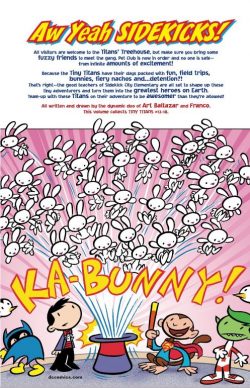
The next issue finds ‘Bunnies, Bunnies, Everywhere Bunnies’ and again opens at Wayne Manor, where Alfred has opted to stay home and watch the kids and their pets. Sadly, magician Zatara joins the fun and once more loses his magic wand to playful Beppo the Super Monkey. Cue rapid rabbit reproduction…

Elsewhere, Deathstroke‘s daughter Rose lands her share of babysitting duties, and soon learns how to handle the Tiny Terror Titans before a ‘Tiny Titans Epilogue’ reveals a marvellous secret regarding one of those proliferating bunnies, before the issue concludes with more activity freebies: ‘Pet Club Mammal Travel’ and a bonus pin-up of Rose and those Tiny Terrors…

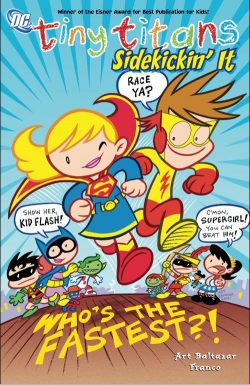
Issue #16 revisits a perennial puzzle of comics, specifically ‘Who’s the Fastest?!’ as Coach Lobo sets his heart on making the Sidekick Elementary kids ultra-fit. Part of the regimen includes a footrace around the entire world, and Supergirl, Inertia and Kid Flash all think they have it nailed…

Lesser-powered tykes find unique ways to cope with natural obstacles – such as the ocean – in ‘As the Race Continues…’ while the Coach takes a load off with coffee and comics and the Wonder Girls and Shelly trade costume tips. Down south, late starters Mas y Menos join the final dash to the finish where a non-starter surprisingly triumphs…

In the aftermath, shrinking-hero contingent The tiny Tiny Titans indulge in ‘One more Contest’ before an ‘Aw Yeah Pin-up’ of Supergirl and Kid Flash is preceded by a Tiny Titans Coin Race activity page.

‘Raven’s Book of Magic Spells’ starts as a play date but is bewilderingly disrupted when Trigon‘s devilish daughter shows off her latest present in ‘Mixin’ it Up’: accidentally manifesting unlikely mystical heavyweight Mr. Mxyzptlk. And so, hilarity and impish insanity ensue…

Back in what passes for the land of reason, Robin, Beast Boy and Cyborg are tasked with recovering Batman’s cape and mask in ‘Battle for the Cow’ (if you read DC regularly, you know how painful a pun that is…).

Naturally, Starfire and Bumblebee have a sensible, pain-free solution to their woes, after which the Boy Wonder’s birthday party displays a fashion parade of alternative costumes in the presents giving portion of festivities…

Those tiny Titans go clothes hunting in ‘Shop Shrinking’ while Kid Flash, Robin and Cyborg ask ‘Hey, What’s Continuity?’ Wrapping up is another Kroc Files contrasting how butler Alfred and the lizardly lout cope with ‘Walking in the Rain’, topped off with Special Bonus Pin-up ‘The Return of the Bat-Cow!’

Concluding the juvenile japery is a fall from grace which can only be called ‘Infinite Detention’ as lunch lady Darkseid is demoted to Janitor for the Day and typically overreacts to boisterous behaviour in the hallways. With both good kids and bad suffering after-class incarceration, arguments ensue and the stern Monitor increase the tally for the slightest infraction. Soon the kids are facing days of detention…

Sadly for the Monitor, his nemesis Anti-Monitor has popped by with coffee and more stupid pranks…

One final Kroc Files reveals ‘How to go Bowling’ and Enigma offers another session of ‘Aw Yeah Joke Time!’ before the tome terminates with a selection of character sketches and studies repackaged as ‘Class Photos’.

Despite being ostensibly aimed at super-juniors and TV kids, these wonderful, wacky yarns – which marvellously marry the heart and spirit of such classic strips as Peanuts and The Perishers with something uniquely mired and marinated in pure comicbookery – are an unforgettable riot of laughs no self-respecting fun-fan should miss: accessible, entertaining, and wickedly intoxicating. What more do you need to know?
© 2009, 2010 DC Comics. All Rights Reserved.
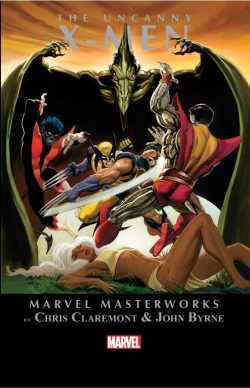
Uncanny X-Men Marvel Masterworks volume 3


By Chris Claremont, John Byrne, Terry Austin, Ricardo Villamonte & various (Marvel)
ISBN: 978-0-7851-1194-8 (HB) 978-0-7851-4570-7 (TPB)

In the autumn of 1963, The X-Men #1 introduced Scott (Cyclops) Summers, Bobby (Iceman) Drake, Warren (Angel) Worthington, Jean (Marvel Girl) Grey and Hank (The Beast) McCoy: very special students of Professor Charles Xavier.

The teacher was a wheelchair-bound telepath dedicated to brokering peace and integration between the masses of humanity and the emergent off-shoot race of mutants dubbed Homo Superior; considered by many who knew him as a living saint.

After nearly eight years of eccentrically spectacular adventures the mutant misfits virtually disappeared at the beginning of 1970 during another periodic downturn in superhero comics sales. Just like in the closing years of the 1940s, mystery men faded away as supernatural mysteries and traditional genre themes once more dominated the world’s entertainment fields…

Although the title was revived at the end of the year as a cheap reprint vehicle, the missing mutants were reduced to guest-stars and bit-players throughout the Marvel universe and the Beast was refashioned as a monster fit for the global uptick in scary stories until Len Wein & Dave Cockrum revived and reordered the Mutant mystique with a brand-new team in Giant Size X-Men #1 in 1975.

To old foes-turned-friends Banshee and Sunfire was added one-shot Hulk hunter Wolverine, and all-original creations Kurt Wagner, a demonic German teleporter codenamed Nightcrawler, African weather “goddess” Ororo Monroe AKA Storm, Russian farmboy Peter Rasputin, who transformed at will into a living steel Colossus and bitter, disillusioned Apache superman John Proudstar who was cajoled into joining the makeshift squad as Thunderbird.

The revision was an instantaneous and unstoppable hit, with Wein’s editorial assistant Chris Claremont writing the series from the second story onwards. The Uncanny X-Men reclaimed their own comicbook with #94 and it quickly became the company’s most popular – and high quality – title.

Cockrum was succeeded by John Byrne and as the team roster shifted and changed the series rose to even greater heights, culminating in the landmark Dark Phoenix storyline which saw the death of arguably the book’s most beloved and imaginative character.

In the aftermath team leader Cyclops left but the epic cosmic saga also seemed to fracture the epochal working relationship of Claremont and Byrne. Within months of publication they went their separate ways: Claremont staying with the mutants whilst Byrne moved on to establish his own reputation as a writer on series such as Alpha Flight, Incredible Hulk and especially his revolutionised and freshly-groundbreaking Fantastic Four…

After Apache warrior Thunderbird became the team’s first fatality, the survivors slowly bonded, becoming an infallible fighting unit under the brusque and draconian supervision of Cyclops.

This third titanic compilation (available in luxurious hardcover, trade paperback and eBook editions) is perfect for newbies, neophytes and even old lags nervous about reading such splendid yarns on fragile but extremely valuable newsprint paper. It celebrates the unstoppable march to market dominance through the pivotal early stories: specifically, issues #111-121 of the decidedly “All-New, All-Different” X-Men – spanning June 1978 to May 1979.

The drama resumes cloaked in moody mystery as ‘Mindgames’ (by dream team Chris Claremont, John Byrne & Terry Austin) sees the Beast visit a circus in search of the new team. They have been missing for weeks…

His presence disrupts a devilish scheme by mutant hypnotist Mesmero to subjugate the heroes through false memories and implanted personalities, but the reawakened team’s vengeance is forestalled when their greatest enemy ambushes them…

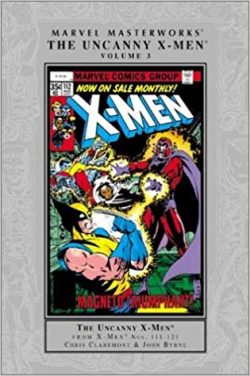
In X-Men #112 the revived and furious heroes fight and fail, leaving ‘Magneto Triumphant!’ and his enemies helplessly imprisoned miles beneath Antarctica in the tense, action-packed battle bonanza follow-up ‘Showdown!’

However, by the time the Polaric tyrant returns after terrorising the humans of Australia, the X-Men have broken free and are waiting for him…

In the apocalyptic battle which follows the base is utterly destroyed and Magneto grievously wounded. With boiling lava flooding everywhere, only Beast and Phoenix manage to reach the surface and, in horror, realise they are the only survivors…

They could not be more wrong.

Unable to go up, the remaining mutants tunnel downwards and ‘Desolation!’ turns to joy as they emerge into the antediluvian wilderness dubbed the Savage Land.

Linking up with old ally Ka-Zar, the team slowly recover in a dinosaur-filled elysian paradise. The idyll is rudely shattered when former foe Karl Lykos succumbs to his old addiction and absorbs their mutant energies to become lethal leather-winged predator Sauron…

His ‘Visions of Death!’ are readily dispelled by the assembled heroes, but he’s just the first course in a campaign of terror as crazy, colonializing barbarian queen Zaladane revives proto-god Garokk as the figurehead of her army of conquest…

When the insane imperialists meddling disrupts the tropical climate of the sub-polar region, Ka-Zar and the X-Men invade their noxious citadel ‘To Save the Savage Land’, where the brutal battle demands the best and worst from the young warriors before the job is done…

With the distasteful task completed, the mutants opt to try a perilous sea-passage back to the outside world…

Uncanny X-Men #117 begins with their rescue by an Antarctic exploration vessel, heralding a slow torturous voyage to Japan, before lapsing into an untold tale of Charles Xavier in his globe-trotting days prior to losing the use of his legs. ‘Psi War!’ is full of clever, in-filling insights as it details how the dispirited, restless young telepath fetches up in Cairo and meets his first “Evil Mutant”…

Amahl Farouk uses his psionic abilities to rule the city’s underworld: a depraved, debauched monster who thinks he is beyond justice. The enraged, disgusted Xavier defeats the beast and in doing so find his life’s purpose…

A revelatory 2-part epic follows as the X-Men – still believed dead by Xavier, Jean and the wider world – arrive in Agarashima, just as the port is being devastated by a vast firestorm. Inked by Ricardo Villamonte, ‘The Submergence of Japan!’ sees tectonic terrorist Moses Magnum undertake a most audacious blackmail scheme, countered by the valiant mutants who briefly reunite with old – and still belligerently surly – comrade Sunfire.

Perhaps he is just surprised to discover Wolverine has unsuspected connections to Japan and has turned the head of local highborn maid Lady Mariko. A bigger surprise awaits the American specialist the government have brought in. Misty Knight is Jean Grey’s roommate in Manhattan and grieved with her at the X-Men’s deaths.

Now she has to tell Cyclops his girl has moved on and Professor X has abandoned Earth for the Shi’ar Empire…

Of course, all of that is moot if they can’t stop Magnum and his Mandroid army sinking Japan into the Pacific, but after a catastrophic conflict inside a volcano there’s a seasonal reunion in store for all in the Austin-inked ‘Twas the Night Before Christmas…’

This volume concludes with another tumultuous two-parter and the introduction of a foreign super-squad in ‘Wanted: Wolverine! Dead or Alive!’, as the enigmatic wild man – accompanied by Cyclops, Nightcrawler, Storm, Colossus, Banshee and Nightcrawler – returns from a bombastic battle and heartbreak in Japan only to be covertly herded into Canadian airspace so that the Ottawa government can confiscate their former property…

Forced down by a magical tempest, the heroes are soon on the run in Calgary, ambushed by the aforementioned Alpha Flight – specifically battle-armoured Vindicator, super-strong Sasquatch, First Nations magician Shaman, shapeshifting Snowbird and mutant speedster twins Northstar and Aurora – all ordered to repossess at any cost former special operative and top super-agent “The Wolverine”…

After a brutal but inconclusive clash at the airport the X-Men fade into the city but only after Wolverine and Nightcrawler are captured…

The retaliation results in a ‘Shoot-Out at the Stampede!’ with the mutants confronting their pursuers as Shaman’s eldritch blizzard spirals out of control, threatening to destroy the entire province. Even after Storm fixes the problem, the Canadians are adamant, so to end hostilities Wolverine surrenders himself in return for his comrades’ safe passage.

Of course, he never promised to stay arrested…

These are some of the greatest stories Marvel ever published; entertaining, groundbreaking and uncannily intoxicating: an invaluable grounding in contemporary fights ‘n’ tights fiction no fan or casual reader can afford to ignore.
© 1977, 1978, 2013 Marvel Characters, Inc. All rights reserved.

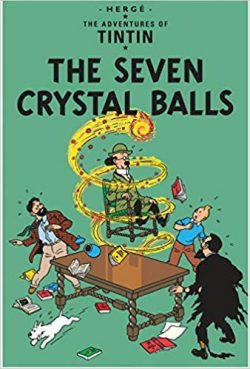
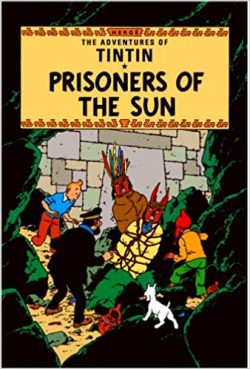
Adventures of Tintin: The Seven Crystal Balls and Prisoners of the Sun


By Hergé & various; translated by Leslie Lonsdale-Cooper & Michael Turner (Egmont)
ISBNs: 978-0-82885-071-1 (HB Crystal Balls)
978-1-40520-624-2 (PB Crystal Balls)
978-1-40520-813-0 (HB Sun)
978-1-40520-625-9 (PB Sun)

Georges Prosper Remi – known universally as Hergé – created a true masterpiece of graphic literature with his astounding yarns tales of a plucky boy reporter and his entourage of iconic associates.

Singly, and later with assistants including Edgar P. Jacobs, Bob de Moor and the Hergé Studio, Remi completed 23 splendid volumes (originally produced in brief instalments for a variety of periodicals) that have grown beyond their popular culture roots and attained the status of High Art.

It’s only fair, though, to ascribe a substantial proportion of credit to the many translators whose diligent contributions have enabled the series to be understood and beloved in 38 languages. The subtle, canny, witty and slyly funny English versions are the work of Leslie Lonsdale-Cooper & Michael Turner.

On leaving school in 1925, Remi worked for Catholic newspaper Le Vingtiéme Siécle where he fell under the influence of its Svengali-like editor Abbot Norbert Wallez. The following year, the young artist – a passionate and dedicated boy scout, produced his first series: The Adventures of Totor for monthly Boy Scouts of Belgium magazine.

By 1928, Remi was in charge of producing the contents of the parent paper’s children’s weekly supplement Le Petit Vingtiéme while discontentedly illustrating The Adventures of Flup, Nénesse, Poussette and Cochonette when Abbot Wallez urged the artist to create an adventure series. Perhaps a young reporter who would travel the world, doing good whilst displaying solid Catholic values and virtues?

And also, perhaps thereby highlighting and exposing some the Faith’s greatest enemies and threats…?

Having recently discovered the word balloon in imported newspaper strips, Remi decided to incorporate this simple yet effective innovation into his own work. He would produce a strip both modernistic and action-packed.

Beginning in early January 1929, Tintin in the Land of the Soviets appeared in weekly instalments, running until May 8th 1930. Accompanied by his garrulous dog Milou (Snowy to us Anglophones), the clean-cut, no-nonsense boy-hero – a combination of Ideal Good Scout and Remi’s own brother Paul (a soldier in Belgium’s army) – would report back all the inequities of the world, since the strip’s prime conceit was that Tintin was an actual foreign correspondent for Le Petit Vingtiéme…

The odyssey was a huge success, assuring further – less politically-charged and controversial – exploits to follow. At least that was the plan…

During the Nazi Occupation of Belgium, Le Petit Vingtiéme was closed down. Hergé was compelled to move his popular strip to daily newspaper Le Soir (Brussels’ most prominent French-language periodical, appropriated and controlled by the Nazis). He diligently toiled on for the duration, but following Belgium’s liberation was accused of collaboration and even being a Nazi sympathiser.

It took the intervention of Belgian Resistance war-hero Raymond Leblanc to dispel the cloud over Hergé, which he did by simply vouching for the cartoonist and by providing the cash to create a new magazine – Le Journal de Tintin – which Leblanc published and managed. The anthology comic swiftly achieved a weekly circulation in the hundreds of thousands.

Begun in conquered Belgium and running in daily instalments, Les Sept Boules de Cristal began in December 1943 but was abruptly shelved when the Allies arrived in September 1944. Hergé, tarred as a collaborator, was unable to work for two years. When he was cleared the story resumed, serialised in Le Journal de Tintin from September 26th 1946 to April 22nd 1948

In 1943 the artist had met Edgar P. Jacobs, who became his assistant. They began with this extended adventure-tale which is now divided into eerie thriller The Seven Crystal Balls and grandiose epic Prisoners of the Sun. These dates seem odd but once again the Nazi conquest holds the answers.

For Belgium. Liberation day was September 3rd 1944. When the occupiers fled, workers on Le Soir were arrested as potential collaborators or Nazi sympathizers and the newspaper was closed down. For the two years they were under suspicion, Hergé, Jacobs and Alice Devos spent their time adapting old Tintin adventures for release as colour albums. The Seven Crystal Balls remained unfinished and unpublished until Raymond Leblanc stepped in.

Anthological Le Journal de Tintin continued the tale before completing the saga with Le Temple du Soleil. During this period, Jacobs left Hergé when the artist supposedly refused him a by-line for his work. At that time, Jacobs was also producing his own science-adventure masterpiece Blake and Mortimer which also featured in the weekly Tintin.

The Seven Crystal Balls sees affable old soak Captain Haddock returned to family manse Marlinspike Hall where he is adjusting (poorly) to his new-found wealth, and the prospect of exasperating Professor Cuthbert Calculus as his house-guest.

When Tintin and Snowy visit, a trip to the theatre embroils them all in a baffling enigma wherein the survivors of the South American Sanders-Hardiman Expedition all successively fall into comas due to an Incan curse and some rather suspect strangers. Tintin soon determines someone more solid than ethereal is causing the tragedies, but even he can’t stop the attacks, and soon he and his friends are also on the mysterious malefactor’s “to-do” list…

When Calculus is abducted from under their very noses, Haddock gives up his life of luxury and resumes adventuring once more, determined to help Tintin rescue their friend and solve the mystery.

Giving chase. they narrowly miss the villains at a seaport but still have a chance to beat the ship carrying Calculus if they board a sea-plane for Peru…

This is classic hairsbreadth storytelling. The pace is spellbinding and the ever-present slapstick actually serves to heighten the tension of the chase. The tale ends on a cliff-hanger, which is only right and proper. Still, imagine how you’d have felt all those decades ago when the conclusion was months away…


The helter-skelter drama continues in as, in the Port of Callao, Tintin and Haddock anxiously await the arrival of the freighter Pachacamac. However, when it arrives, suspected of carrying their kidnapped friend Cuthbert Calculus, the vessel flies a plague-pennant. There is Yellow Fever aboard and nobody can approach her!

And so begins Prisoners of the Sun, epic conclusion of the maddening mystery of Inca curses and the doomed Sanders-Hardiman Expedition to South America…

Suspecting a trick, Tintin sneaks aboard and finds the Professor, only to be driven away by gunfire. After telephoning Haddock, he chases the abductors, leaving the Captain and inept detectives Thompson and Thomson to catch up if they can. The chase takes them deep into the beautiful, rugged country where they finally reunite, only to become the target of many murder attempts, and other methods of dissuasion.

Undaunted, Tintin and Haddock continue their trek towards the mountains, and are befriended by Zorrino, a young lad who risks his own life to help them cross valleys, mountain-ranges and jungles, dodging death from both beasts and men, until they are all finally captured by the last remnants of a lost, wondrous and deeply cautious civilisation…

This is an epic staggering in scope and breathtaking in execution. Whether drawing a battle, choreographing a pratfall or delineating a golden temple, the clean precise line of the art and the simplified colour palette makes every panel “realer-than real”, whilst the captivating imagination of the storytelling makes this a truly graphic narrative.

These are two of the best comic adventures of all time and they demand a place on every fan’s bookshelves.

The Seven Crystal Balls: artwork © 1948, 1975 Editions Casterman, Paris & Tournai.

Text © 1962 Egmont UK Limited. All Rights Reserved.

Prisoners of the Sun: artwork © 1949, 1977 Editions Casterman, Paris & Tournai.
Text © 1962 Egmont UK Limited. All Rights Reserved.

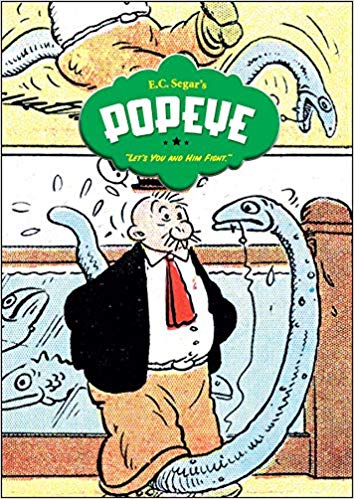
E.C. Segar’s Popeye volume 3: “Let’s You and Him Fight!”


By Elzie Crisler Segar (Fantagraphics Books)
ISBN: 978-1-56097-962-3

There are relatively few comic characters that have entered world consciousness, but a grizzled, bluff, uneducated, visually impaired old sailor with a speech impediment is possibly the most well-known of that select bunch. Elzie Crisler Segar had been producing the Thimble Theatre daily newspaper strip since December 19th 1919, but when he introduced a coarse, brusque “sailor man” into the ever-unfolding adventures of Castor Oyl and Ham Gravy on January 17th 1929, nobody suspected the heights that slouching walk-on would reach.

This third magnificent collection of Segar’s immortal – certainly unkillable – clay-footed reprobate reproduces one spectacular groundbreaking epic after another as the artist-auteur, in a whirlwind of creative inspiration, took the daily strip to new heights of cliffhanging thrills and absurdity. This he did whilst building unique and jovial character studies with the more humorous Sunday pages, generally set in the generic small seaside town of Sweethaven.

Following another erudite essay by Comics historian Donald Phelps, the daily delights (stretching from June 9th 1932 to December 9th 1933) begin with a rip-snorting mystery thriller full of action, tension, scares and laughs featuring a large portion of Thimble Theatre‘s extensive cast. ‘The Eighth Sea’ finds Popeye, Castor, Olive, King Blozo of Nazilia and his idiot retainer Oscar all following the instructions of Oolong the Chinese Parrot to recover a fabulous lost treasure, aided by the incredible Merlock Jones, quick-change detective. This sinister sea saga was the one-and-only Segar tale to feature Popeye’s ultimate nemesis (in the animated cartoons at least) Bluto.

With breakneck pace – Segar never rested on his laurels or his plots – that adventure led the voyagers back to Nazilia for ‘Long Live the King or Gold and Goofs’ and a rematch with General Bunzo and his new Mata Hari Dinah Mow: a worldly-wise vamp even iron-willed Popeye couldn’t resisk…

After taking a well-aimed pop at popular democracy in ‘The Great Lection’ the old sea-dog sets up his own nation in ‘Popeye: King of Popilania’: another stinging satire which sees the increasingly irrepressible J. Wellington Wimpy expand beyond the Sunday pages to join the dailies cast, almost mooching the infant country away from its idealistic founder. Popilania’s problems are multiplied by an invasion of “furiners”, “emmygrunts” and even jungle-Neanderthals in ‘Wild Men and Wild Women’ before the well-meaning reformer learns his lesson. At least he never had to cope with Brexit…

The trenchant social commentary and barbed satire continued when he returns to America to become ‘Star Reporter’ for The Daily Blast, a periodical edited by Castor and “blessed” with Wimpy as photographer. This leads to the next big cast addition and our hero’s greatest advancement when a reader mails Popeye a baby in ‘Me Sweet Pea.’

Discovering the “infink’s” true history and heritage pits the sailor-man against some pretty ruthless types, and results in him suffering a serious brain injury in ‘Bonkus of the Konkus’ but his indomitable soul and noble heart win through as always in the turbulent desert debacle ‘Popeye’s Cure’…

The Sunday Page selection follows a decidedly more domestic but no less riotous path. Running from 9th October to 23rd November 1933, the full-colour section was increasing given over to – or more correctly, appropriated – by the insidiously oleaginous Wimpy: ever hungry, always cadging, yet intellectually stimulating, casually charming and usually triumphant in all his mendicant missions.

Whilst still continuing his pugilistic shenanigans, the action of the Sunday strips moved away from Popeye hitting quite so much to alternately being outwitted by the unctuous moocher, and saving him from the vengeance of Diner owner Rough-house and passionately loathing George W. Geezil, an ethnic Jewish stereotype, who like all Segar’s characters swiftly developed beyond comedic archetype into a unique person with his own story… and another funny accent.

Wimpy was unstoppable – he even became a rival suitor for Olive Oyl’s scrawny favours – and his development owes a huge debt to his creator’s love and admiration of comedian W.C. Fields. A mercurial force of nature, the unflappable mendicant is the perfect foil for common-man-but-imperfect-champion, Popeye. Where the sailor is heart and spirit, unquestioning morality and self-sacrifice, indomitable defiance, brute force and no smarts at all, Wimpy is intellect and self-serving rapacious greed, freed from all ethical restraint or consideration, and gloriously devoid of any impulse-control.

Wimpy literally took candy from babies and food from the mouths of starving children, yet somehow Segar made us love him. He was Popeye’s other half: weld them together and you have an heroic ideal… (and yes, those stories are true: British Wimpy burger bars are built from the remnants of a 1950s international merchandising scheme that wanted to put a J Wellington Wimpy-themed restaurant in every town and city).

The gags and exploits of the two forces of human nature build riotously during this period, ever-more funny; increasingly outrageous. The laugh-out-loud antics seem impossible to top, and maybe Segar knew that. Either he was getting the stand-alone gag-stuff out of his system, or perhaps he was clearing the decks and setting the scene for a really big change.

Within weeks (or for us, next volume) the Thimble Theatre Sunday page changed forever. In a bold move, the blood-and-thunder serial-style adventure epics of the dailies transferred to the Technicolor splendour of the “family pages” and all stops would be pulled out…

Topper strip Sappo actually increased its page-share during this period, going from two to three tiers, as the unstoppable scientist O.G. Watasnozzle took the little feature into increasingly surreal and absurdist realms. On a rocket ship journey, Sappo and his insufferable but long-suffering wife Myrtle experienced incredible thrills, chills and spills during an extended trip around the solar system; experiencing all the goofy wonders and embarrassments Segar’s fevered mind could concoct.

Always innovating, the restless creator also began adding extra value for his readers: incorporating collector stamps, games and puzzles to his Sunday pages. In an era with no television – and indeed, with only the very first prototype comicbooks just starting to appear – radio-shows and Sunday pages were the home entertainment choices of most Americans. Many strips offered extras in their funny-pages and Segar excelled in creating paper-based toys and amusements.

In this book alone there are stamps, play money “lucky bucks”, cartooning tips, drawing lessons and ‘Funny Films’ – dioramic scenes through which continuous strips of cartooned “filmstrips” could be moved to create a home cinema!

As an especially welcome bonus, this volume concludes with an incredibly rare piece of Popeye memorabilia: one I’d heard of but never thought I’d ever see. In 1934 the Chicago World’s Fair was held in the Windy City, and for two weeks before, at the end of 1933, it was advertised and promoted in the Hearst papers with an original full-page, monochrome Popeye serial. That’s terrific enough but the extended yarn was given extra push by escaping the funny-pages ghetto to run for that fortnight in the Sports section, as Popeye and crew explored the wonders of the World’s Fair in a truly spectacular and irresistible enticing prom feature – possibly the first of its kind.

This work is among the finest strip narrative ever created: reading it should be on everybody’s bucket list, and even when you do there’s still more and better yet to come…

In this anniversary year, you owe it to yourself to make the acquaintance of this icon of cartooning.
© 2008 Fantagraphics Books Inc. All comics and drawings © 2008 King Features Inc. All rights reserved.