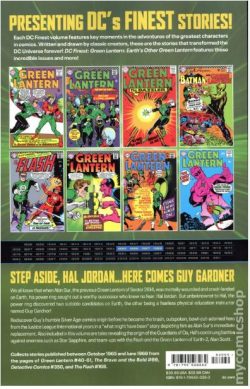
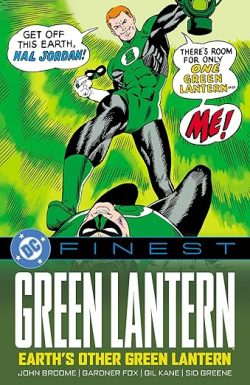
DC Finest Green Lantern (volume 2) – Earth’s Other Green Lantern


By Gardner F. Fox, John Broome, Bob Haney, Gil Kane, Carmine Infantino, Ramona Fradon & Charles Paris, Murphy Anderson, Joe Giella, Frank Giacoia, Sid Greene & various (DC Comics)
ISBN: 978-1-79950-326-2 (TPB)

This book includes Discriminatory Content produced in less enlightened times.

Win’s Christmas Gift Recommendation: Pure & Superhero Sensationalism… 9/10

After a hugely successful revival and reworking of Golden Age all-star The Flash, DC (National Periodical Publications as they were then) built on a resurgent superhero trend. Cover dated October 1959 and on sale from July 28th, Showcase #22 hit newsstands at the same time as the fourth issue of the new Flash comic book (#108) and once again the guiding lights were Editor Julie Schwartz and writer John Broome. Assigned as illustrator was action ace Gil Kane.

Brash, cocky test pilot Hal Jordan was in California when an alien cop crashed on Earth. Mortally wounded, Abin Sur commanded his ring – a device which could materialise thoughts – to find a replacement officer: one both honest and without fear. Scanning the planet, the wonder weapon selected Jordan, whisking him to the crash-site. The dying alien bequeathed his ring, lantern-shaped Battery of Power and his profession (patrolman of Sector 2814) to the astonished Earthman.

In 6 pages the story established characters, scenario and narrative thrust of a series that would become the spine of all DC continuity. With the concept of the superhero being re-established among the buying public, there was no shortage of gaudily clad competition. Better books thrived by having something a little “extra”. With Green Lantern that was primarily the superb scripts of John Broome & Gardner Fox and astounding ever-evolving drawing of Gil Kane (ably abetted by a string of top inkers) whose dynamic anatomy and dramatic action scenes were maturing with every page he drew. Happily, the concept itself was also a provider of boundless opportunity.

Other heroes had extraterrestrial, other-dimensional and even trans-temporal adventures, but the valiant champion of this series was also a cop: a lawman working for the biggest police force in the entire universe.

This fabulous compilation gathers Green Lantern #40-61 (October 1965 -June 1968) plus contemporary guest appearances in The Flash #168, Detective Comics #350 and The Brave and the Bold #69. It all gets started without fanfare and opens with GL #40 which went on sale on August 26th 1965.

Conceived and delivered by Broome, Kane & Sid Greene (with conceptual input as always from editor Schwartz, ‘The Secret Origin of the Guardians!’ was a landmark second only to game-changing ‘Flash of Two Worlds’ (see DC Finest: The Flash – The Human Thunderbolt) as the Emerald Gladiator with his Earth-2 counterpart Alan Scott have to stop obsessed Oan scientist Krona, whose misguided attempts to discover the origins of the universe had introduced evil into our pristine reality billions of years ago. His actions forced his immortal brethren to become protectors of life and civilisation in an unending act of group contrition – the Guardians of the Universe.

Now he was back and still asking the wrong question, with his efforts also endangering a parallel earth. Happily for creation, that world had its own vastly experienced Emerald Avenger, who pitched in, and was so good at crisis management that the Guardians offered him Hal’s job…
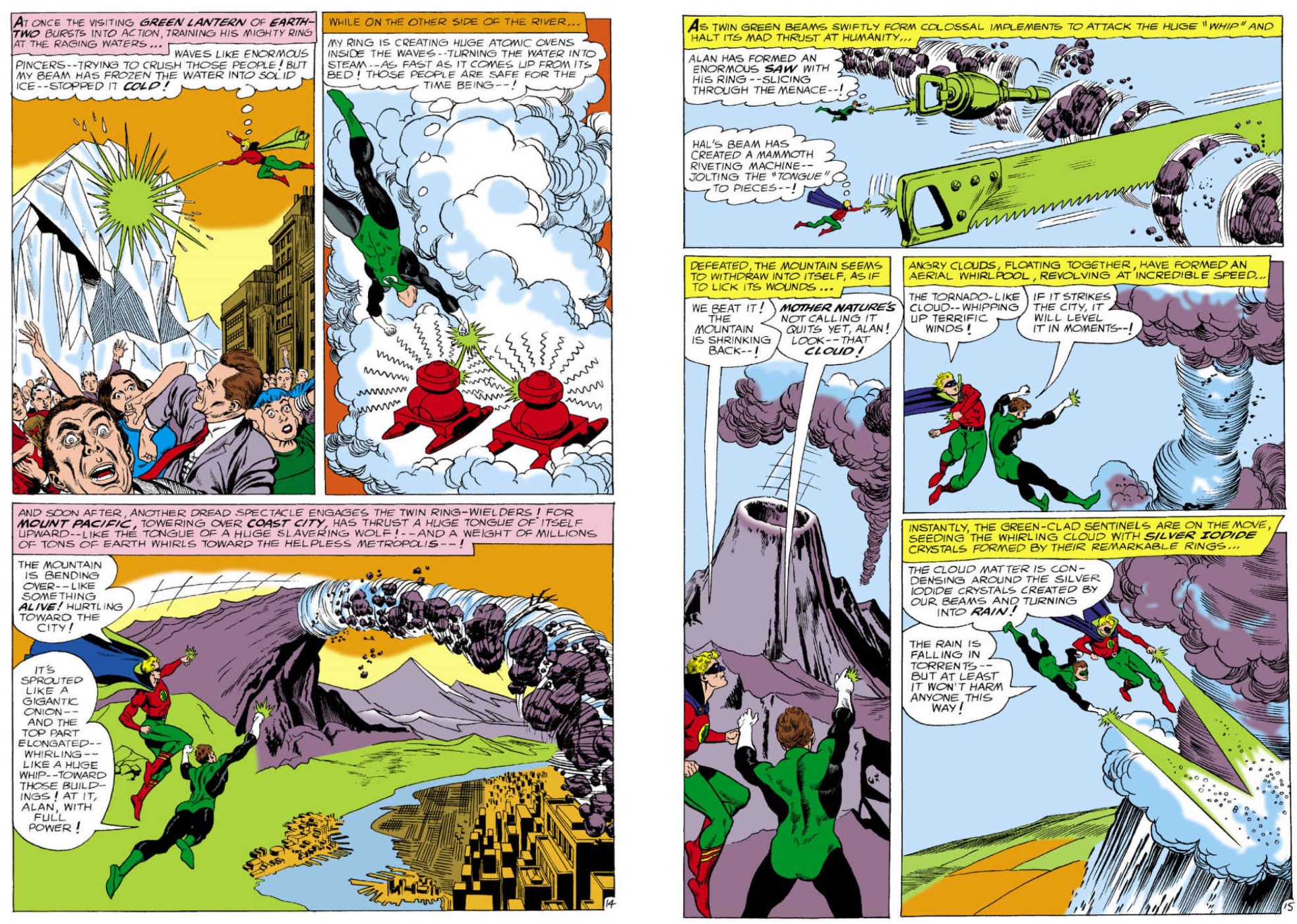
Simultaneously high concept and all-action, the tale became a keystone of DC cosmology and a springboard for all those mega-apocalyptic publishing events such as Crisis on Infinite Earths. It has seldom been equalled and never bettered…

Gardner Fox scribed GL #41, spotlighting twisted romance in ‘The Double Life of Star Sapphire!’ as an alien power-gem again compels Jordan’s boss/true love Carol Ferris to subjugate and marry her sometime paramour Green Lantern. Fox also wrote another cracking magical mystery to end the issue as extraterrestrial wizard Myrwhydden triggered ‘The Challenge of the Coin Creatures!’

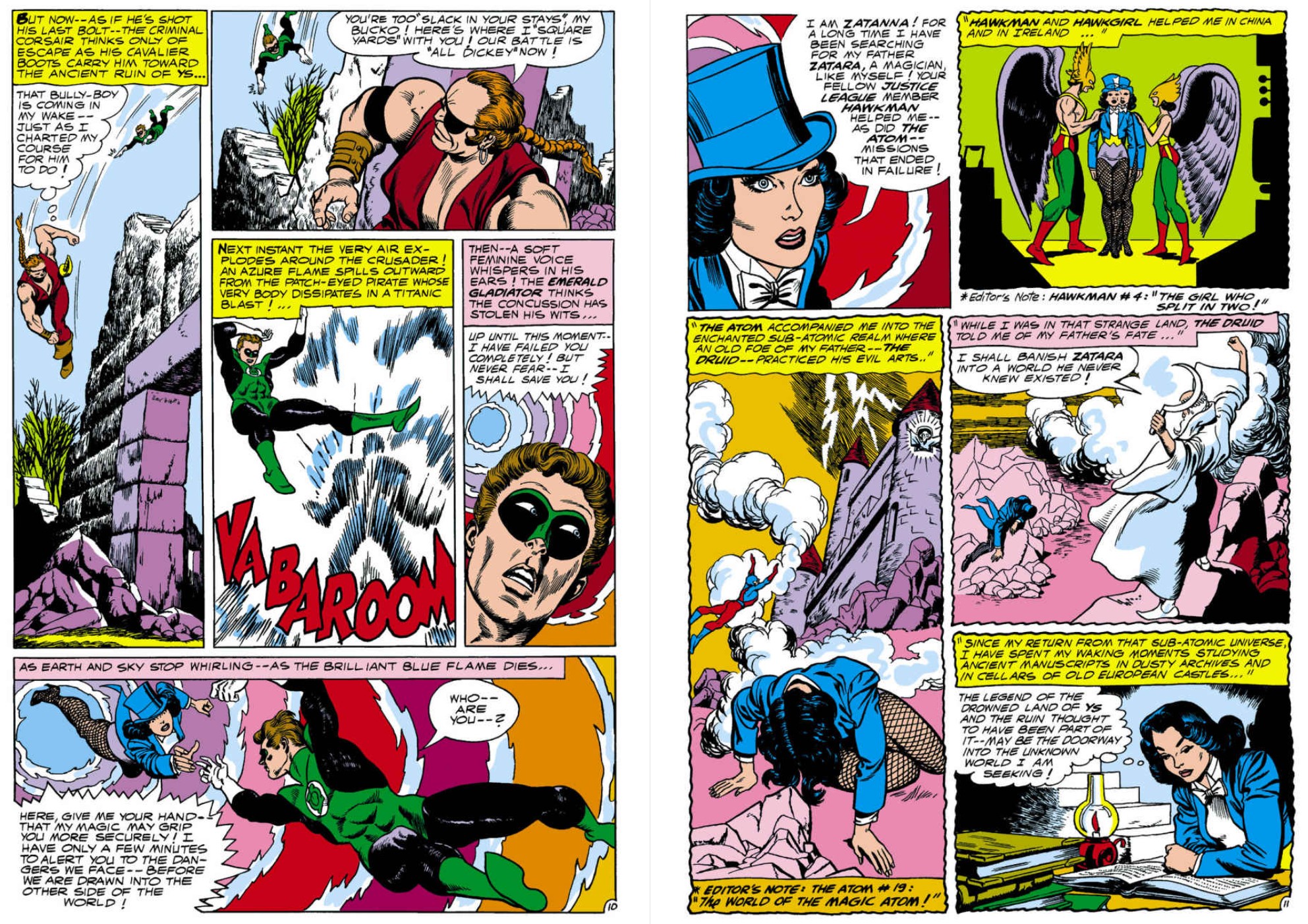
Next came ‘The Other Side of the World!’ wherein Fox continued a long-running experiment in continuity with a superb tale of time-lost civilisations and an extra-dimensional invasion by the Warlock of Ys co-starring peripatetic quester Zatanna the Magician as perfectly pictured by Kane & Greene.

At that time the top-hatted, fish-netted sorceress appeared in a number of Schwartz-edited titles, hunting her long-missing father Zatarra: a magician-hero in the Mandrake mould who had fought evil in the pages of Action Comics for over a decade, beginning with the very first issue. In true Silver Age “refit” style, Fox concocted a young, equally empowered daughter, promoting and popularising her in guest-team ups with superheroes he was currently scripting. If you’re counting, these tales appeared in Hawkman #4, Atom #19, Green Lantern #42 and an Elongated Man back-up strip in Detective Comics #355 as well as a slick piece of back writing to include the high-profile Caped Crusader via Detective #336. It all concluded after this GL segment in Justice League of America #51. You can enjoy the entire early epic by tracking down Justice League of America: Zatanna’s Search

The Flash shared the spotlight in #43: a high-energy tussle with a debuting tectonically terrifying new supervillain for Fox’s ‘Catastrophic Crimes of Major Disaster!’ and the next issue provide two tales – an increasing rarity as book-length epics became the action-packed norm.

Second-class postage discounts had for years dictated the format of comic books: to qualify for cheaper rates periodicals had to contain more than one feature, but when the rules were revised single, complete tales not divided into “chapters” soon proliferated. Here though are two reasons to bemoan the switch; Fox’s ‘Evil Star’s Death-Duel Summons’ and Broome’s “Jordan Brothers” adventure ‘Saga of the Millionaire Schemer!’, offering high-intensity alien supervillain action and a heady, witty comedy-of-errors mystery as Hal visits his family and is embroiled in new sister-in-law Sue’s hare-brained scheme to prove that her husband Jim Jordan is actually Green Lantern!

Crossovers were becoming increasingly common as shared continuity expanded and heroes popped up out of their regular jurisdiction. One brilliantly executed example follows…

Back in 1963 Schwartz had assumed editorial control of Batman & Detective Comics, allowing him space for a character who had been lying mostly fallow ever since his debut as a very long-legged walk-on in the April/May 1960 Flash. The Elongated Man was Ralph Dibny: a circus-performer who discovered an additive in popular soft drink Gingold which gave certain rare people increased muscular flexibility. Intrigued, Dibny isolated and refined the chemical and developed a serum granting him the ability to stretch, bend and compress his body to an incredible degree. From Detective #350 (April 1966) comes ‘Green Lantern’s Blackout!’ wherein Hal’s best friend Thomas Kalmaku seeks out the Stretchable Sleuth to solve the riddle of the hero’s abrupt disappearance – an entrancing, action-packed team-up with a future Justice League colleague by Fox & Carmine Infantino.

Scripted by Broome, Earth-2’s ring wielder returns for another power-packed pairing in Green Lantern #45’s fantasy & fisticuffs romance romp ‘Prince Peril’s Power Play’. The author raised the dramatic stakes with the hero’s first continued adventure in the following issue. GL #46 opens with Fox’s delightfully grounded crime-thriller ‘The Jailing of Hal Jordan’, before – preceded by a spectacular Kane pin-up – ‘The End of a Gladiator!’ details the murder of Sector 2814’s GL by old foe Dr. Polaris, concluding with his honour-laden funeral on Oa, home of the Guardians!

Broome was on fire at this time: the following issue and concluding chapter sees the hero’s corpse snatched to the 58th century and revived in time to save his occasional future home from a biological infection of pure evil in the spectacular triumph ‘Green Lantern Lives Again!’ Bizarrely garbed goodies and baddies were common currency at this time of incipient TV-generated Batmania, so when gold-plated mad scientist Keith Kenyon returned it was as a dyed-in-the-wool costumed crazy for Fox’s ‘Goldface’s Grudge Fight Against Green Lantern!’: a brutal clash of opposites. Sadly, Broome’s showbiz scoundrel Dazzler didn’t quite set the world afire in #49’s ‘The Spectacular Robberies of TV’s Master Villain!’ but the yarn was still a shocker, as Hal Jordan quit his job as a Coast City test pilot and went on the first of his vagabond quests across America…

Green Lantern had been the first hero to co-headline with Batman in The Brave and the Bold #59 (April/May 1965): a tale which became the blueprint of the title’s next 20 years as two colleagues joined forces for a specific case. There devious criminal scientist John Starr tricked Bruce Wayne into clearing his name and stole the Emerald Crusader’s power to fuel a chronal assault on Gotham as the Time Commander. Here and now, Win Mortimer joins scripter Bob Haney as Gotham Gangbuster and Green Knight endure a fractious reunion in B&B #69’s ‘War of the Cosmic Avenger’ (December 1966-January 1967) as John Starr repeats his tactic to unleash star-powered golem Cosmo upon the world, utterly unaware that the monster might have its own sinister agenda. Luckily, our heroes are smarter than the brilliant but bad time bandit…

With Green Lantern #50 Kane began inking his own art (probably in preparation for his forthcoming independent publications Savage and Blackmark), lending the proceedings a raw, savage appeal. The fight content in the stories was also ramped up, as seen in Broome’s murder-mystery treasure hunt ‘The Quest for the Wicked Queen of Hearts!’, complimented by an extragalactic smack-fest in Fox’s ‘Thraxton the Powerful vs Green Lantern the Powerless’, prior to Broome bringing the Emerald Crusader back to the 58th century to battle ‘Green Lantern’s Evil Alter Ego!’ in #52. Meanwhile, across the editorial aisle in The Flash #168 (cover-dated March 1967 but on sale from January 19th) Broome delivered a full-length thriller for Infantino & Sid Greene in which the Guardians of the Universe seek out the Scarlet Speedster after finding ‘One of our Green Lanterns is Missing!’ Bafflingly, as the Vizier of Velocity hunts for his missing best buddy, he is constantly distracted and diverted by a gang of third-rate thugs who have somehow acquired futuristic super weapons…
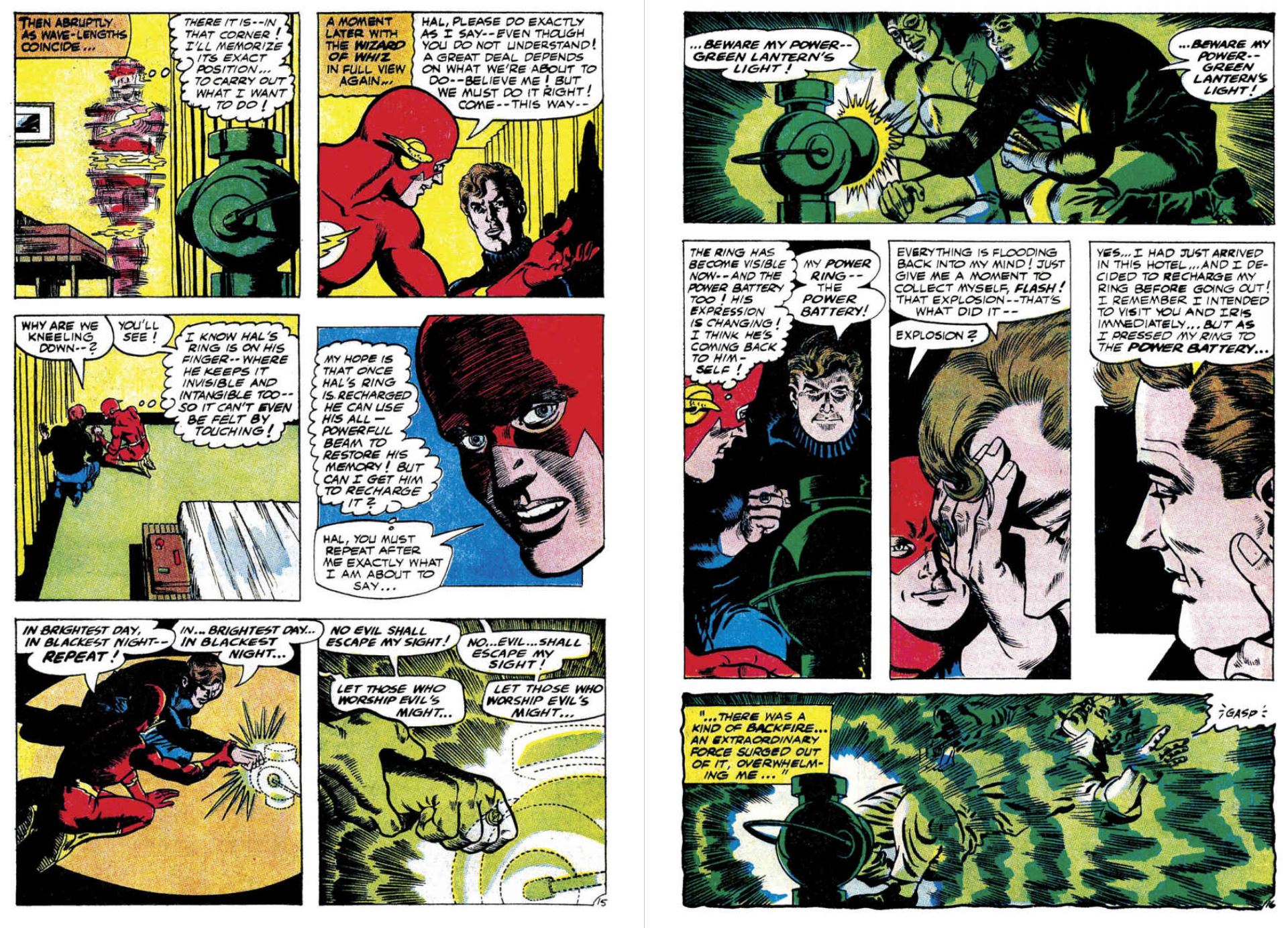
Back in GL #52, Broome & Kane have Alan Scott and comedy sidekick Doiby Dickles pop over from Earth-2 to aid against returning arch nemesis Sinestro in frankly peculiar ‘Our Mastermind, the Car!’, before finding far less outré plot or memorable foe for #53’s ‘Captive of the Evil Eye!’ wherein an alien giant stealing Earth’s atmosphere is ferociously foiled. The same issue sees Infantino & Greene step up to illustrate Broome’s thrillingly comedic Jordan Brothers back-up ‘Two Green Lanterns in the Family!’ as Hal finds employment as an investigator for the Evergreen Insurance company…

Broome & Kane reunite for positively surreal, super-scientific saga ‘Menace in the Iron Lung!’ (GL #54), with a manic shut-in orchestrating a deadly remote war against the Viridian Avenger followed by an all-out attack on the Guardians and their operatives in ‘Cosmic Enemy Number One’. The trans-galactic assassinations conclude in ‘The Green Lanterns’ Fight for Survival!’ and the appointment of a second Earthling to the now depleted Corps.

For #57, Fox scripts a sparkling Fights ‘n’ Tights duel in ‘The Catastrophic Weapons of Major Disaster!’ with the walking extinction event simultaneously tapping into and depowering the power ring before #58’s gripping psycho-thriller ‘Peril of the Powerless Green Lantern’ sees our hero seemingly suffering from debilitating combat fatigue. Sid Greene returned to inking with this yarn, staying on to embellish another continuity landmark.
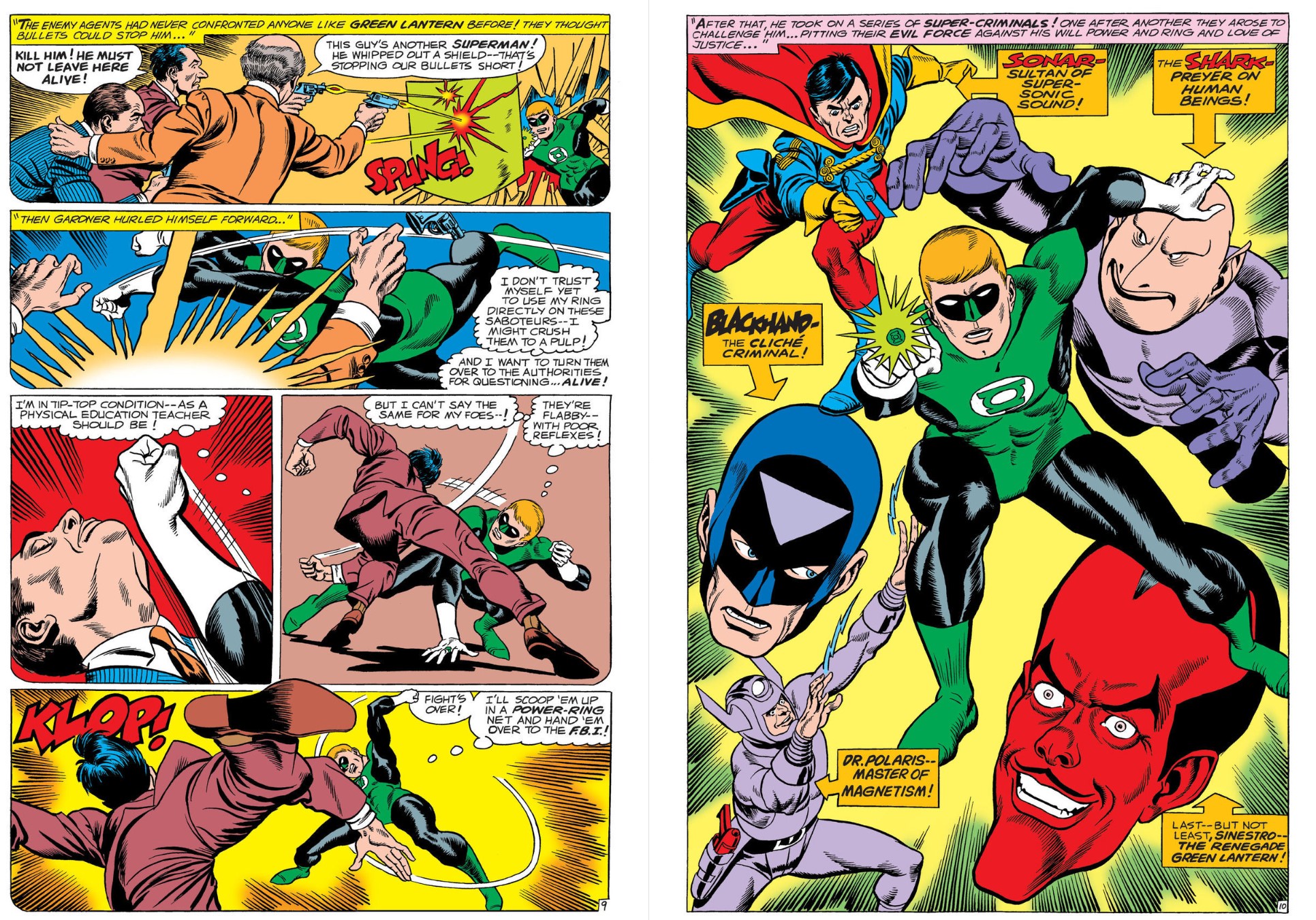
In Green Lantern (volume 2 #59, March 1968) Broome introduced ‘Earth’s Other Green Lantern!’ in a rip-roaring cosmic epic of what-might-have-been. When dying Abin Sur originally ordered his ring to select a worthy successor Hal Jordan wasn’t the only candidate, but simply the closest of two. Here thanks to Guardian technology Hal sees what would have occurred if the ring had chosen his alternative Guy Gardner instead¦?

Action lovers and fans of fantasy fiction couldn’t find a better example of everything that defines superhero comics, but by the time of these later stories began DC was a company in transition – as indeed was America itself – with new ideas (for which, in comic-book terms, read “new, young writers”) granted greater headway than ever before: in turn generating an influx of new kids unseen since the very start of the industry, when excitable young artists and writers ran wild with imagination. Green Lantern #60 (April 1968), however, was an all-veteran outing as Fox, Kane & Greene introduced a fantastic new foe in ‘Spotlight on the Lamplighter!’, a power-packed, crime-busting morality play inadvertently foreshadowing a spectacular Green team-up classic in the next issue.

We end as we began for the last tale in this collection, wherein Mike Friedrich pens ‘Thoroughly Modern Mayhem!’ Mercifully the story is as wonderful as the title is not, since it cut to the quick of a problem many a kid had posited. If the power ring was so powerful why not just command it to end all evil? When the old and world-weary Emerald Crusader of Earth-2 does just that, it takes both him and his Earth-1 counterpart to remedy the shocking consequences to all of humanity…
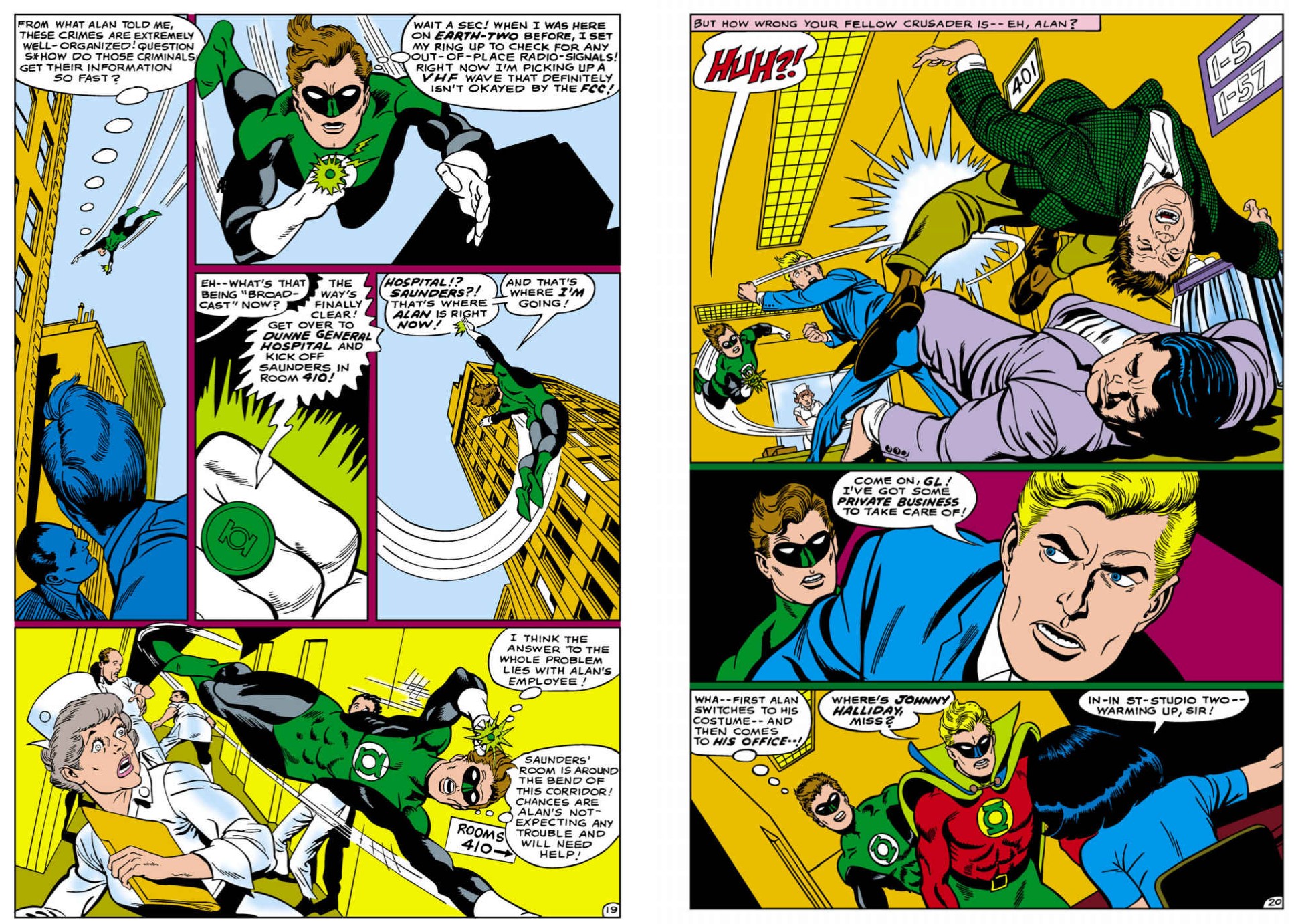
Augmented with covers by Kane, Murphy Anderson, Jack Adler, Infantino, Greene & Joe Giella, these costumed drama romps are in themselves a great read for most ages, but when also considered as the building blocks of all DC continuity they become vital fare for any fan keen to make sense of the modern superhero experience. This blockbusting book showcases the imaginative and creative peak of Broome, Fox & Kane: a plot driven plethora of action sagas and masterful thrillers that literally reshaped the DC Universe. If you love superheroes you will never read better…
© 1965, 1966, 1967, 1968, 2025 DC Comics. All Rights Reserved.

Today in 1908 key comics personage, DC editor, writer and media intermediary Whitney Ellsworth was born, and in 1970 so was Mexican maestro Humberto Ramos who has excelled on everything from Amazing Spider-Man to Young Justice.

You’ve probably never heard of her, but Dorothy Woolfolk shattered a bunch of glass ceilings and was DC’s first woman editor. We lost her today in 2000, but her legacy lives on.
Mighty Thor Omnibus volume 3


By Stan Lee & Jack Kirby, Larry Leiber, Gerry Conway, John Buscema, Neal Adams, Vince Colletta, Joe Sinnott, George Klein, Bill Everett, John Verpoorten, Sam Grainger, Jim Mooney, Sal Buscema, John Romita Sr., Art Simek, Sam Rosen & various & various (MARVEL)
ISBN: 978-1-3029-0381-7 (HB/Digital edition)

This book includes Discriminatory Content produced in less enlightened times

Win’s Christmas Gift Recommendation: A Epic Jewel of Historic Import… 9/10

We all still love superheroes right? Here’s another bunch of yarns thou shouldst not miss…

The Mighty Thor was the title in which Jack Kirby’s restless fascination with all things Cosmic was honed and refined via dazzling graphics and captivating concepts. The King’s career-defining string of signature superheroic fantasies and power-packed pantheons all stemmed from a modest little fantasy/monster title called Journey into Mystery where – in the summer of 1962 – a tried-&-true comic book concept (feeble mortal remade as god-like hero) was revisited by fledgling Marvel Comics to add a Superman analogue to their growing roster of costumed adventurers.

It is lettered throughout by unsung superstars Art Simek &Sam Rosen, and hued by an unjustly anonymous band of colourists. As well as a monolithic assortment of nostalgic treats at the back, this mammoth tome is dotted throughout with recycled Introductions – ‘God and Mangog’ by Arlen Schumer, ‘The Beginning of the End’ by Jon B. Cooke, ‘Legendary Tales’ by Will Murray and ‘Asgard Forever!’ by Stan Lee, from previous Marvel Masterworks editions, and also includes editorial announcements and ‘The Hammer Strikes!’ news and letters pages for each original issue to enhance overall historical experience…

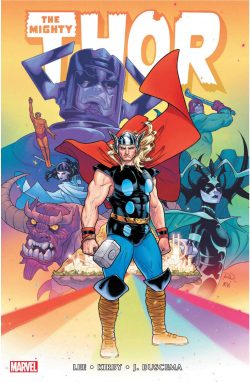
This blockbusting era-defining, full-colour third tome offers Asgardian exploits from Thor #153-194, collectively covering June 1968 to December 1971 as the Universe Jack built slowly began to succumb to the weight and stricture of Marvel’s abiding continuity, and the King sought ever more challenging innovation and spectacle…

Once upon a time lonely, lamed American doctor Donald Blake took a vacation in Norway only to encounter the vanguard of an alien invasion. Entombed in a cave, Blake found a gnarled old walking stick, which, when struck against the ground, turned him into the Norse God of Thunder! Without any hesitation or preamble the reborn godling was soon defending the weak and smiting the wicked. Months swiftly passed and rapacious extra-terrestrials, Commie dictators, costumed crazies and cheap thugs gradually gave way to a vast panoply of fantastic worlds and incredible, mythic menaces. Eventually the magnificent warrior’s ever-expanding world of Asgard was a regular feature and mesmerising milieu for the hero’s earlier adventures, heralding a fresh era of cosmic fantasy to run almost tangentially to the company’s signature superhero sagas.

The action begins here with the conclusion of another calamitous clash involving wicked stepbrother Loki. In the wilds of Asgard, Ulik the Troll had attacked Karnilla, Queen of the Norns and brave lovestruck god Balder offered to be her champion if she freed Thor’s beloved Sif from the awesome Destroyer armour her spirit was trapped in, and which had forced her to kill her briefly de-powered beloved.

Resurrected and triumphant, Thor united with his lost companions against Ulik, only to lose his newly re-energised hammer to Loki, who fled to Earth with it. In hot pursuit, the heroes followed and Sif was gravely wounded…

Now in ‘…But Dr. Blake Can Die!’ the Thunderer reverts to his mortal guise to surgically operate on the dying goddess – an opportunity for further mayhem that Loki cannot resist, but which our hero’s courage and ingenuity manage to frustrate…

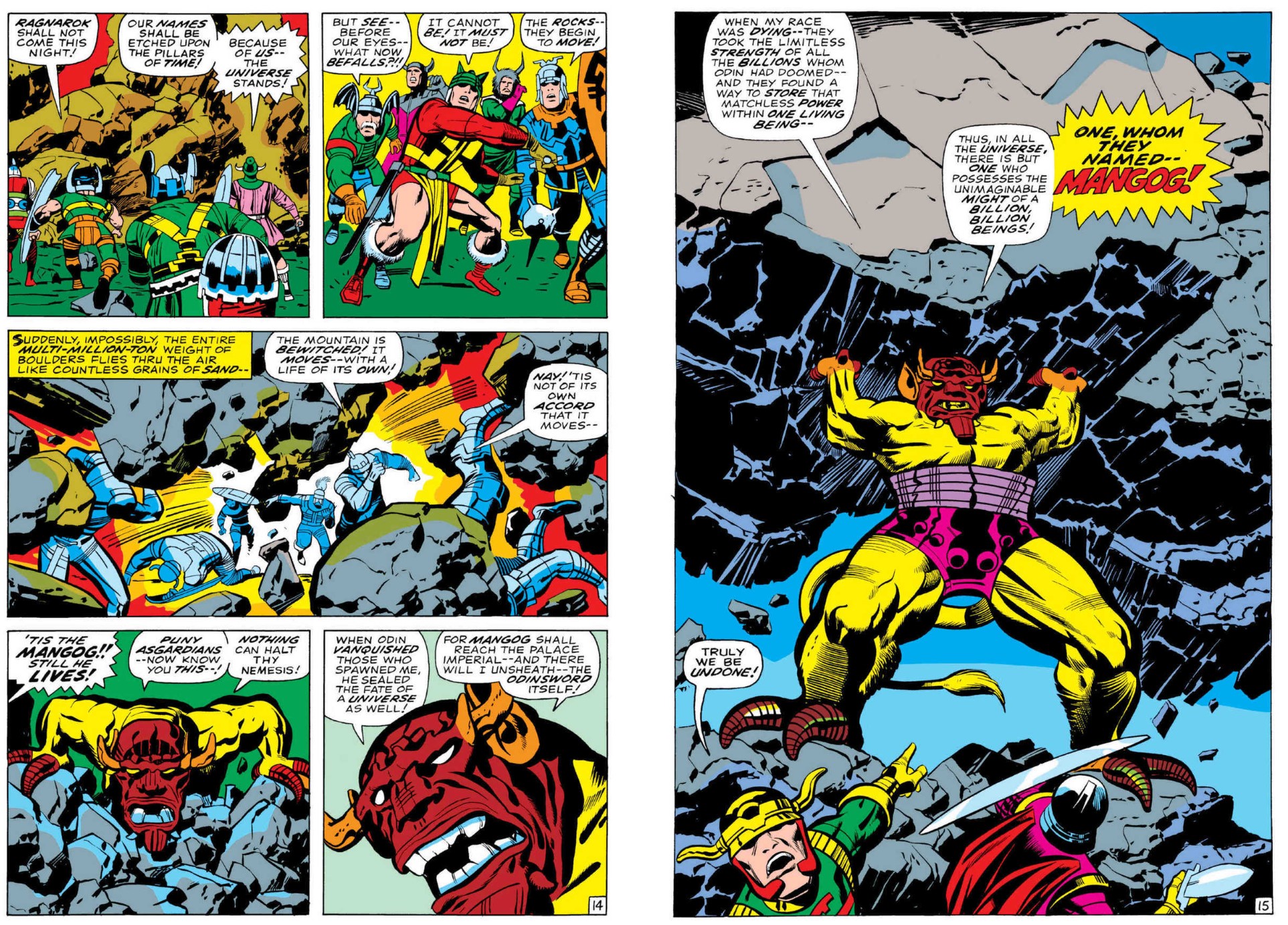
Vanquished and hurled into an inter-dimensionally bottomless pit, furious Ulik saves himself whilst accidentally releasing an ancient unstoppable beast in #154’s ‘…To Wake the Mangog!’ A creature imprisoned by Odin in his ancient prime, the monster – embodying the power and spirit of a billion, billion predatory warriors – emerges incandescent at his long incarceration and, brutally laying waste to everything in its path, rampages towards the heart of Asgard to trigger Ragnarok in ‘Now Ends the Universe!’ All of the Golden Realm’s martial resources are unable to slow the deadly march to doom in ‘The Hammer and the Holocaust!’ but their valiant delaying tactics, depicted in unimaginably powerful battles scenes from a genius on fire Kirby resulted in a last-minute save in #157’s ‘Behind Him… Ragnarok!’

Although short on plot development, the astounding struggle to save Asgard is a masterful expression of the artist’s hunger for bigger stories, and might well have underpinned his later Fourth World series at DC…

The peculiarities of the Blake/Thor relationship were examined and finally clarified next; beginning with ‘The Way it Was!’ – a framing sequence by regular creative team Stan Lee, Kirby & Vince Colletta – that book-ended a reprint of the Thor debut story from Journey into Mystery #83, ‘The Stone Men of Saturn’ (scripted by Larry Leiber and inked by Joe Sinnott). This memory moment neatly segues into ‘The Answer at Last!’ taking the immortal hero back to his long-distant youth to reveal Blake as an Odinian construct designed to teach the Thunderer humility and compassion by living amongst mortals as one of them…

With his true nature re-established, Thor answers a call from the galaxy-roving Colonisers of Rigel, plunging into the depths of space to face a cosmic menace. ‘And Now… Galactus!’ reintroduced old AI companion The Recorder whilst pitting the Devourer of Worlds against living planet Ego: a clash concluded with the Thunderer’s heavy-handed aid in ‘Shall a God Prevail?’ The cosmic wonderment then escalates in ‘Galactus is Born!’ as Asgardian magic finally reveals a tantalising fragment of the terrifying space god’s origins…

Pausing briefly for text interlude ‘The Beginning of the End’ by Jon B. Cooke, we then storm onwards into a sci-fi-fuelled two-parter. In #163 & 164 Thor is summarily despatched to Earth to battle an invasion from a ghastly dystopian future. ‘Where Demons Dwell!’ sees his lover Lady Sif investigating a bizarre energy vortex until captured by Mutate monsters led by rogue Greek god Pluto. The reunited Asgardians decimate the horrors from tomorrow ‘Lest Mankind Fall!’ and as valiant comrade Balder rejoins them in cataclysmic combat, a mysterious cocoon hatches a man-made god…

‘Him!’ (Thor #165) and its conclusion ‘A God Berserk!’ see the creature created by evil scientists to conquer mankind – and who would eventually evolve into tragic cosmic saviour Adam Warlock – wake amidst the turmoil of the battle and, seeing Sif, decide it is time he took a mate…

Trailing the naive artificial superman across space and assorted dimensions with the outraged Thor, Balder witnesses his gentle comrade’s descent into brutal “warrior-madness”, resulting in a savage beating of Him. By the time the Thunderer regains his equilibrium, he is a shaken, penitent and guilt-ridden hero, eager to pay penance for his unaccustomed savagery.

In ‘This World Renounced!’ (sporting a cover by John Romita: the first ever not drawn by Kirby) almighty Odin punishes his son for succumbing to Warrior Madness by exiling him to deep space, where he must atone by locating enigmatic world-devourer Galactus. However, just before departure, the Prince of Asgard clears up some outstanding old business, including another confrontation with his stepbrother Loki…

Superb George Klein came aboard as inker for ‘Galactus Found!’ with Balder and the Warriors Three (Fandral, Hogun & Volstagg) babysitting Earth as Thor roams the heavens on his lonely mission. By the time a new threat emerges in Red China, in the deep unknown Galactus meets to Thor to disclose ‘The Awesome Answer!’ to his origins: a dose of pure Kirby Kosmology of truly staggering proportions. Meanwhile back home, the terrifying Thermal Man is making things far too hot for both his Chinese creators and the Lands of the Free…

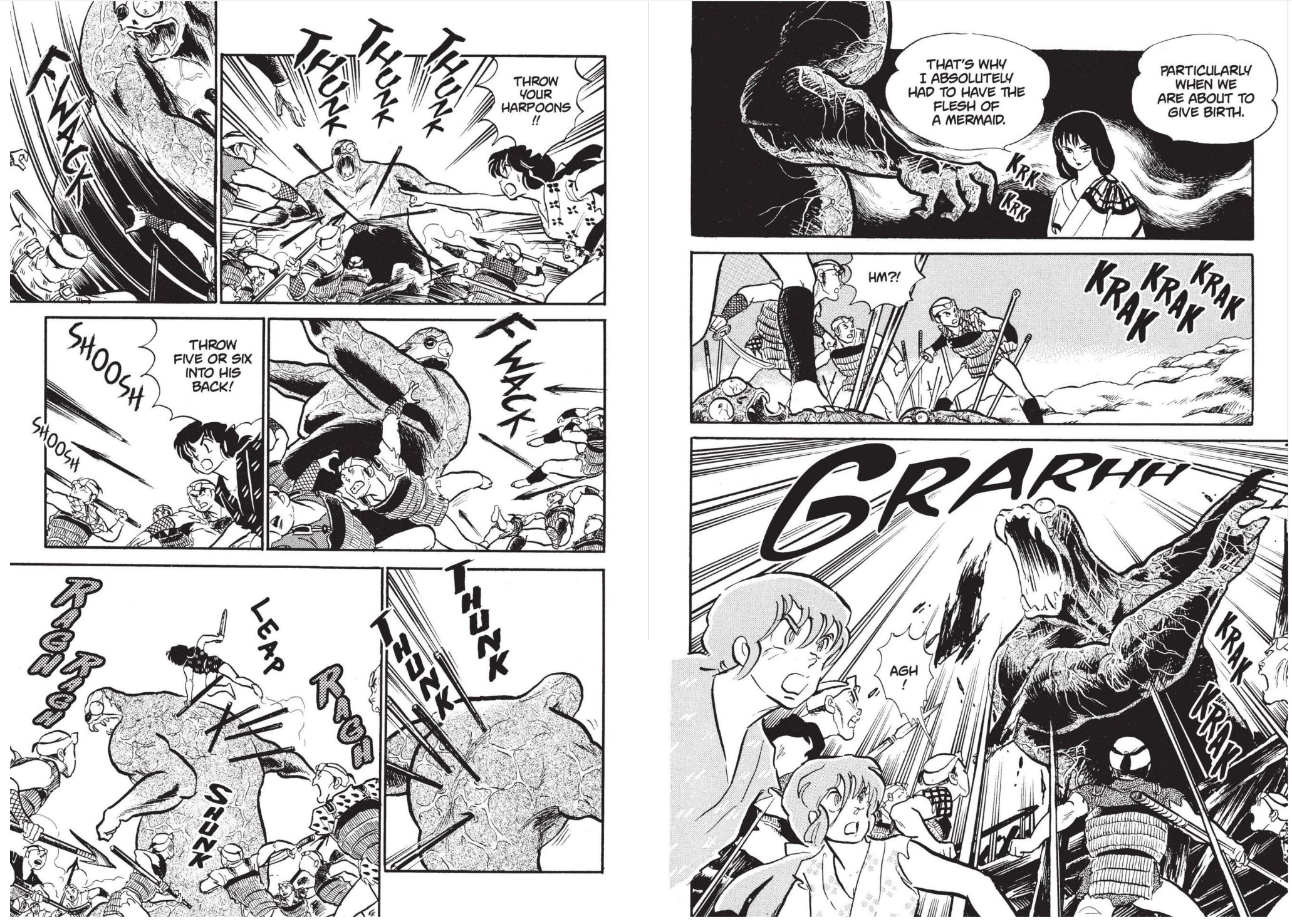
With comics legend Bill Everett assuming inking chores, Thor #170’s ‘The Thunder God and the Thermal Man’ finds the star-lost hero on Earth with mission accomplished, to discover New York besieged by a walking atomic nightmare. Tumbling straight into cataclysmic combat beside his Asgardian comrades against the unstoppable mechanoid menace, Thor is suddenly deprived of his allies at the height of the struggle when Balder, Hogun, Fandral & Volstagg are arcanely abducted to Asgard by Loki and the Norn Queen. Nevertheless, the turbulent Thunder God triumphs…

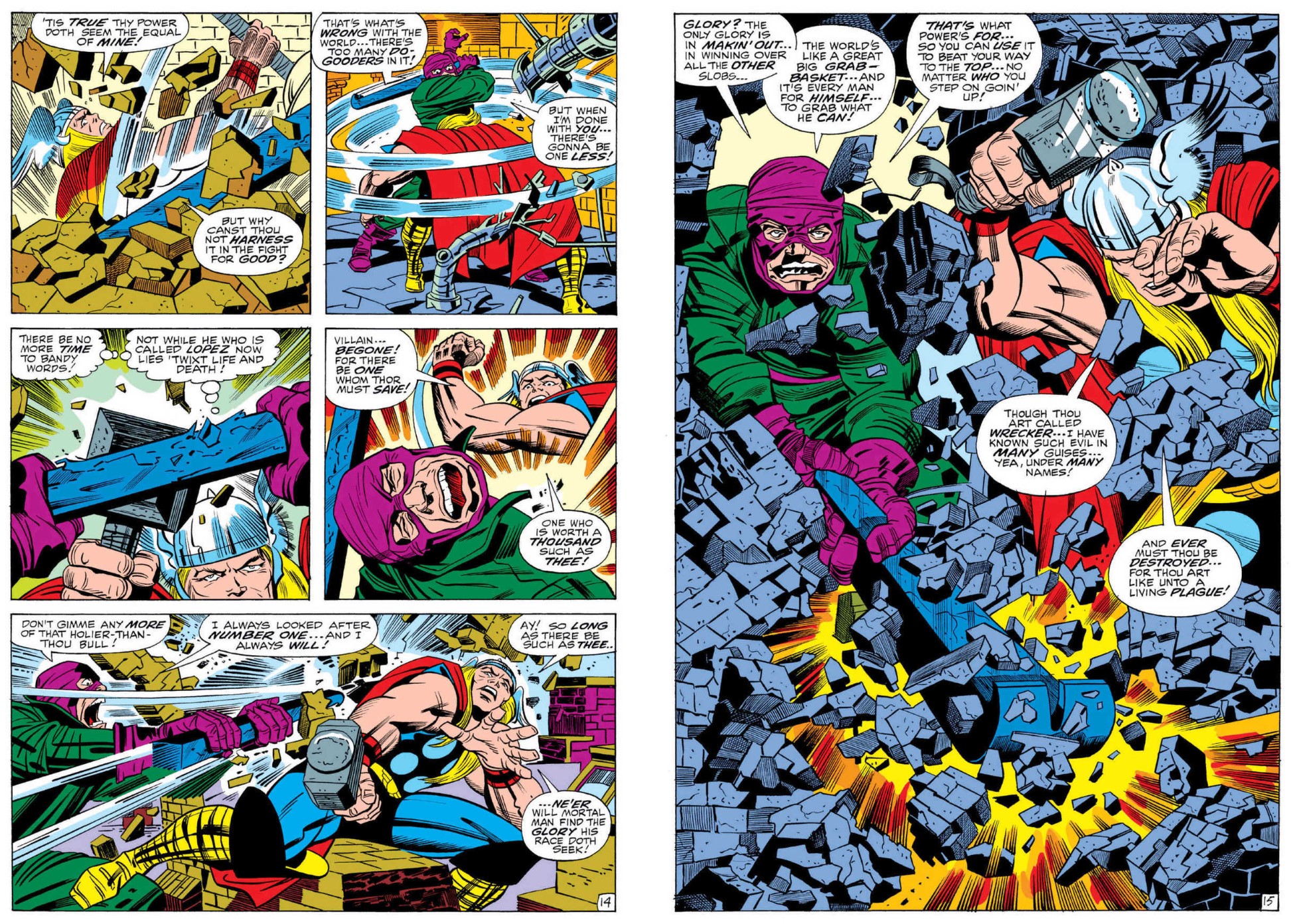
Alone on Earth, Thor next faces a series of single-issue situations: confronting ‘The Wrath of The Wrecker!’ to crush the Norn-empowered bandit before foiling the body-swapping plot of billionaire Kronin Krask in ‘The Immortal and the Mind-Slave!’ after which Will Murray’s text treatise on ‘Legendary Tales’ offers a breather prior to our godly hero overcoming the earthbound fury of ‘Ulik Unleashed!’ after the titanic troll succumbs to the mesmeric wiles of old Thor adversaries The Circus of Crime

The Thunderer continues punching down after a strength-stealing robot runs amok in ‘The Carnage of the Crypto-Man!’ before the last great epic of the Kirby-era begins, behind a Marie Severin cover as ‘The Fall of Asgard!’ (Lee, Kirby & Everett) sees valiant Balder and the Warriors Three barely escape the clutches of lovestruck Karnilla to confront the assembled hordes of giants and trolls marching on the Home of the Gods. With All-Father Odin incapacitated by his annual Great Sleep, perfidious Loki has seized the throne, forcing war-goddess Sif to summon Thor home for perhaps the Last Battle…

Inked by Colletta, ‘Inferno!’ reveals the usurper’s folly as fire-demon Surtur sunders his ancient Odinian captivity to instigate his pre-ordained task of burning down the universe. With everything appearing ‘To End in Flames!’, Loki flees to Earth, having first hidden Odin’s comatose form in the life-inimical Sea of Eternal Night. As Thor leads a heroic Horatian last stand, Balder penetrates the Dimension of Death to rescue the All-Father just as Surtur fires up for his fulminating final foray. It’s a close call but is not yet the end…

Thor #178 (July 1970) was a shock and is a landmark: the first issue without Jack Kirby since the strip’s formative days. Clearly a try-out or hasty fill-in yarn, ‘Death is a Stranger’ – by Lee, John Buscema & Colletta – sees the Thunderer snatched away from Asgard by the nefarious Abomination and duped into clashing with the Stranger: an extra-galactic alien powerhouse who collects unique beings for scientific study…

Inked by John Verpoorten, the interrupted epic riotously resumed in #179 with ‘No More the Thunder God!’ as Thor, Sif & Balder are sent to Earth to arrest fugitive Loki. The issue was Kirby’s last: he left the entire vast unfolding new mythology on a monumental cliffhanger just as the Thunder God is ambushed by his wicked step-brother. Using arcane magic, the Lord of Evil switches bodies with his noble sibling and gains safety and the power of the Storm whilst Thor is doomed to endure whatever punishment Odin decrees…

More than any other Marvel strip Thor was the feature where Kirby’s creative brilliance matched his questing exploration of an Infinite Imaginative Cosmos: dreaming, extrapolating and honing a dazzling new kind of storytelling graphics with soul-searching, mind-boggling concepts of Man’s place in the universe.

Although what followed contained the trappings and even spirit of that incredible marriage, the heart, soul and soaring, unfettered wonderment just were not there any longer: nor would they truly return until 1983 when Walt Simonson assumed creative control with #337.

Here, then ‘When Gods Go Mad!’ introduces the radically different style of hot property Neal Adams, inked by comfortably familiar Joe Sinnott, as the true Thunderer is sent to Hell and the tender mercies of Mephisto, whilst on Earth Loki uses his brother’s body to terrorise the UN Assembly and declare himself Master of the World. In #181’s ‘One God Must Fall’ Sif leads the Warriors Three on a rescue mission to the Infernal Realm as Balder struggles to combat the power of Thor merged with the magic and malice of Loki until Mephisto is thwarted. Then, a cataclysmic battle of brothers on Earth subsequently sets the world to rights…

The new Post-Kirby era truly began with Thor #182, as John Buscema took up the artistic reins and began his own epic run as illustrator with ‘The Prisoner… The Power… and… Dr. Doom!’ Here the Storm Lord becomes entangled in Earthly politics when a young girl entreats him to rescue her father from the deadly Iron Monarch of Latveria. The godling cannot refuse, especially as the missing parent is an expert on missile technology and capable of making Doom the master of ICBM warfare…

The decidedly down-to-Earth and rather mismatched melodrama concludes with Don Blake ‘Trapped in Doomsland!’ until Thor can retrieve his recently misappropriated mallet, but even after his deadly mission of mercy is accomplished, tragedy is his only reward…

Preceded by Stan Lee’s text piece ‘Asgard Forever!’ the first epic of the new age sees Lee, Buscema & Joe Sinnott crafting their own ambitious cosmic saga, opening with #184, exploring ‘The World Beyond!’ wherein an implacable, sinister force devours the outer galaxies, with psychic reverberations of the horrific events impacting and unravelling life on Earth and in Asgard. With all creation imperilled, Odin departs to combat the enigmatic threat alone…

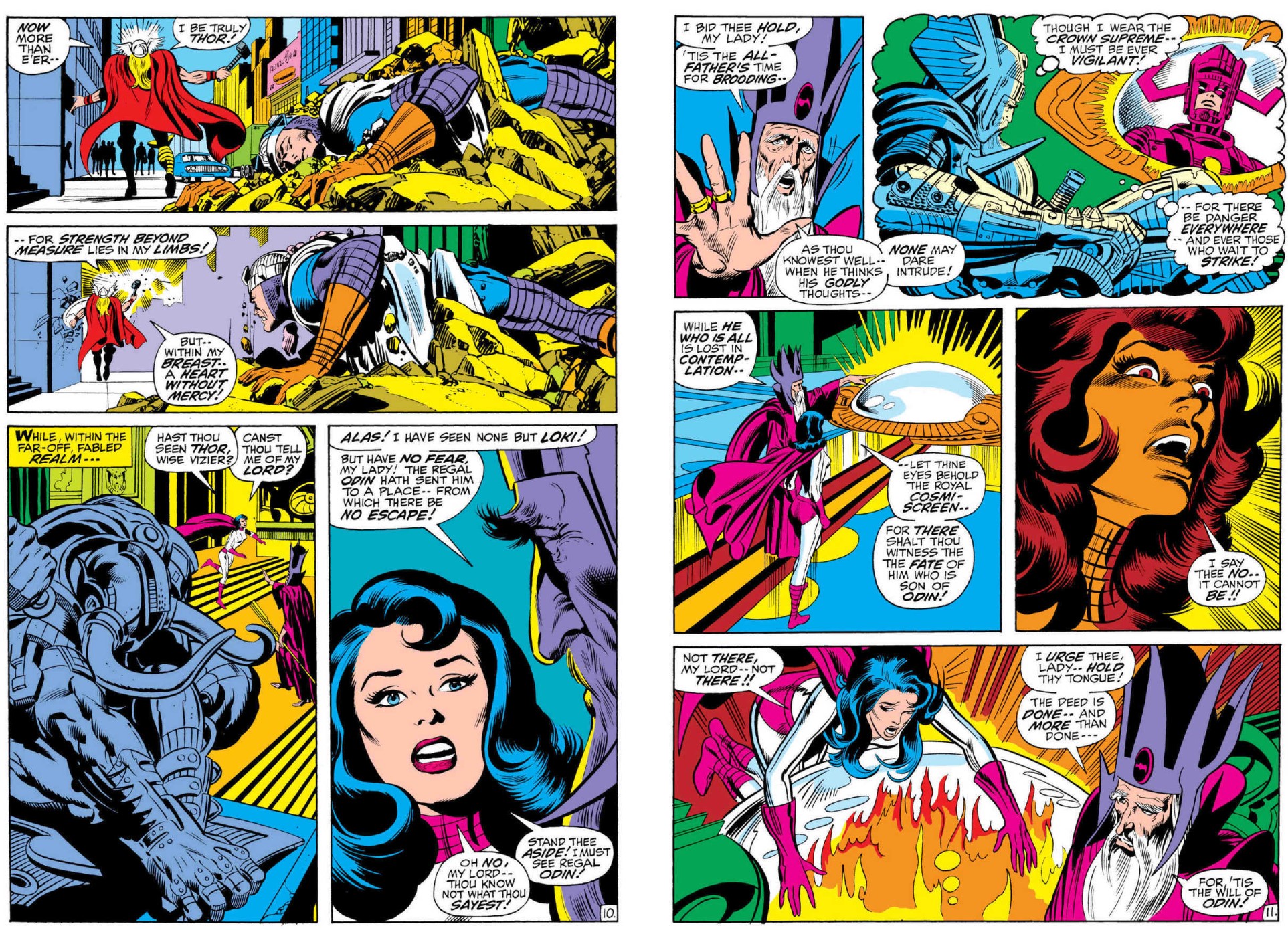
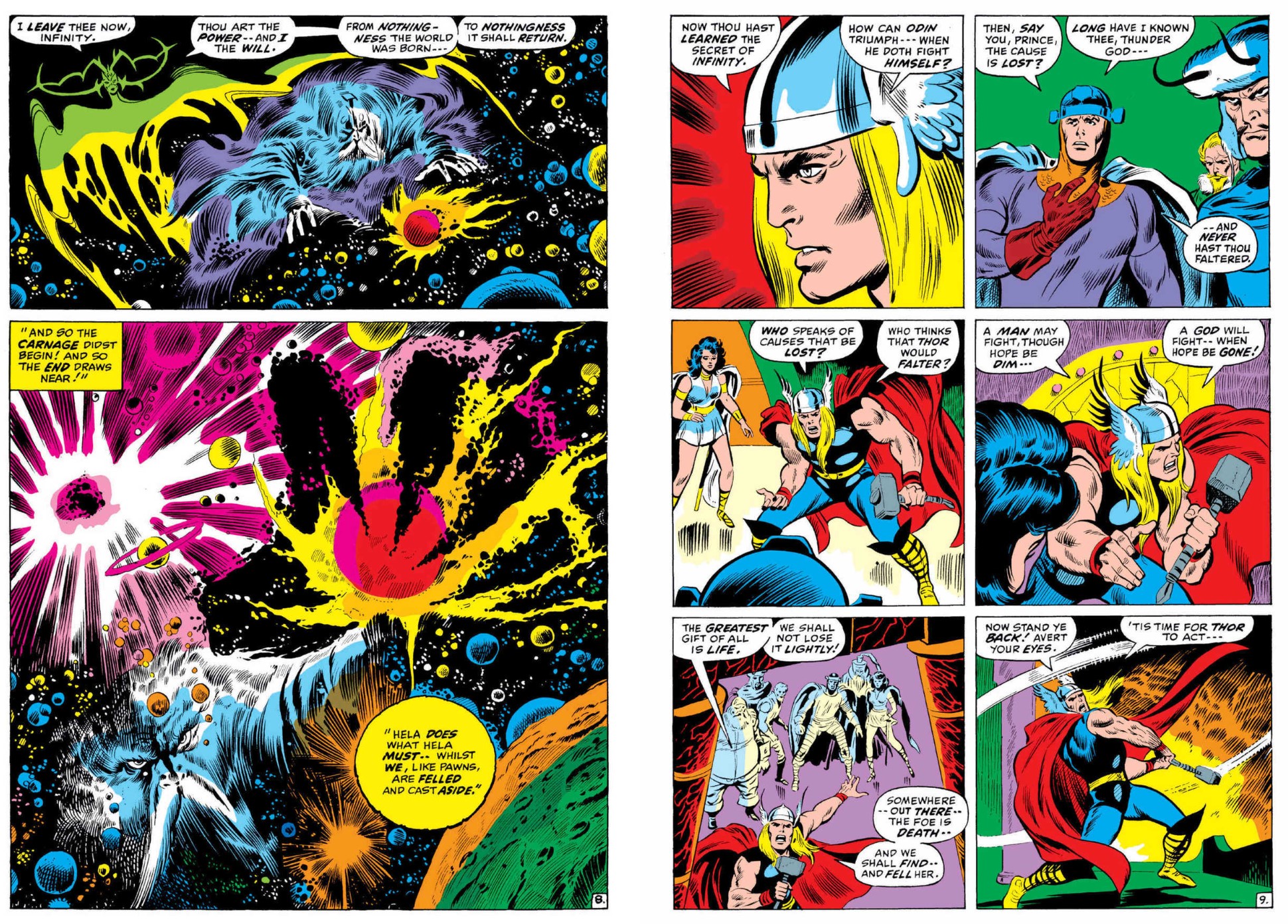
Sam Grainger inked ‘In the Grip of Infinity!’, as universal calamity intensifies and the All-Father falls to an enigmatic, seemingly all-consuming invader before ‘Worlds at War!’ exposes a hidden architect behind the encroaching armageddon. That revelation leads to a desperate last-ditch ploy, uniting the forces of Good and Evil in ‘The World is Lost!’ before one final clash – inked by Jim Mooney – answers all the questions before celebrating ‘The End of Infinity!’ Although vast in scope and drenched in powerful moments highlighting the human side of the gods in extremis, this tale suffers from an excess of repetitive padding and a rather erratic pace. Without pause, though, we plunge on as Thor #189 sees sepulchral goddess Hela come calling, demanding Thor feel ‘The Icy Touch of Death!’ to pay for all the souls she didn’t get in the recent sidereal showdown…

After a big chase around planet Earth she is finally dissuaded in ‘…And So, To Die!’, but the distraction has meanwhile allowed ever-opportunistic Loki to seize the Throne of Asgard and unleash ‘A Time of Evil!’ This typically tyrannical behaviour results in the deranged despot using Odin’s stolen power to manifest an unstoppable artificial hunter/killer dubbed Durok the Demolisher. Unleashing his merciless engine of destruction on Earth, Loki gloats at the ‘Conflagration!’ (Grainger inks) he has callously instigated…

Completing the retiring of the Old Guard, Gerry Conway came aboard as writer for double-length tale ‘What Power Unleashed?’ (#193, with Sal Buscema augmenting & inking brother John) to conclude the epic tale. Prevented by vows from taking up arms against Loki’s puppet, Balder and Sif sagely enlist the Silver Surfer to aid the embattled Thunderer as Asgard totters on the brink of total destruction. Free to act against the real enemy, Thor then retaliates with staggering power and ‘This Fatal Fury!’: occupying the usurper’s full and furious attention until All-Father Odin finally resumes his rightful place.

To be Continued…

Kirby’s Thor will always be a high point in graphic fantasy, all the more impressive for the sheer imagination and timeless readability of the tales. With his departure the series foundered for the longest time before finding a new identity, yet even so the stories in this volume still offer intrigue and action, magnificently rendered by illustrators who, whilst not possessing Kirby’s vaulting visionary passion, were every inch his equal in craft and dedication.

With covers by Kirby, Colletta, Romita, John & Sal Buscema, Everett, Klein, Severin, Adams, Sinnott & Chic Stone, this book also includes the covers to Thor Annuals #3 & 4, pertinent house ads and a huge selection of original artwork plus unedited and unused images and story pages by Kirby, Buscema, Everett, Verpoorten, Grainger, and Mooney. Also on view are the covers to Tales of Asgard #1 (1968 by Kirby) and the 1984 re-release with a Simonson frontage, as well as Super-Villain Classics #1 (Bob Layton) recycling Galactus’ origins as seen in Thor between #160 &168… and it’s 1996 re-release with Steve Epting on the cover.

Other potent pictures include interlocking covers by Olivier Coipel, Mark Morales & Laura Martin from the 2009 Tales of Asgard series, re-re-re-printing Lee & Kirby’s Asgardian back-ups.

This is unmissable fantasy action and an absolute must for all fans of the medium, and all disciples of the modern Norse gods.
© 2022 MARVEL.

Today in 1916 stellar DC inker Stan Kaye was born. Two years later Frank King’s Gasoline Alley began – the longest-running current strip in US, and second-longest running strip of all time. It certainly outlasted Ham Fisher’s boxing strip Joe Palooka, which began in 1930 and ended today in 1984. Two years later, Al Smith died. He had inherited and sustained Bud Fisher’s Mutt and Jeff from 1932 to 1980.

Bone Broth


By Alex Taylor (SelfMadeHero)
ISBN: 978-1-91422-432-4 (TPB)

Win’s Christmas Gift Recommendation: Tasty Treats for Comics Fan-Addicts… 9/10

Here’s a quick, short review of a big, utterly fulfilling, extremely entertaining new confection from queer visual artist Alex Taylor. Winner of the First Graphic Novel Award for 2023, Bone Broth is set in contemporary London – literally underneath the arches! – and compellingly addresses modern living via the oldest traditions of mystery thriller writing…

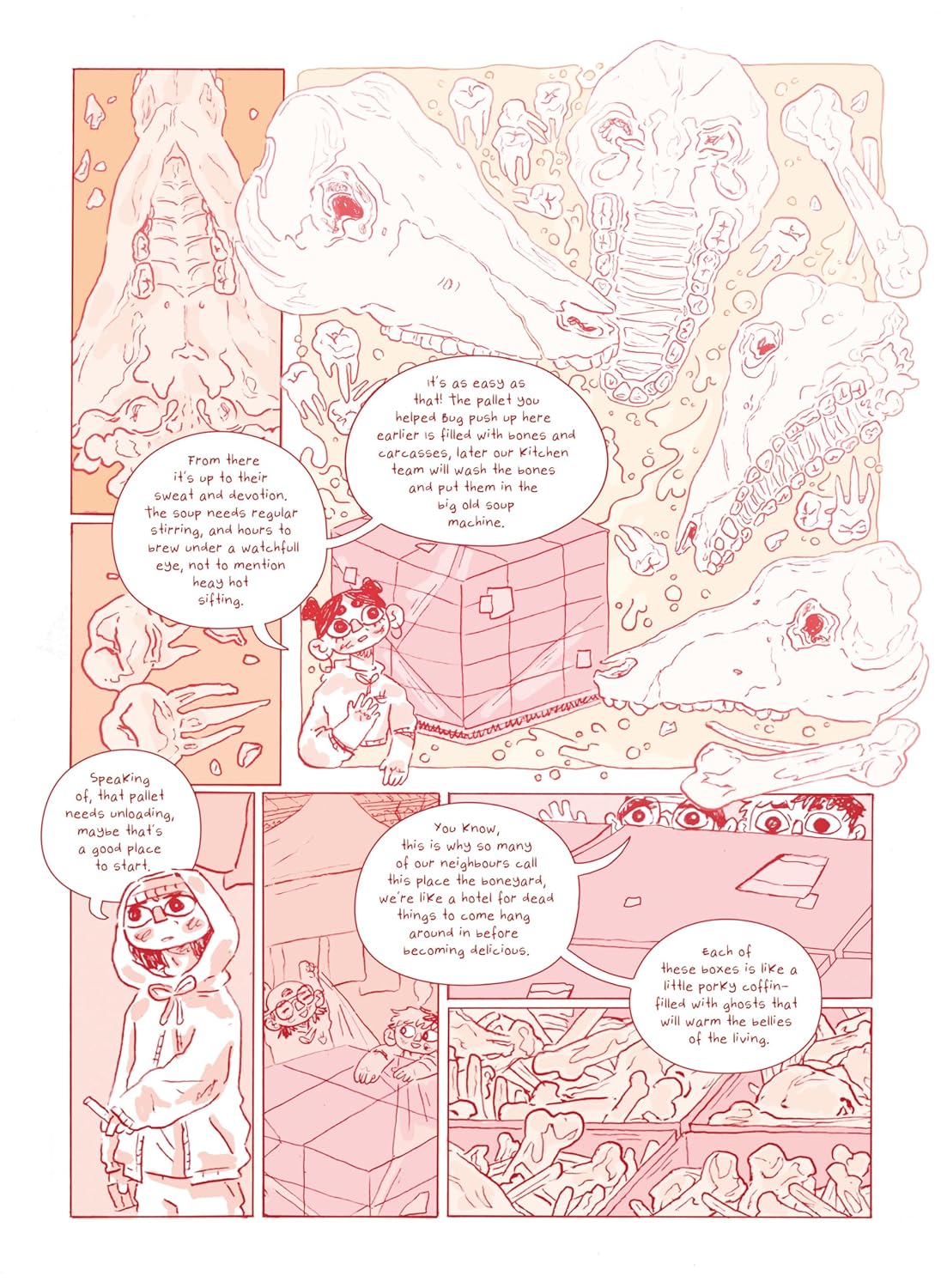
Ash ia young transmaculine artist who almost nearly properly grown up. All that’s missing is to make enough money to pay rent, buy supplies and secure the meds supporting still- ongoing surgeries. That ideal opportunity knocks when crusty old coot/ramen sensei Bug adds the weedy-seeming new guy to the remarkable staff at his traditional noodle bar.

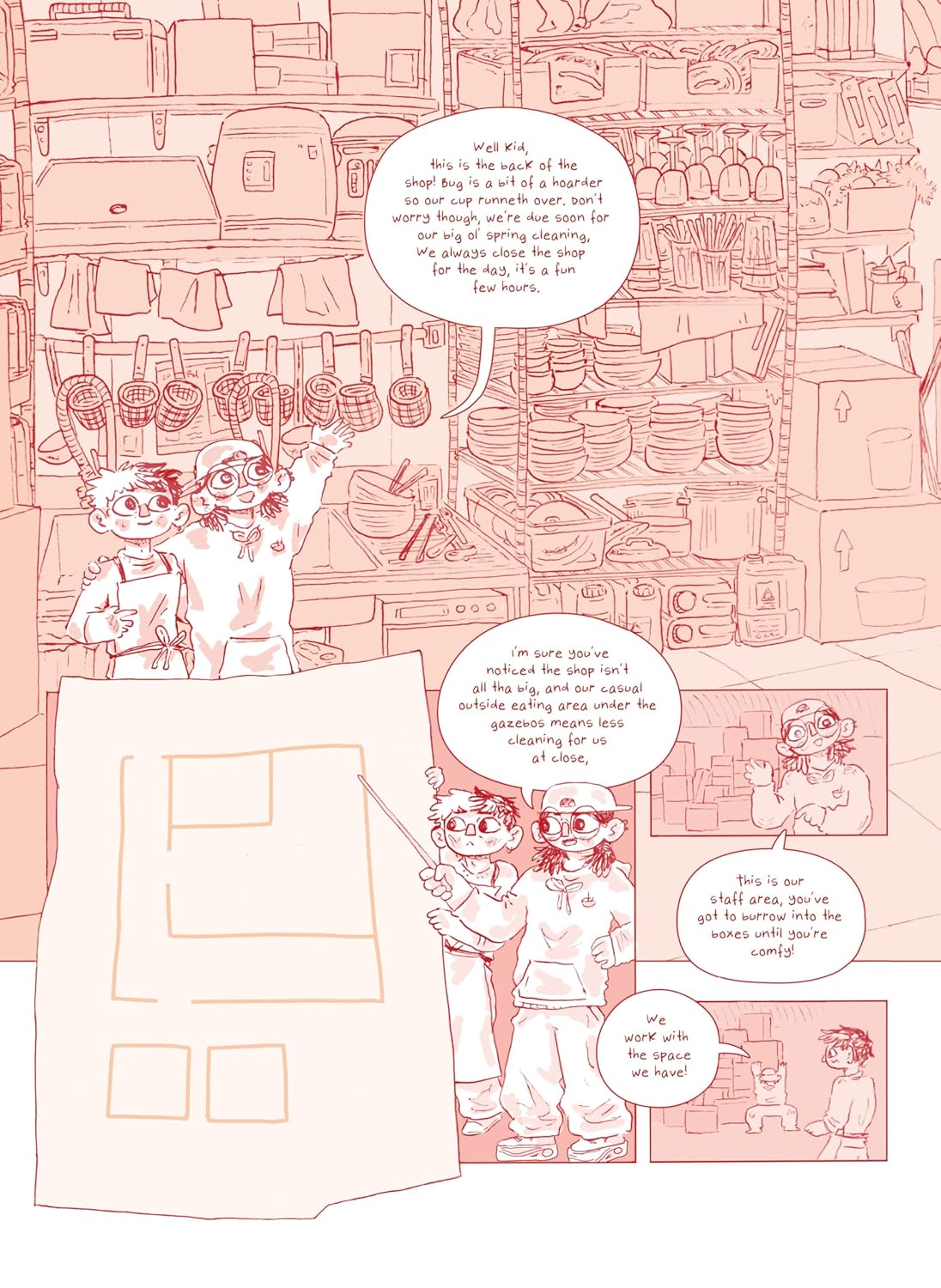
That highly popular haven of exotic eats and affordable takeouts is located off a dingy alley with trains roaring and clattering above at all times. It reminds me of Brixton, but of course, other rail lines, vibrant cross-cultural districts and eateries are available…

Business is brisk and Ash gets acquainted with floor maneger Honey, Sock, Blue, and burly Japanese broth-engineer Creamy – who philosophically monitors and stirs the industrial scale tonkotsu that is basis of all the dishes – whilst scrambling to learn the ropes. The work is intense, fast, complicated, relentless and – just like in any specialist enteprise (like a comic shop for instance ) – sticky, clammy, cloying and jampacked with weirdoes individualists on both sides of the till.

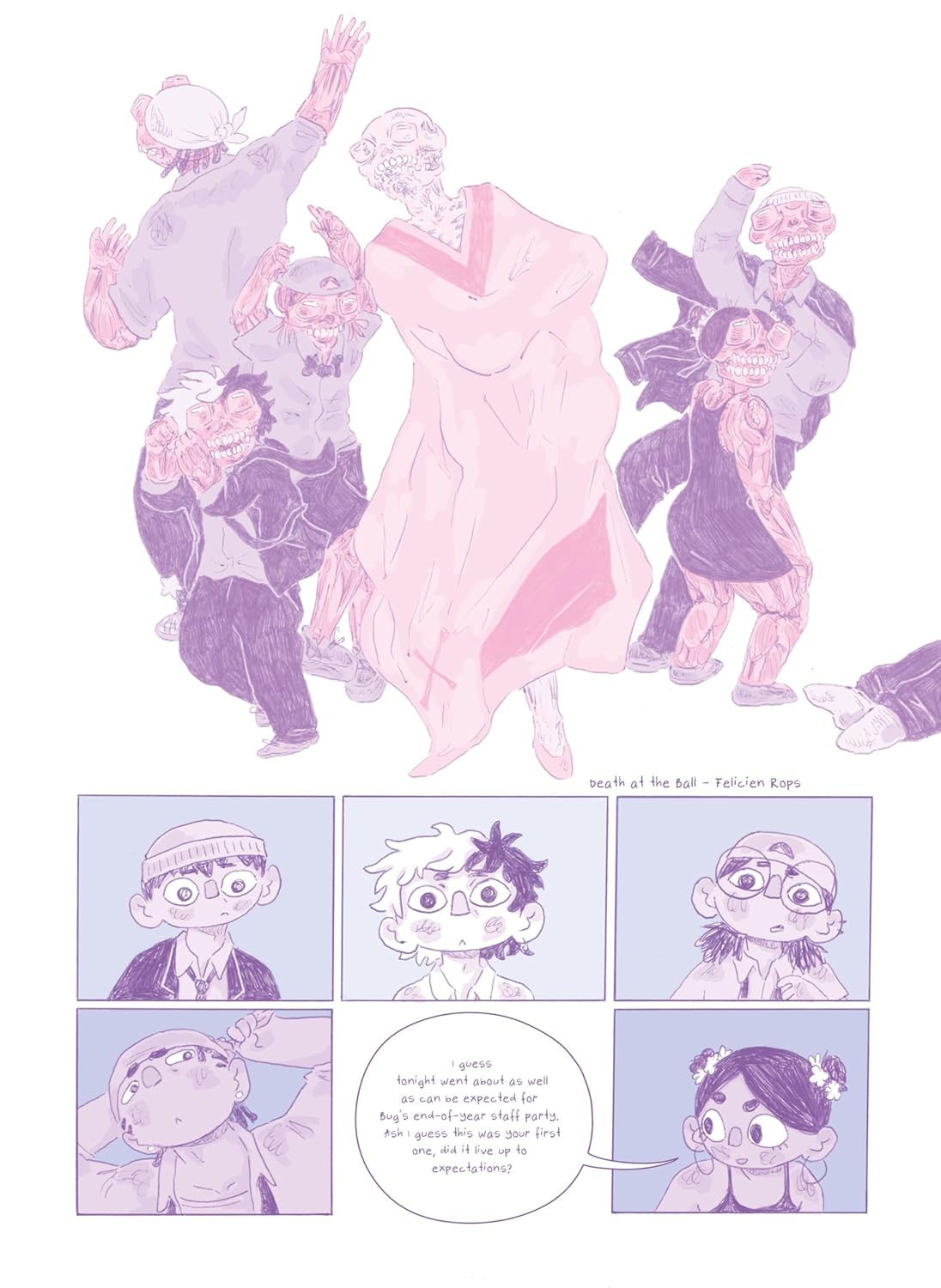
Nevertheless, Ash is immediatly part of the family, trading history and opinions, sharing moments and learning to live with the miasmic funk of entire pig carcasses perpetually becoming soup 24/7. It’s the kind of toil that quickly builds bonds that feel decades old so it’s no wonder everybody kicks back for celebratory drinks occaiosnally. Like the End-of-Year staff do when Bug drinks so much that he just goes to sleep on the floor and everybody took selfies with him.

Of course, Bug wasn’t unconcious and they all have to try and make rational decisions whilst being that drunk. Deleting recents posts is easy and logical but voting to lose the sensei in the body-rending broth doesn’t seem like such a great idea now…

Draped in biological hues and mired in literally organic imagery, Bone Broth’s motifs accentuate an unfolding comedy of errors: deftly mirroring the surgical progress of changing gender whilst reflecting on whatever beneficial butchery is involved in resculpting and crafting a human form with secret knowledge is exposed to those willing to look and think instead of react and revolt. This is a tale that some people will never countenance and that’s sad for them, because its also great stuff demanding second helpings…

Wryly subversive, tantalisingly warming and definitely NOT for little kids, this potent parable is seasoned with buddy film tropes and garnished with a delicious twist that will hit the spot for anyone with a taste for the out-of-the-ordinary fodder. Also included are a heartfelt ‘Thanks’ section and look at the artist’s ‘Process’ to deliver a multi-layered trifle you’d be fool to turn your nose up at.
Text and images © 2025 Alex Taylor. All rights reserved.

Today in 1951 Bob Smith (Super Friends, Superman, Plastic Man, Archie Comics) was born, as was Northampton’s Finest Alan Moore two years later. In 1985 Bill Watterson’s enfant terrible et big buddy Calvin and Hobbes launched. 1991 today saw UK comics stalwart Reg Parlett leave us. All of these optical miracles should be scrutinised at great length, so please go do that…

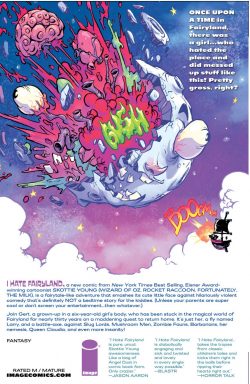
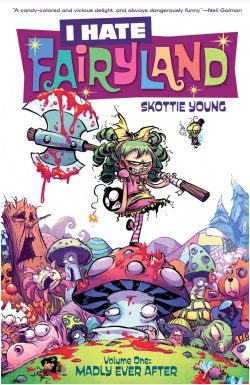
I Hate Fairyland volume 1: Madly Ever After


By Skottie Young, Jean-Francois Beaulieu, Blambot®’s Nate Piekos & various (Image Comics)
ISBN: 978-1-63215-685-3 (TPB/Figital edition)

This book contains Discriminatory Content included for comedic effect.

Win’s Christmas Gift Recommendation: Sugar & Spice & Everything Nicely Reimagined… 10/10

It feels like we haven’t had a good laugh in ages. Oh wait, here’s one now…

We grow up with fairytales all around us. They’re part of the fabric of our lives. Some people generally outgrow them whilst others take them to heart and make them an intrinsic aspect of their lives…

Have you met Skottie Young?

He’s a guy with feet firmly planted in both camps and well able to alternatively embrace the enchantment of imagination and give it a hilariously cynical mean-spirited drubbing at the same time. Hopefully you’ll have seen his glorious, multi-award-winning interpretation of Baum’s Oz books produced by Marvel and his spectacular run on Rocket Raccoon (and Groot!); or perhaps just his gut-bustingly funny baby superhero covers. Maybe you’re aware of his collaboration with Neal Gaiman on Fortunately the Milk?

If not, there’s so much more in store for you after enjoying this particular slice of vintage mirthful mayhem…

I Hate Fairyland is a truly cathartic little gem: a mind-buggering romp of deliciously wicked simplicity and one I heartily recommend as a palate-cleanser for anyone overdosing on cotton candy, wands and glitter, or spandex and slicked-back pecs.

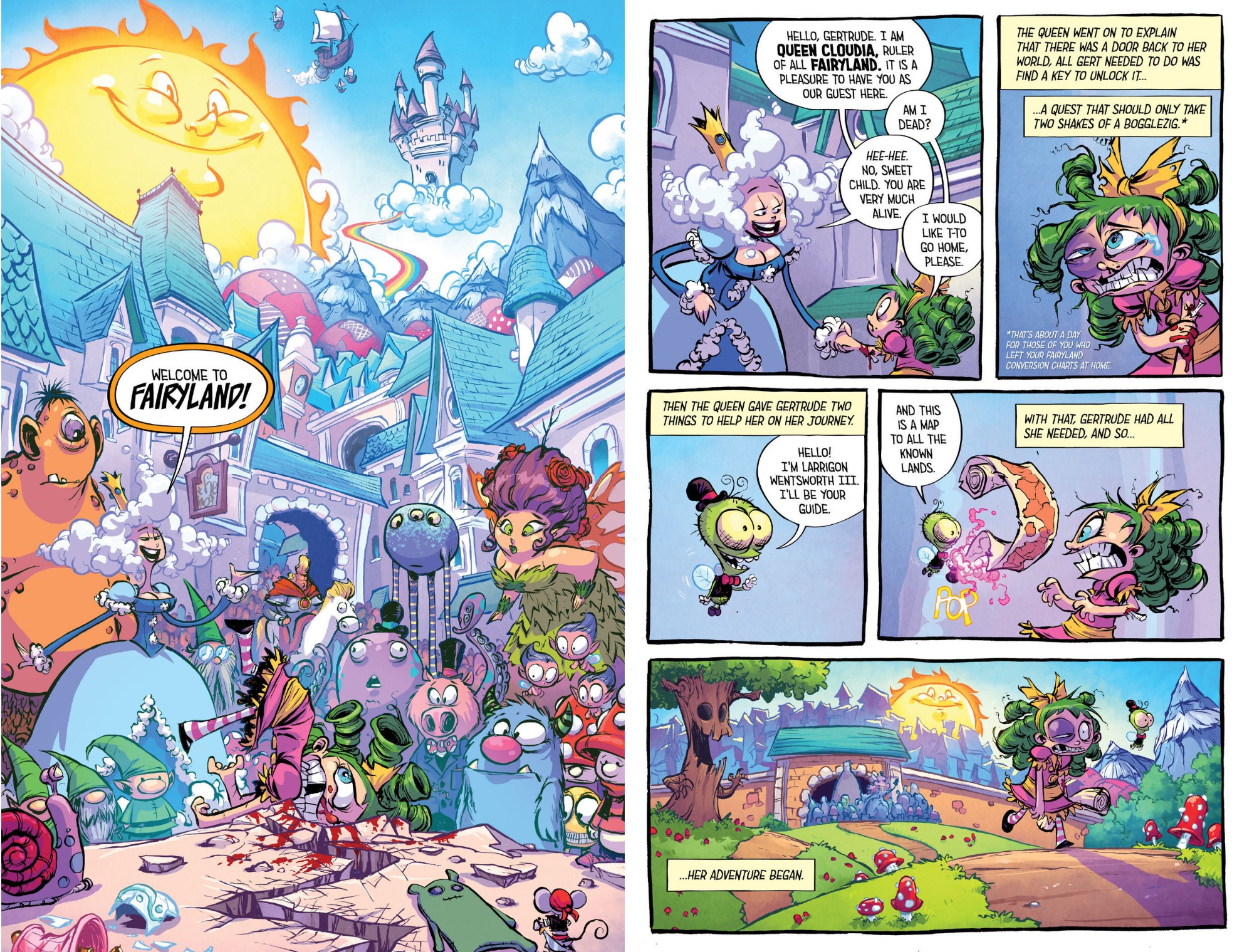
Once upon a time little Gertrude wished she could visit the wonderful world of magic and joyous laughter. Her wish was inexplicably granted and she met happy shiny people: fairies, elves, giants, talking animals and animated trees, rocks, stars, suns and moons; Gert just loved them all…

Resplendent Queen Cloudia made her an Official Guest of Fairyland and invited her to play a game. When she wanted to go back to her own world the bedazzled six-year-old simply had to find a magic key and open the door to the realm of reality. The fabulous Fairy Queen even gave Gertrude a quaintly talking bug as guide and helpmeet, plus a magic map of all the Known Lands…

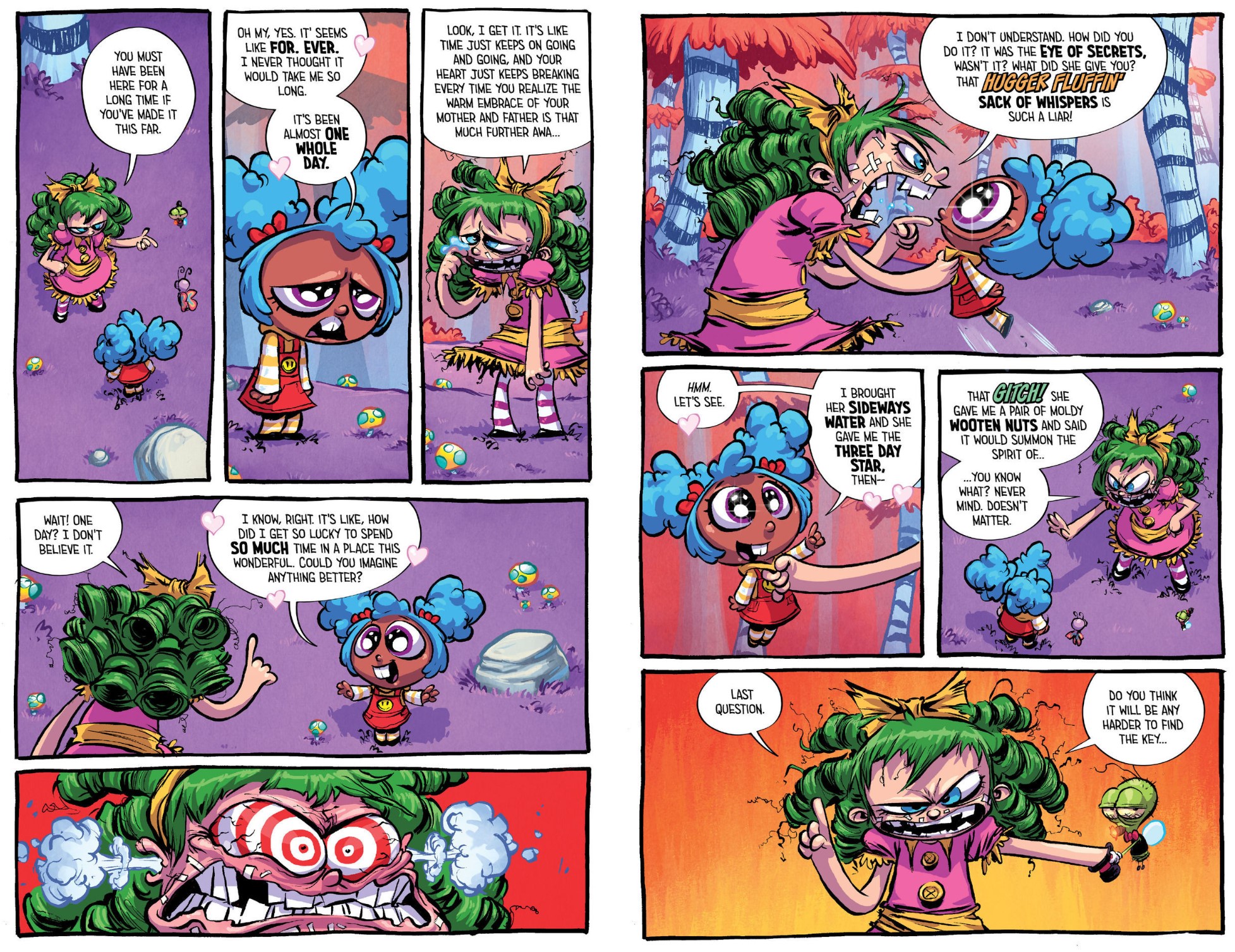
That was 27 years ago and although Gert’s body has not aged a day her mind certainly has. It’s also gotten pretty pissed-off at the interminable insufferable task and just wants it all to end.

Of course, as an Official Guest of Fairyland Gert can’t die and has taken to expressing her monumental frustration in acts of staggering violence and brutal excess as she continues hunting for that fluffer-hugging key…

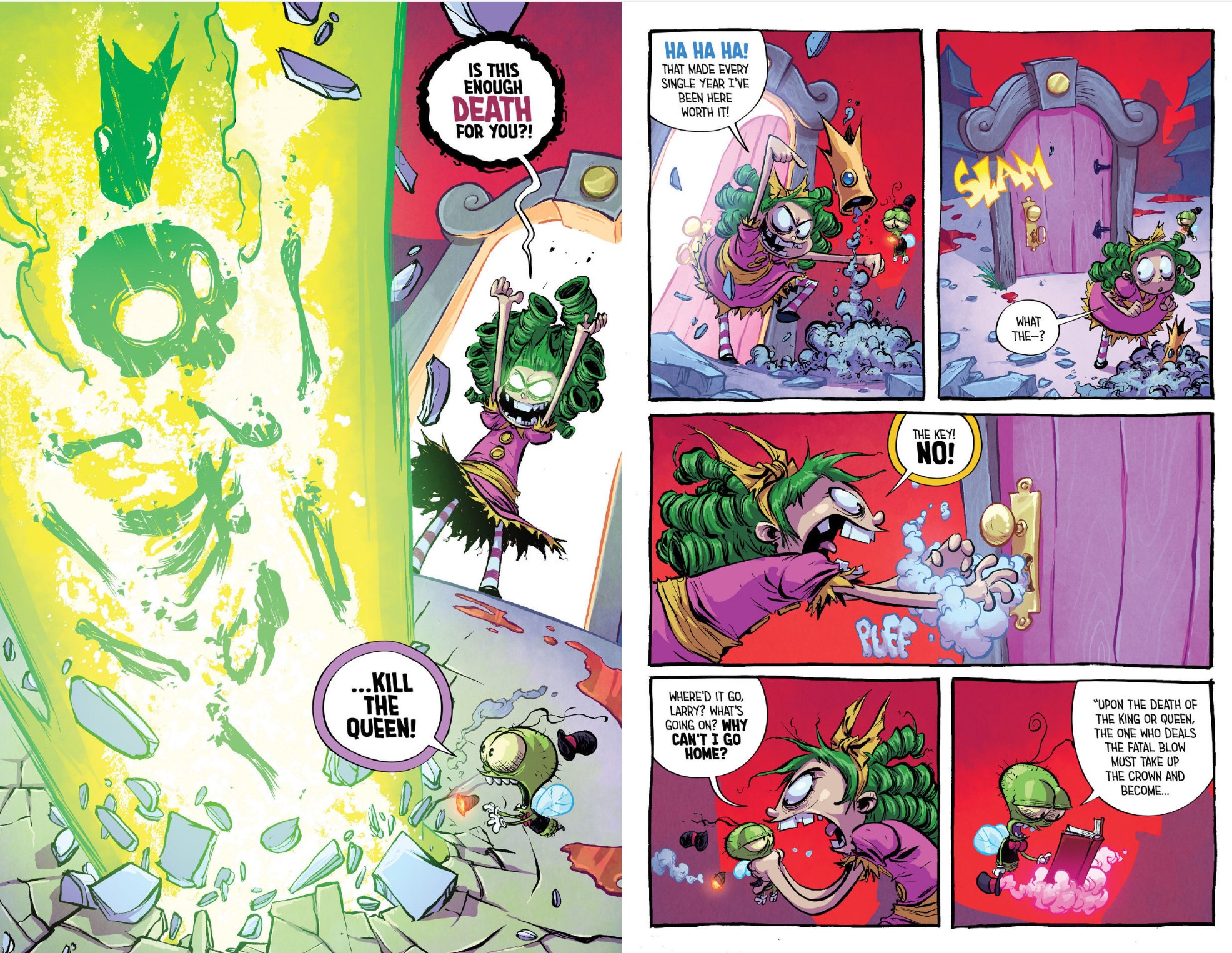
With no other choice, Gert and dissolute bug Larrigon Wentsworth III toil ever onward in search of the way home, regularly enduring horrific – but non-fatal – injuries and taking out their spleen (and often other peoples’) on whoever gets in her way.

After all this time, however, Even Queen Cloudia has had enough. Sadly, she can’t do anything about it whilst Gert is “OFG” (Official Guest of Fairyland, keep up!): a privilege that simply cannot be revoked.

Subtle hints of vast rewards to barbarians and assassins and evil witches all prove worthless too. Between the protection spell and Gert’s own propensity for spectacular bloodletting, there’s nothing in the incredible kingdoms to stop her.

… And then someone has a really amazing idea. Why not invite another sweet little girl to Fairyland and offer her the same deal? When she finds the key, wins the game and goes back, Gert will lose her OFG status and they can be rid of her at last!

Of course, that all goes swimmingly, just like Cloudia hoped and everybody but Gert lives happily ever after.

No, it really, really doesn’t work out like that…

To Be Continued…

Collecting the first five issues of the Image Comic series from October 2015 – February 2016 by Young, colourist Jean-Francois Beaulieu and letterer Nate Piekos of Blambot®, this sublimely outrageous treat offers hilariously over-the-top cartoon violence and the most imaginative and inspired use of faux-profanity ever seen in comics.

This is an unmissable wakeup call for everybody whose kids want to be little princesses and proves once and for all that sweet little girls (and probably comics artists) are evil to the core if you push them too far…
© 2016 Skottie Young. All rights reserved.

Today in 1911, cartoonist Clarence Gray was born. Sadly, there isn’t much of his wonderful Brick Bradford strip around to review. Far more readily represented is Alberto Giolitti whose art can be seen on loads of licensed features books we’ve covered like Star Trek: Gold Key Archives volume 1, and who would be 102 today if he still lived…

In 1941 French star fantasist Caza was born, whilst Superman scribe Elliot S! Maggin joined us in 1950 and FF artist Carlos Pacheco was born in the same year they were: 1961…

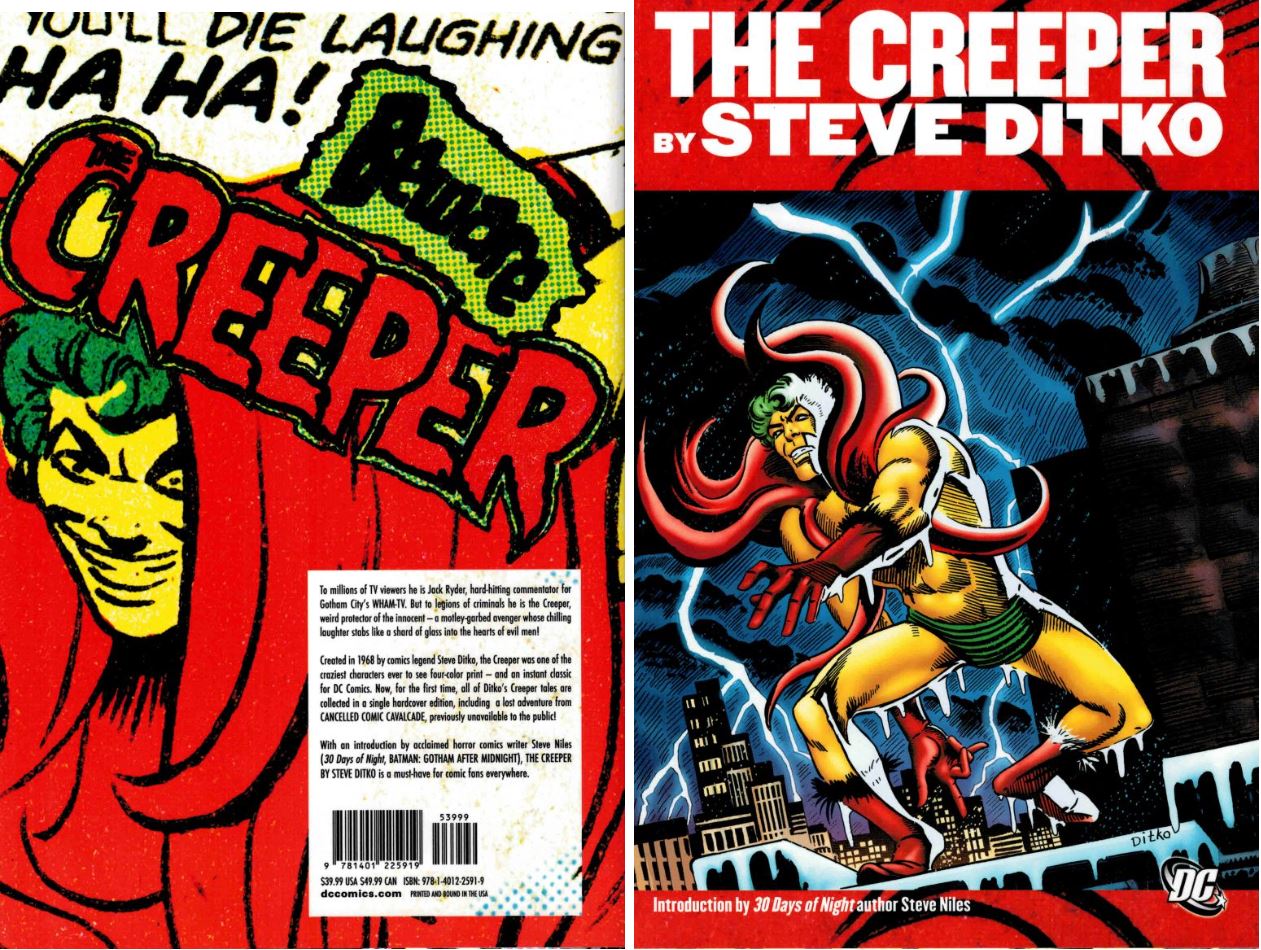
The Creeper by Steve Ditko


By Ditko, Don Segall, Denny O’Neil, Michael Fleisher, Mike Peppe, Jack Sparling & various (DC Comics)
ISBN: 978-1-4012-2592-6 (HB)

This book includes Discriminatory Content produced in less enlightened times.

It’s Steve Ditko’s 99th birthday today and I’m not letting the fact that he’s no longer with us stop us enjoying his wonders and celebrating his unique storytelling mastery…

Steve Ditko was one of our industry’s greatest and most influential talents and, during his lifetime, amongst America’s least lauded. Always reclusive and reticent by inclination, his fervent desire was always just to get on with his job, tell stories the best way he can and let his work speak for him.

Whilst the noblest of aspirations, that attitude was usually a minor consideration – and even an actual stumbling block – for the commercial interests which for so long controlled all comics production and still exert an overwhelming influence upon the mainstream bulk of the comic industry’s output. After Ditko’s legendary disagreements with Stan Lee led to his quitting Marvel – where his groundbreaking efforts made the reclusive genius (at least in comicbook terms) a household name – he found work at Warren Comics and resumed his long association with Charlton Comics.

That company’s laissez faire editorial attitudes had always offered him the most creative freedom, if not greatest financial reward, but in 1968 their wünderkind editor Dick Giordano was poached by the rapidly-slipping industry leader and he took some of his bullpen of key creators with him to DC Comics. Whilst Jim Aparo, Steve Skeates, Frank McLaughlin and Denny O’Neil found a new and regular home, Ditko began only a sporadic – if phenomenally productive – association with DC.

It was during this heady if unsettled period that the first strips derived from Ditko’s interpretation of the Objectivist philosophy of novelist Ayn Rand began appearing in fanzines and independent press publications like Witzend and The Collector, whilst for the “over-ground” publishing colossus he devised a brace of cult classics with The Hawk and the Dove and the superbly captivating concept re-presented here: Beware The Creeper. Later efforts would include Shade, the Changing Man, Stalker and The Odd Man, plus truly unique interpretations of Man-Bat, the Legion of Super-Heroes and many more… including a wealth of horror, mystery and sci fi shorts reminiscent of his Charlton glory days.

The auteur’s comings and goings also allowed him to revisit past triumphs and none more so than with The Creeper – who kept periodically popping up like a mad, bad penny. This superb hardcover compilation – still tragically and inexplicably languishing with other classics DC hasn’t got around to making available in digital formats – gathers every Ditko-drafted/delineated Creeper classic from a delirious decade for your delight, and the spooky superhero spectacle kicks off with an effusive Introduction from appreciative fan Steve (30 Days of Night) Niles.

This collation curates tales from Showcase #73; Beware the Creeper #1-6; 1st Issue Special #7; World’s Finest Comics #249-255 and Cancelled Comics Cavalcade #2/Showcase #106 (collectively spanning March/April 1968 to February/March 1979), so settle in for a long ride…

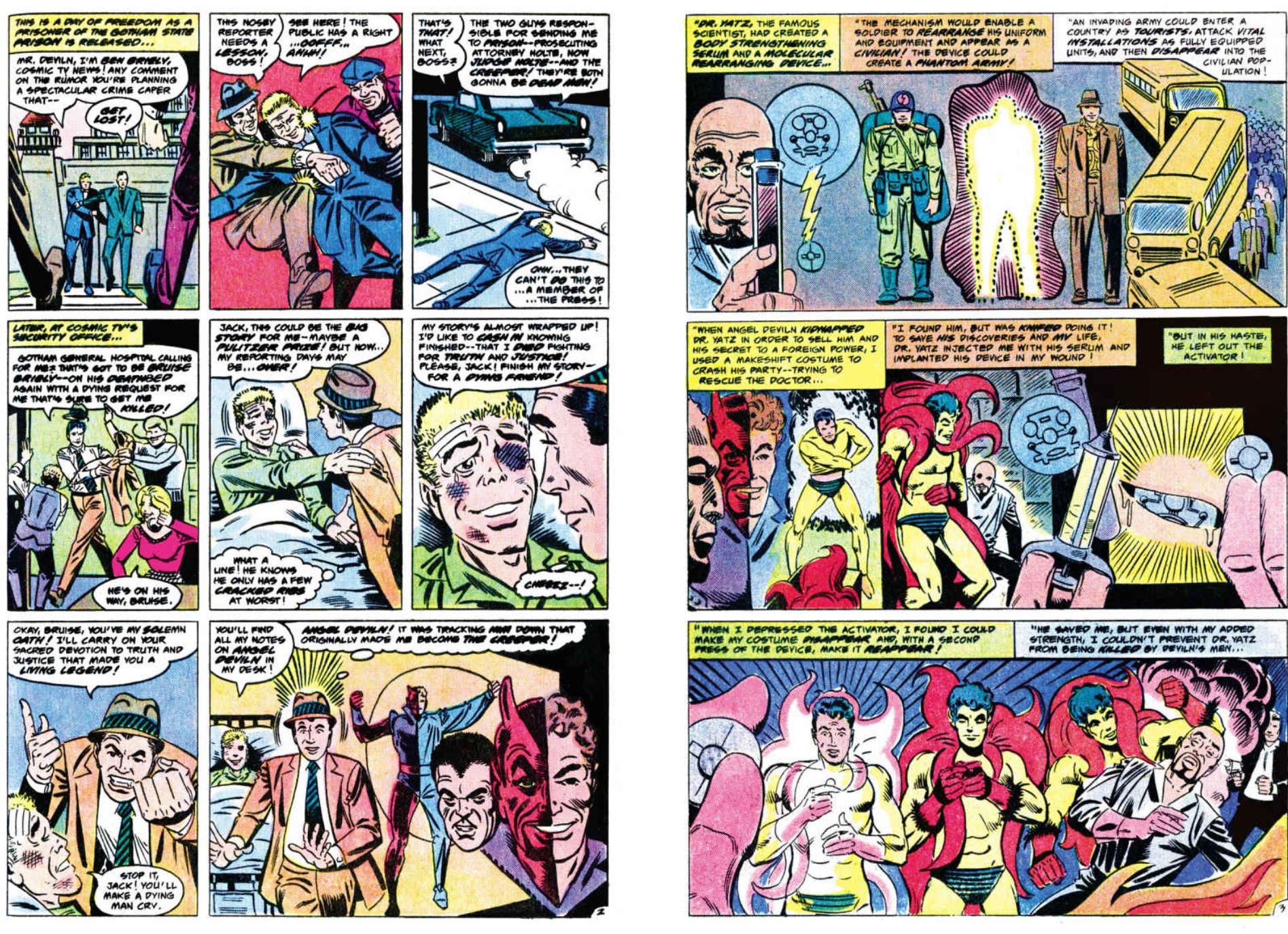
Like so many brilliant ideas before it, Ditko’s bizarre DC visions first exploded off the newsstands in try-out title Showcase. Issue #73 heralded ‘The Coming of the Creeper!!’ with veteran comics & TV scripter Don Segall putting the words to Ditko’s plot and illustrations. The moodily macabre tale introduces suicidally-outspoken TV host Jack Ryder, whose attitude to his show’s sponsors and cronies loses him his cushy job. His brazen attitude does, however, impress network security chief Bill Brane and the gruff oldster offers him a job as an investigator and occasional bodyguard.

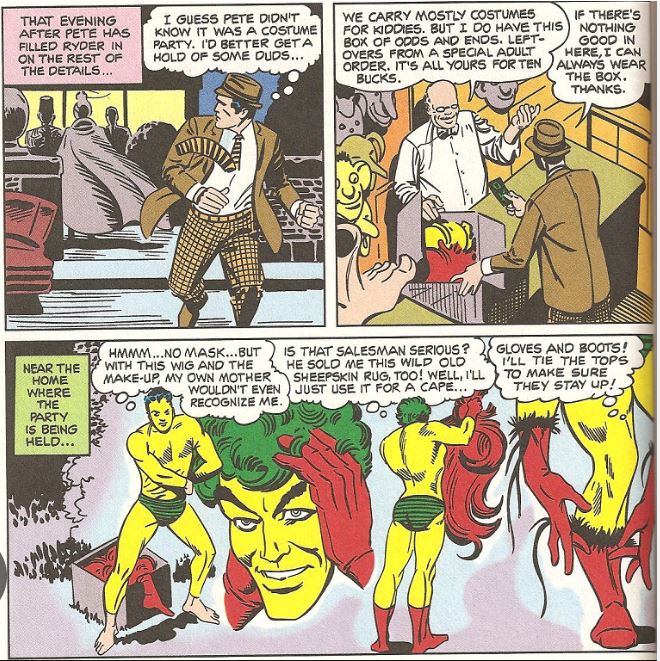
Jack’s first case involves tracking down recent Soviet defector Professor Yatz who has gone missing. The CIA suspect has been abducted by gangster Angel Devilin and sold to Red agent Major Smej. Displaying a natural affinity for detective work, Ryder tracks a lead to Devilin’s grand house and interrupts a costume party designed as a cover to make the trade. Promptly kicked out by thugs, Ryder heads for a costume shop but can only find a box of garish odds and ends… and lots of makeup.

Kitted out in a strange melange of psychedelic attire and accoutrements, he breaks back in but is caught and stabbed before being thrown into a cell with the missing Yatz. The scientist – also grievously wounded – is determined to keep his inventions out of the hands of evil men. These creations comprise an instant-healing serum and a Molecular Transmuter, able to shunt whatever a person is wearing or carrying into and out of our universe. A fully equipped army could enter a country as harmless tourists and materialise a complete armoury before launching sneak attacks…

To preserve them, Yatz lodges the Transmuter inside Ryder’s knife wound before injecting him with the untested serum. The effect is instantaneous and doesn’t even leave a scar. The investigator is also suddenly faster, stronger and more agile…

When Jack presses a handheld activator, he is instantly naked, and experimentation shows that he can make his motley costume appear and disappear just by touching a button. Of course, now, whenever it is activated, neither makeup nor wig, bodystocking, boots or gloves will come off. It’s like the crazy outfit has become his second skin…

When the gangsters come for their captives, Yatz is burning his notes. In the fracas that follows he catches a fatal bullet and, furious, guilt-ridden and strangely euphoric, Ryder goes after the thugs and spies. By the time the cops arrive he finds himself (or at least his canary yellow alter ego) blamed by Devilin for the chaos and even a burglary. The mobster has even given him a name – The Creeper

As soon as the furore dies down vengeful Ryder returns to exact justice for the professor and discovers his uncanny physical prowess and macabre, incessant unnerving laughter give him an unbeatable edge whilst winning him a supernatural reputation…

After that single yarn the haunting hero hurtled straight into his own bimonthly series. Beware the Creeper #1 debuted with a May/June cover-date. Behind one of the most evocative covers of the decade – or indeed, ever – ‘Where Lurks the Menace?’ (scripted by Denny O’Neil under his occasional pen-name Sergius O’Shaughnessy) finds Ryder and the Creeper hunting an acrobatic killer beating to death numerous shady types in a savage effort to take over the city’s gangs. Sadly, Jack’s relentless pursuit of “the Terror” and careful piecing together of many disparate clues to his identity is hindered by the introduction of publicity-hungry, obnoxious glamour-puss ‘Vera Sweet’. The TV weathergirl thinks she has the right to monopolise Ryder’s time and attention, even when he’s ducking fists and bullets…

The remainder of the far-too-brief run featured a classic duel of opposites as a chameleonic criminal mastermind insinuated himself into the lives of Jack and the Brane bunch. It all began with ‘The Many Faces of Proteus!’ in BtC #2 (by Ditko & O’Shaughnessy) wherein a pompous do-gooder’s TV campaign against The Creeper is abruptly curtailed after the Golden Grotesque shows up at the studio and throws bombs.

Caught in the blast is baffled and battered Jack Ryder, and he’s even more bewildered when Brane informs him that a tip has come in confirming the Creeper is working for gambler gangboss Legs Larsen

Dodging Vera, whose latest scheme involves a fake engagement, the real Creeper reaches Larsen’s gaming house in time to see a faceless man put a bullet into the prime suspect. In the ensuing panic the Laughing Terror transforms back into Ryder and strolls out with Larsen’s files, unaware that the faceless man is watching him leave and putting a few clues together himself…

The documents reveal a lone player slowly consolidating a grip on the city’s underworld but discloses no concrete information, so the Creeper goes on a very public rampage against all criminals in hopes of drawing Proteus out. The gambit works perfectly as a number of close friends try to kill Ryder, but only after frantically fending off flamethrower-wielding Vera in his own apartment does the Creeper realise that Proteus is far more than a madman with a makeup kit. A spectacular rooftop duel ends in a collapsed building and apparent end of the protean plunderer… but there’s no body to be found in the rubble…

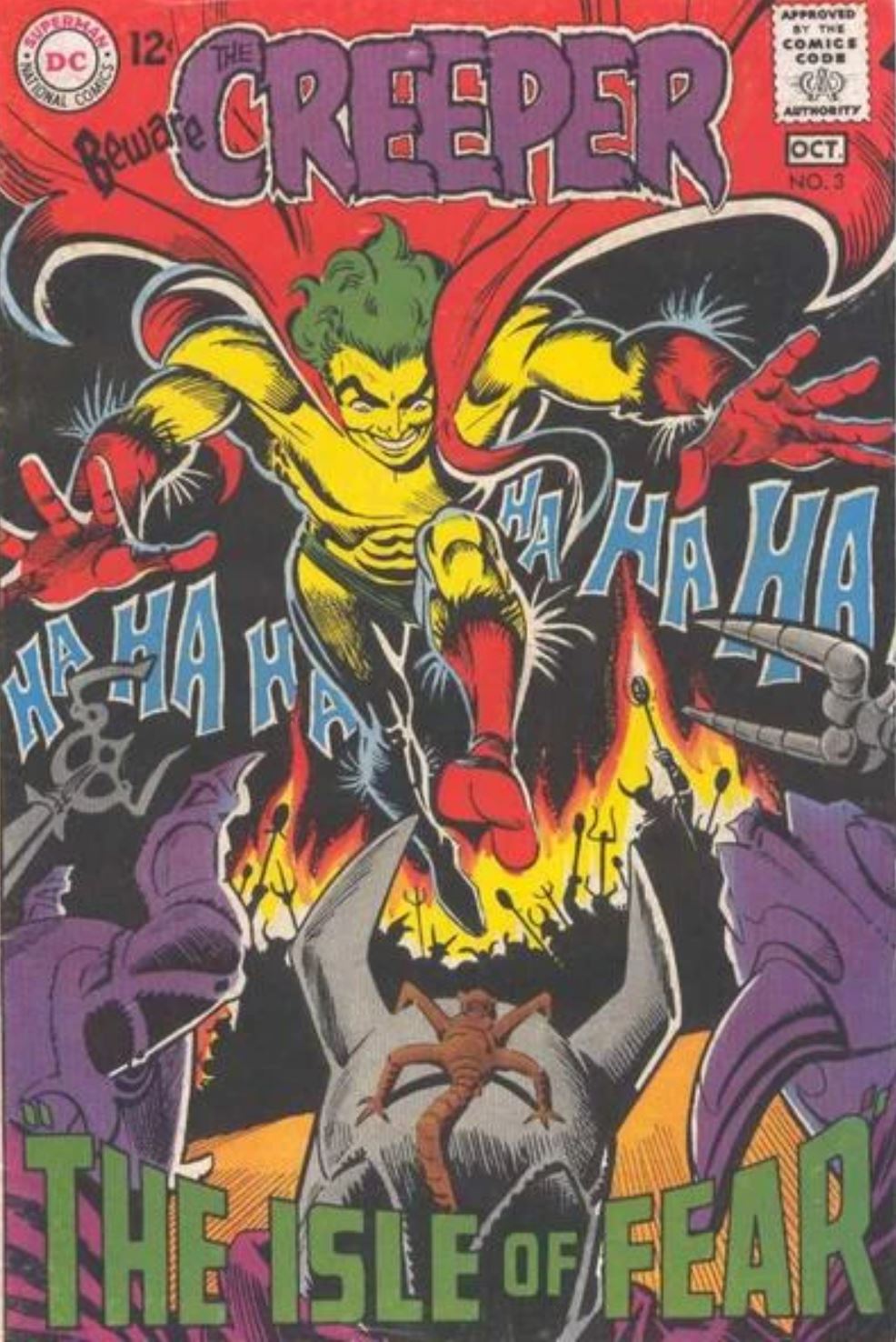
Beware the Creeper #3 has our outré hero tearing the city’s thugs apart looking for Proteus, but his one-man spook-show is curtailed when Brane sends Ryder to find Vera. Little Miss Wonderful is determined to be the first to interview an island society cut off from the world for over a century, but all contact has been lost since she arrived. Tracking her to ‘The Isle of Fear’ Jack finds her in the hands of a death cult. More important to Ryder, however, is the fact that the Supreme One leading the maniacs is actually a top criminal offering sanctuary to Proteus flunkies he’s been scouring the city for…

Back in civilisation again, ‘Which Face Hides My Enemy?’ sees Ryder expose High Society guru and criminal mesmerist Yogi Birzerk’s unsuspected connection to Proteus. The cops drive The Creeper away before he can get anything from the charlatan, and when he dejectedly returns home Jack walks into an explosive booby trap in his new apartment. The “warning” from Proteus heralds the arrival of Asian troubleshooters Bulldog Bird and Sumo who claim to be also pursuing the faceless villain. They reveal he was a high-ranking member of the government of Offalia who stole a chemical which alters the molecular composition of flesh, before suggesting they all team up. Heading back to Bizerk’s place, it soon becomes clear that they are actually working for Proteus and that the faceless fiend knows Ryder’s other identity…

With #5, inker Mike Peppe joined Ditko & O’Neil as the epic swung into high gear with ‘The Color of Rain is Death!’ Proteus makes his closing moves, attacking Jack’s associates and framing him again whilst preparing for a criminal masterstroke which will win him much of the city’s wealth. Luring the Creeper into the sewers as a major storm threatens to deluge the city, the face-shifter reveals a scheme to blow up the drainage system and cause catastrophic flooding. After a brutal battle, he also leaves The Creeper tied to a grating to drown…

The stunning saga closed with final issue Beware the Creeper #6 (March/April 1969), by which time Ditko had all but abandoned his creation. ‘A Time to Die’ saw tireless, reliable everyman artist Jack Sparling pencil most of the story as the Howling Hero escapes his death-trap, deciphers the wily villain’s true gameplan and delivers a crushing final defeat. It was fun and thrilling and – unlike many series which folded at that troubled time – even provided an actual conclusion, but it somehow it wasn’t satisfactory and it wasn’t what we wanted.

This was a time when superheroes went into another steep decline with supernatural and genre material rapidly gaining prominence throughout the industry. With Fights ‘n’ Tights comics folding all over, Ditko concentrated again on Charlton’s mystery line, an occasional horror piece for Warren and his own projects…

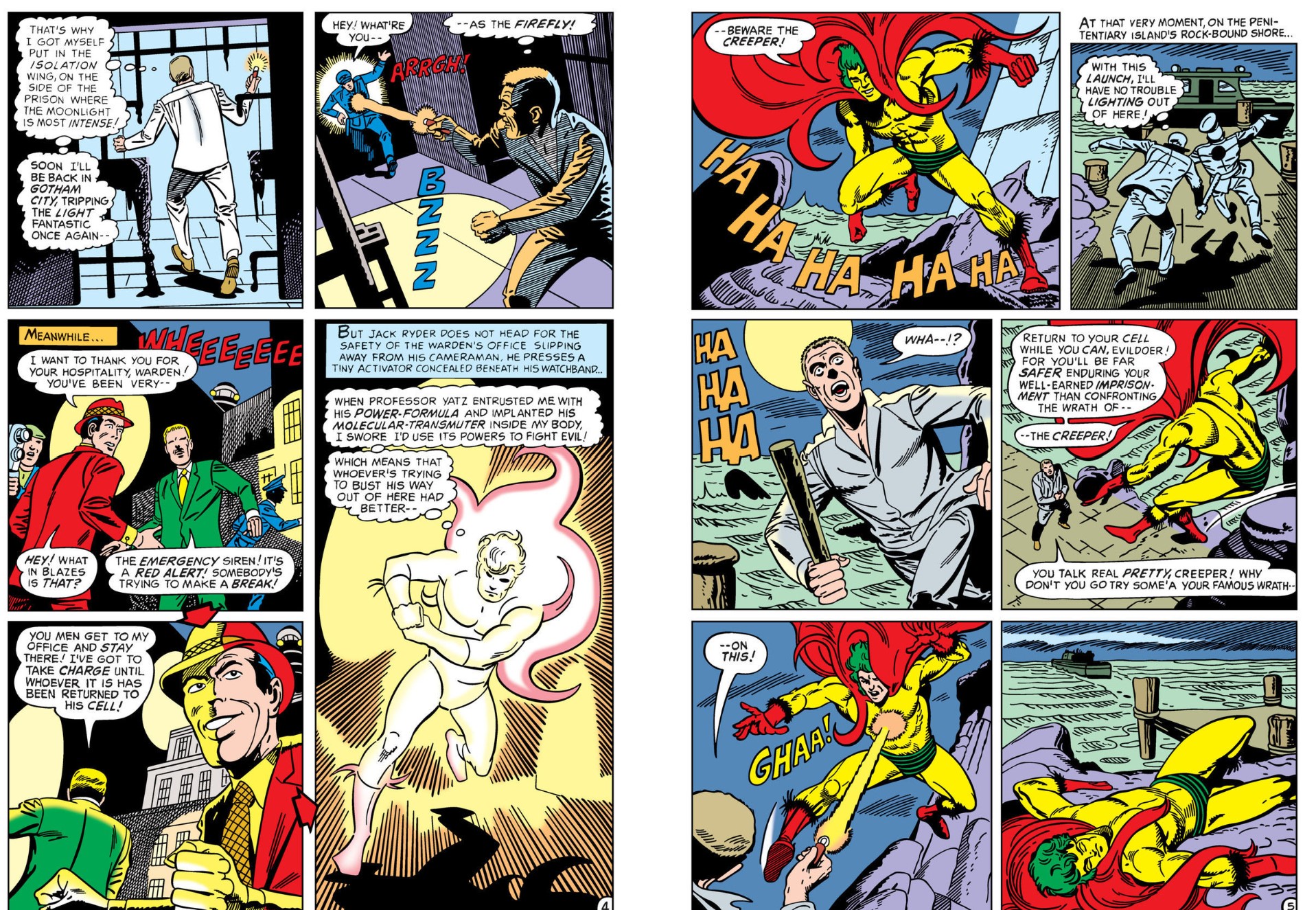
In the years his own title was dormant, the Creeper enjoyed many guest shots in other comics and it was established that the city he prowled was in fact Gotham. When Ditko returned to DC in the mid-1970s, try-out series 1st Issue Special was alternating new concepts with revivals of old characters. Issue #7 (October 1975) gave the quirky crusader another shot at stardom in ‘Menace of the Human Firefly’ – written by Michael Fleisher & inked by Mike Royer. Here restored TV journalist Jack Ryder is inspecting the fantastic felons in Gotham Penitentiary just as manic lifer Garfield Lynns breaks jail to resume his interrupted costumed career as the master of lighting effects. By the time the rogue’s brief but brilliant rampage is over, the Creeper has discovered something extremely disturbing about his own ever-evolving abilities…

The story wasn’t enough to restart the rollercoaster, but some years later DC instituted a policy of giant-sized anthologies, and the extra page counts allowed a number of lesser lights to secure back-up slots and shine again. For World’s Finest Comics #249-255 (cover-dated February/March 1978 to February/March 1979) Ditko was invited to produce a series of 8-page vignettes starring his most iconic DC creation. This time he wrote as well as illustrated and the results are pure eccentric excellence. The sequence begins with ‘Moon Lady and the Monster’ as Ryder – once again a security operative for Cosmic Broadcasting Network – must ferret out a grotesque brute stalking a late-night horror-movie hostess, after which #250’s ‘Return of the Past’ reprises the origin as Angel Devilin gets out of jail and goes looking for revenge…

In WFC #251, ‘The Disruptor’ proves to be a blackmailer attempting to extort CBN by sabotaging programmes whilst ‘The Keeper of Secrets is Death!’ in #252 follows the tragic murder of Dr. Joanne Russell who was accused on a sensationalistic TV show of knowing the Creeper’s secret identity. Next issue ‘The Wrecker’ offers an actual grudge-bearing mad scientist who has built a most unconventional robot, whilst ‘Beware Mr. Wrinkles!’ in #254 debuts a villain with the power to age his victims. Neither, however, are a match for the tireless, spring-heeled Technicolor Tornado, whose too-short return culminates in a lethal duel with a knife-throwing jewel thief in #255’s ‘Furious Fran and the Dagger Lady’

Until this volume, that was it for Ditko devotees and Creeper collectors, but as the final delight in this splendid compendium reveals, there was more. An ill-considered expansion was followed by 1978’s infamous “DC Implosion”, when a number of titles were shut down or cancelled before release. One of those was Showcase #106 which would have featured a new all-Ditko Creeper tale.

It was collected – with sundry other lost treasures – in a copyright-securing, monochrome, minimum print-run internal publication entitled Cancelled Comics Cavalcade. Here, from CCC #2 (1978) and presented in stark black & white, fans can see the Garish Gallant’s last Ditko-devised hurrah as ‘Enter Dr. Storme’ pits the Creeper (and cameo crimebuster The Odd Man) against a deranged weatherman turned climatic conqueror able to manipulate the elements.

Fast, fight-filled, furiously fun and devastatingly dynamic, Beware the Creeper was a high-point in skewed superhero sagas and this is a compendium no lovers of the genre can do without.
© 1968, 1969, 1975, 1978, 1979, 2010 DC Comics. All Rights Reserved.

Today in 1926 Harvey Comics star and Anthro originator Howie Post was born, followed a year later by the mighty Steve Ditko. Just scroll back up or look anywhere on this blog, dude!

Sadly, it’s also the anniversary of Wally Wood’s death in 1981. We last looked closely at Ditko’s frequent collaborator in Cannon.

Lola – a Ghost Story


By J. Torres & Elbert Or (Oni Press)
ISBN: 978-1-934964-33-0 (HB/Digital edition) 978-1-93266-424-9 (PB)

These days young kids are far more likely to find their formative strip narrative experiences online or between the card-covers of specially tailored graphic novels rather than the comics and periodicals of my long-dead youth.

In times past the commercial comics industry thrived by producing copious amounts of gaudy, flimsy pamphlets subdivided into a range of successfully, self-propagating, seamlessly self-perpetuating age-specific publications.

Such eye-catching items generated innumerable tales and delights intended to entertain, inform and educate such well-defined target demographics as Toddler/Kindergarten, Younger and Older Juvenile, General, Girls, Boys and even Young Teens, but today the English-speaking world can only afford to maintain a few paltry out-industry licensed tie-ins and spin-offs for a dwindling younger readership.

Where once cheap and prolific, comics periodicals in the 21st century are extremely cost-intensive and manufactured for a highly specific – and dwindling – niche market, whilst the beguiling and bombastic genres that originally fed and nurtured them are more immediately disseminated via TV, movies and assorted interactive games, media or streaming services.

Happily, old-school prose publishers and the graphic novel industry still have a different business model and more sustainable long-term goals, so magazine makers’ surrender became their window, as solid, reassuringly sturdy Comic Books bucked the pamphlet/papers trend.

Some of the old-fashioned publishers even evolved and joined the revolution…

Independent comics mainstay Oni made the switch to sturdy stand-alone one-offs at the end of the last century, publishing a succession of superbly illustrated tales splendidly pushing the creative envelope whilst providing memorable yarns irresistibly luring young potential fans of the form into our world.

That looks quite creepy in type-form but that’s okay – this is a beguilingly spooky story and you should be on your guard.

Aimed at readers of seven and above, Lola – a Ghost Story follows young Canadian Jesse as he returns to the rural Philippines farm where his parents grew up. It’s not his first visit, but it is the saddest. They’re going back for the funeral of his grandmother…

In the Tagalog language Lola means “grandmother” and Jesse’s was pretty scary. She was old and ugly, had a hump on her back and – he thinks – she tried to drown him when he was a baby. Grandma Lola also saw dead things and monsters and the future… just like Jesse does. Despite all this he loved her very much and really doesn’t want to accept that she’s gone forever.

After hours of exhausting travel into the forbidding wild regions, Jesse and his folks at last arrive at the old farmhouse which has witnessed so much tragedy. The little visitor fulsomely greets his uncle and cousin Maritess, but won’t acknowledge her brother JonJon. That kid’s acting like a jerk as usual, and besides he’s been dead for over a year and no-one else can see him…

Soon the family are gathered together: eating, memorialising the departed and telling stories of Lola – like the time she saw the giant devil-pig and saved the entire family from financial ruin. Despite a convivial atmosphere, Jesse is still ill at ease. Even though everyone here believes grandmother had second sight and blessed gifts, the sensibly modern boy can’t bring himself to believe the things he sees are real. Maritess believes though, and she suspects what Jesse won’t admit even to himself…

After JonJon teases him some more and taunts him with the giant bestial, cigar-smoking Kapre lurking at the window, Jesse finally drops into an exhausted, nervous slumber. The funeral next day is horrible. Everybody is sad, the church is filled with so many shockingly damaged spirits and Jesse is afflicted with a vision of being trapped and burning which makes him run screaming from the ceremony.

Still traumatised that evening, he finds JonJon’s old toybox on his bed and Maritess guesses what has happened. She tells her cousin the story of the bloodsucking Manananggal which attacked Lola’s mother, causing her unborn daughter’s hump back and magical sight. Such gifts and curses usually skip a generation and Maritess always assumed she’d be the one to get the sight, but now that it’s clear Jesse is the one to inherit the power, she’s determined to give him all the help he needs.

The recovered box is full of JonJon’s toy cars, and, after playing with them, Jesse and the dead boy romp over by the farm wall… the one where nobody is allowed to go anymore…

Jesse’s uncle isn’t doing very well: all the tragedies have made him very sad and he’s drinking an awful lot. There are other problems bothering Jesse too. The entire family have stories about grandmother and it’s clear she was brave and determined and fought monsters all her life: is that, then, why she tried to drown him when he was a baby?

Maritess tells her Canadian cousin about the time little Lola saved her school friends from a predatory Tiyanak – a baby-shaped carnivorous monster – and he readies himself to ask her if she thinks he might be evil. Just then her father comes in very drunk and shouts at him for leaving JonJon’s cars in the garden.

They are all he has left to remember his son and the boy’s favourite one is already missing. Jesse knows which one it is… the striped one JonJon calls “Zebra” which he wouldn’t share with him last night by the wall…

Uncle Tim hates the wall. It had something to do with his son’s death and Jesse knows he’ll get into trouble if he goes over it. But Uncle is so sad. He misses his boy and really wanted to bury Zebra with JonJon, but it’s gone and the man is so drunk and angry all the time now…

Jesse’s fear that Lola saw something evil in him is calmed by Maritess, who thinks he should use his gift to help people – just like just their grandmother used to. So, when JonJon appears again, Jesse climbs the despised wall and vanishes into the wild unknown beyond…

With Jesse’s first good deed successfully accomplished, JonJon can rest and Uncle Tim is at peace. The troubled psychic is even a little less disturbed by his power and apparent destiny. Sadly, that all changes on the trip back to the airport when Jesse sees something utterly horrifying…

Evocative, compelling, gently enthralling and with a genuinely scary shock ending, this superb child’s chiller is filled with a fascinating new bestiary of monsters and bogey-men to bedazzle Western eyes and imaginations, but mostly relies on captivating art and top-notch storytelling to draw readers in.

I loved it and so will you…
Lola is ™ & © 2009 J. Torres. All other material © 2009 Oni Press, Inc. All Rights Reserved.

The Golden Age Spectre Archives


By Jerry Siegel & Bernard Baily with Gardner F. Fox & various (DC Comics)
ISBN: 978-1-5638-9955-3 (HB)

This book includes Discriminatory Content produced in less enlightened times.

Win’s Christmas Gift Recommendation: Masterpieces for all Comics Addicts… 9/10

Ola! Happy Día de (los) Muertos!

There were and still are a lot of comics anniversaries this year: many rightly celebrated, but a lot were unjustly ignored. As a feverish fanboy wedged firmly in the past, I’m abusing my privileges here to kvetch again about another brilliant vintage book, criminally out of print and not slated for revival either physically or in digital formats. That means occasionally recommending items that might be a bit hard to find. At least you might be buying from those poor beleaguered comics shops and specialists desperately in need of your support now, rather than some faceless corporate internet emporium..,

In fact, considering the state of the market, how come DC doesn’t just convert its entire old Archive line into eBooks and win back a few veteran fans? Don’t ask me, I only imitate working here…

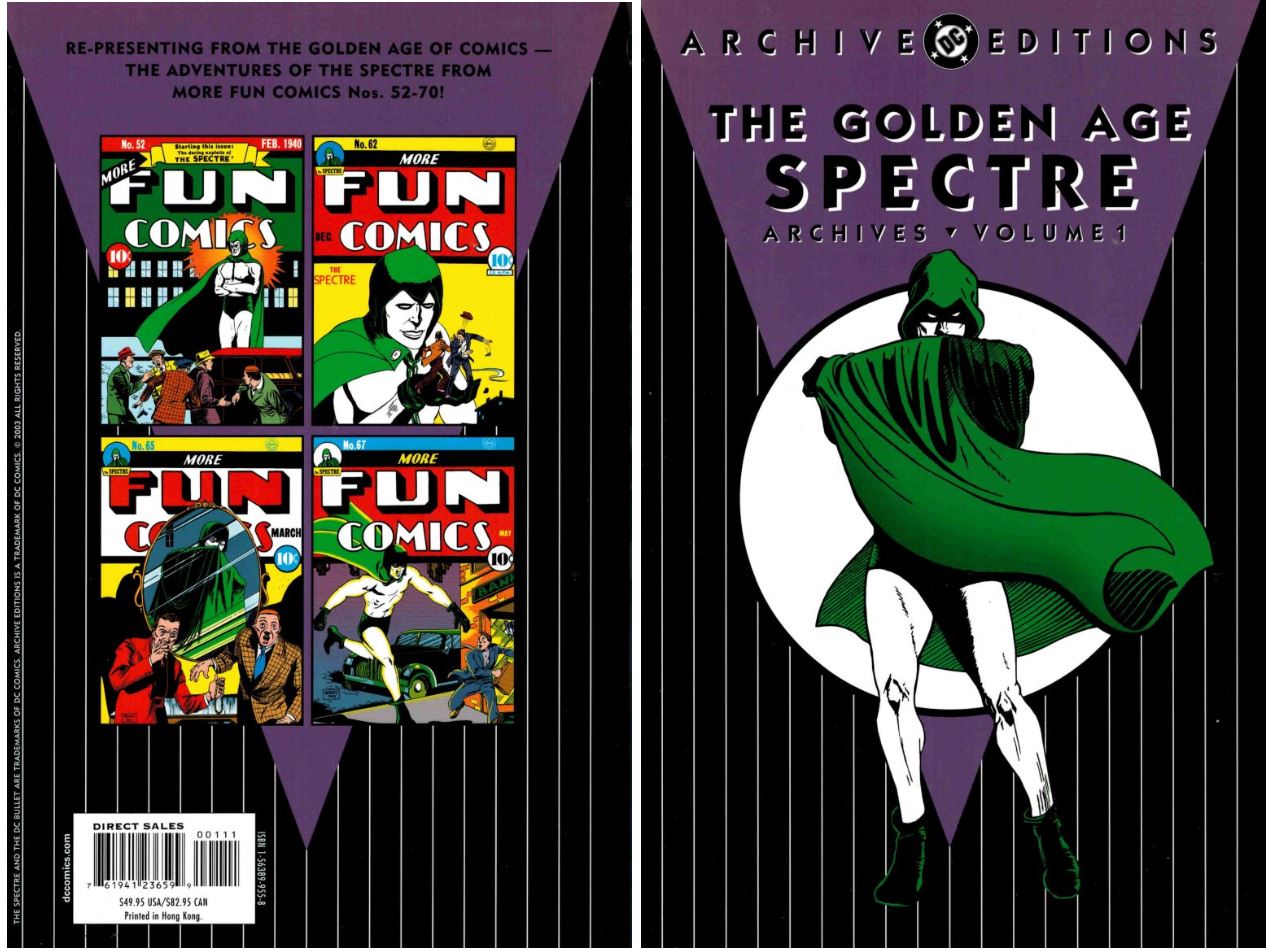
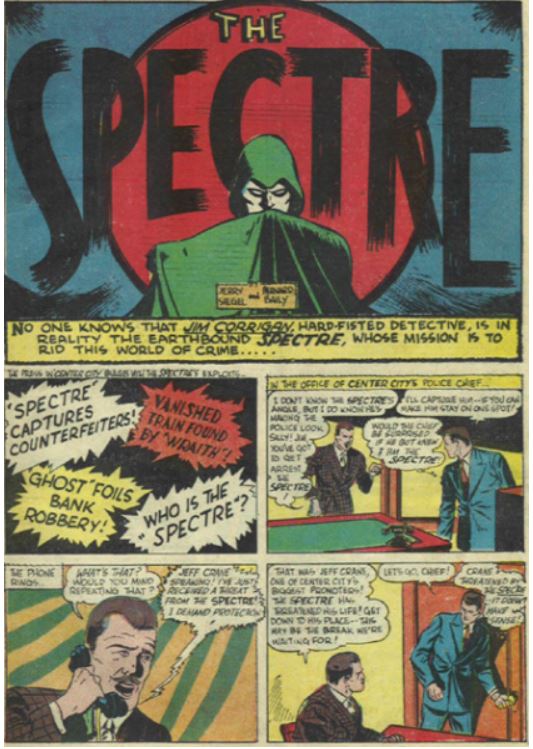
Created by Jerry Siegel & Bernard Baily in 1939, The Spectre is one of the oldest characters in DC’s vast character stable. He debuted with a 2-part origin epic in More Fun Comics #52 and 53 (cover-dated February & March 1940 and on sale from December 28th 1939 and February 2nd 1940 respectively). He was the first superhero to star in that previously all-genres anthology, and reigned supreme in the title with flamboyant, eerily eccentric supernatural thrillers. He gradually slipped from popularity as firstly Dr. Fate and then Johnny Quick, Aquaman, Green Arrow and finally Superboy showed up to steal the limelight.

By the time of his last appearance in More Fun #101 February 1945, the Ghostly Guardian had been reduced to a foil for his own comedic sidekick Percival Popp, the Super-Cop

Just like Siegel’s other iconic creation, the Dark Man suffered from a basic design flaw: he was just too darn powerful. Unlike that vigorously vital and earthy early Superman, however, the ethereal champion of justice was already dead, so he couldn’t be logically or dramatically imperilled. Of course, in those far-off early days that wasn’t nearly as important as sheer spectacle: grabbing the reader’s utter attention and keeping it stoked to a fantastic fever pitch. This the Grim Ghost could do with ease and ever-increasing intensity.

Re-presenting the first 19 eerie episodes and following a fulsome Foreword detailing the state of play within the budding marketplace during those last months of the 1930s – courtesy of preeminent Comics historian Dr. Jerry Bails – the arcane action in this astoundingly enticing collection commences with ‘The Spectre: Introduction’ as first espied in More Fun Comics #52. This wasn’t the actual title: like so many strips of those early days, most stories didn’t have individual descriptors and have been retroactively entitled for compilations such as this.

The Astral Avenger was only barely glimpsed in this initial instalment. Instead, focus rests on hard-bitten police detective Jim Corrigan, who is about to wed rich heiress Clarice Winston when they are abducted by mobster Gat Benson. Stuffed into a barrel of cement and pitched off a pier, Corrigan dies and goes to his eternal reward.

Almost…

Rather than finding Paradise and peace, Corrigan’s spirit is accosted by a glowing light and disembodied voice which, over his strident protests, orders him return to Earth to fight crime and evil until all vestiges of them are gone. Standing on the seabed and looking at his own corpse, Corrigan began his mission by going after his own killers…

MFC #53 details how ‘The Spectre Strikes’ as the outraged revenant swiftly, mercilessly and horrifically ends his murderers before saving Clarice. Naturally “Corrigan” calls off the engagement and moves out of the digs he shares with fellow cop and best friend Wayne Grant. A cold, dead man has no need for the living. The origin ends with Corrigan implausibly sewing himself a green & white costume and swearing to eradicate all crime…

Splendidly daft and intensely enthralling, this 2-part yarn comprises one of the darkest and most memorable origins in comic book annals and the feature only got better with each issue as the bitter, increasingly isolated lawman swiftly grows into the most overwhelmingly powerful hero of the Golden Age.

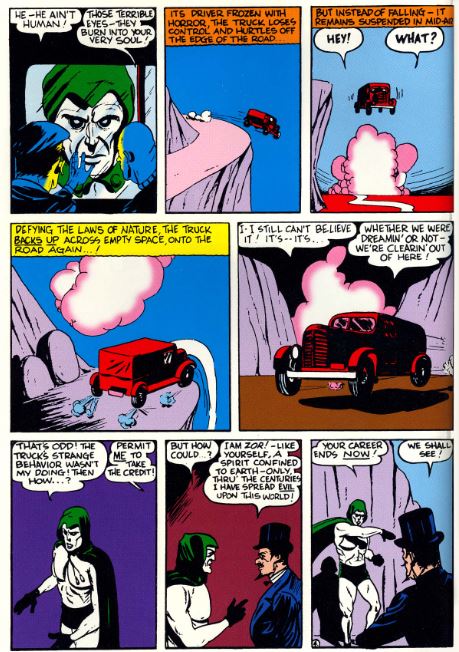
In MFC #54 the Supernatural Sentinel tackles ‘The Spiritualist’, a murderous medium and unscrupulous charlatan who almost kills Clarice and forever ends the Spectre’s hopes for eternal rest, after which #55 introduces worthy opposition in ‘Zor’: a ghost of far greater vintage and power, dedicated to promulgating evil on Earth. He too menaces Clarice and only the intervention of the Heavenly Voice and a quick upgrade in phantasmal power enables Spectre to overcome this malign menace.

More Fun Comics #56 was the first to feature Howard Sherman’s Dr. Fate on the cover, but the Spectre was still the big attraction, even if merely mundane bandits and blackmailers instigating ‘Terror at Lytell’s’ were no match for the ever-inventive wrathful wraith. Far more serious was ‘The Return of Zor’ in #57, as the horrific haunt escapes from beyond to frame Corrigan for murder and again endanger the girl Jim dare not love…

An embezzler turns to murder as ‘The Arsonist’ in #58, but is no match for the cop – let alone his eldritch alter ego – whilst ‘The Fur Hi-Jackers’ actually succeed in “killing” the cop, yet still suffer the Spectre’s unique brand of justice. In #60, ‘The Menace of Xnon’ sees a super-scientist utilising incredible inventions to frame the ghost and even menace his ethereal existence – prompting The Voice to again increase its servant’s power. This means giving The Spectre the all-powerful Ring of Life – but not before the Ghostly Guardian has been branded Public Enemy No. 1.

With Corrigan now ordered to arrest his spectral other self on sight, #61 (another Dr. Fate cover) features ‘The Golden Curse Deaths’ wherein prominent citizens perish from a tech terror with a deadly Midas Touch, prior to ‘The Mad Creation of Professor Fenton’ pitting the Phantom Protector against a roving, ravaging, disembodied mutant super-brain. In #63, a kill-crazy racketeer gets his just deserts in the electric chair only to return and personally inflict ‘Trigger Daniels’ Death Curse’ upon all who opposed him in life. Happily, The Spectre is more than his match whereas ‘The Ghost of Elmer Watson’ is a far harder foe to face. Murdered by mobsters who also nearly kill Wayne Grant, the remnant of the vengeful dead man refuses to listen to The Spectre’s brand of reason. Thus, its dreadful depredations must be dealt with in fearsome fashion…

‘Dr. Mephisto’ was a real-deal spiritualist who used an uncanny blue flame for crime in MFC #65, after which the Ghostly Guardian battles horrendous monsters called forth from ‘The World Within the Paintings’ (probably written by the series’ first guest writer Gardner Fox), whilst Siegel scribes ‘The Incredible Robberies’, putting the phantom policeman into fearful combat to the death and beyond with diabolical mystic Deeja Kathoon. From #68 on The Spectre finally acknowledged someone’s superiority after losing his protracted cover battle to Dr. Fate even though, inside, the ‘Menace of the Dark Planet’ features a fabulously telling tale of Earthbound Spirit against alien invasion by life-leeching Little Green Men. In his next exploit ‘The Strangler’ murders lead Corrigan into an improbable case with an impossible killer…

This terrifying titanic but far-too-short tome terminates on issue #70 and ‘The Crimson Circle Mystery Society’ in which a sinister cult employs merciless phantasmal psychic agent Bandar to carry out its deadly schemes and desires…

Although still a mighty force of fun and fearful entertainment, The Spectre’s Glory Days and Nights were waning, with more credible champions coming to the fore. He would be one of the first casualties of the post-War decline in mystery men and not be seen again until the Silver Age of 1960’s. His path to his own title was tough then too and also led to an early retirement…

Moreover, when he did finally return to comics full-time, the previously omnipotent phantasm was curtailed by strict limits and as he continued to evolve through various returns, refits and reboots The Spectre was finally transmogrified: being bound to a tormented mortal soul inescapably attached to the actual embodiment of the biblical Wrath of God. Revamped and revived in perpetuity, revealed as the Spirit of Vengeance wedded to a human conscience, Jim Corrigan was finally laid to rest in the 1990s and Hal (Green Lantern) Jordan replaced him. Returning to basics in more recent years, the next host was murdered Gotham City cop Crispus Allen.

They’re all worth tracking down and exhuming: spooky comic champions who have never failed to deliver an enthralling, haunted hero rollercoaster – or is that Ghost Train? – of thrills and chills.
© 1940, 1941, 2003 DC Comics. All Rights Reserved.

Today in 1942 writer Michael Fleischer was born. We’ve covered far too many of his books like Jonah Hex and the Spectre to list here so just use the search box, OK? One year later Roy CranesBuz Sawyer began. Do yourself a huge favour by diving into Buz Sawyer: The War in the Pacific.

DC Finest Horror – The Devil’s Doorway


By Alex Toth, Gil Kane, Mike Friedrich, Gerry Conway, Sergio Aragonés, Dave Wood, Joe Orlando, Marv Wolfman, Len Wein, Steve Skeates, John Costanza, Otto Binder, D.J. Arneson, John Albano, Julius Schwartz, E. Nelson Bridwell, Joe Gill, Robert Kanigher, Jack Oleck, Cliff Rhodes, Bob Haney, George Kashdan, Jack Miller, Carl Wessler, Dennis O’Neil, Alan Riefe, Dave Kaler, Jack Phillips, Murray Boltinoff, Curt Swan, Jerry Grandenetti, Bill Draut, Werner Roth, Jack Sparling, Morris Waldinger, Tom Nicolosi, Bernard Baily, Jack Abel, George Roussos, Eddie Robbins, Wayne Howard, Stanley Pitt, Bruno Premiani, Dick Giordano, Dick Dillin, Murphy Anderson, Pat Boyette, Neal Adams, Nick Cardy, Mike Sekowsky, Sid Greene, Mike Roy, Mike Peppe, Don Heck, Wally Wood, Ralph Reese, George Tuska, Gray Morrow, John Celardo, Art Saaf, José Delbo, Vince Colletta, Frank Giacoia, Al Williamson & many & various (DC Comics)
ISBN: 978-1-79950-280-7 (TPB)

Sadly this masterful mystery megamix is not yet available digitally, but we live in hope…

This book includes Discriminatory Content produced in less enlightened times.

Win’s Christmas Gift Recommendation: Splendid Slice of Spectral Shock & Awe… 9/10

It’s the time for sweet indulgence, shocking over-eating and spooky stories, so let’s pay a visit to a much-neglected old favourite in a fresh new costume…

US comic books started slowly until the coming of superheroes unleashed a torrent of creative imitation and sparked a new genre. Implacably vested in World War II, the Overman swept all before him (and very occasionally her or it) until the troops came home and the more traditional genres resurfaced and eventually supplanted the Fights ‘n’ Tights crowd. Although new kids kept on buying, much of the previous generation of consumers also retained their four-colour habit but increasingly sought older themes in the reading matter. The war years altered global psychological landscapes and as a more world-weary, cynical young public came to see that all the fighting and dying hadn’t really changed anything, their chosen forms of entertainment (film and prose as well as comics) reflected this.

As well as Westerns, War and Crime comics, celebrity tie-ins, madcap escapist comedy and anthropomorphic funny animal features were immediately resurgent, but gradually another of the cyclical revivals of spiritualism and public fascination with all things occult, eldritch and arcane led to them being outshone and outsold by a wave of increasingly impressive, evocative and shocking horror comics.

There had been grisly, gory and supernatural stars before, including a pantheon of ghosts, monsters and wizards draped in mystery-man garb and trappings (The Spectre, Mr. Justice, Sgt. Spook, Frankenstein, The Heap, Sargon the Sorcerer, Zatara, Monako, Zambini the Miracle Man, Kardak the Mystic, Dr. Fate and dozens more), but these had been victims of circumstance: The Unknown as a “narrativium” power source for super-heroics.

Now the focus shifted to ordinary mortals thrown into a world beyond their ken with the intention of unsettling, not vicariously empowering, the reader. Almost every publisher jumped on the increasingly popular bandwagon, with B & I (which became magical one-man-band Richard E. Hughes’ American Comics Group) launching the first regularly published horror comic in the Autumn of 1948. Technically, though, Adventures Into the Unknown was actually pipped by Avon who had released an impressive single issue entitled Eerie in January 1947 before finally committing to a regular series in 1951. By this time, and following the filmic horror heyday of Universal Pictures’ fright films franchises, worthy comic book monolith Classics Illustrated had already long milked the literary end of the medium with adaptations of The Headless Horseman, Dr. Jekyll and Mr. Hyde (both 1943), The Hunchback of Notre Dame (1944) and Frankenstein (1945) among others.

If we’re keeping score, this was also the period in which Joe Simon & Jack Kirby identified another “mature market” gap by inventing the Romance comic (Young Romance #1, cover-dated September 1947) but they too saw sales potential in macabre mood material, resulting in seminal anthologies Black Magic (launched in 1950) and boldly obscure psychological drama vehicle Strange World of Your Dreams (1952). Around that time the staid cautious company that would become DC Comics bowed to the commercial inevitable and launched a comparatively straightlaced anthology that became one of their longest-running and most influential titles with the December 1951/January 1952 opening of The House of Mystery.

When the hysterical censorship scandal which led to witch-hunting hearings was at its height, the mobs with pitchforks furore was adroitly curtailed by the industry adopting a castrating straitjacket of self-regulatory rules. Horror titles produced under the aegis of the Comics Code Authority were sanitised, anodyne affairs in terms of Shock ‘n’ Gore.

However, since appetite for suspenseful short stories remained high, in 1956 National DC introduced sister title House of Secrets (a November/December cover-date). Plots were dialled back into superbly illustrated, rationalistic, fantasy-adventure vehicles which would dominate the market until the 1960s when superheroes (which began sneaking back in 1956 after Julius Schwartz reintroduced The Flash in Showcase #4), finally overtook them.

Green Lantern, Hawkman, The Atom and a slew of other costumed cavorters generated a gaudy global bubble of masked mavens which even forced the dedicated anthology suspense titles to transform into super-character split-books, with Martian Manhunter and Dial H for Hero monopolising House of Mystery whilst Mark Merlin – later Prince Ra-Man – sharing space with Eclipso in House of Secrets. When caped crusader craziness peaked and popped, HoS was one of the first casualties, folding with #80, the September/October 1966 issue.

However, nothing combats censorship better than falling profits and by the end of the 1960s the Silver Age superhero boom was over, with many titles gone and some of the industry’s most prestigious series circling the drain. This real-world Crisis prompted surviving publishers to loosen self-imposed restraints against crime and horror comics. Nobody much cared about gangster titles at that juncture, but liberalisation coincided with another bump in public interest for all things Worlds Beyond-ey, so resurrection of scary stories was a foregone conclusion and obvious no-brainer…

Even ultra-wholesome Archie Comics re-entered the field with a rather tasty line of Red Circle Chillers: a minor substrate they regularly return to with style and potency to this day.

Thus, with absolutely no fanfare at all House of Mystery #174 (cover dated May/June 1968), confirmed the downturn in superhero stories eveywhere as it hit newstands everywhere presenting a bold banner asking Do You Dare Enter The House of Mystery? Inside it reprinted admittedly excellent short fantastic thrillers originally seen in House of Secrets from those heady days when it was okay to scare kids…

It was a slow but unstoppable hit which just kept spreading…

This DC Finest collection gathers a year’s worth of scary stuff snapshotted from House of Secrets #81-85; House of Mystery #180-185; The Witching Hour #3-7; The Unexpected #113-117 and includes a short back-up yarn from Phantom Stranger volume 2 #5, which cumulatively filled dank evenings from May 1969-April 1970. It all starts – with absolutely no fanfare at all – in HoM #180…

Going from strength to strength, the fear flagship was increasingly drawing on DC’s major artistic resources. Astounding opener ‘Comes a Warrior’ is a chilling faux Sword & Sorcery classic written and drawn by da Vinci of Dynamism Gil Kane, and inked by incomparable Wally Wood, before they illustrate Mike Friedrich’s fourth-wall-demolishing ‘His Name is Cain Kane!’

A Sergio Aragonés gag page in the long-running ‘Cain’s Game Room’ roaming sequence then cleanses palates for Cliff Rhodes & Joe Orlando’s text-terror ‘Oscar Horns In!’ before Marv Wolfman & Bernie Wrightson proffer prophetic vignette ‘Scared to Life’. A double-page ‘Cain’s Game Room’ precedes an uncredited forensic history lesson drawn by Morris Waldinger and recycled as‘Cain’s True Case Files’ to close proceedings for that title. Meanwhile over in long-running, recently remodelled fantasy anthology The Unexpected, the former sci fi vehicle was retooling as a gritty, weird thriller venue with George Kashdan, Jack Sparling & Vince Colletta detailing ‘The Shriek of Vengeance’. Here, Golden Age troubleshooter Johnny Peril is accused of heinous crimes and then abducted by maniac justice dispenser The Executioner. His gladiatorial tests are no problem for an ordinary guy who’d been facing the incomprehensible unknown since Comics Cavalcade #19 (February 1947) and soon the true motive is exposed and the scheme crushed…

Dave Wood & recent Charlton Comics émigré Pat Boyette then glare into ‘The Eyes of Death’, revealing the fate of an actual criminal who gains the power to see iminent fatalities before Wood, Curt Swan & Mike Esposito ride ‘The Tunnel of Love Fear!’ to introduce potential host narrator Judge Gallows, discussing one of his stranger cases…

With Tales of the Unexpected #105 and House of Mystery #174, National/DC had gambled heavily that anthology horror material was back and wouldn’t call the wrath of the gods – and parents – down upon them. Now that they had a boutique mystery stable, they put lots of thought and effort into creating an all-new title to further exploit our morbid fascination with all thingies fearsome and spooky. They would also resurrect House of Secrets (cancelled in late 1969. Apparently in those heady days it was okay – and profitable – to scare the heck out of little kids if you also made them laugh.

Edited until #14 by Dick Giordano, The Witching Hour first struck with a February/March 1969 cover-date (actually on-sale from December 19th 1968). From the outset it was an extremely experimental and intriguing beast. Here however we begin with #3 (cover-dated July 1969). In this graphic grimoire, cool & creepy horror-hosts traditionally introducing the entertainments are replaced by three witches. Based as much on a common American misapprehension of Macbeth as the ancient concept of Maiden, Mother & Crone, this torrid trio constantly strove to outdo (and outgross) each other in telling of terror tales.

Crucially, Cynthia, Mildred & Mordred – as well as shy monster man-servant minion Egor – were designed by and initially delineated by master illustrator Alex Toth, making framing sequences between yarns as good as and frequently more enthralling than the stories they brazenly bracketed. Following intro ‘You Be Our Judge’ from Toth & Giordano, the graphic genius & Colletta illustrate Don Arneson’s medieval mood masterpiece ‘The Turn of the Wheel!’ before Alan Riefe & Sparling tell a decidedly different ghost-story in ‘The Death Watch’. Steve Skeates & Bernie Wrightson then debut a decidedly alterative fantasy hero in ‘…And in a Far-Off Land!’, followed by the first in a series of short prose vignettes: anonymous fright-comedy ‘Potion of Love’ and Mike Sekowsky & Giordano deliver the sisters’ farewell epilogue…

Back at House of Mystery #181, scripted by Otto Binder and drawn by quirkily capable Sparling, ‘Sir Greeley’s Revenge!’ offers a heart-warmingly genteel spook story, albeit jump-cut interrupted by new comedy featire Page 13 (from Aragonés) after which Wrightson’s first long tale is fantastical reincarnation saga ‘The Siren of Satan’ (scripted by Bob Kanigher) before we get to the next big thing – and an actual resurrection…

House of Secrets returned with #81 (August/September 1969) just as big sister HoM had done a year previously. Under a bold banner declaiming “There’s No Escape From… The House of Secrets”, Mike Friedrich, Jerry Grandenetti & George Roussos introduced a ramshackle, sentient old pile in ‘Don’t Move It!’, after which Bill Draut limned the introduction of bumbling caretaker Abel (with a guest-shot by his murderous older brother Cain) in eponymous intro set-up fable ‘House of Secrets’. A prose yarn by Gerry Conway ‘Burn this House!’ gave the portly porter a pause before he kicked off his storytelling career with Conway & Sparling’s‘Aaron Philip’s Photo Finish!’ before the inaugural issue is put to bed with a Draut limned ‘Epilogue’

The Unexpected #114 led with Kashdan, Ed Robbins & Colletta’s ‘Johnny Peril – My Self… My Enemy!’ as a modern day alchemist unleashes a lifeforce-stealing golem on the doughty P.I., after Dave Wood & Art Saaf premier a new host regaling readers with ‘Tales of the Mad, Mod Witch’ and opening with a warning about magic fountains and poorly aimed coins in ‘The Well of Second Chances’. Thematically on safe ground, we switch to Witching Hour #4 as Toth renders a ‘Witching Hour Welcome Wagon’ after which Conway scripts spectral saga ‘A Matter of Conscience’ for Sparling & George Roussos. Anonymous prose piece ‘If You Have Ghosts?’ then segues into smashing yarn ‘Disaster in a Jar’ (Riefe & Boyette) before Conway turns in period witchfinder thriller ‘A Fistful of Fire’ for José Delbo – a vastly underrated artist who was on the best form of his career at this time.

Toth’s Weird Sisters close out that issue as we move on to HoM #182 which opens with one of the most impressive tales of the entire decade. Jack Oleck’s take on the old cursed mirror plot is elevated to high art with his script for ‘The Devil’s Doorway’ illustrated by incredible Alex Toth. Marv Wolfman & Wayne Howard follow with ‘Cain’s True Case Files: Grave Results!’, and an expose of the Barbadian sugar trade, after which an Aragonés Game Room break leads to nightmarish Gothic revenge tale ‘The Hound of Night!’ from Kanigher & Grandenetti. HoS #82 was a largely Conway scripted affair with Draut drawing both ‘Welcome to the House of Secrets’ and ‘Epilogue’, whilst cinema shocker ‘Realer Than Real’ was illustrated by Werner Roth & Vince Colletta. Prose poser ‘His Last Resting Place!’ leads to Wolfman & Giordano’s short sci fi saga ‘Sudden Madness’ prior to Conway & Sparling regaling us with salutary tale of murder and revenge ‘The Little Old Winemaker’. Finally, as realised by Dick Dillin & Neal Adams ‘The One and Only, Fully-Guaranteed, Super-Permanent, 100%’ presents a darkly comedic eerily unsettling tale of domestic bliss and how to get it…

Carl Wessler & Ed Robbins open Unexpected #115 with Blitz- survivor Maude Waltham unwisely accessing the ‘Diary of a Madman’ and being drawn into a world she could not comprehend or cope with, after which Dave Wood, Swan & Jack Abel reveal how an opportunistic showman appropriates an old abndined house and discovers ‘Abrakadabra – You’re Dead!’ A classic plot gets a sixties makeover as ‘The Day Nobody Died!’ (by Wood as D.W. Holz, Werner Roth & Frank Giacoia) details the repercussions of a wise man unwisely caging the angel of death…

In Witching Hour #5 the sisters are at their most outrageously, eerily hilarious introducing an anonymous yarn lavishly embellished by Wrightson – a nifty nautical nightmare of loneliness and ‘The Sole Survivor!’, before text-teaser ‘The Non-Believer! and Boyette’s stunning, clownish creep-feature ‘A Guy Can Die Laughing!’ set the scene for Steve Skeates, Stanley Pitt & Giordano’s dating dilemma ‘The Computer Game’ I think this was one of the first to explore that now-hoary plot, and it neatly anticipates Toth’s sign off for the witches and added single-page black-comedy bonus ‘My! How You’ve Grown!’ from Sid Greene…

For #183, Joe Orlando offers Cain introductory chuckle ‘Welcome to the House of Mystery’ before, in collaboration with Oleck, Grandenetti reveals the misery of ‘The Haunting!’ Following more mirth in Cain’s Game Room (by John Albano) and vintage Bernard Baily ‘Odds and Ends from Cain’s Cellar’, ‘Curse of the Blankenship’s’ and ‘Superstitions About Spiders’, Wolfman & Wrightson contribute ‘Cain’s True Case Files: The Dead Can Kill!’ A bonanza of Aragonés comprising a comedic horroscope on Page 13 and two pages of Cain’s Game Room precedes a canny teaming of Kanigher with Grandenetti & Wally Wood that results in the truly bizarre ‘Secret of the Whale’s Vengeance’

After Draut & Giordano’s ‘Welcome to the House of Secrets’ piece, superstar Toth made his modern HoS debut with Wolfman-written fantasy ‘The Stuff That Dreams are Made Of’, before Mikes Royer & Peppe visualise sinister love-story ‘Bigger Than a Breadbox’, bookended by anonymous text teaser ‘Once Upon a Time in Mystery Book…’ Wrapping up, Conway & Draut revive gothic menace for chilling fable ‘The House of Endless Years’.

Modernity is briefly embraced in Unexpected #116 as thanks to Dave Wood & Art Saaf, The Mad Mod Witch escorts a group of strangers on an ‘Express Train to Nowhere!’ after which author unknown & Boyette describe a doomed Dutch peddlar’s brush with legend and ‘Steps to Disaster’, before Murphy Anderson picks out apparel ‘Mad to Order’ as Wrightson details the problems wrapped up in a ‘Ball of String!’ ‘Ashes to Ashes, Dustin to Dust?’ then closes the issue with a spectral tale of love & death from Murray “Al Case” Boltinoff & Sid Greene…

Sekowsky & Giordano limn Dave Kaler’s take on the sinister sisters’ intro for Witching Hour #6, after which far darker horror debuts as ‘A Face in the Crowd!’ (Conway, Mike Roy & Mike Peppe), wherein a Nazi war-criminal and concentration camp survivor meet in an American street. Wolfman & Delbo depict a tale of neighbourly intolerance in ‘The Doll Man!’ and ‘Treasure Hunt’ (Skeates, John Celardo & Giordano) shows why greed isn’t always good. Also included were Conway’s prose tale ‘Train to Doom’, ‘Mad Menace’ – a ½-page gag strip by John Costanza – and ‘Distortion!’: another Greene-limned one-pager.

HoM #184 features the triumphant return of Oleck & Toth for captivating Egyptian tomb raider epic ‘Turner’s Treasure’ before cartoon pauses for Page 13 (a diploma fron Aragonés & Orlando) and Orlando gag ‘The Fly’ deftly segues into epic barbarian blockbuster ‘The Eyes of the Basilisk!’ by Bridwell, Gil Kane & Wally Wood…

Closing with more Albano Cain’s Game Room giggles, next comes info short ‘The Devil’s Footprints!’ by Kanigher, Swan & Nick Cardy from The Phantom Stranger #5 (cover-dated January/February 1970) before in House of Secrets #84, Conway & Draut maintain the light-hearted bracketing of stories prior to properly beginning with ‘If I Had but World Enough and Time’ (Wein, Dillin & Peppe): a cautionary tale about too much TV. Tensions grow with Wolfman & Greene’s warning against wagering in ‘Double or Nothing!’ and Skeates, Sparling & Abel’s utterly manic parable of greed ‘The Unbelievable! The Unexplained!’, before Wein & Sparling mess with our dreams in ‘If I Should Die before I Wake…’

Johnny Peril leads in Unexpected #117, as Kashdan & Greene reveal how he becomes the patsy for a clan seeking to avoid a hereditary curse in ‘Midnight Summons the Executioner!’, after which Case, Grandenetti & Draut see a woman trick fate by accepting ‘Hands of Death’ whilst Wessler & Tuska detail the downfall of a money-mad beast in ‘The House that Hate Built!’ Wessler & Bruno Premiani then detail the uncanny ‘Death of the Man Who Never Lived!’ in a spy yarn unlike any other…

In Witching Hour #7, Toth & Mike Friedrich show spectacular form for the intro and bridging sequences, whilst Draut is compulsively effective in prison manhunt saga ‘The Big Break!’, with scripter Skeates also writing modern-art murder-mystery ‘The Captive!’ for Roussos. Friedrich & Abel advise a most individual baby to ‘Look Homeward, Angelo!’, whilst text piece ‘Who Believes Ouija?’ and Jack Miller & Michael Wm. Kaluta’s Gothically delicious ‘Trick or Treat’ round out the sinister sights in this issue. Then, House of Mystery #185 sees Cain take a more active role in all-Grandenetti yarn ‘Boom!’, with Albano, Aragones & Orlando Page13 and Cain’s Game Room, prior to Wayne Howard illustrating the sinister ‘Voice from the Dead!’ Following more Orlando Game-iness prolific Charlton scribe Joe Gill debuts with ‘The Beautiful Beast’: a lost world romance perfectly pictured by EC alumnus Al Williamson.

This monolitic montage of macabre mirth and scary sagas ceases with House of Secrets #85. Here, Cain & Abel acrimoniously open, after which Wein & Don Heck disclose what can happen to ‘People Who Live in Glass Houses…’ whilst graphic legend Ralph Reese limns Wein’s daftly ironic ‘Reggie Rabbit, Heathcliffe Hog, Archibald Aardvark, J. Benson Baboon and Bertram the Dancing Frog’, ere John Costanza contributes comedy page ‘House of Wacks’ and Conway, Kane & Adams herald the upcoming age of slickly seductive barbarian fantasy with gloriously vivid and vital ‘Second Chance’.

With iconic covers from Neal Adams, Jack Adler, Toth, Sekowsky, Cardy and Gray Morrow this (hopefully first of many) moody mystery compilations is a perfect accompaniment to dark nights in, and one you can depend on to astound and amaze in equal amounts.
© 2025 DC Comics. All Rights Reserved.

Today – or maybe even tonight – in 1939 underground cartoonist Frank Stack was born. His blasphemous antics have made us laugh for decades. Why not check out The New Adventures of Jesus: The Second Coming.

In 2011 today UK icon Mick Anglo died. He’s all over this blog if you want to see something very special but I’d advise scoping out one of his unique Annual creations, such as Batman Story Book Annual 1967 (with Robin the Boy Wonder).

Death Be Damned


By Acker, Blacker & Miller, Hannah Christenson, Juan Useche & various (Boom! Studios)
ISBN: 978-1-68415-039-7 (TPB) eISBN: 978-1-61398-716-2

This book contains Discriminatory Content included for dramatic effect.

First seen as a 4-issue miniseries in 2017 written by Ben Acker, Ben Blacker (The Thrilling Adventure Hour podcast, Deadpool, Thunderbolts. Supernatural) & Andrew Miller (Backstrom, League of Pan, The Secret Circle), spooky sagebrush saga Death Be Damned is a deft and compelling addition to the growing, cross-fertilising genre of supernatural westerns. The series was visualised by celebrated illustrator Hannah Christenson (Harrow County, Mouse Guard, Jim Henson’s Storyteller) with colours by Juan Useche and letters from Colin Bell.

In delivery the tale is stripped down, raw and utterly engaging, delivered in sweeping tributes to more than a century of high plains cinema, and begins in 1873 Wyoming after brutalised settler Miranda Coler awakes face down in the river to find her entire family have been butchered. A tough, determined survivor, she buries her husband and child and, picking up her man’s rifle, sets about tracking down the gang who killed them.

By the time she reaches South Pass City, she’s ready to accept any passing pain or humiliation if it leads to her justifiable vengeance, Sadly, righteous anger doesn’t make her good enough to kill one of the marauders in the town whorehouse and he casually puts a bullet in her brain…

Local undertaker Murray takes his job far too seriously. Since his wife passed, he’s become an expert on death rituals and is letting these studies affect his work. He keeps trying to raise the dead and now can’t believe he’s succeeded with the crazy woman just killed in the cathouse…

Events eventually prove he hasn’t, really, but perhaps his attempts to retrieve the dead have set something incredible in motion…

In Laramie City, mass killer Bickford hangs for his crimes. A little later he also gets up: drawn inexorably to South Pass where something unnatural needs to be quashed…

Miranda thinks Murray is crazy, but after he kills her and she comes back again, she finally hears him out. He wants the revenant to rescue his wife from Hell, but has no idea what the land of death is really like. Miranda still wants revenge though, and she’s quite happy to exploit the undertaker’s foolish whims if it gets her closer to her goal, no matter how many times she has to die in the doing of it…

A tale of dark obsessions played out through a nest of gradually-unfolding mysteries, this sinister saga employs all the iconography of “big sky” westerns to add mood to a blistering tale of debts incurred and accounts called due. Unstoppable Miranda even beats her devils to exact precious retribution and learns the painful truths of her life, her man and a hell of a lot of death…

Available in paperback and digital editions, Death Be Damned is graced with an expansive cover gallery by Christenson & Konstantin Tarasov, as well as character designs, and also reveals some secrets of the illustrator’s Cover Process.

A short sharp shocker, to ingest before heading out to roam your own streets in search of treats and judgement…
Death Be Damned is ™ & © 2017 Workjuice Corp. & Andrew Miller.

Today in 1976 appropriately saw the demise of UK gagfest Monster Fun after a mere year of yoks and giggles. Big bunch of birthdays though, with European giants Michel Charlier born in 1924 and Will in 1927, and US pioneer of comics fandom Don Thompson in 1935. In 1951 P. Craig Russell joined the party. Him you can adore in many books including Richard Wagner’s The Ring of the Nibelung.

Mermaid Saga VIZ Signature Edition volume 1


By Rumiko Takahashi, translated by Rachel Thorn & lettered by Joanna Estep (VIZ Media)
ISBN: 978-1-97471-857-3 (Tankobon TPB/Digital edition)

This book includes Discriminatory Content produced in less enlightened times.

Rumiko Takahashi is one of the most successful and globally lauded comics creators of all time and indisputably the best-selling woman in the field (as of 2017, over 200 million volumes – and always rising – of her assorted inventions in print) with countless accolades and awards to her name. That makes the recent unavailability of her works in translation – in print or pixels – utterly incomprehensible to me. At least at last that situation is being remedied…

Born in 1957, she enrolled in a manga school whilst at university and began producing Doujinshi (self-published stories) in 1975, under the tutelage of Manga genius Kazuo Koike. She sold her first professional story 3 years later: award-winning science fiction comedy Urusei Yatsura (34 volumes). Her next big series was rom-com Maison Ikkoku (15 volumes) and she continued both series simultaneously until 1987, whilst also producing a vast array of extremely popular short stories and mini-series.

In 1984, she tried something new: an occasional sequence of interlinked gothic-love horror short-stories that would become known as the Mermaid Saga – appearing at uneven intervals over the next decade. Ten years later, Viz Communications began collecting and translating the nine graphic novelettes for the English speaking world, and this volume (from 2020) re-presents and remasters the first three fishy tales in a stunning display of visual virtuosity and macabre menace as part of a paired and glorious Viz Signature Edition.

‘A Mermaid Never Smiles’ (Parts 1 & 2) begins in a remote rural village in modern Japan as beautiful maiden Mana calls out petulantly to her servants. Meanwhile miles away, a derelict young man wanders aimlessly, searching for something. His name is Yuta and there’s something odd about him…

Mana’s attendants are all women and they are waiting for something. When one performs a unique sacrifice the assembled harridans decree Mana is ready at last for her great purpose…

When Yuta stumbles into the village he is swiftly killed by the old ladies… but doesn’t stay dead for long. Escaping from his grave, Yuta confronts the women and rescues far-from-grateful Mana, who has no idea she has been farmed like a veal calf by her “servants” with but one purpose…

On the run, Yuta explains the legend of Mermaids: eating their flesh can, if one is fortunate, impart immortality and invulnerability. More common is a slow transformation into ghastly monsters, called “Lost Souls”. Most likely, though, is a swift, exceedingly painful death from the malignant meat…

Years previously, Yuta had unwittingly consumed mermaid flesh and has spent half a lonely millennium seeking a cure to his lonely un-aging existence. An old wise woman told him the only solution was to find a live mermaid and ask her for a method to end his interminable life. However, he has cause to regret his wish when he discovers that all the old women here are aged and near-decrepit mermaids and that poor Mana has been bred for years as a means by which they can regain lost youth.

Horrified and reluctantly heroic, Yuta knows he must foil the plan at all costs – but it won’t be easy or pretty…

Also divided into Parts 1 & 2, second story ‘The Village of the Fighting Fish’ takes us back centuries to Feudal Japan and two island communities at war. Eking out their harsh existence with occasional piracy, the fisher-folk of Toba are being slowly squeezed by their ruthless rivals on Sakagami Island. Moreover, the Tobans’ headman is dying and his valiant daughter O-Rin is having difficulty filling his sandals and continuing his legacy and leadership…

She thinks nothing of it when a dead body washes up: that’s just a sign of the times, but when the corpse comes back to life, the sinister, manipulative wife of the Sakagami chieftain seeks him out. It appears she, too, is hunting for a mermaid, just like un-killable stranger Yuta…

With a ruthless agenda of her own, Isago stirs the bubbling pot of tension until war is inevitable, just as restless wander Yuta dares to dream that he might risk loving again, but once more the terrible lure of mermaid flesh and supernatural longevity prove to be more curse than blessing and horrifying bloodshed is the inevitable result…

We return to more-or-less contemporary Japan as Mana & Yuta find an isolated village near deep woods and stop their incessant wandering for one night. However, the naive lass is utterly unaware of the modern world and walks into a near fatal accident. Rushed to the local cottage hospital, the severely injured girl mysteriously goes missing, and when Yuta discovers the woodland called the ‘Mermaid Forest’ he fears the worst. His frantic investigations uncover yet another tragic family destroyed by the mermaid mystique which has tainted so many lives…

Kindly old Dr. Shiina has kept a sinister secret for decades and now, through captive undying Mana, hopes to correct an ancient wrong. Sadly, no-one who has tasted mermaid flesh ever exists or even ends happily, and as Yuta hopelessly battles yet more Lost Soul horrors, our undying hero knows that this time will be no different…

In the aftermath he restless wanderers Yuta & Mana move on, only to stumble into another toxic immortality trap as ‘Dream’s End’ leaves them in the middle of a 40-year duel between a colossal monster mutated by tasting sea-siren flesh and an aging hunter maimed by the beast and rabid for revenge. To world-weary Yuta the case seems clear-cut, but when rampaging Big-eyes shows Mana a softer side, the positions of stalker and prey look far less cut and dried…

Closing this tome is two-part drama ‘Mermaid’s Promise’ as the immortal man comes again to Misaki village to find a sprawling growing metropolis. When he was last here he loved – and left – a maid in dire straits: a broken vow that still plagues him. Tragically, his betrayal turns out to be wasted tears as abandoned Nae is still alive… sort of.

As Mana & Yuta roam the bustling city dubbed Crimson Valley, they are targeted by the big boss of the region, a man with many dark secrets – and loyal thugs – who has also changed a great deal since he vied with Yuta for Nae’s hand sixty decades previously. Killing his rival, ancient Eijiro continues his project of excavating the entire surrounding hills and forests, seeking the ashes of a mermaid. They once enabled his “fiancée” to stay Nae fresh, young, vital. Hopefully another dose will stop her being soullessly, murderously psychotic…

These bleak supernatural tales of jealousy, twisted love and dark devotion are brooding and oppressive epics of understated horror, beautifully realised and movingly effective. One of the best mature manga series ever produced, it can – and should – be read by kids too, but please be aware Japanese social conventions regarding casual nudity are not the same as ours and if you don’t want them seeing naked bodies you should read something else.
TAKAHASHI RUMIKO NINGYO SERIES Vol. 1, 2 © 2003 Rumiko TAKAHASHI. All rights reserved.

Today in 1930 Leo Baxendale was born. We did him just recently, so scroll back to October 20th.

In 1948 master of horror and Swamp Thing co-creator Bernie Wrightson joined the world. You can learn all about him through Frankenstein Alive, Alive – The Complete Collection.

And in 1990 the last issue of UK laughter generator Whizzer and Chips – which had begun the fun way back in 1969 – hit the shelves and spinner racks. You can still get a taste of it all (mostly toffees, liniment, perished rubber and sweaty feet) via Whizzer and Chips Annual 1979.