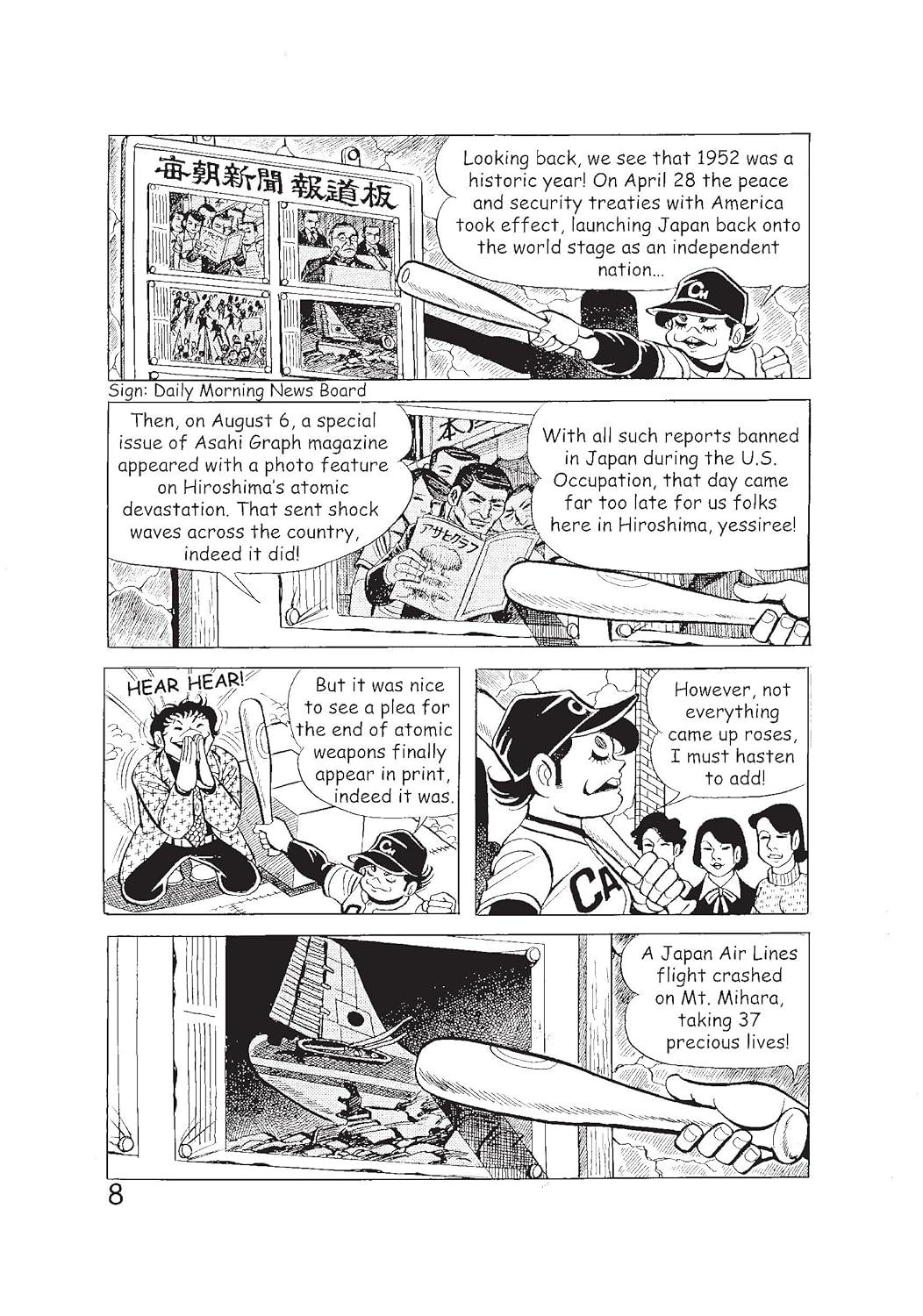
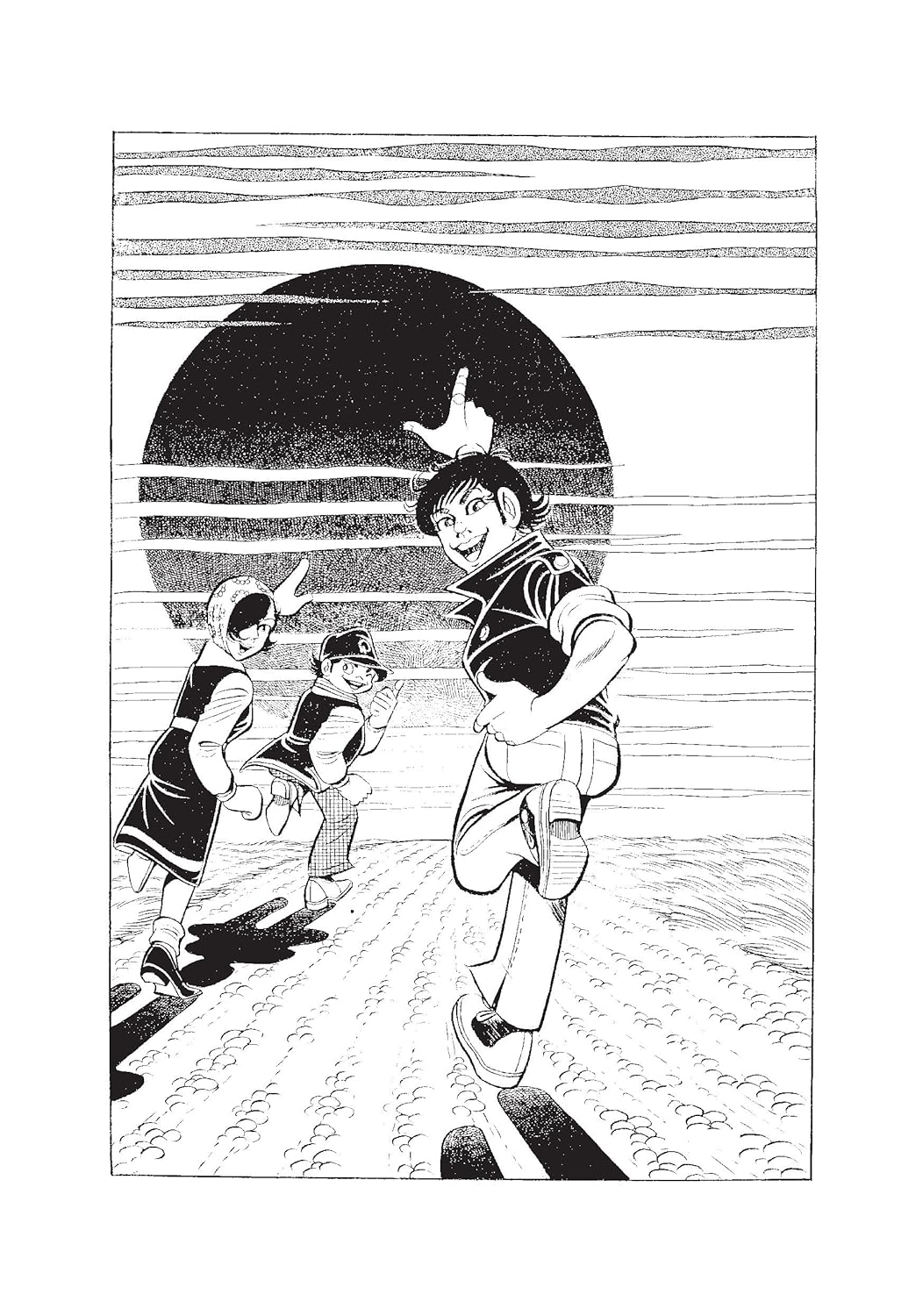
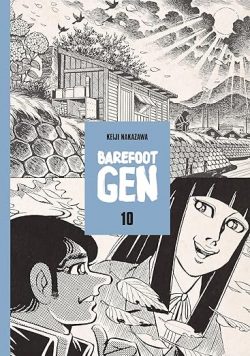
Barefoot Gen volume 10: Never Give Up


By Keiji Nakazawa (Last Gasp)
ISBN: 978-0-86719-601-6 (TPB) 978-0-86719-840-9 (HB/School Edition)

Whilst we are all commemorating the 80th anniversary of VJ Day (the Americans hold theirs on September 2nd), it’s only appropriate to remember how that war ended and what victory and defeat meant to a world forever changed after the conclusion. In comics, that means Keiji Nakazawa and Hadashi no Gen. A standby of anti-nuclear movements since first release in 1983, new hardback editions combining two paperback editions per volume are underway and will be on sale from January 15th 2026 – if we manage to live that long. You could wait or even check out our past reviews or simply save your time & energy by buying the still-available 10 tank?bon set right now.

After many years of struggle the entire piecemeal epic semi-autobiographical saga was remastered as an unabridged and uncompromising 10-volume English-language translation by Last Gasp under the auspices of Project Gen: a multinational organisation dedicated to peace and the abolition of nuclear weapons. Constantly revised and refined by its creator until his death from lung cancer in December 2012, Barefoot Gen is the quintessential anti-war tract and plea to humanity for peace. The combined volumes are angry and uncompromising, and never forgive those who seek to perpetuate greed, mendacity and bloody-handed stupidity.

Hadashi no Gen was first seen in Japan in 1973, serialised in Gekkan Shōnen Janpu Jampu (Monthly Boys Jump) following an occasional 1972 series of stand-alone stories in various magazines which included Kuroi Ame ni Utarete (Struck by Black Rain) and Aru Hi Totsuzen (One Day, Suddenly).

The scattered tales eventually led Shonen Jump’s editor Tadasu Nagano to commission 45-page Ore wa Mita (I Saw It) for a Monthly Jump special devoted to autobiographical works. Nagano clearly recognised that the author – an actual survivor of the world’s first atomic atrocity – had much more to say which readers needed to see and commissioned the serial which has grown into this stunning landmark epic.

The tale was always controversial in a country which still generally prefers to ignore rather than confront past mistakes and indiscretions and, after 18 months, Hadashi no Gen was removed from Jump, transferring firstly to Shimin (Citizen), then Bunka Hyåron (Cultural Criticism), and Kyåiku Hyåron (Educational Criticism). Just like his indomitable hero, Keiji Nakazawa never gave up and his persistence led to a first Japanese book collection in 1975, translated by the newly-constituted Project Gen team into Russian, English and other languages including Norwegian, French, German, Italian, Portuguese, Swedish, Finnish, Indonesian, Tagalog and Esperanto.

Born in March 14th 1939 and changed forever on August 6th 1945, the hibakusha (“atom bomb survivor”) author first completed his account in 1985 and his telling testament of survival has since been adapted into live-action & anime films; operas; musicals and live television dramas; each spreading the message across every continent and all generations.

Today we’re looking again at the concluding volume which brings the story of irrepressible, ebullient Gen and his friends to a close. One last time we see the forceful vitality of a select band of bomb survivors pitted against the constant shadow of tragedy which implacably dogs them in the city slowly recovering from nuclear conflagration.

Here the indomitable idealistic individualist, having finally found a way to express his anger and effectively fight back against the idiocies and injustices of a world which lets Atom bombs fall but is seemingly incapable of learning from its mistakes, at last strikes back at the demagogues and monsters who still keep the bad old ways alive… even after their people suffered the most hideous of consequences…

Barefoot Gen: Never Give Up begins following an inspirational ‘Gen’s Message: A Plea for Nuclear Abolition’ by the Translators & Editors and – as previously – the other end of this monochrome paperback balances the essay with a biography of the author and invaluable data ‘About Project Gen’

The graphic manifesto resumes in March 1953 as Gen prepares for his school graduation ceremony, despite seldom attending that hidebound institution over the past few years. Fellow bomb orphans Ryuta and quietly stolid Musubi – who have shared Gen’s shabby shack for years – are also in high spirits. They have been constantly selling dresses made by radiation-scarred outcast Katsuko on Hiroshima’s rebuilt street corners, diligently saving the proceeds until she has enough money to open a shop. Now the manager of one of the big stores wants to buy all the clothes they can manufacture to sell in his fashionable venues…

At the Graduation Ceremony Gen once again loses his temper when the faculty begin memorialising the past and celebrating the failed regime of the empire. Later, his savage confrontation with teachers and visiting dignitaries sparks a minor student revolution. For many of the juvenile delinquents it’s also an opportunity to inflict some long-delayed retribution on the educational bullies who have oppressed and beaten them for years…

Encouragingly, however, not all parents and attending adults take the teachers’ side, and a potentially murderous confrontation is (rather violently) defused by Gen. The boy’s life then changes forever when he bumps into a young woman and is instantly smitten. His pursuit of Mitsuko will bring him into conflict with her brutal father, former employer and unrepentant war-lover Nakao who is now a highly successful businessman going places in the reconstructed city…

Gen has been studying with elderly artist Seiga Amano, learning the skills his own father would have passed on had he not died in 1945. The mentor/father-figure encourages his protégé to pursue Mitsuko… and it costs them both their jobs. However, the seeming setback is in fact liberating and before long the star-crossed youngsters are in a fevered euphoria of first love. So engaged is Gen that he is not there when stolid Musubi is targeted by a cruel Yakuza honeytrap who addicts him to drugs before fleecing him of all Katsuko’s hard-earned savings…

With a happy ending so close he can touch it, Gen is dragged back down to earth by a trio of tragedies which leave him near-broken and all alone. The legacies of the bombing have again cost him almost everything…

After a horrendous bout of death and vengeance-taking, Gen seems to have nothing to live for, but the despondent young man is saved by aged Amano who rekindles his spirit and wisely advises him to get out of Hiroshima and start his real life in the world beyond it…

Keiji Nakazawa’s broad cartoon art style has often been subject of heated discussion; his simplified Disney-esque rendering felt by some to be at odds with the subject matter, and perhaps diluting the impact of the message. I’d like to categorically refute that.

The style springs from his earliest influence, Osamu Tezuka, Father of Anime & God of Manga who began his career in 1946 and whose works – Shin Takarajima/New Treasure Island, Tetsuwan Atomu/Astro Boy and so many more – assuaged some of the grim realities of being hibakusha, providing escape, hope and even a career path to the young illustrator. Even at its most bleak and traumatic the epic never forgets to shade horror with humour and counterpoint crushing loss with fiery idealism and enthusiasm.

As such the clear line, solid black forms and abstracted visual motifs act as tolerable symbols for much of the horror in this parable. The art defuses but never dilutes the horror of the tragedy and its aftermath. The reader has to be brought through the tale to receive the message and for that purpose drawings are accurate, simplified and effective. The intent is not to repel (and to be honest, even as they are they’re still pretty hard to take) but to inform, to warn.

Shocking. Momentous. Bleak and violent but ultimately astoundingly uplifting, Nakazawa’s Barefoot Gen is without peer and its legacy will be pervasive and long-lasting. So now you’ve been warned, buy this old book. Buy the entire series. Buy the new editions as they come out. Tell everyone you know about it. Barefoot Gen is an indisputable classic and should be available to absolutely everyone.
© 2009 Keiji Nakazawa. All rights reserved.

DC Finest: Plastic Man – The Origin of Plastic Man


By Jack Cole, Gil Fox, Will Eisner, Reed Crandall, Al Bryant & various (DC Comics)
ISBN: 978-1-79950-065-0 (TPB)

This book includes Discriminatory Content produced in less enlightened times.

Jack Ralph Cole (December 14, 1914 – August 13, 1958) was one of the most uniquely gifted talents of American Comics’ Golden Age, crafting landmark tales in horror, true crime, war, adventure and especially superhero genres. His incredible humour-hero Plastic Man remains an unsurpassed benchmark of screwball costumed hi-jinks: frequently copied but never equalled. As the Golden Age faded, Cole could see the writing on the wall and famously jumped into gag and glamour cartooning, becoming a household name when his brilliant watercolour gags and stunningly saucy pictures began running in Playboy from the fifth issue. Ever-restless and innately unsettled, Cole eventually moved into the lofty realms of newspaper strips before, in May 1958, achieving his lifelong ambition by launching a syndicated newspaper strip, the domestic comedy Betsy and Me.

On August 13th 1958 at the moment of his biggest break he took his own life.

The unexplained reasons for his death are not as important as the triumphs of Cole’s artistic life and this captivating paperback (reprinting a rare hardback compilation from 2004) provides a fascinating insight into a transitional moment in his artistic development.

Without doubt – and despite great successes with other heroic characters as well as in the crime and horror genres – Cole’s greatest creation was the zany, malleable Plastic Man. He quickly grew from a minor B-character into one of the most memorable and popular heroes of the Golden Age and seemed to be the perfect fantastic embodiment of the sheer energy, verve and creativity of that era when anything went and comics-makers were prepared to try out every outlandish idea…

This premier trade paperback collection reprints the Stretchable Sleuth’s astounding exploits from anthology title Police Comics #1-36 and Plastic Man #1-2, covering the period August 1941 to November 1944. These whacky exploits are unearthed and unleashed from a time when nobody really knew the rules. Creators, publishers and readers were prepared to try literally anything and, by sheer Darwinian processes, the cream of the crop always rose to the top…

The magic begins with a little added extra as most of these tales have retroactively been awarded titles; although most originally appeared without any. The debut and origin of Plastic Man happened in the middle of Police Comics #1, a brief but beguiling 6-pager introducing mobster Eel O’Brian, who is shot by a guard during a factory robbery. Soaked by a vat of acid and instantly, callously, abandoned by his partners in crime, Eel crawls away and is found by a monk who nurses him back to health and proves to the hardened thug that the world is not just filled with brutes and vicious chisellers all after a fast buck.

His entire outlook altered, and somehow now blessed with incredible malleability – he surmises it was the chemical bath mingling with his bullet wounds – Eel opts to put his new powers to use cleaning up the scum he used to run with. Creating the identity of Plastic Man he thrashes his own gang and begins his stormy association with the New York City cops…

Still written, drawn and lettered by Cole, in Police #2 ‘Dueling the Dope Smugglers’ sees Plas apply for a job with the cops, only to be told he can join up if he accomplishes the impossible task of capturing the notorious and slippery Eel O’Brian, currently the Most Wanted crook in eight states…

Ever wily, the Rubber-Band Man bides his time and wins the position anyway by cracking an international dope racket (that’s illegal narcotics, kids) stretching from Canada to Chinatown, whilst in #3’s ‘The Pinball Racket’ he fully capitalises on his underworld reputation and connections to bust up a nefarious mob led by a cunning crook with ears inside the Police Department itself.

The ‘Crime School for Delinquent Girls’ run by Madame Brawn pits the Silly Putty Paladin against a brutal babe intent on taking over the city mobs, and despite getting a thorough trouncing, she and her gang of gal gorillas are back for next issue, having turned her burly hand to a spot of piracy in ‘The Return of Madame Brawn.’ Police Comics #5 (December 1942) also marked a major turning point for Plastic Man, as with that issue he took the cover-spot away from fellow adventurer and failed superstar Firebrand; a position Plas would hold until costumed heroes faded from popularity at the end of the 1940s.

In PC #6 Plas’ burgeoning popularity was graphically reflected in a spookily murderous mystery in ‘The Case of the Disembodied Hands’, whilst in #7 – as Eel – he infiltrates and dismantles the massed forces of the ‘United Crooks of America!’ before #8 has the hero seriously outmatched but still triumphant when battling a colossal, city-crushing giant ‘The Sinister Eight Ball!’ and its decidedly deranged inventor. In #9 the yarns reached an early peak of macabre malevolence as Plastic Man foils a traitorous little mutant dubbed Hairy Arms in ‘Satan’s Son Sells Out to the Japs!’: a darkly bizarre thriller which embraces the hero’s meteoric rise by increasing the regular story-length from six to nine pages.

The carnival of cartoon grotesques continued in #10 as hayseed wannabe-cop Omar McGootch accidentally involves the Malleable Mystery-man in ‘The Cyclop Caper’, a Nazi plot to steal a new secret weapon, whilst #11 finds Plastic Man in mortal combat with the spirit of a 17th century London alchemist whose brain is unearthed and accidentally transplanted into a wounded spitfire pilot. Suddenly gaining incredible mystic powers and menacing mankind, ‘The Brain of Cyrus Smythe’ is still no match for the Pliable Powerhouse…

In Police #12 a desperate blackmailer joined forces with criminal astrologer ‘The Sinister Swami’, who predicts perpetual failure unless Plastic Man is killed, prior to Cole introducing his second most memorable character in #13’s ‘Presenting… the Man Who Can’t be Harmed’.

Despite himself, indolent felonious slob Woozy Winks accidentally saved a wizard’s life and was gifted in return with a gift of invulnerability: all the forces of nature henceforth shielding him from injury or death. Flipping a coin the oaf decided to get rich quick with his power. Unable to stop him, Plas appeals to his sentimentality and better nature and, once Woozy repented, was compelled to keep him around in case he strayed again…

Unlike Omar, Woozy Winks – equal parts Artful Dodger and Mr. Micawber, with the verbal skills and intellect of Lou Costello’s screen persona – would prove the perfect foil for Plastic Man: a lazy, venal, ethically fluid reprobate with sticky fingers who got all the best lines, possessed inexplicable charm and had a habit of finding trouble. It was the perfect marriage of inconvenience…

As stories jumped to 13 pages the new team were set on the trail of Eel O’Brian himself. PC #14 began the snipe hunt with ‘Oh, Plastic Man!’, but during the chase Woozy stumbled onto a slavery racket which soon foundered against his insane luck and Plastic Man’s ingenuity. In a hilarious twist Plas then let Woozy arrest him, but then escaped from under the smug cops’ very noses. When war scientists investigated Plastic Man and Woozy’s uncanny abilities in #15 it led to murder, a hot pursuit to Mexico City and almost a new Ice Age thanks to ‘The Weather Weapon’, whilst in #16 disgruntled Native Americans organised the ‘Revenge of the Chief Great Warrior’ and a movie cast succumbed one by one to a murderous madman in #17 before hilarious #18 revealed what happened after ‘The Drafting of Plastic Man’

The shockingly intolerable dilemma of all branches of the Armed Services fighting to recruit him was only solved when the President himself seconded Plas to the FBI, where his first case – with Woozy stuck to him like human(ish) moss – saw the Stretchable Sleuth investigating ‘The Forest of Fear!’: a 15 page terror-tale involving a cabal of killers and an army of animated oaks. Police #20 celebrated opening of the ‘Woozy Winks Detective Agency’ as, with Plas temporarily laid up wounded, the rotund rascal took centre stage to solve a robbery in a frantically surreal extravaganza reminiscent of the screwball antics of the musical show/movie Hellzapoppin’ and the anarchic shtick of the Marx Brothers…

The strip just kept getting more popular, and regardless of resource rationing the next step was inevitable. Without doubt – and despite other comic book innovations and triumphs such as Silver Streak, Daredevil, The Claw, Death Patrol, Midnight, Quicksilver, The Barker and The Comet, as well as his uniquely twisted take on the crime and horror tales – Cole’s greatest creation was zany, malleable Plastic Man who exploded from minor back-up into one of the most memorable and popular heroes of the Golden Age. Plas was the wondrously perfect fantastic embodiment of the sheer energy, verve and creativity in an era when anything went and comics-makers were prepared to try out every outlandish idea. Moreover he had a classic literary redemption arc and was funny as hell…

Plastic Man debuted in 1943, plopping onto newsstands on December 29th. The premier issue somehow circumvented shortages and government rationing gripping the country at this time, and publishers shaded their bets by giving it a long, Long, LONG shelf life. It was cover-dated February 1944 – but you won’t see any off sale date on the cover – and it was released through subsidiary company Vital Books, rather than as a straight addition to Quality Comics’ prestigious but officially restricted line.

Regardless of the name on the masthead, the mammoth, 64 page tome offered a quartet of stunning tales of humour, heroic hi-jinks and horror, beginning with cover-featured ‘The Game of Death’ in which Plas and his inimitable, generally unwanted assistant set upon the trail of an engrossing mystery and incredible threat posed by a rich man’s gambling club which concealed a sadistic death cult using games of chance to recruit victims – and new disciples. Said assistant was still a lazy slovenly slob, paltry pickpocket, and utterly venal, but he was slavishly loyal and just as blessed with invulnerability: all the forces of nature would henceforth protect him from injury or death – if said forces felt like it….

In ‘Now You See it, Now You Don’t’, the rotund rogue was involved with a goofy Professor and became the wrong guy to watchdog an invisibility spray. The boffin wanted to sell it to the Army but Japanese spies captured both the formula and Plastic Man, and dispatched them to Tokyo for disposal. Of course this simply allowed the Man of a Thousand Shapes to deliver such a sound and vicariously joyful thrashing to the “Dishonourable Sons of Nippon” that it must have had every American kid who saw it jumping for joy…

Cole then touched heartstrings with the tragic tale of ‘Willie McGoon, Dope’ as a hulking but gentle simpleton disfigured by neighbourhood kids became the embittered pawn of a career criminal. The duo’s terrifying crime-wave paralysed the city until Plas and Woozy stepped in. before the stunning solo package closed with ‘Go West Young Plastic Man, Go West’, as Woozy buys a gold mine from a guy in a bar and greedily gallops to Tecos Gulch to make his fortune. By the time Plas arrives to save him from his folly, the corpulent clown has already been framed for rustling and murder…

The pace and invention didn’t let up in monthly Police Comics and #21 featured conspiracy by a financial cabal attempting to corner the nation’s travel and shipping routes. Only one man can counter the impending monopoly but he is missing, seduced by the prognostications of a circus fortune teller. If Plas can’t rescue Sylvester Smirk from ‘The Menace of Serpina’ the country will grind to a standstill. In #22, ‘The Eyes Have It!’ pits Plas & Woozy against a child-trafficking human horror The Sphinx who exercises all his vile resources to regain possession of a little mute boy who has seen too much, before #23’s purportedly supernatural thriller sees the Stretchable Sleuth prove ‘The Ghost Train’ to be no such thing, but only a scam by a shareholder trying to buy up a rail line the Government needs for vital war work.

A rash of tire thefts (also severely rationed during war time) in PC #24 has a grotesquely  sinister purpose as gangsters and a mad scientist join forces to synthesise evil knock-offs of their greatest enemy. ‘The Hundred Plastic Men’ don’t pan out though and Woozy again steals the show – and sundry other items – when addiction to mystery stories leads him and Plas on a deadly chase to discover culprit and cause of #25’s ‘The Rare Edition Murders’.

Over and above his artistic virtuosity, Cole was an astonishingly adept writer. His regular 15-page cases were packed with clever, innovative notions, sophisticated character shtick and far more complex plots than any of his competitors. In #26’s ‘Body, Mind and Soul’ he starts with Plas’ FBI boss discovering his shady past, and builds on it as the exposed O’Brian agrees to take on three impossible cases to prove he really has reformed.

From there it’s all rollercoaster action as the Pliable Paladin rounds up brutish Slugger Crott, ferrets out the true identity of the city’s smartest mob boss and ends the depredations of a tragically cursed werewolf. The rotund rascal again took centre stage – and the cover – in #27 as ‘Woozy Winks, Juror’ hilariously endangered the very nature and sacred process of jurisprudence after being excluded from jury duty. After all, he only had a small criminal record and the impish imbecile was determined to serve, so when a sharp operator gives him a few tips, Woozy was so grateful that he decided to turn his voluminous coat…

The star-struck schmuck dominated again in #28 as Hollywood called and the Flexible Fed agreed to star in a film. However with Mr. Winks as his manager it was inevitable that Plastic Man’s movie would start with intrigue, sex and murder before ending as a furious fun-filled fiasco. Trailing America’s biggest tax-evader draws Plas to ‘Death in Derlin’s Castle’, as the FBI’s Odd Couple follow an absence of money to an historic pile and nefarious scheme with moody movie echoes of Citizen Kane and The Cat and the Canary. Police Comics #30 then offers outrageously odd and supremely surreal saga ‘Blinky Winks and Gooie Louie’ as Plas & Woozy endure incredible peril when ruthless butter-leggers begin supplying illicit spreads to the city’s dairy-deprived (rationing again) denizens. Even dedicated crime-busters like Winks find it hard to resist the lure of the lard, and when a creamy trail unfortunately leads to Woozy’s uncle Blinky, justice must be done. Of course, there are lots of hard-to-find foodstuffs to be found on a farm, but that’s just a happy coincidence…

Coner-dated June 1944, Police Comics #31 offers an outrageous examination of current affairs as the chameleonic cop investigates ‘The Mangler’s Slaughter Clinic’ wherein fit & healthy draft-dodgers go to get brutalised, broken and guaranteed certifiably unfit for active duty. The biggest mistake these canny crooks make is kidnapping Woozy and trying their limb-busting procedures on a man(like) protected by the forces of nature…

Police #32 details ‘The La Cucaracha Caper’ wherein ultra-efficient Plas is forcibly sent on vacation to give cops and FBI a break and time to process all the crooks the Ductile Detective has corralled. What no-one expected was the last gangsters left un-nabbed would also head south of the border to escape their nemesis (and Woozy) who soon find far more than Sun, Señoritas and Bullfights in a sleepy Mexican resort…

‘Plastic Man’s Rubber Armor’ headlined in #33 as a crazed saboteur stretches our hero’s resources and reason in his mad mission to destroy a vital prototype plane for the most implausible of reasons, which all neatly segues into Plastic Man #2 (August 1944), offering a quartet of brilliant gems, beginning with ‘The Gay Nineties Nightmare’, wherein Plas & Woozy trail the worst rats of the underworld to a hidden corner of America where they can’t be touched. Due to clerical errors, No Place, USA had been left off all official maps and huffily withdrew from the Union in the 1890s. The FBI can’t enforce justice there, but maybe two good men – or one and Woozy – can…

Satire is replaced by outrageous slapstick as mild-mannered Elmer Body became a man who could switch bodies in ‘Who’s Who’, using his newfound gift to experience all the joys and thrills his dull life had denied him. When Plas realises he couldn’t catch or hold the identity thief, all he could do was offer better candidates for possession…

In hot pursuit of Fargo Freddie, the stretchable sleuth accidentally chases the killer into a Mexican volcano, and, thinking the case closed heads home, unaware that a miraculous circumstance has transformed his target into ‘The Lava Man’. His resultant revenge rampage sets nations ablaze until Plas resorts to brains and not bouncy brawn. The issue closes with a tale of urban horror as Plas & Woozy are dispatched to a quiet hamlet where everyone’s been driven crazy – even the medics and FBI agents sent in to investigate – in ‘Welcome to Coroner’s Corners’

An untitled tale in Police #34 introduces a well-meaning if screwball campaigner determined to end Plas’ maltreatment of malefactors by organising “Serena Sloop’s Society for the Prevention of Cruelty to Criminals”. Sadly, the old biddy’s philanthropy takes a big hit after she actually meet the crooks she’s championed, whilst ‘The Confession of Froggy Fink’ in PC #35 threatens to tear the entire underworld apart: if Plas gets hold of it before so many concerned members of the mastermind’s gang do. Cue frantic chases, and lots of double-dealing back-stabbing cathartic violence…

We fold for now with #36 as a gang of brutal thieves hide out in the isolated but idyllic paradise of ‘Dr. Brann’s Health Clinic’, turning the unprofitable resort into a citadel of crime… until Plas &Woozy opt to take a rest cure themselves…

With stunning covers by Cole, Gil Fox, Will Eisner, Reed Crandall & Al Bryant, these tales remain exciting, innovative, thrilling, breathtakingly original, funny, scary and visually intoxicating over 80 years later. Jack Cole’s Plastic Man is a truly unique creation that has only grown in stature and appeal and this is a magical comics experience fans would be crazy to deny themselves.
© 1941, 1942, 1943, 1944, 2025 DC Comics. All Rights Reserved.


Superman The Golden Age Sundays volume 1: 1943-1946


By Jerry Siegel and “DC Comics”, Wayne Boring, Jack Burnley, Stan Kaye, Ira Snappin, &various (IDW/DC Comics)
ISBN: 978-1-61377-797-8 (HB)

This book includes REALLY Discriminatory Content produced in less enlightened times and under the madness of war.

The comic book industry would be utterly unrecognisable without Superman. Jerry Siegel & Joe Shuster’s bold and unprecedented invention was fervidly adopted by a desperate and joy-starved generation and quite literally gave birth to a genre… if not an actual art form.

The Man of Tomorrow was shamelessly copied, adapted by countless inspired writers and artists for numerous publishers, spawning an incomprehensible army of imitators and variations within three years of his summer 1938 debut.

Yes, 87 YEARS… and still counting!

The intoxicating blend of breakneck, breathtaking action and triumphal wish-fulfilment expressed by the early Action Ace expanded to encompass cops-&-robbers crimebusting, socially reformist dramas, science fiction/fantasy, romance, comedy and, once war in Europe and the East also engulfed America, absorbed and reinforced patriotic relevance for a host of gods, heroes and monsters, all dedicated to profit through exuberant, eye-popping excess and vigorous dashing derring-do. Superman was master of the world and whilst transforming and dictating the shape of the fledgling funnybook industry, relentlessly expanded into all areas of entertainment media.

We might think of the Cleveland boys’ iconic invention as the epitome and acme of comic strip creation, but the truth is that very soon after his debut in Action Comics #1 the Man of Steel was a fictional multimedia monolith in the same league as Popeye, Tarzan, and Sherlock Holmes. Diehard comics fans regard our purest, most enduring icons in primarily graphic narrative terms, but the likes of Batman, Spider-Man, The Avengers and their hyperkinetic ilk long ago outgrew four-colour origins to become fully mythologized modern media creatures, instantly recognised in mass markets across all platforms and age ranges. Far more people have viewed or heard the Man of Steel than have ever read his comics.

However, his globally syndicated newspaper strips reached untold millions, and by the time of his 20th anniversary – at the very start of what we know as the Silver Age of Comics – he had been a thrice-weekly radio serial regular and starred in a series of astounding animated cartoons, as well as two films and a novel by George Lowther.

Superman was a perennial wellspring for toy, game, puzzle and apparel manufacturers and had just ended his first smash live-action television serial. In his future were many more shows, a stage musical, many blockbuster movies and almost seamless succession of games, bubblegum cards and TV cartoons beginning with The New Adventures of Superman in 1966 and continuing ever since. Even superdog Krypto got in on the small-screen act…

However, in his formative years the small screen was simply an expensive novelty for many. The Action Ace achieved true mass market fame through a different medium: one not that far removed from his print origins.

Although pretty much a spent force these days, for the majority of the last century newspaper strips were the Holy Grail all American cartoonists/graphic narrative storytellers hungered for. Syndicated across the country – and frequently the world – they might be seen by millions if not billions, of readers and were generally accepted as a more mature and sophisticated form of literature than comic books. At that time it also paid far better, and rightly so. Some of the most enduring and entertaining characters and concepts of all time were created to lure readers from one particular paper to another and many of them grew to be part of a global culture. Flash Gordon, Dick Tracy, Buck Rogers, Blondie, Charlie Brown and many more escaped humble and tawdry newsprint origins to become meta-real: existing in the minds of earthlings from Albuquerque to Zanzibar. Some still do…

After years lost in obscurity, almost all of Superman’s early newspaper strip exploits are at last available to aficionados and the curious newcomer in tomes such as this one, compiled under the auspices of the Library of American Comics. Showcasing the tough transitional period when Shuster’s diminishing eyesight overlapped Siegel’s military service and other minds and hands increasingly steered their super-baby the full colour strips here cover episodes #184 – #353, covering May 9th 1943 to August 4th 1946.

The daily Superman newspaper comic strip launched on 16th January 1939, supplemented by the full-colour Sunday page from November 5th of that year. Initially crafted by Siegel & Shuster and an ever-growing studio – Paul Cassidy, Leo Nowak, Dennis Neville, John Sikela, Ed Dobrotka, Paul J. Lauretta & Wayne Boring – the mammoth, relentless task required the additional talents of luminaries like Jack Burnley and writers Whitney Ellsworth, Jack Schiff & Alvin Schwartz, especially as the draft deprived DC and McClure of those talented gentlemen. Managed by the McClure Syndicate, the feature ran continuously from 1939 until May 1966, appearing at its peak in more than 300 daily and 90 Sunday newspapers, boasting a combined readership of more than 20 million. When the Christopher Reeve Superman film franchise began, a second newspaper strip did too, starting in 1978 as The World’s Greatest Superheroes before becoming simply Superman. It folded in 1985. The combined series totalled almost 12,000 newspaper strips, but I strongly suspect that no matter how good the new movie is, the parlous state of newspaper publishing won’t be able to support a fresh tabloid iteration. I would love to be wrong…

For most of the war years Wayne Boring and Jack Burnley handled the visuals. Seigel was called up in 1943, as were Sikela and Nowak, and scripts were anonymously generated in-house at DC. When Burnley began his Starman comic book series, Boring (working for DC/National, not Shuster’s Superman Studio) was back on Sundays, with inker Stan Kaye signing up for the long haul, reinforced by steadfast Ira Snappin filling narrative boxes and word balloons throughout.

For reasons covered in previous collections, Superman was generally stuck on the home front as ordinary US fighting men proudly got blown up and maimed, but as the war progressed, those high-minded and pragmatically framed (editorial) edicts began to slip. Let’s face it, even the youngest readers knew Superman could have ended the conflict in hours but, like USO tours, the Man of Steel’s job was entertainment not solutionising. Thus, at least initially, content remained carefully curated tales of emotional dilemmas, romances and pedestrian criminality rather than muscle-flexing bombast, utilising mystery, fashion, wit and satire as substitutes for bludgeoning action…

Following affable appreciation in ‘An Introduction’ by Mark Waid, weekly wonderment commences in all its vibrant glory at the height of hostilities. Sadly, individual serial stories are untitled, so you’ll just have to manage with my meagre synopses of individual yarns; and it’s important to note that during this time Seigel finally left for boot camp and a number of often anonymous scribes were pulled in to take his place…

We open with Burnley rendering a serial saga as 4F reporter Clark Kent is assigned to follow and write on the experience of “Model Air Cadet” Dave Cooper as he progresses through training. Naturally, the proposed series presents a perfect opportunity for spies to deliver a shattering propaganda coup, but even after sneaky Nazi uber-strategist Eyeglasses takes charge of a sustained but continually failing campaign of sabotage, character assassination, framing and attempted murder, somehow Dave gets ever nearer to his goal of serving his country as an American Airman without ever knowing how much Superman helped…

With Boring at the drawing board a whole new concept took over the Sunday strip from August 15th as the Action Ace – responding to mail from servicemen overseas – sets up wish-fulfilment service ‘Superman’s Service for Servicemen’.

Apparently based on genuine GI letters from service people reading the strip wherever they were stationed, the following weeks and months found the hero scanning a postcard and then making a wish come true. These included flying soldiers across the world to get the most out of 24-hours passes; playing cupid; chasing off Home Front wolves and solving other “Dear John…” crises; checking for infidelity (he even helps WACs confirm that their far-deployed lovers are staying true!); crushing an invasion of sabotage-intent Gremlins infesting Metropolis and getting one Pacific-stranded soldier home in time for Christmas… and the birth of his first child…

Ranging far and wide, Superman delivers a kangaroo to an officer’s little girl; delivers late or lost mail to every stranded warrior; helps women decide which branch of the auxiliary services they should volunteer for; tracks down four separated pals lost on different missions; handles the KP duties for an entire army camp; supplies a busload of burlesque entertainers for joy-strapped GIs; assuages nervous mothers’ concerns on the lack of luxury in service barracks; criss-crosses oceans to facilitate marriages; retrains square pegs in over their heads; mediates service legal disputes; helps one lonely soldier enlist his pet pooch and much, much more…

Naturally, any enemy shipping, aviation, ordnance or personal encountered during these humanitarian sorties did not fare well at the mighty hands of the Man of Steel, such as a second sneak attack of 200 Japanese bombers seeking to ambush embattled troops and a similar land-based assault on our boys. Eventually as newspaper time catches up with real-world events, Superman acts as escort to flighty Sally Wilshire as she witnesses first-hand the D-Day landing and beyond…

Sadly, not included here is an oddment of publishing history and doctrine that will hopefully make it to future editions. In 1943, McClure – concerned that circulation might dip if Superman did not appear regularly – urged DC to create a spin-off feature. The abortive result was Lois, Lane, Girl Reporter. Intended as filler for emergencies, a trial run of 12 strips ran above Superman Sunday pages in the Cleveland Plain Dealer, sporadically between  October 24th 1943 and February 27th 1944, but are not seen here…

Back on the Superman Service, the ultimate expression of the service was when the Wonder of the Age astoundingly grants the wish of arrogant Japanese Major Saki Sukiyaki, and turns a planned propaganda triumph for the foe into a spectacular victory for democracy…

After more than a year, as the war staggered to its conclusion, continuity drama returned to Superman, albeit still laced with contemporary themes. Strip #263 (November 12th 1944) began a tale exploring the traumas of being demobilised as Clark encounters old pal Elmer Kronk, whose casual reaction to a string of near-lethal accidents is most disturbing…

Reinstating Superman’s service for servicemen – with a side-order of civilian reintegration – took the feature into the last year of the conflict with the emphasis very much on mopping up and going home, but boasts one last bizarre hurrah spanning #279-282 (March 4th – 25th 1945) as Adolf Hitler, Joseph Goebbels, and rest of the insane inner circle use the service to invite the literal Übermensch to a conference where he can take up his natural place as one of them…

Then Lois exploits her relationship for a private service. Having been a volunteer ambulance driver, she wants the Action Ace to visit and cheer up disabled servicemen. That’s easy enough to accomplish but the hero runs with the idea and organises an entire support organisation from those women no longer employed as war workers, but it’s a big job with some weird turns in store. Before long the Man of Tomorrow is finally battling Japanese soldiers in the skies over the Pacific, before heading home to help a young man struggling with uninformed parents and a massive case of “battle fatigue”, and another poor soul who somehow mislaid the army’s cash payroll…

Although the war against Japan ended with unconditional surrender on August 14th 1945 – and officially on September 2nd – preprepared stories kept coming that kept affairs on a strictly martial note. In #306 (September 9th) the failing militarists instigated a scheme to create their own superman with crudely hilarious (by 1940s standards) results, before Superman played matchmaker to a marriage-hungry war-hero seeking a “Dream Girl” to wed…

A sign of changed times came at last with episode #317 (November 25th 1945) as a thematic reset looked forward by looking back. Here, a much enhanced and expanded origin saga began with Jor-El & Lara accepting doom on Krypton, infant Kal-El’s flight to Earth, childhood in Smallville and Clark’s first days at the Daily Planet and nights as Superman…

Clearly the stars were his destination, and the new year brought a new direction. With #326 (27th January 1946) a return to contemporaneity saw the deep thinker Professor Vern build a Rocketship and drag Lois to Saturn with him. Thankfully, when the voyage inevitably hits trouble, Superman is able to follow and rescue them from a thousand perils and the solicitude of oppressive mega civilisation Suprania. It’s a close-run thing though, as fabulous High Queen Arda really likes the Kryptonian and isn’t married at the moment…

A return to Earth in every way prompts a human-scaled story of mystery, murder and romance amongst circus folk as the Man of Tomorrow must navigate a happy course between rivals Sadface the Clown and high wire artist Breakstone as they bring acrimony and woe to Warnum & Wailey’s 3-ring extravaganza whilst battling without let or restraint for the love of comely aerialist Carlotta

Happily, Lois & Clark are there to adjudicate, referee, spot the deathtraps and reap the headlines in a Big Top thriller comprising episodes #339-353 (28th April – 4th August 1946)…

Although that one concludes on a happy note, generally it’s all To Be Continued

Superman: The Golden Age Sunday Pages 1943-1946 is the first of three huge (312 x 245mm), lavish, high-end hardback collections starring the earliest and always transitional Man of Tomorrow. It’s an inexpressible joy to see these “lost” stories, offering a far more measured, domesticated and comforting side of America’s most unique contribution to world culture. It’s also a pure delight to see some of the hero’s most engaging yesterdays. Join me and see for yourself…
Superman ™ & © 2013 DC Comics. All rights reserved. The Library of American Comics is a trademark of The Library of American Comics LLC. All rights reserved. SUPERMAN and all related characters and elements are trademarks of DC Comics.

Moomin volume 9 – The Complete Lars Jansson Comic Strip


By Lasse Lars Jansson (Drawn & Quarterly)
ISBN: 978-1-77046-157-4 (HB) eISBN: 978-1-77046-556-5-

Today 25-years ago in Helsinki Lars Fredrik Jansson died. His work and that of his sister lives on.

Tove Jansson was one of the greatest literary innovators and narrative pioneers of the 20th century: equally adept at shaping words and images to create worlds of wonder. She was especially expressive with basic components like pen & ink, manipulating economical lines and patterns into sublime realms of fascination, whilst her dexterity made simple forms into incredibly expressive and potent symbols. So was her brother…

Tove Marika Jansson was born into an artistic, intellectual and rather bohemian Swedish family in Helsinki, Finland on August 9th 1914. Patriarch Viktor was a sculptor and mother Signe Hammarsten-Jansson a successful illustrator, graphic designer and commercial artist. Tove’s brothers Lars AKA “Lasse” and Per Olov became – respectively – an author and cartoonist, and an art photographer. The family and its close intellectual, eccentric circle of friends seems to have been cast rather than born, with a witty play or challenging sitcom as the piece they were all destined to inhabit.

After extensive and intensive study (from 1930-1938 at the University College of Arts, Crafts and Design, Stockholm, Graphic School of the Finnish Academy of Fine Arts and L’Ecole d’Adrien Holy and L’Ecole des Beaux-Arts, Paris), she became a successful exhibiting artist through the troubled years of WWII.

Brilliantly creative across many fields, she published her first Moomins fable in 1945. Småtrollen och den stora översvämningen (The Little Trolls and the Great Flood – latterly and more euphoniously The Moomins and the Great Flood) was a whimsical epic of gentle, inclusive, accepting, understanding, bohemian misfit trolls and their strange friends…

The term “Moomin” came from maternal uncle Einar Hammarsten who tried to stop Tove pilfering food when she visited by warning that a Moomintroll guarded the kitchen, creeping up on trespassers and breathing cold air down their necks… you can check out our other reviews such as Christmas Comes to Moominvalley for how the critter became a mega franchise and proto-mythology. Here and now, let’s discuss how Lars got involved…

More popular with each successive book, global fame loomed. And in 1952 Finn Family Moomintroll/The Happy Moomins was translated into English to great acclaim, prompting British publishing giant Associated Press to commission a daily newspaper strip starring the seductively sweet & sensibly surreal creations. Jansson had no misgivings or prejudices about strip cartoons as she had already adapted Comet in Moominland for Swedish/Finnish paper Ny Tid. Mumintrollet och jordens undergäng/Moomintrolls and the End of the World was hugely popular and she welcomed the chance to extend her eclectic family’s range. In 1953, The London Evening News began the first of 21 Moomin strip sagas which captivated readers of all ages. Tove Jansson’s involvement in the cartoon ended in 1959, a casualty of its own success and the punishing publication schedule. So great was the strain that she had already recruited brother Lars to help. He quietly took over, continuing the feature until its close in 1975. His tenure as sole creator officially began with the sixth collection in this series and reaches its penultimate volume here…

Liberated from cartooning pressures, Tove returned to painting, writing and other pursuits: generating plays, murals, public art, stage designs, costumes for dramas and ballets, a Moomin opera and 9 more Moomin-related picture-books and novels, as well as 13 books and short-story collections strictly for grown-ups. She died on June 27th 2001, with awards too numerous to mention, and her face on the national currency…

Lars Fredrik Jansson (October 8th 1926 – July 31st 2000) was almost as amazing as his sister. Born into that astounding overachieving clan 12 years after Tove, at 16 he started writing – and selling – his own novels (nine in total). He also taught himself English because there weren’t enough Swedish-language translations of books available for his voracious reading appetite. In 1956 at his sister’s request he began co-scripting the Moomin strip: injecting his own witty whimsicality to ‘Moomin Goes Wild West’. He had been Tove’s English language translator and sense-reader from the start, seamlessly converting her Swedish into text and balloons even the British could grasp.

In 1959, when her contract with The London Evening News expired, Lars officially took over, having spent the interim period learning to draw and perfectly mimic his sister’s art style. He had done so in secret, assisted and tutored by their mother Signe Hammarsten-Jansson. From 1961 to strip’s end in 1974, Lars was sole steersman of trollish tabloid tails (I fear that could be much misconstrued these days…).

“Lasse” was a man of many parts. Other careers included aerial photographer, professional gold miner, writer and translator. He was basis and model for ultimate cool kid Snufkin and his Moomins exploits were subtly sharper than his sister’s version: far more in tune with the quirky British sense of humour. Nevertheless, his whimsically wry sense of wonder was every bit as compelling. In 1990, long after the original series, Lasse began a new career, working with Dennis Livson (designer of Finland’s acclaimed Moomin World theme park) as producers of anime series The Moomins and, with daughter Sophia Jansson in 1993, on new Moomin strips…

Moomintrolls are easy-going free spirits: polite modern bohemians untroubled by hidebound domestic mores but under Lars, increasingly diverted and distracted by societal pressures. Moominmama is warm, kindly tolerant and capable, if perhaps overly concerned with propriety and appearances, whilst her devoted spouse Moominpappa spends most of his time trying to rekindle his adventurous youth or dreaming of fantastic journeys. Their darling son Moomintroll is a meek, dreamy boy with confusing ambitions who adores – and moons over – permanent houseguest the Snorkmaiden – although that impressionable, flighty gamin prefers to play things slowly whilst awaiting somebody potentially better…

A particularly acerbic affair, this 9th monochrome compilation revisits serial strip sagas #34-37, and opens with Lars in full charge as confusion blooms with the arrival of cinematic thespians and sundry other playactors all concerned with immortalising a ‘Damsel in Distress’.

Sadly our happy family and most of Moominvalley are utter neophytes regarding the miracles of the moving image and understandable initial confusion soon grows into envy, dangerous jealousy, unleashed ambition and when Moominpappa leaps to a wrong conclusion, frustrated heroism and vigilantism once the old stalwart spots ladies tied to railway tracks and caped mustachio-twirling figures lurking about…

No soon does that furore die down than domestic strife manifests as ‘Fuddler and Married Life’ finds the androgynous collector and equally ambiguous new spouse Jumble exploit everyone’s goodwill and happy wishes to unwisely expand their personal button collection into a rapacious runaway commercial enterprise that soon leaves them homeless and straining the good will of all around them. Luckily, Moominmamma is on hand to take over babysitting chores whilst the drama sorts itself out…

Rampant unchecked capitalism gone mad is also the order (to go) of the day in ‘Sniff’s Sports Shop’ as the exceptionally shy and nervous critter inherits a thriving activities emporium from an uncle whose sole previous contact was a monthly stipend for staying the full length of the valley away from him…

Moomin is there to support Sniff’s crash course in commercial enterprise and unwise quest for a game or endeavour he can take up as his very own, but the escalating chaos inevitably ends in tizzies, higgledy-piggledy behaviours, embarrassment and injury, before the sporting mogul wisely calls it a day…

Concluding proceedings is the sorry salutary saga of ‘Mymble’s Diamond’ wherein the impulsive, impressionable, incurable romantic shows everyone the flashy ring she’s been given by latest flame Rinaldo, and certain tongues begin wagging once again…

Soon the valley is afire with stridently expressed opinions and mounting certainty that “something should be done”, but what and to whom and – for pity’s sake – why?

A cautionary tale exploring the power of gossip and apparently irresistible need for some to judge others, here is a perfect example of cartoons’ power for cultural commentary and social satire, and a splendid place to pause and think quietly for a moment…

This compilation again closes with a closer look at the creator in ‘Lars Jansson: Roll Up Your Sleeves and Get to Work’ courtesy of family biographer Juhani Tolvanen, extolling his many worthy attributes…

These are utterly, adorably barbed tales for the young, laced with the devastating observation and razor-sharp mature wit which enhances and elevates only the greatest kids’ stories into classics of literature. These tomes – both Tove & Lars’ – are an international treasure trove no fan of the medium – or carbon-based lifeform with even a hint of heart and soul – can afford to be without.
© 2013 Solo/Bulls. “Lars Jansson: Roll Up Your Sleeves and Get to Work” © 2011/2013 Juhani Tolvanen. All rights reserved.

DC Finest: Superman – The First Superhero


By Jerry Siegel & Joe Shuster, Paul Cassidy, Paul Lauretta, Wayne Boring, Dennis Neville, Creig Flessel, Bernard Baily, Bob Kane, Leo O’Mealia, Jack Burnley, Fred Guardineer & various (DC Comics)
ISBN: 978-1-77952-833-9 (TPB)

This book includes Discriminatory Content produced in less enlightened times

Here’s another stunning and timely compilation comprising the best of vintage comics in another astounding and epic DC Finest edition. These full colour treasure troves are chronologically curated themed tomes highlighting past glories from the company that invented superheroes and so much more. Sadly, they’re not yet available digitally, as were the last decade’s Bronze, Silver and Golden Age collections, but we live in hope…

Just over 87 years ago, Superman rebooted planetary mythology and kickstarted the whole modern era of fantasy heroes. Outlandish, flamboyant, indomitable, infallible and unconquerable, he also saved a foundering industry by birthing an entirely new genre of storytelling: the Super Hero. Since April 18th 1938 (the generally agreed day copies of Action Comics #1 first went on sale) he has grown into a mighty presence in all aspects of art, culture and commerce, even as his natal comic book universe organically grew and expanded. Within three years of that debut, the intoxicating blend of eye-popping action and social wish-fulfilment that had hallmarked the early exploits of the Man of Tomorrow had grown: encompassing crime-busting, reforming dramas, science fiction, fantasy and even whimsical comedy. However, once the war in Europe and the East seized America’s communal consciousness, combat themes and patriotic imagery dominated most comic book covers, if not interiors.

In comic book terms alone Superman was soon a true master of the world, utterly changing the shape of the fledgling industry as easily as he could a mighty river. There was a popular newspaper strip, a thrice-weekly radio serial, games, toys, foreign and overseas syndication and as the decade turned, the Fleischer studio’s astounding animated cartoons.

Moreover, the quality of the source material was increasing with every four-colour release as the energy and enthusiasm of originators Jerry Siegel & Joe Shuster went on to inform and infect the burgeoning studio which grew around them to cope with the relentless demand.

These tales have been reprinted many times, but this latest compilation might arguably be the best yet, offering the original stories in reading – if not strictly chronological publishing – order and spanning cover-dates June 1938 to December 1939. It features the groundbreaking sagas from Action Comics #1-25 and Superman #1-5, plus his pivotal first appearance in New York’s World Fair No. 1. Although most early tales were untitled, here, for everyone’s convenience, they have been given descriptive appellations by the editors.

Thus – after describing the foundling’s escape from exploding planet Krypton and offering a scientific rationale for his incredible abilities and astonishing powers in 9 panels – with absolutely no preamble the wonderment begins with Action #1’s primal thriller ‘Superman: Champion of the Oppressed!’ Here, an enigmatic oddly-clad caped crusader – who secretly masquerades by day as mild-mannered reporter Clark Kent – begins publicly averting numerous tragedies and righting injustices…

As well as saving an innocent woman from the Electric Chair and roughing up an abusive “wife beater”, the tireless paragon works over racketeer Butch Matson and consequently saves feisty colleague Lois Lane from abduction and worse at his hands. Then he exposes a lobbyist for the armaments industry bribing Senators on behalf of the greedy munitions interests fomenting the war in Europe…

One month later Action #2 offered the next breathtaking instalment wherein the mercurial mysteryman travels to that benighted war-zone to spectacularly dampen down hostilities already in progress in ‘Revolution in San Monte Part 2’ before it’s back to the US where ‘The Blakely Mine Disaster’ finds the Man of Steel responding to a coal-mine cave-in and landing the blame squarely on corrupt corporate practises, before cleaning up gamblers ruthlessly fixing games and players in #4’s ‘Superman Plays Football’.

The Action Ace’s untapped physical potential is explored in AC #5 as ‘Superman and the Dam’ pits the human dynamo against the power of a devastating natural disaster, after which #6 sees canny chiseller Nick Williams attempting to monetise the hero – without asking first. ‘Superman’s Phony Manager’ (with Paul Lauretta adding inks to increasingly overworked Shuster’s art) even seeks to replace the real thing with a cheap knock-off, but quickly learns a most painful and memorable lesson in ethics…

Although Superman starred on the first cover, National’s cautious editors were initially dubious about the alien strongman’s lasting appeal and fell back upon more traditional genre scenes for the following issues (all by Leo E. O’Mealia and all included here). The Man of Tomorrow’s – and Joe Shuster’s – second cover graced Action Comics #7 (on sale from October 25th but cover-dated December 1938) and sparked a big jump in sales, even as the riotous romp inside revealed why ‘Superman Joins the Circus’ – with the mystery man crushing racketeers taking over the Big Top and illustrated by new kid Wayne Boring. Fred Guardineer produced genre covers for #8 & 9 whilst their interiors saw Siegel, Shuster & Lauretta’s ‘Superman in the Slums’ working to save young delinquents from a future life of crime and depravity before latterly detailing how city cops’ disastrous decision to stop the costumed vigilante’s unsanctioned interference plays out in the Boring-inked ‘Wanted: Superman’. That manhunt ended in an uncomfortable stalemate and ambiguous relationship with the authorities that endured for years…

Action Comics #7 had been one of the publisher’s highest-selling issues ever, so #10 again sported a stunning Shuster shot, whilst Siegel’s smart story ‘Superman Goes to Prison’ limned by Shuster, Lauretta & Boring struck another telling blow against institutionalised injustice and stacked odds, as the Man of Tomorrow infiltrated a penitentiary to expose the brutal horrors of State Chain Gangs. The next month saw a maritime cover by Guardineer whilst inside heartless conmen driving investors to penury and suicide rued the Metropolis Marvel intercession in ‘Superman and the “Black Gold” Swindle’ as illustrated by Paul Cassidy.

Guardineer’s spectacular cover of magician hero Zatara for issue #12 was a shared affair, incorporating another landmark as the Man of Steel was given a cameo badge declaring his presence inside each and every issue. Between those covers, Siegel, Shuster & Cassidy revealed how ‘Superman Declares War on Reckless Drivers’ – a hardhitting tale of joy-riders, cost-cutting automobile manufacturers, corrupt lawmakers and dodgy car salesmen who all feel the wrath of the human dynamo after a friend of Clark Kent dies in a hit-&-run incident…

By now, the editors had realised Superman had propelled National Comics to the forefront of the new industry, and in 1939 the company won a license to create a commemorative comic book edition celebrating the opening of the New York World’s Fair. The Man of Tomorrow naturally topped the bill on the appropriately titled New York World’s Fair Comics at the forefront of such early DC four-colour stars as Zatara, Butch the Pup, Gingersnap and gas-masked vigilante The Sandman.

Following an inspirational cover by Sheldon Mayer, Siegel & Shuster’s ‘Superman at the World’s Fair’ describes how Lois and Clark are dispatched to cover the event, giving our hero an opportunity to contribute his own exhibit and bag a bunch of brutal bandits to boot…

Back in Action Comics #13 (June 1939 and another Shuster cover) the road-rage theme of the previous issue continued with Cassidy-rendered ‘Superman vs. the Cab Protective League’ as the tireless foe of felons faces murderous racketeers trying to take over the city’s taxi companies. The tale also introduces – in almost invisibly low key – The Man of Steel’s first recurring nemesis The Ultra-Humanite

Next follows a truncated version of Superman #1. This is because the industry’s first solo-starring comic book simply reprinted the earliest tales from Action, albeit supplemented with new and recovered material – which is all that’s featured at this point.

Behind the truly iconic and much recycled Shuster & O’Mealia cover, the first episode was at last printed in full as ‘Origin of Superman’, describing the alien foundling’s escape from doomed planet Krypton, his childhood with unnamed Earthling foster parents and eventual journey to the big city…

Also included in those 6 pages (cut from Action #1, and restored to the solo vehicle entitled ‘Prelude to ‘Superman, Champion of the Oppressed’) is the Man of Steel’s routing of a lynch mob and capture of the actual killer which preceded his spectacular saving of the accused murderess that started the legend. Rounding off the unseen treasures is the solo page ‘A Scientific Explanation of Superman’s Amazing Strength!’, a 2-page ‘Superman text story’, and ‘Meet the Creators’ – a biographical feature on Siegel & Shuster. The landmark closed with a pinup of Superman breaking chains by breathing out: an image the tuned in will recognise as the basis of DC Studios’ animation ident…

Sporting another Guardineer Zatara cover, Superman in Action #14 (as realised by Cassidy) featured the return of a manic, money-mad supergenius deranged scientist in ‘Superman Meets the Ultra-Humanite’ as the mercenary malcontent switches his incredible intellect from incessant graft, corruption and murder to an obsessive campaign to destroy the Man of Steel. Whilst Cassidy concentrated on interior epic ‘Superman on the High Seas’ – wherein the hero tackles subsea pirates and dry land gangsters – Guardineer then made some history as illustrator of an aquatic Superman cover for #15. He also produced the Foreign Legion cover on #16, wherein ‘Superman and the Numbers Racket’ by Siegel, Shuster & Cassidy sees the hero save an embezzler from suicide before wrecking another wicked gambling cabal.

Superman’s rise was meteoric and inexorable. He was the indisputable star of Action, with his own dedicated solo title. Moreover, a daily newspaper strip had begun on 16th January 1939, with a separate Sunday strip following from November 5th of that year. The fictive Man of Tomorrow was the actual Man of the Hour and was swiftly garnering millions of new fans. A thrice-weekly radio serial was in the offing, and would launch on February 12th 1940. With games, toys, and a growing international media presence, Superman was swiftly becoming everybody’s favourite hero…

Inked by Cassidy, overworked Siegel & Shuster’s second issue of Superman opened with ‘The Comeback of Larry Trent’ – a stirring human drama wherein the Action Ace clears the name of the broken heavyweight boxer, and coincidentally cleans all the scum out of the fight game, followed by ‘Superman’s Tips for Super-Health’, as ‘Superman Champions Universal Peace!’ depicts the hero once more tackling unscrupulous munitions manufacturers and crushing a gang who had stolen the world’s deadliest poison gas. The pictorial dramas end with ‘Superman and the Skyscrapers’ which finds newshound Kent investigating suspicious deaths in the construction industry, before committing his alter ego to conflict with mindless thugs and their fat-cat corporate boss, after which a contemporary ad and a ‘Superman Text Story’ bring the issue to a close…

Action #17 declared ‘The Return of the Ultra-Humanite’ in a vicious and bloody caper realised by Shuster & Cassidy, involving extortion and the wanton sinking of US ships, and featured their classic Super-cover as the Man of Steel was awarded all the odd-numbered issues for his attention-grabbing playground. That didn’t last long: after Guardineer’s final adventure cover – a bi-plane dog fight on #18, which fronted the Cassidy-limned ‘Superman’s Super-Campaign’ with both Kent and the Caped Kryptonian determinedly crushing a merciless blackmailer, Superman monopolised every cover from #19 onwards. That issue disclosed the peril of ‘Superman and the Purple Plague’ as the city reeled in the grip of a deadly epidemic created by Ultra-Humanite.

The truncated contents of Superman #3 offer only the first and last strips originally contained therein, as the other two were reprints of Action Comics #5 and 6. “The Superman Studio” was constantly expanding to meet spiralling demand and Dennis Nevillie inked Shuster on ‘Superman and the Runaway’ – a gripping, shockingly uncompromising exposé of corrupt orphanages, after which – following a cartoon briefing on ‘Attaining Super-Health: a Few Hints from Superman!’ – Lois finally goes out on a date with hapless Clark – but only because she needs to get close to a gang of murderous smugglers. Happily, Kent’s hidden alter ego is on hand to rescue her in bombastic gang-busting style in ‘Superman and the Jewel Smugglers’ by Shuster & Cassidy…

Cover dated January 1940 and on sale from November 24th 1939, Action Comics #20 notionally opened a new decade and, although Siegel & Shuster had very much settled into the character by now, the buzz of success still fired them, Innovation still sparked and crackled amidst the exuberance and drudgery of churning out more and more material. Moreover, Shuster’s eyesight was failing, demanding his sure signature touch be parcelled out parsimoniously and judiciouly. Collabotative creativity was the order of the day in the Superman Studio …

This conveyor belt process was absent in ‘Superman and the Screen Siren’ as Cassidy pencilled and inked a moving masterpiece wherein beautiful actress Delores Winters is revealed not as another sinister super-scientific megalomaniac but the latest tragic victim – and organic ambulatory hideout – of aged male menace Ultra-Humanite who perfected his greatest horror… brain transplant surgery!

This is followed with an immediate sequel from Shuster & Cassidy as “Delores” seeks to steal another scientist’s breakthrough and oblierate the Action Ace with ‘The Atomic Disintegrator’ before #22 loudly declares ‘Europe at War (Part One)’: a tense, thinly disguised call to arms to a still neutral USA. It too was a continued story – almost unheard of in those early days of funnybook publishing and spectacularly concluded in #23 with ‘Europe at War (Part Two)’.

Cover-dated Spring 1940, Superman #4 featured four big new adventures, and the debut of more creative stars in the making, beginning with a succession of futuristic assassination attempts in ‘Superman versus Luthor’ by omnipresent author Siegel, Shuster & Bernard (The Spectre) Baily. After an educational cartoon vignette on ‘Attaining Super-Strength’, the original Man of Might battles dinosaurs and bandits in ‘Luthor’s Undersea City’, by Shuster, Cassidy & Creig (The Sandman) Flessel, before saving the whole world from financial and literal carnage by ferreting out ‘The Economic Enemy’: a prophetic espionage yarn about commercial sabotage instigated by an unspecified foreign power and artistically crafted by Shuster, Cassidy and Bob Kane – yes, that Bob Kane…

The issue closed with a tale of gangsters intimidating Teamsters and union workers in Siegel, Shuster & Cassidy’s‘Terror in the Trucker’s Union’.

Simultaneously, in Action Comics #24,‘Carnahan’s Heir’ (Shuster & Cassidy) becomes Superman’s latest social reclamation project when the Metropolis Marvel promises to turn a drunken wastrel into a useful citizen, whilst in #25 Cassidy rendered the tale of ‘Amnesiac Robbers’ compelled to crime by an evil hypnotist, before this initial DC Finest compilation closes with the contents of Superman #5: a superb combination of human drama, crime and wickedly warped science augmented by a flurry of gag cartoons by the burgeoning Superman Studio.

As ever scripted throughout by Siegel, it begins with our crimebusting hero crushing ‘The Slot Machine Racket’ (Cassidy, Boring & Lauretta) before pausing to promote health and exercise, via feaurette ‘Super-Strength: Rules for Summer Living’. Without pausing for breath he then – couertsy of Cassidy – foils a rival newspaper’s ‘Campaign Against the Planet’. Limned by Shuster & Boring, the awesome, insidious threat of ‘Luthor’s Incense Machine’ is similarly scuttled, before finally Big Business chicanery is exposed and severly punished whilst a decent simple chemist is cleared of a felonius frame-up in Cassidy’s ‘The Wonder Drug Racket’.

Re-presenting the epochal run of raw, unpolished but viscerally vibrant stories by Siegel & Shuster and their merry band who collectively and until now largely anonymously set the funnybook world on fire, this chronicle compellingly recaptures the sheer thrill of those pioneering days. As fresh and absorbingly addictive now as they ever were, these endlessly re-readable epics perfectly display the savage intensity and sly wit of Siegel’s stories – which literally defined what being a Superhero means – whilst Shuster formulated the basic iconography for all others to follow.

The crude, rough, uncontrollable wish-fulfilling, cathartically exuberant exploits of The First Superhero reveals a righteous, superior champion of the helpless and outmatched dispensing summary justice equally to social malcontents, exploitative capitalists, thugs and ne’er-do-wells that initially captured the imagination of a generation. Although the gaudy burlesque of monsters and super-villains lay years ahead of Superman, these primitive, raw, captivating tales of corruption, disaster, moral deviancy and social injustice are just as engrossing and speak as powerfully of the tenor of the times then and now. Such Golden Age tales are priceless enjoyment. What comics fan could possibly resist them?
© 1938, 1939, 1940, 2025 DC Comics. All Rights Reserved.
Pogo – The Complete Syndicated Comic Strips volume 3: Evidence to the Contrary


By Walt Kelly, edited by Carolyn Kelly & Eric Reynolds (Fantagraphics Books)
ISBN: 978-1-60699-694-2 (HB/Digital edition)

This book includes Discriminatory Content included for comedic and satirical effect.

Today in 1975 the final episode of Pogo was published. Walt’s widow Selby Kelly said it was because newspapers were reducing print size to accommodate more ads but many, Many, Many of us knew it was really because fiction and satire could no longer keep up with reality. now with the burden of hindsight I can safely say “What the $££&%!! did we know?”

Books of this stature, calibre and merit are worth buying and reading at every moment of every day, and rather than waste your valuable time with my purely extraneous blather, you could just hit the shops or online emporia and grab this terrific tome right now. And Stay Tuned, Every time I see the news I resolve to finally finish reviewing these astounding tomes… AND THIS TIME I MEAN IT!

If you still need more though, and aren’t put off by me yet, I’m honoured to elucidate at some length so let’s restart here…

Walter Crawford Kelly Jr. was born in 1913 and began his cartooning career whilst still in High School as artist/reporter for the Bridgeport Post. In 1935 he moved to California and joined the Disney Studio, working on animated short films and such features as Dumbo, Fantasia and Pinocchio. His steady ascent was curtailed by the infamous animator’s strike in 1941. Refusing to take sides, Kelly quit, moving back East and into comic books – primarily for Dell, who held at that time the Disney rights license – amongst many other popular and invaluable properties.

Despite his glorious work on major mass-market, people-based comics classics such as the Our Gang movie serial spin-off, Kelly preferred – and particularly excelled – with anthropomorphic animal and children’s fantasy material.

For the December 1942-released Animal Comics #1 he created Albert the Alligator and Pogo Possum, and wisely retained the copyrights to the ongoing saga of two affable Bayou critters and their young African-American pal Bumbazine. Although the black kid soon disappeared, the animal actors stayed on as stars until 1948 when Kelly moved into journalism, becoming art editor and cartoonist for hard-hitting, left-leaning liberal newspaper The New York Star.

On October 4th 1948, Pogo, Albert and an ever-expanding cast of gloriously addictive, ridiculously exuberant characters began strip careers, appearing in the paper six days a week until the periodical folded in January 1949.

Although ostensibly a gently humorous kids feature, by the end of its NYS run (collected in Pogo: The Complete Syndicated Comic Strips vol. 1), first glimmerings of an astoundingly barbed, boldly satirical masterpiece of velvet-pawed social commentary had begun to emerge.

When the paper folded, Pogo was picked up for mass distribution by the Post-Hall Syndicate, debuting on May 16th 1949 in selected outlets across the nation. The colour Sunday page launched on January 29th 1950 and both were produced simultaneously by Kelly until his death in 1973 and thereafter by his talented wife and family until the feature was at last laid to rest on July 20th 1975. At its height the strip appeared in 500 papers in 14 countries and book collections (which began in 1951) eventually numbered nearly 50; collectively selling over 30 million copies… and all long before this Fantagraphics series even began…

In this third volume of a proposed full dozen reprinting the entire Kelly canon of Okefenokee Swamp’s critter citizenry, undoubtedly our main aspect of interest is the full-on comedic assault against possibly the greatest danger and vilest political demagogue America ever endured (at least in the last century…) but the counterattack against witch-hunter Senator Joe McCarthy is merely one of many delights in this stunning mix of free expression and wild and woolly whimsy…

This colossal and comfortingly sturdy landscape compilation includes monochrome ‘Daily Strips’ from January 1st 1953 to December 31st 1954, and Sundays – in their own full-colour section at the back of the bus book – from January 4th to December 26th of the same years.

Supplemental features this time comprise a Foreword by award-winning cartoonist Mike Peters (Mother Goose & Grimm); a wealth of deliriously winning unpublished illustrations, working drawings by Kelly and utterly invaluable context and historical notes in R.C. Harvey’s ‘Swamp Talk’ appendix. This last also compellingly, almost forensically, details the rise and fall of rabblerousing “red-baiter” Joe McCarthy and how Kelly courageously opened America’s fight back against the unscrupulous, bullying chancer (and the movement for which he was merely a publicity-hungry figurehead. Nope! NOTHING CHANGES) with an unbeatable combination broadside of ridicule and cool disdain…

Mark Evanier’s closing biographical feature ‘About Walt Kelly’ is supplemented by a comprehensive ‘Index of the Strips’ and a gloriously inspired selection of ‘Noteworthy Quotes’ to fill the academic needs of the reader, but of course the greatest boon here is the strips and characters themselves.

Kelly was a masterful inventor of engaging and endearing personalities, all of whom carried as many flaws as virtues. The regular roll call (some commentators reckon to be as many as 1000!) included gentle, perpetually put-upon bemused possum Pogo; boisterous, happily ignorant alligator Albert; dolorous, sensitive Porkypine; obnoxious turtle Churchy La Femme; lugubrious hound Beauregard Bugleboy; carpet-bagging Seminole Sam Fox; pompously ignorant know-it-all Howland Owl; sveltely seductive skunk Miz Mam’selle Hepzibah; long suffering matron Miz Beaver; maternal Miz Groun’chuck and her incomprehensible, bitey baby Grundoon plus all the other bugs, beasts and yapping young’uns of the swamp, but the author’s greatest strength lay in his uniquely Vaudevillian rogues, scoundrels and outright villains.

The likes of Tammanany Tiger, officious Deacon Mushrat, sinister, sycophantic beatnik communist Catbirds Compeer and Confrere, sepulchral Sarcophagus MacAbre, sloganeering P.T. Bridgeport and a trio of brilliantly scene-stealing bats named Bewitched, Bothered and Bemildred were perfect confections to illustrate all manner of pestilential pettifogging, mean manners and venal self-serving atrocities as they intermingled and interfered with the decent folk volubly enduring the vicissitudes of such day-to-day travails as love, marriage, comic books, weather, rival strips, fishing, the problem with kids, the innocent joys of sport, cadging food, making a living and why neighbours shouldn’t eat each other.

You could – and probably should – replace any government anywhere on Earth with them today and nobody would spot a lick of difference…

In this volume topics of exotically extravagant conversation include the longevity and worth of New Year’s Resolutions; the scandalous behaviour of Porkeypine’s kissing-thief Uncle Baldwin; a get-rich scheme involving dirt; and opening shots at the burgeoning phenomenon of commercial television. However, the gradual conversion of the Deacon’s Boy Bird Watchers society into a self-policing vigilante committee looking for strangers and making sure all citizens are right-thinking and proper-looking would quickly insinuate itself into every corner of the feature…

Anti-foreigner sentiments peak following the arrival of Deacon Mushrat’s old pal The Hon. Mole MacCarony; a blind, self-aggrandizing politico determined to root out all (undisclosed) threats, enforce conformity and stamp out the diseases obviously carried by strangers. The xenophobic dirt-digger was based on Nevada Senator Patrick McCarran, who briefly shaped paranoid public opinion on a platform of severely restricting immigration and implementing the speedy deportation of all communists and non-Americans. Clearly and sadly, his poisonous legacy and methodology remains a valuable asset and divine dogma for many politicos and opinion-shapers today…

Things got much darker – and therefore more effectively ludicrous – with the arrival of Mole’s malicious and ambitious associate Simple J. Malarkey – whose bullying tactics soon began to terrify his fellow bigots as much as the increasingly outraged, off-balance citizens. Eventually the villains fall out and trigger their own downfall, with the mortified Deacon sheepishly denying his part in the fiasco. Peace and (in)sanity return and with sunny days ahead weather-prognosticating frog Picayune debuts, only to suffer a great loss when Albert accidentally ingests the amphibian’s pal Halpha – an amoeba who actually did all the meteorological messing about…

Voracious Albert swallowed a lot of things over the years, but his biggest gaffe probably occurs after meeting Roogey Batoon, a pelican impresario who – briefly – “managed” Flim, Flam & Flo: a singing fish act billed as the Lou’siana Perches

Many intriguing individuals shambled into view at this time: Ol’ Mouse and his tutorial pal Snavely (who taught worms how to be cobras and rattlers); cricket-crazed British bugs Reggie and Alf and family icons Bug Daddy and Chile, but the biggest mover and shaker to debut was undoubtedly a sporty Rhode Island Red chicken dubbed Miss Sis Boombah. The formidable biddy is a physically imposing and prodigiously capable sports enthusiast – and Albert’s old football coach – who wanders in as survey taker for Dr. Whimsy’s Report on the Sectional Habits of U.S. Mail Men (a brilliant spoof of societally sensational Kinsey Report on sexual behaviour in America) but her arrival also generates a succession of romantic interludes and debacles which eventually lead to a bewildered Mushrat proposing marriage before leaving her in the lurch and disappearing into the deepest parts of the swamp…

Mole reared his unseeing head again, causing merely minor mischief, but when the marriage-averse Deacon encounters the terrifying Malarkey lurking in hiding with sinister acolyte Indian Charlie (who bears a remarkable resemblance to then US Vice-President Richard Milhouse Nixon) the scene is set for another savage, often genuinely scary confrontation…

That’s also exactly what Miss Boombah has in mind as she sets out – accompanied by Bewitched, Bothered and Bemildred – to hunt down the scoundrel who left her in the lurch at the church…

Other story strands and insane interludes include such epic mini sagas as the search for an abducted puppy – lampooning TV cop series Dragnet – and a long session on the keeping and proper sharing of secrets; much ado about gossip and the art of being a busybody. Most memorable of all though, is Churchy’s sudden predilection for dressing up as a pretty little blonde girl, perpetually visiting Martians, and poor Pogo’s oddly domestic recipe for A-Bombs…

In his time, satirical supremo Kelly unleashed his bestial spokes-cast upon many other innocent, innocuous celebrity sweethearts such as J. Edgar Hoover, the John Birch Society and Ku Klux Clan, as well as lesser leading lights like Hubert Humphrey, Lyndon B. Johnson and – with eerie perspicacity – George W. Romney (U.S. Secretary of Housing and Urban Development, Governor of Michigan and father of a guy named Mitt), but nothing ever compared to his delicious and devilish deconstruction of “Tailgunner Joe” in the two extended sequences reprinted here. Kelly’s unmatched genius lay in his seemingly effortless ability to lyrically, if not vivaciously, portray through anthropomorphic affectation and apparently frivolous nonsense language comedic, tragic, pompous, infinitely sympathetic characters of any shape or breed, all whilst making them undeniably human.

Kelly used that gift to readily blend hard-hitting observation of our crimes, foibles and peccadilloes with rampaging whimsy, poesy and sheer exuberant joie de vivre. However, he usually toned down the satirical scalpels for the magnificently imaginative ‘Sunday Funnies’: concentrating instead on fantastic and unfailingly hilarious serial fables and comedy romps.

Some of the best he ever conceived conclude this volume, beginning with the epic saga of little faun Melonbone whose search for the Fountain of Youth inadvertently causes Sam Duck to revert to an egg. The distraught drake’s wife is not best pleased at having to hatch her own husband out at her age… after all, she’s no spring chicken…

Churchy & Albert endure the ire of sharp toothed tot Grundoon as the kid’s inability to converse leads the alligator to accidentally swallow his turtle pal, after which the animal crackpots all get very lost for a long time in their own swampy backyard…

Howlan Owl’s latest get-rich-quick scheme – digging to China – results in his and Albert’s reluctant consultation of an Atlas and the shocking conclusion that the Russians have taken over Georgia…

The panicked reaction of the chumps precipitates their accidentally awakening an oversleeping bear who opts to celebrate Christmas in the middle of August. Eventually, everybody catches up to him just in time for the true Yule event…

After the usual New Year’s shenanigans, 1954 truly takes hold as everyone’s favourite alligator tries to recount the amazing exploit of ‘King Albert and the 1001 Arabian Knights of the Round Table’ – despite each listener’s evident and express disinterest – before Howlan and Churchy became compulsively embroiled in a furious feud over pugilism. Soon thereafter Albert is mistaken for a monster after getting his head stuck in a cauldron. Sadly, once he’s finally extricated from the calamitous cookpot, other unhappy folk become the infernal alembic’s unwilling method of locomotion…

No sooner does that culinary catastrophe conclude than the whole sorry fiasco promptly kicks off again with a lovesick octopus now playing transient chapeau to a succession of unfortunate and duly startled swamp critters…

The hairy, scaly, feathered, slimy folk of the surreal swamplands are, of course, inescapably us, elevated by burlesque, slapstick, absurdism and all the glorious joys of wordplay from puns to malapropisms to raucous accent humour into a multi-layered hodgepodge of all-ages delight – and we’ve never looked or behaved better. This stuff will certainly make you laugh; it will probably provoke a sentimental tear or ten and will certainly satisfy your every entertainment requirement. Timeless and ineffably magical, Pogo is a giant not simply of comics, but of world literature and this magnificent third tome should be the pride of every home’s bookshelf, right beside the others.

… Or, in the popular campaign parlance of the all politically astute critters – “I Go Pogo!”… and so should you.

Pogo Vol. 3: Evidence to the Contrary and all POGO images, including Walt Kelly’s signature © 2014 Okefenokee Glee & Perloo Inc. All other material © 2014 the respective creator and owner. All rights reserved.

The Phantom: The Complete Sunday Archive volume Five 1953-1956


By Lee Falk & Wilson McCoy, & various (Hermes Press)
ISBN: 978-1-61345-169-4 (HB/Digital edition)

This book includes Discriminatory Content produced in less enlightened times.

Born Leon Harrison Gross, “Lee Falk” created the Ghost Who Walks at the request of his King Features Syndicate employers who were already making history, public headway and loads of money with his first strip sensation Mandrake the Magician. Although technically not the first ever costumed champion in comics, The Phantom was the prototype paladin to wear a skin-tight body-stocking and the first to have a mask with opaque eye-slits…

The generational champion debuted on February 17th 1936, in an extended sequence pitting him against an ancient global confederation of pirates called the Singh Brotherhood. Falk wrote and drew the daily strip for the first fortnight before handing over illustration to artist Ray Moore. The spectacular and hugely influential Sunday feature began in May 1939.

For such a long-lived, influential series, in terms of compendia or graphic collections, The Phantom was quite poorly served in the English language market (except for the Antipodes, where he’s always been accorded the status of a pop culture god). Many companies have sought to collect strips from one of the longest continually running adventure serials in publishing history, but in no systematic or chronological order and never with any sustained success. That began to be rectified when archival specialists Hermes Press launched their curated collections…

This fifth fabulous festival of rain forest romances and jungle action is a landscape hardback (or digital) tome, displaying alternately complete full colour Sunday episodes or crisp monochrome instalments shot from press proofs and digitally remastered. Released in December 2018, its 208 pages are stuffed with sumptuous visual goodies and documentary materials like panel and logo close-ups, comics covers and original art, and opens with publisher Daniel Herman’s Introduction ‘The Phantom Sundays Continue…’.

This recaps all you need to know about the ongoing feature and discloses how reproduction of such an ancient and venerated features offers its own unique problems…

For those who came in late: 400 years ago, a British mariner survived an attack by pirates, and – after washing ashore on the African coast – swore on the skull of his father’s murderer to dedicate his life and that of his descendants to destroying all pirates and criminals. The Phantom fights evil and injustice from his fabulous lair deep in the jungles of Bengali, revered and feared throughout Africa and Asia as the “Ghost Who Walks”…

His unchanging appearance and unswerving war against injustice led to his being considered an immortal avenger by the uneducated, credulous and wicked. Down the decades, one heroic son after another has inherited the task, fought and died in an unbroken family line, with the latest wearer of the mask indistinguishable from the first and proudly continuing the never-ending battle. In his first published exploit, the Phantom met and fell for wealthy American sophisticate Diane Palmer. His passion for her was soon reciprocated and returned and she became a continuing presence in both iterations of the series as ally, partner, sounding board, a means of reader identification and naturally a plot pawn and perennial hostage to fortune. She was also a handy conduit as the hero occasionally shared four centuries of Phantom history, hearing tales of ancestral Ghosts Who Walked in earlier eras. As was the fashion of the feature almost every saga included powerful, capable and remarkably attractive women as both heroes and villains.

However as the ultra-conservative 1950s unfolded, that femme fatale policy was increasingly downplayed. For Falk & Wilson McCoy’s opening tale ‘Madcap Miriam’ (running from (May 31st to October 18th, 1953), that results in a bored multi-millionairess deciding only the “most romantic man of Earth” is good enough for her and sends faithful personal secretary Steve to scour the globe for him. When he at last returns with a photo of the Ghost Who Walks all Miriam’s wealth and wiles are turned upon him…to no effect.

When everything else fails, Miss Miriam tracks him to the jungle and hires thugs to abduct him, before The Phantom loses his patience, crushes her brute squad and makes Miriam his skivvy in the Skull Cave. The miracle of honest toil, being relentlessly bullied and close proximity soon works its unique romantic magic on the captive when Steve arrives to rescue her…

Running October 25th 1953 to January 31st 1954, ‘The Imaginary Playmate’ sees the Jungle Guardian befriend a lonely lad stuck alone on a busy plantation. With his parents too preoccupied to pay attention, Conley Wright is happy to find a fantastic adult willing to indulge in his games and stories. However, as Dad grows more concerned about his boy being lost in fantasy, a gang intent on acquiring the plantation offer incontrovertible proof that the kid’s playmate is all too real and very protective…

February 7th to June 6th 1954 encompassed an epic tale of vengeance as the current Ghost Who Walks finally faced the traitor who betrayed his father when that worthy sought to end the Singh Brotherhood and returned without his equipment, only to die. Now at last The Phantom’s justice lands on mini-tyrant Rama: the villain who killed his father and stole ‘The Belt’. A decade later this yarn was retooled for Gold Key’s Phantom comic book.

The same is true for ‘The Master Spy’ (June 13th – October 10th 1954) which focuses on the Jungle Patrol: a peacekeeping paramilitary force secretly established and run by the Phantom to police the many tribes and intruders seeking to exploit them. When they are approached by “historian” Dr. Heg they have no idea that he is employed by a colonising totalitarian state to undermine the stable society. He benefits greatly from the covert nature of the force, as “The Patrol” are worthy soldiers have truly no idea who their mysterious “Commander” is. When Heg subverts an ambitious but well-meaning new recruit the efficient system goes awry and chaos almost destroys everything until the Phantom takes a firm grip of the situation…

Contemporary politics gives way to timeless fantasy next as ‘Alexander’s Cup’ (October 17th 1954 – February 27th 1955) reveals how History’s greatest treasures are stored in the fabulous Skull Cave. After saving fever-wracked explorer Wells, the Phantom foolishly shows him The Diamond Cup of Alexander the Great (also owned by Xerxes, Jules Caesar and other great men before vanishing from public gaze) and accidentally triggers a greed-fuelled rampage by eager criminals and ambitious chancers like Wells’ explorer colleague Lorgen. Eventually, however, the stolen chalice is restored, but only after one of the most spectacular recovery operations the Ghost Who Walks has ever attempted…

A brief, palate-cleansing all action clash with protection racketeers ‘The Gibs Brothers’ (March 6th – April 3rd) segues into extended warfare against a society of murderers as ‘The Crescent Cult’ sees the Jungle Ghost crushing an assassination gang determined to murder their country’s new Maharani. The assaults are constant and the cult of Kratan is riddled deep in every stratum of the kingdom, so the Phantom’s first move is to kidnap and hold prisoner the intended victim. From there it’s just mopping up, really…

The USA’s rapidly growing dose of UFO fever manifested next as from August 14th through November 6th, a tribal headman teaches the village children of the time when the Ghost Who Walks repelled ‘The Horned Star Demons’. What follows is a wry spin on a classic plot as alien scouts pick The Phantom as the “typical earthling” to test their prowess and superior technology on, prior to deciding to invade or not…

An always fruitful recurring subplot involved Diana Palmer’s stinking rich family continually seeking to discredit her true love and get her married off to money. Now her grandfather had his shot at ending the romance by finding her ‘A Proper Husband’ (November 13th 1955 – February 13th 1956). Bigwig H.H. Palmer’s grand idea is to apply business methods and interview an army of tough guy types, but of course no one measures up and are completely useless when kidnappers join the festivities. Lucky The Phantom and Good Boi Devil aren’t too far away…

Penultimate peril ‘The Jungle Tourneys’ (February 19th – May 20th) then reminds readers that tribal rivalries are settled by Phantom-instituted combat sports days, which culminate with the African last man standing allowed the honour of battling the Ghost Who Walks. Sadly this year an unlucky prison escapee who finds the Phantom’s clothes is stuck fighting a native gladiator in a centuries-old grudge match… and loses.

With legends shattered, the prestige of victory goes to the head of Woban of the Wambesi whose triumph sparks chaos and disruption until the real Phantom restores the status quo of The Phantom’s Peace…

Closing this graphic safari, ‘Pirate Day’ (May 27th – August 19th 1956) finds the port city of Bengali-Town celebrating its own version of trick or treat. Unfortunately, as adults, citizens and kids pick up swag sacks and go marauding like jolly corsairs and buccaneers, real crooks use the festivities to rob a swank ball. When they villains are separated all the loot goes into one sack, and that one is accidentally confused with a candy-stuffed satchel that passed around with astounding frequency, before the Ghost Who Walks settles the matter to everyone’s satisfaction. Well, not the robbers, of course. The Phantom hates pirates…

If the kind of fare you’d encounter in a 1940s Tarzan movie or noir thriller might offend, you should consider carefully before starting this book, but if you’re open to oldies with inherent but honest historical and cultural challenges there’s a lot to be said for these straightforward pioneering thrillers. Finally rediscovered in this hemisphere, these lost gems are especially rewarding as the material is still fresh, entertaining and addictively compelling. However, even if it were only of historical value (or just printed for Australians – manic devotees of the implacable champion from the get-go) surely the Ghost Who Walks and fiancée/wife-who-waits is worthy of a little of your time?

The Phantom® © 1953-1956 and 2018 King Features Syndicate, Inc. ® Hearst Holdings, Inc. Reprinted with permission. All rights reserved.

Richard Wagner’s The Ring of the Nibelung


Adapted by P. Craig Russell, translated by Patrick Mason, with Lovern Kindzierski & Galen Showman (Dark Horse)
ISBN: 978-1-61655-401-9 (HB) eISBN 978-1-63008-154-6

This book includes some Discriminatory Content included for dramatic effect.

If you’re planning on being in Germany next month, music lovers are reminded that THE BAYREUTH FESTIVAL is performing Wagner’s superhero-inspiring RING CYCLE (Das Rheingold:26 July – Schwarz/Young, Die Walküre: 27 July – Schwarz/Young, Parsifal: 28 July – Scheib/Heras-Casado and Siegfried: 29 July – Schwarz/Young. If you check out or even take this tasty tome along, you may achieve a far greater understanding of the text and even certain leitmotif…  but probably not most of the prevailing attitudes, bad manners and big fancy hats…

  1. Craig Russell began his illustrious career in comics during the early 1970s: coming to fame early for a groundbreaking run on science fiction adventure series Killraven, Warrior of the Worlds.

Russell’s fanciful, meticulous classicist style was derived from the great illustrators of Victorian/Edwardian heroic fantasy and was greatly at odds with the sausage-factory deadlines and sensibilities of the mainstream comic book industry. By the 1980s he had largely retired from the merciless daily grind, preferring to work on his own projects (mostly adapting operas and plays into sequential narratives) whilst undertaking occasional high-profile Special Projects for the majors – such as Dr. Strange Annual 1976 (totally reworked and re-released as the magnificent Dr. Strange: What Is It that Disturbs You, Stephen? in 1996) or Batman: Robin 3000.

As the industry grew up and a fantasy boom began, he returned to comics with 1982’s Marvel Graphic Novel: Elric, further adapting Michael Moorcock’s iconic sword-&-sorcery star in the magazine Epic Illustrated and elsewhere. Russell’s stage-arts adaptations had begun appearing in 1978: firstly in groundbreaking independent Star*Reach specials Night Music and Parsifal and then, from 1984, at Eclipse Comics where the revived Night Music became an anthological series showcasing his earlier experimental adaptations: not only the operatic dramas but also tales from Kipling’s Jungle Books and other sources.

As mainstream comics rapidly matured, his stylings were seen in Vertigo titles like The Sandman and Mike Mignola’s Hellboy titles. He never, however, abandoned his love of operatic drama. In 2003 Canadian publisher NBM began a prodigious program to collect all those music-based masterpieces into The P. Craig Russell Library of Opera Adaptations, but just before that, the artist took a couple of years (2000 – 2001) to complete a passion project. Originally released as a procession of linked miniseries – The Ring of the Nibelung: The Rhinegold #1-4, The Ring of the Nibelung: The Valkyrie #1-3, The Ring of the Nibelung: Siegfried #1-3 and The Ring of the Nibelung: Götterdämmerung #1-4 – Russell and his regular collaborator Lovern Kindzierski adapted Richard Wagner’s masterpiece to comics. His wasn’t the first, but it’s most certainly the best.

Collected in a stunning single volume the Teutonic saga is augmented by a Preface from music critic and scholar Michael Kennedy, an Introduction by comics star Matt (no relation) Wagner, and is followed by Russell’s fascinating, heavily-illustrated essay ‘What is an Adaptation?’: describing his thinking, creative process and philosophy in the crafting of this epic, whilst offering an intimate peek into how the magic was made along via a range of pencil, ink and/or fully-coloured sketches and art studies as well as the entire gallery of covers from the original comics.

The four operas Das Rheingold, Die Walküre, Siegfried and Götterdämmerung (or Twilight of the Gods if you’re less pompous or well-travelled than me) is a classic distillation of Germano-Norse myth and the poems collected as the Icelandic Eddas. Over 26 years the master of German music distilled them into a cycle of staggering power, which people either love or hate. Great tunes, too.

Doesn’t absolutely everybody love the brilliant animated tribute-come-distillation starring Bugs Bunny entitled ‘What’s Opera, Doc?’ They probably refer to it as “Kill the Wabbit!” though. Joking aside, the Ring Cycle is a true masterpiece of Western Culture and immortal inspiration to purveyors of drama and historic fiction. In 1989 and 1990 long-time fans and comics superstars Roy Thomas (who’d already integrated the plot into the canon of Marvel’s Mighty Thor) and Gil Kane produced a 4-part, prestige-format miniseries that adapted the events into comic strip form. That’s superbly impressive, but trust me, Russell’s is in a league of its own…

Bold, bright, glittering and tightly adhering to the rhythms and staging of the theatre version – thanks to translator Patrick Mason’s deft contribution – it all begins with the creation of the world…

At some time later, Alberich the Nibelung is a hideous troglodytic Dwarf shunned by all, but smart enough to outwit the three haughty Rhine Maidens. Commanded to guard an accursed treasure horde even the Gods cannot tame, the river nymphs reveal the secret to the glib intruder. Whoever casts The Rhinegold into a ring will have all the wealth and power of the world, but must forever forswear love and joy. Never having known either, greedy Alberich readily and scornfully forsakes these dubious emotional necessities and seizes the treasure even All-Father Voton feared to touch.

Meanwhile, wily Logé has convinced Voton to promise giants Fasolt and Fafnir anything they wish if they build the great castle Valhalla to house the world’s heroes. Assured that the trickster god can free him from his promise to the giants, the All-Father and Preserver of Oaths accepts their price, but on completion the giants demand possession of Freia; goddess of the apples of immortality.

Bound by their Lord’s sworn oath, the gods must surrender Freia, but malicious Logé suggests that Alberich’s stolen gold – now reshaped into a finger-ring – can be used by any other possessor without abandoning love. The brothers then demand the world-conquering trinket as a replacement fee… and no god can sway or deter them. The course is set to disaster!

Second miniseries The Valkyrie sees an earthly warrior calling himself “Woeful” as the sole survivor of a blood-feud. Fleeing, he claims Right of Hospitality from a beautiful woman in a remote cottage. However, when her husband Hunding returns, they all discover that he belongs to the clan Woeful recently slaughtered so many of…

Secure for the night under the sacrosanct bond of Hospitality, Woeful realises he must fight for his life in the morning when the sacred truce expires. Without weapons, he counts little for his chances until the woman reveals to him a magic sword embedded in the giant Ash tree that supports the house. Unfortunately, the gods have already decreed that there can be no happy ending to be won, only further sin and shame and the fall of Voton’s most beloved servant Brunhildé

Sixteen years later, Siegfried is the child of an illicit union, raised by malicious, cunning Mime: a blacksmith who knows the secrets of the Nibelung. No loving parent, the metal-shaper wants the indomitable wild boy to kill a dragon (Fafnir, who was once a giant) and steal the magical golden horde the monster so jealously guards. Of course, the young hero has his own heroic dreams and faces the fearsome firedrake for his own reasons: glory, fame, pride and because he wishes to awaken an otherworldly maiden who slumbers eternally behind a wall of fire!

Years of plotting and treachery and the inescapable onerous burden of fate culminate in Götterdämmerung as all the machinations, faithlessness and oath-breaking of truly flawed divinities lead to their ultimate destruction. Siegfried has won his beauteous Brunhildé from the flames but their happiness is not to be. False friends Hagen and Gunther drug him to steal his beloved, simultaneously betrothing the befuddled hero to a woman he does not love. Final betrayal by a comrade – whose father was Alberich – leads to his death and the inevitable fall of all that is!

If you know the operas you know how much more remains to enjoy in this quartet of tales, and the scintillating passion and glowing beauty the art magnificently captures the grandeur and tragedy of it all. This primal epic is visual poetry and no fan should be without it.
© 2000, 2001, 2014 P. Craig Russell. All rights reserved.

Superman: The Golden Age Dailies 1944 to 1947 (volume 2)


By Alvin Schwartz, Wayne Boring & the Superman Studio (IDW/Library of American Comics)
ISBN: 978-1-68405-197-7 (HB)

This book includes Discriminatory Content produced in less enlightened times.

The American comic book industry – if it still existed at all – would be utterly unrecognisable without Superman. Jerry Siegel & Joe Shuster’s unprecedented invention was first fervidly adopted by a desperate and joy-starved generation, and gave birth to a genre if not an actual art form. Spawning an army of imitators and variations within three years of his 1938 debut, the intoxicating blend of breakneck, breathtaking action and wish-fulfilment epitomising the early Man of Steel grew to encompass cops-&-robbers crimebusting, socially reforming dramas, sci fi fantasy, whimsical comedy and, once the war in Europe and the East sucked in America, patriotic relevance for a host of gods, heroes and monsters, all dedicated to profit through exuberant, eye-popping excess and vigorous, dashing derring-do.

From the outset, in comic book terms Superman was master of the world. Moreover, whilst transforming the shape of the fledgling funnybook biz, the Man of Tomorrow irresistibly expanded into all areas of the entertainment media. Although we all think of the Cleveland boys’ iconic invention as epitome and acme of comics creation, the truth is that very soon after his springtime debut in Action Comics #1 the Man of Steel was a fictional multimedia monolith in the same league as Popeye, Tarzan, Sherlock Holmes and Mickey Mouse. We parochial and possessive comics fans too often regard our purest and most powerful icons in purely graphic narrative terms, but the likes of Batman, Spider-Man, Avengers and their hyperkinetic kind long ago outgrew four-colour origins to become fully mythologized modern media creatures familiar in mass markets, across all platforms and age ranges…

In the last century and even more so in this one, far more people have seen and heard the Man of Steel than have ever read his comic books. These globally syndicated newspaper strips alone were enjoyed by countless millions, and by the time his 20th anniversary rolled around, at the very start of what we call the Silver Age of Comics, he had been a thrice-weekly radio serial star, headlined 17 astounding animated cartoons, become a novel attraction (written by George Lowther) and helmed two feature films. He had then seamlessly segued into the next Big Thing – television. His first smash 8-season live-action show was but the first of many, making Superman a perennial sure-fire success for toys, games, food, puzzle and apparel manufacturers all over the planet.

Although pretty much a spent force these days, for the majority of the previous century the newspaper comic strip was the Holy Grail all American cartoonists and graphic narrative storytellers hungered for. Syndicated across the country – and often the world – a strip feature could be seen by millions if not billions of readers and was generally accepted as a more mature and sophisticated form of literature than comic books. It also – at the start! – paid better, and rightly so. Some of the most enduring, entertaining characters and concepts of all time were devised to lure readers from one particular paper to another and many of the best became cornerstones of a global culture. Mutt and Jeff, Flash Gordon, Dick Tracy, Buck Rogers, Charlie Brown and so many more escaped humble, tawdry newsprint origins to become meta-real: existing in the minds of earthlings from Albuquerque to Zanzibar. Most still do…

The daily Superman newspaper strip launched on 16th January 1939, swiftly augmented by a full-colour Sunday page from November 5th of that year. Originally crafted by luminaries like Siegel & Shuster and their studio (Paul Cassidy, Leo Nowak, Dennis Neville, John Sikela, Ed Dobrotka, Paul J. Lauretta & Wayne Boring), the mammoth task soon required additional talents like strip veteran Jack Burnley and writers including Whitney Ellsworth, Jack Schiff & Alvin Schwartz. The McClure Syndicate feature ran continuously until May 1966, appearing, at its peak, in over 300 daily and 90 Sunday newspapers: a combined average readership of more than 20 million. Eventually, Win Mortimer & Curt Swan joined the unflagging Boring & Stan Kaye, whilst Bill Finger and Siegel also provided stories, telling serial tales largely divorced from comic book continuity throughout years when superheroes were scarcely seen.

This second volume of the Library of American Comics collection continues the vast reprint program begun in the Sterling/Kitchen Sink softcover editions which ceased production in 1999. All of that material – and these books too – are long overdue for re-release and digital editions. Here, however, the never-ending battle resumes with Siegel & Shuster and their helpers ceding control to new creators, but still addressing the World War the USA was close to ending. These sorties in “the never-ending battle” occur over episodes #31-46, pages #1815 through 2594, and publication dates October 30th 1944 to April 26 1947.

We open with an Introduction by Sidney Friefertig, discussing the changes from conflict to reconstruction and sharing why and how the strip aroused the ire of military intelligence and the FBI after casually stepping on the toes of the ultra-top-secret Manhattan Project. All they had wanted was to explore how atomic energy might affect the Action Ace. Also in review is the Man of Tomorrow’s post-war evolution via new scribe (and later poet, novelist and essayist) Alvin Schwartz (1916-2011) in the ever-evolving social stewpot of Metropolis and an increasingly smaller world.

With the majority of material credited to Schwartz (Batman, Wonder Woman, Aquaman, Tomahawk, Newsboy Legion, Slam Bradley, House of Mystery, A Date With Judy, Buzzy, Bizarro) and increasingly the sole province of artist Wayne Boring, the compilation kicks off with Episode 31 (strips #1815-1844 as seen between October 30th and December 2nd 1944) and the dilemma of ‘Superman’s Secret Revealed!’ as “World’s Richest Girl” Aline Wail announces her betrothal to the Man of Steel. Nobody is more despondent than Lois Lane or more surprised than Clark Kent, but by the time this genuine teletype typo is spotted, the story has gone global and Aline’s actual fiancé Aubrey Jones has been outed by frantic reporters – including Lois – as the superhero; thanks to a concatenation of accidents and misconceptions…

Sadly, inveterate gambler Aubrey needs to keep the deception going if he’s to pay off his bookies, and plans to cash in by suing Lois and the Daily Planet, until the real Superman steps in to divert and dispel the mounting media madness…

‘Lois Lane, Millionaire’ (strips #1845-1904, December 4th 1944 – February 10th 1945) then details how a murderous lawyer Homer G. Clutch and his virtual slave Mortimer attempt to procure the feisty journalist’s unsuspected inheritance of $3,000,000 from recently departed Grand-uncle Phineas Lane. Of course, to get the cash, Lois must marry within 10 days of receiving the official letter of notification, and account executor Clutch has many ways of intercepting the pay-out. Moreover, when Clark breaks the story, his scoop makes Lois the target of every other chancer and ne’er-do-well in town. They also all make it onto Clutch’s to-do list before Superman – and ironical fate – end Lane’s dreams of idle indolence…

Mundane crime gives way to wild fantasy next as ‘The Obnoxious Ogies’ (#1905-1946, February 12th – March 31st 1945) are annoying heard but not seen. When the invisible fairy pranksters attach themselves to Superman they make his life – and Clark’s – a cacophony of chaos until the Metropolis Marvel concocts something even these puckish pranksters cannot cope with…

Spanning April 2nd to June 23rd, strips #1947-2018 reveal ‘The Science of Superman’ as intractable intransigent physics Professor Ebenezer Duste refuses student Gil Gilmore his degree because the callow youth used clearly fictious examples of a Man of Tomorrow’s power set in his thesis. With his future career and current romance endangered the kid enlists Superman himself but even he cannot convince the sage of his authenticity, until at the height of a spiralling campaign of bizarre stunts, Duste finally finds his opinions shaken by attentive widow Prunella Busby who has her own way of winning an argument…

When a Daily Planet cooking contest prize goes to elderly spinsters Annabelle and Amelia, they parlay the reception into a longed-for meeting with Superman, inadvertently drawing the cataclysmic attention of Extra-Dimensional prankster Mr. Mxyztplk in ‘A Recipe for Disaster’ (June 25th – August 25th, strips #2019-2072)

Eager to impress, the sprite embarks on a career as a chef to win their attention/annoy the pants off his arch enemy and scare all Metropolis witless. It takes all Superman’s ingenuity and large helping of cunning from the old biddies before the Myxy can be convinced to go home again…

Lois finally finds herself ‘Engaged to Superman’ (#2073-2138, August 27th – November 10th) but when she insists that Clark be Best Man it triggers a wave of popular resentment among the city’s women, who protest in the streets and literally strike a blow for romance. As if that weren’t bad enough, mob chief Gaunt suspends all operations until after the wedding, planning to curb Superman’s anti-crime activities by threatening his bride. First, though, he has to marry Lois and the unhappy couple keep postponing the big day…

Domestic screwball comedy gives way to more traditional dramatic fare when Superman must save the Daily Planet – and Clark’s reputation – after a disgruntled employee publishes implausible predictions that Superman must make come true in ‘Phoney Prophecies’ (#2139-2198, November 12th 1945 to January 19th 1946) after which ‘Lois Lane, Editor’ (January 21st – April 6th, strips #2199-2264) confirms her courage, capability and ingenuity when high powered crooks seek to end her crusading crime reporting by seeking to buy her off with a major promotion. However, staunch and valiant, Miss Lane subverts the plot and makes The Daily Sphere a certified success before exposing the villains and negotiating a most rewarding return to the Planet…

A fantastic crimewave heralds the return of super-science bandit Lex Luthor (AKA Dr. Phineas Hackensack) between April 8th and June 1st (#2265-2312) as the villain unleashes ‘The Red Plague’ as a means of getting Superman into his lab and subjecting to a battery of horrific tests all designed to end his life. When all else fails he turns the Man of Steel into a living atomic bomb but once again tastes bitter defeat, after which ‘The Golden Scam’ (June 3rd – July 20th, #2313-2354) sees super conman J. Phineas Foxtrap gulled by his own greed and lose another fortune after selling fake gold bars to suckers with Superman’s approval. Of course, thanks to maverick atomic boffin Dr. Al Kemist, this time the ingots are completely genuine and vile trickster gets a taste of his own medicine…

In ‘Labors of Love’ (#2355-2378; July 22nd to August 17th) Superman again resolves to propose to Lois, but his heartfelt efforts are continually sabotaged by Mr. Mxyztplk, who spitefully decides that she’s actually the only girl in creation fit to be his mate. Cue crazed chaos, calamity and just a little carnage….

The trend towards whimsy and intellectual challenges continued when Lois is ordered to edit the Planet’s “Advice to the Lovelorn” column. She consequently asks our hero to cure a lazy dockside bum of being old, useless and unemployed in ‘Superman Finds a Job’ (#2379-2432; August 19th – October 2nd. He triumphs by inspiring aging wastrel Sam Brodie to discover his true calling and at last take the wrinkly hand of not-so-patient lady love Miss Tillie Crockett, but it’s a close call and takes all his super-wits and a lot of dumb luck…

Pure wickedness informs ‘The Prankster’s Peculiar Premonitions’ (#2433-2462; October 21st – November 23rd) as the lethal Joker-wannabe feigns clairvoyance and prophecy to humiliate Superman and plunder the city, before a war of aerial signwriters breaks out in ‘Sky Pirates’ (November 25th 1946 to January 4th 1947 and instalments #2463-2498) with a rogue pilot instigating a cunning crime wave of the air.

‘Portrait of a Crime’ (January 6th – February 8th; #2499-2528) introduces devious painter Pierre Laguerre who seeks to remove the Man of Steel from action by the strangest of methods, prior to the book concluding on a potent note of social relevancy.

‘Juvenile Delinquency’ (#2529-2594; February 10th to April 26th 1947) finds privileged brat Stanton Gladstone team up with dead-end kid Nicky Darrow to run wild, have fun and teach their respective families a lesson in parenting. However, rowdy rebellion escalates to felony and possibly murder when veteran criminals lead by top thug Big Jim step in to exploit the situation. Now Superman must not only punish the irredeemably wicked but save what remains of the boys’ tarnished innocence…

These yarns offer timeless wonders and mesmerising excitement for lovers of action and fantasy. The raw-boned early Superman is beyond compare and if you can handle the warts of the era or just crave simpler stories from less angst-wracked times, the adventures gathered here are ideal comics reading, and this a book you simply must see.
© 2018 DC Comics. All rights reserved. Superman and all related names, characters and elements are ™ DC Comics.

The Dick Tracy Casebook – Favourite Adventures 1931-1990


By Chester Gould, selected by Max Allan Collins & Dick Locher (St. Martins/Penguin)
ISBN: 978-0-31204-461-9 (HB) 978-0-14014-568-7 (PB)

This book includes Discriminatory Content produced in less enlightened times.

Lost in all the landmarks and events of the moment, I’d intended to commemorate and memorialise the anniversary of a true comics giant yesterday, but missed my shot. On May 11th 1985, Chester Gould passed away. On that same day in 1953, latterday Dick Tracy scribe Mike Curtis was born. He wrote the latest exploits of the unflinching super-cop, as collected in Calling Dick Tracy!. Justice may be slow sometimes, but if the comics are anything to go by, cannot be deferred forever…

All things considered, comics have a pretty good track record on creating household names. We could play the game of picking the most well-known fictional characters on Earth (with Sherlock Holmes, Mickey Mouse, Superman, James Bond and Tarzan usually topping most lists) but you’ll also see Batman, Popeye, Blondie, Charlie Brown, Tintin, Wonder Woman, Spider-Man, and not so much now – but once upon a time – Dick Tracy there as well.

At the height of the Great Depression cartoonist Chester Gould was looking for strip ideas. The story goes that as a decent guy incensed by the exploits of gangsters (like Al Capone who monopolised front pages of contemporary newspapers) he settled upon the only way a normal man could fight thugs: Passion and Public Opinion.

Raised in Oklahoma, Gould was a Chicago resident who hated seeing his home town in the grip of such wicked men, with far too many honest citizens beguiled and seduced by the gangsters’ power and charisma. Boy, if they could see how politics today exploits that self-destructive tendency…

Gould decided to pictorially get it off his chest with a procedural crime thriller championing the ordinary cops who protected civilisation. He took “Plainclothes Tracy” to legendary newspaperman/comic strip Svengali Captain Joseph Patterson, whose golden touch had blessed such strips as Gasoline Alley, The Gumps, Little Orphan Annie, Winnie Winkle, Smilin’ Jack, Moon Mullins and Terry and the Pirates among others. Casting his seasoned eye on the samples, Patterson renamed its stark, stern protagonist Dick Tracy and revised his love interest into steady girlfriend Tess Truehart. The series launched on October 4th 1931 through Patterson’s Chicago Tribune Syndicate and rapidly became a huge hit, with all the attendant media and merchandising hoopla that follows.

Amidst the toys, games, movies, serials, animated features, TV shows et al, the strip soldiered on, influencing generations of creators and entertaining millions of fans. If you’ve never seen the original legend in action this collection – still readily available and originally released to accompany a movie adaptation in 1990 – is a great introduction.

Selected by successor scripter Max Allen Collins & Dick Locher, who worked on the strip after Gould retired in 1977, it re-presents complete adventures from each decade of the strip’s existence to date, offering a grand overview of the development from radical, ultra-violent adventure to forensic Police Procedural, through increasingly fantastical science fiction and finally back-to-basics cop thriller under Collins’ own script tenure.

From the 1930s comes the memorable and uncharacteristic ‘The Hotel Murders’ (9th March – 27th April, 1936) wherein the terrifyingly determined – some might say obsessed – cop solves a genuine mystery with a sympathetic antagonist instead of the usual unmitigated, unsavoury, unrepentant outlaw.

Whodunits with clues, false trails and tests of wits were counterproductive in a slam-bang, daily strip with a large cast and soap-opera construction, but this necessarily short tale follows all the ground rules as Tracy, adopted boy side-kick Junior, special agent Jim Trailer and the boys on the beat track down the killer of a notorious gambler.

The best case of the 1940s – and for many the best ever – was ‘The Brow’ (22nd May – 26th September 1944) in which the team hunt down a brilliant but ruthless Nazi spy. As my own personal favourite, I’m doing you all the favour of saying no more about this compelling, breathtaking yarn, and you’ll thank me for it, but I will say that this is a complete reprinting, as others have been edited for violence and one edition simply left out every Sunday instalment – which is my own definition of police brutality.

By the 1950s Gould was at his creative peak. ‘Crewy Lou’ (22nd April – 4th November, 1951) and ‘Model’ (23rd January – 27th March, 1952) are perfect examples of the range of his abilities. The first is an epic of minor crimes and perpetrators escalating into major menaces whilst the latter is another short shocker with the conservative Gould showing social ills could still move him to action in a tale of juvenile delinquency as Junior grows into a teenager and experiences his first love affair…

As with many established cartoonists in it for the long haul, the revolutionary 1960s were a harsh time. Along with Milton Caniff’s Steve Canyon, Dick Tracy especially foundered in a cultural climate of radical change where popular slogans included “Never trust anybody over 21” and “Smash the Establishment!”. The strip’s momentum faltered, perhaps as much from the shift towards science fiction themes (Tracy moved into space and an alien character – Moon Maid – was introduced) as any old-fashioned attitudes.

In the era when strip proportions had begun to diminish as papers put advertising space above feature clarity, his artwork had attained dizzying levels of creativity: mesmerising, nigh-abstract monochrome concoctions that grabbed the eye no matter what size editors printed it. ‘Spots’ (3rd August – 30th November) 1960 comes from just before the worst excesses, but still displays the artist’s stark, chiaroscurist mastery in a terse thriller demonstrating the fundamental secret of Tracy’s success and longevity… Hot Pursuit wedded to Grim Irony…

The 1970s are represented by ‘Big Boy’s Open Contract’ (12th June – 30th December 1978) by Collins & Rick Fletcher. Although officially retired since 1977, Gould still consulted with the new creative team, and the third outing for the new guys saw the long-awaited return of Big Boy, the thinly disguised Capone analogue Tracy had sent to prison at the very start of his career, and whose last attempt at revenge tragically cost the dutiful hero a loved one whilst forever changing the strip. Despite a strong core readership the series had stalled, especially as improbable, Bond-style villains were utilised to beef up its perceived “old-fashioned” attitudes. Even the introduction of more minority and women characters and hippie cop Groovy Groove couldn’t stop the rot. However, the feature soldiered on regardless…

When Gould retired, 29-year-old author Max Allen Collins (Road to Perdition Nathan Heller, Mike Mist, Ms. Tree) won the prestigious writer’s role, promptly taking the series back to its crimebusting roots for a breathtaking run, assisted by Gould’s insights as his chief artistic assistant Rick Fletcher was promoted to full illustrator. After 11 years, in 1992 Collins was removed and replaced by Mike Kilian – who apparently worked for half the author’s price – until his death in October 2005, whereafter Dick Locher took over story and art, with assistant Jim Brozman assuming drawing duties from March 2009.

On January 19th 2011, Tribune Media Services announced Locher’s retirement and replacement by a new team – Mike Curtis and Joe Staton. You already know where to find them…

Representing the 1980s, the final tale here is ‘The Man of a Million Faces’ (October 5th 1987 – April 10th 1988) by Collins & Locher. Like Fletcher, this illustrator was an art assistant to Gould who took up the master’s mantle. Despite the simply unimaginable variety of crimes and criminals Tracy has brought to book, this sneaky story of a bank robber and his perfect gimmick proves that sometimes a back to basics approach produces the best results.

Dick Tracy is a milestone strip that has influenced all popular fiction, not simply comics. Baroque villains, outrageous crimes and fiendish death-traps pollinated the work of numerous strips and comics such as Batman, but his studied use – and startlingly accurate predictions – of crimefighting technology and techniques gave the world a taste of cop thrillers, police procedurals and forensic mysteries decades before TV made those disciplines everyday coinage.

This is fantastically readable, and this chronological primer is a wonderful way to sneak into his stark, no-nonsense, Tough-love, Hard Justice world.
© 1990 Tribune Media Services, Inc. All Rights Reserved.