Outrageous Tales from the Old Testament

Outrageous Tales from the Old Testament

By various (Knockabout)
ISBN: 0-86166-054-4

This cracking all-star oddment is actually still in print, unlike so many of the graphic novels and collections I recommend, but if you’re a devout Christian you be best advised to just jump to the next review. Originally released in 1987, it features a varied band of British creators adapting – with tongues firmly in cheeks – a selection of Biblical episodes, and the results are earnest, bitter and darkly funny.

‘Creation’ is the preserve of Arthur Ranson, whilst Donald Rooum explores Eden in ‘Gandalf’s Garden’ and Dave Gibbons puts a decidedly modernistic top-spin to the saga of ‘Sodom and Gomorrah’. Alan Moore and Hunt Emerson examine ‘Leviticus’ (that would be the one with all those Commandments) whilst Neil Gaiman tackles ‘The Book of Judges’ accompanied by Mike Matthews (both the introduction and ‘The Tribe of Benjamin’), Julie Hollings (‘Jael and Sisera’), Peter Rigg (‘Jephthah and His Daughter’), Graham Higgins (‘Samson’) and Steve Gibson (‘Journey to Bethlehem’) and even finds time to produce ‘The Prophet Who Came to Dinner’ (From the Book of Kings) with long-time collaborator Dave McKean.

Closing the volume are Kim Deitch with ‘The Story of Job’, ‘Daddy Dear’ (from Ecclesiastes) by Carol Bennett and Julie Hollings and the incredibly graphic ‘A Miracle of Elisha’ (also from the Book of Kings) by the magnificent Brian Bolland.

Powerful and memorable, these interpretations won’t win any praise from Christian Fundamentalists but they are fierce, subtle and scholarly examinations of the Old Testament from passionate creators with something to say and an unholy desire to instruct. As free thinking adults you owe it to yourself to read these stories, but only in the spirit in which they were made.

© 1987 Knockabout Publications and the Artists and Writers. All Rights Reserved.

The Embalmer, Vol 1

The Embalmer, Vol 1

By Mitsukazu Mihara (Tokyopop)
ISBN: 1-59816-646-8

In Japan the sociology of death is different. Preservation and beautification of corpses is considered unclean and tasteless. Shinjyurou Mamiya is a dark enigmatic young man with a dangerous calling. He is an embalmer, convinced that he can assuage the pain of loss by his loving care of the dead. One corpse at a time he brings peace and fulfilment to the bereaved in a hostile society that does not understand him.

This truly modern gothic character has friends and a fully realised ‘normal’ life, but also a dedication to his craft that is absolutely enthralling. As with all very the best manga tales ‘The Embalmer’ captures the subtle differences in cultures with powerful effect. Superbly illustrated, these episodes of a unique character in a unique situation are powerful, moving and addictive.

By making the stories all about the transitional characters, Mitsukazu Mihara has created a truly memorable Protagonist and a story with appeal far beyond the usual fan-base. This series is one of the very best of its kind and one I can happily recommend even to people who don’t like the Japanese style of comic strip. Try it, it’s worth it.

This book is printed in the ‘read-from-back-to-front’ manga format.

© 2003 Mitsukazu Mihara. English script © 2006 TokyoPop Inc.

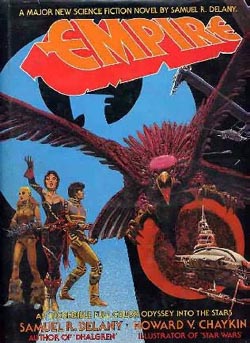
Empire

Empire

By Samuel R .Delaney, illustrated by Howard Chaykin (Berkley/Putnam)
SBN: 399-12245-1

There was a time when Howard Chaykin was about more than lewdness, and potty-mouthed confrontation (not that I’m opposed in any way to those highly entertaining facets of his work): Once he was the darling of the swashbuckling science fiction crowd, both in comics like Monark Starstalker (Marvel) or his own Cody Starbuck, and in the superb paperback covers he produced. In 1976, before he began adapting Star Wars for Marvel, he started a project for Byron Priess Visual Publications with acclaimed author Samuel R .Delaney. It took nearly three years but when it was released Empire was an instant classic and a genuine contender for the title “First Graphic Novel”.

Vast, lush and expansive, this is the story of Wyrn, a young archaeologist who becomes embroiled in a race to recover the separated segments of an artefact that will bring down the dictatorship of the Information-Barons of the Kūndūke. Seduced as much by the charismatic rebel leader Qrelon as by the thirst for adventure and knowledge, the search takes him across the universe and into the heart of corruption in a non-stop thrill-ride of fantastic, exotic adventure.

Perhaps a little simplistic by modern standards, this high-speed, high-concept romp is magnificently illustrated in an engagingly painterly manner whilst Delaney’s poetic style creates a seductive blend of action and political thriller richly steeped in technological philosophy. Whilst the elements of young rebels and sprawling evil dictatorships has now become common currency, the sheer style of this book keeps it a high point of the genre and a worthwhile read for any fan.

© 1978 Byron Preiss Visual Publications Inc. All Rights Reserved.

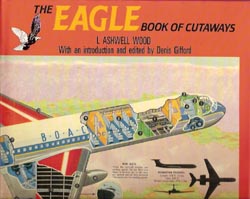
The Eagle Book of Cutaways

The Eagle Book of Cutaways

By L Ashwell Wood, edited by Denis Gifford (Webb & Bower)
ISBN: 0-86350-285-7

It seems inconceivable today, but one of the most popular features in the most popular comic of the 1950’s wasn’t a comic strip at all. When Eagle launched on April 14th 1950, it was a black and white, tabloid-sized periodical, combining strip and prose on good paper with a fuller-than-full-colour front, back and inner cover. The same high quality photo-gravure was used on the centre sheet; four more glorious colour pages for drab, grey, austere post-war Britain.

Across the very centre of those was a painted spread depicting ‘The New Gas Turbine-Electric Locomotive – The 18000’. That was a magnificent train with the engine and operating system exposed, pertinent points numbered and an explanatory block of text explaining all the details. Boys (and, I’m sure, girls) and their dads were transfixed and continued so for the next nine hundred and ninety issues. Each week a new technological marvel of the Space Age and an emergent Modern World would be painted in mind-boggling detail and breezy efficient clarity to captivate and fascinate the readers.

Most of them were crafted by the marvellous L Ashwell Wood (of whom precious little is known; for what there is you should go to Steve Holland’s wonderful and informative Bear Alley website) and although not a new concept, they have become part of the shared psyche of British comic fandom. Ever since then, the fascinating allure of cutaway drawings has bewitched readers, from TV21 to 2000AD and every comic in between.

This grand book reproduces 46 of the very best, from that aforementioned wonder of the rails through other trains and boats and planes and even to that Marvel of a future Age, Dan Dare’s rocket-ship Anastasia (originally revealed on February 7th 1958). This book commands some pretty terrifying prices – and even though I’m prepared to say that it’s worth it, the best solution would be for some enterprising history or popular culture publisher to get the thing back into print immediately – if not sooner.

Illustrations © 1988 Fleetway Publications/Syndication International. All Rights Reserved.